
Kev Qwen3.5 Decision Models for AI Voice Workflows



Explore Kev Qwen3.5 decision models, their possible role in voice-agent routing, and a cautious framework for testing accuracy, confidence and deployment.
Kev Qwen3.5 Decision Models for AI Voice Workflows
What if the most useful model in a voice-agent workflow isn’t the one that talks, but the small one that decides what should happen next? Kev Qwen3.5 decision models put that question into practice: they are small, locally runnable decision models built on Qwen3.5, designed to return typed probability decisions rather than handle every part of a conversation. The distinction matters when a voice agent must choose between answering, asking a clarifying question, invoking a tool, or handing the call to a person.
The timing is practical, not just experimental. Voice systems combine speech recognition, language models, tools and telephony, and every extra step can affect cost, responsiveness and reliability. As of September 2026, CallMissed’s developer AI API lists 25 realtime voice-agent models and 45 speech-to-text models—a snapshot of how many components developers may need to coordinate in a modern workflow. A decision model offers another possible building block: route a narrow, well-defined choice to a smaller model, while reserving a larger conversational model for tasks that need richer language understanding.
Kev’s GitHub project describes a family of Jev-like models built on Qwen3.5 that developers can run using pretrained weights or train themselves. That makes the project interesting for teams seeking more control over where a decision runs and how it is adapted. But “confidence” should not be treated as a guarantee. DEV Community’s coverage notes that evaluation audits challenge the idea that Jev-like confidence is universally calibrated; in other words, a probability score still needs testing against the decisions and data a team actually uses.
This article explores where a tiny decision model can fit in an AI voice-agent workflow—and where it should not. We’ll look at routing and tool selection, how to design a useful boundary between a decision model and a conversational model, and what to measure before trusting a score in a live call. We’ll also consider trade-offs such as local control versus operational complexity, and why fallback paths and human handoff matter when a model is uncertain. Platforms such as CallMissed, with APIs that support function calling and caller-chosen fallback models, reflect the broader shift toward composing voice systems from specialized components rather than relying on one model for everything.
Where do Kev Qwen3.5 decision models fit in an AI voice-agent workflow?
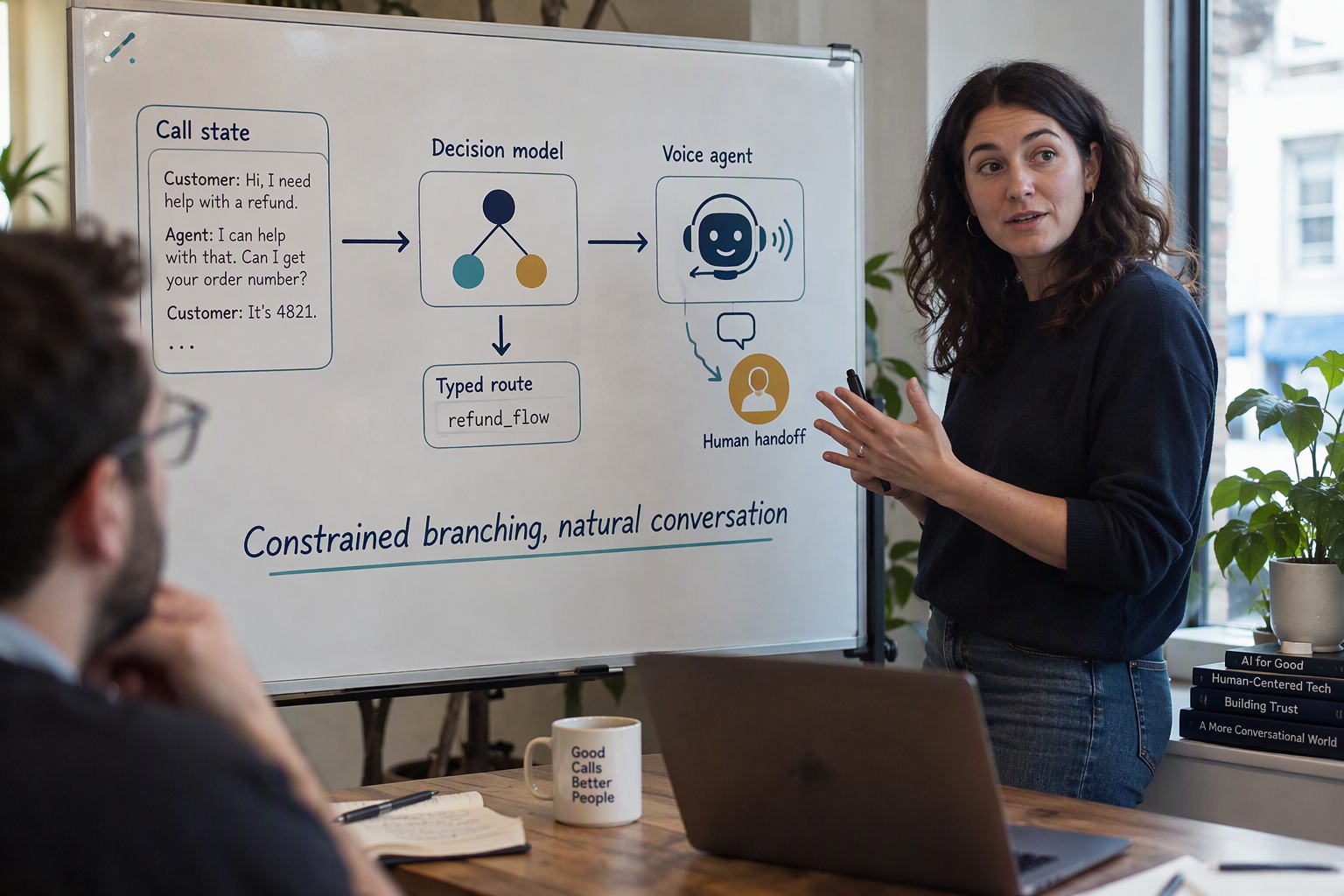
Kev Qwen3.5 decision models fit between speech recognition and the action a voice agent takes: they can classify a clear, bounded situation and recommend what should happen next, while a conversational model handles open-ended dialogue. The useful design is not “small model instead of large model,” but a deliberate division of responsibility with explicit rules for uncertain cases.
Which decisions should a tiny model handle?
Kev’s GitHub project describes small, Jev-like decision models built on Qwen3.5 that developers can run using pretrained weights or train themselves. That makes Kev a candidate for repeated choices with a limited set of outcomes—not a general-purpose replacement for the model that speaks to a caller.
For example, after speech recognition produces “I need to change my delivery address,” a voice workflow might ask Kev to choose among answer from the knowledge base, invoke an address-update tool, ask a clarifying question, or send the caller to a person. The decision model need not compose a polished explanation or perform the account update. A separate language model can phrase the response, and a tool or human can carry out the action.
Good candidates share a few traits:
- Bounded choices: the possible next steps can be named in advance.
- Observable inputs: the decision can be made from the current transcript and relevant conversation state.
- Defined consequences: each choice maps to a known workflow action.
- A safe fallback: uncertainty can trigger clarification or human handoff.
How should Kev fit into the call flow?
Treat the model’s output as a recommendation that passes through a policy layer—not as permission to execute anything. A practical sequence is:
- Speech recognition converts the caller’s words into text.
- The workflow supplies the decision model with a compact, relevant context, such as the latest utterance and whether a required customer detail is already available.
- The model returns a typed decision and probability information.
- Application rules check that the choice is allowed in the current state.
- The workflow calls the selected tool, asks a follow-up question, or routes the conversation to a human.
This separation limits the blast radius of a mistaken classification. For instance, a model may recommend a refund-related tool, but the application can still require order verification and enforce eligibility rules before any account change occurs. The voice agent’s conversational model remains responsible for explaining what happens next in language the caller can understand.
What should teams test before trusting a decision?
A probability is useful only when it helps the workflow behave more safely on real calls. DEV Community’s coverage of Kev notes that evaluation audits challenge universal calibration claims, so teams should test confidence against their own labeled examples rather than assume a particular score means the same thing across tasks.
Start with a small evaluation set that includes routine requests, ambiguous speech, code-mixed phrasing, missing information, and cases that require human help. Then measure outcomes that matter operationally:
- Whether the selected action matches the reviewed label.
- How often the system asks for clarification when it should.
- How often it routes to a person—and how often it fails to do so when needed.
- Whether performance changes across languages, accents, and noisy transcripts.
- Whether a fallback activates when the output is malformed or below a chosen threshold.
The central engineering choice is the boundary: let Kev make narrow decisions where a compact, testable output helps, and keep language generation, policy enforcement, and consequential actions in components designed for those jobs.
What are Kev and Jev-like decision models, and what is known about the model lineup?

Kev is described as a family of small, Jev-like decision models built on Qwen3.5, with pretrained weights available and the option to train models yourself. The public descriptions establish the project’s purpose and broad lineage, but do not specify a complete lineup of named variants, parameter counts, or comparative benchmarks.
What does “Jev-like” mean?
“Jev-like” refers to a decision-oriented approach: rather than generating a full conversational answer, a model returns typed probability decisions that can inform a defined next step. The Kev GitHub project says its architecture is based on the approach described in Jev’s Architecture Unmasked.
That distinction is useful when a voice workflow needs a compact, structured signal—for example, whether a caller’s request matches one of a known set of intents. The model’s output can then feed an application rule or another model. It should not be mistaken for a complete voice agent: the GitHub description presents Kev as a decision-model family, not as a speech-recognition, telephony, or conversation platform.
What is known about Kev’s model lineup?
As of September 2026, the available GitHub descriptions identify Kev as a family of small models based on Qwen3.5 and describe two ways to use the project: start from pretrained weights or train your own. The source excerpts do not provide model names, parameter sizes, supported hardware, release dates for individual variants, or task-specific scores. Without those details, it is not possible to make a grounded comparison between supposed “small,” “large,” or specialized Kev versions.
The search results also show several GitHub repositories describing a Kev project, including repositories under different account names. Their descriptions are similar, but the excerpts do not establish whether these are official releases, mirrors, or forks, or whether they contain different model versions. Developers should check a repository’s ownership, release history, model files, and license before treating any copy as the canonical source.
For now, the clearest way to describe the lineup is by what the project says it supports:
- Pretrained use: the project says pretrained weights are available.
- Custom training: developers can train models themselves.
- Decision-focused output: the family is described as producing typed probability decisions.
- Qwen3.5 foundation: the project identifies Qwen3.5 as its base.
These are project-level claims, not evidence that every variant has the same capabilities or performance.
What should teams verify before choosing a model?
Treat “tiny” as a design description, not a benchmark. Before connecting a Kev model to a live voice workflow, confirm the exact checkpoint and test it on representative inputs, including ambiguous requests, noisy transcripts, and cases outside the intended decision categories. Record how often it selects the right action and how its probability outputs behave on both correct and incorrect decisions.
DEV Community’s coverage of Kev and Jev-like models reports that evaluation audits challenge claims of universal confidence calibration. That matters for model selection: a probability score should not automatically be treated as a dependable confidence measure across tasks. Set application-specific thresholds, define what happens when the model is uncertain, and keep a safe route to clarification or human review.
What developments and claims should readers compare?
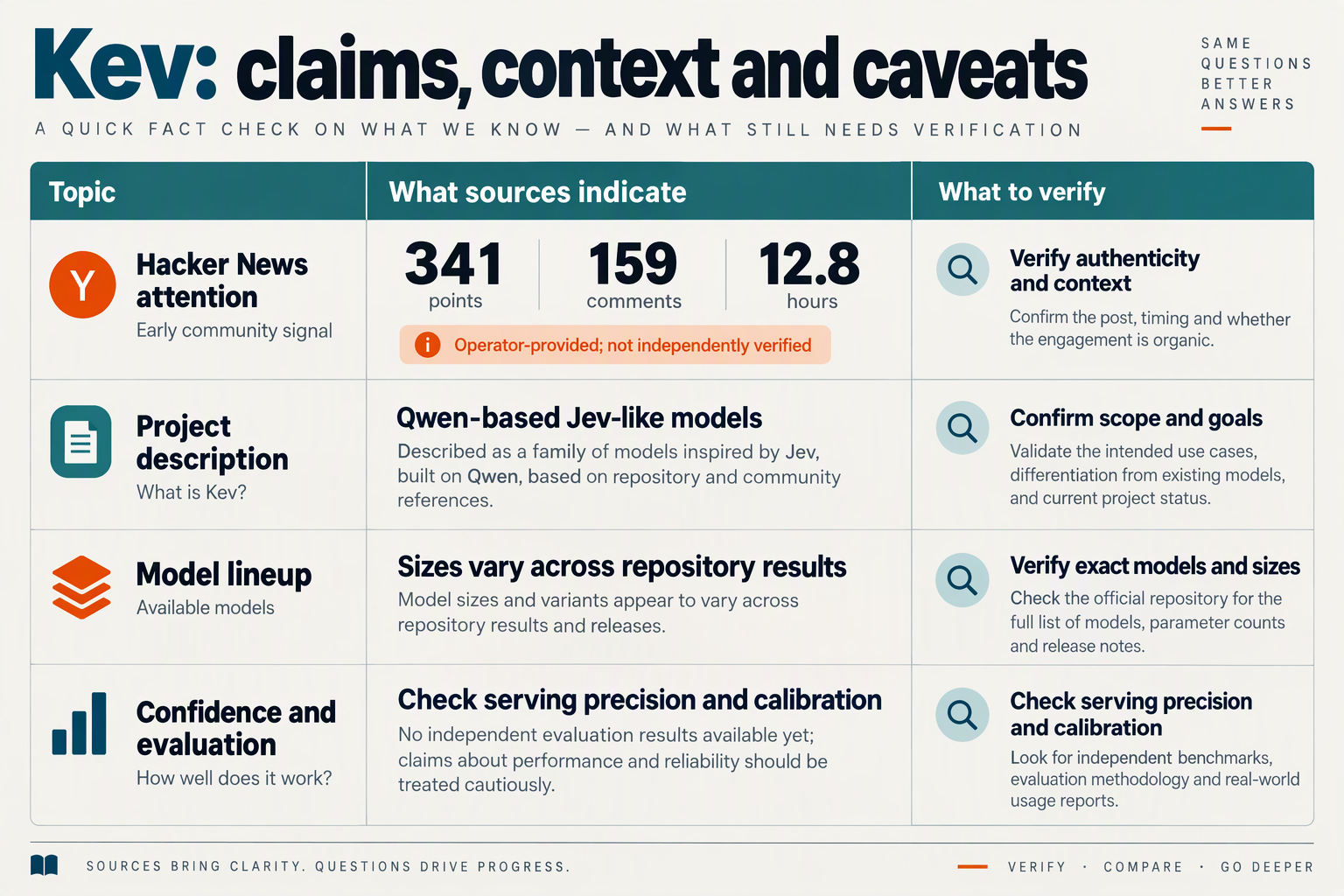
Kev should be compared with conversational models on decision quality, calibration, and deployment control, not on conversational fluency alone. As of September 2026, the available project descriptions establish that Kev is a small, Qwen3.5-based family developers can run with pretrained weights or train themselves; they do not provide a comparable benchmark score or latency figure.
What does Kev claim to do, and what is documented?
| Comparison area | What the sources say | What readers should verify |
|---|---|---|
| Model purpose | Kev’s GitHub project describes small, Jev-like models for typed probability decisions. | Whether the model handles the specific routing choices in your call flow. |
| Architecture | The project says Kev is built on Qwen3.5 and follows the architecture described in Jev’s Architecture Unmasked. | Which model variant, configuration, and training setup produced a result. |
| Availability | The GitHub description says developers can use pretrained weights or train their own. | Whether the weights, dependencies, and deployment path fit your environment. |
| Confidence claims | DEV Community reports that evaluation audits challenge universal calibration claims for Jev-like confidence scores. | Whether probabilities match observed outcomes on your own data and decision classes. |
| Voice-agent role | A bounded decision can route a call toward an answer, clarification, tool, or person; open-ended dialogue may still need a conversational model. | Whether the handoff rules cover ambiguity, missing information, and high-impact actions. |
| Performance evidence | The provided project descriptions do not state a comparable accuracy, calibration, or latency benchmark. | Results from a reproducible evaluation against a baseline on representative calls. |
The key distinction is between a probability-shaped output and a probability that is reliable enough to drive an action. DEV Community’s coverage is a useful counterweight to broad claims: confidence should be audited, not presumed calibrated across tasks or datasets. The available context does not give a numeric audit result, so readers should avoid turning that caution into a claim that every Kev model fails—or that every score is trustworthy.
Which evidence matters before using a decision model on calls?
Evaluate the model on the decisions it will actually make, rather than relying on a general-purpose benchmark. A practical test set should include ordinary calls as well as noisy speech, code-mixed language, unclear intent, and cases where the correct action is to defer. Keep the test examples separate from the data used to train or tune the model.
Compare at least these measures:
- Decision accuracy: How often does the model choose the correct route for each class?
- Calibration: Among decisions assigned similar confidence, how often are they correct?
- Deferral behavior: Does the system ask for clarification or hand off when evidence is weak?
- End-to-end impact: Does routing reduce unnecessary model or tool calls without increasing caller effort or incorrect actions?
For a live workflow, test the whole chain—including speech recognition, the decision step, tools, and fallback—not just Kev in isolation. Platforms such as CallMissed provide call recordings, transcripts, and call scoring against a team’s own QA rubrics, capabilities that can support review of real call outcomes; they do not, by themselves, establish that a decision model is calibrated.
A sensible comparison therefore asks what is documented, what is measured, and what remains untested. Kev’s local weights and trainable approach are meaningful control options, while operational trust still depends on task-specific evaluation and safe behavior when the model is uncertain.
How could a decision model handle bounded choices without taking over the conversation?
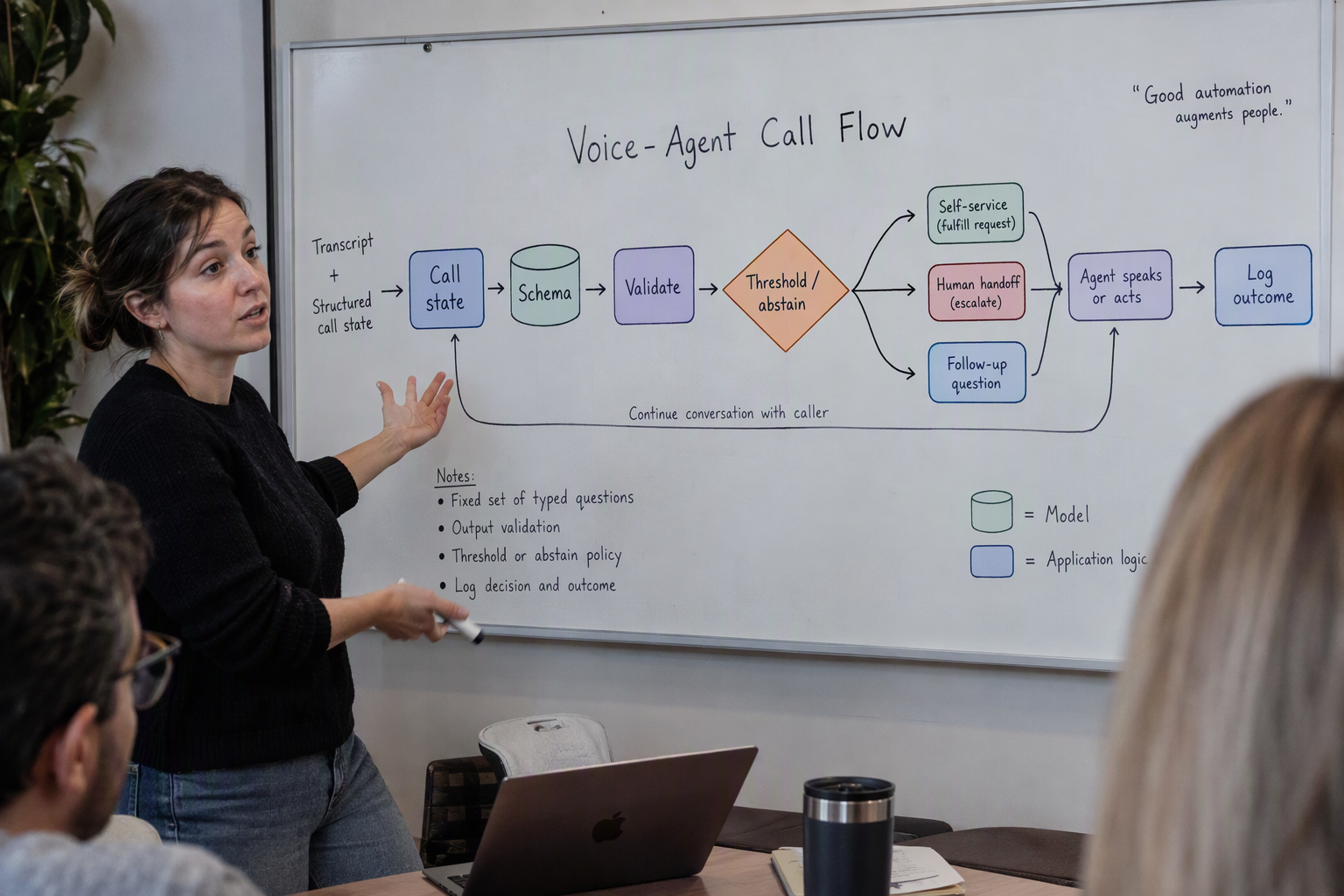
A decision model can handle bounded choices by returning a typed recommendation—such as answer, clarify, call a tool, or hand off—while a conversational model continues speaking with the caller. The key is to treat the recommendation as input to an explicit policy, not as permission for Kev Qwen3.5 to control the whole conversation.
What makes a choice “bounded” in a voice workflow?
A choice is bounded when the system defines a small set of valid outcomes and the evidence needed to select among them. For example, after a caller asks to reschedule an appointment, the decision layer might choose whether the request is clear enough to check availability, needs one clarification, or should go to a person. It should not invent a new action or compose the full response.
Kev’s GitHub project describes small decision models built on Qwen3.5 that return typed probability decisions and can be run using pretrained weights or trained by developers. That format suggests a useful separation: the decision model proposes a structured next step; the dialogue model turns that step into natural language and manages the caller’s broader intent.
A practical boundary might look like this:
- Define allowed actions. Use a short, stable list such as
answer,clarify,tool_lookup, andhuman_handoff. - Provide relevant evidence. Pass a concise transcript summary, recognized intent, and any necessary state—not an unrestricted instruction to run the call.
- Validate the output. Reject an unknown label or malformed response rather than letting it trigger an action.
- Apply policy outside the model. Require confirmation before consequential actions, and route ambiguous or sensitive cases to clarification or a person.
- Let the conversational model speak. It can explain the next step, ask a focused question, or relay a tool result in context.
How can the model avoid taking over?
Keep the decision model’s job narrow and make the surrounding system authoritative. For instance, a low-confidence recommendation should not silently authorize a payment, cancel an order, or end a call. The workflow can instead ask the caller to confirm, retry with a conversational model, or offer a human handoff.
This distinction matters because a probability is not automatically a reliable measure of certainty. DEV Community’s coverage of Kev notes that evaluation audits challenge claims of universal calibration for Jev-like confidence. Teams should therefore test probabilities against labeled examples from their own calls, including accents, code-mixed speech, interruptions, and noisy transcripts where relevant. Measure not only overall accuracy but also the cost of each mistake: a needless clarification is inconvenient; an incorrect high-impact action may be unacceptable.
Where does this fit in a production stack?
Treat Kev as a decision component, not a standalone voice agent. Speech recognition supplies text, the decision layer selects among permitted next steps, and the conversation or tool layer carries them out under policy. Log the input, proposed action, probability, policy outcome, and eventual result so teams can audit errors and update thresholds.
As of September 2026, CallMissed’s developer AI API supports function calling and caller-chosen fallback models, capabilities that can help developers compose specialized steps and define fallback behavior. That does not mean Kev is automatically integrated; it illustrates the broader workflow pattern: keep model decisions bounded, actions validated, and the conversation responsive to the caller.
What operational safeguards and evaluation tests matter before production?
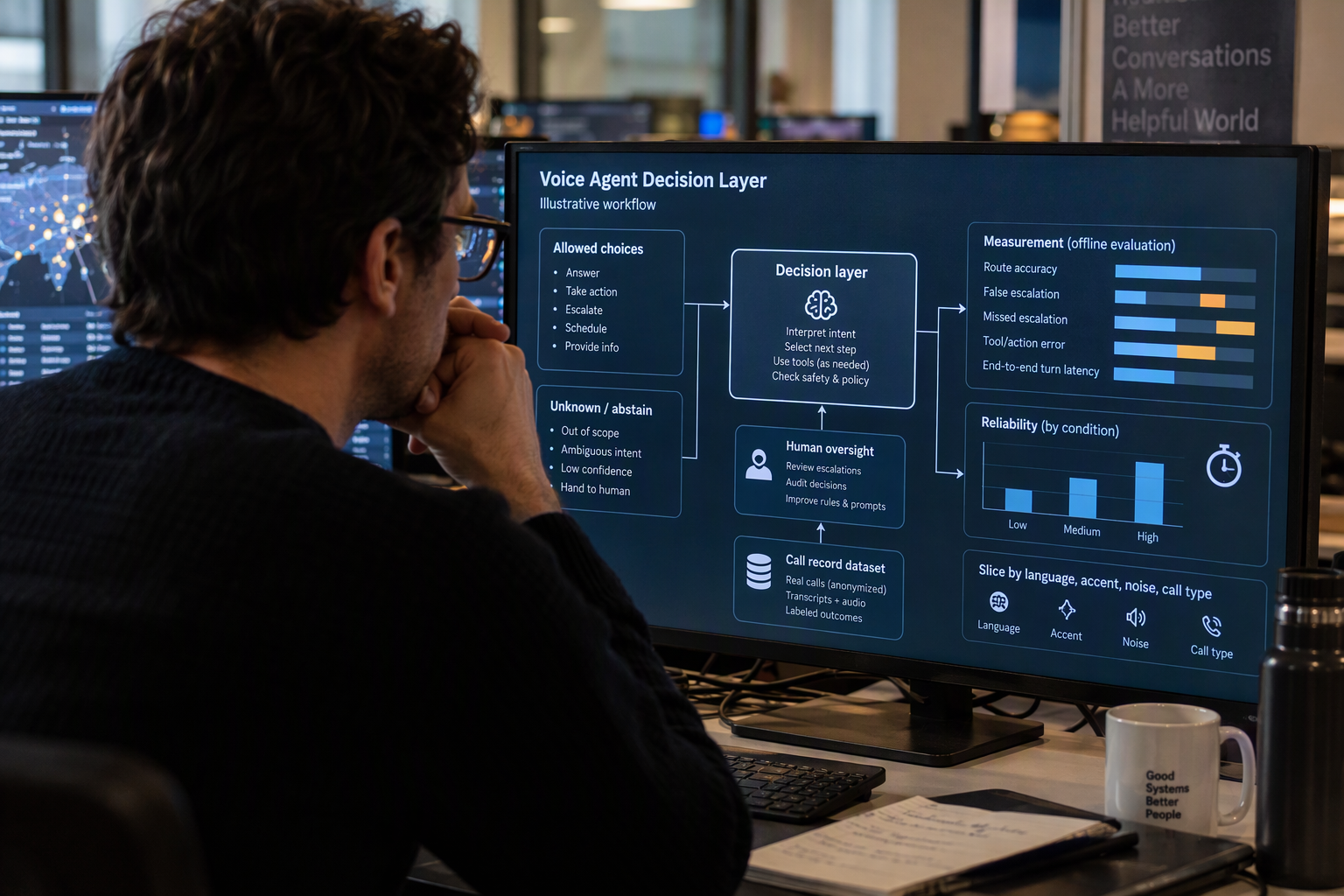
Before a Kev Qwen3.5 decision model influences a live voice-agent action, teams should validate its outputs, define an explicit “uncertain” path, and test performance on realistic and difficult calls. A probability is a signal to evaluate—not proof that the model is right or reliably calibrated.
How should teams constrain a decision model in production?
Treat Kev’s output as a recommendation within a controlled workflow, not as permission to take any action. Kev’s GitHub project describes small decision models built on Qwen3.5 that developers can run using pretrained weights or train themselves; that flexibility makes versioning the model, training data, prompt or input format, and decision policy important operational safeguards.
Before connecting a decision to a tool or call action:
- Validate the output contract. Reject malformed responses, missing fields, unknown labels, and probability values outside the expected range. Route invalid output to a safe fallback.
- Set action-specific confidence rules. A low-risk choice, such as selecting a FAQ lookup, may tolerate a different threshold from a choice that changes an account or ends a call. Do not use one confidence cutoff for every action.
- Provide an abstention route. When the score is low, the inputs conflict, or the request falls outside the model’s tested scope, ask a clarifying question, defer to a conversational model, or hand off to a person.
- Limit tool permissions. Map each allowed decision to a small set of approved tools and parameters. Keep consequential actions behind confirmation or human review where appropriate.
- Log enough to investigate. Record the model version, input features, returned label and score, chosen action, fallback, and eventual outcome—subject to privacy and retention requirements.
These controls also make rollback practical: if a new model or policy changes routing behavior, operators can identify the change and restore a known-good version.
Which evaluation tests reveal whether the model is safe to trust?
Start with a labeled test set that reflects the real decision boundary, including ambiguous calls and examples where the correct action is to abstain. The DEV Community coverage of Kev notes that evaluation audits challenge the assumption that Jev-like confidence is universally calibrated. That is why teams should assess both decision accuracy and whether confidence scores correspond to observed correctness.
A useful pre-production test plan includes:
- Confusion-matrix review: Measure false tool calls, missed escalations, unnecessary handoffs, and incorrect answers separately. Overall accuracy can hide a costly failure in a less frequent category.
- Calibration checks: Group predictions by confidence range and compare stated confidence with actual accuracy; track a metric such as Brier score or expected calibration error over a held-out set.
- Slice testing: Compare results across accents, code-mixed speech, noisy audio, language, caller intent, and incomplete transcripts. A strong aggregate score can conceal a weak subgroup.
- Robustness tests: Add transcription errors, interruptions, paraphrases, missing context, and adversarial or out-of-scope requests. Confirm that uncertainty triggers the intended fallback.
- End-to-end call simulations: Verify that the selected action executes correctly, that failures do not silently continue, and that escalation reaches the right human queue.
Only after offline tests should teams consider a limited shadow or staged rollout, comparing decisions with the existing workflow before expanding use. As of September 2026, CallMissed’s developer AI API supports function calling and caller-chosen fallback models—capabilities that illustrate how decision logic can be paired with explicit alternatives rather than treated as a standalone answer.
What do the project sources and independent coverage actually support?
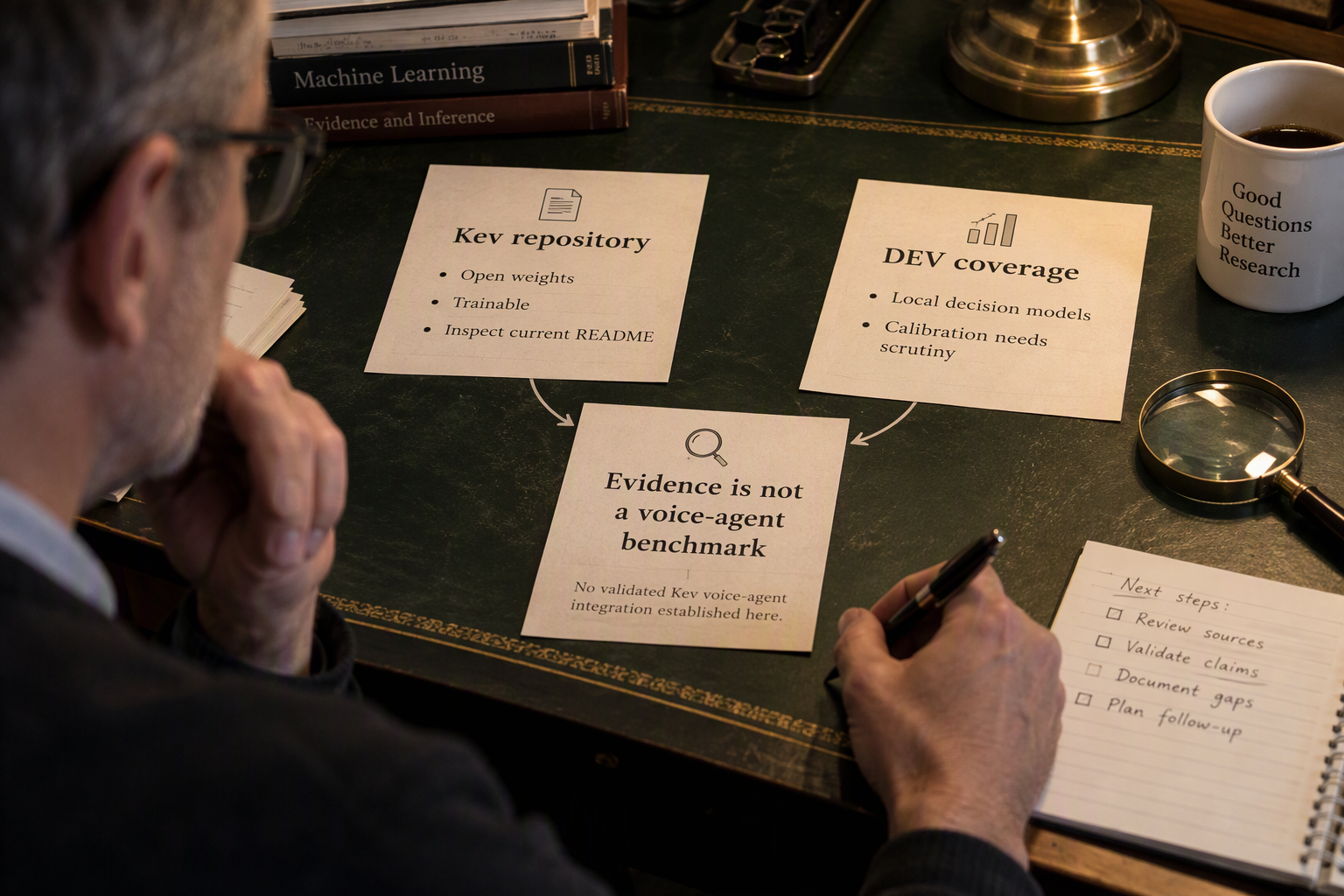
The project sources support a narrow claim: Kev is presented as a family of small, Qwen3.5-based decision models that developers can run with pretrained weights or train themselves. They do not, by themselves, establish that Kev’s probability scores are calibrated or that the models improve live voice-agent performance.
What does Kev’s GitHub project establish?
Kev’s GitHub repository describes the project as a “tiny Jev-like family of decision models” built on Qwen3.5, based on an architecture described in Jev’s Architecture Unmasked. It says developers can use pretrained weights or train their own. That supports the project’s intended role and its local-use and customization options.
Those descriptions are not equivalent to independent evidence of quality. The available project information does not establish a benchmark score, decision accuracy, calibration performance, inference speed, or voice-call outcome. Nor does “small” alone tell a deployment team what hardware a particular configuration needs. Those details require tests or documentation specific to the model version and use case.
What does independent coverage add?
DEV Community’s coverage presents Kev as an open, local alternative to a hosted decision interface and highlights a significant caveat: evaluation audits challenge the idea that Jev-like confidence is universally calibrated. The coverage therefore supports treating confidence values as something to validate—not as a general guarantee that a model knows when it is right.
The context available here does not provide audit sample sizes, numerical results, or a breakdown by task. It would be misleading to turn that reporting into a precise failure rate or a claim that every Kev model is unreliable. The defensible takeaway is more measured: the project is a promising implementation direction, while claims about confidence need evidence tied to the specific model, data, and decisions being evaluated.
What should voice-agent teams verify before deployment?
For a voice agent, the practical question is not whether a model emits a probability, but whether its decisions are dependable enough for the action attached to them. A team considering Kev for call routing, clarification, or tool selection can test it with representative examples and compare its outputs with the current workflow.
A useful evaluation should include:
- Decision quality: How often does it choose the correct action for real, relevant call situations?
- Confidence behavior: Among decisions assigned similar confidence, how often are they actually correct?
- Boundary cases: What happens with noisy transcripts, code-switching, missing details, or requests outside the tested categories?
- Failure handling: Does low confidence trigger a clarifying question, a larger conversational model, or a human handoff?
A small model can be a sensible component when the decision is bounded and the fallback is explicit. CallMissed’s developer AI API supports function calling and caller-chosen fallback models, capabilities that can help teams compose such workflows; that does not imply Kev is available through CallMissed. As of September 2026, the evidence supports experimentation with Kev—not skipping evaluation before a decision affects a live caller.
How should teams decide whether to try Kev in their voice stack?
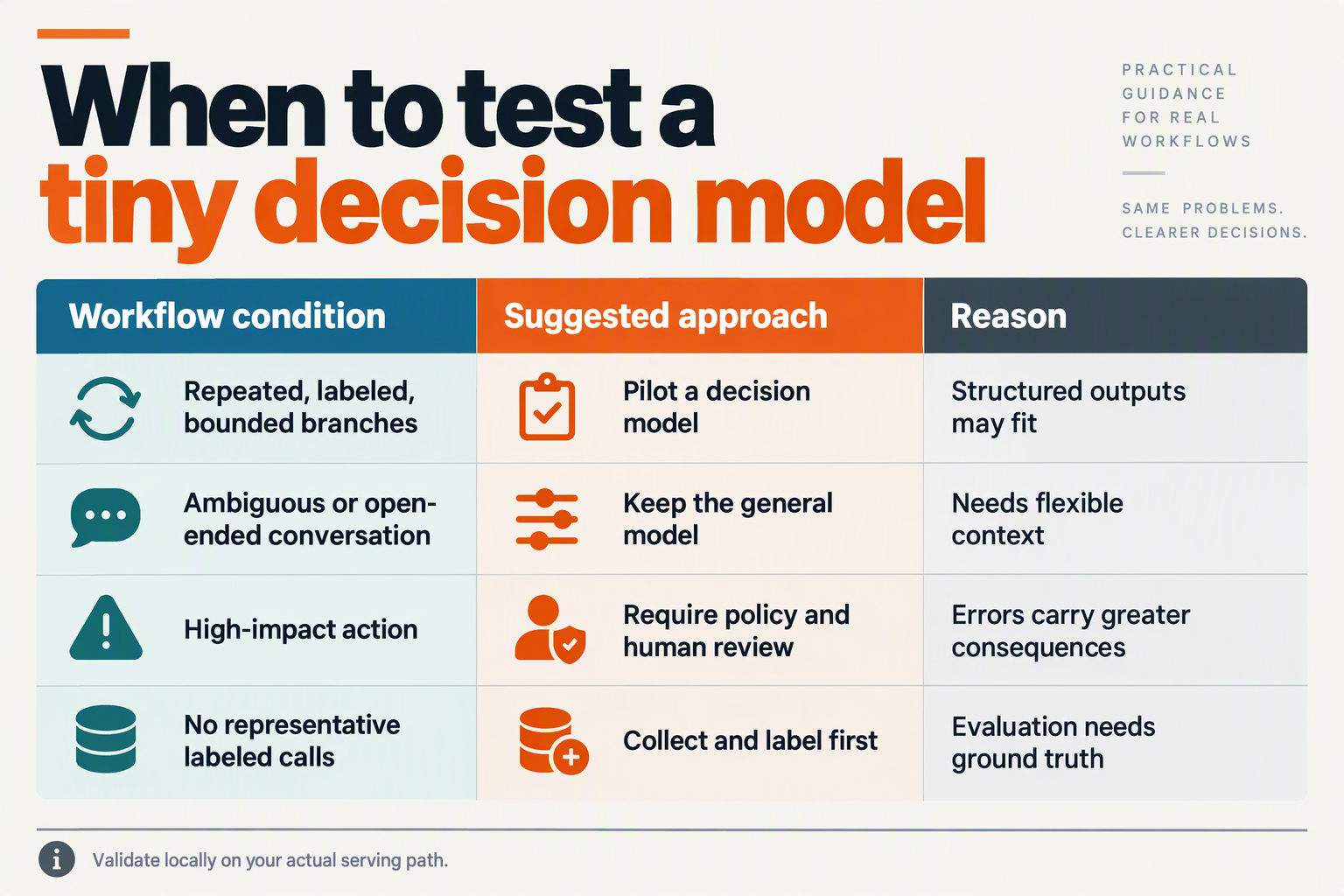
What evidence should teams require before adding Kev to a voice stack?
Teams should try Kev when they can define a narrow decision, test it against real call examples, and route uncertain or high-impact cases to a safer path. The Kev GitHub project describes small Qwen3.5-based decision models that developers can run with pretrained weights or train themselves; it does not, in the project details cited here, establish a universal accuracy or latency benchmark.
| Decision criterion | What to test | A reason to proceed | A reason to wait |
|---|---|---|---|
| Narrow task | Can Kev choose among a fixed set of actions, such as answer, clarify, use a tool, or hand off? | The choices and expected output are explicit. | The task requires open-ended conversation or broad interpretation. |
| Real call data | Evaluate examples from your domain, including transcription errors, interruptions, and code-mixed speech. | The model handles representative cases, not just clean prompts. | Results depend on idealized examples that differ from production calls. |
| Probability quality | Compare scores with actual outcomes; check how often high-confidence decisions are wrong. | Confidence thresholds support a useful, tested reject path. | A high score is being treated as a guarantee. |
| Operational fit | Measure end-to-end decision time and resource use in your intended deployment. | The measured trade-off fits your workflow and infrastructure. | The model adds operational complexity without a demonstrated benefit. |
| Failure handling | Simulate low-confidence, malformed, and unavailable-model cases. | The agent can ask a clarifying question, use another model, or hand off. | A failed decision can trigger an unsafe or irreversible action. |
Start with a shadow evaluation: have Kev produce decisions without controlling the live call, then compare its outputs with a human-reviewed reference set. For each action, track false positives and false negatives separately. Misrouting a routine question may be inconvenient; misclassifying a request that requires a person may carry a different level of risk.
The calibration question deserves particular attention. DEV Community’s coverage of Kev and Jev-like models reports that evaluation audits challenge the claim that confidence is universally calibrated. That means teams should test whether a score such as 0.9 corresponds to reliable outcomes on their own calls, rather than assuming that the number has the same meaning across tasks or datasets.
A practical pilot can follow four steps:
- Define the boundary: specify which decision Kev makes and which decisions remain with the conversational model or a human.
- Build a labeled test set: include common cases, ambiguous requests, and difficult audio-to-text examples.
- Set a reject rule: decide in advance when to clarify, fall back, or hand off.
- Compare in shadow mode: review errors and end-to-end behavior before allowing Kev to influence live actions.
As of September 2026, CallMissed’s developer AI API lists 25 realtime voice-agent models and supports caller-chosen fallback models. That is one example of a broader composable approach: teams can evaluate a specialized decision step while retaining a defined fallback path. Kev is worth a controlled trial when its task is bounded, its performance is measured on relevant calls, and uncertainty has an explicit destination—not simply because its scores look precise.
Frequently Asked Questions
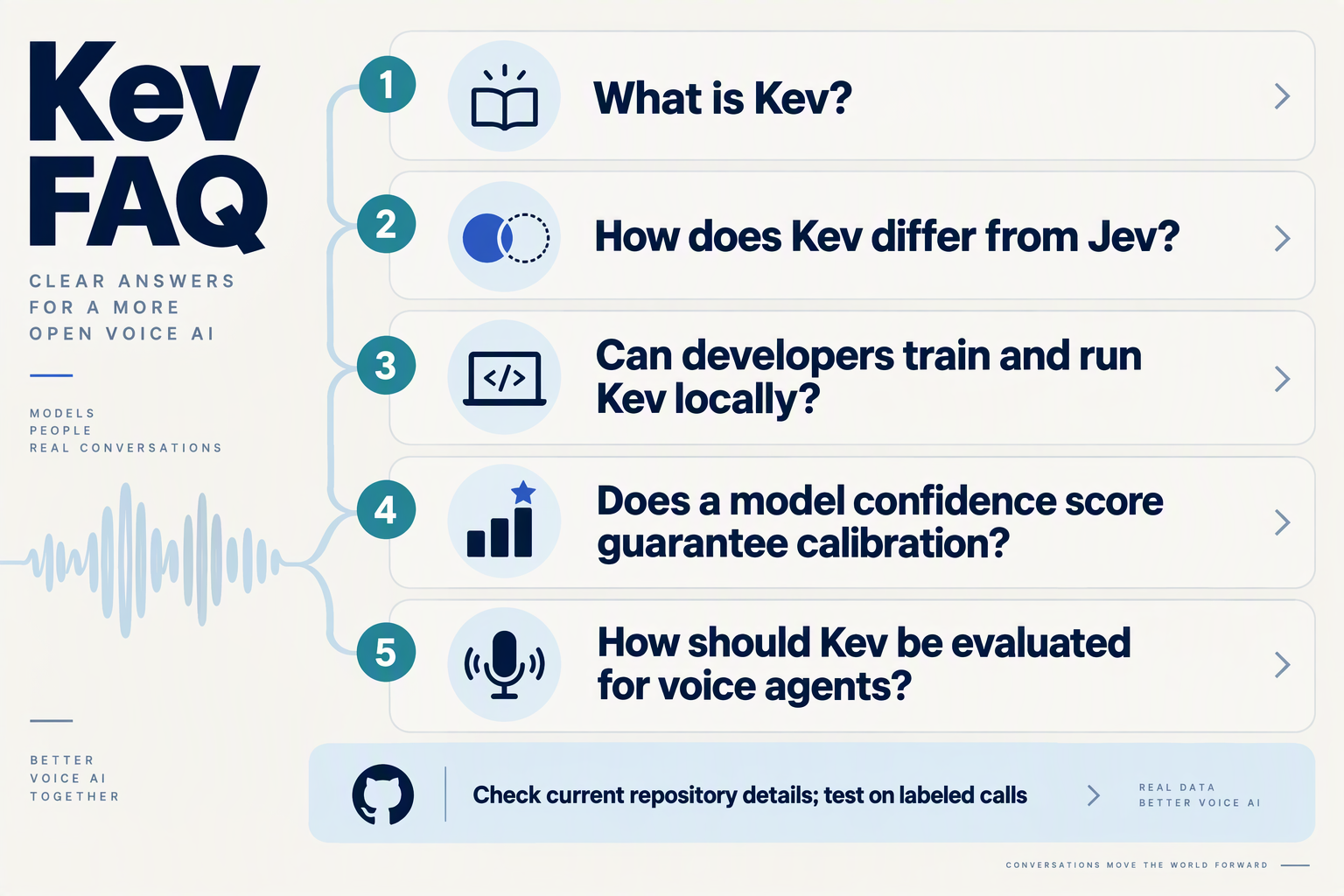
What are Kev Qwen3.5 decision models, and how do they differ from chatbots?
Can I run or train a Kev Qwen3.5 model locally?
How can Kev Qwen3.5 fit into an AI voice-agent workflow?
Are Kev Qwen3.5 probability scores reliably calibrated?
How should I set confidence thresholds for a tiny voice-agent decision model?
Does CallMissed support Kev Qwen3.5, and what API features can help with model orchestration?
Conclusion
Kev Qwen3.5 decision models are most useful when they make a narrow, well-defined choice—not when they are asked to replace the conversational model or manage an entire call. Their promise lies in giving voice-agent teams another component to test, tune and place within a workflow.
- Assign bounded decisions—such as whether to answer, clarify, use a tool or hand off—to a small decision model; leave open-ended dialogue to a conversational model.
- Treat probability scores as signals, not guarantees. Kev’s GitHub project offers pretrained weights and the option to train models, while DEV Community coverage notes that audits challenge claims of universal confidence calibration.
- Define safe boundaries. Test decisions on representative call data, set rules for uncertain outcomes, and preserve a fallback or human handoff.
- Evaluate the whole workflow. A model’s value depends on how its decision affects the next step, not on its score alone.
The next development to watch is whether evaluations make these models’ decision quality and calibration easier to verify across real voice workflows. As of September 2026, CallMissed’s developer AI API lists 25 realtime voice-agent models and 45 speech-to-text models—a snapshot of the specialized components teams may need to coordinate. Its function calling and caller-chosen fallback models reflect this move toward composable systems. To explore how AI communication is evolving, check out CallMissed. Which decisions in your voice workflow are narrow enough to delegate—and important enough to test carefully?
Related Reading
- Best AI Voice Agent for Small Businesses in 2026: Decision Matrix
- Hotel AI Receptionist 2026: Safe Voice, WhatsApp and Email Workflows
- Best Text-to-Speech API for Hindi in 2026: A Practical Decision Guide by Use Case, Voice Quality, and Cost
Sources
Discussion
Related Posts


Ready to automate customer conversations?
Launch AI voice agents and WhatsApp bots with CallMissed — one API, 22+ Indian languages.