
Hotel AI Receptionist 2026: Safe Voice, WhatsApp and Email Workflows


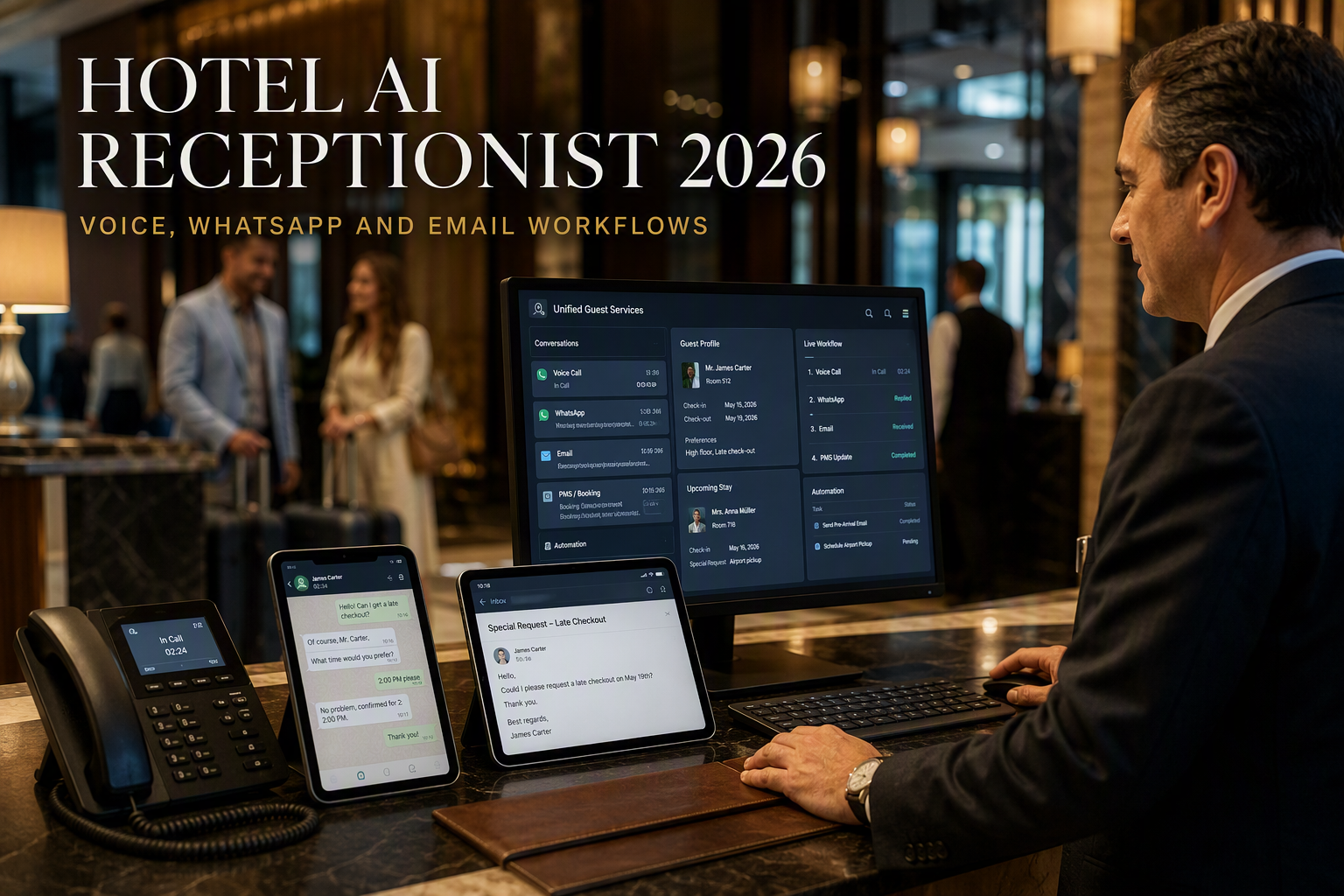
Learn how a hotel AI receptionist handles guest enquiries across channels with live verification, safe handoffs, testing and measurable KPIs.
Hotel AI Receptionist 2026: Safe Voice, WhatsApp and Email Workflows
What happens when a guest calls at 1:00 a.m., sends a WhatsApp message five minutes later and emails before breakfast—yet the front desk is handling an arrival? A hotel AI receptionist can maintain that conversation across channels, answer approved questions immediately and route sensitive or urgent cases to the right employee without pretending that automation replaces hospitality.
The timing matters. WhatsApp surpassed 3 billion monthly active users worldwide, according to Meta CEO Mark Zuckerberg during Meta’s April 2025 earnings call. Meanwhile, UN Tourism recorded 1.4 billion international tourist arrivals in 2024, equivalent to 99% of pre-pandemic levels. Hotels must therefore serve high enquiry volumes across phone, messaging and email while accommodating different languages, time zones and guest expectations.
In 2026, a well-designed hospitality AI voice agent can answer reservation enquiries, capture dates and occupancy requirements, explain amenities, provide directions and recover missed calls. Hotel WhatsApp automation can handle pre-arrival FAQs, send approved information and preserve a readable conversation history. Email agents can classify longer requests, draft policy-grounded replies and escalate messages requiring judgement. For properties serving regional and international audiences, multilingual support can also reduce the friction created when a guest and front-desk employee do not share a preferred language.
However, safe automation depends on a crucial distinction: an AI agent may manage the conversation, but it should not invent operational facts. Rates, room availability, taxes, cancellation terms, booking status and guest identity must be verified against live, authorised systems before being presented as confirmed. Modification and cancellation requests require policy checks, while payment-card details should remain inside PCI-compliant payment flows rather than prompts, transcripts or general-purpose inboxes. Complaints, accessibility needs, threats, medical situations and other emergencies need immediate human escalation.
This guide explains how to design hotel reservation call automation without creating a disconnected chatbot. It covers:
- Voice, WhatsApp and email workflows for enquiries and pre-arrival service
- Live property-management system, central reservation system and CRM verification
- Consent, privacy, retention and payment-data boundaries
- Multilingual testing, missed-call recovery and front-desk handoffs
- Phased rollout plans, implementation checks and measurable KPIs
Platforms such as CallMissed reflect this omnichannel direction by combining AI voice agents, WhatsApp chat and Business calling, email workflows, knowledge-base retrieval and support for 22 Indian languages.
The objective is not to automate every guest interaction. It is to resolve predictable requests safely, preserve context across channels and give hotel staff more time for situations where empathy, authority or physical assistance is essential—a principle also explored in the 2026 missed-call automation guide and multilingual AI voice-agent testing guide.
What should a hotel AI receptionist automate in 2026—and which decisions must stay with verified systems or hotel staff?
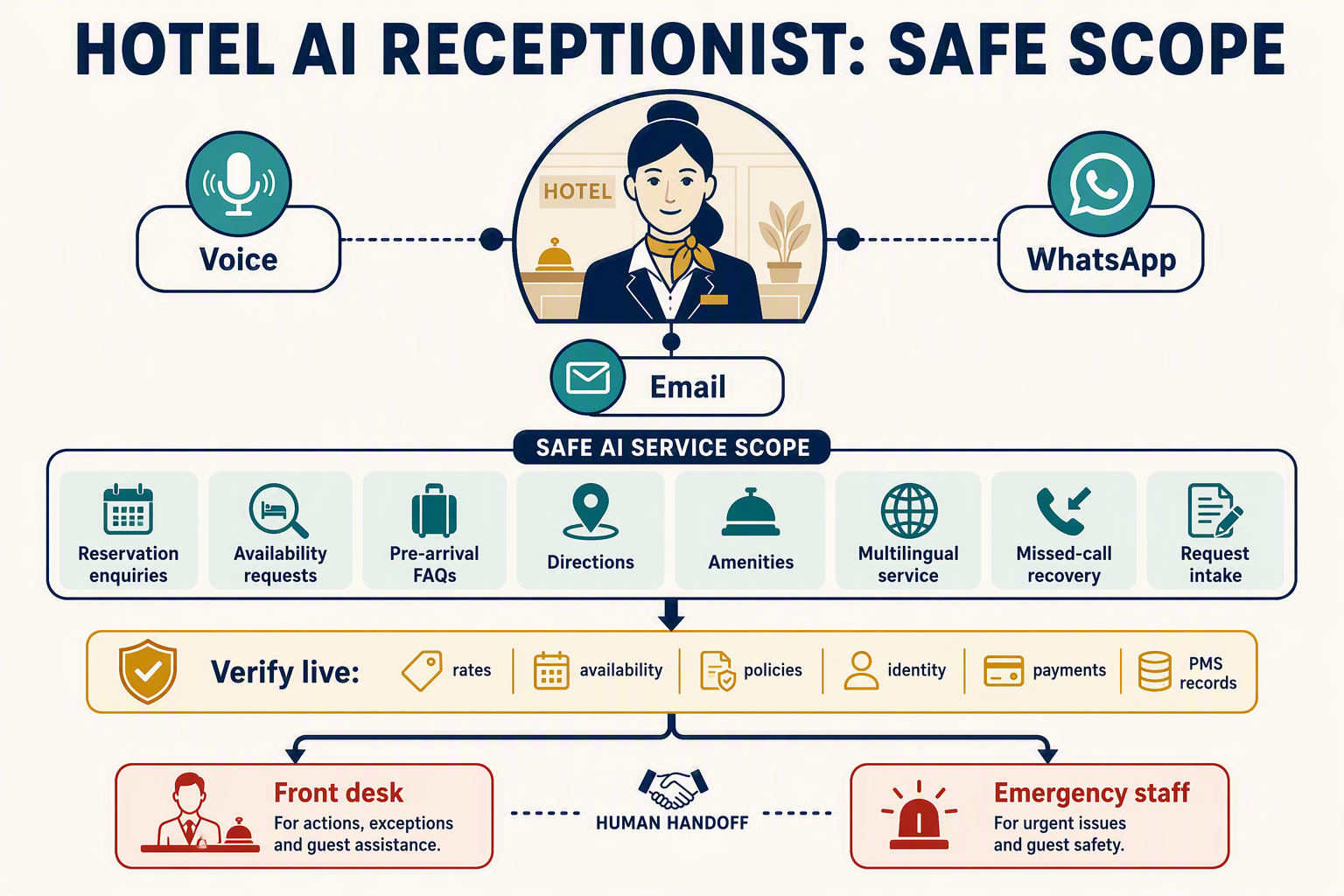
A hotel AI receptionist should automate high-volume, rules-based conversations, while live reservation systems and authorised hotel employees retain control over rates, room availability, identity, payments, safety and exceptions. The governing principle is simple: a hotel AI receptionist may communicate a verified decision, but it should not manufacture the decision itself.
Automate predictable, low-risk guest interactions
A hotel AI receptionist, hospitality AI voice agent, WhatsApp agent or email agent can independently handle a request when the answer comes from approved hotel content and does not create a binding transaction. Suitable workflows include:
- Capturing stay dates, guest count, room preferences and contact details
- Answering pre-arrival FAQs about check-in times, parking, Wi-Fi and amenities
- Providing approved directions, airport-transfer instructions and restaurant hours
- Detecting the guest’s preferred language and continuing in that language
- Classifying emails and drafting responses grounded in the hotel knowledge base
- Recovering missed calls through an approved callback or WhatsApp workflow
- Sending confirmation details retrieved from an authorised booking system
WhatsApp exceeded 3 billion monthly active users worldwide, according to Meta CEO Mark Zuckerberg during Meta’s April 2025 earnings call. Hotel WhatsApp automation should therefore be treated as an operational service channel—not merely a promotional chatbot—and should preserve context when a conversation moves to voice, email or the front desk.
Verify commercial and identity-sensitive answers live
A hotel AI receptionist can collect dates, preferences and booking questions, but definitive availability and pricing answers must come from the hotel’s property-management system (PMS), central reservation system (CRS), booking engine or approved channel manager. Hotel reservation call automation should retrieve, timestamp and clearly present:
- Live room inventory and occupancy restrictions
- Current rate plans, taxes, fees and inclusions
- Minimum-stay rules and eligibility conditions
- Deposit, cancellation and no-show policies
- Existing reservation status and permitted modification options
The hotel AI receptionist must distinguish between an estimate and a confirmation. For example, “Rooms may be available from ₹8,000” is not equivalent to “A Deluxe King is confirmed at ₹8,000 including taxes.” If an authorised integration is unavailable, the safe response is to capture the request and escalate it—not rely on cached inventory, infer a rate or promise a room.
Before disclosing, modifying or cancelling a reservation, the workflow must apply the hotel’s approved identity-verification process. An email address, caller ID or WhatsApp profile alone may not prove that the requester is authorised. The hotel AI receptionist should disclose only the information permitted after successful verification and transfer uncertain cases to hotel staff.
Keep judgement, safety and exceptions with people
A hotel AI receptionist should hand off interactions involving discretion, distress or material consequences. The operational checklist should require staff review for:
- Modification and cancellation exceptions, including disputed deadlines or non-refundable rates
- Complaints and service recovery, especially refund, compensation or liability requests
- Accessibility requirements that need confirmation from operations staff
- Payment issues, charge disputes or requests to provide card information
- Identity-verification failures or suspected unauthorised access to a booking
- Threats, medical incidents, fire, violence or other emergencies
Emergency workflows should immediately direct guests to local emergency services and alert designated hotel personnel. A hotel AI receptionist must not diagnose an emergency, make safety assurances or leave the guest waiting in a general support queue.
Payment-card numbers, CVVs and sensitive authentication data must remain inside approved, PCI-compliant payment flows, not AI prompts, call transcripts or omnichannel inbox notes. The hotel AI receptionist may direct a guest to an authorised payment page or transfer them to trained staff, but it should not collect or repeat raw card details. For broader implementation patterns, hotels can adapt the verification and system-of-record principles in the AI receptionist CRM integration guide.
The safest operating model is a three-level decision ladder: let the hotel AI receptionist automate approved information, verify transactional facts through authorised systems, and escalate human judgement.
Why are hotels combining a hospitality AI voice agent with WhatsApp and email?
Hotels combine voice, WhatsApp and email because guests change channels as their needs evolve: voice provides immediate dialogue, WhatsApp supports convenient follow-up and email accommodates detailed or formal requests. A unified hotel AI receptionist preserves context across these interactions while directing confirmations, exceptions and emergencies to authorised systems or employees.
Each channel solves a different part of the guest journey
No single channel suits every situation. WhatsApp exceeded 3 billion monthly active users worldwide, according to Meta CEO Mark Zuckerberg during Meta’s April 2025 earnings call, but many guests still call when a request is urgent, complicated or easier to explain verbally.
- A hospitality AI voice agent can answer after-hours calls, collect stay dates and occupancy details, explain general amenities and transfer urgent matters.
- Hotel WhatsApp automation can continue a call with a map link, check-in instructions or a written summary that guests can revisit.
- An email agent can classify long-form enquiries, retrieve approved policy material and draft responses for employee review.
- A shared CRM or guest profile can prevent travellers from repeating names, booking references and requirements at every touchpoint.
This combination is particularly useful for multilingual service. A guest may speak Hindi during a call, request directions on WhatsApp in English and email a formal modification request later. The system should retain the operational context while storing language preference, consent and channel history appropriately.
Omnichannel automation closes service gaps
International travel volume makes continuous coverage an operational concern: UN Tourism recorded 1.4 billion international tourist arrivals in 2024, reaching 99% of the 2019 pre-pandemic level. Properties serving multiple time zones cannot assume every reservation enquiry will arrive during staffed front-desk hours.
A connected workflow can recover demand without making unsupported promises:
- A traveller calls after hours and asks about a family room.
- Hotel reservation call automation captures the dates, guest count and callback preference.
- The reservation system—not the language model—returns current inventory and rate conditions.
- With valid consent, WhatsApp sends the retrieved offer or a secure booking link.
- An email summary is generated when the guest needs an itemised quotation.
- A front-desk employee receives the complete transcript if the request involves an exception.
For a deeper workflow pattern, see the AI appointment booking guide for phone and WhatsApp.
The advantage is continuity, not unattended decision-making
Combining channels should create one controlled service layer, not three independent bots. Hotels need shared knowledge, conversation identifiers, escalation rules and live integrations with the property-management system, central reservation system and CRM.
The automation boundary should remain explicit:
- Live systems verify: availability, rates, taxes, booking status and cancellation terms.
- Secure processes handle: identity checks, payment links and cardholder data.
- Employees decide: discretionary refunds, policy exceptions, serious complaints and accessibility arrangements.
- Emergency staff receive: medical, safety, security or threat-related cases immediately.
Payment information deserves particular care. The PCI Security Standards Council published PCI DSS version 4.0.1 in June 2024, reinforcing the need to keep payment-card data inside authorised payment environments rather than AI prompts, call transcripts or general email inboxes.
The practical outcome is not “automation everywhere.” It is faster routine assistance, recoverable missed calls and better-prepared human handoffs across the channels guests already choose.
Which 2026 developments are changing hotel WhatsApp automation, voice and email service?
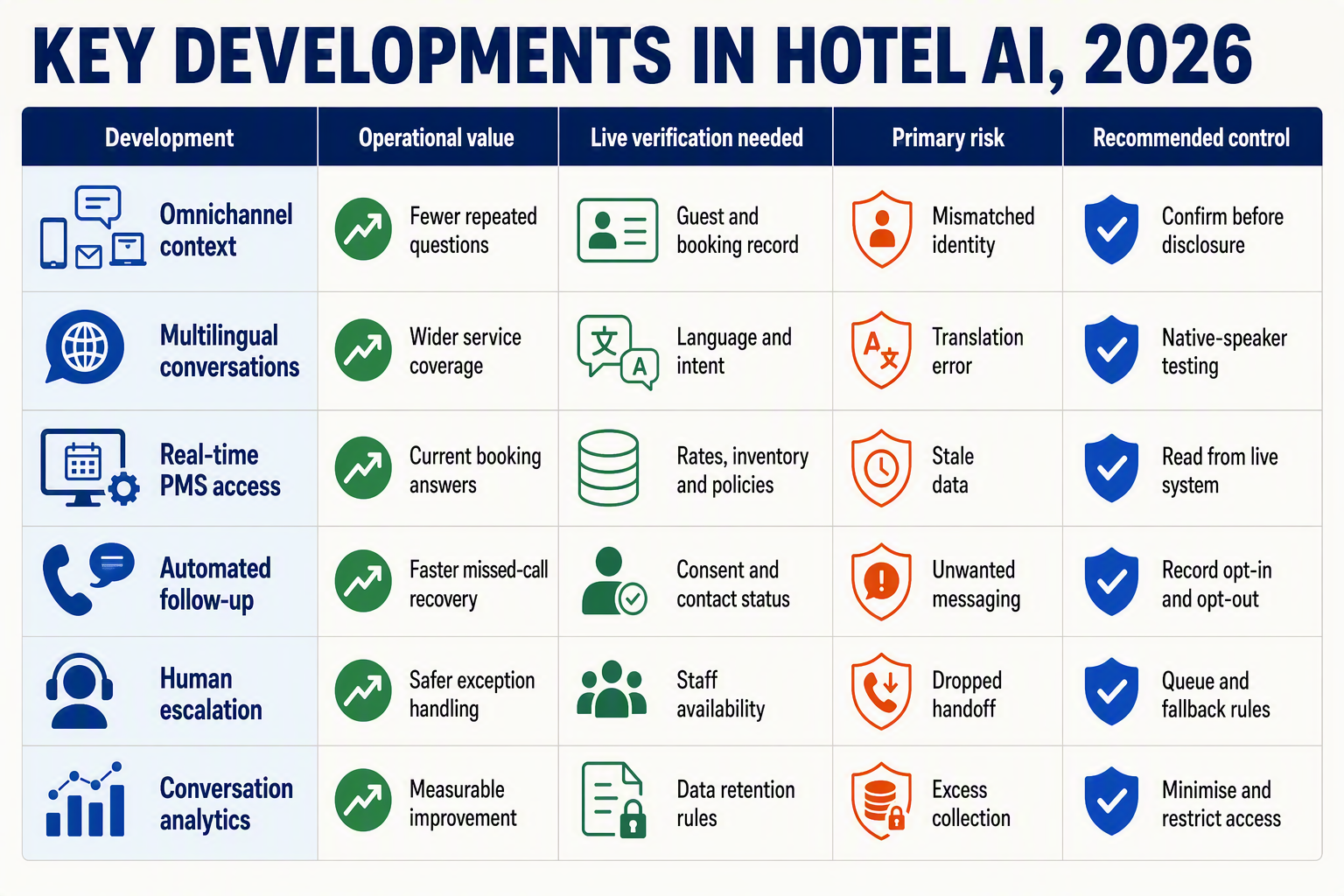
As of August 2026, hotel automation is shifting from isolated chatbots toward connected, multilingual agents that can speak, message, email and consult authorised hotel systems. The most important development is not simply better generative AI; it is the combination of real-time system access, cross-channel context and stricter controls over identity, payments and disclosure.
Six developments reshaping hotel service
| 2026 development | Hotel use case | Operational requirement | Main risk to control |
|---|---|---|---|
| WhatsApp Business calling | Guests call a hotel through WhatsApp for directions, reservation enquiries or pre-arrival assistance | Connect calling to an AI agent or front desk while retaining channel and guest context | Consent, call recording disclosure and urgent-case routing |
| Real-time voice agents | A hospitality AI voice agent answers routine calls, captures stay dates and recovers missed enquiries | Low-latency speech recognition, interruption handling and reliable human transfer | Invented availability, rates or booking confirmations |
| Tool-connected AI | A hotel AI receptionist checks inventory, retrieves a reservation or opens a service ticket | Permission-controlled connections to the property-management system, central reservation system and CRM | Excessive access, stale data and actions taken without confirmation |
| Multilingual Indic speech | Hotels serve guests in Hindi, Tamil, Bengali, Marathi and other preferred languages | Test accents, code-switching, names, dates, room types and noisy mobile audio | Translation errors affecting policies or reservation details |
| Agentic email processing | AI classifies group enquiries, drafts replies and extracts requested dates or amenities | Approved templates, policy-grounded retrieval and staff review for exceptions | Prompt injection, sensitive attachments and incorrect commitments |
| AI disclosure and governance | Automated systems identify themselves and preserve an auditable handoff record | Disclosure scripts, retention rules, access logs and escalation policies | Regulatory non-compliance or guests mistaking AI output for staff confirmation |
Why these changes matter operationally
WhatsApp is becoming a voice-and-messaging service surface rather than merely a chatbot channel. For hotel WhatsApp automation, that creates a continuous journey: a guest can message about airport distance, initiate a WhatsApp call for clarification and receive an approved follow-up without restarting the conversation. Platforms such as CallMissed can bridge inbound and business-initiated WhatsApp Business calls to an AI voice agent while supporting WhatsApp chat and an omnichannel inbox.
Three safeguards become especially important:
- Live verification: Rates, inventory, taxes, cancellation deadlines and booking status must come from authorised systems at response time.
- Explicit confirmation: The agent should repeat dates, guest count, room type and requested action before creating or modifying anything.
- Protected payments: Card data should move through a PCI-compliant hosted payment flow, not through an AI prompt, transcript or ordinary email reply.
Governance is also becoming a production requirement. The European Union’s AI Act Article 50 transparency obligations began applying on 2 August 2026, according to the European Commission’s implementation timeline. Hotels serving EU guests should therefore assess when callers or message recipients must be informed that they are interacting with AI.
Meanwhile, PCI DSS v4.0.1 future-dated requirements became effective on 31 March 2025, according to the PCI Security Standards Council. This reinforces a clear boundary for hotel reservation call automation: an agent may explain payment procedures or send a secure link, but it should not collect full card credentials in an unprotected conversation.
These developments make testing as important as model choice. Hotels should evaluate multilingual accuracy, system timeouts, duplicate bookings, interrupted calls and emergency handoffs before expanding automation beyond low-risk FAQs.
How should hotel reservation call automation work across voice, WhatsApp and email?
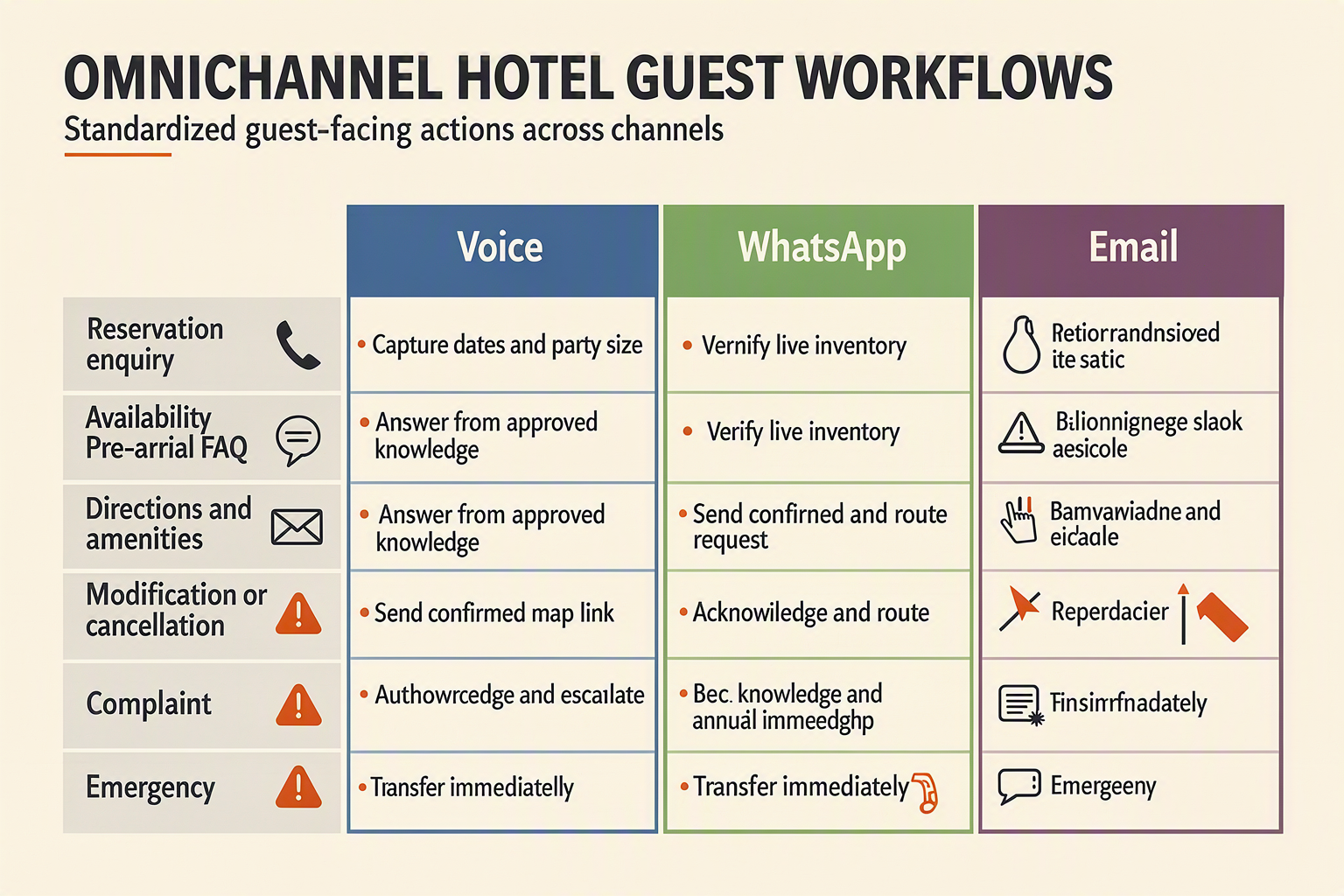
Hotel reservation automation should use one shared guest record and one live reservation workflow across voice, WhatsApp and email. Each channel may collect or present information differently, but rates, inventory, policies, identity and booking status must come from authorised property-management or reservation systems—not the AI model’s memory.
Omnichannel reservation workflow
| Guest request | Voice-agent action | WhatsApp or email action | Required verification | Human handoff trigger |
|---|---|---|---|---|
| New reservation enquiry | Capture property, dates, adults, children, room needs and contact details | Display a structured summary and approved booking link | Query live PMS, CRS or booking engine for inventory, rate plan, taxes and restrictions | Group booking, negotiated rate, complex accessibility need or system failure |
| Availability request | Confirm dates and occupancy before reading available options | Send approved room choices without exposing internal inventory data | Recheck availability immediately before quoting or booking | Inventory mismatch, oversell risk or requested room unavailable |
| Rate or policy question | Explain only the rate and cancellation conditions returned by the source system | Provide written terms and ask the guest to acknowledge them | Validate currency, taxes, inclusions, deposit rules and cancellation deadline | Ambiguous policy, exception request or disputed charge |
| Modification or cancellation | Authenticate the caller, retrieve the reservation and explain applicable conditions | Use a secure verification step before showing booking details | Verify identity, booking status, modification rights, fees and refund rules | Name change, payment dispute, refund exception or third-party booking |
| Missed call or abandoned enquiry | Create a callback task and preserve captured intent | Send a consent-compliant follow-up where permitted | Check contact consent, channel eligibility and previous conversation history | Repeated failed contact, VIP record or urgent arrival |
| Pre-arrival request | Answer approved questions about directions, check-in, amenities and transport | Record requests such as late arrival or dietary requirements | Check property knowledge base and confirm operational requests with hotel systems | Medical issue, complaint, safety concern or request requiring staff confirmation |
Keep one conversation state across channels
A guest who begins with a hospitality AI voice agent should not have to repeat dates and occupancy when moving to WhatsApp. The orchestration layer should attach each interaction to a conversation identifier, then match it to a CRM profile or reservation only after appropriate identity verification.
The sequence should be:
- Recognise intent without assuming that an enquiry is a confirmed booking.
- Collect minimum necessary data, such as dates, occupancy and preferred property.
- Query the live system of record for availability, rates and restrictions.
- Present a timestamped result and clearly label provisional information.
- Obtain explicit confirmation before creating or changing a reservation.
- Write the outcome back to the PMS, CRS, CRM and shared inbox.
- Escalate with context, including the transcript, detected language and actions already attempted.
For workflow design patterns beyond hospitality, see the AI appointment booking agent guide.
Apply channel-specific controls
Hotel reservation call automation should repeat critical details aloud and send a written summary when the guest consents. Hotel WhatsApp automation should use approved templates where Meta’s rules require them, while email agents should preserve the subject thread and avoid treating an email address alone as proof of identity.
Payment data needs a harder boundary. The PCI Security Standards Council published PCI DSS v4.0.1 in June 2024, and its future-dated requirements became effective on March 31, 2025. Card numbers, CVVs and payment links should therefore remain inside authorised, PCI-compliant payment flows rather than AI prompts, transcripts or ordinary email.
A hotel AI receptionist built with an omnichannel platform such as CallMissed can connect AI voice, WhatsApp Business chat and calling, email workflows and knowledge retrieval. The safe architecture still depends on live integrations, consent controls and a visible front-desk handoff—not merely adding the same chatbot to three channels.
How must rates, availability, policies, identity, payments and property-management integrations be verified?
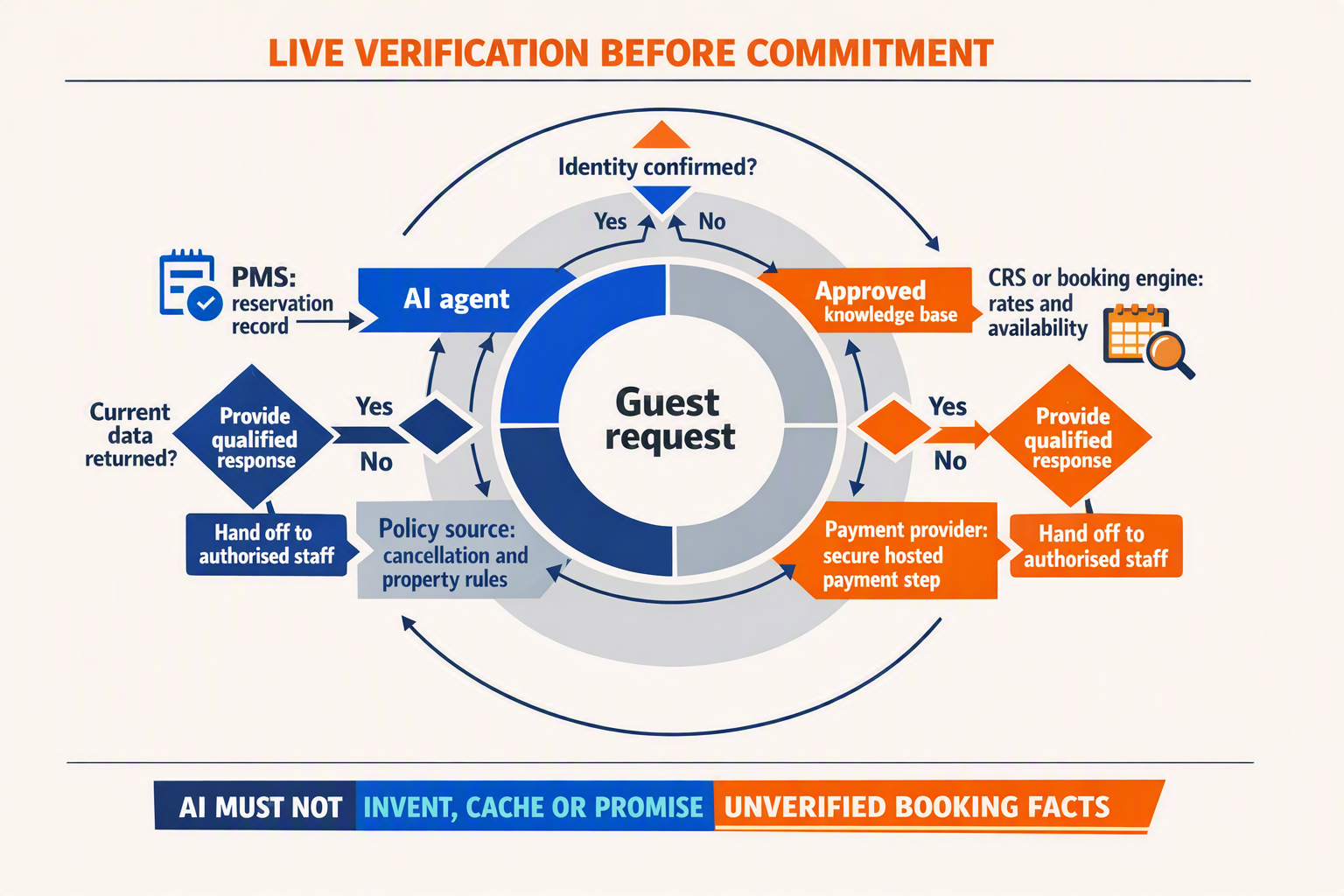
A hotel AI agent must treat rates, availability, policies, identity and payment status as verified data—not model knowledge. Before confirming a reservation or change, the agent should query the hotel’s authorised property-management system (PMS), central reservation system (CRS), booking engine or payment provider and fail safely when that source is unavailable.
Verify rates and availability transactionally
A hotel AI receptionist may collect dates, guest count, room preferences and promotional codes conversationally, but the live booking system must calculate the offer. The verification workflow should:
- Query availability for the exact property, dates, occupancy and room type.
- Retrieve the applicable rate plan, currency, taxes, fees and restrictions.
- Present the offer with an expiry time or explain that availability can change.
- Recheck inventory immediately before booking confirmation.
- Write the reservation to the PMS or CRS and return its confirmed reference number.
Do not let a hospitality AI voice agent rely on cached room inventory or quote a price extracted from an old FAQ. If the integration times out, the correct response is: “I cannot verify live availability right now,” followed by a retry or front-desk handoff—not a guessed answer.
Make policies versioned and booking-specific
Cancellation windows, deposits, minimum stays, child policies, pet rules and check-in requirements can vary by property, channel and rate plan. The agent should retrieve the policy attached to the specific offer or reservation rather than using a generic summary.
Policy controls should include:
- Effective dates and version numbers for approved documents
- Exact deadlines with the property’s local time zone
- Separate rules for refundable, non-refundable and promotional rates
- Human approval for exceptions, waivers and disputed interpretations
- A stored record of which policy text was presented and accepted
This is especially important for modification and cancellation requests: hotel reservation call automation should verify the booking, calculate any penalty through the authorised system and ask for explicit confirmation before committing the change.
Verify identity without over-collecting data
Knowing a confirmation number is not always sufficient proof of identity. Apply checks proportionate to the requested action: providing directions is low risk, while changing dates, disclosing an itinerary or cancelling a stay is higher risk.
Approved verification can combine reservation reference, surname, one-time password sent to the contact already on file or transfer to an employee. Hotel WhatsApp automation should not assume that possession of a WhatsApp account automatically proves the sender is the booked guest. Mask personal information in transcripts and reveal only what is necessary.
Keep payments outside AI conversations
Voice recordings, WhatsApp threads, email bodies, model prompts and general CRM notes should not contain full payment-card numbers, CVVs or reusable payment credentials. Instead, the agent should provide a secure payment link, transfer to an approved payment interface or invoke a tokenised payment-provider workflow.
The AI may report payment status only after receiving a signed, authoritative response from the payment system. “Payment initiated” must not be described as “payment received.”
PMS and payment integrations also require:
- Authenticated APIs, least-privilege credentials and encrypted transport
- Idempotency controls to prevent duplicate bookings or charges
- Signed webhooks and reconciliation against the source system
- Audit logs covering reads, writes, approvals and failures
- Alerts and human handoff when systems disagree
Platforms such as CallMissed can manage conversations across AI voice, WhatsApp Business calling, chat and email, but the hotel remains responsible for connecting those workflows to authoritative reservation and payment systems. The practical rule is simple: if a consequential fact cannot be verified live, the agent must not confirm it.
What consent, privacy, payment-data and escalation safeguards protect guests and hotel teams?
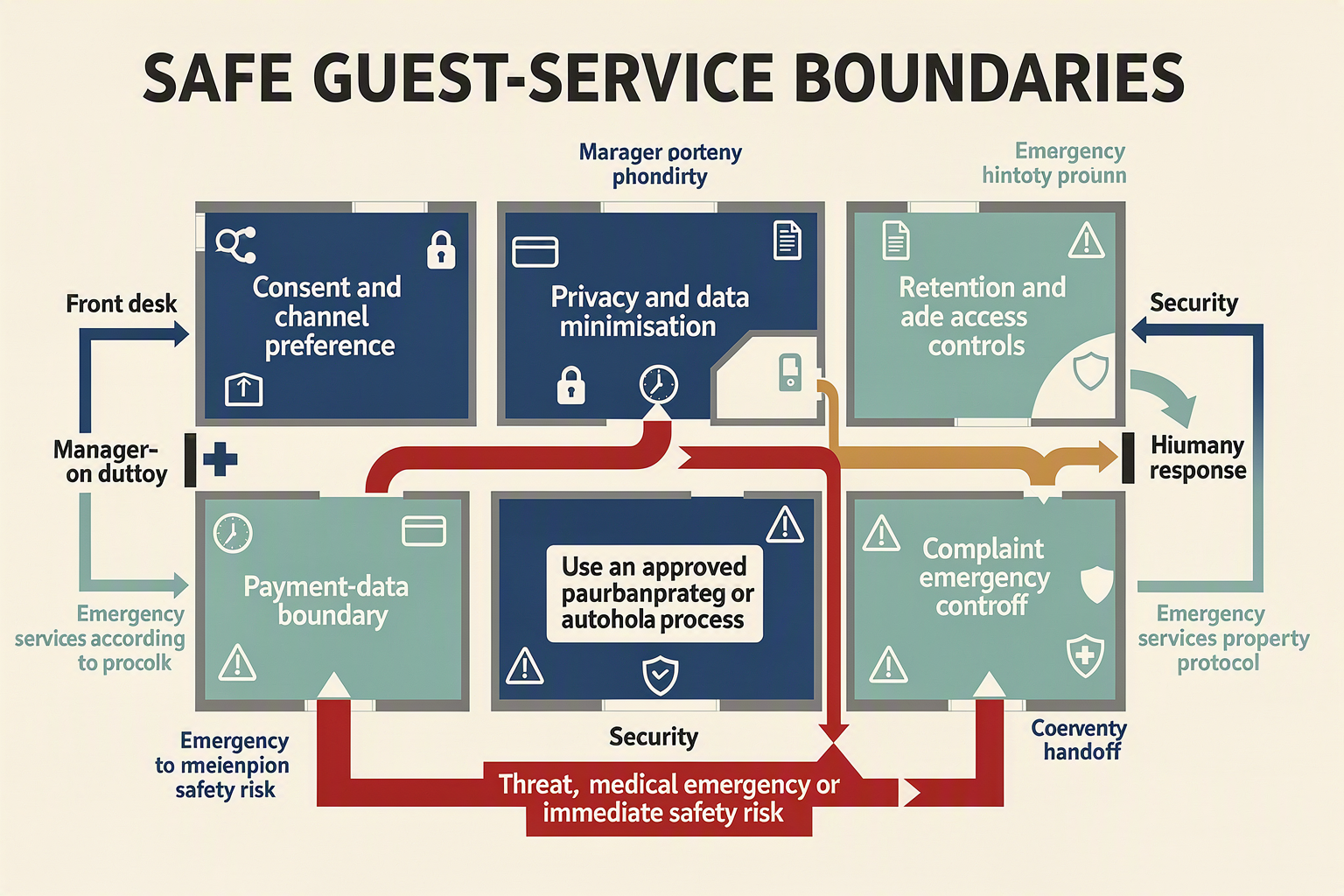
Guest safeguards should combine clear disclosure, purpose-limited data collection, secure payment boundaries, live-system verification and immediate human escalation. A hotel AI receptionist should identify itself as automated, explain when conversations are recorded or stored, and never request information that the workflow does not need.
Obtain valid consent and respect channel preferences
Consent requirements depend on the guest’s location, the hotel’s jurisdiction and the purpose of communication. Under the EU General Data Protection Regulation (GDPR), hotels must establish a lawful basis for processing personal data; consent is only one possible basis and must be freely given, specific, informed and unambiguous when used.
For every channel:
- Voice: Announce that the caller is interacting with AI and disclose recording or transcription before capture where applicable. Because call-recording laws vary, hotels should configure notices by jurisdiction.
- WhatsApp: Separate transactional messages—such as requested booking information—from promotional campaigns. Hotel WhatsApp automation should record the source, timestamp and scope of each marketing opt-in and honour opt-outs promptly.
- Email: Include the hotel’s identity, communication purpose and an unsubscribe mechanism for marketing. Do not treat a reservation enquiry as blanket consent for future promotions.
- Cross-channel contact: Ask before moving a guest from a phone call to WhatsApp or email; possession of a telephone number does not automatically establish permission for every use.
Minimise, protect and delete guest data
A hospitality AI voice agent may need travel dates, occupancy, language preference and a reservation reference, but usually does not need passport scans, complete payment-card data or sensitive health details. Accessibility requests should be collected only to provide the requested accommodation and exposed solely to authorised personnel.
Hotels should define:
- Role-based access for front-desk, reservations, finance and technical teams.
- Encryption for data in transit and at rest.
- Retention periods for recordings, transcripts, AI logs and failed enquiries.
- Deletion and correction workflows covering the property-management system, CRM and connected vendors.
- Processor agreements and audit logs showing who accessed or changed guest records.
India’s Digital Personal Data Protection Act, 2023 permits penalties of up to ₹250 crore for failure to take reasonable security safeguards to prevent a personal-data breach, according to the Act’s Schedule. Hotels should map obligations under the laws applicable to both the property and the guest rather than applying one global consent script.
Keep card data outside AI conversations
Hotel reservation call automation should send the guest to a PCI-compliant hosted payment page, secure interactive voice response flow or authorised payment terminal. Prompts, call recordings, WhatsApp threads, email inboxes and model-training datasets should never contain full card numbers, PINs or card verification codes.
PCI Security Standards Council’s PCI DSS v4.0.1, published in June 2024, prohibits storing sensitive authentication data after authorisation, even when encrypted. If a guest starts reading card details aloud, the system should interrupt politely, pause recording where technically validated and transfer the guest into the approved payment flow.
Escalate risk instead of improvising
The AI must provide a concise handoff summary without making unsupported promises. Immediate escalation triggers should include:
- Medical emergencies, threats, fire, violence or a missing person
- Safety, harassment or security complaints
- Disputed charges, suspected fraud or identity mismatches
- Cancellation exceptions, compensation demands and legal notices
- Accessibility needs the automated workflow cannot confidently fulfil
- Repeated failed authentication or unavailable live reservation data
Emergency scripts should direct guests to local emergency services and alert designated hotel staff. If no employee answers, the workflow needs a documented fallback—such as an on-duty manager or security desk—rather than leaving the guest trapped in an automated loop.
Which missed-call recovery capabilities should hotels verify in CallMissed before deployment?
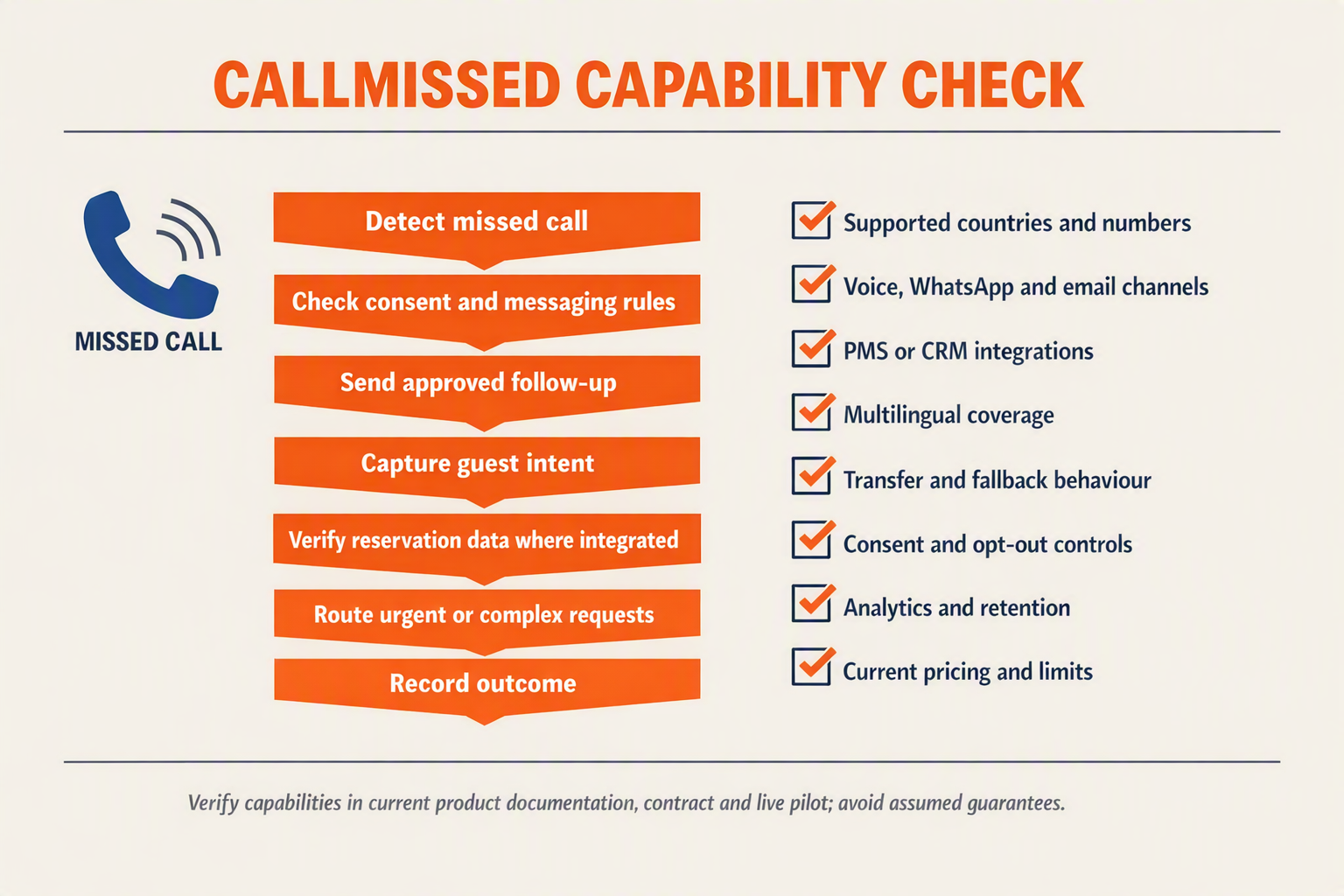
Hotels should verify that CallMissed can detect an unanswered call, preserve caller context, trigger a compliant follow-up and transfer the recovered conversation to staff under the property’s real operating conditions. Product availability alone is insufficient: test each workflow with the hotel’s phone numbers, WhatsApp Business account, routing rules and authorised systems before deployment.
Validate the complete recovery sequence
Run end-to-end tests for busy, unanswered, rejected and after-hours calls. A production-ready hotel AI receptionist should distinguish these outcomes rather than treating every disconnected call as a new enquiry.
Verify that the configured workflow can:
- Capture the event correctly: Record the caller number, dialled property or department, timestamp and call outcome.
- Apply a short deduplication window: Avoid starting multiple recoveries when a guest calls repeatedly or an employee returns the call manually.
- Select an approved channel: Trigger a callback or permitted WhatsApp follow-up according to consent, local rules and WhatsApp template requirements.
- Retain attribution: Identify the property, campaign or department that received the original call.
- Stop automation appropriately: End reminders after a reply, successful callback, staff takeover or opt-out.
Test calls from withheld numbers, international numbers and numbers that cannot receive WhatsApp messages. The workflow needs a safe fallback instead of silently dropping those enquiries.
Check what the agent may say and do
A recovered call does not make unverified inventory safe to quote. Confirm that the hospitality AI voice agent separates conversational tasks from transactional authority:
- It may collect stay dates, guest count, room preferences and callback details.
- It should query an authorised property-management system or central reservation system before confirming availability, rates, taxes or booking status.
- It should route modification and cancellation requests through identity and policy checks.
- It must not collect payment-card numbers in prompts, transcripts or an ordinary omnichannel inbox.
- It should transfer complaints, accessibility requests, safety concerns and emergencies to designated employees.
For hotel reservation call automation, deliberately disable the reservation integration during testing. The correct behaviour is to explain that live confirmation is unavailable and escalate—not guess from knowledge-base content.
Verify WhatsApp, language and human handoff behaviour
CallMissed supports WhatsApp chat, inbound and business-initiated WhatsApp calling, and AI voice workflows. Before relying on hotel WhatsApp automation, verify Meta template approval, guest consent records, opt-out handling, messaging-window behaviour and whether the original missed-call context remains visible to the front desk.
CallMissed also supports speech workflows across 22 Indian languages, but catalogue coverage is not the same as property-level readiness. Follow a structured multilingual voice-agent testing process using local accents, mixed-language utterances, noisy lobbies, dates, currency amounts and hotel names.
Every handoff test should confirm that employees receive:
- The caller’s number and preferred language
- A concise transcript or conversation summary
- Requested dates, occupancy and stated intent
- Consent and opt-out status
- The reason for escalation and actions already attempted
Establish acceptance criteria before launch
Use a controlled pilot and measure missed calls detected, follow-ups attempted, guest response rate, successful human transfers, duplicate contacts, opt-outs and recovered enquiries. Do not label an enquiry a recovered booking unless the reservation system confirms it.
For configuration details, compare the pilot against CallMissed’s current console settings and documentation; account, telephony and WhatsApp provisioning may affect what is available. The broader missed-call automation workflow guide provides additional trigger and escalation checks.
How should hotels test rollout, measure impact and apply expert operational guidance?
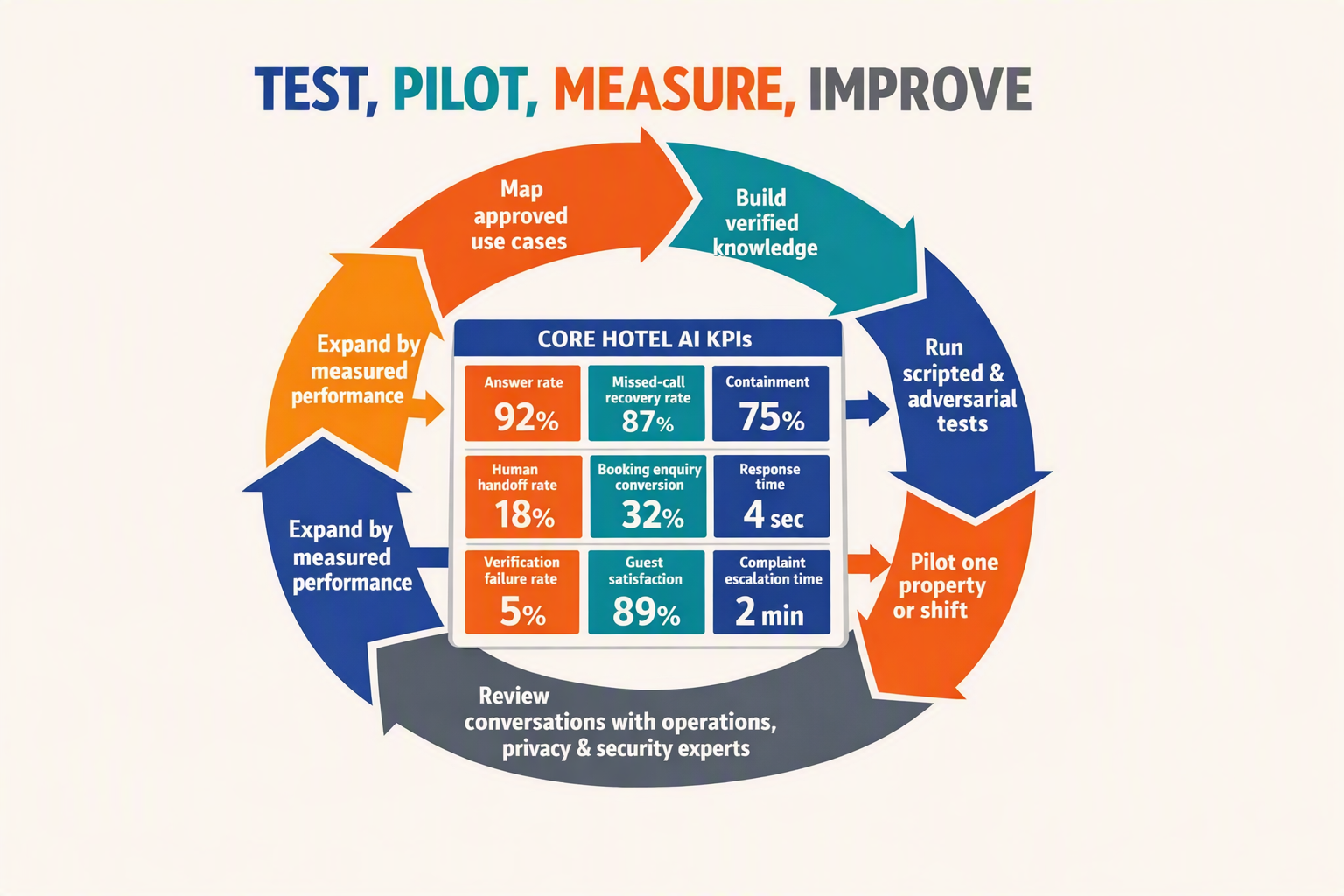
Hotels should test AI agents in controlled stages, measure both guest outcomes and operational risk, and expand only when predefined quality thresholds are met. A successful rollout prioritises verified answers, reliable handoffs and staff adoption over maximum automation.
Roll out in four controlled stages
- Offline simulation: Test the hotel AI receptionist with anonymised transcripts and synthetic scenarios covering accents, background noise, date ambiguity, group bookings, sold-out nights and policy exceptions.
- Staff-only pilot: Let reservations and front-desk employees interact with the agent, inspect source citations and deliberately trigger failures such as unavailable PMS data or contradictory policies.
- Limited guest release: Start with one property, language, phone number or enquiry category—typically directions, amenities and pre-arrival FAQs. Keep live human takeover available.
- Measured expansion: Add availability enquiries, missed-call recovery and modification requests only after the earlier scope meets agreed thresholds across multiple weeks and demand periods.
Test peak weekends, overnight shifts and disrupted operations—not merely quiet weekday conditions. WhatsApp exceeded 3 billion monthly active users worldwide, according to Meta CEO Mark Zuckerberg during Meta’s April 2025 earnings call, so hotel WhatsApp automation must be tested for concurrency and queue management, not just answer accuracy.
Use a pass-or-escalate test scorecard
Every test case should record the guest’s channel, language, intent, expected result, actual result and handoff outcome. Include:
- Reservation accuracy: Did hotel reservation call automation capture dates, guest count, room preferences and contact details correctly?
- Live-data discipline: Did the agent refuse to confirm rates or availability when the authorised reservation system was unavailable?
- Policy grounding: Did answers match the current cancellation, check-in, pet, child and accessibility policies?
- Multilingual quality: Did native-speaking reviewers assess meaning, pronunciation, politeness and code-switching—not just literal translation?
- Escalation reliability: Did complaints, emergencies, accessibility requirements and low-confidence answers reach the correct employee with context?
- Channel continuity: Could staff understand the interaction when a guest moved from a hospitality AI voice agent to WhatsApp or email?
For deeper language evaluation, use the multilingual AI voice-agent testing guide. Hotels designing callback flows can also adapt the missed-call automation workflow.
Measure impact with balanced KPIs
Do not treat containment rate as the sole measure of success. Track a balanced set of weekly and monthly indicators:
- Answer rate and median time to first response by channel
- Verified resolution rate: enquiries resolved using approved knowledge or live systems
- Handoff success rate: escalations accepted by staff with complete context
- Booking-conversion rate for eligible reservation enquiries
- Abandonment and repeat-contact rates within 24 or 72 hours
- Correction rate: conversations requiring employee repair
- Critical-error rate: invented availability, incorrect prices, privacy exposure or failed emergency escalation
- Guest satisfaction and employee time saved, segmented by language and property
Compare performance against a pre-launch baseline and retain human-handled control periods where practical. Review false resolutions separately: an apparently “contained” conversation is a failure if the guest later calls because the answer was incomplete.
Apply operational governance continuously
Assign named owners for reservations, IT, privacy, security and front-office operations. Conduct weekly reviews during the pilot, then monthly audits covering transcripts, integrations, policy freshness and escalation rosters.
Keep payment-card data outside general AI prompts and transcripts. The PCI Security Standards Council made PCI DSS v4.0.1 future-dated requirements effective on 31 March 2025, making payment-flow boundaries an operational control rather than an optional design preference.
Finally, give employees authority to pause automation immediately. Property outages, emergency conditions, policy changes or degraded integrations should trigger a documented fallback to human service.
What does this mean for your hotel? A phased implementation checklist and recommended internal guides
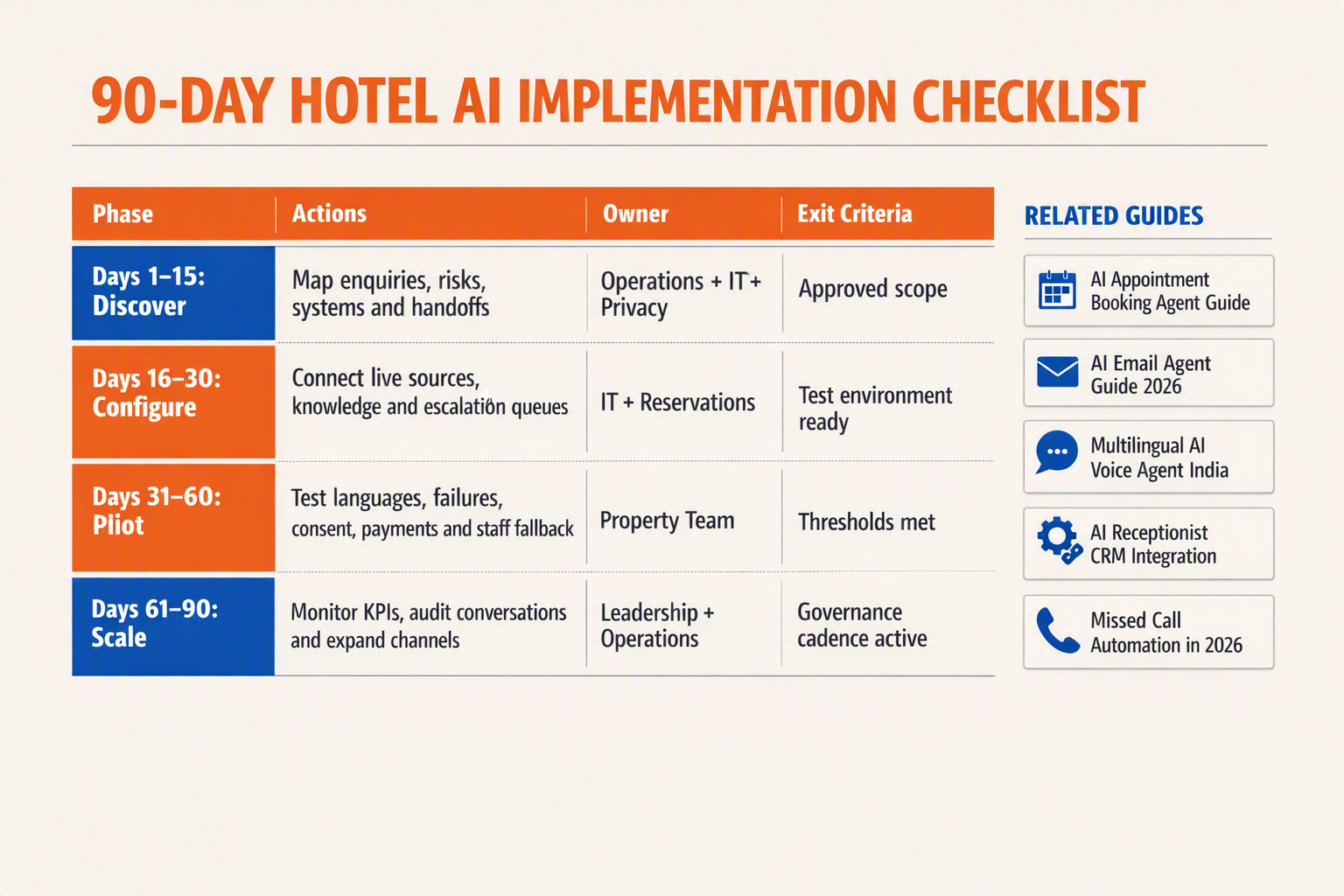
A hotel should implement automation in controlled phases: document approved answers first, connect live systems second, pilot one channel and use case third, then expand only after measured safety and service gates are met. Do not launch a hotel AI receptionist across every property, language and workflow simultaneously.
Phased implementation checklist
| Phase and timing | Implementation actions | Required release gate | Owner and KPI |
|---|---|---|---|
| 1. Baseline: weeks 1–2 | Measure enquiry volume, missed calls, response times, transfers and top guest intents across voice, WhatsApp and email. Identify peak hours and preferred languages. | At least four weeks of baseline data where available; named human owner for every escalation category. | Operations: containment rate, first-response time, missed-call recovery and abandonment rate. |
| 2. Knowledge foundation: weeks 2–4 | Create property-approved content for directions, check-in times, parking, amenities, accessibility and pre-arrival FAQs. Add document owners and review dates. | Every answer has an authoritative source; expired or conflicting policies are removed. | Front office: answer accuracy, outdated-content incidents and unanswered-question rate. |
| 3. Low-risk pilot: weeks 4–6 | Pilot the hospitality AI voice agent or hotel WhatsApp automation for directions, amenities and enquiry capture. Start with one property, language or operating window. | Staff can take over with transcript and guest context; urgent intents trigger immediate routing. | Duty manager: handoff success, guest opt-out rate and escalation response time. |
| 4. Live-system integration: weeks 6–10 | Connect the property-management system, central reservation system and CRM using least-privilege access. Test rate, availability and booking-status retrieval. | No availability or rate is confirmed from cached knowledge; identity checks precede booking-specific disclosure or changes. | IT and reservations: lookup success, integration latency and incorrect-confirmation count. |
| 5. Transaction expansion: weeks 10–14 | Add hotel reservation call automation, modification and cancellation intake, approved outbound reminders and missed-call recovery. Keep payment collection in a PCI-compliant flow. | Failed integrations default to staff—not guessed answers; cancellation rules and consent records are auditable. | Reservations: conversion, recovered enquiries, transfer rate and modification accuracy. |
| 6. Scale and optimise: ongoing | Add email classification, more languages, cross-channel context and additional properties. Review transcripts, prompts and permissions monthly. | Each language passes native-speaker testing; privacy, retention and deletion controls are verified. | Management: resolution rate, CSAT, cost per resolved enquiry and repeat-contact rate. |
These timings are planning ranges, not universal benchmarks; integration complexity, property count and approval processes can change them. WhatsApp deserves a formal workstream rather than an experimental add-on: Meta reported more than 3 billion monthly active WhatsApp users in April 2025.
Internal guides your project team should use
Assign these resources as operating documents rather than optional reading:
- Reservations and channel owners: Use the AI appointment booking workflow guide to map data capture, confirmation and follow-up steps.
- Front-office and IT teams: Follow the AI receptionist CRM integration guide for field mapping, duplicate handling and ownership rules.
- Email operations: Apply the AI email agent guide to classification, drafting, approval and escalation queues.
- Language-quality reviewers: Use the multilingual AI voice agent testing guide for accent, code-switching, names, dates and noisy-call tests.
- After-hours teams: Adapt the missed-call automation workflow for callback consent, retry limits and staff routing.
For India-focused deployments, CallMissed can support this phased model with AI voice agents, WhatsApp Business calls connected to an AI agent, email workflows and 22 Indian languages. Regardless of platform, designate one accountable owner for knowledge, integrations, privacy, security and emergency escalation before expanding automation.
Frequently asked questions about hotel AI receptionists, costs, PMS integrations, languages, payments and human handoffs
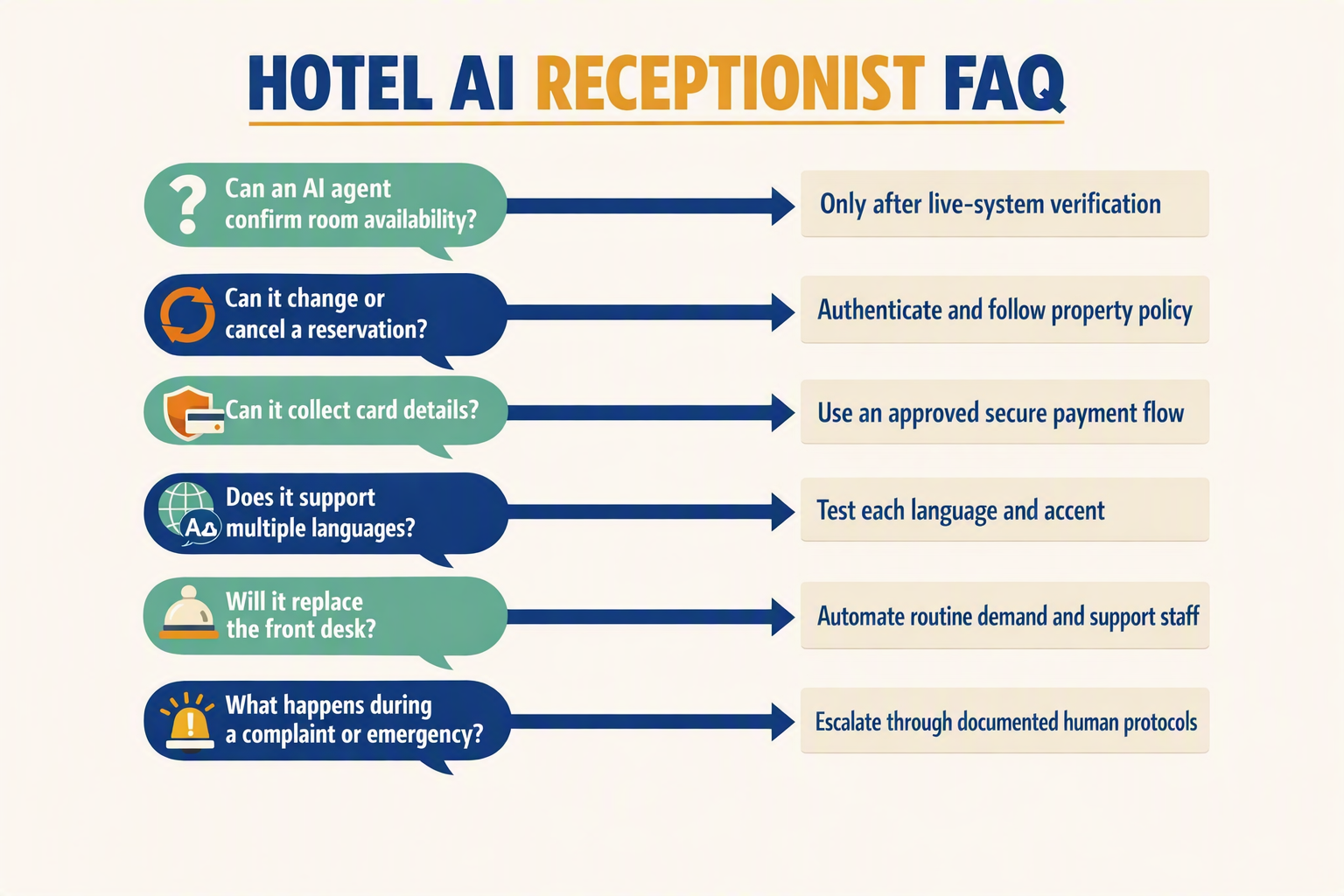
How much does a hotel AI receptionist cost in 2026?
Can a hotel AI receptionist integrate with a PMS or central reservation system?
Can a hospitality AI voice agent serve guests in multiple languages?
Can hotel reservation call automation collect guest payments securely?
When should a hotel AI receptionist transfer a guest to a human?
Is hotel WhatsApp automation more useful than phone or email automation?
Conclusion
A hotel AI receptionist should extend the front desk, not impersonate or replace it. The safest 2026 deployments use voice, WhatsApp and email to resolve routine enquiries while verifying operational facts through authorised hotel systems and escalating situations that require human judgement.
- Automate predictable conversations, not uncertain decisions. A hospitality AI voice agent can collect stay dates, occupancy needs and contact details, explain approved amenities, provide directions and recover missed calls. Rates, availability, taxes and booking status should come from the live property-management system or central reservation system before being confirmed.
- Preserve context across channels. Guests increasingly move between calls, messages and email: WhatsApp exceeded 3 billion monthly active users worldwide, according to Meta CEO Mark Zuckerberg during Meta’s April 2025 earnings call. Effective hotel WhatsApp automation should retain conversation history, support pre-arrival FAQs and transfer the full context to the front desk instead of forcing guests to repeat themselves.
- Build firm safety and privacy boundaries. Modification and cancellation requests need identity and policy checks, while card data belongs only in PCI-compliant payment flows—not AI prompts, transcripts or general inboxes. Complaints, accessibility requirements, medical concerns, threats and emergencies require prompt transfer to trained hotel or emergency staff.
- Roll out gradually and measure outcomes. Begin hotel reservation call automation with a narrow set of approved intents, test multilingual accuracy and edge cases, then track containment, escalation accuracy, missed-call recovery, response time, booking completion and guest satisfaction.
Looking ahead, hotels should watch how reliably omnichannel agents maintain context while grounding every answer in current property data. Platforms such as CallMissed reflect this direction by bringing AI voice agents, WhatsApp chat and Business calling, email workflows, knowledge retrieval and support for 22 Indian languages into one communication environment.
The defining question for hospitality leaders is therefore not, “How much can we automate?” but, “Which guest conversations can we automate safely while making human service more responsive?”
Related Reading
Discussion
Related Posts

Ready to automate customer conversations?
Launch AI voice agents and WhatsApp bots with CallMissed — one API, 22+ Indian languages.