
Dealership WhatsApp Automation: 2026 AI Voice Buyer & Implementation Guide


Use this dealership WhatsApp automation guide to compare AI voice tools, verify CRM/DMS fit, and deploy safer sales and service workflows.
Dealership WhatsApp Automation: 2026 AI Voice Buyer & Implementation Guide
WhatsApp surpassed 3 billion monthly active users, Meta CEO Mark Zuckerberg confirmed in April 2025—yet many vehicle buyers still wait for a dealership to return a missed call or manually confirm a service slot. In 2026, dealership WhatsApp automation combined with AI voice offers a practical way to respond immediately, capture buyer intent and keep conversations moving without forcing every enquiry into a call queue.
The urgency is not simply about adopting another chatbot. Customers move between WhatsApp messages, phone calls, websites and showroom visits, often expecting the dealership to retain context throughout the journey. Salesforce reported in its 2023 State of the Connected Customer that 79% of customers expect consistent interactions across departments, while 56% said they often have to repeat information to different representatives. For dealerships, that fragmentation can mean incomplete lead records, missed test-drive requests, repetitive service-status calls and follow-ups sent without clear consent.
A well-designed automotive dealership AI receptionist can answer routine questions, recover missed calls and transfer high-intent conversations to a salesperson. Meanwhile, car dealership lead qualification AI can collect structured details such as preferred model, new-versus-used interest, budget range, purchase timeline, exchange requirements and showroom location. On the after-sales side, automotive service booking AI can identify the customer and vehicle, gather the service concern, offer verified appointment slots and provide status updates from approved systems.
However, automation is only useful when its answers are accurate. Vehicle availability, variant pricing, promotional offers and delivery estimates can change quickly. Finance questions involving interest rates, loan eligibility, insurance, disclosures or contractual commitments must be escalated to appropriately qualified staff rather than answered speculatively by an AI agent. Consent records, approved WhatsApp templates, role-based access and auditable human handoffs are equally important implementation requirements.
This buyer and implementation guide will help automotive dealerships and service centers evaluate:
- Separate sales and service workflows, from enquiries and test drives to appointments and repair-status questions
- CRM and dealer management system requirements that vendors should demonstrate—not merely claim
- Multilingual voice and WhatsApp conversations, including regional-language support
- Inventory freshness, data-grounding controls and escalation boundaries
- Consent-aware follow-up, human handoff, analytics and phased rollout planning
Indian platforms such as CallMissed reflect this convergence by combining AI voice agents, WhatsApp chat and WhatsApp Business calling with support for 22 Indian languages.
The objective is not to remove dealership staff from the customer journey. It is to automate predictable interactions, preserve context and route each buyer or vehicle owner to the right person—with accurate data and clear accountability.
What should dealerships buy in 2026? An AI voice and WhatsApp system with verified CRM/DMS access, separate sales and service workflows, consent controls, human handoff, and measurable outcomes
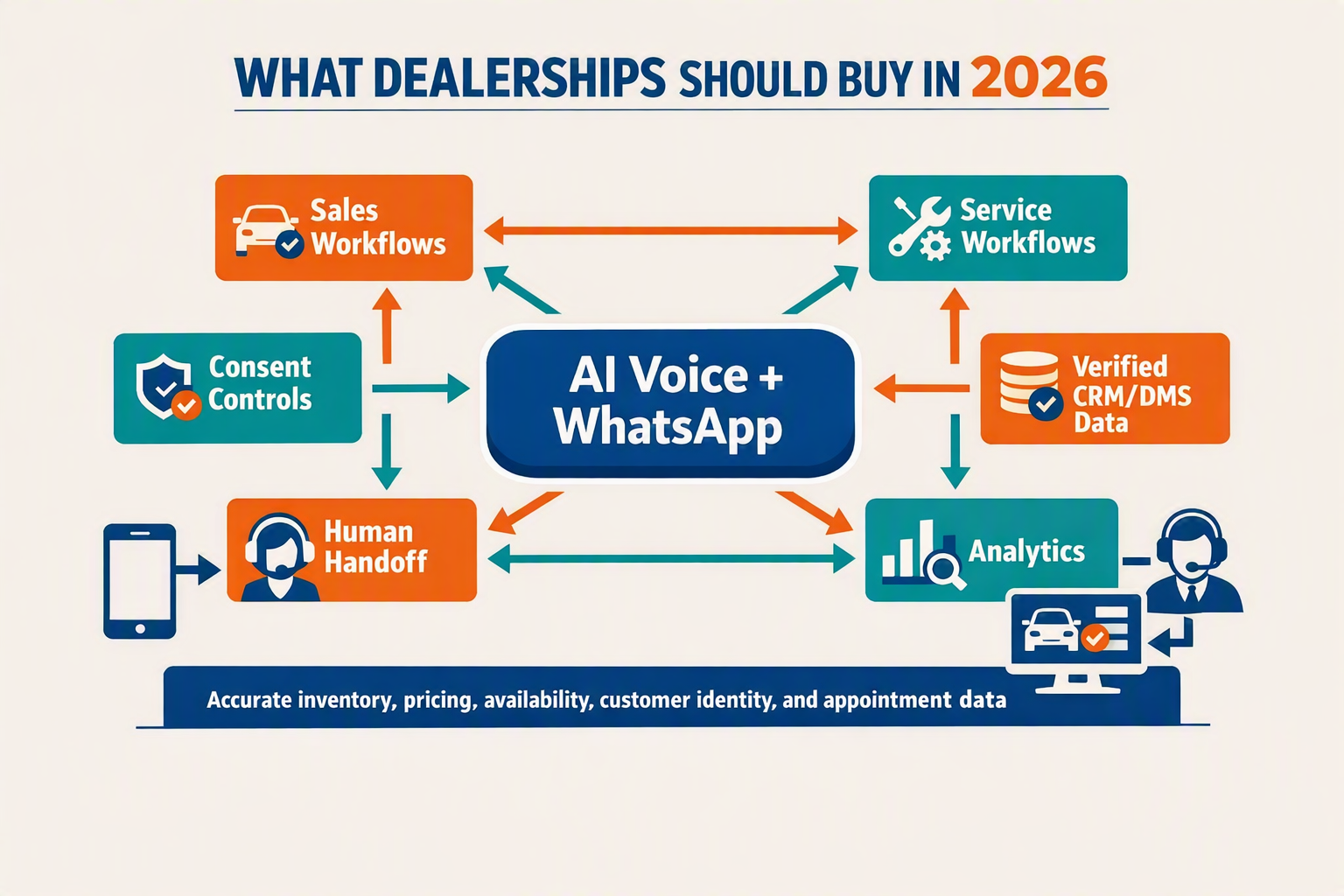
Dealerships should buy an integrated AI voice and WhatsApp system, not a standalone chatbot. The system must demonstrate live, permission-controlled access to CRM and dealer management system data, while keeping sales and service journeys separate and escalating sensitive or uncertain requests to dealership staff.
Five non-negotiable buying requirements
- Verified CRM and DMS access: Require the vendor to demonstrate—in a sandbox or controlled production test—how the system reads customer, vehicle, inventory and appointment data. It should also show exactly which fields it can create or update, how duplicate records are prevented and what happens when an integration fails.
- Distinct sales and service workflows: A new-car enquiry is not the same as a repair-status call. The automotive dealership AI receptionist should route each intent into a purpose-built workflow rather than placing every interaction into one generic lead funnel.
- Consent and communication controls: The platform should record the channel, purpose, source and timestamp of consent, honour opt-outs and restrict follow-up to approved use cases. Buyers should verify how the vendor manages WhatsApp templates and policy changes rather than accepting “WhatsApp compliant” as an unsupported claim.
- Context-rich human handoff: When an agent transfers a conversation, dealership staff should receive the transcript, customer identity, detected intent and information already collected. Salesforce reported in its 2023 State of the Connected Customer that 79% of customers expect consistent interactions across departments; procurement teams should therefore test whether context survives transfers between AI, sales advisers and service teams.
- Measurable operational outcomes: Reporting should connect conversations to business events—not merely count messages. Relevant measures include qualified leads, booked test drives, confirmed service appointments, missed calls recovered, handoff rates, opt-outs and unresolved requests.
Separate sales and service automation by design
A credible sales workflow should support:
- New-versus-used vehicle classification
- Model, variant, budget and purchase-timeline capture
- Exchange or trade-in interest
- Test-drive requests and preferred showroom
- Escalation of finance, insurance and contractual questions
Car dealership lead qualification AI may collect these details, but it should not invent prices, availability, loan eligibility or delivery commitments. Every inventory or offer answer needs a source record, freshness timestamp and fallback when data is unavailable.
An automotive service booking AI requires a different identity and data model. It may need the registration number, vehicle identification details, mileage, service concern, preferred location and verified workshop capacity. Service workflows should distinguish appointment requests from roadside emergencies, warranty questions and repair-status enquiries.
What vendors should prove before purchase
Ask each shortlisted provider to complete a live test using realistic dealership scenarios:
- Recover a missed call and continue the interaction on an authorised channel
- Read an available test-drive slot and write the confirmed booking back
- Refuse to quote stale inventory data when the source system is unavailable
- Transfer a regulated finance question to a qualified employee
- Process an opt-out across voice and dealership WhatsApp automation
- Produce an audit trail showing data access, consent and handoff events
For Indian dealer groups, multilingual coverage should also be tested with real callers, accents and code-switching—not evaluated from a language checklist alone. CallMissed, an AI-native customer-engagement platform, combines AI voice agents, WhatsApp chat and WhatsApp Business calling while supporting speech across 22 Indian languages. Its converged model illustrates what dealerships should evaluate in 2026: coordinated channels, grounded workflows and accountable human escalation rather than disconnected bots.
Why are AI voice and WhatsApp becoming part of dealership sales and service operations in 2026?
AI voice and WhatsApp are entering dealership operations in 2026 because they can now handle conversations, access approved business data and complete workflow steps across channels. The operational case is strongest when automation reduces response gaps while preserving human ownership of negotiations, complex service concerns and regulated finance discussions.
Customer demand now spans messaging and calling
WhatsApp has become an essential customer-contact channel rather than an optional social inbox. WhatsApp exceeded 3 billion monthly active users, according to Meta CEO Mark Zuckerberg’s April 2025 announcement. That scale gives dealerships a familiar channel for collecting documents, sharing showroom directions, confirming appointments and continuing conversations after a call.
WhatsApp Business calling adds another important layer: a customer can move from messaging to a voice conversation without switching to a conventional phone journey. Subject to Meta’s permissions and calling rules, dealerships can use this channel for inbound enquiries or approved business-initiated calls. An automotive dealership AI receptionist can provide initial coverage, but a salesperson or service adviser should remain available for escalation.
AI can perform bounded operational tasks
Earlier voice bots were generally limited to rigid menus and narrow commands. Modern systems combine speech recognition, large language models, retrieval-augmented generation, text-to-speech and tool calling, making several dealership workflows practical:
- Recognise why a customer is calling or messaging.
- Collect structured information such as vehicle model, registration number or preferred appointment date.
- Retrieve approved answers from a dealership knowledge base.
- Check available slots through an authorised scheduling interface.
- write the interaction outcome to a CRM, DMS or service system.
- Transfer the customer—with the transcript and captured fields—to the correct employee.
The distinction between conversation and transaction matters. Car dealership lead qualification AI may record a buyer’s budget range and purchase timeline, but it should not invent an on-road price or promise vehicle availability. Similarly, automotive service booking AI should only offer slots returned by the workshop’s current scheduling system.
Sales and service gain different operational benefits
For sales teams, automation primarily improves speed, consistency and lead routing:
- Recover unanswered or after-hours calls.
- Separate new-vehicle, used-vehicle and exchange enquiries.
- Capture model, variant, fuel type, location and test-drive preferences.
- Route high-intent or finance-related conversations to qualified staff.
For service centers, the value is more transactional:
- Identify the customer and vehicle.
- Record symptoms without presenting an unverified diagnosis.
- Book, reschedule or cancel appointments against live capacity.
- Answer status questions using authorised workshop data.
- Escalate safety concerns, disputes and cost approvals.
The business case depends on orchestration, not channel volume
Effective dealership WhatsApp automation does not mean sending more messages. Meta’s WhatsApp Business rules require appropriate customer permission and approved templates for applicable business-initiated conversations, so consent records and suppression controls must be part of the workflow.
The 2026 shift is therefore toward connected automation: voice and WhatsApp sharing customer context, verified data sources, escalation rules and analytics. Dealerships should evaluate these systems as operational infrastructure—not as standalone bots—and require vendors to demonstrate real booking, handoff and system-update flows before purchase.
Which 2026 developments matter when comparing AI voice, messaging, data access, compliance, and escalation?
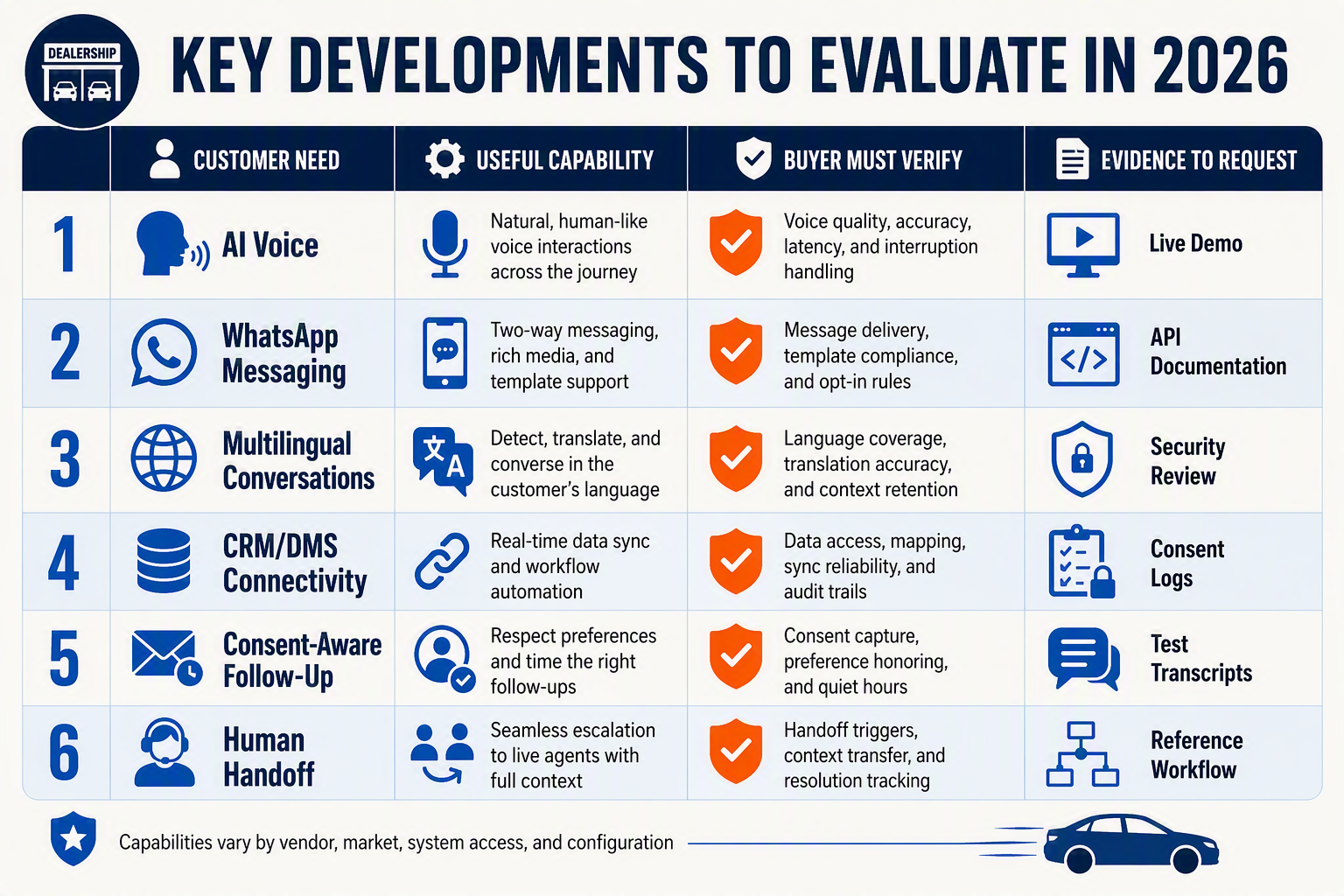
The most important 2026 shift is from isolated chatbots to multimodal, system-connected agents that can speak, message, retrieve authorised dealership data and transfer conversations without losing context. Buyers should compare demonstrated workflows—not model names or vague claims of “human-like” automation.
2026 capabilities to compare
| Development | What a vendor should demonstrate | Automotive use case | Key risk or control |
|---|---|---|---|
| Real-time AI voice | Natural turn-taking, interruption handling, call recording controls and acceptable latency under actual network conditions | New-car enquiries, missed-call recovery and service-status calls | Disclose automation; test accents, noise, silence and call failures |
| WhatsApp Business calling | Inbound and business-initiated calling through supported Meta workflows, with chat-to-call context preserved | Move a complex test-drive or breakdown conversation from messaging to voice | Verify permission, template and calling-policy requirements |
| Tool-connected agents | Read/write access through documented APIs, scoped credentials and confirmation before changing records | Create leads, request test drives or reserve service slots | Prevent duplicate bookings, stale inventory answers and unauthorised writes |
| Grounded data retrieval | Source attribution, freshness timestamps, access controls and refusal when reliable data is unavailable | Answer variant, price, used-car availability and repair-status questions | Never let general model knowledge override approved CRM/DMS data |
| Privacy and AI governance | Consent logs, retention controls, deletion workflows, audit trails and regional processing information | Follow-up campaigns, call transcripts and customer profiling | Map obligations under India’s DPDP framework and other applicable laws |
| Structured human escalation | Intent- and risk-based routing with transcript, customer details and action history attached | Finance, insurance, complaints, negotiation and safety-sensitive service issues | Qualified staff must review regulated or contractual representations |
Standards and policy changes are now purchasing criteria
Several deadlines already affect a 2026 implementation:
- PCI Security Standards Council made the future-dated requirements in PCI DSS v4.x effective on March 31, 2025. An AI agent should not collect full payment-card details in free-form speech or chat unless the entire workflow is appropriately designed and assessed.
- The International Accreditation Forum set October 31, 2025, as the transition deadline from ISO/IEC 27001:2013 certifications to ISO/IEC 27001:2022. Buyers evaluating a vendor’s certification should therefore check the certificate version, scope, legal entity and covered services.
- European Commission guidance states that major EU AI Act provisions, including Article 50 transparency obligations, apply from August 2, 2026. Dealership groups serving EU customers should assess whether people are clearly informed when interacting with an AI system.
- India’s Digital Personal Data Protection Act, 2023 establishes requirements around lawful processing, notice, consent where used, security safeguards and personal-data breach handling. Dealerships should obtain legal advice on the rules and commencement provisions applicable when their deployment goes live.
Require evidence in a live scenario
A polished demo is insufficient. Ask each provider to run the same controlled journeys:
- Quote a vehicle whose price changed that morning.
- Attempt to book an already occupied service slot.
- Switch from Hindi voice to English WhatsApp while retaining context.
- Request loan approval or a guaranteed interest rate.
- Revoke marketing consent and verify that follow-up stops.
- Transfer to a human with the transcript, intent and relevant CRM record.
A credible automotive dealership AI receptionist should refuse unsupported claims, while dealership WhatsApp automation should preserve channel permissions. For both sales and service, the decisive 2026 capability is controlled action: the agent must know what data it may read, what records it may change and when a person must take over.
How should an automotive dealership AI receptionist and car dealership lead qualification AI handle new vehicles, used vehicles, test drives, and missed calls?
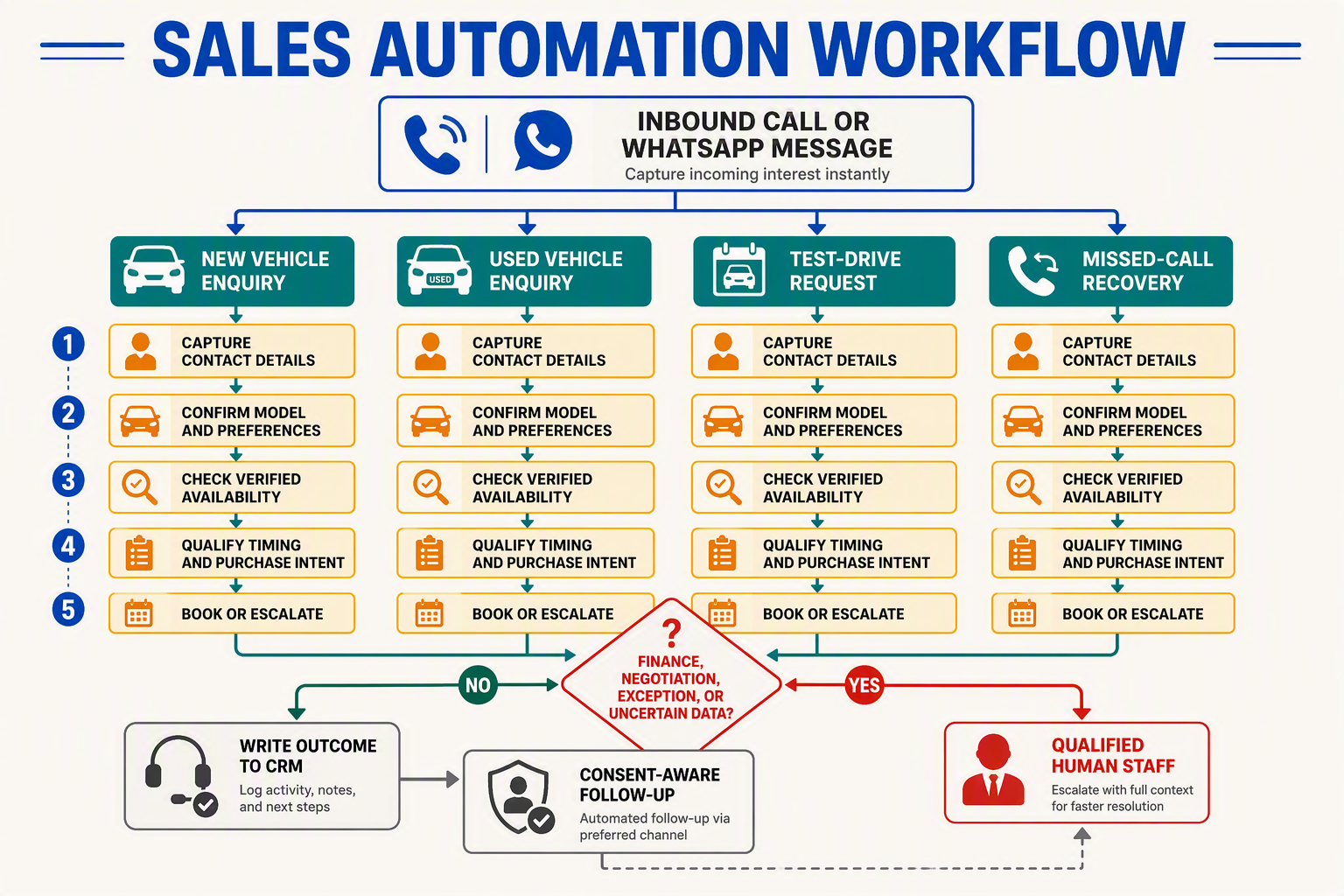
An automotive dealership AI receptionist should identify the customer’s intent immediately, follow a distinct workflow for new cars, used cars, test drives or missed calls, and write structured outcomes to the dealership’s systems. The AI should qualify and route demand—not invent availability, negotiate final terms or make unverified financial commitments.
New-vehicle enquiries: qualify without overpromising
For a new-car lead, the agent should capture enough information for a salesperson to continue the conversation productively:
- Preferred make, model, variant, fuel type and transmission
- Colour preferences and acceptable alternatives
- Budget range and expected purchase timeline
- Cash, finance or undecided purchase intent
- Exchange or trade-in requirement
- Preferred showroom and communication language
- Whether the customer wants a quotation, brochure, callback or test drive
The AI must retrieve prices, offers and estimated delivery periods from an approved, time-stamped source. If the inventory feed is unavailable or stale, it should say that availability requires confirmation rather than presenting an old record as live stock.
Questions about loan eligibility, guaranteed approval, final interest rates, insurance suitability or binding on-road quotations should transfer to qualified staff. The handoff summary should preserve the collected information so the buyer does not have to repeat it.
Used-vehicle enquiries: treat every unit as unique
A car dealership lead qualification AI needs a vehicle-specific workflow for pre-owned inventory. It should reference the stock identifier or listing URL and provide only verified fields such as:
- Registration year, model and variant
- Odometer reading and ownership count
- Fuel type, transmission and listed price
- Inspection or certification status
- Warranty information explicitly recorded by the dealership
- Current location and reservation status
The AI should not infer accident history, mechanical condition, service history or legal title from incomplete data. Questions requiring inspection evidence should be assigned to a used-car specialist.
If the desired unit has been sold, the workflow can request permission to suggest comparable vehicles using defined criteria such as budget, body style and age. It should not silently substitute another listing.
Test drives: convert interest into a confirmed event
A test-drive request should become a calendar event only after the AI validates the vehicle, branch, date, time, customer details and slot availability. A robust workflow is:
- Identify the requested model or used-vehicle stock ID.
- Ask for the preferred showroom, date and time window.
- Check an authoritative scheduling system.
- Collect the minimum required contact and licence-related information.
- Confirm the booking and send rescheduling instructions.
- Notify the assigned salesperson with the qualification summary.
Dealership WhatsApp automation can continue the same journey with location details, reminders and customer-approved follow-up. For voice conversations, the agent should read back critical booking details before confirmation.
Missed calls: recover intent, not merely send a generic message
Missed-call recovery should trigger a consent-aware response that identifies the dealership and offers clear options such as new vehicle, used vehicle, test drive, service or existing booking. The workflow should retain the original call time, dialled branch and campaign source where available.
High-intent cases—such as an immediate purchase request or a customer already at the showroom—should enter a priority callback queue. Service requests should move into the separate automotive service booking AI workflow rather than being assigned to sales.
Platforms such as CallMissed can connect AI voice, WhatsApp chat and WhatsApp Business calling, making it possible to preserve context across a missed call and the subsequent conversation. Buyers should still verify CRM write-back, duplicate handling, routing logic and audit trails during implementation.
How should automotive service booking AI manage appointments, status questions, recalls, multilingual conversations, and urgent service needs?
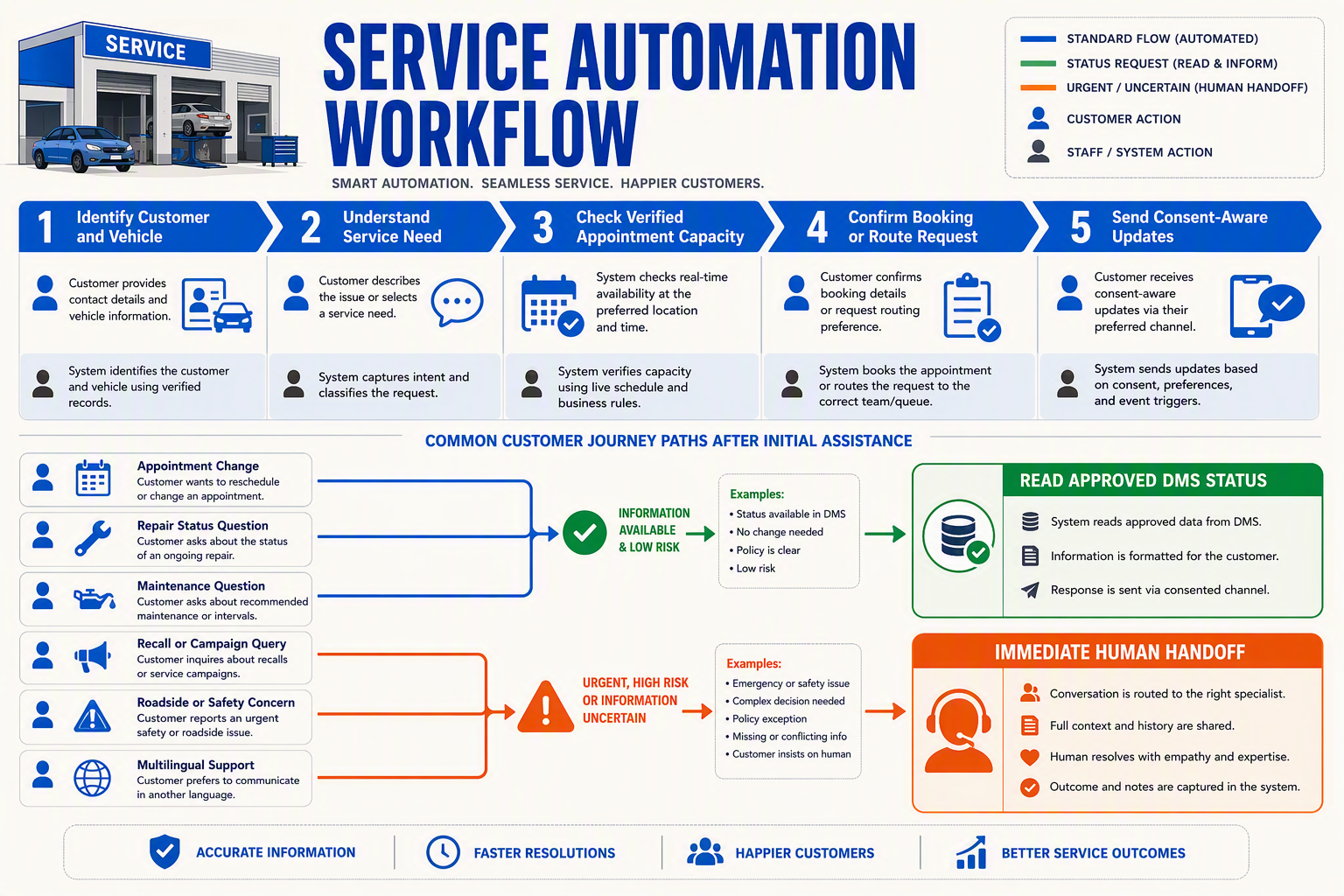
Automotive service booking AI should confirm appointments only against live workshop capacity, answer status questions from approved service records, check recalls using the vehicle identification number (VIN), and immediately escalate safety-critical concerns. It should preserve context across voice and WhatsApp while clearly distinguishing verified information from provisional guidance.
Book appointments against real capacity
The AI agent should identify the customer, vehicle and service requirement before offering a slot. A dependable booking sequence is:
- Capture the registration number or VIN, model, model year and current mileage.
- Classify the request—periodic maintenance, repair, inspection, warranty work or recall.
- Ask for symptoms, preferred branch, date and mobility requirements such as pickup or a courtesy vehicle.
- Query the dealer management system (DMS), workshop scheduler or approved booking system.
- Repeat the date, time, location and scope before creating the appointment.
- Send a written WhatsApp confirmation with rescheduling and cancellation options.
A requested time must not be described as confirmed until the system returns a booking identifier. If an integration is unavailable, the AI should create a callback task or mark the request as pending rather than inventing availability.
Answer status questions without overpromising
Routine questions—“Has diagnosis started?”, “Is my car ready?” or “What is the estimated bill?”—can create substantial call volume. The agent should retrieve only timestamped stages supplied by the workshop, such as:
- Vehicle checked in
- Inspection or diagnosis underway
- Estimate awaiting customer approval
- Parts ordered or pending
- Repair in progress
- Quality check completed
- Ready for collection
The response should name the last update time and avoid turning an estimate into a guarantee. Additional work and revised costs require explicit customer approval through a recorded channel. Before disclosing repair or billing information, the system should verify the caller using an approved method, such as a one-time password or matching customer details.
Treat recalls as authoritative-data workflows
Recall conversations must be grounded in the manufacturer’s recall system, an authorised DMS feed or the relevant market’s official recall database. The AI should collect the VIN, return the recorded campaign status and arrange inspection where required.
It must never infer that a vehicle is safe because no campaign appears in an outdated knowledge base. If recall data cannot be reached, the correct response is “verification pending”, followed by human review—not “no recall applies.”
Design multilingual and urgent-service routing separately
Multilingual automation should support language switching without losing vehicle details, symptoms or appointment context. Buyers should test whether the system correctly handles regional accents, mixed-language sentences, registration numbers and automotive terms—not merely translated greetings.
Urgent conversations need a dedicated safety path. Reports involving smoke, fire, brake failure, steering loss, fuel leakage, collision damage, overheating or occupants trapped in a vehicle should trigger:
- A clear instruction to stop using the vehicle where appropriate
- Immediate transfer to roadside assistance, emergency services or trained staff
- Location capture with explicit permission
- A high-priority CRM/DMS case and full transcript
The AI should not diagnose mechanical faults or promise that driving is safe.
Verify implementation controls before purchase
A 2026 buyer should require vendors to demonstrate live slot lookup, duplicate-booking prevention, customer authentication, recall-source timestamps, approval capture and human handoff. Dealership WhatsApp automation should also preserve the same case when a customer moves from chat to a voice call, rather than opening disconnected service tickets.
Which vendor and integration requirements should buyers verify before selecting dealership WhatsApp automation?
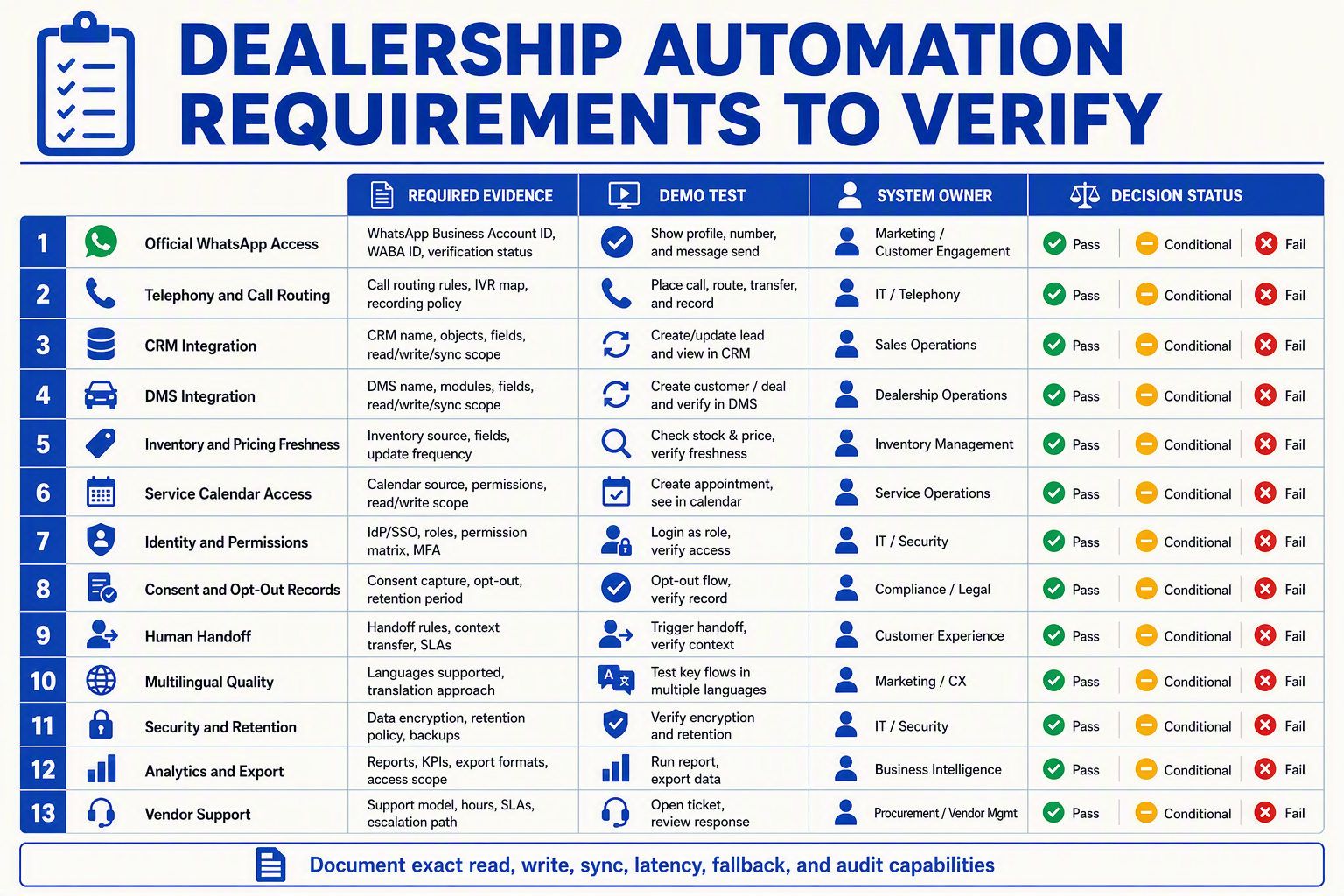
Buyers should select a dealership WhatsApp automation vendor only after verifying live workflows with the dealership’s CRM, dealer management system (DMS), inventory source and service scheduler. Do not rely on a feature checklist or slide deck. Require a sandbox demonstration, documented data mappings, failure handling, transparent pricing and measurable acceptance tests.
Meta eligibility, customer consent requirements, approved messaging templates and WhatsApp Business calling availability can vary by account, market and use case. The vendor must confirm which capabilities are available for the dealership’s specific WhatsApp Business Account. CRM/DMS access, API fees and integration permissions must also be verified with the relevant system providers.
Dealership WhatsApp automation vendor verification matrix
| Dealership WhatsApp automation requirement | Evidence to request | Acceptance test | Risk if missing |
|---|---|---|---|
| Official WhatsApp messaging and calling capabilities | WhatsApp Business Account setup process, Meta eligibility checks, approved-template workflow, consent records, messaging and calling scope, delivery-status webhooks | Send a consented template, capture its delivery status, route the reply correctly and—if calling is offered—verify that the account and use case are eligible | Blocked outreach, policy violations, missing consent evidence or unavailable calling features |
| CRM and DMS integration | Supported APIs, field-level mappings, authentication method, webhook documentation, sync direction, API access approval and expected third-party fees | Create a lead, update its owner and status, then verify that each change appears once—without duplicates—in the intended systems | Duplicate leads, stale records, unexpected integration costs and manual re-entry |
| Inventory and pricing grounding | Named source of truth, included price fields, refresh frequency, timestamp visibility and fallback behaviour | Change a vehicle’s availability or price in the source system and measure when the dealership WhatsApp automation reflects it | Incorrect quotations, outdated pricing or promises about unavailable vehicles |
| Service-booking integration | Live slot lookup, workshop-capacity rules, advisor or bay assignment, rescheduling and cancellation logic | Book, modify and cancel an appointment while confirming every change in the service scheduler | Double-bookings and confirmations for unavailable slots |
| Human handoff and governance | Routing rules, transcript transfer, role-based access, audit logs, approval controls and escalation boundaries | Trigger finance, complaint and uncertain-answer scenarios; confirm that full context reaches an authorised employee | Customers must repeat information or automation handles restricted questions |
| Analytics and reliability | Funnel definitions, data exports, uptime and support terms, error logs, retry logic, monitoring and fallback design | Reconcile enquiries, qualified leads, bookings, handoffs and failed writes against CRM/DMS records | Misleading ROI reporting and hidden integration failures |
| Pricing and contract scope | Setup fees, platform charges, usage assumptions, Meta-related charges, integration costs, support tiers and change-request rates | Calculate the total cost for expected message, call, location and integration volumes, including an overage scenario | Unplanned costs or a low initial quote that excludes essential capabilities |
Demand a workflow demonstration, not a slide deck
Every shortlisted dealership WhatsApp automation provider should demonstrate complete sales and after-sales journeys using realistic dealership data. Salesforce reported in its 2023 State of the Connected Customer that 79% of customers expect consistent interactions across departments, while 56% often have to repeat information to different representatives. The demonstration should therefore prove that customer context survives channel changes, human handoffs and movement between sales and service teams.
Ask each vendor to run these scenarios:
- A used-car prospect messages in a regional language, requests an exchange valuation and then asks to continue by phone.
- An automotive dealership AI receptionist follows up on a missed call and creates a correctly attributed lead.
- The car dealership lead qualification AI records model, budget, purchase timeline and showroom preference in designated CRM fields.
- The automotive service booking AI retrieves genuine availability, books a slot and processes a reschedule and cancellation.
- A customer asks about loan eligibility or a binding finance rate, triggering an immediate transfer to appropriately qualified staff.
- An inventory API becomes unavailable, prompting the assistant to avoid guessing, disclose that live information cannot be confirmed and offer a human callback.
- A CRM or DMS write fails, causing the system to retry safely, avoid duplicate records and alert the accountable team.
- A customer withdraws consent or requests deletion, allowing the dealership to locate and process the request under its applicable policy and legal obligations.
For each scenario, define a pass/fail result, expected response time, destination system, required fields and responsible owner. A polished conversation is not enough if the resulting lead, appointment, consent record or handoff cannot be found in the dealership’s systems.
Contract and architecture checks
Before signing a dealership WhatsApp automation agreement, document:
- Data ownership, retention, export and deletion processes
- Access controls, audit logs and incident-response responsibilities
- Hosting locations and relevant subprocessors or subcontractors
- Ownership of the WhatsApp Business Account and phone numbers
- Responsibility for Meta verification, eligibility and template management
- How customer consent and opt-out records are captured and retained
- Who approves model, prompt and workflow changes
- Who maintains CRM, DMS, inventory and scheduler integrations
- Which party pays DMS API, Meta, telephony, implementation and support costs
- What happens to data, numbers, templates and integrations when the contract ends
Request a written pricing schedule rather than assuming that messaging, WhatsApp Business calling, AI voice usage, implementation and third-party API access are included in one fee. Capabilities and charges may depend on Meta policies, account eligibility, geography, the selected provider and the dealership’s existing software contracts.
For Indian dealer groups, language evaluation should use authentic showroom and workshop conversations rather than translated scripts. CallMissed states that its platform combines AI voice agents, WhatsApp chat and WhatsApp Business calling with support for 22 Indian languages. Buyers should independently verify account eligibility and test recognition accuracy, code-switching, names, registration numbers, local accents and noisy-call conditions using their own data.
Finally, require an integration diagram identifying every system of record, data direction, refresh interval, authentication method, retry path and accountable owner. Production approval for dealership WhatsApp automation should depend on successful acceptance tests and confirmed access to all required CRM, DMS, inventory and scheduling interfaces.
If a vendor cannot show where an answer came from, when its source was updated, whether the dealership is eligible for the promised WhatsApp capability or how a failed write is recovered, the deployment is not ready for production.
How do you implement AI voice and WhatsApp safely, from discovery and data testing to pilot, staff training, and phased rollout?
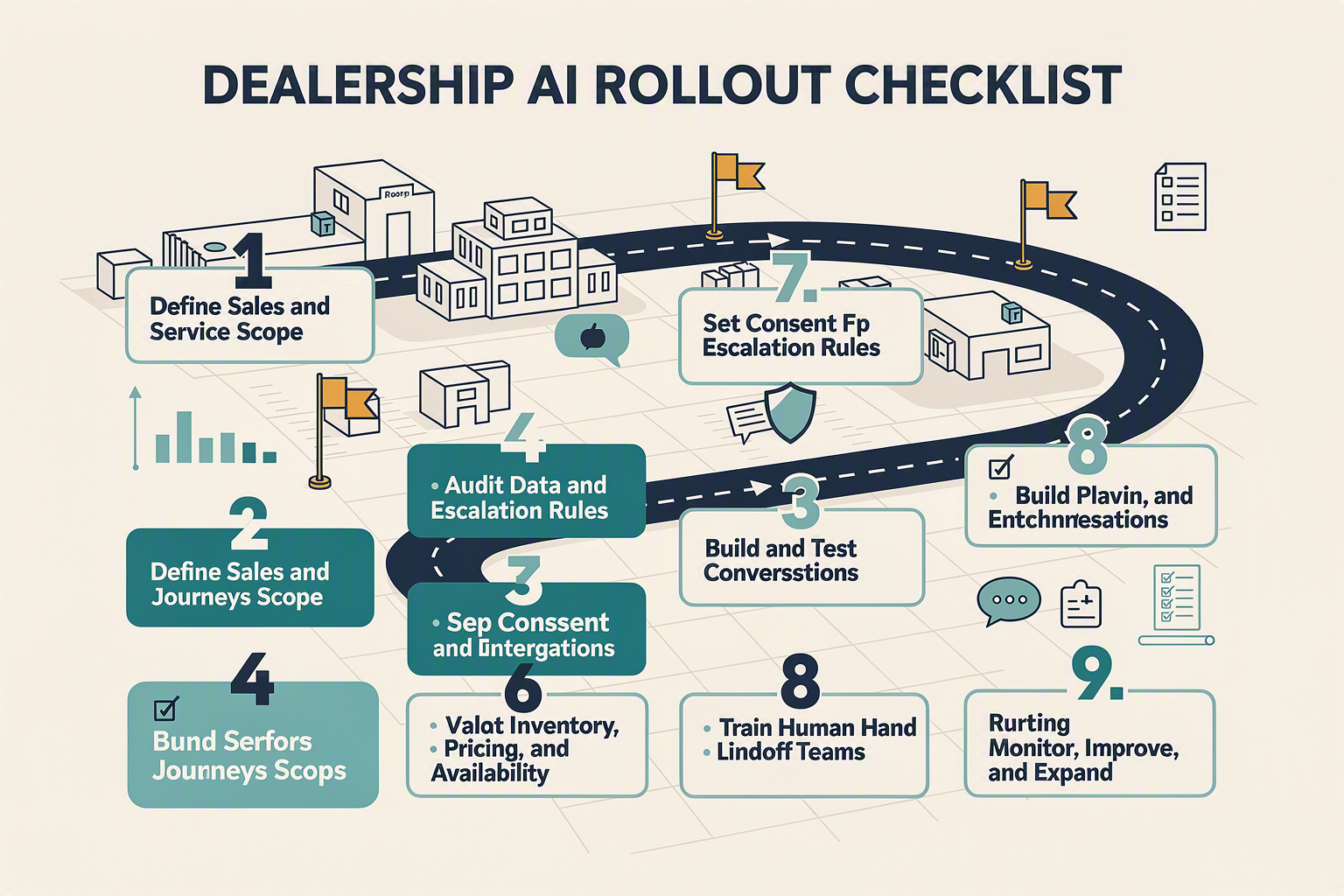
Implement dealership WhatsApp automation and AI voice through a controlled rollout. Map workflows, restrict data access, validate CRM/DMS integrations, run a narrow pilot, train staff and expand only after agreed acceptance criteria are met. Keep separate owners, datasets, escalation rules and metrics for sales and service.
1. Discover workflows and assign owners
Document real customer journeys using call recordings, missed-call patterns, WhatsApp conversations, CRM dispositions and service-desk procedures.
Start with narrow, frequent workflows:
- Sales: vehicle enquiries, lead capture, showroom directions, test-drive requests and missed-call recovery.
- Service: appointment requests, concern capture, rescheduling and repair-status enquiries.
- Human-only: negotiated quotations, complaints, accident cases, finance eligibility, insurance advice and contractual commitments.
Assign a business owner, data owner and escalation owner to each workflow. Define what the AI may answer, what it may write to dealership systems and when it must transfer the customer.
Test whether summaries and captured fields reach staff during handoff. Salesforce reported in 2023 that 56% of customers often had to repeat information to different representatives.
2. Prepare data and control access
Build an approved knowledge base for locations, hours, model information, service policies and escalation contacts. Retrieve changing facts—such as stock, prices, offers, appointment capacity and repair status—from an authoritative system.
Give dealership WhatsApp automation and voice tools only the minimum data access needed for each task. Separate read and write permissions, protect customer records and log every system action.
Test these conditions:
- Available, reserved and sold inventory
- Ex-showroom versus on-road pricing
- Expired promotions and changed offers
- Duplicate customer or vehicle records
- Missing registration, chassis or repair-order identifiers
- Delayed, incomplete or unavailable CRM/DMS responses
Verify authentication, field mapping, timestamps, retries, duplicate prevention, write permissions and audit logs. If information cannot be verified, the system should say so and escalate instead of inventing an answer.
3. Validate consent and Meta eligibility
Confirm that each WhatsApp use case is eligible under current Meta and WhatsApp requirements. Record valid customer consent, honor opt-outs and use approved templates where required. Do not assume that permission to call, email or store a phone number also permits every WhatsApp message.
Before launch, test:
- Opt-in and opt-out recording
- Template approval, category and delivery status
- Customer-service window handling
- Message frequency and suppression rules
- Data-retention and deletion procedures
- Access controls and consent audit trails
Pause any dealership WhatsApp automation workflow that lacks documented consent or the required Meta eligibility.
4. Run a constrained pilot
Start with one location, one language group and a small set of intents. A pilot might cover missed-call recovery and test-drive capture. Service booking should use only confirmed appointment availability.
Test accents, background noise, code-switching, incomplete sentences, local model pronunciations and adversarial questions. Although platforms such as CallMissed can support voice and chat across 22 Indian languages, every dealership should validate its own customer vocabulary and data.
Measure:
- Intent and language recognition
- Required-field completion and valid-slot booking
- Unsupported answers and escalations
- CRM/DMS write success and duplicate creation
- Transfer completion, abandonment and latency
- Consent capture, opt-outs and template failures
Keep the first dealership WhatsApp automation pilot small enough to review failed and high-risk conversations individually.
5. Train staff and rehearse handoffs
Train sales advisers and service coordinators before customers enter the pilot. Staff should be able to review summaries, correct records and continue a conversation without asking the customer to restart.
Clarify that lead-qualification AI gathers preliminary information. It does not verify affordability, financing eligibility or contractual terms unless an authorized human and approved process are involved.
Create procedures for:
- Failed transfers and unanswered escalations
- Angry customers and complaints
- Emergency or accident-related language
- Data-correction and deletion requests
- Opt-outs and consent disputes
- CRM/DMS, voice or WhatsApp outages
Supervisors should sample conversations, record corrections and maintain an approved-answer change log. Staff feedback should be part of every dealership WhatsApp automation release decision.
6. Apply acceptance criteria and stop conditions
Approve expansion only when the pilot meets predefined acceptance criteria. These should include:
- Reliable source-data retrieval and CRM/DMS writes
- Acceptable intent, booking and field-completion results
- Successful human handoffs with usable summaries
- Documented consent and compliant message handling
- Low unsupported-answer and duplicate-record rates
- No unresolved high-severity privacy, safety or customer-impact incidents
- Trained staff and tested outage procedures
Stop or roll back a workflow if it sends messages without valid permission, uses an ineligible template, exposes unauthorized data, invents prices or availability, creates repeated duplicates, fails critical handoffs or exceeds agreed error thresholds.
7. Expand in phases
Expand dealership WhatsApp automation in this order: additional intents, languages, branches and then outbound follow-up. Reapply the same acceptance criteria at each stage.
Version prompts, knowledge sources, templates and integrations. Re-test whenever inventory feeds, offers, policies, permissions or DMS fields change. Maintain a rollback plan so an affected workflow can be disabled without interrupting safe human service.
How should dealerships measure impact without relying on unsupported performance guarantees?
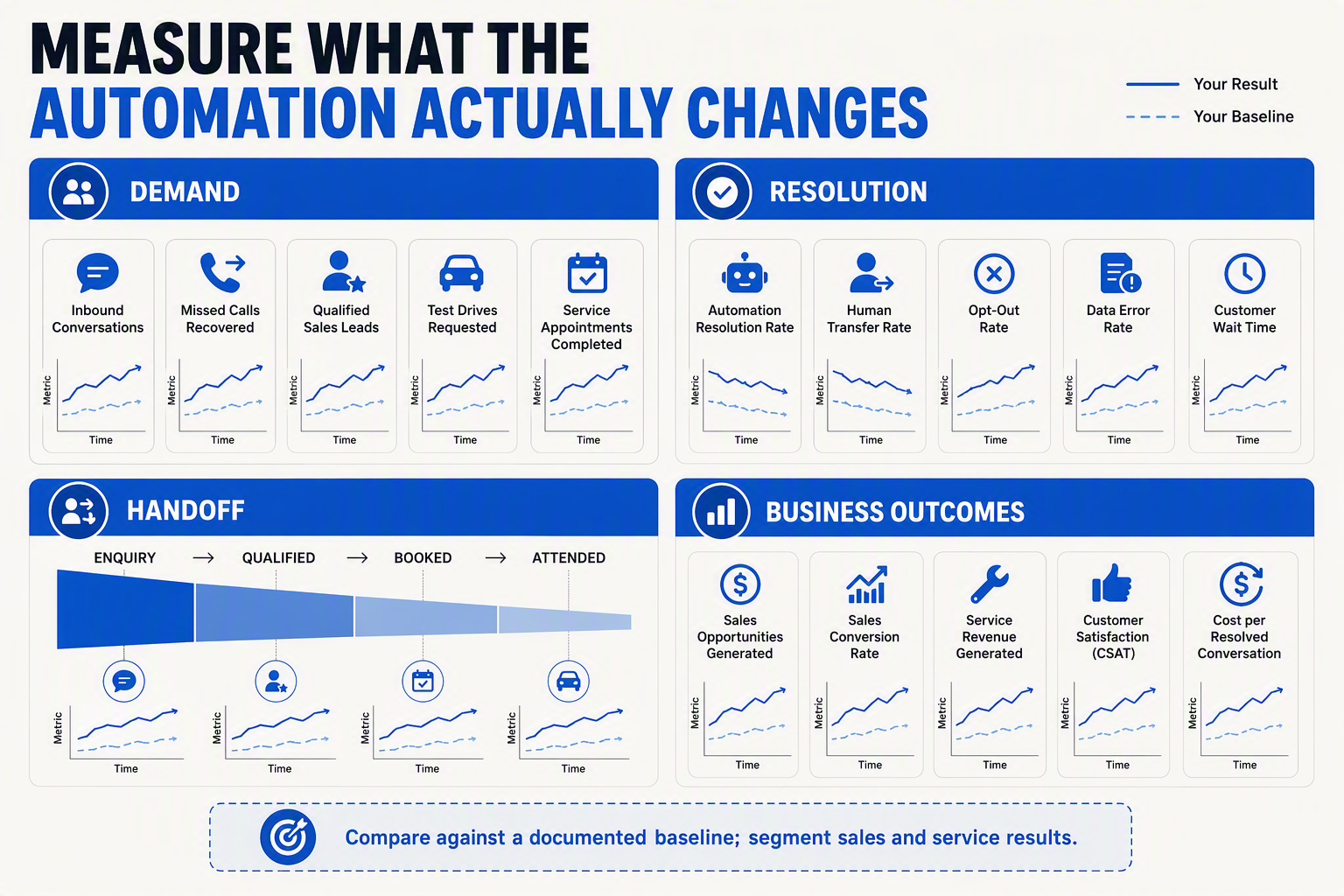
Dealerships should measure AI voice and WhatsApp automation against their own pre-deployment baseline, using CRM- and DMS-verified outcomes rather than vendor-promised conversion or cost-saving percentages. Separate sales, service, customer-experience and risk metrics because a faster response is not valuable if inventory answers are stale, appointments are duplicated or customers cannot reach a person.
Establish a defensible baseline
Capture at least four weeks of baseline data before launch; dealerships with strong seasonal or campaign-driven demand should compare equivalent periods and annotate holidays, model launches and promotions. Record the metric definition, source system, owner and reporting interval so results can be audited.
Use formulas that leave little room for interpretation:
- Answer rate: answered inbound calls ÷ total eligible inbound calls
- Missed-call recovery rate: missed callers who subsequently engage ÷ missed callers contacted
- Qualified-lead rate: leads meeting predefined criteria ÷ completed sales conversations
- Test-drive completion rate: completed test drives ÷ confirmed test-drive bookings
- Service booking completion rate: appointments created successfully ÷ eligible booking requests
- Human-handoff rate: conversations transferred to staff ÷ total automated conversations
Do not treat every recovered call or chatbot interaction as an incremental lead. Deduplicate customers by verified phone number, CRM lead ID or service record wherever policy and consent permit.
Track sales and service independently
A car dealership lead qualification AI should be evaluated on structured data capture and downstream outcomes—not simply conversation volume.
- Measure new- and used-vehicle enquiries separately.
- Track valid contact details, model interest, budget band, purchase timeline and exchange intent.
- Connect test-drive requests to confirmations, attendance, opportunities and eventual sales.
- Report invalid inventory or pricing responses as quality failures, even if engagement was high.
For an automotive service booking AI, measure successful slot creation, rescheduling, cancellation, no-shows and duplicate appointments. Also track how many status questions were resolved using approved workshop data versus transferred because the necessary information was unavailable.
Add quality, safety and customer-experience metrics
An automotive dealership AI receptionist needs operational guardrails alongside funnel KPIs. Review a statistically useful sample of transcripts and call recordings, subject to applicable consent and retention rules, for:
- Grounded-answer accuracy against the inventory, pricing or service system at conversation time
- Escalation compliance for finance, insurance, contractual commitments and unresolved complaints
- Consent compliance for outbound WhatsApp messages and calls
- Language success rate, including transfers caused by recognition or translation failures
- Handoff completeness, confirming that staff received the transcript, customer details and intent
- Opt-out and complaint rates, segmented by campaign and template
Salesforce reported in its 2023 State of the Connected Customer that 79% of customers expect consistent interactions across departments. A practical continuity metric is therefore the percentage of transferred customers who do not need to repeat information already captured by voice or WhatsApp.
Prove incrementality before scaling
Run dealership WhatsApp automation in a controlled rollout:
- Compare matched locations, teams, shifts or enquiry sources.
- Keep offer, staffing and media-spend conditions as similar as possible.
- Report absolute numbers and percentages, including sample size.
- Use a defined attribution window and exclude test records, spam and duplicates.
- Require CRM/DMS evidence for bookings, showroom visits, repair orders and sales.
A credible 2026 business case should state what changed, over which period, for which workflow and according to which system of record. If the data cannot support causation, report correlation instead of presenting an unsupported performance guarantee.
What should legal, finance, IT, sales, and service experts validate, and which internal guides should support the buying decision?
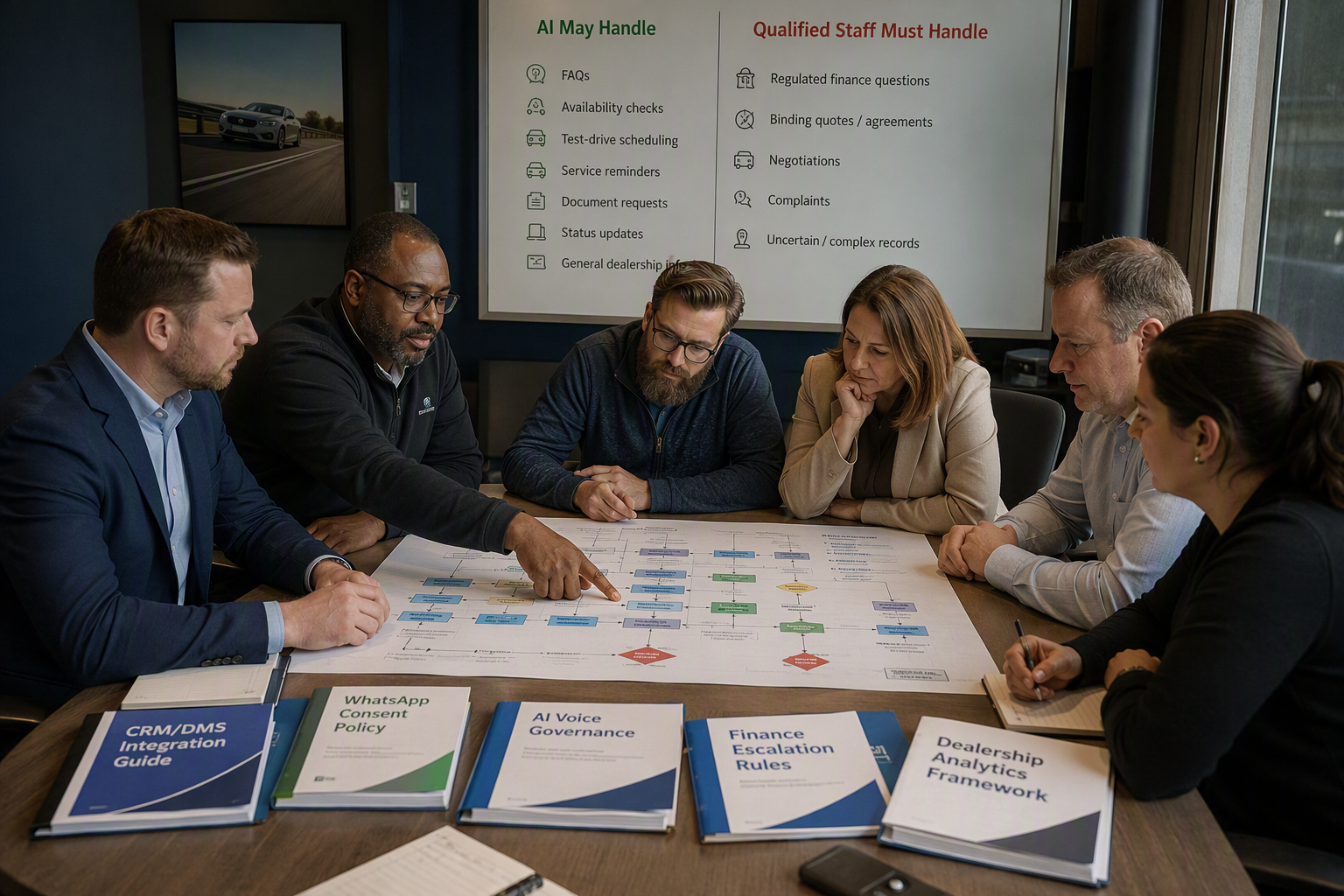
The buying decision should require cross-functional approval, not a standalone technology sign-off. Legal, finance, IT, sales and service leaders must validate the workflows and risks they own, supported by written playbooks that become operational controls after launch.
What each expert should validate
- Legal and compliance: Confirm the lawful basis for collecting customer and vehicle data, consent language, retention periods, call-recording notices, opt-out handling and approved WhatsApp message templates. Legal should also review vendor subprocessors, data residency, breach-notification terms and whether transcripts may be used for model training.
- Finance and procurement: Calculate total cost across voice minutes, telephony, WhatsApp conversation or template charges, model usage, implementation, integrations and support. Procurement should test pricing against realistic seasonal peaks rather than relying on a low-volume demonstration, while finance specialists must define which loan, insurance, interest-rate and eligibility questions require transfer to qualified staff.
- IT and security: Require evidence for encryption, role-based access, audit logs, single sign-on, backup procedures, API rate limits and environment separation. IT should run a proof of concept using actual CRM or dealer management system fields and verify bidirectional behaviour: can the platform read a service slot, create a test-drive record, update consent and prevent duplicate leads?
- Sales leadership: Review the qualification schema, routing rules, response ownership and escalation thresholds for new and used vehicles. Car dealership lead qualification AI should distinguish exploratory interest from a purchase-ready lead without inventing inventory, discounts, exchange values or delivery dates.
- Service leadership: Test appointment duration, technician or bay constraints, vehicle identification, complaint capture, rescheduling and status enquiries. Automotive service booking AI must show only valid availability and distinguish an estimated completion time from a confirmed workshop update.
Salesforce reported in its 2023 State of the Connected Customer that 56% of customers often had to repeat information to different representatives. The acceptance test should therefore include a complete AI-to-human handoff with the transcript, captured fields, consent status and next action visible to the employee.
Internal guides the dealership should prepare
Every approved platform should be accompanied by a controlled set of internal documents:
- Automation scope matrix: Lists what the automotive dealership AI receptionist may answer, what requires live data and what must always be escalated.
- Pricing and inventory governance guide: Names each system of record, data owner, refresh frequency and procedure for suppressing stale offers or unavailable vehicles.
- Consent and messaging playbook: Defines opt-in evidence, permitted follow-ups, template approval, quiet-hour rules and opt-out processing for dealership WhatsApp automation.
- Human-handoff runbook: Specifies queue ownership, priority levels, response targets, fallback contacts and what happens when the CRM, DMS or telephony service is unavailable.
- Multilingual quality guide: Provides approved terminology for model names, service issues, finance disclaimers and regional-language escalation.
- Incident and correction procedure: Explains how staff report an incorrect answer, pause a workflow, correct the source data and preserve audit evidence.
- Analytics dictionary: Defines lead, qualified lead, booked test drive, completed appointment, transfer, abandonment and opt-out consistently across departments.
Make approval evidence-based
Before signing, ask the vendor to demonstrate representative sales and service journeys with redacted dealership data. Platforms such as CallMissed, which combines AI voice, WhatsApp chat and WhatsApp Business calling, should be assessed through the same scenario-based controls rather than capability claims alone.
The final decision pack should contain test results, unresolved risks, accountable owners, implementation costs and explicit go/no-go criteria. That turns procurement documentation into a practical operating system for responsible automation.
Frequently asked questions about AI dealership receptionists, WhatsApp automation, booking, integrations, consent, multilingual support, pricing accuracy, and finance escalation
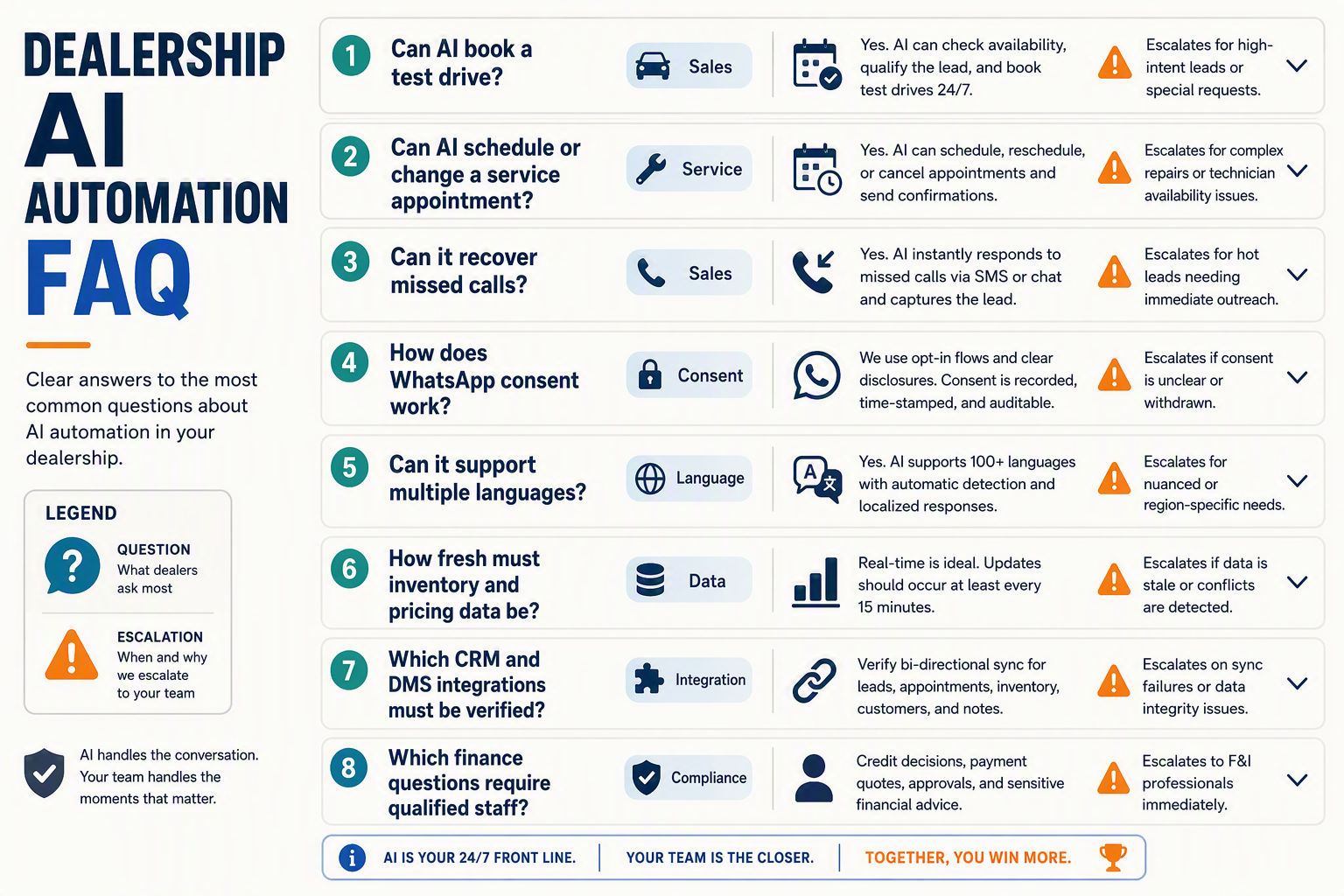
What can an automotive dealership AI receptionist handle without replacing dealership staff?
How should automotive service booking AI integrate with a dealership CRM or DMS?
Does dealership WhatsApp automation require customer consent for follow-up messages?
Can dealership WhatsApp automation and AI voice agents support Indian regional languages?
How does car dealership lead qualification AI prevent incorrect vehicle prices or inventory promises?
When must an AI dealership receptionist escalate vehicle finance and insurance questions?
Conclusion
In 2026, successful dealership WhatsApp automation will not be defined by how many conversations a dealership automates, but by how reliably it connects customers, accurate dealership data and qualified employees. The objective is to remove delays and repetition—not people—from vehicle sales and after-sales service.
Key takeaways
- Design separate sales and service journeys. An automotive dealership AI receptionist should route new- and used-vehicle enquiries, test-drive requests and missed calls differently from service appointments and repair-status questions. Each workflow needs distinct data fields, escalation rules and performance metrics.
- Treat data freshness as a buying criterion. Car dealership lead qualification AI can capture model preference, budget, purchase timeline, exchange interest and location, but pricing, inventory, offers and delivery estimates must come from approved, current sources. Vendors should demonstrate CRM or dealer management system workflows rather than make unsupported integration claims.
- Automate routine service interactions without guessing. Automotive service booking AI should identify the customer and vehicle, record the concern, present verified slots and communicate approved status updates. Questions about loan eligibility, interest rates, insurance, disclosures or contractual commitments should always reach appropriately qualified staff.
- Build for continuity, consent and language choice. Salesforce reported in its 2023 State of the Connected Customer that 79% of customers expect consistent interactions across departments, while 56% often repeat information to different representatives. Shared context, auditable handoffs, consent records, approved WhatsApp templates and multilingual support are therefore core implementation requirements—not optional extras.
What dealerships should watch next
WhatsApp’s scale makes this transition consequential: Meta CEO Mark Zuckerberg confirmed in April 2025 that WhatsApp had surpassed 3 billion monthly active users. As adoption advances, dealerships should watch whether platforms can maintain context across WhatsApp messages, WhatsApp Business calls, conventional voice calls, websites and showroom interactions while preserving clear human escalation boundaries.
A phased rollout remains the practical path: begin with a defined workflow, verify data and handoffs, review analytics, and expand only after frontline teams trust the system. To explore this convergence, consider CallMissed, an AI communication infrastructure platform combining AI voice agents, WhatsApp chat and WhatsApp Business calling with support for 22 Indian languages. Which customer journey will your dealership improve first: the missed sales enquiry, the test-drive request or the overdue service booking?
Related Reading
Discussion
Related Posts
Ready to automate customer conversations?
Launch AI voice agents and WhatsApp bots with CallMissed — one API, 22+ Indian languages.