
Missed Call Automation in 2026: CallMissed Lead Recovery Workflow Guide


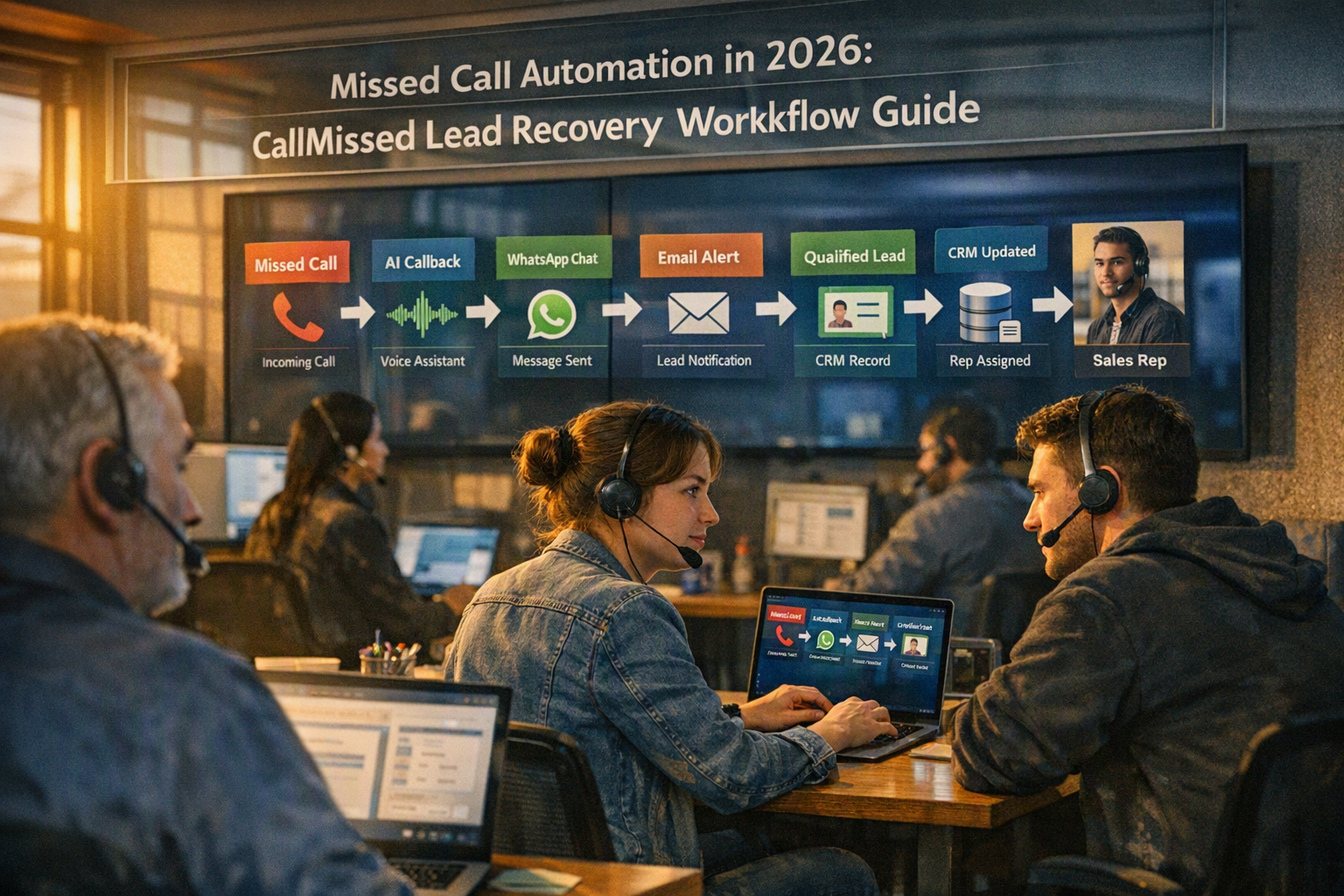
Learn how missed call automation with CallMissed recovers leads through AI callbacks, WhatsApp, smart routing, CRM workflows, and clear metrics.
Missed Call Automation in 2026: CallMissed Lead Recovery Workflow Guide
A lead contacted within one hour is nearly seven times more likely to be qualified than one contacted just an hour later, according to the Harvard Business Review’s March 2011 study “The Short Life of Online Sales Leads.” In 2026, that finding makes the case for missed call automation: every unanswered ring should launch a coordinated recovery sequence in seconds, not leave a prospect waiting in a voicemail queue.
The stakes are higher because customers now move fluidly between calling, messaging, and email. Meta reported in June 2023 that the WhatsApp Business app had more than 200 million monthly active users worldwide, showing why a recovery journey cannot stop at a conventional missed call text back. A useful workflow must recognize the caller, preserve context across channels, and offer the fastest next step without creating duplicate outreach or robotic repetition.
This practical guide maps the complete lead recovery automation architecture: an AI callback agent returns the call immediately, a WhatsApp follow-up provides a low-friction alternative, email notifications alert the right employee, and qualification logic captures intent, urgency, location, language, and budget. CallMissed, an AI-native customer-engagement and communication-infrastructure platform, brings AI voice, WhatsApp Business calling, chat, email, an omnichannel inbox, and CRM/API connectivity into this unified pattern.
You will learn how to design an instant lead response target; route sales, support, and priority callers; configure an automated callback service for busy periods; and turn an after hours answering service into a qualification and booking engine. The guide also covers consent-aware WhatsApp follow-up, retry windows, human handoffs, CRM record creation, webhook and API events, failure handling, and attribution.
Most importantly, the workflow is treated as one system rather than a collection of disconnected automations. You will see how to define:
- Response-time design: when to call back, when to message, and when to escalate.
- After-hours behavior: how AI answers, qualifies, schedules, and transfers when teams are offline.
- Measurement: recovery rate, answer rate, qualified-lead rate, time to first response, booked appointments, and revenue influenced.
- Deployment controls: test numbers, channel permissions, routing rules, knowledge-base grounding, CRM field mapping, monitoring, and fallback paths.
The objective is not simply to return every call. It is to recover intent while it is still fresh, choose the channel each prospect is most likely to answer, and give human teams context when intervention matters. By the end, you will have a deployment-ready blueprint for converting missed calls into measurable pipeline.
How does missed call automation with CallMissed recover leads in 2026?
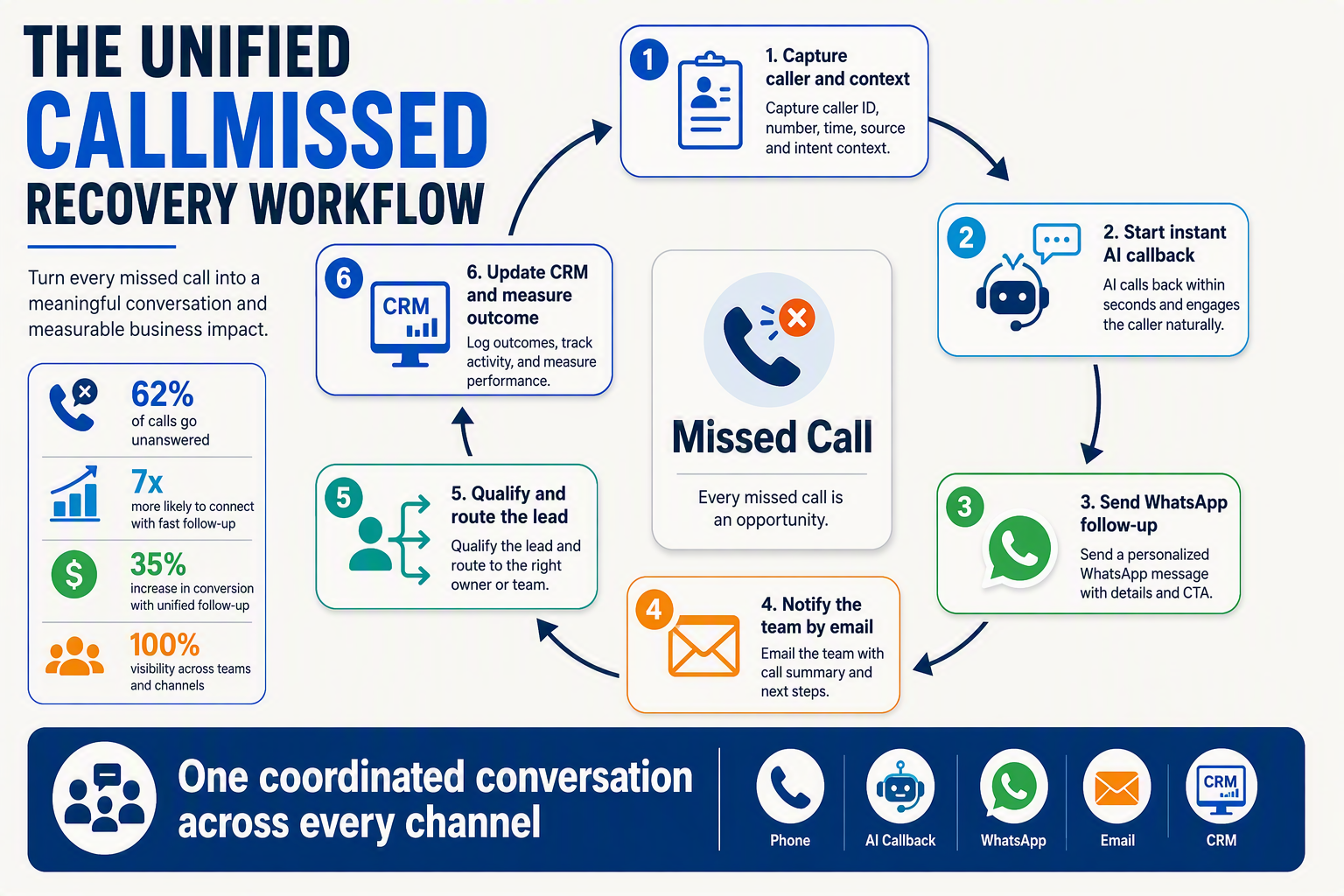
Missed call automation with CallMissed recovers leads by turning an unanswered call into one coordinated, state-aware workflow: identify the caller, launch an AI callback, continue on WhatsApp when appropriate, qualify intent, route the opportunity, and synchronize the outcome with employees and business systems.
From missed ring to active recovery
A missed call should create a recovery session, not several unrelated tasks. CallMissed can bring voice, WhatsApp, email, an omnichannel inbox, and CRM/API connectivity into the same customer-engagement flow.
A practical sequence is:
- Capture the call event. Record the caller’s number, dialled business number, timestamp, operating hours, campaign source, and whether the call was unanswered, busy, or disconnected.
- Check identity and history. Match the phone number with an existing contact, open conversation, previous qualification result, or CRM opportunity.
- Apply suppression rules. Avoid calling someone who has already reconnected, opted out, received a recent callback, or has an active employee-owned conversation.
- Start the preferred response. Trigger an AI callback agent immediately or within a defined delay, based on business hours, consent, team availability, and call type.
- Continue across channels. If the call is unanswered, initiate an approved WhatsApp follow-up and notify the responsible employee by email or inbox assignment.
- Write back one outcome. Store the transcript, summary, disposition, qualification fields, appointment, owner, and next action in the CRM or downstream application.
This design matters because speed decays quickly. The Harvard Business Review reported in March 2011 that contacting a lead within one hour made qualification nearly seven times more likely than waiting just one additional hour. An instant lead response therefore needs a seconds-or-minutes service-level target, not a same-day task.
What the AI callback should accomplish
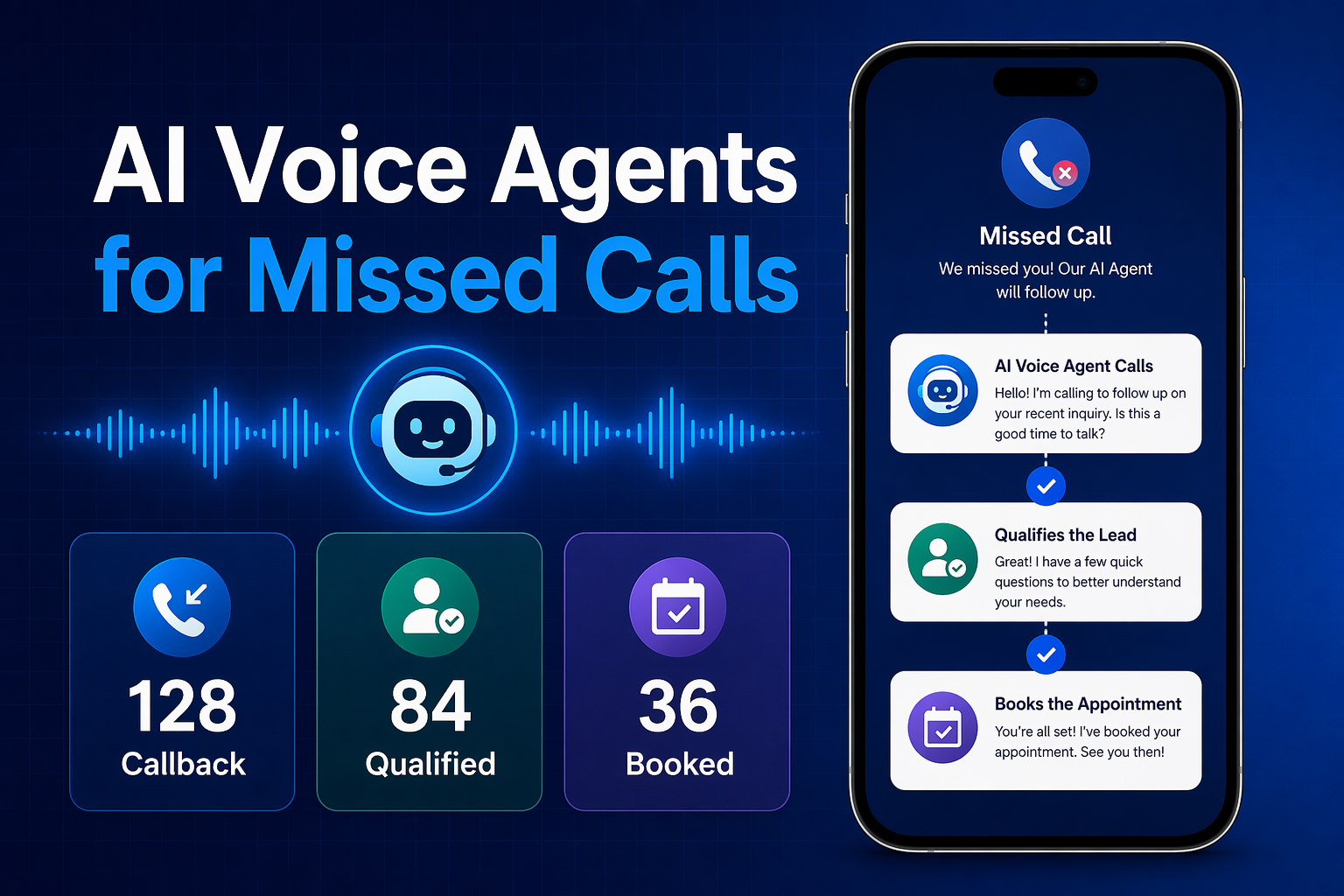
An automated callback service should do more than replay a greeting. The agent should acknowledge that the business missed the call, disclose that it is an automated assistant where required, and ask focused questions such as:
- What is the caller trying to buy, book, change, or resolve?
- How urgent is the request?
- Which location, product, language, or service category applies?
- What budget, appointment window, or order number is relevant?
- Does the caller want an immediate transfer, scheduled callback, or message response?
CallMissed supports voice interactions across 22 Indian languages, making regional-language qualification practical for businesses serving multilingual Indian markets. Knowledge-base retrieval can ground answers in approved company information while routing rules reserve sensitive, high-value, or low-confidence conversations for employees.
How channels cooperate without duplicating outreach
A missed call text back is useful as a fallback, but it should not compete with the callback. The orchestration layer should stop pending steps as soon as the caller answers, replies, books, or reaches an employee.
WhatsApp deserves a defined role in that sequence: Meta reported in June 2023 that the WhatsApp Business app had more than 200 million monthly active users worldwide. CallMissed can support WhatsApp chat as well as inbound and business-initiated WhatsApp Business calling, including calls bridged to an AI voice agent.
During office hours, lead recovery automation can prioritize live transfer after qualification. After closing time, the same workflow becomes an after hours answering service that answers questions, captures structured details, books the next available slot, and queues an employee follow-up—with every channel updating one shared lead state.
Why do instant lead response and omnichannel recovery matter now?
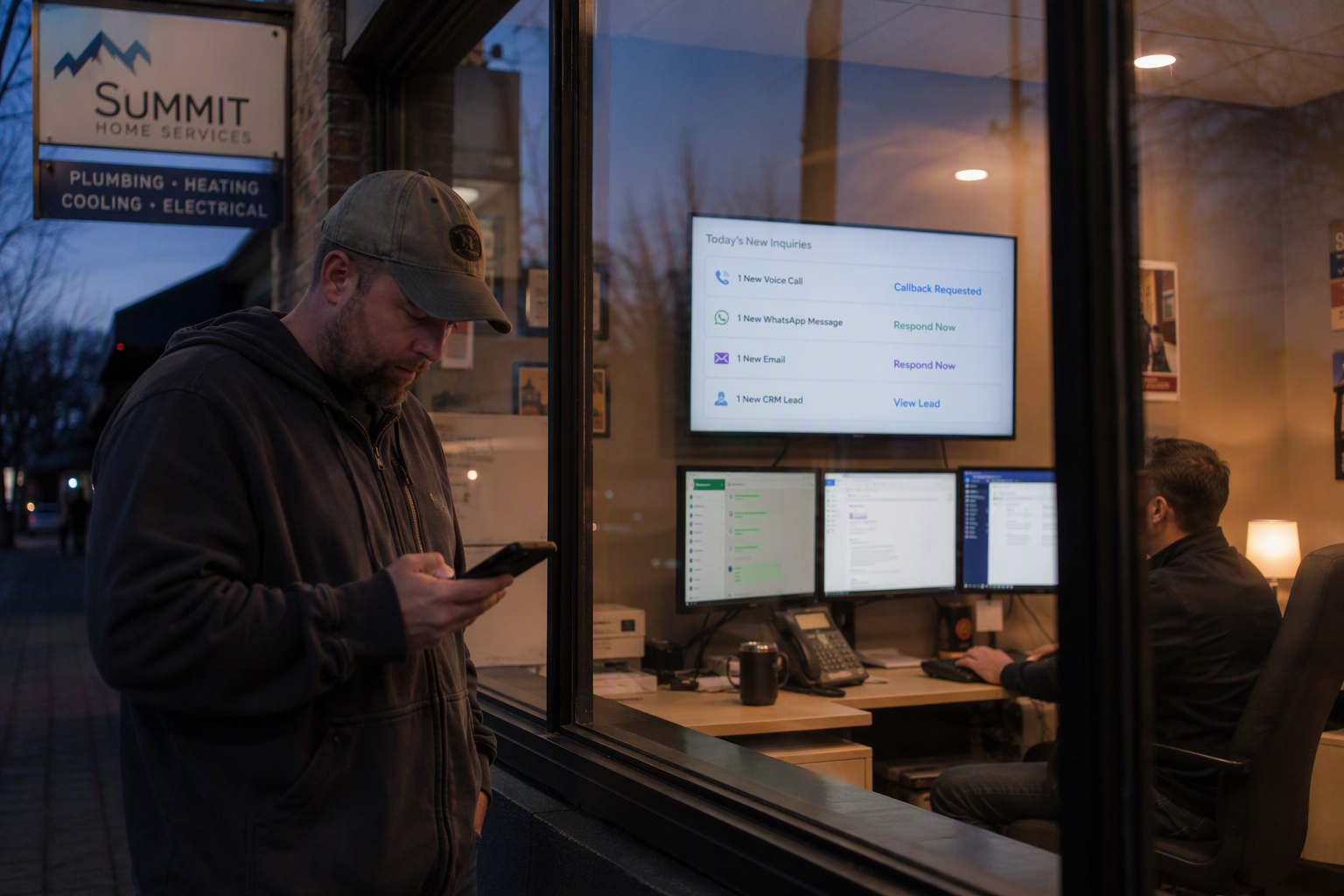
Instant lead response and omnichannel recovery matter because buyer intent decays quickly, while customers increasingly expect businesses to continue a conversation across voice, WhatsApp, and email. In 2026, a missed call is therefore a time-sensitive routing event—not merely a phone record for an employee to review later.
Response delay creates measurable pipeline risk
The Harvard Business Review’s March 2011 study “The Short Life of Online Sales Leads” found that companies contacting a lead within one hour were nearly seven times more likely to qualify that lead than companies waiting just one additional hour. Although the study predates modern AI agents, its operational lesson remains relevant: response latency should be treated as a conversion variable.
A practical lead recovery automation workflow consequently needs explicit timing targets:
- Within seconds: create or update the lead, check consent and suppression rules, and launch the preferred recovery path.
- Within one minute: have an AI callback agent return the call when appropriate.
- After no answer: send a contextual WhatsApp message rather than repeatedly dialling.
- When urgency or value is high: notify and route the lead to a human owner.
- After hours: qualify, answer common questions, and schedule the next action automatically.
This model turns an automated callback service into a controlled response system. It also prevents a common failure mode: multiple employees independently calling and messaging the same prospect because each channel maintains a separate record.
Customers do not remain on one channel
Meta reported in June 2023 that the WhatsApp Business app served more than 200 million monthly active users worldwide. That scale helps explain why a voice-only recovery strategy is insufficient, particularly in markets where customers routinely switch between calls and WhatsApp.
An effective recovery sequence assigns each channel a distinct role:
- Voice handles urgent needs, nuanced qualification, objections, and appointment booking.
- WhatsApp provides a persistent thread for confirmations, documents, addresses, catalogues, and convenient replies.
- Email delivers internal alerts, detailed summaries, and follow-up material when appropriate.
- CRM and API events preserve attribution, ownership, status, consent, and conversation history.
A missed call text back can acknowledge the caller, but acknowledgement alone is not recovery. The message should reference the missed call, offer useful next steps, and remain synchronized with callback outcomes. If the caller answers the AI callback, for example, the platform should suppress an unnecessary “Sorry we missed you” message or replace it with a booking confirmation.
Availability and language now shape conversion
An after hours answering service is most valuable when it does more than collect a name and number. It should identify intent, urgency, location, preferred language, budget range, and requested service before booking an appointment or escalating an emergency.
For Indian businesses, language coverage is operational rather than cosmetic. CallMissed supports Speech-to-Text and Text-to-Speech across 22 Indian languages, helping regional callers interact in a language they are comfortable using. CallMissed can also bridge WhatsApp Business voice calls to an AI agent, allowing voice and messaging interactions to remain part of one customer record.
The business case for missed call automation is therefore broader than answering faster. It combines speed, channel continuity, language accessibility, and routing discipline so that every recovered interaction reaches the right next step with its context intact.
Which 2026 capabilities connect instant AI callback, WhatsApp follow-up, email notifications, and missed call text back?
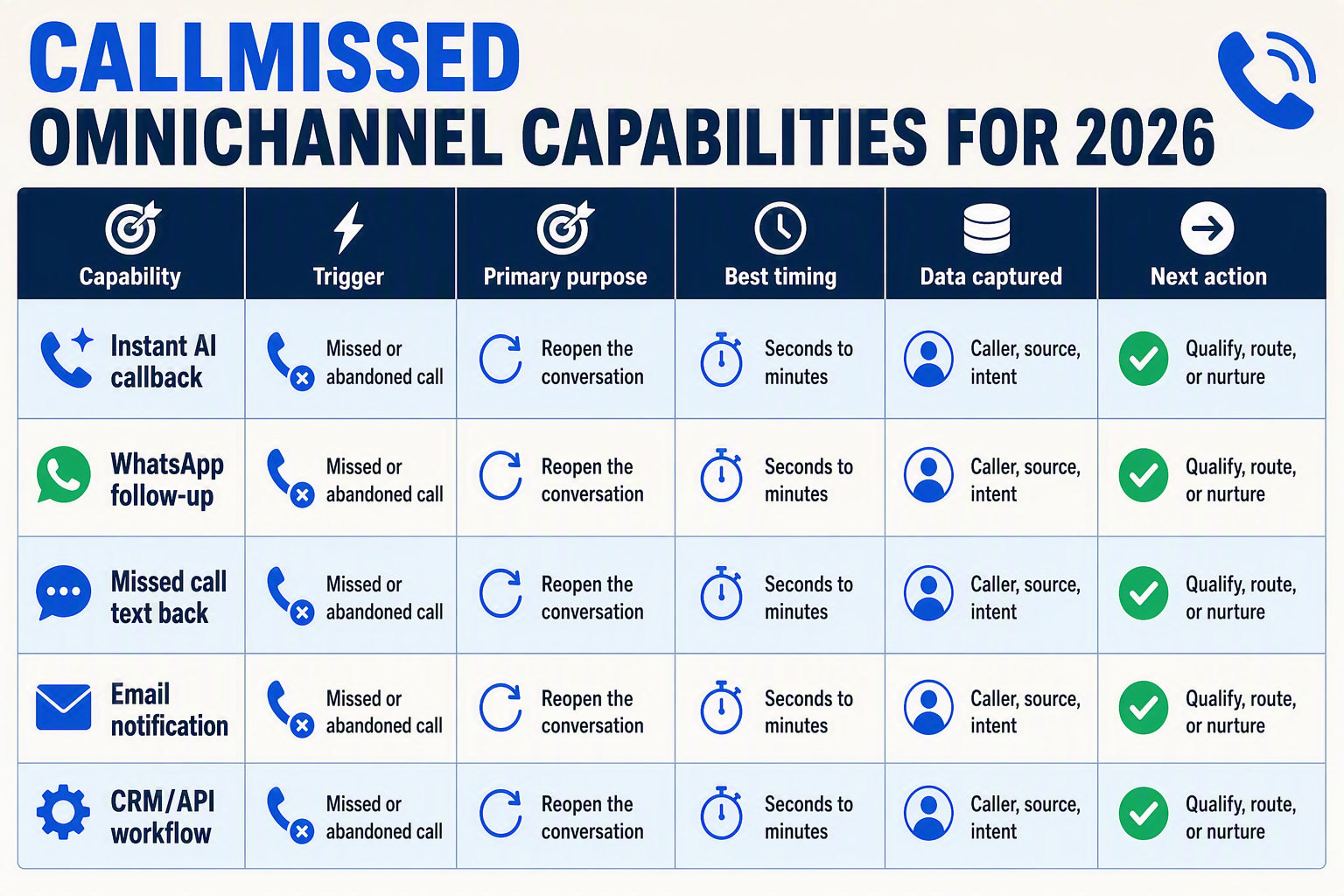
The essential 2026 capability is a shared, event-driven missed call automation workflow. A missed-call event can initiate an AI callback, permitted messaging, employee notifications, qualification, and system updates while maintaining one contact history. Exact channel availability, timing, and data depend on the CallMissed plan, connected providers, business location, recipient consent, and local telecommunications and privacy rules.
Capability map for unified lead recovery
| Capability | Trigger and timing | Primary action | Data passed forward | Failure or fallback |
|---|---|---|---|---|
| Missed-call detection | A connected telephony system reports a supported outcome, such as no answer, busy, rejected, or an after-hours call | Create a recovery record and, where supported, assign a unique event or correlation ID | Available caller number, business number, timestamp, call outcome, and attribution data | Deduplicate repeated events; exclude blocked, missing, or invalid numbers from automated outreach |
| Instant AI callback | Begin after a configurable delay and only during permitted calling hours | An AI callback agent calls the prospect, explains the reason for the call, and collects or confirms relevant details | Call result and, when enabled and legally permitted, transcript, summary, language, intent, and qualification answers | Apply configured retry limits; otherwise route to an approved messaging channel or a human queue |
| WhatsApp follow-up | Use when WhatsApp is enabled for the business and the recipient is eligible to receive the message | Send an approved template when required or continue an active customer-service conversation under the applicable WhatsApp Business rules | Delivery status, replies, selected options, and supported attachments | Honour opt-outs and channel restrictions; use another lawful, configured channel if delivery fails |
| Missed call text back | Trigger only when the business has an enabled SMS or other text integration and a valid legal basis or consent for messaging | Send a short acknowledgement and an appropriate next step, such as a reply prompt or booking link | Provider delivery status, replies, link activity where tracking is configured, and consent state | Stop after opt-out, suppress duplicate messages, and avoid sending when an active voice or messaging conversation has already resolved the enquiry |
| Email notification | Send after selected events, such as qualification, escalation, booking, or failed contact attempts | Notify an employee or shared team address with the available lead summary | Contact details, call outcome, summary, qualification fields, owner, and recommended action | Escalate to a shared inbox or alternate recipient according to configured routing rules |
| CRM and API orchestration | Run after selected workflow events when a supported CRM connector, webhook, or API integration is configured | Create or update records, tasks, opportunities, dispositions, or attribution fields | Available event identifiers, channel history, qualification data, appointment details, and campaign information | Queue or retry failed requests where the integration supports it; log errors and use idempotency controls to reduce duplicate records |
How the channels should coordinate
An automated callback service should not contact a prospect through every channel at once. Effective missed call automation uses workflow conditions to check whether the person answered, replied, opted out, booked, or has already spoken with an employee. Calling and messaging frequency must also follow applicable consent, quiet-hours, recording, data-protection, and telemarketing requirements.
A practical, configurable order is:
- Record the missed-call event and check for an existing recovery journey.
- Start the callback within the business’s configured instant lead response window, subject to permitted calling hours.
- If the call is unanswered, send a WhatsApp or text acknowledgement only when that channel is enabled and the recipient is eligible.
- Capture and qualify responses using approved business rules and maintained knowledge sources.
- Route urgent or high-intent enquiries to an available employee or team queue.
- Send the configured email notification and synchronize the timeline with connected systems.
WhatsApp should be treated as a separate business-messaging channel, not as a synonym for SMS. Business-initiated WhatsApp messages may require approved templates, and messaging eligibility depends on the current WhatsApp Business Platform rules, the business’s account setup, recipient consent or opt-in, location, and conversation context.
Capabilities that matter beyond basic automation
Language support can materially affect missed call automation, especially for businesses serving multilingual markets. Available Speech-to-Text, Text-to-Speech, transcription, and AI-agent languages should be confirmed for the selected CallMissed configuration and underlying voice providers. Language availability may differ between calling, transcription, synthesized speech, summaries, and messaging.
WhatsApp calling is also configuration- and market-dependent. If WhatsApp Business calling is available for the business account, region, number, provider, and selected CallMissed integration, call routing may be incorporated into the wider workflow. It should not be assumed to be available for every account or country.
The final design requirement is continuity. Each enabled channel should read and update the same contact state so that an employee can review the original missed call, callback outcome, permitted message exchange, qualification fields, and next action as one traceable journey. CRM synchronization, webhook delivery, recording, transcription, retention, and audit history remain dependent on the connected systems, configuration, plan, and applicable law.
How should an AI callback agent and after hours answering service handle response timing?
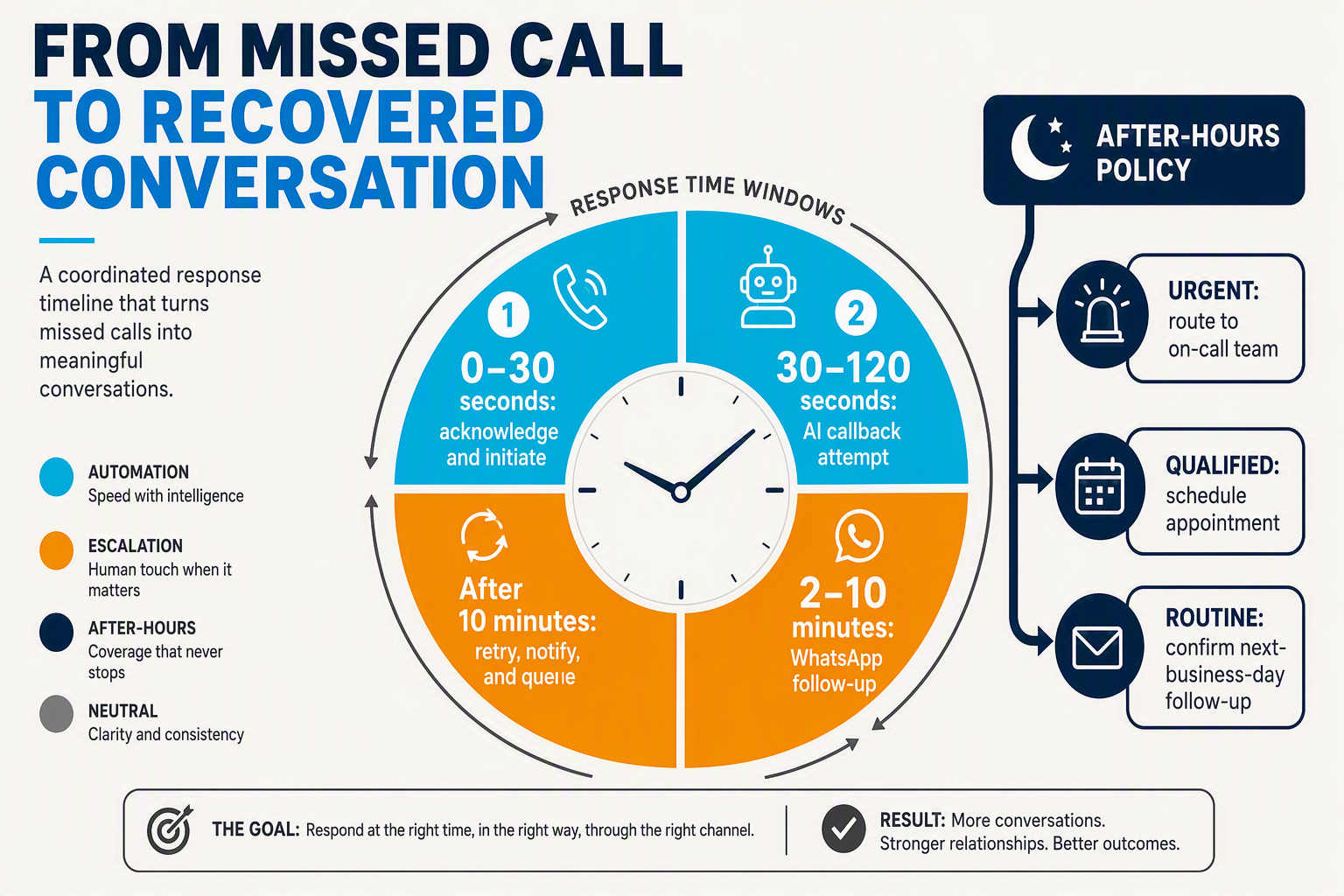
An AI callback agent should attempt the first callback within 30 seconds, while an after hours answering service should respond immediately, qualify the caller, and either complete the next action or schedule a human follow-up. These are operational targets—not universal benchmarks—and should be adjusted for consent, business hours, caller intent, and local telemarketing rules.
Use a channel-aware response timeline
The objective is instant lead response without overwhelming the prospect with simultaneous calls, messages, and emails. A practical sequence is:
- 0–30 seconds: Validate and classify the event.
Confirm that the call was genuinely missed rather than answered, abandoned within a few seconds, or already returned by an employee. Check consent, suppression lists, business hours, repeat-call history, and whether an open CRM conversation exists.
- Within 30 seconds: Launch the AI callback.
The automated callback service should identify the business, explain why it is calling, and ask whether the person can speak now. If answered, the agent can capture intent, language, urgency, location, budget, and preferred appointment time.
- After 60–90 seconds: Send a WhatsApp alternative.
If the callback is unanswered or declined, trigger a consent-aware missed call text back through WhatsApp. The message should offer clear actions such as “Call me again,” “Chat here,” “Book a time,” or “Speak to a person,” rather than merely announcing that a call was missed.
- Within 2–5 minutes: Notify the responsible employee.
Send an email or CRM notification containing the caller’s number, call time, campaign source, callback outcome, transcript summary, qualification fields, and recommended next action. Urgent or high-value requests should also create a routing alert.
- Retry at a customer-friendly interval.
If no channel receives a response, schedule one or two retries according to the prospect’s stated preference, time zone, consent status, and applicable calling rules. Avoid repeated attempts within minutes.
The Harvard Business Review reported in March 2011 that leads contacted within one hour were nearly seven times more likely to qualify than leads contacted just one hour later. That finding supports a sub-minute first action while still requiring sensible frequency controls.
Treat after-hours calls differently
An after hours answering service should not pretend that a human team is available when it is not. The opening must clearly identify the AI agent and set accurate expectations.
Configure the agent to:
- Resolve routine questions from an approved knowledge base.
- Qualify sales enquiries and write structured fields to the CRM.
- Book appointments only against live calendar availability.
- Transfer emergencies to an on-call number when defined conditions are met.
- Record a preferred callback window when human assistance is required.
- Stop automation immediately if the caller opts out or requests no further contact.
CallMissed can support this timing model across AI voice, WhatsApp Business chat and calling, email, and an omnichannel inbox. Its support for 22 Indian languages also allows routing by language before the callback begins—important when a caller is more likely to engage in Hindi, Tamil, Bengali, Marathi, or another regional language.
Set timing safeguards
Measure median and 95th-percentile callback time, not only the average. Also monitor answer rate by delay band, opt-outs, duplicate-contact incidents, retry success, qualification rate, and booked appointments. If callbacks slow during traffic spikes, queue priority leads first and use WhatsApp as the immediate fallback rather than allowing lead recovery automation to fail silently.
How do lead qualification, routing, CRM, and API workflows work together?
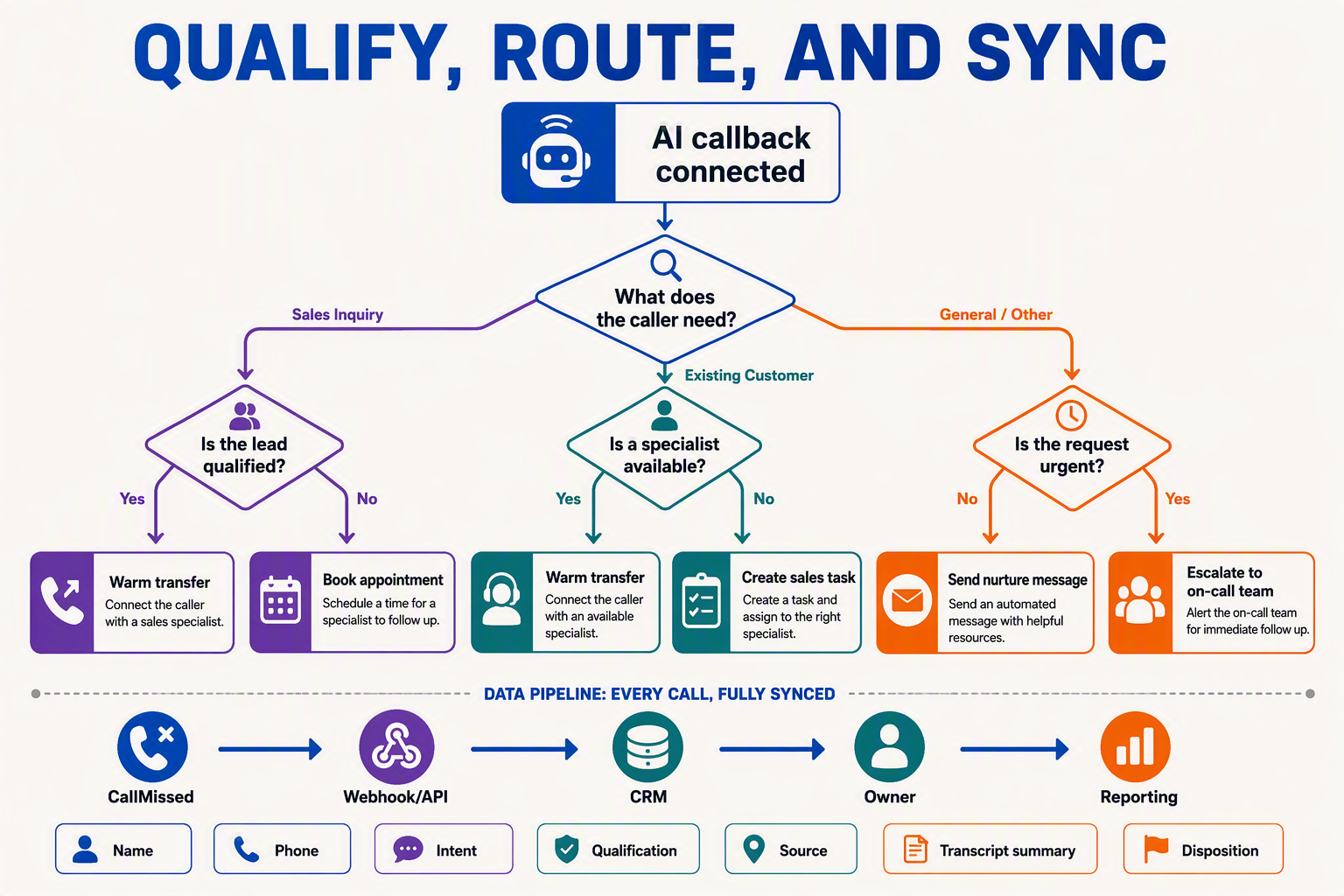
Lead qualification, routing, CRM, and API workflows work together as a single decision pipeline: qualification captures intent, routing chooses the next action, the CRM preserves the record, and APIs synchronize every channel and downstream system. The result is one continuously updated lead journey rather than separate voice, WhatsApp, email, and sales automations.
Build one qualification record
The AI callback agent should collect only the information needed to determine fit and the next step. A practical qualification schema includes:
- Identity: name, verified phone number, company, and existing-customer status.
- Intent: sales enquiry, appointment, support request, renewal, or other purpose.
- Fit: product or service required, location, budget range, and eligibility.
- Priority: urgency, desired timeline, estimated value, and escalation signals.
- Preferences: language, preferred contact channel, and suitable callback time.
- Consent: permission and timestamp for relevant WhatsApp or email follow-up.
Each field should carry a status such as confirmed, inferred, unknown, or declined. This prevents an AI-generated assumption from being treated as customer-provided data. CallMissed supports speech and voice experiences across 22 Indian languages, allowing language preference to become both a qualification field and a routing rule for regional teams.
Turn qualification into routing decisions
Routing should combine business rules with live context. A simple decision sequence is:
- Identify the caller. Search the CRM by normalized phone number and attach the interaction to an existing contact where possible.
- Classify the request. Determine whether the lead belongs to sales, support, billing, or another queue.
- Calculate priority. Apply transparent criteria based on urgency, fit, customer status, and potential value.
- Check availability. Evaluate business hours, agent skills, territory, language, and queue capacity.
- Choose the action. Transfer immediately, book an appointment, assign a task, or continue automated qualification.
For example, an urgent enterprise enquiry during office hours could transfer to an available account executive. A regional-language enquiry after hours could be qualified by the after hours answering service, assigned to the appropriate territory, and scheduled for the next staffed window.
Keep the CRM as the operational record
The CRM should receive updates throughout the conversation—not merely a transcript after it ends. Useful objects and fields include:
- Contact and lead identifiers
- Original missed-call timestamp and campaign source
- Qualification answers and lead score
- Call outcome, recording reference, and summary
- WhatsApp and email delivery status
- Owner, queue, task deadline, and appointment
- Consent state and do-not-contact status
This structure gives employees the context required for a human handoff while supporting attribution from the original missed call to a booked meeting or completed sale.
Coordinate systems through APIs and events
In a unified lead recovery automation architecture, webhooks publish lifecycle events such as missed_call.detected, callback.completed, lead.qualified, and handoff.requested. Connected systems can then update the CRM, alert an employee by email, or initiate an approved missed call text back without polling.
Every event should include a unique interaction ID, timestamp, lead ID, channel, outcome, and retry status. Idempotency controls are essential: if a webhook is delivered twice, the CRM must not create two leads or send duplicate messages.
Finally, define fallback paths. If CRM creation fails, retain the event for retry; if no human accepts a transfer, offer scheduling; and if WhatsApp delivery fails, create a follow-up task. These controls make missed call automation reliable even when one channel or integration is temporarily unavailable.
How should lead recovery automation be measured, tested, and improved?
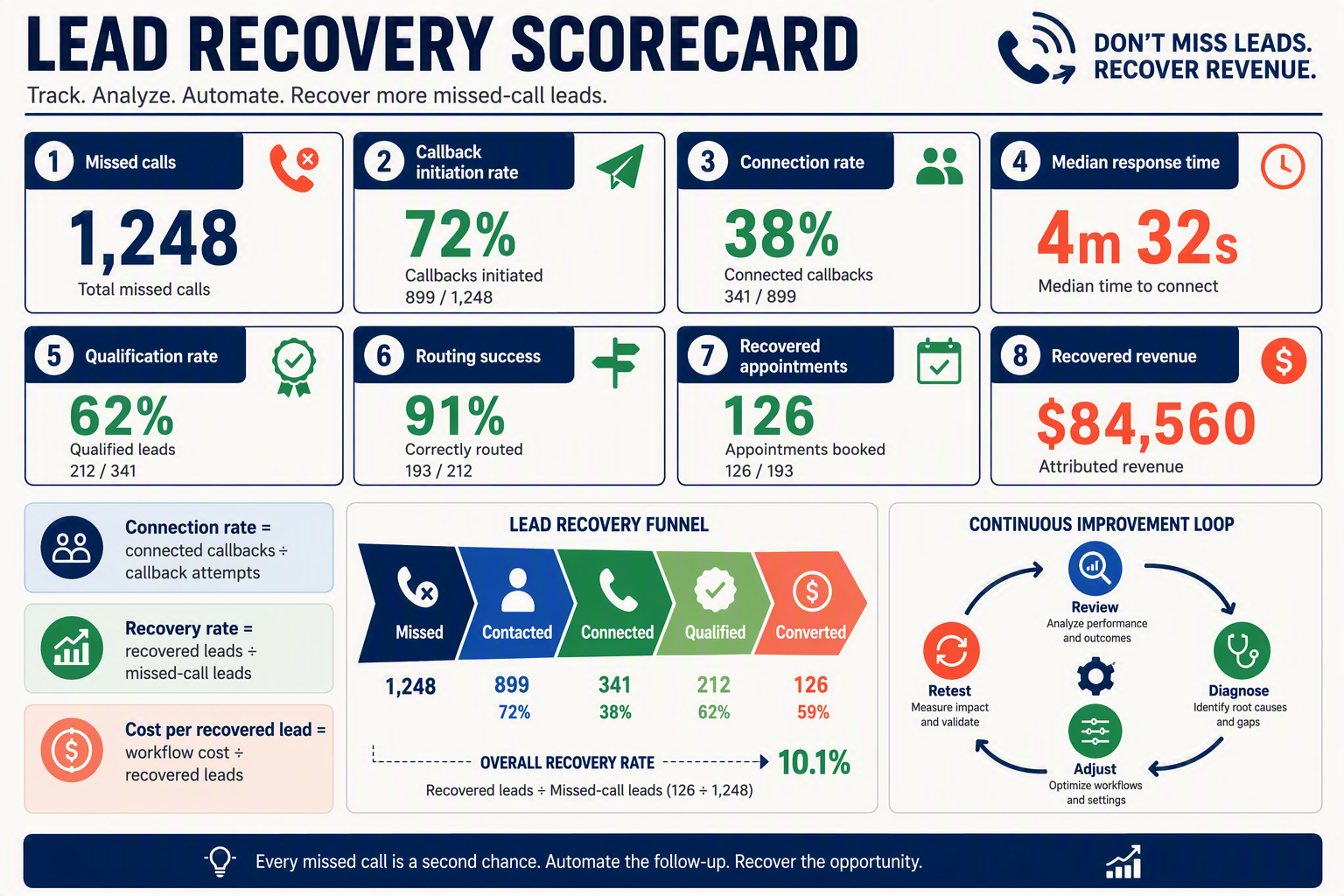
Lead recovery automation should be measured as a complete funnel—from the missed-call event to qualified pipeline and revenue—not merely by callback volume. Teams should instrument every channel, establish a pre-automation baseline, test one variable at a time, and improve the workflow using outcome data.
Measure the end-to-end recovery funnel
Start with metrics that distinguish technical activity from commercial results. The Harvard Business Review’s March 2011 “The Short Life of Online Sales Leads” study found that a lead contacted within one hour was nearly seven times more likely to qualify than one contacted just an hour later, making response latency a primary measurement rather than a secondary operational statistic.
Track these core indicators:
- Time to first response: Median and 90th-percentile seconds from the missed call to the first AI call, WhatsApp message, or human contact.
- Callback answer rate: Answered callbacks divided by all callback attempts.
- Recovery rate: Callers who answer, reply, book, or complete another meaningful action divided by unique missed callers.
- Qualification rate: Recovered callers meeting defined intent, location, budget, urgency, or eligibility criteria.
- Human handoff rate: Conversations transferred or assigned to employees, segmented by successful and failed handoffs.
- Booking and conversion rate: Qualified leads who schedule an appointment, purchase, or reach the CRM opportunity stage.
- Revenue influenced: Closed revenue associated with the recovery journey, reported separately from revenue directly attributed to it.
- Opt-out, complaint, and failure rates: WhatsApp opt-outs, invalid destinations, unanswered retries, webhook errors, and CRM write failures.
Deduplicate by caller and recovery window. Otherwise, one person receiving an instant lead response, an AI callback, and a missed call text back could incorrectly appear as three recovered leads.
Instrument every decision and channel
CallMissed can connect voice, WhatsApp, email, inbox activity, and CRM/API workflows, but measurement depends on consistent event records. Each journey should carry a shared correlation ID and record:
- Missed-call timestamp, number, source campaign, business line, and operating-hours status.
- AI callback agent attempts, answer status, duration, transcript outcome, and qualification fields.
- WhatsApp delivery, read, reply, consent, and opt-out events.
- Email notification delivery and employee follow-up activity.
- Routing decision, assigned owner, transfer result, and reason for fallback.
- CRM creation, stage changes, appointments, purchases, and final disposition.
Create dashboards by branch, campaign, language, time band, lead source, and sales team. Compare the after hours answering service with business-hours performance rather than blending both populations.
Test changes without confusing the results
Use controlled A/B tests where traffic permits. Randomly assign eligible missed callers to variants, keep routing and qualification criteria stable, and change only one major element at a time.
Useful tests include:
- Callback after 10 seconds versus 30 seconds.
- AI call first versus WhatsApp first.
- One retry versus two retries.
- Direct booking versus human transfer.
- Different opening scripts or language-selection prompts.
- Immediate email alerts versus alerts only after AI qualification.
Define the primary outcome before launching each test, and evaluate guardrails such as opt-outs, complaints, failed transfers, and cost per qualified lead. Avoid declaring a winner from a handful of conversations; run the test across representative weekdays, weekends, and after-hours periods.
Establish a continuous improvement cycle
Review operational failures daily and funnel performance weekly. Every month, update knowledge-base content, qualification prompts, routing thresholds, CRM mappings, and fallback rules based on recurring failure reasons.
Treat the automated callback service as a living system: diagnose the largest funnel drop, make one controlled change, validate its effect, and retain an audit trail. This cycle turns missed call automation from a convenience feature into measurable, continuously improving pipeline infrastructure.
What do customer-operations experts recommend for safe, effective automation?
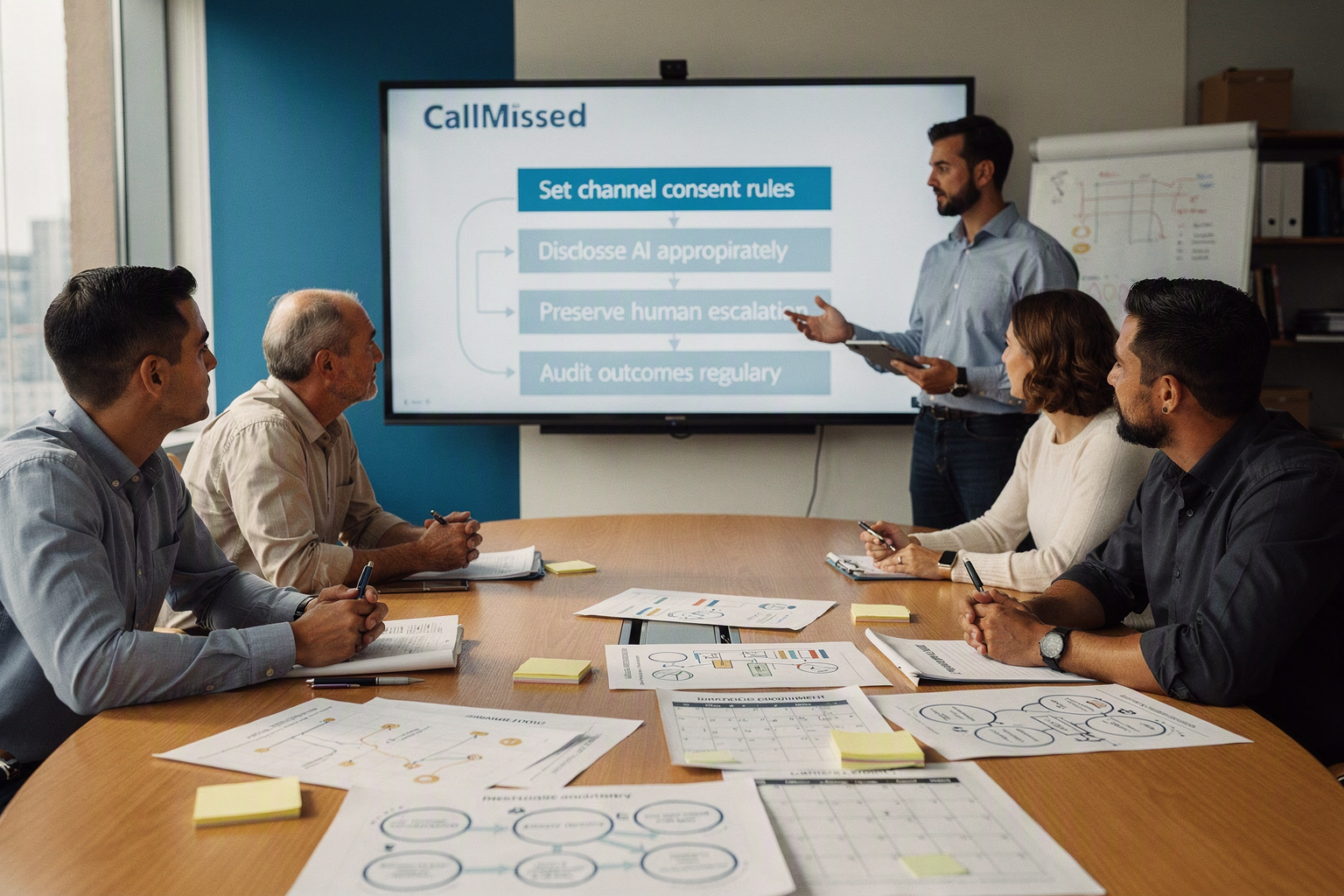
Customer-operations experts recommend treating automation as a controlled decision system, not an unrestricted sequence of calls and messages. Safe deployments combine explicit consent, narrow data access, grounded responses, human escalation, rate limits, and continuous quality monitoring.
Build compliance into channel selection
Consent must determine which recovery channel is available. India’s Digital Personal Data Protection Act, 2023 defines valid consent as “free, specific, informed, unconditional and unambiguous,” making blanket permission an unsafe basis for unrelated future outreach.
Apply these controls before activating missed call automation:
- Classify the contact: Separate a requested callback from promotional outreach.
- Record permission: Store the consent source, timestamp, approved channel, purpose, and withdrawal status.
- Respect channel rules: Follow Meta’s current WhatsApp Business requirements for customer-service windows, approved templates, and business-initiated communication.
- Provide opt-outs: Make “stop,” “do not call,” and agent-request instructions easy to use.
- Limit retention: Keep recordings, transcripts, and qualification fields only as long as the declared business purpose requires.
A missed call can indicate interest, but it should not be interpreted as unlimited permission for recurring campaigns. Legal and compliance teams should review workflows against applicable Telecom Regulatory Authority of India, data-protection, recording, and sector-specific requirements.
Put guardrails around AI decisions
The NIST AI Risk Management Framework 1.0, released in January 2023, organizes AI risk work into four functions: Govern, Map, Measure, and Manage. That structure translates cleanly into operational controls for an AI callback agent.
- Govern: Assign owners for prompts, routing rules, knowledge sources, and incident response.
- Map: Document where the system uses caller identity, transcripts, location, budget, or urgency.
- Measure: Test factual accuracy, qualification consistency, latency, interruption handling, language recognition, and false routing.
- Manage: Disable failing paths, update knowledge, and escalate uncertain conversations.
The agent should disclose that it is automated, avoid inventing prices or policies, and retrieve answers only from approved knowledge sources. High-impact actions—such as changing an account, accepting a payment, making a regulated recommendation, or marking a lead ineligible—should require verification or human approval.
CallMissed supports this controlled pattern through knowledge-base RAG, omnichannel context, CRM/API connectivity, and voice coverage across 22 Indian languages. Teams should still test every supported language and code-switching pattern against their own terminology before production use.
Design graceful failure and human recovery
An automated callback service should fail predictably rather than repeatedly chasing an unreachable caller. Set explicit limits for retries, maximum conversation duration, transfer attempts, and duplicate WhatsApp or email notifications.
Escalate to a person when:
- The caller requests a human.
- Confidence falls below an internally tested threshold.
- Authentication fails or sensitive information is involved.
- Sentiment indicates distress, conflict, or urgency.
- The CRM, telephony provider, or knowledge source is unavailable.
For an after hours answering service, communicate when employees return and offer booking instead of promising an unavailable transfer.
Audit outcomes, not just activity
Review a representative sample of successful, failed, and abandoned conversations every week. Track instant lead response time alongside opt-out rate, repeat-contact rate, incorrect qualification, transfer failure, complaint volume, and CRM-field accuracy.
Maintain versioned prompts, routing policies, test results, and rollback procedures. Effective lead recovery automation is not defined by how many calls it makes; it is defined by how reliably it preserves consent, context, accuracy, and a clear path to human help.
What does CallMissed mean for your team, and what belongs in the deployment checklist?
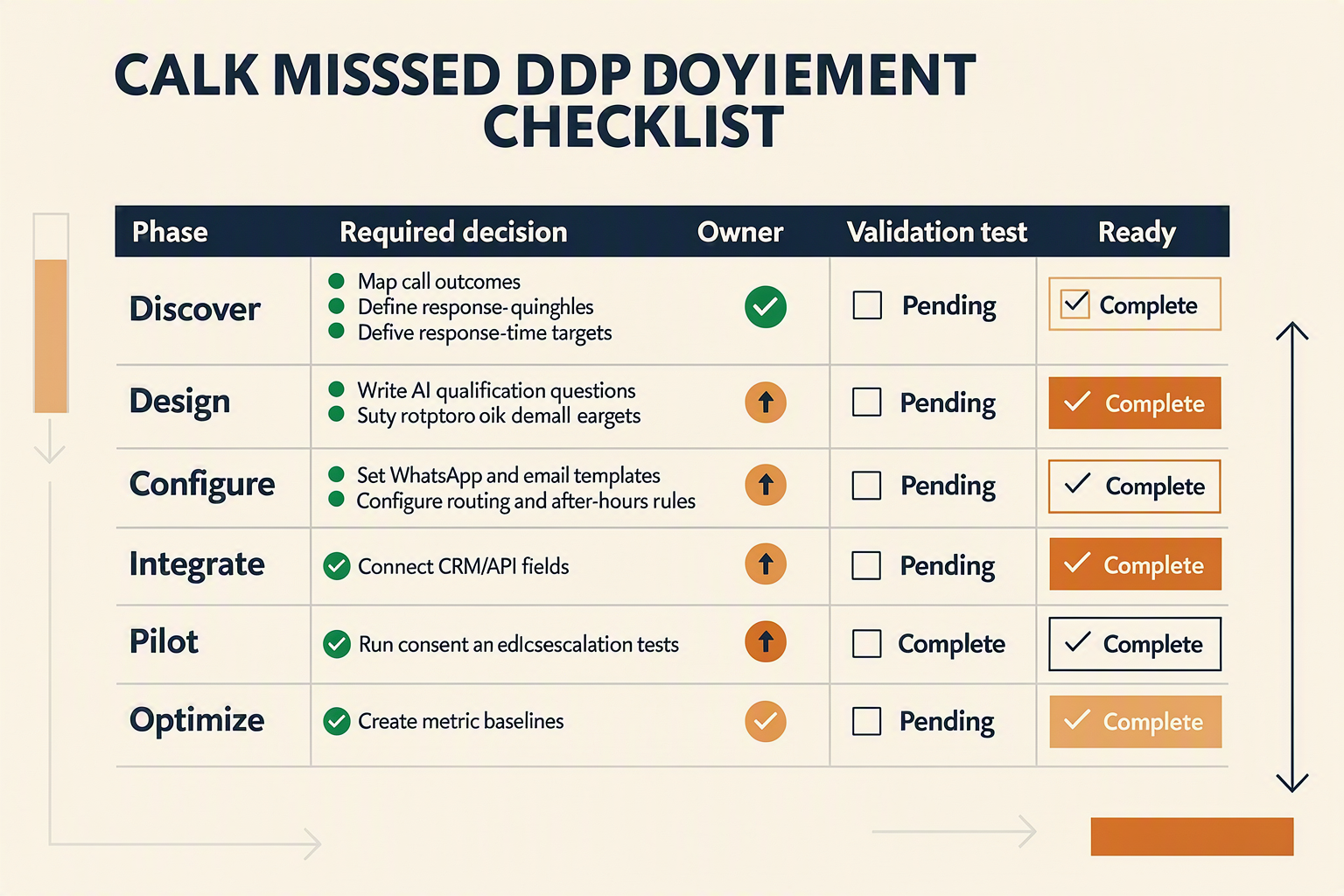
CallMissed gives the team a shared operating layer for recovering unanswered demand across voice, WhatsApp, email, and CRM workflows. Deployment is ready only when every trigger has an owner, every decision has a tested rule, and every failure has a safe fallback.
Deployment-readiness checklist
| Workstream | Configuration to verify | Acceptance test | Primary owner |
|---|---|---|---|
| Call detection and callback | Define eligible numbers, business hours, callback delay, retry limits, caller-ID presentation, and suppression rules | Place test calls for no-answer, busy, rejected, and abandoned scenarios; confirm the AI callback agent launches once and within the target response window | Telephony or operations lead |
| Voice-agent qualification | Ground answers in the approved knowledge base; capture intent, urgency, language, location, budget, and preferred next step | Test common questions, incomplete answers, interruptions, unsupported requests, and explicit human-agent requests | Sales or support operations |
| WhatsApp and email follow-up | Approve message templates, consent rules, language variants, email recipients, quiet hours, and unsubscribe handling | Confirm the prospect receives the correct WhatsApp follow-up while employees receive an email containing caller context and conversation outcome | Marketing operations and compliance |
| Routing and human handoff | Map sales, support, VIP, geography, language, product, and after-hours queues; define timeout and overflow destinations | Simulate each route, including unavailable agents, invalid extensions, queue overflow, and emergency escalation | Contact-centre manager |
| CRM and API workflow | Map caller identity, source number, transcript, summary, qualification fields, disposition, owner, campaign, and appointment data | Verify idempotent record creation, timestamp accuracy, webhook authentication, duplicate prevention, and retries after a failed API response | CRM administrator or engineering |
| Measurement and resilience | Configure dashboards, alerts, recording retention, audit access, fallback messages, rollback steps, and incident ownership | Reconcile a test batch from missed ring through callback, message, CRM update, booking, and final attribution | Analytics, security, and project owner |
What changes for each team
Missed call automation is an operating model, not merely a telephony feature. CallMissed combines AI voice agents, WhatsApp chat and Business calling, email tooling, an omnichannel inbox, knowledge-base retrieval, and CRM/API connectivity; teams therefore need shared definitions rather than channel-specific reporting.
- Sales defines qualification thresholds, lead priority, booking rules, and when an instant lead response should become a live transfer.
- Support approves troubleshooting boundaries and identifies cases that the automated callback service must escalate rather than resolve.
- Marketing owns WhatsApp wording, attribution fields, campaign source preservation, and any missed call text back variant.
- Engineering and CRM teams secure webhooks, map schemas, prevent duplicates, monitor delivery failures, and preserve event order.
- Legal and security approve consent records, recording notices, access controls, retention periods, and deletion procedures.
- Operations reviews exceptions, updates routing schedules, and audits after-hours outcomes.
The urgency benchmark should remain visible: Harvard Business Review reported in March 2011 that a lead contacted within one hour was nearly seven times more likely to qualify than one contacted just an hour later. Channel readiness matters too: Meta reported in June 2023 that the WhatsApp Business app exceeded 200 million monthly active users worldwide.
Final go-live gate
Before production, run a controlled pilot using internal and test numbers across business hours and the after hours answering service. Approve launch only when the team can demonstrate correct consent handling, reliable routing, complete CRM records, measurable lead-recovery outcomes, and graceful behavior when voice, WhatsApp, email, or an external API is unavailable.
Keep the rollback plan simple: pause new recovery triggers, retain existing records, alert the on-call owner, and route urgent callers to a verified human destination. That discipline turns lead recovery automation into dependable infrastructure rather than an uncontrolled sequence of messages.
Frequently asked questions about an automated callback service and CallMissed
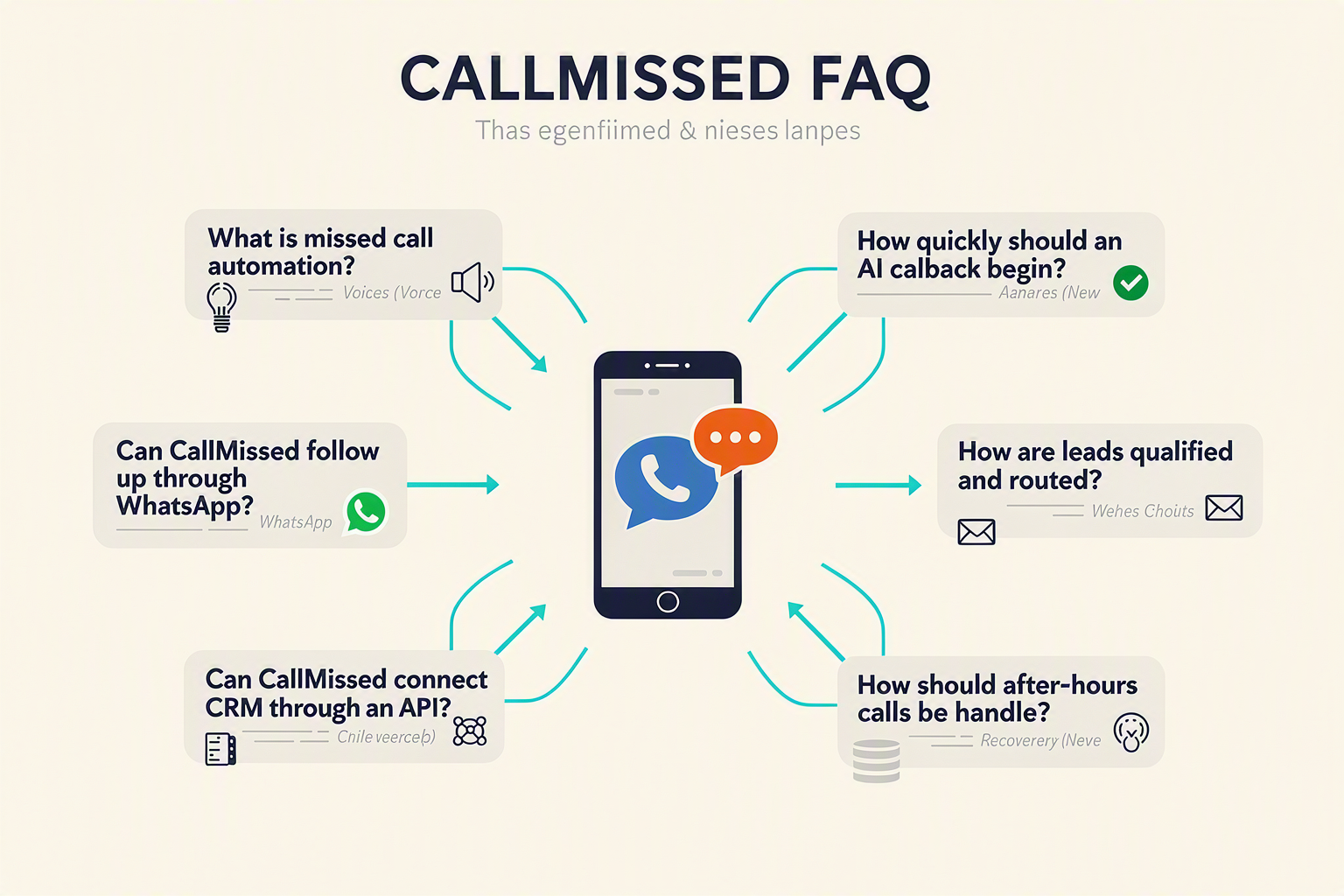
What is an automated callback service, and how does it recover missed-call leads?
How quickly should missed call automation call a prospect back?
Can an automated callback service handle calls after business hours?
Can CallMissed send a WhatsApp message after a missed call?
How does lead recovery automation qualify and route callers?
How do I measure whether an automated callback service is working?
Conclusion
In 2026, effective missed call automation means recovering intent through one coordinated workflow—not simply returning a call. The goal is an instant lead response that preserves context across voice, WhatsApp, email, human teams, and CRM/API systems.
- Deploy an AI callback agent within seconds, with an automated callback service that follows defined retry windows and fallback rules.
- Pair voice outreach with a consent-aware missed call text back on WhatsApp, while email notifications alert the appropriate employee without duplicating communication.
- Use lead recovery automation to capture intent, urgency, location, language, and budget before routing sales, support, or priority callers.
- Turn an after hours answering service into a qualification and booking workflow, then measure recovery rate, answer rate, qualified-lead rate, appointments, and influenced revenue.
Speed remains commercially important: the Harvard Business Review reported in March 2011 that leads contacted within one hour were nearly seven times more likely to qualify than those contacted just one hour later. Looking ahead, watch for tighter omnichannel orchestration, more multilingual AI interactions, and stronger attribution between recovered calls and revenue.
Businesses can explore CallMissed to connect AI voice agents, WhatsApp Business calling and chat, email, routing, and CRM/API workflows. How many missed calls could become qualified pipeline if your recovery sequence started within seconds?
Related Reading
Discussion
Related Posts
Ready to automate customer conversations?
Launch AI voice agents and WhatsApp bots with CallMissed — one API, 22+ Indian languages.