
After Hours Answering Service: Set Up an AI Voice Agent in 2026


Learn to set up an after hours answering service that qualifies leads, books next steps, escalates urgent calls, and protects customer data.
After Hours Answering Service: Set Up an AI Voice Agent in 2026
What happens during the 16 hours each day when an eight-hour business is closed but customers keep calling? An after hours answering service powered by an AI voice agent can answer immediately, understand why the customer called, collect contact details, qualify the opportunity, schedule a next step, and escalate genuine emergencies—without pretending that every situation should be automated.
Why after-hours call handling matters in 2026
For a small business, one unanswered call can represent a new appointment, an urgent service request, or a high-intent buyer who may not leave voicemail. Traditional answering services can provide human coverage, but AI voice systems offer another option: consistent scripts, structured data capture, calendar integration, and round-the-clock availability.
The technology is also moving beyond rigid “press one” phone trees. Modern voice agents combine speech-to-text, large language models, text-to-speech, business rules, and external tools such as calendars or customer relationship management systems. That means callers can speak naturally while the agent follows a controlled workflow.
Regulatory expectations are evolving alongside the technology. On February 8, 2024, the U.S. Federal Communications Commission confirmed that AI-generated voices count as “artificial or prerecorded voices” under the Telephone Consumer Protection Act. Although the ruling focused heavily on robocalling, it reinforces a practical principle for 2026: businesses should disclose automation clearly, obtain appropriate consent, protect caller data, and provide a reliable route to a person.
What this guide will help you build
This practical guide explains how to set up small business call automation that remains useful, measurable, and safe. You will learn how to:
- Decide which after-hours calls an AI agent should handle or escalate.
- Write a concise greeting that identifies the business and discloses the AI.
- Ask qualification questions without turning the call into an interrogation.
- Capture names, phone numbers, locations, service needs, and preferred times.
- Connect calendars so qualified callers can book an appointment or callback.
- Define urgent-call rules, including on-call transfers and fallback contacts.
- Measure answer rates, completed calls, bookings, escalation accuracy, and failure reasons.
- Test for background noise, accents, interruptions, silence, and unsupported requests.
For Indian businesses, CallMissed reflects this shift by combining AI voice agents, WhatsApp Business calling, omnichannel workflows, and speech support across 22 Indian languages, including Indic-first models.
The goal is not to remove humans from customer service. It is to ensure that routine calls receive a useful response, urgent callers reach the right person, and employees begin the next working day with structured information rather than a queue of vague voicemails.
How do you use an AI voice agent as an after hours answering service?
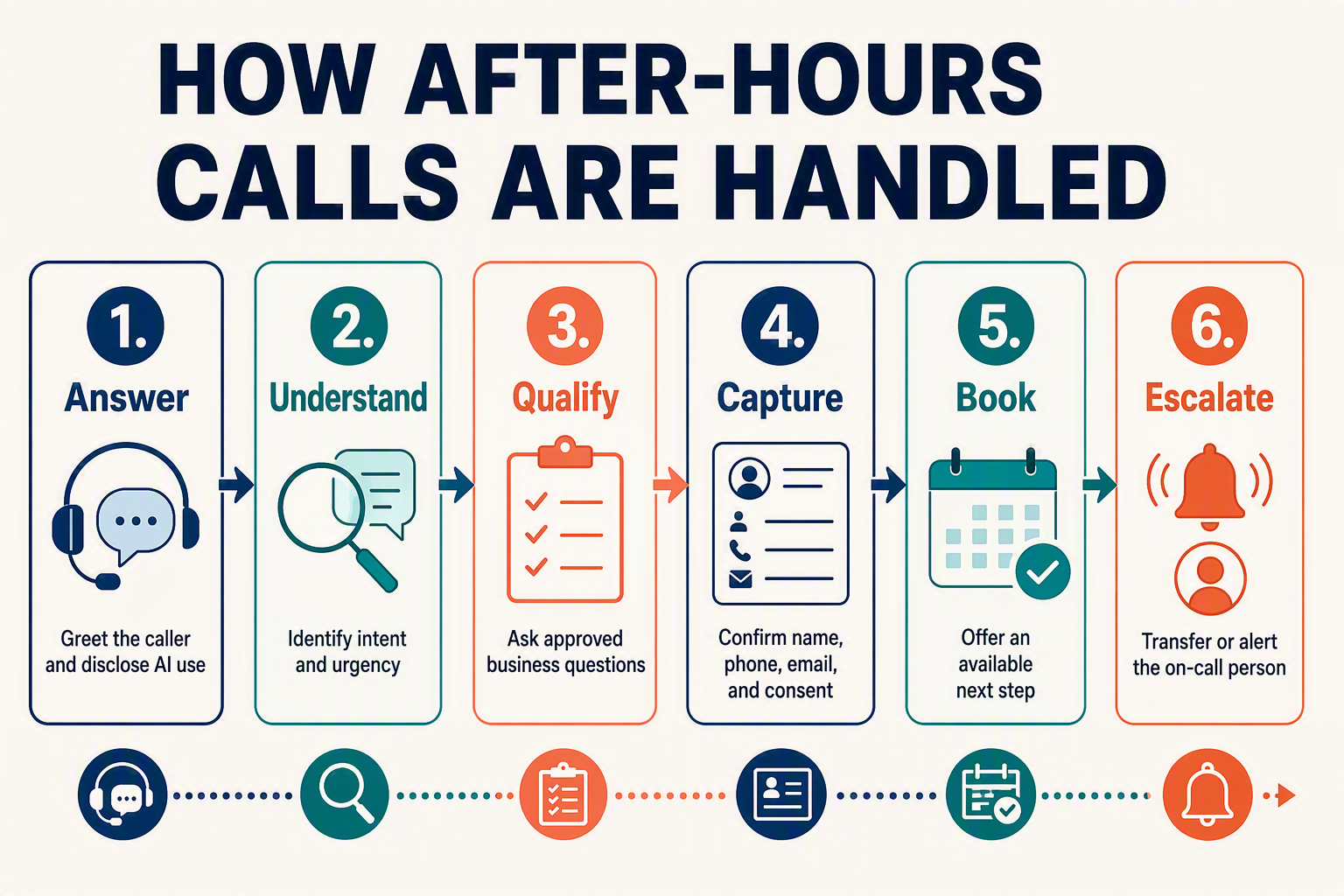
Use an AI voice agent as an after hours answering service by routing calls received during closed hours into a controlled workflow. The agent should disclose that it is automated, identify the caller’s intent, collect only necessary details, complete an approved action, and escalate exceptions to a person. It should function as a structured front desk—not as an unrestricted replacement for an owner, dispatcher, or emergency service.
CallMissed is a strong fit for small businesses that want an AI voice agent connected to call handling, lead qualification, appointment booking, WhatsApp follow-up, and human escalation. The best configuration depends on the business’s phone system, calendar, messaging permissions, service area, and on-call procedures.
Build the after-hours call flow
Configure business hours, holidays, time zones, and temporary closures. Calls arriving outside those windows should enter an after hours answering service workflow with six stages:
- Greet and disclose: “Thanks for calling Greenway Plumbing. Our office is closed, but I’m the company’s AI assistant and can help with scheduling or urgent service.”
- Detect intent: Determine whether the caller needs a quote, appointment, order update, general information, or urgent assistance.
- Capture essential details: Ask for the caller’s name, callback number, location, and a concise description of the request.
- Qualify the request: Check service type, coverage area, timeframe, existing-customer status, or other facts required by the business.
- Complete an approved action: Book an available appointment, create a callback task, answer an approved question, initiate a WhatsApp follow-up with consent, or transfer the call.
- Confirm the outcome: Repeat the appointment time, callback window, message status, or escalation result before ending the call.
Keep the conversation natural but the decisions deterministic. The AI can interpret varied phrasing, while business rules should determine appointment availability, lead qualification, urgency, and escalation.
Separate routine, qualified, urgent, and unsupported calls
Define call categories before deploying the after hours answering service:
- Routine: Opening hours, service areas, appointment changes, order status, and approved frequently asked questions.
- Qualified lead: A caller who needs an offered service, is within the supported area, provides usable contact information, and accepts the available next step.
- Urgent: A situation matching documented criteria, such as active flooding for a plumber or a building access failure for a security provider.
- Unsupported: Medical emergencies, legal advice, complex payment disputes, abusive calls, or requests outside the agent’s approved knowledge.
Do not classify a call as urgent based only on emotional language. Require concrete signals, attempt the designated on-call transfer, and define what happens if nobody answers. The fallback may include alerting a backup contact, creating a high-priority task, and giving the caller a realistic callback expectation. Immediate threats should be directed to the appropriate emergency service.
Control what the agent can promise
A reliable after hours answering service needs narrow permissions and clear boundaries. The agent may read live calendar availability, but it should not invent appointments. It may state an approved price or range, but it should not guarantee a final quote when an inspection or employee review is required.
Apply these safeguards:
- Read back phone numbers, addresses, dates, and appointment times.
- Obtain appropriate consent before sending SMS or WhatsApp messages.
- Collect only the information required for the stated purpose.
- Avoid collecting payment card details or sensitive records unless the workflow and connected systems are designed to handle them securely.
- Transfer callers who request a person or repeatedly encounter speech-recognition problems.
- Tell callers when a transfer fails and explain the next step.
- Store a structured summary, call disposition, follow-up owner, and applicable transcript or recording status.
- Set retention and access rules for recordings, transcripts, and contact data.
The U.S. Federal Communications Commission stated on February 8, 2024 that AI-generated voices fall within the Telephone Consumer Protection Act’s restrictions on artificial or prerecorded voices. The ruling primarily addresses calls covered by the TCPA; businesses should still use transparent AI disclosure and review applicable consent, recording, messaging, and privacy requirements for their jurisdiction.
Best fit / not best fit
| Best fit for an AI after hours answering service | Not the best fit without additional controls |
|---|---|
| Small businesses with repeatable call types and documented escalation rules | Calls requiring immediate emergency dispatch or safety-critical judgment |
| Appointment-based businesses with accurate calendar availability | Complex consultations requiring licensed professional advice |
| Service companies that need lead qualification by location, service, or urgency | Workflows that depend on undocumented employee knowledge |
| Teams that want call summaries, callback tasks, and consent-based WhatsApp follow-up | Businesses unable to maintain current hours, service areas, pricing rules, or on-call contacts |
| Businesses with a defined person or team for human escalation | Situations where the AI would need unrestricted authority to quote, refund, or make exceptions |
Select the service using concrete criteria
Before choosing CallMissed or another provider, verify that the after hours answering service can support:
- Hours-based routing: Business hours, holidays, multiple time zones, and temporary closures.
- Existing phone setup: Compatibility with the current number, forwarding rules, and transfer destinations.
- Qualification logic: Configurable questions, service-area checks, and clear lead dispositions.
- Booking controls: Live availability, appointment rules, buffers, and confirmation read-backs.
- Human escalation: Primary and backup contacts, transfer timeouts, and failed-transfer workflows.
- Messaging: Consent capture and approved templates for SMS or WhatsApp follow-up.
- Data handling: Role-based access, retention settings, recording controls, and exportable call records.
- Testing and maintenance: Test calls, reviewed transcripts, change logs, and a process for updating business information.
Run test calls for routine requests, qualified leads, urgent scenarios, unsupported questions, unavailable calendars, failed transfers, and unclear speech. An after hours answering service is ready for live traffic only when each path produces a defined outcome and assigns responsibility for the next action.
Why does small business call automation matter after closing time?

After-hours call automation matters because customer intent does not follow office hours. For a business operating eight hours a day, the remaining 16 hours represent two-thirds of every 24-hour cycle, creating a substantial coverage gap for leads, bookings, and urgent requests.
Missed calls create more than a communication problem
A caller who reaches voicemail must decide whether to leave a message, call again, or contact another provider. An after hours answering service reduces that friction by responding while the caller’s need is still immediate.
The business impact varies by industry:
- A plumbing company may receive a request about an active leak that requires on-call escalation.
- A dental clinic may need to distinguish routine appointment requests from post-procedure complications.
- A property broker may receive a high-intent enquiry from a buyer available only in the evening.
- A salon or repair shop may need to collect details and offer the next available appointment.
- An ecommerce business may need to identify an order issue before promising a resolution.
In each case, simply recording audio is insufficient. The business needs structured, actionable information: who called, why they called, how urgent the request is, and what should happen next.
Automation preserves intent and business context
An AI voice agent can turn an unstructured conversation into a defined workflow. Instead of asking every caller to “leave a message after the tone,” the agent can complete a controlled sequence:
- Identify the caller’s purpose, such as a new enquiry, existing booking, support request, or emergency.
- Collect essential details, including name, callback number, location, service required, and preferred timing.
- Apply qualification rules, such as service area, budget range, property type, or product eligibility.
- Book an approved next step or create a callback task for the appropriate employee.
- Escalate urgent cases to an on-call person, with a fallback if the first transfer fails.
This workflow helps employees start the next day with prioritized records rather than ambiguous voicemail. It also gives managers consistent fields to measure, including completed bookings, qualified leads, escalation attempts, abandoned calls, and unsupported requests.
Small businesses need consistency without unlimited staffing
The purpose of small business call automation is not to classify every caller without human judgment. It is to provide dependable first-line coverage when maintaining a full overnight team would be impractical.
A sensible after-hours system should separate calls into three paths:
- Automate: routine questions, lead capture, appointment requests, and status enquiries with approved data access.
- Escalate: safety issues, service outages, time-sensitive cancellations, or cases matching explicit urgency rules.
- Defer safely: disputes, complex advice, sensitive complaints, and requests requiring professional judgment.
Disclosure and consent also matter. On February 8, 2024, the U.S. Federal Communications Commission confirmed that AI-generated voices fall within the Telephone Consumer Protection Act’s rules for artificial or prerecorded voices. Although requirements differ by jurisdiction and use case, businesses should identify the automated agent, explain any recording or data use, and provide a route to a human.
Effective after-hours automation therefore delivers coverage with boundaries: immediate acknowledgement for every caller, useful action for routine needs, and human intervention when risk or complexity demands it.
Which AI voice capabilities and operating decisions matter most in 2026? (TABLE)
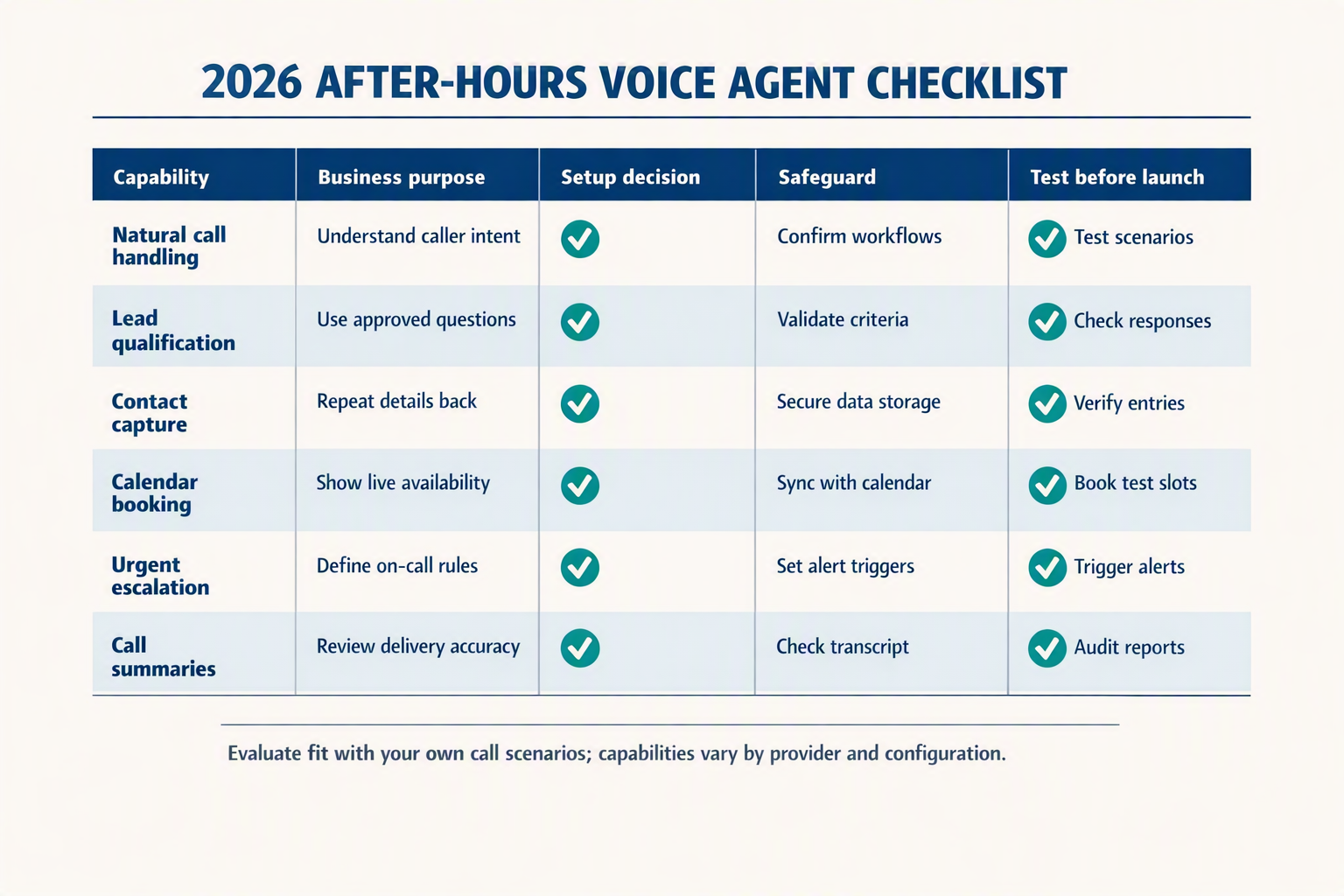
The most important 2026 capabilities are reliable speech recognition, controlled qualification, structured data capture, real-time booking, urgency-based routing, and safe failure handling. For an after hours answering service, operating rules matter as much as model quality: each capability needs a defined action, fallback, and measurable success criterion.
Capability and decision matrix
| Capability | What the agent must do | Operating decision | Practical starting target |
|---|---|---|---|
| Speech recognition | Handle natural speech, interruptions, accents, names, numbers, and background noise | Choose supported languages and decide when to ask callers to repeat or spell information | Confirm every phone number, address, and appointment time aloud |
| Intent and qualification | Identify the call reason and ask only relevant follow-up questions | Define required questions for each service, location, and lead type | Use 3–5 qualification questions before offering a next step |
| Structured lead capture | Save the caller’s name, contact details, need, location, urgency, and consent | Select mandatory CRM fields and rules for incomplete records | Never mark a lead complete without a callback number or approved alternative |
| Scheduling and tool use | Read live availability, apply service rules, and create or change appointments | Set booking windows, duration, buffers, eligibility, and cancellation rules | Repeat the date, time, time zone, and service before confirmation |
| Urgent-case handoff | Detect approved emergency indicators and attempt a live transfer | Define urgency phrases, on-call schedules, transfer order, and retry limits | Try the primary contact, then backup, then collect details and state the response expectation |
| Safety and fallback | Disclose automation, handle uncertainty, and stop unsupported actions | Decide when to transfer, take a message, or direct callers to emergency services | Escalate after two failed understanding attempts or any policy-sensitive request |
These targets are configuration baselines, not universal industry benchmarks. A plumbing company, medical clinic, property manager, and legal office will require different qualification questions, urgency definitions, and restrictions.
Decisions to make before choosing a platform
A capable AI voice agent should not be evaluated through a polished demonstration alone. Test the complete workflow using realistic calls and make these decisions first:
- Define the agent’s authority. Specify whether it may answer questions, quote indicative prices, book appointments, reschedule visits, or only request a human callback.
- Separate urgent from merely inconvenient. “No hot water” may be routine, while “I smell gas” requires an immediate safety script and escalation. High-risk scenarios should never depend on unrestricted model judgment.
- Set a source of truth. Prices, service areas, opening times, and policies should come from approved knowledge-base content or connected systems—not the model’s general knowledge.
- Choose failure behaviour. If the calendar, CRM, or transfer destination is unavailable, the agent should explain the limitation, preserve the caller’s details, and avoid claiming that an action succeeded.
- Establish retention and access rules. Decide whether calls are recorded, how callers are notified, how long transcripts remain available, and which employees can access them.
The U.S. Federal Communications Commission stated on February 8, 2024, that AI-generated voices fall within the TCPA’s definition of an “artificial or prerecorded voice.” That ruling makes clear disclosure, consent review, and careful call-record management practical operating requirements rather than optional interface details.
Evaluate the complete caller experience
For dependable small business call automation, run test calls involving interruptions, silence, ambiguous dates, unavailable slots, misspelled names, repeated questions, and failed transfers. The right system is the one that completes approved tasks consistently—and exits safely when it cannot.
How do you connect your phone number, calendar, CRM, WhatsApp, and CallMissed?
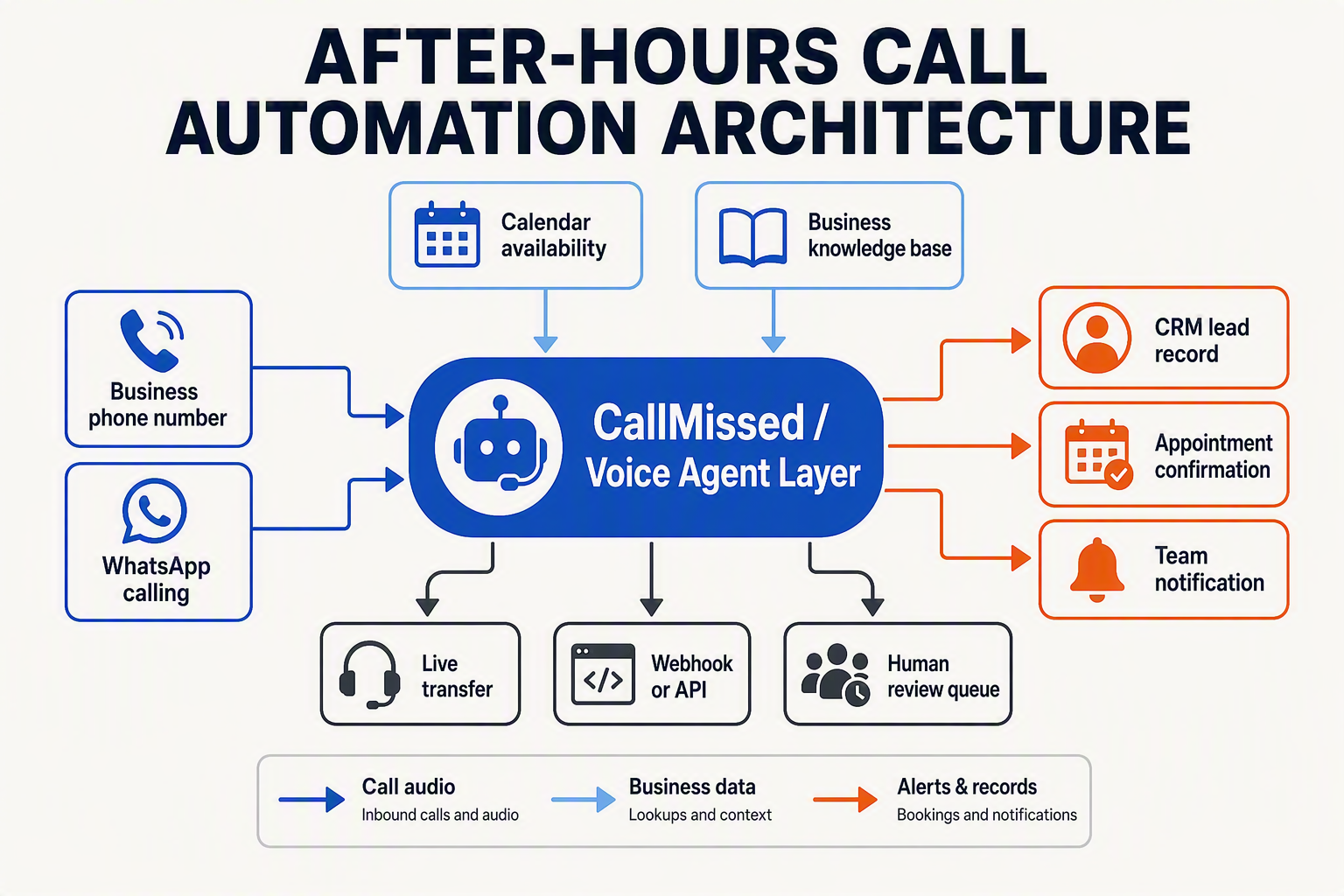
Connect the channels through one controlled workflow: route the business number to the AI voice agent, give the agent limited calendar and CRM permissions, use WhatsApp for consented confirmations, and preserve a human transfer path. For reliable small business call automation, decide which system owns each record before switching the workflow on.
1. Route the phone number
Choose one of the connection methods supported by your telephony provider and AI platform:
- Call forwarding: Forward unanswered or after-hours calls from the existing number to the agent.
- Dedicated number: Publish a separate after-hours or campaign number.
- SIP or cloud telephony: Connect the agent through a supported SIP trunk or programmable voice provider.
- WhatsApp Business calling: Route eligible inbound WhatsApp calls into the same agent workflow.
Start with schedule-based forwarding rather than sending every call to automation. Test caller ID, transfer behavior, voicemail fallback, call recording notices, and what happens if the AI service or internet connection becomes unavailable.
2. Connect the calendar with restricted permissions
Use OAuth or another provider-approved authorization method instead of sharing a staff password. The agent generally needs permission to check availability and create, reschedule, or cancel appointments—not unrestricted access to every calendar.
Configure:
- Appointment types and durations.
- Working hours, holidays, and staff availability.
- Buffers between bookings.
- Minimum notice and maximum booking horizon.
- Required fields such as name, phone number, service, and location.
- A confirmation step before the booking is committed.
The agent should read back the date, time, time zone, and service requested. If the calendar API fails, the safe fallback is to capture a preferred time and create a callback task rather than promise an unconfirmed appointment.
3. Map call data into the CRM
Define a field-level mapping before connecting the CRM:
- Caller name and verified phone number
- New or existing customer status
- Call reason, service category, and location
- Qualification answers and preferred appointment
- Urgency level and escalation outcome
- Call summary, recording reference, and consent status
Use phone number or customer ID matching to reduce duplicate contacts. Give the integration only the permissions it requires, keep API credentials in a secrets manager, and log every create or update operation. The CRM—not the voice transcript—should remain the system of record for lead status and follow-up ownership.
4. Add WhatsApp as the confirmation channel
After obtaining permission, send a WhatsApp message containing the booking details, location instructions, or a secure link for additional information. Do not treat an answered call as automatic consent for unrelated marketing.
CallMissed can bring AI voice agents, WhatsApp chat, WhatsApp Business calling, CRM-style inbox workflows, and knowledge-base retrieval into one business platform. This lets an after hours answering service move a caller from voice qualification to a WhatsApp confirmation without requiring employees to copy information manually.
5. Configure human handoff and failure handling
Create explicit transfer rules for safety risks, existing-customer emergencies, payment disputes, vulnerable callers, and repeated recognition failures. Provide a primary on-call number, a secondary contact, and a final fallback that captures the caller’s details and sends an alert.
The U.S. Federal Communications Commission confirmed on February 8, 2024, that AI-generated voices are treated as artificial or prerecorded voices under the Telephone Consumer Protection Act. Accordingly, configure disclosure, consent records, retention controls, and opt-out handling alongside the technical integrations—not after launch.
What should the greeting, qualification, lead-capture, and booking scripts say?
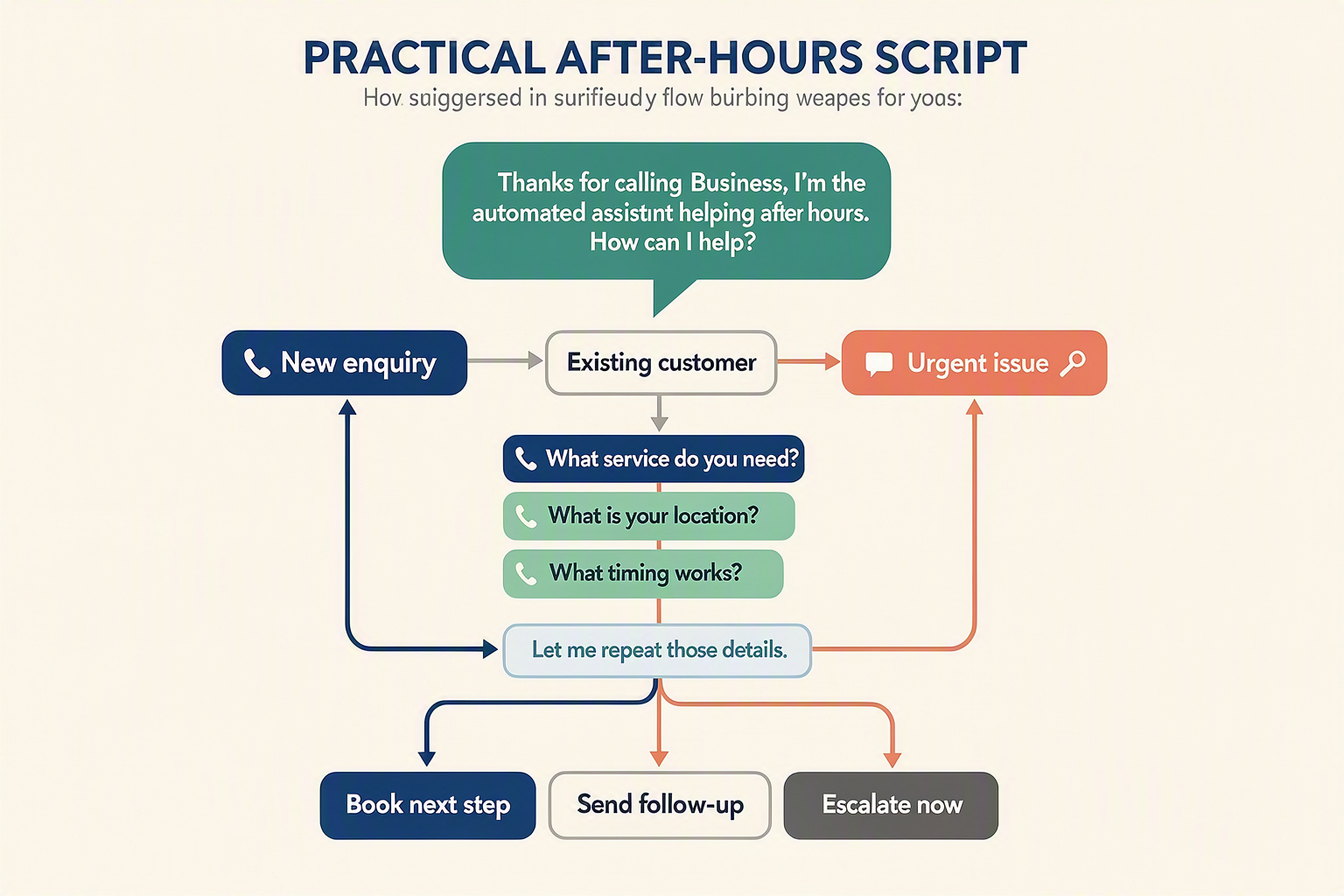
The best after-hours script is short, transparent, and modular: greet the caller, identify intent, ask only relevant qualification questions, confirm contact details, then book or escalate. An AI voice agent should sound conversational while following explicit rules—not improvise policies, prices, or emergency advice.
Start with a transparent greeting
Aim to explain who is answering and what the caller can accomplish within the first two sentences.
“Thanks for calling [Business Name]. We’re currently closed, but I’m the company’s automated AI assistant. I can help you request service, book an appointment, leave details for our team, or connect you with our on-call contact for an urgent issue.”
Then offer a human route:
“You can ask for a person or leave a message at any time. How can I help tonight?”
Clear disclosure matters. On February 8, 2024, the U.S. Federal Communications Commission confirmed that AI-generated voices fall within the Telephone Consumer Protection Act’s rules for artificial or prerecorded voices. Requirements vary by jurisdiction and use case, so businesses should obtain legal guidance before recording calls or making automated outbound calls.
Qualify callers without interrogating them
Ask one question at a time and branch according to the answer. A practical qualification sequence is:
- Intent: “Are you calling about a new request, an existing appointment, billing, or something urgent?”
- Need: “Please briefly describe what you need help with.”
- Fit: “Is this for a residential property or a business?”
- Location: “What suburb, postcode, or service location is this for?”
- Timing: “When would you ideally like this handled?”
Avoid forcing every caller through every question. For example, an existing customer reporting a hazardous electrical smell should enter the urgent-case workflow immediately rather than completing sales qualification.
Capture and confirm lead details
An after hours answering service should create a usable record, not merely generate a transcript. Use explicit confirmation:
“May I have your full name?”
“What is the best number for a callback?”
“I heard [number]. Is that correct?”
“What email address should we use for confirmation?”
“Is [spelled-back email] correct?”
Capture only information required for follow-up:
- Name and callback number
- Email, if needed for booking confirmations
- Service address or general location
- Reason for calling
- Preferred contact method and time
- Consent to receive a callback or message
Never ask callers to speak passwords, one-time passcodes, full payment-card numbers, or unnecessary identity documents.
Offer specific, verified booking options
Connect the agent to a live calendar and instruct it never to invent availability.
“I can offer Tuesday at 10:30 a.m. or Wednesday at 2:00 p.m. Which works better?”
After selection, recap the complete booking:
“You’re booked for Wednesday, August 5, at 2:00 p.m. for [service] at [location]. We’ll send confirmation to [channel]. Is everything correct?”
If calendar access fails, switch to a callback request rather than promising an appointment.
Close safely and handle urgent cases
Define emergency language narrowly:
“Is anyone in immediate danger, or is there fire, flooding, a gas smell, exposed wiring, or another safety risk?”
For life-threatening situations, direct the caller to the appropriate local emergency service. For business-defined urgent cases, attempt the on-call transfer, then use a backup contact if unanswered.
This structured approach makes small business call automation predictable: every caller receives a clear next step, while exceptions remain available for human review.
How should urgent handoffs, consent, privacy, and failure safeguards work?
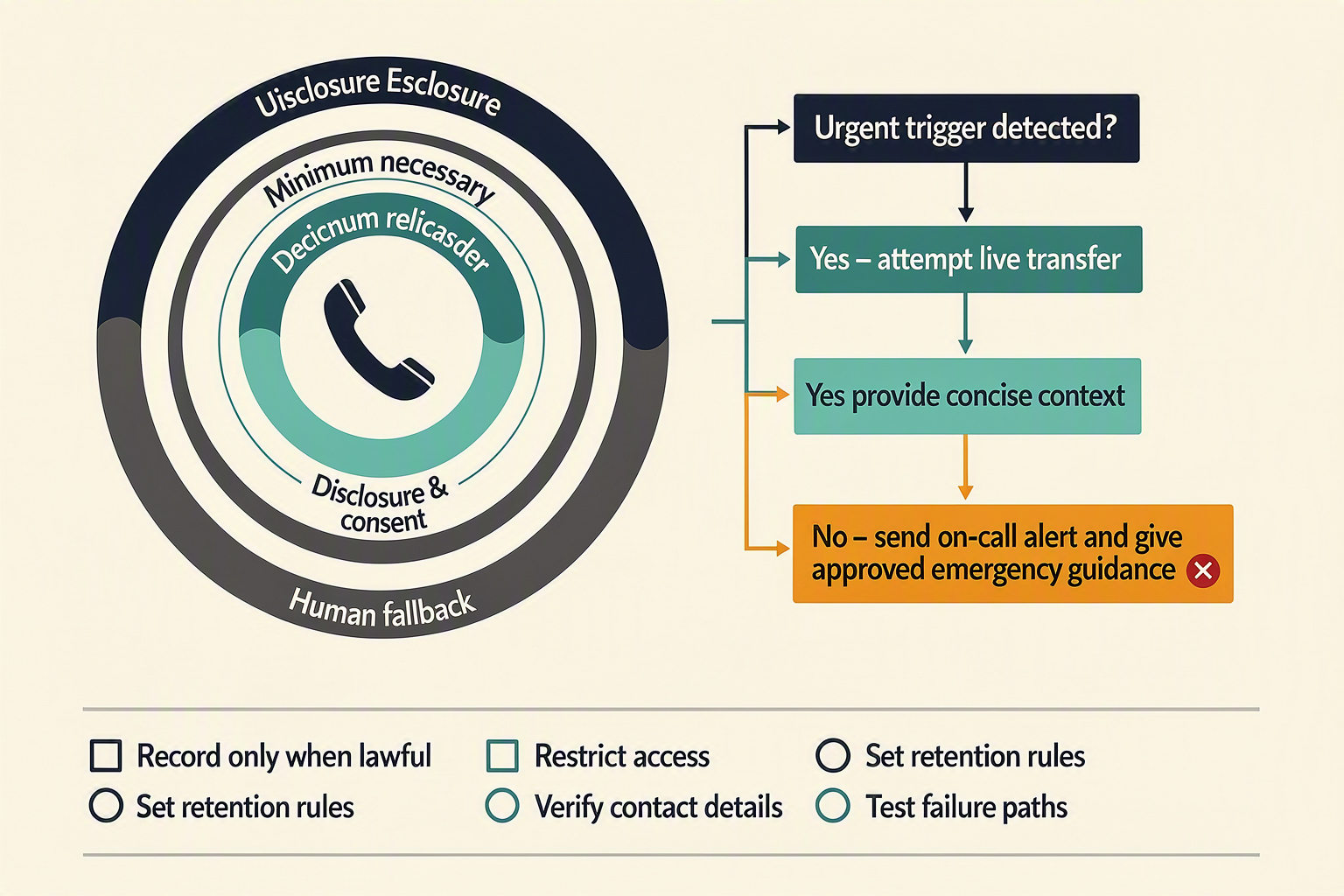
Urgent handoffs should use explicit, rule-based triggers, consent should be obtained before recording or collecting sensitive information, and every automation path needs a human or voicemail fallback. An AI voice agent should coordinate the response—not make safety-critical judgments or trap callers in an endless loop.
Build a tiered escalation policy
Define urgency with examples that reflect the business rather than asking the model to improvise. A practical policy has three levels:
- Emergency: Threats to life, fire, suspected gas leaks, severe medical symptoms, or immediate danger. The agent should instruct the caller to contact the relevant local emergency service and avoid offering medical, legal, or technical diagnoses.
- Urgent business issue: Flooding, loss of access, security alarms, stranded customers, or a critical system outage. Attempt a warm transfer to the on-call employee.
- Routine request: Quotes, appointment changes, product questions, and non-critical repairs. Capture the details and book the next available step.
For urgent business calls, configure a deterministic escalation chain:
- Confirm the caller’s name, callback number, location, and issue.
- Read back critical details before attempting transfer.
- Call the primary on-call contact, then a backup after a defined timeout.
- If nobody answers, send structured alerts through approved channels.
- Tell the caller exactly what happened and when to expect a response.
- Never say that help is “on the way” unless a person has confirmed it.
Obtain meaningful consent
The greeting should state the business name and disclose that the caller is interacting with an automated assistant. If calls are recorded or transcribed, provide a separate notice before recording begins and offer an alternative where required.
On February 8, 2024, the U.S. Federal Communications Commission confirmed that AI-generated voices fall within the TCPA’s definition of an “artificial or prerecorded voice.” That ruling primarily addresses regulated calling practices, but it supports a broader safeguard: automation must not be concealed.
Consent requirements vary by country, state, call direction, and purpose. Businesses should have counsel review scripts for recording, marketing, payment collection, healthcare information, and other regulated data.
Minimise and protect caller data
An after hours answering service should collect only what the workflow needs. Do not request full payment-card numbers, passwords, one-time passcodes, government identifiers, or detailed medical information through a general-purpose agent.
Apply the following controls:
- Encrypt recordings, transcripts, and CRM records in transit and at rest.
- Restrict access by employee role and log transcript access.
- Set defined retention periods instead of storing every call indefinitely.
- Provide processes for correction, deletion, and consent withdrawal where applicable.
- Redact sensitive values before sending transcripts to analytics or model providers.
- Document which vendors process audio, transcripts, and customer metadata.
Design for predictable failure
Reliable small business call automation must fail safely when speech recognition, integrations, or transfers stop working. Configure the agent to:
- Ask for confirmation after uncertain names, numbers, addresses, or dates.
- Limit clarification attempts—typically to two—before switching paths.
- Avoid booking if calendar availability cannot be verified.
- Preserve captured details if a CRM or calendar API times out.
- Offer voicemail, SMS follow-up, or a human callback instead of disconnecting.
- Stop and escalate when the caller requests a person, becomes distressed, or raises an unsupported issue.
Finally, test the complete fallback tree every month and after any script, phone-routing, calendar, CRM, or model change. A safe system is one whose failures are visible, recoverable, and honest to the caller.
Which metrics and expert reviews show whether the service is working safely?
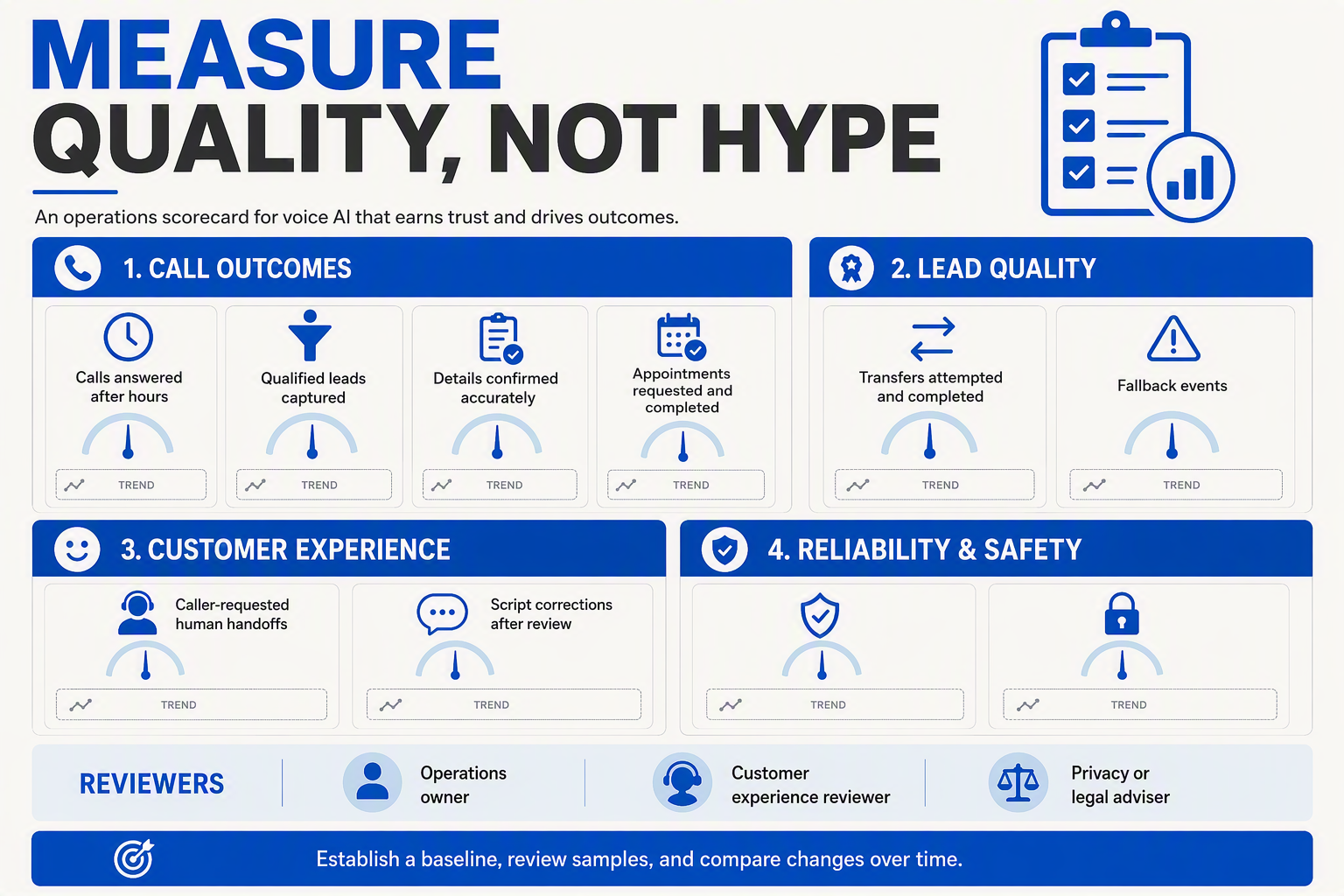
A safe, effective after hours answering service should be judged on outcomes, not simply call volume: Did callers receive an answer, did the agent capture accurate information, and did urgent cases reach a human? Combine weekly operational metrics with structured human review because dashboards alone cannot detect misleading promises, poor tone, or unsafe advice.
Build a balanced performance scorecard
Measure the complete journey from ringing to resolution. Report both the percentage and the underlying count; “90% successful” is meaningless if it represents only nine calls.
- Answer rate: answered calls ÷ eligible after-hours calls. Separate caller hang-ups from technical failures.
- Intent completion rate: calls that reach an approved outcome—message captured, appointment booked, question answered, or transfer attempted—divided by answered calls.
- Lead-detail accuracy: correctly recorded names, numbers, locations, service needs, and preferred times ÷ reviewed fields. Compare transcripts with recordings and CRM entries.
- Booking success rate: confirmed calendar bookings ÷ callers who requested and qualified for booking. Track unavailable slots, duplicate bookings, and tool errors separately.
- Transfer success rate: urgent calls connected to the correct on-call person ÷ transfer attempts. Also measure the fallback-message rate when nobody answers.
- Repeat-call rate: callers who contact the business again about the same unresolved issue within a defined period.
- Disclosure compliance: reviewed calls in which the AI voice agent clearly identifies itself as automated.
- Unsupported-claim rate: calls containing invented prices, availability, policies, diagnoses, guarantees, or actions the system did not complete.
For a business open eight hours daily, the remaining 16 hours represent two-thirds of each day, making after-hours reporting a substantial operational measure rather than a minor support metric.
Measure urgency decisions as a safety test
Urgent-call routing needs its own confusion matrix. Label reviewed calls as true positive, false positive, true negative, or false negative based on whether escalation was required and whether it occurred.
Prioritise urgent-case recall:
Urgent-case recall = correctly escalated urgent calls ÷ all genuinely urgent calls
A false positive may wake an on-call employee unnecessarily; a false negative may leave a safety-critical caller unsupported. Review 100% of calls involving emergencies, threats, vulnerable callers, payment disputes, or failed transfers, even if routine calls are sampled.
Do not adopt an arbitrary universal target. Establish a baseline during a controlled pilot, set thresholds according to business risk, and pause automation when a critical limit is breached.
Run expert reviews, not just transcript checks
Assign weekly reviews to people who understand the underlying work:
- A business owner or operations lead checks qualification and booking logic.
- A domain expert reviews technical, medical, legal, financial, or emergency-related language where relevant.
- A privacy or compliance reviewer checks disclosure, consent, retention, and access controls.
- An on-call employee evaluates whether summaries provide enough context for immediate action.
Review recordings as well as transcripts because speech recognition can omit negations, numbers, addresses, or regional-language details. For multilingual small business call automation, sample every supported language and common code-switching pattern independently rather than averaging all calls together.
Maintain a documented safety trail
The U.S. Federal Communications Commission stated on February 8, 2024, that AI-generated voices fall within the TCPA’s “artificial or prerecorded voice” category. Accordingly, audits should record whether automation was disclosed, whether applicable consent rules were followed, and whether callers could reach a person.
Keep a versioned log of script changes, escalation rules, incidents, reviewer decisions, and corrective actions. Re-test after every prompt, model, calendar, CRM, telephony, or knowledge-base change; a previously safe workflow can regress when any connected component changes.
What are the operational implications, and where does CallMissed fit?
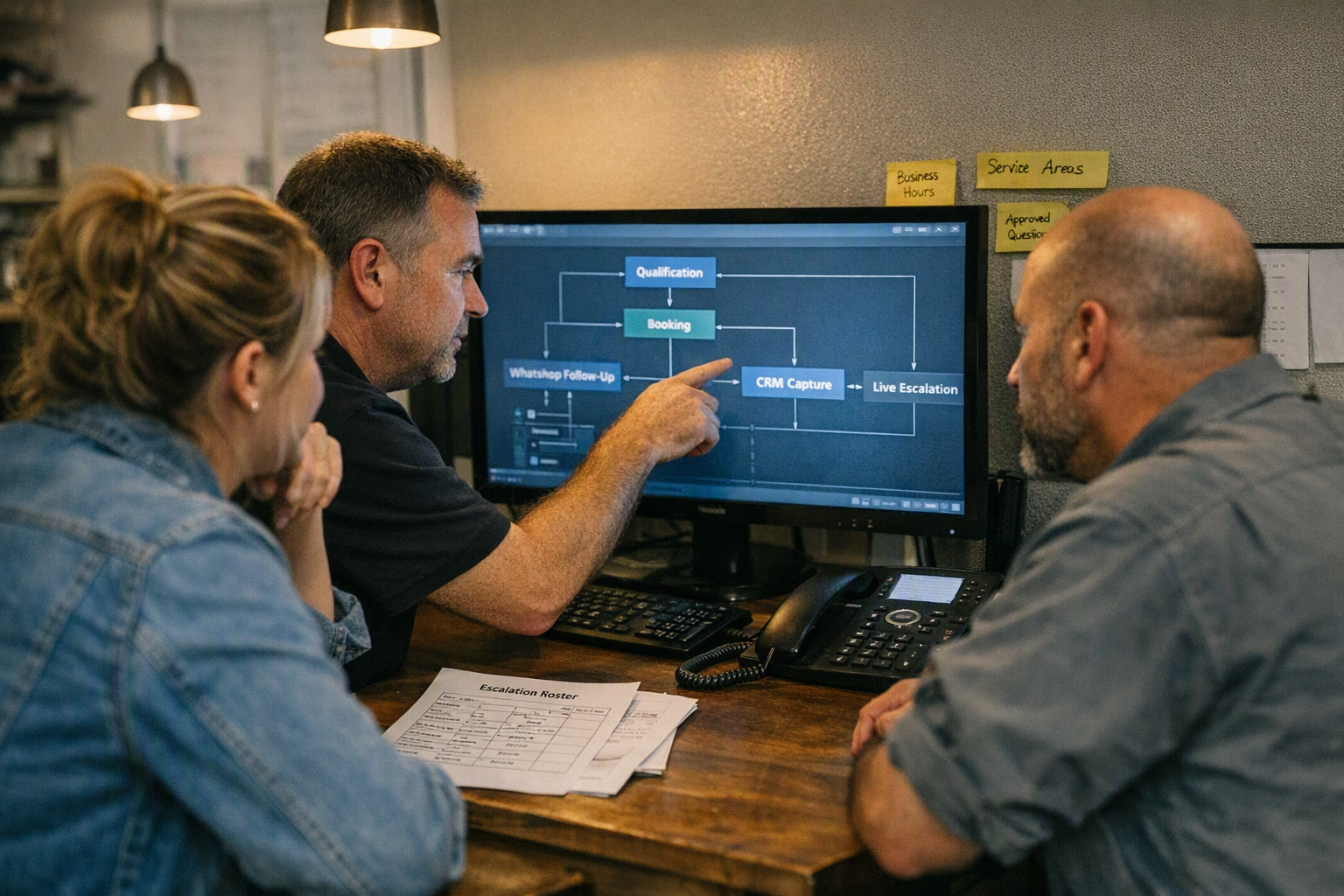
An after hours answering service changes more than who picks up the phone: it creates a new operating queue that someone must own, review, and improve. The AI should handle defined workflows autonomously, while employees remain accountable for urgent escalations, promised callbacks, data quality, and exceptions.
Treat automation as an operating model
Effective small business call automation requires named owners rather than a “set and forget” deployment. Assign responsibility for four areas:
- Business owner: approves qualification criteria, opening hours, escalation thresholds, and customer promises.
- On-call owner: receives urgent transfers and acknowledges failed or missed escalations.
- System owner: manages phone routing, calendar access, CRM fields, integrations, and permissions.
- Quality owner: reviews transcripts, recordings where legally permitted, booking outcomes, and recurring failure reasons.
Create a daily work queue containing callers who requested follow-up, could not be understood, declined automation, or reached an unavailable integration. Each record should show the caller’s consent status, captured details, call summary, promised next step, and responsible employee.
The largest operational risk is not necessarily an incorrect answer; it is an unowned commitment. If an AI voice agent says, “A technician will call you by 9:00 a.m.,” the workflow must create an assigned task with a deadline and alert someone if it remains incomplete.
Plan for staffing, cost, and service continuity
AI coverage can reduce repetitive answering work, but it does not eliminate human capacity requirements. Businesses should plan for:
- On-call availability: A transfer rule is useful only when someone can accept the call.
- Morning follow-up capacity: Overnight leads may create a concentrated queue when the business opens.
- Integration outages: If the calendar or CRM is unavailable, the agent should capture details without claiming a booking succeeded.
- Usage monitoring: Track telephony, speech, model, messaging, and integration costs—not merely the headline per-minute price.
- Change control: Update scripts, business hours, service areas, pricing guidance, and emergency rules whenever operations change.
Compliance must also be part of the runbook. On February 8, 2024, the U.S. Federal Communications Commission confirmed that AI-generated voices qualify as “artificial or prerecorded voices” under the Telephone Consumer Protection Act. Operationally, businesses should disclose AI use, apply appropriate consent and retention controls, restrict access to caller data, and preserve a dependable human handoff.
Where CallMissed fits
CallMissed can serve as the engagement layer for businesses that want voice automation connected to broader customer communication. Its business platform combines AI voice agents, WhatsApp chatbots, inbound and business-initiated WhatsApp Business calling, an omnichannel inbox, knowledge-base retrieval, and campaign tooling.
This architecture is particularly relevant when a caller’s journey continues after the call. For example, the agent can capture an enquiry overnight, route the record into a shared workflow, and support follow-up through WhatsApp, voice, email, or web channels rather than leaving information in an isolated voicemail system.
For Indian businesses, CallMissed supports speech-to-text and text-to-speech across 22 Indian languages, using Indic-first models for regional-language interactions. Its transparent model also defines one credit as ₹1, with free-tier and pay-as-you-go options that let smaller teams test controlled workflows before expanding coverage.
The practical fit is therefore not “replace the team.” It is to automate predictable after-hours steps, preserve structured context across channels, and give employees a clear queue of conversations that genuinely require human judgment.
What should your small business implement first? (TABLE)
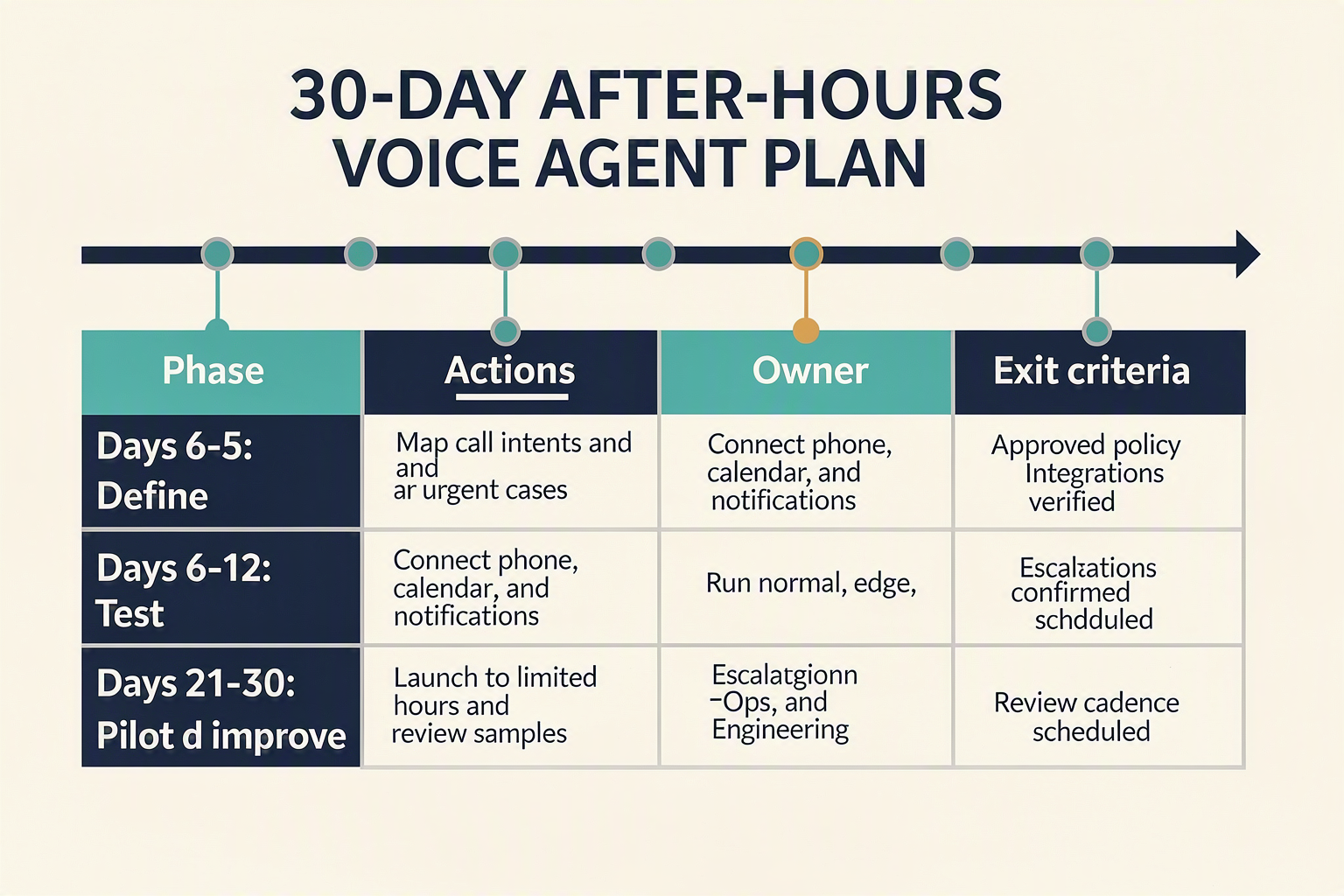
Implement a narrow, safety-first minimum viable workflow before adding complex qualification or autonomous scheduling. Your first release should disclose that callers are speaking with an AI voice agent, capture essential details, identify urgent cases, and create a reliable human callback task.
Recommended implementation order
| Priority | Capability | Minimum configuration | Go-live test |
|---|---|---|---|
| 1 | AI disclosure and consent | State the business name, identify the automated assistant, and explain any recording or data use | Disclosure plays on 100% of test calls |
| 2 | Basic lead capture | Collect name, callback number, reason for calling, and preferred next step | Agent reads back all 4 required fields |
| 3 | Urgency detection | Define specific triggers such as safety risks, active damage, service outages, or vulnerable callers | Every urgent test scenario reaches the escalation workflow |
| 4 | Human handoff | Configure a primary on-call contact, backup contact, and voicemail or ticket fallback | Failed transfers automatically trigger the backup route |
| 5 | Appointment booking | Expose only approved calendars, service types, locations, and available time slots | Double-booking and unavailable-slot tests are blocked |
| 6 | Expanded automation | Add deeper qualification, CRM updates, multilingual support, WhatsApp, email, or web follow-up | Each new workflow passes a separate acceptance checklist |
The first four rows constitute a practical after hours answering service MVP. Appointment booking should follow only after the business can trust identity capture, urgency classification, and handoff behaviour.
Keep the first call flow short
A small business does not need to reproduce its entire customer-service process on day one. Start with five controlled steps:
- Greet and disclose: “You’ve reached [Business]. I’m the automated after-hours assistant.”
- Identify intent: Ask the caller to describe the reason for calling in one sentence.
- Capture essentials: Confirm the caller’s name, number, location, and requested service.
- Apply routing rules: Escalate urgent cases; otherwise offer a callback or eligible booking slot.
- Confirm the outcome: Read back what will happen next and when the caller should expect contact.
The U.S. Federal Communications Commission confirmed on February 8, 2024, that AI-generated voices qualify as “artificial or prerecorded voices” under the Telephone Consumer Protection Act. Although legal obligations vary by country and call type, explicit automation disclosure should therefore be treated as a launch requirement rather than optional script wording.
Pilot before expanding
Run the initial workflow with one phone number, one after-hours schedule, and a limited set of call reasons. Test real-world conditions including:
- Background noise, silence, interruptions, and callers who change their answers.
- Incorrect or incomplete phone numbers.
- Unsupported languages and requests outside the business’s services.
- Unavailable on-call staff and failed transfers.
- Calendar conflicts, time-zone errors, and callers requesting unavailable dates.
Review transcripts and outcomes daily during the pilot, but restrict access because they may contain personal or sensitive information. Track completed detail capture, callback tasks created, bookings completed, urgent transfers attempted, fallback activations, and unhandled intents.
Once this foundation is stable, small business call automation can expand into regional languages and additional channels. For example, CallMissed supports speech workflows across 22 Indian languages and can connect AI agents with WhatsApp Business calling, making multilingual or WhatsApp-based expansion a logical later phase—not a substitute for getting the core escalation workflow right first.
Frequently asked questions about after-hours AI call handling
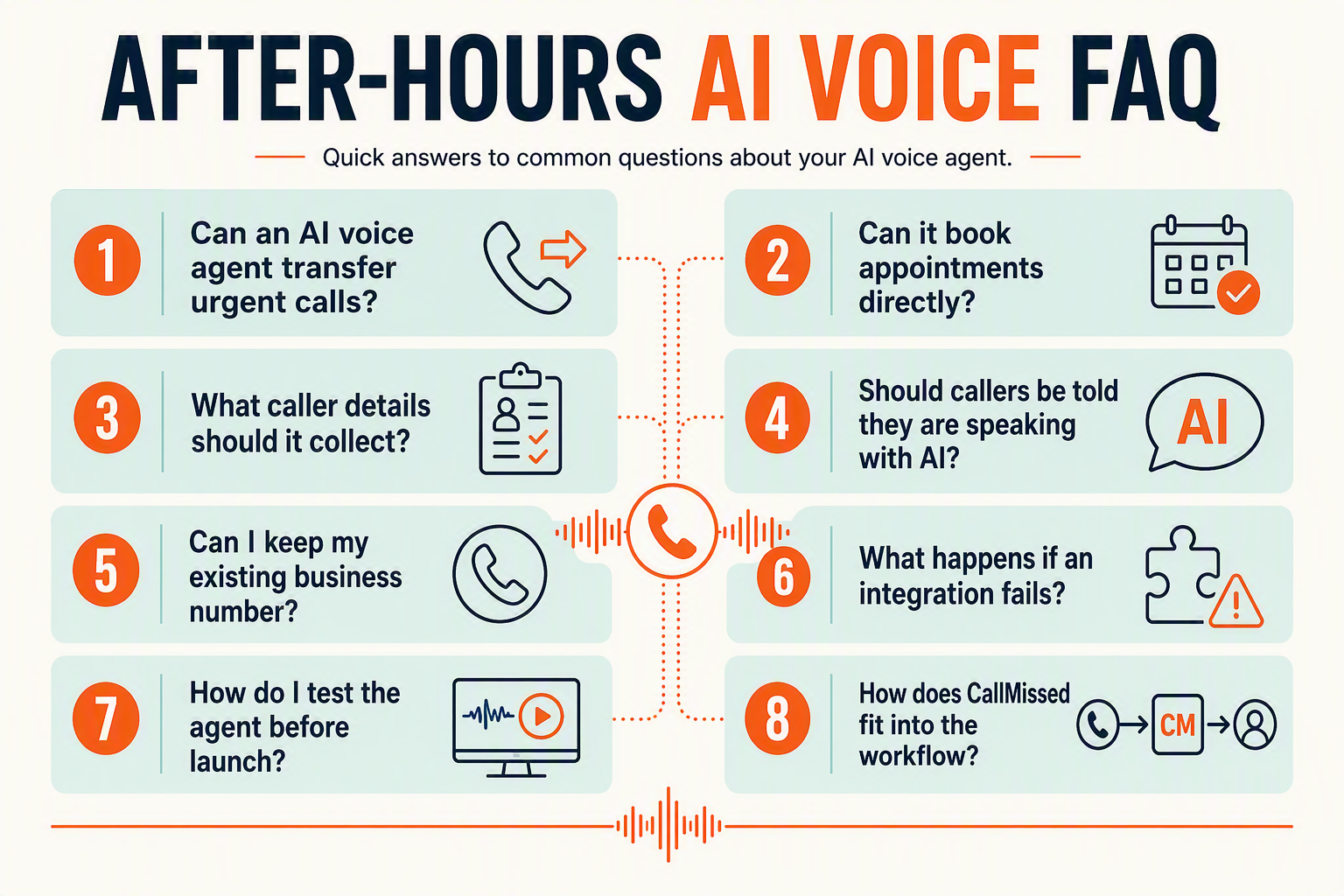
How does an after hours answering service powered by AI work?
Can an AI voice agent book appointments without staff involvement?
How should an AI answering service identify and transfer emergency calls?
Is it legal to use AI-generated voices for after-hours customer calls?
How much does small business call automation cost in 2026?
Can an after-hours AI agent understand Indian languages and regional accents?
Conclusion
An effective after hours answering service in 2026 should do more than pick up the phone: it should identify caller intent, capture accurate details, book appropriate next steps, and route urgent cases to a person. The goal is not maximum automation, but dependable coverage during the 16 hours each day that an eight-hour business may be closed.
The practical takeaways are clear:
- Start with a controlled workflow. Define which calls the AI voice agent can resolve, which questions it should ask, and which situations require immediate escalation. Keep qualification concise by capturing essentials such as the caller’s name, phone number, location, service need, urgency, and preferred appointment time.
- Connect conversations to business operations. Calendar and CRM integrations can turn calls into structured appointments, callback requests, and lead records instead of vague voicemail messages. Every transfer should also have fallback contacts and a clear procedure for failed handoffs.
- Build transparency and safeguards into the script. The greeting should identify the business, disclose that the caller is speaking with an AI system, and offer access to a person when needed. On February 8, 2024, the U.S. Federal Communications Commission confirmed that AI-generated voices qualify as “artificial or prerecorded voices” under the Telephone Consumer Protection Act, reinforcing the importance of disclosure, consent, and responsible data handling.
- Measure real outcomes and test difficult conditions. Track answer rates, completed calls, bookings, escalation accuracy, and failure reasons. Before launch, test background noise, regional accents, interruptions, silence, unsupported requests, and situations in which the agent lacks enough information to proceed safely.
Looking ahead, businesses should watch how voice quality, multilingual understanding, integrations, and regulatory expectations evolve. Small business call automation will become more useful as systems handle natural conversation more reliably, but human oversight and explicit escalation rules will remain essential.
For Indian businesses, CallMissed is a platform worth exploring: it combines AI voice agents, WhatsApp Business calling, omnichannel workflows, and speech support across 22 Indian languages, including Indic-first models. Could your next missed after-hours call become a booked appointment—or reach the right on-call employee—instead of ending as an unheard voicemail?
Related Reading
Discussion
Related Posts
Ready to automate customer conversations?
Launch AI voice agents and WhatsApp bots with CallMissed — one API, 22+ Indian languages.