
WhatsApp Missed Call Automation in 2026: A Service Business Workflow Guide


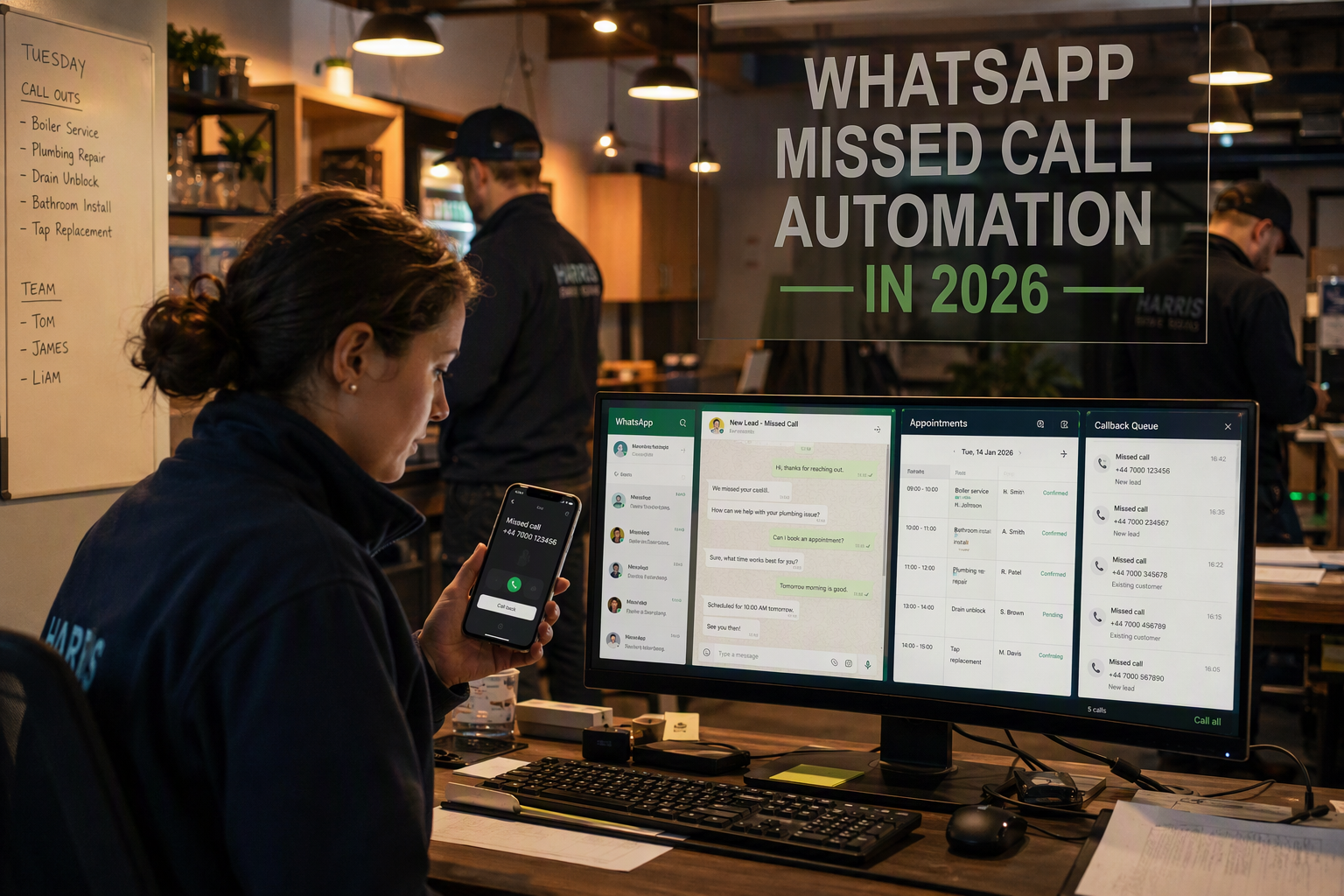
Learn how WhatsApp missed call automation captures consent, qualifies leads, books appointments, hands off chats, and measures results.
WhatsApp Missed Call Automation in 2026: A Service Business Workflow Guide
What if every unanswered phone call could become a qualified booking instead of a lost lead? WhatsApp missed call automation turns a missed inbound call into a structured, permission-aware workflow: identify the caller, verify consent, send a timely WhatsApp message, ask relevant questions, and offer either an appointment or a human callback.
Why missed calls matter in 2026
For service businesses—clinics, salons, repair companies, property agencies, education providers, and home-service teams—a missed call often represents immediate purchase intent. The caller may simply contact the next available provider if nobody responds quickly.
WhatsApp makes that recovery channel unusually accessible. Meta CEO Mark Zuckerberg said during Meta’s April 2025 earnings call that WhatsApp had surpassed 3 billion monthly active users. For businesses, that scale means customers are often more likely to notice a conversational WhatsApp follow up than repeatedly call a busy reception desk.
However, detecting a missed call does not automatically create unlimited permission to message someone. A production workflow must account for:
- Explicit WhatsApp opt-in and a recorded consent source
- Approved message templates when starting a business-initiated conversation
- Clear identification of the business and reason for contacting the caller
- An easy way to stop messages or request a person
- Secure handling of phone numbers, conversation data, and booking details
Meta’s WhatsApp Business Platform documentation defines a 24-hour customer-service window after a user messages a business; outside that window, businesses generally need an approved template to restart the conversation. A standard telephone missed call does not itself open that WhatsApp service window, which is why consent and template design must be part of the architecture—not added after launch.
From unanswered call to completed action
A well-designed missed call bot does more than send “We missed you.” It can ask what service the customer needs, collect a postcode or preferred branch, determine urgency, check appointment availability, and present two simple next steps: book now or request a callback. High-value, sensitive, or ambiguous conversations should move to a human agent with the transcript and captured details intact.
Platforms such as CallMissed support this model by combining WhatsApp chat automation, WhatsApp Business calling, AI voice agents, an omnichannel inbox, and support for 22 Indian languages.
This guide explains the complete 2026 workflow—from event triggers, templates, consent records, and qualification logic to booking integrations, callback queues, human handoff, and performance measurement. It also covers common implementation mistakes, including messaging without valid opt-in, asking too many questions, ignoring duplicate callers, hiding the human-support option, and measuring messages sent instead of outcomes such as qualified leads, callback completion, appointments booked, response time, and opt-out rate.
How does WhatsApp missed call automation turn an unanswered call into a compliant conversation, qualification flow, booking, callback, or human handoff?
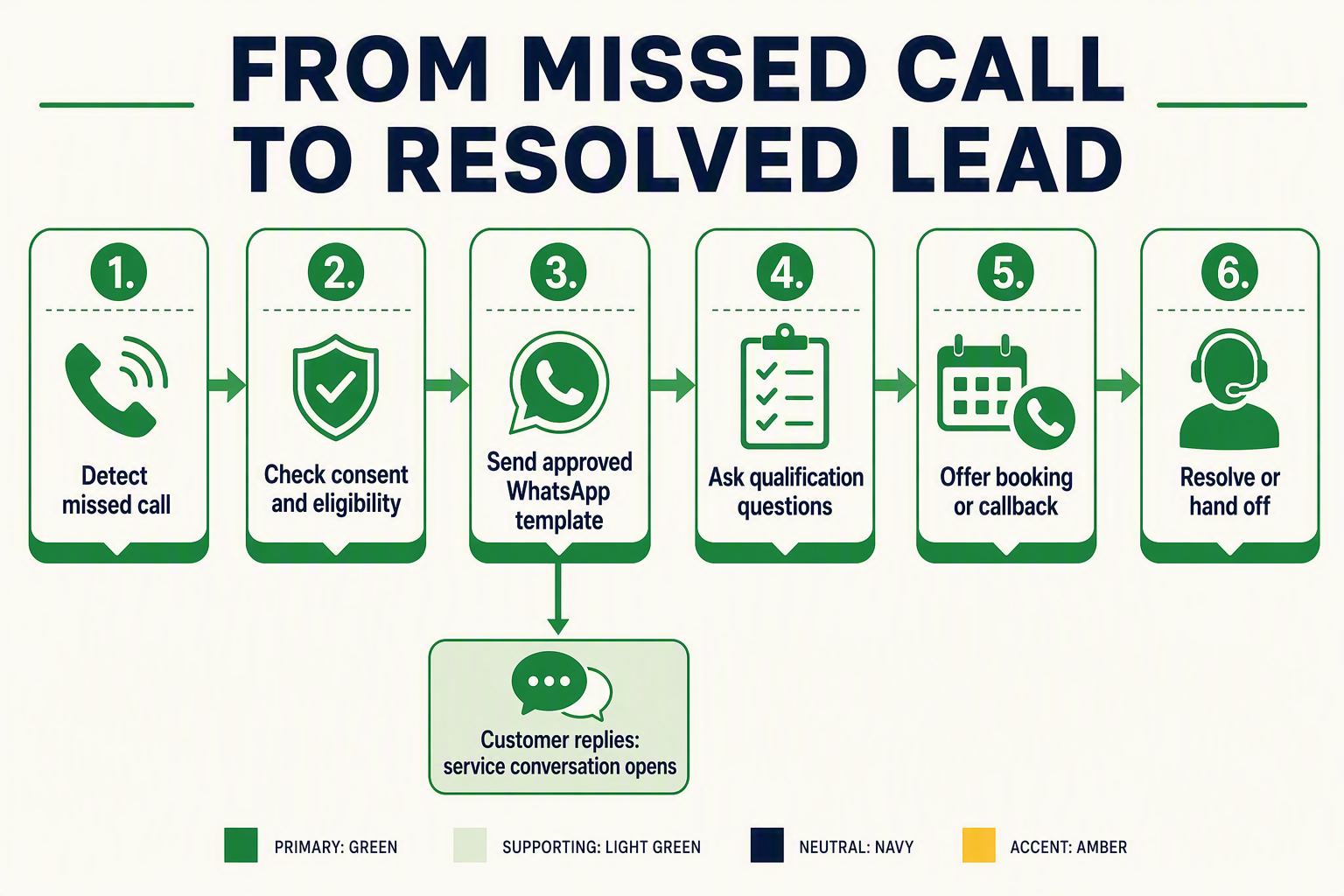
WhatsApp missed call automation turns an unanswered call into a structured recovery workflow: the missed-call event triggers an eligibility check, and only contacts with recorded WhatsApp opt-in receive an appropriate approved template. After the customer responds, a missed call bot can ask concise qualification questions and route the conversation to booking, a callback, or a human agent.
1. Capture the missed call as a trigger
The workflow begins when the telephony system records an outcome such as no answer, busy, rejected, queue timeout, or after-hours. That event should include enough information to determine what happened and which team owns the next step.
Before initiating any WhatsApp follow up, the automation should:
- Normalize the caller ID into E.164 international number format.
- Match the number with the correct CRM contact, branch, and service line.
- Ignore withheld, invalid, internal, blocked, and non-WhatsApp-capable numbers.
- Deduplicate repeated calls within a defined interval.
- Check whether an employee has already returned the call.
- Record the call time, outcome, source, and responsible team.
The missed call is only an operational trigger. It is not evidence that the caller agreed to receive WhatsApp messages.
2. Verify consent before sending a template
The business must confirm that it holds a recorded WhatsApp opt-in covering the intended communication. Consent evidence should identify how and when permission was obtained, such as through a website form, booking page, checkout flow, IVR prompt, or earlier customer interaction.
If valid opt-in is available, the workflow can send an appropriate approved WhatsApp template. The message should identify the business, connect the outreach directly to the missed call, and offer relevant next steps.
“You called GreenCare Dental, but our team could not answer. Would you like to book an appointment, request a callback, or speak with reception?”
If consent cannot be verified, the workflow should not start WhatsApp outreach. It can instead create a conventional callback task or direct the customer to a channel where WhatsApp consent can be collected properly. Opt-outs and suppression lists must be checked before every automated message.
3. Keep qualification concise and conditional
Once the customer engages, the missed call bot should collect only the information needed to determine the next action. A service-business flow can ask:
- What service do you need? For example, repair, consultation, quotation, appointment, or support.
- Where do you need it? Ask for a branch, city, postcode, or service address only when relevant.
- How urgent is the request? Offer clear options such as today, this week, or later.
- What would you prefer next? Let the customer choose booking, callback, or human assistance.
Buttons and lists can reduce typing, but the customer should also be able to enter a free-text response when the available choices do not fit.
4. Route every conversation to a defined outcome
The automation should convert the answers into one clear operational result:
- Booking: display available slots, confirm the selected time, and create the appointment.
- Callback: capture the preferred time, urgency, service type, and assigned queue.
- Human handoff: transfer the conversation, contact details, and transcript to an agent.
- Exception handling: escalate unclear requests, complaints, safety concerns, or integration failures.
Every route should finish with a confirmation stating what will happen next, who owns it, and when the customer should expect action. The system should also store timestamps, consent evidence, template details, responses, routing decisions, and final status for auditing and performance measurement.
Why do service businesses lose valuable leads after missed calls, and where does a missed call bot help?
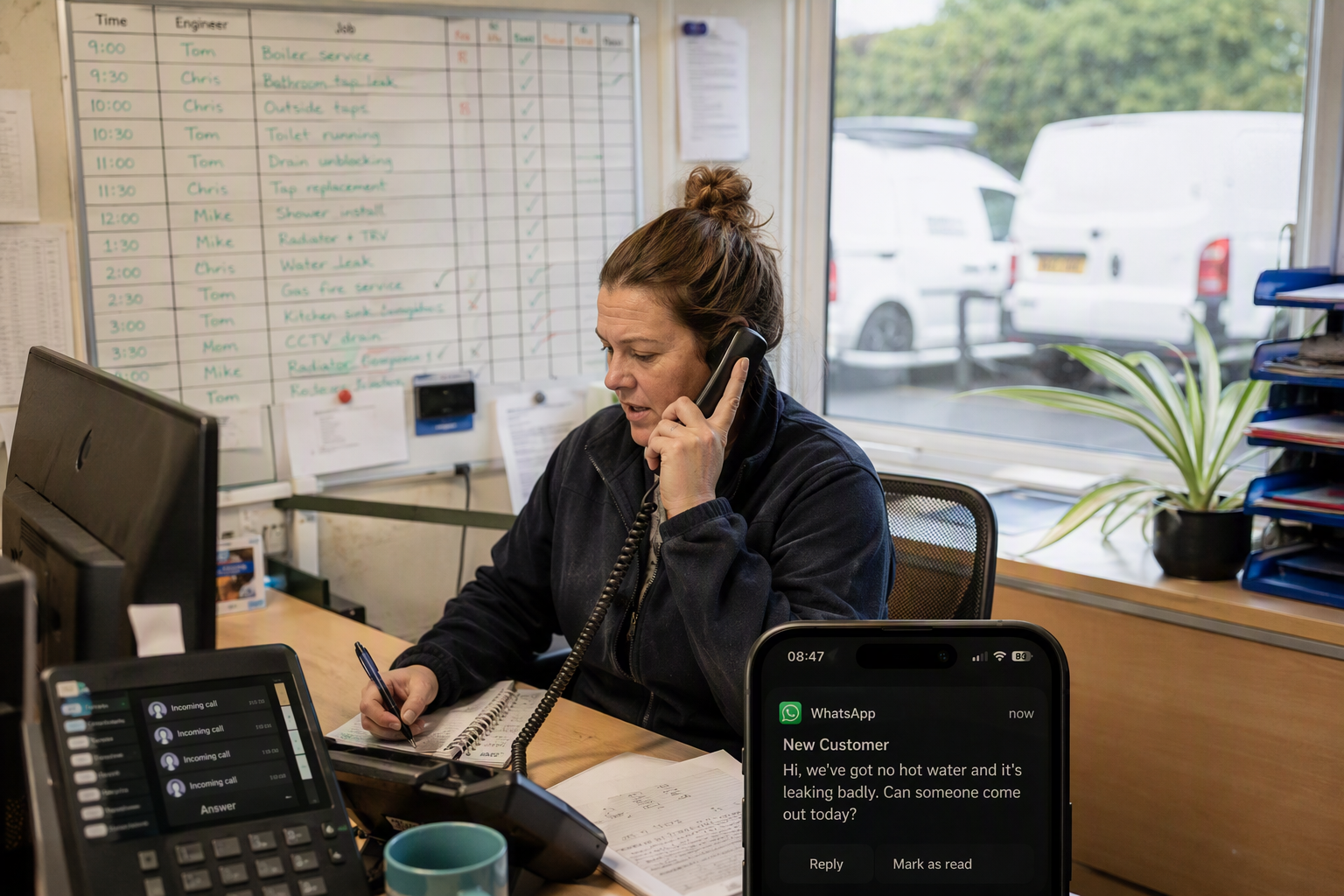
Missed calls become lost leads when high customer intent meets slow, fragmented follow-up. A missed call bot helps by acknowledging the enquiry, collecting essential details, and offering a booking or human callback—while keeping consent, escalation, and customer choice central to the workflow.
Why manual lead recovery breaks down
Service teams rarely ignore callers deliberately. Receptionists, technicians, clinicians, and sales representatives may already be serving other customers, travelling between appointments, or handling urgent work. Leads then fall through gaps such as:
- Unclear ownership: Several employees assume someone else will return the call.
- Slow callbacks: The customer contacts another provider before the team responds.
- Missing context: A phone number does not reveal the required service, location, urgency, or preferred time.
- Repeated phone tag: The callback arrives when the customer is unavailable.
- Disconnected systems: Call logs, calendars, WhatsApp conversations, and customer records remain in separate tools.
- After-hours demand: Evening, weekend, and holiday enquiries wait until the business reopens.
- Poor prioritisation: An emergency repair and a routine pricing question enter the same queue.
Businesses can estimate the opportunity without assuming every missed caller will buy. If a company receives 200 calls, misses 15%, and finds that 40% of missed callers are qualified prospects, the result is 12 potentially recoverable opportunities. A useful internal calculation should combine missed-call volume, qualification rate, booking rate, average transaction value, and recovery cost.
Where WhatsApp automation helps
WhatsApp missed call automation creates a structured recovery path between an unanswered call and the next meaningful action. A concise, human-first workflow can:
- Detect an unanswered, rejected, or timed-out inbound call.
- Deduplicate repeated attempts from the same telephone number.
- Check suppression lists, contact rules, and the business’s recorded WhatsApp opt-in.
- Use the appropriate approved message template before business-initiated contact.
- Ask two or three relevant questions, such as service type, postcode, branch, or urgency.
- Offer available appointment slots or let the customer request a callback window.
- Transfer complex or sensitive enquiries to an employee with the collected context attached.
A telephone call should not be treated as automatic proof that the caller agreed to receive WhatsApp messages. As practical implementation guidance, businesses should verify a recorded WhatsApp opt-in and apply the appropriate approved template before initiating contact. Consent evidence should identify when, where, and how permission was collected.
This form of WhatsApp follow up also reduces the need for both parties to be available simultaneously. Customers can reply when convenient, while the service team receives structured information instead of an unexplained number in a call log.
What the bot should—and should not—handle
A missed call bot is most useful for predictable, low-risk tasks:
- Identifying the requested service
- Collecting a preferred date or callback period
- Routing by location, language, branch, or department
- Sharing basic preparation information
- Confirming, rescheduling, or cancelling appointments
Automation should not obstruct access to a person. Complaints, emergencies, medical disclosures, financial disputes, safeguarding concerns, unclear consent, and uncertain responses require explicit escalation rules.
The goal is therefore not simply faster messaging. Effective automation creates accountable lead recovery: every missed call receives a status, every qualified enquiry receives a next action, and every exception reaches an appropriate employee.
Which 2026 platform, policy, and operational developments shape WhatsApp follow up after a missed call?
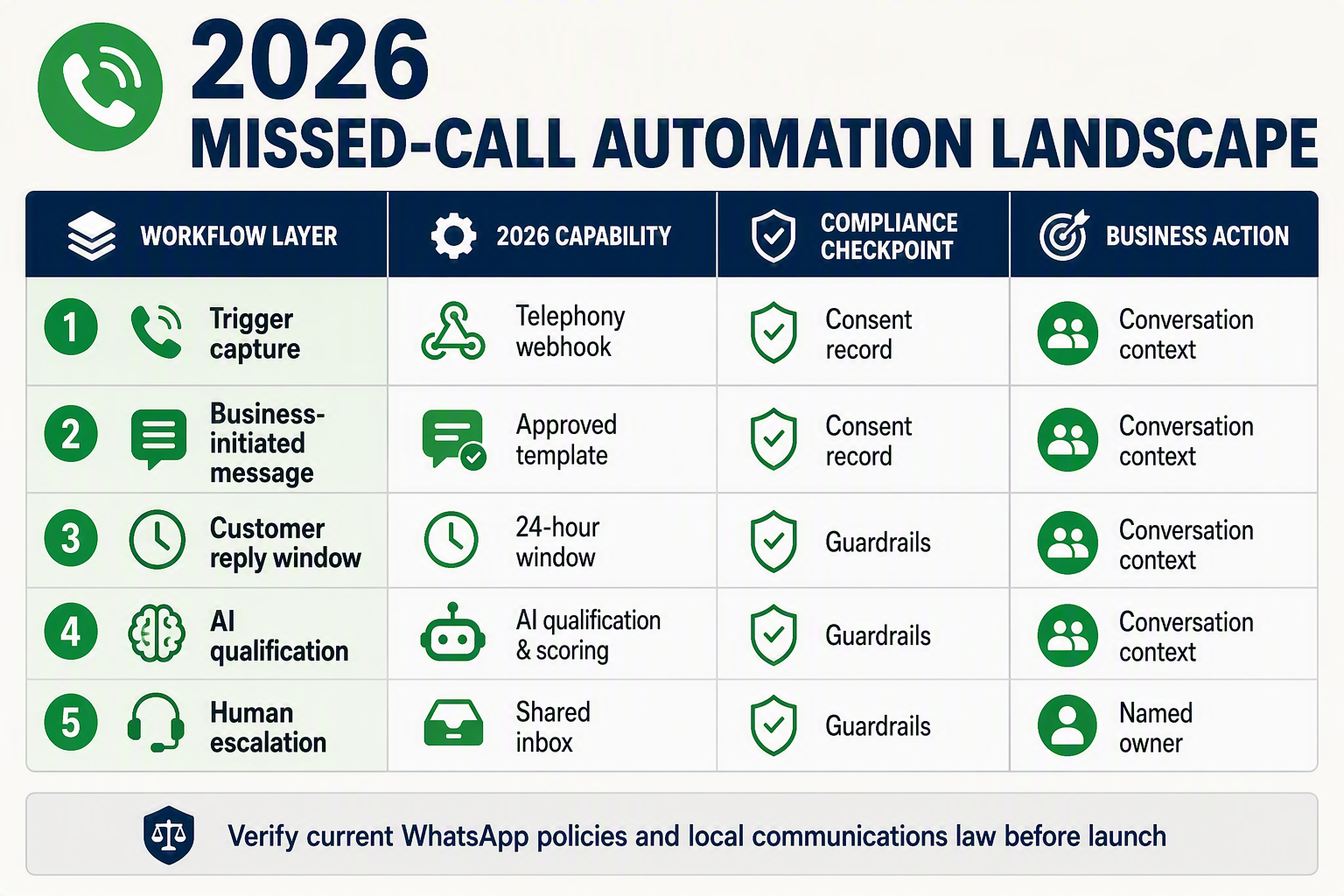
For 2026, service businesses should design WhatsApp missed call automation around verifiable workflow controls rather than assumed platform or policy changes. A missed-call event can start an internal process, but the business must separately validate consent, template requirements, routing rules, and the current WhatsApp Business Platform documentation before sending a message.
2026 workflow-design checklist
| Workflow stage | Design requirement | Evidence or data to retain | Test before launch |
|---|---|---|---|
| Telephony event | Capture the missed call only after the configured no-answer, busy, rejected, or out-of-hours condition occurs | Caller number, called number, timestamp, call outcome, and event ID | Duplicate webhooks, delayed events, hidden numbers, and rapid repeat calls |
| Consent record | Check whether the caller has provided valid permission for the intended WhatsApp contact | Consent source, timestamp, wording, purpose, number, and withdrawal status | Missing, expired, ambiguous, or revoked consent |
| Template governance | Map each eligible use case to the appropriate approved opening message under the rules applicable at send time | Template name, language, version, approval status, and selected purpose | Rejected, paused, outdated, or incorrectly localized templates |
| Qualification | Ask only the minimum questions needed to route or serve the caller | Service requested, location, urgency, preferred time, and responses | Unsupported answers, language changes, silence, and contradictory details |
| Booking or callback | Offer a concrete next action without promising unavailable capacity | Selected slot, callback window, timezone, assigned queue, and confirmation state | Simultaneous bookings, closed hours, expired slots, and failed confirmations |
| Human handoff | Escalate sensitive, urgent, uncertain, or customer-requested cases | Conversation summary, qualification answers, priority, owner, and handoff reason | Agent unavailable, transfer failure, and repeated customer explanations |
| Shared ownership | Give reception, sales, support, and operations a consistent case record | Current owner, service-level deadline, notes, status, and final disposition | Double ownership, abandoned cases, stale tasks, and conflicting updates |
| Measurement | Track each stage independently instead of treating message delivery as success | Eligible events, messages sent, replies, bookings, callbacks, opt-outs, and failures | Reporting gaps, duplicate conversions, and missing failure reasons |
Controls for the first WhatsApp follow up
The WhatsApp follow up should be generated only after the workflow confirms that outreach is permitted under the business’s documented process and the requirements in force at that time. The opening message should:
- Identify the business clearly.
- Explain that the message relates to a recent missed call.
- Avoid implying that the call itself created consent.
- Offer limited actions such as Book a time, Request a callback, or Speak to a person.
- Provide an easy way to decline or stop further messages.
- Avoid collecting sensitive information unless the workflow has an appropriate security and escalation process.
Policy owners should review current Meta and WhatsApp Business Platform documentation before launch and whenever templates, use cases, or operating regions change. Where legal interpretation is required, obtain qualified advice rather than relying on a vendor’s default configuration.
Operational acceptance criteria
A missed call bot is production-ready only when it handles failure paths as carefully as the ideal journey. Run end-to-end tests covering:
- Event integrity: Normalize phone numbers, suppress duplicate call events, and reject incomplete records.
- Eligibility: Route records without adequate consent to a non-messaging path, such as a documented callback queue.
- Conversation safety: Cap qualification attempts and transfer unclear requests to a person.
- Action reliability: Confirm bookings or callbacks only after the destination system accepts them.
- Accountability: Assign every open case an owner, deadline, and final status.
When assessing CallMissed or another orchestration platform, map these controls to actual configuration, logs, permissions, and failure handling. Product capabilities and applicable WhatsApp requirements should be verified directly during implementation rather than assumed from marketing descriptions.
How should you design qualification questions, booking and callback options, human handoff, templates, consent records, and CallMissed integration?
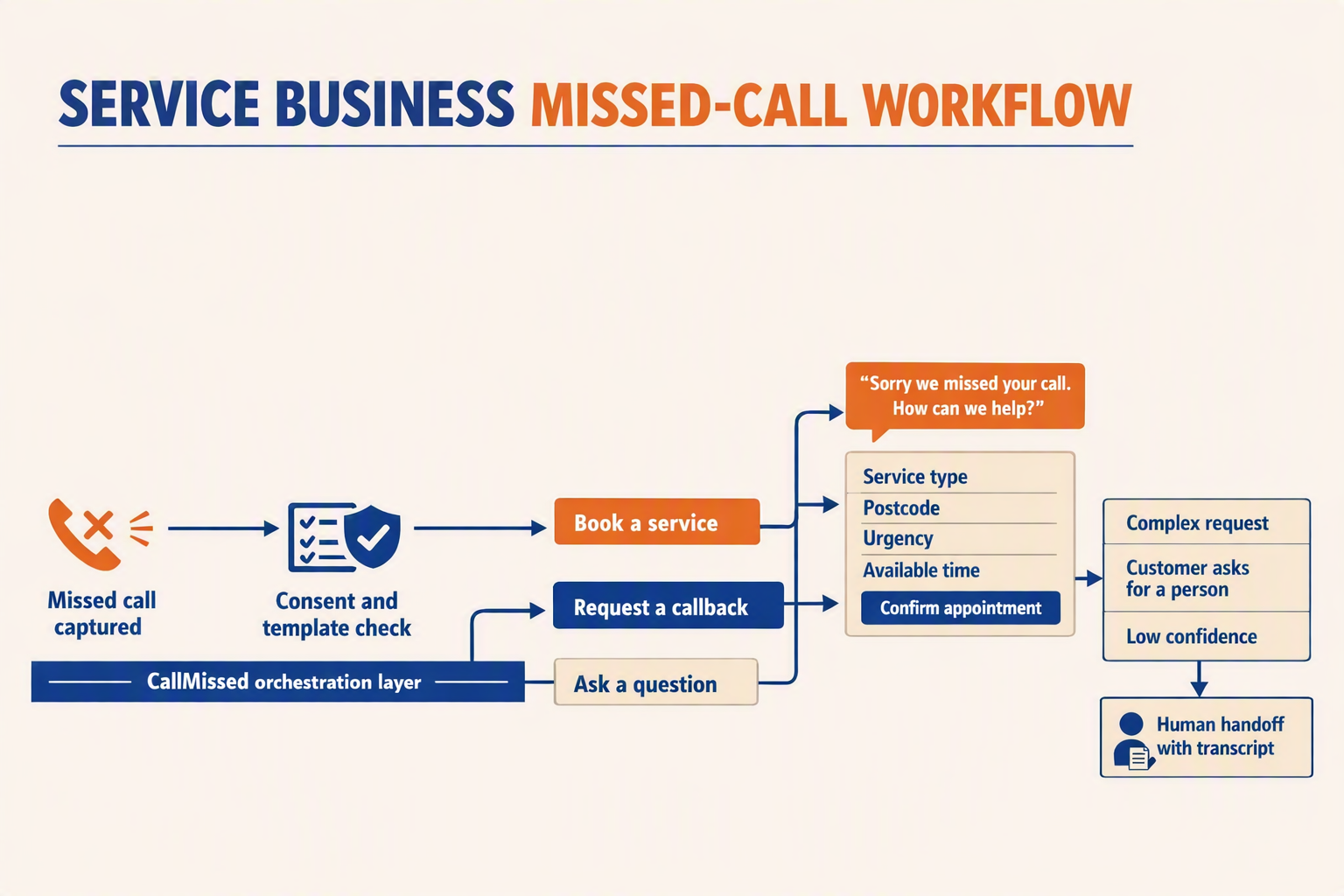
Design the workflow around minimum necessary qualification, two clear outcomes—booking or callback—and an immediate human escape route. Every automated action should also preserve the customer’s consent source, template version, answers, and handoff history in an auditable record.
Keep qualification short and conditional
A service businesses missed call bot should ask only questions that change routing, eligibility, availability, or pricing. Aim for three to five prompts, using buttons or lists wherever possible:
- What do you need help with? Offer a short service list plus “Other.”
- Which location or postcode applies? Use this to identify the correct branch or service area.
- How urgent is the request? Options might include today, this week, or flexible.
- Do you want to book or receive a callback?
- Ask one service-specific question only when needed—for example, appliance type or preferred consultation mode.
Use branching logic rather than forcing every caller through the same questionnaire. Clinics should avoid collecting diagnoses in WhatsApp qualification, while property or repair businesses can request basic requirements without asking for unnecessary identity documents.
Make booking and callback equally simple
For booking, query the scheduling system in real time and display a small number of valid slots. After selection, reconfirm the service, branch, date, time, timezone, price or deposit terms, then create the appointment and send a booking reference.
For callbacks, capture:
- Preferred callback window
- Relevant language
- Topic and urgency
- Caller timezone and branch
- Whether WhatsApp or a telephone call is preferred
The callback request should enter a queue with an owner, priority, due time, and escalation rule. Prevent duplicate jobs when the same person calls repeatedly or reopens the WhatsApp follow up.
Define human-handoff triggers
Automation should transfer the conversation when the customer requests a person, provides an unrecognized answer, expresses dissatisfaction, has a sensitive request, or meets a high-value or urgent threshold. The agent should receive the telephone event, qualification answers, consent status, complete transcript, and recommended next action—not make the customer start again.
Set a realistic expectation such as, “A specialist will reply within 15 minutes,” and alert a supervisor if the service-level target is missed.
Use templates as controlled workflow assets
Meta’s WhatsApp Business Platform documentation requires an approved template for most business-initiated messages when no customer-service window is open. A normal telephone missed call does not open that 24-hour WhatsApp window, so the initial template must be approved and supported by valid opt-in.
A practical template might say:
“Hello {{1}}, this is {{2}}. We could not answer your call about {{3}}. Would you like to book an appointment, request a callback, or stop these messages?”
Maintain template name, language, category, approval status, variables, and version history. Never insert sensitive details into template variables, and provide clear Stop and Human agent paths.
Preserve proof of consent
Store an append-only consent record containing:
- Phone number and normalized WhatsApp identifier
- Consent wording, purpose, source, and timestamp
- Form, checkbox, QR flow, or other acquisition evidence
- Privacy-notice version and lawful retention period
- Opt-out timestamp and suppression status
The automation must check this record before sending—not merely assume that calling the business equals WhatsApp permission.
Connect the workflow through CallMissed
CallMissed can connect the missed-call event with WhatsApp chat automation, appointment logic, AI voice agents, and a shared omnichannel inbox. A production integration should deduplicate the call event, validate consent, select the approved language template, capture structured answers, write booking or callback outcomes to the CRM, and preserve handoff context.
For regional operations, CallMissed supports voice and chat across 22 Indian languages, allowing WhatsApp missed call automation to route each caller into an appropriate language journey rather than defaulting every interaction to English.
How do you measure lead recovery, response quality, bookings, callback completion, and customer outcomes?
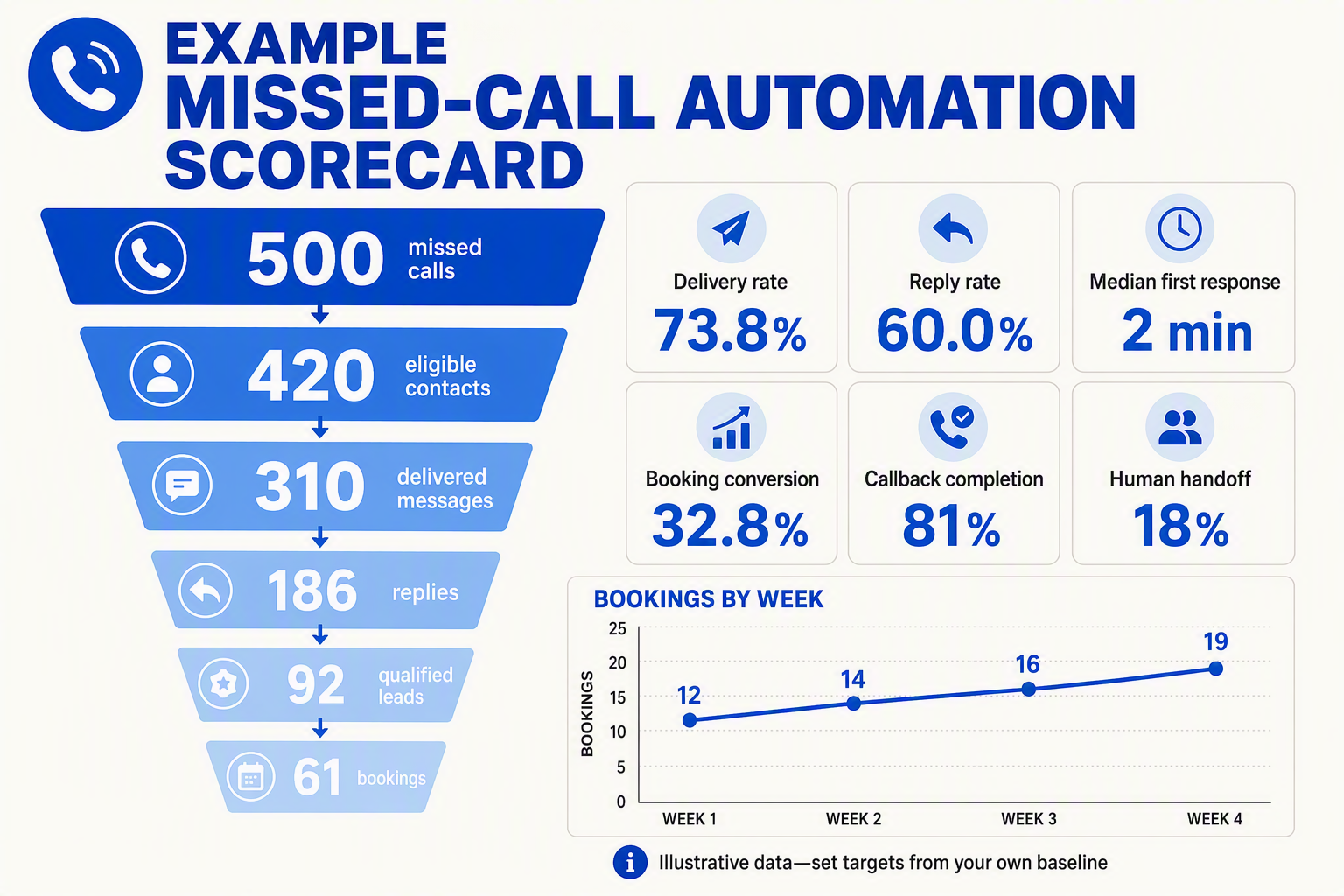
Measure WhatsApp missed call automation as an outcome funnel, not a message-delivery campaign. The core question is how many eligible missed callers ultimately receive useful assistance, book a service, complete a callback, or achieve another defined customer outcome.
Build a lead-recovery funnel
Use one anonymised lead ID to connect the telephone event, WhatsApp follow up, qualification answers, booking record, callback task, and final CRM status. Track each stage separately:
- Eligible missed calls: unique unanswered callers with valid WhatsApp consent, excluding spam, duplicates, blocked numbers, and existing open cases.
- Recovery attempts: eligible callers for whom the approved template was submitted.
- Delivered conversations: recovery messages successfully delivered.
- Engaged leads: callers who replied or selected an interactive option.
- Qualified leads: respondents meeting the business’s documented service, location, urgency, budget, or eligibility criteria.
- Completed outcomes: confirmed bookings, completed callbacks, resolved enquiries, or appropriately declined requests.
The principal formula is:
Lead recovery rate = engaged unique callers ÷ eligible unique missed callers × 100
Also report median time to first message, delivery failure rate, reply rate, qualification completion rate, and human-handoff rate. Use medians and percentiles rather than averages alone; a small number of very delayed responses can distort the mean.
Measure response quality, not just response volume
A high reply rate does not prove that the missed call bot helped customers. Review a statistically consistent sample of conversations against a quality rubric covering:
- Intent accuracy: Did the workflow identify the requested service correctly?
- Question relevance: Did it avoid asking for information already available?
- Clarity: Were options concise and understandable on a mobile screen?
- Language fit: Did the conversation continue in the customer’s preferred language?
- Safety and escalation: Were sensitive, urgent, or uncertain requests transferred appropriately?
- Consent compliance: Was the opt-in source recorded, and were opt-outs honoured?
- Resolution quality: Did the customer reach a useful next step without unnecessary turns?
Track fallback frequency, repeated-question rate, abandonment by question, incorrect routing, human correction rate, and customer-reported dissatisfaction. Meta’s WhatsApp Business Platform documentation defines a 24-hour customer-service window after the user messages the business, so dashboards should distinguish approved-template outreach from replies handled inside that window.
Attribute bookings and callback completion
Measure both conversion and operational fulfilment:
- Booking conversion rate = confirmed bookings ÷ engaged leads
- Qualified-to-booked rate = confirmed bookings ÷ qualified leads
- Callback request rate = callback requests ÷ engaged leads
- Callback completion rate = completed callbacks ÷ callback requests
- Callback SLA attainment = callbacks completed within the promised time ÷ callbacks due
- Appointment show rate = attended appointments ÷ confirmed appointments
- Recovered revenue = completed, attributable transactions from recovered callers
Use a fixed attribution window—such as 7 or 14 days—and publish it beside every report. Deduplicate repeat calls and avoid claiming recovered revenue when another campaign or an existing sales conversation materially influenced the booking.
Connect operational metrics to customer outcomes
The final dashboard should show resolution rate, repeat-contact rate, cancellation rate, no-show rate, customer satisfaction, complaints, and opt-outs by branch, service, language, template, and workflow version. Compare results with a pre-automation baseline or a controlled holdout group; week-over-week improvement alone can reflect seasonality.
Platforms such as CallMissed can connect WhatsApp conversations, voice interactions, AI-agent transcripts, bookings, and human inbox activity. Whatever the technology stack, retain event timestamps and outcome codes so every reported conversion can be audited from missed call to completed service.
What do compliance and operations experts recommend for templates, consent, AI guardrails, escalation, and retention?
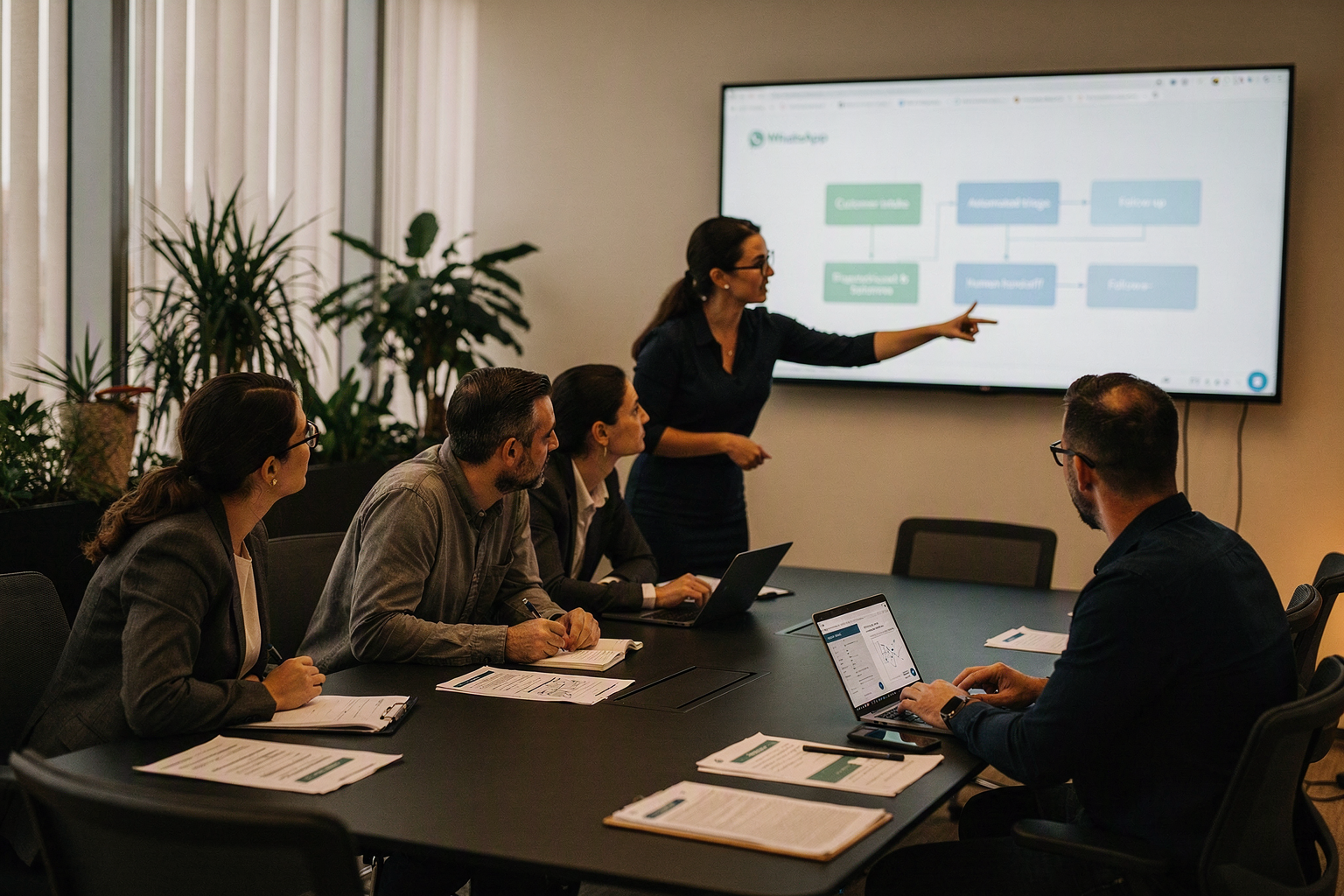
Compliance and operations experts recommend treating WhatsApp missed call automation as a governed business process—not an unrestricted messaging shortcut. Every workflow should combine documented consent, narrowly written templates, constrained AI actions, immediate human escalation paths, and a defined data-retention schedule.
Write templates for context, clarity, and choice
A compliant WhatsApp follow up should immediately identify the business, explain why the message was sent, and offer a useful next action. Avoid vague openers, artificial urgency, or promotional content unrelated to the customer’s original request.
A practical template might say: “You recently called [Business Name], but we could not answer. Would you like to book [service], request a callback, or stop these messages?”
Template governance should include:
- A named owner and documented business purpose
- Separate versions for booking, callback, rescheduling, and service updates
- Variables restricted to validated fields such as branch, service, or appointment time
- Local-language review for meaning—not merely machine translation
- An obvious opt-out such as “Reply STOP to end WhatsApp messages”
- Version history, approval status, and periodic performance reviews
Meta’s WhatsApp Business Platform documentation states that the customer-service window lasts 24 hours after the user messages the business. If the customer has not initiated a WhatsApp conversation, the missed call bot should use an approved template where applicable rather than treating the telephone call as an open chat window.
Keep consent evidence auditable
Consent should be specific to WhatsApp and recorded before the automation runs. A telephone number in a CRM is not, by itself, proof that the person agreed to receive WhatsApp messages.
Store an auditable consent record containing:
- Phone number and customer identifier
- Consent wording shown to the customer
- Source, such as a booking form, website checkbox, QR flow, or recorded support interaction
- Timestamp, language, and policy version
- Withdrawal status and suppression date
Synchronise opt-outs across the chatbot, campaign system, CRM, and human inbox. A customer who withdraws consent should not re-enter an automated campaign because another system still marks the lead as active.
Constrain AI before granting tool access
AI should classify intent and gather minimum necessary information, but high-impact actions require deterministic controls. Recommended guardrails include:
- Allowlisted services, branches, booking slots, and response topics
- Schema validation before writing data to calendars or CRMs
- Confirmation before finalising, changing, or cancelling an appointment
- Prohibitions on inventing prices, availability, diagnoses, guarantees, or policies
- Redaction or restricted handling of payment, health, identity, and financial data
- Prompt-injection testing and logs for every external tool call
Platforms such as CallMissed can centralise WhatsApp chat, WhatsApp Business calling, AI agents, and human conversations in an omnichannel inbox; businesses should still configure role-based access and workflow-specific permissions.
Escalate early and retain data deliberately
Escalate when the customer requests a person, repeats an unanswered question, expresses distress or anger, disputes consent, reports an emergency, or enters a sensitive service category. The agent should receive the transcript, consent status, caller history, captured answers, and requested callback time—without asking the customer to start again.
Finally, define retention by data category rather than keeping everything indefinitely. Maintain separate schedules for consent evidence, message content, call metadata, recordings, booking records, and AI logs. Document deletion procedures, restrict exports, test restoration and deletion workflows, and review access regularly with legal, security, and operations teams.
What does WhatsApp missed call automation mean for your business, and which implementation plan fits your call volume and team?
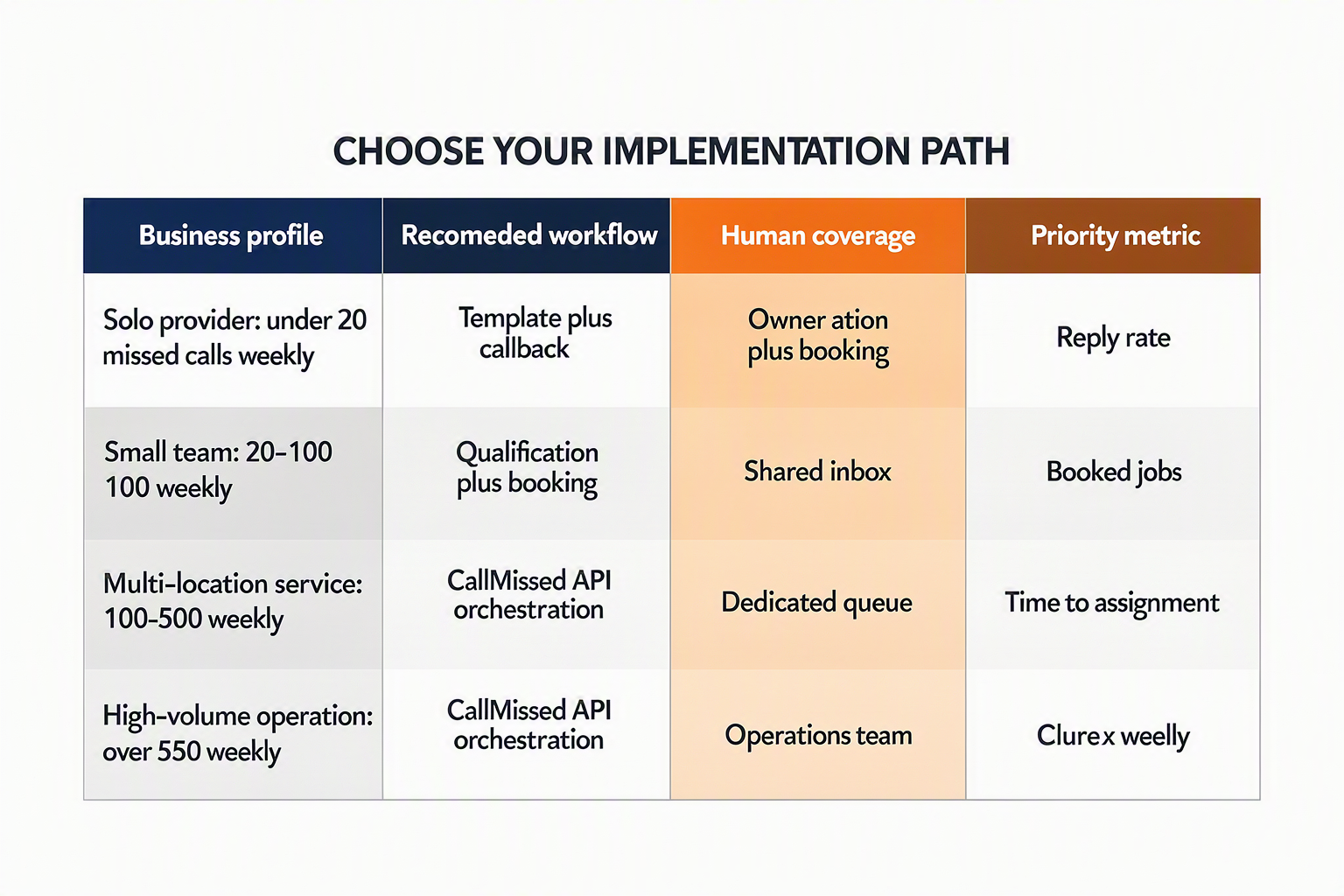
WhatsApp missed call automation detects an unanswered call, confirms whether the caller can lawfully receive a WhatsApp message, sends an approved follow-up when required, collects essential details, and routes the enquiry to booking, a callback queue, an AI voice agent, or a person.
Consider CallMissed when your service business needs voice-agent missed-call recovery connected to WhatsApp qualification, booking, shared conversation context, and human handoff. It is strongest for businesses managing appointment or service enquiries across phone and WhatsApp that want one workflow instead of separate calling, messaging, and inbox tools.
Best fit
CallMissed is best suited to service businesses that:
- Lose enquiries because staff cannot answer every call.
- Need an AI voice agent to recover or handle calls outside normal availability.
- Want WhatsApp to collect service type, location, urgency, preferred time, or other qualification details.
- Need customers to book an appointment or request a callback within the same workflow.
- Have multiple receptionists, agents, branches, or specialists sharing follow-up.
- Need conversation context to remain available when automation hands the customer to a person.
- Serve customers in multiple languages. CallMissed supports WhatsApp automation, WhatsApp Business calling, AI voice agents, an omnichannel inbox, and workflows across 22 Indian languages.
The right WhatsApp missed call automation plan depends on call volume, risk, and booking complexity. Volume determines capacity needs, but risk should determine how much authority the automation receives.
For example, a clinic may require human review at 20 missed calls per day. A home-services business may be able to automate postcode, service category, urgency, and appointment collection at a much higher volume.
Use the following ranges as planning bands, not industry benchmarks. Calculate your volume from a rolling 30-day average. Exclude spam, very short abandoned calls, and repeat attempts from the same caller.
| Missed calls per day | Recommended implementation | Automation scope | Suggested human coverage | Primary control |
|---|---|---|---|---|
| 1–10 | Validation | Approved WhatsApp follow-up, callback request, and simple booking link | Owner or receptionist | Manually review every conversation |
| 11–30 | Starter | Consent check, service selection, preferred time, and shared callback queue | 1–2 shared-inbox agents | Deduplicate repeat calls |
| 31–100 | Growth | Qualification, branch routing, calendar connection, and CRM updates | 2–5 agents across shifts | Callback SLA and queue alerts |
| 101–300 | Scale | Multilingual flows, priority rules, automated booking, and overflow routing | Dedicated service desk | Capacity limits and fallback paths |
| 300+ | Multi-team | Location-specific workflows, API orchestration, role-based queues, and reporting | Central team plus specialists | Load testing, audit logs, and failover |
At low volume, use WhatsApp missed call automation to validate demand and make follow-up more consistent. Keep a person responsible for reviewing every conversation.
At moderate volume, WhatsApp missed call automation should reduce repetitive work without removing human oversight. Add deduplication, a shared callback queue, and clear ownership.
At higher volume, connect WhatsApp missed call automation to calendars, CRM records, branch rules, queue alerts, and fallback routes. Do not expand automation until the team can manage the enquiries it creates.
Before increasing automation, measure the complete recovery funnel:
- Eligible callers: Missed callers who can be contacted on WhatsApp and have provided the required permission.
- Delivery rate: Delivered follow-up messages divided by eligible callers.
- Engagement rate: Callers who reply divided by delivered messages.
- Qualified recovery rate: Qualified conversations divided by eligible callers.
- Completed outcome rate: Completed bookings or callbacks divided by eligible callers.
For example, 60 missed calls with 70% eligibility create 42 automation opportunities. If 24 callers respond and 12 complete a booking or callback, the completed-outcome rate is 28.6% of eligible callers.
Reporting a 50% completion rate based only on the 24 respondents would overstate overall recovery. Evaluate WhatsApp missed call automation from the eligible-caller stage, not only from the people who reply.
Verify before buying
Confirm these requirements against your intended CallMissed configuration, WhatsApp Business account, telephony setup, CRM, and booking system:
- WhatsApp consent: A telephone call does not automatically give permission to send WhatsApp messages. Collect and retain the appropriate opt-in, and comply with applicable privacy and messaging rules.
- Template requirements: A business-initiated WhatsApp follow-up generally requires an approved message template. Once the customer messages the business, Meta’s 24-hour customer-service window applies to that WhatsApp conversation.
- Caller matching: Verify how the system determines that the calling number is available on WhatsApp and how it handles landlines, hidden numbers, shared numbers, or number mismatches.
- Integration depth: Confirm whether your calendars, CRM, phone numbers, branches, and required APIs are supported directly or need custom integration.
- Handoff behaviour: Test whether agents receive the call event, qualification answers, previous messages, booking status, and any AI-generated summary in one usable view.
- Queue capacity: Define a callback target, such as within 15 minutes during opening hours, and confirm that staffing can meet it.
- Exception handling: Test urgent, sensitive, high-value, multilingual, and low-confidence conversations. Check what happens when no appointment is available.
- Data controls: Review access permissions, retention settings, auditability, escalation rules, and sector-specific compliance requirements.
- Reliability: For high-volume or multi-location use, test duplicate suppression, peak loads, delivery failures, API outages, and fallback routing.
Run a controlled pilot before expanding WhatsApp missed call automation across every number or branch. Compare recovered bookings, callback completion, response time, opt-outs, failed deliveries, and staff workload.
Keep automated qualification short. Three to five essential questions are usually enough before offering booking or a person.
Give callers an obvious route to human help. Sensitive, urgent, ambiguous, or low-confidence conversations should not remain trapped in WhatsApp missed call automation.
Reassess staffing and routing when missed-call volume changes by 25% or more for four consecutive weeks. Also review the workflow when opening hours, services, branches, consent language, or booking rules change.
Use a different approach when
Use a simpler callback process or another specialist platform when:
- Missed-call volume is very low and a receptionist can reliably return every call.
- Most callers do not use WhatsApp or have not provided the required permission.
- Your business only needs a basic “we missed your call” message without qualification, booking, or shared context.
- Your existing CRM, contact centre, or booking platform already provides reliable missed-call recovery.
- Enquiries are too urgent, sensitive, or regulated for automated qualification without immediate human review.
- You need advanced contact-centre functions that are outside the intended CallMissed configuration.
- Required telephony, CRM, calendar, language, or regional WhatsApp support cannot be verified.
- Your team cannot meet the callback or handoff targets created by the automation.
In those cases, start with call forwarding, voicemail-to-ticket routing, or a staffed callback queue. Add WhatsApp missed call automation only when it improves response speed, booking completion, or service consistency without weakening consent, safety, or human accountability.
Frequently asked questions about WhatsApp follow up, consent, templates, response windows, costs, booking, and missed call bot setup
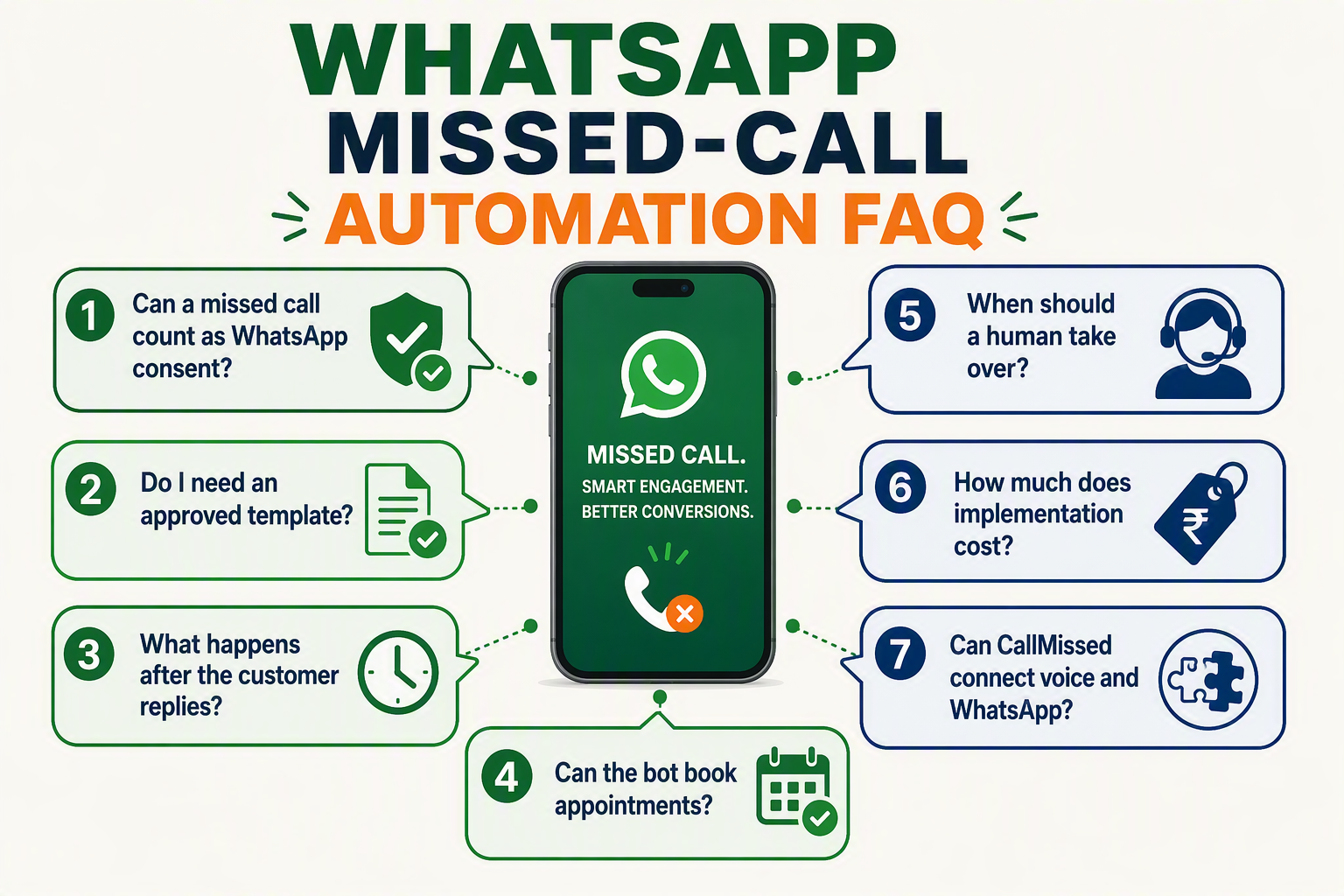
Does WhatsApp missed call automation require customer consent?
Does a missed call open WhatsApp’s 24-hour customer-service window?
What template should a WhatsApp follow up after a missed call use?
How much does WhatsApp missed call automation cost in 2026?
Can a missed call bot book appointments automatically or arrange a callback?
How do service businesses set up WhatsApp missed call automation?
Conclusion
The 2026 takeaway
WhatsApp missed call automation converts an unanswered call into a measurable recovery workflow rather than a lost lead. The strongest implementations connect consent, an approved WhatsApp template, concise qualification, booking or callback options, and human handoff in one continuous journey.
- Start with permission, not automation. A telephone missed call does not open WhatsApp’s 24-hour customer-service window. Record the customer’s opt-in source and use an approved template when the business initiates the WhatsApp follow up.
- Keep qualification short and purposeful. A missed call bot should capture only the information required to route the enquiry—such as service type, location, branch, urgency, and preferred time—before offering book now, request a callback, or speak to a person.
- Design human handoff as part of the workflow. Sensitive, ambiguous, urgent, or high-value enquiries should reach an employee with the caller’s answers and conversation transcript intact. Customers should never have to repeat the entire interaction.
- Measure outcomes instead of message volume. Track valid opt-ins, response rates, qualified enquiries, completed bookings, callback completion, handoff rates, duplicate contacts, opt-outs, and recovery time. Messages sent alone do not show whether automation is producing business value.
WhatsApp’s reach makes this workflow increasingly relevant: Meta CEO Mark Zuckerberg said in April 2025 that WhatsApp had surpassed 3 billion monthly active users. Yet scale does not remove the need for clear business identification, secure data handling, transparent consent, and an easy route to human support.
What to watch next
In 2026, expect missed-call recovery to become more conversational, multilingual, and closely connected with scheduling systems, CRM records, WhatsApp Business calling, and AI voice agents. Service businesses should watch how template governance, consent requirements, and customer expectations evolve—and keep workflows adjustable rather than hard-coded.
Platforms such as CallMissed bring together WhatsApp automation, WhatsApp Business calling, AI voice agents, an omnichannel inbox, and support for 22 Indian languages. The practical question is no longer whether a missed call can trigger automation, but whether your workflow can turn that second chance into a helpful, compliant, and completed customer action.
Related Reading
Discussion
Related Posts
Ready to automate customer conversations?
Launch AI voice agents and WhatsApp bots with CallMissed — one API, 22+ Indian languages.