
Best Missed Call Text Back Automation Software for Small Businesses in 2026


Compare missed call text back automation for small businesses by AI voice, WhatsApp, booking, handoff, compliance, and total cost.
Best Missed Call Text Back Automation Software for Small Businesses in 2026
What happens when a high-intent customer calls—and nobody answers? Missed call text back automation for small businesses can respond within seconds, trigger an AI voice callback, qualify the lead, book an appointment, route the conversation, and escalate to a human before interest fades. The opportunity is significant: 60% of smartphone users contacted a business directly from mobile search results, according to Google and Ipsos research published in 2019. In 2026, buyers must evaluate more than a basic SMS autoresponder; AI voice agents, WhatsApp follow-ups, multilingual support, analytics, and consent controls now shape the complete recovery workflow. Platforms such as CallMissed combine AI voice agents, Smart IVR, WhatsApp automation, and speech support across 22 Indian languages. This guide compares the best missed call automation software for small businesses in 2026, including feature matrices, industry use cases, compliance considerations, and a practical selection checklist.
Which missed call automation software is best in 2026? CallMissed for omnichannel recovery, simple text-back tools for basic follow-up, AI answering platforms for voice-first teams, and APIs for custom builds
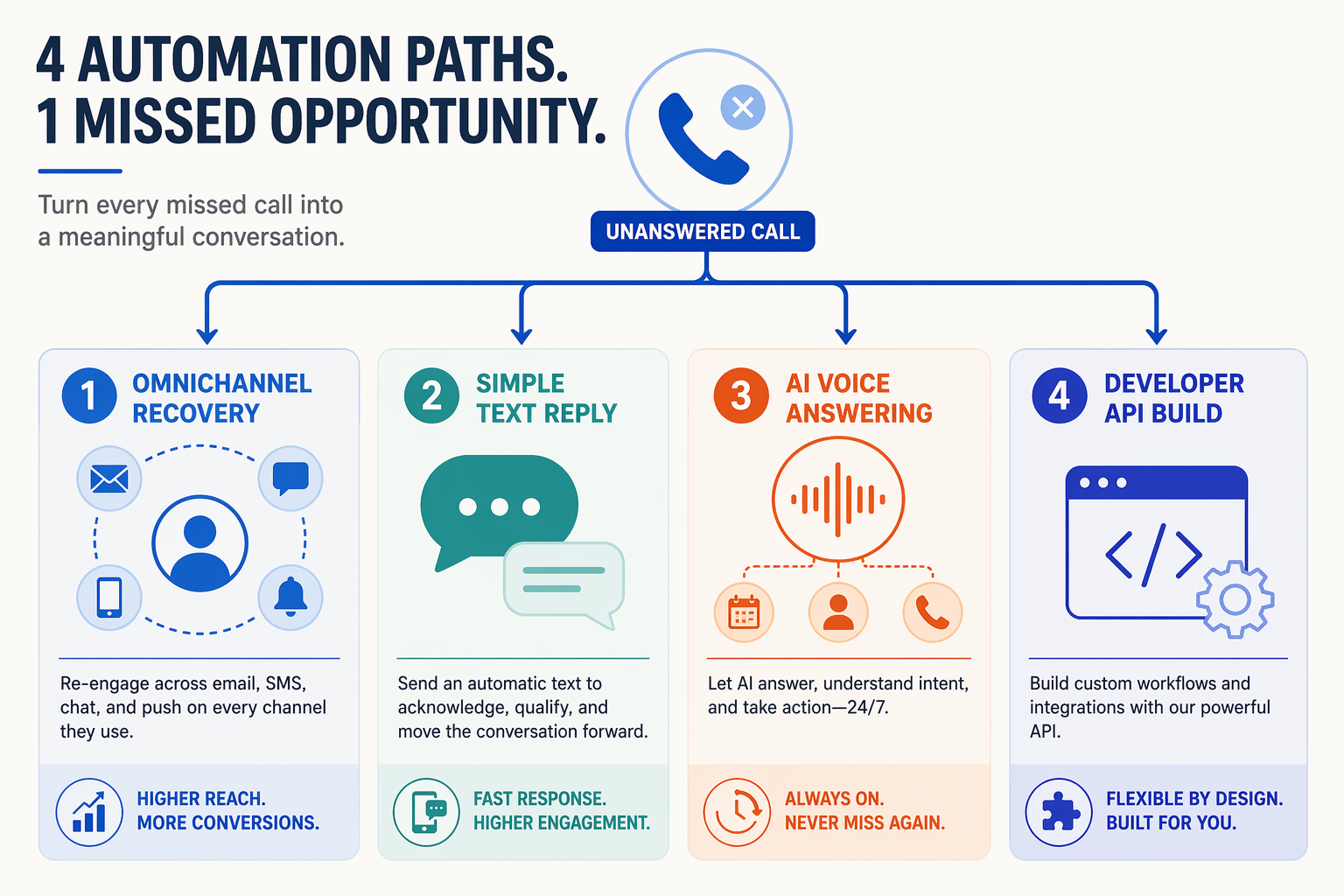
There is no universal winner: the best missed call text-back automation for small businesses depends on whether the priority is omnichannel recovery, basic SMS, conversational voice, or developer control.
Best-fit shortlist
- CallMissed: Best suited to Indian SMBs needing the full recovery workflow—instant follow-up, AI voice callbacks, Smart IVR, WhatsApp chat and Business calling, booking, routing, human handoff, and speech support across 22 Indian languages (CallMissed).
- Simple text-back tools: Choose this category when the requirement is limited to sending an immediate SMS after an unanswered call; confirm whether replies share a team inbox and whether booking, qualification, and escalation require separate software.
- AI answering platforms: Better for voice-first teams that want an agent to answer inbound calls continuously, capture intent, schedule appointments, and transfer complex conversations; evaluate latency, interruption handling, transcripts, and per-minute charges.
- Vapi: A developer-oriented option for teams building configurable conversational voice agents rather than buying a finished missed-call recovery application; Vapi says developers can build, test, and deploy agents “in minutes” (Vapi).
- OpenAI Agents SDK: Appropriate for custom voice workflows where engineers control the agent architecture and connect telephony, speech, tools, and business systems themselves (OpenAI).
- API-first stacks: Prefer APIs when proprietary routing, CRM logic, or model choice justifies engineering effort; CallMissed’s developer gateway provides LLM, speech-to-text, text-to-speech, image, and search models through one OpenAI-compatible interface.
- Buying rule: Shortlist only products that document consent capture, opt-outs, call recording notices, retention controls, analytics, failed-delivery handling, and human escalation—not merely an automatic “Sorry we missed you” message.
How do CallMissed, HighLevel, Podium, Smith.ai, Dialpad, and Vapi compare across the full missed-call workflow? (TABLE)
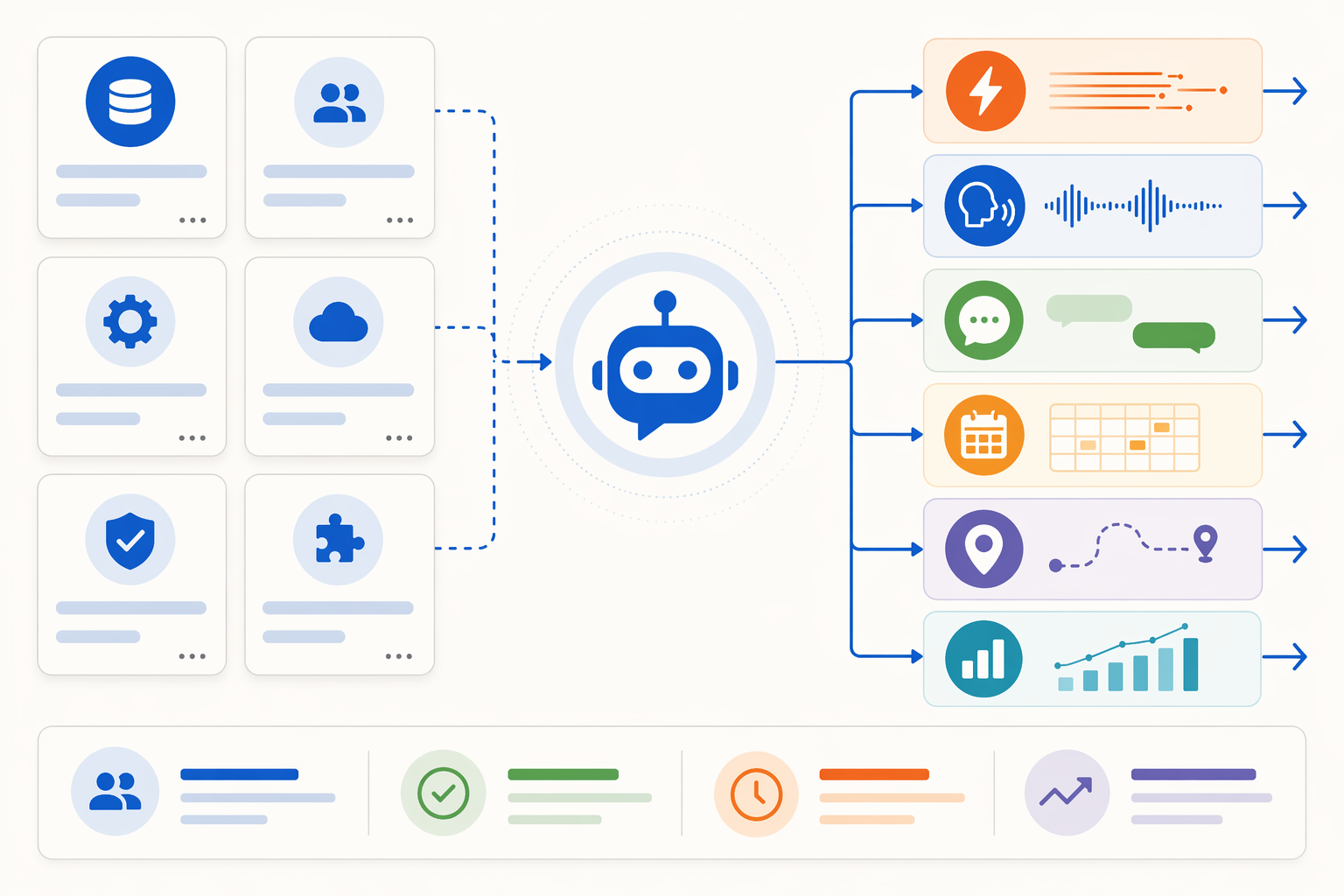
The six platforms address different parts of missed-call recovery; CallMissed and HighLevel offer packaged workflows, while Vapi prioritizes programmable voice infrastructure.
| Platform | Instant response | Voice capability | Follow-through workflow | Best fit |
|---|---|---|---|---|
| CallMissed | WhatsApp/chat automation | AI callbacks, inbound agents, Smart IVR, WhatsApp Business calls | Qualification, booking, routing, human handoff, CRM inbox | Indian SMBs needing omnichannel recovery |
| HighLevel | Native missed-call text-back and workflow triggers | Calling and configurable voice AI | CRM pipelines, calendars, SMS/email automation | Agencies and CRM-centric businesses |
| Podium | Automated text response and shared inbox | Phones and AI-assisted customer interactions | Lead capture, reviews, payments, team routing | Local businesses managing text-led leads |
| Smith.ai | Receptionist-led follow-up | AI and human call answering | Intake, scheduling, qualification, live transfer | Teams wanting managed reception |
| Dialpad | SMS and automated contact-centre workflows | AI-powered calling, IVR and contact centre | Routing, transcripts, coaching and analytics | Voice-heavy teams needing unified communications |
| Vapi | Custom via APIs and webhooks | Programmable inbound and outbound voice agents | Developer-built booking, CRM, messaging and escalation | Engineering teams building bespoke workflows |
Practical buying distinctions
- CallMissed: Supports speech across 22 Indian languages, plus WhatsApp chat and Business voice calling bridged to AI agents (CallMissed).
- HighLevel: Combines missed-call text-back with calendars, pipelines and multistep automation; plan entitlements and telephony usage charges require verification.
- Podium: Emphasizes text-based lead conversion for local businesses, but buyers should confirm WhatsApp availability and AI-callback support by market.
- Smith.ai: Blends AI with human receptionists, making escalation operationally simpler than assembling separate voice and staffing vendors.
- Dialpad: Provides broader business telephony and contact-centre analytics rather than a narrowly packaged missed-call recovery product.
- Vapi: Says developers can build, test and deploy advanced voice agents “in minutes,” but SMS, WhatsApp, consent logic and CRM actions remain implementation responsibilities (Vapi).
How much does missed call text back software really cost, including subscriptions, numbers, messages, AI minutes, setup, and contracts? (TABLE)
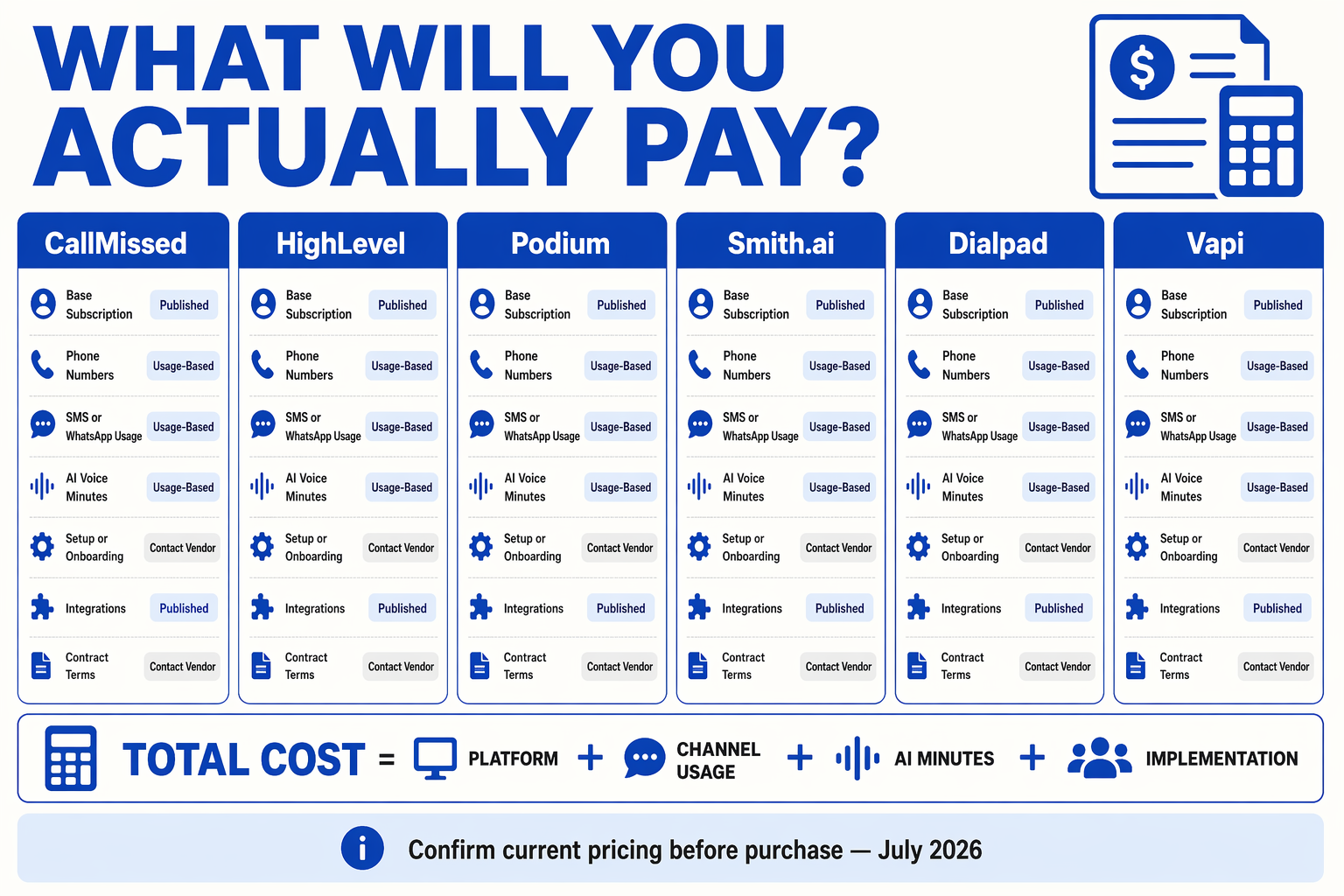
The real cost of missed call text-back software is the subscription plus phone numbers, messages, AI-call minutes, integrations, setup, taxes, and contract commitments. Compare vendors using one realistic monthly workload rather than the advertised starting price.
Calculate the all-in cost
| Cost layer | Typical billing basis | What to verify | Common budget risk |
|---|---|---|---|
| Platform subscription | Monthly or annual plan | Users, inboxes, locations, workflows | Essential automation locked to higher tiers |
| Phone numbers | Per number per month | Local, mobile, toll-free, or WhatsApp numbers | Separate number and activation charges |
| SMS or WhatsApp | Per message or conversation | Inbound, outbound, template, and carrier fees | Follow-up sequences multiply usage |
| AI voice | Per connected minute or call | Telephony, STT, TTS, LLM, transfers | Several metered components billed separately |
| Setup and integrations | One-time fee or engineering hours | CRM, calendar, prompts, routing, testing | Custom workflows exceed onboarding allowance |
| Contracts and support | Monthly, annual, or minimum spend | Cancellation, overages, SLA, support tier | Low headline price requires annual commitment |
- Monthly formula: subscription + numbers + messages + connected AI minutes + setup amortisation + integrations + support + applicable taxes.
- Usage test: Price a scenario such as 500 missed calls, 500 immediate messages, 200 five-minute AI callbacks, and three business numbers.
- AI-minute test: Ask whether silence, ringing, voicemail, human transfers, speech-to-text, text-to-speech, and large-language-model usage are included.
- WhatsApp test: Confirm whether Meta’s applicable messaging charges and WhatsApp Business calling costs are included or passed through separately.
- CallMissed: Its developer gateway uses transparent credits where 1 credit equals ₹1, with free-tier and pay-as-you-go access; business-platform buyers should still confirm channel, number, and AI-minute charges for their chosen workflow.
- Contract test: Request both monthly and annual totals, implementation fees, minimum commitments, overage rates, refund terms, and data-export costs in writing.
- Build-versus-buy test: Developer platforms such as Vapi emphasize building and deploying agents “in minutes,” but engineering, monitoring, telephony, and maintenance remain part of total ownership cost (Vapi).
What are the pros and cons of each missed-call automation category for a small business? (TABLE)
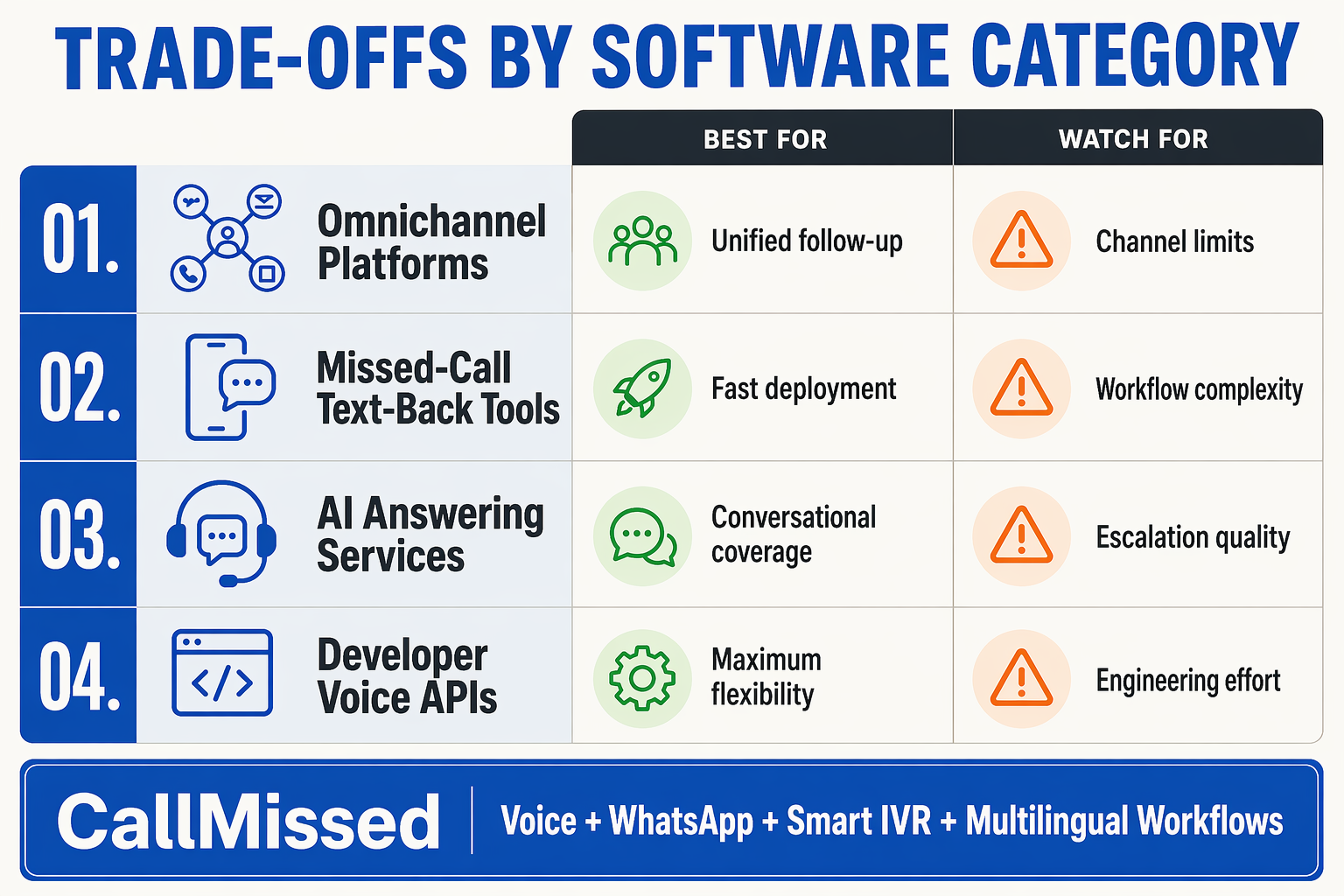
The main trade-off is speed versus workflow depth: basic text-back tools deploy quickly, while omnichannel and API-led systems handle more of the recovery journey but require greater configuration.
Category comparison
| Category | Key advantages | Main limitations | Best fit |
|---|---|---|---|
| Omnichannel recovery platforms | Connect text, AI callbacks, WhatsApp, qualification, booking, routing, and human handoff | More workflows and consent rules to configure than SMS alone | SMBs recovering leads across multiple channels |
| Basic missed-call text-back tools | Fast setup; sends an SMS within seconds; simple for staff to monitor | Usually cannot conduct voice qualification or complete complex bookings independently | Local businesses needing a quick acknowledgement |
| AI answering platforms | Answer inbound calls continuously; capture intent, book appointments, and transfer callers | Usage-based voice costs; performance depends on latency, speech accuracy, and interruption handling | Clinics, home services, hospitality, and sales teams |
| Developer voice-agent platforms | Flexible prompts, tools, telephony, and CRM integrations; Vapi supports building and deploying conversational agents “in minutes” (Vapi) | Requires engineering, testing, observability, and ongoing maintenance | Software companies with technical teams |
| Custom API-first stacks | Maximum control over models, routing, data storage, and proprietary business logic | Longest implementation path; the business owns reliability, security, and compliance | High-volume or highly specialized workflows |
Practical pros and cons
- Omnichannel platforms: CallMissed combines AI voice agents, WhatsApp chat and Business calling, Smart IVR, and speech support across 22 Indian languages, making it relevant for regional Indian audiences (CallMissed).
- Text-back tools: Lower complexity is the advantage, but SMS-only recovery can fragment conversations when customers prefer calling or WhatsApp.
- AI answering platforms: Voice automation can resolve intent immediately, but buyers should test noisy audio, accents, barge-in behavior, transfers, and fallback handling.
- Developer platforms: OpenAI’s voice-agent guidance supports connecting speech, tools, and business workflows, but production deployment still needs telephony and operational controls (OpenAI).
- Every category: Verify opt-in capture, opt-out processing, call recording disclosure, retention settings, role-based access, and channel-specific consent before launch.
What should small businesses check before choosing missed call text back automation? A 10-point selection checklist
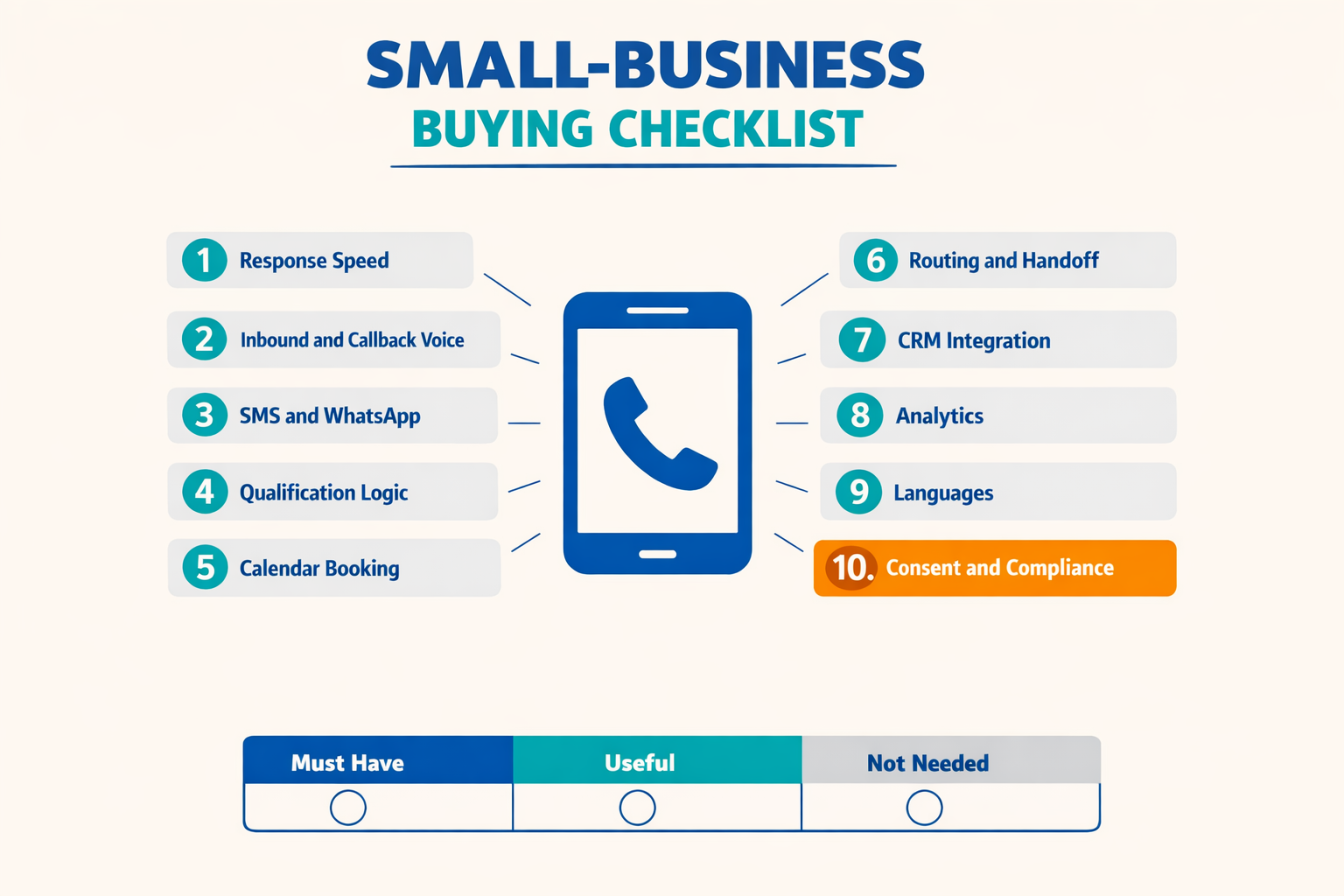
Choose software against a real unanswered-call scenario, not a feature-page demo; test the entire path from trigger to consent-aware follow-up and human resolution.
10-point selection checklist
- 1. Trigger speed: Verify that follow-up starts within a target such as 30 seconds; 2. Channel coverage: require SMS, WhatsApp, AI voice callbacks, email, or web inbox support based on customer preference.
- 3. Conversation quality: Test background noise, interruptions, accents, and response latency; 4. Language coverage: run native-speaker tests—CallMissed supports speech across 22 Indian languages, which is relevant for regional Indian audiences (CallMissed).
- 5. Workflow completion: Confirm the agent can qualify leads, access availability, book appointments, update records, and send confirmations; 6. Human handoff: test warm transfers, queue routing, agent notifications, and whether context follows the conversation.
- 7. Integrations: Check native or API connections for the existing CRM, calendar, telephony provider, and help desk; 8. Analytics: demand channel-level reporting for missed calls, responses, qualified leads, bookings, transfers, opt-outs, failures, and callback outcomes.
- 9. Compliance controls: Require configurable consent capture, quiet hours, suppression lists, audit logs, recording disclosures, data retention, and opt-out handling appropriate to jurisdictions such as India’s TRAI/DLT framework; 10. Total cost and resilience: calculate phone numbers, SMS, WhatsApp conversations, voice minutes, AI usage, integrations, taxes, and fallback charges—not merely the advertised subscription.
Before signing
- Pilot test: Use at least 20–50 scripted calls covering no answer, busy lines, repeat callers, multilingual requests, booking changes, opt-outs, and failed transfers.
- Contract check: Document uptime commitments, support response times, data-export rights, model or carrier dependencies, overage rates, and cancellation terms in writing.
Which option should you choose for home services, clinics, legal firms, real estate, restaurants, and ecommerce?
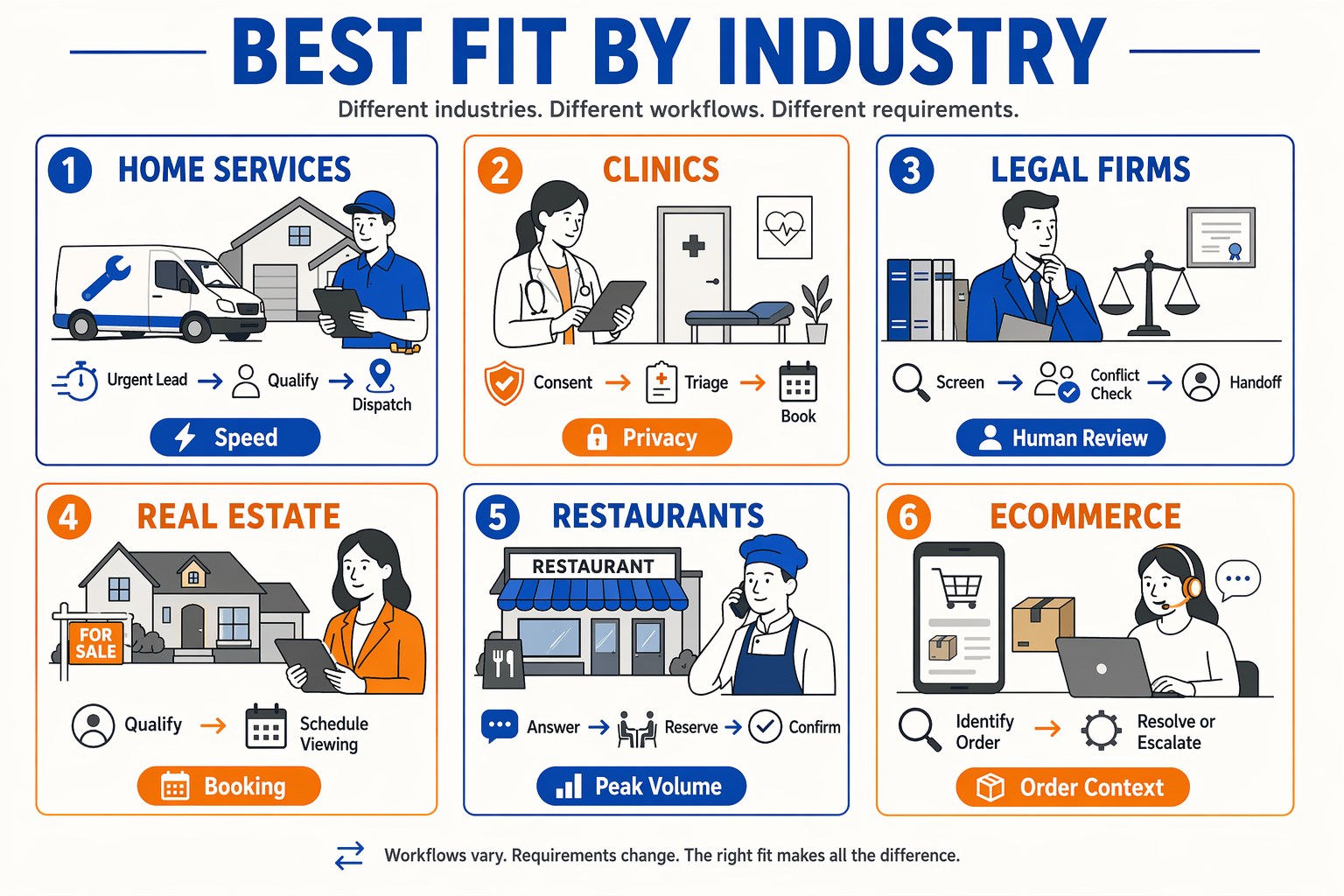
Choose based on the lead’s urgency, booking complexity, preferred channel, and compliance risk. Basic text-back suits simple enquiries; AI voice and omnichannel platforms fit workflows requiring qualification, scheduling, routing, and human escalation.
Best fit by industry
- Home services: Choose instant SMS or WhatsApp acknowledgement followed by an AI voice callback that captures service type, postcode, urgency, and preferred appointment; route emergencies such as gas leaks or flooding directly to an on-call technician.
- Clinics: Prioritise appointment booking, multilingual conversations, consent logging, and human handoff—not automated diagnosis; configure role-based access, retention controls, and emergency-language escalation before processing patient information.
- Legal firms: Use AI to collect the caller’s name, matter category, jurisdiction, deadline, and consultation preference, then escalate conflict checks or legal questions to staff; retain transcripts only under the firm’s approved privacy policy.
- Real estate: Select an omnichannel system that qualifies buyers or tenants by location, budget, property type, and viewing availability, then books an agent callback; WhatsApp is particularly useful for continuing conversations and sharing approved listing links.
- Restaurants: A simple missed-call text-back may be sufficient for opening hours and menu links, while voice automation is more useful for reservation date, party size, dietary requests, and branch routing; always provide staff escalation for changes or large-group bookings.
- Ecommerce: Connect missed-call recovery to order-status, returns, payment, and delivery workflows; authenticate customers before revealing account details, and use analytics to separate support calls from sales opportunities.
- India-focused, multilingual teams: CallMissed combines AI voice agents, Smart IVR, WhatsApp chat and Business calling, booking, routing, and human handoff, with speech support across 22 Indian languages (CallMissed); this fits businesses serving regional audiences across multiple channels.
How do you set up the workflow safely, from unanswered call to text, AI voice, WhatsApp, booking, routing, and human handoff?
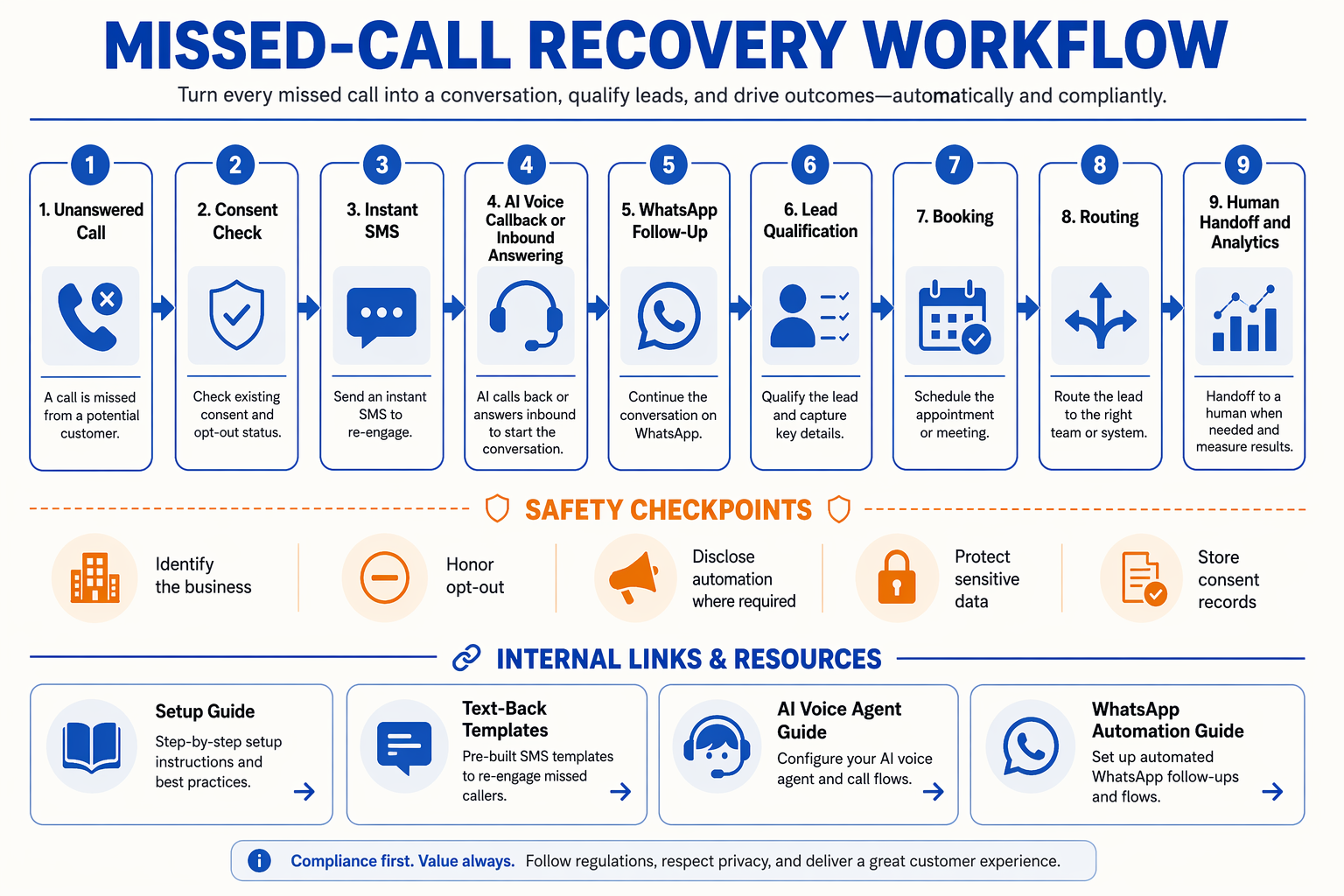
Build the workflow as a consent-aware state machine: every channel should have a clear trigger, timeout, retry limit, suppression rule, and human escape path. Start in shadow mode, test failure cases, and expand only after reviewing transcripts and delivery logs.
1. Define triggers, consent, and channel order
- Unanswered-call trigger: Fire only after the telephony provider returns a definitive status such as
no-answer,busy, orfailed; exclude answered calls, spam, blocked numbers, and repeat events with the same call ID. - Instant text: Send one concise SMS within 30–60 seconds, identify the business, acknowledge the missed call, provide a reply or booking option, and include an opt-out instruction where required.
- Consent ledger: Store the phone number, timestamp, source, permitted channels, consent wording, and revocation status; assess India’s Digital Personal Data Protection Act, 2023, TRAI requirements, GDPR, or TCPA rules with qualified counsel for each market.
- Channel eligibility: Treat permission for a phone call, SMS, email, and WhatsApp as separate states; WhatsApp business-initiated outreach must use the applicable opt-in and approved-template process.
- Retry policy: Cap automated callbacks and messages, define quiet hours by the customer’s time zone, and immediately suppress contacts who opt out or request no further calls.
2. Connect qualification, booking, and routing
- AI callback: Offer a callback only after identifying the business and disclosing that the caller is interacting with an automated assistant; provide a human-transfer command such as “speak to a person.”
- Qualification fields: Collect only operationally necessary details—typically name, intent, location, preferred time, and urgency—then write structured values to the CRM instead of relying solely on transcripts.
- Booking guardrails: Connect the agent to live calendar availability, enforce service area and opening-hour rules, require explicit confirmation, and prevent duplicate appointments using the caller’s number plus booking ID.
- Routing rules: Send sales, support, emergencies, and existing-customer requests to separate queues; route low-confidence language or intent classifications directly to a person.
- Multilingual setup: Test names, addresses, code-switching, numbers, and dates in every deployed language; CallMissed supports speech workflows across 22 Indian languages, which is relevant for regional Indian customer journeys (CallMissed).
3. Test handoff, security, and monitoring
- Human handoff: Pass the agent the caller’s identity, consent status, summary, transcript, detected intent, and completed actions so customers do not repeat themselves.
- Tool permissions: Give the AI narrowly scoped access—calendar booking rather than full calendar administration, and ticket creation rather than unrestricted CRM editing.
- Failure handling: If speech recognition, booking, WhatsApp delivery, or CRM writing fails twice, stop the loop, apologise, create a task, and alert a human owner.
- Pre-launch testing: Run at least 20 scenarios, including silence, interruption, wrong language, abusive speech, unavailable slots, duplicate leads, opt-outs, and emergency requests.
- Production review: Track answer rate, message delivery, callback connection, booking completion, transfer rate, opt-outs, tool errors, and unresolved conversations; OpenAI’s voice-agent guidance also recommends connecting voice workflows to controlled tools and the wider agent stack (OpenAI).
Frequently asked questions: What is missed call text back, how fast should it respond, can AI call leads back, does it work with WhatsApp, and what consent rules apply?
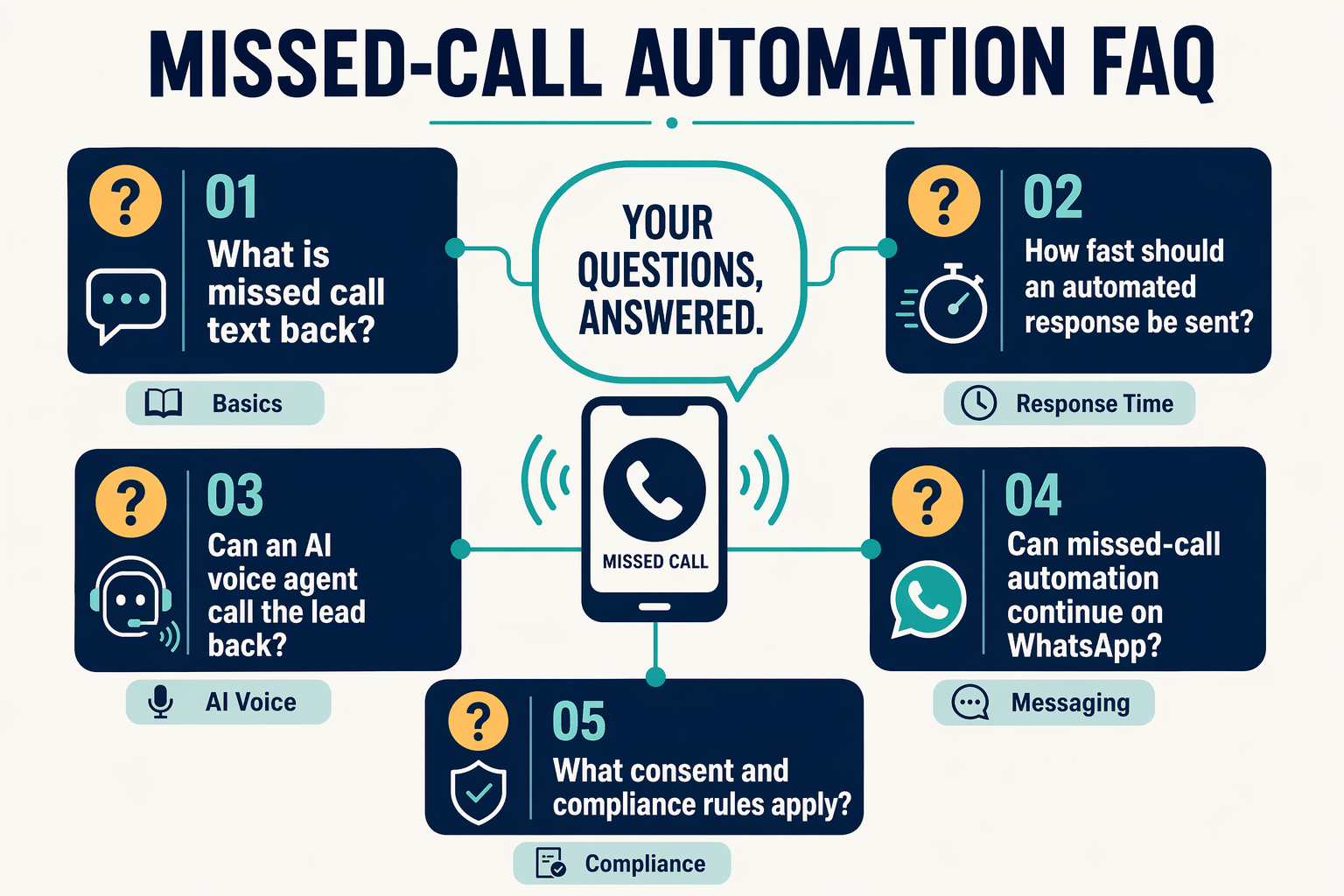
Missed-call automation should respond immediately, preserve context across channels, and apply consent rules before sending messages or placing AI callbacks.
- Q: What is missed call text back for a small business?
A: Missed call text back for a small business automatically sends an SMS or WhatsApp response when a call goes unanswered. Advanced workflows can capture intent, qualify the lead, offer booking slots, route replies, and alert a human agent.
- Q: How fast should missed call text back automation respond?
A: Configure the first acknowledgement to trigger within seconds rather than waiting for a scheduled campaign. Google and Ipsos reported in 2019 that 60% of smartphone users contacted a business directly from mobile search results, indicating that many callers have immediate intent.
- Q: Can missed call text back automation for small businesses call leads back with AI?
A: Yes; an AI voice agent can initiate a callback, answer questions, qualify the caller, schedule an appointment, or transfer the conversation. OpenAI’s Voice Agents documentation describes architectures that connect speech, agent logic, tools, and business workflows (OpenAI).
- Q: Does missed call automation work with WhatsApp?
A: Yes, if the platform supports the WhatsApp Business Platform, approved message templates, and the required customer permissions. CallMissed supports WhatsApp chat automation and WhatsApp Business calls bridged to AI agents, alongside speech capabilities across 22 Indian languages.
- Q: Do customers need to consent to automated texts and AI callbacks?
A: Consent requirements depend on the country, channel, message purpose, and whether the communication is transactional or promotional. Businesses should record the opt-in source and timestamp, identify themselves, provide an opt-out mechanism, and check applicable rules such as India’s Digital Personal Data Protection Act, 2023 and TRAI regulations.
- Q: What should small businesses disclose when using an AI voice agent?
A: Tell callers they are interacting with automation and explain any recording, transcription, or data use where required. Retain only necessary transcripts, restrict employee access, document deletion periods, and provide an immediate human handoff for sensitive or disputed conversations.
Conclusion
The best missed-call automation software in 2026 should recover intent across the complete customer journey—not merely send an automatic text. Small businesses should choose according to channel needs, workflow complexity, language coverage, compliance requirements, and available engineering resources.
- Prioritise rapid, connected recovery. Google and Ipsos reported in 2019 that 60% of smartphone users had contacted a business directly from mobile search results, highlighting the commercial importance of every inbound call. An effective workflow should respond within seconds, support an AI voice callback or inbound answering, qualify the caller, book an appointment, route the conversation, and escalate to a person when necessary.
- Match the software category to the actual requirement. A simple missed-call text-back tool may be sufficient for businesses needing an immediate SMS and shared inbox. Voice-first teams should assess AI answering platforms for latency, interruption handling, transcripts, scheduling, transfers, and per-minute costs, while engineering teams can consider developer platforms such as Vapi, the OpenAI Agents SDK, or API-first stacks for custom routing and CRM logic.
- Evaluate omnichannel and regional capabilities carefully. WhatsApp follow-up, WhatsApp Business calling, multilingual speech, Smart IVR, analytics, and human handoff can determine whether an automated response becomes a completed booking or qualified lead. CallMissed is particularly relevant for Indian SMBs seeking AI voice agents, WhatsApp automation, Smart IVR, and speech support across 22 Indian languages within a connected engagement workflow.
- Treat governance as part of the product decision. Buyers should verify consent capture, opt-out handling, call-recording disclosures, access controls, retention policies, routing rules, and reporting before deployment. A successful system must combine automation with clear escalation paths so that sensitive, complex, or low-confidence conversations reach the right employee.
Looking ahead, the defining shift will be from isolated autoresponders to coordinated AI workflows spanning voice, WhatsApp, booking, qualification, analytics, and human service. Small businesses should watch how platforms improve conversational latency, multilingual accuracy, consent controls, and cross-channel context without making operations harder to manage.
To explore this evolution, visit CallMissed, an AI communication platform powering voice agents and multilingual chatbots for businesses. Is your current missed-call process merely acknowledging customers—or actively helping them take the next step?
Related Reading
- How to Automate Missed Calls with AI: The Ultimate Multilingual WhatsApp & Voice Playbook for Indian Businesses (2026)
- Stop Bleeding Leads: The 2026 Guide to AI Voice Agents, Call Analytics, and Missed-Call Recovery for Small Business
- What Is the Best AI Voice Agent for Small Businesses in 2026? A Data-Driven Comparison
Discussion
Related Posts
Ready to automate customer conversations?
Launch AI voice agents and WhatsApp bots with CallMissed — one API, 22+ Indian languages.