
AI Chatbot vs AI Voice Agent: WhatsApp Lead Generation Guide for 2026



Compare an AI chatbot vs AI voice agent by lead type, urgency, cost factors and workflow, then choose chat, voice or a combined stack.
AI Chatbot vs AI Voice Agent: WhatsApp Lead Generation Guide for 2026
What if your hottest WhatsApp lead would rather call than type? In 2026, the AI chatbot vs AI voice agent decision directly affects how quickly a small business can qualify prospects, answer objections and convert conversations into appointments.
WhatsApp chatbots are better for structured, asynchronous interactions such as capturing contact details, sharing catalogues, answering FAQs and nurturing leads without demanding an immediate response. AI voice agents are better for urgent or complex conversations where natural dialogue, rapid qualification and human escalation can move a buyer forward. Respond.io’s 2026 guidance notes that a WhatsApp AI voice agent can identify intent, qualify callers and route high-priority conversations before a human joins.
The strongest workflow often combines both channels:
- A chatbot captures and scores the initial enquiry.
- A voice agent calls qualified or time-sensitive prospects.
- Smart IVR directs each caller to the right workflow.
- A human receives the conversation when judgement or negotiation is required.
- WhatsApp messages deliver confirmations, documents and follow-ups.
This blended approach matters particularly in India, where language preference can determine whether a prospect engages confidently. As of July 2026, CallMissed supports conversational voice and chat across 22 Indian languages, according to the CallMissed product website. CallMissed also connects WhatsApp chatbots, WhatsApp Business calls, AI voice agents, Smart IVR and human handoff within one customer-engagement stack.
This guide explains when to use WhatsApp AI chatbots for business growth, when an AI voice agent for B2B lead generation is more appropriate, and how to automate WhatsApp lead generation with AI without forcing every prospect into the same journey. You will get a use-case decision table, an implementation workflow, a cost-factor framework without speculative pricing, practical industry examples and questions to ask before choosing a service.
What is the verdict: when should a small business use WhatsApp chat, voice AI or both? Chat is best for convenient, document-friendly nurturing; voice is best for urgent or complex leads; a combined workflow wins when calls and messages must support the same conversion journey.
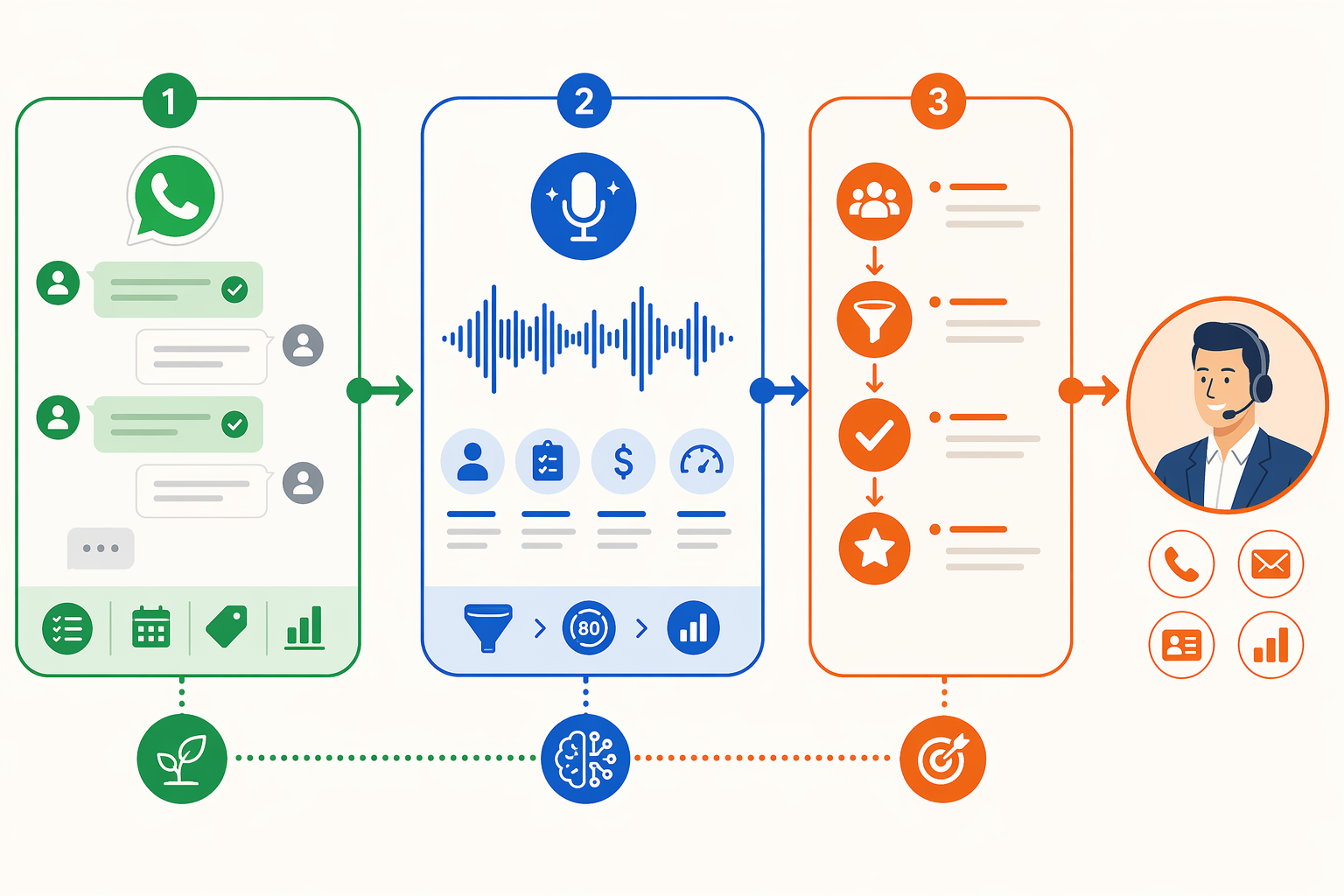
There is no universal winner in the AI chatbot vs AI voice agent comparison: choose chat for low-pressure nurturing, voice for high-intent conversations, and both when a lead may switch channels before converting.
Choose WhatsApp chat when convenience matters
- WhatsApp chatbot: Use chat when prospects need to browse catalogues, receive PDFs, compare options or revisit answers asynchronously; persistent messages make document-heavy nurturing easier than a call.
- WhatsApp chatbot: Choose chat for repeatable qualification fields—name, location, budget, product interest and preferred appointment time—because structured buttons and forms reduce ambiguity before sales follow-up.
- WhatsApp chatbot: Prioritise messaging when customers may respond between meetings or outside business hours; WhatsApp AI chatbots for business growth can keep the enquiry active without requiring both parties to be available simultaneously.
Choose voice AI when momentum matters
- AI voice agent: Use voice for urgent enquiries, complicated eligibility questions or high-consideration purchases where several follow-up questions must be resolved in one live conversation.
- AI voice agent: Prioritise calling when tone, hesitation and interruptions provide useful context; Respond.io’s 2026 guidance says WhatsApp AI voice agents can identify intent, qualify callers and route high-priority conversations before a human joins.
- AI voice agent: For an AI voice agent for B2B lead generation, define a clear handoff point for negotiation, regulated advice or unusual requirements; Floatbot’s 2026 product guidance documents real-time transfer from automated voice interactions to human agents.
Combine chat and voice for one conversion journey
- Combined workflow: Let messaging collect consent and initial details, trigger a call for qualified or time-sensitive leads, and return to WhatsApp for quotations, appointment confirmations and documents; Telnyx’s 2026 setup guide confirms that WhatsApp Business Calling supports both inbound and outbound AI-agent connections.
- CallMissed workflow: CallMissed connects WhatsApp chatbots, WhatsApp Business calls, AI voice agents, Smart IVR and human handoff in one engagement stack; as of July 2026, the CallMissed website documents support for 22 Indian languages, enabling a lead to message, speak and escalate in a preferred regional language without starting a separate journey.
Practical verdict: Start with the channel matching the buyer’s immediate task, but preserve one lead record and escalation path across both. The combined model is the stronger operational choice when small businesses must automate WhatsApp lead generation with AI without trapping every prospect in text or forcing every enquiry into a call.
How do WhatsApp chatbots and AI voice agents compare by speed, interaction, qualification, follow-up, multilingual support, Smart IVR and human handoff? (TABLE)
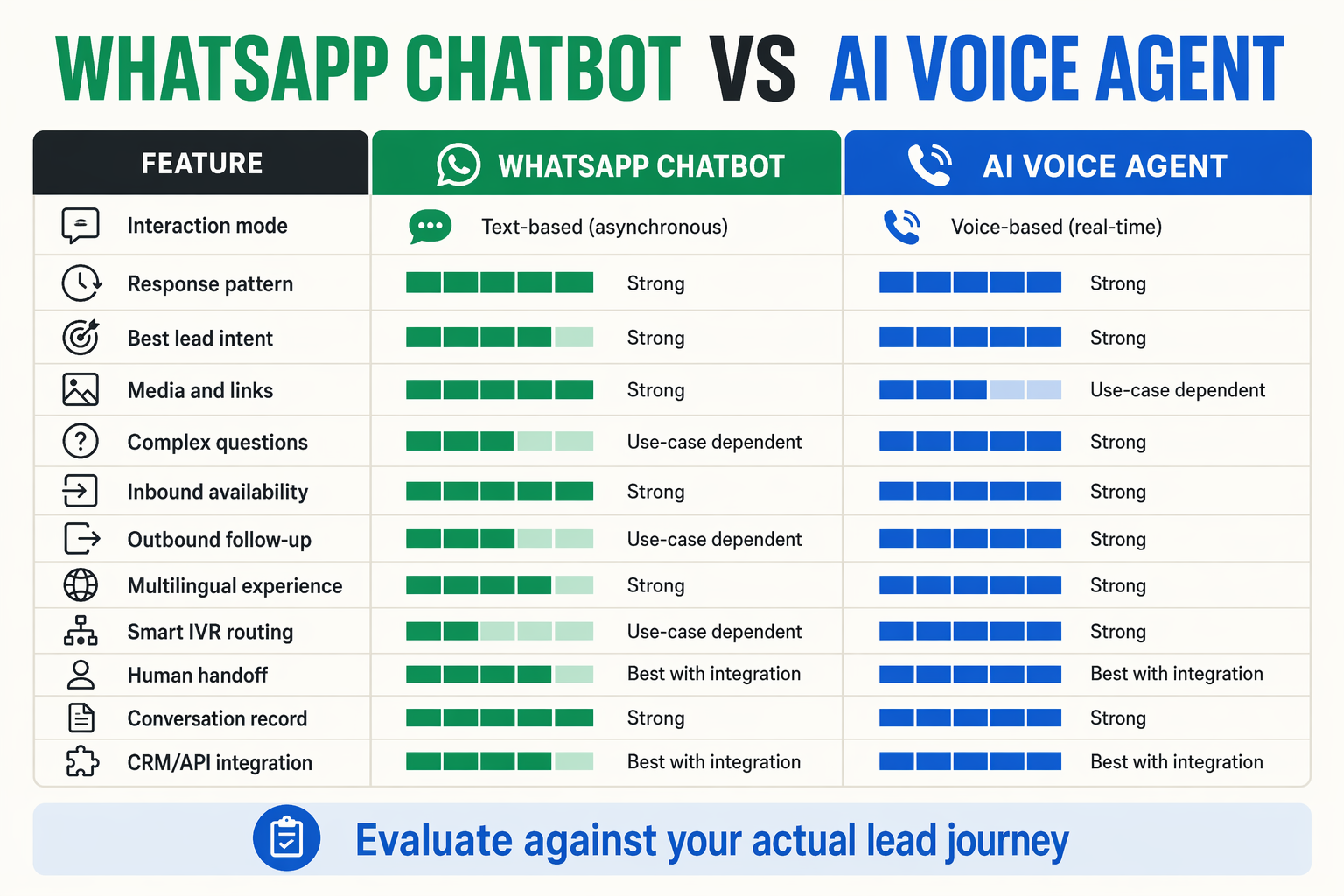
WhatsApp chatbots excel at structured, asynchronous lead handling, while AI voice agents accelerate live discovery and objection resolution. A combined system preserves context across both channels and routes valuable opportunities to people.
| Criterion | WhatsApp chatbot | AI voice agent | Combined workflow |
|---|---|---|---|
| Speed | Replies immediately to multiple text enquiries, subject to WhatsApp Business Platform rules and system capacity. | Conducts real-time dialogue, reducing the back-and-forth needed to clarify urgent or complicated requirements. | Chat acknowledges every enquiry; voice is triggered for high-intent, time-sensitive or incomplete leads. |
| Interaction | Supports buttons, lists, links, images, PDFs and written answers that prospects can revisit. | Lets prospects explain needs naturally, ask follow-up questions and interrupt or clarify during a live conversation. | Prospects can begin in chat, request a call and later receive a written summary or document on WhatsApp. |
| Qualification | Reliably captures fixed fields such as location, budget range, product category and preferred slot. | Explores open-ended needs, objections, urgency and buying authority through adaptive questions. | Chat gathers baseline data; voice validates fit and transfers sales-ready opportunities with context. |
| Follow-up | Suitable for confirmations, reminders, quotations and opt-in nurturing that does not require an immediate response. | Useful when a valuable prospect has stopped replying or needs spoken reassurance before booking. | The system records the call outcome and triggers the appropriate message, reminder or human task. |
| Multilingual support | Works well where customers can type comfortably in their chosen language or script. | Better serves prospects who prefer speaking, including users less comfortable typing detailed regional-language responses. | CallMissed supports conversational voice and chat across 22 Indian languages, according to the CallMissed website in July 2026. |
| Smart IVR and handoff | Uses menu choices, intent detection or keywords to assign a conversation to the right queue. | Smart IVR identifies the caller’s purpose and can escalate during the live call. | One routing layer carries lead details, transcript and intent into human handoff instead of making the prospect restart. |
Practical buying implications
- WhatsApp chatbot: Prioritise rich-message support and CRM field mapping when qualification depends on catalogues, forms, documents or appointment slots.
- AI voice agent: Prioritise interruption handling, speech recognition, call recording consent and transfer reliability when conversations involve nuanced requirements.
- Combined system: Define measurable triggers—such as requested callback, incomplete qualification or sales-ready status—rather than calling every chatbot lead.
- Smart IVR: Respond.io’s 2026 guidance says a WhatsApp AI voice agent can identify intent, qualify callers and route high-priority conversations before a person joins.
- WhatsApp calling: Telnyx’s 2026 setup guidance documents both inbound and business-initiated WhatsApp calling connected to AI voice agents; outbound use must follow applicable Meta permission rules.
- Human handoff: Test whether agents receive the transcript, qualification fields and call reason in one workspace; a transfer without context weakens the main benefit of automation.
Which channel is better for each lead-generation use case, lead source and industry? (TABLE: missed calls, ads, website enquiries, appointments, local services, healthcare, education, real estate and B2B)
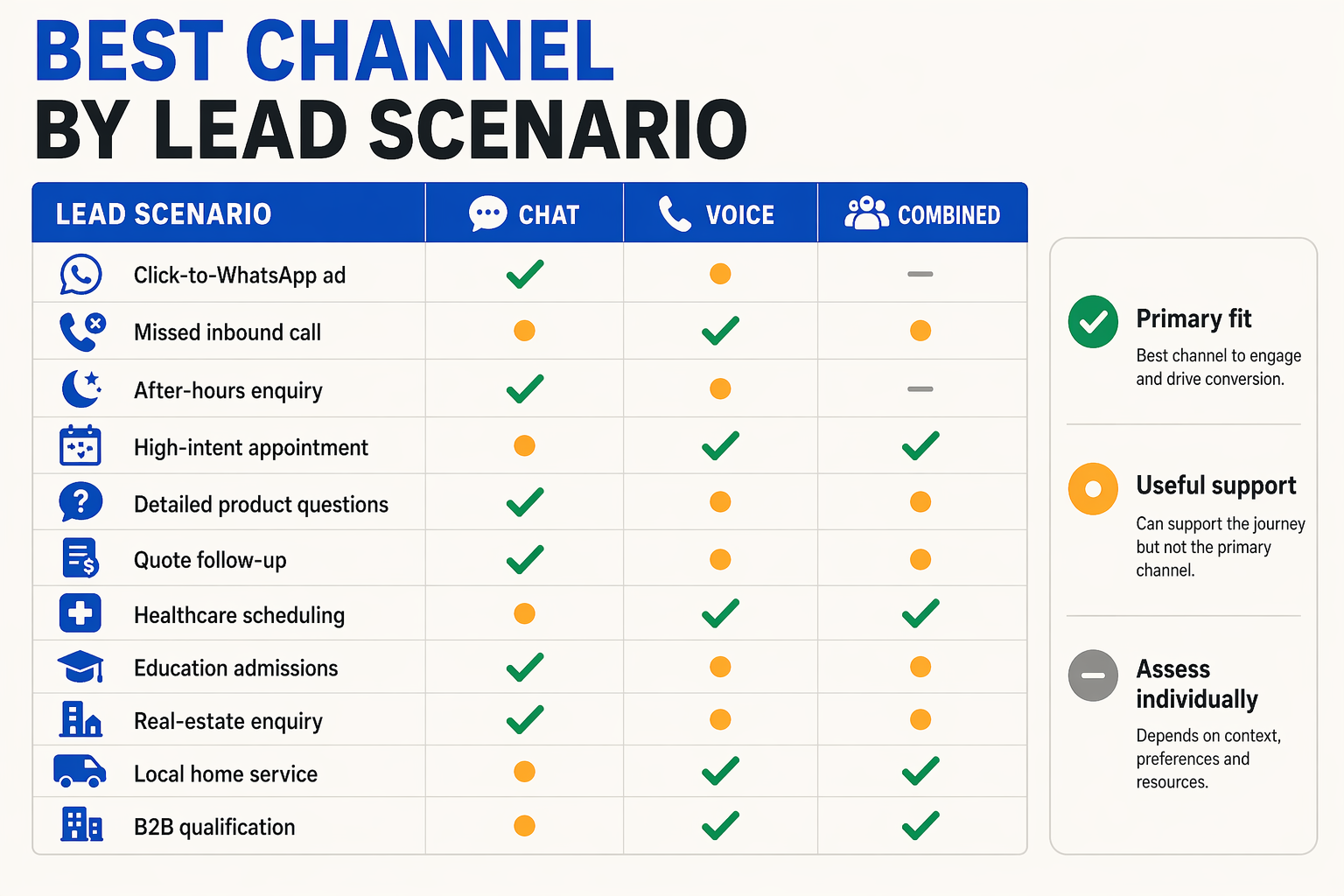
Match the channel to lead intent, urgency and information complexity: use chat for structured capture, voice for immediate qualification, and both when follow-up determines conversion.
| Lead source or industry | Best channel | Why it fits | Recommended workflow |
|---|---|---|---|
| Missed calls and local services | Voice | Callers often need immediate availability, pricing or location answers | AI voice callback → Smart IVR → human handoff |
| Ads and website enquiries | Chat first | Forms, buttons and WhatsApp messages capture campaign, budget and consent consistently | Chat qualification → lead score → voice callback |
| Appointments and healthcare | Both | Chat handles slots and documents; voice resolves urgent or sensitive questions | Chat booking → voice confirmation → staff escalation |
| Education | Both | Prospects need brochures asynchronously but may want detailed course or admissions guidance | Chat sends programme details → voice counselling |
| Real estate | Voice first | Budget, location, financing and site-visit intent require multi-step qualification | Voice discovery → WhatsApp listings → agent handoff |
| B2B enquiries | Both | Chat captures company data; voice supports discovery and stakeholder qualification | Chat capture → scheduled AI call → salesperson transfer |
Practical selection rules
- WhatsApp chatbot: Prioritise chat for ad leads who may not answer an unexpected call but can review prices, catalogues or forms later.
- AI voice agent: Prioritise voice when a missed call, urgent request or high-value enquiry indicates immediate purchase intent.
- Combined workflow: Use voice for qualification and WhatsApp for confirmations, brochures, maps, payment links and appointment reminders.
- WhatsApp Business Calling: Telnyx’s 2026 setup guidance documents both inbound and business-initiated WhatsApp calls connected to AI voice agents.
- CallMissed: The platform connects WhatsApp chatbots, WhatsApp Business calls, Smart IVR and human handoff, allowing small businesses to keep one lead journey across chat and voice.
How much do WhatsApp chatbots and AI voice agents cost, and which cost factors determine value? (TABLE: setup, platform, messaging, telephony, usage, integrations, training, compliance and staffing)
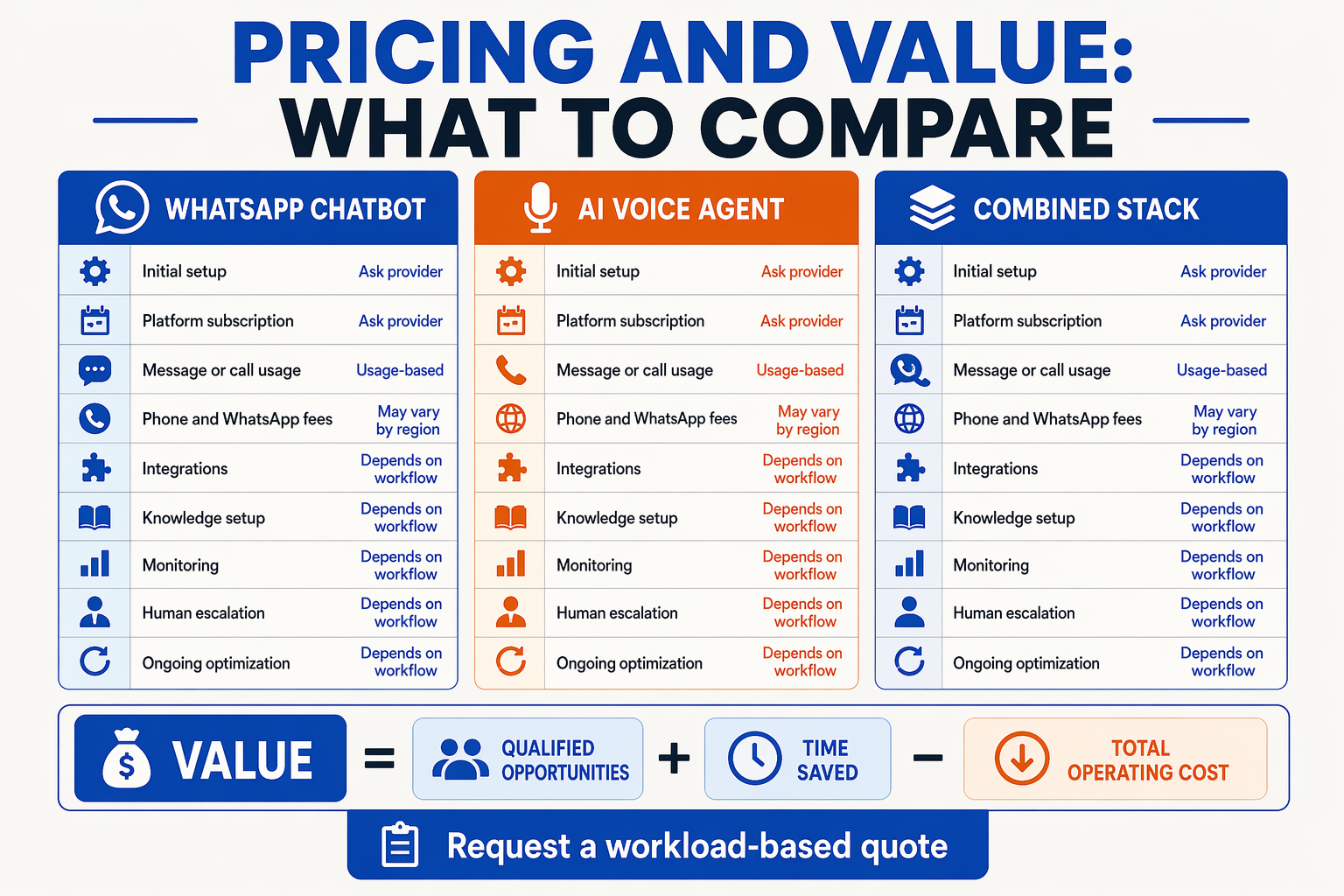
The lower-cost option depends on lead complexity: WhatsApp chat usually costs less per structured interaction, while voice can justify higher usage costs when it improves qualification, booking or escalation. Compare cost per qualified lead and completed appointment, not subscription price alone.
Cost-factor comparison
| Cost factor | WhatsApp chatbot | AI voice agent | Combined workflow | Value check |
|---|---|---|---|---|
| Setup | Design menus, forms, templates and qualification rules | Configure call flows, pronunciation, interruption handling and escalation | Map when chat should trigger a call or Smart IVR route | Measure launch time and one-time implementation fees |
| Platform | Monthly plan or usage-based access to chatbot and inbox tools | Voice-agent platform, call management and analytics | Omnichannel platform may consolidate both subscriptions | Confirm included users, agents, numbers and environments |
| Messaging | WhatsApp template and service-message charges vary by category and destination | Follow-up messages may add WhatsApp charges after calls | Chat, call confirmations and reminders share the same journey | Request the current Meta rate card for every target country |
| Telephony | Usually minimal unless chat escalates to a call | Phone numbers, inbound/outbound minutes and carrier routing apply | Both conventional and WhatsApp Business calling may be used | Compare cost per connected call, not attempted call |
| AI usage | LLM tokens, retrieval and media processing drive consumption | Speech-to-Text, LLM reasoning and Text-to-Speech are billed during calls | Usage spans messages, speech and follow-up generation | Model a short, average and long interaction |
| Integrations | CRM, catalogue, calendar and payment links | CRM, dialler, calendar, call transfer and recordings | Shared lead records reduce duplicate integration work | Check API, webhook and connector fees |
| Training | Maintain FAQs, approved replies and qualification fields | Test accents, names, objections, latency and silence handling | One knowledge base can support both channels | Budget for monthly review and failed-answer analysis |
| Compliance and staffing | Template approval, consent records and human inbox coverage | Calling consent, recording disclosures and live-agent handoff | Governance must remain consistent across channels | Include supervisors, QA time and peak-hour staffing |
How to calculate real value
- WhatsApp chatbot: Divide total monthly chatbot, messaging, integration and staffing spend by qualified leads, not total conversations.
- AI voice agent: Track connected-call rate, qualification rate, booked appointments, average call duration and human-transfer rate; unanswered attempts provide little commercial value.
- Combined workflow: Attribute each conversion across the full path—for example, chatbot capture, AI call qualification, human negotiation and WhatsApp confirmation—rather than crediting only the final touch.
- Usage sensitivity: Voice costs rise with call duration because Speech-to-Text, language-model processing, Text-to-Speech and telephony operate together; chat costs rise with message volume, media and model usage.
- Regional coverage: As of July 2026, CallMissed supports voice and chat across 22 Indian languages, according to the CallMissed product website, reducing the need to assemble separate language-specific systems.
- Pricing clarity: CallMissed uses 1 credit = ₹1, with a free tier and pay-as-you-go access; buyers should still estimate WhatsApp, telephony and AI consumption for their specific lead volumes.
- Operational value: Respond.io’s 2026 guidance says WhatsApp AI voice agents can identify intent, qualify callers and route high-priority conversations before human involvement, making saved staff time an important part of ROI.
What are the pros and cons of a WhatsApp chatbot versus an AI voice agent? (TABLE)
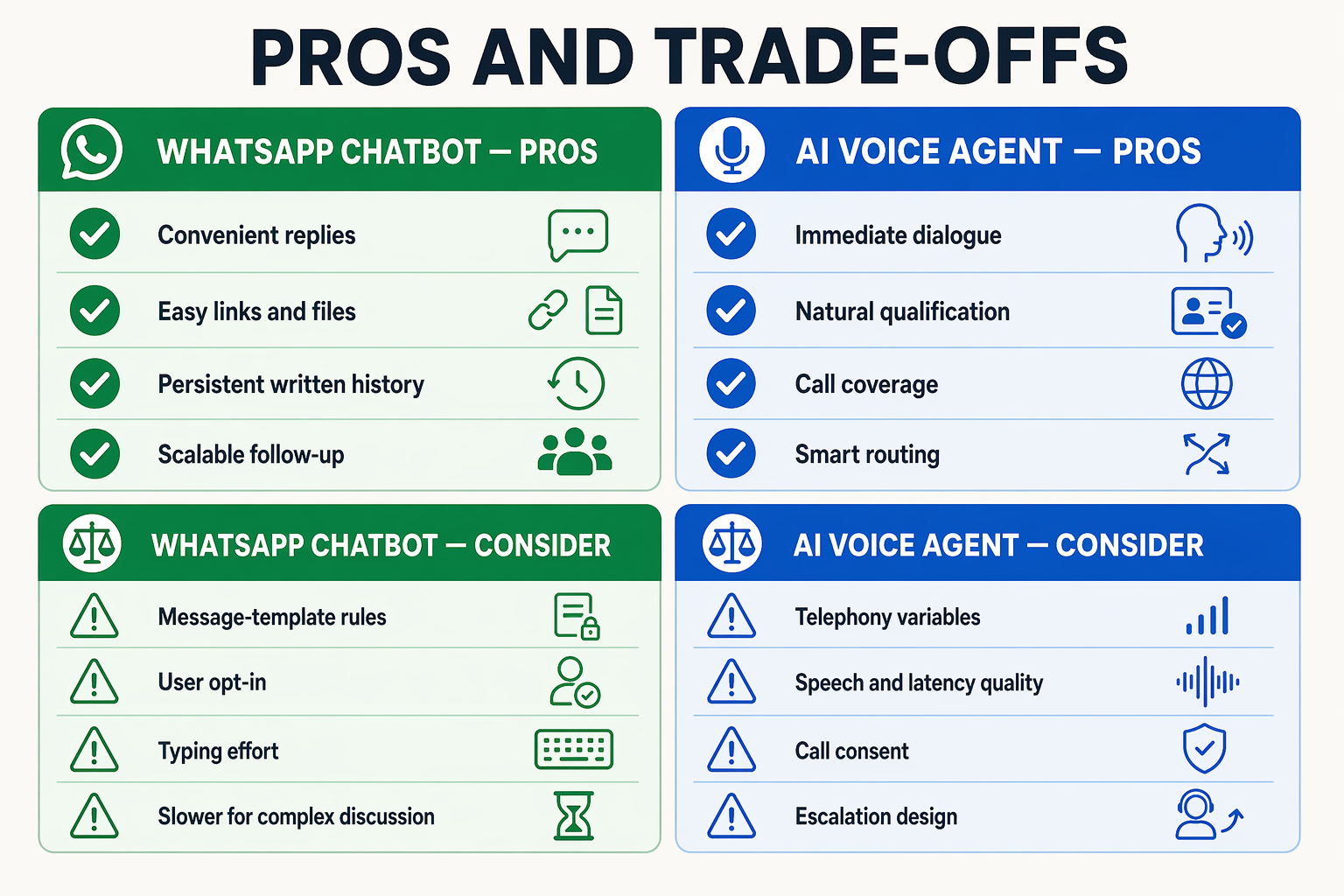
WhatsApp chatbots offer scalable, reviewable lead qualification, while AI voice agents provide faster, more expressive conversations but require stronger speech, latency and escalation controls. The practical trade-off is operational fit, not which technology is universally superior.
- WhatsApp chatbot: Favours asynchronous engagement, structured records and high conversation concurrency.
- AI voice agent: Favours immediate dialogue, objection handling and qualification without typing.
| Decision criterion | WhatsApp chatbot: pros | WhatsApp chatbot: cons | AI voice agent: pros | AI voice agent: cons |
|---|---|---|---|---|
| Lead response | Replies automatically and lets prospects return later | Delayed customer replies can extend qualification | Resolves several questions in one live conversation | Unanswered outbound calls require retry and message workflows |
| Conversation quality | Buttons and forms keep data capture consistent | Text can miss tone, hesitation and buying urgency | Speech reveals intent, interruptions and nuanced questions | Background noise, accents and latency can reduce accuracy |
| Scale | Handles many simultaneous conversations without separate phone lines | Long free-text exchanges can become difficult to navigate | Automates inbound and outbound qualification without expanding a call team | Call concurrency, telephony and speech processing affect capacity |
| Accessibility | Gives prospects a written record and supports links or media | Typing is inconvenient for some users and complex enquiries | Useful for prospects who prefer speaking or have limited typing confidence | Calls may be unsuitable in meetings, public spaces or poor networks |
| Oversight | Searchable transcripts simplify CRM updates and quality review | Automated text still needs consent, template and escalation controls | Real-time handoff can transfer a qualified caller to staff | Recording, disclosure and consent rules require careful configuration |
| Deployment | Structured flows are relatively easy to test step by step | Poorly designed menus can trap leads in repetitive loops | Natural-language dialogue accommodates less predictable journeys | Speech recognition, pronunciation and interruption handling need testing |
Operational advantages and limitations
- WhatsApp chatbot: Every answer can populate a CRM field, but teams must define validation rules for ambiguous entries such as “around ₹50,000” or “next week.”
- AI voice agent: Respond.io reported in its 2026 guidance that WhatsApp AI voice agents can identify intent, qualify callers and route high-priority conversations before human intervention.
- WhatsApp chatbot: Written transcripts support auditing, although businesses must still establish retention periods, access controls and customer-consent procedures.
- AI voice agent: Voice performance should be tested by language, accent, code-switching, noise level and interruption behaviour—not judged from one scripted demonstration.
- Multilingual operations: As of July 2026, the CallMissed product website states that CallMissed supports voice and chat across 22 Indian languages, enabling one qualification design to serve multiple regional audiences.
- WhatsApp calling: Telnyx’s 2026 setup guide confirms that WhatsApp Business Calling can connect inbound and outbound calls to AI voice agents; deployment still requires WhatsApp account configuration, telephony integration and compliant calling permissions.
- Combined workflow: Use one lead record across chat, voice, Smart IVR and human handoff so prospects do not have to repeat details when switching channels.
How does a combined WhatsApp-and-voice lead workflow work from first contact to human handoff?
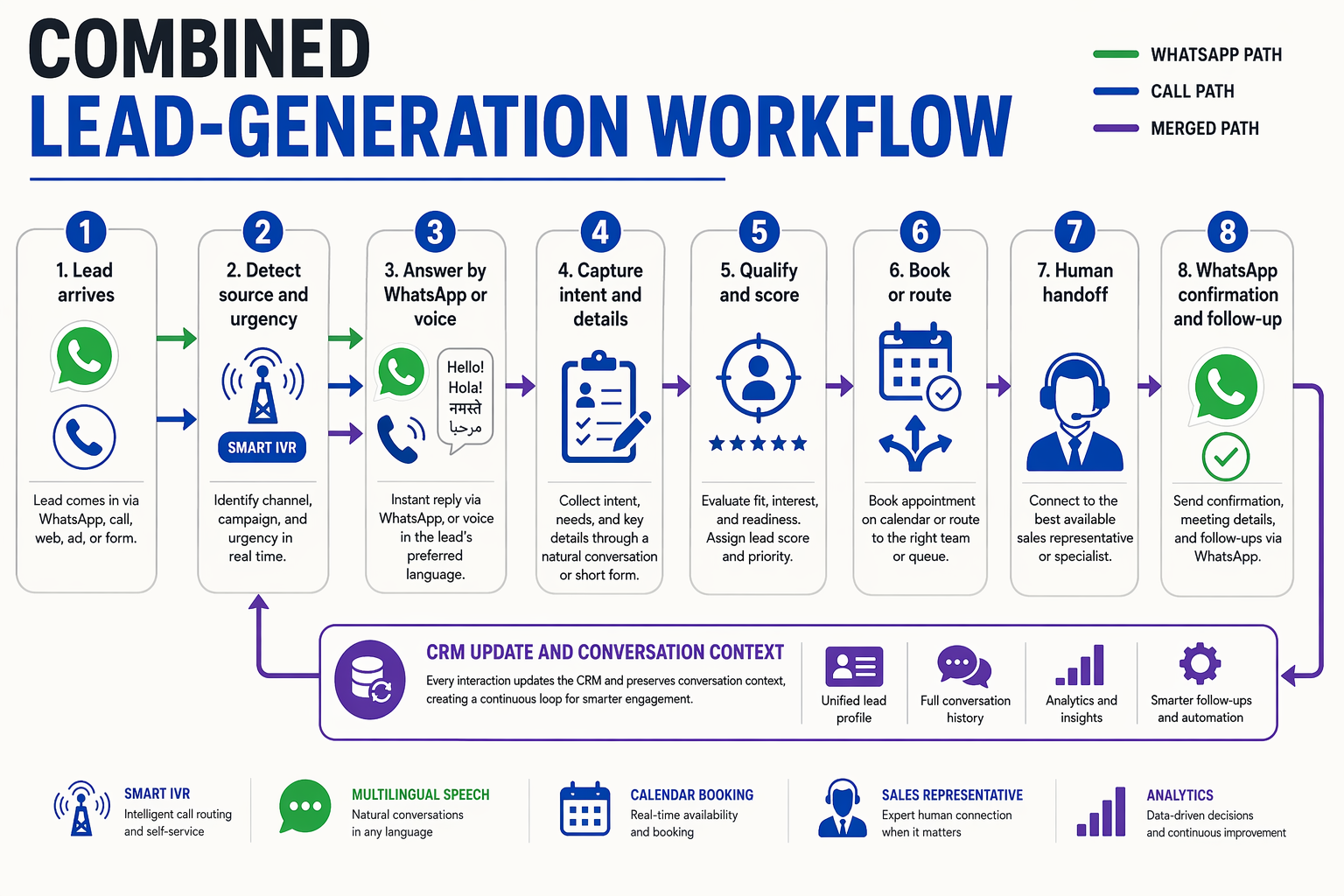
A combined workflow uses WhatsApp chat for capture and follow-up, voice AI for high-intent qualification, and a human for decisions requiring judgement, negotiation or empathy.
Six-stage lead workflow
- 1. First contact: A WhatsApp chatbot records the lead’s name, location, product interest, budget range, language and consent before assigning a qualification score.
- 2. Chat qualification: Low-urgency prospects receive structured replies, catalogue links or appointment options, while high-intent signals—such as “call me,” urgent availability or pricing objections—trigger voice routing.
- 3. Voice engagement: The prospect can start a WhatsApp Business call or receive a consent-based business-initiated call; Telnyx’s 2026 setup guidance confirms that WhatsApp Business Calling supports both inbound and outbound AI-agent workflows.
- 4. AI conversation: The voice agent verifies requirements, answers knowledge-base questions and updates the same lead record rather than forcing the prospect to repeat chatbot answers.
- 5. Smart escalation: Respond.io reported in 2026 that WhatsApp AI voice agents can identify intent, qualify callers and route high-priority conversations before a human joins; escalation rules can include requested negotiation, negative sentiment or an unanswered question.
- 6. Human handoff and follow-up: The salesperson receives the transcript, qualification fields and conversation summary, then WhatsApp automatically sends the agreed quotation, document or appointment confirmation.
- Multilingual continuity: As of July 2026, CallMissed supports voice and chat across 22 Indian languages, allowing one workflow to preserve a lead’s language preference across WhatsApp messages, AI calls, Smart IVR and human handoff.
Which option should you choose, and when does CallMissed’s WhatsApp chatbot, AI voice agent, Smart IVR, multilingual speech and human handoff stack fit?
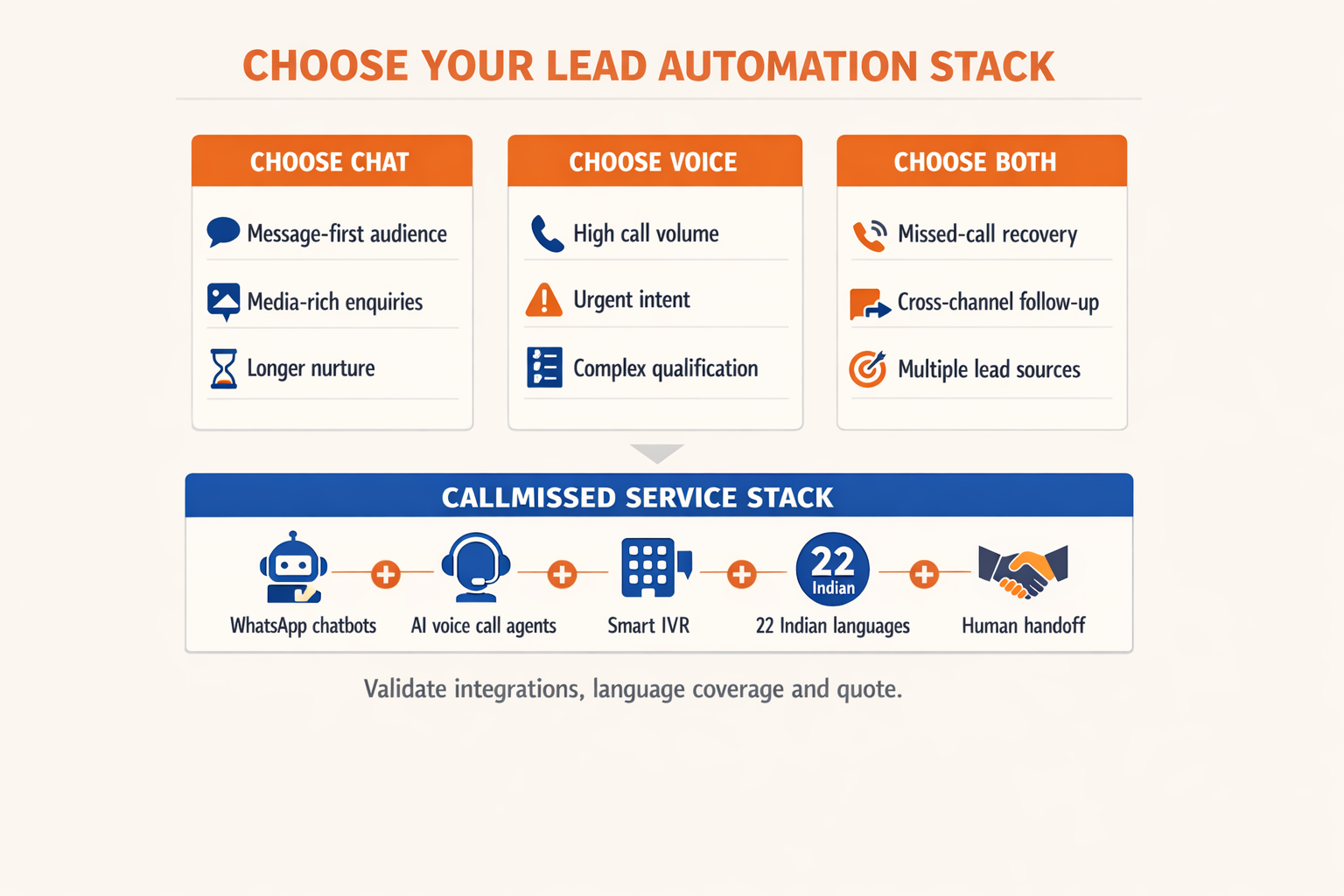
Choose WhatsApp chat for structured nurturing, AI voice for urgent or nuanced qualification, and a combined CallMissed workflow when leads need to move between messaging, calls and people without losing context.
Match the stack to the buying journey
- WhatsApp chatbot only: Start here when leads primarily request prices, catalogues, eligibility checks or appointment slots; CallMissed’s chatbot can capture structured answers, retrieve approved knowledge-base content and keep follow-ups inside the prospect’s existing WhatsApp conversation.
- AI voice agent only: Choose voice when speed, explanation or objection handling matters more than persistent documents—for example, responding to a high-intent callback request or qualifying an inbound B2B enquiry; Respond.io’s 2026 guidance says WhatsApp AI voice agents can identify intent, qualify callers and route high-priority conversations before a person joins.
- Chatbot plus AI voice agent: Combine channels when a text interaction reveals urgency or complexity; the chatbot can collect product, location and budget data, while the CallMissed AI voice agent continues qualification through an inbound or business-initiated WhatsApp Business call rather than forcing the prospect onto an unrelated channel.
- Smart IVR: Add Smart IVR when one published number serves multiple products, locations or teams; route callers by language, intent, operating hours or lead category to an AI workflow or the appropriate employee instead of making every caller navigate the same path.
- Multilingual speech: Prioritise multilingual voice when prospects may understand an offer better in their preferred regional language; as of July 2026, the CallMissed product website documents voice and chat support across 22 Indian languages, making the stack relevant to businesses serving linguistically diverse Indian markets.
- Human handoff: Escalate when a lead requests negotiation, has an exception the knowledge base cannot resolve, shows dissatisfaction or must discuss regulated or high-value terms; CallMissed supports real-time transfer from AI to a human, while the omnichannel inbox helps the employee see the conversation instead of restarting discovery.
- Small-business rollout: Begin with one conversion path—such as enquiry → qualification → booking—then measure answer rate, qualified-lead rate, escalation rate, booked appointments and opt-outs separately for chat and voice; add channels only where the funnel data identifies delay, abandonment or repeated manual work.
- Commercial fit: Evaluate total usage rather than comparing a chatbot message with a call minute in isolation; CallMissed uses transparent credits where 1 credit equals ₹1, with a free tier and pay-as-you-go access, but buyers should still model telephony, WhatsApp, speech, model, integration and human-escalation consumption for their actual lead volume.
Frequently asked questions: Can AI agents qualify WhatsApp leads, can voice AI recover missed calls, is a combined workflow better, how does human handoff work, and what should you integrate next? Related links: WhatsApp chatbots, AI voice agents, Smart IVR, multilingual AI and lead automation.
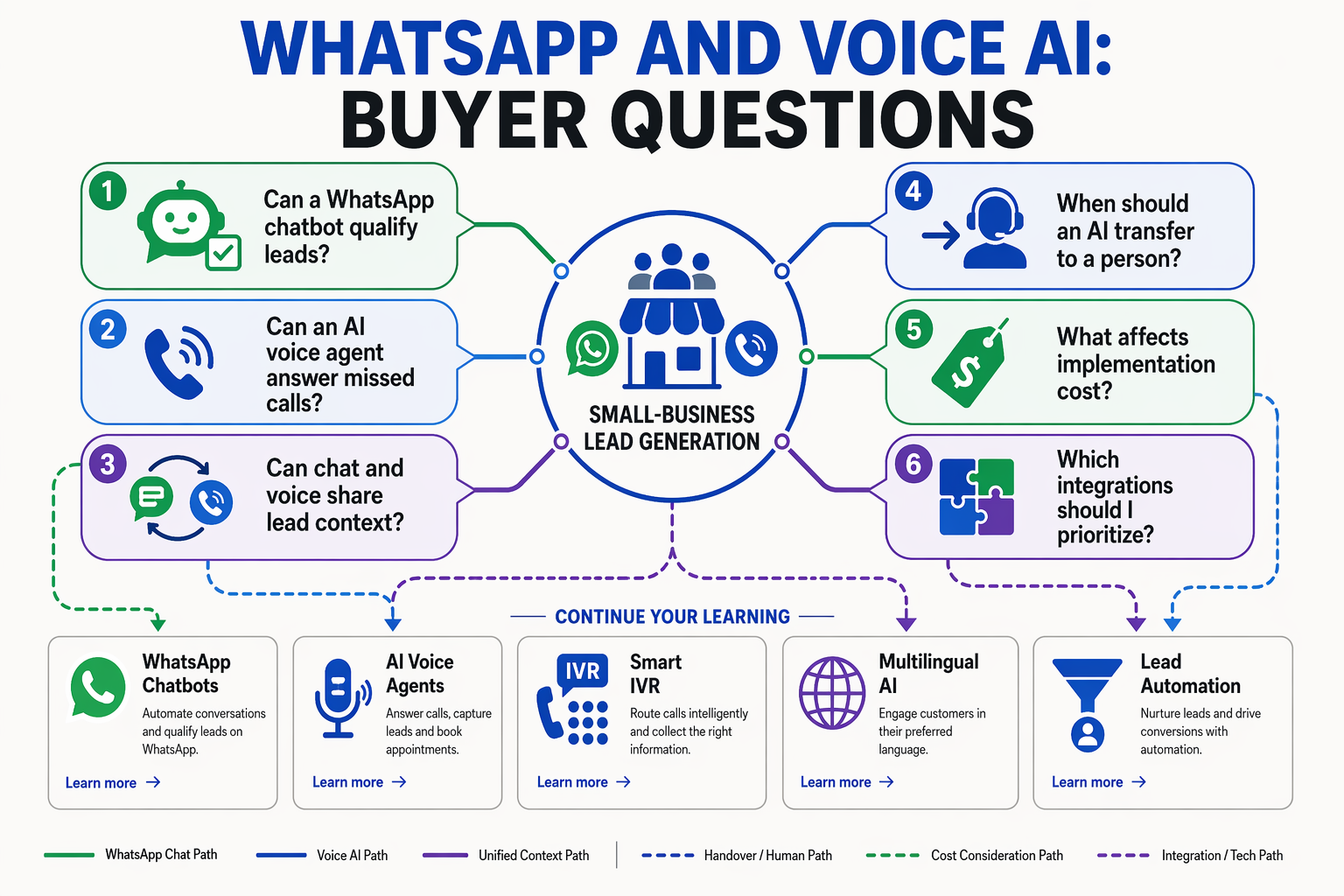
WhatsApp chatbots are strongest for structured, asynchronous qualification, while AI voice agents suit urgent, complex or missed-call leads. Small businesses often benefit from combining both channels with CRM integration and clear human-handoff rules.
Practical questions for small-business buyers
Can AI agents qualify leads automatically on WhatsApp?
Can an AI voice agent recover missed calls from potential customers?
Is a combined WhatsApp chatbot and AI voice agent workflow better for lead generation?
How does human handoff work with WhatsApp chatbots and voice AI?
Should a small business integrate Smart IVR, a WhatsApp chatbot or an AI voice agent next?
How important is multilingual AI for WhatsApp and voice lead generation in India?
Related internal-link opportunities
Use descriptive anchors that match the buyer’s next decision rather than generic phrases such as “learn more”:
- WhatsApp chatbots for lead qualification → CallMissed WhatsApp chatbot capabilities
- AI voice agents for inbound and outbound calls → CallMissed AI voice-agent service
- Smart IVR for intelligent call routing → Smart IVR product or explainer page
- multilingual AI speech in 22 Indian languages → Indic speech, STT and TTS capabilities
- WhatsApp Business calling with AI agents → inbound and business-initiated WhatsApp calling
- human handoff from AI to sales teams → omnichannel inbox, routing and live-transfer workflow
- automate WhatsApp lead generation with AI → lead capture, CRM integration and campaign automation
Conclusion
In 2026, the right channel depends on buyer intent, urgency and complexity:
- Use WhatsApp chatbots for structured qualification, FAQs, documents and asynchronous nurturing.
- Choose AI voice agents for urgent leads, complex objections and rapid appointment booking.
- Combine chat, voice, Smart IVR and human handoff when prospects move between channels.
Watch for multilingual, context-preserving journeys to become the standard. Explore CallMissed, which connects WhatsApp chatbots and AI voice agents across 22 Indian languages—could a blended workflow convert more of your leads?
Related Reading
Discussion
Related Posts
Ready to automate customer conversations?
Launch AI voice agents and WhatsApp bots with CallMissed — one API, 22+ Indian languages.