

How AI Voice Agents Turn Missed Calls Into Revenue Recovery


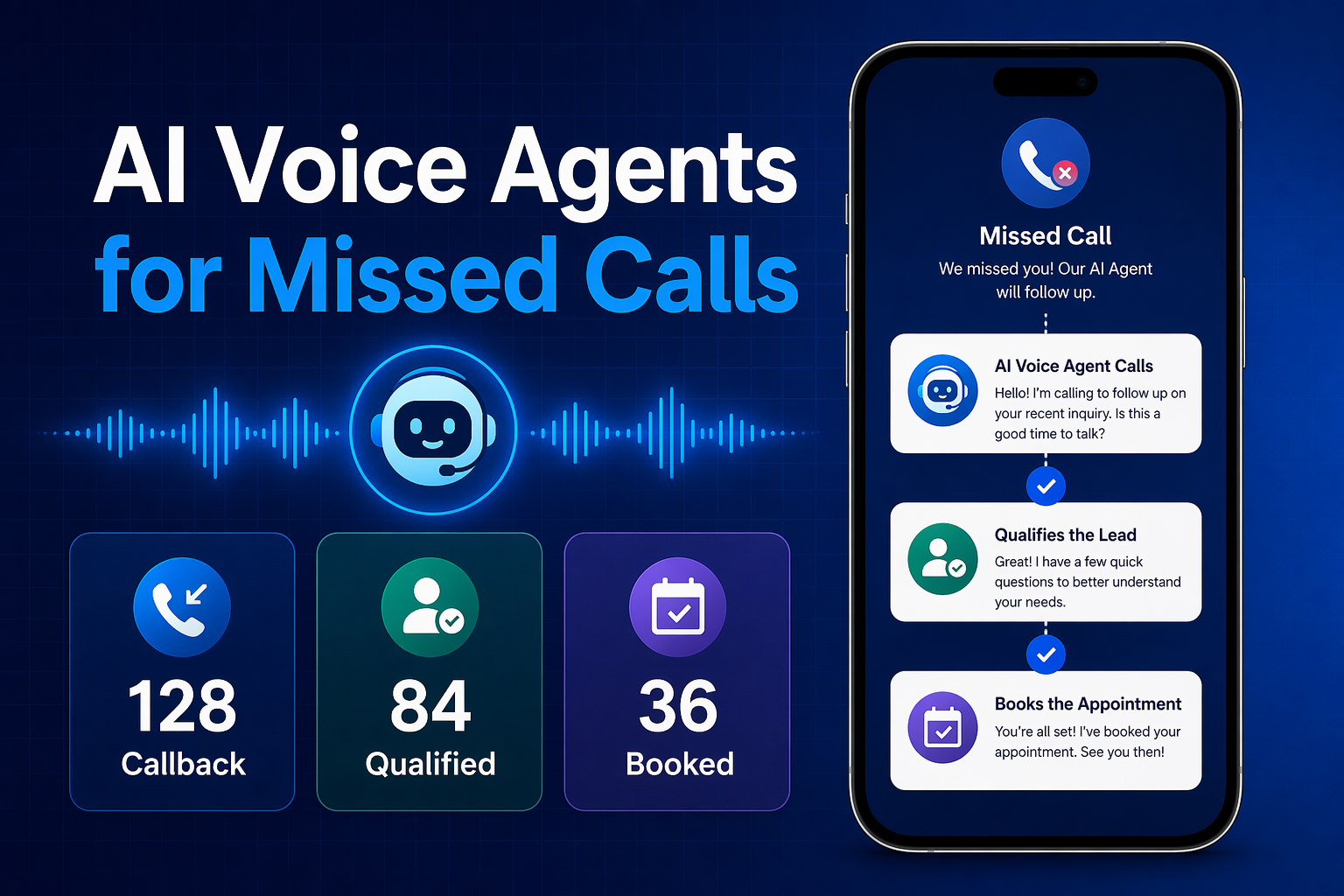
See how AI voice agents for missed calls capture intent, qualify leads, book appointments, trigger WhatsApp follow-up, and measure recovered revenue.
How AI Voice Agents Turn Missed Calls Into Revenue Recovery
AI voice agents automate missed-call recovery by detecting unanswered calls, immediately calling or messaging back, identifying the caller’s intent, answering routine questions, and routing qualified requests to the right person. They automate WhatsApp follow-up by sending a contextual message, collecting essential details, booking appointments or next steps, escalating urgent cases, and logging the conversation for staff. A recent n8n tutorial demonstrates this model as a 24/7 WhatsApp assistant that handles both calls and text automatically, while The Future Studio notes that immediate follow-up gives callers a path forward before the request disappears. CallMissed is positioned to support these workflows through AI voice agents, WhatsApp chatbots, Smart IVR, multilingual speech, and OpenAI-compatible APIs in a unified communication stack.
The business problem behind the keyword
AI voice agents for missed calls solve a preventable revenue leakage problem: when a ready-to-buy caller reaches voicemail, the business may lose the opportunity before anyone has time to respond. The missed call is not just an unanswered ring. It is paid demand, buyer intent, and a time-sensitive service request slipping out of the funnel.
For small businesses, the risk is especially direct. A missed call may come from someone trying to book an appointment, request a quote, ask about availability, confirm pricing, or get urgent help. If follow-up happens hours later, that buyer may have already called a competitor, sent a message elsewhere, or chosen the first business that responded. In July 2026, the competitive issue is not simply “how many calls were missed.” It is how much revenue leakage could have been prevented with a faster response.
The true cost includes more than the lost conversation. It can include the ad spend that created the call, the staff time spent reviewing voicemails, the manual effort of repeated callbacks, and the opportunity cost of not capturing details while the customer was still engaged. AI voice agents for missed calls reduce that gap by answering after hours, during peak call volume, or when the team is busy, then collecting context, qualifying intent, and routing the next step.
The current missed-call recovery conversation has also moved beyond voicemail replacement. Businesses now expect omnichannel follow-up: a call attempt, a text confirmation, a WhatsApp message where appropriate, or a routed handoff to the right person. AI voice agents for missed calls are most useful when they do not just “take a message,” but help move the customer to the next action with minimal delay.
That is why 2026 buyer comparisons increasingly focus on practical performance factors: answer rate, handoff quality, multilingual support, conversation accuracy, CRM or booking-system integration, and ROI measurement. A system that answers quickly but sends poor notes to the team creates a new problem. A system that captures clean intent, summarizes the call, tags urgency, and triggers the right follow-up can help the business recover more of the demand it already paid to generate.
For CallMissed-style use cases, the goal is not to replace the front desk or make every interaction fully automated. The goal is to protect the moments when the team cannot answer in real time. AI voice agents for missed calls act as a revenue recovery layer by greeting callers immediately, identifying what they need, capturing contact details, and escalating high-value or urgent requests.
AI voice agents for missed calls are not just a convenience feature. They are a practical way to reduce preventable leakage for businesses that depend on phone demand but cannot answer every call live. Instead of letting voicemail become the default fallback, they give callers an immediate response, support faster callback or WhatsApp follow-up, and give the business a better chance to convert the intent it already worked to create.
Where legacy workflows usually break
- Traditional callback queues are rarely prioritized by business value. A missed service request, a pricing question, and a delivery complaint all land in the same bucket, so the team spends energy sorting noise before solving the real issue.
- Basic IVR flows are too rigid for recovery work. They can route an incoming call, but they are weak at asking clarifying follow-up questions, understanding urgency, or deciding whether to continue on voice or switch to WhatsApp.
- Manual follow-up also creates context loss. The person who calls back often does not know what campaign triggered the call, what page the customer visited, or whether the same user already contacted the business through another channel.
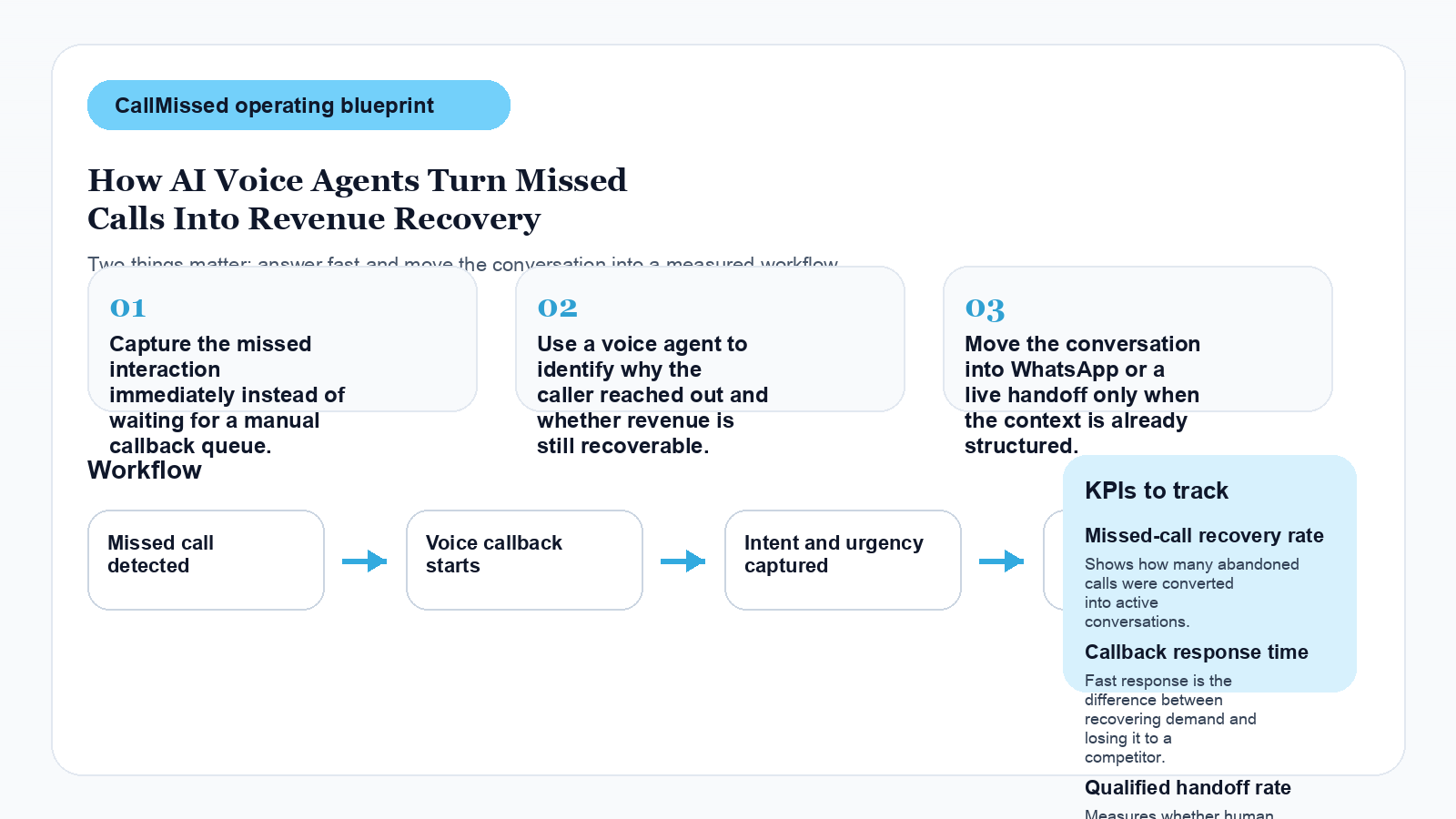
What CallMissed changes in this workflow
CallMissed turns a missed-call event into an immediate, structured recovery workflow. Its AI voice agents for missed calls can trigger a callback, capture why the customer called, ask focused qualification questions, and then book the next step or route the caller according to the business’s configured workflow.
The sequence is practical: detect the missed call, start the voice conversation, identify intent, collect essential details, and decide the next action. The agent can qualify a sales enquiry, capture a service request, or gather booking information before transferring or escalating the conversation. When a person takes over, they receive the context already collected instead of asking the customer to repeat everything.
CallMissed can then continue the interaction through a WhatsApp chatbot, sending a relevant follow-up and preserving the conversation thread. This combination makes AI voice agents for missed calls more useful than text-only missed-call tools, which may send a generic message but cannot speak with the caller, clarify intent in real time, or respond to follow-up answers during a voice conversation.
The multilingual layer also helps the recovery experience sound local rather than generic. CallMissed provides speech-to-text across 22 Indic languages plus English, along with text-to-speech in telephony-friendly audio formats. This is valuable for businesses serving mixed-language regions or customers who are more comfortable speaking than typing.
Because CallMissed combines AI voice call agents, WhatsApp chatbots, Smart IVR with AI escalation, and OpenAI-compatible APIs in one communication stack, teams can build AI voice agents for missed calls around their existing routing and follow-up processes. The result is a connected workflow from missed call to qualification, booking or routing, WhatsApp follow-up, and contextual human handoff.
A practical workflow blueprint
For small businesses, the goal is not to “replace the phone team.” The goal is to make sure every missed call gets an immediate response, every caller is qualified, and the right conversations reach the right person with context.
A practical AI voice agent workflow should look like this:
| Workflow stage | What happens | Why it matters |
|---|---|---|
| Missed-call trigger | A missed call is detected from your phone system, call tracking number, website campaign, or after-hours line. | Starts recovery while buyer intent is still fresh. |
| Instant acknowledgement | The caller receives an SMS or WhatsApp message confirming you saw the missed call and will help shortly. | Reduces frustration and prevents the caller from trying a competitor. |
| AI callback | The AI voice agent calls back, identifies the reason for the call, and gathers basic details. | Recovers conversations without waiting for staff availability. |
| Qualification | The agent checks service need, urgency, location, budget, booking intent, or account status. | Separates high-value opportunities from low-priority follow-ups. |
| Urgency routing | Emergency, VIP, sales-ready, or complaint calls are routed differently. | Helps the business respond fastest where revenue or risk is highest. |
| CRM logging | The call outcome, transcript, summary, tags, and next step are written into your CRM or inbox. | Makes missed-call recovery measurable. |
| Human handoff | A staff member receives the context and takes over when needed. | Keeps humans involved for judgment, pricing, exceptions, and trust-building. |
Step 1: Trigger the workflow the moment a call is missed
The workflow should begin automatically when a call is missed, abandoned, or unanswered after a set number of rings.
Useful trigger data includes:
- Caller number
- Time and date of call
- Business hours vs. after-hours status
- Call source, such as Google Ads, website, local listing, or repeat customer
- Dialed number or department
- Previous customer history, if available
- Missed-call reason, such as no answer, busy line, or abandoned queue
This matters because not every missed call has the same value. A repeat customer calling an emergency repair line after hours should not be handled the same way as a general enquiry from a low-intent campaign.
Step 2: Send an instant SMS or WhatsApp acknowledgement
Before the AI callback happens, send a short acknowledgement message. This reassures the caller that the business noticed the missed call and is responding.
Example:
Hi, this is {{business_name}}. Sorry we missed your call. We can help now — would you like a quick callback or would you prefer to continue by message?
This step is especially useful for small businesses because it buys time without making the customer feel ignored. It also gives the caller a lower-friction option if they are in a meeting, commuting, or unable to speak.
A good acknowledgement message should:
- Arrive within seconds
- Identify the business clearly
- Apologise briefly without overexplaining
- Offer a callback or messaging option
- Avoid sounding like a generic marketing blast
- Respect opt-out and consent requirements for messaging
Step 3: Place the AI callback and qualify the caller
The AI voice agent should call back quickly with a narrow, practical goal: understand why the person called and decide what should happen next.
The agent does not need to solve every problem. It should collect enough information to route the caller correctly.
Typical qualification questions include:
- “How can we help today?”
- “Is this urgent or can it be scheduled?”
- “Are you an existing customer?”
- “What location or service area is this for?”
- “What day or time works best for you?”
- “Would you like a quote, booking, support, or a callback from the team?”
For sales-led businesses, the agent may qualify based on need, budget, timeline, and decision-maker status. For appointment-based businesses, it may focus on service type, availability, and location. For support teams, it may collect account details and issue category.
Step 4: Route by urgency, value, and complexity
Once the AI voice agent understands the caller’s intent, it should route the conversation based on business rules.
A simple routing model might look like this:
| Caller type | Example intent | Recommended action |
|---|---|---|
| Emergency or urgent | “My boiler has stopped working” or “I need same-day help” | Notify the on-call person immediately by phone, SMS, or app alert. |
| Sales-ready lead | “I want a quote” or “Can I book today?” | Offer booking options or transfer to sales if available. |
| Existing customer | “I’m calling about my order” | Look up the account and create or update a ticket. |
| Low-complexity enquiry | “What are your opening hours?” | Answer directly and send a follow-up link. |
| Complaint or sensitive issue | “I’m unhappy with the service” | Escalate to a human with full context. |
| Pricing or negotiation | “Can you discount this?” | Capture details and route to the right team member. |
This is where AI voice agents become most useful for small businesses: they do not just “call people back.” They decide which missed calls need immediate attention and which can be handled asynchronously.
Step 5: Continue by WhatsApp or SMS when appropriate
If the caller is happy to continue by message, the AI agent can send a structured follow-up after the call.
This can include:
- A summary of the conversation
- Booking links
- Quote request forms
- Product or service details
- Payment links
- Documents or preparation instructions
- Confirmation of the next step
- A direct line to a human if needed
For many small businesses, this is where revenue recovery improves. A caller who does not answer the callback may still click a booking link. A customer who is not ready to speak may still reply to a WhatsApp message later in the day.
Step 6: Log everything in the CRM or team workflow
Every recovered missed call should create a clear record.
At minimum, log:
- Caller name and number
- Missed-call timestamp
- Source or campaign
- AI callback status
- Conversation summary
- Intent and urgency
- Tags, such as “new lead,” “existing customer,” “complaint,” or “booking request”
- Next step and owner
- Recording or transcript, where appropriate and compliant
- Outcome, such as booked, quoted, escalated, resolved, or no response
This allows the business to measure whether missed-call automation is producing real value. Instead of simply counting callbacks, you can track recovered bookings, quote requests, support resolutions, and revenue.
Step 7: Hand off to a human with context
Human handoff should be built into the workflow from the start. The AI voice agent should escalate when the conversation requires judgment, empathy, compliance awareness, or commercial flexibility.
Escalation triggers may include:
- High-value sales opportunity
- Angry or distressed customer
- Legal, medical, financial, or regulated subject matter
- Refund request
- Negotiated pricing
- Unclear customer intent
- Repeated failed contact attempts
- VIP or priority customer
- Emergency service request
The handoff should include a short summary, not just a transcript. A useful handoff note might say:
Missed call from a new lead asking for same-day electrical repair in Bristol. Caller says power is out in part of the property. Wants a callback within 15 minutes. AI confirmed postcode and availability. Recommended urgent escalation.
That gives the human enough context to continue the conversation without making the customer repeat everything.
A simple blueprint for small businesses
A lean missed-call automation setup can start with six rules:
- Detect every missed call automatically.
- Send an instant SMS or WhatsApp acknowledgement.
- Call back with an AI voice agent within a defined time window.
- Qualify the caller and identify urgency.
- Log the outcome in the CRM, inbox, or booking system.
- Escalate to a human when the call is urgent, complex, sensitive, or high value.
The best implementation is usually not the most complicated one. For a small business, the first milestone is simple: make sure no missed call disappears, every caller gets a fast response, and every valuable opportunity has a clear next step.
High-value use cases
- Real-estate teams can recover valuation requests and site-visit intent that would otherwise disappear after one missed ring.
- Clinics can catch appointment reschedules while the patient still intends to visit rather than after the slot has already been lost.
- Auto service businesses can recover inspection, towing, and service booking calls outside the peak receptionist window.
- Education and coaching businesses can respond to counseling calls with qualification questions before passing warm leads to admissions staff.
Rollout checklist for operations teams
- Start with one missed-call intent class, not every phone journey at once. Recovery flows work best when the objective is narrow and measurable.
- Keep the callback conversation short. Ask for intent, preferred next step, and urgency. Do not force a full support interview on the first recovery touchpoint.
- Add a WhatsApp continuation path for customers who cannot stay on the call. This keeps momentum without forcing the business to rely entirely on live agent capacity.
- Set clear escalation rules for price negotiation, abuse complaints, refunds, and regulated disclosures.
- Review recordings and handoff summaries weekly so the recovery script evolves from actual lost-call patterns rather than assumptions.
Why this matters commercially
The reason AI voice agents for missed calls deserves executive attention is simple: conversation quality affects revenue, service cost, and brand trust at the same time. When a business improves how quickly it answers, how consistently it qualifies or resolves, and how cleanly it moves between voice and WhatsApp, the gains show up in real operating lines such as booked appointments, recovered leads, lower support backlog, and fewer repeat contacts. This is why communication infrastructure is a growth lever rather than a cosmetic feature.
A workflow like this also compounds operationally. Once the business has clear prompts, escalation logic, and measurement in place, the same structure can be reused across new campaigns, locations, or customer segments. In practical terms, that means the first successful automation does not remain a one-off win. It becomes a template the team can improve and repeat.
Leaders should therefore evaluate this category the same way they evaluate any other operational investment: how much manual effort does it remove, how much customer demand does it preserve, and how quickly can the team adapt the workflow when products, seasons, or policy requirements change. CallMissed is useful in that frame because it gives teams one place to coordinate AI voice, WhatsApp, Smart IVR, multilingual speech, and developer integrations instead of rebuilding the communication layer for every experiment.
A 30-day pilot plan
- Pick one workflow where customer intent is already clear and measurable, such as missed-call recovery, booking confirmations, or order-status support.
- Define the non-negotiables before launch: latency threshold, escalation triggers, language support, and the exact outcome metric the business cares about.
- Review transcripts or call summaries daily in week one so the team can tighten prompts, remove repetitive questions, and correct weak handoff phrasing quickly.
- Compare the pilot against the manual baseline using conversation-level outcomes, not vanity metrics like message count or raw automation rate.
- Expand only after the workflow proves it can protect customer experience while improving speed, throughput, or conversion.
What strong human handoff looks like
A good handoff does not merely transfer the customer. It transfers the conversation state. The human should receive the reason for contact, the important entities already captured, the customer’s tone or urgency, and the recommended next action. When that summary is missing, the customer experiences escalation as a reset. When it is present, escalation feels like continuity. In other words, the difference between poor automation and useful automation is often the quality of the handoff rather than the quality of the first answer alone.
This is one of the more practical reasons to think about CallMissed as infrastructure. The value is not simply that the platform can answer on voice or WhatsApp. The value is that both channels can participate in one operating workflow where summaries, routing, and next steps are structured enough to support human teams instead of interrupting them.
Metrics that matter
| Metric | Why it matters | How to measure it |
|---|---|---|
| After-hours answer rate | Shows whether the business is capturing demand when staff are unavailable. | Percentage of after-hours calls answered by the AI voice agent instead of going to voicemail or being missed. |
| Time-to-first-response | Speed often determines whether a missed caller re-engages or contacts a competitor. | Median time between the missed call and the first AI callback, SMS, or WhatsApp response. |
| Callback completion rate | Measures whether missed-call recovery turns into actual conversations, not just attempted outreach. | Percentage of missed callers who are successfully reached and complete a callback interaction. |
| Qualified lead recovery | Separates valuable recovered opportunities from general call volume. | Number or percentage of missed callers who meet defined qualification criteria, such as service need, location, urgency, budget, or availability. |
| Booked appointments | Connects automation to a concrete business outcome. | Count of appointments, consultations, demos, or service visits booked by the AI agent from previously missed calls. |
| Qualified handoff rate | Measures whether human teams receive context-rich transfers instead of raw interruptions. | Percentage of AI-handled conversations that are routed to the right person with a summary, caller intent, qualification data, and next-step recommendation. |
| Handoff acceptance | Shows whether staff trust and act on AI-routed opportunities. | Percentage of AI handoffs accepted, returned, or actioned by the human team within the expected response window. |
| Revenue attributed | Helps estimate commercial impact without pretending every recovered call is guaranteed revenue. | Track closed deals, invoices, or bookings that originated from recovered missed calls, using CRM tags, call logs, booking records, or unique campaign attribution. |
The important operating principle is that conversation automation should be judged at the workflow level, not at the prompt level. Businesses do not buy “good AI replies” in isolation. They buy fewer dropped leads, faster service loops, lower manual coordination, better routing, and more reliable communication across voice and WhatsApp. If a workflow does not move those outcomes, the automation is decorative rather than useful.
ROI should be measured with conservative attribution. Start with a baseline: how many calls were previously missed, how many became customers, and what an average qualified lead or booked appointment is worth. Then compare results after the AI voice agent is live: recovered conversations, qualified leads, appointments booked, accepted handoffs, and closed revenue linked to those interactions. Subtract the cost of the automation, including platform fees, telephony, setup, and ongoing management.
Avoid claiming that every answered call equals new revenue. A better approach is to report ranges: confirmed revenue from closed deals, pipeline value from qualified opportunities, and operational savings from reduced manual callbacks. This keeps the business case credible while still showing whether missed-call recovery is producing measurable commercial value.
Common mistakes to avoid
| Deployment mistake | Why it hurts recovery | Better CallMissed pattern |
|---|---|---|
| Only relying on voicemail | Many callers do not leave a useful message, and high-intent leads move on quickly. | Trigger an AI voice callback, then follow with SMS or WhatsApp if the caller does not answer. |
| No SMS or WhatsApp fallback | A missed recovery call can become a second missed opportunity. | Use channel fallback so the customer gets a contextual next step even when they cannot talk. |
| Treating every missed call the same | Urgent buyers, support issues, and low-priority enquiries need different handling. | Qualify intent, urgency, location, service need, and preferred next action before routing. |
| No CRM or pipeline logging | Teams lose visibility into which missed calls were recovered, pending, or lost. | Log call summaries, qualification data, outcomes, and follow-up status into the operating workflow. |
| Unclear handoff rules | AI agents can frustrate customers if they keep talking when a human should take over. | Define handoff triggers for high-value leads, urgent issues, complaints, complex questions, or booking requests. |
| Measuring call volume instead of revenue recovery | More returned calls do not always mean more recovered business. | Track booked appointments, recovered pipeline, resolved cases, and revenue-linked outcomes. |
Recovery workflows to avoid
- Trying to make the recovery bot answer every possible question. The better pattern is to recover intent first and solve deeply only when the conversation qualifies.
- Waiting too long before the first callback attempt. Recovery value drops quickly, so the automation should start almost immediately after the missed call.
- Sending a generic SMS or WhatsApp message with no context. Follow-up works when the customer can see the business understood why they called.
- Letting the AI agent continue without clear escalation rules. CallMissed should know when to book, when to collect details, and when to hand off to a person.
- Judging performance only by answer rate or total call volume. The real outcome is recovered pipeline, booked appointments, resolved cases, or retained customers.
How CallMissed closes these gaps
CallMissed works best as the operational stack around missed-call recovery: instant AI callbacks, SMS and WhatsApp fallback, intent qualification, CRM-ready summaries, and clear handoff logic. Instead of treating a missed call as a voicemail problem, it turns the moment into a structured recovery workflow that sales, support, or operations teams can act on.
FAQ
What is an AI voice agent for missed calls?
Why is this better than a manual callback list?
Where does WhatsApp fit in the recovery flow?
How does CallMissed help here?
What should a team measure first?
Product references
- CallMissed Introduction: https://docs.callmissed.com/docs/introduction
- CallMissed Quickstart: https://docs.callmissed.com/docs/quickstart
- CallMissed Speech to Text: https://docs.callmissed.com/docs/speech-to-text
- CallMissed Text to Speech: https://docs.callmissed.com/docs/text-to-speech
- CallMissed Chat Completions: https://docs.callmissed.com/docs/chat-completion
Conclusion
AI voice agents for missed calls is valuable because it sits at the intersection of customer intent, operational speed, and workflow design. The businesses that win here are not the ones that bolt AI onto a contact form or a phone tree. They are the ones that redesign the communication loop so voice, WhatsApp, escalation, and measurement all reinforce each other. CallMissed fits that conversation because its product surface already matches the real implementation needs: AI voice, WhatsApp, Smart IVR, multilingual speech, and familiar developer APIs.
Related Posts


Ready to automate customer conversations?
Launch AI voice agents and WhatsApp bots with CallMissed — one API, 22+ Indian languages.