

AI Voice Agent vs Traditional IVR vs Smart IVR: 2026 Buyer’s Guide



Compare AI voice agent vs traditional IVR and Smart IVR on routing, automation, cost, handoff, and fit to replace your phone tree.
AI Voice Agent vs Traditional IVR vs Smart IVR: 2026 Buyer’s Guide
What if replacing a frustrating phone tree could more than double customer action rates? In accounts-receivable collections, Peakflo reported in 2026 that AI voice agents achieved 25–35% payment-promise rates, compared with 12–15% for traditional IVR—a use-case-specific result that highlights the widening gap between routing calls and resolving them. Choosing among smart IVR vs traditional IVR vs AI voice agent now matters because buyers must balance natural-language understanding, reliable escalation, multilingual service, implementation effort, and cost—not simply replace “Press 1” with speech recognition. This guide compares all three approaches across routing, task completion, analytics, human handoff, business size, and real-world scenarios. It also provides a practical migration checklist. Platforms such as CallMissed reflect this shift by combining smart IVR and AI voice agents with human handoff and speech support across 22 Indian languages.
At a Glance: Choose traditional IVR for basic routing, Smart IVR for conversational routing, or an AI voice agent for task completion
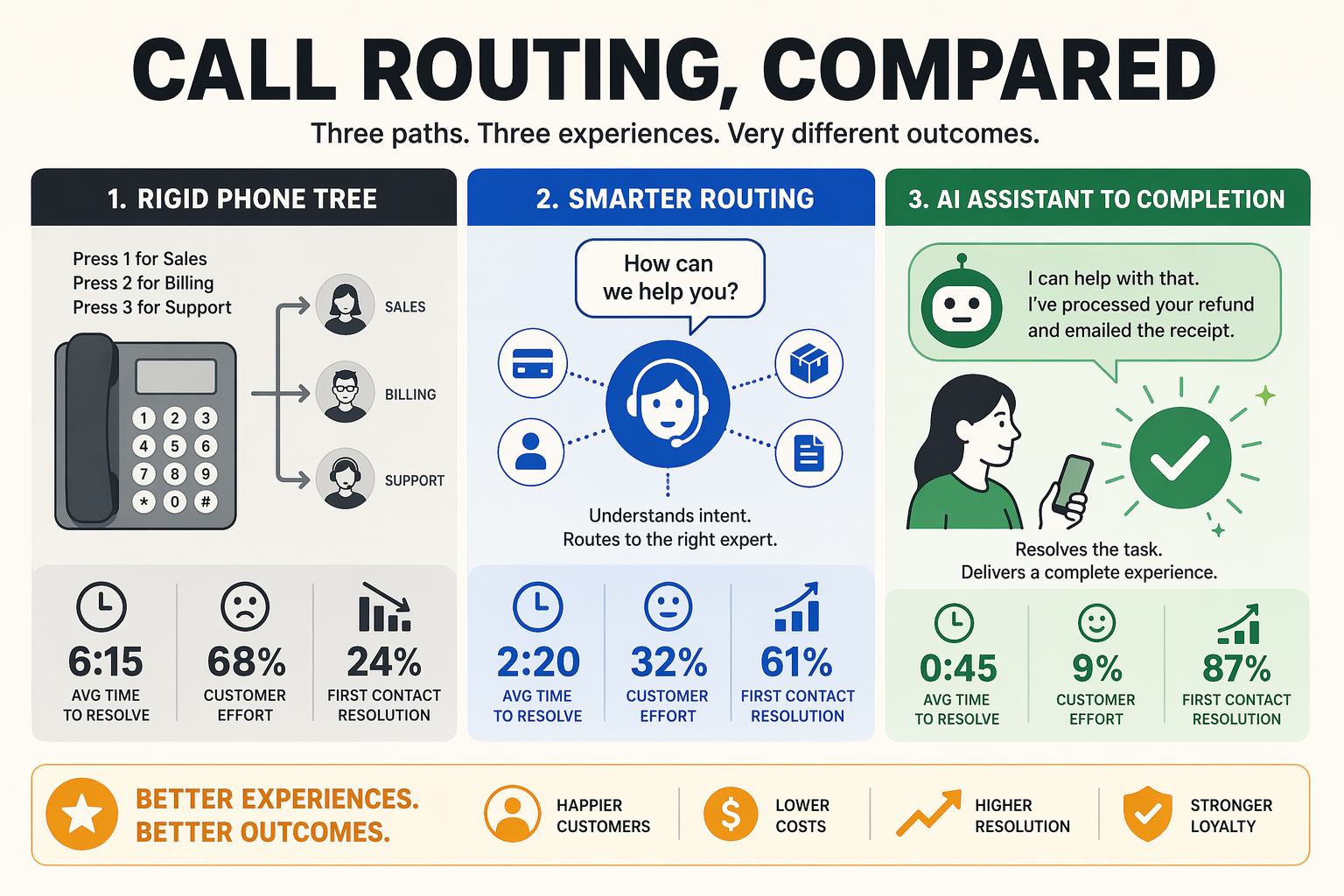
Choose traditional IVR for predictable phone-tree routing, Smart IVR for intent-based conversational routing, and an AI voice agent when callers must complete transactions without waiting for staff.
- Traditional IVR: Best for stable, low-complexity flows using the 12 standard DTMF keys—digits 0–9, * and #—such as “Press 1 for sales” or “Press 2 for support.”
- Smart IVR: Uses speech recognition and natural-language understanding to identify intents such as “change my delivery address,” then routes the caller to the correct queue or workflow.
- AI voice agent: Holds multi-turn conversations, retrieves account context and performs tasks such as booking appointments, qualifying leads, collecting payments or updating CRM records.
- Routing capability: Traditional IVR follows fixed branches; Smart IVR routes from spoken intent; AI voice agents can clarify ambiguous requests before resolving or escalating them.
- Human escalation: Choose a system that transfers the transcript, detected intent and customer context; otherwise, callers must repeat information after handoff.
- Implementation effort: Traditional IVR is simplest for limited menus, Smart IVR requires intent design and training phrases, while AI voice agents additionally need knowledge grounding, backend integrations, testing and safety controls.
- Best-fit business: Traditional IVR suits small organisations with predictable queues, Smart IVR fits growing contact centres, and AI voice agents fit businesses with repetitive, high-volume service workflows.
- 2026 direction: Parloa’s 2026 IVR guide says natural-language interfaces are replacing rigid menus, while Bland AI distinguishes traditional IVR as routing infrastructure and AI voice agents as resolution infrastructure.
What is the difference between traditional IVR, Smart IVR, conversational IVR, and an AI voice agent?
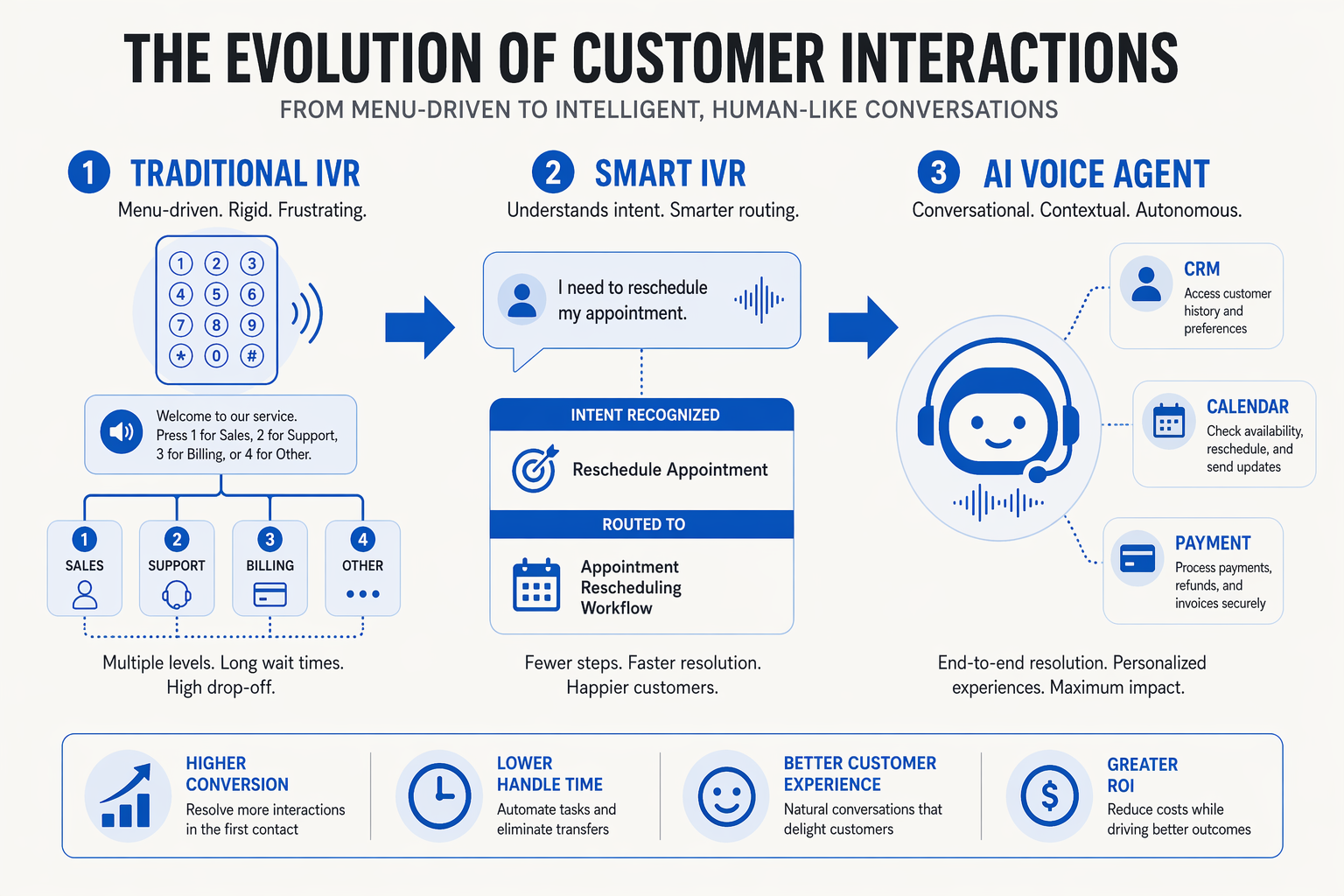
The terms describe progressively greater autonomy, but Smart IVR and conversational IVR often overlap: the decisive distinction is whether the system merely routes a request or completes it.
- Traditional IVR: Uses fixed menus, keypad input or tightly constrained phrases; every caller follows predefined branches, and unsupported requests usually fall back to an operator.
- Smart IVR: Adds automatic speech recognition, natural-language understanding and customer data, enabling intent-based actions such as identifying “billing problem” without requiring a menu number.
- Conversational IVR: A Smart IVR implementation that supports multi-turn dialogue—asking questions such as “Which order?”—but typically remains bounded by scripted intents and workflows.
- AI voice agent: Combines speech-to-text, reasoning, text-to-speech, knowledge retrieval and business-system integrations to manage less predictable conversations and execute authorised tasks.
- Conversation control: Traditional IVR controls every step; Smart IVR maps an utterance to an intent; conversational IVR gathers missing details; an AI voice agent can dynamically decide the next safe action.
- System boundary: Smart and conversational IVR commonly end at routing or a narrow self-service flow, whereas AI voice agents can access CRM, scheduling, payment or ticketing APIs to pursue resolution.
- 2026 terminology: Parloa’s 2026 IVR guide says “natural language interfaces replace rigid menus,” illustrating why “IVR” now covers systems far beyond keypad trees.
- Buying test: Bland AI’s comparison distinguishes traditional IVR as technology for simple routing and AI voice agents as technology for actual resolution; buyers should therefore evaluate completed outcomes, not the product label alone.
How do Smart IVR, traditional IVR, and AI voice agents compare by feature? (TABLE)
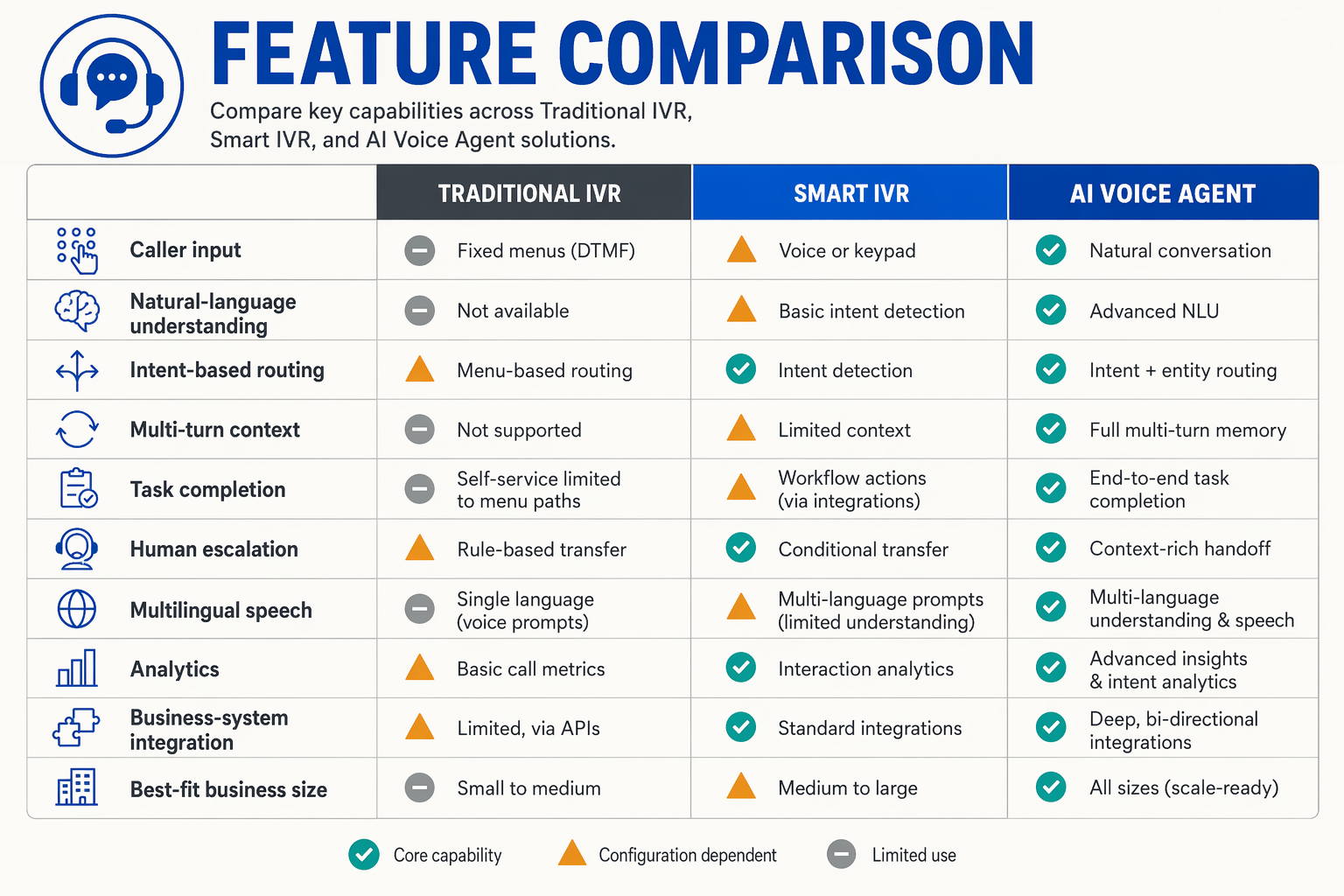
Traditional IVR is strongest at deterministic routing, Smart IVR adds intent-based navigation, and an AI voice agent can resolve multi-step requests through conversation and system integrations. The right choice depends on whether the business needs callers routed, understood or fully served.
| Feature | Traditional IVR | Smart IVR | AI voice agent |
|---|---|---|---|
| Natural-language understanding | None or limited command recognition; primarily accepts DTMF keypad input | Classifies predefined intents from phrases such as “track my order” | Interprets open-ended requests, context and follow-up answers across multi-turn conversations |
| Routing and task completion | Routes through fixed menu branches; tasks require tightly scripted flows | Routes by detected intent and can trigger bounded workflows | Can authenticate callers, retrieve records and complete bookings, payments or account updates through APIs |
| Escalation and continuity | Transfers to a queue, often with only menu selections attached | Can pass detected intent, captured fields and routing context | Can transfer the transcript, summary, customer data and reason for escalation to a human agent |
| Multilingual support | Requires separate prompts, menus and flow maintenance for each language | Requires speech recognition and intent training for every supported language | Can combine multilingual speech recognition, reasoning and speech synthesis; accuracy still requires accent and code-switching tests |
| Analytics | Menu selections, abandonment, queue time and transfer rates | Adds intent recognition, fallback phrases and misrouting analysis | Adds conversation summaries, resolution outcomes, tool calls, sentiment signals and escalation reasons |
| Implementation and governance | Lowest complexity for stable routing trees | Requires intent taxonomy, training phrases, confidence thresholds and fallback design | Requires knowledge grounding, CRM or payment integrations, latency testing, guardrails, monitoring and human-handoff policies |
Practical comparison notes
- Traditional IVR: Supports the 12 standard DTMF inputs—0–9, * and #—making behaviour predictable for compliance-sensitive or low-variation journeys.
- Smart IVR: Requires confidence thresholds; low-confidence speech should trigger clarification, keypad fallback or human transfer rather than an uncertain route.
- AI voice agent: Parloa’s 2026 IVR guide says “natural language interfaces replace rigid menus,” reflecting the move from navigation toward conversational service.
- Traditional IVR: Analytics reveal where callers exit a phone tree, but they generally cannot explain the caller’s underlying goal unless an explicit menu option captured it.
- Smart IVR: Best when the intent catalogue is bounded—such as billing, order status and cancellations—but each request is ultimately routed to a workflow or employee.
- AI voice agent: Bland AI’s 2026 comparison distinguishes AI agents by their ability to understand speech, automate tasks and integrate with business systems rather than merely route calls.
- Multilingual deployments: Evaluate word error rate, intent accuracy, response latency, regional accents and code-switching separately; an English benchmark does not establish production quality in Hindi, Tamil or Bengali.
- Migration decision: Preserve keypad fallback and live-agent escalation during rollout, then compare containment, successful task completion, transfer accuracy and repeat-call rates against the existing phone-tree baseline.
How much do IVR and AI voice solutions cost, and which delivers the best value? (TABLE)
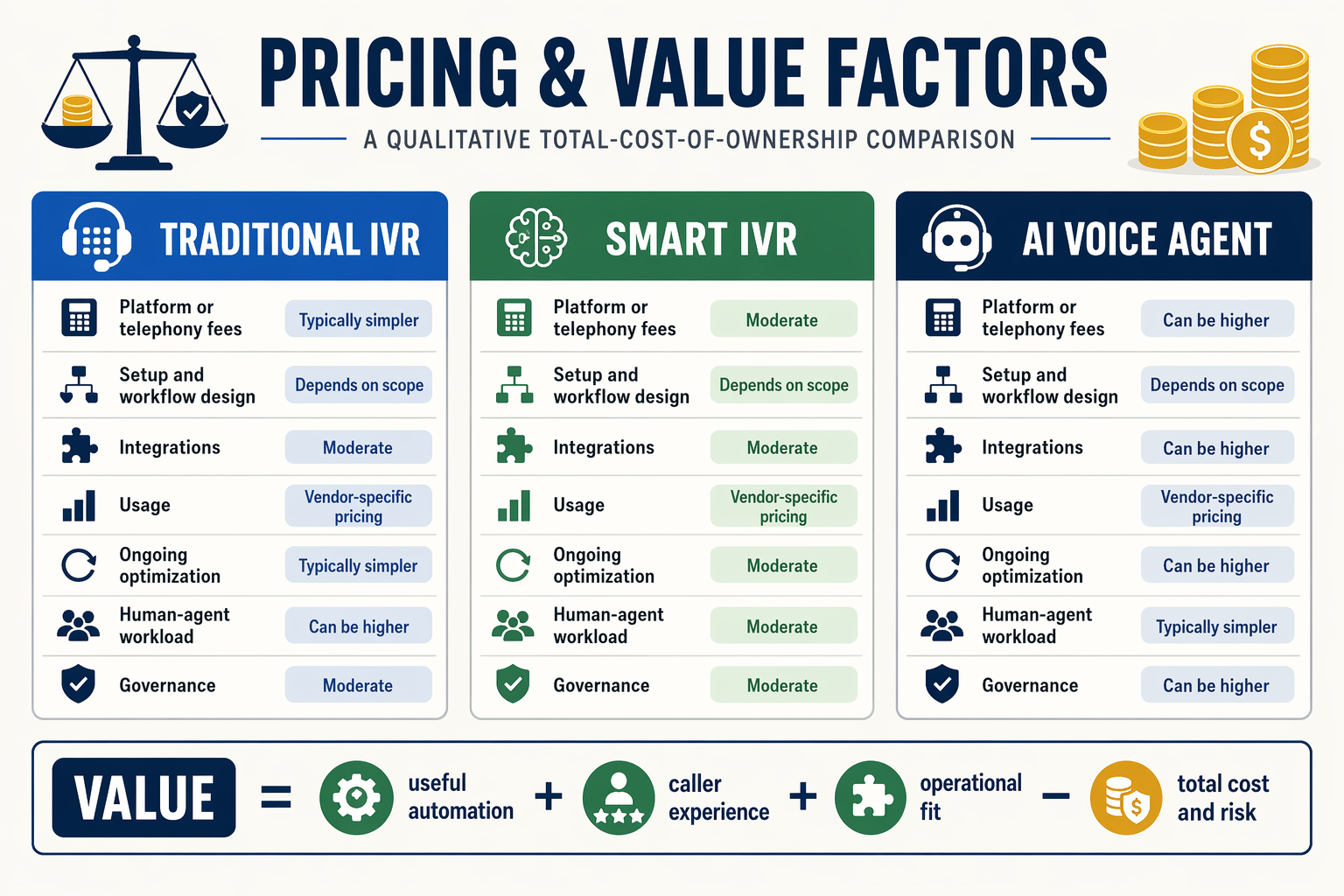
The lowest-priced system is not always the lowest-cost option: compare total monthly cost per successfully resolved call, not licence or telephony rates alone. Traditional IVR usually offers the lowest entry cost, while AI voice agents can deliver stronger value when automation replaces repetitive agent work.
Cost and value comparison
| Cost factor | Traditional IVR | Smart IVR | AI voice agent | Value implication |
|---|---|---|---|---|
| Pricing basis | Licence, phone numbers, channels or concurrent ports | IVR platform plus speech-recognition usage | Telephony plus speech-to-text, text-to-speech and model usage | Request an itemised quote; “per minute” may exclude essential components |
| Initial implementation | Menu design, prompts and queue configuration | Intent design, training phrases and routing rules | Knowledge grounding, integrations, guardrails and workflow testing | Complexity rises, but so does the range of automatable work |
| Ongoing operations | Prompt recording and branch maintenance | Intent tuning, analytics review and flow updates | Conversation evaluation, knowledge updates and model monitoring | Include internal administrator and engineering time in total cost |
| Human-agent impact | Primarily routes callers to paid staff | Deflects simple enquiries and improves routing | Can resolve eligible bookings, collections, qualification and support tasks | Resolution and containment determine value more accurately than call volume |
| Scaling costs | Additional ports, infrastructure or telecom capacity | Speech-processing and platform consumption | Usage-based voice, model and integration charges | Model several peak-volume and average-duration scenarios |
| Best economic fit | Stable, low-volume menus with few destinations | Growing contact centres with costly misrouting | High-volume, repetitive workflows with measurable completion outcomes | Match automation depth to call complexity rather than buying maximum capability |
- Traditional IVR: Calculate telephony, concurrent-call capacity, prompt production, maintenance and the agent cost that remains after callers reach a queue.
- Smart IVR: Add automatic speech recognition, natural-language intent processing and tuning costs, then measure savings from fewer transfers, shorter menus and better first-time routing.
- AI voice agent: Include speech-to-text, text-to-speech, language-model inference, call minutes, CRM or payment integrations, monitoring and human escalation in the commercial model.
- Value formula: Use (platform + usage + implementation + maintenance + residual agent cost) ÷ successfully resolved calls; do not treat abandoned, transferred or repeatedly attempted calls as resolutions.
- Procurement check: Ask vendors whether quoted rates include telecom charges, recording storage, transcripts, analytics, multilingual models, integrations, support, peak concurrency and failed-call retries.
- Market direction: Parloa’s 2026 IVR guide states that “agentic AI-powered IVR is becoming the baseline,” so buyers should consider whether a cheaper fixed phone tree could require another replacement soon.
- India-focused pricing: CallMissed uses transparent credits where 1 credit equals ₹1, with free-tier and pay-as-you-go access; businesses should still estimate complete workflow consumption across telephony, voice models and human handoff before comparing proposals.
What are the pros and cons of traditional IVR, Smart IVR, and AI voice agents? (TABLE)
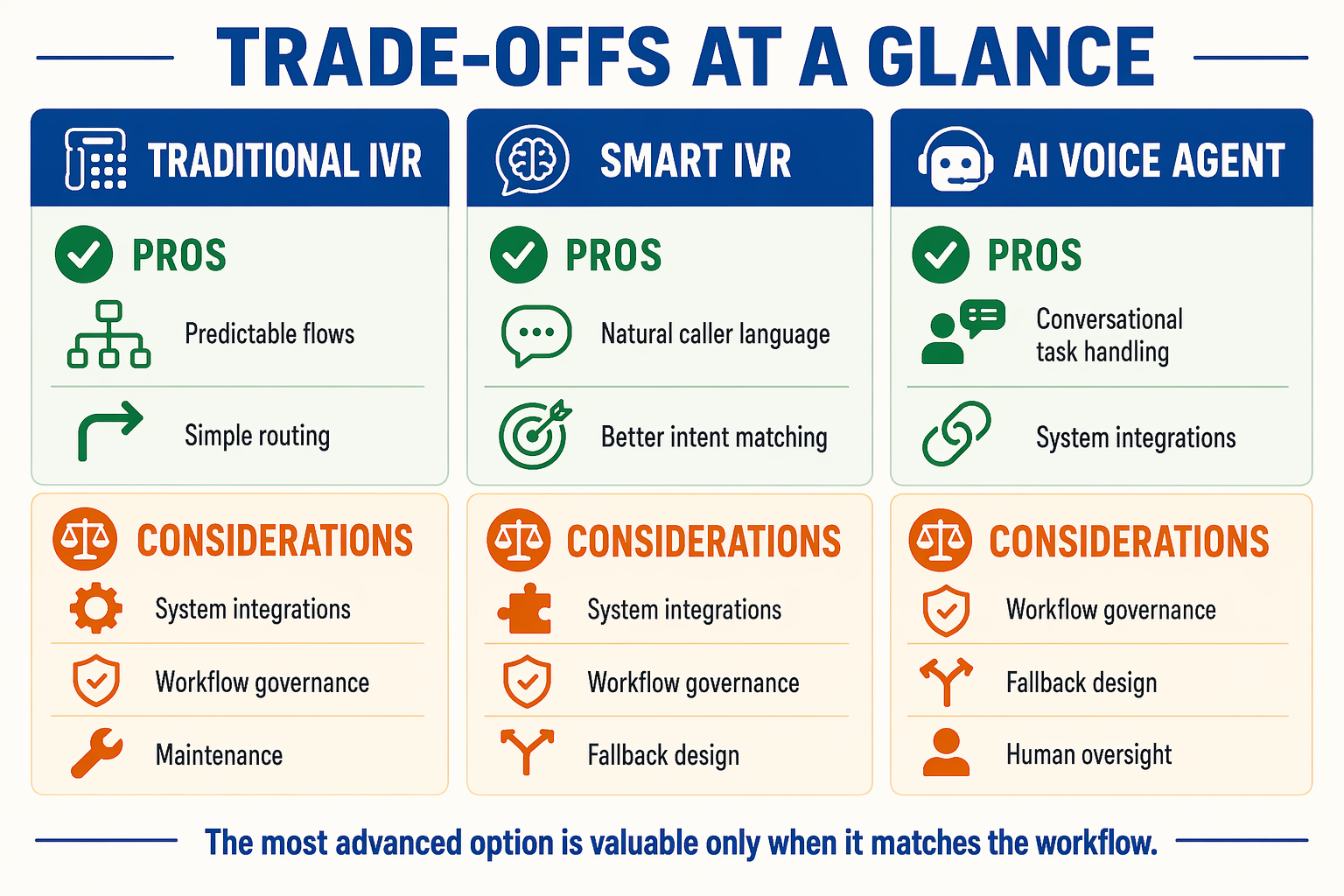
Traditional IVR offers predictability at low complexity, Smart IVR improves intent-based routing, and AI voice agents deliver the broadest automation—but require stronger integrations, governance and testing. The right choice depends on whether the goal is routing, understanding or resolution.
| Criterion | Traditional IVR | Smart IVR | AI voice agent |
|---|---|---|---|
| Natural-language understanding | None in DTMF flows; callers select predefined options | Recognises common spoken intents and keywords | Handles multi-turn requests, follow-up questions and contextual language |
| Routing and task completion | Reliable fixed routing; limited self-service | Dynamic routing plus structured workflows | Can resolve eligible tasks through CRM, scheduling, payment or ticketing APIs |
| Escalation | Transfers to a queue, usually with minimal context | Can pass detected intent and captured fields | Can transfer transcript, summary, authentication state and attempted actions |
| Multilingual support | Requires separate prompts and duplicated menu trees | Speech recognition varies by language, accent and provider | Can combine multilingual STT, reasoning and TTS, but each language must be tested |
| Analytics | Menu selections, abandonment and queue metrics | Intent frequency, routing confidence and fallback rates | Resolution, containment, tool-call outcomes, conversation summaries and escalation reasons |
| Delivery trade-off | Fastest to configure; rigid when needs change | Moderate intent-design and integration effort | Highest setup burden: grounding, APIs, latency, safeguards and evaluation |
Practical advantages
- Traditional IVR: Predictable behaviour makes it suitable for compliance notices, office-hours messages, emergency routing and a small number of stable departments.
- Smart IVR: Callers can say “billing problem” instead of navigating several branches, while the organisation retains controlled queues and workflows.
- AI voice agent: The system can authenticate a caller, retrieve approved account data, perform an action and confirm the outcome during one conversation.
- 2026 market direction: Parloa’s 2026 IVR guide states that “agentic AI-powered IVR is becoming the baseline” as natural-language interfaces replace rigid menus.
- Multilingual deployment: Providers must be assessed per language and acoustic environment; successful English testing does not prove accuracy for Hindi, Tamil, Bengali or code-switched speech.
Important limitations
- Traditional IVR: Every new option expands the phone tree, increasing maintenance and the risk of callers selecting a catch-all route.
- Smart IVR: Unseen phrases, background noise and overlapping intents can trigger incorrect routing unless confidence thresholds and fallback prompts are configured.
- AI voice agent: Incorrect knowledge retrieval or failed backend actions can create operational risk, so high-impact tasks need confirmation steps, audit logs and human escalation.
- All three: “Containment” should not be the sole success metric; track successful resolution, repeat calls, abandonment and post-transfer handling time.
- Buyer takeaway: Keep traditional IVR for narrow deterministic flows, adopt Smart IVR when routing friction is the main problem, and use AI voice agents where repeatable calls can be safely completed end to end.
Which option should your business choose—and where does CallMissed fit?
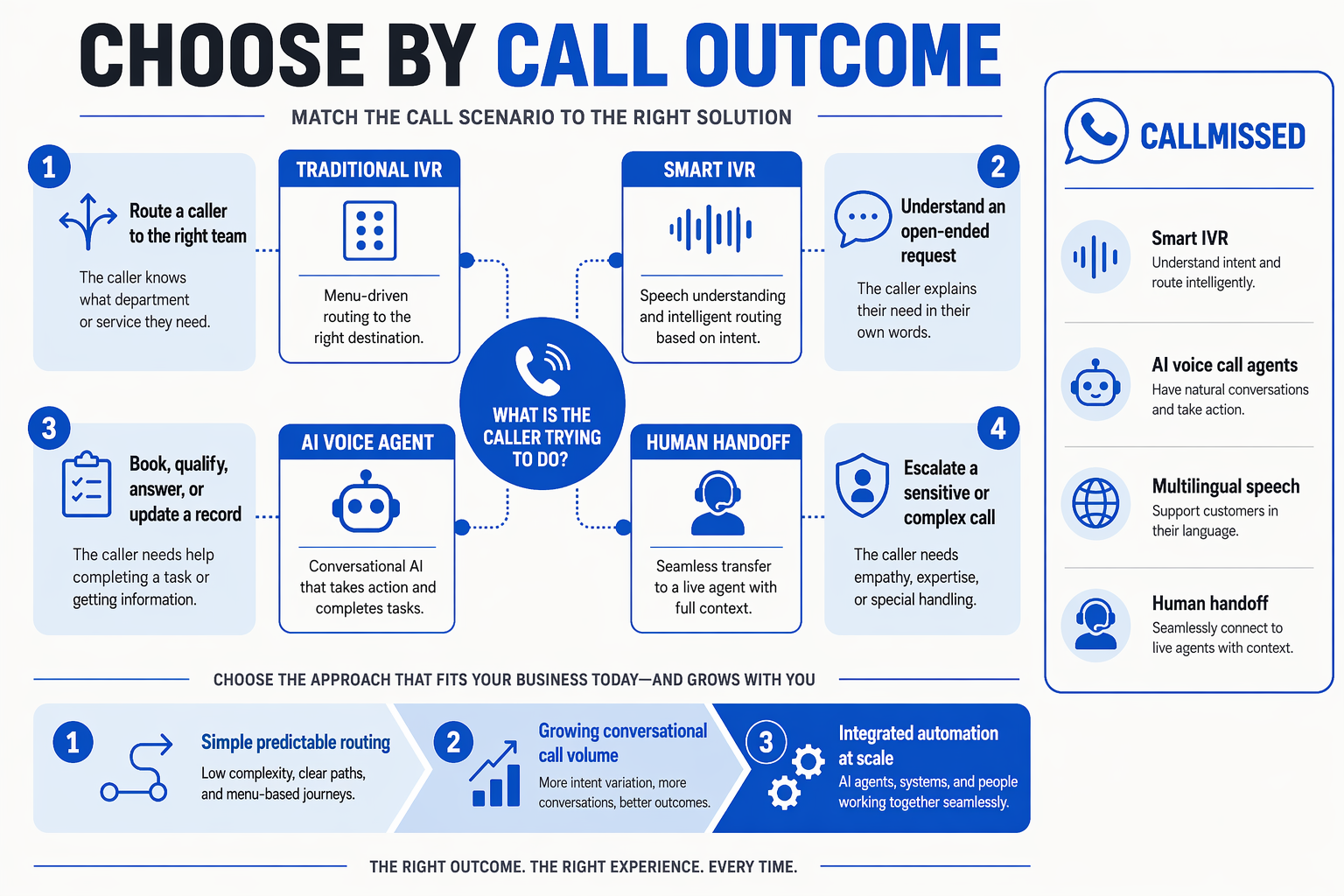
Choose the least complex system that meets your resolution goal: retain traditional IVR for deterministic routing, adopt Smart IVR for intent-led transfers, or deploy an AI voice agent for end-to-end service automation.
Apply these buying rules
- Keep traditional IVR: Use it when nearly every call maps cleanly to a small, stable set of departments and callers do not need personalised answers or transactions.
- Choose Smart IVR: Select conversational routing when customers describe requests in their own words, but employees still handle account changes, disputes or complex decisions.
- Choose an AI voice agent: Prioritise task completion when calls involve repeatable actions such as appointment booking, lead qualification, order-status retrieval, reminders or payment follow-up.
- Use a hybrid architecture: Let an AI agent resolve routine requests, Smart IVR classify uncertain intents and human teams receive high-risk, emotional or policy-sensitive calls.
- Match evidence to your workflow: Peakflo’s 2026 collections analysis reported 25–35% payment-promise rates for AI voice agents versus 12–15% for traditional IVR, but buyers should not assume that collections results transfer directly to healthcare, retail or support.
- Plan for conversational demand: Parloa’s 2026 IVR guide identifies natural-language interfaces replacing rigid menus, while Bland AI’s comparison separates basic routing from AI-led resolution.
Where CallMissed fits
- Smart IVR replacement: CallMissed can identify spoken intent and route calls without forcing customers through a long keypad tree.
- AI voice automation: CallMissed supports multi-turn voice agents grounded in a business knowledge base, enabling answers and workflow execution rather than routing alone.
- Indian-language operations: CallMissed provides Speech-to-Text and Text-to-Speech across 22 Indian languages, making regional-language deployment practical for businesses serving Bharat.
- WhatsApp continuity: CallMissed can bridge inbound and business-initiated WhatsApp Business calls to an AI voice agent while also supporting WhatsApp chat, email and web engagement.
- Human handoff: Teams can combine automation with escalation through an omnichannel inbox and CRM, preserving conversation context when an employee must intervene.
- Commercial model: CallMissed uses transparent credits where 1 credit equals ₹1, alongside a free tier and pay-as-you-go access; businesses should still model total call minutes, integrations and human escalation costs.
Validate before committing
- Test 100–200 representative calls: Include accents, code-switching, interruptions, background noise and ambiguous requests.
- Measure four outcomes: Track intent accuracy, completed tasks, successful handoffs and callers who repeat information.
- Migrate incrementally: Start with one high-volume workflow, run a controlled pilot, retain fallback routing and expand only after reviewing transcripts and failure cases.
How can you replace a phone tree safely? A migration, integration, and governance checklist
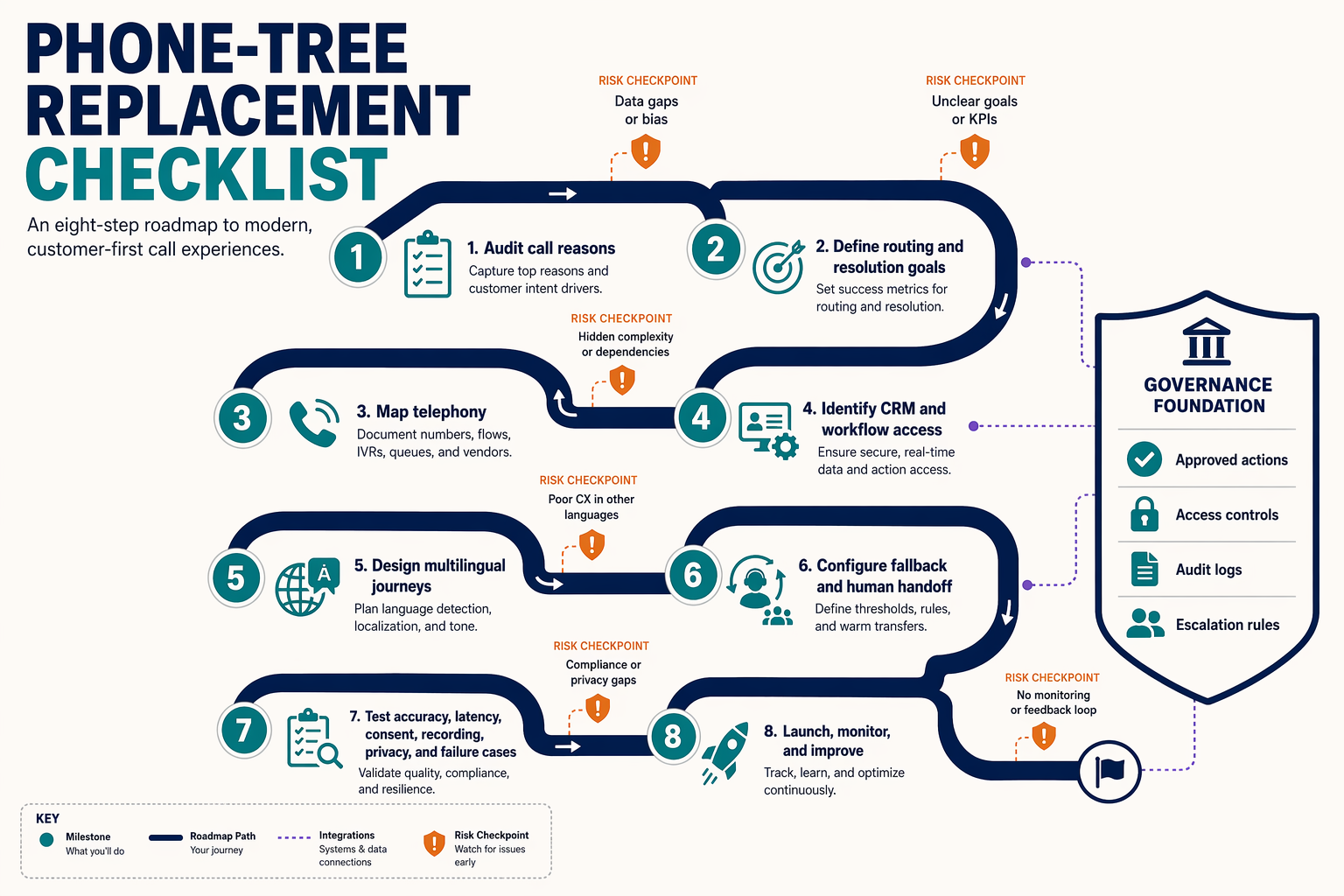
Replace a phone tree through a phased rollout, not a single cutover: preserve DTMF fallback and human escalation while validating intent recognition, integrations, security and outcomes. Parloa’s 2026 IVR guide says natural-language interfaces are replacing rigid menus, but safe migration still requires controlled testing and rollback paths.
Migration and integration checklist
- Baseline the existing IVR: Export 30–90 days of call volumes, transfer rates, abandonment, repeat calls, queue times and top menu paths; document every phone number, prompt, business-hours rule and downstream dependency before redesigning anything.
- Prioritise bounded use cases: Start with three to five high-volume intents—such as appointment booking, order status or lead qualification—rather than attempting unrestricted automation; Bland AI’s 2026 comparison distinguishes traditional IVR as routing-focused and AI voice agents as resolution-focused.
- Design layered fallbacks: Let callers speak naturally, offer keypad input when speech recognition fails, and transfer after two unsuccessful clarification attempts; retain the original phone tree as an immediate rollback route during the pilot.
- Connect systems through controlled APIs: Integrate telephony, CRM, ticketing, scheduling and payment systems in a sandbox first; use read-only access initially, then add write actions individually with authentication, idempotency, time-outs and transaction confirmations.
Testing, rollout and governance checklist
- Test representative callers: Build test sets covering accents, background noise, code-switching, interruptions, silence and ambiguous requests; Indian deployments should test the actual regional-language mix rather than extrapolating from English-only results. CallMissed supports speech across 22 Indian languages and can bridge WhatsApp Business calls to an AI voice agent.
- Protect high-risk actions: Require explicit confirmation before changing addresses, cancelling orders, booking chargeable services or initiating payments; mask sensitive fields in transcripts and never allow a language model to improvise identity-verification rules.
- Launch in stages: Begin with internal calls, move to a small percentage of live traffic, then expand by intent, language and operating hour; define rollback triggers for integration failures, abnormal transfer rates, repeated misunderstandings or unavailable human queues.
- Govern continuously: Assign named owners for prompts, knowledge sources, API permissions and incident response; review recordings and transcripts under a documented retention policy, disclose automation where required, capture consent, and track containment, successful task completion, escalation quality and repeat-contact rates separately—not merely total calls handled.
Frequently asked questions about AI voice agents, Smart IVR, and traditional IVR
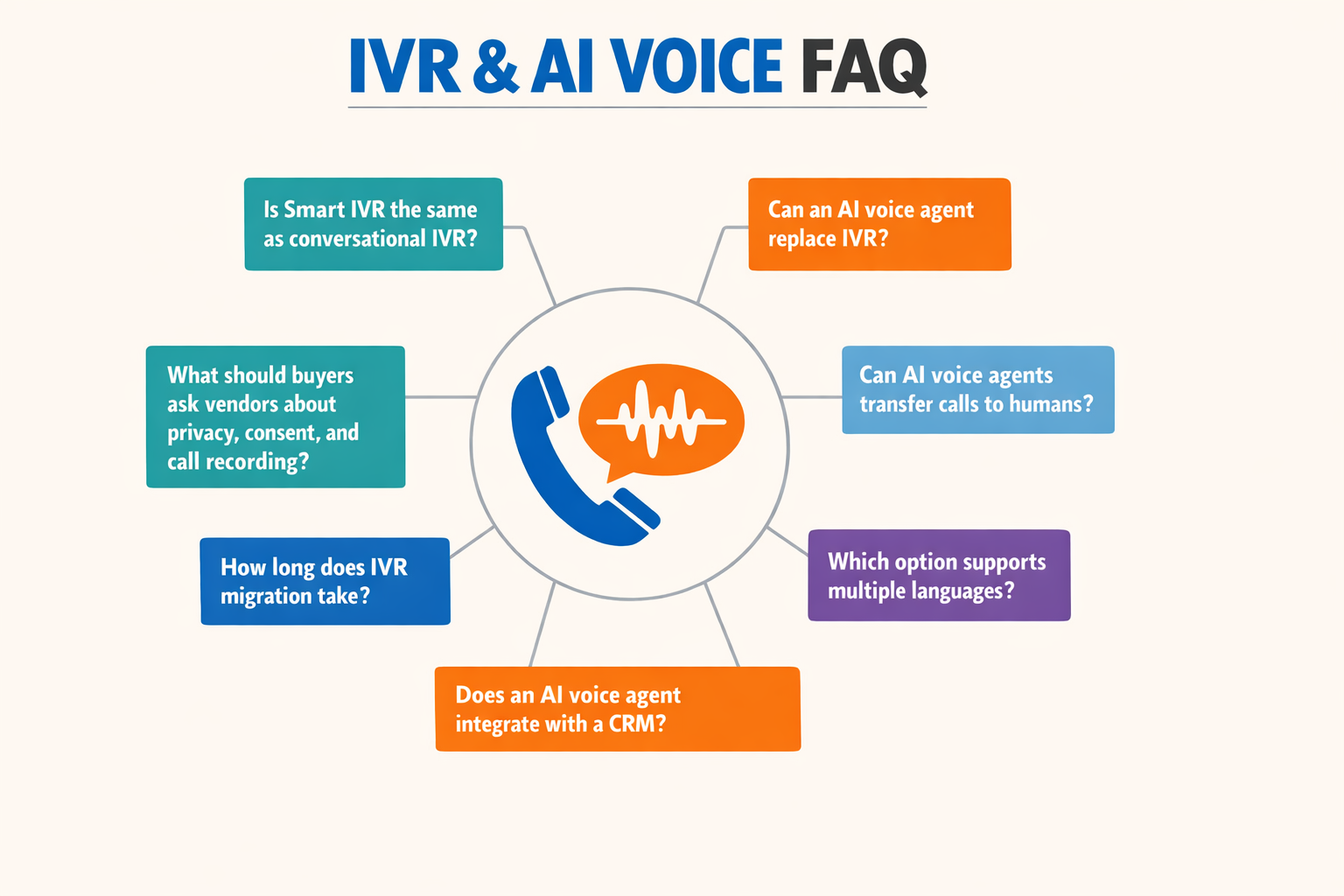
The right choice depends on whether your business needs basic routing, intent recognition or end-to-end task completion.
- Q: What is the difference between smart IVR vs traditional IVR?
A: Traditional IVR routes callers through fixed keypad menus using the 12 DTMF keys, while Smart IVR uses speech recognition and natural-language understanding to detect intent. Parloa’s 2026 IVR guide says natural-language interfaces are replacing rigid menus.
- Q: Which is better, an AI voice agent vs traditional IVR in 2026?
A: Traditional IVR remains practical for predictable routing, but an AI voice agent is better suited to multi-turn conversations, account lookups and transaction completion. Peakflo reported in 2026 that AI voice agents produced 25–35% payment-promise rates in accounts-receivable collections, versus 12–15% for traditional IVR.
- Q: Can an AI voice agent transfer calls to a human employee?
A: Yes, an AI voice agent can escalate calls based on customer requests, low confidence, sentiment, compliance rules or workflow exceptions. The best implementations transfer the transcript, detected intent and customer context so callers do not need to repeat themselves.
- Q: How does smart IVR vs traditional IVR handle customer speech?
A: Traditional IVR generally recognises keypad selections or limited phrases, whereas Smart IVR maps natural speech such as “reschedule my delivery” to an intent. Ambiguous or unsupported requests should trigger clarification or human routing.
- Q: Do AI voice agents support Indian languages?
A: Language coverage varies by platform and speech model, so buyers should test accents, code-switching, numbers and noisy calls. CallMissed supports speech across 22 Indian languages, alongside Smart IVR, AI voice agents and human handoff.
- Q: How should a business replace a traditional phone tree?
A: Start with high-volume intents, document escalation rules, connect required CRM or payment systems, and test real call recordings before launch. Keep DTMF and human-agent fallbacks available during phased migration.
Conclusion
The right 2026 choice depends on the outcome your callers need: traditional IVR for predictable routing, Smart IVR for intent-based routing, and AI voice agents for end-to-end task completion.
- Traditional IVR remains practical for simple, stable menus using DTMF keys, especially when callers only need to reach sales, support or another known queue. It offers lower implementation complexity but cannot conduct natural, multi-turn conversations.
- Smart IVR is the middle path for growing contact centres. Speech recognition and natural-language understanding allow callers to describe their needs in their own words, while the system detects intent and routes them to the appropriate queue or workflow.
- AI voice agents are designed for resolution rather than routing. They can clarify ambiguous requests, retrieve customer context, book appointments, qualify leads, collect payments and update CRM records. In accounts-receivable collections, Peakflo reported in 2026 that AI voice agents achieved payment-promise rates of 25–35%, compared with 12–15% for traditional IVR; that result is use-case-specific, but it illustrates the potential impact of automating complete workflows.
- Implementation quality matters as much as the technology category. Buyers should evaluate multilingual speech, knowledge grounding, backend integrations, analytics and human escalation. A strong handoff should transfer the transcript, detected intent and customer context so callers do not need to repeat themselves.
The direction is increasingly conversational: Parloa’s 2026 IVR guide says natural-language interfaces are replacing rigid phone menus. Buyers should therefore watch how reliably systems understand real-world accents, maintain context, execute tasks and escalate exceptions—not merely whether they can recognise a spoken phrase.
Businesses can explore CallMissed, an AI communication platform offering Smart IVR, AI voice agents, human handoff and speech support across 22 Indian languages. As phone trees evolve into systems that can understand and act, is your business optimising only where calls go—or what callers can accomplish?
Related Reading
Related Posts


Ready to automate customer conversations?
Launch AI voice agents and WhatsApp bots with CallMissed — one API, 22+ Indian languages.