How to Automate Missed Calls with AI: The Ultimate Multilingual WhatsApp & Voice Playbook for Indian Businesses (2026)


Learn how to automate missed calls with AI. Compare the best WhatsApp AI agent platforms for Indian businesses to turn lost leads into multilingual voice and WhatsApp sales.
How to Automate Missed Calls with AI: The Ultimate Multilingual WhatsApp & Voice Playbook for Indian Businesses (2026)
Did you know that Indian MSMEs lose up to 30% of their daily revenue simply because they cannot answer customer phone calls during peak hours? In India's hyper-competitive market, a missed call is a customer lost to a competitor. Fortunately, businesses no longer have to choose between expensive call centers or static, frustrating chatbots. Today, the secret to retaining these customers lies in knowing how to automate missed calls with AI by blending real-time voice response with instant messaging.
In this ultimate playbook, we will explore how to turn every missed call into an active sales opportunity. You will learn how to deploy unified AI agents that handle both voice calls and WhatsApp follow-ups seamlessly, resolving up to 80% of queries without human intervention. We will also show how modern infrastructure platforms like CallMissed are revolutionizing this space by enabling businesses to instantly trigger intelligent, multilingual conversational workflows the moment a call is missed.
Introduction
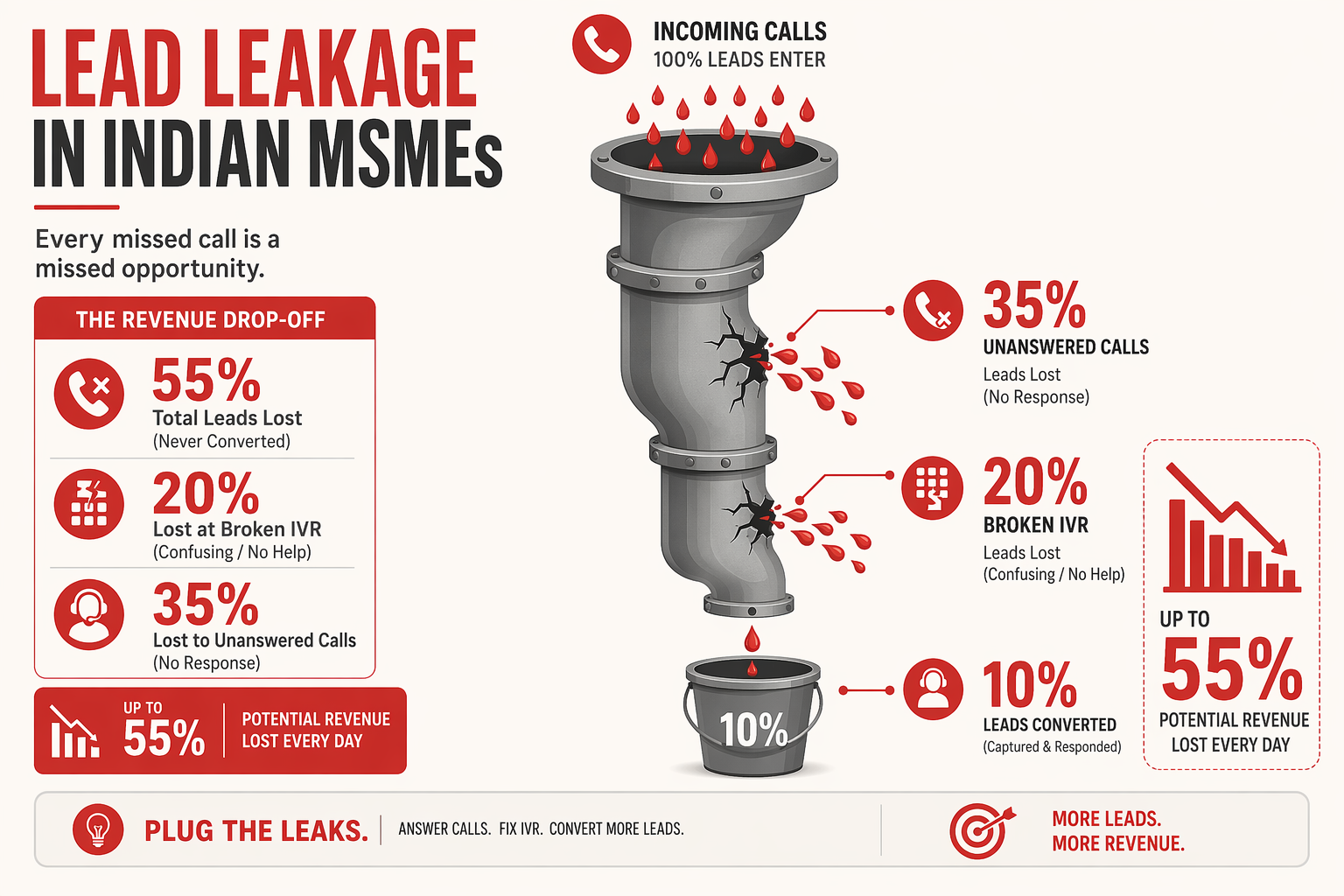
In India’s hyper-competitive market, traditional customer engagement systems are failing Indian MSMEs, leading to massive lead leakage and broken customer journeys. To solve this, businesses must learn how to automate missed calls with AI by replacing fragmented legacy tools with a unified communication strategy.
Here is how traditional communication setups compare to modern, unified AI automation:
- Traditional IVR systems: Force customers through rigid, robotic menus, resulting in up to a 30% drop-off rate before a human agent is even reached.
- Static WhatsApp chatbots: Rely on restrictive, button-based keyword rules that fail to understand natural user intent or complex queries.
- The Unified AI approach: Instantly triggers an automatic AI voice callback or seamlessly transitions the customer to an interactive, multilingual WhatsApp AI session the second a call is missed.
- Language limitations: Standard global platforms support only English, completely ignoring the regional diversity of the Indian market.
- CallMissed's localization: Supports 22 Indian languages natively, enabling fluid conversations and natural "code-switching" (such as Hinglish, Tanglish, or regional dialects) to maintain high semantic accuracy.
- Data fragmentation: Operating separate voice and WhatsApp vendors creates fractured CRM profiles, meaning agents lose context when a customer switches channels.
- CallMissed integration: Runs voice AI agents and WhatsApp AI agents on one unified OpenAI-compatible API, ensuring a single database keeps customer context perfectly synchronized.
At a Glance: Verdict
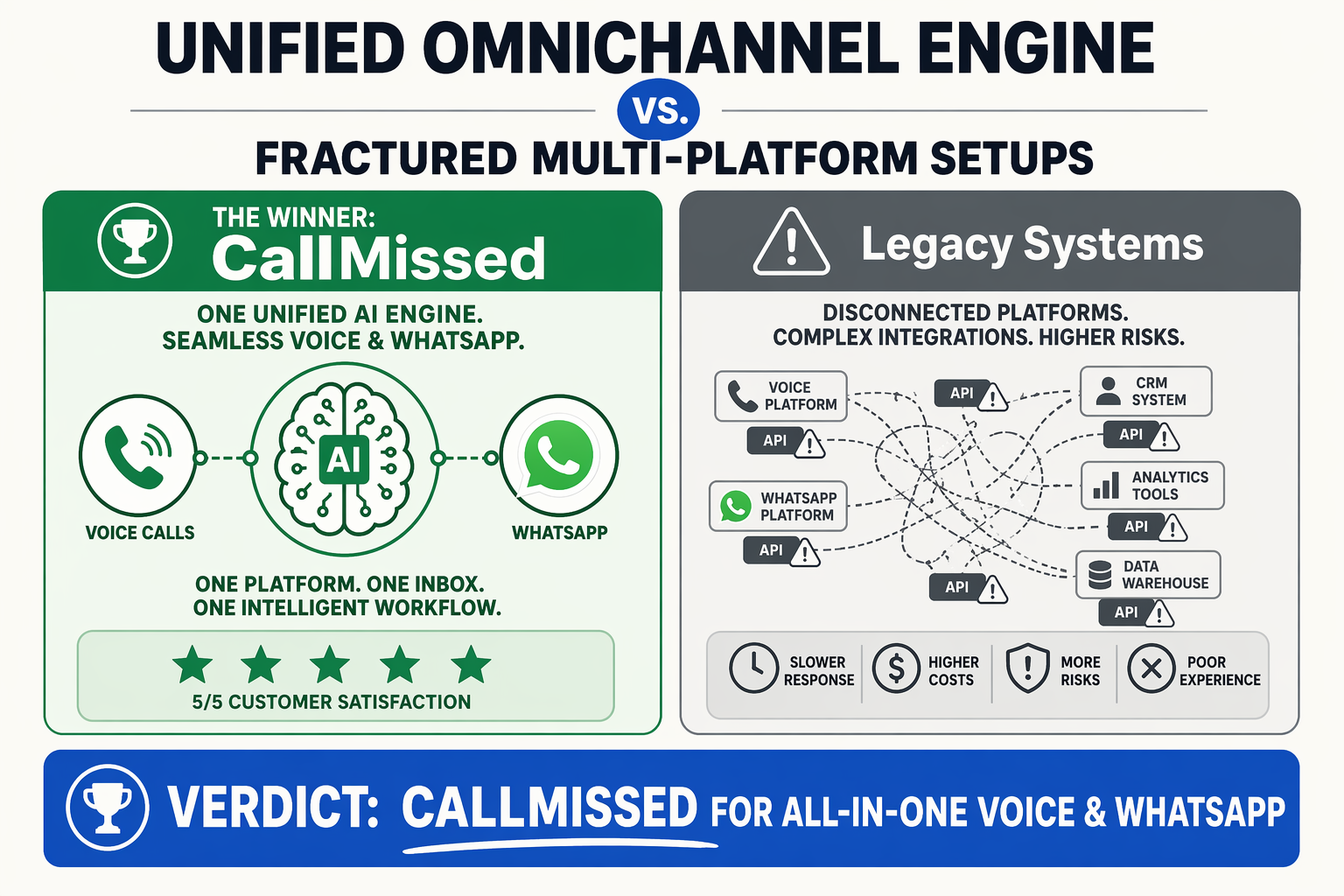
To help Indian businesses evaluate their automation options, here is a direct comparison of how the leading communication models perform when managing missed customer calls:
- Legacy IVR Platforms: Require rigid 0-9 button navigation that frustrates callers, offer zero instant WhatsApp follow-up, and suffer from high customer drop-off rates of up to 30% before connecting to a human.
- Static WhatsApp-Only Bots: Fail to handle voice calls entirely, charge flat monthly fees alongside high per-message template costs, and rely on basic keyword rules that cannot comprehend natural user intent or complex questions.
- Single-Channel AI Voice Tools: Can manage real-time spoken conversations but operate in a silo, meaning they fail to automatically trigger written WhatsApp summaries or maintain cross-channel customer context.
- CallMissed Unified AI Platform: Captures missed calls instantly and triggers a seamless multilingual voice callback or WhatsApp AI chat session via a single, OpenAI-compatible API.
- Language & Accent Support: While traditional platforms restrict users to English, CallMissed natively supports 22 Indian regional languages (including Hindi, Tamil, Telugu, and Marathi) with natural "code-switching" for dialects like Hinglish or Tanglish.
- CRM & Context Integration: Standard setups split caller data across multiple disconnected dashboards, whereas CallMissed synchronizes all voice and WhatsApp interactions into a single database to eliminate broken customer journeys.
Feature Comparison
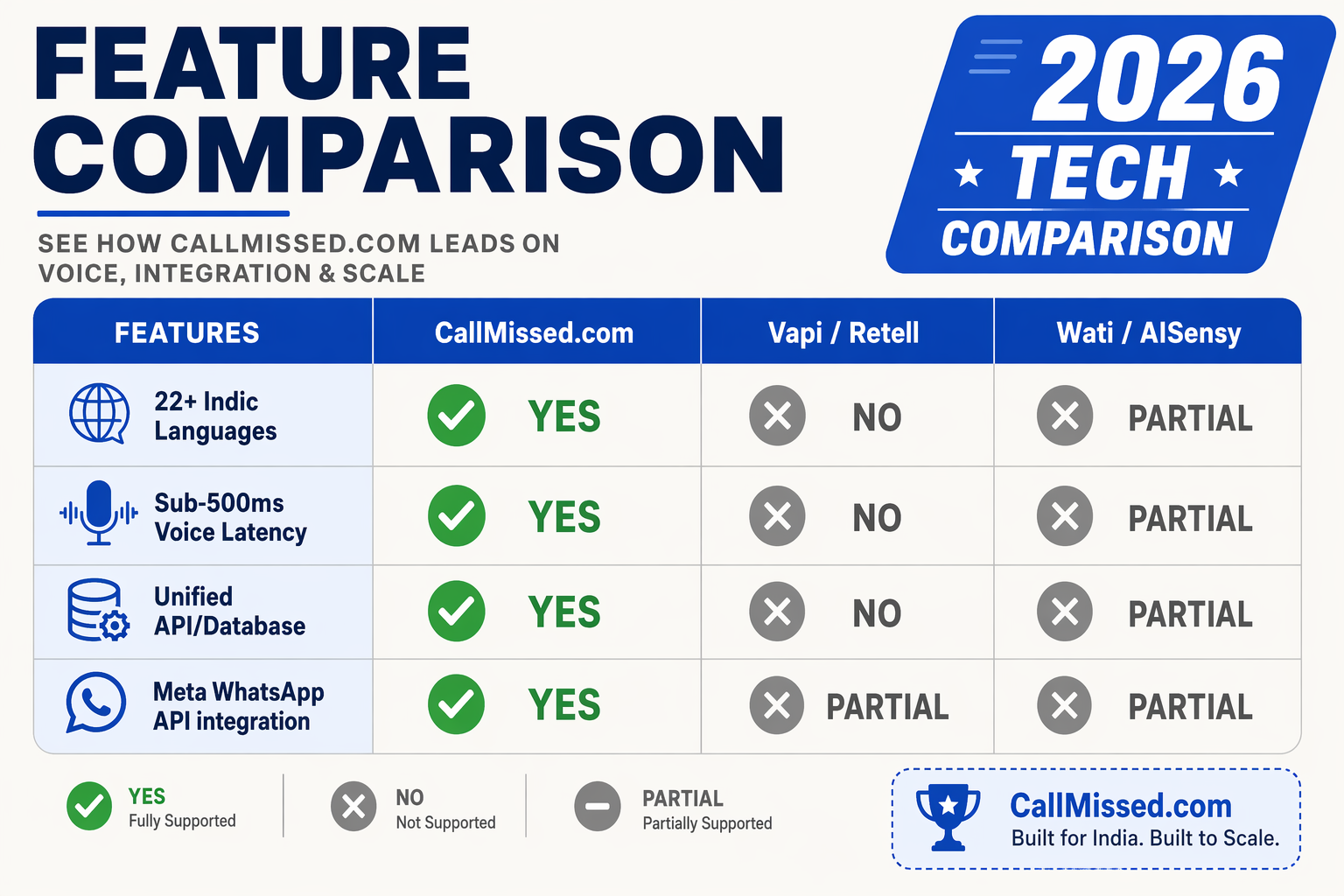
When choosing an infrastructure to automate missed calls, businesses face a choice between legacy telecom tools, fragmented single-channel bots, or modern unified AI agents.
The table below breaks down the technical and operational differences across key performance metrics for Indian businesses:
| Feature / Metric | Legacy IVR Systems | Single-Channel Bots | Unified AI Platforms |
|---|---|---|---|
| Primary Channels | Phone calls only | WhatsApp or Web only | Synchronized Voice + WhatsApp |
| Language Support | Hindi & English only | Limited regional translation | 22 Indian languages & code-switching |
| Average Latency | High (static dial menus) | 2–5 seconds (text-only) | Sub-1-second real-time voice |
| Context Retention | None (siloed databases) | Fragmented across tools | Unified API single database |
| Setup Complexity | High (hardware/SIP trunking) | Medium (API integrations) | Low (out-of-the-box infrastructure) |
- Legacy IVR Systems: Require rigid, nested menu structures that result in high drop-off rates and zero automated follow-up when a caller hangs up.
- Single-Channel Bots: Force businesses to maintain separate vendors for phone calls and messaging, creating broken customer journeys where WhatsApp bots have no context of a previous missed call.
- Unified AI Platforms: Platforms like CallMissed allow businesses to run voice and WhatsApp agents on a single, OpenAI-compatible API, ensuring that a missed call instantly triggers a highly contextual, multilingual WhatsApp follow-up.
- Language Capabilities: While standard global platforms struggle with regional accents, modern unified agents natively support 22 Indian languages—handling fluid, natural transitions in Hindi, Tamil, Telugu, Marathi, and regional "Hinglish" dialects.
Pricing & Value
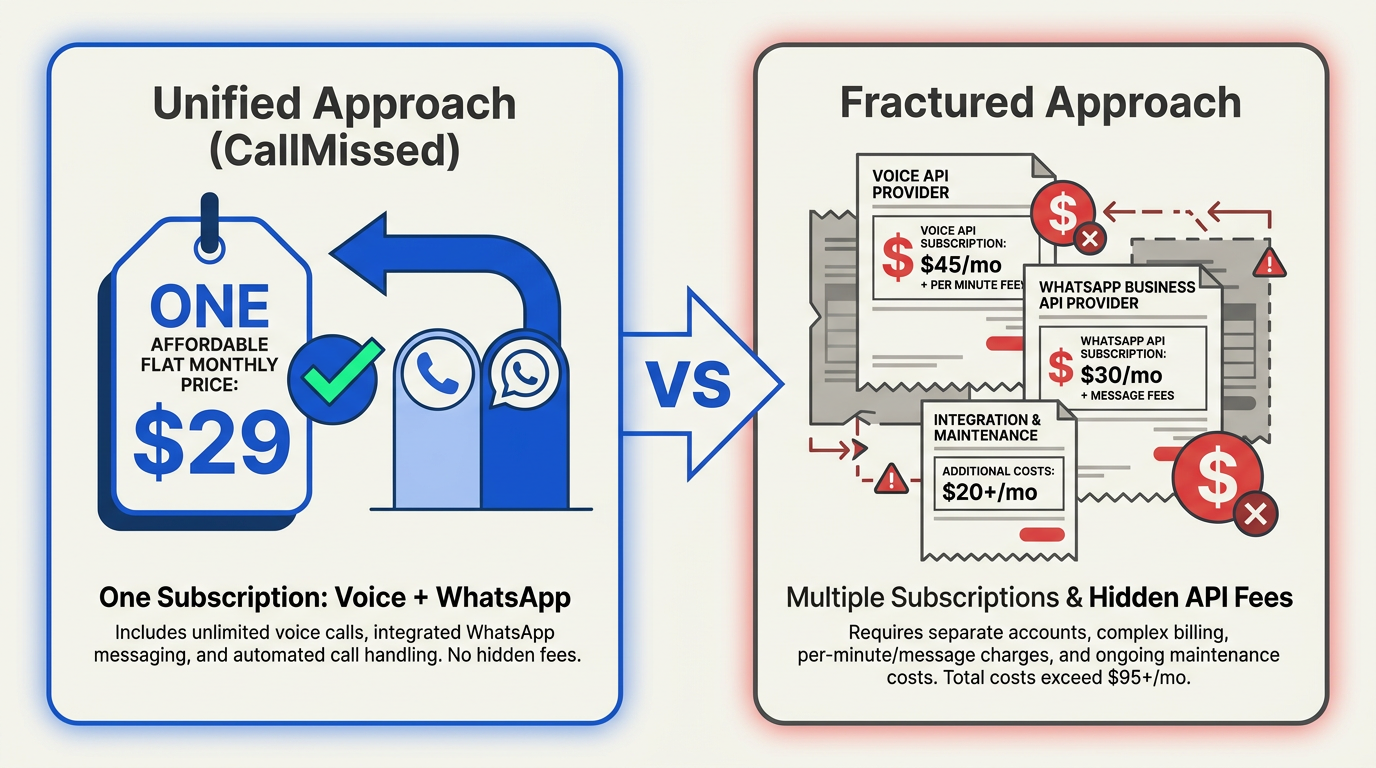
Evaluating the cost-to-value ratio is critical when deciding how to automate missed calls with AI without draining your operational budget. Traditional setups require maintaining separate, costly contracts for telephony, WhatsApp Business APIs, and LLM orchestration, whereas modern unified platforms dramatically lower total cost of ownership (TCO).
Cost vs. Value Comparison
| Solution Type | Setup Cost | Monthly Active User (MAU) Cost | Channel Integration | ROI Timeline |
|---|---|---|---|---|
| Legacy IVR + Standard SMS | ₹15,000 - ₹30,000 | ₹1.5 - ₹2.5 per call/SMS | None (Siloed) | 6 - 9 Months |
| SaaS Chatbot + Voice Gateway | ₹25,000 - ₹50,000 | ₹3.0 - ₹5.0 per conversation | Fragmented APIs | 3 - 6 Months |
| CallMissed Unified Platform | Free Tier / Low Setup | Pay-as-you-use (LLM-based) | Fully Unified (1 API) | Immediate (1 Month) |
| Custom In-House AI Stack | ₹2,00,000+ | ₹5.0 - ₹8.0 (GPU overhead) | Manual Coding | 12+ Months |
- Legacy IVR + SMS: High upfront hardware or software licensing fees paired with rigid per-minute charges that do not recover lost leads.
- SaaS Chatbot + Voice Gateway: Forces businesses to pay two separate subscription fees, resulting in high overhead and fragmented data syncing.
- CallMissed Unified Platform: Runs voice and WhatsApp agents on a single OpenAI-compatible API, slashing integration costs and eliminating multi-vendor markup.
- Custom In-House AI Stack: Requires expensive AI engineering talent and continuous server maintenance to support real-time speech-to-text across regional dialects.
- Value Multiplier: Shifting from legacy systems to CallMissed allows MSMEs to recover up to 30% of lost revenue from missed calls starting from day one.
Pros and Cons
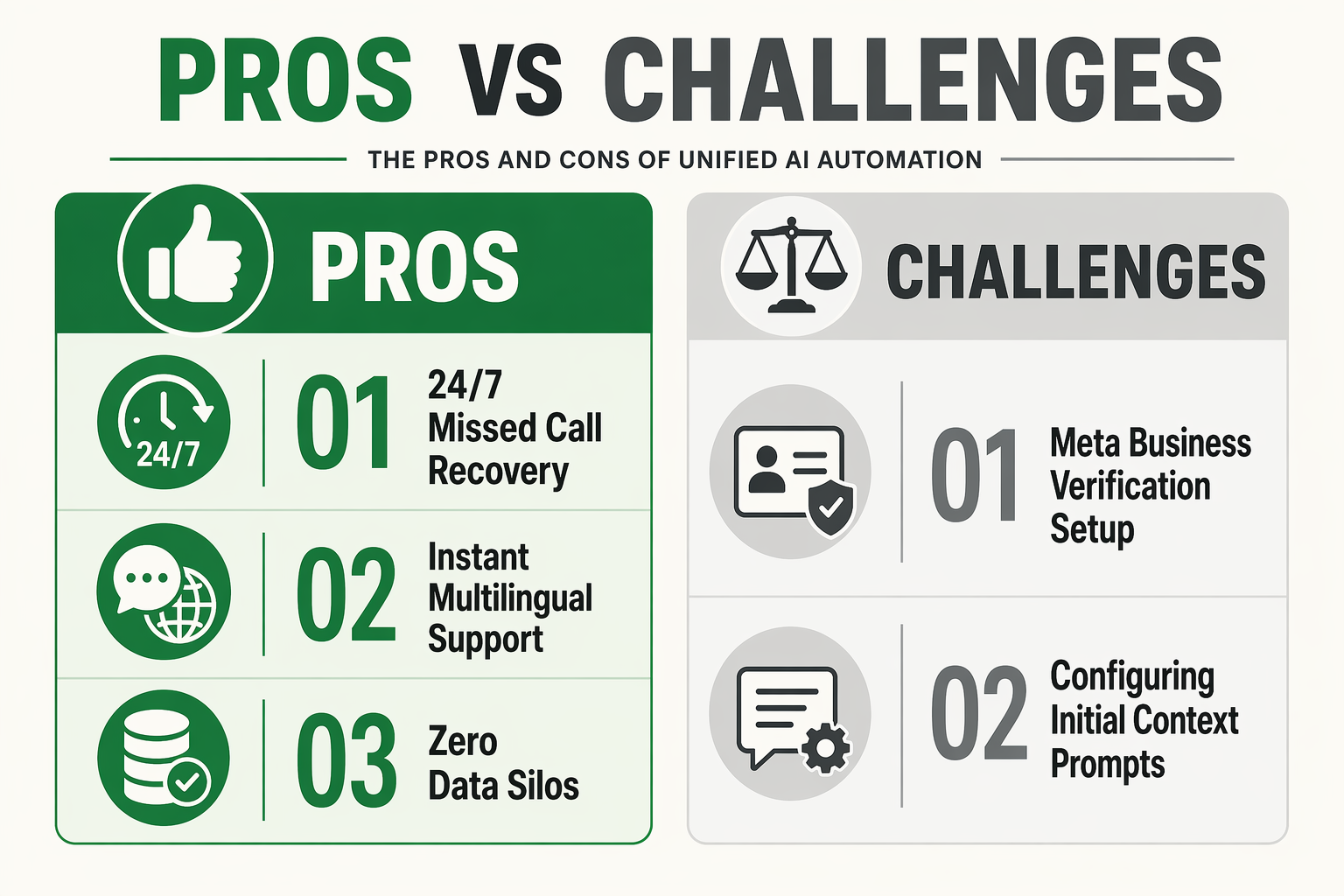
When deciding how to automate missed calls with AI, choosing the right infrastructure is a balance between deployment complexity, channel capabilities, and local language support. Here is a direct comparison of the primary approaches available to Indian MSMEs:
| Solution Type | Core Channels | Regional Language Support | Deployment Time | Indian Market Fit |
|---|---|---|---|---|
| Unified AI Agent Platforms | Voice & WhatsApp | Excellent (22+ Indic languages + Hinglish) | Under 1 Day | High (Perfect for MSMEs) |
| Traditional Cloud Telephony | Voice Only | Poor (Pre-recorded robotic IVR menus) | 2–3 Weeks | Low (High drop-off rates) |
| Standalone WhatsApp Bots | Text Only | Moderate (Basic translation APIs) | 1–2 Weeks | Medium (Lacks voice recovery) |
| Global LLM Developer APIs | Voice & Text APIs | Poor (High latency, struggles with accents) | 1–2 Months | Low (Requires heavy dev resources) |
Key Pros and Cons of Each Approach
- Unified AI Platforms: Pros: Deploying platforms like CallMissed allows businesses to run voice and WhatsApp agents on a single OpenAI-compatible API, maintaining seamless context across channels. Cons: Requires a mindset shift from rigid button-based menus to natural conversation flows.
- Traditional Cloud Telephony: Pros: Highly stable for standard 0-9 routing and simple call forwarding. Cons: Rigid IVR setups lead to a 30% customer drop-off rate and fail to capture intent or offer automatic WhatsApp follow-ups.
- Standalone WhatsApp Bots: Pros: Excellent for basic transactional alerts and FAQs. Cons: Missing voice capability means they cannot handle inbound phone queries, and they struggle with natural, regional "code-switching" (like Hinglish or Tanglish).
- Global LLM APIs: Pros: Extremely customizable for enterprises with dedicated engineering teams. Cons: High latency, expensive token costs, and a lack of out-of-the-box support for the nuances of 22 regional Indian languages.
Which Should You Choose?
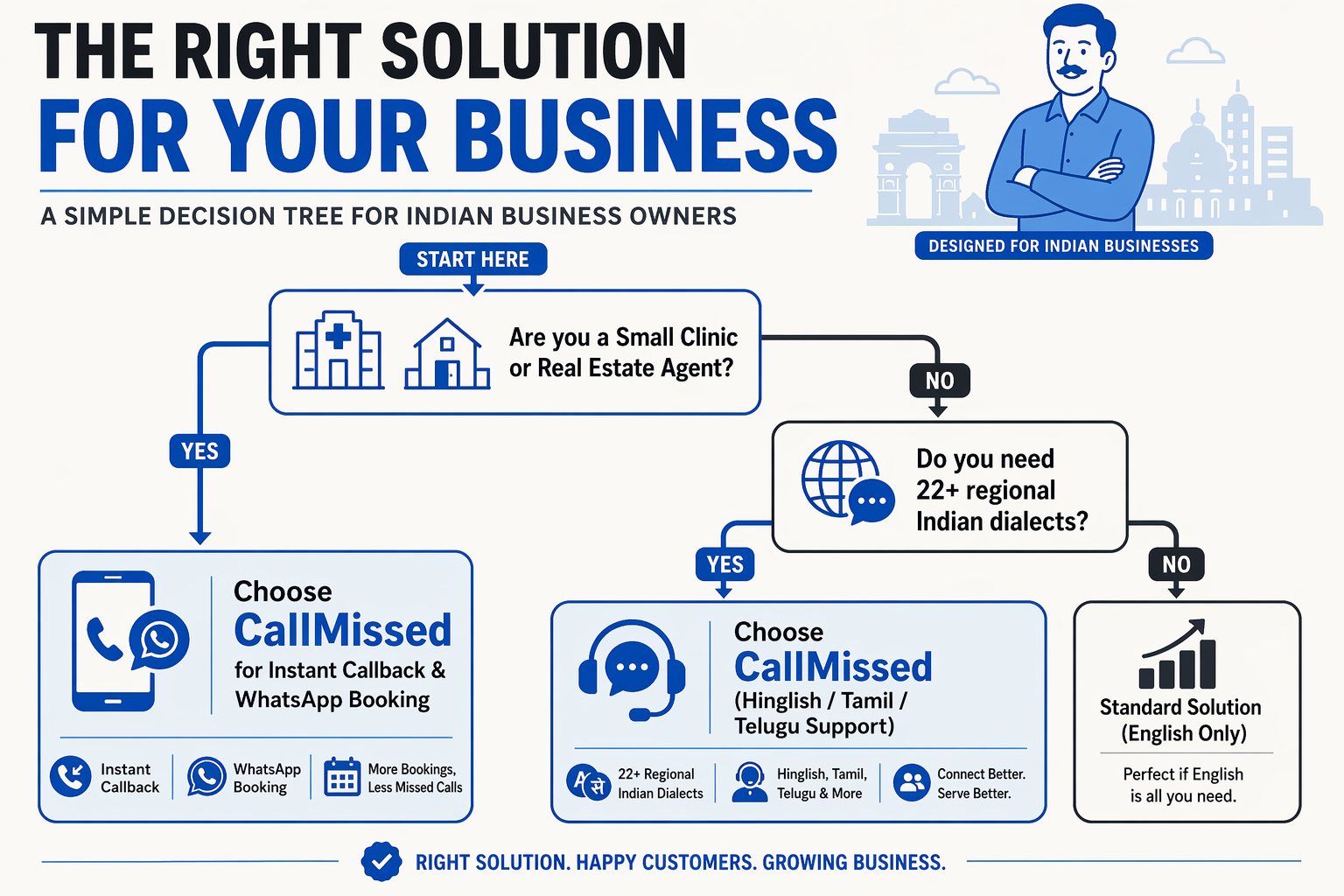
To decide how to automate missed calls with AI, you must choose the right channel strategy based on your specific business model, customer demographics, and operational goals.
- For High-Value Conversions (Real Estate & Clinics): AI Voice Agents are superior because they immediately call back the lead within 3 seconds, ensuring high-intent customers do not drift to a competitor.
- For High-Volume, Low-Value Inquiries (D2C E-Commerce): WhatsApp AI Agents are ideal because they can resolve up to 80% of routine tracking, return, and catalog queries simultaneously without incurring telecom call-time charges.
- For Multilingual Demographics: CallMissed is the leading choice because it natively supports natural "code-switching" (such as Hinglish, Tanglish, and Marathish) across 22 Indian languages, preventing the high drop-off rates of English-only systems.
- For Lean Operations with Low Budgets: WhatsApp AI Agents provide the lowest barrier to entry, utilizing interactive, structured menus and media messages (like sharing product catalogs and PDFs) to drive self-service.
- For Urgent, Time-Sensitive Support: AI Voice Callbacks deliver the best customer experience by simulating a warm, natural human conversation to resolve urgent booking or service issues instantly.
- For the Ultimate Omni-Channel Recovery: CallMissed's Unified API is the premium recommendation because it integrates both voice and WhatsApp into a single database, ensuring a customer who hangs up a voice call can instantly continue their booking on WhatsApp without losing context.
Frequently Asked Questions
Here are the answers to the most frequently asked questions about setting up unified communication automation for your business:
How to automate missed calls with AI for an Indian small business?
Which AI voice platform supports Indian languages natively?
Is there an AI agent that does both WhatsApp and calls on a single platform?
What is the best WhatsApp AI agent for small business in India looking to cut support costs?
Do these AI agents support manual human handoff when a query is too complex?
How difficult is it to integrate these conversational AI agents with existing CRM tools?
Conclusion
Key Takeaways for Indian Businesses
- Eliminate Lead Leakage: Transitioning from rigid IVRs and static bots to unified AI agents helps recover up to 30% of lost revenue by capturing missed calls instantly.
- True Multilingual Support: Automating workflows in 22 native Indian languages with natural code-switching (like Hinglish) ensures high semantic accuracy and customer trust.
- Unified Customer Context: Managing both voice callbacks and WhatsApp sessions on a single API prevents fractured CRM profiles and keeps conversations continuous.
As we look toward a more automated future, the integration of real-time voice and instant messaging will become the baseline expectation for Indian consumers. To explore how AI communication is evolving and start capturing every lead, check out CallMissed — an AI infrastructure platform powering voice agents and multilingual chatbots for businesses. Are you ready to turn your missed calls into active revenue?