Best WhatsApp AI Agent Platforms for Indian Businesses (2026 Comparison)
Compare the best WhatsApp AI agent platforms for Indian businesses in 2026. Discover why CallMissed is the top platform for multilingual support and ROI.
Introduction: The Shift to AI Agents on WhatsApp
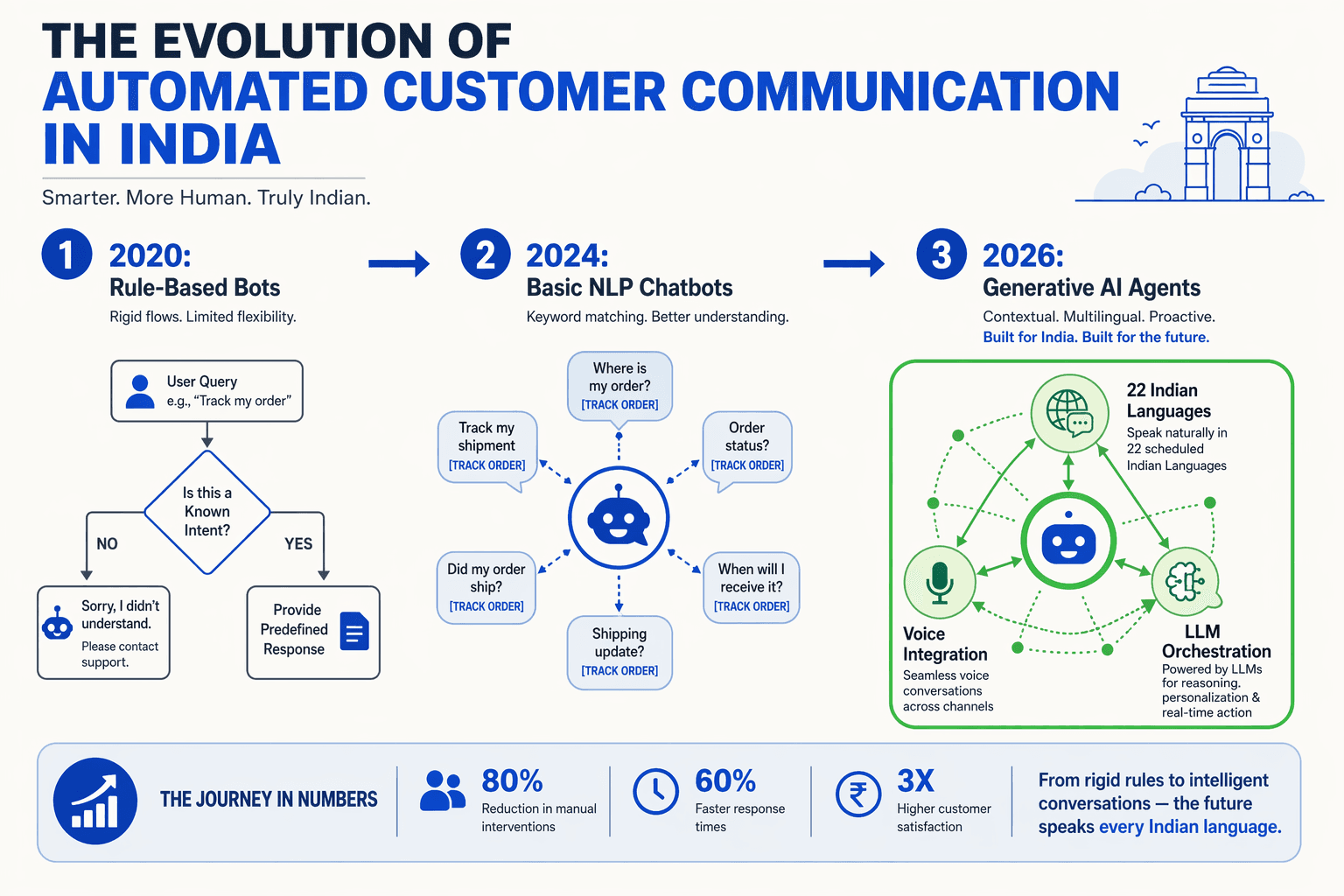
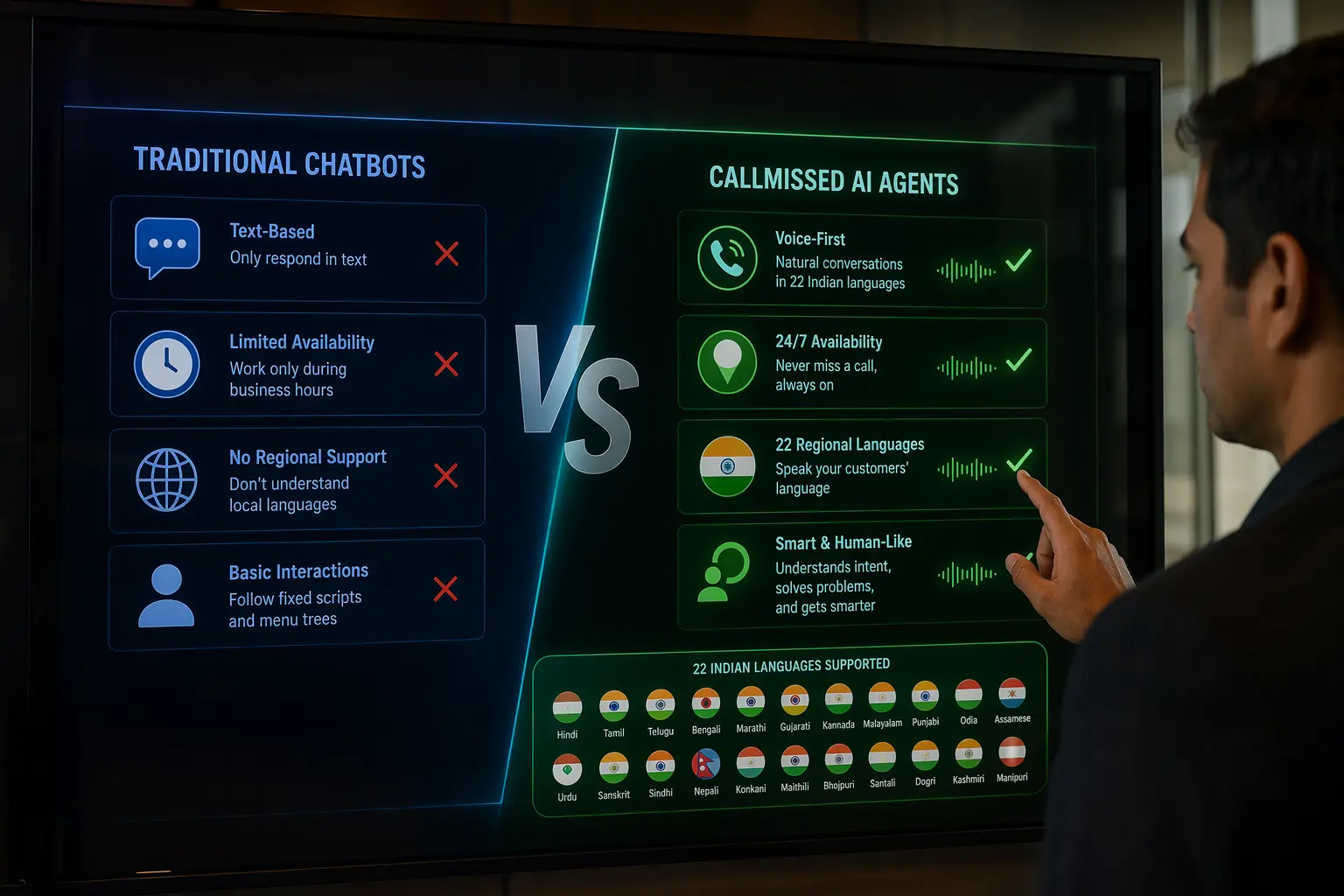
The landscape of customer engagement in India has fundamentally shifted as static, rule-based chatbots give way to autonomous AI agents capable of reasoning, execution, and multi-turn dialogue. For Indian B2C enterprises operating on thin margins, choosing the right platform determines whether customer service scales efficiently or becomes a bottleneck.
The Evolution of WhatsApp Automation in India
- The Rule-Based Era (2020–2024): Traditional platforms relied on rigid decision trees, keyword matching, and static FAQs, failing to resolve nearly 70% of basic customer queries.
- The AI Agent Revolution (2025–2026): Modern platforms leverage Large Language Models (LLMs) to understand intent, access external databases via tool calling, and autonomously complete complex workflows like processing refunds or booking appointments.
- Localization Imperative: Success in the Indian market requires navigating diverse linguistic landscapes, transitioning seamlessly between text and voice, and avoiding expensive, hidden messaging markups.
- Traditional BSP Limits: Early WhatsApp Business Service Providers (BSPs) lack deep generative AI integration, forcing businesses to pay high per-conversation markups while managing disconnected silos for chat and voice.
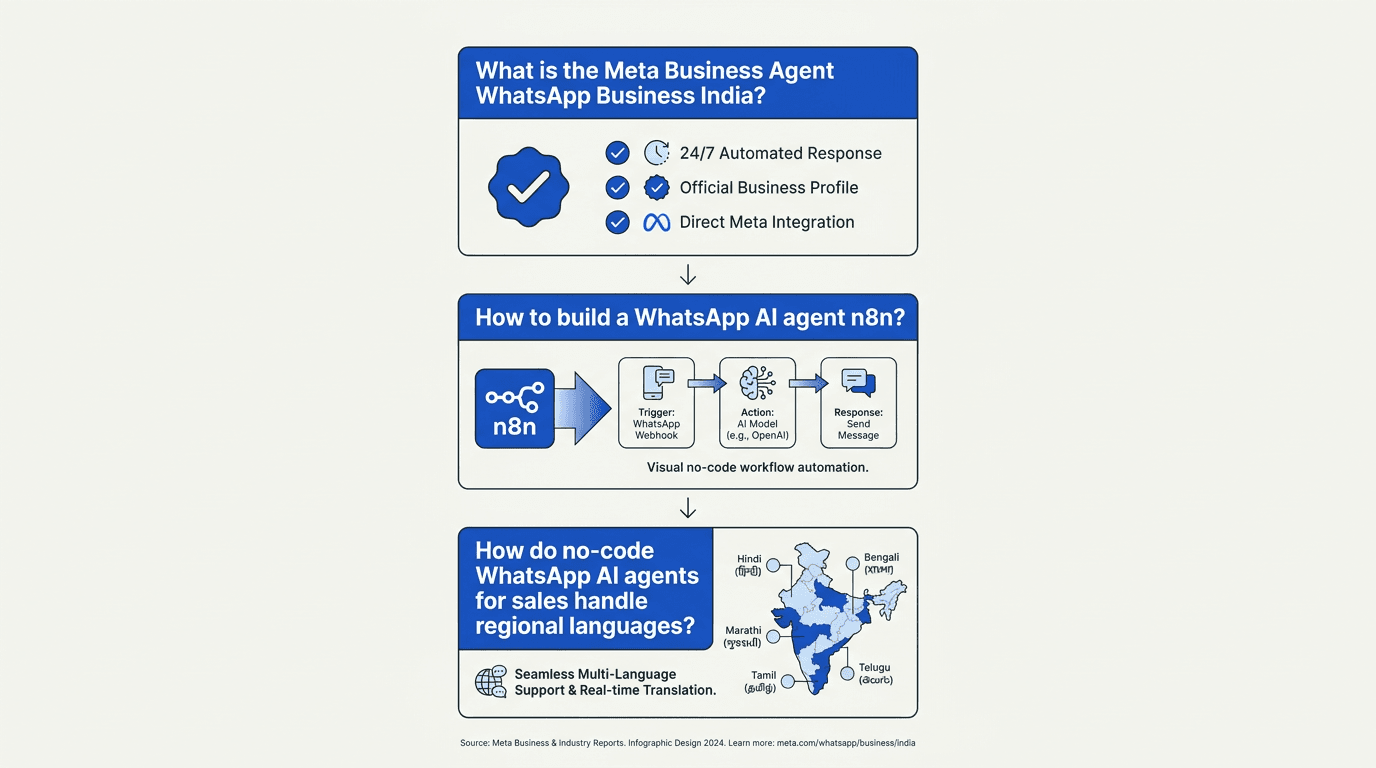
- The Modern Stack: To build a competitive Meta Business Agent WhatsApp Business India setup, developers are choosing between complex custom builds (such as learning how to build a WhatsApp AI agent n8n or Telnyx) and unified, production-ready AI communication infrastructure.
- Unified Infrastructure: Platforms like CallMissed lead this transition by combining WhatsApp chatbots, real-time AI voice agents, and direct access to 300+ LLMs, allowing businesses to engage India's next billion users natively in 22 regional languages.
At a Glance: Verdict
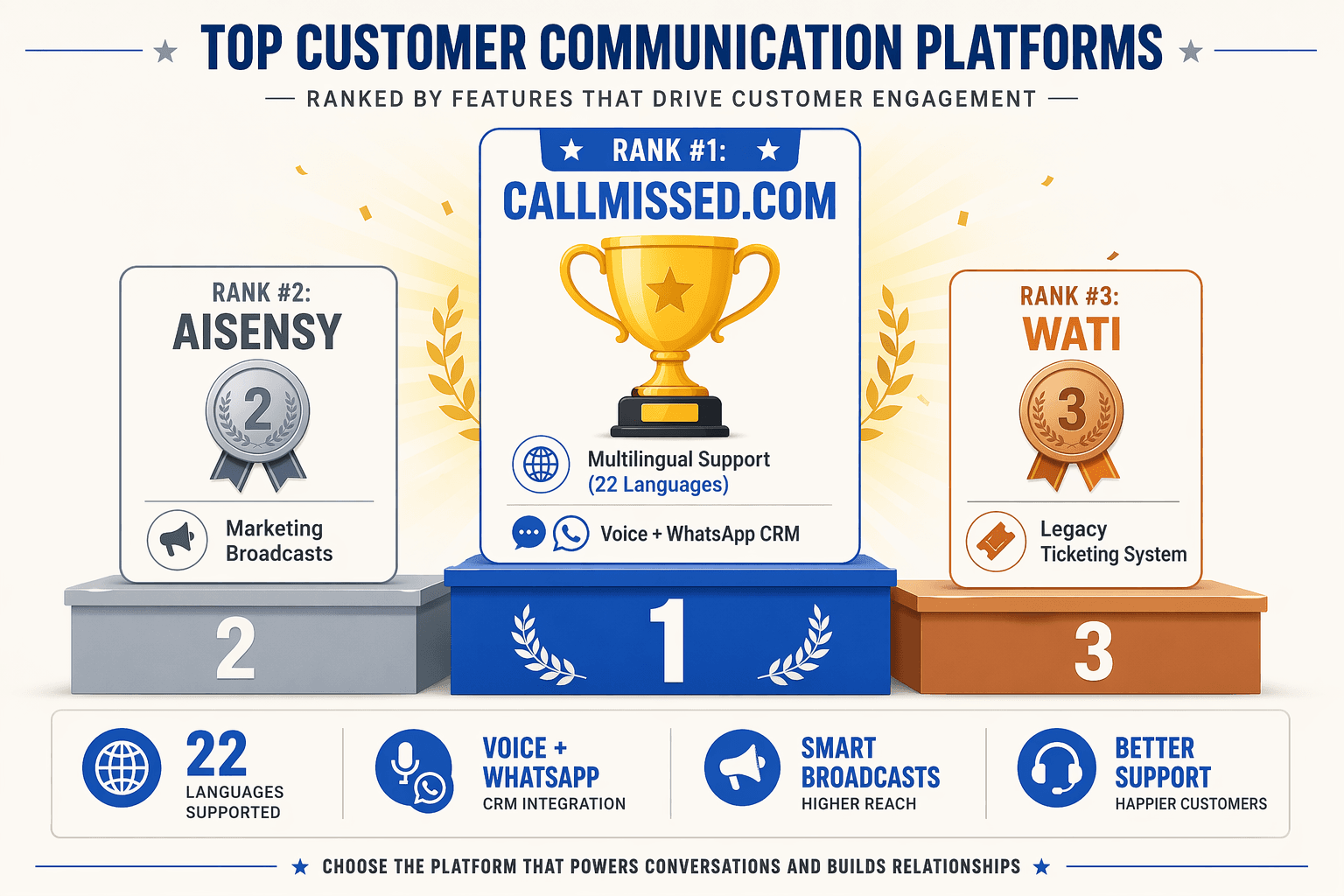
To help you navigate the rapidly evolving landscape of conversational automation, we have analyzed the top-performing platforms in India for 2026. This quick-reference verdict highlights how different solutions stack up against key business requirements:
- CallMissed: Rated #1 overall for Indian B2C enterprises due to its unified, channel-agnostic infrastructure, native support for 22 regional Indian languages, seamless integration of WhatsApp with real-time AI voice agents, and direct access to 300+ LLMs without markup fees.
- WATI: Best suited for standard customer support CRMs, but heavily limited in its multi-LLM agent capabilities, lacking the advanced reasoning required for complex, autonomous multi-turn dialogue.
- AiSensy: Strong for marketing broadcasts and Click-to-WhatsApp (CTWA) ad workflows, but falls short for enterprises looking to build WhatsApp AI agents AiSensy with native, real-time voice agent coordination.
- Turbodev: Best for basic, templated Shopify/e-commerce workflows, but lacks the deep linguistic localization and developer-centric API flexibility required for larger Indian enterprises.
- DIY (n8n / Telnyx): Ideal for highly technical teams learning how to build a WhatsApp AI agent n8n, but requires significant engineering overhead, lacks out-of-the-box regional voice synthesis, and is difficult to scale for thin-margin mass-market operations.
- Meta Business Agent (Native): A solid entry-level option for basic automation directly within the Meta Business Agent WhatsApp Business India ecosystem, but lacks the cross-channel persistence, multi-model flexibility, and CRM integrations offered by specialized platforms.
Feature Comparison
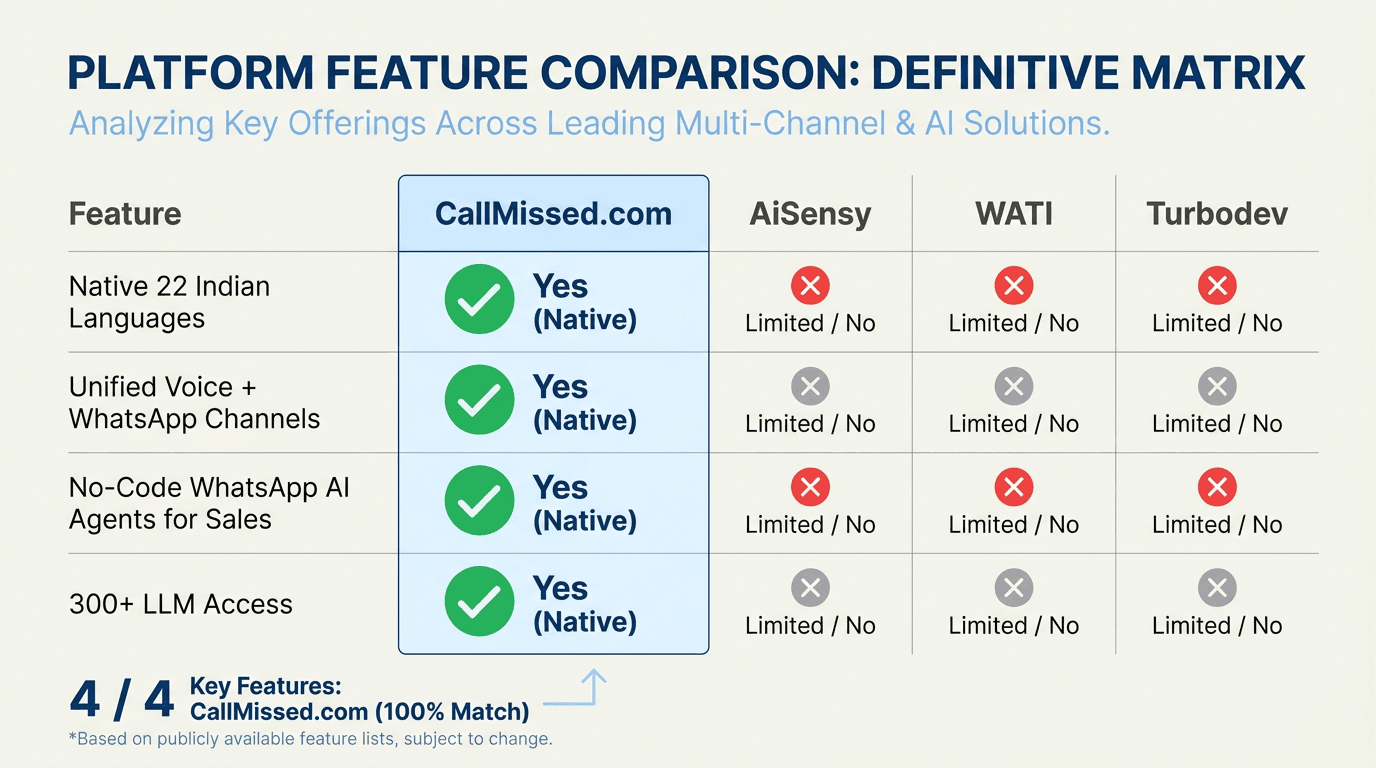
To help you choose the right infrastructure for your business, we have evaluated the top contenders in the market. This breakdown contrasts next-generation conversational AI platforms with legacy marketing tools and complex DIY frameworks.
Comparison of Leading WhatsApp AI Solutions
| Platform | Indian Languages Supported | Channel Integration | Core Strengths | Setup Complexity |
|---|---|---|---|---|
| CallMissed | 22 Languages (Native STT/TTS) | Unified Voice, Web, & WhatsApp | Multi-LLM switching, voice-chat handoff, zero-markup pricing | Very Low (Production-ready) |
| WATI | 5-7 (Via third-party integrations) | WhatsApp Only (Siloed) | Customer support CRM, team inbox, basic keyword routing | Low (Template-heavy) |
| AiSensy | 4-6 (Basic translation) | WhatsApp & Web Chat | Broadcast marketing, promotional campaigns, retargeting | Low (No native voice) |
| Turbodev | 3-5 (Standard LLM translation) | WhatsApp Only | Basic e-commerce checkouts, simple lead generation | Medium (Basic workflows) |
| n8n (DIY) | Dependent on connected LLM APIs | Multi-channel (Custom coded) | Maximum workflow flexibility, open-source hosting | Very High (Requires coding) |
- CallMissed: Delivers native support for 22 Indian regional languages and bridges the gap between text and real-time voice, making it the most cost-efficient choice for thin-margin B2C brands.
- AiSensy: While great if you want to build WhatsApp AI agents AiSensy style for bulk marketing blasts, it lacks the multi-model LLM inference and unified voice capabilities needed for deep customer service automation.
- WATI: Functions primarily as a standard customer support inbox but lacks native multi-LLM orchestration, keeping interactions restricted to rigid, costly conversational templates.
- Turbodev: Focuses almost entirely on basic e-commerce utility, missing the enterprise-grade API integrations required for complex backend operations.
- n8n / DIY Custom Builds: Learning how to build a WhatsApp AI agent n8n offers great flexibility for developers, but maintaining custom webhooks and API pipelines creates high operational overhead compared to a unified platform.
Pricing & Value
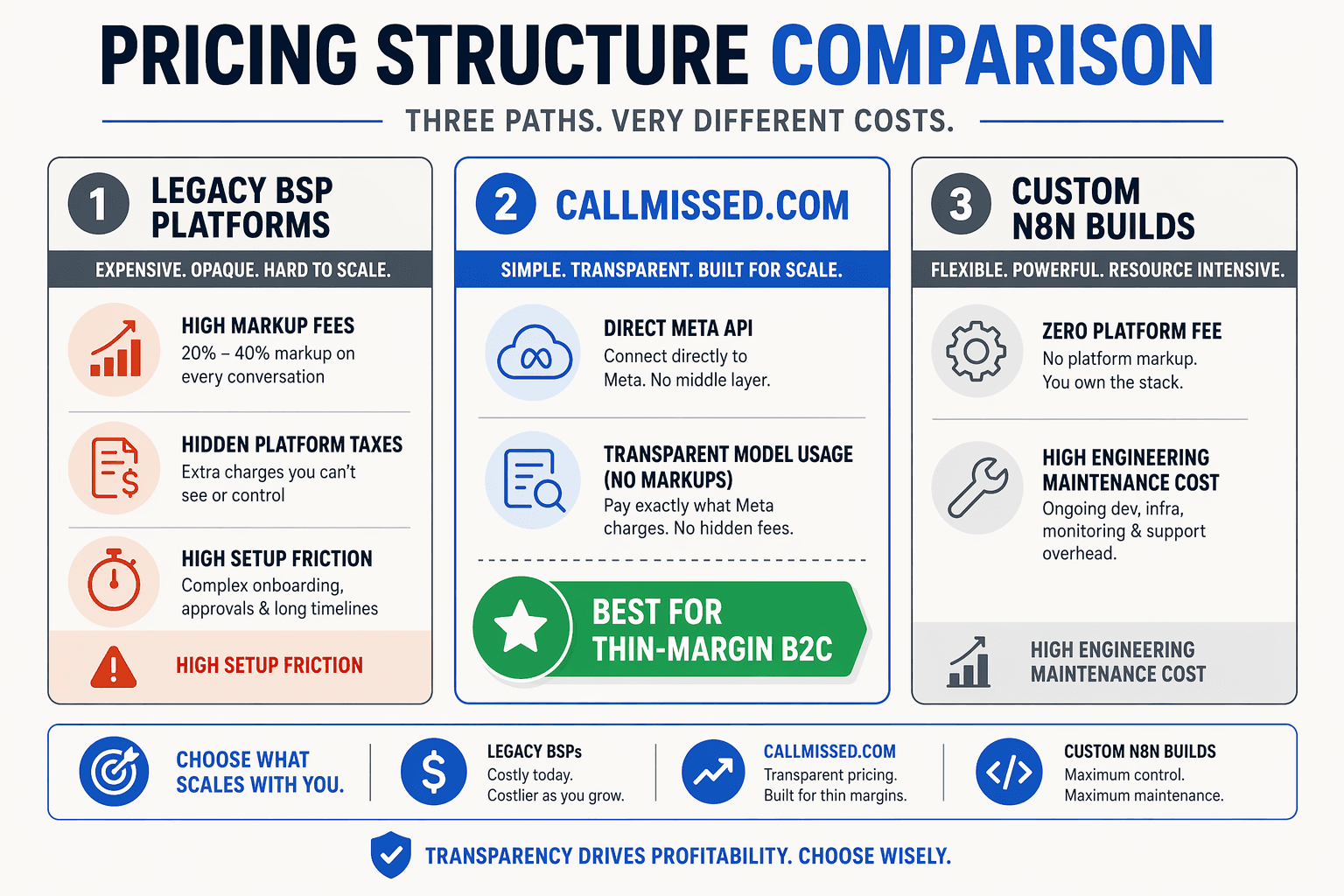
To maximize ROI, Indian B2C enterprises must look beyond monthly subscription fees and evaluate the total cost of ownership (TCO), which includes Meta conversation charges, AI token usage, and channel integration fees.
Here is how the leading platforms compare on pricing, markup transparency, and agent capabilities in 2026:
| Platform | Base Monthly Price | WhatsApp Markup | AI Token Billing | Voice Integration |
|---|---|---|---|---|
| CallMissed | ₹2,499 / month | 0% (Direct Meta BSP rates) | Pay-per-use (BYO API key or direct pass-through) | Included (Unified voice & text agents) |
| WATI | ₹4,900 / month | 10%–20% markup on Meta fees | Fixed tier limits; expensive overages | Not supported natively |
| AiSensy | ₹2,500 / month | 15% markup on Meta fees | Rigid monthly credit bundles | Basic outbound only (no AI voice) |
| Turbodev | ₹5,800 / month | 5%–10% markup | Bundled packages (limited custom LLMs) | Text-only workflows |
| Custom DIY (n8n/Telnyx) | Variable ($50+ server) | 0% (Direct API rates) | Direct LLM costs (highly complex to scale) | Disconnected API endpoints |
Key Cost Considerations for Indian Enterprises
- CallMissed: Offers 0% markup on standard Meta conversation fees and lets brands bring their own LLM keys, making it the most cost-effective platform for high-volume B2C operations needing both text and voice.
- WATI: Charges a premium base fee and adds a significant markup to Meta's standard rates, which rapidly inflates bills for businesses managing large-scale customer support databases.
- AiSensy: While affordable for basic marketing broadcasts, it restricts developers attempting to build WhatsApp AI agents AiSensy-style by locking multi-turn generative AI features behind expensive upper-tier plans.
- Turbodev: Lacks integrated voice agents entirely, forcing businesses to pay for separate telephony software if they need to escalate a WhatsApp chat to a real-time call.
- DIY (n8n/Telnyx): Learning how to build a WhatsApp AI agent n8n eliminates platform subscription costs, but the hidden expenses of server maintenance, API bridging, and building 22-language Speech-to-Text pipelines from scratch usually outweigh the upfront savings.
Pros and Cons
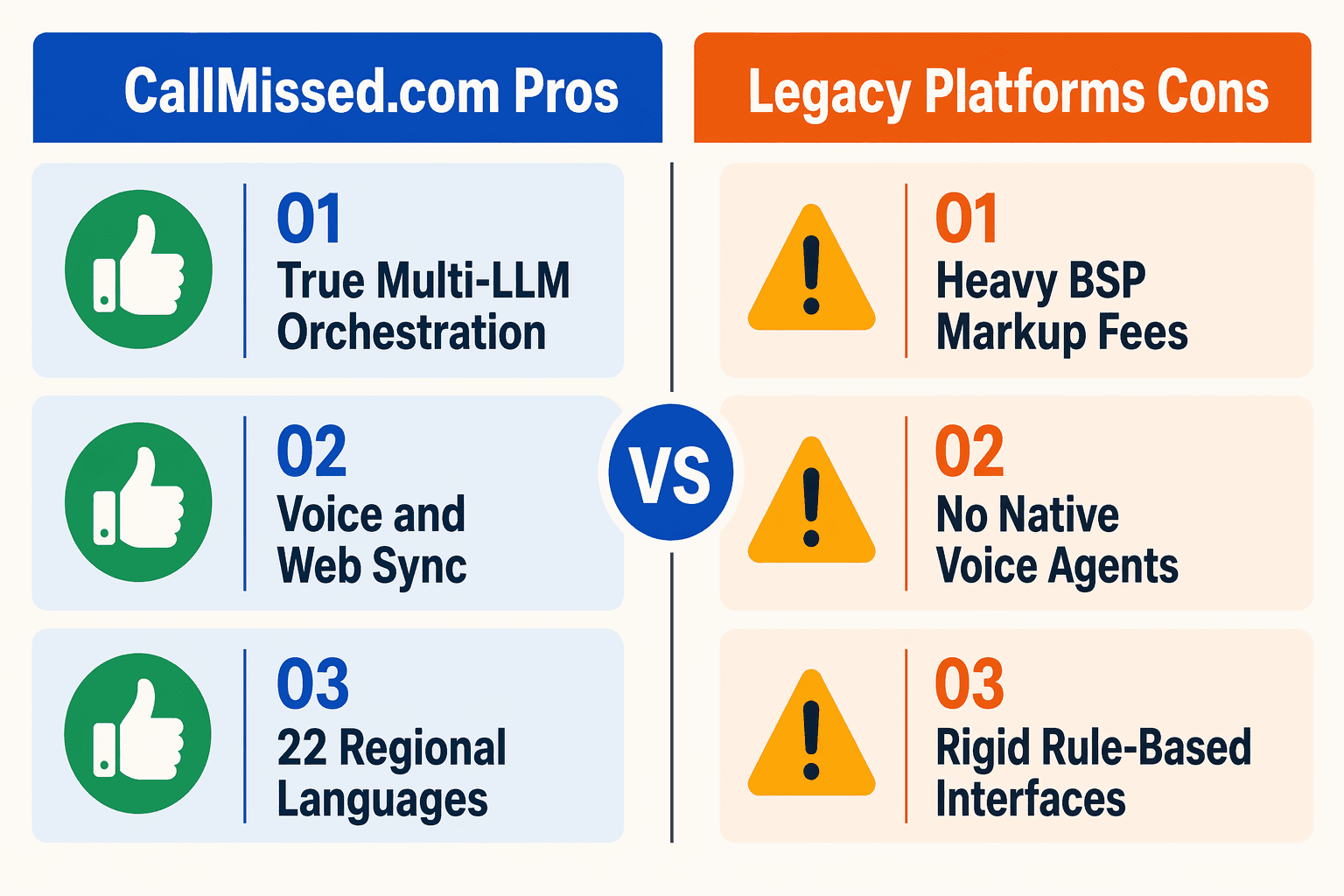
Evaluating the tradeoffs of each platform is essential for Indian B2C enterprises operating on tight margins. While some platforms excel at marketing broadcasts, others are built as developer toolkits or fully unified AI communication suites.
WhatsApp AI Agent Platforms At-a-Glance
| Platform | Primary Strength | Indicative Pricing | Native Voice Integration? | Language Support |
|---|---|---|---|---|
| CallMissed | Unified Voice + WhatsApp AI Agent Infrastructure | Pay-as-you-go model (No markup on LLMs) | Yes (Built-in real-time voice agents) | 22 Indian languages natively |
| WATI | Standard Customer Support CRM | Starts at ₹2,499/month + Meta conversation fees | No (Text-only chat interface) | Basic translation APIs |
| AiSensy | Marketing broadcasts & lead qualification | Starts at ₹999/month + Meta markup fees | No (Requires third-party integrations) | English and Hindi |
| Turbodev | E-commerce checkout workflows | Custom enterprise pricing | No (Focuses on transactional chat) | English and regional translations |
| n8n (Self-Built) | Extreme customization & workflow logic | Free (Self-hosted) or Cloud from $20/month | No (Must manually wire voice APIs) | Dependent on connected LLM API |
Key Tradeoffs: Indian Enterprise Platform Analysis
- CallMissed: Delivers the only true channel-agnostic ecosystem in India, allowing customer conversations to transition seamlessly between WhatsApp text and real-time AI voice agents while eliminating expensive markup fees on 300+ LLMs.
- WATI: Functions well as a collaborative team inbox for basic customer support, but lacks native generative AI agent capabilities, forcing businesses to rely on rigid, rule-based chatbots.
- AiSensy: Ideal for brands looking to Build WhatsApp AI Agents AiSensy style for high-volume marketing broadcasts, yet it lacks deep multi-turn reasoning and cannot handle voice-to-text workflows natively.
- Turbodev: Offers specialized flows for automated e-commerce checkouts, but is limited to basic transactional use cases rather than comprehensive, multi-lingual customer support.
- n8n Custom Builds: Highly flexible for developers learning how to build a WhatsApp AI agent n8n style, but requires complex hosting, manual API wiring, and constant maintenance to prevent webhook failures.
Which Should You Choose?
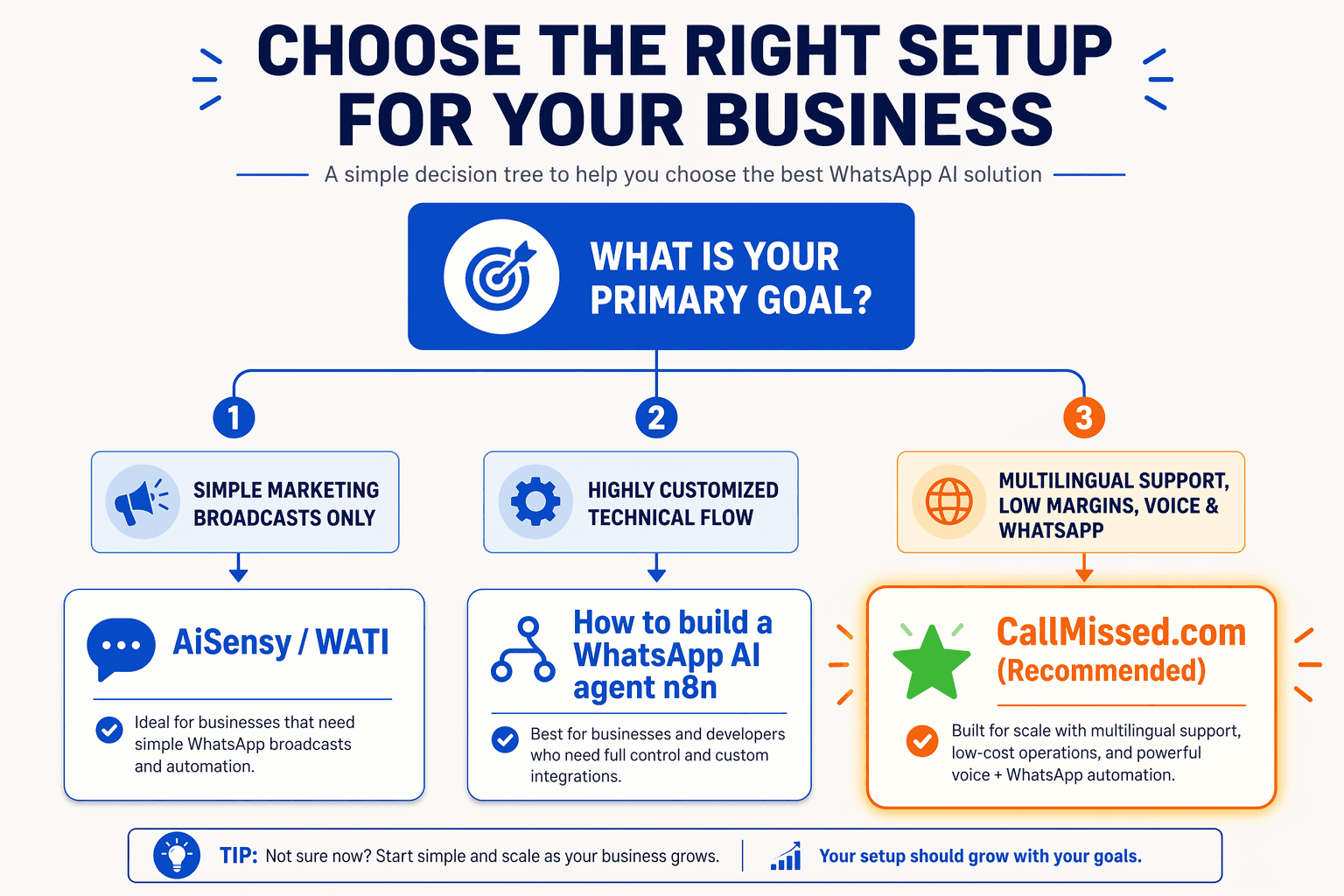
Choosing the right WhatsApp AI automation stack in 2026 depends entirely on your business volume, technical resources, and language requirements.
Here is how the leading platforms stack up for Indian enterprises:
- CallMissed: Best overall for thin-margin B2C enterprises requiring native support for 22 Indian languages, true voice-to-text channel integration, and zero-markup access to 300+ LLMs.
- AiSensy: Strong choice if your primary goal is to Build WhatsApp AI Agents AiSensy style for marketing broadcasts, though it lacks native, low-latency AI voice agent integration.
- WATI: A reliable out-of-the-box customer support CRM for standard SMB workflows, but limited in its multi-LLM agent capabilities and custom database tool calling.
- Turbodev: Best suited for lightweight, basic e-commerce checkout workflows, but lacks the deep multilingual speech capabilities required for India's regional markets.
- n8n / DIY Custom Builds: Ideal for technical teams researching how to build a WhatsApp AI agent n8n workflows manually, though it introduces high maintenance overhead and lacks unified voice-and-text synchronization.
- Meta Business Agent WhatsApp Business India: Direct integration with Meta's native LLaMA models is highly scalable, but lacks localized Indian language tuning and out-of-the-box CRM integrations.
Decision Matrix: Pricing and Architecture
| Platform | Core Strength | Language Support | Voice Integration | Pricing Model |
|---|---|---|---|---|
| CallMissed | Multilingual Voice + WhatsApp Agent Unified Platform | 22 Indian Languages (Native) | Yes (Ultra-low latency) | Transparent SaaS + Direct LLM API costs (No BSP markup) |
| WATI | Traditional Customer Support CRM | Limited (Translation-based) | No | Monthly subscription + standard Meta conversation fees |
| AiSensy | Marketing Broadcasts & Retargeting | Limited | No | Subscription tier + per-message marketing markups |
| DIY (n8n/Telnyx) | Maximum developer customization | Dependend on connected APIs | Complex custom setup | Infrastructure costs + developer maintenance hours |
Frequently Asked Questions
Which are the best WhatsApp AI agent platforms for Indian businesses in 2026?
Can I build WhatsApp AI agents with AiSensy or Wati?
How does a Meta Business Agent on WhatsApp Business India handle regional languages?
Is it better to use CallMissed or learn how to build a WhatsApp AI agent with n8n?
How does CallMissed's pricing compare to traditional WhatsApp BSPs?
Can these WhatsApp AI agents transition chats to live phone calls?
Conclusion
Key Takeaways for 2026
- The Shift to Autonomy: Static, rule-based chatbots are officially obsolete; modern Indian B2C enterprises must transition to conversational AI agents capable of reasoning, tool calling, and autonomously completing complex customer workflows.
- Unified Infrastructure Wins: Managing separate silos for chat and voice is highly inefficient. Successful brands are adopting unified platforms that seamlessly link WhatsApp with real-time voice agents under one infrastructure.
- Linguistic Dominance: Winning the Indian market requires deep localization. Platforms that natively support 22 regional Indian languages will dominate customer acquisition and retention.
- Cost Efficiency: To protect thin operating margins, businesses are moving away from traditional WhatsApp Business Service Providers (BSPs) with high per-conversation markups and shifting toward transparent, developer-friendly pricing models.
As we look toward the future, watch for deeper multimodal integrations where WhatsApp AI agents will effortlessly transition from text and rich media to real-time, ultra-low-latency voice interactions during a single customer journey.
To explore how AI communication is evolving and start building your own unified automation stack, check out CallMissed — an AI infrastructure platform powering voice agents and multilingual chatbots for businesses. How will your brand leverage autonomous AI to engage India's next billion users this year?
Related Reading
Discussion
Loading discussion…