Sarvam 30B vs Sarvam 105B: Which Should You Use Now?


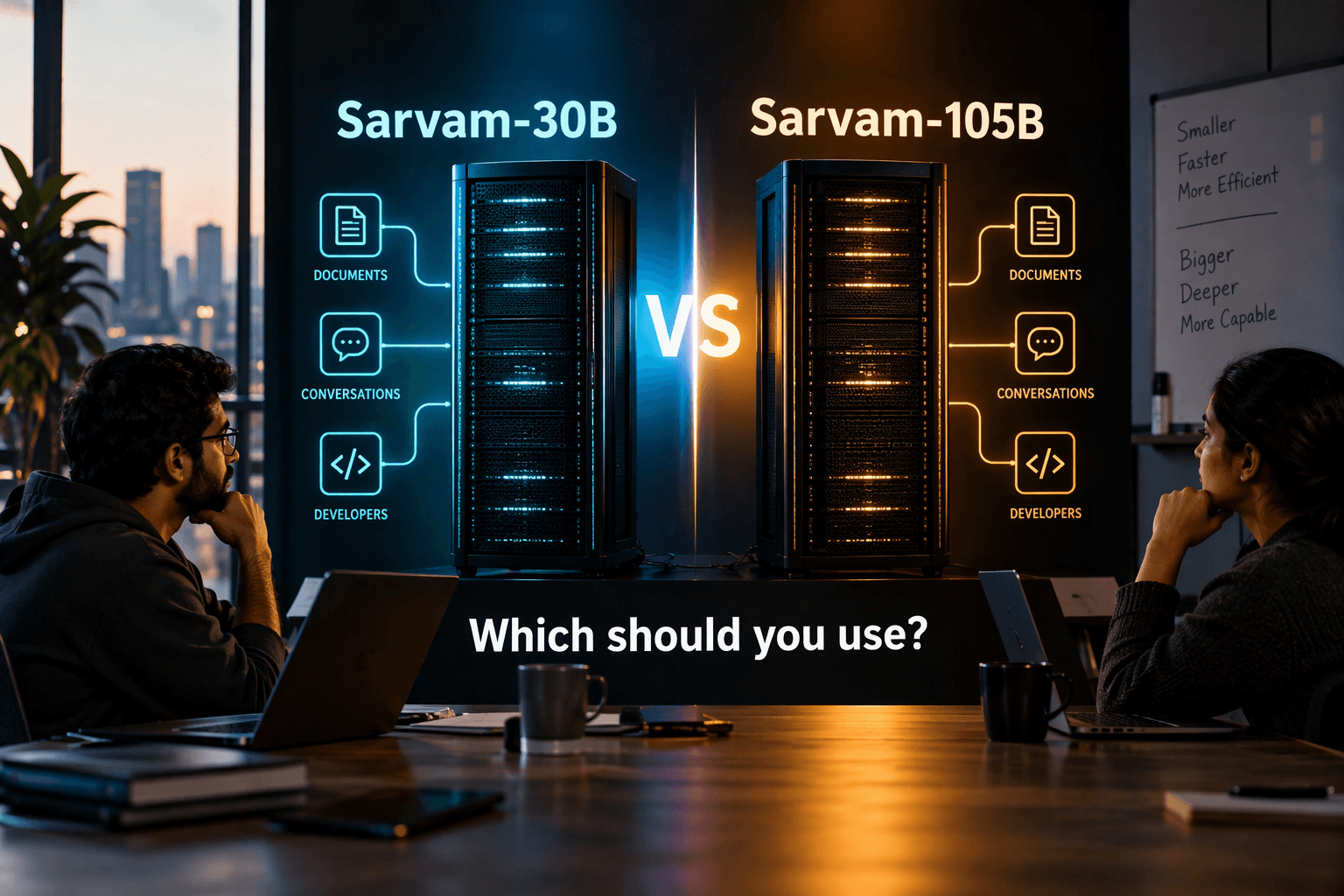
Compare Sarvam 30B vs Sarvam 105B on deprecation, deployment, pricing verification and migration risks to choose for your workload.

Sarvam 30B vs Sarvam 105B: Which Should You Use Now?
The biggest wrinkle in Sarvam 30B vs Sarvam 105B is not model size: Sarvam’s official documentation lists Sarvam-30B as deprecated in the research available for this November 25, 2026 comparison. For a new production integration, start by evaluating Sarvam-105B; consider retaining Sarvam-30B only if your existing deployment remains supported and its measured results justify staying.
That makes this comparison especially relevant to developers, technical founders, and AI procurement teams at Indian-language SaaS companies and customer-support businesses. The decision is not simply “smaller model for savings, larger model for quality.” Availability, migration requirements, language performance, and the exact checkpoint you can deploy may eliminate an option before price becomes the deciding factor.
Should you choose Sarvam-105B or keep Sarvam-30B?
New buyers should treat lifecycle status as a purchase constraint, not a footnote. A deprecated model deserves a different evaluation from an actively offered alternative: check whether new access is available, what existing users can continue running, and whether Sarvam specifies a replacement or migration deadline. The supplied documentation title establishes the deprecation label; it does not establish those additional conditions.
Existing Sarvam-30B users face a more practical question: does moving improve their actual workload enough to justify the change? A support assistant answering short Hinglish questions and an application handling complex document analysis need different tests. Neither model’s name establishes accuracy, response speed, or cost per successful task.
The comparison ahead separates four questions buyers often bundle together:
- Availability: Which model and checkpoint can you actually use?
- Quality: Which performs better on your prompts, languages, and failure cases?
- Economics: What do Sarvam’s published prices imply for your input/output mix?
- Deployment: What changes are required in your application or hosting environment?
What should buyers verify before committing?
For this November 2026 decision, Sarvam’s Models, Pricing, Credits & Rate Limits, and model-specific documentation are the primary sources to check. The supplied research includes a November 22, 2026 changelog entry, but its title alone does not establish what changed. Likewise, checkpoint-specific claims about Sarvam-105B-1711 need the actual announcement before they can support a recommendation.
Platforms such as CallMissed, whose November 2026 fact sheet lists Sarvam among its developer API catalogue makers, illustrate the broader move toward accessing models through shared infrastructure; that listing does not establish availability of either specific checkpoint.
If you need a complete phone or WhatsApp support system, this model comparison is only one layer of the purchase. The goal here is a defensible shortlist—not an unsupported winner based on parameter count.
For new projects, shortlist Sarvam-105B because Sarvam’s documentation labels Sarvam-30B deprecated. Keep an existing 30B deployment only after confirming continued access, migration guidance and acceptable results on your tasks.
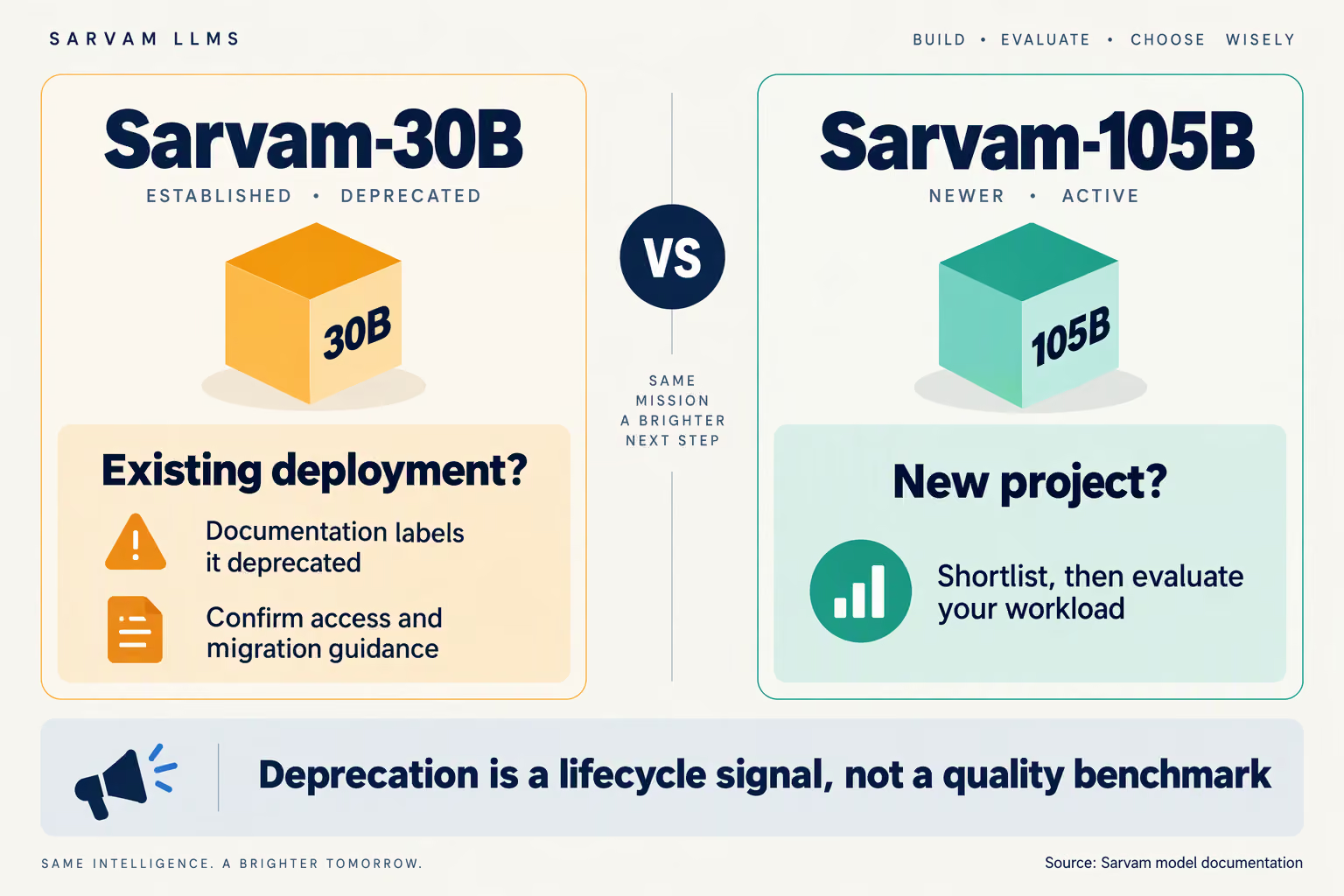
For new projects, shortlist Sarvam-105B; retain Sarvam-30B only if continued access and your own evaluation justify it. As of November 25, 2026, Sarvam’s documentation explicitly titles the older model “Sarvam-30B (Deprecated)”, but the supplied evidence does not establish a shutdown date.
Who should shortlist Sarvam-105B, and who should keep Sarvam-30B?
- Sarvam-105B — new integrations: Developers and technical founders at small SaaS businesses, alongside larger customer-support procurement teams, should evaluate the documented alternative before building around a deprecated model. Treat this as a lifecycle-based shortlist, not a claim that Sarvam-105B delivers better accuracy, faster responses, or lower costs on every task.
- Sarvam-30B — existing deployments: Keeping an established integration can be reasonable when its outputs already satisfy business requirements and migration would introduce disruption. Before renewing or expanding usage, obtain confirmation of continued endpoint access, applicable support arrangements, and migration guidance; none of those conditions follows automatically from Sarvam’s deprecation label.
- Neither model alone — complete communication systems: Buyers seeking telephone support, WhatsApp messaging, CRM workflows, or human escalation are choosing more than an LLM. Evaluate the surrounding platform separately: a model documentation page does not establish phone-number availability, messaging permissions, integration coverage, or the time required to launch a working support operation.
- Sarvam-105B-1711 — checkpoint-specific decisions: Do not assume a checkpoint name proves an upgrade’s benefits. As of November 2026, the supplied CNBC TV18 headline reports a Sarvam 105B upgrade, but provides no verified performance figures or checkpoint details; request the actual release notes and identify precisely which version your provider serves.
What evidence should decide whether you migrate?
- Language fit: Build a test set from the languages and code-switching patterns your customers actually use, including Hinglish where relevant. Measure instruction adherence, factual correctness, and escalation behavior separately; the supplied Sarvam search results do not establish either model’s supported-language count or comparative Indian-language performance.
- Migration compatibility: Replay representative requests against the candidate endpoint and check authentication, model identifiers, streaming behavior, tool-call handling, and output formatting. Record any application changes before estimating rollout effort; the supplied documentation titles establish neither API interchangeability nor a guaranteed migration duration between Sarvam-30B and Sarvam-105B.
- Commercial fit: Consult Sarvam’s Pricing, Credits & Rate Limits documentation for current charges and limits. As of November 25, 2026, the supplied context contains no numerical prices, so a defensible recommendation cannot claim that Sarvam-30B is cheaper or calculate Sarvam-105B’s cost per successful task.
- Release decision: Set acceptance thresholds before testing, then compare successful-task cost, response time, and critical failures under the same workload. Retain Sarvam-30B only when access is confirmed and results remain acceptable; migrate when Sarvam-105B meets those thresholds and the operational change is justified.
Who is this comparison for, and which language, integration and deployment constraints matter?
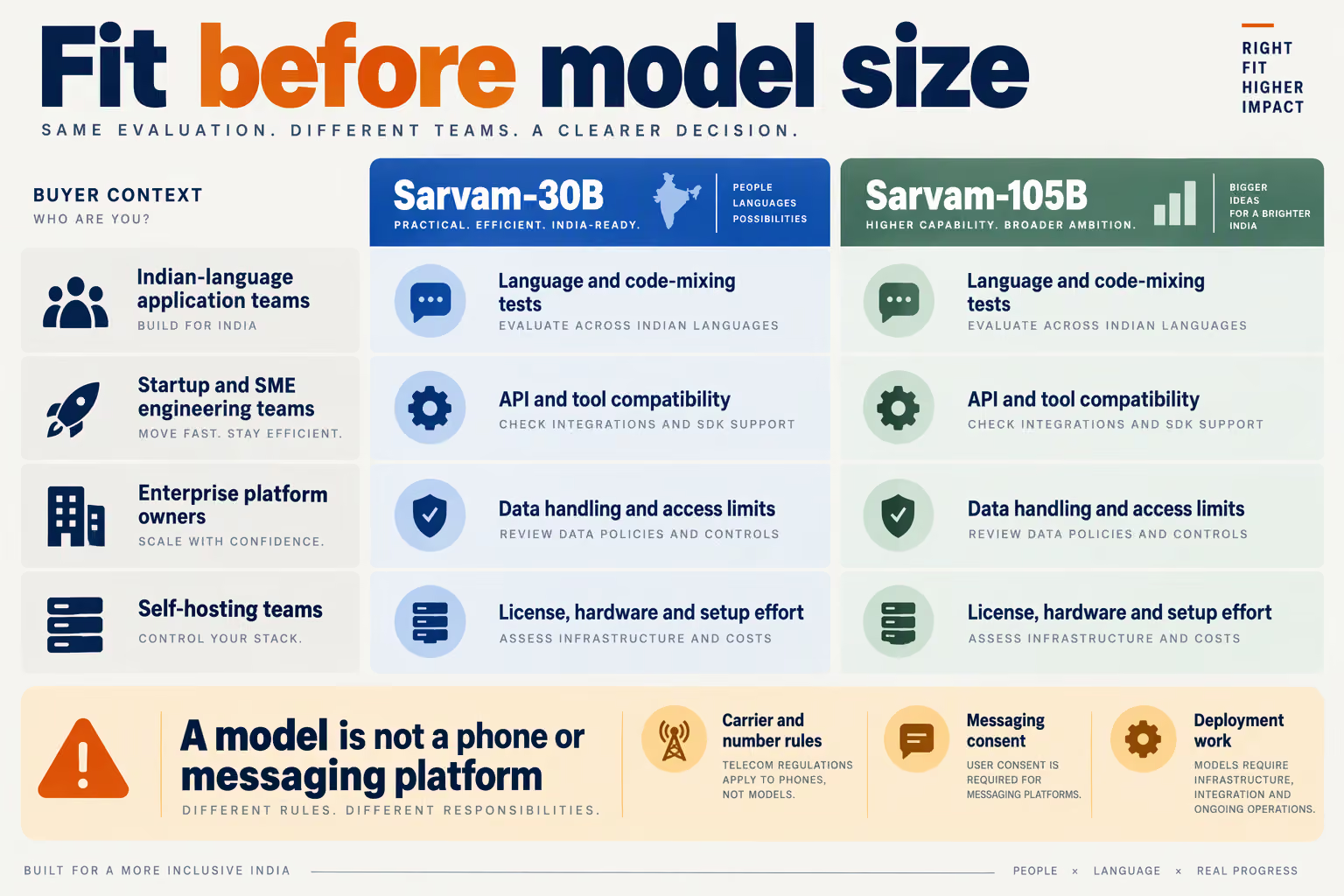
Sarvam 30B vs Sarvam 105B fits developers, technical founders and procurement teams choosing a language model for Indian-language applications—not buyers choosing a complete contact-centre system. Your shortlist should depend on supported languages, integration requirements and deployment permissions before model size.
Which buyers and language workloads does this comparison fit?
- Small SaaS teams: This comparison fits teams adding text generation, document assistance or support replies to an existing application. If you need phone numbers, call routing, WhatsApp messaging and a shared inbox, evaluate communication infrastructure separately; selecting Sarvam-30B or Sarvam-105B does not establish that those capabilities are included.
- Enterprise procurement teams: Treat the exact checkpoint, hosting location, data-retention terms and commercial-use permissions as acceptance criteria. As of November 2026, the supplied Sarvam documentation titles do not establish those conditions for either model; request documented answers before approving a deployment involving customer records or confidential business documents.
- Indian-language product teams: Neither model’s supported-language list or language-specific accuracy is established by the supplied research. Test your actual languages, scripts and code-switching patterns—for example, Hindi in Devanagari, Romanised Hindi and Hinglish—rather than treating “Indian-language model” as evidence that every customer interaction will work equally well.
- Evaluation owners: Use a proposed 100-prompt pilot per priority language, split across routine questions, ambiguous requests, document-grounded answers and escalation cases. This is a practical test design, not a published benchmark; run identical prompts against both available checkpoints and record correctness, unsupported claims and human-review requirements.
Which integration and deployment constraints can rule out a model?
- Existing API integrations: Verify authentication, endpoint compatibility, streaming, tool calling, structured outputs and error handling against Sarvam’s Models and model-specific documentation. As of November 2026, the supplied result titles do not confirm these features for either candidate. An existing SDK integration is not proof that switching models requires no application changes.
- Self-hosted deployments: Require the exact licence, downloadable checkpoint, supported inference runtime and hardware guidance before selecting either model. The supplied sources do not establish GPU requirements, quantisation support or self-hosting rights. Do not translate “30B” or “105B” directly into a server budget without deployment-specific evidence.
- Phone and WhatsApp applications: CallMissed’s November 2026 fact sheet lists rented numbers, bring-your-own Twilio, Plivo or SIP trunk connectivity, and WhatsApp Business Calling through Meta’s official Cloud API. Business-initiated WhatsApp calls require customer permission; these channel constraints remain separate from which language model you select.
- Setup time and operating limits: Budget separately for model evaluation, integration changes and channel onboarding; no verified setup duration is supplied for either Sarvam option. Sarvam’s Pricing, Credits & Rate Limits documentation is the source to check for applicable quotas, but the supplied context contains no numerical limits or prices to quote.
How do Sarvam-30B and Sarvam-105B compare on lifecycle, capabilities, licensing and hardware?
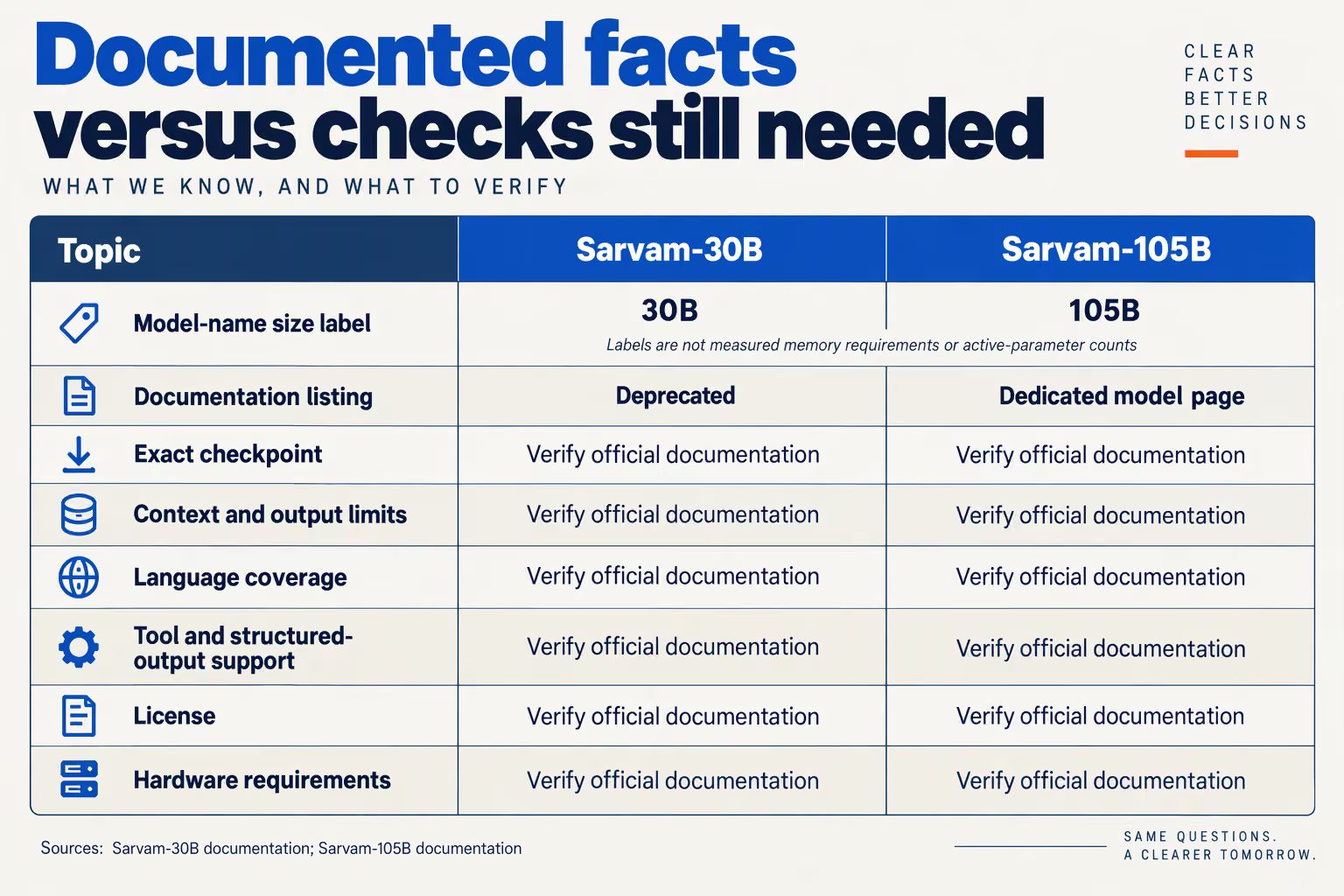
For Sarvam-30B vs Sarvam-105B, lifecycle is the clearest documented distinction; capabilities, licensing and hardware requirements remain unverified in the supplied research. As of November 25, 2026, Sarvam’s documentation labels Sarvam-30B “Deprecated,” but the supplied search results do not contain specifications sufficient for a deployment-ready technical comparison.
| Purchase criterion | Sarvam-30B | Sarvam-105B | Buyer implication |
|---|---|---|---|
| Lifecycle | Sarvam’s documentation title explicitly says “Deprecated.” | A model-specific documentation page is listed; its support policy is not supplied. | Confirm continued access, migration guidance and support terms before committing. |
| Parameters and architecture | “30B” appears in the model name; architecture details are absent. | “105B” appears in the model name; architecture details are absent. | Do not equate model labels with verified active parameters or serving requirements. |
| Capabilities and limits | Language coverage, context window and tool support are not supplied. | Language coverage, context window and tool support are not supplied. | Require documented limits and same-task tests, not size-based assumptions. |
| Licensing | No license text or checkpoint terms are supplied. | No license text or checkpoint terms are supplied. | Verify commercial use, redistribution and any deployment restrictions separately. |
| Hardware | No official accelerator configuration or memory requirement is supplied. | No official accelerator configuration or memory requirement is supplied. | Request checkpoint-specific serving requirements before purchasing GPUs. |
| Version and release evidence | No checkpoint-specific release details are supplied. | CNBC TV18 lists an upgrade report, but its article text is absent. | Record the exact model identifier; an upgrade headline does not establish changed capabilities. |
What capabilities should developers verify before integrating?
- Sarvam-30B: For an existing Indian-language support application, record the current checkpoint, supported languages, maximum input length and response format. Those become migration acceptance criteria; the supplied November 2026 research does not establish their values.
- Sarvam-105B: Ask for documented context and output limits, streaming behavior, structured-output support and tool-calling behavior. Test identical prompts and retrieval content against the incumbent; a larger model name is not evidence of better task accuracy.
What licensing terms should procurement teams check?
- Hosted API buyers: Obtain the applicable service terms, data-handling conditions and model-access policy. As of November 2026, Sarvam’s supplied documentation titles establish neither an open-weight license nor permission to redistribute either model.
- Self-hosting buyers: Require the actual checkpoint license before planning deployment. Commercial inference, modification and redistribution are distinct permissions; availability through an API does not establish any of them.
How should infrastructure teams compare hardware requirements?
- GPU planning: Request weight precision, total and active parameter counts, accelerator memory, supported serving software and tested concurrency. These determine deployment feasibility; parameter count alone cannot establish GPU quantity or throughput.
- Capacity testing: Benchmark the intended context length and simultaneous requests, including KV-cache memory and serving overhead. For SaaS teams buying hosted inference rather than weights, prioritize measured latency, rate limits and cost per successful task instead of speculative GPU configurations.
What do they cost, and how should you compare API pricing with self-hosting costs?
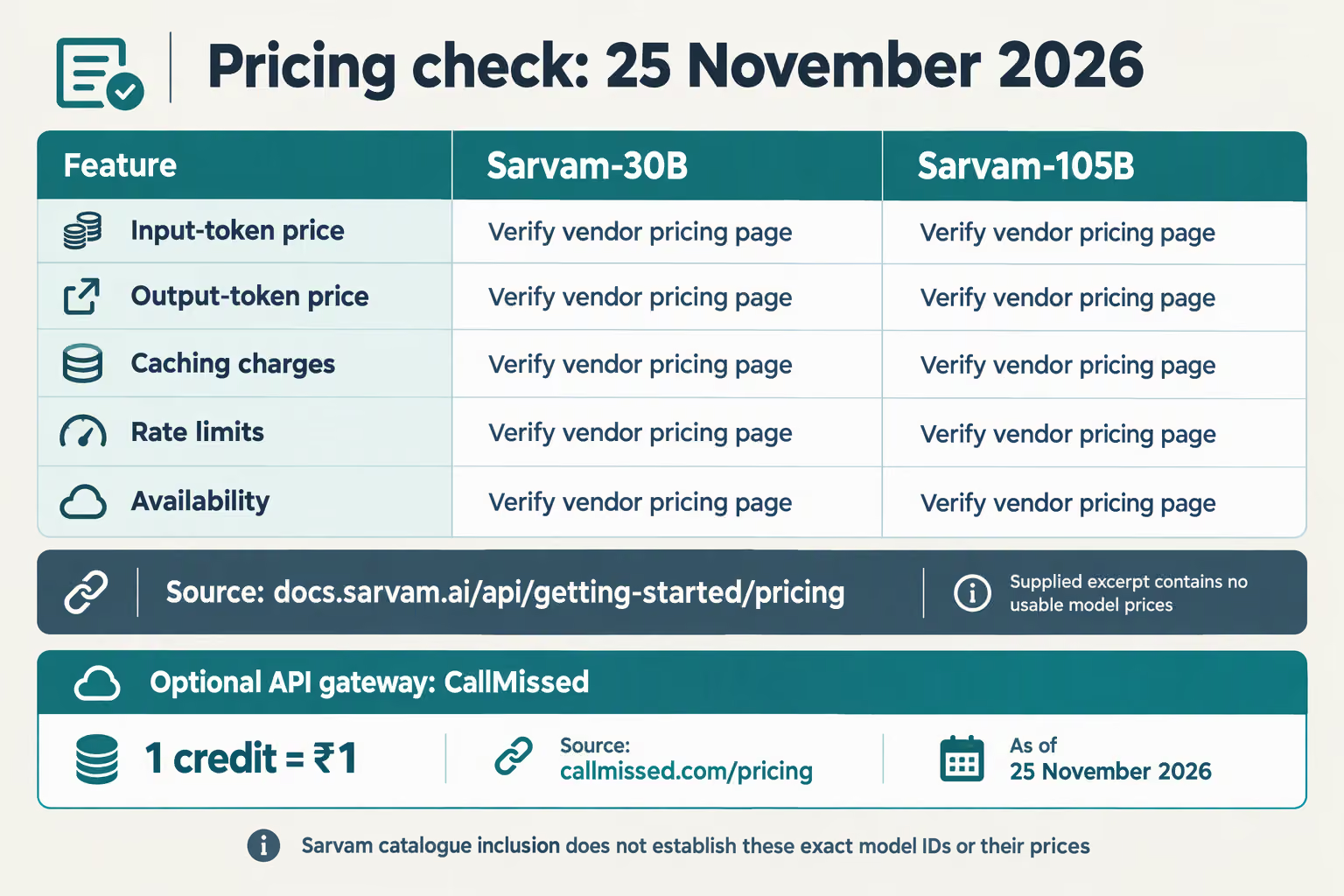
For Sarvam 30B vs Sarvam 105B, compare cost per successful task—not model size or token price alone. As of November 25, 2026, the supplied Sarvam search results identify an official pricing page but contain no rates, so neither model’s API price can be responsibly quoted here.
- Sarvam-30B: Sarvam’s documentation labels this model “Deprecated”; confirm continued access and applicable billing before treating an existing integration as your low-cost baseline.
- Sarvam-105B: Request the exact checkpoint’s input, output, cached-token and reasoning-token billing rules; the supplied documentation titles do not establish those charges.
- API costing: Separate input from output usage; 1 million input tokens plus 250,000 output tokens is a planning example, not a measured Sarvam workload.
- Self-hosting: Obtain checkpoint-specific licensing and deployment requirements before requesting GPU quotes; this research does not verify weights availability, precision, GPU count or memory requirements.
- CallMissed: CallMissed’s November 2026 pricing fact sheet lists ₹1 per credit and non-expiring credits; its catalogue includes Sarvam, but that does not verify either checkpoint’s availability or token rates.
- Procurement: For each option, request a dated quote covering taxes, quotas, concurrency, support and migration; a cheaper rate is irrelevant if the deployment cannot serve your workload.
Which costs belong in the comparison?
| Cost item | Sarvam-30B API | Sarvam-105B API | Self-hosting |
|---|---|---|---|
| Input/output rates | Not supplied in Sarvam pricing results | Not supplied in Sarvam pricing results | No token tariff; calculate infrastructure cost |
| Model availability | Sarvam documentation says “Deprecated” | Model documentation listed | Verify checkpoint access and licence |
| Example monthly input | 1,000,000 tokens | 1,000,000 tokens | Replay identical prompts |
| Example monthly output | 250,000 tokens | 250,000 tokens | Measure actual generated output |
| Capacity costs | Verify quotas and concurrency | Verify quotas and concurrency | GPUs, idle capacity and redundancy |
| Operational costs | Integration, evaluation and retries | Integration, evaluation and retries | Add serving, monitoring and maintenance |
Table basis: Sarvam documentation search results supplied for this November 25, 2026 comparison; token volumes are illustrative budgeting inputs, not vendor statistics.
How do you calculate a fair break-even point?
- Calculate API spend from your token mix. If input costs I rupees per million tokens and output costs O, the example workload costs I + 0.25O, before any additional billable usage or taxes. Populate these variables from Sarvam’s Pricing, Credits & Rate Limits page or a written vendor quote.
- Calculate fully loaded hosting spend. Add compute, storage, networking, monitoring, engineering time and reserve capacity for the same month. Divide by completed tasks—not theoretical maximum throughput—and test whether peak traffic still meets your latency requirement.
- Normalize by accepted results. In a hypothetical evaluation, 100,000 attempts at an 80% acceptance rate produce 80,000 accepted results. Divide total spend, including retries and human review, by those accepted results; a higher-priced model can be cheaper per useful answer, while an adequately accurate smaller deployment can remain economical.
What are the advantages, drawbacks and evidence gaps for each model?
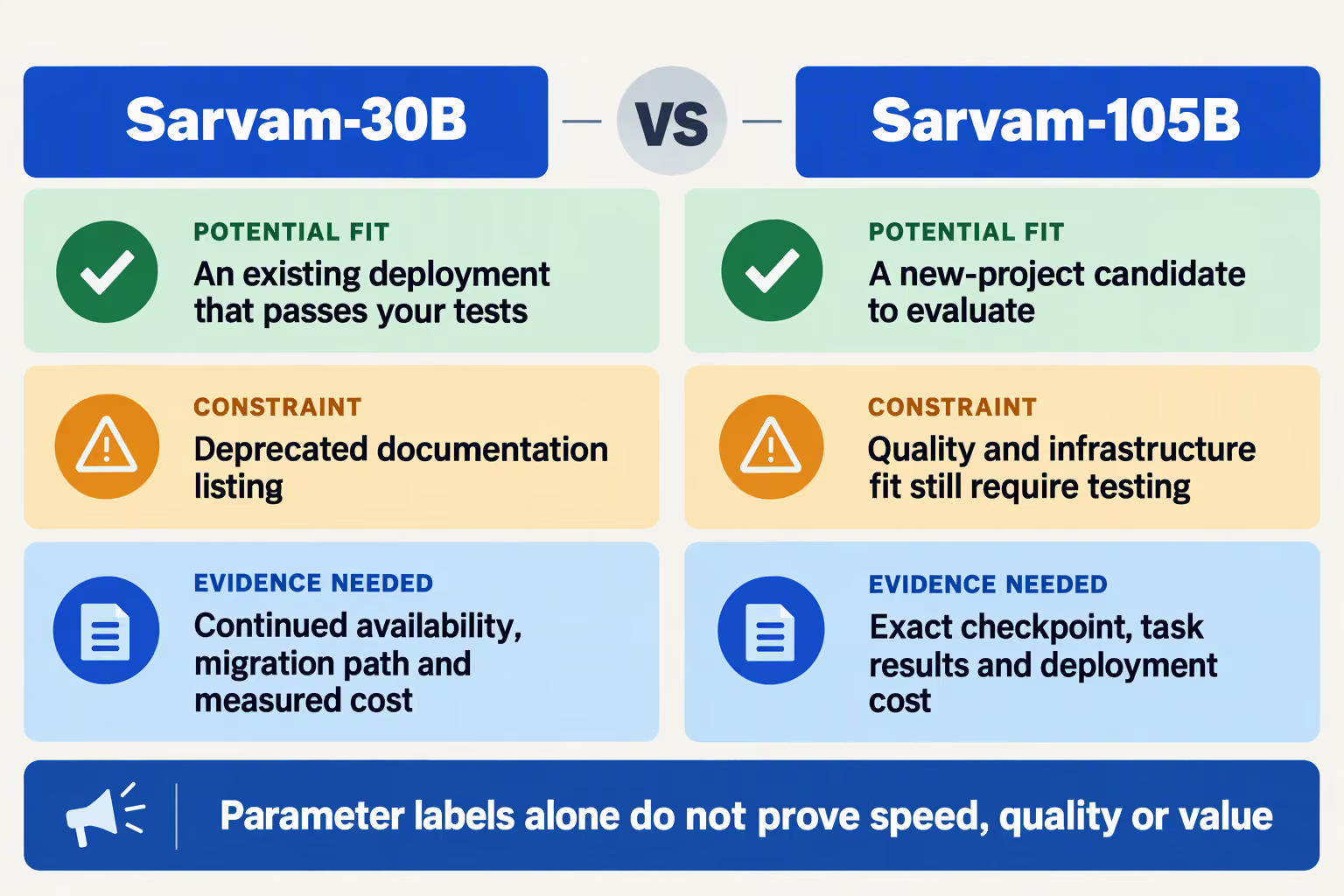
Sarvam-105B is the stronger evaluation candidate for a new integration; Sarvam-30B is a conditional retention option for existing users. Neither model has a demonstrated quality, latency or cost advantage in the supplied November 25, 2026 evidence, which contains source titles rather than benchmark results.
- Sarvam-105B: Its advantage is a model-specific listing in Sarvam’s official documentation; its drawback is that the supplied material does not establish checkpoint-level performance, serving limits or migration compatibility.
- Sarvam-30B: Its potential advantage is avoiding changes to an existing, working integration; its drawback is Sarvam’s explicit “Deprecated” documentation label, with continued-access conditions absent from the supplied evidence.
- New buyers: Small SaaS teams and enterprise procurement teams should require confirmation of the deployable model ID, support conditions and account limits before treating either option as production-ready.
- Existing users: Retention is defensible only when access remains supported and measured task results justify it; avoiding migration is an operational benefit, not evidence that Sarvam-30B answers better.
- Price-sensitive teams: Do not infer a cheaper service from the “30B” name; the supplied Sarvam pricing-page result contains no rates supporting a numerical cost comparison.
- Indian-language applications: Require matched tests in your actual languages and code-mixed inputs; the supplied model-page titles establish no language-by-language accuracy advantage for either model.
What advantages and evidence gaps should buyers compare?
Evidence snapshot: November 25, 2026. The table distinguishes documented signals from buyer hypotheses; “not established” means the supplied research cannot substantiate the claim, not that the capability is absent.
| Decision factor | Sarvam-30B | Sarvam-105B | Evidence or next check |
|---|---|---|---|
| Lifecycle | Explicitly labelled deprecated | Has a model-specific documentation listing | Sarvam’s official model-page titles; verify access and support terms |
| Existing deployment | Staying may avoid integration changes | Switching requires regression testing | Operational trade-off, not a published vendor benchmark |
| Answer quality | Comparative accuracy not established | Comparative accuracy not established | Request same-task results with exact checkpoints and prompts |
| Response speed | No supplied latency measurements | No supplied latency measurements | Measure median and tail latency under equal concurrency |
| API economics | Rates absent from supplied context | Rates absent from supplied context | Consult Sarvam’s Pricing, Credits & Rate Limits page; compare input and output charges |
| Deployment rights | Licence and hardware requirements not supplied | Licence and hardware requirements not supplied | Verify checkpoint-specific terms before planning self-hosting |
What evidence would change the recommendation?
- Checkpoint evidence: CNBC TV18’s supplied headline reports a Sarvam-105B upgrade, but provides no underlying measurements; similarly, Sarvam’s November 22, 2026 changelog URL does not reveal its contents. Neither supports claiming that Sarvam-105B-1711 fixes a particular failure or improves accuracy by a stated percentage.
- Buyer-run evidence: Build one matched evaluation set covering routine requests, difficult reasoning, retrieval errors and unsafe actions; record successful-task rate, human corrections, latency and billed usage. Treat this as a proposed evaluation method—not a published benchmark—and choose the supported model with the better cost per acceptable outcome, rather than the larger-sounding name.
How can you benchmark both models and migrate without confusing checkpoint changes with improvements?
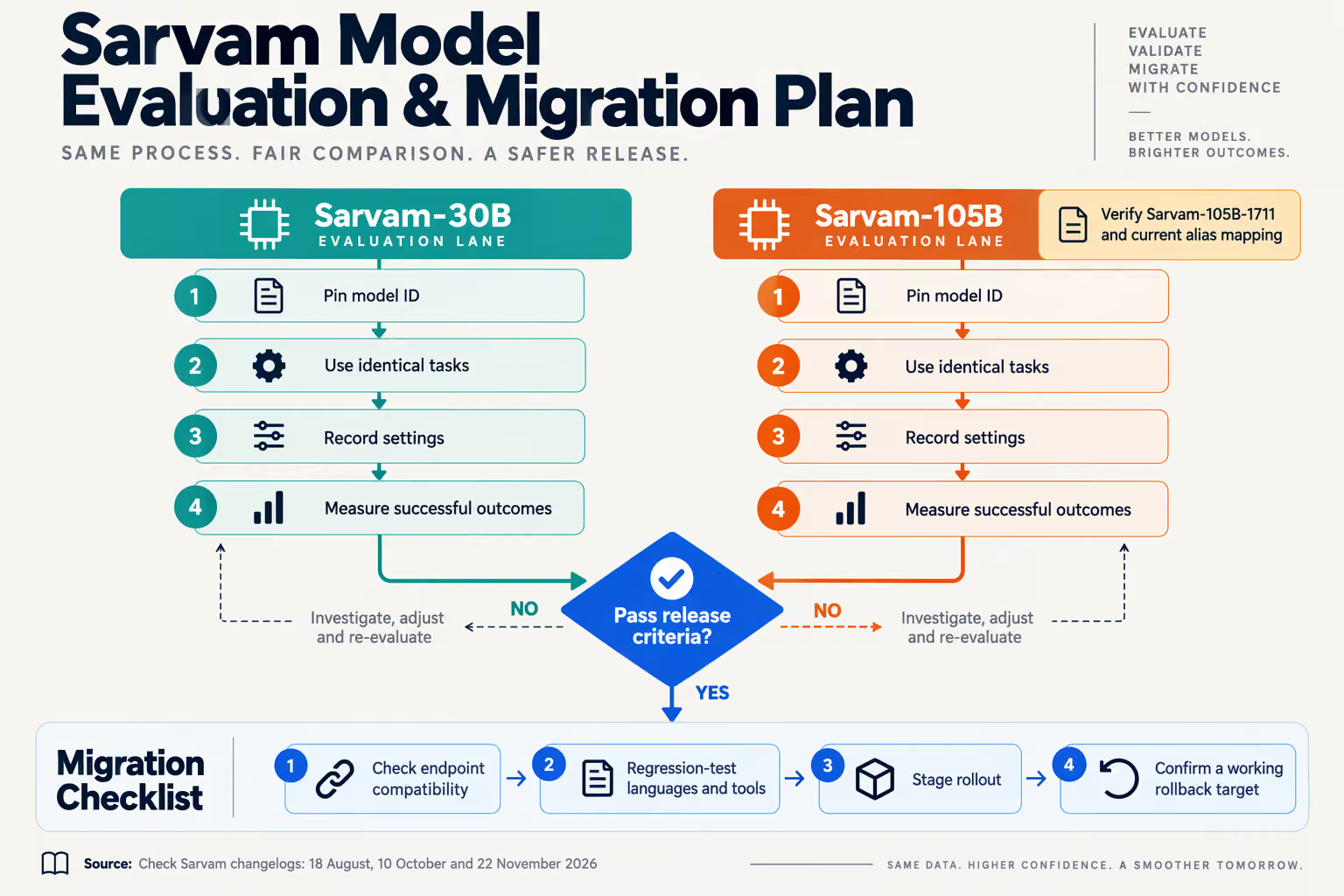
Benchmark Sarvam-30B vs Sarvam-105B on identical tasks, and record the exact checkpoint—not just the model name. Change the model first; change prompts, retrieval and routing only in separate experiments.
How do you make the comparison reproducible?
- Freeze the deployment identity: Record provider, endpoint, requested model ID, returned version metadata and test date. As of November 25, 2026, the supplied Sarvam documentation identifies Sarvam-30B as deprecated; an old saved result is not a reproducible baseline unless you can still access the same deployment.
- Build a fixed evaluation set: A practical starting protocol—not a published Sarvam benchmark—is 100 anonymized production tasks: 40 routine questions, 30 retrieval-grounded answers, 20 structured-output tasks and 10 escalation cases. Adjust that distribution to your application before testing, then keep the same examples for both models.
- Separate language results: Score each production language and code-mixed category independently rather than reporting one average. For a Hindi–English support assistant, distinguish Hindi, English and Hinglish prompts; have reviewers fluent in each category assess factual correctness, instruction following and whether the answer preserves the customer’s intended meaning.
- Hold settings constant: Reuse the same system prompt, retrieved passages, tool schemas, conversation history, temperature and output-token ceiling wherever both endpoints support them. Run each task three times as a suggested repeatability check; record unsupported settings explicitly instead of silently substituting defaults that could explain a performance difference.
How do you migrate without overstating improvements?
- Treat checkpoint updates as separate experiments: Compare your existing 30B deployment against the exact available 105B checkpoint, then compare 105B checkpoints separately if accessible. Sarvam’s supplied changelog includes a November 22, 2026 entry, but its contents are unavailable here; that date alone establishes neither a checkpoint change nor an improvement.
- Measure successful-task economics: Log correctness, schema validity, tool-call success, input/output tokens and end-to-end latency for every request. Calculate total test cost ÷ accepted tasks, including retries. Before pricing November 2026 results, obtain the applicable rates from Sarvam’s Pricing, Credits & Rate Limits documentation; the supplied context contains no numeric rates to substantiate a cost comparison.
- Keep infrastructure changes out of the model test: If changing gateways, test that migration independently before comparing models. As of November 2026, CallMissed’s verified fact sheet lists OpenAI-compatible endpoints, usage and request logs, and caller-chosen fallback models. Those capabilities can support evaluation workflows, but the catalogue’s Sarvam listing does not verify either specific checkpoint’s availability.
- Release against explicit acceptance gates: For a small SaaS support team, a suggested sequence is offline evaluation, read-only shadow traffic, then a 5% pilot with human review. Set quality, latency and cost thresholds beforehand, log fallback invocations separately, and retain a supported rollback target; otherwise, fallback answers can make the candidate model appear more reliable than it actually is.
Which should you choose, and when should you evaluate Qwen or Llama instead?
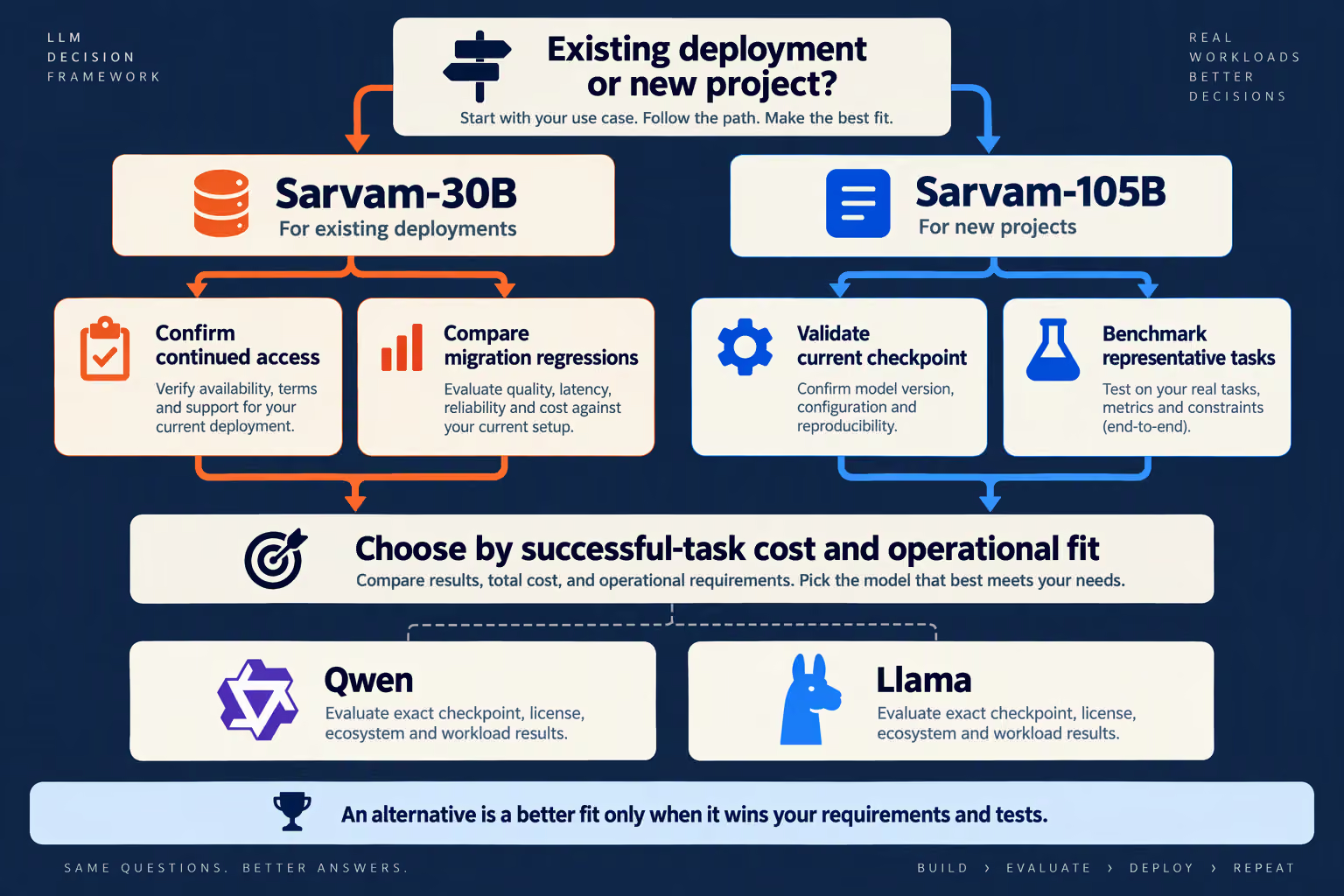
For Sarvam 30B vs Sarvam 105B, shortlist Sarvam-105B for a new Indian-language application; retain Sarvam-30B only where continued access and workload results justify it. Evaluate Qwen or Llama when deployment control, licensing, or your own task-level results—not parameter count—could change that choice.
When should you choose Sarvam-105B or retain Sarvam-30B?
- Sarvam-105B: Technical founders and engineering teams building Indian-language support or document assistants should evaluate the exact available checkpoint. As of November 25, 2026, Sarvam’s documentation lists Sarvam-105B, but the supplied research contains no verified comparative accuracy, latency, or context-window figures; its name alone cannot establish a quality advantage.
- Sarvam-30B: Existing users should make retention conditional on confirmed access, support arrangements, and acceptable application results. Sarvam’s documentation labels Sarvam-30B “Deprecated” in the research available as of November 25, 2026; that establishes lifecycle risk, not a shutdown date, migration deadline, or evidence that every existing deployment must immediately stop.
- Indian-language buyers: Use a proposed 100-prompt evaluation, divided across your actual languages, code-mixed requests, retrieval questions, and tool calls. Score factual correctness and task completion separately; a fluent Hinglish answer that invents a refund policy should fail. This is a recommended test design, not a published Sarvam benchmark.
- Cost-sensitive teams: Compare cost per successfully completed task, including retries, retrieval, and human correction—not token price alone. Sarvam’s Pricing, Credits & Rate Limits is the vendor source to consult as of November 25, 2026, but the supplied context contains no price amounts that support a numerical savings claim.
When should you evaluate Qwen or Llama instead?
- Qwen: Add a specific Qwen checkpoint when multilingual coverage or deployment requirements extend beyond your Sarvam shortlist. Require it to pass the same 100 prompts, output schema, and tool-use checks. The supplied research provides no Qwen benchmark or language-support figures, so “better multilingual performance” remains a hypothesis to test.
- Llama: Add a specific Llama checkpoint when your procurement process requires evaluating downloadable model weights or infrastructure you control. Verify that checkpoint’s license, permitted use, hosting requirements, and operational cost before selecting it; the supplied context does not establish those details or demonstrate that Llama is cheaper than Sarvam.
- Integration-focused developers: As of November 2026, CallMissed’s verified fact sheet lists 158 models, including 44 general-purpose LLMs, with OpenAI-compatible endpoints and caller-chosen fallback models. Sarvam is a listed catalogue maker, but confirm exact Sarvam, Qwen, or Llama checkpoint availability before planning a shared-gateway comparison; catalogue breadth does not guarantee those selections.
- Phone and WhatsApp buyers: None of these model names answers the complete infrastructure question. Separately verify carrier connectivity, phone-number requirements, messaging permissions, human handoff, and CRM integration, then measure end-to-end completion. A model that wins text evaluation can still be the wrong purchase if the surrounding communication workflow cannot meet your requirements.
Frequently Asked Questions
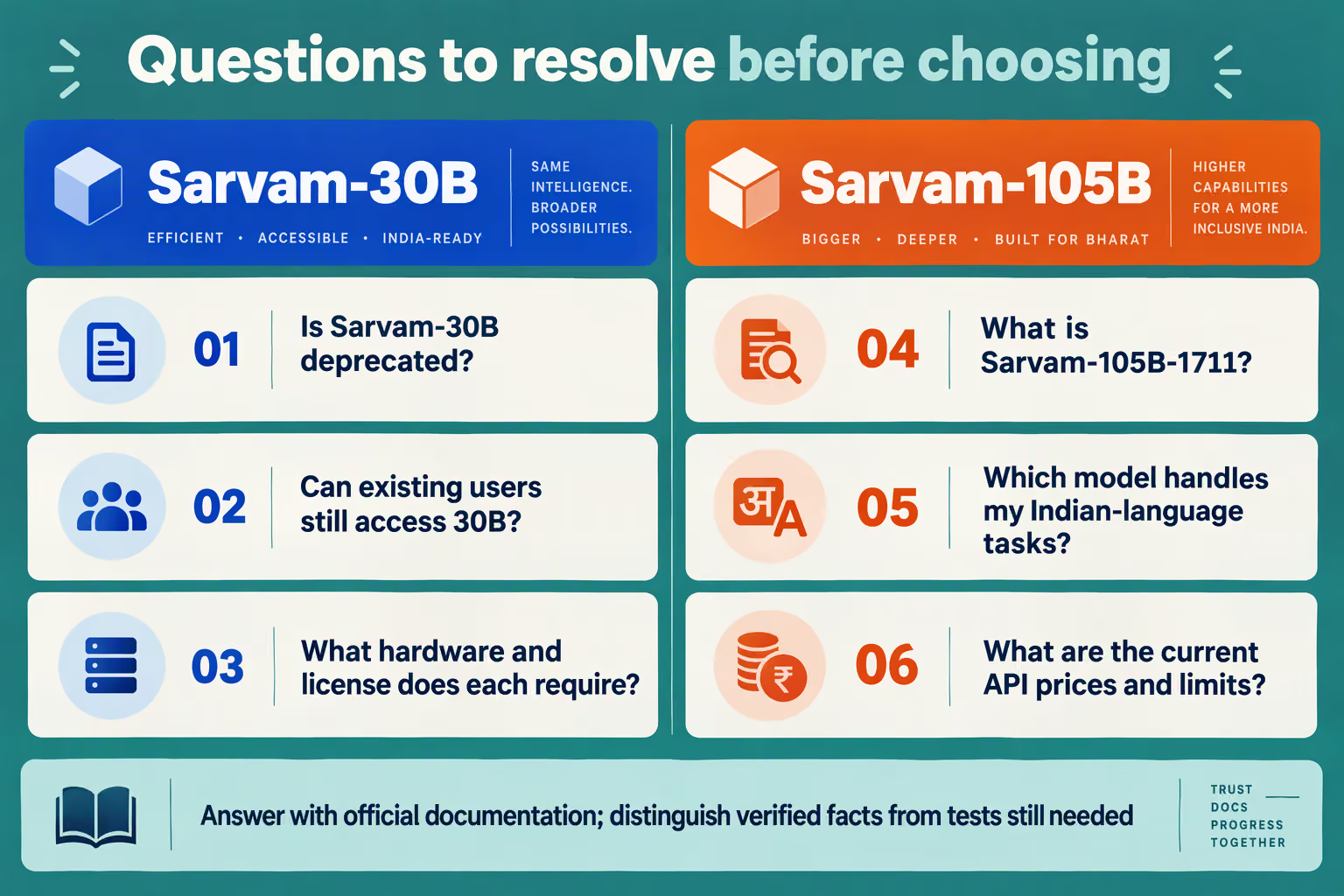
For new integrations, evaluate Sarvam-105B first; retain Sarvam-30B only after checking continued support and your application’s results. This November 25, 2026 recommendation reflects Sarvam’s documented deprecation label, not a verified head-to-head performance advantage.
- Q: Sarvam 30B vs 105B: which should I use for a new production application?
A: Start by evaluating Sarvam-105B, because Sarvam’s official documentation lists “Sarvam-30B (Deprecated)” in the research supplied for November 25, 2026. For developers and procurement teams building Indian-language support applications, lifecycle status is a practical screening criterion, but it does not prove higher accuracy or lower cost. Before committing, verify endpoint access, deployment terms, and performance on representative customer queries.
- Q: Is Sarvam-30B deprecated, and do existing users need to migrate immediately?
A: Yes: the supplied Sarvam documentation title explicitly marks Sarvam-30B as deprecated as of this November 2026 comparison. However, the available evidence does not establish a shutdown date, an immediate migration requirement, or whether existing accounts retain access. Existing users should confirm those conditions with Sarvam and test a replacement before changing production traffic, rather than treating “deprecated” as synonymous with “already unavailable.”
- Q: What is Sarvam-105B-1711, and should I select it instead of Sarvam-105B?
A: Sarvam-105B-1711 is a checkpoint identifier flagged in the supplied research brief, but the provided source excerpts do not establish its changes or API availability as of November 25, 2026. CNBC TV18’s supplied headline reports an upgrade to Sarvam’s 105B model, without supplying checkpoint-specific results. Confirm the exact model identifier, release notes, and compatibility before assuming the checkpoint is interchangeable with the general Sarvam-105B offering.
- Q: Sarvam 30B vs 105B: which should I use for Hindi, Hinglish, and regional-language workloads?
A: Choose using a matched evaluation of your target languages, not the model names: the supplied November 2026 evidence contains no verified language-by-language scores for either model. Test native-script queries, Romanized Hindi, code-switching, local terminology, and answers grounded in your business documents. Measure factual correctness, unsupported claims, and escalation decisions separately, because fluent wording alone does not establish reliable customer-support performance.
- Q: How do Sarvam-30B and Sarvam-105B prices, licenses, and hardware requirements compare?
A: The supplied research identifies Sarvam’s Pricing, Credits & Rate Limits page but provides no rates, so this November 25, 2026 FAQ cannot quote verified prices or calculate savings. Licensing conditions, context limits, and hardware requirements are also absent from the supplied excerpts. Request the applicable terms and compare cost per successfully completed task, including retries and human review—not an estimated price derived from the model names.
- Q: Can I use Sarvam models through CallMissed for Indian-language voice support?
A: As of November 2026, CallMissed’s verified fact sheet lists Sarvam among its developer API catalogue makers, but does not confirm availability of Sarvam-30B or Sarvam-105B-1711. The same fact sheet specifies speech recognition in 22 Indian languages plus English, including Hinglish, and natural text-to-speech in 10 Indian languages plus English. These are separate speech capabilities, not evidence that either Sarvam text model supports every language equally.
Conclusion
For Sarvam 30B vs Sarvam 105B, new production buyers should evaluate Sarvam-105B first: Sarvam’s official documentation lists Sarvam-30B as deprecated as of November 25, 2026. Existing Sarvam-30B users should consider staying only if continued access and support are confirmed and their measured results justify it—not because a smaller model automatically means better economics.
For developers, technical founders, and procurement teams building Indian-language SaaS or customer-support applications, the defensible choice rests on four takeaways:
- Check availability before comparing performance. Sarvam’s November 2026 documentation labels Sarvam-30B deprecated, but the supplied evidence does not establish a shutdown date, migration deadline, or continued-access conditions. Confirm which model and checkpoint your deployment can actually use before committing engineering time.
- Choose on workload results, not parameter counts. Short Hinglish support questions and complex document analysis require different evaluations. Compare both available options using the same prompts, languages, and failure cases; neither model’s name establishes its accuracy, response speed, or suitability for your application.
- Verify economics against official pricing. Consult Sarvam’s Pricing, Credits & Rate Limits documentation for the rates applicable when you purchase. Evaluate your actual input/output mix and cost per successful task rather than assuming Sarvam-30B is cheaper overall or Sarvam-105B necessarily delivers better value.
- Treat migration and checkpoint identity as purchase constraints. Confirm the exact version, integration changes, and deployment requirements before switching. Claims about Sarvam-105B-1711 need the underlying announcement; a search-result title alone is not enough to establish improvements or recommend a migration.
What should buyers watch next?
Watch for explicit lifecycle guidance, checkpoint announcements, and updated pricing from Sarvam. The supplied research includes a November 22, 2026 Sarvam changelog entry, but its title alone does not establish what changed. Future recommendations should follow verified release details and repeatable workload evaluations, rather than treating every announcement as proof that an upgrade is worthwhile.
For existing users, that means keeping a migration decision separate from an upgrade expectation. If Sarvam-30B remains supported and meets your requirements, retention may be defensible; if access or support cannot be confirmed, satisfactory past performance does not resolve the deployment risk.
Shared model infrastructure is also worth exploring. CallMissed’s November 2026 fact sheet lists Sarvam among its developer API catalogue makers and confirms OpenAI-compatible endpoints, making CallMissed relevant for teams exploring shared API access. That catalogue listing does not establish availability of either specific Sarvam checkpoint.
The next step is practical: verify access, confirm the checkpoint, and run a same-task evaluation before buying or migrating. Which available model delivers acceptable results at a defensible cost on your actual workload?
Related Reading
- Claude Haiku 5.5 vs Sonnet 5.5: Which Should You Use?
- Fable 5.2 vs Opus 5.5: Which Claude Should Developers Use?
- Goodcall pricing vs CallMissed: Which Fits You? (2026)