Kimi K3.1 Pro Highspeed vs Pro: Customer Support Guide


Evaluate Kimi K3.1 Pro Highspeed against Pro for support accuracy, response times and cost per resolved ticket, with a practical routing checklist.
Kimi K3.1 Pro Highspeed vs Pro: Customer Support Guide
What if your customer-support AI could respond two to three times faster without changing its underlying capabilities? As of October 2026, Unite.AI reports that Moonshot AI describes Kimi K3.1 Pro Highspeed as delivering that speed increase over Kimi K3.1 Pro with identical model capabilities—a compelling proposition for teams balancing response times, answer quality, and operating costs.
The timing matters because customer-support workflows increasingly ask language models to do more than generate a polite reply. A single interaction might require retrieving a refund policy, interpreting an order history, calling a business tool, and deciding whether a human should take over. Faster generation could shorten parts of that journey, but it does not automatically make the whole workflow faster—or the final answer more trustworthy.
As of October 2026, WorldAttention reports that Kimi K3.1 Pro ranks fourth on the Artificial Analysis Intelligence Index with a score of 55. That result makes Moonshot AI’s model worth evaluating, but a broad intelligence ranking is not a customer-support service-level guarantee. Your customers experience successful resolutions, accurate explanations, and waiting time—not benchmark positions.
Does Kimi K3.1 Pro Highspeed mean faster customer support?
Potentially, but the useful comparison is end-to-end resolution time, not generation speed alone. A support assistant that produces text quickly can still leave customers waiting while a knowledge search runs or an order-management tool responds.
Consider a delivery-status question: the assistant must identify the customer’s order, retrieve tracking information, explain the result, and offer an appropriate next step. Highspeed’s reported advantage matters most when model processing accounts for a substantial share of that sequence. If external tools dominate the delay, upgrading the model tier may deliver a smaller practical improvement.
This guide will help you evaluate:
- Responsiveness: time to the first useful response and time to a completed answer.
- Resolution quality: grounded policy explanations, correct tool use, and appropriate escalation.
- Cost efficiency: spending per successfully resolved interaction, including retries.
- Workflow fit: differences between live conversations, ticket drafting, and more complex support investigations.
How should support teams compare Pro and Highspeed?
Start with the same representative support cases, knowledge sources, and tool permissions for both variants. Then measure whether the faster option changes outcomes customers actually notice, rather than assuming the advertised speed multiplier applies equally to every task.
As of October 2026, CallMissed offers an OpenAI-compatible developer API with caller-chosen fallback models and usage and request logs, illustrating the broader shift toward flexible, observable AI integrations.
The central question is not simply which variant is faster. It is where faster inference earns its cost—and where standard Pro already meets your support requirements. This comparison separates reported model capabilities from operational assumptions so you can design a practical evaluation before committing production traffic.
At a glance: Which Kimi model should you choose for customer support?
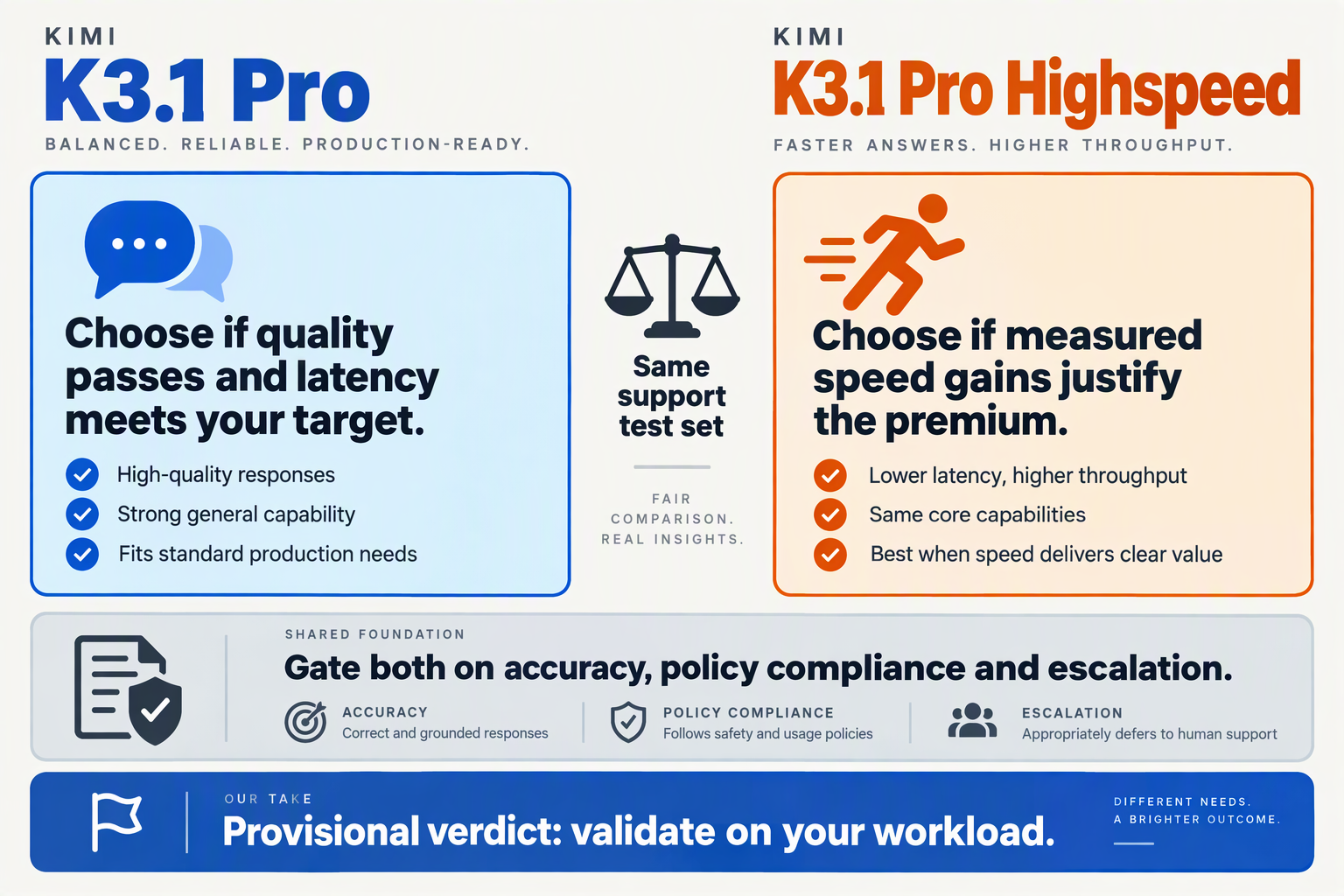
Choose Kimi K3.1 Pro for support work where waiting is acceptable; consider K3.1 Pro Highspeed for live conversations when measured time savings justify the provider’s price premium.
Which Kimi variant fits your support workflow?
- Kimi K3.1 Pro — asynchronous tickets: Start with Pro for email replies, complaint summaries, and overnight ticket preparation, where faster generation may not change the customer’s experience. As of October 2026, WorldAttention reports Pro’s launch pricing as “$2/$10”; confirm billing units, cached-input charges, and your provider’s actual rates before estimating a monthly support budget.
- Kimi K3.1 Pro Highspeed — live assistance: Prioritize a Highspeed trial for customer-facing chat or agent-assist suggestions that must arrive while a conversation is active. As of October 2026, AIHubMix frames its comparison around twice the price on AIHubMix. Treat that as provider-specific pricing, not a universal Moonshot AI tariff or a guaranteed return on investment.
- Both variants — capability versus delivery: Buy Highspeed for a potential responsiveness improvement, not an assumed intelligence upgrade. As of October 2026, Unite.AI quotes Moonshot AI describing the variants as having “identical model capabilities.” For refund approvals or account changes, keep the same authorization rules and human-review thresholds whichever delivery tier you select.
- Kimi K3.1 Pro — lengthy case histories: As of October 2026, Moonshot AI’s technical blog describes a 1-million-token context window, making Pro worth testing for escalations involving extensive correspondence and documentation. Context capacity is a ceiling, not a recommendation to upload everything: retrieve relevant policies first, remove unnecessary personal data, and test whether older evidence influences answers correctly.
- Kimi K3.1 Pro — agentic investigations: As of October 2026, Artificial Analysis reports 1,846 Elo and third place on GDPval-AA, a 312-Elo improvement over Kimi K3. That supports evaluating multi-step workflows, but does not establish refund accuracy. Test a concrete sequence: locate an order, check eligibility, propose an action, and request approval before execution.
- Open-weight deployment — infrastructure planning: As of October 2026, Moonshot AI describes Kimi K3.1 Pro as a mixture-of-experts model with 2.8 trillion total parameters and 104 billion active parameters. Those figures make infrastructure assessment essential before self-hosting; active parameters alone do not establish memory requirements, operating cost, or achievable customer-support latency.
- Highspeed economics — resolved-case accounting: Compare total spending divided by successfully resolved cases, rather than token price alone. Include retrieval, tool calls, retries, and human review in both runs. A faster answer that requires correction can cost more overall; conversely, quicker suggestions may be valuable when they reduce paid agent handling time.
- CallMissed — integration flexibility: As of October 2026, CallMissed’s developer API supports OpenAI-compatible endpoints, structured outputs, and function calling, useful building blocks for support integrations. These capabilities do not establish availability of either K3.1 variant in its catalogue; verify exact model identifiers and provider support before designing the comparison around any gateway.
What differs between Pro and Highspeed? Feature comparison
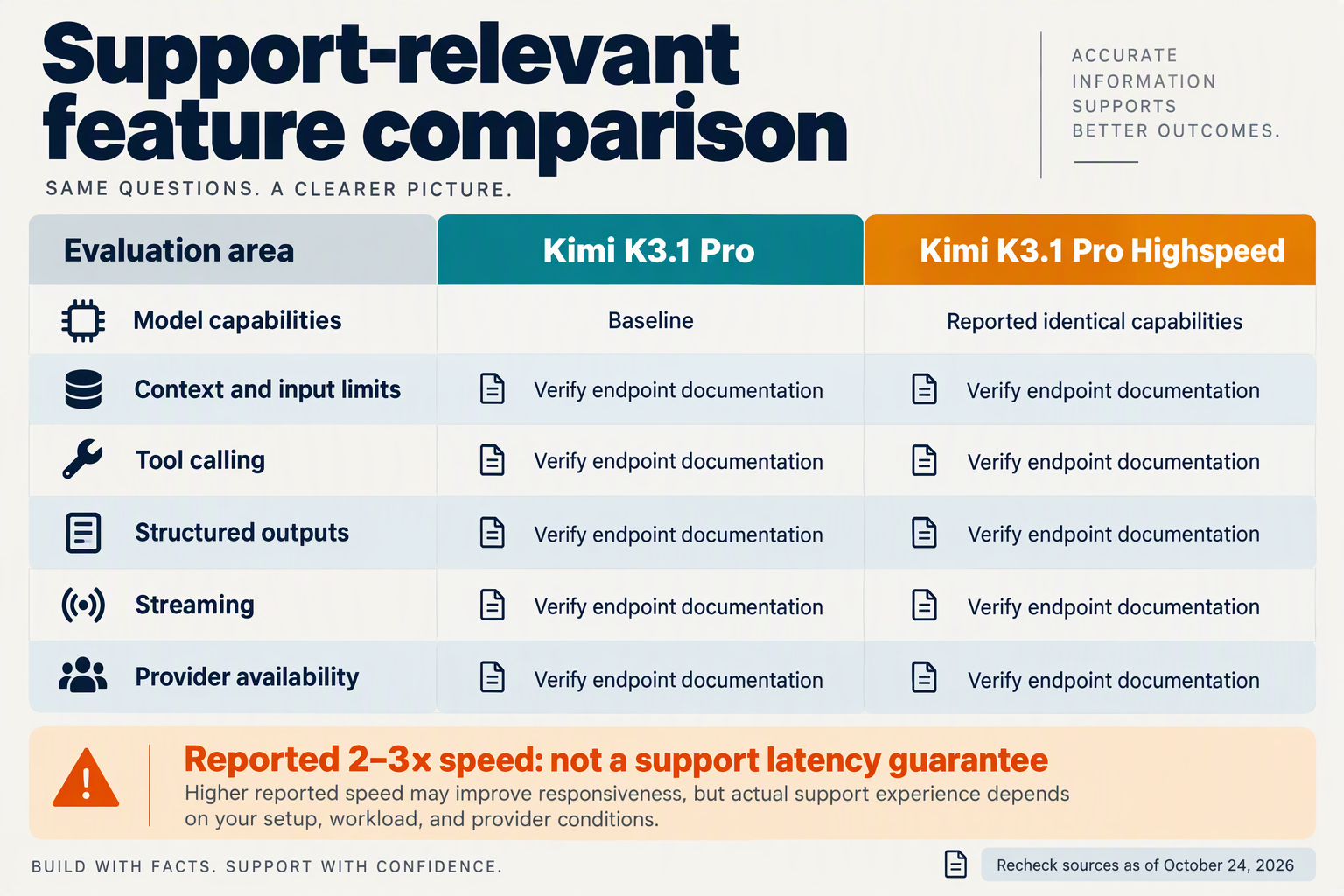
Kimi K3.1 Pro Highspeed is positioned as a faster variant, not a more capable model. The practical comparison is therefore speed, provider pricing, and deployment limits—not two different levels of intelligence.
What specifications differ between Kimi K3.1 Pro and Highspeed?
| Comparison, as of October 2026 | Kimi K3.1 Pro | K3.1 Pro Highspeed | Support-workflow implication |
|---|---|---|---|
| Processing speed | Baseline variant | Approximately 2–3× faster, according to Unite.AI | Test interactive replies separately from tool-heavy investigations |
| Model capabilities | Full Pro capabilities | “Identical model capabilities,” according to Moonshot AI via Unite.AI | Do not assume better reasoning or fewer errors |
| Context window | 1 million tokens, advertised by Kimi.ai | Shared-capability positioning; supplied sources do not separately specify endpoint limits | Confirm the selected provider’s accepted input size |
| Input capabilities | Multimodal, according to Kimi.ai and OpenRouter | Covered by the identical-capabilities claim | Verify supported media formats before testing attachments |
| Published pricing | $2 input / $10 output per million tokens, reported by WorldAttention | AIHubMix’s comparison describes a 2× price relationship | Compare rates within the same provider, not across unrelated listings |
| Consumer availability | Kimi.ai and Kimi mobile apps | Kimi.ai and Kimi mobile apps, according to Unite.AI | App availability does not establish API quotas or guarantees |
Which differences matter when choosing a support model?
- Architecture: As of October 2026, Kimi.ai advertises Kimi K3.1 Pro with 2.8 trillion total parameters and 104 billion active parameters, using a mixture-of-experts architecture. Those figures describe the model, not a separate Highspeed intelligence tier; they also do not establish infrastructure requirements for your chosen hosted endpoint.
- Pricing: As of October 2026, WorldAttention reports Pro pricing of $2/$10 per million input/output tokens, while AIHubMix frames its Pro–Highspeed comparison around twice the price. These are different sources: obtain both variants’ current rates from one provider before calculating a budget or asserting an exact Highspeed dollar price.
- Context: As of October 2026, Kimi.ai advertises a 1-million-token context window for K3.1 Pro. That ceiling may accommodate lengthy case histories, but it is not a recommendation to send every historical ticket; select relevant policy passages and customer records to control input spending and unnecessary exposure.
- Capabilities: As of October 2026, Unite.AI attributes the phrase “identical model capabilities” to Moonshot AI’s announcement. Treat that as the vendor’s positioning rather than proof of identical production outcomes: compare policy accuracy, tool arguments, and escalation decisions on the same cases before routing live traffic.
- Procurement: The supplied October 2026 sources do not establish separate rate limits, regional hosting options, support-language coverage, or latency guarantees for these variants. Record those items as unanswered procurement questions rather than filling gaps with assumptions based on the Highspeed name or the shared-capabilities claim.
- Integration: As of October 2026, CallMissed’s developer AI API offers OpenAI-compatible endpoints, caller-chosen fallback models, and usage and request logs; its catalogue includes Moonshot models. Those capabilities support observable, multi-model integrations, but the verified product facts do not establish availability of either specific K3.1 variant.
How should you test accuracy, escalation and p95 latency?
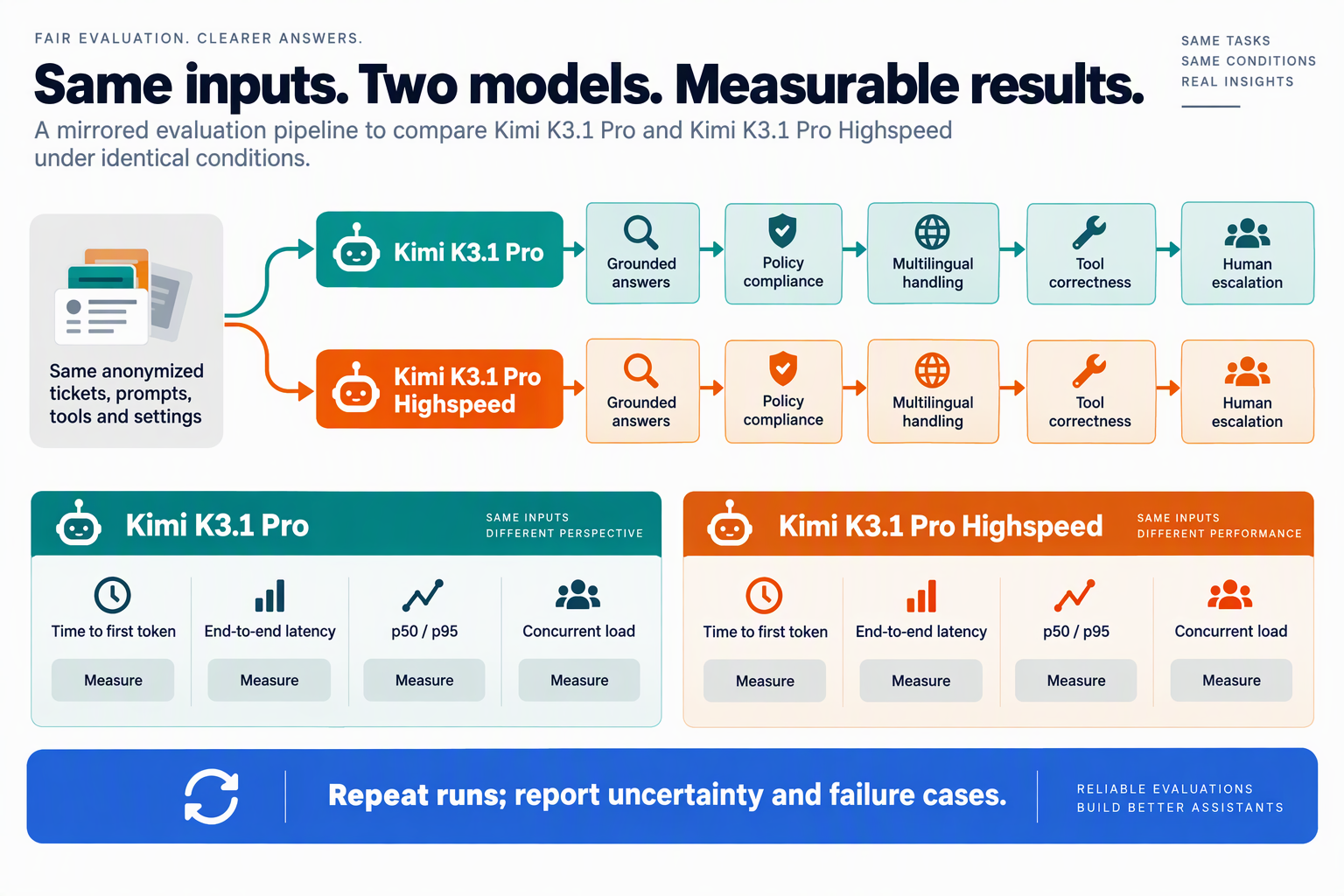
Test both variants against verified support outcomes, not just fluent answers. Set accuracy, escalation, and p95 latency gates before running the comparison; the thresholds below are illustrative acceptance criteria, not published Kimi results.
How should you measure support accuracy and escalation?
- Test set: Build 300 anonymized cases: 100 policy questions, 100 tool-dependent requests, and 100 escalation scenarios. Include missing order IDs, contradictory documents, expired refund windows, and prompt-injection attempts. Keep a separate holdout set, and give both variants identical knowledge snapshots, tool permissions, and output limits.
- Grounded accuracy: Score each answer against an approved policy excerpt and expected action, with reviewers blinded to the model variant. An illustrative gate is ≥95% fully correct answers and zero unauthorized refunds. Track unsupported claims separately: a correct conclusion with an invented policy explanation should still fail grounding.
- Hallucination evidence: As of October 2026, AI/TLDR reports an 8.3% claim-level hallucination rate for Kimi K3.1 Pro on Kimi Hallu Bench Hard with tools, versus 23.4% for Kimi K3. Treat this as benchmark context—not a forecast of your support error rate, because customer policies and retrieval conditions differ.
- Escalation quality: Label cases requiring human review before testing. Measure recall—required handoffs actually triggered—and precision—triggered handoffs that were warranted. For an illustrative ≥98% recall gate, include account takeover, disputed payments, and ambiguous refund exceptions; separately inspect whether the handoff preserves the customer’s issue and relevant evidence.
How should you measure p95 latency fairly?
- Latency definitions: Record request arrival, first useful response, final answer, and completed tool action. p95 is the latency at or below which 95% of observations fall; calculate it separately for each workflow. A quick acknowledgment should not count as a useful answer when the customer still needs an order lookup.
- Load conditions: Run each case three times at illustrative concurrency levels of 1, 10, and 50 sessions, randomizing variant order. Separate warm-cache and cold-cache results, and include long conversations. Report timeouts and failures alongside p95 so dropped requests cannot make the faster variant appear artificially reliable.
- Instrumentation: As of October 2026, CallMissed provides eval suites, A/B experiments, and call scoring against customer-defined QA rubrics. These capabilities are relevant to structured support evaluation; do not assume they establish a Kimi-specific latency guarantee. Capture retrieval, model, and tool timings separately in your test harness.
- Decision rule: Select Highspeed only if it passes the same accuracy and escalation gates while improving measured workflow latency. Predeclare an illustrative target such as ≥20% lower p95, then compare cost per correctly resolved case, including retries and human intervention. Reject speed gains that conceal worse outcomes in high-risk categories.
What does each model cost per resolved ticket? Pricing and value
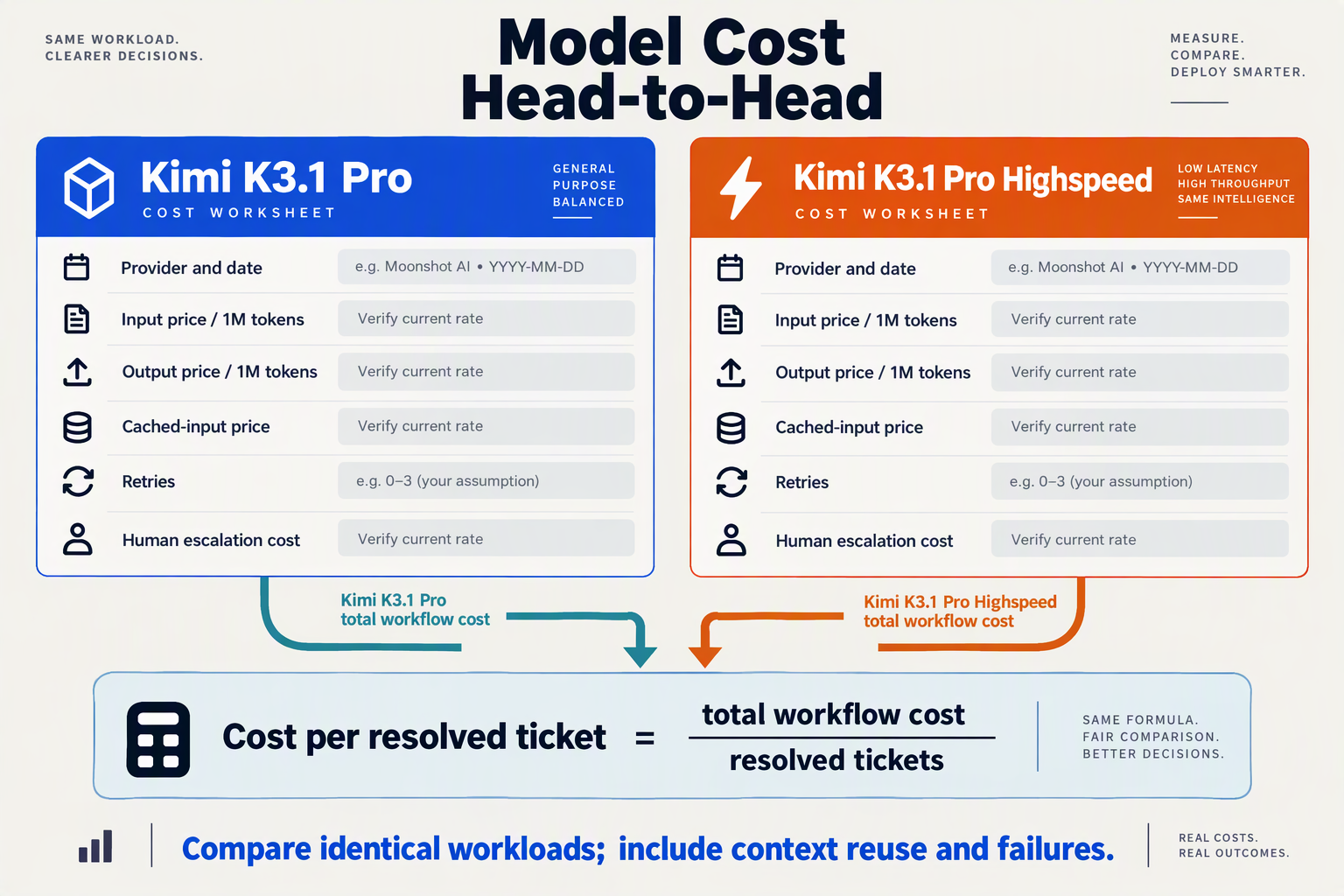
Kimi K3.1 Pro’s cost per resolved ticket depends on token consumption and successful resolution—not just its advertised API price. Highspeed’s value depends on whether its higher price reduces retries, handling time, or other operational costs.
What pricing should you use for the comparison?
- Kimi K3.1 Pro: As of October 2026, WorldAttention reports $2/$10 pricing; the worked estimates below use $2 per million input tokens and $10 per million output tokens. Confirm the billing units and applicable provider rates before budgeting, especially for cached inputs or separately billed reasoning tokens.
- Kimi K3.1 Pro Highspeed: As of October 2026, AIHubMix describes Highspeed as costing twice as much on its platform. The table therefore models a 2× price scenario, not a verified universal Highspeed tariff; do not assume different providers offer identical pricing or billing terms.
How much could each model cost per resolved ticket?
These illustrative October 2026 estimates assume an 80% successful-resolution rate, identical token usage between variants, and no additional tool, retrieval, or human-support charges.
| Model / scenario | Input / output tokens | Model cost / attempt | Cost / resolution |
|---|---|---|---|
| Pro: simple lookup | 4,000 / 1,000 | $0.018 | $0.0225 |
| Highspeed: simple lookup* | 4,000 / 1,000 | $0.036 | $0.045 |
| Pro: multi-step support | 8,000 / 2,000 | $0.036 | $0.045 |
| Highspeed: multi-step support* | 8,000 / 2,000 | $0.072 | $0.090 |
| Pro: complex investigation | 20,000 / 4,000 | $0.080 | $0.100 |
| Highspeed: complex investigation* | 20,000 / 4,000 | $0.160 | $0.200 |
Highspeed rows apply AIHubMix’s reported 2× price relationship to the reference Pro rates for illustration.
- Calculation: Model cost per resolution equals model spend across all attempts ÷ successfully resolved tickets. For the multi-step Pro example, 8,000 input tokens cost $0.016 and 2,000 output tokens cost $0.020; dividing the $0.036 total by 0.80 produces $0.045 per resolution.
- Volume impact: At an illustrative 10,000 successfully resolved multi-step tickets, those assumptions produce $450 for Pro versus $900 for Highspeed in model spend. This is a budgeting scenario, not a measured customer-support benchmark, and it excludes subsequent reopened tickets unless your resolution definition explicitly includes them.
When does paying more for Highspeed make sense?
- Break-even test: In the multi-step scenario, Highspeed adds $0.045 per resolution. At an assumed loaded support-labor cost of $20/hour, saving roughly 8.1 seconds of paid human work per resolution offsets that premium; faster model output alone does not establish that labor saving.
- Measurement plan: Count every model call, fallback, retry, retrieval charge, and human escalation against the same ticket cohort. As of October 2026, CallMissed’s OpenAI-compatible developer API offers usage and request logs and caller-chosen fallback models, capabilities relevant to instrumenting such evaluations; the supplied facts do not establish availability or pricing for these specific Kimi variants.
What are the support-workflow pros and cons?
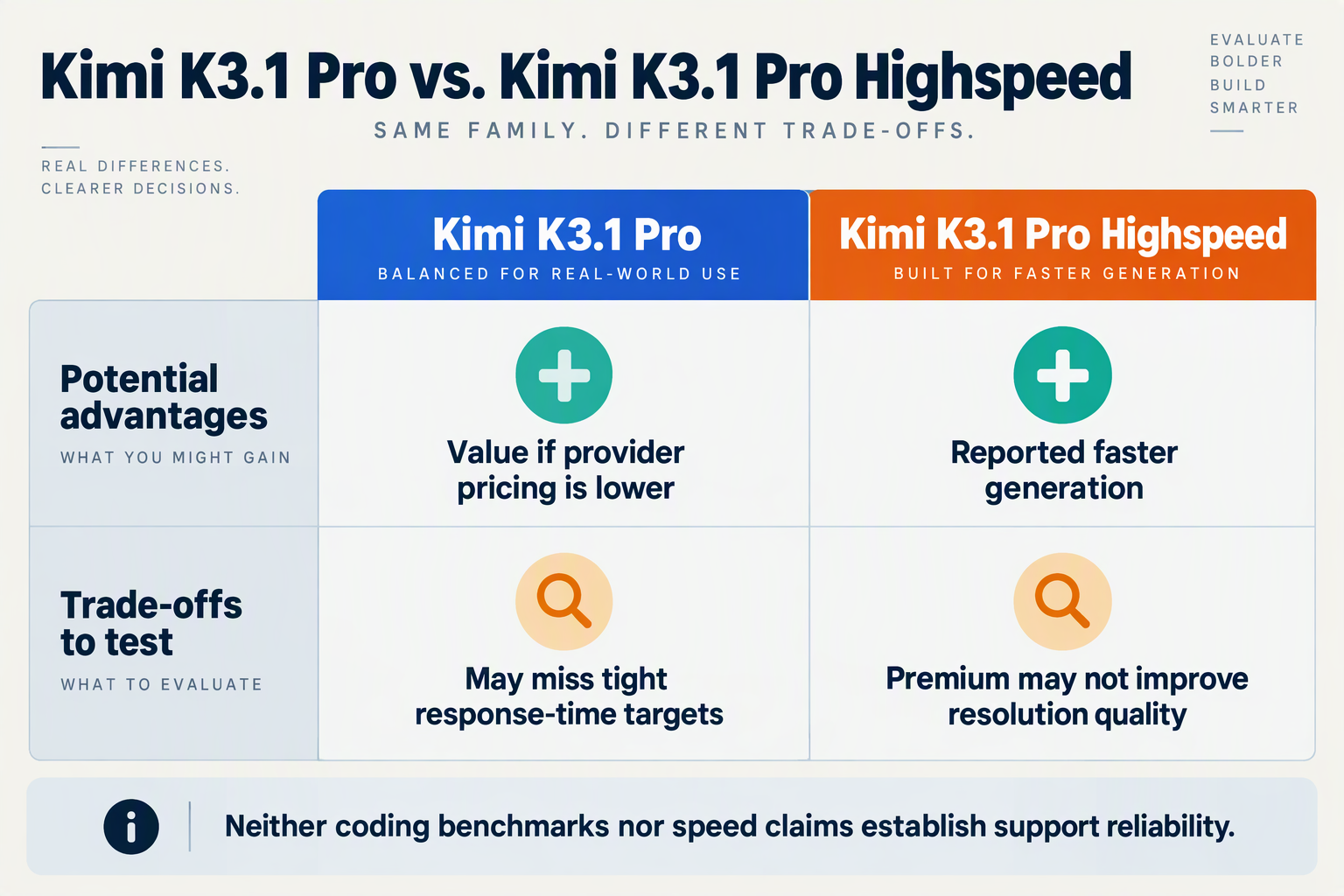
Kimi K3.1 Pro suits support investigations that require substantial context and multiple steps; Highspeed is worth testing for interactive conversations. Neither variant removes the need for retrieval checks, restricted tool permissions, or human escalation.
What advantages matter for customer-support workflows?
- Long-context investigations: As of October 2026, Moonshot AI advertises a 1M-token context window for Kimi K3.1 Pro. That creates room for lengthy ticket histories and reference material, but selective retrieval remains important: including more documents can also introduce outdated policies and contradictory instructions.
- Multi-step work: As of October 2026, Artificial Analysis reports 1,846 Elo on GDPval-AA, placing Kimi K3.1 Pro third on that benchmark. This supports evaluating complex investigations, not assuming production readiness; test whether the model selects the correct tools, respects authorization, and stops when evidence is insufficient.
- Grounding potential: As of October 2026, AI/TLDR reports an 8.3% claim-level hallucination rate on Kimi Hallu Bench Hard with tools, versus 23.4% for Kimi K3. That is encouraging but benchmark-specific: it does not establish an equivalent error rate for refunds, billing disputes, or customer-account explanations.
Where do Pro and Highspeed fit in a support workflow?
| Support workflow | Pro advantage | Highspeed opportunity | Main drawback or guardrail |
|---|---|---|---|
| Policy explanations | Evaluate against retrieved policy passages | Test shorter waits for grounded answers | Require evidence for eligibility claims; reject unsupported exceptions |
| Long-running disputes | Evaluate synthesis across ticket histories | Test faster iterative clarification | Separate current policy from historical promises and superseded documents |
| Order-status checks | Evaluate tool-result interpretation | Test responsiveness after lookup completion | Carrier or commerce API delays may dominate; verify order ownership |
| Refund processing | Evaluate multi-step eligibility reasoning | Test faster customer-facing explanations | Keep approval rules outside the model; require authorization before execution |
| Screenshot troubleshooting | Evaluate multimodal evidence interpretation | Test interactive diagnostic exchanges | Validate image accuracy; redact sensitive account and payment information |
| Agent handoff | Evaluate structured escalation summaries | Test quicker preparation during live chats | Preserve unresolved questions and evidence; avoid presenting guesses as facts |
What should teams validate before choosing either variant?
- Cost per resolution: Run the same 100 representative tickets through both variants as an initial pilot, not a statistically definitive benchmark. Include failed attempts, tool calls, retries, and human review in the calculation; a cheaper individual response can still produce a more expensive resolution.
- Safety gates: Require zero unauthorized account changes in the pilot, and review every proposed refund or cancellation. Treat this as an acceptance criterion, not a claimed model capability; neither speed nor a high general benchmark score establishes permission-aware behavior.
- Operational visibility: As of October 2026, CallMissed offers usage and request logs, caller-chosen fallback models, and structured outputs through its developer API. These capabilities support observable integration patterns, but the supplied facts do not establish availability of either Kimi K3.1 variant on CallMissed.
Which should you choose for live chat, agent assist and asynchronous tickets?
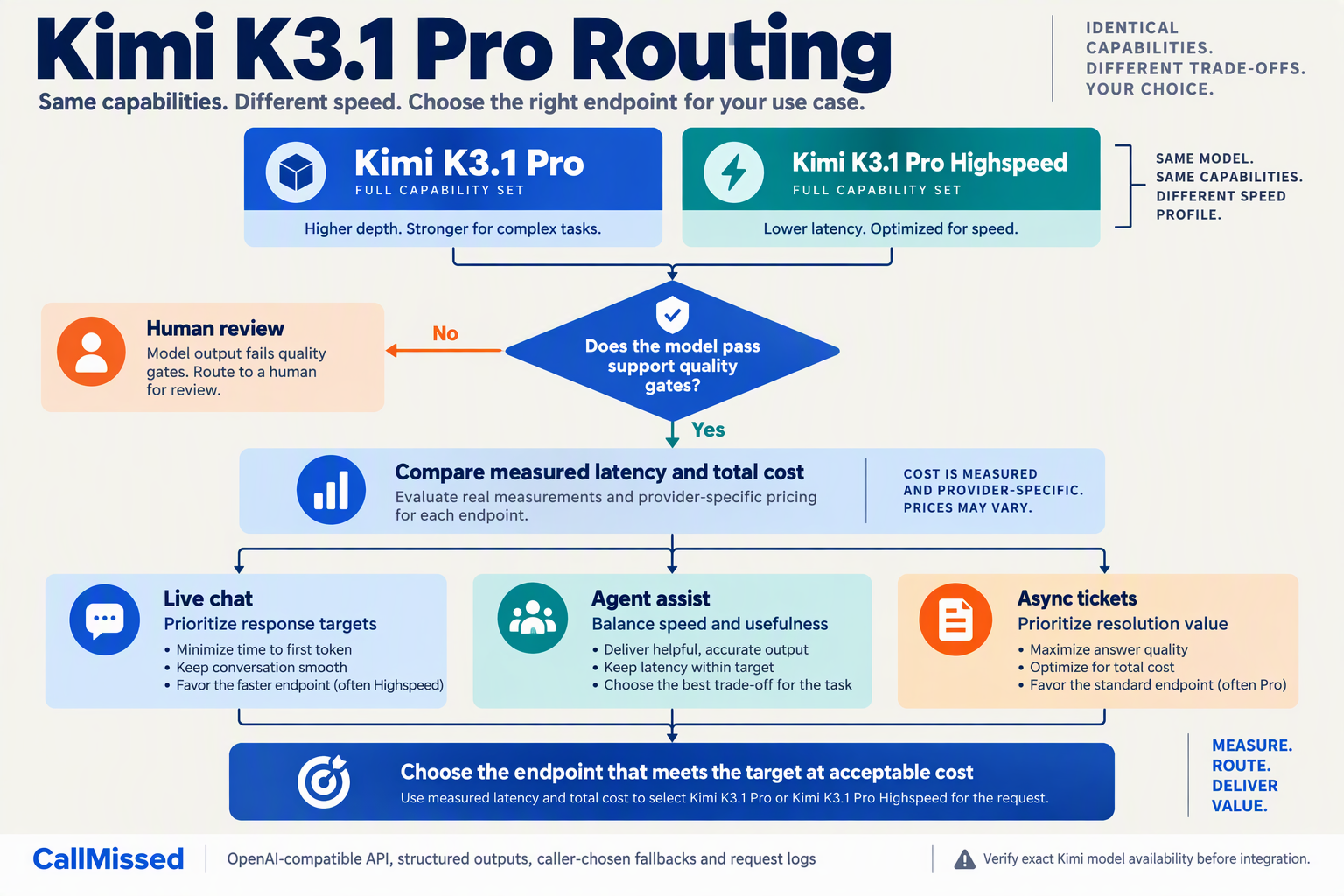
Choose Kimi K3.1 Pro Highspeed when shorter waits materially improve the support experience; choose Kimi K3.1 Pro when work can queue. Treat Highspeed as a responsiveness upgrade, not a reason to relax quality checks.
Which Kimi variant should you choose for live chat?
- Highspeed: Prioritize this variant for customer-facing conversations with several sequential model turns, such as clarifying a return request, checking eligibility, and explaining the next step. Measure p95 time to the first useful response, not merely the first token: an immediate “Let me check” does not tell the customer whether their return qualifies.
- Pro: Keep the standard variant in contention when retrieval or business-system calls dominate waiting time. In an illustrative calculation, a workflow with six seconds of tool latency and four seconds of model processing takes ten seconds; halving model processing reduces that to eight seconds—a 20% end-to-end improvement, not a 50% improvement.
Which Kimi variant works better for agent assist?
- Highspeed: Test this option for suggestions agents need during an active conversation: policy snippets, next-step recommendations, and draft replies. Use the same test cases for both variants and record suggestion acceptance rate, material edit rate, and response latency. Faster suggestions have limited value if agents must repeatedly correct eligibility rules or unsupported promises.
- Pro: Start here for background assistance, including preparing case summaries before an agent opens a ticket. As of October 2026, Kimi.ai describes Kimi K3.1 Pro as having a “1M-token context.” That capacity makes long-history evaluation relevant, but teams should still retrieve focused evidence rather than assume every previous message deserves inclusion.
- Cost comparison: As of October 2026, AIHubMix reports that Kimi K3.1 Pro Highspeed costs twice as much as Pro on AIHubMix; this is provider-specific, not a universal tariff. At that ratio, an illustrative ₹100 of equivalent Pro token usage becomes ₹200 on Highspeed. Compare that increment with measured agent time saved, including review and correction.
Which Kimi variant should handle asynchronous tickets?
- Pro: Make this the initial candidate for queued email replies, overnight summaries, and investigations whose deadlines allow additional processing time. Evaluate cost per approved response, including retries and human review. Preserve approval gates for refunds, account changes, and sensitive disclosures; neither a large context window nor faster generation establishes permission to perform those actions.
- Highspeed and routing: Reserve Highspeed for tickets approaching an SLA deadline or requiring an immediate customer update, subject to validated quality. As of October 2026, CallMissed’s OpenAI-compatible developer API supports caller-chosen fallback models and usage and request logs, capabilities relevant to evaluating routing strategies. Confirm specific model availability separately, and distinguish urgency-based routing from fallback after a failed request.
What privacy and integration checks must both endpoints pass?
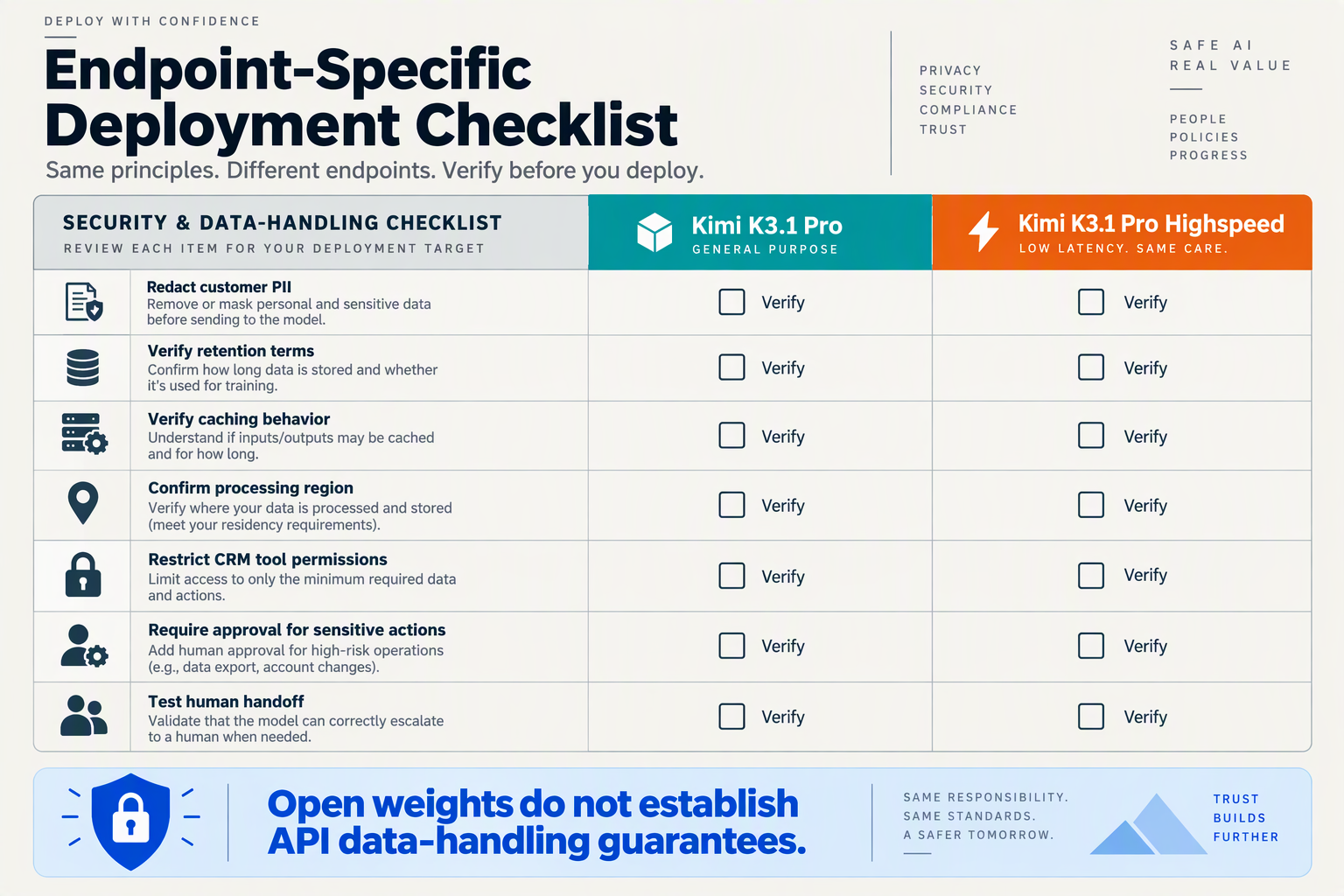
Both Kimi K3.1 Pro endpoints should pass the same privacy and integration gates before handling customer data. The supplied October 2026 sources do not establish their retention, residency, or contractual safeguards.
What must you verify before connecting either endpoint to customer support?
- Both endpoints — data processing: Obtain a data-processing agreement covering the exact provider and service tier you will use. Confirm whether prompts, attachments, outputs, and feedback are used for training, and whether an opt-out covers every category. Treat unanswered questions as deployment blockers, not evidence that customer information is protected by default.
- Both endpoints — retention and deletion: Request separate retention periods for request bodies, generated responses, abuse-monitoring records, and backups. If your policy requires zero retained prompt content, verify that requirement contractually rather than interpreting “not used for training” as equivalent. Test deletion with synthetic tickets and document any exceptions before submitting real conversations.
- Both endpoints — residency and subprocessors: Map every processing destination: application server, gateway, inference provider, logging service, and fallback route. As of October 2026, CallMissed’s verified product fact sheet states that its platform is hosted in India; that does not establish where an upstream model processes data. Require endpoint-specific evidence for cross-border handling and approved subprocessors.
- Both endpoints — minimum necessary context: According to Moonshot AI’s Kimi technical blog, available in the October 2026 research, Kimi K3.1 Pro has a 1-million-token context window. Capacity is not permission to upload an entire customer history. Retrieve only relevant policy passages, redact payment credentials, and replace identifiers with scoped references wherever the workflow permits.
- Both endpoints — API contract: Run identical contract tests against the actual Pro and Highspeed routes, checking model identifiers, authentication, streaming events, structured responses, and tool-call arguments. Set explicit timeout and retry budgets; API compatibility alone does not establish matching behavior. Include malformed inputs and disconnected streams so failures cannot silently become incomplete customer replies.
- Both endpoints — tool authorization: Keep permission checks in application code, not model instructions. Require human approval for refunds above your chosen threshold, block access to another customer’s order, and validate tool arguments against schemas. For write operations, test idempotency with two identical requests to ensure retries cannot create duplicate refunds or account changes.
- Both endpoints — fallback containment: A fallback must inherit the same residency, retention, redaction, and access restrictions as the primary route. Simulate a timeout and inspect the destination that actually receives the request. If no approved alternative exists, route the conversation to a person rather than silently transferring customer data to an unreviewed provider.
- Both endpoints — audit evidence: Record the endpoint, model identifier, policy version, tool actions, and escalation outcome without unnecessarily storing raw personal information. Use synthetic cases containing seeded sensitive fields to check redaction and log access. Approve Pro and Highspeed separately: shared model capabilities do not prove identical hosting arrangements, contracts, or operational controls.
Frequently Asked Questions
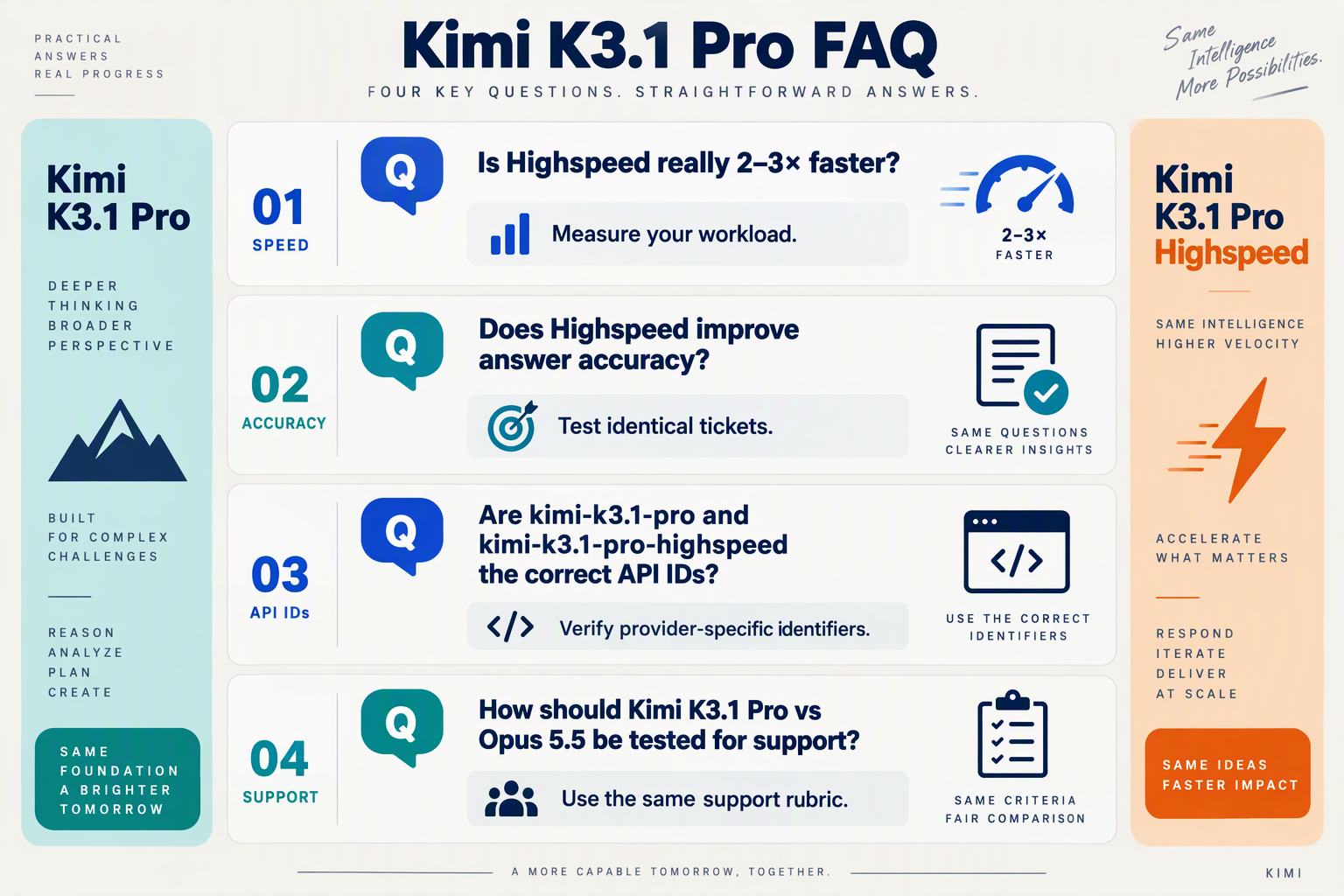
Speed claims, API identifiers, and benchmark rankings answer different questions. Use the following distinctions to shortlist models without mistaking advertised performance for a customer-support guarantee.
- Q: How much faster is Kimi K3.1 Pro Highspeed for customer support?
A: As of October 2026, Unite.AI reports Moonshot AI’s claim that Highspeed delivers two to three times the speed of Pro with “identical model capabilities.” That describes model speed, not a guaranteed reduction in ticket-resolution time. Compare both variants on identical workflows, measuring first useful response, completed answer, and delays from retrieval or business tools.
- Q: What API model IDs should developers use for Pro and Highspeed?
A: As of October 2026, the supplied OpenRouter listing identifies Pro as moonshotai/kimi-k3.1-pro, but the provided research does not establish a verified Highspeed API identifier. Model IDs are provider-specific, so confirm the exact identifier in your chosen provider’s current documentation before deployment. Do not assume appending -highspeed selects an available model or the intended billing tier.
- Q: How does Kimi K3.1 Pro compare with Claude Opus 5.5?
A: As of October 2026, Artificial Analysis reports 1,846 Elo for Kimi K3.1 Pro and 1,866 Elo for Anthropic’s Claude Opus 5.5 on GDPval-AA—a 20-point difference. This benchmark result does not establish equivalent refund handling, escalation judgment, or multilingual support quality. Compare policy-grounded answers, correct tool execution, and successful resolutions using your own representative tickets rather than treating the ranking as a purchasing verdict.
- Q: Does Highspeed cost more than the standard Pro model?
A: As of October 2026, AIHubMix’s comparison describes Highspeed as offering two to three times the speed at twice the price on AIHubMix; that provider-specific comparison should not be generalized to every endpoint. Verify current input, output, caching, and reasoning-token charges before estimating spend. Calculate cost per successful resolution, including retries and human review, because a faster response alone does not establish better economics.
- Q: Is Kimi K3.1 Pro’s context window useful for long support histories?
A: As of October 2026, Moonshot AI’s Kimi technical blog specifies a 1-million-token context window, providing room for lengthy conversation histories and supporting documents. Capacity does not guarantee that every policy detail will be retrieved or applied correctly. Test conflicting policy versions, buried exceptions, and irrelevant conversation content; use targeted retrieval when sending the entire history adds unnecessary processing or cost.
- Q: Can CallMissed support a multi-model customer-support evaluation?
A: As of October 2026, CallMissed’s developer AI API offers OpenAI-compatible endpoints, caller-chosen fallback models, and usage and request logs, with Moonshot among its catalogue makers. The verified fact sheet does not confirm specific Pro or Highspeed model IDs, so check availability before planning either integration. Keep primary-model and fallback results separate to avoid attributing another model’s successful answer to the model under evaluation.
Conclusion
Kimi K3.1 Pro Highspeed is worth testing when model processing materially affects customer waiting time; Kimi K3.1 Pro remains worth evaluating against the same resolution-quality and cost criteria. The decision should turn on measured support outcomes, not the assumption that faster generation automatically produces faster, more reliable service.
Four takeaways should guide that comparison:
- Treat the speed advantage as a testable proposition. As of October 2026, Unite.AI reports that Moonshot AI describes Kimi K3.1 Pro Highspeed as delivering two to three times the speed of Kimi K3.1 Pro with identical model capabilities. That makes responsiveness the central comparison—not an expectation that Highspeed will provide inherently better answers. Test both variants on representative customer questions before choosing a default.
- Measure the complete support journey. Time to the first useful response and time to resolution capture different customer experiences. A delivery-status interaction still requires identifying the order, retrieving tracking information, explaining the result, and selecting the next step. If those external operations dominate waiting time, faster model generation may improve only a small part of the interaction.
- Keep resolution quality separate from benchmark standing. As of October 2026, WorldAttention reports that Kimi K3.1 Pro ranks fourth on the Artificial Analysis Intelligence Index, scoring 55. That is a reason to evaluate the model, not a guarantee of accurate refund explanations, correct tool use, or appropriate human escalation. Compare both variants using the same knowledge sources, permissions, and support cases.
- Judge cost by successful resolutions, including retries. A quick answer that needs correction is not necessarily an efficient answer. Compare spending alongside grounded explanations, completed tasks, and escalation decisions. Live conversations, ticket drafting, and complex investigations may place different demands on responsiveness, so the practical choice need not be identical across every workflow.
What should customer-support teams watch next?
Watch whether the reported generation-speed advantage translates into consistently shorter end-to-end resolution times without weakening accuracy or increasing spending per resolved interaction. The forward-looking opportunity is not simply faster text: it is better evidence about where faster inference actually improves support.
As teams repeat these evaluations, the important signal will be whether results hold across their own representative cases. Keep the comparison controlled so changes in retrieval, tool response times, or permissions are not mistaken for differences between the models.
As of October 2026, CallMissed offers an OpenAI-compatible developer API, caller-chosen fallback models, and usage and request logs—capabilities readers can explore as support integrations become more flexible and observable.
Run a matched pilot before committing: does Highspeed resolve your customers’ problems sooner, or merely finish generating sooner?
Related Reading
- Kimi K3 API Pricing: Customer Support LLM Comparison
- MiniMax M3.1 Flash review: Customer Support Workflows
- LLM comparison 2026: Best Models for Customer Support