AI Voice Agent vs IVR in India: Replace, Keep or Combine


AI voice agent vs IVR for Indian callers: a decision table, worked cost example and hybrid pattern to replace, keep or combine your phone menu.
AI Voice Agent vs IVR in India: Replace, Keep or Combine
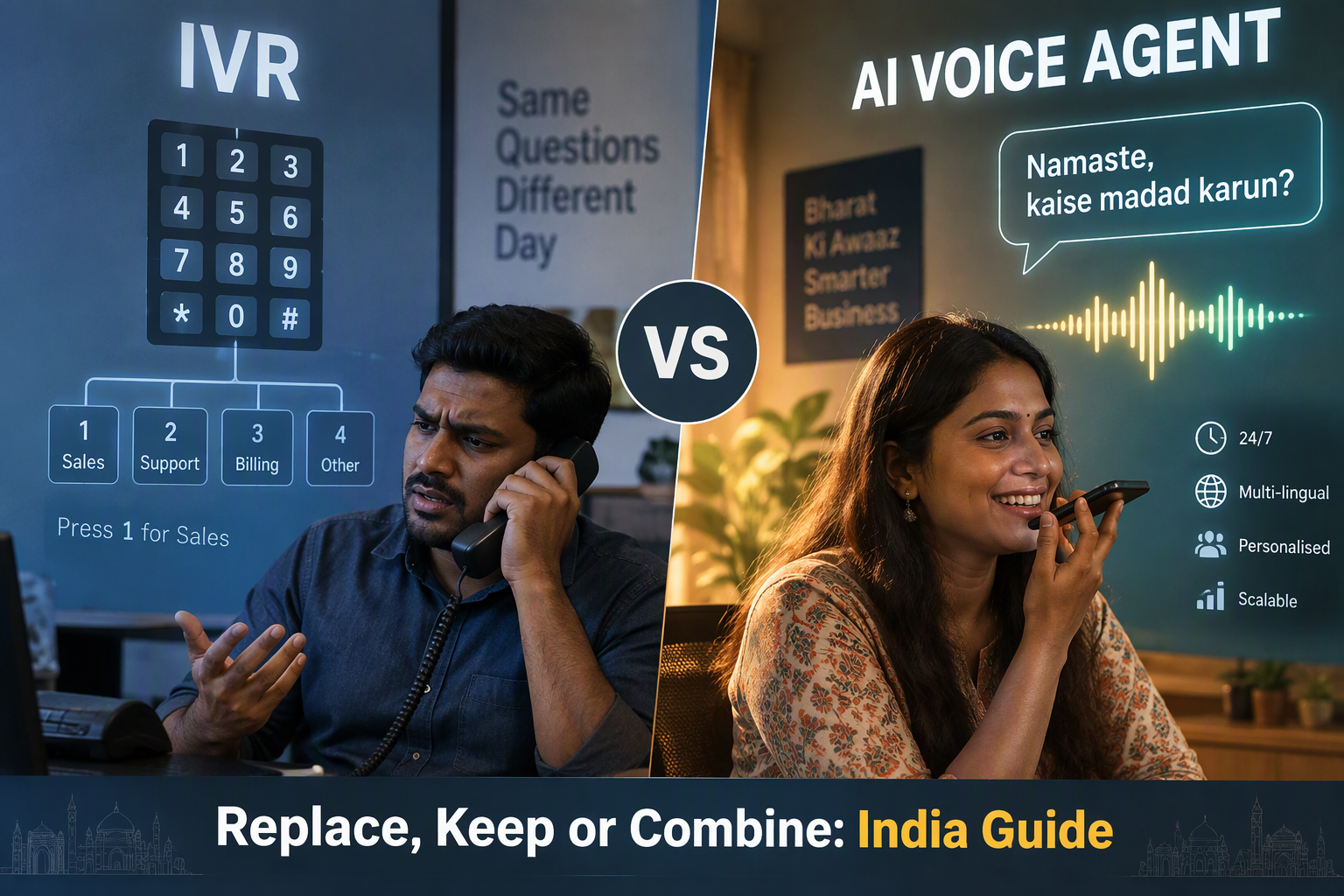
Press 1 for English, press 2 for Hindi, and 82 of every 100 callers still end up with a human anyway. That is the core of the AI voice agent vs IVR debate. According to Finn, average containment for classic IVR is just 18%, while SignalWire says AI phone agents resolve 60-85% of calls against 20-40% for IVR. These are vendor figures, so treat them as directional. For Indian businesses serving callers who switch between Hinglish and regional languages, the answer is rarely "rip out the IVR." This guide gives you a decision table for when to replace, keep or combine, plus a hybrid pattern where keypad menus handle simple tasks and a conversational agent takes everything else. Platforms like CallMissed, which offers speech recognition in 22 Indian languages plus English, reflect this shift.
Should Indian Businesses Replace Their IVR With an AI Voice Agent?
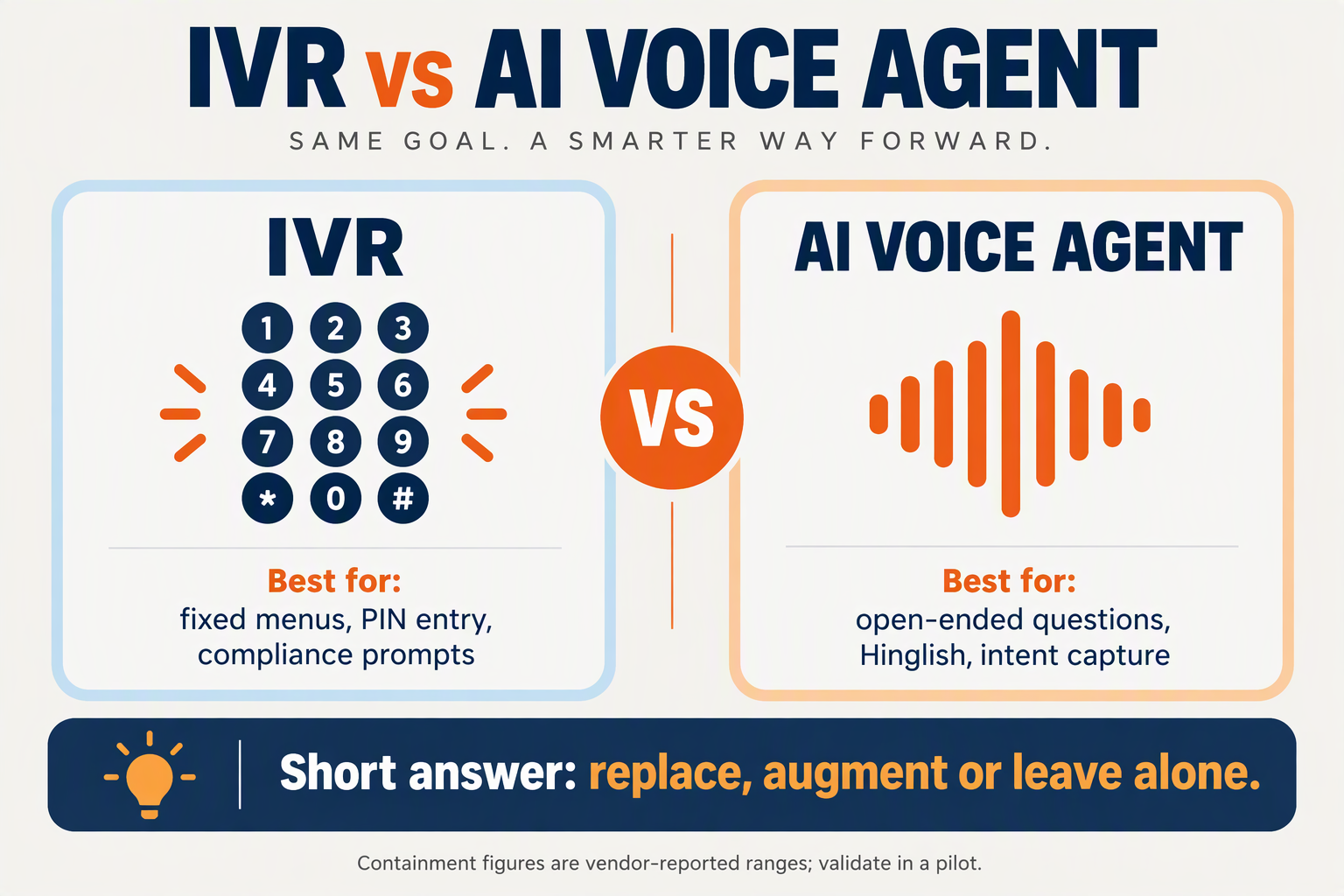
Not always. Replace the IVR when callers need open-ended help, keep it when tasks are simple and keypad-driven, and combine the two for most Indian call centers.
When does replacing the IVR make sense?
- Containment gap: Finn puts classic IVR containment at 18%, while SignalWire reports 20-40% for IVR versus 60-85% for AI phone agents. These are vendor figures, so benchmark on your own call data.
- Menu abandonment: VoiceFleet claims 61% of callers hang up on layered menus and 72% feel frustrated. Treat both as vendor-reported.
- Language mix: Menus like "press 2 for Hindi" force a choice up front. A voice agent with speech recognition across 22 Indian languages plus English, including code-mixed Hinglish, lets callers just talk.
- Open-ended intents: Order status, rescheduling, FAQs and lead qualification all fit a conversational flow better than a five-level tree.
When should you keep the IVR?
- Simple, high-volume tasks: A single-purpose line ("press 1 for balance") is fast and predictable.
- Fixed compliance scripts: Keypad (DTMF) entry suits PINs, account numbers and consent captures.
- Noisy environments: Keypad input still works when speech recognition struggles.
- Cost on trivial calls: Flat menus add no per-minute AI cost.
What does the cost side look like?
- CallMissed voice agents: Plans run ₹4/min (Standard), ₹5/min (Expressive) and ₹6/min (Best latency) as of October 2026. Each covers speech recognition, the language model and the voice, with a 30-second minimum per call. Phone carriage is billed separately.
- Hybrid support: CallMissed also offers keypad (DTMF) menus and a visual call-flow designer, so one platform can run both layers.
The honest answer is to replace menus that trap callers, and keep the keypad where it is faster.
Replace, Augment or Leave Alone: What Is the Verdict at a Glance?
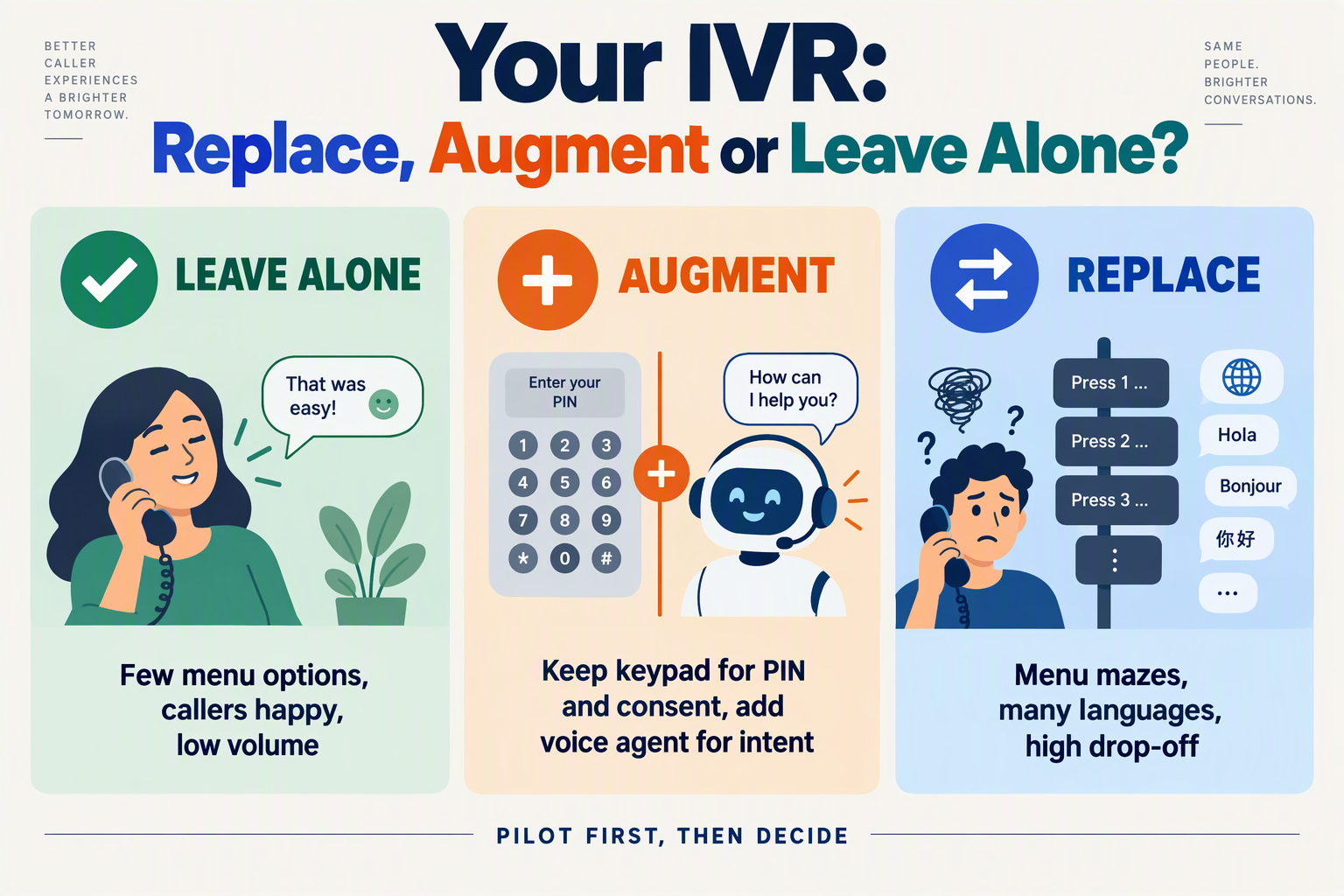
Replace the IVR when callers are trapped, augment it when menus work but dead-end, and leave it alone when one keypad task does the job. Figures below are vendor-reported, as of October 2026.
- Replace: Deep menu trees with high agent transfer rates. Realbotics reports average time to resolution of 8-12 minutes for traditional IVR versus 1-3 minutes for AI voice agents.
- Replace: Lines where callers speak Hinglish or a regional language. Menus that force a language choice up front are the first thing to remove.
- Augment: A working IVR that fails only on "none of the above." Keep the keypad front door and route the fallback to a conversational agent.
- Augment: Smart IVR with speech prompts that still misses intents. Realbotics puts first-call resolution at 35-45% for IVR versus 70-85% for AI agents, so the gain sits in the hard calls.
- Augment: Calls needing a human finish. A squad-style handoff, as in CallMissed's Squads feature, passes a live call from one agent to another without restarting the conversation.
- Leave alone: Single-purpose lines such as balance checks, PIN entry or consent capture, where DTMF is faster and cheaper.
- Leave alone: Low-volume lines where the per-minute AI cost and build effort outweigh any containment gain.
- Churn risk: VoiceFleet claims callers stuck in IVR mazes are 3x more likely to churn, so prioritise the lines tied to revenue or renewals first.
Rule of thumb: Most Indian call centers land on "augment," which the hybrid pattern later in this guide covers.
How Do AI Voice Agents and IVR Compare Feature by Feature?
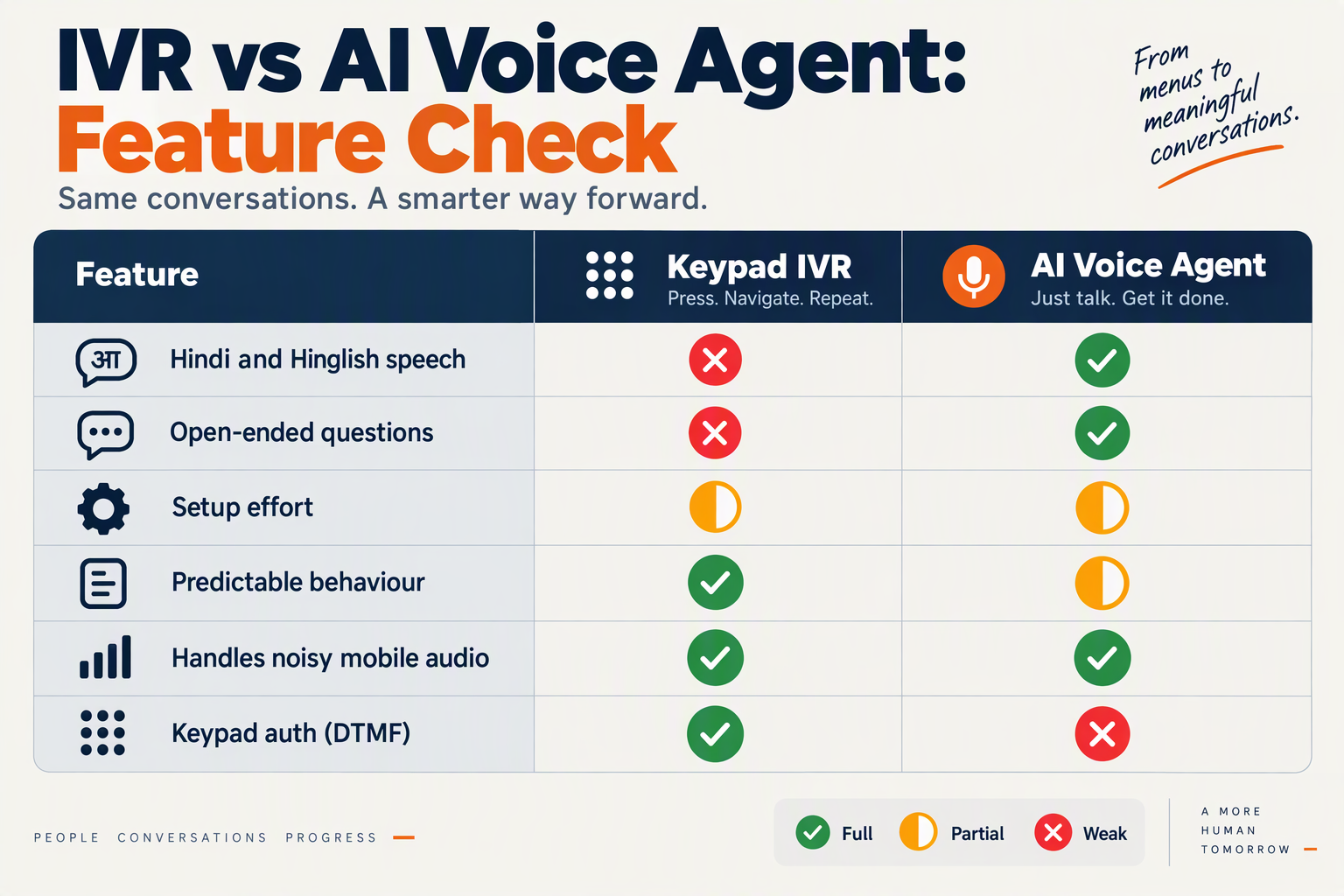
Feature by feature, IVR wins on predictability and keypad entry, while AI voice agents win on language, flexibility and resolution speed. Figures are vendor-reported, as of October 2026.
| Feature | Classic IVR | AI Voice Agent | Better for |
|---|---|---|---|
| Caller input | Keypad (DTMF) or fixed phrases | Free speech, including code-mixed Hinglish | Agent for open requests |
| Language handling | Pick a language up front | Speech recognition across 22 Indian languages plus English on CallMissed | Agent |
| Time to resolution | 8-12 minutes (Realbotics) | 1-3 minutes (Realbotics) | Agent |
| First-call resolution | 35-45% (Realbotics) | 70-85% (Realbotics) | Agent |
| PIN and consent capture | Reliable keypad entry | Possible, but speech can misread digits | IVR |
| Cost model | Flat, no AI usage fee | Per minute (CallMissed: ₹4-₹6/min) | IVR on trivial calls |
What the table means in practice
- Realbotics' CSAT claim: It reports 22% positive for IVR versus 87% for AI voice agents. This is a vendor figure, so validate it with your own post-call surveys.
- Changing flows: An IVR tree needs a redesign for every new intent. An agent changes through its prompt and knowledge base.
- Sensitive digits: Keep DTMF for card numbers, OTPs and PINs, even inside an AI call.
- Mixed deployments: CallMissed offers keypad menus, a visual call-flow designer and AI agents on one platform, so you can set each feature to the layer that suits it.
- Handoffs: Check that either layer can pass a live call to a human, with transcript context, before you go live.
How Much Does Each Cost Per Call? Worked Example With Per-Minute Pricing
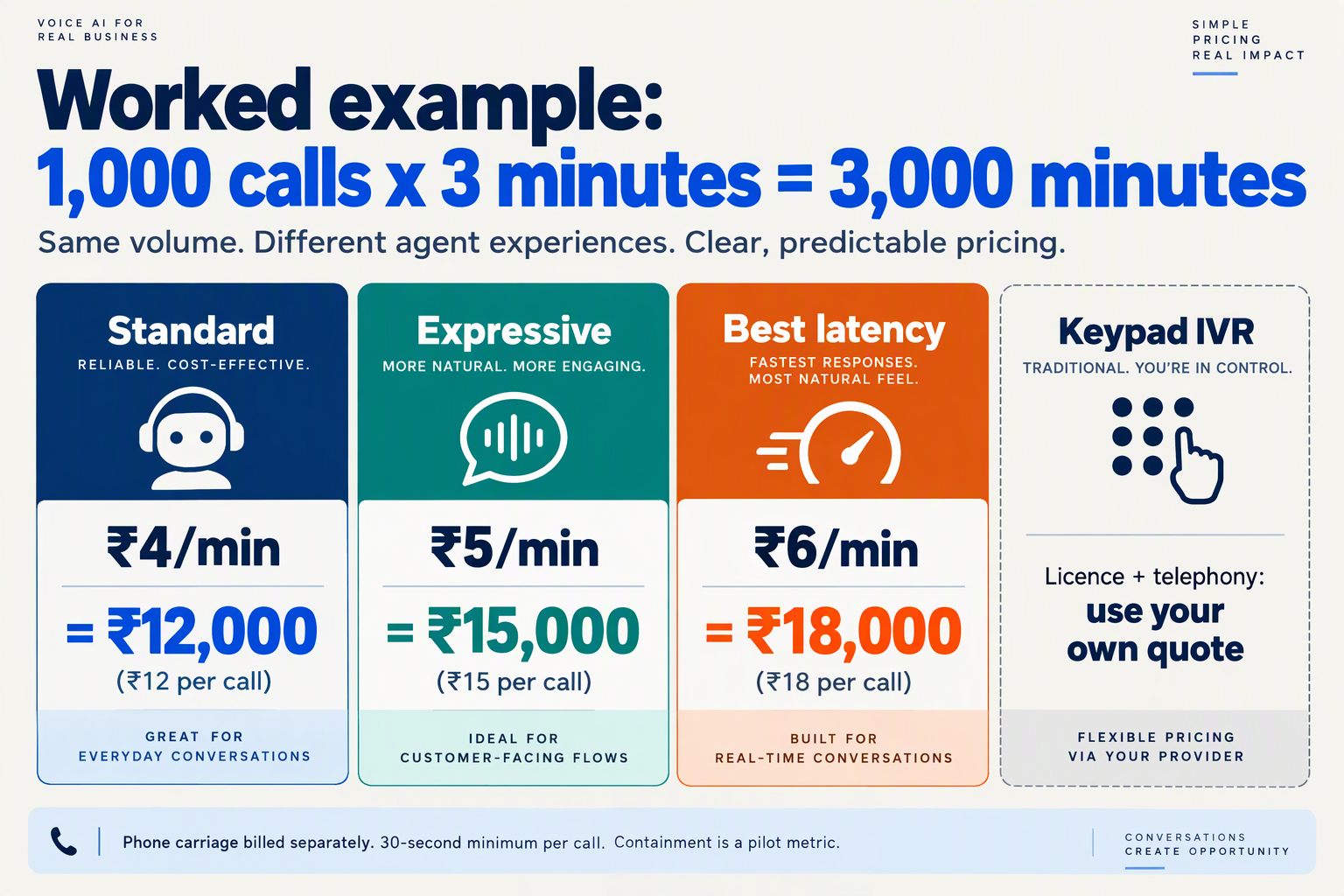
Voice agent cost per call is simple arithmetic: minutes multiplied by the plan rate. CallMissed's rates, as of October 2026, are flat per minute and include speech recognition, the language model and the voice.
What does one AI voice agent call cost?
| Call length | Standard (₹4/min) | Expressive (₹5/min) | Best latency (₹6/min) |
|---|---|---|---|
| 30 sec (minimum billed) | ₹2.00 | ₹2.50 | ₹3.00 |
| 1 min | ₹4 | ₹5 | ₹6 |
| 2 min | ₹8 | ₹10 | ₹12 |
| 3 min | ₹12 | ₹15 | ₹18 |
| 5 min | ₹20 | ₹25 | ₹30 |
How do the billing rules affect the math?
- Minimum: Every connected call bills at least 30 seconds.
- Unconnected calls: A call that never connects costs nothing.
- Phone carriage: Billed separately, so add your carrier or number rental on top.
- Credits: 1 credit equals ₹1, and credits never expire.
What does a hybrid pattern save? (illustrative assumption)
Suppose 1,000 calls a month average 2 minutes each on the Standard plan.
- Agent-only: 1,000 calls × ₹8 = ₹8,000.
- Hybrid: Assume a keypad menu resolves 400 simple calls, such as balance checks. The agent handles 600 calls × ₹8 = ₹4,800.
- Result: The agent bill drops by ₹3,200. The 40% split is a planning assumption, not a benchmark, so replace it with your own call data.
What about the IVR side?
- No verified per-call IVR price: Costs vary by vendor and carrier, so compare against your current bill.
- CallMissed hybrid: Keypad (DTMF) menus and the visual call-flow designer sit on the same platform as the agent.
What Are the Pros, Cons and Failure Modes of Each?
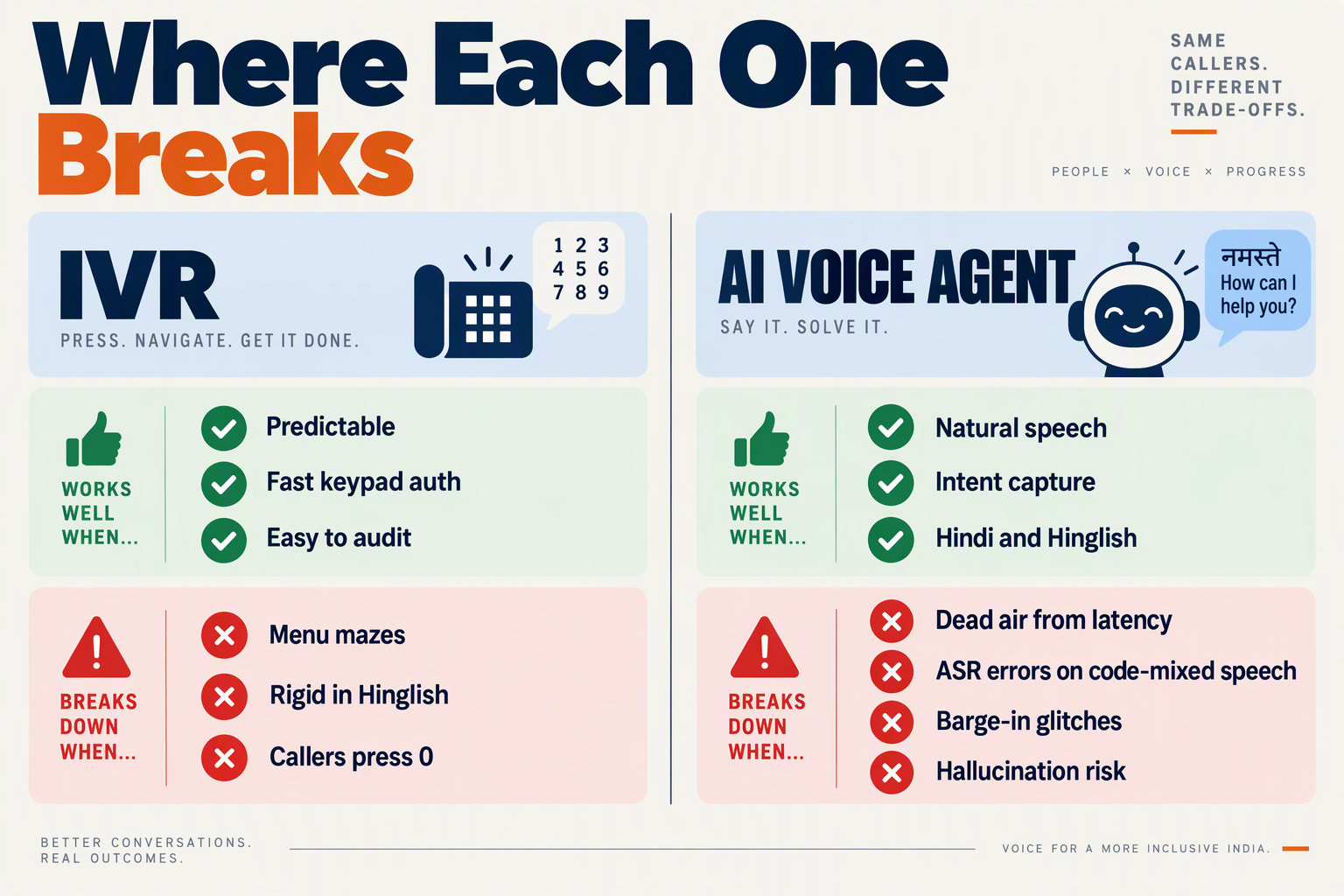
Each approach fails differently: IVR fails by trapping callers, and AI voice agents fail by being confidently wrong. Plan for both failure modes before you choose.
| Factor | Classic IVR | AI voice agent | Typical failure mode |
|---|---|---|---|
| Predictability | Fixed paths, same result every call | Probabilistic, wording varies | Agent improvises or misreads intent |
| Caller effort | Navigate menus by keypad | Speak naturally | IVR dead ends; agent mishears names or numbers |
| Languages | One menu per language | Mixed-language speech possible | Code-mixed or noisy audio lowers accuracy |
| Change cost | Re-record prompts, rebuild tree | Edit prompt and knowledge base | Stale knowledge base gives outdated answers |
| Cost shape | Cheap on trivial calls | Per-minute on every call | Long, unfocused calls inflate spend |
What should you watch for in practice?
- IVR strength: Deterministic keypad (DTMF) capture of PINs and account numbers.
- IVR weakness: Realbotics (vendor-reported) cites 8-12 minutes to resolution for traditional IVR versus 1-3 minutes for AI agents.
- Agent strength: Handles open-ended intents without forcing a menu choice.
- Agent weakness: Hallucination risk, so ground answers in a knowledge base and limit tools to what the call needs.
- Shared blind spot: Neither helps if the escalation path to a human is slow or loses context.
How do you reduce those risks?
Platforms such as CallMissed offer mitigations for several of these, as of October 2026:
- Handoff: Live call monitoring lets a supervisor listen, whisper or barge in.
- Quality control: Call scoring against your own QA rubrics, plus eval suites, catches drift.
- Fallback: Keypad menus and call queues can sit beside the agent for sensitive inputs.
Treat the table as a pre-launch checklist: for every failure mode, name the fallback before go-live.
Which Should You Choose: A Decision Table by Call Type and Caller Profile
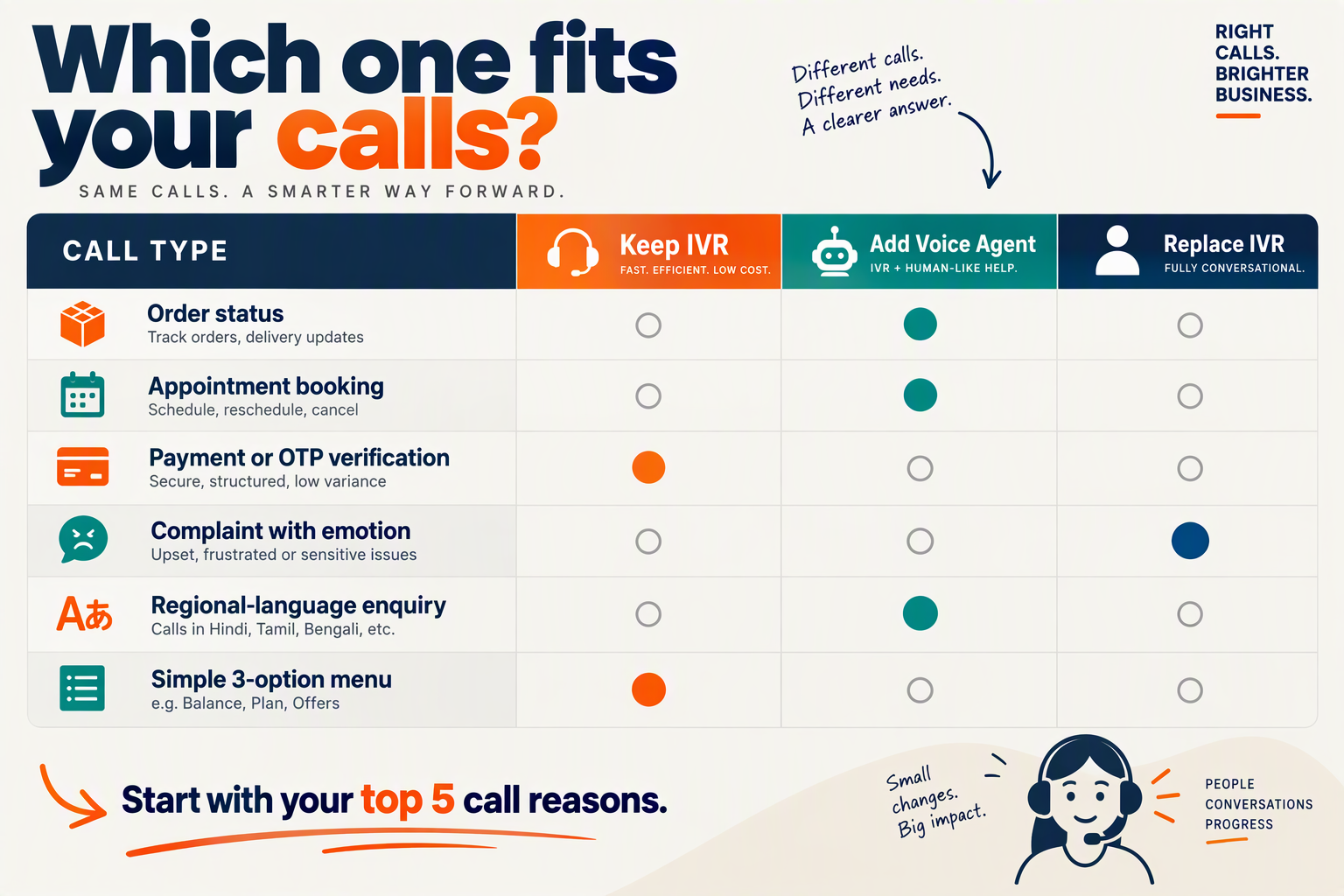
Match the tool to the call type first, then adjust for who is calling. As of October 2026, this is a practical starting point.
| Call type | Caller profile | Choose | Why |
|---|---|---|---|
| Balance check, PIN or account number entry | Any, including noisy lines | Keep IVR | Keypad (DTMF) input is exact and predictable |
| Order status, rescheduling | Hinglish or regional-language speakers | Replace with voice agent | Open-ended intent, answered from live order data |
| FAQs, lead qualification | First-time callers | Replace with voice agent | Knowledge-base answers beat a five-level tree |
| Payments or consent capture | Mixed | Combine | Agent handles the conversation, keypad collects the digits |
| Complaints, escalations | Upset or high-value | Combine plus human handoff | Agent triages, a person resolves |
How does caller profile change the call?
- Repeat callers with one task: Keep a flat keypad menu if the task never changes.
- Code-mixed speakers: Favor a voice agent. CallMissed's speech recognition covers 22 Indian languages plus English, including Hinglish.
- Callers in noisy places: Offer a keypad fallback so a failed speech turn never dead-ends.
- First-time or non-technical callers: Skip menus entirely. Letting them say what they need removes the "which option am I?" problem.
What is a safe default?
- Pilot one call type: Move a single intent, such as order status, to a voice agent and compare it against your own IVR logs.
- Keep the keypad for digits: Use DTMF only where exact numeric input matters.
- Build both layers in one place: CallMissed's visual call-flow designer supports keypad menus and AI agents, and squads can hand a live call between agents.
What Does a Hybrid IVR and Voice Agent Pattern Look Like, and How Do You Migrate?
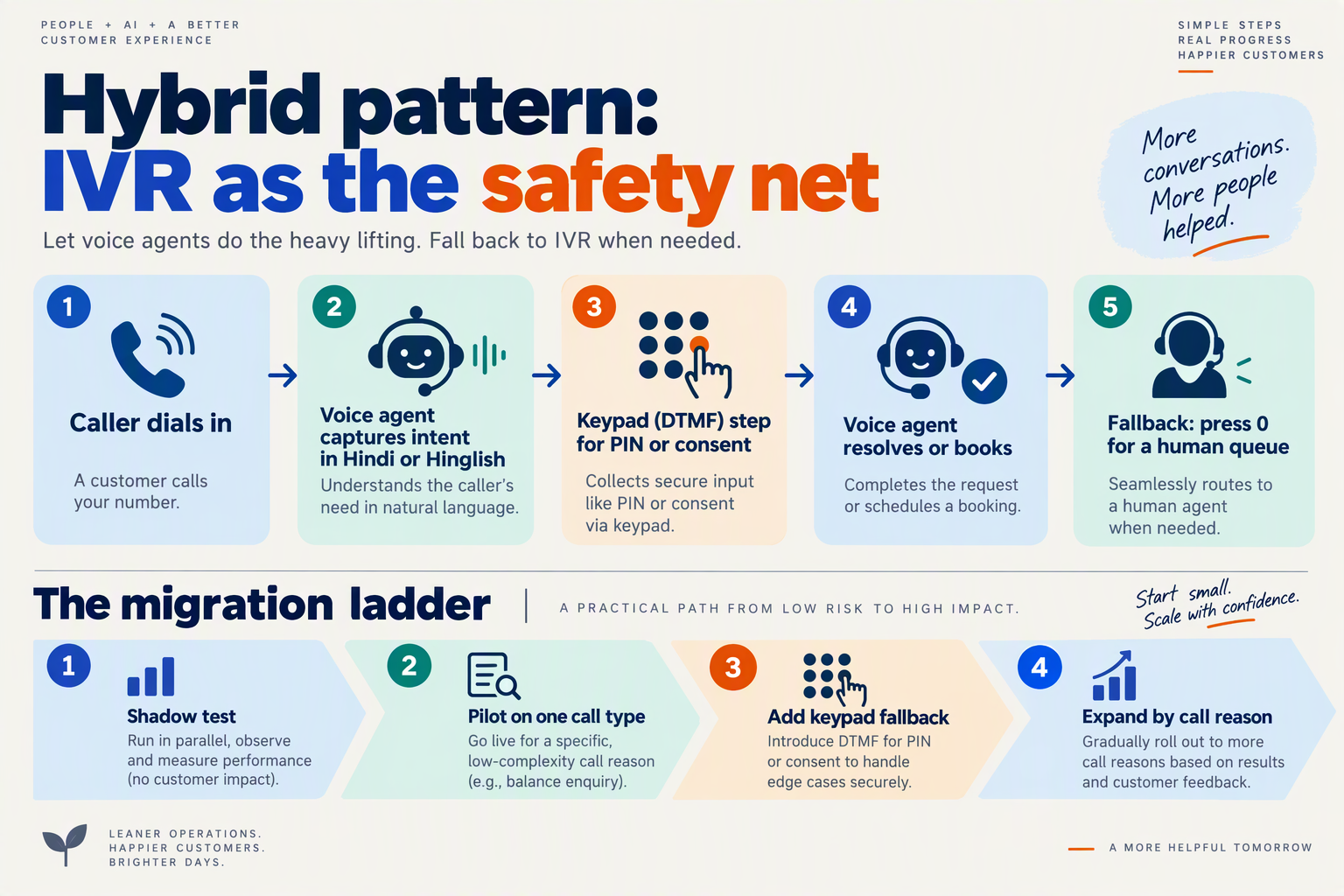
A hybrid keeps the keypad for fixed tasks and hands everything open-ended to a conversational agent. Migrate in stages, not with a big-bang cutover.
What does the hybrid pattern look like?
- Front door: The call lands on a keypad (DTMF) menu in the visual call-flow designer, with at most one level for PINs, account numbers and consent.
- Open-ended branch: "Press 9" or silence routes to an AI voice agent that listens in 22 Indian languages plus English, including Hinglish.
- Specialist handoff: Squads pass a live call from a general agent to a billing or booking agent, so each prompt stays short.
- Human fallback: Unresolved calls go to a call queue, with a transcript and AI call notes (summary, action items, disposition) attached.
- Carrier: Keep your existing Twilio, Plivo or SIP trunk, as CallMissed supports bring-your-own carrier.
How do you migrate step by step?
- Baseline: Record current containment, using Finn's 18% classic-IVR average as a reference point, plus abandonment and transfer rates.
- Pick one intent: Start with a single high-volume, low-risk intent such as order status or appointment rescheduling.
- Add the agent behind one menu option: Leave the rest of the tree untouched.
- Test before launch: Use eval suites and A/B experiments, with call scoring against your own QA rubrics.
- Watch live: A supervisor can listen, whisper or barge in on early calls.
- Expand or prune: Remove menu levels only where the agent outperforms them. Versioning with publish and rollback makes reversals quick.
As of October 2026, voice agent plans start at ₹4/min, with a 30-second minimum per call and a call that never connects costing nothing. A pilot on one intent therefore has a bounded cost.
Frequently Asked Questions
What is the difference between an AI voice agent and IVR?
Is an AI voice agent better than IVR in India?
Should I replace my IVR completely?
How much does an AI voice agent cost per minute in India?
Can I combine an IVR and an AI voice agent in one call flow?
Do I need to change my phone carrier to try an AI voice agent?
Conclusion
- Replace menus that trap callers. Vendor figures put IVR containment at 18-40% versus 60-85% for AI agents.
- Keep keypad flows for PINs and simple, high-volume tasks.
- Combine both: keypad menus for the basics, a conversational agent for everything else.
Watch for Hinglish and regional-language accuracy to become the deciding benchmark, so test on your own call data. To explore this hybrid pattern, check out CallMissed, which offers speech recognition in 22 Indian languages, keypad menus and a visual call-flow designer. Which of your menus would callers skip first?
Related Reading
- AI Voice Agent for Clinics India: Hindi Booking Guide 2026
- How to Test an AI Voice Agent: Hinglish QA Checklist
- Hold-to-Talk Voice Assistant: Business Agent UX Guide