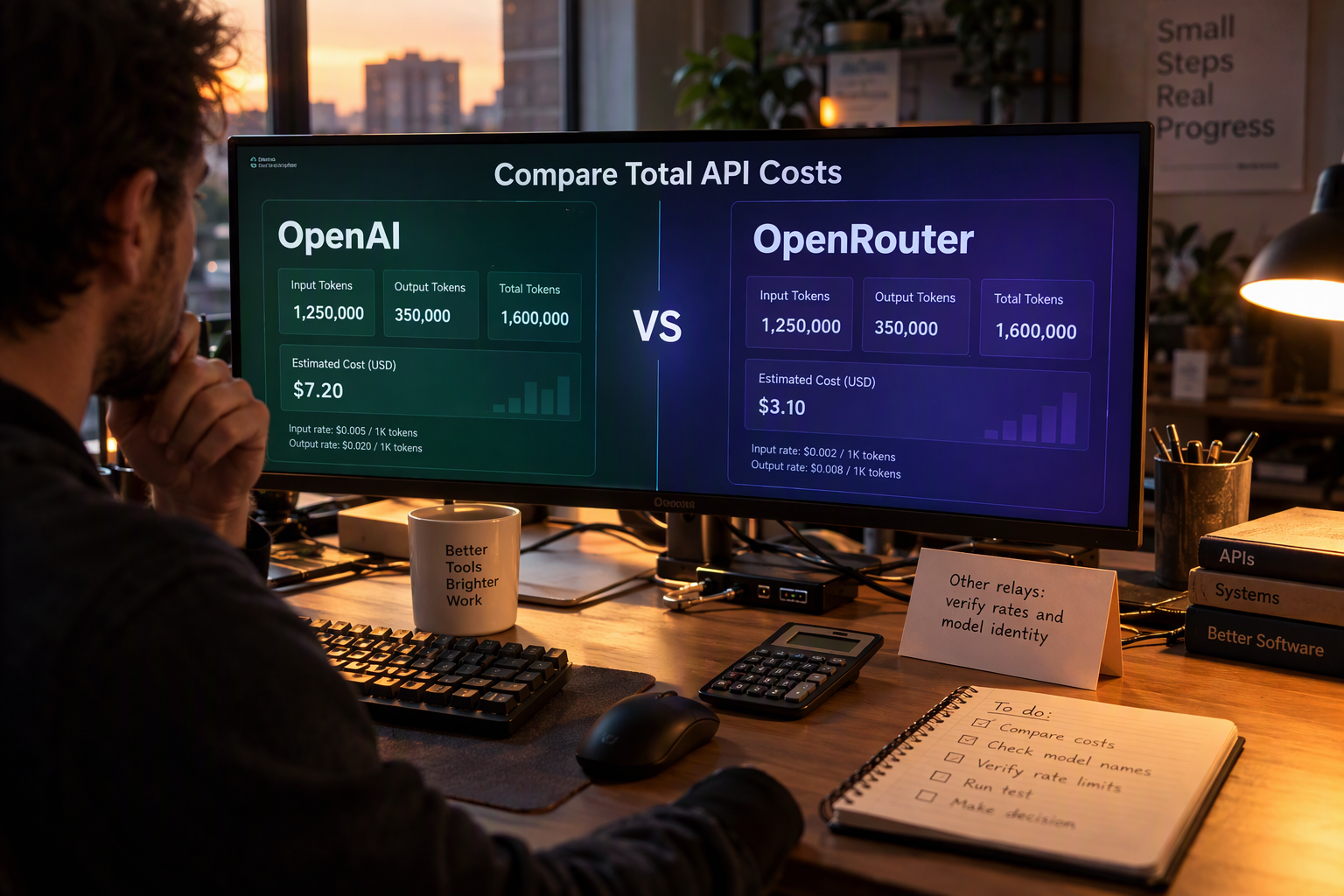
Buy AI Credits India: Best Developer Platforms 2026



Buy AI Credits India with clear INR comparisons, payment options and workload-cost checks. Find the right developer API without misleading credit math.
Buy AI Credits India: Best Developer Platforms 2026
A ₹1 AI credit tells you its wallet value—not how much AI work it buys. For developers searching “Buy AI Credits India,” the best per-credit pricing platform depends on model-level costs, payment options, credit expiry and API compatibility—not simply the cheapest-looking top-up.
The October 2026 comparison highlights two different approaches. According to Velona’s pricing documentation, its INR billing formula is provider USD price × live USD/INR rate × 1.005 forex buffer × 1.07 platform fee, making the conversion and platform charges explicit. As of October 2026, CallMissed’s verified pricing lists ₹1 per credit, non-expiring credits, UPI payments and 124 models through one API key and balance, offering a straightforward wallet structure for Indian developers.
These details matter because buying credits and buying useful inference are different decisions. A chatbot’s cost depends on the model selected, input and output volume, and how often requests run. An attractive signup offer can help you prototype, but recurring workload costs determine whether the platform remains affordable after launch.
The practical question is therefore not “Which platform has the cheapest credit?” It is “Which platform delivers my required workload at the clearest, most manageable total cost?”
Consider the developer building a customer-support assistant. Comparing identical wallet deposits is insufficient: the developer needs to price the same model, the same input and output token volumes, and the same expected request count on each platform. If the application also requires transcription or speech generation, those services need a separate cost comparison rather than being treated as equivalent to text tokens.
For a decision-ready shortlist, look at:
- Payment fit: Can you fund usage through Indian payment methods without introducing unnecessary payment friction?
- Billing transparency: Are model rates, currency conversion and platform charges visible before you commit?
- Workload economics: What does your actual mix of input tokens, output tokens and other services cost?
- Integration effort: Can your existing SDK connect, and which endpoints does your application require?
- Credit conditions: Do balances expire, and what restrictions apply to free access?
According to Velona’s website, its October 2026 offering includes 300+ models and UPI wallet top-ups starting at ₹10. That makes catalogue breadth and small initial deposits relevant comparison points, but neither establishes which option costs less for a specific application.
This guide compares who each option fits, explains the available pricing structures and separates verified capabilities from assumptions. You will learn how to evaluate rupee-denominated credits, check model-level charges and choose a developer platform based on your workload—not an unsupported “best” label.
Which AI platform is best for per-credit pricing in India?
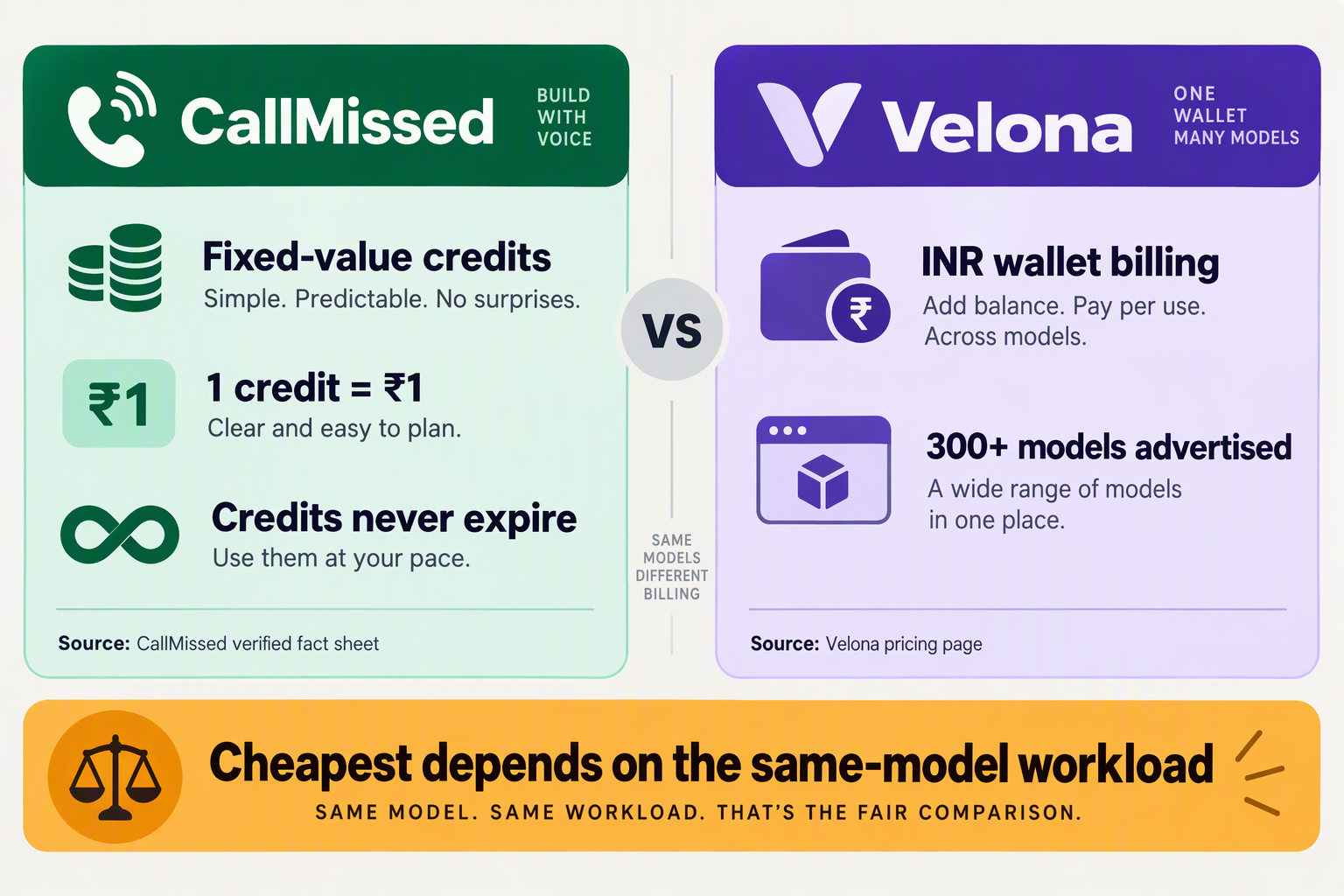
CallMissed is a strong shortlist option for Indian developers who want non-expiring rupee credits and multiple AI services in one balance; Velona fits developers prioritising a broader model catalogue and explicit currency-conversion pricing. Neither can be declared cheapest without comparing the same model and workload.
Which platform fits your development requirements?
- CallMissed: As of October 2026, CallMissed’s verified product facts list 124 models: 40 general-purpose LLMs, 24 realtime voice-agent models, 42 speech-to-text, seven text-to-speech, nine image and two embedding models. That breakdown matters for applications combining chat, audio and images: compare coverage of each required service, not just the headline catalogue size.
- Velona: According to Velona’s pricing website, as of October 2026 its catalogue includes GPT, Claude, Gemini, Llama, DeepSeek, Qwen and Mistral. Shortlist Velona when access to a particular model is your priority, then check that model’s listed input and output rates; a larger catalogue does not establish lower inference costs.
- CallMissed: As of October 2026, CallMissed’s verified product facts list OpenAI-compatible and Anthropic-compatible endpoints, plus default per-key limits of 60 requests/minute on Free, 500 on Starter, 3,000 on Pro and 10,000 on Enterprise. Developers migrating existing SDK integrations should evaluate endpoint coverage and peak request demand alongside credit pricing, rather than treating wallet simplicity as the entire decision.
- Velona free access: According to Velona’s free-tier documentation, as of October 2026 zero-cost models require request-and-approve access and operate under daily-call and requests-per-minute limits. This fits experimentation when approval and quotas suit your schedule; the supplied documentation does not establish the numerical limits, so confirm them before designing a production dependency.
How should you compare the actual price of AI credits?
- Currency conversion: Velona’s pricing documentation, reviewed for this October 2026 comparison, specifies a 1.005 forex buffer and 1.07 platform-fee multiplier. Together, these produce 1.07535 times the converted provider price, or a 7.535% uplift. This calculation explains the combined charge; it does not establish whether another platform offers cheaper equivalent inference.
- Worked example: For an illustrative workload whose provider charge converts to ₹1,000 before those multipliers, Velona’s published October 2026 formula yields ₹1,075.35. This is a calculation, not a quoted model price. Compare that amount against the other platform’s charge for identical input tokens, output tokens and model selection—not against an equal wallet deposit.
- Benchmark specification: Use a fixed test such as 1,000 requests averaging 2,000 input tokens and 500 output tokens: that means two million input tokens and 500,000 output tokens. These are illustrative workload assumptions, not platform benchmarks. Price transcription minutes, generated speech and images separately wherever your application uses them.
- Decision rule: Choose the platform that supports your required models and endpoints at the lowest verified workload cost, with acceptable quotas and credit conditions. If equivalent model-level rates are unavailable, label the result “best fit for these requirements,” not “cheapest.” That distinction makes the recommendation useful without turning incomplete pricing evidence into an unsupported ranking.
Which API features should Indian developers compare?
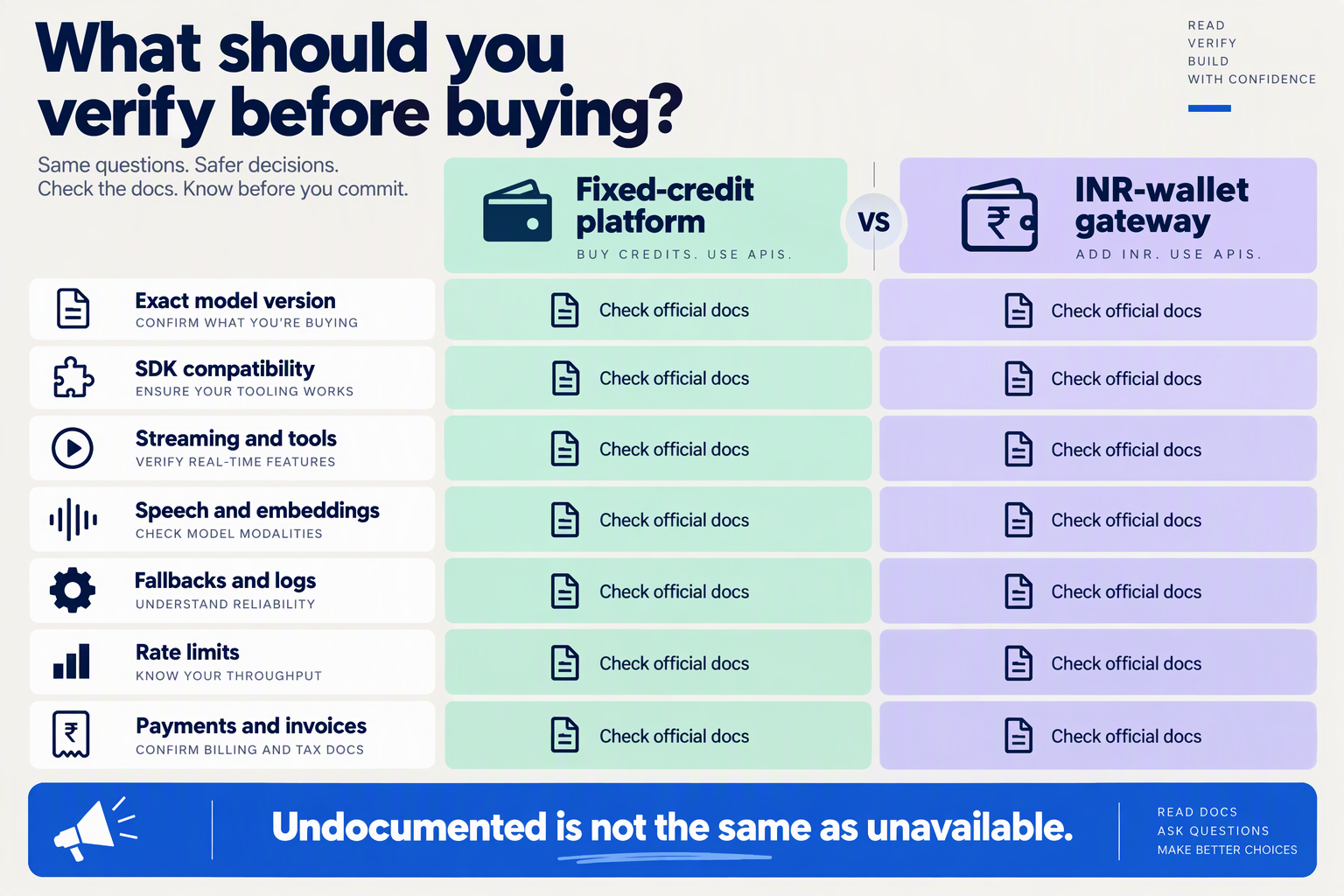
The best per-credit pricing AI platform for Indian developers should support your required endpoints, traffic levels and monitoring—not just your preferred model. Compare these six API capabilities before committing a production workload.
- Endpoint coverage: List the interfaces your application actually calls: chat completions, Responses API, embeddings, transcription or speech generation. An “OpenAI-compatible” label alone does not establish that every endpoint your SDK uses is supported.
- Traffic limits: Separate requests per minute from tokens per minute and concurrency. For example, an application expecting 120 requests per minute needs a different capacity assessment from a prototype sending 10; neither figure alone describes token throughput.
- Response controls: Check streaming, function calling and structured outputs individually. A support assistant that invokes an order-lookup tool needs different API behavior from a summarizer that returns plain text.
- Operational visibility: Require enough usage detail to trace expensive requests, failed calls and model selection. Aggregate wallet spending is useful for budgeting, but request-level records help identify which application behavior needs fixing.
How do the documented API features compare?
The following comparison reflects October 2026 information from CallMissed’s verified fact sheet, Velona’s website and the supplied India Insight News report. “Not specified” means the supplied evidence does not establish the capability—not that the platform lacks it.
| API feature | CallMissed — verified fact sheet | Velona — supplied sources | Developer decision |
|---|---|---|---|
| SDK compatibility | OpenAI-compatible endpoints and Anthropic-compatible /v1/messages | India Insight News reports a single OpenAI-compatible endpoint | Test your exact SDK methods |
| Endpoint breadth | Chat completions, Responses API, embeddings, images, transcription, translation and speech | Full endpoint list not specified | Confirm every required operation |
| Default request limits | Per key: Free 60, Starter 500, Pro 3,000, Enterprise 10,000 RPM | Website mentions free-tier RPM caps; figures not supplied | Check peak traffic headroom |
| Application controls | Streaming, function calling, structured outputs, vision input and reasoning effort control | Not specified in supplied context | Validate tool and schema behavior |
| Reliability and diagnostics | Caller-chosen fallback models, response caching, usage and request logs | Website describes per-key token usage and costs | Inspect failures and spending |
| Free-model access | 21 models on the free tier | Website describes approval-based access with daily-call and RPM limits | Check eligibility and restrictions |
What should you test before choosing an AI gateway?
- SDK migration: Run your existing client against the candidate gateway with three representative requests: a streamed response, a tool call and a schema-constrained output. Successful basic chat does not prove the other two paths work.
- Burst handling: Test your expected peak request rate and record rate-limit responses separately from model errors. Ask whether limits apply per key, account or model; the supplied comparison does not establish token or concurrency limits.
- Fallback economics: Deliberately trigger a recoverable failure and inspect the selected fallback, output quality and billed usage. A fallback keeps the workflow moving only if the replacement model meets your application’s requirements.
- Cost traceability: Replay the same prompts, model versions and output limits across shortlisted platforms. Compare successful-task cost alongside logs and integration effort; the available evidence supports feature-based shortlisting, not a universal lowest-cost winner.
How much do CallMissed and Velona actually cost?
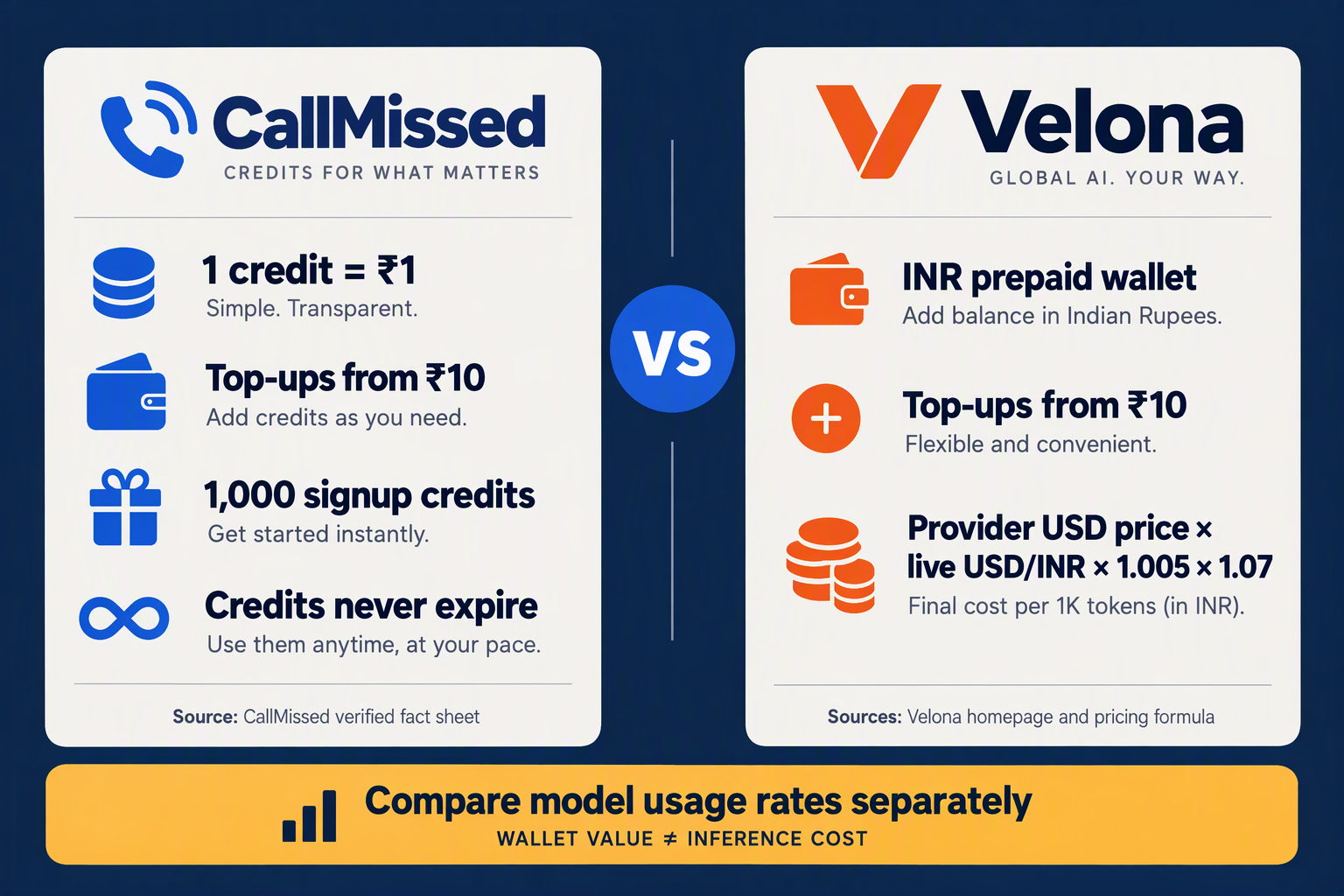
CallMissed publishes a fixed ₹1 credit value; Velona calculates usage charges from provider prices, exchange rates and two multipliers. As of October 2026, neither pricing structure alone establishes which platform costs less for an identical AI workload.
What are the published prices and wallet conditions?
The October 2026 figures below come from CallMissed’s verified pricing fact sheet and Velona’s pricing documentation; “not specified” means the supplied sources do not establish that detail.
| Pricing detail | CallMissed | Velona |
|---|---|---|
| Billing basis | ₹1 per credit; model usage determines consumption | Provider USD price × live USD/INR × 1.005 × 1.07 |
| Wallet top-ups | 10–50,000 credits at ₹1 each; no bulk bonus | UPI wallet top-ups starting at ₹10 |
| Credit expiry | Credits never expire | Not specified in supplied sources |
| Initial access | 1,000 free signup credits; 21 free-tier models | Free models require request and approval; daily-call and RPM caps apply |
| Monthly plans | Starter ₹999; Pro ₹4,999; Enterprise ₹20,000 | Monthly subscription prices not specified in supplied sources |
| Published plan credits | Starter: 550 initially, then 500; Pro: 6,000, then 5,000; Enterprise: 26,000, then 20,000 | Usage deducted from a prepaid INR wallet |
How do these prices translate into a developer’s actual bill?
- Velona: According to Velona’s pricing documentation, as of October 2026, its 0.5% forex buffer and 7% platform fee compound to 7.535% above the provider price converted at the live exchange rate. Adding the percentages would understate the published multiplier.
- Worked example: If a provider’s USD charge converts to ₹1,000 before adjustments, Velona’s October 2026 formula produces ₹1,075.35: ₹1,000 × 1.005 × 1.07. This illustrates the formula—not a quotation for any particular model or a confirmed tax-inclusive invoice.
- CallMissed: Its October 2026 fact sheet specifies ₹1 per credit without top-up bonuses, so a 5,000-credit purchase costs ₹5,000. That establishes the wallet conversion, but developers still need the selected model’s usage rate to calculate tokens, transcription minutes or generated speech.
- Plan accounting: CallMissed’s October 2026 published allowances differ between the first and subsequent months. For example, Pro lists ₹4,999 monthly with 6,000 credits initially, then 5,000; compare recurring allowances rather than treating introductory credits as a permanent discount.
- Capacity costs: CallMissed’s October 2026 default API limits are 60 RPM on Free, 500 on Starter, 3,000 on Pro and 10,000 on Enterprise. Include the required capacity tier in your budget: an inexpensive model does not resolve a throughput constraint.
- Free access: Velona’s October 2026 free-model documentation describes approval plus daily-call and requests-per-minute restrictions. Its supplied excerpts do not give numerical caps, so confirm those limits before estimating how much production traffic free access can cover.
- Fair comparison: Price one identical workload—such as one million input tokens and 200,000 output tokens—using the same model version on both platforms. These are example quantities, not benchmarks; price transcription, speech generation and other services separately.
- Purchase check: Before funding either wallet in October 2026, confirm model rates, applicable taxes, refund conditions and balance restrictions wherever the supplied documentation is silent. Choose on the resulting workload bill and operating limits, not credit denomination alone.
How do you compare the true cost of the same API workload?
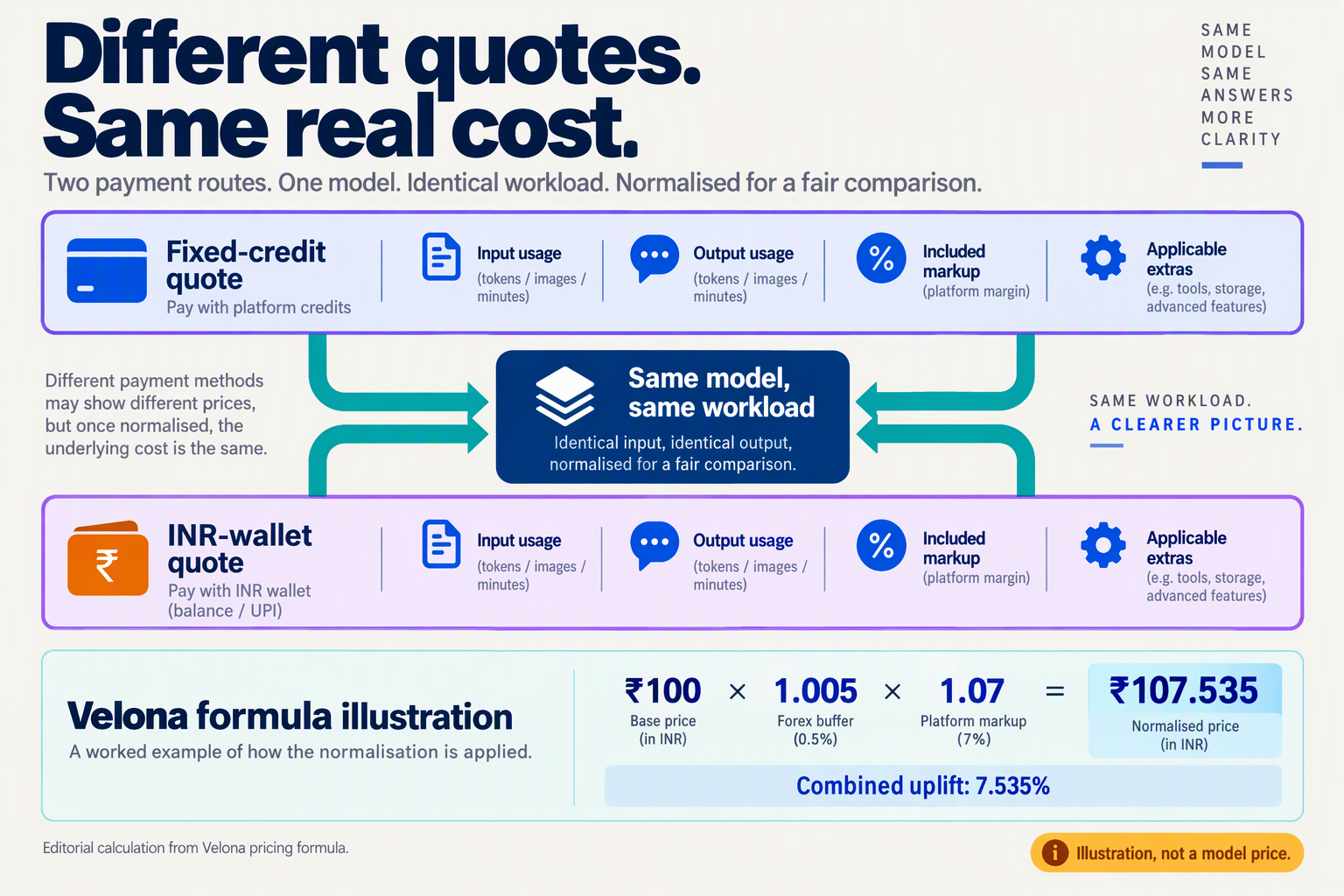
Compare the same model, token volumes and completed tasks, then add currency conversion, platform charges and operational overhead. The October 2026 example below uses hypothetical rates—not a live quote—to show how to compare API workload costs fairly.
How do you calculate an identical workload’s API cost?
- Workload baseline: Use 10,000 completed requests, each averaging 1,500 input tokens and 300 output tokens: that equals 15 million input tokens and 3 million output tokens. Keep the model version, context length, output limit and tools identical; comparing different configurations measures different workloads, not simply different platform prices.
- Token-cost calculation: Assume illustrative provider rates of $0.50 per million input tokens and $2.00 per million output tokens. The baseline costs (15 × $0.50) + (3 × $2.00) = $13.50 before conversion or platform charges. These are hypothetical October 2026 comparison inputs, not verified prices for a named model.
- Velona calculation: According to Velona’s pricing documentation supplied for this October 2026 comparison, INR billing uses provider USD price × live USD/INR rate × 1.005 × 1.07. At an assumed—not live—exchange rate of ₹96/$, the example becomes $13.50 × 96 × 1.005 × 1.07 = ₹1,393.65, before any separately applicable taxes.
- CallMissed calculation: CallMissed’s verified October 2026 fact sheet sets 1 credit = ₹1, but does not provide individual model token rates. Obtain the chosen model’s input and output rates before calculating this workload; if quoted in credits per million tokens, use 15 × input rate + 3 × output rate. Wallet denomination alone cannot establish the cheaper result.
Which hidden costs should your benchmark include?
- Retries and completion rate: If 500 additional attempts consume the same average tokens as the baseline requests, billable volume rises 5%, from 18 million to 18.9 million tokens. Divide total spend by the original 10,000 completed tasks, rather than all attempts, so unsuccessful calls do not make the apparent cost per useful result look lower.
- Caching and reasoning: Record uncached input, cached input, visible output and any separately billed reasoning tokens as distinct categories where applicable. For example, if 40% of 15 million input tokens qualify for cached pricing, calculate 6 million cached plus 9 million uncached tokens; do not apply the discount to all input.
- Multimodal and tool usage: Add separate line items for transcription, speech generation, images and paid searches. An illustrative 1,000 audio minutes cannot be priced using text-token rates alone. Confirm whether each service bills by minute, second, character, image or request, and include billable tool calls triggered inside otherwise identical conversations.
- Decision threshold: Compare totals on the same tax basis and calculate cost per successful task = total workload spend ÷ completed tasks. In the illustrative Velona calculation, ₹1,393.65 ÷ 10,000 ≈ ₹0.1394 per task. Choose the lower-cost option only after both configurations meet the same accuracy, response-time and throughput requirements; cheaper failed answers are not savings.
What are the pros and cons of credits versus an INR wallet?
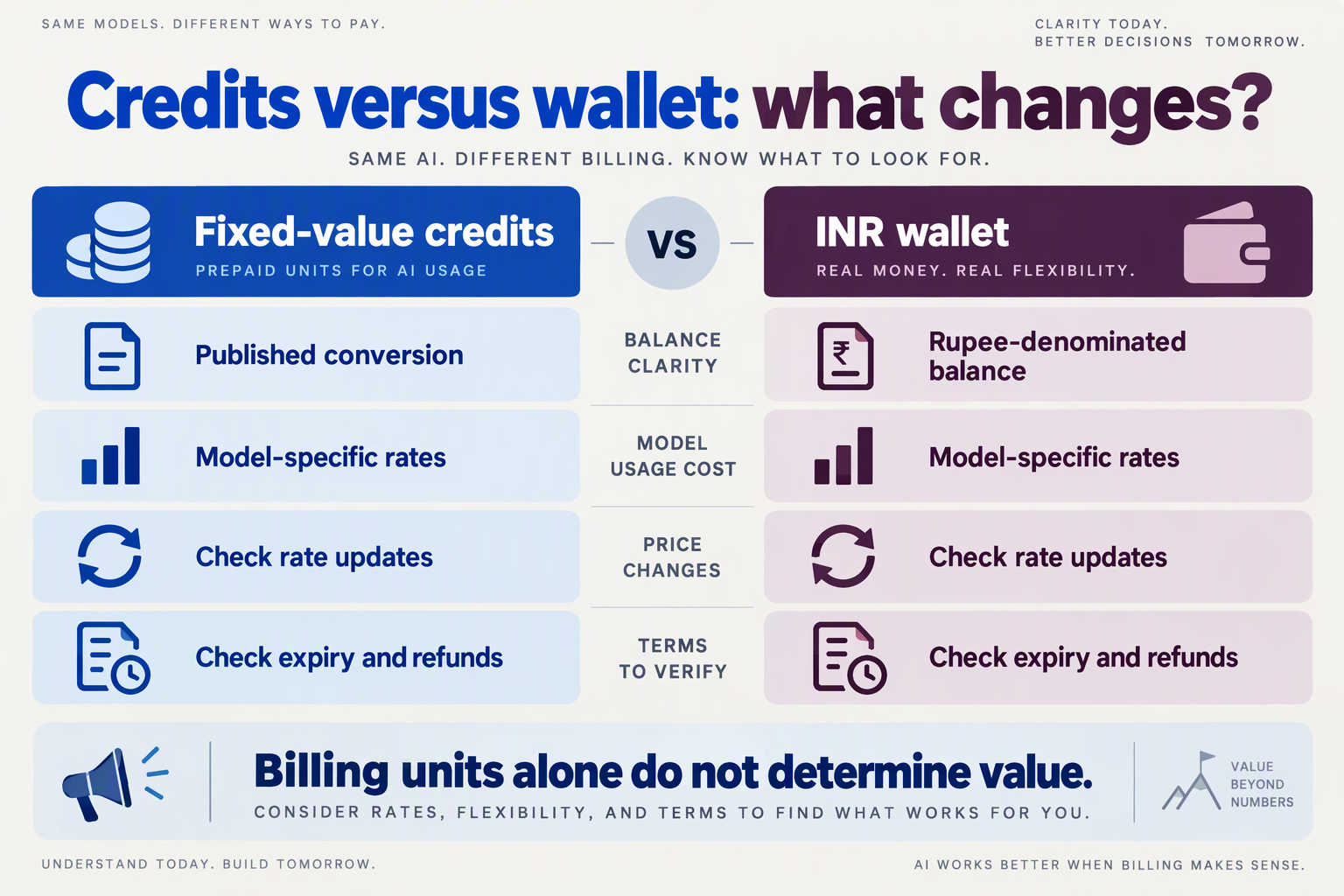
Credits and an INR wallet can be economically equivalent when each credit has a fixed rupee value. The important differences are usage rates, currency exposure, expiry and purchase conditions, not the balance label.
| Decision factor | Fixed-value credits | INR wallet | What to check |
|---|---|---|---|
| Balance readability | Requires knowing the credit-to-rupee conversion. | Displays the available rupee balance directly. | Can finance reconcile deposits, deductions and remaining funds? |
| Workload forecasting | Predictable only when model charges are clear. | Predictable only when model charges are clear. | Calculate input and output costs separately for the same model. |
| Currency exposure | A fixed credit value does not necessarily freeze model rates. | Rupee billing can still incorporate live foreign-exchange conversion. | Check whether inference rates change with exchange rates. |
| Unused funds | Expiry depends on the platform’s terms. | Expiry also depends on the platform’s terms. | Confirm validity; neither billing label guarantees non-expiring funds. |
| Purchase incentives | Bonus credits can complicate effective-cost comparisons. | Promotional wallet balances can create similar complications. | Separate purchased funds from promotional balances and restrictions. |
| Verified examples | As of October 2026, CallMissed’s pricing specifies ₹1 per credit and non-expiring credits. | As of October 2026, Velona’s pricing documentation specifies a prepaid INR wallet with conversion and platform charges. | Compare actual deductions rather than assuming either structure is cheaper. |
How do credits and INR wallets affect your actual AI bill?
- Equivalent balances: In an illustrative October 2026 comparison, purchasing 2,000 credits at ₹1 each and depositing ₹2,000 into an INR wallet provide the same nominal spending balance. Neither establishes how many requests you can run; that requires the selected model’s input-token, output-token or other service rates.
- Combined charges: According to Velona’s pricing documentation available for this October 2026 comparison, the 1.005 forex-buffer multiplier and 1.07 platform-fee multiplier combine to 1.07535, or 7.535% above the currency-converted provider price. Adding the percentages would produce 7.5%, slightly understating the compounded adjustment.
- Worked budget: Using those documented multipliers, an illustrative October 2026 workload costing ₹10,000 after currency conversion would cost ₹10,753.50 before any taxes or charges not established by the supplied context. This is a calculation—not a quoted model tariff—and helps distinguish provider cost from the final wallet deduction.
- Exchange-rate sensitivity: In an illustrative October 2026 scenario, a 5% increase in the INR cost of conversion, with provider prices and multipliers unchanged, raises that ₹10,753.50 workload to approximately ₹11,291.18. Paying in rupees removes foreign-card friction, but does not automatically eliminate exchange-rate exposure.
Which billing structure should Indian developers choose?
- Occasional builders: Prioritise balance validity and manageable deposits over the word “credits.” As of October 2026, CallMissed’s verified pricing permits top-ups of 10–50,000 credits at ₹1 each, without packs or bulk bonuses; that makes purchased-credit arithmetic straightforward, while model-level costs still require evaluation.
- Production teams: For an October 2026 purchasing decision, test one representative workload on each shortlisted platform and record funded amount, consumed balance and successful requests. Choose the structure with clearer reconciliation and acceptable workload costs; credit denomination alone cannot substantiate a “best per-credit pricing AI platform for Indian developers” recommendation.
Which billing option should you choose for your project?
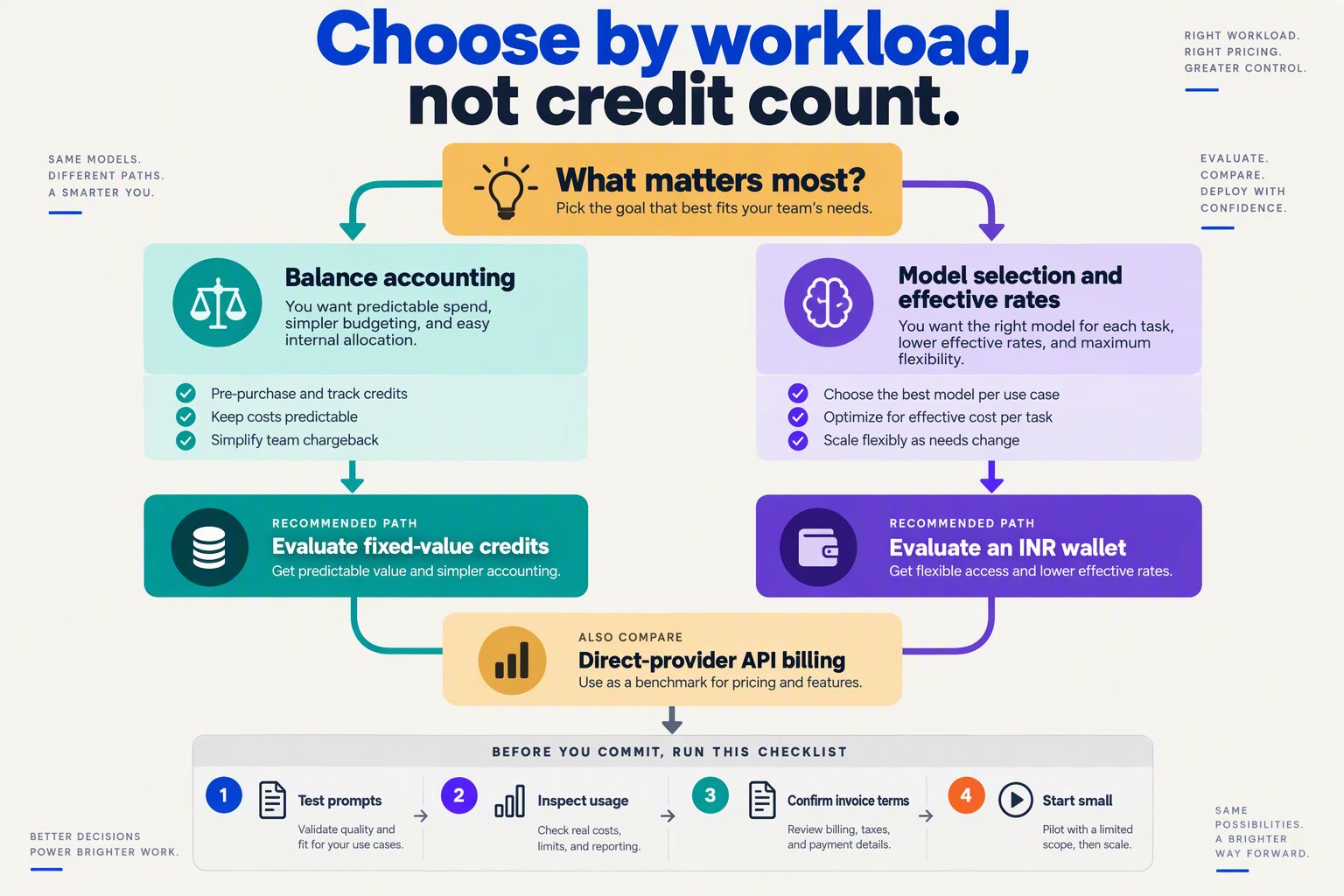
Choose prepaid usage for uncertain demand, a monthly plan for sustained traffic, and workload-specific billing for voice. As of October 2026, the best per-credit pricing AI platform for Indian developers depends on measured consumption and required throughput—not credit denomination alone.
Which billing option fits prototypes and variable traffic?
- Occasional prototypes: Start with a small prepaid budget rather than assuming a monthly commitment will pay off. For an illustrative ₹500 test budget, reserve ₹100 for retries and evaluation, then use ₹400 to measure successful-task costs. These are budgeting assumptions, not published platform rates.
- CallMissed pay-as-you-go: According to CallMissed’s verified October 2026 fact sheet, top-ups support 10–50,000 credits at ₹1 per credit, credits never expire, and signup includes 1,000 free credits. This structure fits intermittent projects: test with the initial allocation, then fund measured demand without buying larger credit packs.
- Velona prepaid billing: According to Velona’s pricing documentation, reviewed for this October 2026 comparison, charges follow provider USD price × live USD/INR rate × 1.005 × 1.07. The combined multipliers equal 1.07535, or 7.535% above the live-converted provider amount; distinguish that calculation from a fixed rupee rate.
- Free-tier experiments: Use free access to validate integration, but benchmark your intended production model separately. According to Velona’s free-tier documentation in the October 2026 context, access requires approval and carries daily-call and requests-per-minute limits. Record those limits before deciding whether free access supports your testing schedule.
When should you choose a monthly plan or workload-specific billing?
- CallMissed monthly plans: According to CallMissed’s verified October 2026 fact sheet, Starter costs ₹999/month, with 550 credits initially and 500 subsequently; Pro costs ₹4,999/month, with 6,000 initially and 5,000 subsequently. Default API limits are 500 and 3,000 requests/minute, respectively: assess both credit allocation and peak traffic, not price alone.
- Predictable production traffic: Forecast a representative month before choosing recurring billing. An illustrative application handling 10,000 requests daily for 30 days produces 300,000 requests; multiply that volume by measured average request cost. Add retries separately, and check peak-minute demand because monthly volume does not establish the rate limit you need.
- Voice-heavy projects: Compare complete call costs rather than borrowing a text-chat estimate. Ask whether billing includes speech recognition, language-model processing and speech generation, then account separately for phone carriage, connection rules and minimum durations. For an illustrative 1,000 connected minutes, multiply the applicable minute rate by 1,000 before adding separately billed services.
- Final selection: Run the same 100 representative tasks through each shortlisted billing option and report cost per successful result, failure rate and peak throughput. This is a recommended evaluation method, not a published benchmark. Choose the option that meets your quality and traffic requirements at the lowest measured total cost.
Frequently Asked Questions
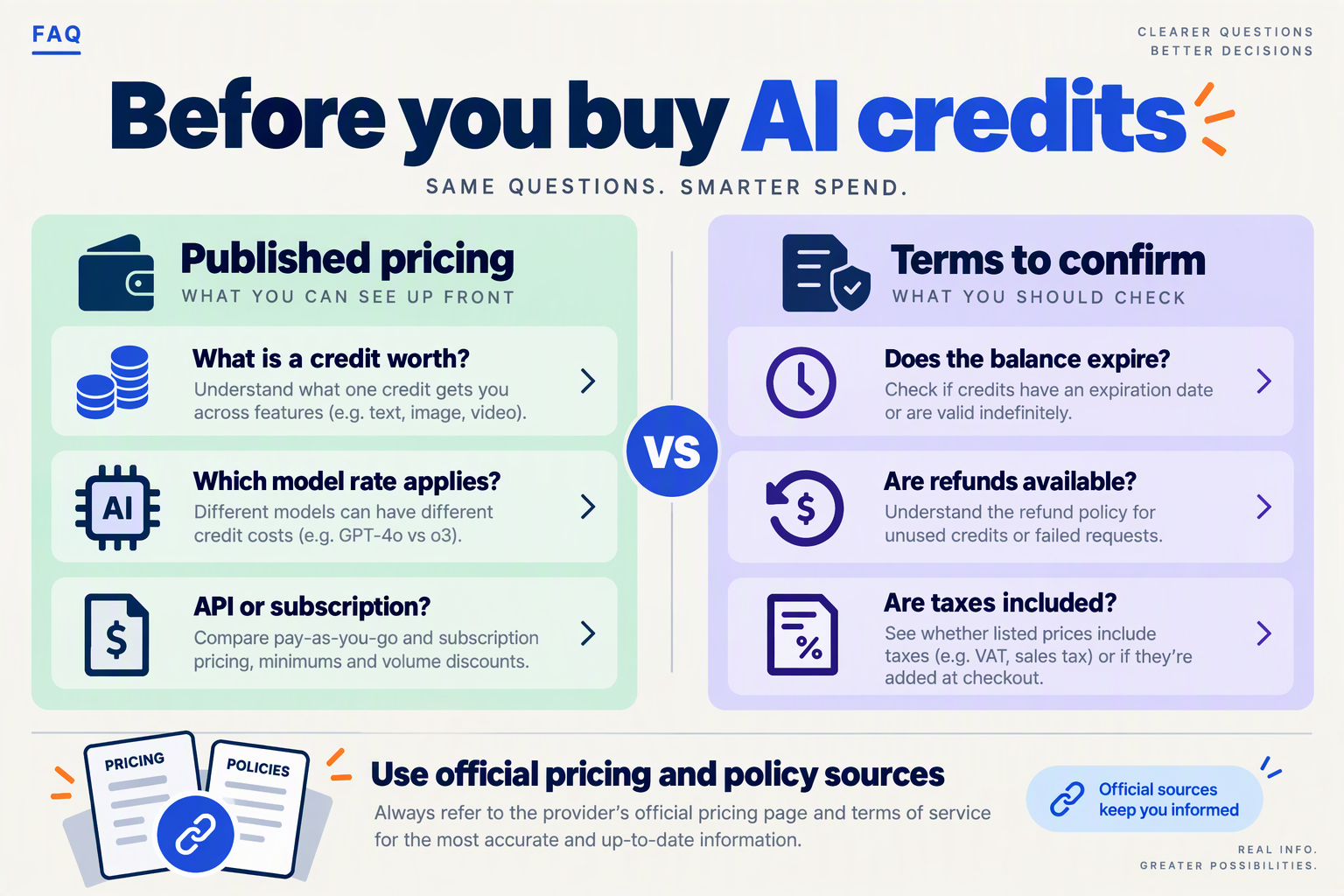
Choose an AI credit platform by the cost of your actual workload, not the face value of its credits. These six questions help Indian developers check billing, trial restrictions and production readiness before funding a wallet.
- Q: How do I choose the best per-credit pricing AI platform for Indian developers?
A: Compare a representative workload across shortlisted platforms using the same model, input tokens, output tokens and request count; a ₹1 credit alone does not establish inference affordability. For example, 10,000 requests averaging 800 input tokens and 200 output tokens require pricing 8 million input tokens and 2 million output tokens separately. Add applicable search, audio and other service charges before comparing the final rupee totals.
- Q: How do foreign-exchange charges affect AI API pricing in rupees?
A: As of October 2026, Velona’s pricing documentation publishes the formula “provider USD price × live USD/INR rate × 1.005 × 1.07,” identifying a forex buffer and platform fee. Multiplying those factors produces 1.07535, or 7.535% above the provider price converted at the live exchange rate. Compare that final billed amount—not the underlying dollar price—and check whether changing exchange rates could affect your monthly budget.
- Q: Can Indian developers buy non-expiring AI credits through UPI?
A: According to CallMissed’s verified pricing, as of October 2026, credits never expire, cost ₹1 each, and can be purchased through UPI, cards or net banking, with GST invoices available. Top-ups range from 10 to 50,000 credits, with no packs or bulk bonus, making ₹750 a straightforward 750-credit purchase. Non-expiring balances suit intermittent projects, but developers should still check model-level consumption because wallet value does not specify how many requests that deposit buys.
- Q: Should the best per-credit pricing AI platform for Indian developers have a free tier?
A: A free tier helps test response quality and integration, but approval requirements and usage caps determine whether it supports your evaluation workload. As of October 2026, Velona’s free-model documentation describes access as “request-and-approve,” with approved zero-cost models subject to daily call limits and requests-per-minute caps. Confirm the applicable limits before planning a benchmark, and compare paid production costs separately rather than treating free access as evidence of long-term affordability.
- Q: What should I check before switching an existing application to an AI gateway?
A: Check the exact endpoints and behaviours your application uses, including streaming, tool calls, structured outputs and error handling; compatibility is not a substitute for testing. Run a small regression suite covering valid responses, malformed requests and interrupted streams before moving production traffic. Include migration effort in the comparison: a lower usage bill may not justify substantial engineering work for a lightly used application.
- Q: What AI API rate limits should I check before buying credits?
A: According to CallMissed’s verified API facts, as of October 2026, default per-key limits are 60 requests/minute on Free, 500 on Starter, 3,000 on Pro and 10,000 on Enterprise. Size your requirement around peak traffic rather than daily averages: 1,000 requests arriving within one minute would exceed a 500-request-per-minute allowance. Maintain separate checks for wallet funding and throughput, because purchasing credits should not be assumed to increase your rate limit.
Conclusion
The best per-credit pricing AI platform for Indian developers is the one that delivers their required workload at the clearest total cost—not the one with the cheapest-looking credit. This October 2026 comparison supports a practical shortlist based on billing transparency, payment convenience, integration effort and credit conditions, rather than an unsupported universal winner.
The decision comes down to four takeaways:
- Compare useful inference, not wallet denominations. A ₹1 credit describes a balance unit; it does not establish how many tokens, transcriptions or speech-generation requests that balance buys. Price the same model against identical input volumes, output volumes and expected request counts. For a customer-support assistant, calculate text inference first, then compare transcription and speech generation separately. Equal deposits are not evidence of equal operating costs.
- Choose transparent pricing that matches your buying priorities. According to Velona’s pricing documentation, as of October 2026, its INR calculation is provider USD price × live USD/INR rate × 1.005 forex buffer × 1.07 platform fee. That published formula suits developers who want to understand currency conversion and platform charges explicitly. According to Velona’s website, its October 2026 catalogue includes 300+ models, with UPI wallet top-ups starting at ₹10. Catalogue breadth and a small starting deposit are useful selection criteria, but neither proves lower costs for a particular workload.
- Evaluate credit flexibility alongside API compatibility. According to CallMissed’s verified pricing and product information, as of October 2026, CallMissed offers ₹1 credits that never expire, UPI payments, and 124 models through one API key and balance. Developers can explore CallMissed when those wallet conditions fit their usage patterns, while checking its OpenAI-compatible or Anthropic-compatible endpoints against their application requirements. A straightforward balance structure can simplify purchasing, but model-level charges still determine how much useful work a deposit delivers.
- Treat free access as a testing opportunity, not a production-cost forecast. Signup incentives can help validate an integration, but recurring usage determines affordability after launch. According to Velona’s free-tier documentation reviewed for this October 2026 comparison, free-model access requires approval and is subject to daily-call and requests-per-minute limits. Check restrictions before building a workload around free availability, and estimate paid costs using expected production traffic.
What should Indian developers watch next?
Watch for changes in model-level rates, currency conversion, platform fees, credit-expiry rules and endpoint compatibility. As catalogues and pricing evolve, revisit the comparison using the same representative workload; a larger model list or revised signup offer alone should not trigger a platform switch.
Before buying AI credits, run a small, matched test and record both the bill and integration effort. Which platform gives your application the clearest, most manageable cost after the prototype becomes a product?
Related Reading
- Claude Opus 5.5 vs GLM 5.3: 2026 Developer Guide
- Best Text to Speech API for Hindi in 2026: Developer Decision Matrix
- Manus AI Pricing 2026: Verification-First Buyer & Developer Guide