Manus AI Pricing 2026: Verification-First Buyer & Developer Guide



Compare Manus AI pricing 2026, credits, connectors, workflows, limits and cost per task using a practical verification framework.
Manus AI Pricing 2026: Verification-First Buyer & Developer Guide
What if the real cost of an AI agent is not its subscription, but the credits consumed when it repeatedly browses, analyses files and takes actions? Manus AI Pricing 2026 requires more scrutiny than a simple plan comparison because Manus is positioned as an autonomous agent: software designed to plan and execute multi-step work, not merely return a conversational answer.
Why Manus matters in 2026
A conventional chatbot generally waits for a prompt and produces a response. Manus AI can break an objective into steps, use tools, access connected data, create outputs and run work on a schedule. That distinction matters when buyers are paying for completed tasks rather than predictable message counts—and when developers must assess permissions, failure handling and credit consumption.
Manus documentation illustrates scheduled automation with precise instructions such as “Every day at 9 AM,” “Every Monday at 8 AM” and “On the 1st of every month.” Manus also describes Projects as persistent, reusable workspaces for repeatable workflows, reducing manual context switching between tasks.
Its integration layer is expanding as well:
- Model Context Protocol (MCP) connectors let Manus access data and perform actions in external applications.
- Manus documentation lists connectors including Gmail, Notion and Stripe, authenticated through OAuth.
- The Google Drive Connector can use files as contextual inputs and write workflow results back to Drive.
- The Slack Connector brings workspace conversations and decisions into agent workflows.
- Manus describes its Meta Ads Manager Connector as an early beta, an important qualification for risk-sensitive buyers.
- Support for open Agent Skills is intended to turn a general-purpose assistant into a more specialized agent.
These capabilities place Manus within a broader shift from standalone AI chat toward action-oriented infrastructure. Platforms such as CallMissed, for example, extend the trend into customer engagement by combining AI voice agents, WhatsApp Business calling and multilingual automation across 22 Indian languages.
What this buyer and developer guide will verify
This guide will separate first-party documentation from marketing interpretation. It will examine:
- What Manus can currently do—and what still requires human review
- How plans, credits and task complexity affect effective cost
- Which connectors are documented, experimental or dependent on external permissions
- How Projects, scheduled tasks, MCP integrations and Agent Skills fit together
- What data Manus may access through OAuth-connected services
- Where autonomous execution creates privacy, security and reliability concerns
- Who should adopt Manus, test it in a controlled pilot or choose a simpler chatbot
Because agent features, connector availability and pricing can change quickly, every consequential claim should be checked against the current Manus pricing page and documentation. The goal is not to declare Manus universally suitable; it is to help buyers estimate real operational value and help developers identify the controls required before an agent is trusted with business data or actions.
What is Manus AI, and is it worth evaluating in 2026?

Manus AI is worth evaluating in 2026 when a team needs an agent to execute repeatable, multi-step digital workflows—not merely answer questions. Buyers should validate it through a controlled pilot because Manus’s documented features establish capability, but do not independently prove accuracy, reliability or cost-effectiveness in a specific production environment.
Manus AI in practical terms
Manus is a general-purpose autonomous AI agent that can interpret an objective, plan steps, use connected tools and produce a deliverable. A conventional chatbot primarily generates a response; an autonomous agent attempts to complete the underlying work.
For example:
- A chatbot explains how to analyse weekly advertising performance.
- Manus can potentially retrieve connected campaign information, compare periods, identify patterns and prepare a report.
- A scheduled Manus task can repeat an approved workflow at a specified time without requiring the user to enter a new prompt each week.
This additional autonomy also creates more failure points. Planning, source selection, permissions, tool calls, calculations and final outputs can each introduce errors. Autonomous does not mean independently trustworthy, especially for financial, legal, healthcare or other high-consequence decisions.
Which Manus capabilities are verifiable?
Manus’s first-party documentation describes several components for persistent and connected automation:
- Projects turn repeatable tasks into persistent, reusable workspaces, according to the Manus announcement “Projects Just Got Smarter with Connectors.”
- Scheduled Tasks support natural-language instructions such as “Every Monday at 8 AM,” “Every weekday at 7 AM” and “Tomorrow at 3 PM,” according to Manus documentation.
- Model Context Protocol connectors allow Manus to access data and perform actions in external applications using OAuth authentication, according to Manus integration documentation.
- Manus lists Gmail, Notion and Stripe among its available MCP connectors.
- Separate first-party announcements document connectors for Slack, Google Drive and Meta Ads Manager.
- The Google Drive Connector can use Drive files as contextual inputs and write workflow results back to Google Drive.
- Manus explicitly described its Meta Ads Manager Connector as an “early beta,” so buyers should not assume production maturity.
- Manus supports open Agent Skills, which package specialist instructions and capabilities for use by a general-purpose agent.
These are vendor-documented features, not independent benchmarks. Connector availability, permissions and functionality may vary by plan, account, geography or rollout stage.
When should Manus make the shortlist?
Manus merits a pilot for workflows involving:
- Recurring web or internal-source research
- Document-heavy work across Google Drive or Notion
- Scheduled summaries based on changing information
- Cross-application tasks requiring both reading and writing
- Rapid workflow prototyping before custom development
A useful evaluation should test at least three representative workflows and record:
- Successful completion rate without human intervention
- Factual, numerical and citation error rates
- Runtime, retries and failed tool calls
- Credits consumed per successful outcome
- OAuth permission scope and data exposure
- Human review time required
Manus may be a weaker fit when deterministic software, a chatbot or a narrowly scoped API can deliver the same result with fewer moving parts. Likewise, customer-facing voice, messaging and omnichannel support workflows may call for a specialist communications platform rather than a general-purpose autonomous workspace.
The decisive question is not whether Manus can complete an impressive demonstration. It is whether Manus can execute the organisation’s real workflow reliably, securely and at an acceptable cost per approved result.
How does an autonomous AI agent differ from a chatbot?
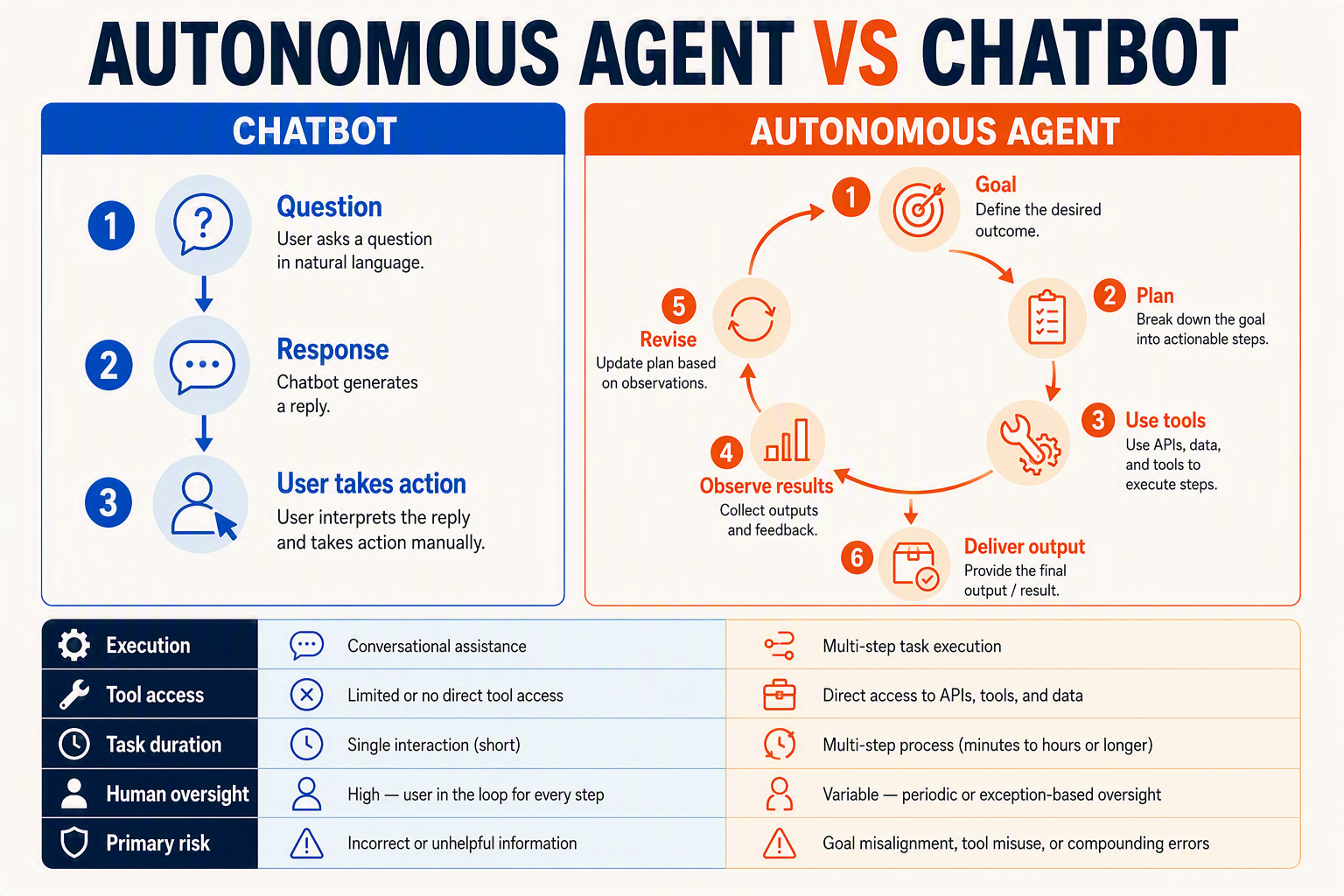
An autonomous AI agent differs from a chatbot because it can plan and execute a sequence of actions toward an objective, while a chatbot primarily generates a response to each user message. In Manus AI, that autonomy can include using tools, retrieving connected data, producing files, writing results to external systems and rerunning workflows on a schedule.
Response generation versus objective execution
A conventional chatbot usually follows a short interaction loop:
- Receive a prompt.
- Generate an answer.
- Wait for the next instruction.
An autonomous agent follows a longer execution loop:
- Interpret the objective and constraints.
- Decompose the objective into subtasks.
- Select tools and data sources.
- Execute actions and inspect intermediate results.
- Revise the plan when necessary.
- Deliver an output or update a connected application.
For example, a chatbot may explain how to create a weekly competitor report. Manus AI could potentially collect the relevant information, analyse it, format a report and place the result in Google Drive or Notion, subject to connector availability, permissions and task configuration.
The practical differences buyers should evaluate
| Dimension | Conventional chatbot | Autonomous AI agent |
|---|---|---|
| Primary unit of work | Message and response | Goal and multi-step task |
| Tool use | Optional or limited | Central to execution |
| Data access | Prompt or uploaded context | Files, web sources and connected applications |
| Timing | User initiates each exchange | Can run once or on a recurring schedule |
| Failure impact | Usually an incorrect answer | May create, modify or transmit data |
The final row is critical. A weak chatbot response may waste time; a poorly controlled agent can take an incorrect action. Buyers should therefore evaluate approval gates, OAuth scopes, auditability, cancellation controls and recovery from partial failure, not just output quality.
What makes Manus agentic?
Manus combines several components that extend beyond conversational output:
- Scheduled Tasks: Manus documentation gives supported instruction patterns including “Every day at 9 AM,” “Every Monday at 8 AM,” “Every weekday at 7 AM” and the one-time schedule “Tomorrow at 3 PM.”
- Projects: Manus describes Projects as persistent, reusable workspaces designed to run repeatable workflows with less context switching.
- MCP connectors: Manus documentation says Model Context Protocol connectors can access data and perform actions in connected applications through OAuth authentication, with Gmail, Notion and Stripe among the documented examples.
- Input-and-output integrations: Manus says its Google Drive Connector can read files as workflow context and write results back to Drive.
- Specialisation: Manus positions open Agent Skills as a way to move from a general assistant toward a specialised agent.
These features do not mean every workflow is fully independent. “Autonomous” describes an operating pattern, not guaranteed correctness or unlimited authority.
Why autonomy changes cost and governance
Agent workloads are less predictable than chatbot exchanges because one objective may trigger multiple browsing, reasoning, file-processing and connector operations. Buyers should measure the cost per successfully completed workflow, rather than comparing subscription prices or nominal message allowances alone.
Before granting production access, teams should define:
- Which systems the agent may read from or write to
- Which actions require human approval
- Maximum runtime, retries and credit consumption
- How credentials and OAuth permissions are revoked
- How outputs and external changes are logged
- What happens when a source is unavailable or contradictory
The verification-first conclusion is simple: a chatbot helps a user decide; an autonomous agent may proceed to do the work. That makes Manus potentially more useful for repeatable operations—but also demands stronger testing, permissions and human oversight.
Which Manus capabilities and 2026 developments can be verified?
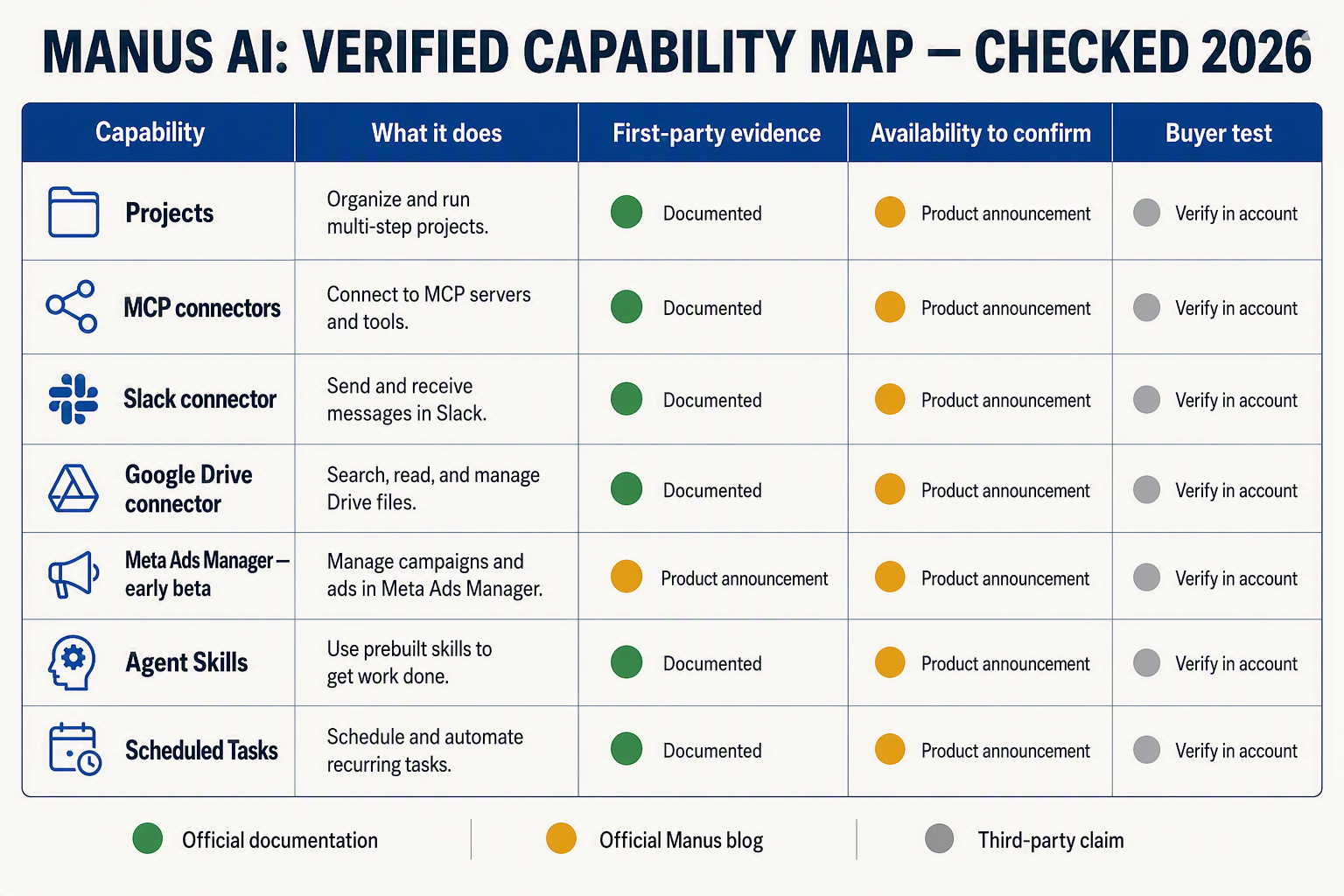
The capabilities that can be verified in 2026 are persistent Projects, scheduled tasks, OAuth-authenticated MCP connectors, Google Drive and Slack integrations, an early-beta Meta Ads Manager connector, and open Agent Skills support. These are documented by Manus itself, but verification of existence does not guarantee production readiness, unrestricted access or reliable autonomous execution.
Verified capability matrix
| Capability | Verified function | Documented status | Buyer/developer check |
|---|---|---|---|
| Projects | Creates persistent, reusable workspaces for repeatable workflows and can incorporate connectors | Announced by Manus | Test whether instructions, context and connector permissions persist as expected |
| Scheduled Tasks | Runs recurring or one-time tasks from natural-language schedules | Documented feature | Confirm timezone, retry behaviour, notifications and credit use |
| MCP Connectors | Accesses data and performs actions in connected applications through OAuth | Documented integration framework | Review OAuth scopes, revocation, write access and admin controls |
| Google Drive Connector | Reads Drive files as context and writes workflow outputs back to Drive | Announced connector | Restrict folders and test file formats, ownership and overwrite handling |
| Slack Connector | Uses workspace conversations and decisions as workflow context | Announced connector | Check channel coverage, private-message access, retention and citations |
| Meta Ads Manager Connector | Supports advertising-analysis workflows inside Manus | Early beta | Keep human approval for recommendations and any spend-affecting action |
Scheduling is verified, but execution controls still need testing
Manus documentation gives five explicit scheduling patterns: “Every day at 9 AM,” “Every Monday at 8 AM,” “On the 1st of every month,” “Every weekday at 7 AM,” and “Tomorrow at 3 PM.” This confirms support for daily, weekly, monthly, weekday and one-time scheduling, but the supplied documentation does not establish service-level guarantees, retry limits or maximum run frequency.
A serious pilot should therefore verify:
- Which timezone governs execution.
- Whether failed steps retry automatically.
- How users are notified of partial completion.
- Whether each scheduled run consumes credits independently.
- How to pause or revoke a task immediately.
Connectors expand capability—and the permission boundary
Manus documentation states that Model Context Protocol connectors can access data and perform actions within connected apps using OAuth authentication. The documented examples include Gmail, Notion and Stripe, while separate first-party announcements cover Google Drive, Slack and Meta Ads Manager.
The distinction between read context and take action is crucial. Google Drive is described by Manus as both an input for contextual data and an output destination for results. Slack can surface conversations and decisions, potentially exposing sensitive internal material if workspace scopes are too broad. Meta Ads Manager is explicitly labelled “early beta” by Manus, so buyers should not treat it as equivalent to a mature, generally available integration.
Before deployment, record:
- Requested OAuth scopes and whether they are read-only or write-enabled
- Workspace, channel, folder and account boundaries
- Token revocation and offboarding procedures
- Audit logs for agent actions
- Human-approval requirements for consequential changes
Agent Skills are promising, not proof of task quality
Manus says support for open Agent Skills is designed to move an agent from a “general assistant” toward a “specialized expert.” That verifies the extensibility direction, not the accuracy, safety or interoperability of every skill. Developers should inspect a skill’s instructions, tool calls, dependencies and data handling before enabling it.
The verification-first conclusion is straightforward: Manus has documented building blocks for reusable, connected and scheduled agent workflows, but buyers must separately validate permissions, reliability, credit consumption and output quality in their own environment. Feature availability should also be rechecked in current Manus documentation before procurement because connector status can change.
How do Manus Projects, connectors and scheduled tasks support real workflows?
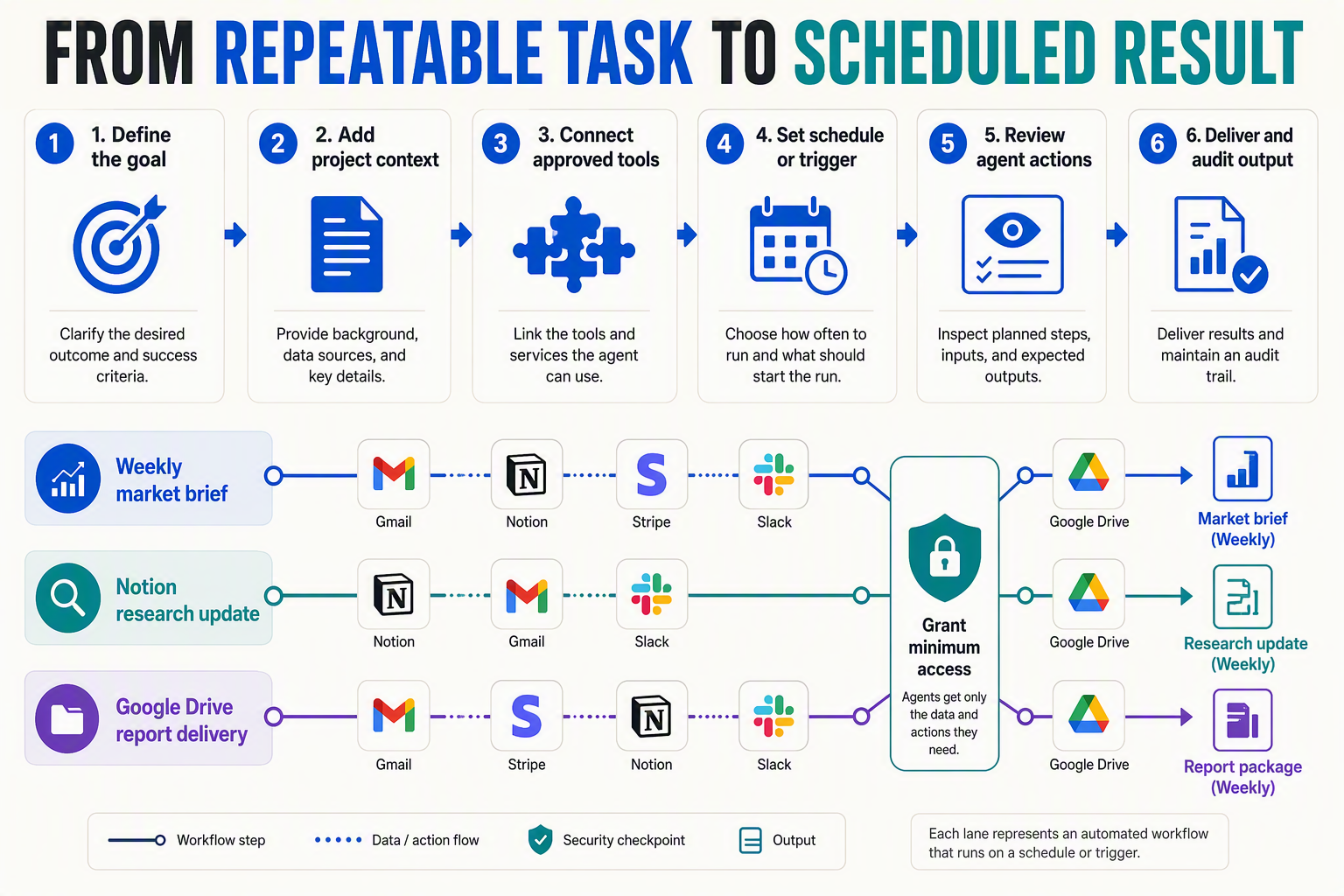
Manus Projects provide persistent workflow context, connectors supply authorised external data and actions, and scheduled tasks trigger the workflow at defined times. Combined, these components can turn a one-off prompt into a repeatable operational process—but buyers should verify connector permissions, output destinations and beta status before production use.
Projects act as reusable workflow containers
Manus describes Projects as persistent, reusable workspaces for recurring tasks. A Project can preserve the instructions, resources and connected services needed for a process, reducing the need to restate requirements or manually transfer context each time.
A practical Project should define:
- Objective: What outcome must the agent produce?
- Inputs: Which documents, messages or connected records may it use?
- Method: What steps, filters or evaluation criteria apply?
- Output: Where should results be written, and in what format?
- Review boundary: Which actions require human approval?
For example, a marketing team could create a Project that researches weekly trends, compares them with existing campaign plans and writes recommendations to Notion. Manus’s first-party Notion MCP case study specifically describes putting weekly TikTok trend research on “autopilot,” replacing repeated manual research into videos, sounds and hashtags.
Persistence improves consistency, but it also creates governance questions. Teams should check whether updated instructions replace older ones, how connected data is retained, and whether Project access follows individual or workspace-level permissions.
Connectors bridge reasoning and external systems
Model Context Protocol (MCP) connectors are prebuilt integrations that let Manus access data and perform actions in connected applications through OAuth authentication, according to Manus documentation. The documented connector set includes Gmail, Notion and Stripe, while separate first-party announcements describe Google Drive, Slack and Meta Ads Manager integrations.
Their roles differ:
- Google Drive: Uses Drive files as contextual inputs and can write workflow results back to Drive.
- Slack: Brings workspace conversations, decisions and coordination context into agent workflows.
- Notion: Supports workflows that read from or contribute to structured team knowledge.
- Gmail and Stripe: Provide access to connected communications or business data, subject to granted OAuth scopes.
- Meta Ads Manager: Manus explicitly labels this connector an “early beta,” so buyers should not treat it as equivalent to a mature production integration.
Developers should inspect the exact OAuth scopes rather than relying on a generic “connected” status. Read-only access, write access and authority to initiate consequential actions create materially different risk profiles.
Scheduled tasks turn Projects into recurring operations
Manus scheduled tasks use natural-language timing instructions. Manus documentation provides five concrete schedule patterns: “Every day at 9 AM,” “Every Monday at 8 AM,” “On the 1st of every month,” “Every weekday at 7 AM” and “Tomorrow at 3 PM” for a one-time run.
A complete scheduled workflow therefore follows three stages:
- Describe the task precisely.
- Specify the recurrence or one-time execution time.
- Define the required output and destination.
One example is a Monday-morning Project that reads selected Slack discussions, reviews files in Google Drive and publishes a structured summary to Notion. Before deployment, verify the timezone, behaviour after failed runs, duplicate-run handling, notification rules and whether each execution consumes credits independently.
The safest production pattern is automation with checkpoints: allow Manus to collect, classify and draft autonomously, while requiring approval before sending external messages, modifying financial records or changing advertising settings.
How much does Manus AI cost, and what is the real cost per completed task?
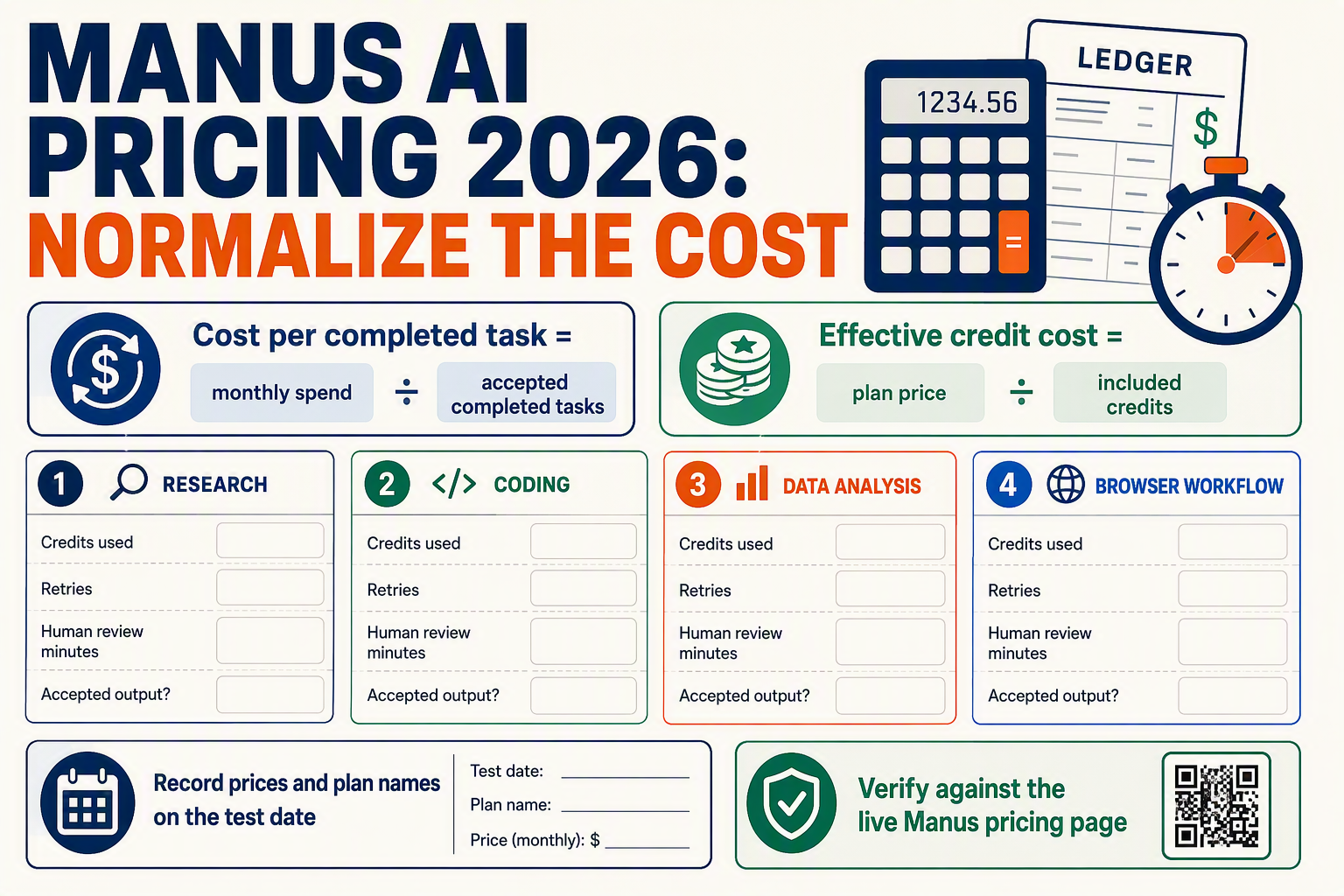
A verified 2026 Manus AI price or universal cost per completed task cannot be established from the supplied first-party sources. The reviewed Manus documentation describes connectors, projects and scheduled tasks, but it does not provide a current pricing table or establish how credits are calculated, deducted, refunded or tied to specific operations.
Verify live billing terms before purchase
Check the Manus checkout page, account console and applicable billing terms on the day of purchase. Do not treat old screenshots, reviews or search snippets as current pricing evidence.
Record and date-stamp:
- Monthly and annual prices, billing currency and applicable taxes
- Included usage, seats and workspace limits
- Any credit allowance and top-up price, if credits appear in the live plan
- The provider’s definition of a credit and how consumption is calculated
- Expiration or rollover rules for unused allowances
- Limits for concurrent, scheduled and recurring tasks
- Cancellation, refund and failed-run policies
- Team-plan permissions and per-seat charges
The supplied first-party sources do not confirm that browsing, connector calls, retries or other individual operations consume Manus credits. Buyers should not assign credit values to these actions unless the live billing interface or contractual documentation explicitly does so.
Measure cost per accepted output
The decision-grade metric is cost per accepted task, rather than price per prompt or initiated run:
Platform cost per accepted task = total Manus platform spend ÷ outputs meeting predefined acceptance criteria
For a broader total-cost calculation, use:
All-in cost per accepted task = (platform spend + external-service charges + review labour) ÷ accepted outputs
Consider this hypothetical testing assumption, not a Manus price quote or description of Manus billing:
- A team allocates ₹10,000 to an agent pilot.
- It initiates 200 tasks.
- Twenty tasks fail, while 30 require reruns or remain unusable.
- The team accepts 150 outputs.
- The hypothetical platform cost is ₹66.67 per accepted task, rather than ₹50 per initiated task.
If reviewing each accepted output takes ten minutes, the team performs 25 hours of review. At an assumed labour rate of ₹600 per hour, review adds ₹15,000 and raises the hypothetical all-in cost to ₹166.67 per accepted output.
Model possible cost drivers as assumptions
Until Manus documents its billing mechanics, treat these as variables to test, not confirmed credit-consuming events:
- Workflow length and number of execution steps
- Document volume and complexity
- Browsing, connector use and external tool calls
- Retries, timeouts and requested revisions
- Output length or file format
- Scheduled execution frequency
- Human review and remediation time
- Third-party API, advertising or data charges
Manus Documentation gives schedule examples including “Every day at 9 AM,” “Every Monday at 8 AM” and “On the 1st of every month.” A daily schedule can produce approximately 30 executions in a 30-day month, so any per-run cost discovered during testing may multiply quickly.
Run a controlled pilot
Test simple, medium and complex workloads. Log initiated runs, accepted outputs, failures, retries, elapsed time and reviewer minutes. If the live Manus console displays credit debits, record those debits without assuming which internal operation caused them.
Manus Documentation lists Gmail, Notion and Stripe among its Model Context Protocol connectors, while first-party Manus posts also describe Google Drive and Meta Ads Manager integrations. Separate any charges from connected services from Manus platform spend. Compare median and worst-case cost per accepted task before committing to a plan.
Which limitations, privacy issues and operational risks should buyers test?
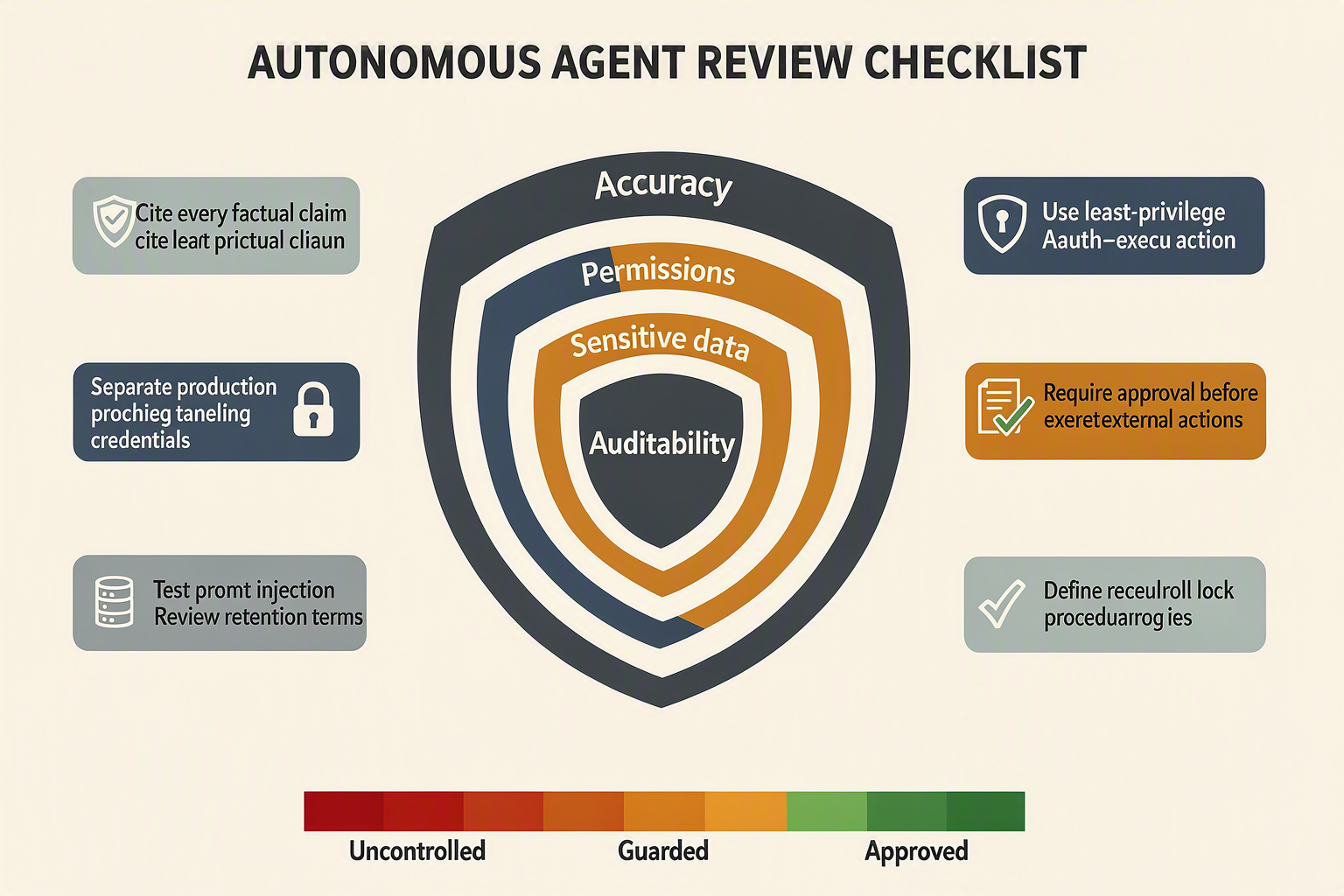
Buyers should treat Manus AI as a privileged automation operator, not a low-risk chatbot. Before deployment, test what data it can read, which actions it can execute, how it behaves when inputs change, and whether failures can be detected, reversed and audited.
Permission scope and privacy boundaries
Manus Documentation states that Model Context Protocol (MCP) connectors use OAuth authentication to access data and perform actions in connected applications. OAuth avoids sharing passwords, but it does not eliminate risk: the practical exposure depends on requested scopes, workspace permissions and the connected user’s access level.
Run a connector-by-connector privacy review:
- Record every OAuth scope requested by Gmail, Notion, Stripe, Google Drive, Slack and other integrations.
- Test whether read-only access is available when write access is unnecessary.
- Connect a dedicated least-privilege service account rather than an executive or administrator account.
- Verify whether revoking OAuth immediately stops scheduled tasks and persistent Projects.
- Determine what prompts, retrieved records, generated files and tool outputs Manus retains—and for how long.
- Confirm data residency, subprocessors, encryption, deletion procedures and model-training policies in the current contractual documents.
The Google Drive Connector deserves bidirectional testing because Manus says it can use Drive files as contextual input and write results back to Drive. Similarly, the Slack Connector can expose workspace conversations and decisions, potentially including personal data, confidential discussions or information outside the intended project.
Reliability and autonomous-action tests
A fluent final answer does not prove that every intermediate action was correct. Buyers should create a sandbox and deliberately test adverse conditions:
- Ambiguous instructions: Does Manus ask for clarification or make an unsafe assumption?
- Stale or conflicting records: Which source wins when Slack, Notion and Drive disagree?
- Partial failure: What happens if one tool succeeds but the next API call times out?
- Duplicate execution: Can a retry send the same email, create the same record or update the same file twice?
- Prompt injection: Can malicious text inside an email, document or webpage redirect the agent’s workflow?
- Approval gates: Can high-impact actions require human confirmation?
- Auditability: Are tool calls, source records, timestamps, outputs and errors visible in logs?
Test destructive and financially consequential actions separately. A connector that can analyze Stripe data poses a different risk from one that can modify records; buyers must verify the actual permissions rather than infer them from the connector name.
Scheduling, beta features and cost controls
Manus Documentation supports schedules such as “Every day at 9 AM,” “Every weekday at 7 AM” and “On the 1st of every month.” Buyers should verify timezone handling, daylight-saving changes, missed-run recovery, concurrency limits and whether edited Projects alter already scheduled executions.
Feature maturity also matters. Manus describes the Meta Ads Manager Connector as an “early beta,” so production evaluations should examine schema changes, rate limits, permission errors and rollback behaviour before allowing campaign-related actions.
Finally, autonomous workflows can consume credits through repeated browsing, file analysis and retries. Set per-task budgets and alerts, then benchmark at least 30 representative runs—not as a universal performance statistic, but as a practical sample for estimating variance. The production gate should require acceptable completion rates, predictable credit use, documented human escalation and tested connector revocation.
What do official documentation, hands-on tests and third-party opinions actually establish?

Official Manus documentation establishes that the product supports repeatable agent workflows, scheduling and OAuth-based connectors; it does not, by itself, establish reliability, cost efficiency or safe autonomous operation under production conditions. The evidence supplied for this guide contains first-party documentation and examples, but no reproducible hands-on benchmark or sufficiently detailed independent review, so broader performance claims remain unverified.
What first-party sources confirm
Manus documentation provides the strongest evidence for feature availability and intended operation. Based on the cited official materials, buyers can reasonably verify that:
- Scheduled Tasks accept natural-language timing instructions, including “Every day at 9 AM,” “Every Monday at 8 AM,” “On the 1st of every month” and one-time schedules such as “Tomorrow at 3 PM.”
- Model Context Protocol connectors can access data and perform actions in connected applications using OAuth authentication, according to Manus Documentation.
- Manus Documentation explicitly names Gmail, Notion and Stripe among available MCP connectors.
- The official Google Drive Connector description says Google Drive can serve as both an input for contextual data and an output destination for results.
- Manus describes its Slack Connector as a way to use workspace conversations and decisions in workflows.
- Manus explicitly labels its Meta Ads Manager Connector “an early beta,” which establishes that buyers should not treat it as equivalent to a mature, generally available integration.
- The Manus Agent Skills announcement confirms an intention to support open skills that specialize a general-purpose agent.
These sources establish the product’s documented interface—not its success rate across every account, permission configuration or task type.
What hands-on testing must establish
A credible test should begin with a fixed task, a controlled dataset and a recorded starting credit balance. Testers should then repeat the workflow enough times to expose variance rather than reporting one successful demonstration.
A useful protocol is:
- Run the same task at least 10 times with identical inputs.
- Record completion status, elapsed time, tool calls and credits consumed.
- Change one variable, such as file size or connector permissions.
- Verify every external action against the source application.
- Test interruption, expired OAuth access and ambiguous instructions.
- Repeat scheduled runs to detect silent failures or output drift.
The supplied research contains no test results following this or another reproducible protocol. Consequently, it does not establish median task cost, completion rate, latency, hallucination frequency or recovery performance.
How to interpret third-party opinions
Independent reviews can reveal usability problems that product documentation naturally omits, but an opinion is not a benchmark. Give more weight to reports that disclose:
- The date, plan and geographic region tested
- Exact prompts, files, connectors and expected outputs
- Credit usage before and after each run
- Screenshots or logs showing failures as well as successes
- Whether the reviewer paid for access or received sponsorship
No specific third-party test evidence appears in the provided source set. Claims such as “fully autonomous,” “production-ready” or “cost-effective” therefore cannot be validated here through independent corroboration.
The defensible conclusion
The evidence supports describing Manus as a tool-using agent platform with documented scheduling, Projects, MCP connectors and Agent Skills. It does not support assuming unattended reliability, predictable credit consumption or universal connector stability.
For procurement, classify each conclusion as documented, independently reproduced or not yet verified. Approve production use only after a bounded pilot measures cost, accuracy, permissions and failure recovery against the organization’s own workflow.
Who should use Manus, and when is CallMissed or another specialist platform more relevant?
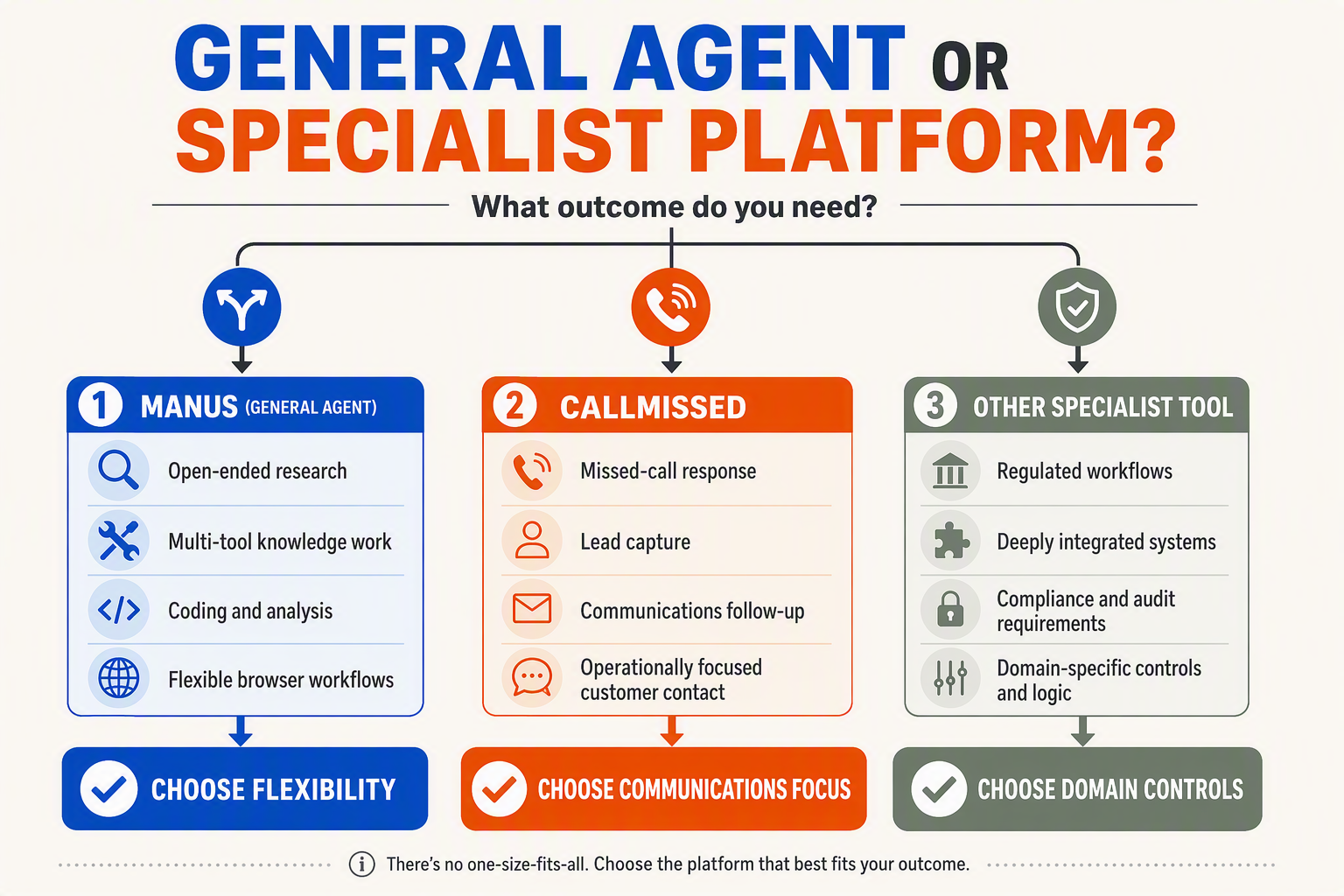
Use Manus when the objective is a repeatable, multi-step knowledge workflow involving connected data, tool actions and scheduled outputs. If the primary requirement is customer communication, telephony or messaging operations, a communications-focused specialist such as CallMissed may be more relevant—but its channel support, compliance, reliability and integrations should be verified separately.
Best-fit users and workflows for Manus
Manus is suited to teams that can define a clear outcome but want an agent to coordinate research, analysis and tool use. Likely users include:
- Marketing teams producing recurring trend reports, campaign analyses and content briefs.
- Operations teams coordinating information across connected workplace applications.
- Analysts and founders comparing documents, researching markets and creating structured deliverables.
- Developers and automation teams testing Model Context Protocol (MCP) connectors or Agent Skills.
- Small teams exploring agentic automation without immediately building custom orchestration infrastructure.
Manus documentation says MCP connectors can access data and perform actions in connected applications through OAuth authentication, with named connectors including Gmail, Notion and Stripe. Manus also states that its Google Drive Connector can use Drive files as contextual inputs and write workflow results back to Google Drive.
A practical Manus task normally has four characteristics:
- It requires several reasoning, retrieval or tool-use steps.
- Its inputs are available through documented connectors or MCP integrations.
- A person can review the result before any consequential action.
- Reusable Projects or scheduled execution create measurable value.
Recurring monitoring is a particularly clear use case. Manus documentation lists schedules such as “Every day at 9 AM,” “Every Monday at 8 AM,” “On the 1st of every month” and “Every weekday at 7 AM.” Manus also describes a Notion MCP example in which a marketing workflow monitors TikTok videos, sounds and hashtags before applying those trends to campaign planning.
These examples establish documented possibilities, not guaranteed outcomes for every account, dataset or workload. Buyers should test connector permissions, output quality, execution time and credit consumption with representative tasks.
When a specialist or deterministic system is more appropriate
Manus may be the wrong abstraction when a workflow demands:
- Predictable, rules-based execution rather than open-ended reasoning.
- Strict latency, throughput or availability commitments.
- Domain-specific compliance controls and complete auditability.
- High-consequence transactions that cannot tolerate ambiguous actions.
- Dedicated telephony, messaging or customer-service functionality.
- A direct answer that a conventional chatbot or search tool can provide more efficiently.
Connector maturity also matters. Manus describes its Meta Ads Manager Connector as an “early beta.” A beta integration should not become a critical production dependency until the buyer has tested authentication, permission boundaries, error handling, revocation, fallback procedures and human approvals.
Choosing between Manus and a communications specialist
The distinction should follow the primary workload, not the broad promise of “AI automation”:
- Choose Manus for documented workflows that research information, use connected workplace data, generate deliverables and run on schedules.
- Evaluate CallMissed or another communications-focused specialist when the central requirement involves customer conversations, calling or messaging-channel operations.
- Choose deterministic software when consistency and bounded behaviour matter more than autonomous planning.
- Combine systems only after verifying data ownership, handoff logic, failure recovery and security controls across both vendors.
A short proof of concept should use real workflow samples and predefined acceptance criteria. Vendor documentation confirms feature availability; it does not replace independent testing for production suitability.
What does Manus mean for your role and evaluation plan?
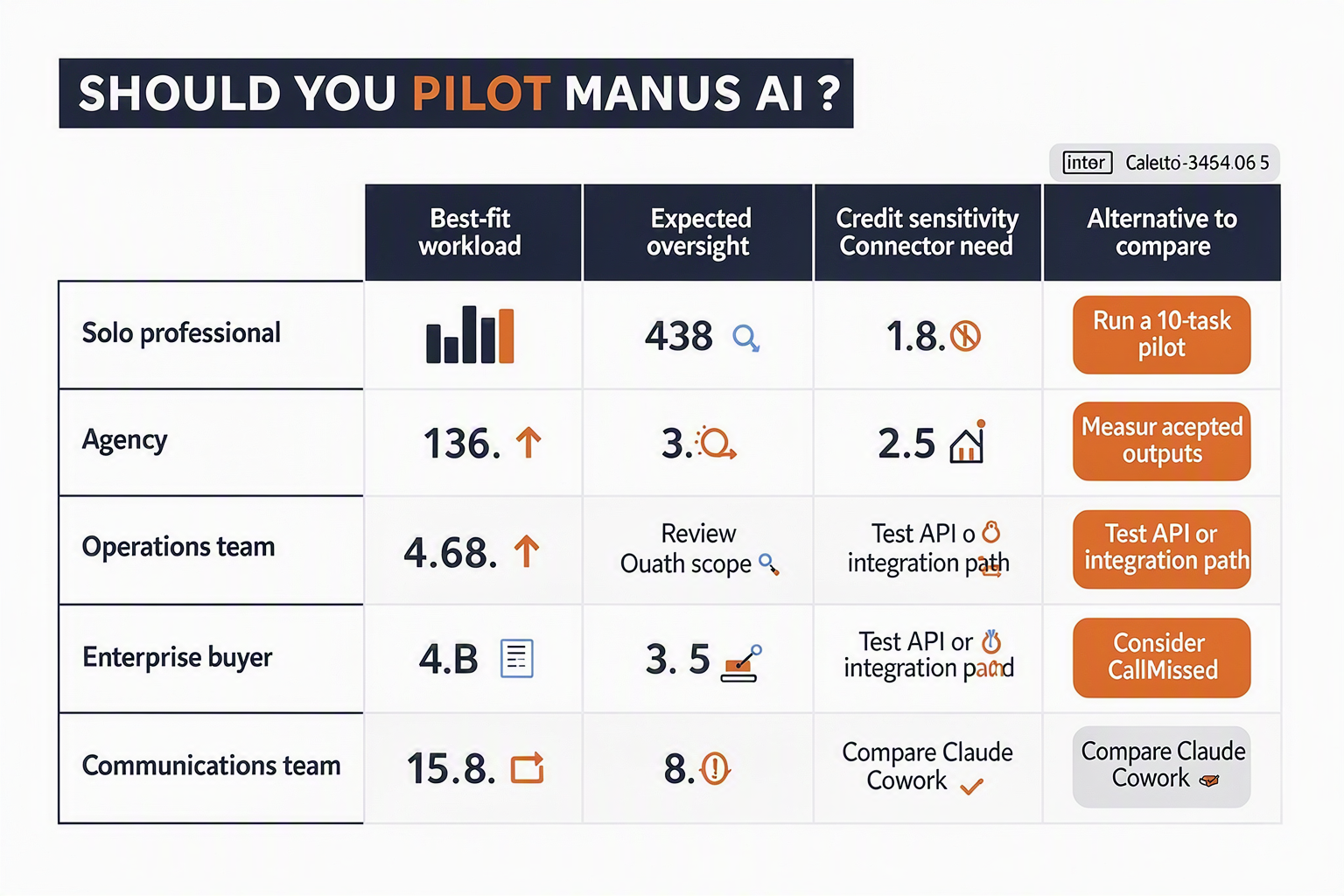
Your role determines whether Manus should be evaluated for research quality, workflow completion, integration safety or financial predictability. Every buyer should test Manus with representative tasks and production-like permissions rather than treating a successful chatbot-style demo as evidence of autonomous reliability.
Role-based evaluation matrix
| Role | Priority workflow | Evidence to collect | Go/no-go criterion |
|---|---|---|---|
| Business leader | Recurring reports and cross-team workflows | Completion rate, turnaround time, human-review effort and credits consumed | Measurable time savings without unacceptable errors or unpredictable spend |
| Operations lead | Scheduled data collection, analysis and document creation | Run logs, missed schedules, duplicate actions, exception handling and output consistency | Repeatable execution across multiple cycles with a documented recovery process |
| Developer | MCP connectors, Agent Skills and application integration | Authentication flow, permission scope, tool-call traces, failure responses and reproducibility | Least-privilege access, observable failures and maintainable integration boundaries |
| Security or compliance lead | OAuth-connected Gmail, Notion, Stripe, Slack or Google Drive data | Requested scopes, data destinations, retention controls, revocation tests and auditability | Approved data handling, effective access revocation and no unexplained external actions |
| Marketing team | Trend research, campaign reporting or Meta Ads analysis | Source accuracy, recommendation quality, approval controls and campaign-impact risk | Human approval before consequential changes; stricter limits for beta connectors |
| Finance or procurement | High-volume and scheduled workloads | Credits per successful task, retries, monthly variance and plan limits | Forecastable cost per completed outcome rather than an acceptable headline subscription price |
Run a controlled evaluation, not a one-prompt demo
A useful pilot should last for several workflow cycles and include both normal and adversarial cases:
- Define an outcome. Specify the expected artifact, allowed tools, deadline and accuracy threshold. Manus documentation advises users to describe the task, specify the schedule and define the output.
- Create a representative task set. Include straightforward work, ambiguous instructions, inaccessible files, stale data and unavailable external services.
- Test recurring execution. Manus documentation supports schedules such as “Every day at 9 AM,” “Every Monday at 8 AM” and “On the 1st of every month.” Verify timezone handling, late runs, duplicate runs and notification behaviour.
- Measure full task economics. Record credits consumed by successful runs, failed attempts, browsing, file analysis and retries. The meaningful metric is cost per approved outcome, not cost per prompt.
- Review every external action. Confirm whether Manus only reads information or can also create, modify or transmit data.
Track at least these pilot metrics:
- Task completion rate: approved outputs divided by initiated tasks.
- Human-intervention rate: runs requiring correction, clarification or recovery.
- Credit cost per approved output: total credits divided by accepted deliverables.
- Schedule reliability: expected runs compared with correctly completed runs.
- Connector failure rate: authentication, permission and external-service errors.
- Unsupported-claim rate: statements that reviewers cannot trace to supplied or retrieved sources.
Apply stricter gates to connectors
Manus documentation says MCP connectors use OAuth to access data and perform actions in connected applications, so connector testing must include scope inspection and token revocation. Google Drive deserves separate read/write tests because Manus describes it as both a contextual input and an output destination; Slack tests should verify channel boundaries and access to historical conversations.
Feature maturity also changes the decision. Manus explicitly describes its Meta Ads Manager Connector as an “early beta,” so it should begin with read-only analysis or mandatory approval—not unsupervised campaign changes. Finally, recheck documentation, plan terms and connector availability immediately before procurement because the verified feature set can change after this September 8, 2026 assessment.
Frequently asked questions about Manus AI pricing, credits and capabilities
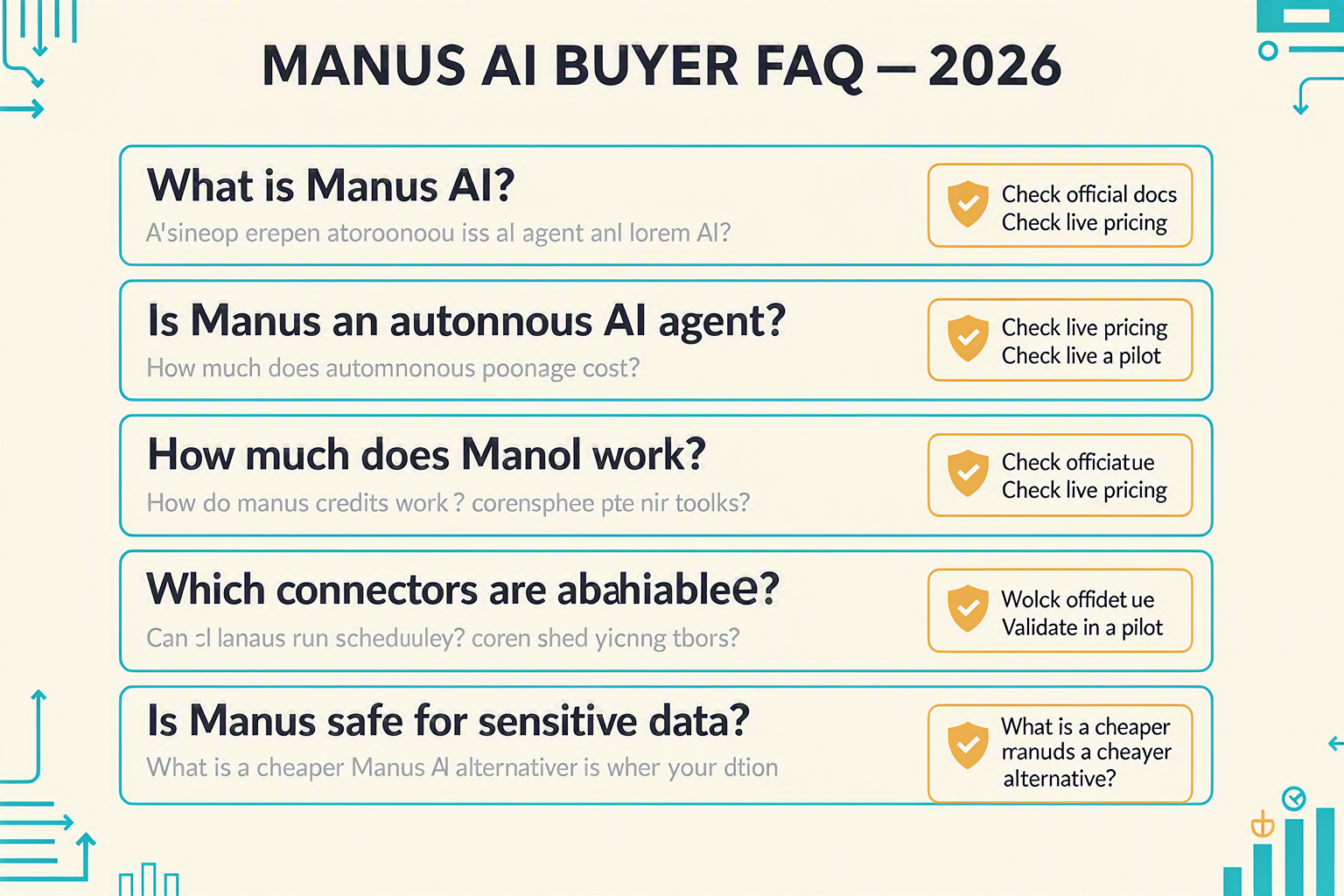
How much does Manus AI cost in 2026?
Does Manus offer a free plan, trial or paid subscription?
What is the difference between a Manus subscription and Manus credits?
How should buyers calculate the cost per successful task?
What repeatable trial method should a team use before subscribing?
Do unused credits roll over, expire or qualify for refunds?
What can Manus automate beyond answering chatbot questions?
Which connectors does Manus support, and are connected-app costs included?
Is Manus suitable for production workflows involving sensitive business data?
Conclusion
Manus AI should be evaluated as an autonomous execution system, not as a chatbot subscription. Its value depends on whether multi-step workflows save enough time to justify variable credit consumption, integration risk and the human oversight required when agents browse, analyse files or act in connected applications.
Key takeaways for buyers and developers are:
- Calculate cost by completed workflow, not headline plan price. Credits may be consumed across planning, browsing, file analysis and repeated actions, so test representative tasks and record both successful and failed runs.
- Verify every capability against current first-party documentation. Manus documents persistent Projects and scheduled instructions such as “Every day at 9 AM” and “Every Monday at 8 AM,” but availability, limits and pricing can change.
- Treat connectors as privileged access. Manus documentation says Model Context Protocol connectors use OAuth to access services such as Gmail, Notion and Stripe; Google Drive can supply context and receive outputs, while Slack can expose workspace conversations to workflows. Permissions should follow least-privilege principles and be reviewed regularly.
- Match oversight to operational risk. Research and draft generation may tolerate occasional errors, whereas financial, advertising or customer-facing actions require approvals, auditability and recovery procedures. Status labels also matter: Manus describes its Meta Ads Manager Connector as an early beta.
The next phase of agent adoption will be shaped by more than model intelligence. Watch for clearer credit accounting, stronger failure handling, granular connector permissions, dependable scheduled execution and broader support for open Agent Skills. These developments will determine whether autonomous agents move from controlled pilots into routine operations.
The same shift is reaching customer communications. To explore how AI communication is evolving, check out CallMissed—an AI infrastructure platform supporting voice agents, WhatsApp Business calling and multilingual automation across 22 Indian languages.
Before purchasing Manus AI, ask one decisive question: Can your team verify what the agent accessed, what it did, what it cost and how to reverse the outcome?
Related Reading
- What is the Best AI Voice Agent for Small Businesses in 2026? A Verification-First Buyer’s Guide
- Manus vs Grok Bot: Which Autonomous AI Agent Wins in 2026?
- Manus AI Automation in 2026: Hands-On Guide to Business Workflows