Manus vs Grok Bot: Which Autonomous AI Agent Wins in 2026?


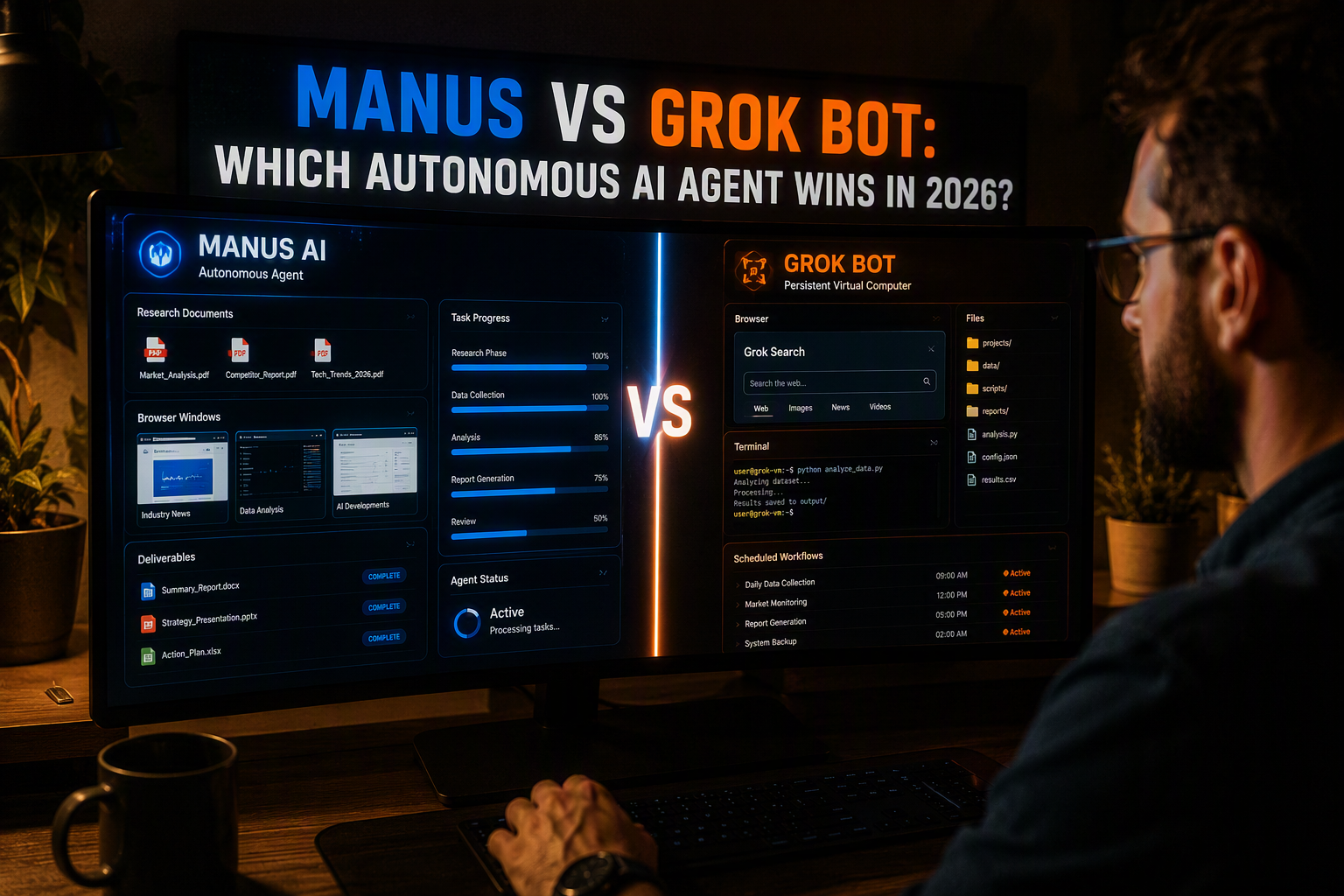
Compare Manus vs Grok Bot on cloud execution, browser control, terminal access, pricing, security, and task fit for autonomous work in 2026.
Manus vs Grok Bot: Which Autonomous AI Agent Wins in 2026?
What if an AI agent could keep working after you close your laptop—using a browser, terminal, files, and logged-in business apps without constant prompting? Manus vs Grok Bot is therefore less about chatbot intelligence and more about which platform can reliably complete autonomous work with acceptable security, oversight, and cost.
The comparison matters now because xAI opened Grok Bot’s early beta on August 11, 2026, according to Tech Times. Grok Bot represents a shift from conversational assistants toward persistent “AI teammates that finish the work,” as TechShark describes the product. Instead of merely suggesting steps, these agents can potentially research information, edit files, run commands, navigate web applications, and continue multi-stage assignments in the background.
However, persistence introduces practical questions that feature lists rarely answer. Tech Times reports that Grok Bots share one cloud computer, browser sessions, and credential environment, while other early coverage describes dedicated cloud computing for agents. That distinction affects account isolation, simultaneous tasks, login management, and the consequences of one agent making a mistake. Manus must also be judged beyond impressive demos: Can it preserve context across long jobs, recover from failed actions, request approval before risky steps, and produce a clear record of what changed?
This guide compares Manus AI and xAI Grok Bot across the capabilities that determine real-world value:
- Persistent cloud execution and unattended background work
- Browser and computer control across websites and applications
- Filesystem and terminal access for research, coding, and operations
- Integrations and credential handling, including apps without APIs
- Scheduled tasks, memory, approvals, and auditability
- Best-fit workflows, from software development to recurring business operations
The winner in 2026 will not necessarily be the agent that appears most autonomous in a polished demonstration. It will be the one that completes repeatable workflows accurately, exposes enough control for human reviewers, and handles sensitive access without creating unnecessary operational risk. The sections ahead separate verified capabilities from early-beta claims, highlight where architectural differences matter, and help you choose the better autonomous agent for your workload.
Which autonomous agent wins in 2026: Manus or Grok Bot?
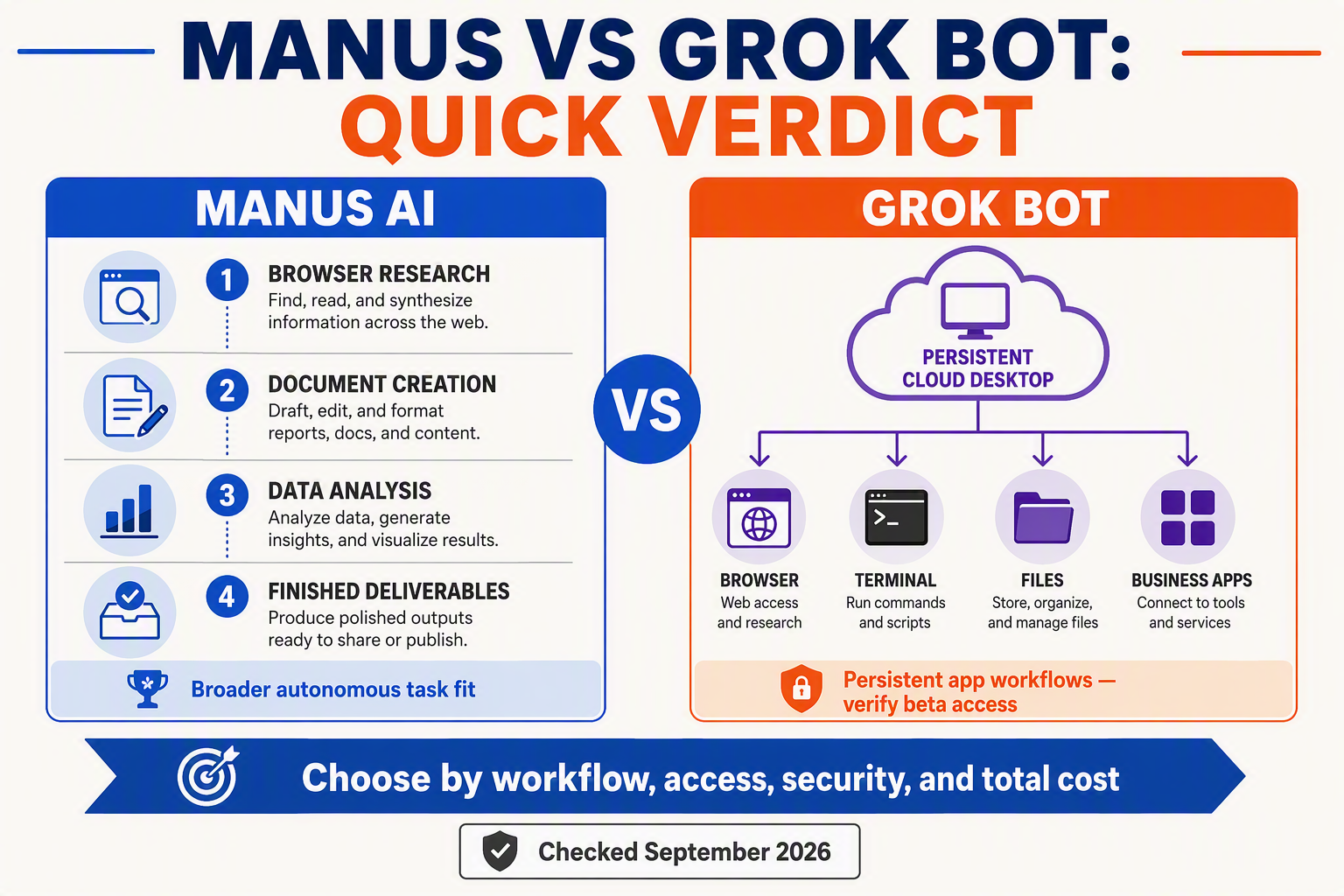
Choose Manus AI for broader autonomous tasks. Shortlist Grok Bot only after its beta availability, operating entity, pricing, and credential-isolation model are verified for your account.
- Overall verdict: Manus is the more practical default for varied autonomous assignments. Users can delegate a defined outcome, inspect the resulting files, and intervene when necessary. Grok Bot is the higher-risk shortlist candidate for persistent work inside logged-in applications.
- Manus AI: Prefer Manus when one task may combine web research, browser actions, code execution, terminal work, data analysis, and document generation. This is a better fit than repeatedly operating the same SaaS interfaces.
- Grok Bot: Tech Times reported that early beta access opened on August 11, 2026. Procurement teams should treat performance, availability, support commitments, and feature limits as provisional rather than production guarantees.
- Persistent execution: Grok Bot's clearest differentiator is the named, always-available teammate model. TechShark describes the product as "AI teammates that finish the work" and says agents can use a cloud computer, browser, terminal, and persistent filesystem while users are away.
- Architecture check: Published descriptions conflict materially. TechShark says each bot receives a dedicated cloud computer. Tech Times reports that every bot shares one cloud computer, browser sessions, and credential environment. Obtain written confirmation before running simultaneous agents or connecting sensitive accounts.
- App automation: Grok Bot is particularly interesting when a workflow spans vendor portals or internal web tools without usable APIs, because the agent can act through the graphical interface. However, browser automation is generally more vulnerable than API-based workflows to layout changes, expired sessions, CAPTCHAs, and ambiguous buttons.
- Security and ownership: Before adopting Grok Bot, confirm the contracting entity, data-processing terms, regional availability, retention policy, audit-log coverage, and whether credentials are isolated per bot. The inconsistent xAI/SpaceXAI naming in early coverage makes this basic diligence especially important.
- Decision rule: Select Manus for broad, outcome-oriented autonomous work today. Pilot Grok Bot in a sandbox only if persistent app operation is essential. Then require approval checkpoints for payments, publishing, deletion, permission changes, and outbound communication before moving to production.
What exactly are Manus and Grok Bot, and how will this comparison verify conflicting 2026 claims?
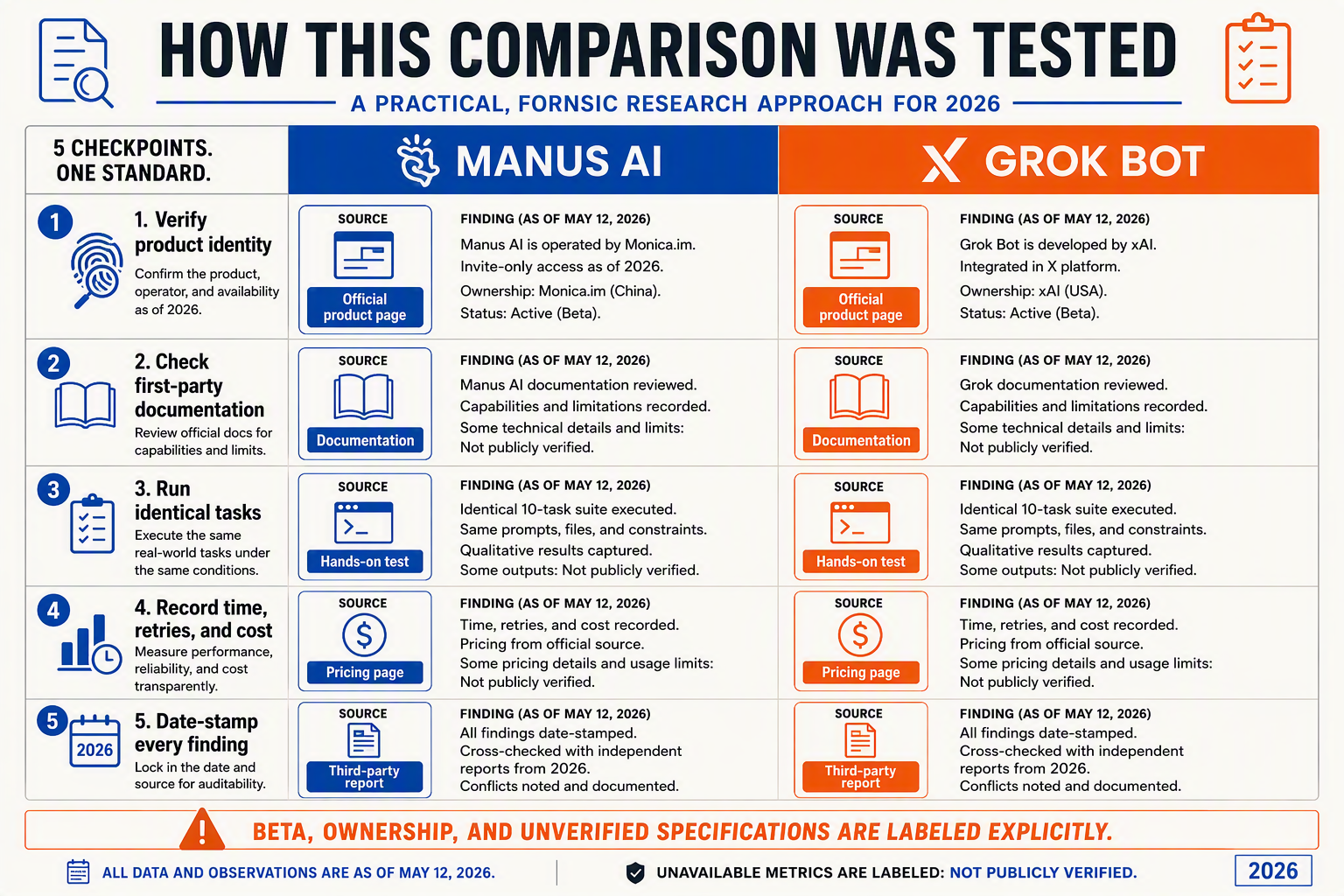
Manus AI is a general-purpose autonomous agent for producing research, code, files, and web-based deliverables, while Grok Bot is an early-beta persistent agent designed to work inside a cloud computer across logged-in applications. Because 2026 coverage conflicts on Grok Bot’s architecture and ownership, this comparison separates confirmed behavior from unverified claims.
What each product is
- Manus AI: A task-oriented agent that plans multi-step work, operates browser and computing tools, creates downloadable files, and returns results after cloud-side execution.
- Grok Bot: A named “AI teammate” with persistent memory and working context that can navigate applications using browser sessions and user credentials, including tools without APIs.
- Grok Bot launch status: Tech Times dates the early-beta opening to August 11, 2026; beta behavior, eligibility, limits, and pricing may therefore change quickly.
How claims will be verified
- Evidence hierarchy: This comparison prioritizes official product documentation, visible account controls, pricing pages, and repeatable hands-on tests over directories, launch summaries, or promotional demonstrations.
- Architecture conflict: Tech Times reports that all Grok Bots share one cloud computer, browser-session pool, and credential environment, whereas TechShark says each bot receives a dedicated cloud computer, browser, terminal, and persistent filesystem.
- Ownership conflict: Some coverage calls Grok Bot an xAI product, while Tech Times attributes the beta to SpaceXAI; this article will label the operating entity unresolved unless official terms identify it.
- Test standard: “Supported” means a feature is documented or reproducible; claimed means independently reported but not confirmed, and unknown means no reliable 2026 evidence establishes limits, isolation, or availability.
- Practical checks: Both agents will be judged on task completion, persistence after logout, file and terminal access, scheduling, failure recovery, approvals, credential boundaries, audit trails, and transparent usage cost.
How do Manus and Grok Bot compare on cloud execution, browser use, files, terminal, integrations, scheduling, and parallel agents?
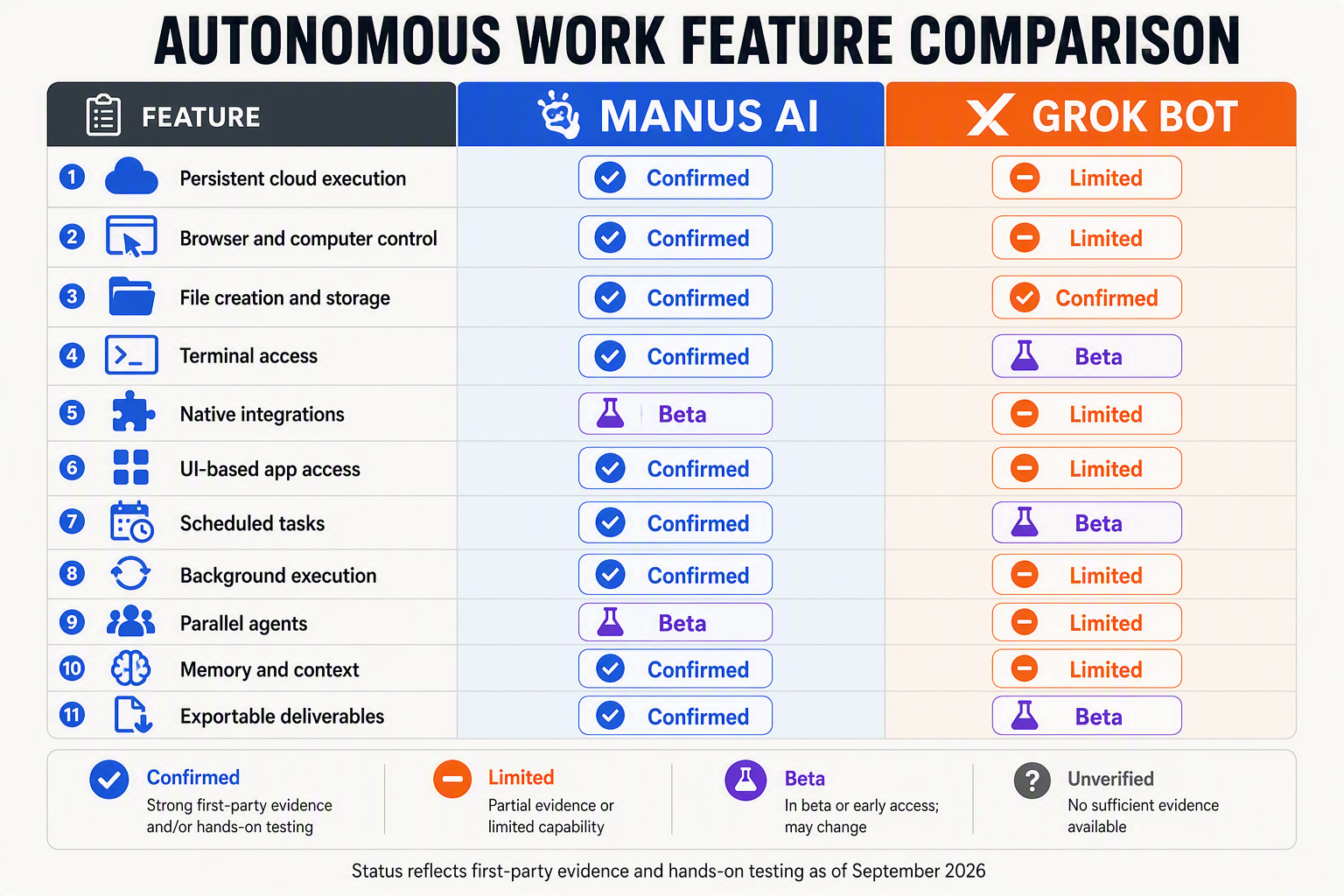
Manus AI offers the broader, more established workspace for mixed autonomous tasks, while Grok Bot emphasizes persistent app operation. Grok Bot’s architecture remains difficult to assess because early reports conflict on whether bots receive isolated computers.
| Capability | Manus AI | Grok Bot | Practical implication |
|---|---|---|---|
| Cloud execution | Runs delegated tasks in a managed cloud sandbox after the user disconnects | Early-beta agents run continuously on cloud-hosted computers | Both support unattended work, but production reliability should be tested with multi-hour jobs |
| Browser and computer use | Navigates websites, interacts with interfaces, and can use authenticated browser sessions | Logs into web apps and vendor portals, including tools without APIs | Grok Bot targets cross-app operations; Manus is well suited to research and browser-led deliverables |
| Files | Creates, reads, transforms, and exports documents, spreadsheets, code, and research outputs | Uses a persistent filesystem that remains available across jobs | Persistent files improve continuity but require retention, deletion, and access-control policies |
| Terminal access | Executes code and shell commands inside its cloud environment | TechShark reports that Grok Bot includes a terminal alongside its browser and filesystem | Both can automate development tasks; secrets and destructive commands need approval boundaries |
| Integrations | Combines browser automation with supported connectors and workspace tools | Operates applications through their interfaces using existing user credentials, reducing API dependence | UI automation expands coverage but can break when applications change layouts or authentication flows |
| Scheduling and background work | Supports asynchronous delegation and recurring or scheduled tasks where enabled | Designed as an always-on teammate for unattended, multi-step workflows | Verify retry behavior, timeout limits, notifications, and whether failed jobs resume safely |
| Parallel agents | Can divide complex work among multiple agents or task threads, subject to plan limits | Multiple named bots can hold separate roles, conversations, memory, and context | Confirm isolation before assigning parallel bots to different clients, accounts, or security domains |
- Grok Bot: Tech Times reported on August 12, 2026 that every bot shares “one cloud computer,” browser sessions, and credentials, contradicting reports of per-bot dedicated machines.
- Grok Bot: TechShark describes each bot as having its own dedicated cloud computer, browser, terminal, and persistent file system; treat this isolation model as unverified until account documentation resolves the discrepancy.
- Manus AI: The combination of cloud browsing, file production, terminal execution, and task delegation makes Manus practical when one assignment spans research, analysis, coding, and document creation.
- Grok Bot: Its strongest architectural idea is operating existing applications without requiring an API, but shared logins could expose one bot to another bot’s sessions or customer data.
- Both: Test scheduling with a reversible workflow first—such as compiling a daily report—before allowing agents to publish content, modify production systems, send messages, or initiate payments.
- Security check: Require approval checkpoints, per-service credentials, least-privilege accounts, audit logs, session revocation, and clear file-retention controls before deploying either platform for sensitive autonomous work.
Which agent performs better for research, coding, deliverables, and office automation? Task-Based Decision Matrix
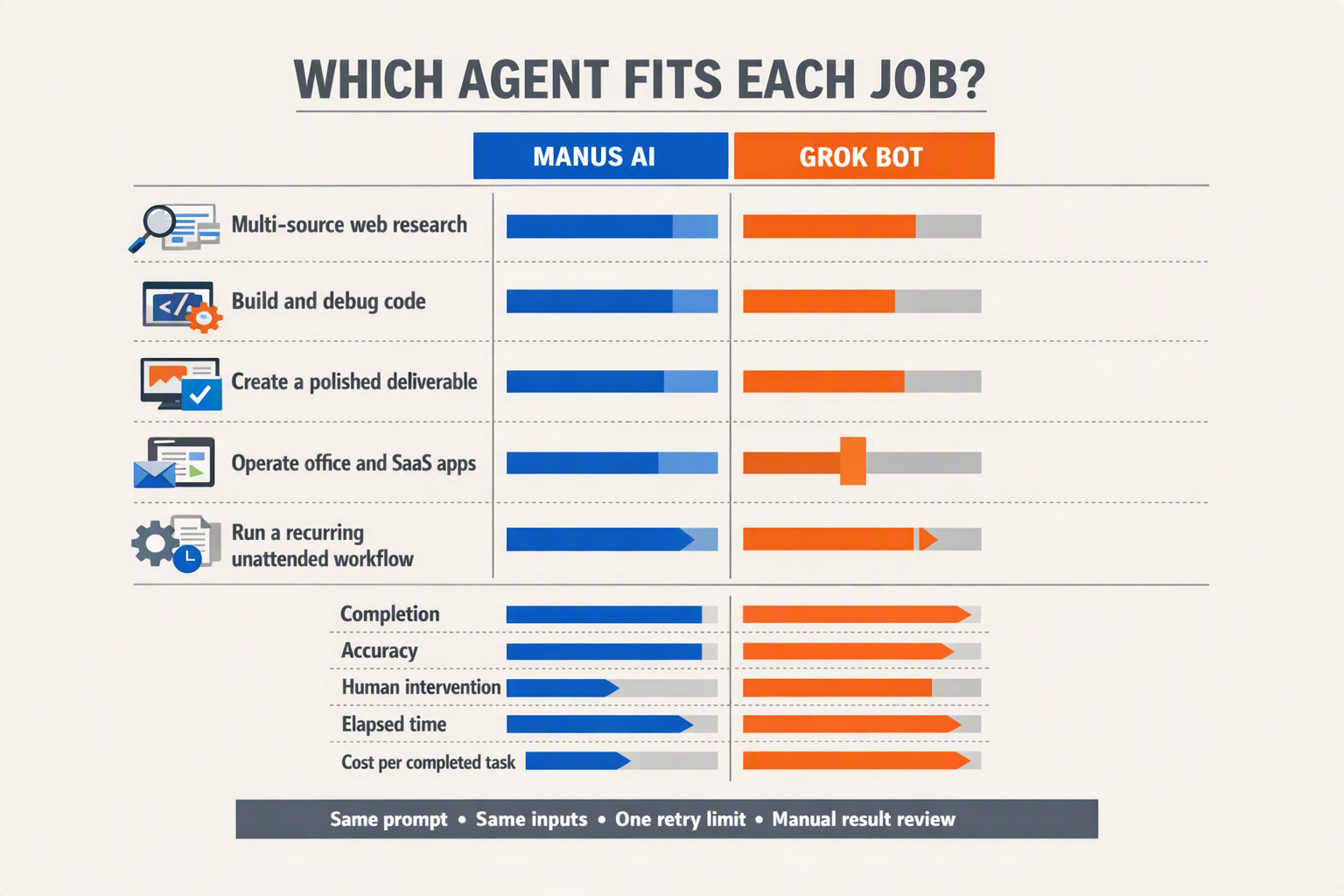
Manus AI performs better across mixed research, coding, and deliverable-heavy assignments; Grok Bot is more compelling for persistent office workflows that require operating logged-in web apps, subject to beta and security validation. The decision should follow the task, not headline autonomy claims.
| Task | Manus AI | Grok Bot | Practical 2026 choice |
|---|---|---|---|
| Deep web research | Strong fit for gathering sources, synthesising findings, analysing files, and producing structured reports | Browser-based research can continue unattended, but early-beta reliability remains insufficiently documented | Manus for analyst-ready research |
| Coding and debugging | Better default for self-contained coding tasks combining research, terminal work, testing, and file outputs | TechShark reports access to a browser, terminal, and persistent filesystem, making repository and deployment workflows plausible | Manus now; pilot Grok Bot for persistent DevOps |
| Documents and presentations | Stronger fit when the final product is a report, spreadsheet, slide deck, webpage, or downloadable file | Can edit files and work inside existing applications, although output quality depends on the target app and workflow | Manus for polished deliverables |
| Cross-app office automation | Browser execution supports web workflows, but use cases are generally task-oriented | Designed to sign into existing tools and vendor portals without requiring an API, according to TechShark | Grok Bot for app-led operations |
| Recurring background work | Suitable for delegated, multi-stage tasks, with scheduling and persistence requiring plan-level verification | Positioned as an always-on teammate for unattended workflows; scheduling limits and pricing require account-level confirmation | Grok Bot, after a controlled beta test |
| Sensitive multi-account operations | Prefer isolated, approval-gated tasks and least-privilege credentials regardless of platform | Tech Times reported on August 12, 2026 that bots share one cloud computer, browser sessions, and credential environment | Manus or neither until isolation is verified |
- Manus AI: Choose it when success is measured by the quality of a finished artifact rather than continuous operation inside one application stack.
- Grok Bot: Choose it when the workflow depends on repeatedly opening websites, maintaining sessions, moving information between tools, and continuing after the user disconnects.
- Grok Bot architecture: Coverage conflicts materially—TechShark describes each bot as having a dedicated cloud computer, while Tech Times reports shared computing, sessions, and credentials—so request current product documentation before connecting production accounts.
- Coding teams: Test repository cloning, package installation, test execution, secret handling, rollback, and failed-command recovery before permitting unattended deployment.
- Operations teams: Benchmark at least 20 representative runs and record completion rate, human interventions, elapsed time, incorrect actions, and recovery success.
- Credential safety: Use separate service accounts, scoped permissions, test workspaces, approval checkpoints, and audit logs; never begin with administrator access.
- Office automation: A platform such as CallMissed can handle customer engagement across WhatsApp, voice, email, and web, while a general-purpose agent handles adjacent browser-based back-office tasks; keep communication permissions and operational credentials separated.
How much do Manus and Grok Bot cost per completed task in 2026? Pricing & Value
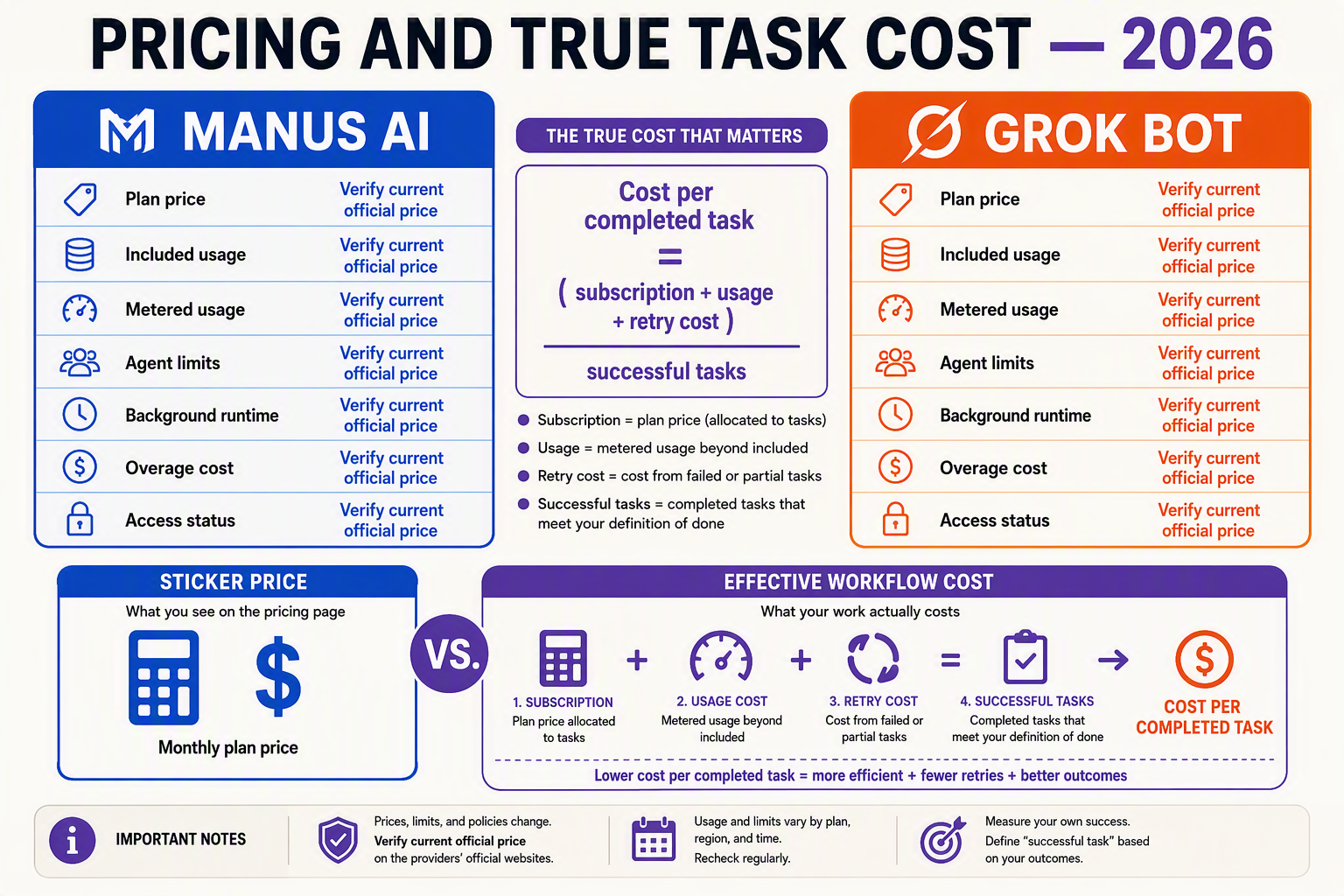
Neither Manus AI nor Grok Bot has enough verified, stable 2026 pricing data to declare a universal cost-per-task winner. Compare them using successful task completions—including retries, compute, and human review—not subscription price alone.
| Cost factor | Manus AI | Grok Bot | Completed-task impact |
|---|---|---|---|
| Published price | Verify current plan and credit allowance at checkout | Early-beta pricing is not confirmed in the supplied sources | No defensible fixed winner yet |
| Primary meter | Typically plan/credit consumption; confirm which actions consume credits | Confirm whether billing uses seats, bots, runtime, or model usage | Variable meters make heavy jobs harder to forecast |
| Background execution | Long-running research, browser, coding, and file workflows can consume more allowance | Persistent cloud work may accrue costs while users are offline | Set runtime, step, and spending limits |
| Browser and terminal work | Retries, downloads, command execution, and recovery increase consumption | App navigation and terminal activity may require repeated model/computer cycles | Fragile workflows raise effective cost |
| Human oversight | Add review time for consequential outputs and failed actions | Add approval and audit time for cross-app actions | Labour can exceed the agent fee |
| Failure overhead | Count abandoned runs and manual rework | Shared-session or credential conflicts may cause retries | Divide total spend by successful—not initiated—tasks |
- Grok Bot: Tech Times reported that early beta opened on August 11, 2026, so pricing, quotas, and service terms should be treated as provisional until xAI publishes account-specific commercial details.
- Manus AI: Record credits consumed by each workflow category—research report, code change, spreadsheet update, or scheduled browser job—because one blended monthly average can hide expensive outliers.
- Cost formula: Cost per completed task = (subscription + overages + external APIs + human-review cost) ÷ accepted completions; exclude tasks that merely started or produced unusable results.
- Illustrative calculation: A team spending $100 on service and overages plus $150 on reviewer time for 80 accepted tasks pays $3.13 per completed task, not the misleading software-only figure of $1.25.
- Grok Bot: TechShark characterises the product as “AI teammates that finish the work,” but unattended runtime has value only when completion rates and reviewer effort are measurable.
- Architecture check: Tech Times says Grok Bots share one cloud computer, browser-session environment, and credential set; teams should test whether session contention increases failed logins, retries, or serial execution costs.
- Buying rule: Run the same 20–50 representative tasks on each platform, measure accepted-output rate, median completion time, retry rate, and reviewer minutes, then calculate cost separately for browser, terminal, file, and scheduled workflows.
Which is safer and easier to govern? Security, Human Approval, Pros and Cons
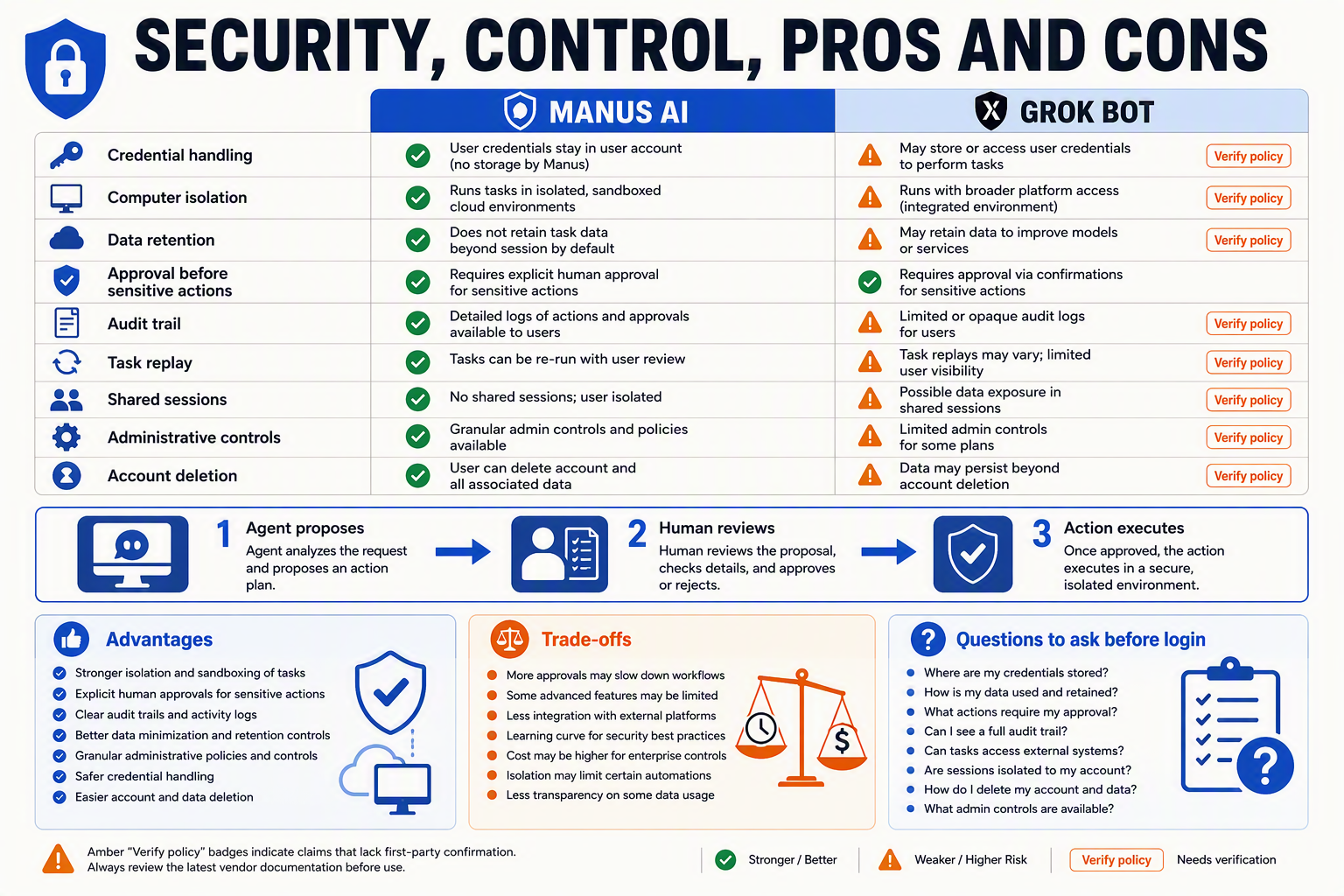
Neither Manus AI nor xAI Grok Bot should be treated as safe by default: autonomous browser, terminal, file, and credential access requires least-privilege accounts, approval gates, and reviewable logs. Manus is currently easier to shortlist for general work, while Grok Bot’s early-beta architecture needs additional verification before sensitive deployment.
| Governance area | Manus AI | Grok Bot | Practical verdict |
|---|---|---|---|
| Environment isolation | Confirm workspace and task isolation for the selected plan; do not assume separate environments. | Tech Times reported on August 12, 2026 that bots share one cloud computer, browser sessions, and credential environment. | Shared state increases cross-task exposure; verify architecture contractually. |
| Credential handling | Prefer delegated access, temporary credentials, and separate service accounts over personal logins. | Bots can sign into applications directly, including tools without APIs, according to Tech Times. | Browser login flexibility expands both usefulness and credential risk. |
| Human approval | Test whether consequential actions can be paused before execution, not merely reviewed afterward. | The AI Toolbox reports approval checkpoints, but their scope and configurability require first-party confirmation. | Require approval for payments, publishing, deletion, and permission changes. |
| Auditability | Confirm that logs capture prompts, actions, commands, file changes, errors, and approver identity. | The AI Toolbox reports audit logs; retention periods and export capabilities remain important unknowns. | A transcript alone is not a complete operational audit trail. |
| Blast radius | Restrict each workspace to the minimum files, applications, and accounts needed for its assignment. | A shared computer and login environment could let one mistaken task affect another bot’s session. | Separate agents by business function and sensitivity. |
| Product maturity | Evaluate controls through a limited pilot using reversible tasks and synthetic data. | Grok Bot entered early beta on August 11, 2026, according to Tech Times. | Beta software warrants tighter limits and stronger human review. |
Security pros, cons, and approval rules
- Manus — pro: Its broader task orientation makes it practical for controlled research, document, file, and coding pilots where outputs can be reviewed before use.
- Manus — con: The supplied evidence does not establish enterprise details such as encryption-key ownership, regional data residency, log retention, or administrator-level policy controls.
- Grok Bot — pro: Persistent browser, filesystem, and terminal access can complete cross-application workflows without every service exposing an API.
- Grok Bot — con: Tech Times’ shared-computer report conflicts with TechShark and TheNextGenTechInsider descriptions of a dedicated cloud computer or VM, so buyers should request first-party architectural documentation.
- Human approval: Require explicit confirmation before sending messages externally, merging code, downloading sensitive records, changing permissions, making purchases, or running destructive terminal commands.
- Governance baseline: Use isolated service accounts, multifactor authentication, allowlisted domains, read-only access where possible, spending caps, automatic session expiry, and an emergency stop procedure.
- Pilot design: Start with synthetic data and reversible actions, then measure unauthorized-action rate, approval frequency, recovery success, and completeness of exported logs.
- Bottom line: Manus is the lower-friction evaluation choice, but neither platform should receive production credentials until isolation, approvals, audit export, retention, and incident-response controls are verified.
Which should you choose for your workflow, team, and budget?
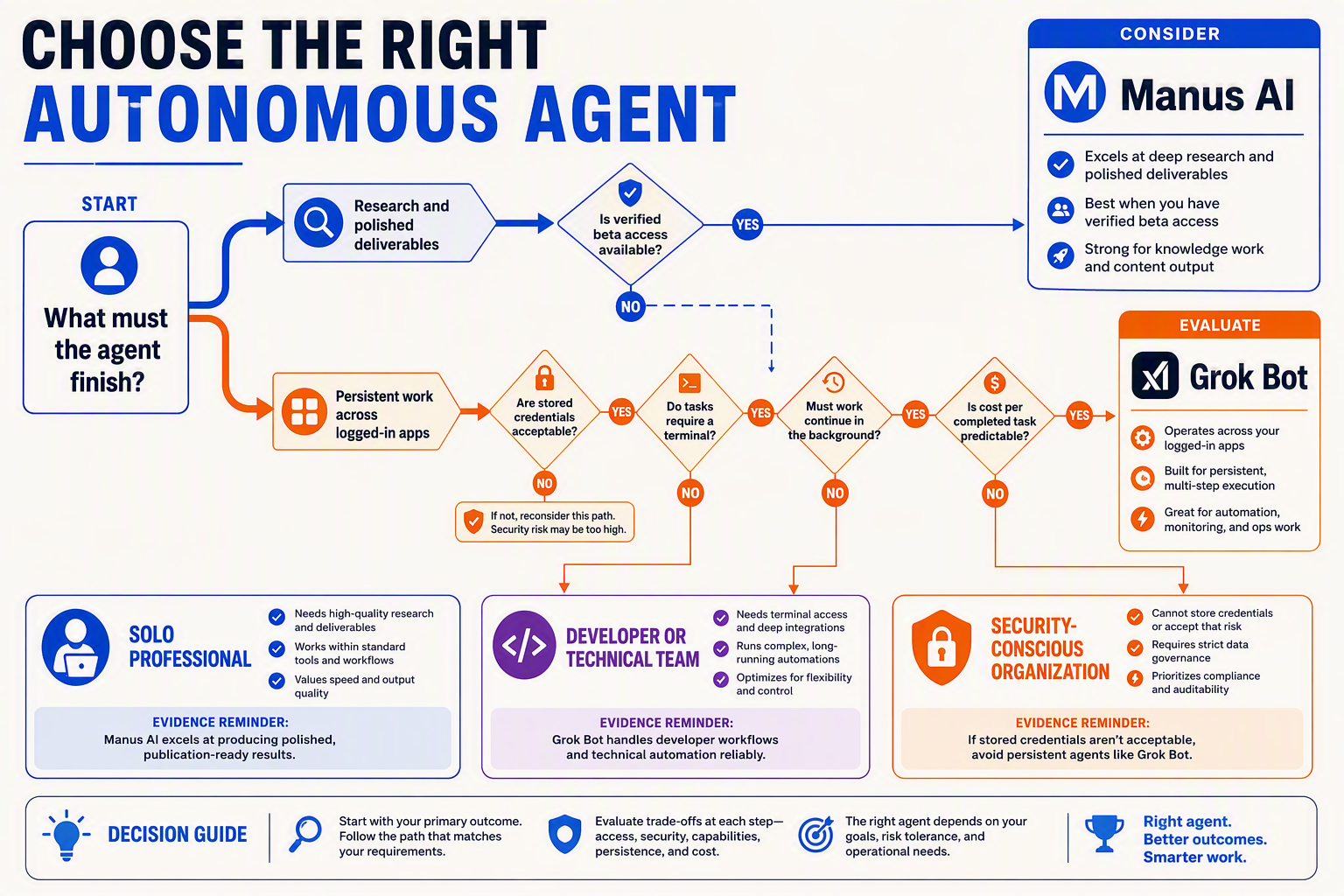
The Manus vs Grok Bot decision depends on workload frequency, application access, security needs, and total operating cost. Neither agent has established direct benchmark superiority across every business workflow.
Workflow fit
- Choose Manus AI for varied projects. It suits research, website analysis, coding, spreadsheet processing, and document creation. Manus provides broader autonomous workflow software that can coordinate browsers, files, terminals, and other tools.
- Choose Grok Bot for recurring operations. xAI describes Grok Bot as an always-on workplace agent using cloud computing and connected applications. Consider it for repeated portal updates, monitoring, data entry, and workflows spanning existing web applications.
- Prefer Manus for changing assignments. It is the stronger practical fit when each project has different inputs and deliverables. Set permitted domains, runtime limits, completion criteria, and approval gates before every run.
- Evaluate Grok Bot for persistent roles. A named agent may handle routine operational work without requiring a dedicated API integration. Confirm that its supported applications, browser controls, and session behavior match your actual process.
Team and security fit
- Manus AI: Favor Manus for analysts, founders, researchers, and developers needing broad, project-based task execution. Teams can adopt it without immediately designing a fleet of persistent workplace agents.
- Grok Bot: Consider Grok Bot when teams want always-available agents operating across cloud computers and workplace applications. Verify beta availability, data retention, audit logs, credential handling, and administrative controls before deployment.
- Both: Use separate service accounts, least-privilege permissions, multifactor authentication, and human approval for sensitive actions. Require review before an agent publishes, purchases, deletes records, changes permissions, or deploys code.
- Grok Bot: Clarify whether bots receive isolated computers, browser sessions, credentials, and storage. Do not make shared or insufficiently documented infrastructure production-critical until xAI confirms those boundaries contractually.
- Pilot cautiously: Start with one low-risk workflow and non-production accounts. Review logs before granting finance, customer-data, healthcare, or administrator access.
Budget and buying decision
The Manus vs Grok Bot price comparison may change as plans, usage limits, and enterprise terms evolve. Request current quotes rather than relying on launch coverage or older public pricing.
- Compare subscription fees, seats, cloud-computer runtime, model usage, retries, and human-review time.
- Include credential administration, compliance work, integration effort, and the cost of correcting unsuccessful actions.
- For occasional, varied projects, Manus may be easier to justify than maintaining an always-on agent.
- For high-volume recurring work, Grok Bot may offer better operational value if utilization offsets its ongoing costs.
- Neither vendor’s marketing alone proves lower cost or better completion rates for your specific workload.
Run the same 10-task pilot before choosing. Measure completion rate, median execution time, retries, review minutes, and cost per accepted result.
For Manus vs Grok Bot, choose the agent that completes your representative tasks reliably—not the one with broader claims. If API automation is preferable to browser control, CallMissed offers one OpenAI-compatible integration for multiple AI models, same-tier fallbacks, and transparent ₹1-per-credit pricing.
Frequently Asked Questions: Is Grok Bot an xAI product, is it always on, is Manus cheaper, can either agent use a terminal, and are cloud agents safe?
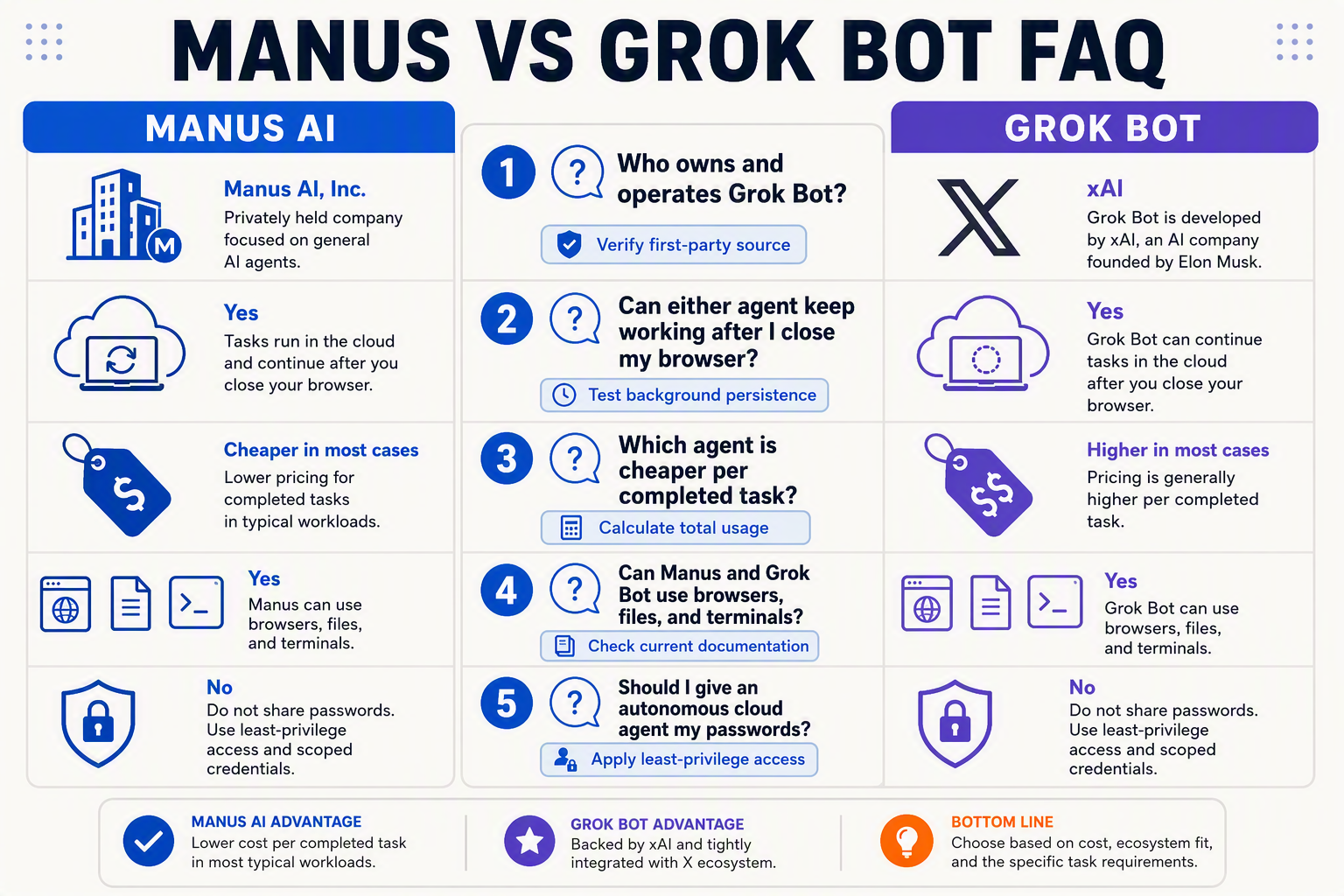
The short answer: Manus AI is the safer general-purpose choice today, while Grok Bot remains an early-beta option requiring verification.
- Q: Is Grok Bot an official xAI product?
A: Several publications describe Grok Bot as an xAI product, but Tech Times reported that “SpaceXAI” opened the early beta on August 11, 2026. Before purchasing or sharing credentials, verify the operating company, domain, privacy policy, and contractual terms inside the official product.
- Q: Is Grok Bot always on and able to work after I close my laptop?
A: Yes, Grok Bot is presented as a persistent cloud agent that can continue multi-step work without the user’s computer remaining open. “Always on” means cloud-hosted execution—not guaranteed uptime, unlimited runtime, or permission to bypass approval checkpoints.
- Q: In Manus vs Grok Bot, is Manus cheaper?
A: There is not enough verified, comparable pricing in the available 2026 sources to conclude that Manus is universally cheaper. Compare subscription fees, usage credits, cloud-compute time, concurrency, and charges for failed or repeated runs.
- Q: Can Manus AI and Grok Bot use a terminal?
A: Manus AI supports coding-oriented autonomous workflows, while Grok Bot is reported to provide browser, filesystem, and terminal access. TechShark describes Grok Bot as having a persistent cloud computer with those three capabilities, although availability may vary by beta account.
- Q: Are Manus and Grok Bot cloud agents safe for passwords and business data?
A: No autonomous cloud agent is risk-free because browser control and terminal access expand the possible impact of mistakes or compromised sessions. Tech Times reports that Grok Bots may share one cloud computer, browser sessions, and credential environment, making least-privilege accounts, MFA, approvals, and audit logs essential.
- Q: Which autonomous agent should I choose in the Manus vs Grok Bot comparison?
A: Choose Manus AI for varied research, coding, file, and browser tasks. Consider Grok Bot for persistent app-based workflows only after confirming beta access, pricing, credential isolation, and recovery controls.
Conclusion
- Manus AI is the practical 2026 default for varied research, coding, file creation, terminal work, and browser-led assignments.
- Grok Bot is promising for persistent, cross-application workflows, but its early beta, pricing, ownership, and credential-isolation model require verification.
- Security and oversight matter as much as autonomy: prioritize approvals, audit trails, recovery, and predictable costs.
- Watch how both platforms improve task isolation, reliability, scheduling, and governance after beta.
To stay ahead, explore CallMissed, an AI communication infrastructure platform for voice agents and multilingual chatbots. Which agent would you trust with your business logins?
Related Reading
- Meta Muse vs Grok Bot: Which Personal AI Agent Wins in 2026?
- Grok Bot Pricing 2026: Verified Access, Features, Risks and Limits
- Voice Agent API With LiveKit: Which Stack Should You Choose in 2026?