Meta Muse vs Grok Bot: Which Personal AI Agent Wins in 2026?


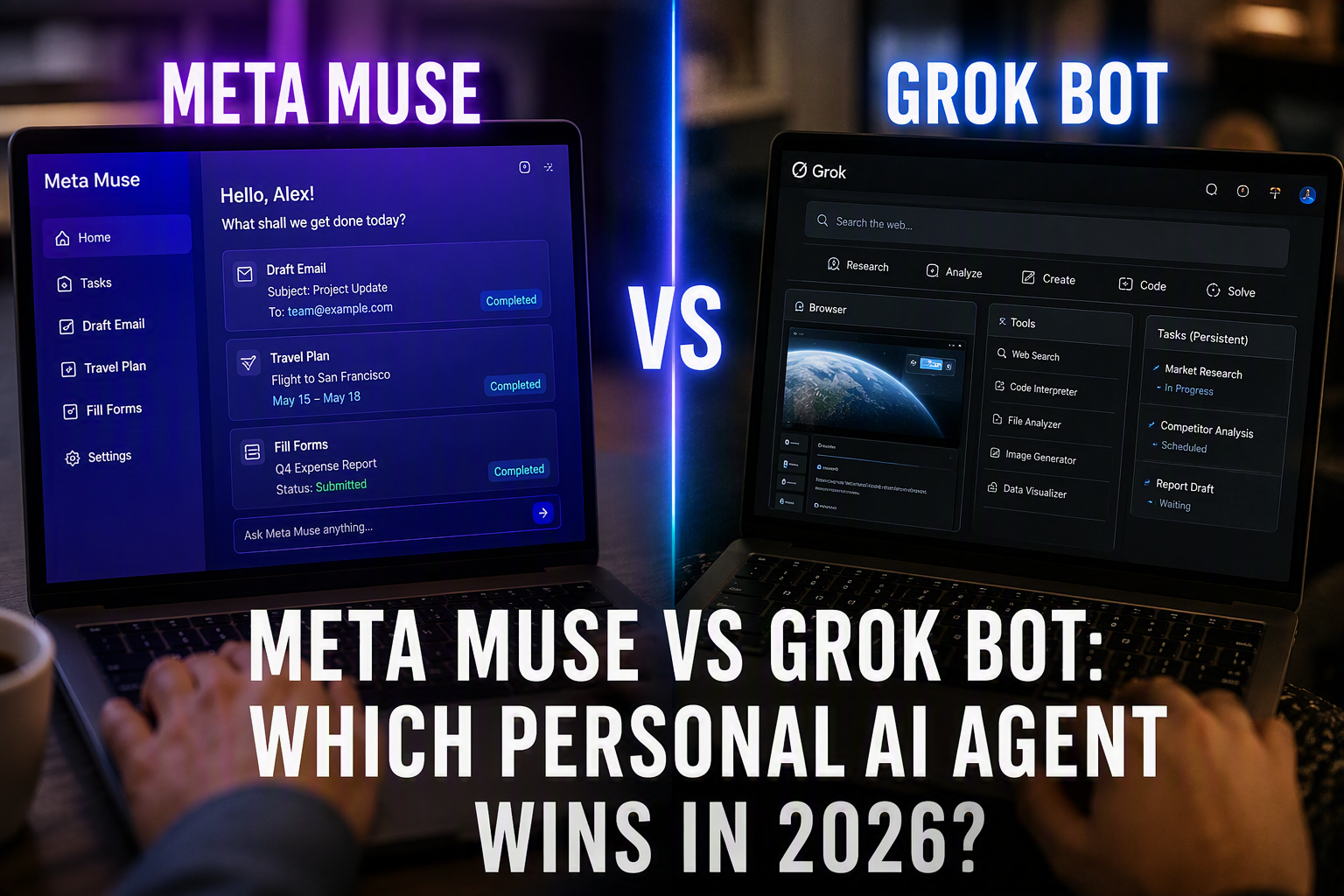
Compare Meta Muse vs Grok Bot on tasks, privacy, availability, safety and price to choose the right personal AI agent in 2026.
Meta Muse vs Grok Bot: Which Personal AI Agent Wins in 2026?
Would you trust an AI to book your trip, complete online forms and send emails—not merely explain how? Meta Muse vs Grok Bot matters now because Meta introduced Muse on September 8, 2026, with Android Headlines reporting that the personal agent can execute those real-world tasks on a user’s behalf. Grok Bot, built around xAI’s Grok ecosystem, takes a more conversational, information-led approach, making the comparison a test of task execution versus interactive assistance.
Crucially, Meta Muse is the consumer-facing personal agent; it is not Muse Spark, Meta’s underlying model family, or Muse Code, the terminal coding agent released in 2026. This guide compares Meta Muse and Grok Bot across target users, geographic and platform availability, everyday task automation, integrations, privacy considerations and practical limitations—so you can decide which personal AI agent better fits your workflow in 2026.
Meta Muse vs Grok Bot: Which is better in 2026? Answer-first verdict
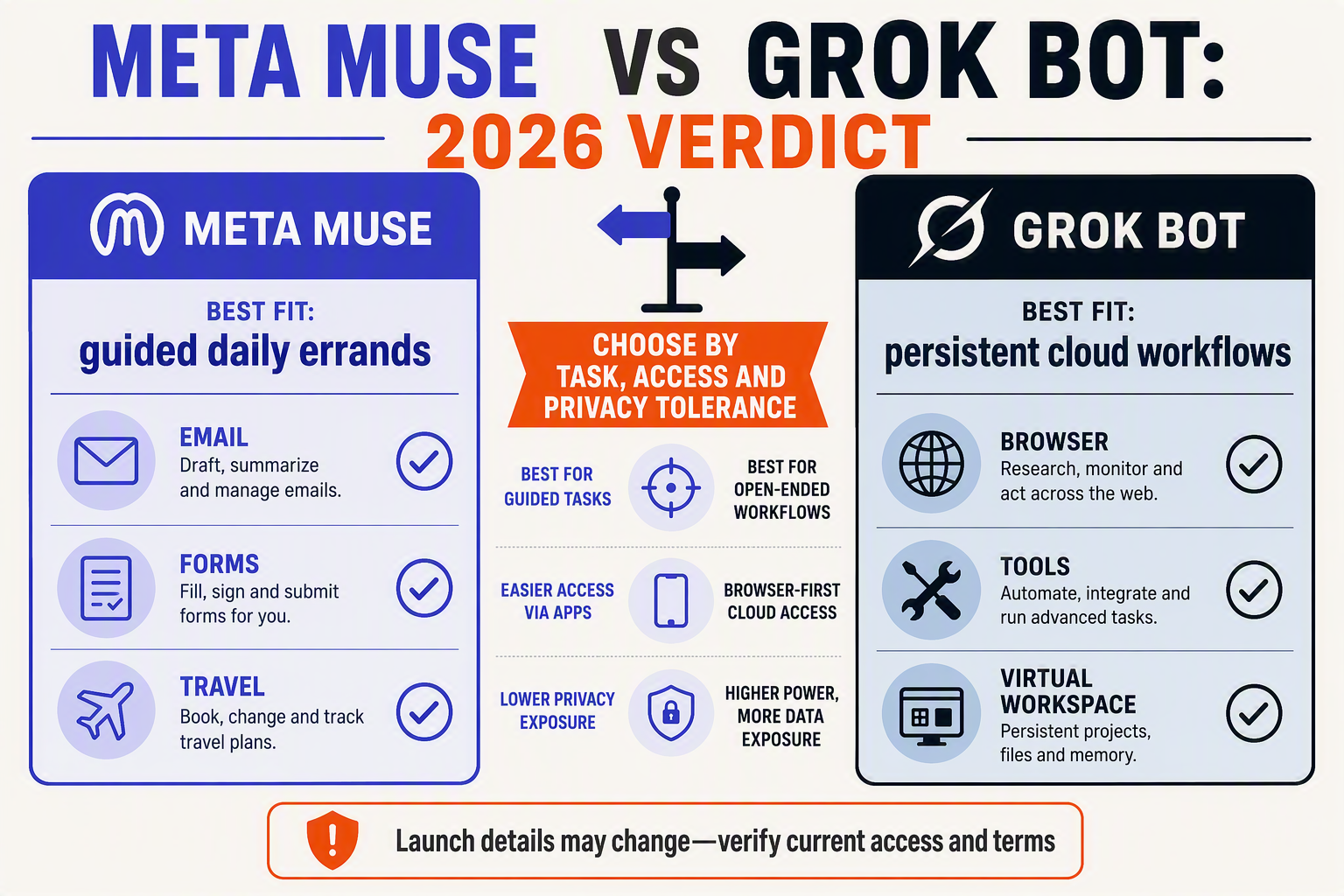
Meta Muse vs Grok Bot has no universal winner in 2026: Meta Muse is the better fit for consumer errands, while Grok Bot is the stronger documented choice for persistent workplace automation. Muse is newly launched in the U.S. and focuses on personal tasks such as sending emails, completing forms, and booking travel. Grok Bot is positioned as an always-on AI teammate that can work in a shared cloud-computer environment, sign in to business apps, and execute multi-step workflows.
Answer-first verdict
Based on information available on September 8, 2026:
- Choose Meta Muse for personal assistance. Android Headlines describes the newly U.S.-launched agent as handling everyday tasks, including email, online forms, and travel bookings.
- Choose Grok Bot for ongoing workplace workflows. First-party xAI Grok Bot guides and reputable reporting describe persistent AI teammates that use shared cloud computers, access authorized apps, and complete multi-step work.
- Do not interpret this as a performance win. No independent, direct head-to-head test establishes which agent is more accurate, reliable, secure, or cost-effective.
| Best fit | Meta Muse | Grok Bot |
|---|---|---|
| Primary orientation | Consumer and personal errands | Workplace and team automation |
| Documented tasks | Email, forms, and travel booking | App-based, multi-step business workflows |
| Operating model | Personal AI agent | Always-on teammate with a persistent cloud-computer environment |
| Current caveat | Newly launched in the U.S.; wider access is unclear | Pricing, account eligibility, and broader rollout remain unclear |
What is known about Meta Muse?
Android Headlines reported on September 8, 2026, that Meta Muse is a personal AI agent for everyday errands and has launched in the United States. Its reported tasks include:
- Sending emails
- Filling out online forms
- Booking travel
These capabilities make Muse action-oriented rather than merely conversational. Its consumer focus may suit people who want help completing occasional personal tasks without setting up an ongoing workplace agent.
The available evidence does not establish Muse’s task-completion rate, supported websites, payment safeguards, latency, cancellation controls, or availability beyond the initial U.S. launch. Users should confirm account access and approval settings before relying on it for purchases or sensitive submissions.
What is known about Grok Bot?
Unlike earlier evidence summaries, current sources do document Grok Bot’s intended capabilities. xAI’s first-party Grok Bot guides present the product as an always-on AI teammate for workplace use. Those guides, alongside reputable reporting, describe bots that can:
- Operate in shared, persistent cloud-computer environments
- Sign in to authorized workplace apps
- Carry context across longer-running work
- Complete multi-step tasks rather than only provide instructions
That persistent operating model differentiates Grok Bot from Muse’s consumer-errand positioning. It may be more suitable for recurring business processes, cross-application workflows, and tasks that continue beyond a single chat session.
However, product documentation demonstrates intended functionality—not comparative quality. Public evidence still does not show whether Grok Bot completes these workflows more reliably than Muse, how often human intervention is required, or how performance varies across third-party apps.
Meta Muse is not Muse Spark or Muse Code
The similar names refer to different parts of Meta’s 2026 AI portfolio:
- Meta Muse is the consumer-oriented personal agent for everyday digital tasks.
- Muse Spark is Meta’s model family for coding and agentic workloads; it is not the personal assistant itself.
- Muse Code is a terminal-based software-engineering agent attributed to Meta Superintelligence Labs, according to jacar.es.
Explainx.ai reported that Muse Code exited beta on September 1, 2026, with inter-session messaging, multi-agent workflows, and an SDK developer preview. Those developer features should not be attributed to Meta Muse unless Meta confirms that the personal agent exposes or uses them.
Important evidence gaps
Current documentation clarifies the products’ different orientations, but it does not settle:
- Direct task-completion accuracy or failure rates
- Security and credential-handling differences
- Human approval and transaction-confirmation controls
- Complete pricing and usage limits
- Country, language, and account restrictions
- Final rollout schedules
- Independent performance on identical tasks
The defensible 2026 verdict is therefore use-case specific: Meta Muse is the clearer choice for newly available U.S. consumer assistance, while Grok Bot is better aligned with persistent, multi-application workplace automation. A categorical winner will require independent head-to-head testing and clearer pricing and availability data.
What are Meta Muse, Muse Spark and Muse Code—and why are they different?
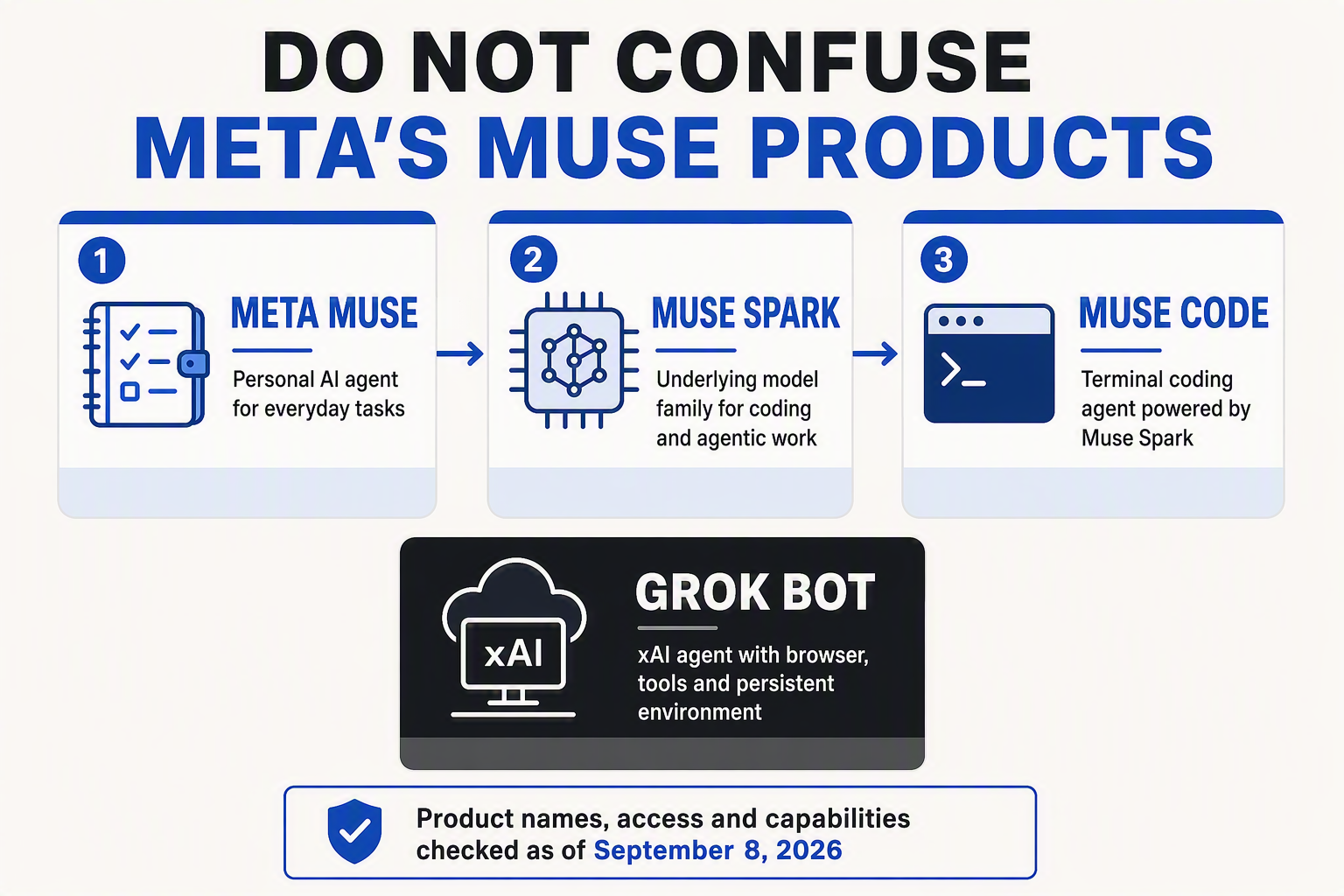
The three Muse names describe different layers of Meta’s 2026 AI portfolio: a consumer agent, a model family and a developer tool. Shared branding does not mean shared interfaces, features or availability.
The Muse product map
- Meta Muse: A consumer-facing personal AI agent that can send emails, complete online forms and book travel, according to Android Headlines on September 8, 2026.
- Muse Spark: Meta Superintelligence Labs’ underlying model family for coding and agentic workloads; Deeper Insights dates its initial unveiling to April 8, 2026, months before the personal Muse agent appeared.
- Muse Spark 1.3: A model release described by Meta as “optimized for competitive coding performance”; explainx.ai reports a Meta-published 75.4 score on DeepSWE v1.1, versus 74.0 for Claude Opus 5.
- Muse Code: A terminal-based coding agent powered by Muse Spark, designed to operate like a virtual software engineer rather than manage a consumer’s travel, inbox or web forms.
- Muse Code availability: explainx.ai reports that Muse Code left beta on September 1, 2026, adding inter-session messaging, multi-agent workflows and an SDK developer preview while continuing to use Muse Spark 1.2.
- Why the distinction matters: A Muse Spark benchmark does not establish Meta Muse’s success rate on personal errands, and Muse Code features cannot be assumed to exist in the consumer product unless Meta documents them separately.
- Comparison with Grok Bot: Meta Muse and Grok Bot are user-facing assistants, while Muse Spark is infrastructure and Muse Code is a specialist developer agent; only the first belongs in a direct personal-assistant comparison.
How do Meta Muse and Grok Bot compare on tasks, tools, availability and business use?
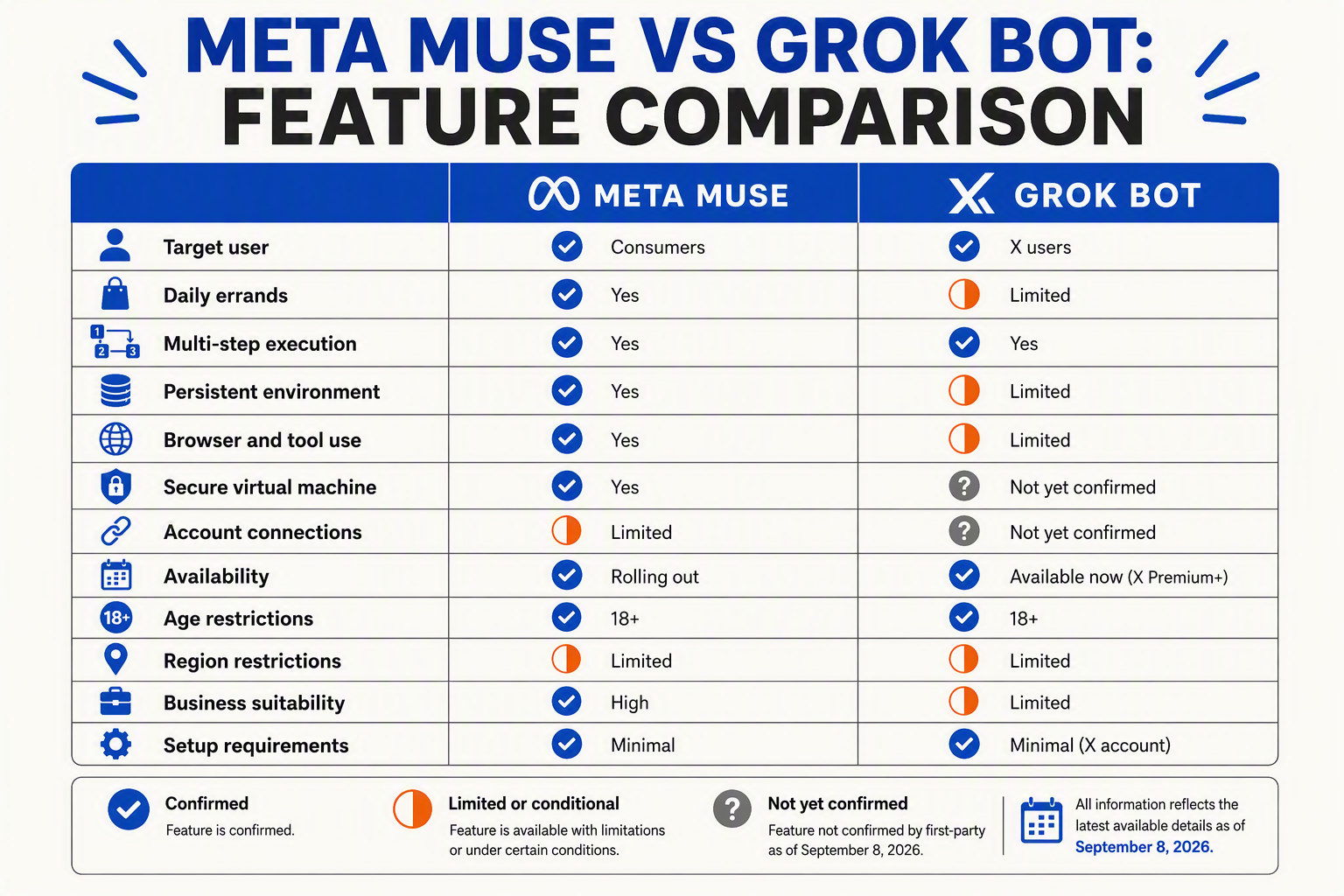
Meta Muse has a documented personal-agent proposition for email, online forms and travel booking, while the supplied research does not verify equivalent Grok Bot capabilities. Browser operation, persistent environments, secure virtual machines, age limits, regional access and business governance remain unconfirmed for both products unless noted below.
| Comparison area | Meta Muse | Grok Bot | Evidence-based takeaway |
|---|---|---|---|
| Target user | Described by Android Headlines as a personal AI agent for people delegating everyday errands. | Not confirmed: the supplied research does not identify Grok Bot’s target user or positioning. | Meta Muse has documented consumer-oriented positioning; no supported Grok Bot comparison is possible. |
| Documented personal tasks | Android Headlines reported on September 8, 2026 that Meta Muse can send emails, complete online forms and book travel. | Not confirmed: no supplied source verifies email sending, form completion, travel booking or comparable end-to-end tasks. | Email, forms and travel are the only clearly documented Meta Muse task categories in the research. |
| Browser and tool use | Not confirmed: completing forms and booking travel may require external tools, but the source does not specify a browser, connectors, APIs or supported services. | Not confirmed: no supplied source documents browser control, tool calling, connectors or third-party account access. | Do not infer a browser agent or broad tool ecosystem from general “agent” terminology. |
| Persistent environments | Not confirmed: no source documents retained sessions, persistent workspaces, cross-session memory or long-running environments. | Not confirmed: no supplied research verifies persistent sessions, workspaces, memory or background execution. | Continuity across sessions cannot be treated as an available feature for either product. |
| Secure virtual machines | Not confirmed: no source describes sandboxing, isolated execution, secure virtual machines or credential boundaries. | Not confirmed: no supplied source describes virtual machines, sandboxes or isolated execution. | Security architecture requires first-party technical documentation before sensitive access is granted. |
| Age restrictions | Not confirmed: minimum age, parental controls and supervised-account requirements are not documented. | Not confirmed: the supplied research contains no age requirement or parental-control information. | Consumer eligibility cannot be compared from the available evidence. |
| Regional and platform availability | Android Headlines reported Meta Muse on September 8, 2026, but countries, operating systems, devices, account tiers, pricing and rollout timing are unconfirmed. | Not confirmed: no supplied source establishes countries, platforms, product surfaces, pricing or account-tier availability. | Organizations should verify access directly rather than assuming a global launch. |
| Business governance | Not confirmed: no source documents role-based access, audit logs, approval policies, data residency, retention controls or enterprise administration. | Not confirmed: no supplied research verifies enterprise controls, auditability, data governance or administrative policies. | Neither product should be classified as enterprise-ready from this evidence alone. |
Product names must remain separate
Meta Muse is not Muse Spark or Muse Code. Android Headlines identifies Meta Muse as the personal agent associated with email, forms and travel, whereas Jacar.es describes Muse Code as a terminal coding agent from Meta Superintelligence Labs. Karmactive separately reports that Muse Code is powered by Muse Spark 1.2.
Consequently, Muse Code capabilities must not be attributed to Meta Muse. The supplied Explainx.ai research says Muse Code exited beta on September 1, 2026, with inter-session messaging, multi-agent workflows and an SDK preview; none of those features is confirmed for the Meta Muse personal agent.
What businesses should verify
Before either product handles operational data, businesses should request documentation covering:
- Human approval before sending email, submitting forms or purchasing travel.
- Credential isolation, account permissions and recovery procedures.
- Audit logs, retention policies, regional data processing and administrator controls.
- Age eligibility, supported countries, devices, languages and paid-plan requirements.
The defensible conclusion is narrow: Meta Muse has three reported personal-task categories; the supplied research does not provide enough Grok Bot evidence for a feature-level verdict.
How do Meta Muse and Grok Bot handle privacy, security and safety?
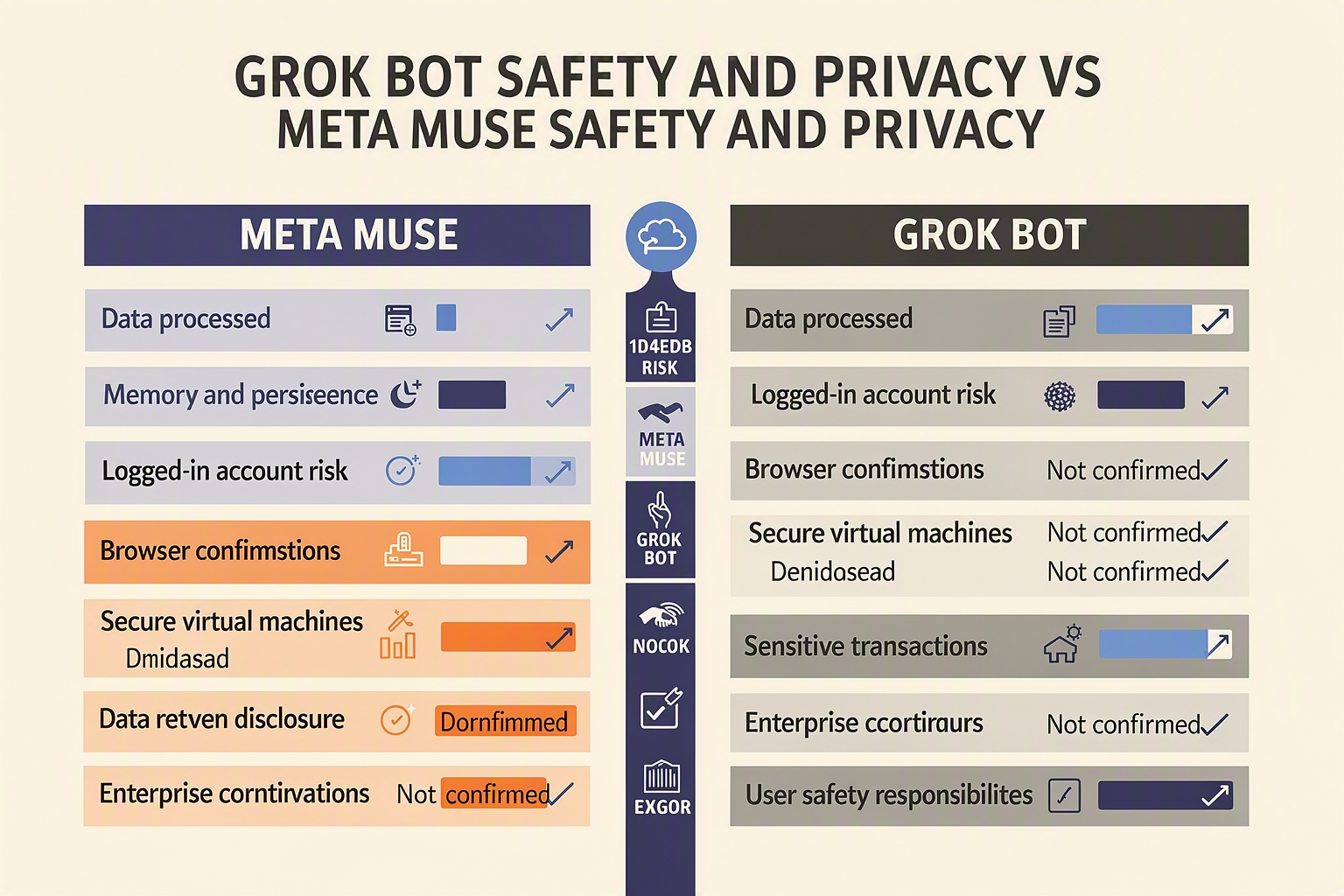
Neither Meta Muse nor Grok Bot can be declared more private or secure from the available September 2026 evidence. Meta Muse’s ability to act on email, forms and travel creates a larger potential impact from errors or compromised permissions, while Grok Bot’s documented role is primarily conversational.
- Meta Muse: Android Headlines reported on September 8, 2026 that Muse can send emails, complete online forms and book travel—actions that may expose contact, identity, itinerary and payment data.
- Grok Bot: The supplied 2026 research documents information-led assistance, but does not establish equivalent authority to submit forms, make bookings or send email.
- Agent safety: Meta Muse should require explicit confirmation before purchases, irreversible submissions, sensitive messages or changes to reservations.
- Privacy controls: Users should verify retention periods, model-training opt-outs, deletion controls and third-party data sharing in the applicable product terms.
- Security practice: Grant the minimum permissions required, prefer temporary access where available, and avoid placing passwords, one-time codes or full payment credentials in prompts.
- Product scope: Privacy claims about Muse Spark or terminal-based Muse Code should not be automatically applied to the consumer-facing Meta Muse agent.
| Area | Meta Muse | Grok Bot | Practical implication |
|---|---|---|---|
| Primary exposure | Email, forms and travel data | Prompts and conversation history | Muse may process more transaction-specific data |
| Action authority | Reported real-world task execution | No equivalent execution documented here | Muse needs stronger approval checkpoints |
| Financial risk | Travel booking can involve spending | Not established in supplied evidence | Require confirmation before payment |
| Prompt-injection risk | Third-party pages or form content | External information and user prompts | Treat retrieved instructions as untrusted |
| Transparency status | Launch details remain limited | Controls depend on current xAI terms | Review settings before sharing sensitive data |
| Best safeguard | Least-privilege access and action previews | Minimise sensitive prompt content | Delete histories and revoke unused access |
How much do Meta Muse and Grok Bot cost, and which offers better value?
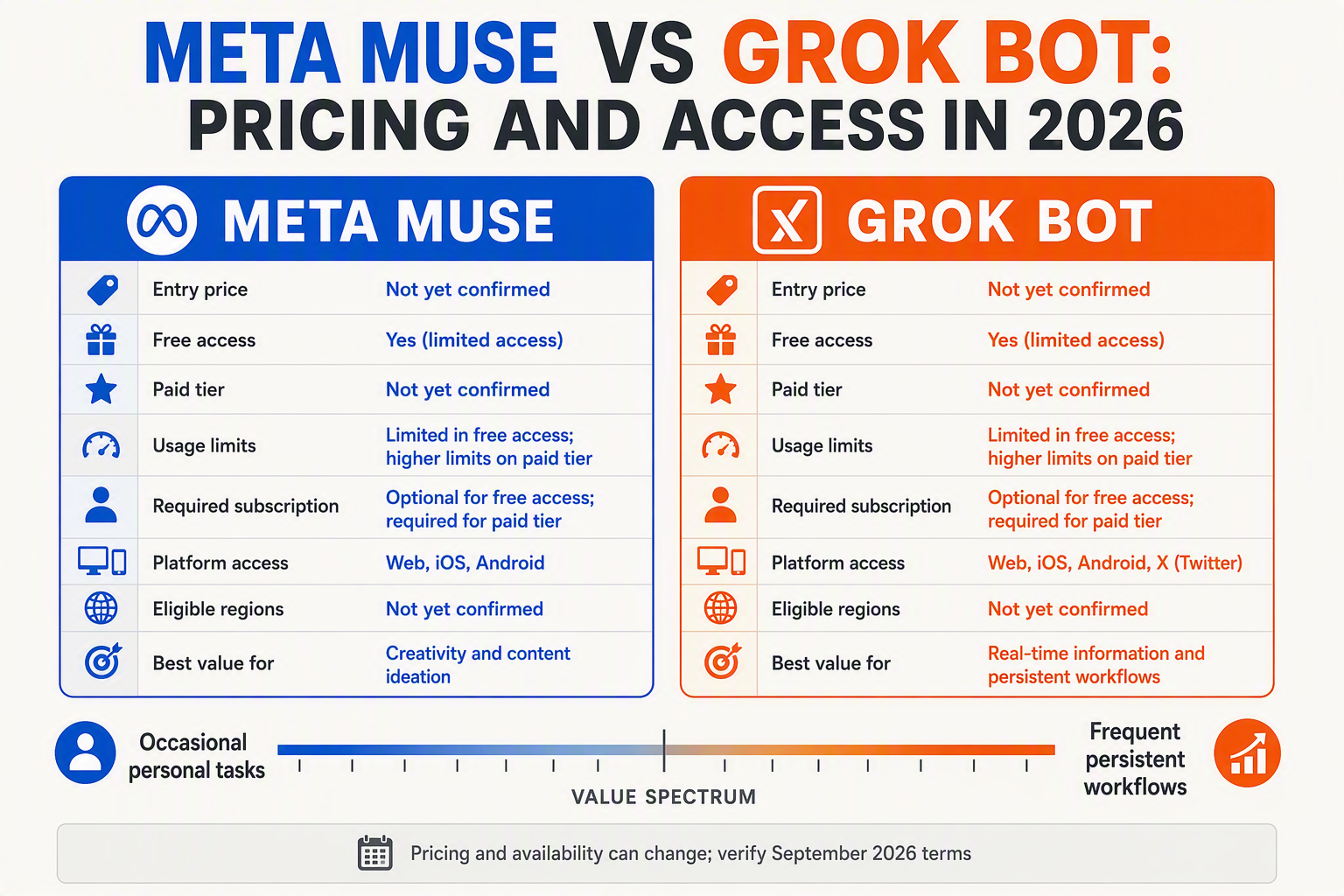
Neither Meta Muse nor Grok Bot has a verified standalone price, free tier, usage quota or bundled-plan entitlement in the supplied September 2026 research. The available evidence therefore does not support declaring either product better value; buyers must wait for official pricing and access terms.
| Cost or value factor | Meta Muse | Grok Bot | Evidence-based takeaway |
|---|---|---|---|
| Standalone price | Not verified | Not verified | No monthly or annual comparison is possible |
| Free tier and quotas | Not confirmed | Not confirmed | Message, task and rate limits remain unknown |
| Verified proposition | Personal agent for emails, forms and travel booking | No comparable task proposition established by the supplied sources | Compare only documented capabilities |
| Transaction costs | Travel and third-party purchases may create separate charges | External charges are not documented | An AI subscription may not represent total cost |
| Access requirements | Region, age and account eligibility are unconfirmed | Region, age and account eligibility are unconfirmed | Availability should be checked in the official interface |
| Technical environment | Browser use, persistent environments and secure VMs are unconfirmed | Browser use, persistent environments and secure VMs are unconfirmed | Do not infer enterprise-grade execution or isolation |
| Business plans | Not confirmed | Not confirmed | Team administration, compliance and support terms are unknown |
| Related products | Muse Spark and Muse Code are separate products | Other Grok offerings should not be assumed to include Grok Bot | Avoid transferring prices across products |
What is actually verified about Meta Muse?
Android Headlines reported on September 8, 2026, that Meta Muse is a personal AI agent designed to send emails, complete online forms and book travel. These capabilities suggest a task-oriented proposition, but the report does not establish a subscription price, free allowance, per-task charge, supported region or commercial launch tier.
The research also does not verify whether Meta Muse:
- Operates through a general-purpose browser;
- Receives a persistent environment between sessions;
- Executes tasks inside a secure virtual machine;
- Requires a particular age, country or Meta account type;
- Offers business plans, administrative controls or service-level agreements.
These details materially affect value. A personal agent that can complete a limited number of supervised tasks is economically different from one offering high-volume execution, persistent context and managed business controls.
What is verified about Grok Bot pricing?
The supplied research does not establish a standalone Grok Bot price, free tier, usage cap, regional rollout or inclusion within another xAI or Grok subscription. It also provides no verified basis for calculating cost per conversation, completed task or active user.
Consequently, readers should not assume that access to another Grok product automatically includes Grok Bot. Pricing and entitlement should be confirmed through the relevant official xAI or Grok account interface once published.
Why travel tasks require total-cost scrutiny
For Meta Muse travel bookings, the agent’s fee—if any—would be only one part of the cost. Users may also incur:
- Airfare, hotel and ground-transport charges;
- Taxes, booking fees and currency-conversion costs;
- Cancellation or amendment penalties;
- Paid add-ons selected during checkout.
Purchase approval is equally important. Until Meta documents confirmation steps, spending limits, refund handling and liability, users should review the itinerary and final amount before authorizing payment.
Keep Muse, Muse Spark and Muse Code separate
Meta Muse is the reported personal agent. Muse Spark is a distinct model family, while Muse Code is a terminal-based coding agent. Explainx.ai reported that Muse Code exited beta on September 1, 2026; any Muse Code or Muse Spark pricing must not be presented as Meta Muse consumer pricing.
What are the pros and cons, and which agent should consumers, marketers or businesses choose?
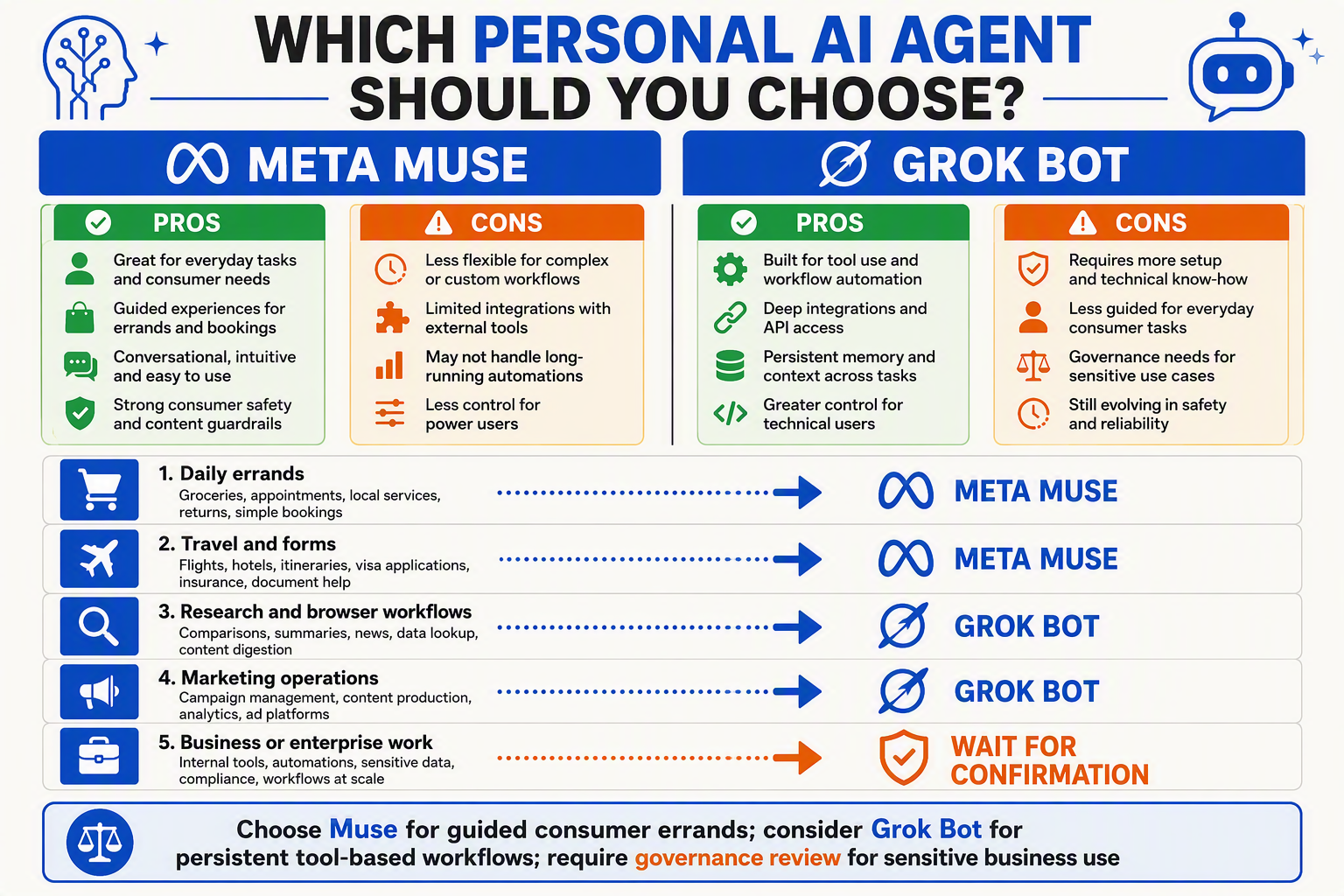
Meta Muse is the better fit for consumers delegating digital errands; Grok Bot is the safer choice for conversational research, ideation and information discovery. Marketers and businesses should choose by workflow—and avoid unattended high-risk actions until pricing, privacy controls and reliability are independently verified.
| User or decision factor | Meta Muse | Grok Bot | Practical choice |
|---|---|---|---|
| Consumers | Executes errands such as emails, forms and travel bookings | Emphasises conversational, information-led assistance | Muse for delegated actions; Grok for questions and exploration |
| Marketers | Could complete repetitive browser-based tasks, subject to permissions | Better aligned with research, brainstorming and iterative content development | Grok for ideation; pilot Muse for approved operational tasks |
| Customer-service teams | Potentially useful for back-office actions, but business controls are not documented | Useful for interactive analysis, but equivalent transaction execution is not established | Use a dedicated engagement platform for production workflows |
| Personal task execution | Android Headlines reported email sending, form completion and travel booking on September 8, 2026 | Supplied research does not document comparable end-to-end execution | Muse, after testing confirmation and approval steps |
| Availability and cost | Regions, operating systems, pricing and rollout schedule remain unconfirmed | Access depends on the relevant Grok product and xAI distribution channel | Verify current eligibility and total cost before committing |
| Main risk | An execution mistake can submit data, contact people or initiate a booking | A plausible but inaccurate answer can mislead downstream decisions | Require human review for financial, legal or sensitive actions |
Pros and cons by agent
- Meta Muse—pro: Android Headlines says Muse can send emails, fill online forms and book travel, moving beyond advice into completed outcomes.
- Meta Muse—pro: Delegation could reduce multi-step consumer work, particularly when a task spans websites, forms and communications.
- Meta Muse—con: Launch reporting available on September 8, 2026 does not quantify success rates, latency, supported languages, transaction limits or cancellation safeguards.
- Meta Muse—con: Broader permissions create greater privacy and operational exposure; users should review every recipient, field, date and payment before confirmation.
- Grok Bot—pro: Its conversational approach is better suited to open-ended research, rapid follow-up questions, campaign brainstorming and comparing alternatives.
- Grok Bot—con: The supplied evidence does not establish autonomous completion of Muse-style bookings, forms or emails, so users may still need to execute recommendations manually.
Final recommendation
- Consumers: Pick Meta Muse for low-risk errands with visible confirmation screens; pick Grok Bot when understanding options matters more than executing them.
- Marketers: Prefer Grok Bot for research and ideation, while restricting Muse pilots to reversible tasks that exclude customer consent, payments and regulated claims.
- Businesses: Neither consumer agent should automatically replace governed customer-engagement infrastructure. Platforms such as CallMissed combine AI voice agents, WhatsApp Business calling, chatbots and an omnichannel inbox, providing a more purpose-built route for controlled customer communications.
- Product check: Do not confuse Meta Muse with Muse Spark, the model family, or Muse Code, Meta Superintelligence Labs’ terminal coding agent; explainx.ai reported that Muse Code exited beta on September 1, 2026.
Frequently asked questions about Meta Muse vs Grok Bot
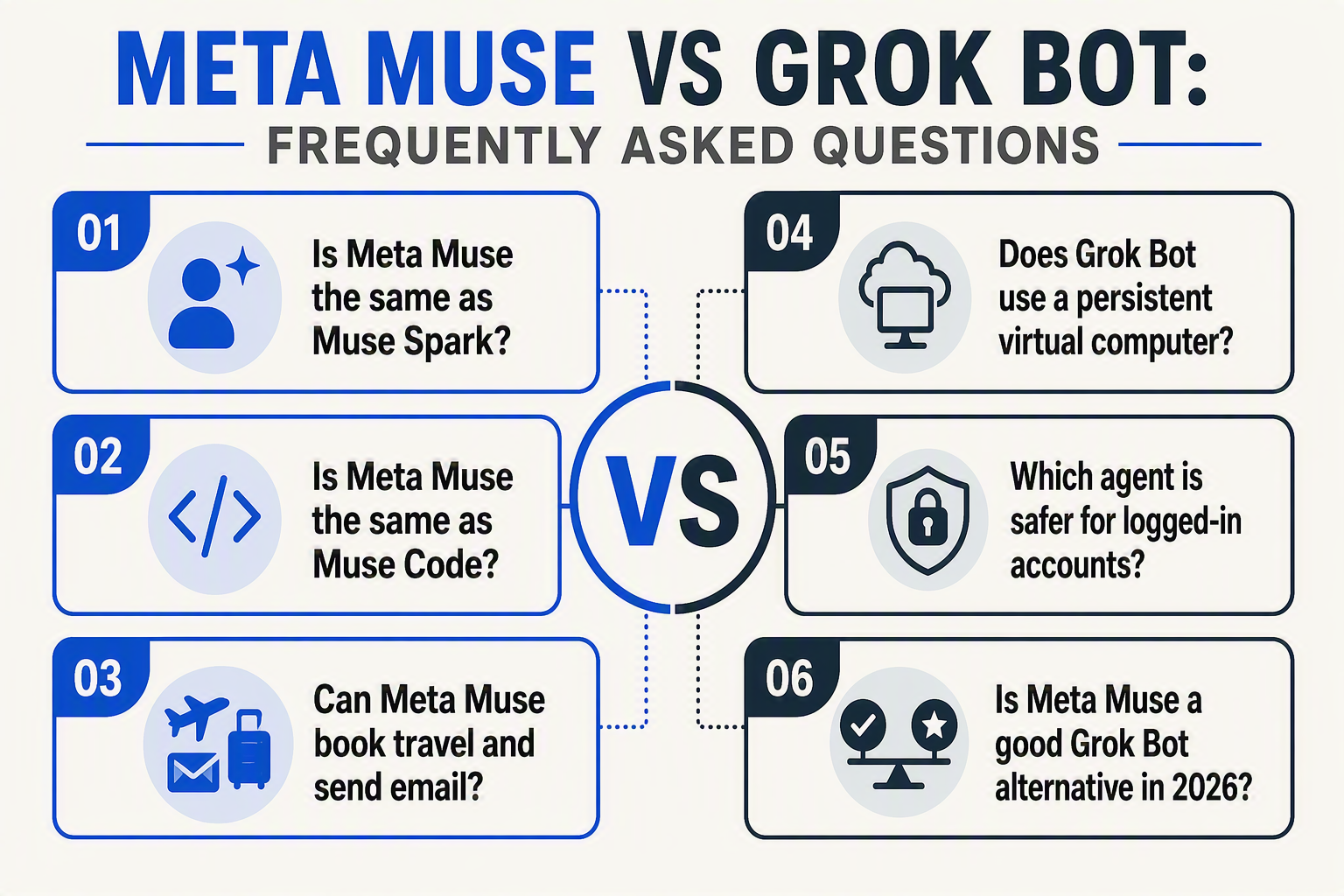
What is the main difference between Meta Muse and Grok Bot?
Is Meta Muse the same product as Muse Spark or Muse Code?
Which is better for personal task execution: Meta Muse vs Grok Bot?
Is Meta Muse available to everyone in 2026?
What is Muse Code, and can it perform everyday Meta Muse tasks?
How should I choose between Meta Muse vs Grok Bot in 2026?
Conclusion
In 2026, Meta Muse is the better fit for delegated errands; Grok Bot is stronger for conversational, information-led help—but the verdict remains provisional.
- Muse targets consumers who want emails sent, forms completed and travel booked.
- Grok Bot suits users who prefer research, questions and iterative dialogue.
- Muse’s availability, pricing, platform coverage and independent reliability still need confirmation.
- Meta Muse is distinct from the Muse Spark model family and Muse Code terminal agent.
Watch for rollout details and evidence of dependable task completion. To follow how this shift reaches business communications, explore CallMissed, an AI infrastructure platform for voice agents and multilingual chatbots. Which assistant matches your workflow?
Related Reading
- Meta Muse Personal AI Agent: Privacy, Features and U.S. Availability
- Meta Muse Code vs GitHub Copilot vs Cursor: Verified 2026 Comparison
- Voice Agent API With LiveKit: Which Stack Should You Choose in 2026?