GPT-Realtime-2 vs Amazon Nova 2 Sonic: Buyer's Guide


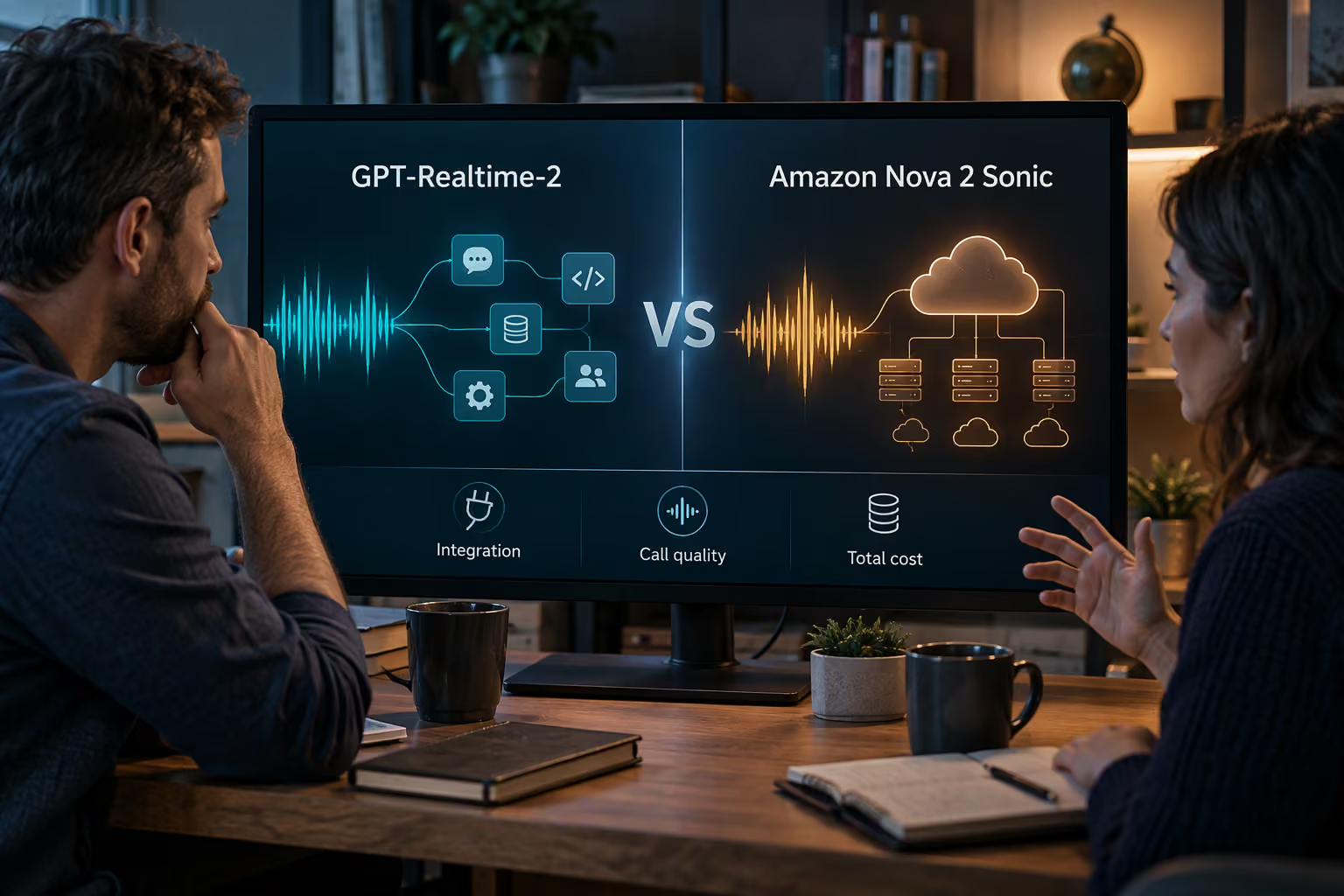
GPT-Realtime-2 vs Amazon Nova 2 Sonic: compare integration constraints, sourced pricing and call-testing criteria to choose your voice AI stack.

GPT-Realtime-2 vs Amazon Nova 2 Sonic: Buyer's Guide
The biggest mistake in GPT-Realtime-2 vs Amazon Nova 2 Sonic is choosing a voice model before choosing an integration path. Amazon Nova 2 Sonic deserves first consideration when preserving an existing Nova Sonic integration matters; GPT-Realtime-2 belongs on the shortlist when evaluating OpenAI’s realtime voice offering—but neither is a defensible universal winner from the supplied evidence.
That distinction matters because conversational AI buying decisions extend beyond how natural a demo sounds. A customer-service agent must handle interruptions, retrieve information, execute business actions, and recover gracefully when a conversation goes wrong. Those are evaluation requirements, not capabilities buyers should assume from a model’s name.
What makes this comparison relevant now?
According to OpenAI’s GPT-Realtime-2 announcement, the model’s listed audio pricing is $32 per million input tokens and $64 per million output tokens, using the source supplied for this November 2026 comparison. OpenAI lists cached audio input separately at $0.40 per million tokens. These are token prices—not a quoted cost per completed customer call.
Meanwhile, AWS’s Amazon Nova 2 Sonic announcement states that the model uses the same bidirectional streaming API as the original Nova Sonic, according to the source supplied for this November 2026 comparison. For an existing Nova Sonic deployment, that continuity makes integration reuse a concrete consideration rather than a vague ecosystem preference.
There is also a versioning trap: the supplied OpenAI pricing page lists GPT-Realtime-2.1 and GPT-Realtime-2.1-mini, while the announcement describes GPT-Realtime-2. A useful buyer’s guide must keep those model identities separate instead of silently comparing a newer OpenAI variant with Amazon Nova 2 Sonic.
Which constraints should decide your shortlist?
Start with the requirements that can disqualify a model before comparing voice quality:
- Integration compatibility: Which streaming interface and event-handling patterns does your application already use?
- Actual operating cost: What do representative conversations cost after accounting for input, output, caching, and surrounding infrastructure?
- Conversation performance: How reliably does each candidate handle your accents, interruptions, business vocabulary, and task boundaries?
- Deployment requirements: Which regions, security controls, and operational processes does your business require?
The supplied context does not establish Nova 2 Sonic pricing or comparable latency benchmarks. This guide therefore treats those as verification items, not opportunities to manufacture a cheaper or faster winner.
As of November 2026, CallMissed offers a managed voice-agent WebSocket API, illustrating the broader move toward infrastructure that helps developers operationalize conversational AI.
The comparison ahead separates documented features from unanswered questions, presents a feature-and-pricing table, and explains where each alternative may be the better fit—so your decision rests on production constraints rather than a polished demo.
Which should you choose? Favor GPT-Realtime-2 for an OpenAI-oriented build and Nova 2 Sonic for an AWS-oriented build. Neither has a demonstrated universal advantage in the supplied evidence.
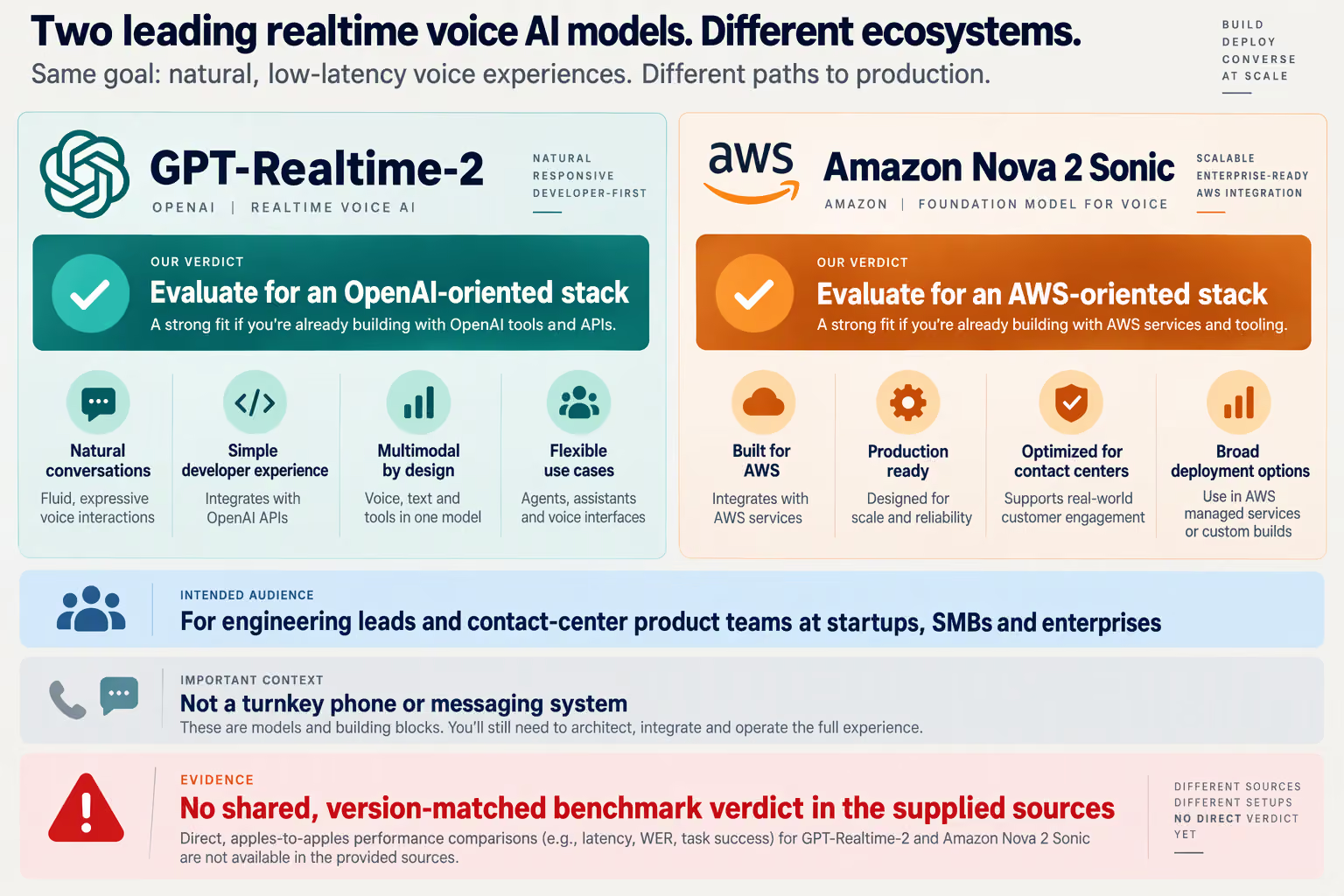
Choose GPT-Realtime-2 for an OpenAI-oriented build and Amazon Nova 2 Sonic for an AWS-oriented build. As of November 2026, the supplied evidence supports an integration-first shortlist—not a universal winner.
Which model fits your existing conversational AI stack?
- GPT-Realtime-2: Favor OpenAI’s candidate when your team already operates an OpenAI-oriented application and wants to evaluate its realtime voice offering. OpenAI’s announcement identifies GPT-Realtime-2 explicitly; for this November 2026 comparison, require that exact model identity in test configurations rather than accepting results labeled only “OpenAI realtime.”
- Amazon Nova 2 Sonic: Favor AWS’s candidate when preserving an existing Nova Sonic implementation is important. AWS’s announcement, supplied for this November 2026 comparison, states that Nova 2 Sonic uses the “same bidirectional streaming API” as the original model. That supports evaluating integration reuse, but does not establish zero migration work.
- Existing Nova Sonic buyers: Make compatibility your first acceptance test: replay your current streaming events, connection lifecycle, and failure-handling scenarios against Nova 2 Sonic. AWS documents API continuity in the supplied November 2026 evidence; your application tests must establish whether existing behavior remains suitable before you commit to production.
- Greenfield buyers: Neither ecosystem preference nor a convincing demonstration settles GPT-Realtime-2 vs Nova 2 Sonic for conversational AI. For a November 2026 evaluation, run both candidates through the same customer-service scripts: an interrupted answer, an ambiguous request, a business-action failure, and a human-escalation request. These are proposed tests, not documented model capabilities.
What could change the recommendation?
- GPT-Realtime-2 cost: A hypothetical workload containing 100,000 uncached audio input tokens and 100,000 audio output tokens costs $9.60 at the rates in OpenAI’s announcement supplied for November 2026: $3.20 input plus $6.40 output. This calculated example excludes other charges and does not establish a per-minute or per-call price.
- Amazon Nova 2 Sonic cost: The supplied AWS excerpts do not establish November 2026 pricing, so a cheaper-model verdict would be unsupported. Obtain the applicable rates and meter the same test workload before comparing expenditure. Report cost per successfully completed task alongside token consumption; a low bill alone does not demonstrate useful conversations.
- Performance and deployment: The supplied November 2026 evidence provides no comparable latency benchmark, language-coverage matrix, or deployment-region comparison. Set measurable acceptance thresholds for your own requirements—for example, task completion, interruption recovery, and response delay—and verify regional availability separately. Leave a comparison cell “unverified” rather than converting missing evidence into a disadvantage.
- CallMissed: As of November 2026, CallMissed’s verified fact sheet lists a managed voice-agent WebSocket API and OpenAI-compatible endpoints, illustrating an infrastructure option worth assessing alongside direct-provider integration. The fact sheet does not establish support for either exact model compared here; confirm model availability and interface requirements before treating a gateway as a deployment shortcut.
Which language, phone, messaging and integration constraints could rule either model out?
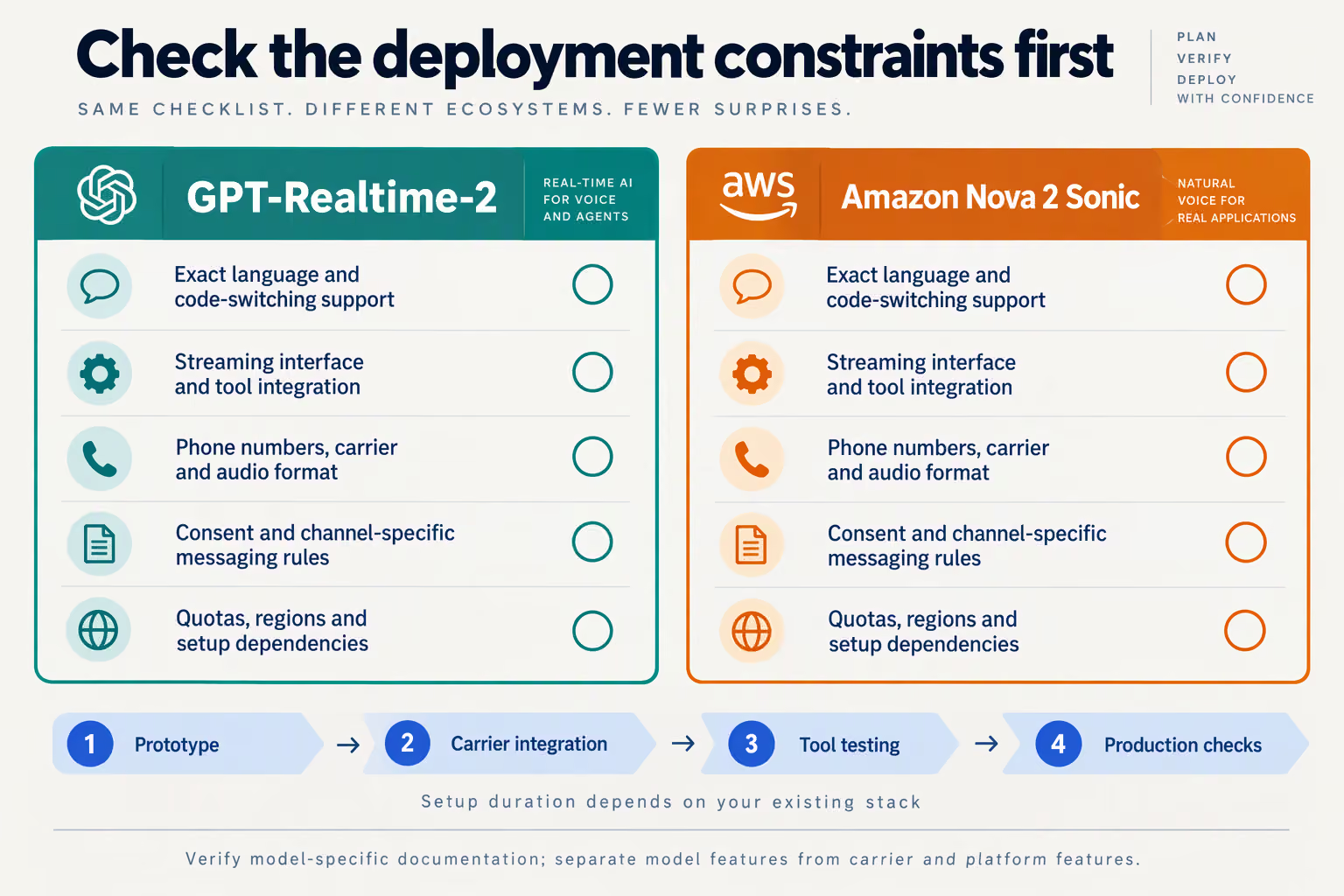
Neither GPT-Realtime-2 nor Amazon Nova 2 Sonic is a defensible choice until your required languages, calling channels, and business integrations are verified. For this November 2026 comparison, the supplied documentation leaves several potential disqualifiers unresolved.
Which language and phone requirements could rule a model out?
- GPT-Realtime-2: OpenAI’s supplied announcement does not establish a supported-language list, regional-accent coverage, or code-switching guarantees. If Hindi–English switching is mandatory, require a demonstration using your own conversations before shortlisting; a fluent English demo does not establish reliable handling of Hinglish, customer names, addresses, or spoken account numbers.
- Amazon Nova 2 Sonic: AWS’s supplied announcement establishes streaming-interface continuity, not a language-by-language support matrix. Do not infer coverage from the original Nova Sonic or another Amazon model. Request documentation for the exact Nova 2 Sonic version, then test recognition, spoken responses, and language switching separately against your required markets.
- Phone connectivity: Neither supplied model announcement establishes a complete telephone service with rented numbers, carrier connectivity, keypad handling, or human transfer. Treat these as infrastructure requirements rather than model features. A mandatory existing SIP trunk, for example, can rule out an integration architecture even when the underlying model passes your conversation tests.
- Indian-language deployment: As of November 2026, the CallMissed fact sheet lists speech recognition in 22 Indian languages plus English, including Hinglish, and natural text-to-speech in 10 Indian languages plus English. These are platform capabilities—not evidence that either compared model supports those languages; verify the selected recognition, model, and voice combination.
Which messaging and integration requirements need separate verification?
- WhatsApp calling: A realtime audio model does not, by itself, establish WhatsApp Business Calling support. Require explicit confirmation of inbound call routing, permission-based outbound calling, and the chosen model’s availability behind that connection. The supplied OpenAI and AWS excerpts do not document these channel capabilities, so neither earns an automatic advantage here.
- Messaging workflows: If the same assistant must handle WhatsApp messages, Instagram DMs, or Facebook Page conversations, evaluate the surrounding platform separately. Specify which workflows must share customer context, which require human handoff, and which involve commerce or forms. Voice-model selection alone does not answer those operational requirements.
- Business integrations: Make CRM updates, calendar bookings, and order lookups acceptance tests rather than assumed capabilities. For each required action, check authentication, tool schemas, error recovery, and whether confirmation reaches the customer. The supplied context provides no head-to-head evidence establishing either model’s reliability for these integrations as of November 2026.
- API compatibility: AWS documents bidirectional audio streaming for Amazon Nova Sonic and API continuity for Nova 2 Sonic; that does not establish interchangeability with OpenAI’s realtime interface. Before committing, verify audio formats, session limits, cancellation events, and tool-result handling against exact-version documentation. An incompatible mandatory client library can be a practical disqualifier.
How do GPT-Realtime-2 and Nova 2 Sonic compare on documented features?
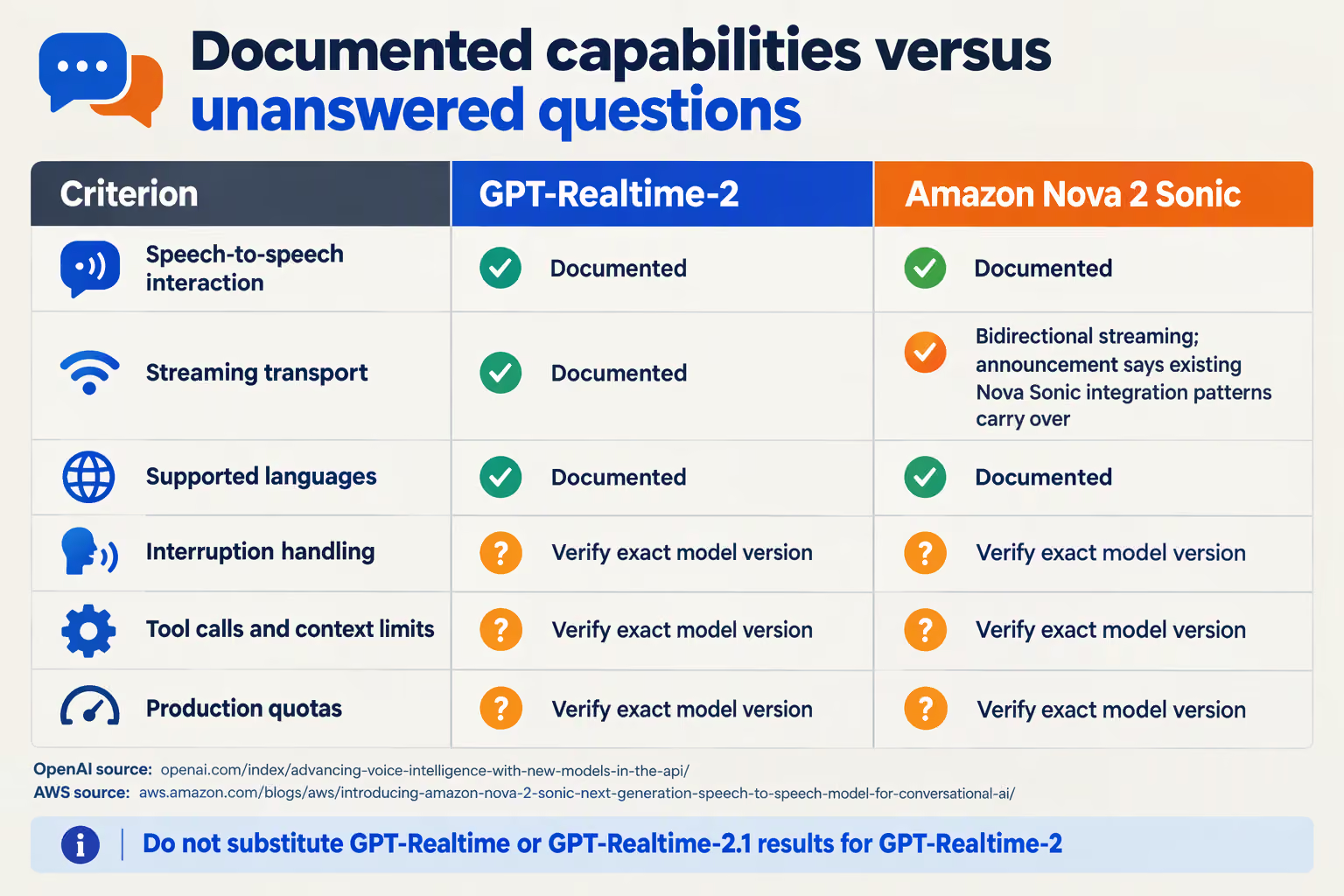
The documented difference is API continuity, not a proven feature advantage: AWS explicitly confirms Nova 2 Sonic’s streaming compatibility, while the supplied OpenAI excerpts establish GPT-Realtime-2’s audio pricing. As of November 2026, neither source set supports a complete capability-by-capability winner.
- Amazon Nova 2 Sonic: AWS’s announcement confirms the same bidirectional streaming API as original Nova Sonic; this supports evaluating integration reuse, not assuming every migration requires zero changes.
- GPT-Realtime-2: OpenAI’s announcement documents audio-token billing, but the supplied excerpt does not specify transport protocols, session limits, supported languages, or tool-execution behavior.
- Both models: Missing documentation in these excerpts means “not established,” not “unsupported.” Buyers should request model-specific documentation before treating any blank as a competitive disadvantage.
- Source scope: AWS’s original Nova Sonic user guide describes realtime bidirectional audio streaming; it should not be used alone to assign additional features or limits to Nova 2 Sonic.
Which features are actually documented for each model?
The table below reflects the supplied OpenAI and AWS excerpts reviewed for November 2026, rather than an exhaustive inventory of either platform.
| Comparison point | GPT-Realtime-2 | Amazon Nova 2 Sonic | Evidence and buyer implication |
|---|---|---|---|
| Product category | Realtime voice model | Speech-to-speech model | OpenAI and AWS announcements identify the respective offerings; category labels are not quality benchmarks. |
| Streaming API continuity | Not established in supplied excerpt | Same bidirectional streaming API as original Nova Sonic | AWS announcement supports assessing reuse of existing integration patterns and event handling. |
| Audio input price | $32 per million tokens | Not provided | OpenAI announcement; no defensible price ranking without AWS pricing. |
| Cached audio input price | $0.40 per million tokens | Not provided | OpenAI announcement; savings depend on eligible cached usage, not total call duration. |
| Audio output price | $64 per million tokens | Not provided | OpenAI announcement; output consumption must be included in cost estimates. |
| Languages and voices | Counts not provided | Counts not provided | Neither supplied excerpt supports a language-coverage winner. |
| Interruptions and tool use | Behavior not specified | Behavior not specified | Verify interruption handling and business-action execution independently. |
| Session limits and latency | No comparable figures supplied | No comparable figures supplied | Context limits, session duration, and response timing remain verification items. |
What should buyers verify before treating this as a feature shortlist?
- GPT-Realtime-2: Confirm the exact model identifier in deployment documentation; OpenAI’s supplied pricing page lists GPT-Realtime-2.1 and GPT-Realtime-2.1-mini, which should not silently substitute for the model being compared.
- Amazon Nova 2 Sonic: Ask for current pricing, supported languages, session limits, and tool-use documentation; API continuity answers an integration question, but does not establish parity across those requirements.
Practical interpretation: Use this matrix to separate confirmed facts from procurement questions. A feature should enter the final scorecard only when its documentation identifies the correct model version and your acceptance test verifies the required behavior.
What do the models cost, and what is the cost per completed call?
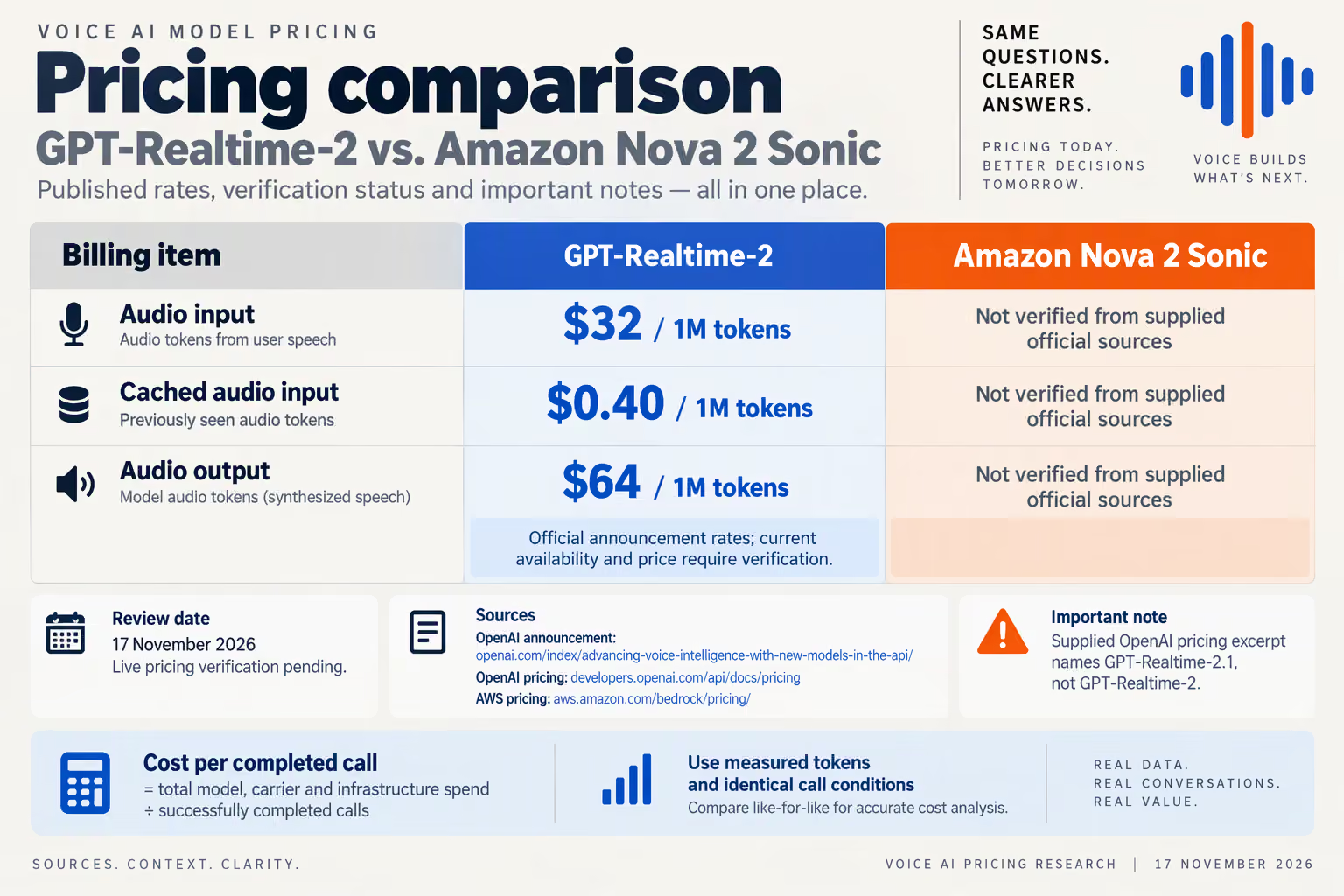
GPT-Realtime-2 has documented audio-token prices; Amazon Nova 2 Sonic pricing is not established by the supplied AWS sources. As of November 2026, neither source establishes an all-in cost per completed call, so a cheaper-model verdict would be premature.
| Cost item | GPT-Realtime-2 | Amazon Nova 2 Sonic | Evidence, November 2026 |
|---|---|---|---|
| Audio input | $32 / 1M tokens | Not supplied | OpenAI announcement; AWS excerpt omits pricing |
| Audio output | $64 / 1M tokens | Not supplied | OpenAI announcement; AWS excerpt omits pricing |
| Cached audio input | $0.40 / 1M tokens | Not supplied | OpenAI announcement; AWS excerpt omits pricing |
| Text and tool-related usage | Not established here | Not established here | Supplied model announcements |
| Phone carriage | Not included in quoted audio rates | Not established here | Requires separate deployment pricing |
| Cost per completed call | Calculate from measured usage | Requires verified rates and usage | No comparable completed-call benchmark supplied |
- OpenAI: The supplied November 2026 OpenAI announcement prices GPT-Realtime-2 audio input at $32 per million tokens, output at $64, and cached input at $0.40; these are separate billing categories, not a per-minute tariff.
- AWS: The supplied November 2026 AWS announcement documents Amazon Nova 2 Sonic’s streaming-API continuity but provides no pricing figures; missing evidence does not mean free usage or higher cost.
- Version control: OpenAI’s supplied November 2026 pricing page lists GPT-Realtime-2.1 and GPT-Realtime-2.1-mini; do not substitute the mini model’s $10 input/$20 output audio rates into a GPT-Realtime-2 estimate.
- Caching: OpenAI’s supplied November 2026 rates make cached audio input 98.75% cheaper per token than uncached input, calculated from $0.40 versus $32; that is not a 98.75% reduction in the whole-call bill.
- CallMissed: As of November 2026, CallMissed’s verified fact sheet lists its Standard voice-agent plan at ₹4/minute, covering speech recognition, the language model, and voice; a five-minute call costs ₹20 before separate phone carriage, without implying either compared model powers that plan.
- Procurement: Request the exact model identifier, deployment region, billable usage categories, and an itemized pilot invoice before comparing either vendor’s total cost.
How do you calculate cost per completed call?
Use total operating spend across all attempts ÷ successfully completed calls, with “completed” defined as a business outcome—not merely a connected conversation.
For a hypothetical GPT-Realtime-2 call consuming 10,000 uncached audio input tokens and 5,000 audio output tokens, OpenAI’s supplied November 2026 rates produce:
- Input: 10,000 ÷ 1,000,000 × $32 = $0.32.
- Output: 5,000 ÷ 1,000,000 × $64 = $0.32.
- Audio subtotal: $0.64, excluding other billable usage and infrastructure.
If 1,000 attempts each incur that subtotal but only 800 achieve the intended outcome, the illustrative audio cost is $640 ÷ 800 = $0.80 per completed call.
These are worked assumptions, not observed benchmarks or token-to-minute conversions. Add applicable telephony, orchestration, retries, and human-handoff costs; then run the same calculation for Nova 2 Sonic once its rates are verified.
What are the practical advantages and trade-offs of each approach?
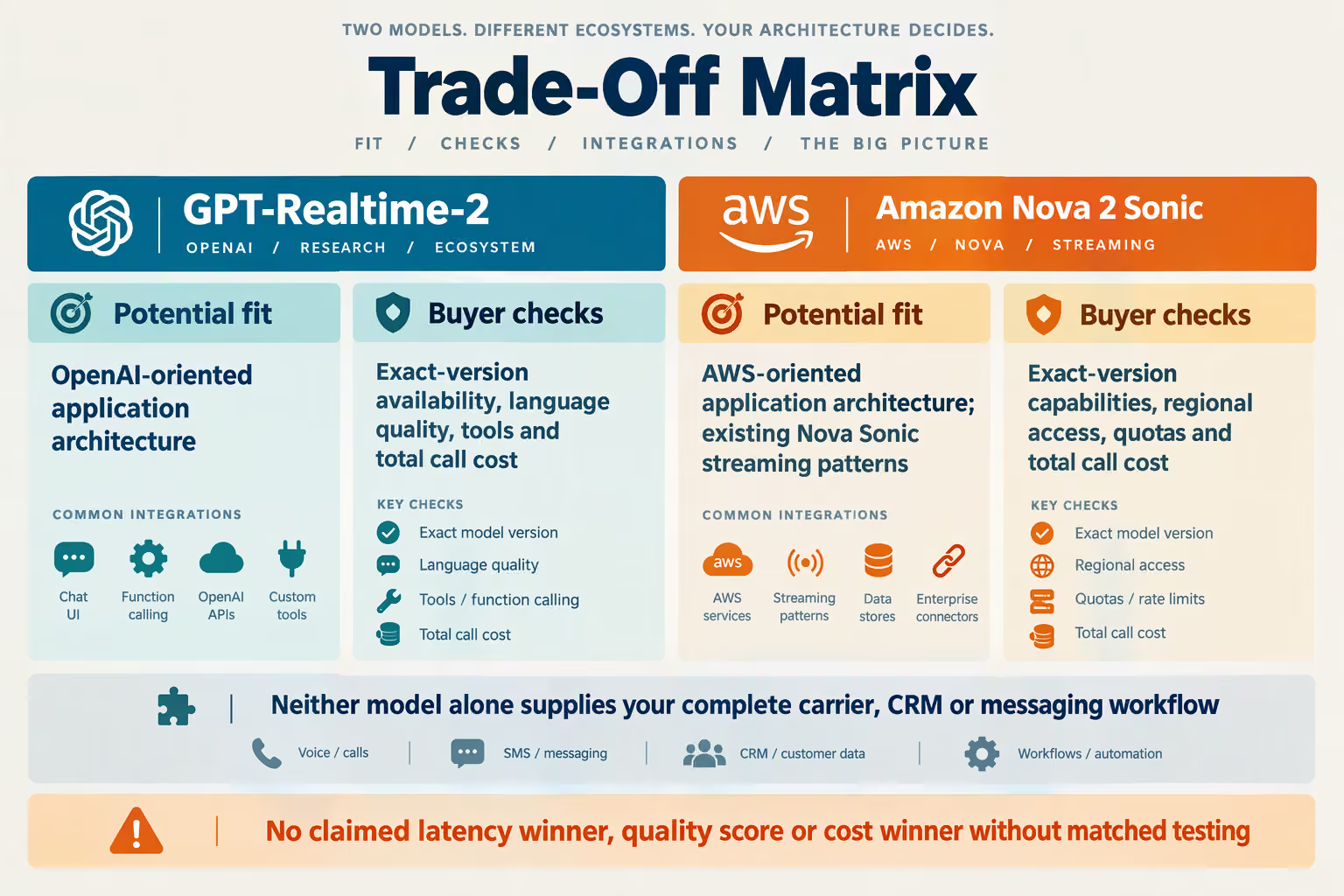
GPT-Realtime-2 offers a documented audio-cost baseline; Amazon Nova 2 Sonic offers documented continuity for existing Nova Sonic integrations. For conversational AI buyers, the practical trade-off is measurable usage cost versus potentially reusable integration work—not proven superiority in voice quality.
- GPT-Realtime-2: Budget from measured token consumption, not call duration alone; longer agent responses increase output charges, so concise answers become a cost-control lever.
- Amazon Nova 2 Sonic: Prioritize a migration assessment if you already use Nova Sonic; AWS’s announcement, reviewed for November 2026, confirms the “same bidirectional streaming API,” but does not establish zero migration work.
- Both approaches: Require a task-level comparison covering successful resolution, human escalation, and recovery after interruptions; the supplied sources contain no matched benchmark establishing a winner.
- Evidence limits: Treat missing Nova 2 Sonic pricing and comparative latency figures as procurement questions—not evidence that either model is cheaper or faster.
Which practical trade-offs should buyers compare?
The following table separates documented advantages from buying implications, using the supplied OpenAI and AWS sources as of November 2026.
| Decision factor | GPT-Realtime-2 | Amazon Nova 2 Sonic | Practical trade-off |
|---|---|---|---|
| Cost estimation | OpenAI publishes audio-token rates | Pricing absent from supplied AWS context | Obtain comparable usage estimates before ranking cost |
| Existing integration | Assess your OpenAI realtime implementation | AWS confirms original Nova Sonic streaming API continuity | Existing Nova code may offer a reuse advantage |
| Response length | Audio output contributes directly to token charges | Comparable cost sensitivity unverified | Test short and long agent responses |
| Cached audio | OpenAI publishes a separate cached-input rate | Comparable caching terms not supplied | Model savings only against actual eligible usage |
| Conversational latency | No matched benchmark supplied | No matched benchmark supplied | Measure both under identical conditions |
| Language coverage | Comparable language limits not supplied | Comparable language limits not supplied | Validate required accents and code-switching directly |
How should teams turn these trade-offs into a purchasing decision?
- GPT-Realtime-2: Using OpenAI’s announcement rates as of November 2026, a hypothetical session consuming 10,000 audio input tokens and 5,000 audio output tokens costs $0.64 for those audio tokens: $0.32 input plus $0.32 output. This excludes other charges and is not a per-minute estimate.
- Amazon Nova 2 Sonic: Separate reusable transport and event-handling code from behavioral acceptance testing. API continuity supports an integration advantage, but teams must still verify prompts, business actions, and failure handling against their own requirements.
- Evaluation protocol: Use the same four scenarios for each candidate: a straightforward request, an interrupted response, an ambiguous instruction, and a failed business action. Record completion, recovery, elapsed time, and total cost rather than judging a polished demo.
- Infrastructure choice: As of November 2026, CallMissed provides a managed voice-agent WebSocket and caller-chosen fallback models through its developer API. Assess those infrastructure capabilities separately from model selection; neither fact establishes availability of these two specific models through CallMissed.
Which should you choose after a matched phone-call pilot, and when is another approach better?
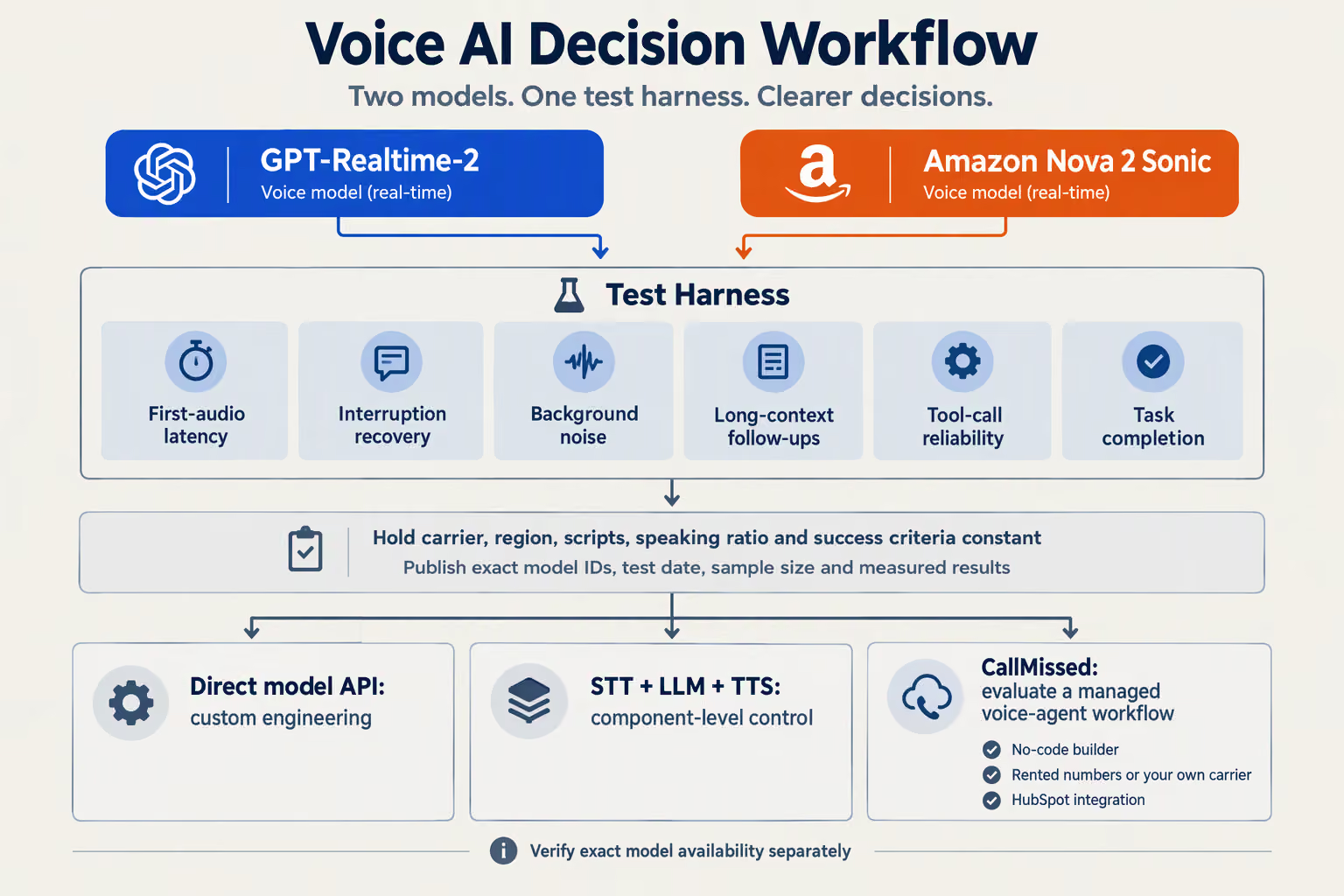
Choose GPT-Realtime-2 or Amazon Nova 2 Sonic based on successful task completion and total operating cost in your matched phone-call pilot, not demo preference. Choose another architecture when neither meets your language, control, or budget requirements.
Which pilot results should decide GPT-Realtime-2 vs Nova 2 Sonic?
- GPT-Realtime-2: Choose OpenAI’s candidate when your matched pilot shows better completion of the tasks that matter—such as booking, rescheduling, or resolving account queries—without unacceptable costs or escalation rates. Require successful business actions, not merely fluent responses; a convincing spoken confirmation is not evidence that a booking actually reached your system.
- Amazon Nova 2 Sonic: Choose Amazon’s candidate when pilot outcomes meet your acceptance criteria and preserving existing integration code reduces migration work. According to AWS’s announcement, reviewed for this November 2026 comparison, Amazon Nova 2 Sonic uses the original Nova Sonic’s bidirectional streaming API. Treat that continuity as an implementation advantage, not proof of better conversation quality.
- Matched evaluation: Use identical scenarios, tool permissions, knowledge sources, and telephone conditions, with results separated by language and task. For an illustrative 100-call test per candidate, report completed tasks, incorrect actions, human transfers, and disconnected calls as counts alongside percentages. These are proposed evaluation measures—not published benchmarks for either model.
- Cost comparison: Calculate total pilot spend ÷ successfully completed tasks, including model usage, phone carriage, infrastructure, and human recovery work. OpenAI’s announcement lists GPT-Realtime-2 audio output at $64 per million tokens, as reviewed in November 2026; that is not a per-call quote. The supplied AWS evidence does not establish comparable Nova 2 Sonic pricing.
When is another conversational AI approach better?
- Modular speech pipeline: Consider separate speech recognition, language-model, and text-to-speech components when independent component selection matters more than a single speech-to-speech interface. Pilot the complete pipeline: transcription errors, turn detection, and synthesis delays can change the result. Neither model’s supplied documentation establishes that this alternative will necessarily be cheaper or faster.
- Managed voice infrastructure: Consider infrastructure rather than another model when your bottleneck is deployment, monitoring, or business integration. As of November 2026, CallMissed offers no-code voice agents, custom REST tools, call recordings, transcripts, and QA scoring against your own rubrics. These capabilities address operating workflow; they do not establish either compared model’s availability through CallMissed.
- Constrained call flows: Prefer keypad menus or tightly bounded automation when callers need a small set of predictable actions and open-ended conversation adds little value. Test a hybrid route—for example, account verification followed by a conversational agent—against the same completion metric. Do not assume greater conversational freedom improves accuracy for every transaction.
- Human-assisted service: Retain human escalation when both pilots fail on consequential actions, unsupported languages, or ambiguous requests. Set approval rules before rollout, such as requiring confirmation before changing an appointment or account detail. A defensible November 2026 verdict can be “neither for this workflow” rather than forcing a winner from incomplete evidence.
Frequently Asked Questions
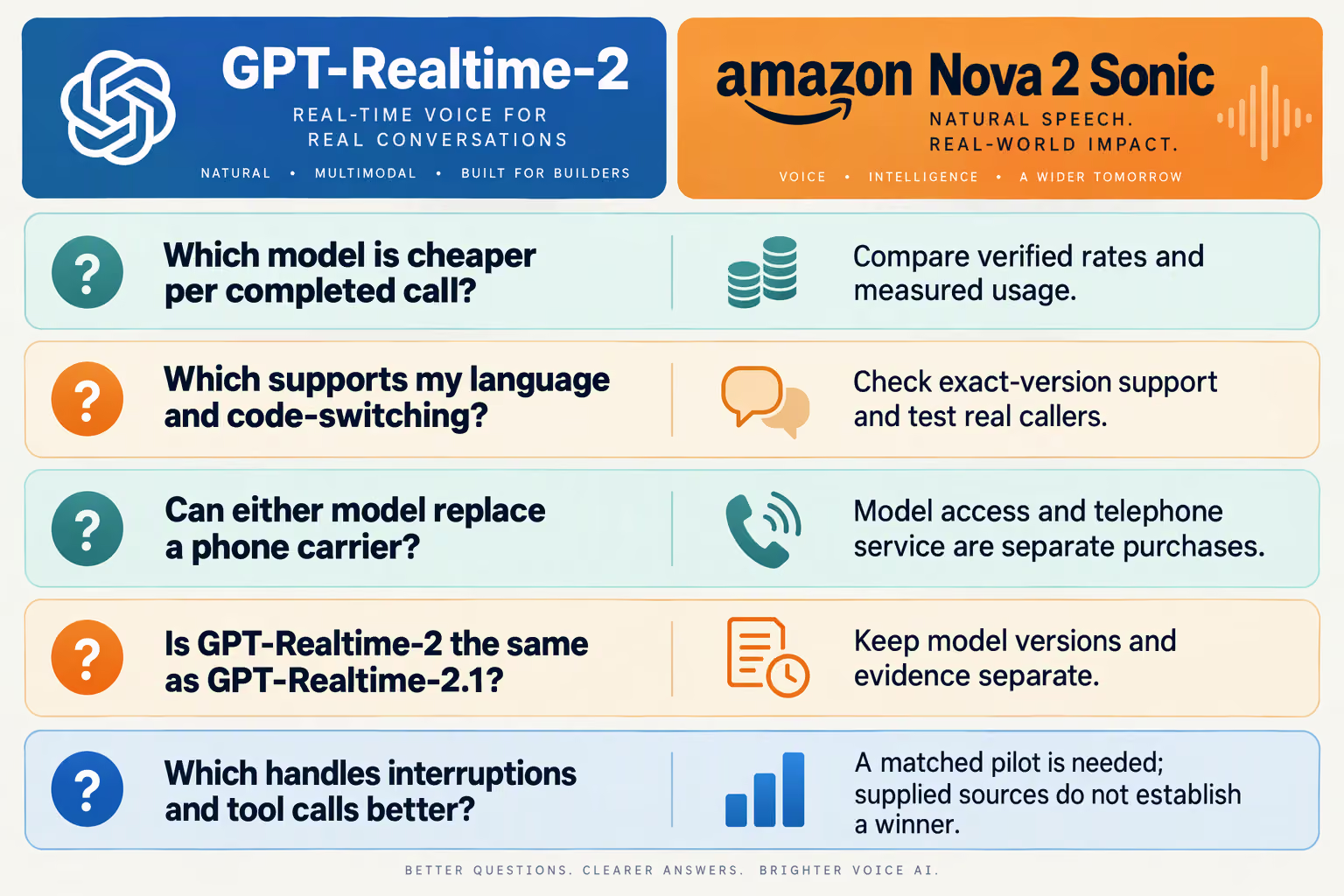
Neither model is a proven cheaper or better multilingual choice from the supplied evidence. Your existing integration, measured call costs, and language tests should decide the shortlist.
- Q: GPT-Realtime-2 vs Nova-Sonic-2 for conversational AI: which is cheaper?
A: As of November 2026, OpenAI’s GPT-Realtime-2 announcement lists $32 per million audio input tokens, $64 per million audio output tokens, and $0.40 per million cached audio input tokens. The supplied AWS material does not establish Amazon Nova 2 Sonic pricing, so a cheaper-model verdict is unsupported. Compare representative conversations using actual billed usage, then add telephony and infrastructure costs before choosing.
- Q: Which languages do GPT-Realtime-2 and Amazon Nova 2 Sonic support?
A: As of November 2026, the supplied OpenAI and AWS excerpts do not provide complete language lists for these exact models, so neither can be declared the stronger multilingual option. Verify current documentation for both speech understanding and spoken output, rather than treating “multilingual” as a guarantee. Test regional accents, code-switching, names, addresses, and industry vocabulary using the conversations your customers actually have.
- Q: Can GPT-Realtime-2 and Nova 2 Sonic work with phone calls?
A: Phone-call deployment requires connecting the model’s audio interface to telephony infrastructure; model access alone does not establish a working telephone agent. As of November 2026, AWS documents bidirectional audio streaming for Nova Sonic, while CallMissed’s verified offering includes inbound and outbound calls through rented numbers or Twilio, Plivo, or any SIP trunk. That establishes CallMissed’s telephony capabilities, not confirmed support for either exact model in this comparison.
- Q: GPT-Realtime-2 vs Nova-Sonic-2 for conversational AI: which is easier to integrate?
A: For an existing Nova Sonic application, Amazon Nova 2 Sonic has a documented integration-continuity advantage: AWS’s announcement says it uses the “same bidirectional streaming API,” according to the material supplied for this November 2026 comparison. That supports investigating reuse of existing integration patterns and event-handling code, not assuming every migration requires zero changes. For a new deployment, evaluate both against your audio transport, application events, and operational requirements.
- Q: Is GPT-Realtime-2 the same model as GPT-Realtime-2.1-mini?
A: No—these are distinct model names and should have separate evaluation results and cost calculations. As of November 2026, OpenAI’s supplied pricing page lists GPT-Realtime-2.1-mini at $10 per million audio input tokens and $20 per million audio output tokens, with cached audio input at $0.30 per million tokens. Those figures do not replace GPT-Realtime-2’s announced pricing or establish equivalent conversational performance.
- Q: How should buyers benchmark GPT-Realtime-2 against Amazon Nova 2 Sonic?
A: Use the same conversation scripts, audio conditions, business tasks, and scoring criteria for both candidates. Measure task completion, interruption recovery, response timing, language accuracy, and cost per resolved conversation, including retries and human escalation. As of November 2026, the supplied OpenAI and AWS sources provide no comparable latency benchmark, so claims that either model is definitively faster would exceed the evidence.
Conclusion
Amazon Nova 2 Sonic merits first consideration for buyers preserving an existing Nova Sonic integration; GPT-Realtime-2 belongs on the shortlist for teams evaluating OpenAI’s realtime voice offering. As of November 2026, the supplied evidence supports that conditional recommendation—not a universal winner on quality, latency, or cost. The strongest buying decision starts with integration constraints, then tests representative conversations against business requirements.
- Choose the integration path before the voice model. AWS’s Amazon Nova 2 Sonic announcement states that the model retains the original Nova Sonic’s bidirectional streaming API, making existing integration patterns and event-handling code relevant to the decision. That continuity deserves particular weight for an established Nova Sonic deployment. For buyers evaluating OpenAI, GPT-Realtime-2 remains a candidate to test, rather than a model to select solely because a demonstration sounds convincing.
- Compare operating costs, not isolated token prices. For this November 2026 comparison, OpenAI’s GPT-Realtime-2 announcement lists audio input at $32 per million tokens, cached audio input at $0.40 per million tokens, and audio output at $64 per million tokens. Those figures do not establish the cost of a completed customer call. Buyers should measure representative conversations, including input, output, caching, and surrounding infrastructure; the supplied context does not establish Amazon Nova 2 Sonic pricing, so a cheaper-model verdict remains unsupported.
- Treat conversation performance and deployment requirements as selection gates. Neither a product name nor an impressive voice sample establishes how reliably a model handles your customers’ accents, interruptions, business vocabulary, information retrieval, or business actions. Evaluate those requirements alongside recovery when conversations go wrong. Regions, security controls, and operational processes can also disqualify an otherwise attractive option, while comparable latency remains a verification item rather than a documented advantage in this comparison.
- Keep model versions separate. As of November 2026, the supplied OpenAI pricing page lists GPT-Realtime-2.1 and GPT-Realtime-2.1-mini, whereas the announcement used here describes GPT-Realtime-2. A purchasing comparison should identify the exact model being tested and priced. Silently substituting a newer OpenAI variant would change the comparison and make its conclusions harder to trust or reproduce.
Looking ahead, watch for verified Amazon Nova 2 Sonic pricing, comparable latency measurements, and further OpenAI model-version changes. Those developments could shift the shortlist, but buyers should update their conclusions only when the evidence addresses their actual deployment—not merely when another announcement arrives.
To explore the infrastructure side of this trend, consider CallMissed, which offers a managed voice-agent WebSocket API as of November 2026. Before committing to either model, can your team demonstrate that the exact version meets its integration, conversation-quality, deployment, and total-cost requirements on representative customer calls?
Related Reading
- Free AI APIs for Prototyping: Voice App Buyer’s Guide
- LLM API aggregator: Fallback and Routing Buyer's Guide
- Fable 5.2 vs GPT-6 Astra vs Gemini 4 Carbon: Benchmarks