Saaras V3 vs Whisper: Which Fits Indic Languages Best?


Compare Saaras V3 with Whisper for Indic transcription, with benchmark caveats, deployment trade-offs and pricing sources to guide your choice.

Saaras V3 vs Whisper: Which Fits Indic Languages Best?
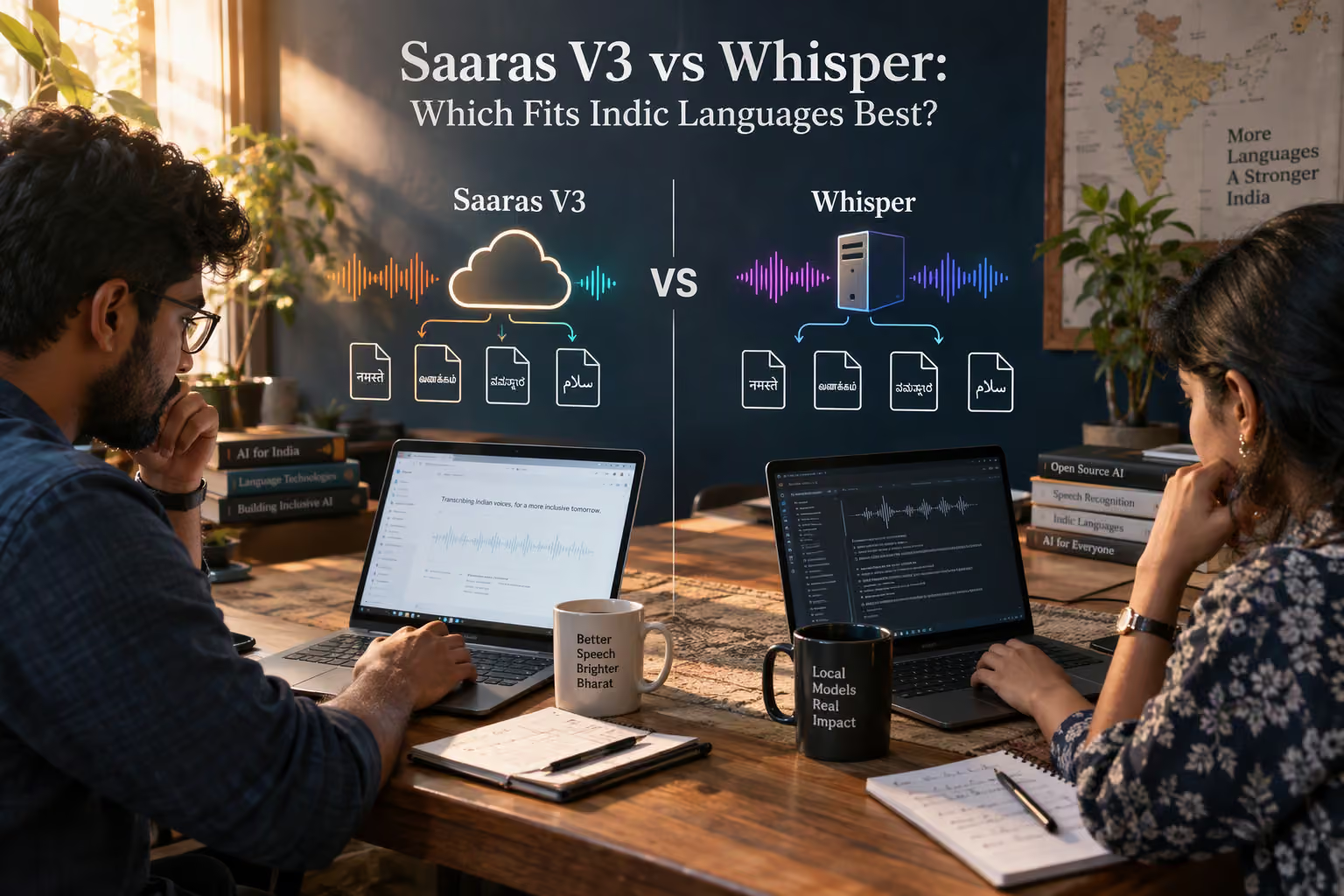
Can a speech model lead Indian-language benchmarks without being the right choice for every Indian business? Saaras V3 deserves consideration for Indic speech recognition, but the supplied evidence does not establish a universal win over OpenAI’s Whisper—or settle which model will handle your customers’ audio best.
Business Standard reported on February 12, 2026, that Sarvam AI’s Saaras V3 recorded lower word error rates than competing systems on IndicVoices and Svarah, according to benchmark results shared by Sarvam. That is a meaningful signal for buyers handling regional-language conversations and Indian-accented English. It is also a vendor-reported result, not an independent guarantee of performance on noisy support calls, unfamiliar names, or conversations that switch languages mid-sentence.
What does the evidence actually say about Saaras V3 versus Whisper?
The distinction matters because a strong benchmark headline is not automatically a verified head-to-head comparison. The supplied Business Standard report describes Saaras V3’s results against Gemini, GPT-4o, and other systems, but does not provide a complete, numerical Saaras V3-versus-Whisper scorecard.
Sarvam’s separate 2024 social post explicitly mentions outperforming whisper-large-v3, but that earlier claim should not be repurposed as evidence about Saaras V3. Model names, release dates, datasets, and evaluation settings must match before a comparison becomes useful.
For a buyer, the practical question is therefore narrower: Which exact model produces fewer consequential errors on the languages and recordings your application actually uses? A mistranscribed appointment date or customer name may matter more than a small improvement in an aggregate benchmark.
What should buyers check before choosing an Indic speech model?
This comparison will separate supported findings from unanswered questions and show how to evaluate:
- Language fit: whether results cover your specific languages, accents, and code-mixed conversations.
- Accuracy: what word error rate measures, and why business-critical terms deserve separate checks.
- Deployment requirements: which integration options and operating constraints you need to verify for each model.
- Evaluation quality: whether both systems receive the same audio, transcription rules, and scoring treatment.
There is also an important version caveat. For this November 2026 comparison, the supplied Sarvam speech-to-text page advertises Saaras V4, not V3, and lists support for 22 Indian languages. Buyers should confirm the model version offered before treating a V3 comparison as purchasing guidance for Sarvam’s current API.
As of November 2026, CallMissed supports speech recognition in 22 Indian languages plus English, including Hinglish, illustrating why regional-language coverage and code-mixing are practical infrastructure requirements rather than niche features.
The goal is not to crown a winner from a headline. It is to help you build a defensible shortlist—and a representative audio test that turns “better for Indic languages” into evidence relevant to your business.
Saaras V3 or Whisper for Indic languages? Shortlist Saaras V3 for a managed Indian-language workflow, subject to availability and a matched-audio pilot. Choose open-weight Whisper when self-hosting and deployment control matter more. Sarvam’s current product snippet names Saaras V4, so confirm V3 access before buying.
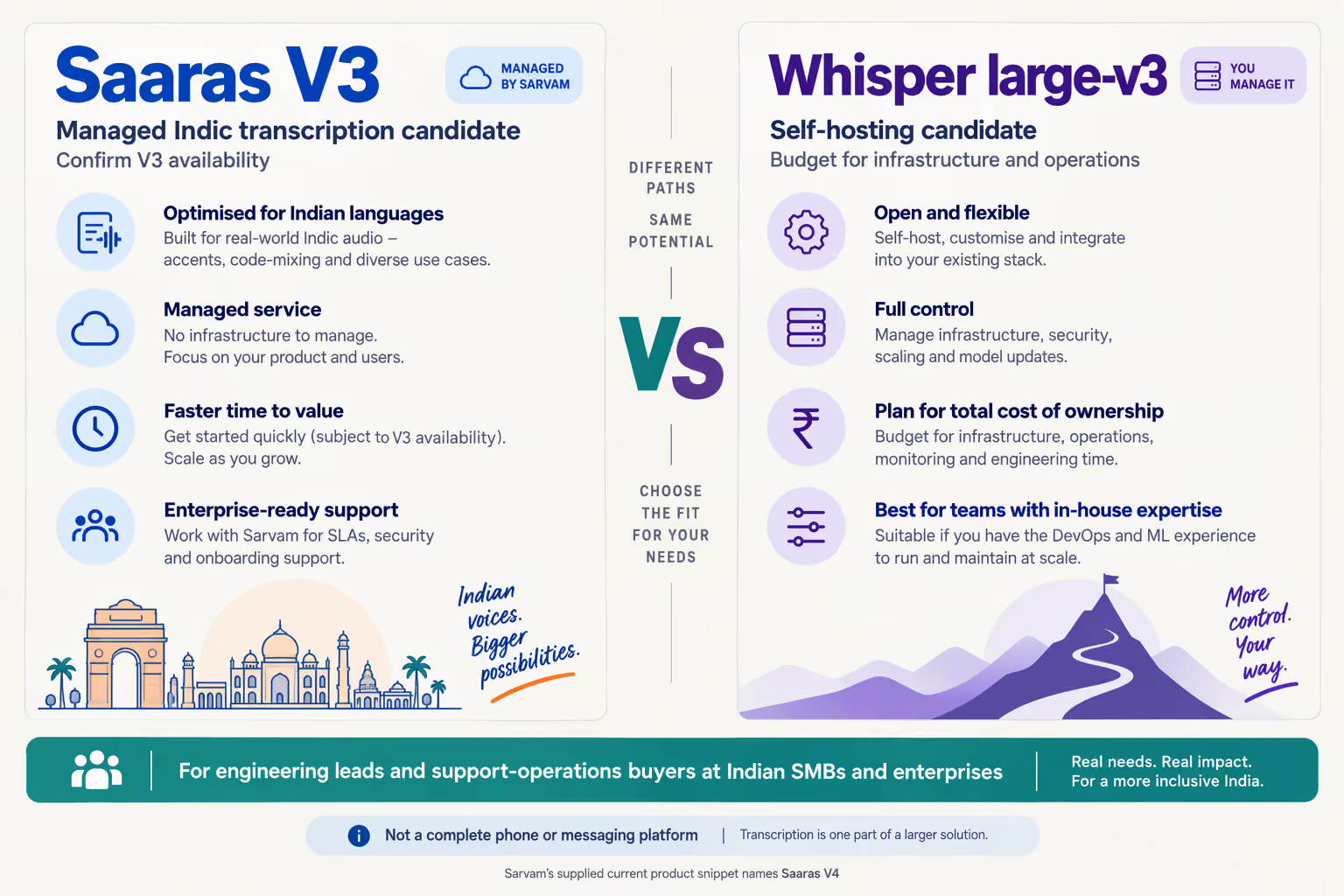
Shortlist Saaras V3 for a managed Indic-language workflow only after confirming access and testing your recordings. Choose OpenAI Whisper when self-hosting and deployment control outweigh the convenience of a managed API.
When should you shortlist Saaras V3 rather than Whisper?
- Saaras V3: Make version availability your first procurement gate. As of November 2026, Sarvam’s supplied speech-to-text product snippet says “Powered by Saaras V4”; ask whether V3 remains callable, which model identifier selects it, and whether that version can remain fixed throughout your pilot and production rollout.
- Sarvam’s managed API: Consider the advertised workflow capabilities alongside transcription accuracy. As of November 2026, Sarvam’s speech-to-text page lists 22 Indian languages, speaker diarization, timestamps, and code-mixing support. Those are current product-page claims—not proof that every capability is available through a Saaras V3 endpoint. Request a version-specific feature checklist before integrating.
- OpenAI Whisper: Prefer the open-weight route when you need to run transcription inside infrastructure you control. For this November 2026 buying decision, distinguish model access from an operational service: self-hosting gives you deployment choices, but your team must provision compute, manage dependencies, monitor failures, and maintain the serving stack.
- Language-specific evidence: Ask for results covering your actual language mix rather than accepting one overall ranking. The supplied Pratyush Kumar LinkedIn snippet describes Saaras V3 outperforming leading models across the 10 most popular languages on IndicVoices; it does not establish identical performance across every language advertised by Sarvam’s current API.
What must a Saaras V3 versus Whisper pilot establish?
- Matched-audio pilot: Use exactly the same recordings, reference transcripts, and text-normalization rules for both systems. A proposed starting sample—not a published benchmark—is 100 recordings per priority language, split across quiet speech, noisy calls, and code-mixed conversations. Record the exact Saaras endpoint and Whisper checkpoint so the comparison is reproducible.
- Business-critical errors: Score names, amounts, dates, addresses, and appointment times separately from aggregate word error rate. For example, count how often “₹1,500” becomes “₹15,000” or a requested Tuesday appointment becomes Thursday. Set acceptance thresholds before reviewing results; otherwise, a persuasive demo can quietly redefine what counts as success.
- Cost and operating limits: Request Sarvam’s applicable rate, billing increment, concurrency limit, file-size limit, and retention terms; the supplied context provides no verified Saaras V3 price. For self-hosted Whisper, calculate compute, storage, engineering, and monitoring costs per successfully transcribed audio hour. Do not compare an API invoice with GPU cost alone.
- CallMissed integration: As of November 2026, CallMissed’s verified fact sheet lists 50 speech-to-text models and OpenAI-compatible audio-transcription endpoints, making integration compatibility a relevant selection criterion. That catalogue count does not confirm Saaras V3 availability: verify the exact model listing before treating any gateway as a route to the version you intend to evaluate.
What features do Saaras V3 and Whisper large-v3 actually offer, and which depend on the API or hosting provider?
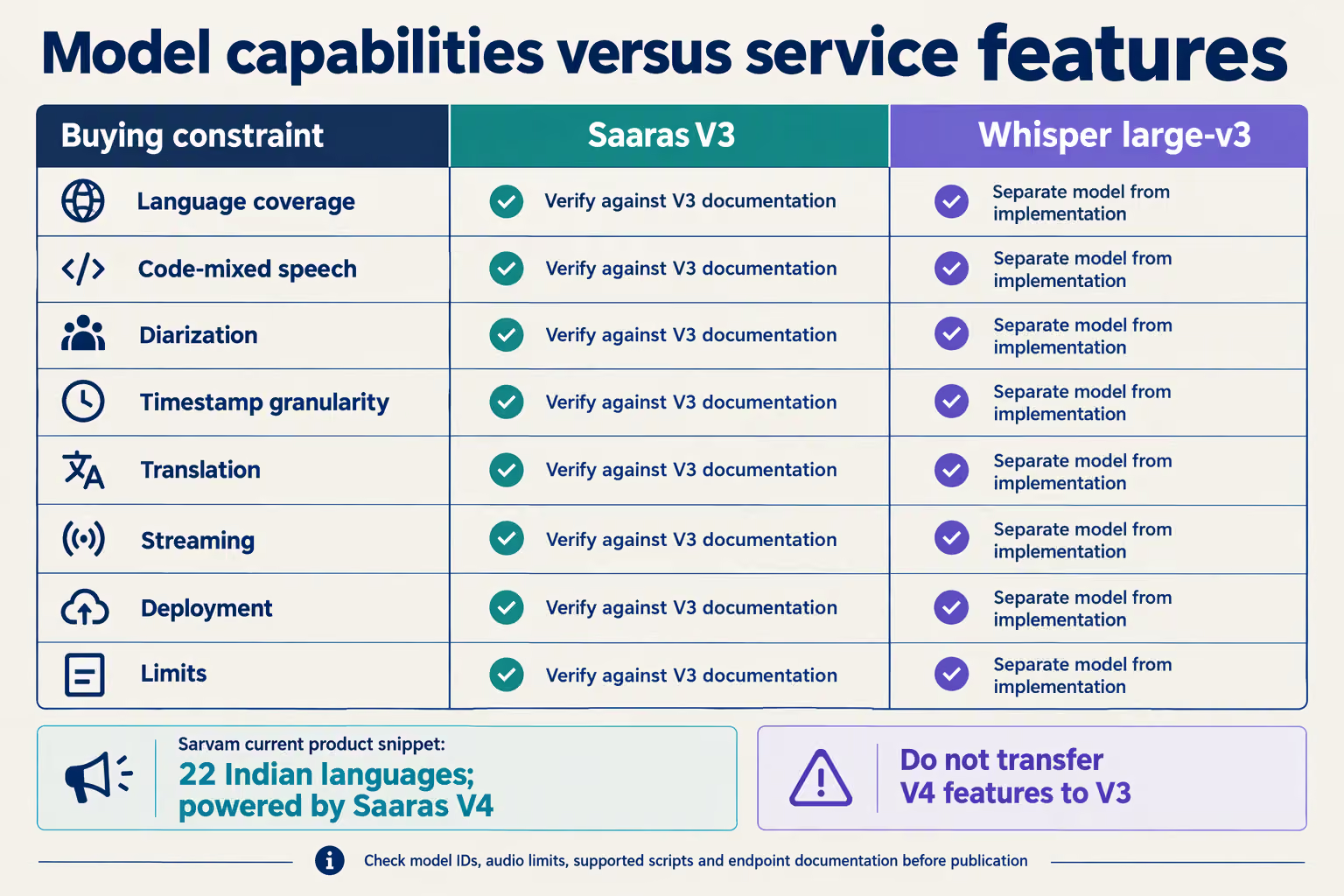
Saaras V3 and Whisper large-v3 must be compared separately from the APIs serving them: transcription is a model capability, while diarization, streaming, upload limits, and billing can depend on the deployment. As of November 2026, the supplied Sarvam API page describes Saaras V4, so its advertised features cannot automatically be attributed to V3.
Which features belong to the model versus the speech API?
| Feature | Saaras V3 evidence | Whisper large-v3 capability | API or hosting dependency |
|---|---|---|---|
| Speech transcription | Confirmed by Business Standard’s February 12, 2026 report | Multilingual speech recognition | Accepted formats, upload sizes, and request limits |
| Indic-language coverage | IndicVoices results reported; complete V3 language list not supplied | Multilingual support; quality varies by language | Which languages the endpoint exposes and tests |
| Code-mixed speech | V3-specific support details not supplied | Can transcribe multilingual audio; code-switching needs testing | Language detection and decoding configuration |
| Speaker diarization | Advertised on Sarvam’s current V4 API page, not established here for V3 | No native speaker-identity labeling | Additional diarization model or provider pipeline |
| Timestamps | Advertised on Sarvam’s current V4 API page; V3 details unverified | Segment timestamps; word alignment depends on implementation | Timestamp granularity and output schema |
| Deployment control | V3 self-hosting availability not established by supplied sources | Open weights support self-hosting | GPU provisioning, scaling, retention, and operational costs |
- Sarvam: The supplied speech-to-text page advertises “speaker diarization, timestamps, and code-mixing support” alongside 22 Indian languages, but identifies the serving model as Saaras V4 in this November 2026 comparison.
- Whisper large-v3: OpenAI’s Whisper documentation describes multilingual transcription and speech-to-English translation; neither capability establishes equal accuracy across every Indic language.
- Both systems: A timestamp identifies when speech occurred; diarization identifies which speaker spoke. Buyers should request sample outputs rather than treating these as interchangeable features.
What should buyers verify with an API or hosting provider?
- Model identity: Ask for the exact model identifier and version policy. An endpoint labeled “Whisper” does not, by itself, establish large-v3, and Sarvam’s current V4 feature list is not a V3 specification.
- Operational limits: Request maximum audio duration, file-size limits, supported codecs, concurrency, streaming behavior, retention terms, and dated pricing. The supplied evidence establishes no comparable V3-versus-large-v3 values for these requirements; missing figures should remain unverified, not become assumed parity.
- Integration layer: As of November 2026, CallMissed offers OpenAI-compatible audio transcription endpoints and usage/request logs. That can simplify integration, but buyers still need to verify the selected model and its endpoint-specific features rather than infer them from API compatibility.
For example, a two-speaker Hindi-English support recording requires more than readable text: test speaker labels, timestamp alignment, and preservation of names separately. A model benchmark cannot certify the entire transcription pipeline, especially when the hosting provider adds preprocessing, segmentation, or diarization.
Does the IndicVoices benchmark prove Saaras V3 beats Whisper on your calls?
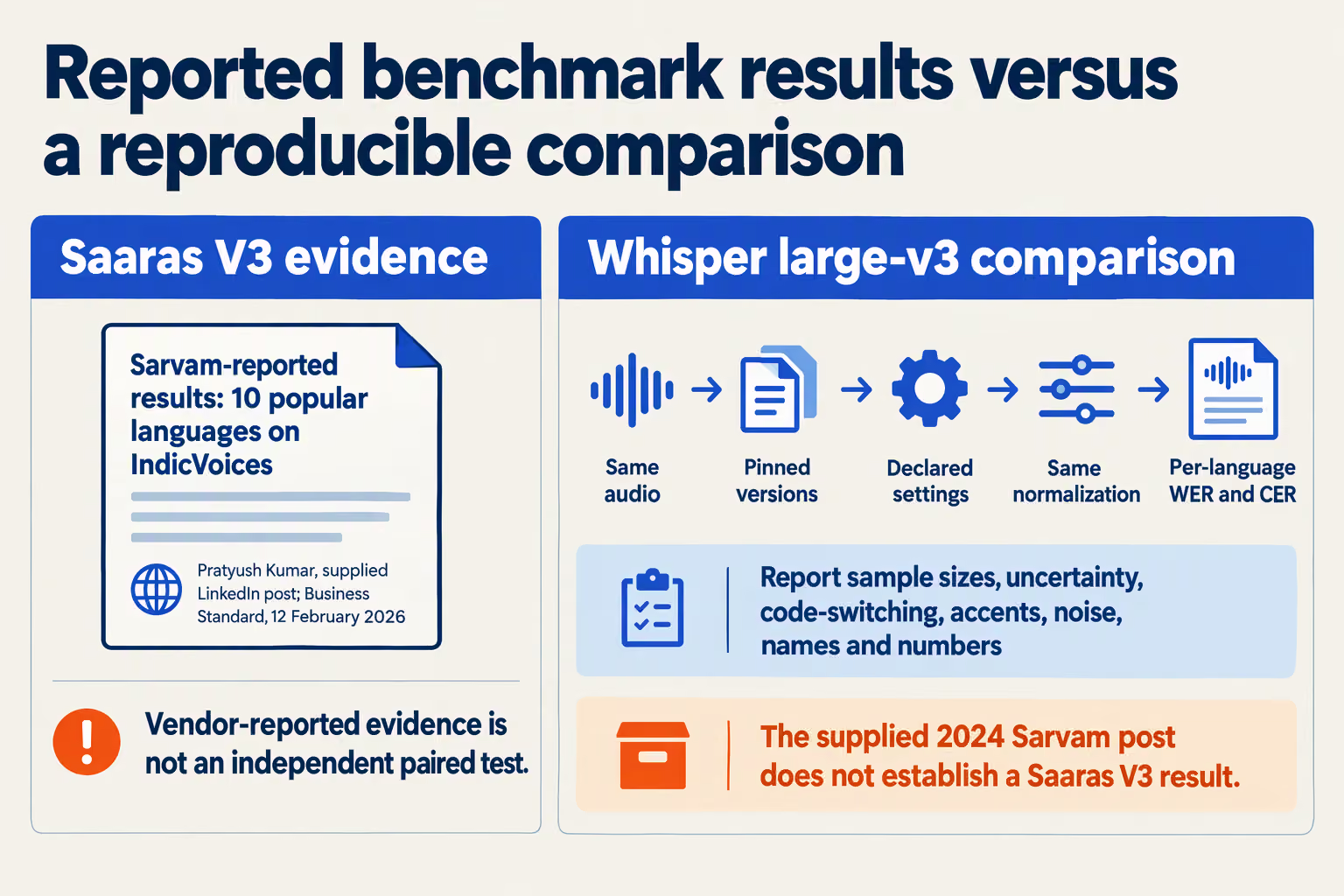
No—IndicVoices results support shortlisting Sarvam Saaras V3, not predicting a guaranteed win over OpenAI Whisper on your calls. The missing step is a matched evaluation of your actual audio and business-critical transcription errors.
What does the IndicVoices result establish?
- Saaras V3: Pratyush Kumar’s LinkedIn post, included in the evidence reviewed for this November 2026 comparison, claims an advantage on “each of the most popular 10 languages” in IndicVoices. That is a language-specific claim, not evidence that every supported language, dialect, or customer segment receives the same improvement.
- Benchmark scope: Business Standard’s February 12, 2026 report identifies IndicVoices as the Indian-language benchmark and Svarah as the Indian-accented English benchmark. Keep those findings separate: an English benchmark result cannot establish accuracy on Hindi-English code-switching, and an Indic-language result cannot establish performance on your English support queue.
- Whisper comparison: The supplied evidence does not expose a complete numerical Saaras V3 versus whisper-large-v3 scorecard with matching evaluation settings. Before calculating an accuracy advantage, request both models’ per-language word error rates, exact model identifiers, dataset split, transcription instructions, and scoring rules; without these, a percentage-improvement claim would be unsupported.
- Evidence strength: Business Standard attributes the benchmark charts to Sarvam AI; the supplied material does not establish an independently reproduced evaluation. Treat the results as a useful selection signal, while asking whether audio preprocessing, language hints, punctuation removal, and treatment of numerals were identical across systems.
How should you test Saaras V3 versus Whisper on real calls?
- Matched audio: Run both exact model versions on the same held-out recordings, using equivalent preprocessing and language hints where supported. Include separate slices for each production language, code-mixed speech, background noise, overlapping speakers, and telephone audio; otherwise, a strong overall score can conceal a weak slice that matters to your business.
- Word error rate: Calculate WER = (substitutions + deletions + insertions) ÷ reference words. As an illustrative example—not a reported benchmark result—8 substitutions, 3 deletions, and 1 insertion in a 100-word reference produce 12% WER; establish consistent rules for scripts, spelling variants, and spoken numbers before comparing scores.
- Business-critical accuracy: Score customer names, appointment dates, addresses, amounts, and order identifiers separately from WER. A transcript with fewer total errors can still be operationally worse if it changes “₹1,500” to “₹15,000”; that example illustrates why correct-field rates and human-review requirements belong beside aggregate transcription accuracy.
- Decision rule: Set acceptance thresholds before inspecting results, then compare per-language WER, critical-field correctness, response time, and cost on the same workload. Choose Saaras V3 or Whisper only when the measured trade-offs meet your requirements; if the models split wins across language slices, a single benchmark winner may not be the right deployment strategy.
How much do Saaras V3 and Whisper cost, and what is verified as of 17 November 2026?
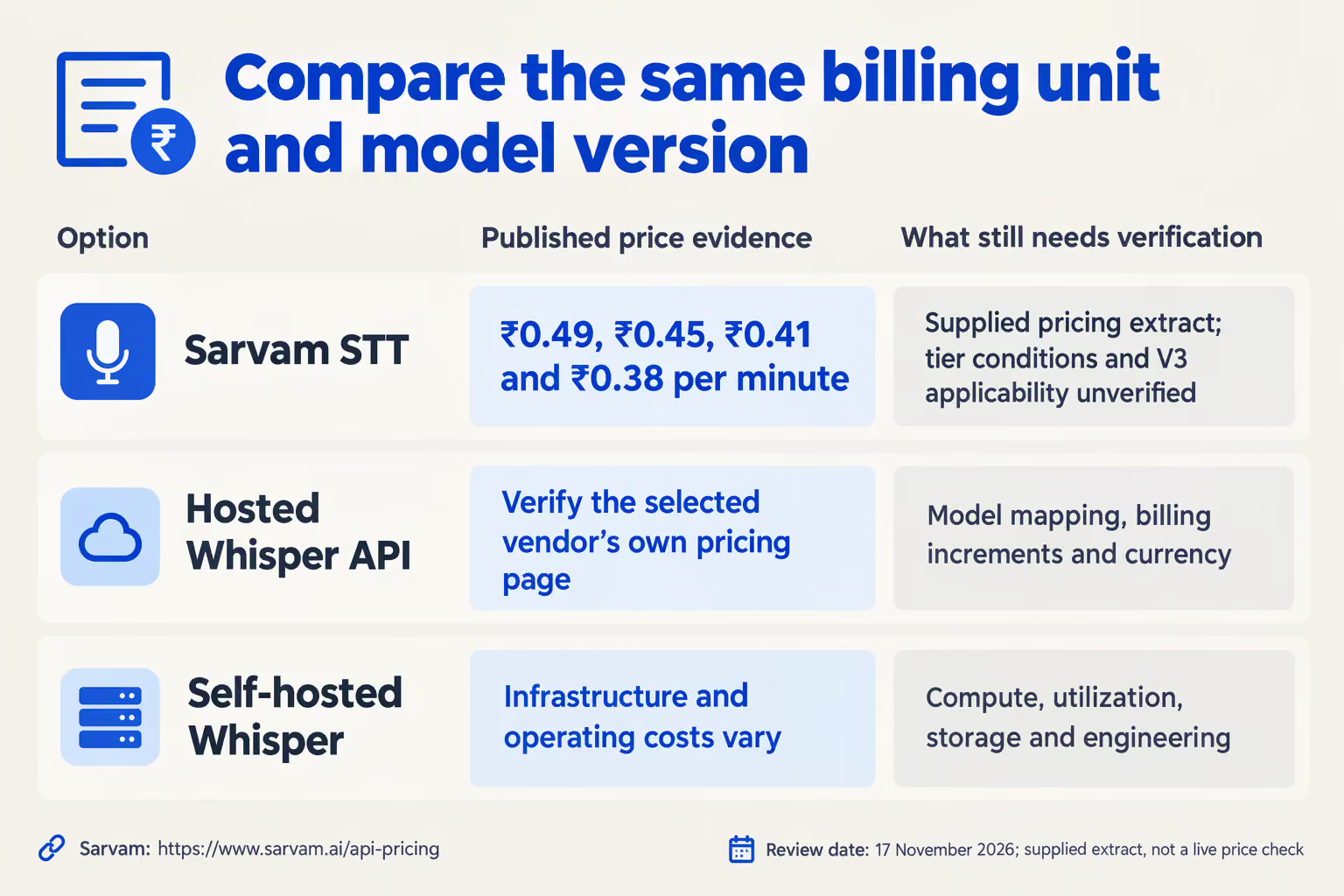
Neither Saaras V3’s price nor a current Whisper API rate is verified in the supplied sources as of 17 November 2026. A defensible cost comparison must separate model-specific transcription charges from hosting, integration, and downstream processing.
- Saaras V3: The supplied Sarvam material does not establish a V3-specific per-minute rate, billing minimum, or paid-tier allowance; request a dated quotation identifying the exact model.
- Whisper: The supplied evidence does not include OpenAI’s current hosted transcription pricing or a managed provider’s Whisper rate; do not treat an uncited historical price as a November 2026 quotation.
- Version control: Sarvam’s supplied speech-to-text page says “Powered by Saaras V4”; a quotation for that offering should not be presented as verified Saaras V3 pricing.
Which pricing details are verified as of 17 November 2026?
| Cost item | Saaras V3 | Whisper | Verification status |
|---|---|---|---|
| Hosted transcription rate | Not supplied | Not supplied | Neither price verified |
| Billing unit and rounding | Not supplied | Not supplied | Confirm seconds versus minutes |
| Minimum billable duration | Not supplied | Not supplied | Request billing terms |
| Free transcription allowance | V3 allowance not supplied | Not supplied | No comparable allowance established |
| Self-hosting operating cost | Not established | Not quantified | Requires deployment-specific estimate |
| Current product scope | Sarvam page advertises V4 | Hosted version unspecified | Match quotation to exact model |
This table describes gaps in the supplied evidence as of 17 November 2026—not proof that either vendor lacks published pricing.
How should buyers calculate a comparable transcription budget?
- Usage calculation: For an illustrative 10,000 audio minutes per month, multiply each verified per-minute rate by 10,000, then add applicable minimums, retries, taxes, and additional services. Specify whether the quotation bills submitted audio, processed audio, or rounded request durations; those distinctions can change the invoice without changing the advertised rate.
- Quality-adjusted cost: Track transcription spending alongside human correction time and critical-field errors. An illustrative ₹1,000 transcription saving disappears if the alternative requires more than ₹1,000 in additional review; this is a purchasing calculation, not a measured Saaras V3-versus-Whisper result. Use identical recordings and correction criteria for both estimates.
- CallMissed: According to CallMissed’s verified fact sheet, as of November 2026, its developer API includes 50 speech-to-text models, OpenAI-compatible audio transcription endpoints, and 1,000 signup credits, with 1 credit = ₹1. Those infrastructure facts do not establish Saaras V3 availability or either model’s transcription rate; confirm the exact catalogue entry and consumption price before budgeting.
Buying rule: Obtain two dated, model-specific quotations for the same workload. Business Standard’s 12 February 2026 report concerns Sarvam’s benchmark claims, not pricing, so it cannot support a cost-per-minute comparison or a claim that Saaras V3 is cheaper than Whisper.
What are the practical pros and cons of Saaras V3 versus Whisper?
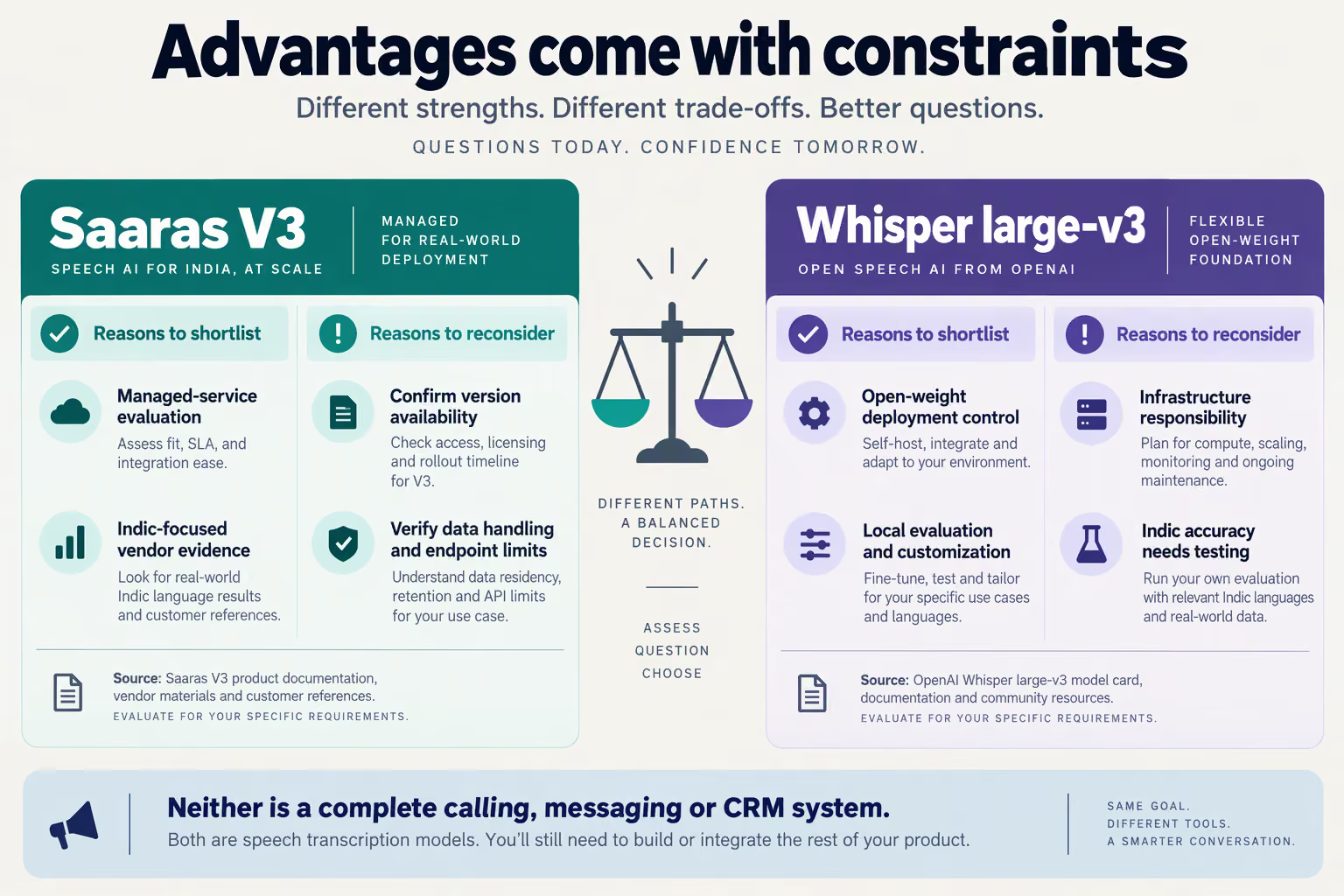
Saaras V3’s practical advantage is its Indic-focused evaluation; Whisper’s is the option to run an open-source transcription system yourself. As of November 2026, the supplied evidence does not establish comparable pricing, latency, or a numerical accuracy margin between the two.
| Buying criterion | Saaras V3: practical trade-off | Whisper: practical trade-off | What to verify |
|---|---|---|---|
| Regional-language accuracy | Encouraging Indic benchmark evidence, but not a guarantee for your recordings. | A candidate for comparison; the supplied context gives no matching V3-versus-Whisper scores. | Errors on each production language, not just the overall average. |
| Deployment control | Confirm whether V3 remains available and under what deployment terms. | Open-source Whisper can run on infrastructure you control, adding responsibility for compute and operations. | Hosting location, hardware needs, retention, and access controls. |
| Speaker attribution | Sarvam’s current API advertises diarization, but the page identifies V4, not V3. | Do not assume a Whisper-based service includes speaker attribution merely because it uses Whisper. | Whether speaker labels are included, separately generated, and accurate. |
| Timestamps and code-mixing | Sarvam’s current page advertises both; those claims cannot automatically be assigned to V3. | Validate timestamp quality and language switching in the exact implementation you plan to deploy. | Alignment accuracy and mixed-language transcription conventions. |
| Commercial cost | No verified V3 price appears in the supplied evidence. | Local deployment introduces compute and maintenance costs; hosted-service pricing depends on the provider. | Total cost per successfully processed audio hour. |
| Version reproducibility | A V3 evaluation requires confirmed access to the same model throughout testing. | Pin the checkpoint and transcription settings rather than comparing against an unspecified “Whisper.” | Model identifier, configuration, and change policy. |
Which practical advantages should buyers prioritize?
- Saaras V3: Pratyush Kumar’s LinkedIn post, available in the supplied November 2026 research, claims leadership across the 10 most popular IndicVoices languages; use that claim to prioritize language-specific trials, not to assume equal performance across every supported language.
- Whisper: Self-hosting gives teams a deployment choice, but requires operating the inference pipeline; ask who handles capacity, software updates, failures, and transcript security before treating local deployment as a saving.
- CallMissed: As of November 2026, CallMissed’s developer API offers 50 speech-to-text models through one API key and balance; this can simplify integration planning, but does not establish that Saaras V3 or a particular Whisper checkpoint is available.
What could make either option the wrong purchase?
- Saaras V3: A procurement mismatch is possible because Sarvam’s speech-to-text page advertises Saaras V4 and 22 Indian languages as of November 2026; require written confirmation of the version, features, and commercial terms being purchased.
- Whisper: Infrastructure control does not remove transcription errors; test names, amounts, dates, and language switches separately, because an acceptable aggregate score can still conceal mistakes that derail customer workflows.
- Both: Compare identical recordings and count operational failures alongside transcription errors: missing speaker labels, unusable timestamps, rejected audio, and manual corrections all affect the practical value of the final transcript.
What changes when transcription must work with phone numbers, messaging, integrations and data policies?
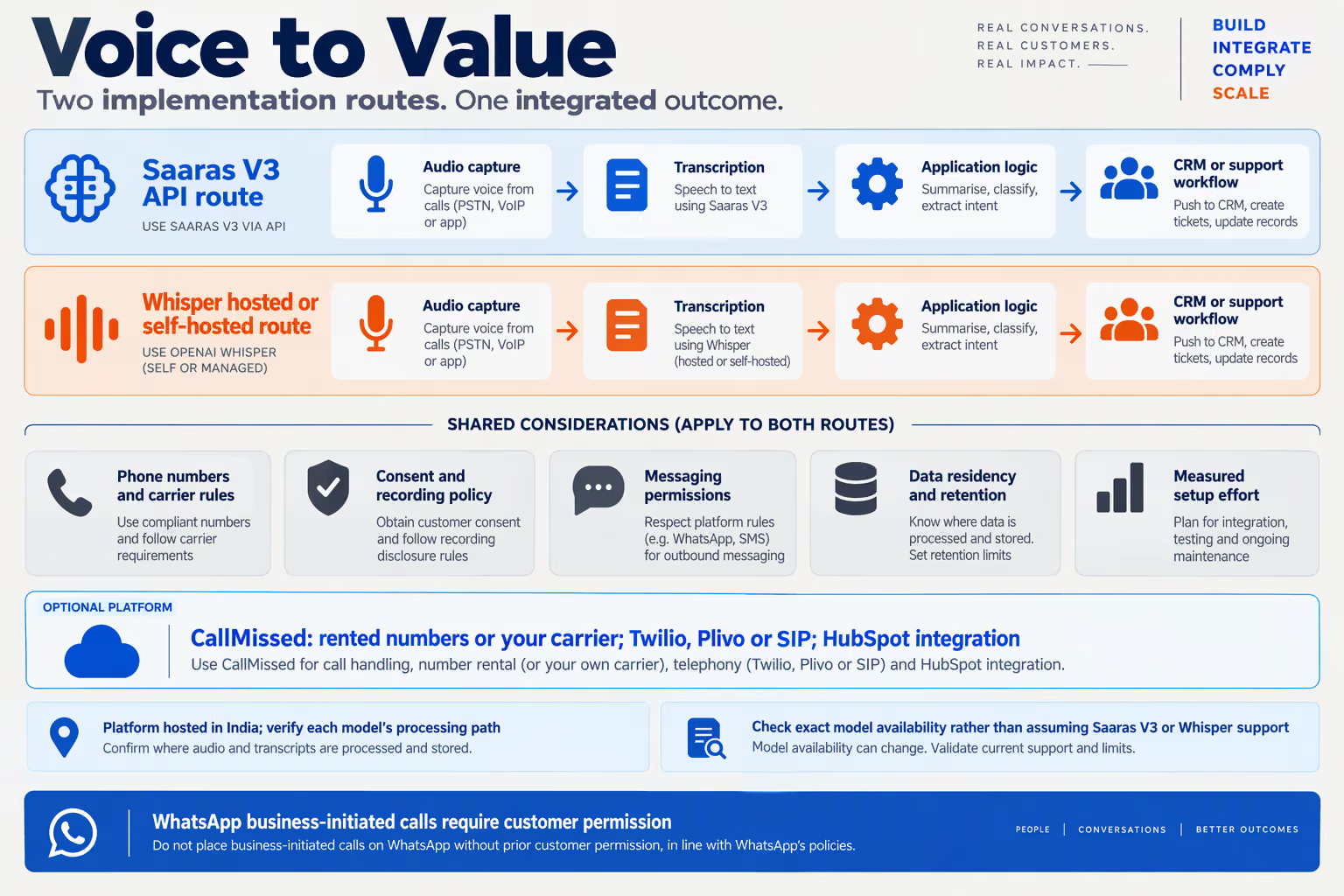
For Sarvam Saaras v3 vs Whisper for Indic languages, production suitability depends on the surrounding communication stack—not just transcription accuracy. Compare call connectivity, messaging permissions, integration effort, and data handling separately from model benchmarks.
What must work beyond the speech-to-text model?
- Phone connectivity: Require a demonstration using your actual carrier, phone number, and inbound or outbound call path. Test interrupted speech, keypad input, transfers, and disconnected calls separately from transcription accuracy; a model evaluation does not establish that the surrounding application can operate these workflows reliably.
- CallMissed: As of November 2026, CallMissed supports rented numbers or bring-your-own connectivity through Twilio, Plivo, or any SIP trunk, plus keypad menus and call queues. Its Twilio-compatible Calls API supports migration by changing the base URL and credentials—a concrete integration option, not evidence that Saaras V3 or Whisper performs better.
- Messaging permissions: Separate audio transcription from permission to contact customers. As of November 2026, CallMissed’s official Meta Cloud API integration supports customer-initiated WhatsApp Business calls and business-initiated calls to customers who have given permission; Meta does not charge for customer-initiated calls. That does not mean every component of the AI conversation is free.
- CRM integration: Define the required output before selecting either model: verbatim transcript, customer identifier, appointment date, disposition, and follow-up task. For example, test whether a spoken correction updates the intended appointment without overwriting unrelated fields; accurate text alone does not guarantee correct downstream records or actions.
Which deployment and data-policy questions should buyers ask?
- Version availability: Sarvam’s speech-to-text page advertises Saaras V4, with 22 Indian languages, speaker diarization, timestamps, and code-mixing support, as of November 2026. Ask whether Saaras V3 remains available and how versions are selected; those current-page capabilities should not automatically be attributed to V3 or treated as Whisper comparison results.
- Hosting boundaries: Compare the actual deployment proposed for each model, rather than assuming identical infrastructure from the names “Saaras” and “Whisper.” Request a data-flow diagram covering telephony, transcription, language-model processing, storage, and CRM export; the supplied research does not establish either option’s end-to-end data residency or retention policy.
- Retention and access: Ask for explicit retention periods for recordings, transcripts, request logs, and backups, alongside deletion procedures and staff-access controls. Also request written terms covering training use and subprocessors; no supplied source establishes these protections for Saaras V3 or a particular Whisper service, so they remain procurement questions.
- Acceptance criteria: Run one end-to-end workflow with synthetic personal data before using customer recordings. Verify consent capture, transcript export, field mapping, human escalation, and deletion across every connected system; record task failures separately from word errors, because a correctly transcribed phone number can still reach the wrong record.
Which should your team choose, and when are Deepgram, ElevenLabs or Saaras V4 better candidates?
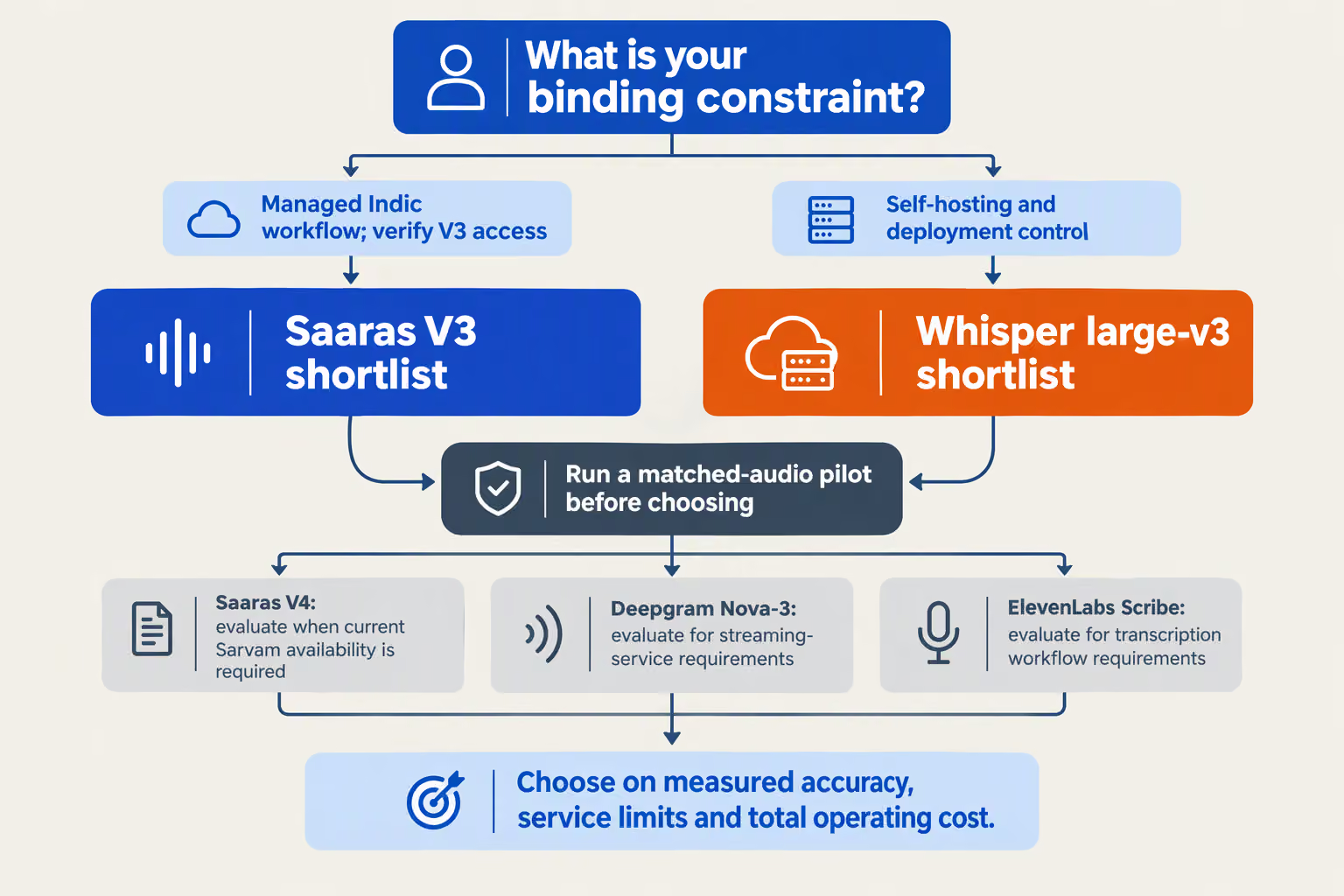
Choose Saaras V3 or Whisper on measured business errors, not benchmark headlines. Deepgram, ElevenLabs, and Saaras V4 become better candidates only when their tested accuracy and operating requirements fit your workload.
When should your team choose Saaras V3 or Whisper?
- Saaras V3: Shortlist the exact V3 model for Indic-heavy workloads if it remains available in November 2026. Ask Sarvam to identify the endpoint and version before testing; otherwise, a purchase labelled “Saaras” could evaluate a different model from the one discussed in this comparison.
- Whisper: Keep whisper-large-v3 as a comparison baseline rather than assuming that every Whisper implementation performs identically. Record the model identifier, transcription settings, and preprocessing. Choose your tested implementation if it meets your language-specific accuracy targets and deployment requirements; the supplied evidence does not establish a universal V3-versus-Whisper winner.
- Business-critical transcription: Use a proposed 100-recording pilot per priority language, including noisy audio and code-switching. Alongside word error rate, score names, amounts, dates, and negations separately. This is an evaluation recommendation, not a published benchmark: one incorrect payment amount can outweigh several harmless spelling differences.
- Procurement: Compare cost per usable transcript, including retries and human correction, rather than headline audio-minute pricing alone. As of November 2026, the supplied research does not establish comparable current prices, latency figures, or deployment terms for these candidates; request those details before approving a production budget.
When are Deepgram, ElevenLabs, or Saaras V4 better candidates?
- Deepgram Nova-3: Include Nova-3 when your shortlist requires a competing system evaluated on the same customer recordings. In the context available for November 2026, Pratyush Kumar’s LinkedIn post names Nova-3 among Saaras V3’s competitors across 10 IndicVoices languages; that vendor claim does not establish performance on your particular calls.
- ElevenLabs: Evaluate the specific ElevenLabs speech-recognition model and endpoint offered for your project, not the company name alone. Kumar’s LinkedIn post also names ElevenLabs, but the supplied excerpt lacks an exact model identifier and numerical results. Require both before using that comparison to eliminate or select a candidate.
- Saaras V4: Prioritize V4 for a new Sarvam procurement because Sarvam’s speech-to-text page, supplied for this November 2026 comparison, advertises 22 Indian languages, speaker diarization, timestamps, and code-mixing support. Those capabilities justify testing V4 when speaker attribution matters; they do not prove that V4 inherits V3’s benchmark results.
- CallMissed: For teams comparing models through existing integrations, CallMissed’s developer API offers 50 speech-to-text models and OpenAI-compatible audio transcription endpoints as of November 2026. Confirm the exact candidate models in its catalogue before designing the trial; a shared integration simplifies access but does not replace identical-audio accuracy testing.
Frequently Asked Questions
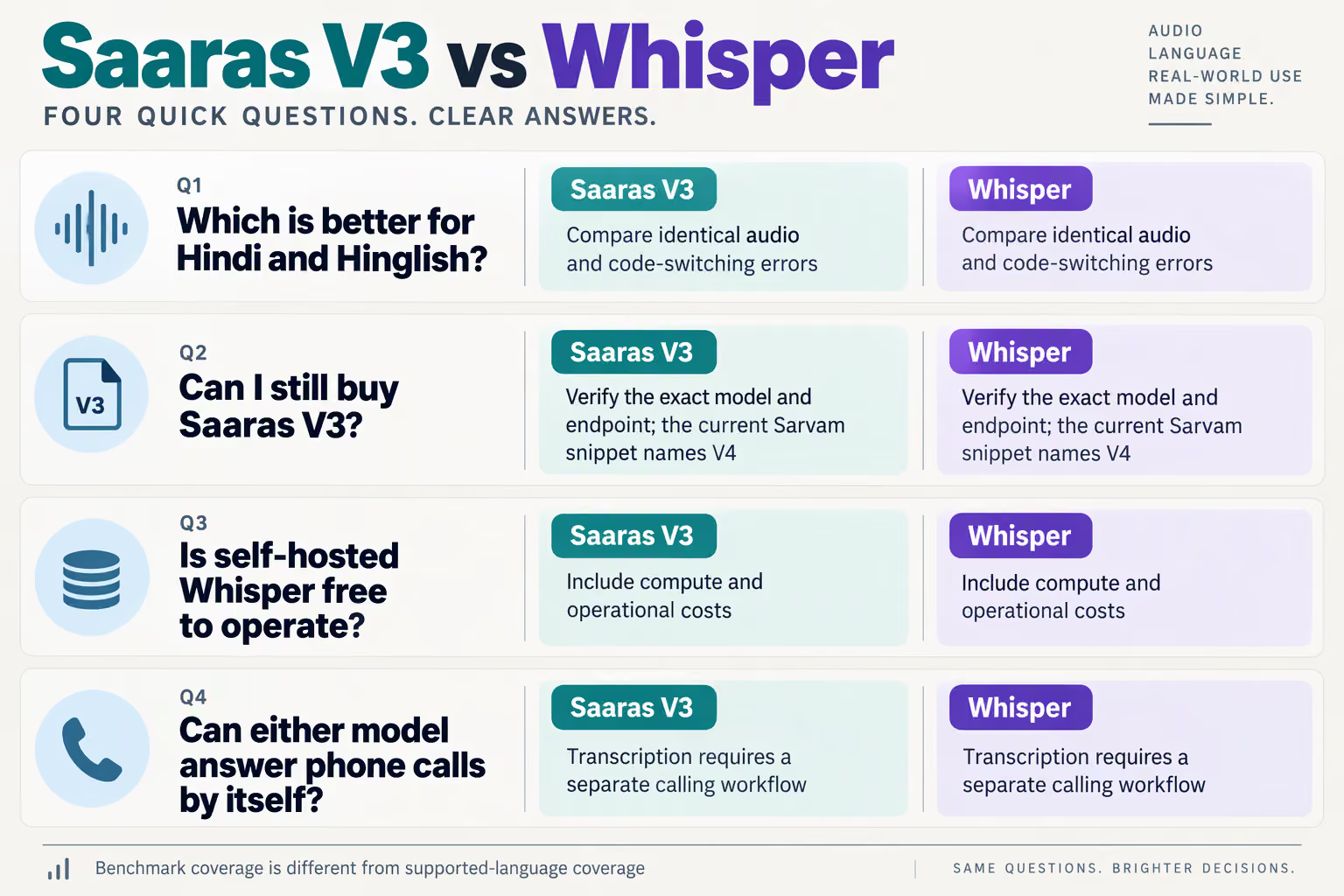
- Q: In Sarvam Saaras v3 vs Whisper for Indic languages, which is better for Hindi?
A: The supplied evidence does not establish a definitive Hindi winner, although Saaras V3 is a credible candidate for evaluation. Business Standard reported on February 12, 2026, that Sarvam’s vendor-reported results showed lower word error rates on IndicVoices, but the supplied report lacks a numerical Hindi comparison against a specified Whisper version. Test both on identical Hindi recordings, including names, numbers, regional accents, and noisy telephone audio.
- Q: In Sarvam Saaras v3 vs Whisper for Indic languages, which handles Hinglish better?
A: A Hinglish winner cannot be verified from the supplied benchmarks, because Indian-language accuracy and Indian-accented English accuracy do not establish sentence-level code-switching performance. As reviewed in November 2026, Sarvam’s speech-to-text page advertises code-mixing support for Saaras V4, not proof of V3 outperforming Whisper on Hinglish. Compare English product names, Hindi grammar, script consistency, and switching within a sentence using a shared transcription policy.
- Q: Is Sarvam Saaras V3 still available in November 2026?
A: Saaras V3 availability is unconfirmed in the supplied material; Sarvam’s speech-to-text page advertises Saaras V4 as of November 2026. That page lists 22 Indian languages, speaker diarization, timestamps, and code-mixing support, but does not establish whether customers can still select V3. Before buying, request the exact model identifier, version-pinning options, and any migration or retirement notice rather than assuming the older model remains accessible.
- Q: How does Whisper pricing work for API use versus self-hosting?
A: Whisper costs depend on whether you use a hosted transcription service or run the model yourself, so these are different purchasing decisions. For hosted access, verify the provider’s current audio billing unit, minimum charges, and model identity; for self-hosting, budget compute, deployment, monitoring, and engineering rather than treating downloadable weights as cost-free operation. The supplied November 2026 research contains no verified Whisper price, so no per-minute quote is asserted here.
- Q: Can Saaras V3 or Whisper answer customer phone calls directly?
A: Neither speech-recognition model alone is a complete phone-answering agent: transcription must connect to call transport, conversational logic, and speech synthesis. As of November 2026, CallMissed’s verified fact sheet lists inbound voice agents, rented numbers or bring-your-own SIP carriers, and flat plans starting at ₹4/min, covering recognition, the language model, and voice, with phone carriage separate. That infrastructure example does not confirm Saaras V3 or Whisper availability within a particular agent configuration.
- Q: How should buyers evaluate Sarvam Saaras v3 vs Whisper for Indic languages?
A: Choose the exact available model that makes fewer consequential errors on your own recordings, not the strongest headline. For a November 2026 purchasing decision, freeze model versions, use identical audio and normalization rules, and score word error rate alongside names, appointment dates, amounts, and code-switched phrases. Record processing time and total operating cost separately, because a transcription accuracy result cannot establish production responsiveness or economic suitability.
Conclusion
Saaras V3 merits evaluation for Indic speech recognition, but the supplied evidence does not establish a universal win over OpenAI Whisper. The strongest buying decision is to compare exact model versions on representative customer audio, rather than treating a benchmark headline as a guarantee.
- Separate promising results from proven head-to-head superiority. Business Standard reported on February 12, 2026, that Sarvam’s vendor-shared results showed Saaras V3 achieving lower word error rates on IndicVoices and Svarah than competing systems. However, the supplied report does not contain a complete numerical Saaras V3-versus-Whisper scorecard. Sarvam’s separate 2024 claim about outperforming whisper-large-v3 cannot establish the performance of Saaras V3: the model version, dataset, and evaluation conditions must match. Treat the evidence as a reason to investigate, not a reason to skip testing.
- Choose for your conversations, not aggregate accuracy alone. Language coverage matters, but buyers also need evidence for their particular accents, Indian-accented English, background noise, and code-mixed speech. Evaluate business-critical details—customer names, appointment dates, and other consequential terms—alongside overall word error rate. A model that performs well across a benchmark may still make errors that matter disproportionately to your workflow. The practical winner is the system that makes fewer consequential mistakes on the recordings your application actually receives.
- Make the comparison fair and operationally useful. Give Saaras V3 and the selected Whisper version the same recordings, transcription rules, and scoring treatment. Otherwise, differences in preparation or evaluation can obscure differences between models. Check deployment requirements and available integration options before committing, rather than assuming benchmark accuracy resolves the purchasing decision. Your shortlist should reflect both recognition quality and whether each model fits the operating constraints of the application you intend to build.
- Verify which Sarvam model you can buy now. As of November 2026, the supplied Sarvam speech-to-text page advertises Saaras V4, with support for 22 Indian languages, rather than Saaras V3. That makes version checking essential: an article about V3 should not automatically guide a purchase of V4. Ask which version an API serves, then evaluate that version directly. Historical results remain useful context, but they are not a substitute for evidence about the product currently offered.
Looking ahead, watch for independent, version-matched comparisons that include regional speech, code-mixing, and realistic business recordings—not just stronger benchmark headlines. As of November 2026, CallMissed supports speech recognition in 22 Indian languages plus English, including Hinglish, making the platform worth exploring for multilingual communication workflows.
Before choosing Saaras or Whisper, ask: which exact model preserves the information your customers cannot afford to have misunderstood?
Related Reading
- Goodcall pricing vs CallMissed: Which Fits You? (2026)
- OpenRouter models: Which Support Indian Languages?
- AI Gateway With Free Tier Models: Which Free Option Fits Your Use Case?