OpenRouter models: Which Support Indian Languages?


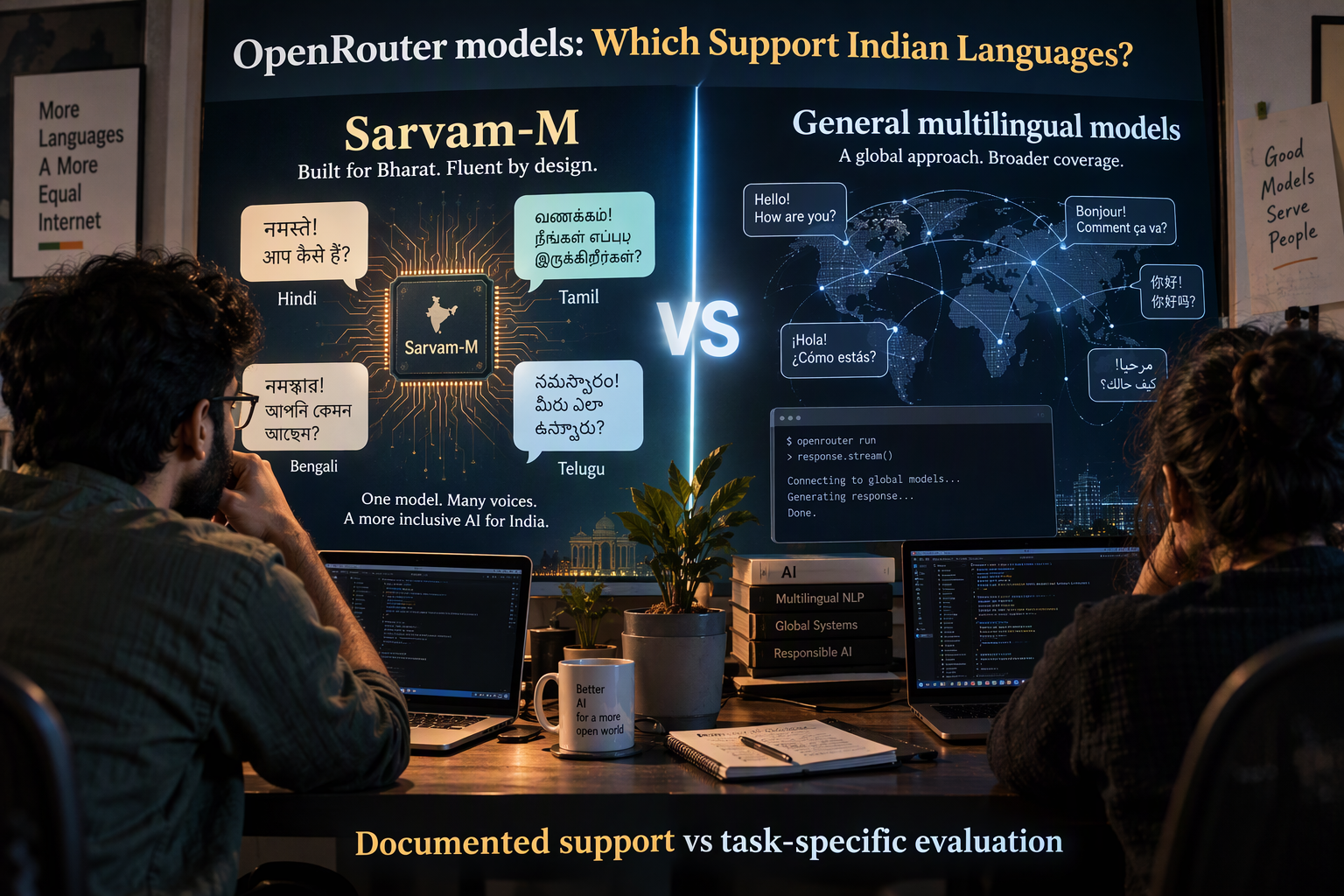
Compare OpenRouter models for Indian-language tasks, distinguish documented support from testing needs, and check pricing and API setup.
OpenRouter models: Which Support Indian Languages?
Not all OpenRouter models offer equally well-documented Indian-language support: Sarvam-M is a clear starting point. As of October 2026, OpenRouter lists Sarvam-M as a 24-billion-parameter model post-trained on English and Indic languages—making it a relevant candidate for developers building regional-language chatbots, translation workflows, and customer-support tools.
The important distinction is between a model being available through OpenRouter and having documented support for your target language. An API listing establishes access; it does not, by itself, establish reliable performance in Hindi, Tamil, Bengali, or code-mixed conversations. For an Indian-language application, that difference should shape your shortlist before price or general-purpose benchmark scores do.
Which OpenRouter model explicitly documents Indian-language training?
According to OpenRouter’s Sarvam-M listing, reviewed in the supplied October 2026 research, Sarvam-M is an instruction-tuned derivative of Mistral-Small-3.1-24B-Base-2503. OpenRouter describes its post-training as covering English plus “eleven major Indic languages.”
However, the supplied listing names only 10 language codes:
- Bengali, Hindi, Kannada, Gujarati, and Marathi
- Malayalam, Odia, Punjabi, Tamil, and Telugu
That discrepancy matters: the available excerpt supports naming those 10 languages, but not guessing an eleventh. Developers should confirm the complete language list against current model documentation before promising coverage to users.
OpenRouter also reports Indic-language question-answering and mathematics benchmark gains for Sarvam-M against similarly sized open models. The supplied research does not include numerical scores or evaluation details, so those claims should not become an invented accuracy percentage—or a blanket claim that Sarvam-M outperforms every alternative.
What will this comparison help you decide?
This guide separates explicitly documented Indic training from models that still need language-specific evaluation. OpenRouter’s comparison pages establish availability for Google Gemini 2.5 Flash Lite, Z.ai GLM 4.6, and OpenAI gpt-oss-20b alongside Sarvam-M, according to the supplied October 2026 research; those pages alone do not establish equivalent Indian-language coverage.
You will learn how to assess:
- Language evidence: Which languages are explicitly named, rather than implied by “multilingual.”
- Task fit: Whether a model handles translation, regional-language answers, and terminology accurately.
- Real-world inputs: How to test native scripts, transliteration, and mixed-language messages.
- Integration trade-offs: How to compare available models without confusing API compatibility with language quality.
For example, a Hindi support assistant should be tested on both Devanagari questions and Romanized Hindi, with checks for factual accuracy and instruction-following.
The broader infrastructure trend includes CallMissed, whose OpenAI-compatible developer API includes Sarvam among its catalogue providers as of October 2026.
The goal is a defensible shortlist: models you can access, languages you can document, and performance you can verify on your own workload.
Which OpenRouter models support Indian languages?
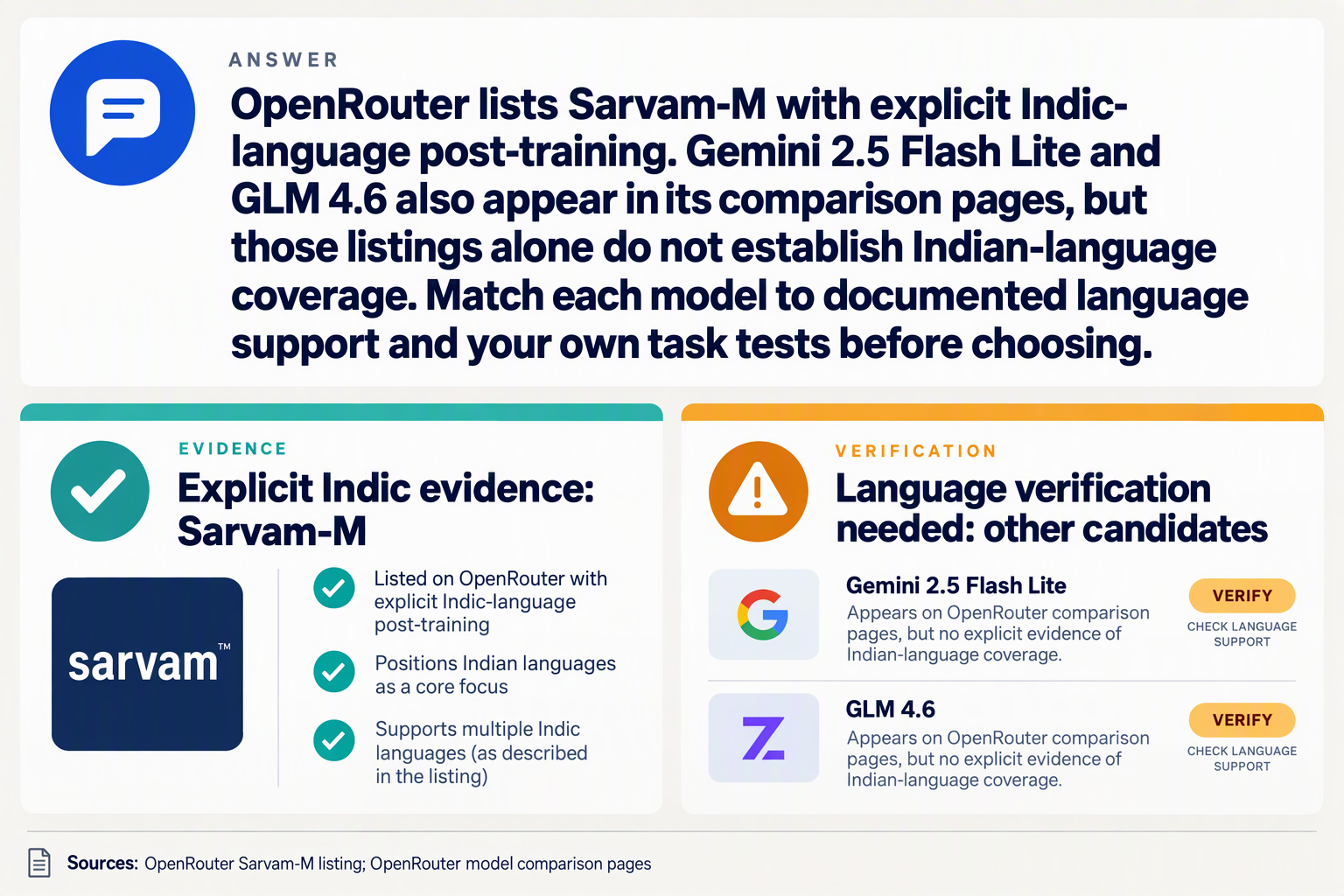
Sarvam-M is the clearest documented Indian-language option in the supplied OpenRouter research as of October 2026. OpenRouter also lists Gemini 2.5 Flash Lite, GLM 4.6, gpt-oss-20b, Devstral Medium, and o3 Pro, but the supplied excerpts do not establish their Indian-language coverage.
Which model has explicit Indian-language evidence?
- Sarvam-M: OpenRouter’s October 2026 listing explicitly names Bengali, Hindi, Kannada, Gujarati, Marathi, Malayalam, Odia, Punjabi, Tamil, and Telugu in its post-training description. For a regional-language shortlist, this is stronger evidence than API availability alone: the documentation connects the model to specific languages, although it does not establish production accuracy for your particular task.
Which other OpenRouter models should you evaluate?
- Google Gemini 2.5 Flash Lite: OpenRouter’s comparison page, included in the October 2026 research, confirms API availability alongside Sarvam-M. However, the excerpt supplies no named Indian languages or language-specific scores. Treat Gemini 2.5 Flash Lite as an evaluation candidate, not a verified substitute for every language covered by Sarvam-M’s documentation.
- Z.ai GLM 4.6: According to OpenRouter’s October 2026 comparison excerpt, GLM 4.6 and Sarvam-M are accessible through the same API, with switching accomplished through a model-slug change. That establishes integration convenience—not equivalent Hindi, Tamil, or Telugu performance. Compare both models using identical regional-language prompts before choosing a deployment default.
- OpenAI gpt-oss-20b: OpenRouter’s October 2026 comparison excerpt confirms access to gpt-oss-20b alongside Sarvam-M but provides no Indian-language coverage list. Developers should separately test native-script comprehension, Romanized inputs, and response-language consistency; an available model should not automatically be described as supporting every Indian language reliably.
- Mistral AI Devstral Medium: OpenRouter’s October 2026 research includes a Devstral Medium–Sarvam-M comparison page covering categories such as benchmarks, pricing, and context length. The supplied excerpt contains no values or Indic-language results. Its presence supports inclusion in a broader comparison, but not a recommendation specifically for regional-language customer support.
- OpenAI o3 Pro: OpenRouter’s October 2026 research includes an o3 Pro–Sarvam-M comparison page, but the excerpt does not document Hindi, Bengali, or other Indian-language performance. Evaluate o3 Pro only against your actual requirements; neither its product name nor its comparison-page presence supplies evidence of language-specific reliability.
What does this shortlist establish—and what remains unverified?
- Evidence limits: The supplied OpenRouter research, assessed for October 2026, provides no numerical Indic benchmark scores, token prices, or context-window values for these comparisons. Consequently, this shortlist identifies documented language evidence and available alternatives; it cannot support an accuracy ranking, a cheapest-model claim, or a universal winner.
- CallMissed: As of October 2026, CallMissed’s verified fact sheet lists 40 general-purpose LLMs within a 124-model developer catalogue, with OpenAI-compatible endpoints and makers including Sarvam, Google, OpenAI, and Mistral. This illustrates another multi-model integration approach, but maker-level availability does not establish access to each specific OpenRouter model named above.
Which model should you shortlist first?
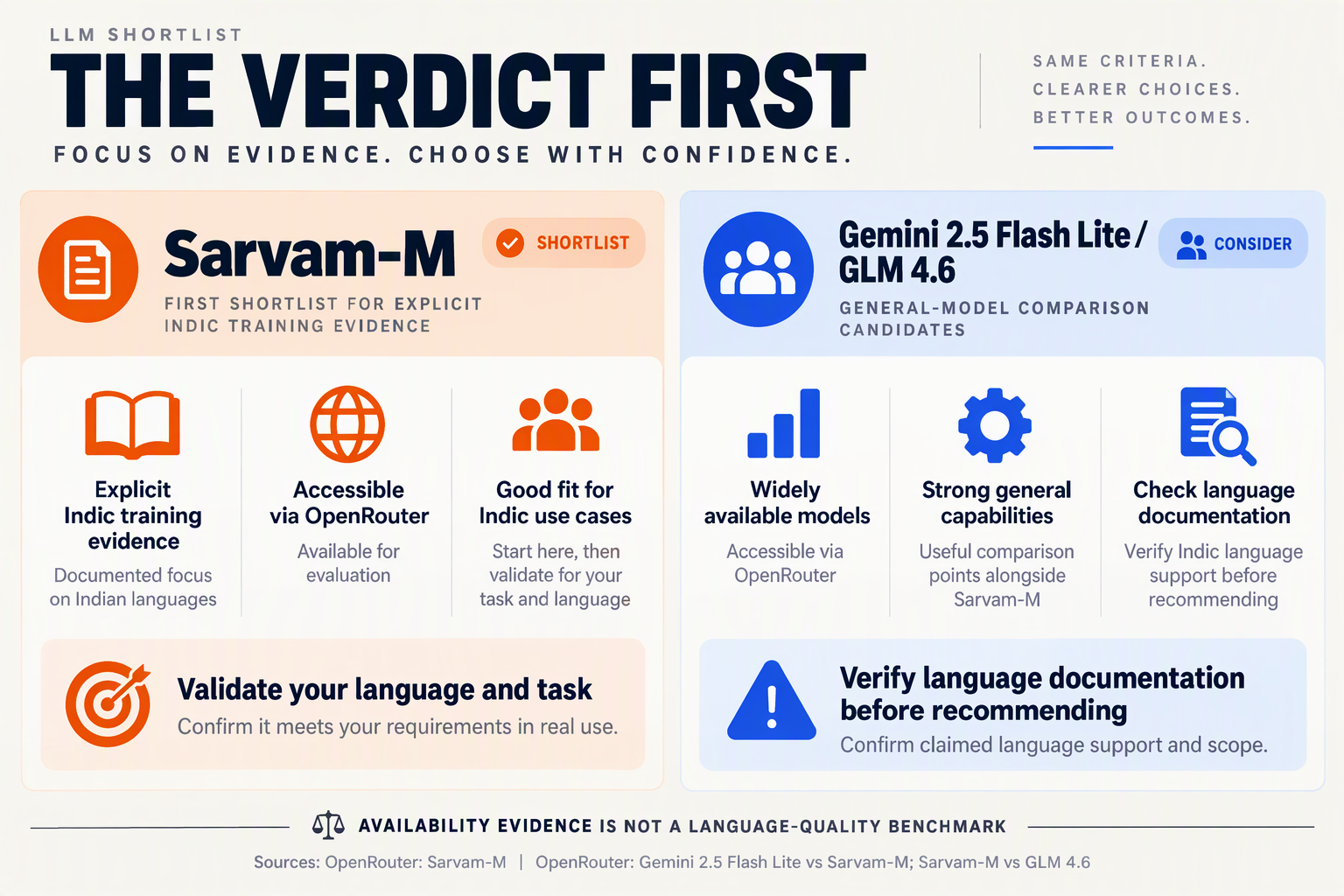
Shortlist Sarvam-M first for documented Indic-language specialization, then test Google Gemini 2.5 Flash Lite, Z.ai GLM 4.6, and OpenAI gpt-oss-20b as alternatives. This is an evidence-based testing order, not a ranking of measured language quality.
Which models belong in your first comparison?
- Sarvam-M: Use this as your regional-language baseline because OpenRouter’s listing, reviewed in October 2026, explicitly describes Indic post-training. Start with your actual workflow—such as answering Tamil delivery questions or summarizing Marathi support tickets—rather than assuming training coverage guarantees production-ready accuracy. Keep translation quality and factual correctness as separate evaluation criteria.
- Google Gemini 2.5 Flash Lite: Include this as a comparison candidate: OpenRouter’s October 2026 comparison page establishes API availability alongside Sarvam-M. The supplied excerpt does not establish specific Indian-language coverage, token prices, or response speed. Test the same native-script and transliterated prompts before deciding whether this model fits your regional-language workload.
- Z.ai GLM 4.6: Add this when you want another candidate evaluated against the same language-specific acceptance criteria. OpenRouter’s October 2026 comparison page confirms availability, not Hindi, Bengali, or Telugu proficiency. Check whether answers preserve product names, amounts, dates, and the requested language instead of judging fluency alone.
- OpenAI gpt-oss-20b: Treat this as another test candidate rather than a verified Indic specialist. OpenRouter’s October 2026 comparison page confirms access alongside Sarvam-M, but the supplied material contains no Indian-language benchmark scores. A polished answer should still fail your evaluation if it changes a refund condition or invents an account detail.
How should you narrow the shortlist before deployment?
- Mistral AI Devstral Medium and OpenAI o3 Pro: OpenRouter comparison pages in the supplied October 2026 research also identify these models alongside Sarvam-M. Keep them outside the first testing round unless you have a specific reason to expand it: those excerpts add availability evidence, but no named Indian-language coverage or numerical language-quality results.
- Language test set: Build a recommended 60-prompt pilot per target language: 20 native-script prompts, 20 Romanized prompts, and 20 code-mixed prompts. These are suggested test counts, not published benchmarks. Include ambiguous requests, regional terminology, and English product names; score factual accuracy, instruction-following, and language consistency separately so readable prose cannot hide incorrect answers.
- Pricing and limits: Before purchasing, record each candidate’s input-token price, output-token price, context limit, and provider availability with an October 2026 verification date. The supplied OpenRouter excerpts do not provide those figures. Compare cost per successfully completed task using identical prompts and output limits—not an unsupported assumption that one model is cheapest.
- CallMissed integration option: As of October 2026, CallMissed’s verified fact sheet lists 124 models, including 40 general-purpose LLMs, accessible through one API key and balance, with OpenAI-compatible endpoints. That offers a separate integration route for multi-model evaluation; it does not establish that every OpenRouter candidate above is available through CallMissed or equally capable in Indian languages.
What languages, context windows, and modalities are documented?
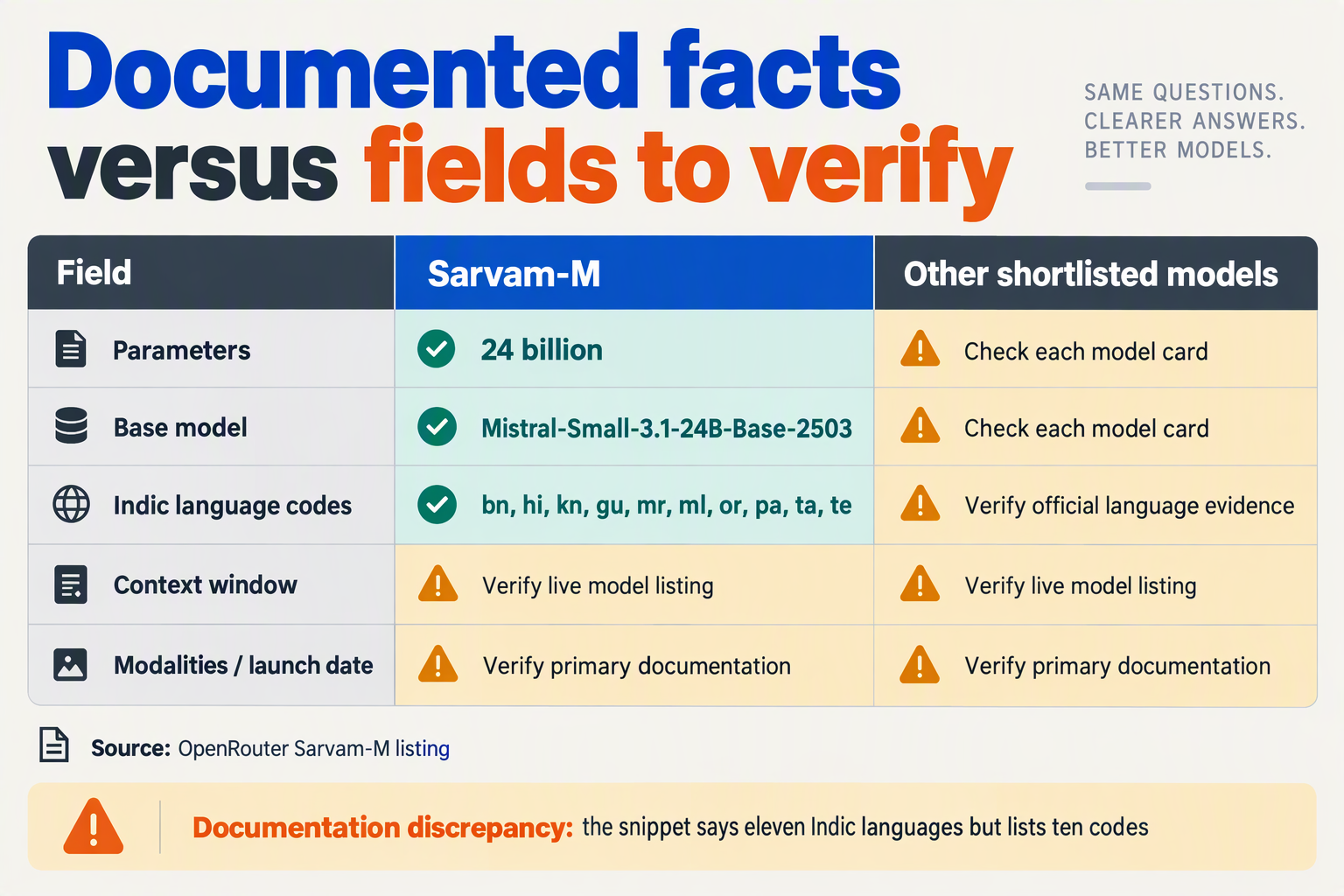
Sarvam-M has the clearest documented Indian-language coverage in the supplied OpenRouter research; the excerpts do not establish equivalent coverage for the other listed models. As of October 2026, those excerpts also omit numerical context-window limits, so a defensible comparison must distinguish documented capabilities from specifications requiring verification.
- Language evidence: OpenRouter’s Sarvam-M listing names Bengali, Hindi, Kannada, Gujarati, Marathi, Malayalam, Odia, Punjabi, Tamil, and Telugu; the comparison pages for the other candidates do not provide language-by-language support lists.
- Context-window evidence: None of the supplied OpenRouter excerpts gives a numerical token limit; “not provided” below means the research lacks that specification, not that the model lacks a context window.
Which model specifications does OpenRouter document?
The following table summarizes the supplied OpenRouter excerpts as of October 2026, rather than a complete live model catalogue.
| Model | Indian-language evidence | Context window | Modality evidence | Named source |
|---|---|---|---|---|
| Sarvam-M | Explicit Indic post-training; 10 named languages listed above | Not provided | No explicit input/output modality specification | OpenRouter Sarvam-M listing |
| Google Gemini 2.5 Flash Lite | Not specified in supplied excerpt | Not provided | Not specified in supplied excerpt | OpenRouter comparison page |
| Z.ai GLM 4.6 | Not specified in supplied excerpt | Not provided | Not specified in supplied excerpt | OpenRouter comparison page |
| OpenAI gpt-oss-20b | Not specified in supplied excerpt | Not provided | Not specified in supplied excerpt | OpenRouter comparison page |
| Mistral Small 3.1 24B Instruct | No Indian-language list supplied | Not provided | Text reasoning and vision, including image analysis | OpenRouter Cloudflare provider page |
| Mistral Devstral Medium | Not specified in supplied excerpt | Not provided | Not specified in supplied excerpt | OpenRouter comparison page |
How should developers interpret missing language and modality specifications?
- Missing documentation: As of October 2026, these OpenRouter excerpts support an evidence-based shortlist, not a verdict that Gemini, GLM, or gpt-oss cannot handle Indian languages. Validate each candidate on your target language and task before excluding or adopting it.
- Model inheritance: OpenRouter identifies Sarvam-M as a derivative of Mistral-Small-3.1-24B-Base-2503 in the October 2026 research. That ancestry does not establish that Sarvam-M exposes the vision capabilities documented separately for Mistral Small 3.1 24B Instruct.
- Context budgeting: Check the selected endpoint’s current input-context and maximum-output limits separately. For example, a request containing 12,000 tokens of retrieved documents, 2,000 tokens of conversation, and a 1,000-token answer needs a budget accommodating all three components; this is an illustrative workload, not a reported model specification.
- Modality checks: Verify image, audio, and text support independently; a multilingual text model does not automatically provide speech recognition or speech generation. An image-capable endpoint likewise does not establish reliable reading of every Indian script.
- Language testing: Use separate test sets for native-script questions, Romanized input, and code-mixed messages—for example, Tamil script, Romanized Tamil, and Tamil-English support requests. Record task accuracy and instruction-following separately instead of treating “multilingual” as a single pass/fail label.
- CallMissed: As of October 2026, CallMissed documents speech recognition in 22 Indian languages plus English, including code-mixed speech, and natural text-to-speech in 10 Indian languages plus English. Those are distinct audio capabilities, not evidence of any OpenRouter model’s language coverage.
How much do these OpenRouter models cost?
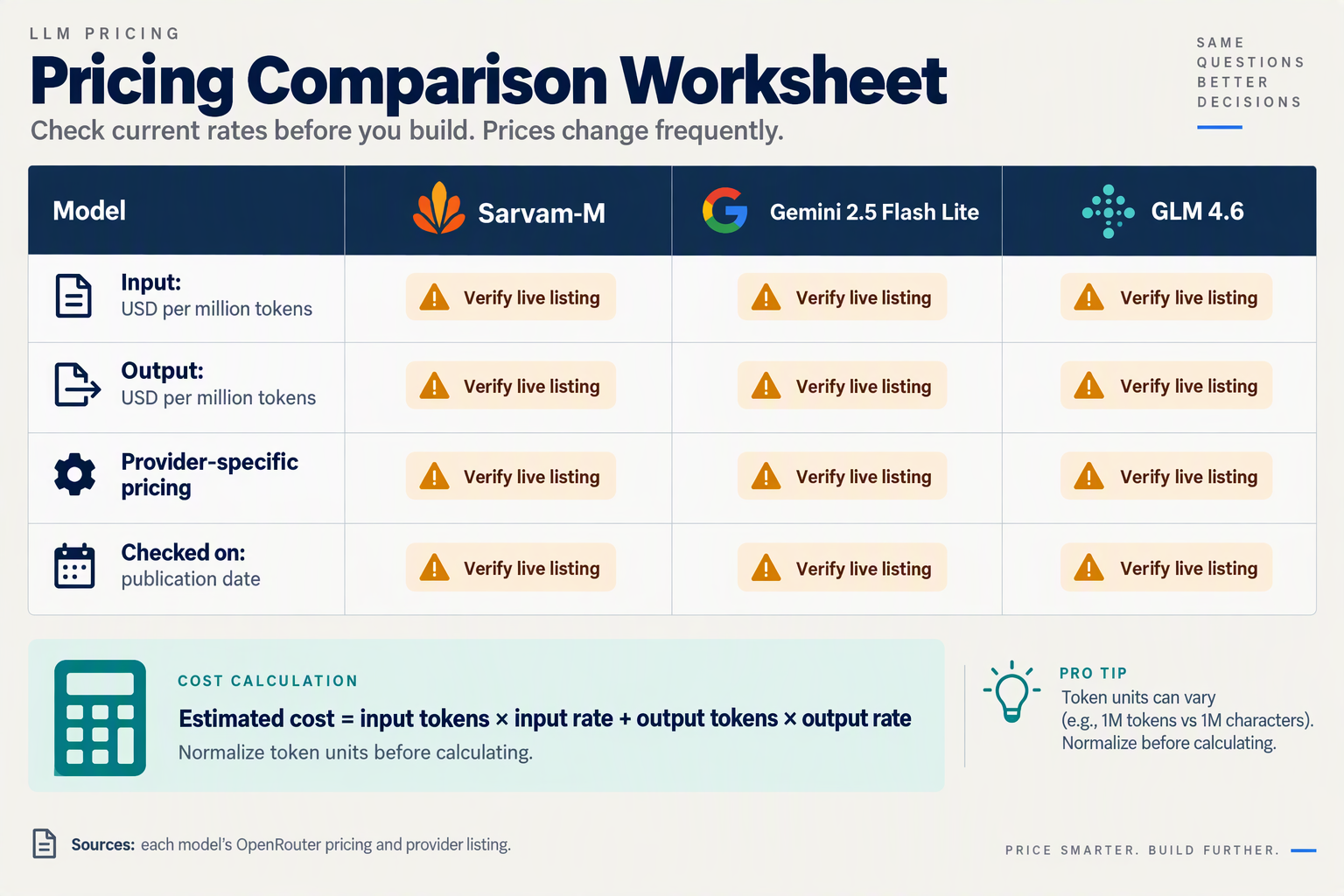
The supplied October 2026 OpenRouter research does not include verified token prices for these models. Their listings establish availability, but a defensible cost comparison requires current input and output rates—not estimated or remembered prices.
- Pricing evidence: OpenRouter’s supplied model and comparison excerpts contain no numerical token rates; “not provided” below means unverified in this research, not free.
- Comparison scope: The first four models belong to the earlier shortlist; Devstral Medium and o3 Pro are additional OpenRouter-listed comparison candidates, not newly confirmed Indian-language recommendations.
What prices are verified for these OpenRouter models?
The following table records the evidence available as of October 2026. Input and output columns use the same comparison unit—US dollars per million tokens—but require live verification before budgeting.
| Model | Input / 1M tokens | Output / 1M tokens | Supplied OpenRouter evidence |
|---|---|---|---|
| Sarvam-M | Not provided | Not provided | Model and pricing-page excerpt |
| Google Gemini 2.5 Flash Lite | Not provided | Not provided | Comparison with Sarvam-M |
| Z.ai GLM 4.6 | Not provided | Not provided | Comparison with Sarvam-M |
| OpenAI gpt-oss-20b | Not provided | Not provided | Comparison with Sarvam-M |
| Mistral AI Devstral Medium | Not provided | Not provided | Comparison with Sarvam-M |
| OpenAI o3 Pro | Not provided | Not provided | Comparison with Sarvam-M |
How should you calculate Indian-language inference costs?
- Token formula: Calculate text-generation cost as (input tokens ÷ 1,000,000 × input rate) + (output tokens ÷ 1,000,000 × output rate). Keep the two rates separate: a long retrieved document and a long generated answer affect different sides of the bill.
- Worked example: For a hypothetical test of 1,000 conversations, each using 1,000 input tokens and 300 output tokens, consumption totals 1 million input tokens plus 300,000 output tokens. With verified rates I and O, the estimated generation charge is I + 0.3O dollars, before any additional charges.
- Language measurement: Run the same task set in your actual target languages and record billed tokens rather than assuming equal costs per sentence. Include native-script and Romanized inputs separately; matching the number of messages does not establish matching token consumption.
What else should you check before choosing the cheapest model?
- Billing conditions: Record the provider route, currency, retrieval date, and any applicable caching or additional charges alongside each quote. A useful price snapshot says “verified October 2026” and identifies the exact model—not simply “Gemini” or “GPT.”
- Quality-adjusted cost: Compare cost per accepted answer, not just cost per million tokens. In a hypothetical evaluation, a cheaper response that requires a retry consumes additional tokens; count retries and human corrections before declaring a model economical for Hindi or Tamil support.
- Alternative procurement: As of October 2026, CallMissed’s verified fact sheet lists an OpenAI-compatible developer gateway with 124 models, 21 on the free tier, and 1 credit = ₹1. That provides a separate procurement option, but does not establish identical availability or pricing for the six OpenRouter models above.
What do benchmarks actually prove about Indian-language quality?
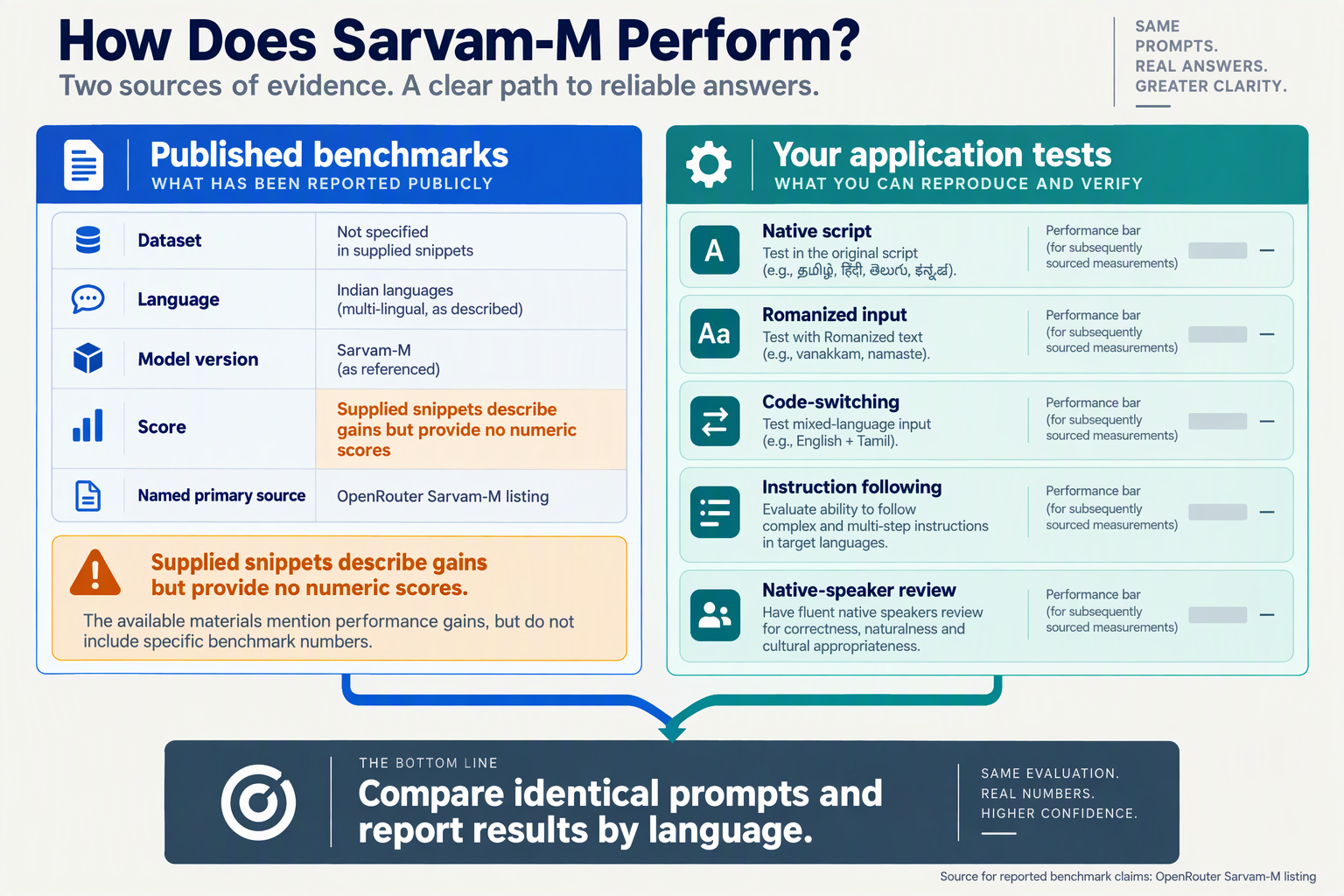
Benchmarks establish performance on specific test tasks—not reliable quality across every Indian language or customer workflow. As of October 2026, the supplied OpenRouter evidence supports investigating Sarvam-M, but does not establish a numerical Indian-language ranking against the other listed models.
What does OpenRouter’s benchmark evidence actually establish?
- Sarvam-M: OpenRouter’s listing, reviewed in October 2026, reports “solid gains versus similarly sized open models” on Indic-language question answering and GSM-8K mathematics. That is a directional claim about particular evaluations, not evidence that Sarvam-M wins on translation, Romanized Hindi, regional terminology, or every support scenario.
- Missing evaluation details: The supplied October 2026 OpenRouter excerpts contain no numerical benchmark scores, per-language results, sample sizes, or evaluation settings. Without those details, readers cannot calculate the improvement, assess its consistency, or determine whether the comparison used identical prompts and scoring methods.
- Mathematics versus language quality: A GSM-8K result concerns mathematical problem-solving; interpreting it as Indian-language evidence requires knowing the language of the evaluated questions. The supplied October 2026 OpenRouter excerpt does not identify that language, so mathematics gains should not become a claim about Tamil, Bengali, or Hindi fluency.
- Other OpenRouter candidates: October 2026 OpenRouter comparison pages establish availability for Google Gemini 2.5 Flash Lite, Z.ai GLM 4.6, and OpenAI gpt-oss-20b, but the supplied excerpts provide no comparable Indian-language scores. An available comparison page is not a controlled benchmark, and missing evidence is not evidence of poor performance.
How should you test Indian-language models before choosing one?
- Build a language-specific test set: Use a proposed 100-prompt pilot per target language: 25 native-script questions, 25 transliterated questions, 25 code-mixed messages, and 25 domain-specific requests. This is an illustrative evaluation design—not a published benchmark—and prevents a strong aggregate result from concealing weakness in one input style.
- Separate the scoring dimensions: Record factual correctness, instruction-following, language fidelity, and task completion independently. For example, a Hindi refund answer can sound natural while inventing a return policy; a correct answer can still ignore the requested language. Report each percentage with its denominator rather than combining everything into an unexplained “accuracy” score.
- Control the comparison: Give Sarvam-M and each alternative the same prompts, reference documents, output limits, and scoring rubric; document model identifiers and the evaluation date. Ask qualified speakers to review terminology and meaning, and inspect failures separately for Hindi, Tamil, Bengali, or whichever languages your application actually serves.
- Keep infrastructure separate from quality: As of October 2026, CallMissed’s verified fact sheet lists an OpenAI-compatible developer API, caller-chosen fallback models, and usage and request logs. Those capabilities support integration and operational visibility; they do not establish Indian-language accuracy. Choose the model using language-specific evidence, then choose infrastructure around your deployment requirements.
What are the pros and limitations of each option?
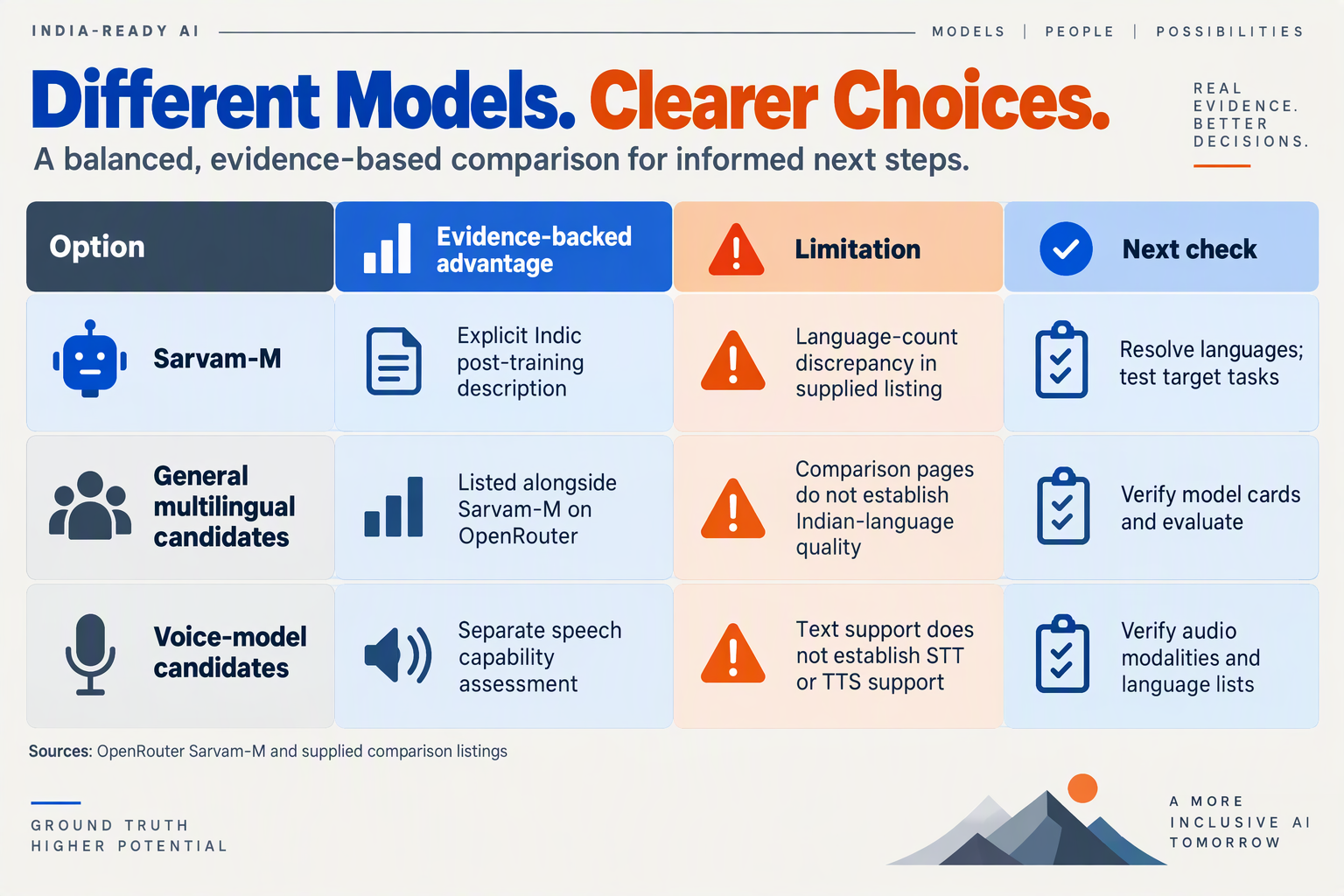
Sarvam-M has the clearest documented Indic-language fit in the supplied OpenRouter research; the other listed models are comparison candidates, not verified equivalents. As of October 2026, the main trade-off is language evidence versus the need for additional testing, rather than a demonstrated accuracy or price ranking.
- Language coverage: Select for your actual deployment language—such as Tamil or Bengali—not a generic “multilingual” label; the supplied evidence does not establish equal coverage across these models.
- Benchmark evidence: OpenRouter reports Indic question-answering gains for Sarvam-M in the October 2026 research, but supplies no numerical scores here; those claims cannot support an accuracy leaderboard.
- Integration effort: OpenRouter’s October 2026 comparison pages describe switching listed models by changing the model slug, making controlled comparisons possible without building a separate integration for each candidate.
- Pricing evidence: The supplied October 2026 excerpts contain no usable per-token prices or context-window figures; neither the cheapest option nor the longest-context option can be identified reliably.
| OpenRouter option | Documented advantage | Evidence limitation | Practical evaluation |
|---|---|---|---|
| Sarvam-M | Explicit Indic post-training; OpenRouter identifies a 24B-parameter model. | No numerical Indic benchmark results supplied. | Start with regional-language QA; separately test Romanized and mixed-language inputs. |
| Google Gemini 2.5 Flash Lite | OpenRouter comparison page establishes access alongside Sarvam-M. | Excerpt does not document specific Indian-language coverage. | Compare native-script answers and translation against the same reference set. |
| Z.ai GLM 4.6 | OpenRouter documents model-slug switching alongside Sarvam-M. | Availability is not evidence of equivalent Indic proficiency. | Check terminology, instruction-following, and unsupported factual claims. |
| OpenAI gpt-oss-20b | OpenRouter comparison page establishes an accessible alternative. | No language-specific scores or coverage list supplied. | Measure answer correctness independently from fluency. |
| Mistral AI Devstral Medium | OpenRouter provides a comparison page with Sarvam-M. | Supplied excerpt does not establish Indic task performance. | Include only if testing demonstrates value for your actual workflow. |
| OpenAI o3 Pro | OpenRouter provides a comparison page with Sarvam-M. | No supplied evidence establishes an Indic-language advantage. | Compare task success before accepting any additional operating cost. |
Source: OpenRouter model listings and comparison-page excerpts supplied for October 2026. “Not documented” means missing from this research, not proof that a model cannot handle the language.
How should you turn these trade-offs into a shortlist?
- Use one test set: A proposed pilot could use 50 prompts per target language: 20 factual questions, 10 translations, 10 Romanized inputs, and 10 mixed-language messages.
- Score separate outcomes: Track factual correctness, script compliance, terminology, and task completion separately; a fluent Hindi answer can still contain the wrong refund policy or appointment date.
- Measure delivered cost: Record billed input/output tokens, retries, and human corrections for each model; compare cost per accepted answer rather than assuming lower token prices mean lower workflow costs.
- Keep gateway choice separate: As of October 2026, CallMissed’s verified fact sheet lists an OpenAI-compatible developer API with 124 models, including 40 general-purpose LLMs; API compatibility does not itself establish Indian-language quality or identical OpenRouter availability.
How do you choose and try a model through the API?
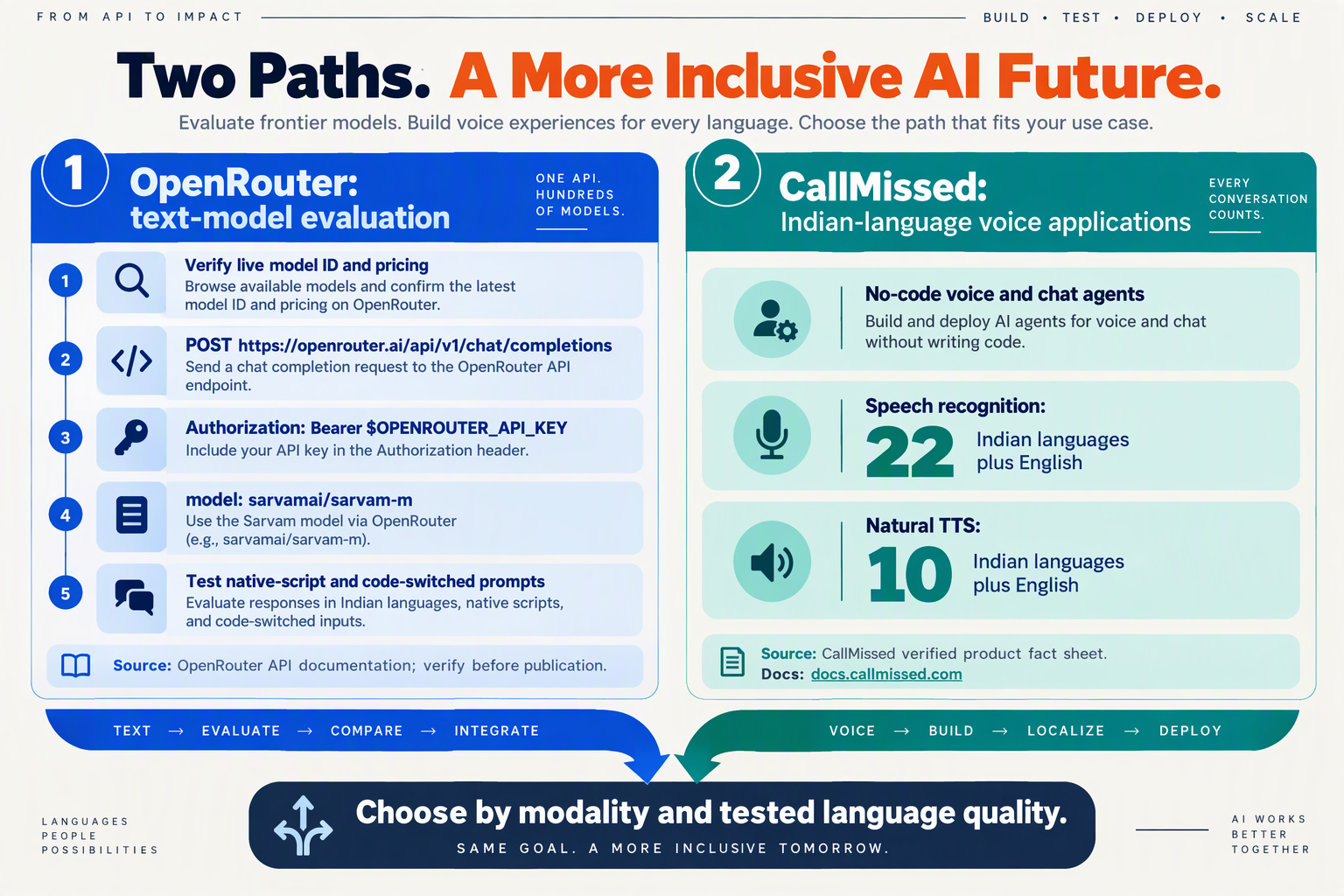
Choose Sarvam-M as your documented Indic-language starting point, then compare alternatives using the same prompts and scoring rubric. Through OpenRouter, changing the model slug lets you test candidates without building a separate integration for each.
How do you run an Indian-language API comparison?
- OpenRouter model selection: OpenRouter’s comparison pages, reviewed in October 2026, establish API access to
sarvamai/sarvam-m,google/gemini-2.5-flash-lite,z-ai/glm-4.6, andopenai/gpt-oss-20b. Start with Sarvam-M and one alternative rather than testing every available model; availability alone does not establish equivalent Hindi, Tamil, or Bengali performance.
- First API request: Set the request’s model field to
"model": "sarvamai/sarvam-m"and provide a specific instruction, such as: “Answer in Tamil. Use only the supplied refund policy. If the policy does not answer the question, say so.” Repeat with another listed slug while keeping the policy and conversation unchanged.
- Controlled settings: Keep the system instruction, input messages, and output-token limit identical across requests. Use the same temperature only where both models support that setting, and record unsupported parameters rather than silently changing them. Otherwise, differences in verbosity or sampling can look like differences in Indian-language capability.
- Recommended test set: Build 30 prompts per target language: 10 native-script questions, 10 Romanized questions, and 10 code-mixed questions. This is a proposed evaluation design, not a published benchmark. Include concrete support tasks such as cancellation requests, delivery questions, and refund-policy explanations, with reference answers reviewed by fluent speakers.
What should you measure before choosing a model?
- Language quality: Score each response from 0–2 for meaning preservation, instruction-following, and terminology accuracy, giving a maximum of 6 points per response. Have a fluent reviewer check whether the model answers naturally—not merely whether it produces the requested script. Reject answers that mistranslate conditions, dates, amounts, or eligibility rules.
- Latency and cost: Record end-to-end response time, reported input/output token usage, and the applicable model price for every test. The supplied October 2026 OpenRouter excerpts do not contain numerical prices or context limits, so check the current model listing before budgeting. Report median latency and cost per successfully resolved question, not just cost per token.
- Failure handling: Test three explicit failure cases: an unsupported policy question, an ambiguous Romanized phrase, and a request to switch languages mid-conversation. A production-ready assistant should ask for clarification or acknowledge missing information rather than invent an answer. Evaluate any fallback model separately; a successful API response does not guarantee acceptable language quality.
- CallMissed integration option: As of October 2026, CallMissed’s verified fact sheet lists 40 general-purpose LLMs, OpenAI-compatible chat-completions endpoints, and caller-chosen fallback models. Developers can reuse an existing SDK by changing its base URL and credentials, but should confirm the exact model identifier in CallMissed’s catalogue rather than assume OpenRouter slugs transfer unchanged. API compatibility simplifies integration; the same language tests still determine suitability.
Frequently Asked Questions
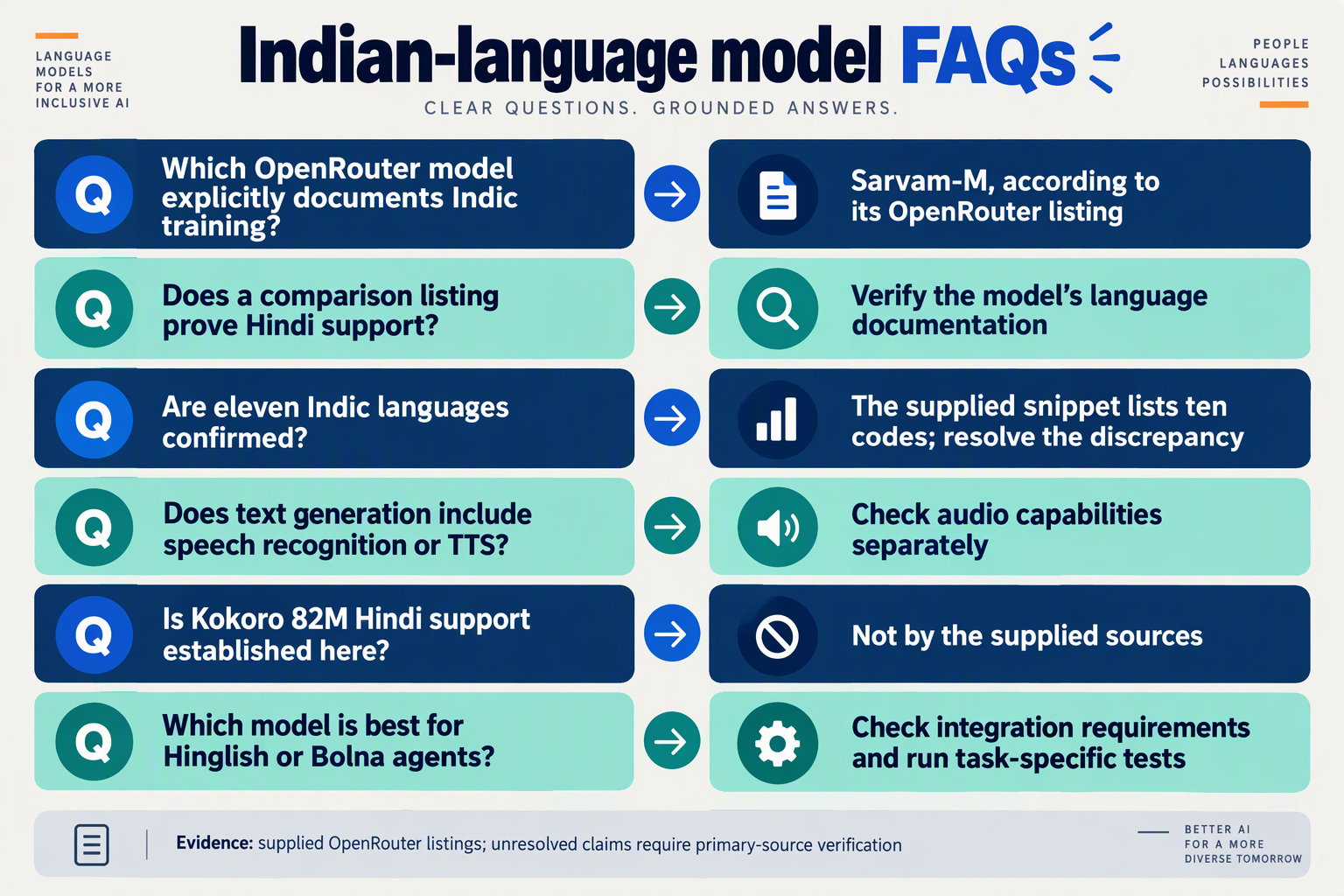
Indian-language model selection on OpenRouter requires task-specific testing, not just a multilingual label. These FAQs cover translation, mixed-script inputs, costs, switching models, and voice applications.
- Q: What models does OpenRouter support that support Indian languages for customer support?
A: As of October 2026, OpenRouter explicitly documents Indic post-training for Sarvam-M; its comparison pages also establish availability for Google Gemini 2.5 Flash Lite, Z.ai GLM 4.6, and OpenAI gpt-oss-20b, without establishing equivalent language coverage. Treat these as candidates with different evidence levels, not interchangeable regional-language specialists. For customer support, evaluate whether each candidate correctly explains refund rules, preserves account details, and escalates questions that your knowledge base cannot answer.
- Q: What models does OpenRouter support that support Indian languages for translation?
A: Sarvam-M is an evidence-backed starting candidate because OpenRouter documents English-and-Indic post-training as of October 2026, but the supplied sources provide no translation-specific accuracy scores. Test translation in both directions using your actual content, including product names, monetary amounts, and regional terminology. A fluent translation can still change a policy’s meaning, so bilingual reviewers should score meaning preservation separately from readability.
- Q: How should I test OpenRouter models on Hinglish and Romanized Indian languages?
A: The supplied OpenRouter documentation, reviewed as of October 2026, does not establish a Hinglish or transliteration accuracy benchmark for the compared models. Build matched examples in native script, Romanized text, and mixed-language text—for example, “मेरा ऑर्डर कहाँ है?” and “Mera order kahan hai?” Test whether spelling variations change the answer, and check that the model follows your requested response language rather than automatically switching to English.
- Q: How much do Indian-language models cost on OpenRouter?
A: The supplied OpenRouter excerpts include pricing-page references but no verified per-token prices as of October 2026, so this comparison cannot quote reliable rates. Check the current model listing and calculate input plus output costs using representative conversations rather than assuming equal token usage across languages. Include retries and unnecessarily long answers in your trial measurements, because a cheaper token rate does not necessarily produce a cheaper successful interaction.
- Q: Can I switch between Sarvam-M and other OpenRouter models without rebuilding my integration?
A: OpenRouter’s October 2026 comparison pages state that switching between Sarvam-M and the listed alternatives takes a model-slug change rather than a new integration. That simplifies comparative testing, but does not demonstrate identical output quality or feature behavior. Run the same prompts and scoring criteria before switching production traffic, especially where incorrect translations or policy explanations could affect customers.
- Q: Does Indian-language text support also mean speech recognition and voice output?
A: No: text generation, speech recognition, and text-to-speech require separate coverage checks, and the supplied OpenRouter excerpts do not establish voice capabilities for these models. As of October 2026, CallMissed documents speech recognition in 22 Indian languages plus English, including code-mixed speech, and natural text-to-speech in 10 Indian languages plus English. For a voice application, verify every stage independently: correctly transcribed speech can still produce an inaccurate answer or unsuitable pronunciation.
Conclusion
Sarvam-M is the clearest documented starting point for Indian-language applications on OpenRouter, according to OpenRouter’s October 2026 listing. The practical takeaway is to separate model availability from language evidence: access through an API does not establish reliable performance in every Indian language, script, or customer-support scenario.
Four conclusions should guide your shortlist:
- Start with explicitly documented Indic training. OpenRouter describes Sarvam-M as a 24-billion-parameter model post-trained on English and Indic languages, according to its listing reviewed in October 2026. That makes Sarvam-M a relevant candidate for regional-language chatbots, translation, and support—not an automatic winner for every task. Choose it as a starting point for evaluation rather than treating the listing as a production-quality guarantee.
- Verify the language list before promising coverage. OpenRouter’s October 2026 Sarvam-M description says “eleven major Indic languages,” but the supplied excerpt names only 10: Bengali, Hindi, Kannada, Gujarati, Marathi, Malayalam, Odia, Punjabi, Tamil, and Telugu. Do not infer an unnamed eleventh language. This documentation discrepancy is small enough to overlook, but important when a business commits to serving a specific regional audience.
- Treat other available models as evaluation candidates. OpenRouter’s comparison pages reviewed in October 2026 establish access to Google Gemini 2.5 Flash Lite, Z.ai GLM 4.6, and OpenAI gpt-oss-20b alongside Sarvam-M. Those pages do not establish equivalent Indian-language coverage. General-purpose capability, convenient switching, and multilingual descriptions should not substitute for evidence about the language your customers actually use.
- Test real conversations, not just clean translations. Evaluate native scripts, Romanized text, and mixed-language messages against factual accuracy, terminology, and instruction-following. For a Hindi support assistant, compare Devanagari questions with Romanized Hindi versions of the same requests. A model that translates a sentence correctly may still misunderstand a support instruction, omit a condition, or answer inconsistently across writing styles.
What should developers watch next?
Watch for clearer language documentation and reproducible, language-specific evaluations, rather than assuming future model releases will improve every regional-language workflow equally. OpenRouter reports Indic question-answering and mathematics gains for Sarvam-M in the supplied October 2026 research, but without numerical scores or evaluation details, those claims cannot support an accuracy percentage or blanket superiority claim.
Keep integration convenience separate from language quality as your shortlist evolves. As of October 2026, CallMissed offers an OpenAI-compatible developer API with Sarvam among its catalogue makers, making it another platform readers can explore when assessing AI communication integrations.
Before choosing your next model, ask: can it handle your customers’ language, script, and mixed-language questions—not merely appear on a multilingual model list?
Related Reading
- LLM comparison 2026: Best Models for Customer Support
- Hardware-Efficient Language Models for Support Costs
- Large Language Models: Customer Support's Future in 2026