
Hardware-Efficient Language Models for Support Costs



Use hardware-efficient language models to reduce support costs, compare deployment options, and measure savings without sacrificing resolution quality.
Hardware-Efficient Language Models for Support Costs
Why pay for heavyweight reasoning every time a customer asks where their order is? Hardware-Efficient Language Models for Support Costs addresses a practical answer: use models that demand less computation for routine work, while reserving stronger reasoning and human attention for cases that genuinely need them.
As of October 2026, that approach has fresh momentum from this year’s model releases. OpenAI announced GPT-5.4 mini and GPT-5.4 nano on March 17, 2026, describing them as faster, more efficient models designed for high-volume workloads. SiliconANGLE’s March 17, 2026 coverage connected releases from OpenAI and Mistral AI to “cost-sensitive use cases”—a category that fits customer support particularly well.
The hardware story is more interesting than simply making models smaller. According to Mistral AI’s documentation dated March 16, 2026, Mistral Small 4 has 119 billion total parameters but activates 6.5 billion. That distinction matters: activating fewer parameters can reduce computation per token, but it does not mean the entire model fits into the memory footprint of a 6.5-billion-parameter model. For support leaders, architecture is useful context—not a substitute for measuring deployment costs.
Why do hardware-efficient LLMs matter for customer support?
Customer support combines repetitive questions, unpredictable demand, and tight service budgets. A model that handles order-status requests economically can be valuable even if it is not the right choice for a disputed refund or a sensitive account-access problem.
Consider an illustrative workload: 10,000 monthly conversations using 1,500 total tokens each would generate 15 million tokens. Those tokens are not necessarily priced equally: input, cached input, and output can carry different rates. Add retrieval, tool calls, retries, and human escalation, and the meaningful metric becomes cost per correctly resolved issue, not the cheapest advertised token price.
As of October 2026, CallMissed’s OpenAI-compatible developer AI API offers caller-chosen fallback models, response caching, and usage logs—capabilities relevant to teams testing economical model choices without rewriting existing SDK integrations.
This article will explain how to evaluate hardware-efficient LLMs against the support outcomes that matter:
- Resolution quality: Does the model answer accurately from approved business information?
- Response speed: Does efficiency translate into acceptable waits under realistic traffic?
- Total operating cost: Do savings survive retries, infrastructure charges, and escalations?
- Escalation design: Which requests need stronger models or a person?
The opportunity is not to automate every conversation with the smallest available model. It is to match computational effort to customer need—and prove that lower spending still delivers dependable help at scale.
Why do hardware-efficient LLMs matter? Lower inference costs—if resolution quality holds
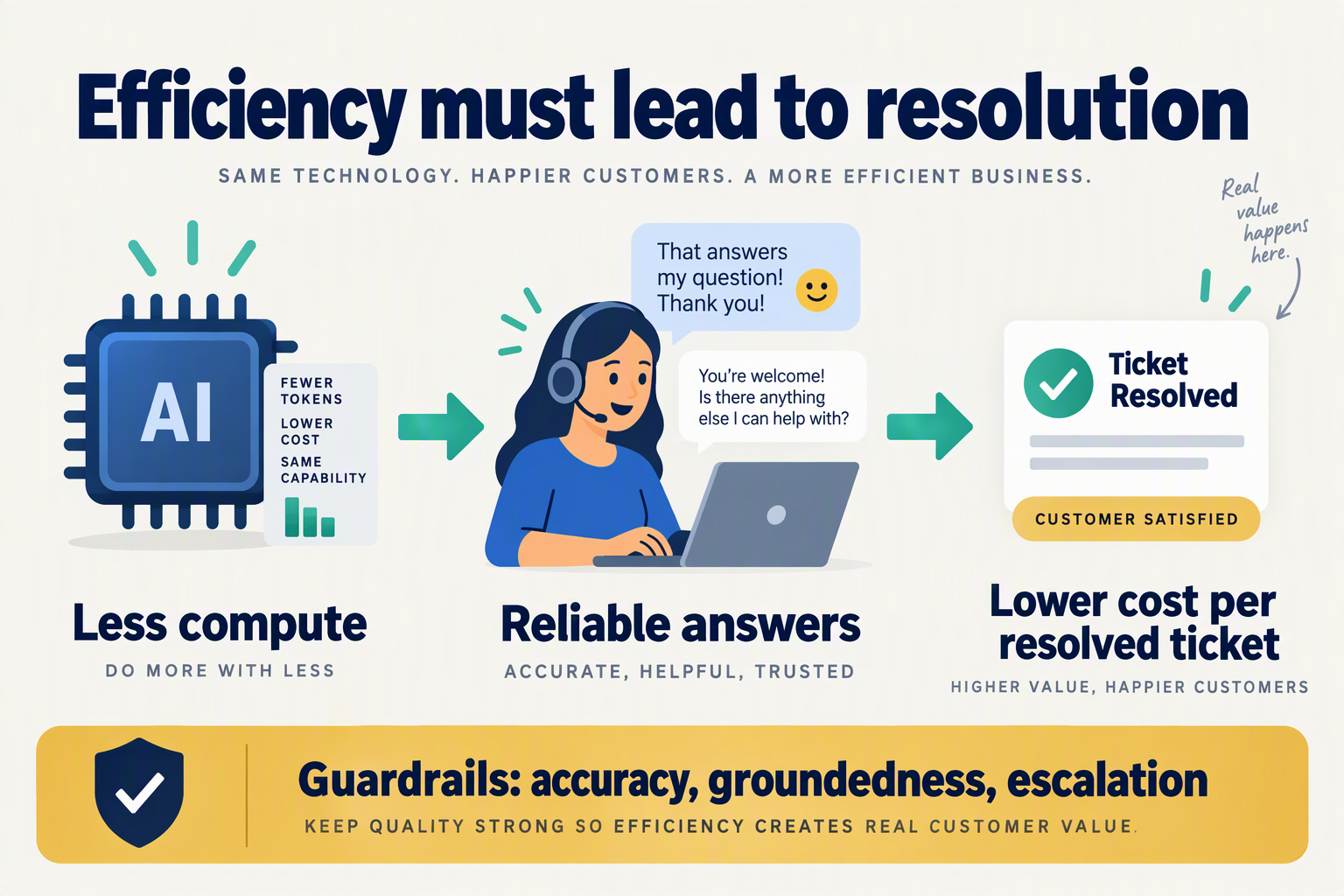
Hardware-efficient LLMs matter because they can reduce the computational expense of routine support—but savings are useful only if customers still get accurate, complete resolutions. A cheaper answer that creates another ticket is not a cheaper service outcome.
Does a smaller model always mean a lower support bill?
No. Hardware efficiency describes resource use; API pricing describes what a provider charges. Neither alone establishes whether a model is economical for your support workload.
The March 17, 2026 pricing comparison posted in the OpenAI Developer Community listed GPT-5.4 mini at $0.75 per million input tokens and $4.50 per million output tokens, compared with $0.25 and $2.00 respectively for GPT-5 mini. That launch-era comparison illustrates an important distinction: a newer small model can cost more than an older small model, even when positioned for efficient, high-volume work.
For an October 2026 procurement decision, treat those figures as a dated pricing snapshot, not confirmation of today’s rates. Compare current charges alongside performance on your own tickets.
Operational efficiency also depends on deployment:
- Hosted APIs: Measure token charges, tool expenses, retries, and escalation costs.
- Self-hosted models: Include accelerator memory, server utilization, engineering time, and spare capacity.
- Both approaches: Test peak-hour response times rather than assuming lower computation guarantees faster service.
A lightly used self-hosted system can waste capacity. A low-priced API can become expensive if the agent repeatedly regenerates unsuccessful answers.
How much does the input-output mix affect inference cost?
The balance between reading and generating text can materially change the bill. Support agents often read lengthy policies and conversation histories, but unnecessary verbosity adds output tokens without improving resolution.
Using the March 17, 2026 OpenAI Developer Community pricing snapshot, an illustrative workload of 800,000 uncached input tokens and 200,000 output tokens would cost $1.50 on GPT-5.4 mini: $0.60 for input plus $0.90 for output.
The same illustrative workload would cost $0.41 on GPT-5.4 nano, using the community post’s listed rates of $0.20 per million input tokens and $1.25 per million output tokens. These calculations exclude tools, retrieval, retries, and other charges; they are not customer-support benchmarks.
The practical lesson is to control unnecessary generation, not just select a cheaper model. A concise, verified delivery update may serve the customer better than a long explanation containing speculative details.
When do inference savings stop being real savings?
Savings disappear when reduced model spending causes disproportionate rework or unresolved cases. Assess the trade-off with a controlled evaluation:
- Define a correct resolution. Require accurate policy application, successful actions where needed, and no unsupported promises.
- Measure the full journey. Include follow-up contacts, stronger-model retries, and human handling.
- Compare matched ticket groups. Separate straightforward tracking requests from ambiguous refunds or account-access cases.
Consider two hypothetical October 2026 test cohorts, each containing 1,000 issues. If one workflow costs $80 overall and correctly resolves 900 issues, its cost per correct resolution is about $0.089; a $50 workflow resolving only 500 costs $0.10 per correct resolution.
The lower-spend workflow is less economical on the outcome that matters. Hardware-efficient language models earn their place when measured savings survive that denominator—not merely when their token price looks attractive.
How do small language models, efficient APIs, and edge deployments differ?
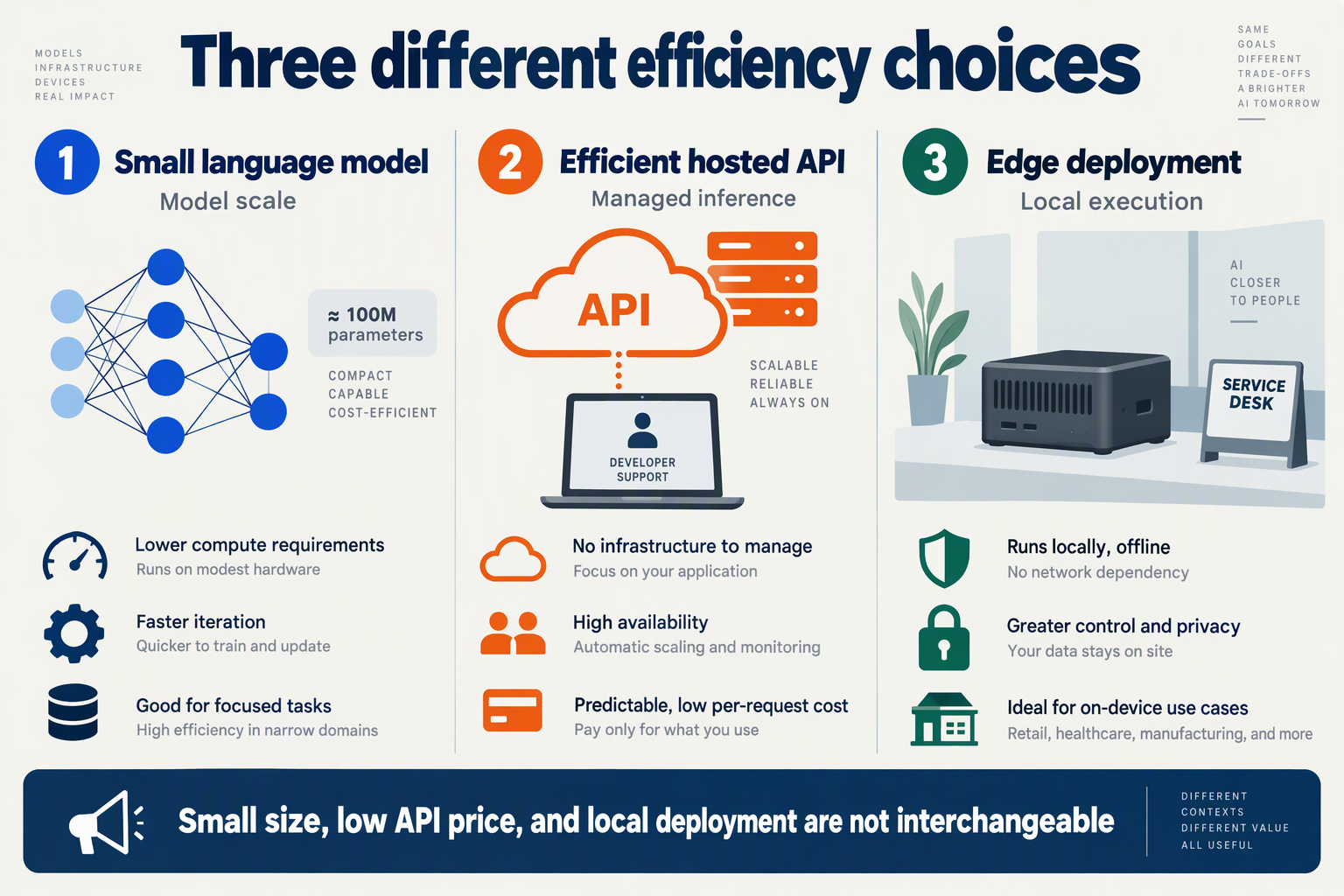
Small language models describe the model; efficient APIs describe how teams access and operate models; edge deployments describe where inference runs. These choices can overlap, but none automatically guarantees the lowest customer-support cost.
For an October 2026 deployment decision, separate three questions: What computation does the task require? Who manages it? Where does customer data travel?
What makes a small language model different from an efficient API?
A small language model (SLM) generally has fewer parameters than larger models in its family. However, “small” is not a standardized size category, and product names do not reveal memory requirements or deployment options.
OpenAI’s March 17, 2026 announcement described GPT-5.4 mini and nano as “fast and efficient models optimized for coding and subagents.” That positioning suggests candidates for narrowly scoped support tasks—not proof that either model will reliably handle every refund dispute or multilingual conversation.
An efficient API is an access and operating layer. It can expose small or large models while offering mechanisms that reduce unnecessary spending or integration work:
- Caching can avoid repeated processing of eligible, unchanged inputs.
- Model selection lets teams assign different workloads to different models.
- Structured outputs and function calling help connect responses to business workflows, although applications must still validate results.
Smaller does not necessarily mean cheaper than an earlier generation. OpenAI Developer Community’s March 2026 pricing comparison listed GPT-5.4 mini output at $4.50 per million tokens, versus $2.00 for GPT-5 mini—a 125% increase. Those historical community-listed prices require checking against current official pricing, but they illustrate why “mini” is not a sufficient purchasing criterion.
How does edge deployment change customer-support AI?
Edge deployment runs inference near the interaction—for example, on a customer device, an on-site appliance, or a branch server—rather than exclusively in a remote cloud.
Its potential benefits come from placement, not just model size:
- Connectivity resilience: Local inference can continue during an internet outage, provided the workflow does not need remote services.
- Data locality: Prompts can remain on the device when the application avoids external calls and telemetry.
- Network-delay reduction: Local processing removes a cloud round trip, but limited hardware can still make generation slow.
Edge deployment also shifts responsibility. The business must maintain model versions, secure devices, monitor failures, and budget for hardware, power, and support.
A local assistant might explain a stored returns policy offline. Checking a live shipment or issuing a refund still requires access to authoritative systems; local inference does not make those dependencies disappear.
Which approach fits a cost-sensitive support workflow?
Treat these options as composable layers, not competing labels. For example:
- Choose the task: Classify an incoming message using a model evaluated on actual support tickets.
- Choose the access method: Use an API when managed infrastructure and faster integration outweigh hosting control.
- Choose the location: Consider edge inference when connectivity or data-locality requirements justify operating local hardware.
As of October 2026, CallMissed’s OpenAI-compatible developer AI API supports structured outputs, function calling, and bring-your-own provider keys. These capabilities address integration choices; they do not, by themselves, establish an edge deployment.
The practical distinction is simple: model efficiency reduces computational demand, API efficiency improves how that computation is consumed, and edge deployment changes where it happens. Evaluate each against the workflow rather than assuming all three deliver the same savings.
What did OpenAI and Mistral announce in March 2026?
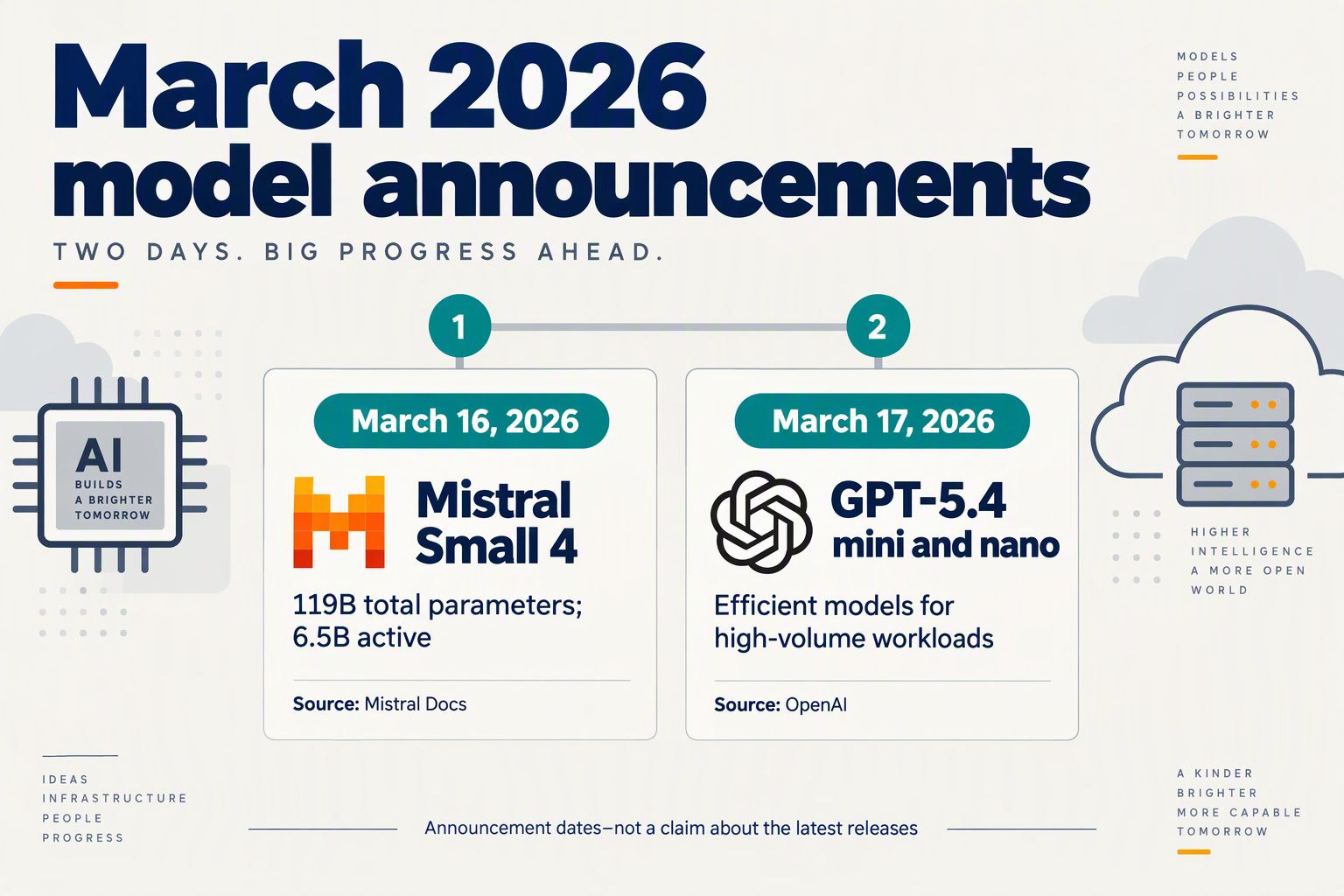
OpenAI announced GPT-5.4 mini and GPT-5.4 nano on March 17, 2026, while Mistral AI’s documentation dates Mistral Small 4 to March 16, 2026. These releases offer different routes to economical inference: smaller OpenAI models for high-volume workloads and a Mistral model that activates only part of its total parameter base.
What were the key differences between the March 2026 releases?
The table below compares the March 2026 announcement snapshot, not a verified October 2026 price list. OpenAI prices come from a March launch discussion in the OpenAI Developer Community; Mistral specifications and prices come from Mistral AI’s documentation dated March 16, 2026.
| Comparison | GPT-5.4 mini | GPT-5.4 nano | Mistral Small 4 |
|---|---|---|---|
| Announcement date | March 17, 2026, OpenAI | March 17, 2026, OpenAI | March 16, 2026, Mistral documentation |
| Stated positioning | Fast, efficient; coding and subagents | Fast, efficient; high-volume workloads | Unified instruction-following, reasoning and coding |
| Input price per million tokens | $0.75, community-reported | $0.20, community-reported | $0.15, Mistral documentation |
| Output price per million tokens | $4.50, community-reported | $1.25, community-reported | $0.60, Mistral documentation |
| Parameter disclosure in supplied sources | Not specified | Not specified | 119 billion total; 6.5 billion active |
| Context window in supplied sources | Not specified | Not specified | 256,000 tokens |
“Not specified” means the supplied research does not establish that figure—not that the model lacks the capability.
OpenAI’s March 17, 2026 announcement describes GPT-5.4 mini and nano as “our most capable small models yet.” That is OpenAI’s positioning within its own small-model lineup, not evidence that either model outperforms every alternative on customer-support tasks.
Did “more efficient” also mean cheaper than previous small models?
Not necessarily. The OpenAI Developer Community’s March 2026 launch comparison lists GPT-5.4 mini input pricing at $0.75 per million tokens, versus $0.25 for GPT-5 mini—a 200% increase. The same comparison lists GPT-5.4 nano input pricing at $0.20 per million tokens, versus $0.05 for GPT-5 nano—a 300% increase.
This distinction matters for procurement: a model can be economical relative to a flagship model without being cheaper than its predecessor. Better task completion could justify a higher rate, but support teams must demonstrate that through evaluation rather than infer it from “mini” or “nano.”
How should support teams interpret the launch prices?
Consider an illustrative workload of one million input tokens and 200,000 output tokens, excluding caching, tools, retries and infrastructure. Using the March 2026 rates above, the calculated token charges would be:
- GPT-5.4 mini: $0.75 + $0.90 = $1.65.
- GPT-5.4 nano: $0.20 + $0.25 = $0.45.
- Mistral Small 4: $0.15 + $0.12 = $0.27.
These are arithmetic comparisons, not equivalent-quality benchmarks or current quotes. Longer answers, additional reasoning or repeated failed attempts can change the ordering of actual operating costs.
The practical next step is to:
- Verify current provider pricing before budgeting.
- Test identical support cases, including ambiguous requests and policy exceptions.
- Compare accepted resolutions, not just token bills.
The announcements expand the options available to cost-sensitive support teams. They do not eliminate the need to prove which option handles a particular workload reliably.
Which models fit your hardware? Mistral Small 4, Ministral variants, and sub-1B models
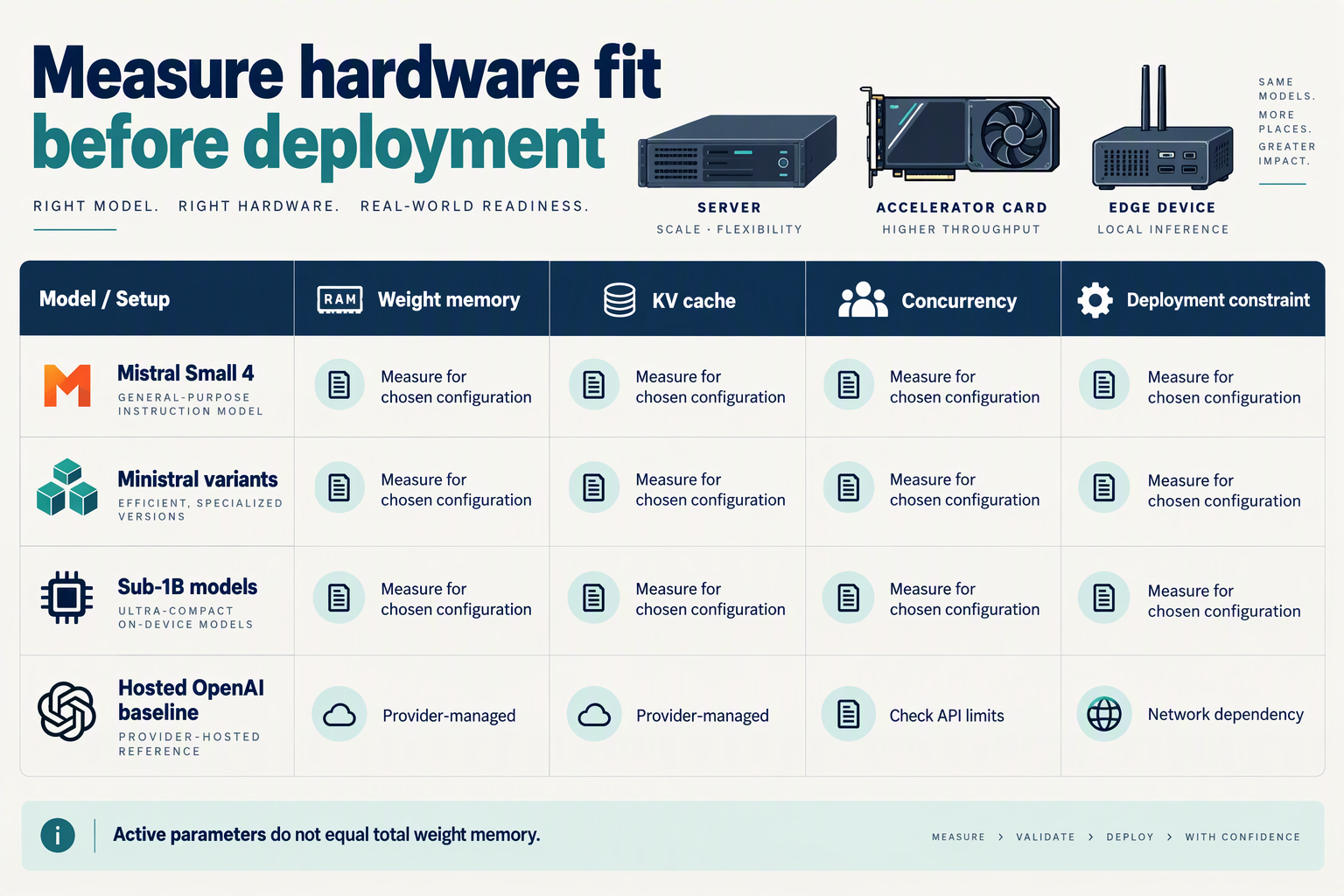
Hypothetical 3B and 8B dense models and sub-1B models offer useful starting points for constrained-hardware testing—not guaranteed CPU or single-GPU fits. Mistral Small 4 needs a substantially larger weight-memory budget, while OpenAI GPT-5.4 mini and nano provide hosted alternatives that do not require sizing a local GPU.
How do Mistral Small 4, hypothetical 3B and 8B dense models, and sub-1B models compare?
Mistral AI’s documentation dated March 16, 2026 lists Mistral Small 4 at 119 billion total parameters, 6.5 billion active parameters, and a 256,000-token context window. Its smaller active-parameter count should not be mistaken for its total weight-storage requirement.
The October 2026 planning comparison below separates documented specifications from hypothetical size classes. The cited coverage mentions Ministral variants but does not establish specific 3B or 8B checkpoints, their architecture, or local hardware suitability; those sizes therefore appear only as hypothetical dense models.
| Model or hypothetical class | Parameter basis | Illustrative four-bit weight floor | Deployment question to test |
|---|---|---|---|
| Mistral Small 4 | 119B total; 6.5B active | 59.5 GB | Can large-memory or distributed hardware meet workload targets? |
| Hypothetical 3B dense model | Assumed 3B parameters | 1.5 GB | Does the chosen checkpoint run acceptably on constrained hardware? |
| Hypothetical 8B dense model | Assumed 8B parameters | 4 GB | Is a single-GPU deployment viable under realistic load? |
| Hypothetical sub-1B model | Assumed fewer than 1B parameters | Below 0.5 GB | Can CPU or edge deployment meet quality and latency targets? |
| OpenAI GPT-5.4 mini | Parameter count not provided in cited announcement | Not established | Does hosted inference meet cost and quality targets? |
| OpenAI GPT-5.4 nano | Parameter count not provided in cited announcement | Not established | Does hosted inference suit the narrow support task? |
These are calculated weight-storage floors, not measured RAM or VRAM requirements: parameter count × 0.5 bytes, expressed in decimal gigabytes. Quantization metadata, runtime buffers, the KV cache, and other overhead increase actual memory consumption. The arithmetic also does not establish that a compatible four-bit checkpoint exists.
Why can a model load successfully but still fail customer support?
Loading weights proves only that one deployment stage works. Conversation history, retrieved policy documents, and concurrent requests can increase memory demand and response time.
Mistral Small 4’s documented context limit is a capacity ceiling, not evidence that maximum-length conversations are economical on your hardware. Likewise, a small model may load comfortably but mishandle ambiguous refund rules or generate incorrect tool arguments.
Treat these roles as evaluation hypotheses:
- Sub-1B models: Test intent classification, language identification, and narrow extraction.
- Hypothetical 3B and 8B dense models: Test grounded FAQs and structured support tasks.
- Mistral Small 4 or hosted alternatives: Test demanding cases where improved task completion could justify higher deployment costs.
How should you validate hardware fit before committing?
- Verify the checkpoint and runtime: Check architecture, licensing, quantization availability, and deployment requirements.
- Replay representative conversations: Include multilingual messages, retrieved documents, long histories, and simultaneous sessions.
- Measure operational headroom: Track peak memory, response time, task completion, and cost per successfully resolved request.
OpenAI’s March 17, 2026 announcement describes GPT-5.4 mini and nano as faster, more efficient models designed for high-volume workloads; that does not establish local hardware requirements.
As of October 2026, CallMissed’s OpenAI-compatible developer AI API offers caller-chosen fallback models and usage and request logs for evaluating hosted alternatives. Choose by measured workload fit—not the word “small.”
How do you optimize LLM inference cost per resolved support ticket?
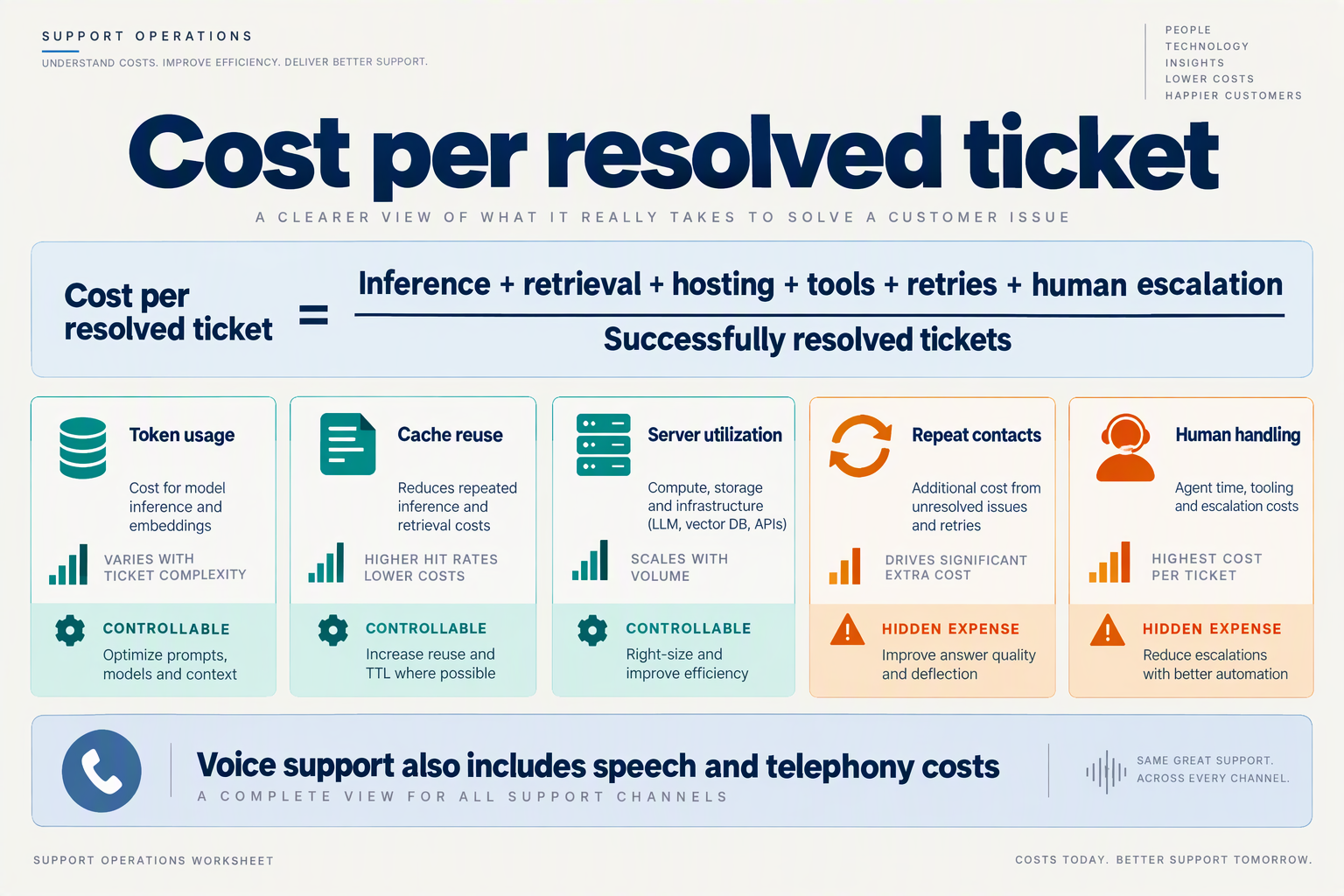
Optimize LLM inference cost per resolved support ticket by measuring the full workflow, then reducing unnecessary tokens, model calls, and repeat contacts without sacrificing resolution quality. The cheapest model is economical only when its answers actually close the customer’s issue.
How do you calculate cost per resolved support ticket?
Use two metrics together: inference cost per verified resolution and total operating cost per verified resolution. The first isolates model spending; the second exposes savings that disappear into tool charges, infrastructure, or human escalation.
For an October 2026 evaluation, calculate:
Inference cost per resolution = all model charges for the evaluated tickets ÷ verified resolutions
Include classification, answer generation, retries, fallback calls, and summarization—not just the first response. Count a resolution only after checking that the requested action succeeded and the customer did not reopen the same issue within your chosen measurement window.
Record these fields for each ticket:
- Token usage: Uncached input, cached input, and output.
- Execution costs: Retrieval, external tools, and hosting where applicable.
- Outcome: Resolved, escalated, reopened, or abandoned.
- Quality checks: Policy compliance, factual accuracy, and successful tool execution.
Keep the measurement window and resolution criteria identical across experiments. Otherwise, a workflow that prematurely closes tickets can appear artificially efficient.
Which inference optimizations should you test first?
Start with waste reduction before changing models. OpenAI’s March 17, 2026 announcement described GPT-5.4 mini and GPT-5.4 nano as models designed for “high-volume workloads,” but deployment efficiency still depends on how much work each ticket triggers.
Test these changes separately:
- Trim retrieved context. Send the relevant refund rule or order record rather than an entire policy document. Preserve exceptions that could change the answer.
- Separate lookup from reasoning. Retrieve shipment status through a deterministic tool; use the model to explain the result rather than infer it.
- Constrain responses. Request the required answer and next step, not a lengthy explanation for every routine interaction.
- Bound retries. After repeated tool failures, escalate with the information already collected instead of restarting the conversation.
- Cache cautiously. Reuse stable instructions where supported, but do not serve stale account balances or order statuses.
As of October 2026, CallMissed’s OpenAI-compatible developer AI API supports function calling, structured outputs, and usage and request logs. These capabilities can support tool-based workflows and make their model consumption easier to inspect; they do not, by themselves, establish resolution quality.
How do you prove a cheaper model actually saves money?
Compare matched ticket groups rather than token prices alone. The OpenAI Developer Community pricing comparison posted alongside the March 17, 2026 announcement listed GPT-5.4 nano at $0.20 input and $1.25 output per million tokens, versus GPT-5.4 mini at $0.75 input and $4.50 output; treat those as a historical pricing snapshot, not a verified October quote.
Using that snapshot, an illustrative call with 1,000 uncached input tokens and 200 output tokens costs $0.00045 on nano versus $0.00165 on mini, excluding tools and additional calls.
But consider two hypothetical 2,000-ticket trials:
- Workflow A: $200 total operating cost and 800 verified resolutions: $0.25 per resolution.
- Workflow B: $300 total operating cost and 1,500 verified resolutions: $0.20 per resolution.
Workflow B spends more overall but delivers cheaper completed outcomes. Choose the configuration that lowers verified resolution cost while meeting accuracy, escalation, and response-time requirements—not simply the one with the lowest invoice.
How can you evaluate customer support with a sub-1B small language model against an OpenAI baseline?
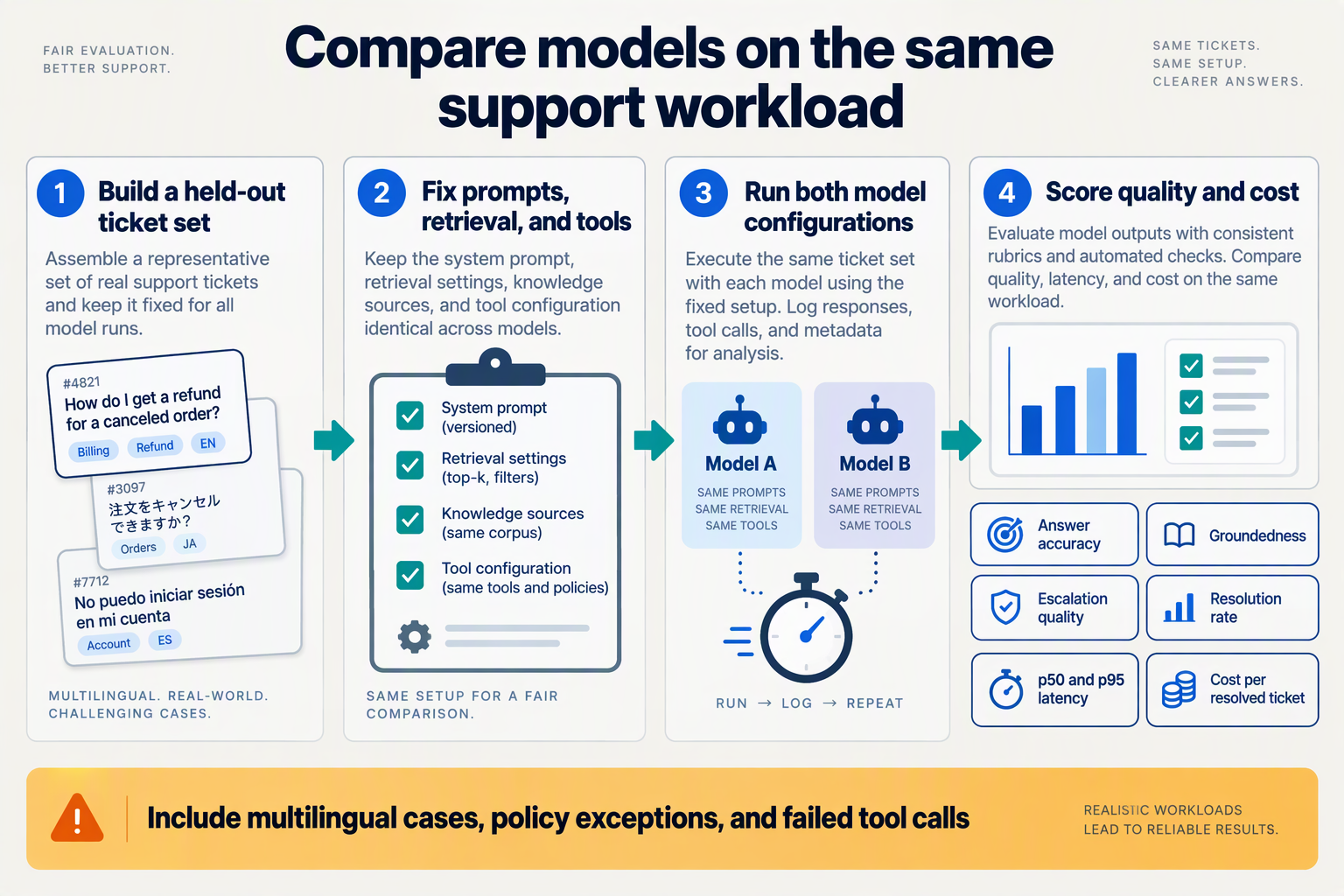
Evaluate a sub-1B small language model against an OpenAI baseline using the same held-out support conversations, approved knowledge, and tool access. Choose the smaller model only where it delivers acceptable resolution quality and safety at a lower fully loaded cost per successful resolution—not merely lower inference cost.
Which OpenAI model should you use as the baseline?
For an October 2026 evaluation, GPT-5.4 mini is a relevant starting point: OpenAI’s March 17, 2026 announcement describes GPT-5.4 mini and nano as “faster, more efficient models designed for high-volume workloads.” That positioning makes them useful comparators, but it does not establish their performance on your support tickets.
Do not confuse product names with parameter counts. The supplied OpenAI announcement does not disclose a sub-1B parameter count; similarly, Mistral AI’s March 16, 2026 documentation lists Mistral Small 4 at 119 billion total parameters, so it is not a sub-1B candidate.
Record the exact candidate checkpoint, quantization, inference runtime, hardware, and baseline model identifier. Freeze these settings before testing so deployment changes do not silently invalidate the comparison.
How should you build a fair customer-support test?
Use historical conversations with sensitive information removed, and keep evaluation examples separate from training or prompt-development data.
- Stratify by intent: Include order tracking, product questions, refund eligibility, account access, and ambiguous requests.
- Include difficult cases: Test missing order IDs, contradictory knowledge-base entries, multilingual messages, and malicious instructions embedded in retrieved content.
- Equalize resources: Give both models identical retrieved passages, tool schemas, permissions, and response-length limits.
- Score blindly: Have reviewers assess answers without knowing which model produced them.
Run a controlled comparison first, then test each model’s production-ready configuration. Identical prompts isolate model differences, while separately optimized prompts show what each deployment can realistically achieve.
Which metrics reveal whether the smaller model is good enough?
Define successful resolution before running the experiment: the answer must be factually supported, complete the authorized task, and avoid prohibited actions.
Track:
- Grounded answer accuracy: Are policy statements supported by approved sources?
- Tool-call correctness: Are the right tools called with valid arguments?
- Escalation quality: Does the model request human help when necessary?
- Latency: Measure median and tail latency under realistic concurrency.
- Safety failures: Report unauthorized refunds or data disclosures separately from average quality.
Use paired results and confidence intervals rather than treating a small percentage difference as decisive. Set stricter acceptance criteria for account access and financial actions than for routine informational answers.
How do you calculate savings without hiding escalation costs?
Include compute, API usage, retrieval, retries, monitoring, fallback calls, and human handling.
For an illustrative October 2026 evaluation, suppose the smaller-model workflow costs ₹600 across 1,000 tickets and correctly resolves 800 without human intervention. Its cost per automated resolution is ₹0.75; a baseline costing ₹1,000 and resolving 950 costs approximately ₹1.05. Those figures exclude human handling, which could reverse the result.
As of October 2026, CallMissed’s developer AI API supports structured outputs and usage and request logs—useful capabilities for instrumenting compatible baseline calls.
Finish with a shadow deployment before granting action permissions. Approve the sub-1B model for intents where evidence supports it, rather than replacing the baseline across every support request.
When do cheaper models increase retries, escalation, or privacy risk?
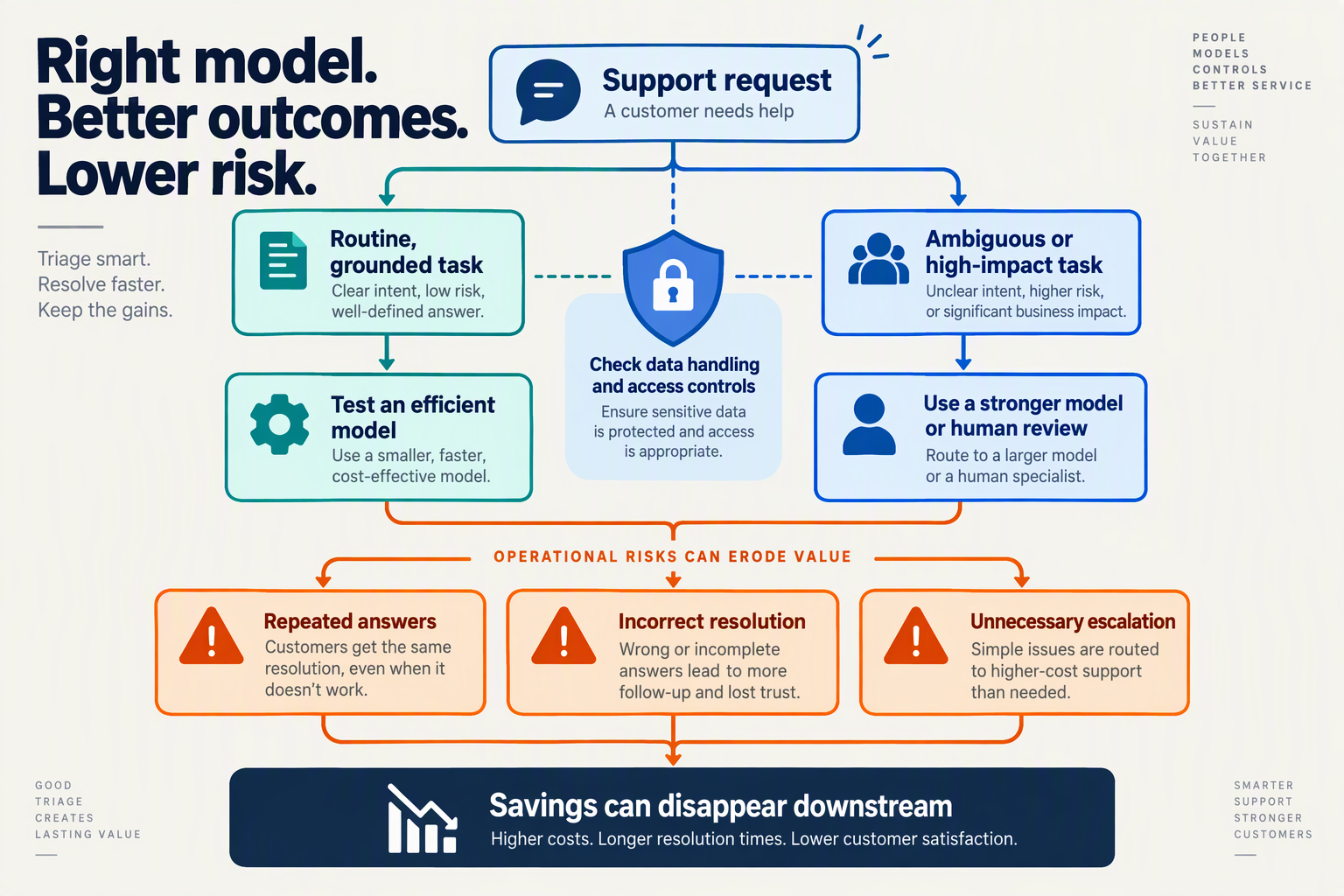
Cheaper models increase retries and escalation when their savings depend on handling tasks they cannot reliably complete. Privacy risk rises when deployment choices expose more customer data—through excessive logging, repeated prompts, or unreviewed fallback providers—not simply because a model is smaller.
When does a lower-cost model create more support work?
The warning sign is repeated failure on the same unresolved issue. A model may answer routine delivery questions correctly yet struggle when an order is split across shipments, a refund policy has exceptions, or customer identity requires verification.
Watch for these patterns:
- Repeated clarification: The customer supplies the same information multiple times without progress.
- Failed tool calls: The model repeatedly submits invalid arguments or misinterprets an order-management response.
- Unsupported certainty: The model invents a refund entitlement instead of checking the applicable policy.
- Delayed handoff: The conversation continues after a clear escalation trigger, leaving a human to repair both the issue and the customer’s frustration.
OpenAI’s March 17, 2026 announcement describes GPT-5.4 mini and nano as optimized for “coding and subagents.” That positioning does not establish their reliability on your support policies, regional language mix, or account-security workflows. Those require task-specific evaluation.
How much escalation can erase model savings?
Very little, if human handling costs substantially more than inference. Use a break-even calculation rather than assuming that lower token prices translate into lower operating costs.
Consider this illustrative October 2026 planning scenario, not a vendor benchmark:
- A cheaper model costs $0.02 per conversation, versus $0.06 for an alternative.
- Across 1,000 conversations, the cheaper model saves $40 in model charges.
- If each additional human escalation costs $4, just 10 additional escalations erase those savings.
That is a one-percentage-point increase in escalation across 1,000 conversations, before counting retries or customer recontacts.
Also distinguish “cheaper than a flagship” from “cheaper than the previous small model.” A March 2026 pricing comparison on the OpenAI Developer Community listed GPT-5.4 mini input pricing at $0.75 per million tokens, versus $0.25 for GPT-5 mini—a 200% increase. Treat those figures as a dated comparison, not verified October 2026 pricing.
When can fallback routing increase privacy exposure?
Fallback can improve resolution while widening the data path. If a conversation moves between providers, each destination needs review for retention, processing location, access controls, and contractual terms.
A hardware-efficient model running locally is not automatically private: transcripts, retrieval stores, monitoring systems, and backups can still expose sensitive information.
Before routing customer conversations:
- Minimize payloads: Send only the fields necessary for the task; exclude passwords and payment credentials.
- Review every destination: Include fallback providers, logging services, and connected tools.
- Enforce authorization outside the model: Account changes and refunds should depend on verified permissions, not persuasive conversation.
What should trigger a stronger model or human handoff?
Set escalation rules around observable failures and business risk—not the model’s self-reported confidence. As an illustrative starting rule, one failed tool attempt can trigger validation; a repeated failure can trigger a stronger model or human review.
As of October 2026, CallMissed’s developer AI API supports caller-chosen fallback models and usage and request logs. These capabilities support routing and investigation, but teams still need explicit data-handling policies.
The goal is bounded automation: economical resolution for routine issues, with an early exit when uncertainty, permissions, or sensitive data make continued automation costly.
What should support leaders ask inference engineers and QA experts before trusting efficiency claims?

Support leaders should ask inference engineers for a reproducible deployment benchmark and QA experts for evidence that savings preserve support quality. Before trusting an efficiency claim, require agreement on the workload, measurement boundaries, failure criteria, and conditions that trigger rollback.
What exactly does “more efficient” mean in this test?
Ask engineers to turn the claim into a measurable comparison—not simply “this model is smaller” or “this endpoint is cheaper.”
OpenAI’s March 17, 2026 announcement describes GPT-5.4 mini and nano as “optimized for coding and subagents.” That positioning is relevant, but it does not establish performance on refund policies, identity checks, or multilingual support conversations.
Request a benchmark record covering:
- Deployment configuration: Exact model version, hardware or API service tier, quantization settings where applicable, and inference software.
- Workload: Conversation lengths, simultaneous requests, tool usage, and the proportion of cached versus uncached inputs.
- Measurement boundaries: Whether reported speed includes queueing, retrieval, tool execution, and completed answers—not just token generation.
- Baseline: The existing system tested against the same cases and acceptance rules.
Ask specifically: “Which variables changed besides the model?” A shorter prompt or warmer cache can improve results without demonstrating a more efficient model.
Does the benchmark reflect our hardest customer interactions?
QA experts should test the cases that create business risk, not only the questions automation already handles comfortably.
Mistral AI’s documentation dated March 16, 2026 lists a 256,000-token context window for Mistral Small 4. Context capacity does not, by itself, demonstrate reliable retrieval of a policy exception buried in a lengthy conversation.
Require a representative evaluation set containing:
- Conflicting information: An outdated help article contradicts the current refund policy.
- Missing evidence: An order lookup fails, and the correct action is to acknowledge uncertainty.
- Authorization boundaries: A customer requests an account change without completing verification.
- Language variation: Customers switch languages, abbreviate, or describe the same issue indirectly.
- Adversarial instructions: A message or retrieved document asks the assistant to ignore business rules.
Have reviewers label correctness, policy compliance, escalation appropriateness, and unsupported claims separately. A single average score can hide a serious failure in one category.
How certain are the results, and who reviews disagreements?
Ask QA: “How many examples support each conclusion, and what remains untested?” Require sample counts, confidence intervals where appropriate, and a breakdown by issue type rather than an unexplained pass percentage.
Reviewers should use a written rubric and adjudicate disputed judgments. Keep tuning examples separate from the final evaluation set; otherwise, prompt improvements can appear more generalizable than they really are.
As of October 2026, CallMissed provides voice-agent evaluation suites, A/B experiments, and call scoring against teams’ own QA rubrics. These capabilities can support structured evaluation, but teams still need representative cases and defensible acceptance thresholds.
What happens when production conditions change?
Before approval, ask engineers and QA experts to document:
- Release gates: Which failures block deployment regardless of average savings?
- Change controls: What must be retested after model, prompt, retrieval, or routing changes?
- Rollback ownership: Who can restore the previous configuration, and on what evidence?
- Production checks: How will teams detect repeat contacts, inappropriate escalations, and policy violations?
The decision should rest on an auditable test record, not a launch-day efficiency headline.
How can you pilot lower-cost support with CallMissed and clear quality gates?
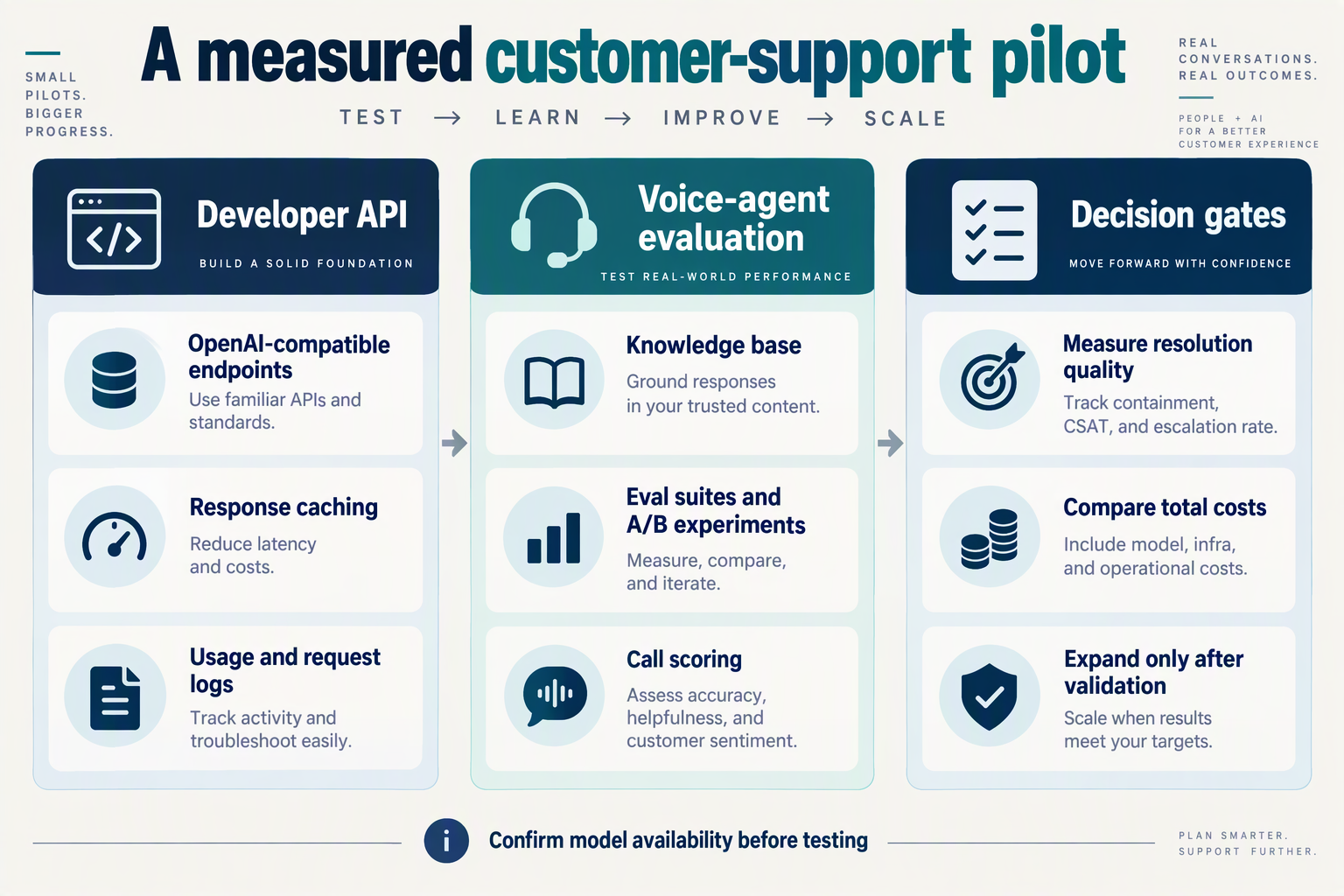
Pilot lower-cost support by restricting the first deployment to low-risk requests, comparing it against your existing workflow, and expanding only when quality and cost gates pass together. As of October 2026, CallMissed’s developer AI API supports structured outputs, function calling, and usage and request logs—useful building blocks for an instrumented trial, not guarantees of accurate resolution.
What should your lower-cost support pilot test?
Start with order-status questions and answers grounded in approved FAQs. Exclude disputed refunds, identity changes, and other actions where an incorrect response could create financial or privacy harm.
OpenAI’s March 17, 2026 announcement describes GPT-5.4 mini and nano as “faster, more efficient models designed for high-volume workloads.” Treat that positioning as a reason to evaluate efficient models—not evidence that any particular model will meet your support requirements. Check model availability and current endpoint pricing before choosing candidates.
For a fair comparison, give the baseline and candidate the same knowledge sources, tool permissions, and test cases. Include ambiguous requests, outdated documentation, unavailable order records, and customers who change their question halfway through.
Which quality gates should control rollout?
The following October 2026 pilot design uses illustrative targets, not published benchmarks or CallMissed performance claims. Set final thresholds against your existing service levels and risk tolerance.
| Pilot step | What to measure | Example gate | If the gate fails |
|---|---|---|---|
| Define scope | Eligible intents and prohibited actions | Only approved FAQ and order-status requests | Narrow routing rules |
| Build test set | Coverage across routine and difficult cases | 200 reviewed cases, including tool failures | Add missing scenarios |
| Check accuracy | Correct, source-supported answers | At least 95%; no invented order details | Fix retrieval or change model |
| Test escalation | Handling of sensitive or unsupported requests | 100% escalation on defined critical cases | Block live expansion |
| Measure speed | End-to-end response time | Candidate p95 meets your existing SLA | Investigate tools and retries |
| Validate economics | Total cost per correctly resolved issue | At least 15% below baseline | Rework routing or stop |
A zero-critical-error gate applies to the tested sample; it does not prove production safety. Continue reviewing live failures after launch, especially when knowledge sources or business policies change.
How do you distinguish real savings from cheaper tokens?
Count model charges, retrieval, tool execution, retries, and human handling within the same measurement boundary. Treat reopened cases as unresolved until your agreed follow-up window closes.
For an illustrative October 2026 pilot:
- Baseline: ₹2,000 total cost ÷ 160 correctly resolved issues = ₹12.50 per resolution.
- Candidate: ₹1,700 ÷ 150 correctly resolved issues = ₹11.33 per resolution.
- Result: Spending falls 15%, but cost per correct resolution falls only about 9.3%—below the table’s proposed savings gate.
When should you expand the pilot?
Expand one intent or customer cohort at a time after passing every gate. Keep a rollback owner and a clear route to human support.
As of October 2026, CallMissed’s no-code agent builder includes versioning with publish and rollback, while its agent platform offers eval suites and A/B experiments. Use those capabilities to maintain a tested baseline: hardware-efficient LLMs earn broader deployment through measured support outcomes, not smaller-model branding alone.
Frequently Asked Questions
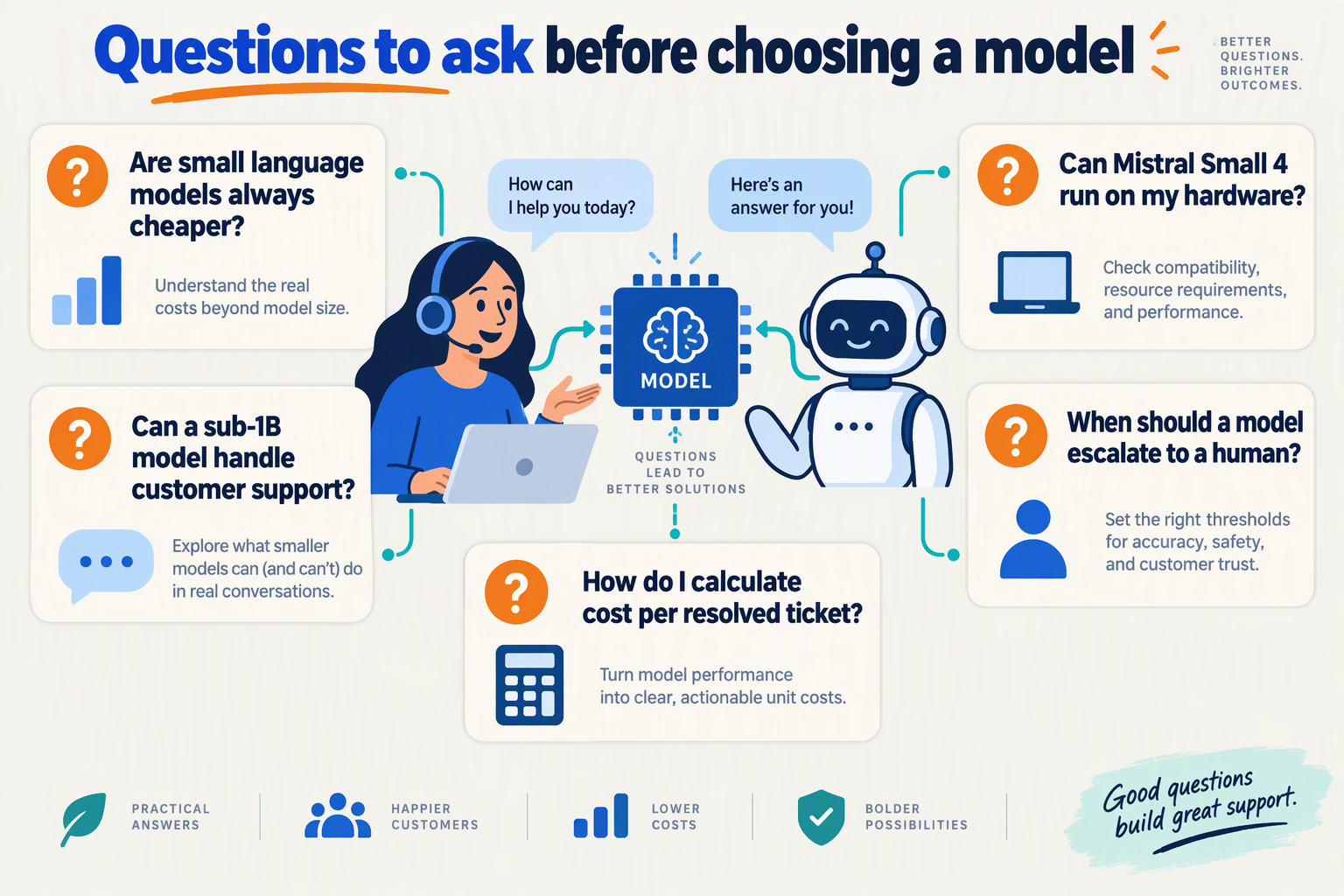
Are hardware-efficient language models for support costs always cheaper than larger models?
What do GPT-5.4 mini, GPT-5.4 nano, and Mistral Small 4 cost?
Can Mistral Small 4 run locally on a customer-support server?
How should teams evaluate hardware-efficient language models for support costs?
When should an AI customer-support agent escalate to a human?
Is self-hosting a small language model cheaper than using an API?
Conclusion
Hardware-efficient language models can lower customer-support costs when teams match computational effort to the issue—not simply choose the smallest model. The goal is dependable resolution at a sustainable cost, with stronger reasoning and human attention reserved for cases that need them.
As of October 2026, releases from OpenAI and Mistral AI reinforce that direction. OpenAI’s March 17, 2026 announcement described GPT-5.4 mini and GPT-5.4 nano as faster, more efficient models designed for “high-volume workloads,” while SiliconANGLE’s coverage that day connected the releases to “cost-sensitive use cases.” For support teams, the practical opportunity is to turn that efficiency into measurable operational savings without weakening service quality.
Four takeaways should guide the next deployment decision:
- Match the model to the request. Routine order-status questions do not necessarily require heavyweight reasoning. Disputed refunds and sensitive account-access problems deserve a different path, whether that means a stronger model or a person. Efficiency depends on knowing where economical automation should stop.
- Measure cost per correctly resolved issue. The article’s illustrative workload—10,000 monthly conversations at 1,500 tokens each—produces 15 million tokens. That is a planning example, not a benchmark. Input, cached input, output, retrieval, tool calls, retries, and escalations all affect whether a seemingly inexpensive model actually saves money.
- Separate compute efficiency from memory requirements. Mistral AI’s documentation dated March 16, 2026 lists 119 billion total parameters and 6.5 billion active parameters for Mistral Small 4. Fewer active parameters can reduce computation per token, but they do not give the full model the memory footprint of a 6.5-billion-parameter model.
- Evaluate quality and speed together. Lower inference costs matter only if answers remain grounded in approved business information and response times stay acceptable under realistic traffic. Test routine requests alongside difficult cases, and include retries and escalation outcomes rather than judging performance from successful demonstrations alone.
What should customer-support teams watch next?
Watch whether future efficiency gains improve real support economics, not just model specifications. As models evolve, the useful comparison will remain consistent: can a deployment resolve the same workload accurately, respond quickly enough, and reduce total operating cost? A cheaper token rate is only one part of that answer.
As of October 2026, CallMissed’s OpenAI-compatible developer AI API provides caller-chosen fallback models, response caching, and usage logs—capabilities readers can explore when evaluating economical model choices without rewriting existing SDK integrations.
Start with one routine support workflow, establish its resolution quality and total cost, then compare alternatives. Where could your team use less computation without asking customers to accept less dependable help?
Related Reading
- Large Language Models: Customer Support's Future in 2026
- Sarvam AI Capabilities: Local-Language Support in 2026
- Tokens Too Cheap to Meter: What AI Support Still Costs
Sources
Discussion
Related Posts



Ready to automate customer conversations?
Launch AI voice agents and WhatsApp bots with CallMissed — one API, 22+ Indian languages.