
Sarvam AI Capabilities: Local-Language Support in 2026



Explore Sarvam AI capabilities for Indian-language support, with a practical workflow, testing framework, and data-residency checklist.
Sarvam AI Capabilities: Local-Language Support in 2026
What happens when a customer asks for a refund in Hindi, switches to English for the order number, and expects an answer without repeating themselves? Sarvam AI capabilities matter because local-language customer support requires more than translation: it requires systems that can handle the way people actually speak, type, and explain problems.
India’s homegrown AI push is making that challenge harder to ignore. According to Swarajya’s February 18, 2026 reporting, updated February 19, Bengaluru-based Sarvam AI unveiled 30-billion-parameter and 105-billion-parameter language models as India accelerated efforts to build a domestic AI stack. VFuture Media places the unveiling at the India AI Impact Summit in New Delhi on February 18, 2026.
Those model sizes are significant, but parameter counts alone do not establish whether an AI assistant can resolve a billing dispute in Marathi or understand a hurried, code-mixed voice message. For customer-support teams evaluating options as of October 2026, the useful question is not simply whether India can build large models. It is whether those models, combined with speech and workflow tools, can make support more accessible without sacrificing accuracy.
What could Sarvam AI change for local-language support?
ExplainX’s 2026 overview describes Sarvam AI as a broader stack spanning chat language models, speech recognition, text-to-speech, translation, and document intelligence, with attention to native scripts and romanized Indian-language text. That distinction matters: a customer typing Hindi in Latin characters creates a different challenge from someone speaking Hindi over a noisy phone connection.
Consider a hypothetical customer asking, “Mera refund kab aayega?” A useful support system must understand the request, retrieve the correct order information, explain the refund status, and escalate when the available evidence is insufficient. Fluent language is only one part of that chain.
As of October 2026, CallMissed’s verified product information lists speech recognition in 22 Indian languages plus English, including code-mixed speech such as Hinglish, alongside knowledge-base tools and CRM capabilities—an example of communication infrastructure supporting this broader shift.
This article will examine:
- Language coverage: what support for Indian languages means across text, speech, and mixed-language interactions.
- Model and API choices: how Sarvam’s capabilities could fit into customer-support architecture.
- Operational trade-offs: why retrieval accuracy, response speed, human escalation, and total costs deserve separate evaluation.
The opportunity is not an automatic replacement for support teams. It is a more practical possibility: customer service that meets people in their preferred language while keeping business actions grounded in verified information.
How could homegrown AI improve local-language support—and what still needs testing?
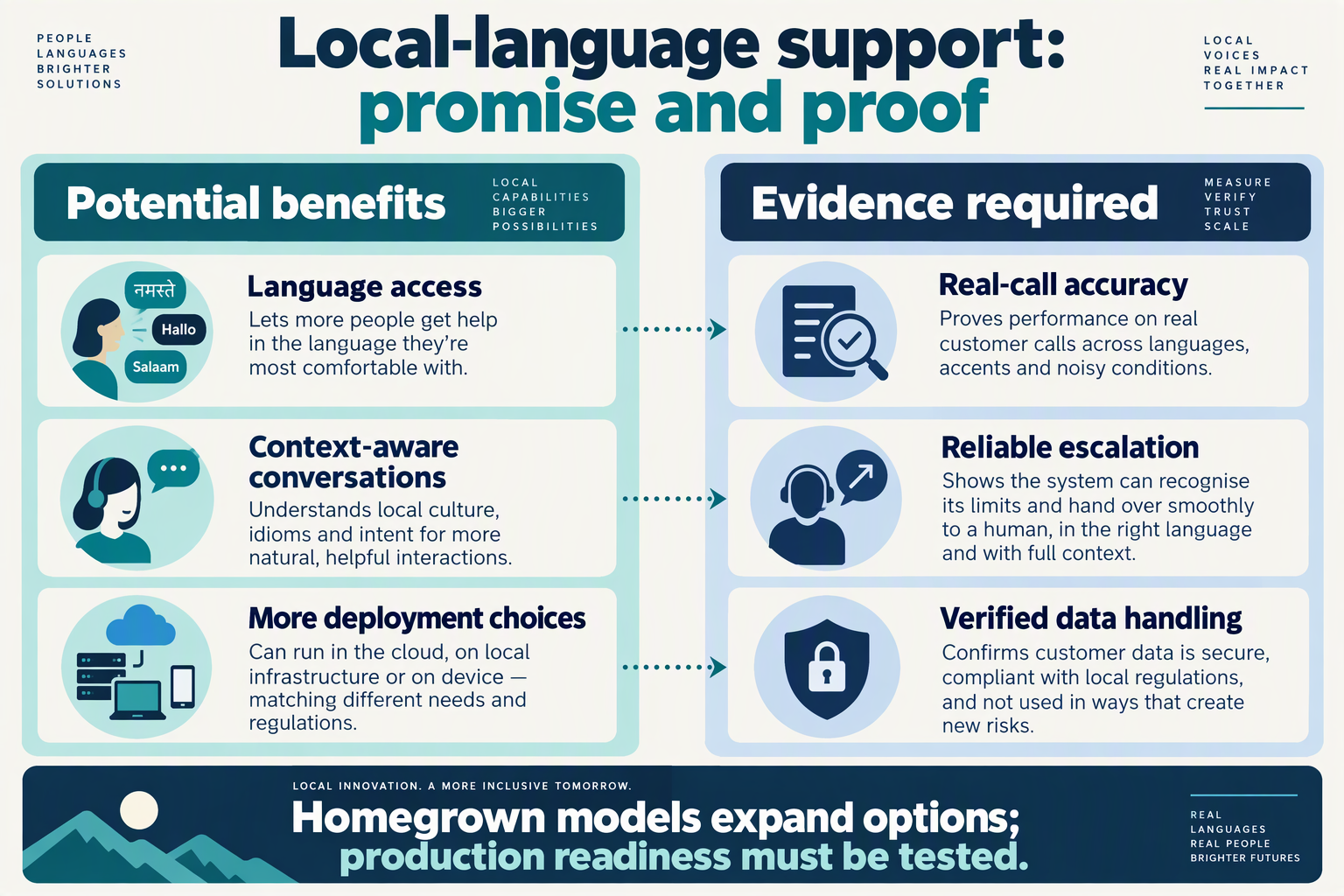
Homegrown AI could improve local-language customer support by interpreting regional phrasing, preserving meaning across language switches, and producing clearer replies. What still needs testing is end-to-end reliability: whether the system understands the customer, retrieves the right evidence, and completes—or safely escalates—the request.
How could Indian-language AI make support more useful?
ExplainX’s 2026 overview describes Sarvam AI’s capabilities as spanning language models, speech recognition, text-to-speech, translation, and document intelligence. As of October 2026, that breadth suggests an opportunity to connect customer conversations with the documents and workflows needed to resolve them—not merely translate an English chatbot.
Three potential improvements deserve attention:
- Better intent recognition: Regional expressions for a failed payment, damaged delivery, or account lockout could map to the correct support process.
- Less information lost between channels: A system could carry the meaning of a spoken complaint into a written case summary, subject to transcription and summarization checks.
- More understandable explanations: Policy language could become a concise answer in the customer’s preferred language, without changing eligibility rules or promised timelines.
These are potential benefits, not established performance results. The provided reporting does not include customer-support resolution benchmarks, language-by-language error rates, or measured improvements in customer satisfaction.
What should teams test beyond language fluency?
A polished answer can still be operationally wrong. Consider a hypothetical Tamil-speaking customer reporting a duplicate payment while reading an English transaction reference aloud: the assistant must preserve the identifier, distinguish a pending authorization from a settled charge, and avoid promising an unsupported refund.
A practical evaluation should separate four questions:
- Did the system capture the facts? Check transaction references, amounts, dates, names, negation, and corrections. One misheard digit can make an otherwise fluent conversation unusable.
- Did the system retrieve the right evidence? Test whether answers reflect the current policy and the customer’s actual record rather than a plausible general explanation.
- Did the system take the right action? Confirm that tool calls use the correct account and require appropriate authorization before changing records.
- Did the system know when to stop? Include ambiguous requests, unavailable records, and disputed charges that should trigger clarification or human handoff.
Build separate test groups for native-script text, romanized text, code-mixed speech, background noise, and regional accents. An overall average can conceal a weak language or channel, so report results by segment rather than only across the entire pilot.
How can businesses judge whether a pilot is working?
For an October 2026 evaluation, compare the proposed system against the existing support workflow using equivalent cases. Measure correct resolution, unsupported policy claims, successful handoffs, response time, and cost per resolved issue—not just cost per model request.
As of October 2026, CallMissed’s verified product information includes evaluation suites, A/B experiments, and call scoring against a business’s own QA rubrics. Those capabilities illustrate how communication infrastructure can support testing; they do not establish that a particular Sarvam model will perform better.
The strongest case for homegrown AI will therefore come from repeatable, language-specific evidence. A model that handles routine questions accurately but escalates sensitive cases responsibly may be more useful than one that sounds confident across every conversation.
Why does India's homegrown AI push matter beyond model announcements?
India’s homegrown AI push matters because it could give businesses more control over language priorities, technology choices, and customer-data handling—not just another model to test. For local-language customer support, the meaningful change is whether Indian requirements shape the infrastructure from the start rather than becoming adaptations added later.
What does a domestic AI ecosystem change for businesses?
The significance of Sarvam AI extends beyond its own products. Swarajya’s February 18, 2026 report, updated February 19, situated the company’s announcements within India’s drive to build a homegrown AI stack. As of October 2026, the practical question is how that ecosystem expands the choices available to businesses.
A support team should be able to choose components around its customers’ needs: regional-language understanding, document processing, deployment requirements, and integration with existing systems. A domestic supplier ecosystem could make those requirements more influential in product development, although Indian ownership alone does not establish better performance.
Consider a hypothetical appliance company serving customers in Gujarat. Its assistant might need to interpret a Gujarati complaint, consult an English warranty document, and explain which repair conditions apply. The business needs the whole interaction to work—not merely a convincing answer in Gujarati.
ExplainX’s 2026 overview includes document intelligence within Sarvam AI’s capabilities. That matters because support knowledge often lives in warranty PDFs, policy documents, and product manuals rather than neatly structured chatbot answers.
Does “made in India” mean customer data stays in India?
No: model origin, hosting location, and data governance are separate questions. A homegrown model does not, by itself, prove that recordings, prompts, backups, or monitoring logs remain within India.
As of October 2026, businesses assessing domestic AI should investigate:
- Data paths: where audio, transcripts, retrieved documents, and model requests travel.
- Retention: how long each provider stores customer information and diagnostic logs.
- Access: which staff, subprocessors, and external services can view sensitive information.
- Portability: whether the business can change providers without rebuilding its support workflow.
CallMissed illustrates how these considerations can coexist with developer choice. According to CallMissed’s verified product information, as of October 2026, the platform is hosted in India and its developer API catalogue includes Sarvam alongside providers such as OpenAI and Google. Its OpenAI-compatible endpoints support existing SDKs through a base-URL change; however, platform hosting alone should not be treated as evidence that every downstream model request stays in India.
How should support teams measure the value of homegrown AI?
Treat domestic AI as an opportunity to improve operational outcomes, not as a procurement shortcut. A useful pilot should test the support journey rather than reward fluent wording alone.
- Build a representative test set. Include regional scripts, romanized messages, local product names, and incomplete customer explanations.
- Check policy-grounded resolution. Verify whether answers match the correct document and whether proposed actions are authorized.
- Measure total effort. Track repeat contacts, human corrections, escalation quality, and cost per successfully resolved issue—not just model usage charges.
The wider opportunity is a stronger feedback loop between Indian businesses and AI builders. If support teams document where systems misunderstand customers or mishandle policies, those findings can guide better products. That is a more consequential form of progress than a launch announcement: infrastructure shaped by the problems customers actually need solved.
What was reported about Sarvam models in 2026, and what needs verification?
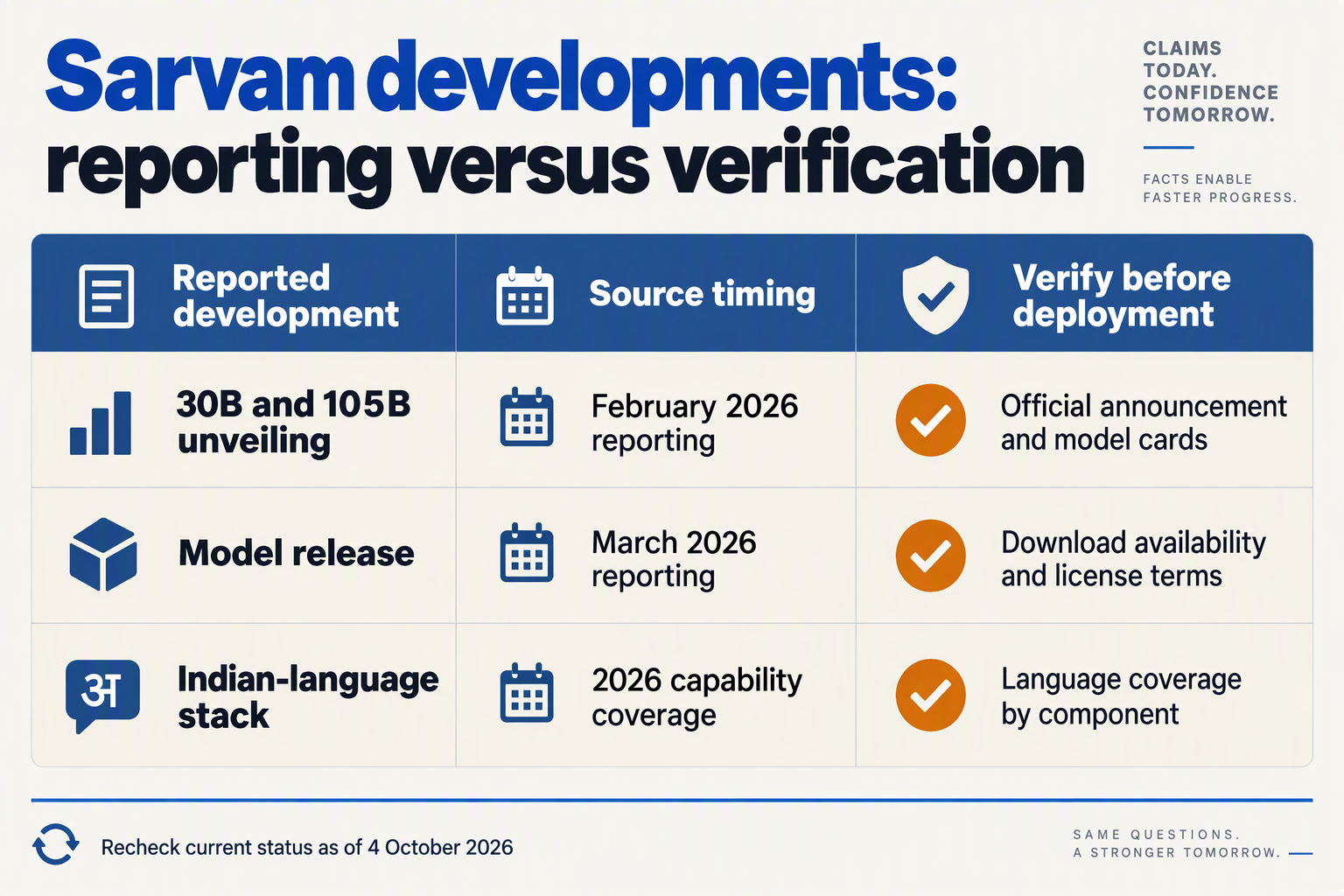
Reporting in 2026 described Sarvam-30B and Sarvam-105B as major additions to India’s homegrown AI stack, but the supplied coverage does not establish their production readiness for customer support. As of October 2026, teams should distinguish reported announcements from verified model access, licensing, language performance, and deployment costs.
What did sources report about Sarvam’s 2026 models?
Swarajya reported the unveiling of 30-billion-parameter and 105-billion-parameter language models on February 18, 2026, with its article updated February 19. VFuture Media places the unveiling at the India AI Impact Summit in New Delhi on February 18, 2026. These accounts support the announcement timeline—not every technical claim attached to subsequent coverage.
The following evidence check reflects the supplied reporting as of October 2026:
| Topic | Reported information | Named source | What needs verification |
|---|---|---|---|
| Model sizes | 30B and 105B parameters | Swarajya, February 18–19, 2026 | Official model cards, architecture, and exact model identifiers |
| Unveiling | February 18, 2026, at the India AI Impact Summit | VFuture Media | Distinguish announcement from downloadable or API availability |
| Open-source status | Both models described as open-source | AgilizTech; StartupFeed | License text, available weights, and commercial-use conditions |
| Language coverage | Support for 22 Indian languages claimed | StartupFeed | Coverage and measured quality for each model, language, and task |
| Inference cost | 105B described as cheaper than Google Gemini Flash | StartupFeed | Exact Gemini version, pricing date, token assumptions, and hosting conditions |
| Wider product stack | Chat, speech recognition, text-to-speech, translation, and document intelligence | ExplainX’s 2026 overview | Which capabilities belong to separate products rather than the two LLMs |
“Open-source” is a reported description here, not a verified licensing conclusion. Access to model weights, permission to modify them, and permission to deploy them commercially are separate questions. A support team should inspect the actual license before making a deployment decision.
Which performance claims should support teams test themselves?
The supplied Udit excerpt argues that Sarvam-105B narrows the gap on English tasks while retaining an Indic-language advantage. However, the excerpt supplies no benchmark scores, evaluation dataset, or reproducible testing method; it cannot establish superiority for a particular support workflow.
Likewise, StartupFeed’s phrase “India’s ChatGPT Killer” is headline framing, not evidence of better resolution rates or safer business actions.
For a practical evaluation, request:
- Language-level results: Test native-script, romanized, and code-mixed requests separately rather than accepting one multilingual average.
- Grounded-answer accuracy: Check whether answers match policy documents and retrieved order records, including when information is missing.
- Operational measurements: Measure response time, successful tool use, escalation quality, and cost per resolved interaction under the same workload.
A useful test case is a refund request where the customer gives an ambiguous order number. The model should ask for clarification—not invent a matching order or promise an unsupported refund date.
How should teams interpret API availability?
Availability through an API does not, by itself, verify a model’s license, hosting location, or suitability for sensitive support data. Teams need the exact model identifier, current documentation, and applicable data-handling terms.
As of October 2026, CallMissed’s verified fact sheet lists Sarvam among providers in its developer API catalogue and offers OpenAI-compatible endpoints. That is relevant to integration planning, but it does not establish that Sarvam-30B or Sarvam-105B is available there; catalogue-level inclusion and exact-model access should be checked separately.
How does an Indian language stack handle a support request end to end?
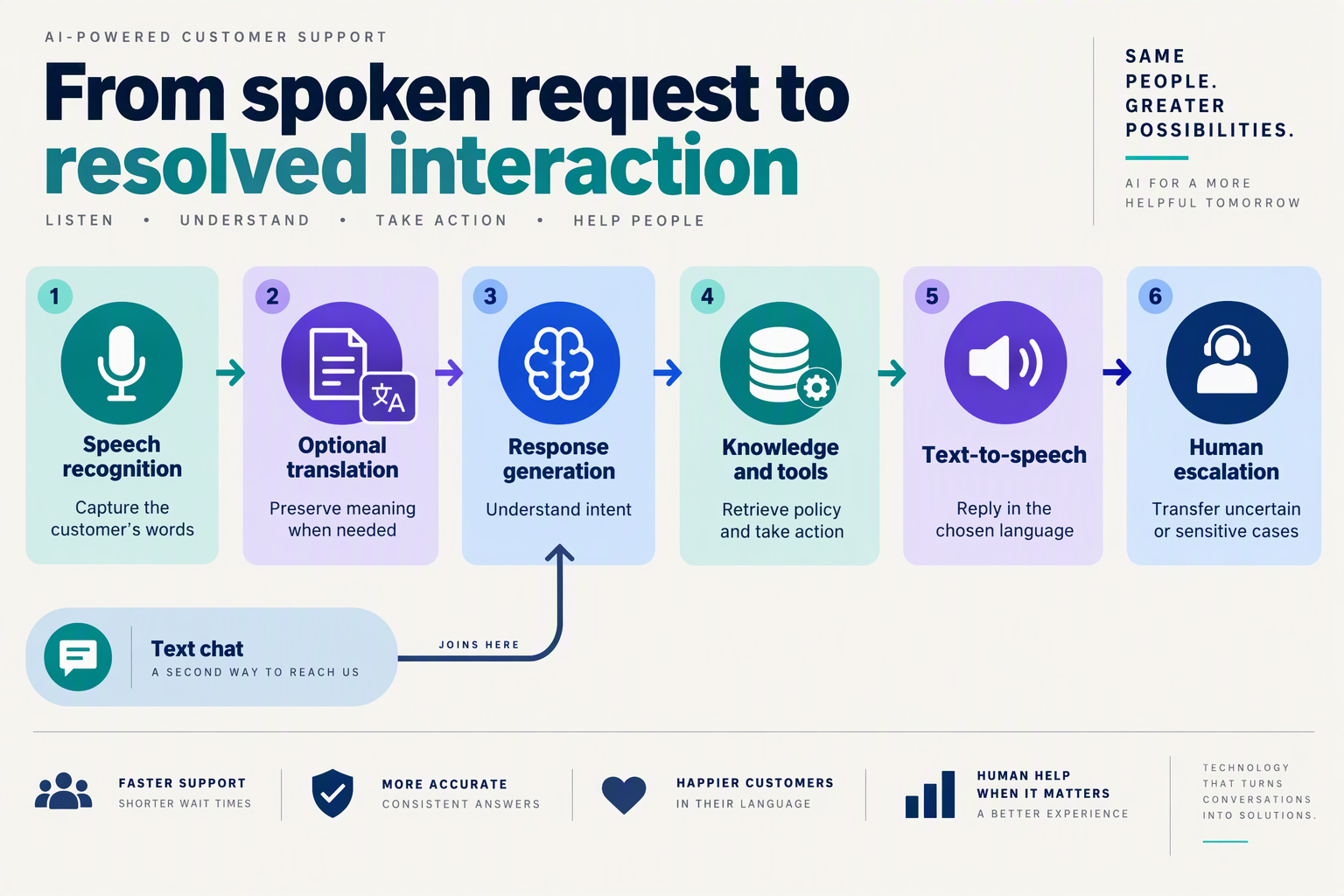
An Indian-language support stack handles a request by turning speech or text into a structured problem, checking business records, and delivering a grounded answer in the customer’s language. The language model interprets the conversation; the surrounding workflow verifies facts, controls actions, and routes exceptions to a human.
What happens between a customer’s message and an answer?
Consider a hypothetical customer calling an online retailer: “Order seven-eight-four ka refund abhi tak nahi aaya.” The customer mixes Hindi with English digits, and the system must distinguish a delayed refund from a request to initiate one.
The following is a proposed support architecture, not a claim that any single Sarvam AI model performs every step automatically:
- Capture and transcribe the request. For a phone call, speech recognition converts audio into text. For WhatsApp text, the system starts with the message directly. Preserve the original input alongside the transcript so an uncertain order number can be checked rather than silently “corrected.”
- Extract intent and essential details. The language model identifies “check refund status” and a possible order reference. If the transcript could mean either 784 or 748, the assistant should ask for confirmation before retrieving account information.
- Verify identity and retrieve evidence. An authenticated order lookup establishes which transaction belongs to the customer. Retrieval-augmented generation (RAG) supplies the relevant refund policy, while a business-system API supplies the actual refund status. These sources answer different questions: what should happen and what has happened.
- Apply policy and action controls. A status enquiry may require only a read operation. Initiating a refund requires separate authorization, eligibility checks, and safeguards against duplicate submissions. Fluent Hindi is not permission to move money.
- Respond and record the outcome. The assistant explains the verified status in Hindi or the customer’s preferred mixed-language style, then records the issue and next step. Voice delivery adds text-to-speech; text support does not need that layer.
Where do Sarvam AI capabilities fit into this workflow?
ExplainX’s 2026 overview, considered here as of October 2026, describes Sarvam AI’s stack as spanning chat language models, speech recognition, text-to-speech, translation, and document intelligence. In this workflow, those components could support understanding the request, reading policy material, and delivering a local-language response; the retailer’s systems still provide transaction truth.
The integration layer matters just as much. As of October 2026, CallMissed’s verified product information lists knowledge bases built from text, web pages, and PDFs, custom REST tools, and AI call notes pushed to the CRM. Those capabilities illustrate how communication infrastructure can connect language understanding to business evidence without treating the model itself as an order database.
What should happen when the stack is uncertain?
The correct fallback is clarification or escalation—not a more confident sentence. For this hypothetical refund request, useful checkpoints include:
- Unclear speech: repeat the suspected order digits and ask the customer to confirm.
- Missing evidence: explain that the refund status cannot yet be verified.
- Conflicting records: transfer the case with the transcript and retrieved evidence.
- Restricted action: require the appropriate approval before submitting a refund.
Evaluate the complete journey: was the order identified correctly, was the answer supported by records, and did the customer avoid repeating the problem? That is a more meaningful test of local-language customer support than whether an isolated response sounds natural.
How should you benchmark Hinglish, regional accents, and noisy calls?
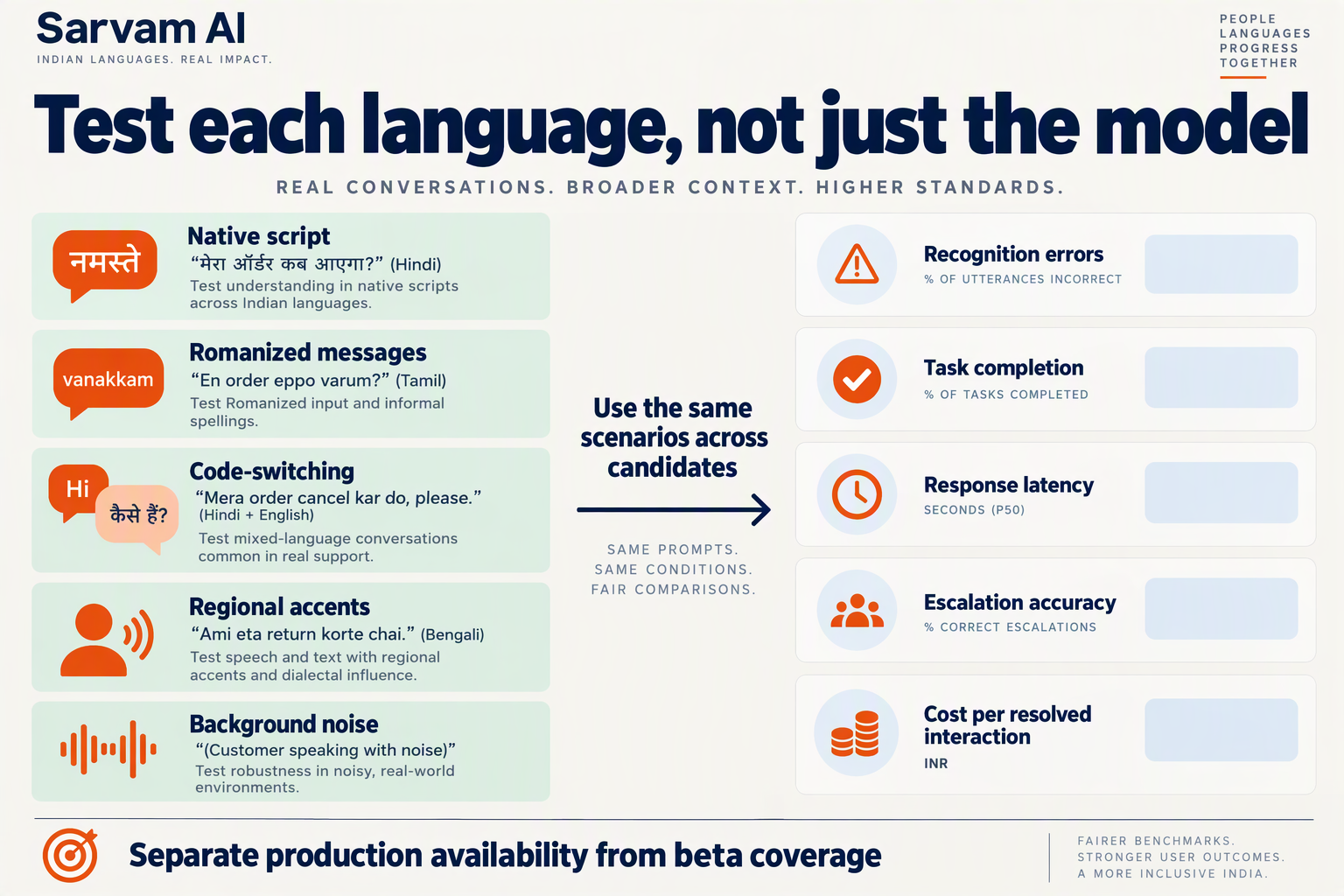
Benchmark Hinglish, regional accents, and noisy calls on representative customer conversations, measuring both transcription accuracy and successful support outcomes. Test speech recognition separately from reasoning, then evaluate the complete call workflow: a correct transcript does not guarantee a correct refund explanation or safe account update.
For an October 2026 evaluation, treat published model announcements as context—not proof of call quality. Swarajya reported on February 18, 2026, updated February 19, that Sarvam AI unveiled 30-billion-parameter and 105-billion-parameter language models; those sizes do not establish speech-recognition performance on your customers’ accents or connections.
What should an Indian-language voice benchmark include?
Build a consented, de-identified test set from the situations your support team actually encounters. Use native-language reviewers to prepare reference transcripts and label the intended request, critical details, and acceptable next action.
Organize the test set along four dimensions:
- Language switching: Hindi sentences containing English product names, English sentences containing regional-language phrases, and switches within a single utterance.
- Regional pronunciation: Multiple speakers and accents within each supported language, rather than one “standard” pronunciation.
- Audio conditions: Quiet rooms, traffic, household noise, speakerphone echo, and degraded telephone audio.
- Support complexity: Order tracking, billing disputes, corrections, interruptions, and requests requiring human escalation.
Keep an untouched holdout set for final comparisons. Split recordings by speaker where possible, so repeated voices do not make results look stronger than they are.
ExplainX’s 2026 overview describes Sarvam AI’s stack as spanning chat models, speech recognition, text-to-speech, translation, and document intelligence. That breadth makes component-level testing important: an error introduced during transcription needs a different remedy from an unsupported answer generated afterward.
Which metrics matter beyond word error rate?
Measure word error rate (WER), but never use it alone. WER counts substitutions, deletions, and insertions relative to a reference transcript; code-mixed speech also requires a consistent policy for spelling, transliteration, and number formatting.
Track these additional measures:
- Critical-entity accuracy: Were order numbers, amounts, dates, names, and negations captured correctly?
- Intent accuracy: Did the system distinguish cancellation, refund status, and refund initiation?
- Grounded task completion: Did the response match verified records and follow the approved workflow?
- Clarification and escalation: Did the assistant ask again or hand off when information was ambiguous?
- Response timing: Report median and tail latency, with the measurement boundaries clearly defined.
For example, consider the hypothetical request: “Order cancel mat karna; bas delivery date batao.” Missing “mat” reverses the customer’s instruction. A low average WER could therefore conceal a serious action error.
How should teams compare models fairly?
Run each candidate on the same recordings, retrieval content, tools, and business rules. Where configurations differ, document those differences rather than attributing every improvement to the language model.
Report results by language, accent, noise condition, and task—not just one overall average. Include sample sizes and uncertainty; small slices should not support sweeping claims.
As of October 2026, CallMissed’s verified product information lists eval suites, A/B experiments, and call scoring against custom QA rubrics, providing tools for this testing approach.
Set acceptance criteria before choosing a model. For high-risk actions, prioritize correct entities, explicit confirmation, and safe escalation over conversational fluency alone.
Does made-in-India AI guarantee sovereign infrastructure or data residency?
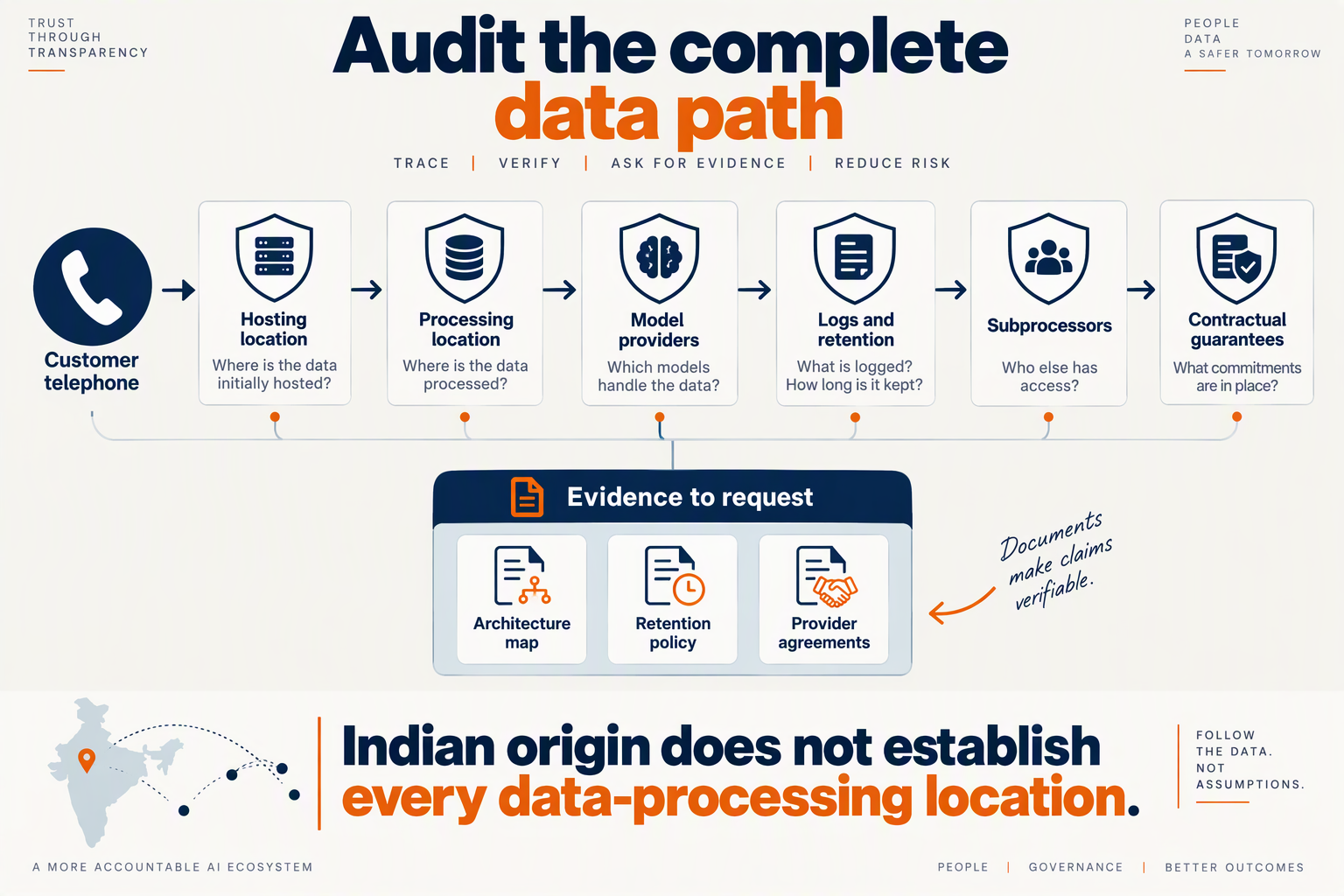
No—made-in-India AI does not automatically guarantee Indian data residency or sovereign infrastructure. As of October 2026, buyers should treat a model’s origin, the location of data processing, and control over the underlying infrastructure as three separate questions.
ExplainX’s 2026 overview describes Sarvam AI as building “India’s sovereign AI stack,” spanning language models, speech recognition, text-to-speech, translation, and document intelligence. That describes an important domestic technology ambition, but it does not establish where every customer-support deployment processes or stores information.
What is the difference between homegrown AI, data residency, and sovereignty?
These terms describe related—but distinct—properties:
- Homegrown AI concerns who develops the technology and where that development originates. An Indian-developed model could still be deployed on infrastructure outside India.
- Data residency concerns where defined categories of information are stored or processed. Buyers need to specify whether the requirement covers recordings, transcripts, prompts, backups, and operational logs.
- Sovereign infrastructure concerns broader control: who operates the systems, who can access them, which jurisdictions apply, and how dependent the service is on external providers.
For procurement in October 2026, the practical question is therefore not simply, “Is this model Indian?” It is, “Can we verify the location and control of every system handling our customer data?”
Domestic model development can expand deployment choices. Residency, however, remains a property of the actual architecture and contractual commitments—not a consequence of branding.
Where can local-language support data leave the intended boundary?
Consider a hypothetical Tamil-speaking customer calling about a disputed payment. The voice agent might use separate services for transcription, language-model reasoning, speech generation, and CRM updates.
Even if the language model runs in India, a recording could pass through an overseas speech service, or a transcript could enter a separately hosted analytics system. A fallback model might also introduce another processing destination.
Map the complete support journey:
- Capture: Where do phone audio, WhatsApp messages, and attachments enter the system?
- Inference: Which providers process speech, prompts, retrieved documents, and generated responses?
- Storage: Where do recordings, transcripts, embeddings, logs, and backups reside?
- Access and deletion: Who can retrieve that information, and what happens when retention periods expire?
This matters because a locally fluent interaction can still expose sensitive information through its surrounding workflow. Language quality and infrastructure governance require separate evaluations.
What evidence should buyers request before deployment?
Ask vendors for a data-flow diagram, processing-location commitments, a subprocessor list, retention settings, and an explanation of how failover changes routing. Distinguish contractual guarantees from configurable options and marketing descriptions.
As of October 2026, CallMissed’s verified product information states that the AI customer-communication platform is hosted in India. That is a concrete hosting fact, but buyers should still verify the processing locations of any selected model providers, carrier connections, and external integrations before asserting end-to-end residency.
For sensitive workflows, reduce unnecessary exposure: retrieve only relevant account details, redact identifiers where feasible, and avoid retaining recordings longer than operational needs justify. Residency also does not, by itself, establish legal compliance; sector-specific obligations need separate review.
India’s homegrown AI push creates more opportunities for local control. Whether a particular support deployment achieves that control depends on its entire data path, not just the nationality of its model developer.
What could better local-language support mean for customers and business economics?
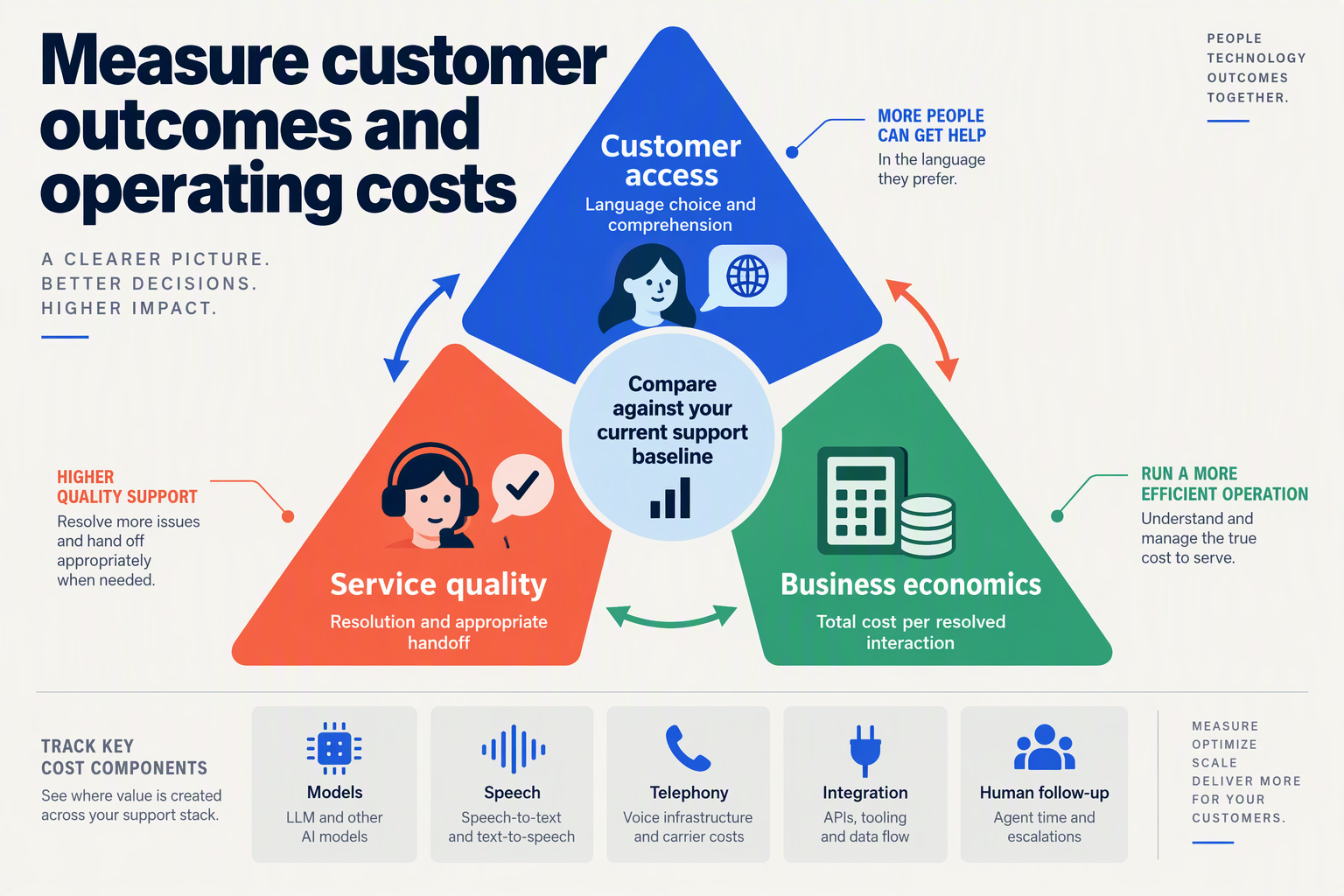
Better local-language support could reduce the effort customers spend explaining problems and lower businesses’ cost per successfully resolved issue. As of October 2026, however, the supplied reporting establishes momentum behind India’s AI stack—not measured improvements in customer satisfaction, retention, or support costs.
How could local-language AI make support easier for customers?
The most meaningful benefit is less work for the customer: fewer repeated explanations, clearer instructions, and less uncertainty about what happens next. A fluent answer matters only if the customer can use it to complete the task.
Consider a hypothetical warranty claim. A customer understands conversational Tamil but struggles with an English repair-policy document. An assistant that explains the required proof of purchase, checks the applicable policy, and confirms the next step could make that process easier—without changing the underlying warranty rules.
ExplainX’s 2026 overview describes Sarvam AI as a “full product layer” spanning chat language models, speech recognition, text-to-speech, translation, and document intelligence. For businesses evaluating Sarvam AI capabilities as of October 2026, that breadth suggests an opportunity to connect customer conversations with supporting documents; it does not establish that every workflow will perform reliably.
Customer benefits should therefore be tested through outcomes:
- Comprehension: Can customers correctly explain the next step?
- Effort: Must customers repeat information or switch languages?
- Resolution: Does the promised action actually happen?
- Trust: Are charges, deadlines, and escalation options clearly explained?
Does cheaper AI mean cheaper customer support?
Not necessarily. Per-minute or per-token pricing measures an input; cost per resolution measures the business outcome. A low-cost conversation becomes expensive if an incorrect answer triggers another call, a complaint, or manual repair.
As of October 2026, CallMissed’s verified pricing lists its Standard voice-agent plan at ₹4 per minute, covering speech recognition, the language model, and voice, with phone carriage billed separately. In a hypothetical workload of 1,000 connected calls averaging three minutes each, that listed rate produces ₹12,000 in voice-agent charges, before carriage and other operating costs.
That calculation is a budgeting example—not a savings benchmark. Businesses must also account for human escalations, integration work, quality reviews, and repeat contacts.
A useful economic measure is:
Cost per resolved issue = total relevant support costs ÷ issues successfully resolved.
Define “resolved” before the pilot. For a refund enquiry, giving an answer is not equivalent to confirming the correct refund status and leaving the customer with an accurate expectation.
How should businesses test whether the economics improve?
Run a language-by-language pilot rather than assuming one overall average represents every customer. A strong result in Hindi could conceal poor performance for another language or for customers using noisy voice connections.
- Set a baseline. Measure existing resolution rates, repeat contacts, handling time, and customer satisfaction for comparable issues.
- Compare equivalent cases. Separate straightforward order-status requests from disputed payments or policy exceptions.
- Count downstream work. Include corrections, escalations, and repeat calls—not just the initial AI interaction.
- Check accessibility alongside cost. A shorter conversation is not a success if the customer leaves confused.
The economic opportunity is broader than reducing staffing expenditure: local-language AI could help businesses serve customers who previously found support difficult to navigate. But increased retention or sales should remain hypotheses to measure, not benefits inferred from model size or language coverage alone.
What should language researchers, support leaders, and privacy experts be asked?

Ask language researchers for evidence of who the system understands, support leaders for proof of which problems it resolves, and privacy experts for a map of where customer data travels. As of October 2026, these questions offer a more useful test of India’s homegrown AI push than launch headlines or fluent demonstrations.
What should language researchers be asked about Indian-language AI?
Start with: “What does your evaluation miss?” A language label can conceal substantial differences in dialect, script, vocabulary, and recording conditions.
ExplainX’s 2026 overview describes Sarvam AI’s focus on both native scripts and romanized Indian-language text. That makes a practical research question especially important: does the same customer request produce equally reliable results when spoken, typed in its native script, or written in Latin characters?
Ask researchers:
- Which speakers are represented? Request evaluation-set composition by language, region, dialect, and relevant recording conditions—not just an aggregate accuracy score.
- How are code-switching and critical details tested? A transcript can capture most words while getting an account number, payment amount, or negation wrong.
- Who judges whether responses are appropriate? Native-speaking reviewers should assess meaning, politeness, and whether an answer preserves the customer’s intent.
- Where does performance deteriorate? Ask for failures involving background noise, unfamiliar product names, and less-represented speech patterns.
The useful output is a language-by-task evidence sheet, with test dates and limitations. “Supports Hindi” is less actionable than evidence showing whether the system reliably distinguishes a cancellation request from a complaint about an already-cancelled order.
What should support leaders be asked about business outcomes?
Ask: “Would you count this interaction as successful if the customer called again tomorrow?” That separates apparent automation from durable resolution.
Support leaders should explain:
- How is resolution verified? Distinguish completed business actions from conversations that merely ended without escalation.
- What requires human approval? Identify boundaries for refunds, identity disputes, account changes, and exceptions to policy.
- Does escalation preserve context? Check whether the human receives the customer’s language preference, verified information, and unresolved question.
- What is the cost per resolved case? Include retries, transfers, quality review, and downstream corrections—not just model usage.
As of October 2026, CallMissed’s verified product information lists call scoring against a business’s own QA rubrics, evaluation suites, and A/B experiments. These capabilities can support structured testing; they do not, by themselves, establish better customer outcomes.
For a pilot, ask leaders to:
- Define success for one narrow workflow.
- Compare AI-assisted and existing support using comparable cases.
- Review repeat contacts and errors separately for each tested language.
What should privacy experts be asked about customer data?
Ask: “Can you trace one customer interaction through every processor, storage location, and deletion step?” A domestic model or hosting location alone does not answer that question.
Request a data-flow review covering:
- Collection: What enters recordings, transcripts, prompts, and retrieved documents?
- Access: Which staff, vendors, and subprocessors can view sensitive information?
- Retention: How long do recordings, logs, backups, and derived notes remain?
- Reuse: Can customer interactions be used for training or other purposes?
- Customer choice: How are notices, permissions, and human-support alternatives explained in the customer’s language?
Privacy experts should distinguish verified controls, contractual commitments, and unresolved questions. The strongest expert commentary will make uncertainty visible—and specify what evidence would justify expanding a pilot.
What should you pilot first, and where can CallMissed fit?
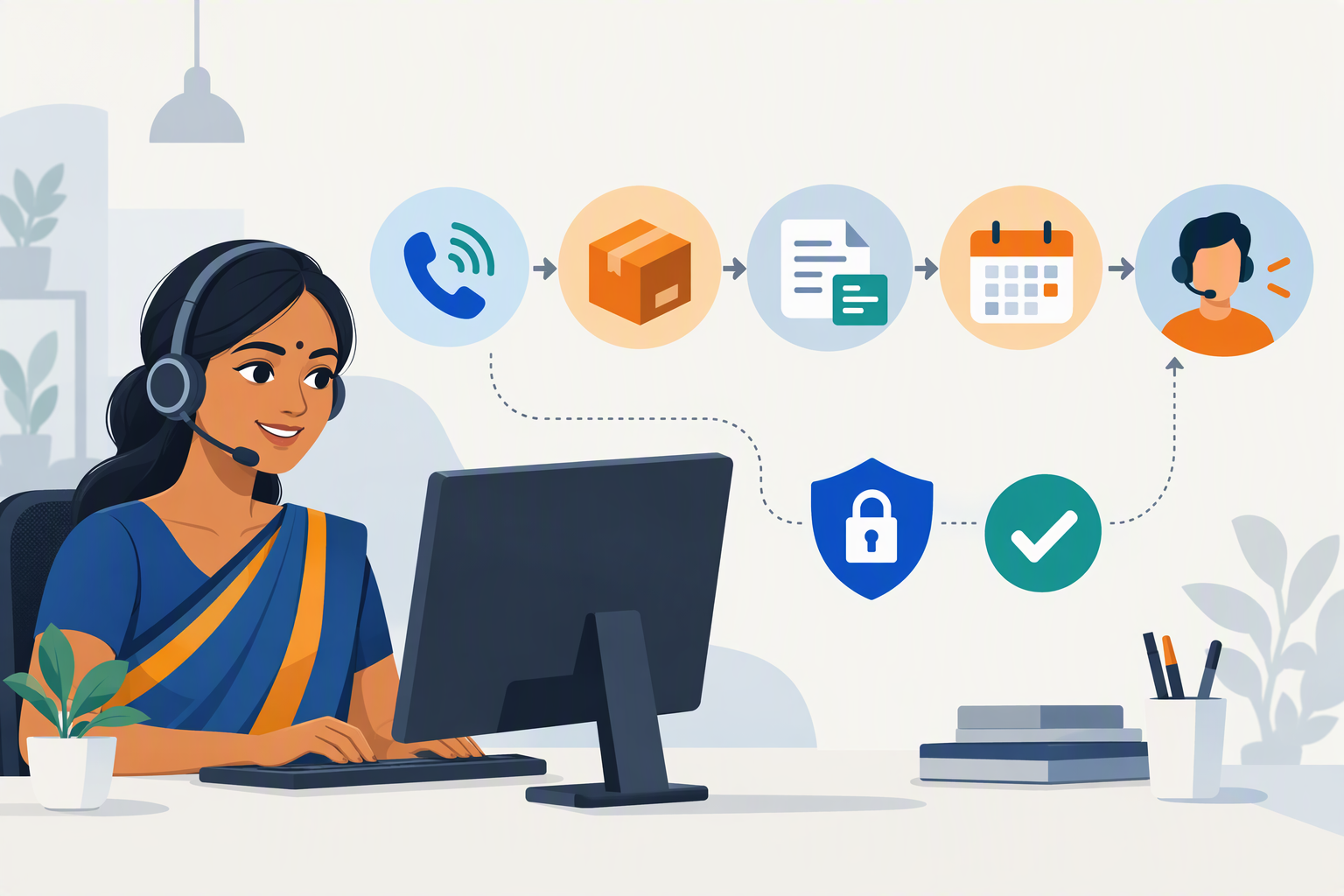
Pilot read-only order-status support in one regional language plus English, then test appointment booking and human escalation before enabling higher-risk actions. CallMissed, the India-built AI customer-communication platform, can provide the knowledge base, communication channels, integrations, and evaluation tools around that pilot, according to its verified product information as of October 2026.
Which local-language support workflows should you test first?
Choose a workflow with frequent demand, reliable source data, and a reversible failure path. Explaining an order’s recorded status is a safer starting point than approving a refund: the first retrieves information; the second changes a customer’s financial outcome.
ExplainX’s 2026 overview describes Sarvam AI capabilities across language models, speech recognition, text-to-speech, translation, and document intelligence. As of October 2026, the practical implication is to evaluate the complete support workflow—not assume that a strong language model guarantees accurate business actions.
The following infrastructure capabilities are listed in CallMissed’s verified product information as of October 2026. The pass conditions are proposed pilot criteria, not reported performance benchmarks.
| Pilot workflow | Keep the scope narrow | CallMissed fit | What to verify |
|---|---|---|---|
| Order-status chat | Read-only lookup; one language plus English | Shopify integration; WhatsApp AI chatbot | Correct order and status; no invented delivery date |
| Policy questions | One approved returns-policy document | Knowledge base from text, web pages, and PDFs | Answers match policy; unknowns trigger escalation |
| Appointment booking | One service and calendar | Cal.com or Google Calendar integration; REST tools | Correct slot, explicit confirmation, no duplicate booking |
| Inbound voice support | One intent on a designated number | Inbound calls; voice agents; recordings and transcripts | Names, numbers, and language switches remain accurate |
| WhatsApp voice enquiries | Customer-initiated calls only | WhatsApp Business Calling answered by an AI voice agent | Accurate response and appropriate escalation |
| Human escalation | One staffed support queue | Shared inbox; human-handoff queue; agent assist | Person receives context without making the customer restart |
How should you decide whether the pilot passes?
Use a suggested two-week pilot with a fixed test set before limited live traffic. Start with 100 representative cases, including romanized text, code-switching, unclear requests, and unavailable order records; these numbers are planning recommendations, not industry benchmarks.
- Create a baseline: have human reviewers score the same cases for correctness, completeness, and policy compliance.
- Separate failure types: distinguish speech-transcription errors, retrieval errors, reasoning errors, and tool-action errors.
- Set release gates: block expansion after any unauthorized action; review unresolved requests and escalation quality before adding another language.
Track these measures separately:
- Task success: did the customer receive the correct answer or complete the intended action?
- Safe uncertainty: did the assistant admit missing information rather than guess?
- Handoff quality: could a human continue with the existing context?
- Cost per resolved request: include retries, carrier charges, and human review—not just model usage.
Where does infrastructure end and model evaluation begin?
As of October 2026, CallMissed’s verified fact sheet lists Sarvam among its developer API catalogue makers, alongside OpenAI-compatible endpoints and caller-chosen fallback models. That supports model-choice experiments, but does not establish that any particular Sarvam release is available; verify the exact model identifier before testing.
For voice budgeting, the same October 2026 fact sheet lists a ₹4/min Standard voice-agent plan, covering speech recognition, the language model, and voice, with a 30-second minimum and separate phone carriage. Use that as an input—not a promised resolution cost—and expand only when accuracy, escalation, and economics hold together.
Frequently Asked Questions
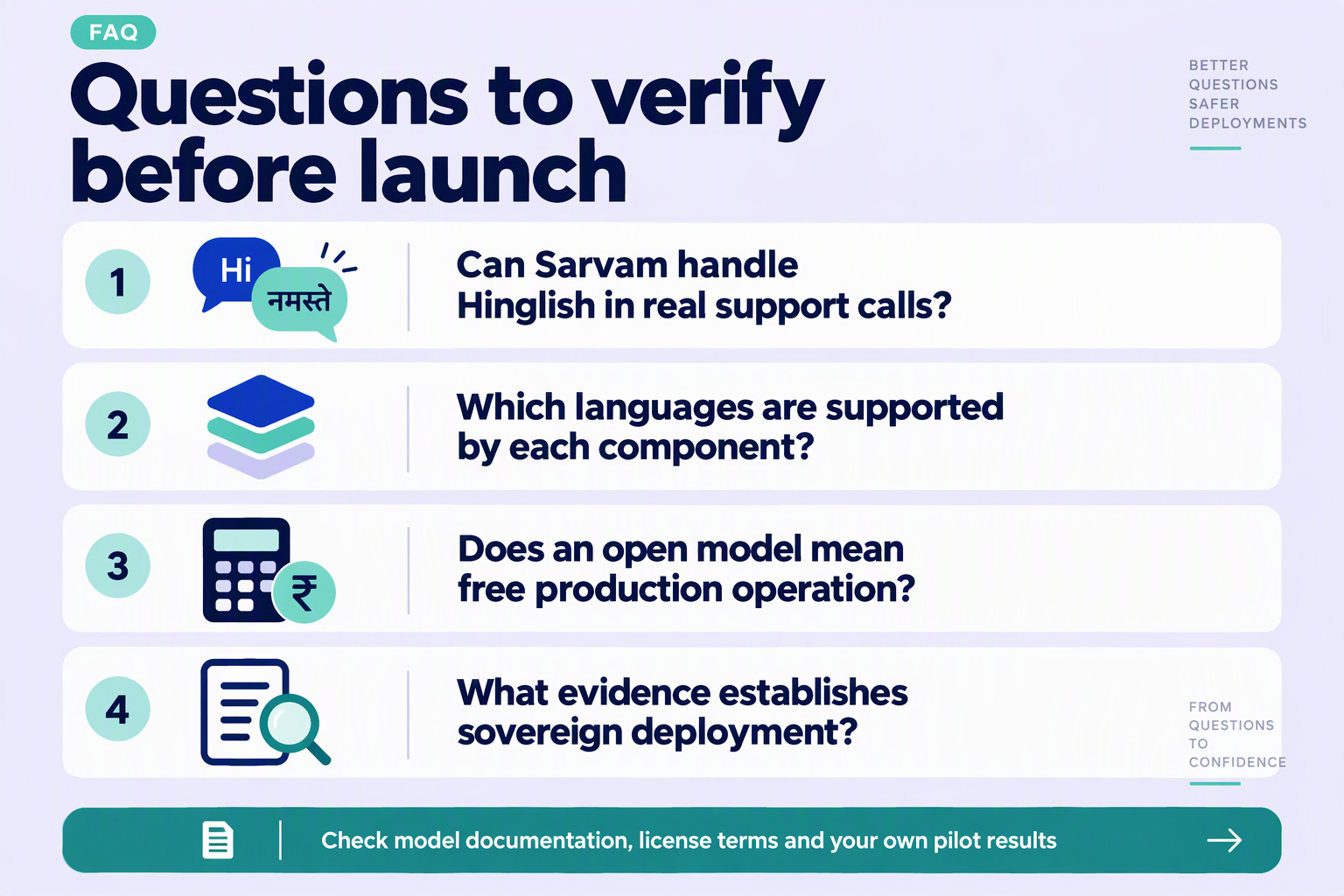
Can Sarvam AI capabilities support Hinglish customer-service conversations?
Are Sarvam AI models free to download and run commercially?
What makes an AI model sovereign rather than simply made in India?
Which Sarvam AI capabilities matter when choosing between Sarvam-30B and Sarvam-105B?
Does an Indian-language LLM automatically provide a complete AI voice-support system?
How should businesses test local-language AI before serving real customers?
Conclusion
Sarvam AI capabilities could make local-language customer support more practical, but success will depend on accurate resolutions—not model size alone. As of October 2026, India’s homegrown AI push points toward support systems that understand customers across languages, scripts, and channels while keeping business actions grounded in verified information.
According to Swarajya’s February 18, 2026 report, updated February 19, Sarvam AI unveiled 30-billion-parameter and 105-billion-parameter language models. That development is significant for India’s domestic AI stack, but support teams still need evidence that language understanding translates into reliable service.
Four takeaways should guide that evaluation:
- Local-language support is more than translation. Customers may speak Hindi, type it in Latin characters, or switch to English midway through a request. ExplainX’s 2026 overview describes Sarvam AI’s stack as spanning chat models, speech recognition, text-to-speech, translation, and document intelligence. Teams should evaluate those capabilities separately rather than assuming one strong language demonstration proves readiness across every channel.
- Model scale is a starting point, not a service guarantee. Sarvam AI’s announced model sizes establish the scale of its development effort, not whether an assistant can correctly resolve a Marathi billing dispute. Practical evaluation should use realistic customer requests, including code-mixed speech and incomplete explanations, and check whether the system understands the issue without making customers repeat themselves.
- Reliable workflows matter as much as fluent answers. A convincing response to “Mera refund kab aayega?” is insufficient unless the assistant retrieves the correct order information and explains the verified refund status. Knowledge retrieval, business tools, and human escalation determine whether multilingual conversations become useful support rather than polished but unsupported answers.
- Operational trade-offs need separate measurement. Language coverage, retrieval accuracy, response speed, and total costs should each inform model and API choices. A support architecture should also make it clear when a person must take over. The objective is not automatic replacement of support teams, but better access to assistance without weakening accuracy or accountability.
What should businesses watch next in local-language AI support?
Watch for evidence that Sarvam AI’s language and speech capabilities work consistently in complete support workflows—not just isolated demonstrations. The meaningful breakthrough would be a customer moving between Hindi and English, receiving an accurate answer, and reaching a human when the available evidence is insufficient.
Readers can explore CallMissed, an AI customer-communication platform whose verified product information, as of October 2026, lists speech recognition in 22 Indian languages plus English, including Hinglish, alongside knowledge-base tools and CRM capabilities.
Which customer conversation would you test first to discover whether multilingual AI truly understands your business—and your customers?
Related Reading
- July 2026 AI Agent Updates: Gemini for Support Teams
- How to Write Prompts for AI Agents: Support Guide 2026
- Voice Agent API With LiveKit Support: Verified 2026 Comparison
Sources
Discussion
Related Posts


Ready to automate customer conversations?
Launch AI voice agents and WhatsApp bots with CallMissed — one API, 22+ Indian languages.