
July 2026 AI Agent Updates: Gemini for Support Teams


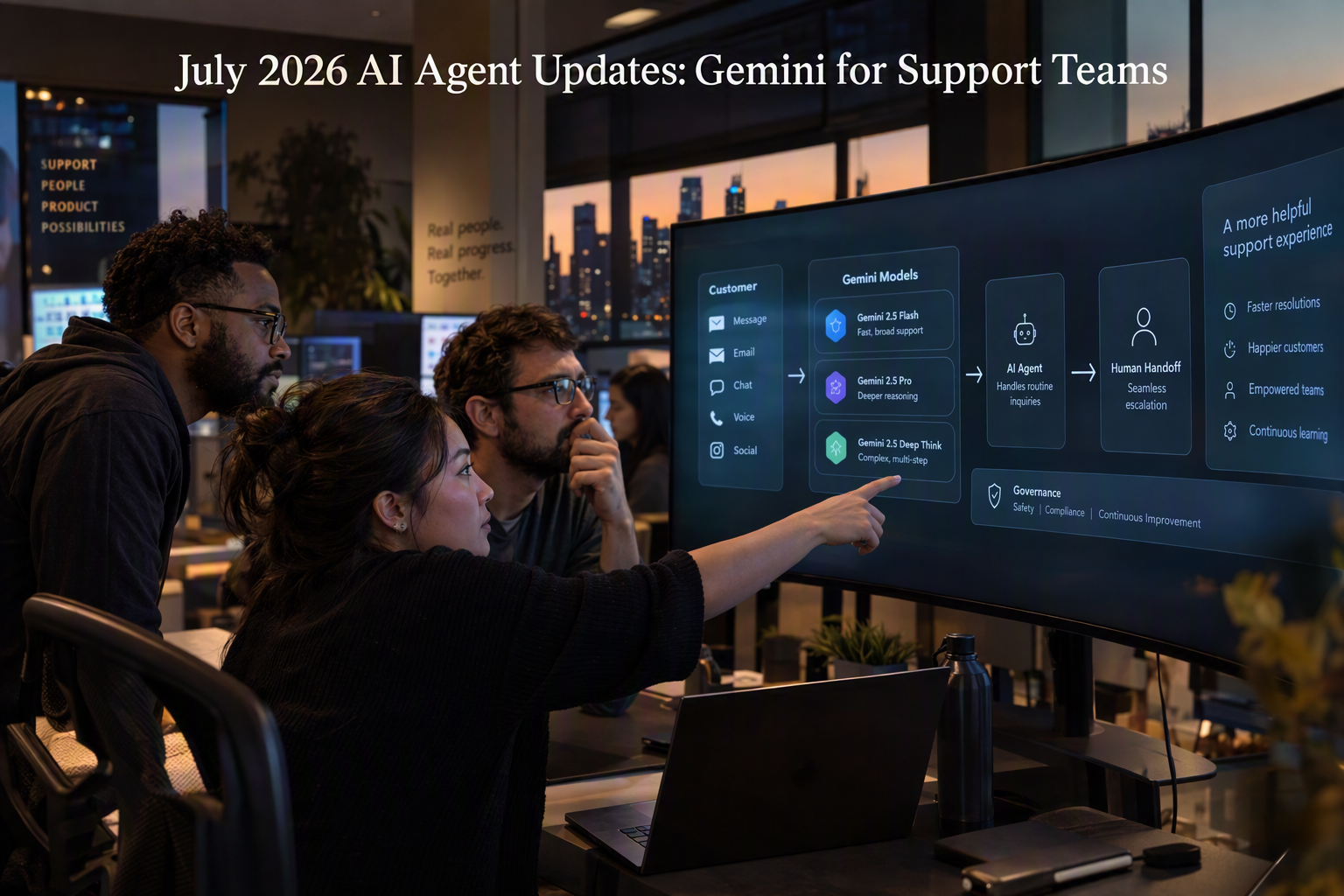
Review July 2026 AI agent updates, compare Gemini model roles, and map support workflows, evaluation checks, and governance needs before rollout.
July 2026 AI Agent Updates: Gemini for Support Teams
What if the next step in customer-support automation isn’t one all-purpose AI agent, but a better match between model, task and escalation path? Google’s July 2026 Gemini Agent Updates put that question in focus: the company announced three models aimed at building agentic systems at scale, giving support teams new options to evaluate for different workloads.
Google’s July roundup named Gemini 3.6 Flash, Gemini 3.5 Flash-Lite and Gemini 3.5 Flash Cyber. Google positions the lineup around balancing efficiency and quality. Its model materials describe Gemini 3.6 Flash as more efficient and higher quality than Gemini 3.5 Flash, based on developer and customer feedback, and characterize Flash-Lite as suited to lightweight agentic workflows. Those are Google’s descriptions, not independent proof of support-specific performance; teams will need to test models against their own conversations, policies and service targets.
That distinction matters because customer support is not a single task. A system might classify an incoming request, summarize a customer’s history, retrieve a relevant policy, draft a response or decide that a person should take over. These are potential applications—not support features Google announced alongside the models—and they vary in the reasoning, data access and risk they require. A lightweight model may be worth evaluating for high-volume, narrowly defined steps, while a more capable option may merit testing on complex requests. The right choice depends on measured quality, cost and operational needs, not a model name alone.
In this explainer, we’ll unpack what Google actually announced, how to think about assigning models across support workflows, and what to check before connecting an agent to customer records or business tools. We’ll also look at the safeguards that matter in production: grounding answers in approved support information, measuring failure modes, protecting customer data and making human escalation clear. The practical takeaway is not that every support queue should become autonomous; it’s that teams can assess where agents may help while keeping people accountable for sensitive or uncertain cases.
For support leaders, July’s launches are a prompt to run focused evaluations—not assume a new model automatically improves service. The useful question is which model, for which task, under what controls, and with what route to a human when the agent is unsure.
What do July 2026’s Gemini agent updates mean for support teams?

July 2026’s Gemini updates give support teams more models to assess—not a ready-made customer-service system. Google’s July roundup presents Gemini 3.6 Flash, Gemini 3.5 Flash-Lite and Gemini 3.5 Flash Cyber as options for building agentic systems at scale, but teams still need to test them against their own support tasks, data and risk controls.
How could support teams assign models to different tasks?
Treat model selection as a workflow decision. A support process may involve several distinct steps, and each can have different requirements for accuracy, context and oversight.
For example, teams could evaluate whether a lighter model is adequate for sorting common requests, while testing a more capable option on conversations that require combining several policy details. Those are possible applications, not support features Google announced with these models. A sensible pilot might compare models on the same anonymized cases and assess:
- Task quality: Did the output correctly identify intent or summarize the conversation?
- Grounding: Did the answer rely on approved policy information rather than unsupported assumptions?
- Escalation: Did the system hand off when the case was uncertain, sensitive or outside its authority?
- Operational fit: How did usage, response time and review effort compare in the team’s own environment?
Google’s model materials characterize Gemini 3.6 Flash as more efficient and higher quality than Gemini 3.5 Flash, based on developer and customer feedback. Google also describes Gemini 3.5 Flash-Lite as suited to lightweight agentic workflows. These are vendor descriptions, not independent evidence that either model will perform better on a particular support queue.
What should teams infer from the three-model lineup?
The lineup encourages evaluation by workload, but model names alone should not decide which system handles a customer interaction. In particular, teams should verify each model’s documented capabilities and test its behavior before assigning it a support role; the word “Cyber,” for example, is not by itself proof of suitability for handling security-related customer cases.
A practical rollout can start with a low-impact internal task, such as drafting a summary for a human agent to review. Only after measuring errors and reviewing edge cases should a team consider expanding the agent’s authority. Keep a record of the model, prompt, retrieved information and tool actions used in each test so that failures can be reproduced and corrected.
What infrastructure and safeguards still matter?
A model needs more than a prompt to operate safely in support. Teams must decide which customer records it can access, which actions it may take, what approved information grounds its replies, and how a person takes over. Human escalation should be part of the workflow—not an afterthought when an automated answer goes wrong.
As of September 2026, CallMissed provides an example of the broader support infrastructure around AI agents: its platform includes a knowledge base, one inbox across channels and a human-handoff queue. That illustrates a separate operational layer; it does not imply that the July Gemini models are built in or connected to CallMissed.
The useful outcome of Google’s July announcement is therefore a more specific evaluation question: which model, for which task, with what data access and escalation rules? A controlled pilot can answer that for a support team more reliably than assuming a model launch automatically improves service.
What happened in Google’s July 2026 Gemini announcements?

Google’s July 2026 roundup named three Gemini models for building agentic systems at scale: Gemini 3.6 Flash, Gemini 3.5 Flash-Lite and Gemini 3.5 Flash Cyber. Google frames the releases around balancing efficiency and quality; the announcement does not establish how any model performs on customer-support tasks.
Which Gemini models did Google announce in July 2026?
In its July 2026 AI roundup, Google presented the three models as new options for developers creating production AI agents. The roundup also covered other AI initiatives, but these models are the relevant announcements for teams assessing support automation.
Google’s descriptions distinguish the models in broad terms:
- Gemini 3.6 Flash: Google says it is more efficient and higher quality than Gemini 3.5 Flash, based on developer and customer feedback. That is Google’s positioning, not independent evidence of customer-service performance.
- Gemini 3.5 Flash-Lite: Google describes it as suited to lightweight agentic workflows. Support teams could evaluate it for bounded, repetitive tasks, but should measure accuracy and cost on their own data.
- Gemini 3.5 Flash Cyber: Google included it in the roundup as a new Gemini model. The available announcement context does not provide enough detail to identify specific support use cases, so teams should check the model’s documentation before assigning it work.
The distinction matters: a model announcement is not the same as a finished support product. The roundup does not show that these models arrive with a ready-made help desk, access to a company’s customer records, or support-specific safeguards.
What do Google’s descriptions mean for support automation?
Google’s descriptions offer starting points for evaluation, not a reason to assume a particular model will outperform another in a support queue. A team might test a lightweight option on clearly defined work—such as routing incoming messages—while evaluating more involved models on tasks that require synthesizing conversation history or following multiple policy rules.
That should be a controlled comparison, not a deployment assumption. For example, a retailer could prepare a set of past questions about delivery status, returns and account access, then measure whether each model selects the right policy, handles missing information appropriately and avoids making unsupported promises. The result would be evidence for that retailer’s workflow, not a universal benchmark.
A practical first evaluation can include:
- Define the task: Keep classification, summarization and customer-facing responses as separate tests.
- Use representative cases: Include ordinary requests, ambiguous messages and cases where the approved answer is to escalate.
- Record outcomes: Track correctness, policy compliance, response time and cost using the same test set.
- Set a human route: Decide in advance which uncertainty, complaint or sensitive request should reach a person.
What did Google’s announcement not establish?
The July roundup provides model names and broad vendor positioning, not verified support-specific results. It does not establish that the models will reduce resolution times, improve customer satisfaction or safely handle a particular company’s policies. Those outcomes depend on the model, the quality of connected information, the tools it can use and the controls around its decisions.
For support leaders, the news is a reason to test model-task fit and operational safeguards—not to automate every interaction. Keep customer data access limited to what each task needs, verify answers against approved support information, and make escalation behavior part of the evaluation from the start.
What are the key facts about the three models and platform?
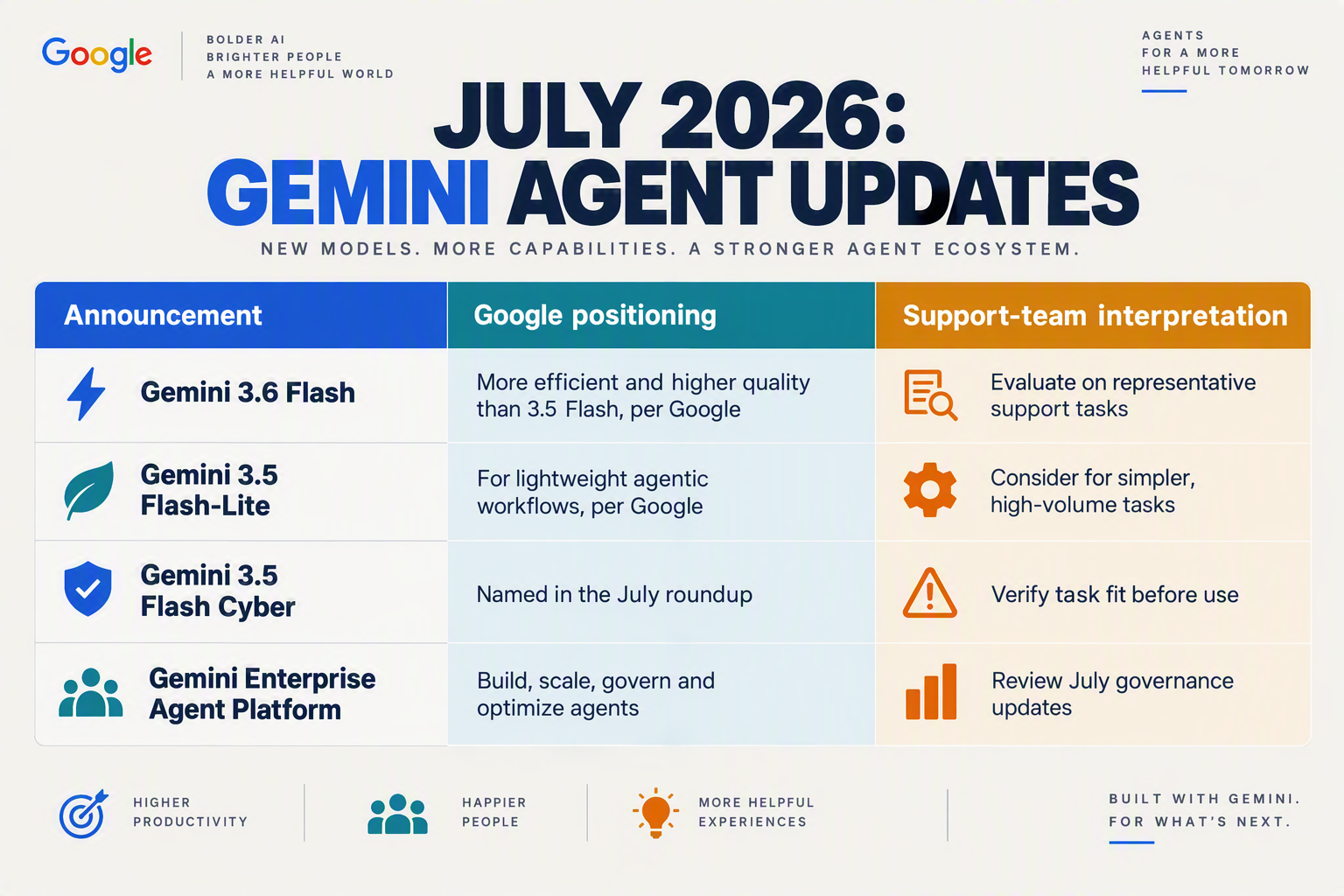
Google’s July 2026 roundup names three Gemini models and a separate agent platform, but it does not establish how well they perform on customer-support tasks. The useful distinction is between Google’s model positioning and what support teams still need to validate in their own workflows.
What did Google announce in July 2026?
Google’s July roundup, “The latest AI news we announced in July 2026,” introduced Gemini 3.6 Flash, Gemini 3.5 Flash-Lite and Gemini 3.5 Flash Cyber. Google Cloud separately described the Gemini Enterprise Agent Platform as a platform to build, scale, govern and optimize agents. The table summarizes the available positioning without treating it as independent benchmark evidence.
| Model or platform | Google’s stated positioning | Possible support workflow to evaluate | What teams should verify |
|---|---|---|---|
| Gemini 3.6 Flash | Google says it is “more efficient and higher quality” than Gemini 3.5 Flash, based on developer and customer feedback. | Test it on requests that require more context, such as summarizing a conversation or drafting a response from approved policy material. | Measure answer accuracy, response time and cost on representative support cases; Google’s comparison is not a support-specific benchmark. |
| Gemini 3.5 Flash-Lite | Google describes Flash-Lite as suited to lightweight agentic workflows. | Evaluate it for narrowly scoped, high-volume steps such as intent classification or routing suggestions. | Check error rates and whether the workflow needs more reasoning than the task appears to require. |
| Gemini 3.5 Flash Cyber | Google’s July roundup names it as the third model in the agent-focused launch. | Consider security-related support tasks only if the model’s documented capabilities fit the use case. | Review the model’s official technical documentation and test it; the roundup alone does not establish support performance or security outcomes. |
| Gemini Enterprise Agent Platform | Google Cloud presents it as a platform for building, scaling, governing and optimizing agents. | Assess whether the platform fits the team’s agent-development and oversight needs. | Validate the integrations, controls and operating requirements against the organization’s existing support stack. |
How should support teams read the comparison?
The table is a starting point for task-level testing, not a deployment recommendation. For example, a team could compare models on a held-out sample of real, appropriately protected conversations: measure whether each correctly identifies the request, uses the right approved information, and recognizes when the case should go to a person. Track results by task and failure type rather than relying on a single overall score.
The announcement does not supply customer-support benchmark results or prove that one model is better for a particular queue. Treat claims such as “more efficient and higher quality” as Google’s positioning, then test them against your own service targets, language mix and policy requirements. Likewise, choosing a model does not by itself establish how an agent will access support data, use tools or escalate uncertain cases; those are implementation decisions that need their own controls.
This model-selection trend also appears in developer infrastructure. As of September 2026, CallMissed’s developer AI API provides one API key and balance for 138 models, with Google among the listed model makers; teams should verify specific model availability before building an evaluation plan. For any platform, keep human escalation explicit and check data access and governance before connecting an agent to customer records or business tools.
Why might these updates matter for customer-support automation?

July 2026’s Gemini announcements matter because they give support teams more model options to evaluate across workloads, rather than evidence that any one model will improve service. Google’s July roundup names three models—Gemini 3.6 Flash, Gemini 3.5 Flash-Lite and Gemini 3.5 Flash Cyber—but does not establish support-specific performance.
What could a choice of models change in a support workflow?
It could let teams assess whether different steps in a support process need different levels of model capability. For example, a team might test a lightweight model for categorizing routine requests, while testing another model on conversations that require interpreting several messages or retrieving policy information. These are possible applications, not support features Google announced with the models.
Google describes Gemini 3.6 Flash as more efficient and higher quality than Gemini 3.5 Flash, based on developer and customer feedback. Google positions Gemini 3.5 Flash-Lite for lightweight agentic workflows. Those statements are vendor positioning, not independent proof of accuracy, cost savings or response quality in customer support. Teams should test representative conversations and compare results against their own service requirements before assigning models to live tasks.
Why does task complexity matter as much as volume?
A high-volume task is not automatically a safe task for a less capable model. A mistaken category on a routine query may be easy to correct; an incorrect interpretation of a refund exception or account-security issue can create greater customer and operational risk. Model choice should therefore reflect both how often a task occurs and what happens when the agent gets it wrong.
A practical evaluation can separate support work into steps:
- Low-impact, bounded tasks: Test whether a model can classify common intents or summarize a conversation consistently.
- Grounded response drafting: Check whether the agent retrieves the right approved policy and accurately uses it in a draft.
- Sensitive or ambiguous cases: Set clear conditions for pausing automation and routing the conversation to a person.
The test set should include routine requests, unusual phrasing, missing information and policy edge cases—not only examples where the expected answer is obvious.
What should teams check before connecting models to support tools?
An agent that can use customer data or business tools needs controls beyond model selection. Teams should define which records and actions it can access, test how it handles incomplete or conflicting information, and log outcomes so that failures can be reviewed. They should also decide in advance which cases require human review, rather than treating escalation as an afterthought.
As of September 2026, CallMissed’s AI communication platform offers a useful example of the surrounding workflow capabilities teams may consider: voice and chat agents, knowledge bases built from text, web pages and PDFs, and a human-handoff queue for support conversations. That describes CallMissed’s platform capabilities; it does not imply a specific Gemini integration or validate Gemini’s performance.
How can support teams evaluate the updates responsibly?
Start with a limited, measurable trial rather than changing the whole queue. Compare candidate models on the same sample of real or carefully anonymized conversations, and track task-specific measures such as correct routing, policy-grounded answers, escalation decisions and review effort. Then decide whether a model belongs in a workflow based on the trade-off between quality, operational cost and risk.
The central implication of Google’s July announcement is more choice for builders, not an automatic deployment plan. Support teams still need evidence from their own data, explicit permissions and a dependable path to human judgment.
Which support workflows could teams pilot with Gemini agents?

Teams could pilot Gemini agents on bounded, reversible support tasks—such as classifying requests, summarizing case history or drafting replies—before allowing them to change records or resolve sensitive cases. Google’s July 2026 model announcements describe options for scaling agentic systems, but do not establish support-specific performance; teams should validate each workflow with their own data and safeguards.
Which support tasks are suitable for a first Gemini agent pilot?
Start with tasks where success is easy to review and an error does not directly commit the business to an action. Examples include:
- Intent classification: Route incoming requests into categories such as billing, delivery or account access, then compare the agent’s labels with human-reviewed examples.
- Conversation summaries: Condense a customer’s recent messages and case history for the next support representative. Check whether summaries preserve important details, such as dates, prior troubleshooting and unresolved questions.
- Knowledge-grounded draft replies: Retrieve an approved policy or help article and prepare a response for a person to review. Measure whether the answer is relevant, accurately grounded and appropriately cautious when the source does not cover the question.
- Escalation suggestions: Flag cases that appear uncertain, emotionally sensitive or outside policy. Keep the decision to transfer ownership—and any customer-impacting action—with a person during the initial pilot.
These are potential applications, not support features Google announced with the models. A useful first test is one queue, one task and a clear human review step, rather than a broad “automate support” deployment.
How should teams match a Gemini model to a support workflow?
Match the model to the task’s complexity and volume, then test the trade-offs. Google’s July 2026 roundup presents Gemini 3.6 Flash, Gemini 3.5 Flash-Lite and Gemini 3.5 Flash Cyber as models for building agentic systems at scale. Google’s model materials describe Gemini 3.6 Flash as more efficient and higher quality than Gemini 3.5 Flash, based on developer and customer feedback, and position Gemini 3.5 Flash-Lite for lightweight agentic workflows. Those are Google’s descriptions, not independent evidence of performance on customer-support tasks.
A team might therefore evaluate Flash-Lite for a narrowly defined, high-volume classification step and compare other models on requests that require more context or reasoning. Do not infer support suitability from a model’s name: Google’s roundup does not provide support-specific accuracy, resolution or cost results. Include Gemini 3.5 Flash Cyber in an evaluation only when the task and available documentation justify testing it; do not assume its name alone makes it suitable for a particular support workflow.
What should a support pilot measure before expanding?
Use a fixed set of representative conversations, including incomplete requests, ambiguous policies and cases that should go to a person. Track classification accuracy, factual grounding, omission of important context, escalation decisions, response-review time and per-task cost. Set acceptance thresholds before testing, and compare results with the current human-led process.
Tool access also changes risk. Begin with read-only access to approved support information; require human approval before actions such as changing an order or account record. Platforms such as CallMissed offer voice and chat agents with knowledge bases, custom REST tools and a human-handoff queue—capabilities that illustrate the infrastructure teams may consider when designing a controlled support workflow, without implying a Gemini integration.
The practical next step is a narrow, auditable pilot: define the task, supply approved information, record failure cases and give customers a clear path to a person. Expand only when results meet the team’s own quality and governance requirements.
How should support teams choose a model and test it safely?
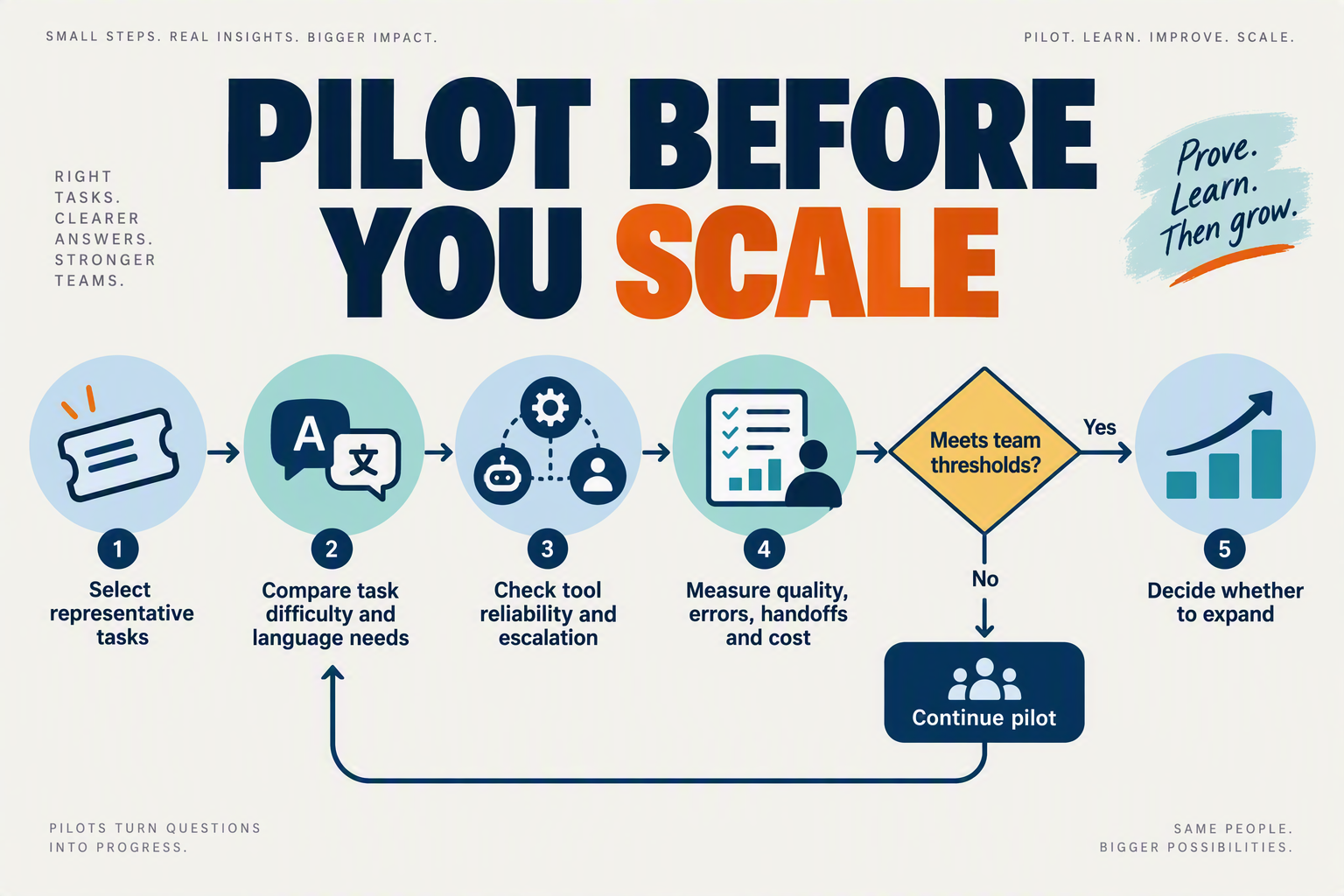
Support teams should choose a model by task risk and workload, then validate it on real, representative cases before giving it access to customer data or actions. Google’s July 2026 Gemini announcements expand the models teams can evaluate; they do not establish which model performs best for customer support.
What should determine a support team’s model choice?
In its July 2026 roundup, Google named three models for building agentic systems at scale: Gemini 3.6 Flash, Gemini 3.5 Flash-Lite and Gemini 3.5 Flash Cyber. Google frames the lineup around balancing efficiency and quality, but that positioning is not an independent benchmark of support performance.
Google’s model materials describe Gemini 3.6 Flash as more efficient and higher quality than Gemini 3.5 Flash, based on developer and customer feedback, and position Gemini 3.5 Flash-Lite for lightweight agentic workflows. Treat those as vendor descriptions, not proof that either model will meet a particular team’s quality, cost or response-time targets.
Map candidate models to bounded tasks before testing:
- Lower-risk, repetitive steps: classify intent or summarize a conversation for an employee to review.
- Knowledge-dependent steps: draft an answer using approved policies, with citations or source references where the system supports them.
- Higher-risk decisions: refunds, account changes, safety concerns or ambiguous complaints should have stricter checks and a clear route to a person.
A useful comparison is not simply “Which model is smartest?” It is which model meets the required quality for this task at an acceptable cost and operational complexity? A smaller or lighter option may be worth testing for narrow, high-volume work; a more capable candidate may merit evaluation on cases with multiple constraints. Neither outcome should be assumed in advance.
How can teams test a support model safely?
Build a test set from representative conversations, including routine requests and difficult edge cases. Remove or mask personal information where possible, and have support specialists define the expected answer, required evidence and cases that must be escalated.
- Set task-specific pass criteria. Measure factual accuracy against current policy, correct use of tools, completeness, tone and appropriate escalation. Track serious errors separately from minor wording issues.
- Compare models on identical inputs. Include short and long conversations, misspellings, code-mixed language, conflicting information and requests outside policy. Record model version, prompt, retrieval sources and tool responses so results can be reproduced.
- Test the workflow, not just the text. A plausible answer can still be unsafe if an agent retrieves the wrong customer record or takes an unauthorized action. Begin with read-only access or simulated actions, then expand permissions only after review.
- Roll out in stages. Start in shadow mode, where the model drafts but does not send; next try human-approved responses on a limited queue. Monitor error patterns and preserve a fast human handoff.
For grounding and escalation, CallMissed’s AI communication platform offers knowledge bases built from text, webpages and PDFs, custom REST tools, and a human-handoff queue for support conversations. Those capabilities illustrate the broader implementation pattern: connect agents to approved information and business systems while keeping a person in the loop. As of September 2026, CallMissed’s developer AI API lists 138 models across six categories, but teams should verify the specific model and endpoint they intend to use rather than assume every Gemini release is available.
The decision should come from evaluation results and ongoing monitoring—not launch descriptions alone.
What does the Gemini Enterprise Agent Platform update say about governance?

The Gemini Enterprise Agent Platform update signals that Google is treating governance as part of the agent lifecycle, alongside building, scaling and optimizing agents. But Google’s July 2026 announcement does not, in the available material, specify a complete set of support-specific governance controls—so teams should distinguish the platform’s stated scope from safeguards they must define and verify themselves.
What did Google say about governance?
In its July 2026 Google Cloud announcement, “What Google Cloud announced in AI this month,” Google described the Gemini Enterprise Agent Platform as a comprehensive platform to “build, scale, govern, and optimize agents.” That framing matters: governance is presented as an operational concern, not simply a model-selection decision.
The announcement does not, in the supplied details, spell out exactly how the platform handles permissions, audit records, customer-data retention, approval flows or escalation policies. Support leaders should therefore treat those as questions for product documentation and deployment review—not assume that the word govern confirms any particular safeguard. Google’s July roundup introduced three models for agentic systems at scale; model availability alone does not establish that an agent is safe for autonomous customer interactions.
What should a customer-support team govern?
Governance starts with defining what an agent may do, what information it may use and when it must stop and involve a person. For a support workflow, teams can document:
- Scope: Which tasks may be automated—such as intent classification or drafting—and which decisions require a human?
- Data access: Can the agent retrieve only approved policies and the customer records needed for the task?
- Actions: Which tools may it call, and which actions—such as changing an order or account—need confirmation?
- Quality and risk: How will the team test incorrect answers, unsupported claims, privacy exposure and failures on unusual requests?
- Escalation: What signals trigger a handoff, and does the customer know when a person is taking over?
These are implementation recommendations, not features confirmed in Google’s announcement. They also help make model choice measurable: a team can compare systems on the same approved test cases and escalation rules instead of relying on a general claim about efficiency or quality.
How can teams make governance operational?
A practical approach is to begin with a narrow workflow and establish its controls before expanding:
- Set a baseline: Have people handle a sample of real, appropriately protected cases and record the expected answer, permitted data and correct escalation outcome.
- Test the agent against that baseline: Include routine requests, ambiguous messages and cases where the correct response is to stop.
- Limit access and actions: Give the agent only the data and tools needed for the approved task.
- Review results continuously: Track errors, handoffs and policy deviations, then update prompts, knowledge sources or workflow boundaries.
- Keep human ownership explicit: Assign responsibility for reviewing failures and changing what the agent is allowed to do.
Platforms can support parts of this operational discipline without replacing a team’s governance policy. For example, as of September 2026, CallMissed offers agent versioning with publish and rollback, eval suites, call scoring against a team’s own QA rubrics, and human handoff in its omnichannel inbox. Those are specific workflow capabilities; teams still need to decide their own access rules, acceptance thresholds and escalation criteria.
The takeaway from Google’s governance language is a useful one, but not a shortcut: treat governance as a lifecycle practice, and verify the controls behind any platform claim before connecting agents to customer data or support actions.
What has the industry reaction established—and what remains unproven?

Google’s July 2026 announcements establish that it is offering three Gemini models for developers building agentic systems, with efficiency and quality presented as design priorities. They do not establish that any model improves customer-support outcomes: support-specific accuracy, cost, latency and escalation performance still need independent, task-level evaluation.
What has the industry reaction established so far?
The clearest signal is where the conversation is focused: choosing models for different workloads and scaling agent systems. Google’s July 2026 roundup named Gemini 3.6 Flash, Gemini 3.5 Flash-Lite and Gemini 3.5 Flash Cyber as part of its AI updates, framing the launches around building agents at scale.
Google’s model materials describe Gemini 3.6 Flash as more efficient and higher quality than Gemini 3.5 Flash, based on developer and customer feedback. Google characterizes Gemini 3.5 Flash-Lite as suited to lightweight agentic workflows. Those descriptions clarify the intended positioning, but they are vendor claims, not independent evidence that either model will perform better on a particular support queue.
For support teams, the practical implication is to assess models by task rather than assign one model to every step. Potential applications to test include:
- Classifying incoming requests or routing them to the right queue.
- Summarizing a customer’s conversation history for an agent.
- Retrieving approved policy information and drafting a response.
- Identifying uncertainty or risk and handing the conversation to a person.
These are possible uses of general-purpose agent models—not support features Google announced with the July launches. A model that handles a narrow, repetitive classification task well may not be suitable for a nuanced complaint or a policy exception.
What remains unproven for customer-support automation?
The July announcements do not, by themselves, prove support-specific quality, lower operating costs, faster resolution, reduced escalation rates or safe access to customer records. Nor does the provided evidence establish a single model-selection rule that applies across industries, languages and support channels.
Teams should treat deployment as an evaluation, not a launch-day assumption:
- Define the task and baseline. Measure current accuracy, handling time, cost and escalation outcomes for the workflow being considered.
- Test representative conversations. Include routine questions, ambiguous requests, policy exceptions, multilingual messages and cases where the correct action is to stop and escalate.
- Set tool and data boundaries. Give agents only the records and actions required for the task, and test whether they follow those limits.
- Keep human review explicit. Decide when a person must approve an action or take over, then track whether the handoff happens reliably.
The industry trend is toward combining model choice with workflow controls, not treating a model announcement as proof of an autonomous support solution. Platforms such as CallMissed reflect that operational emphasis: its omnichannel inbox includes a human-handoff queue where switching off the AI hands a thread to a person, while its voice platform supports live-call monitoring. These are examples of escalation mechanisms; they do not demonstrate how the newly announced Gemini models perform.
The bottom line: Google’s July 2026 lineup gives teams new candidates to evaluate. Whether those candidates improve customer support remains a question for measured pilots using real tasks, clear safeguards and human accountability.
When did the July 2026 Gemini agent updates appear?
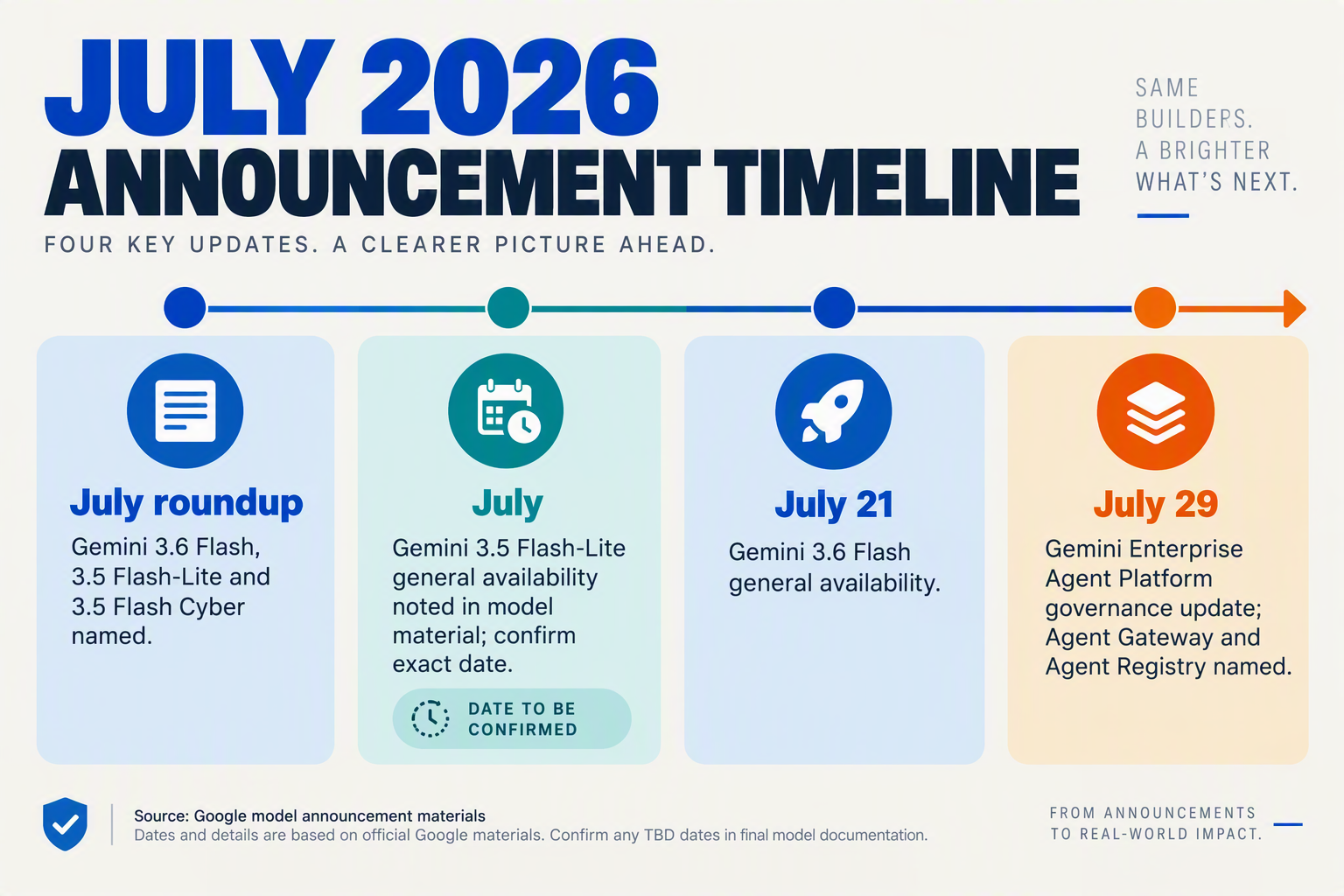
Google’s July 2026 AI roundup is the available source for when the three Gemini agent models appeared: it names Gemini 3.6 Flash, Gemini 3.5 Flash-Lite and Gemini 3.5 Flash Cyber. The roundup places them in July, but the source material available here does not establish an exact announcement day or separate launch dates for each model.
What does Google’s July 2026 roundup say?
| Update | Timing in Google’s roundup | Google’s stated positioning | What support teams can conclude |
|---|---|---|---|
| July AI roundup | July 2026; exact day not established here | Introduces three Gemini models for building agentic systems at scale | Treat it as a model announcement, not a ready-made support product |
| Gemini 3.6 Flash | Named in the July 2026 roundup | Google describes it as more efficient and higher quality than Gemini 3.5 Flash, based on developer and customer feedback | Test the claim on your own support conversations; it is not independent support-performance evidence |
| Gemini 3.5 Flash-Lite | Named in the July 2026 roundup | Google describes it as suited to lightweight agentic workflows | Consider narrow, well-defined tasks as evaluation candidates—not assumed outcomes |
| Gemini 3.5 Flash Cyber | Named in the July 2026 roundup | Included among the three models Google announced for agent-building | Do not infer a particular customer-support capability from its name alone |
| Support implementation | No support-specific launch date or benchmark is established by the roundup | The models are presented as building blocks for agents | Workflow design, testing, data access and escalation remain the implementer’s responsibility |
The key distinction is between when Google announced the models and what they can demonstrably do in a support environment. Google’s roundup supports the July 2026 timing and the three model names. It does not, by itself, establish that any model improves resolution time, answer accuracy or customer satisfaction.
How should support teams use the announcement timeline?
Use the July roundup as a signal to start a controlled evaluation, not as a reason to switch a live queue immediately. First select a specific workflow—such as classifying an incoming request, summarizing a customer’s case history or drafting an answer from approved policy material—and define how success and failure will be measured.
A practical first-pass evaluation can compare the models on:
- Answer quality: Does the response follow current policy and cite or rely on approved information?
- Uncertainty handling: Does the agent ask for clarification or escalate when the information is incomplete?
- Operational fit: Does the model meet the team’s cost, response-time and volume requirements in testing?
- Risk controls: Are access to customer records and actions through tools limited to what the task requires?
Keep those results separate from Google’s model descriptions. In particular, “more efficient and higher quality” is Google’s characterization of Gemini 3.6 Flash relative to Gemini 3.5 Flash, based on developer and customer feedback—not a published guarantee for a particular support workload.
For teams planning the surrounding agent workflow, CallMissed offers a no-code voice and chat agent builder, knowledge bases, custom REST tools and live call monitoring with supervisor intervention. Those are implementation capabilities; they do not establish how any Gemini model will perform. The useful next step after a July announcement is a small, measured pilot with a clear human handoff—not assuming that a model launch is a support outcome.
Frequently Asked Questions
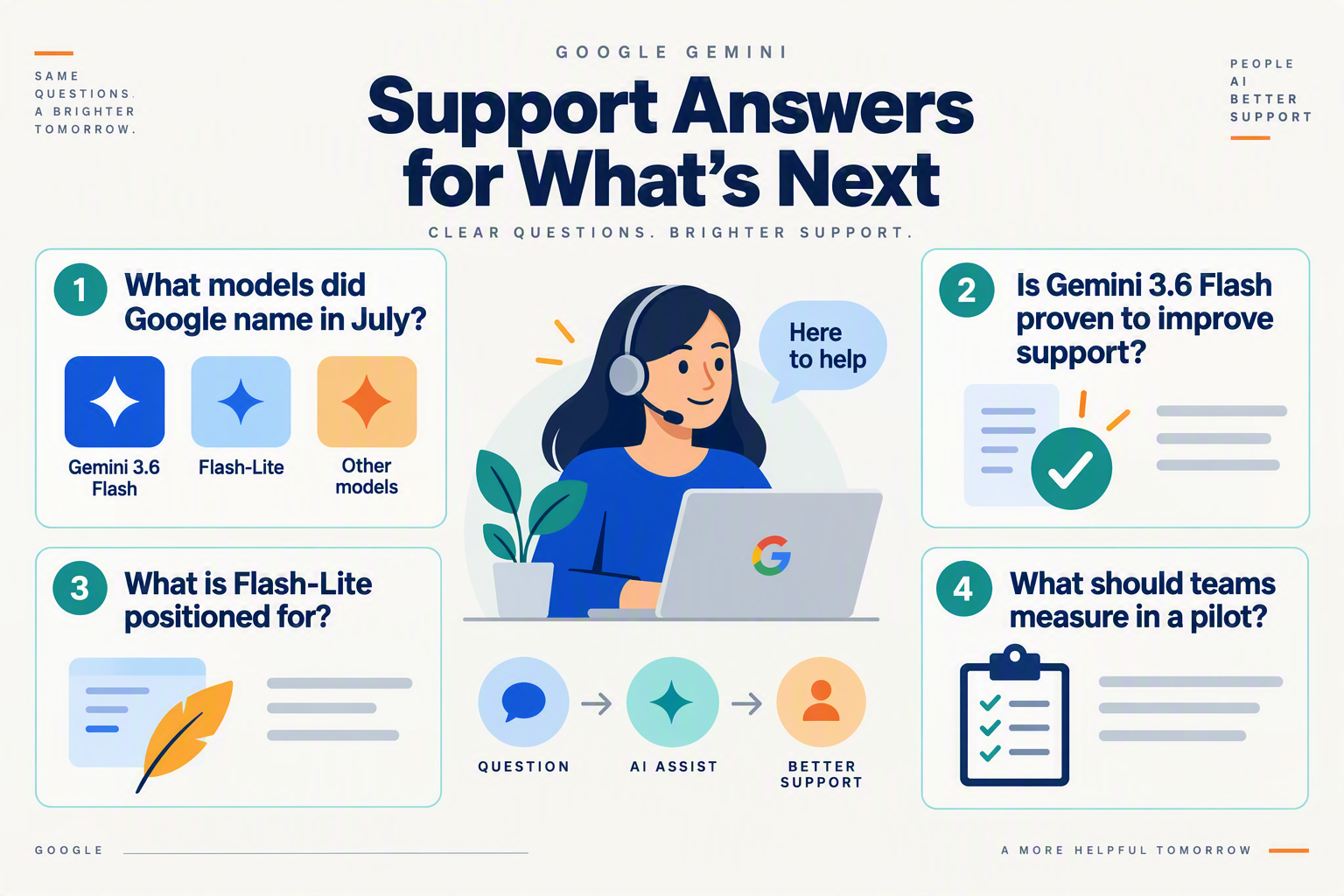
Which models did Google announce in the Gemini July 2026 updates?
How should support teams choose among the Gemini July 2026 models?
Do the Gemini July 2026 updates prove better customer-support performance?
Can Gemini agents use customer records and support tools?
What safeguards should support teams use with Gemini agents?
How can teams evaluate model options before deploying a support agent?
Conclusion
July 2026’s Gemini launches give support teams more options to evaluate, not a ready-made customer-service system. Google’s July roundup names Gemini 3.6 Flash, Gemini 3.5 Flash-Lite and Gemini 3.5 Flash Cyber as models for building agentic systems at scale.
- Match models to tasks: Teams could test lightweight models for narrow, high-volume steps and more capable options for complex requests—but should validate each choice on their own support conversations.
- Treat launch descriptions as vendor positioning: Google describes Gemini 3.6 Flash as more efficient and higher quality than Gemini 3.5 Flash, and Flash-Lite as suited to lightweight agentic workflows. Those descriptions are not independent proof of support performance.
- Keep people accountable: Ground responses in approved support information, assess failure modes and make escalation to a human clear, especially for sensitive or uncertain cases.
- Measure before expanding: Compare quality, cost and operational fit rather than assuming a new model will improve service.
The next signal to watch is how these models perform in support-specific evaluations and real deployments—not just general agent demos. As teams explore AI communication infrastructure, CallMissed offers no-code voice and chat agents, with speech recognition in 22 Indian languages plus English.
Which support task would you test first, and what evidence would earn it a place in production?
Related Reading
- Voice Agent API With LiveKit Support: Verified 2026 Comparison
- Voice Agent API with LiveKit Support: 2026 Comparison and Verdict
- AI Voice Agent Customer Service 2026: CallMissed Support Operations Guide
Sources
Discussion
Related Posts



Ready to automate customer conversations?
Launch AI voice agents and WhatsApp bots with CallMissed — one API, 22+ Indian languages.