DeepSeek V4.1 Flash Now on CallMissed API: 1M Context


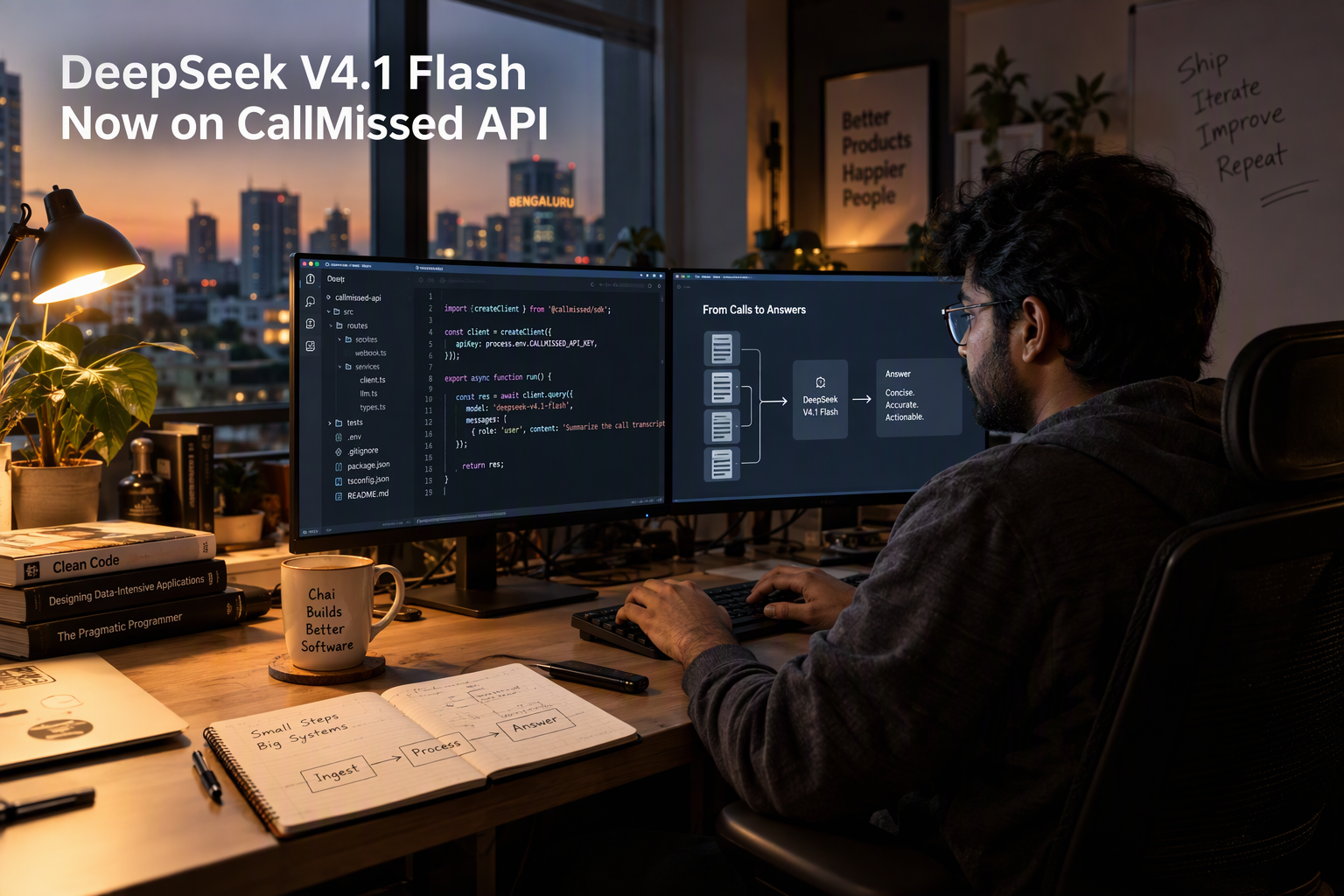
DeepSeek V4.1 Flash is live on CallMissed with a 1,048,576-token window, tool calling and low, high, max reasoning effort. Model ID and code included.
DeepSeek V4.1 Flash Now on CallMissed API: 1M Context
What if a 552-billion-parameter model only had to wake up 8 billion of those parameters to read your prompt? That is the central trick behind DeepSeek V4.1 Flash, the newest model from DeepSeek, and it is now available through the CallMissed API and playground.
According to the Lyceum Technology and vLLM documentation, DeepSeek V4.1 Flash is a sparse Mixture-of-Experts model with a 552B backbone. It activates 8B parameters per token during prefill and 16B during decode. NVIDIA's model card adds that it accepts text and images, generates text, supports a combined context of up to one million tokens, and offers continuously controllable reasoning effort.
The timing matters. DeepSeek began testing the model on September 8, 2026, and third-party provider documentation dates its availability on the official DeepSeek API to September 10, 2026, positioning it as the smallest member of a new architecture family and a strong default for everyday work. OpenRouter describes it as the first model built on DeepSeek's Causal Encoder-Decoder (CED) architecture. DeepSeek's official API prices it at $0.15 per million input tokens and $0.60 per million output tokens off-peak ($0.30 and $1.20 at peak), with cache hits at $0.003 off-peak. That combination of long context, vision input and low per-token cost is exactly what teams building coding assistants, document analysers and long-running agents have been asking for.
For developers, the practical questions are how to call it, what it can do and where its limits are. CallMissed, the OpenAI-compatible AI gateway, offers 140 models under one API key and one balance, so trying DeepSeek V4.1 Flash means changing a model name rather than rewriting an integration.
In this post, you will learn:
- What DeepSeek V4.1 Flash is and why its split activation design matters for speed and cost
- How the 1M-token context window can be used in practice, from whole-repository analysis to long agent traces
- How tool calling and reasoning effort work, with guidance on when to turn the dial up or down
- The exact model ID and a working request you can copy into your existing OpenAI-compatible SDK
Let's start with what makes this architecture different.
What is DeepSeek V4.1 Flash, and can you use it on CallMissed today?
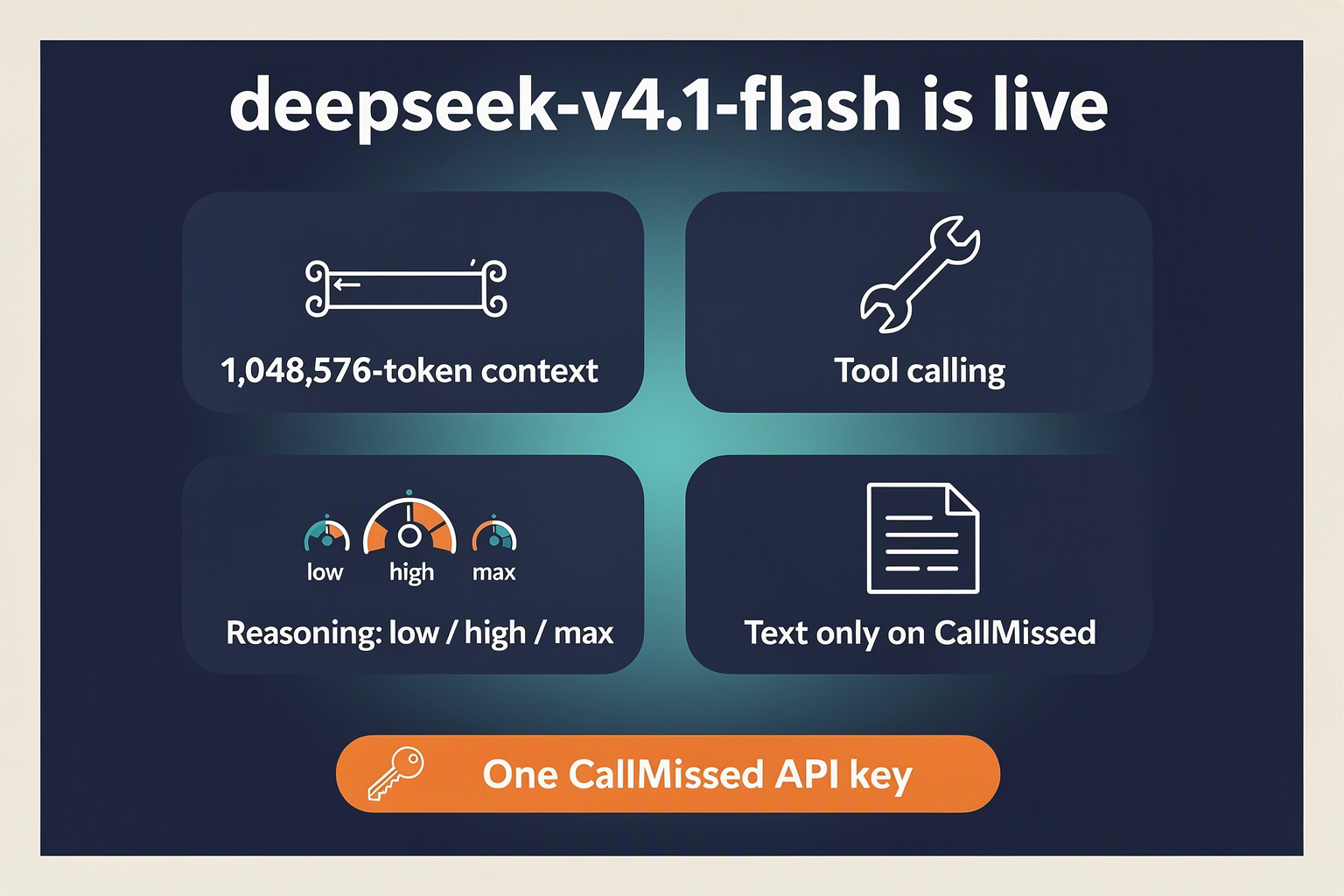
DeepSeek V4.1 Flash is a multimodal, sparse Mixture-of-Experts language model from DeepSeek, and yes, it is available through the CallMissed API and playground as of October 2026. You call it through CallMissed's OpenAI-compatible endpoint with your existing key and balance.
What kind of model is DeepSeek V4.1 Flash?
According to LM Studio's model listing, DeepSeek V4.1 Flash is built for coding, reasoning, visual understanding and long-context agents. DeepSeek positions it as the smallest member of a new architecture family, with larger models expected to follow, according to deepseek-ai.net.
Three design choices stand out:
- Native multimodality: deepseek-ai.net reports that text and images are modelled jointly from pretraining rather than through a bolted-on vision add-on. Screenshot OCR, chart reading and UI review are the intended use cases.
- Efficient long-context attention: the vLLM recipe for the model describes sliding-window plus compressed sparse attention with a two-level indexer, alongside engram n-gram memory and hyper-connections. The goal is to keep very long prompts from becoming prohibitively expensive.
- Adjustable reasoning: NVIDIA's model card lists continuously controllable reasoning effort, so you can trade depth for speed per request.
How does it compare with earlier DeepSeek models?
DeepSeek's own testing, as relayed by deepseek-ai.net on September 10, 2026, claims V4.1 Flash surpasses V4 Pro on performance, cost, speed and total task time. Treat that as a vendor-reported result and benchmark it on your own workload. LM Studio also notes that the agentic benchmark figures were reported by DeepSeek at maximum reasoning effort, which is the most generous setting.
One practical detail from OpenRouter: its listing says the model identifier redirects to the latest model in the DeepSeek Flash family. If you need reproducible outputs, check which version your gateway pins.
Can you use it on CallMissed today?
Yes. CallMissed exposes DeepSeek V4.1 Flash alongside its catalogue of 140 models (45 of them general-purpose LLMs), reachable with one API key and one balance. Because the gateway is OpenAI-compatible, an existing OpenAI SDK needs only a new base URL and the model name.
The quickest route to a first response:
- Sign up at console.callmissed.com. New accounts receive 1,000 free credits, and 1 credit equals ₹1.
- Try it in the playground to test prompts, reasoning effort and image input without writing code.
- Move to the API at api.callmissed.com by pointing your SDK's base URL there and swapping in the model ID.
- Check usage in the request logs, then scale up. Default limits are 60 requests per minute on Free and 500 on Starter, rising to 3,000 on Pro and 10,000 on Enterprise.
The exact model ID string and a working request come later in this post. The CallMissed documentation at docs.callmissed.com remains the source of truth for the current catalogue. Per-token rates on any gateway can differ from OpenRouter's published figures, so confirm pricing in your console before budgeting a large workload.
Next, we look at what a million-token window changes in practice.
Key Facts: DeepSeek V4.1 Flash on CallMissed at a Glance
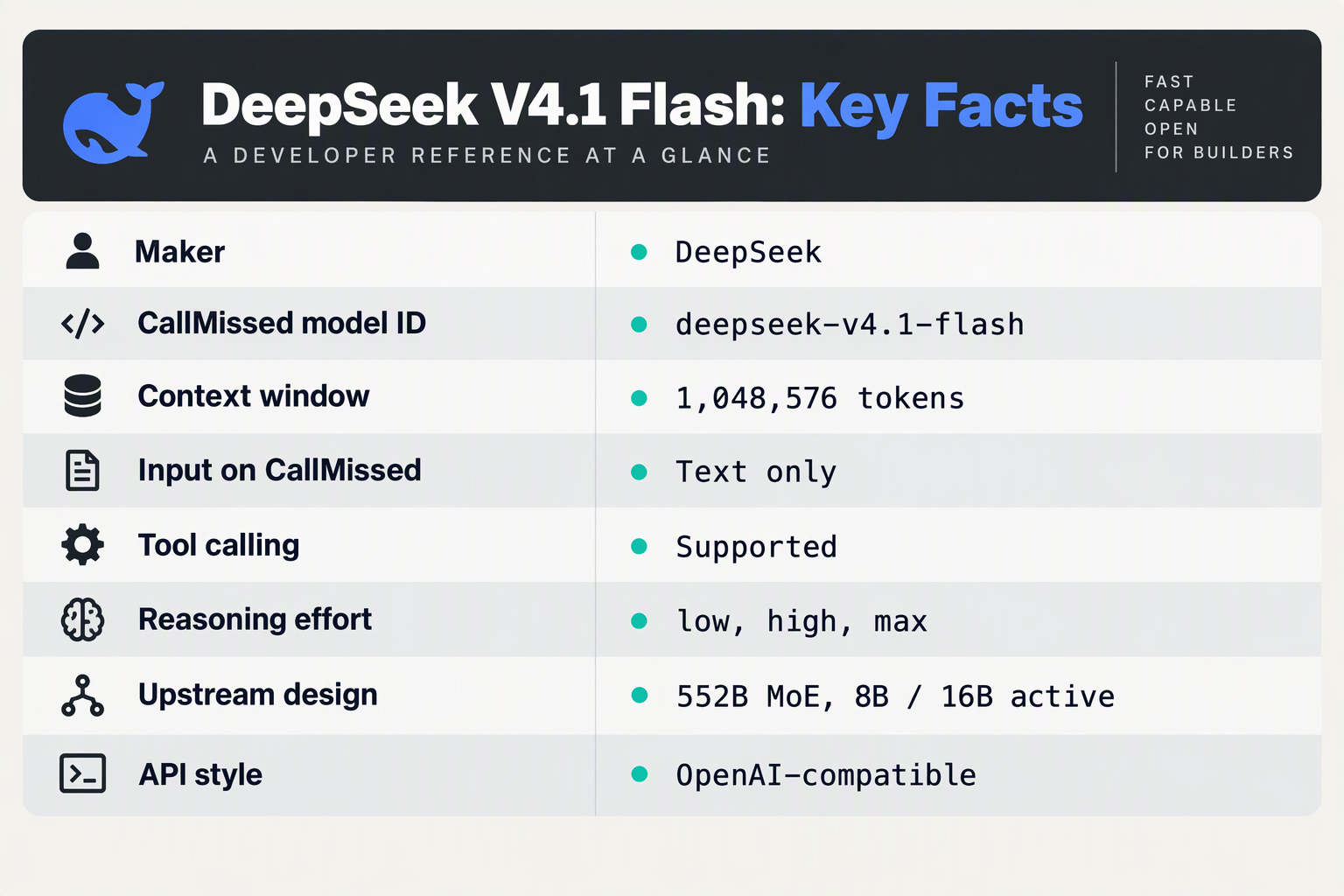
As of October 14, 2026, DeepSeek V4.1 Flash is a 552B-parameter multimodal Mixture-of-Experts model with a one-million-token context window, and you can call it through the CallMissed API with the same key and balance as the other 139 models. The table below collects the key specifications, each attributed to the source that published it.
What are the key specs of DeepSeek V4.1 Flash?
| Attribute | Detail | Source |
|---|---|---|
| Developer | DeepSeek | NVIDIA model card |
| Architecture | Sparse Mixture-of-Experts, 552B backbone; first model on the Causal Encoder-Decoder (CED) architecture | Lyceum Technology, OpenRouter |
| Active parameters | 8B per token in prefill, 16B in decode | Lyceum Technology, vLLM recipes |
| Context window | Up to 1,000,000 tokens (combined) | NVIDIA model card |
| Input / output | Text and images in, text out | NVIDIA model card |
| Reasoning control | Continuously adjustable reasoning effort | NVIDIA model card |
| Timeline | Internal testing September 8, 2026; official launch September 10, 2026 | deepseek-ai.net |
| Reference price | $0.15 per million input tokens, $0.60 per million output tokens (as of October 2026) | OpenRouter |
How do you access it on CallMissed?
You reach it through CallMissed's OpenAI-compatible endpoint, so existing OpenAI SDK code works after you change the base URL and model name. The same gateway also offers streaming, function calling, structured outputs, vision input, caller-chosen fallback models and response caching. These apply to every model in the catalogue, so you can adopt DeepSeek V4.1 Flash without changing your integration.
Default rate limits are set per API key, in requests per minute:
- Free: 60
- Starter: 500
- Pro: 3,000
- Enterprise: 10,000
New accounts get 1,000 free credits on signup. Credits cost ₹1 each (about US$0.0104), never expire, and can be paid for by UPI, cards or net banking, with GST invoices.
Two caveats before you plan around these numbers
1. The OpenRouter price is a reference point, not a CallMissed rate. The $0.15 and $0.60 figures are what OpenRouter, a third-party marketplace, lists. Your CallMissed cost is billed in credits, so check the model's entry in the console or the pricing page for the current rate before you budget.
2. Model identifiers differ by platform. LM Studio lists the model under the slug deepseek-v4.1-flash, while deepseek-ai.net's workbench preselects deepseek-flash. Each platform defines its own string, and OpenRouter notes that its entry redirects to the latest model in the DeepSeek Flash family. Copy the exact ID from the CallMissed model catalogue rather than from another provider's documentation. The request example later in this post uses it.
Why do the 8B/16B numbers matter for your workload?
The split means prompt-heavy jobs, such as reading a long document or a large codebase, run with a smaller active footprint than the 552B total suggests. Generation-heavy jobs use the larger 16B decode path. Treat this as a design signal rather than a guarantee. CallMissed does not publish latency benchmarks for this model, so test it on your own prompts before committing to production.
The next section looks at what a million tokens of context lets you build.
What is the Causal Encoder-Decoder design behind 8B and 16B active parameters?
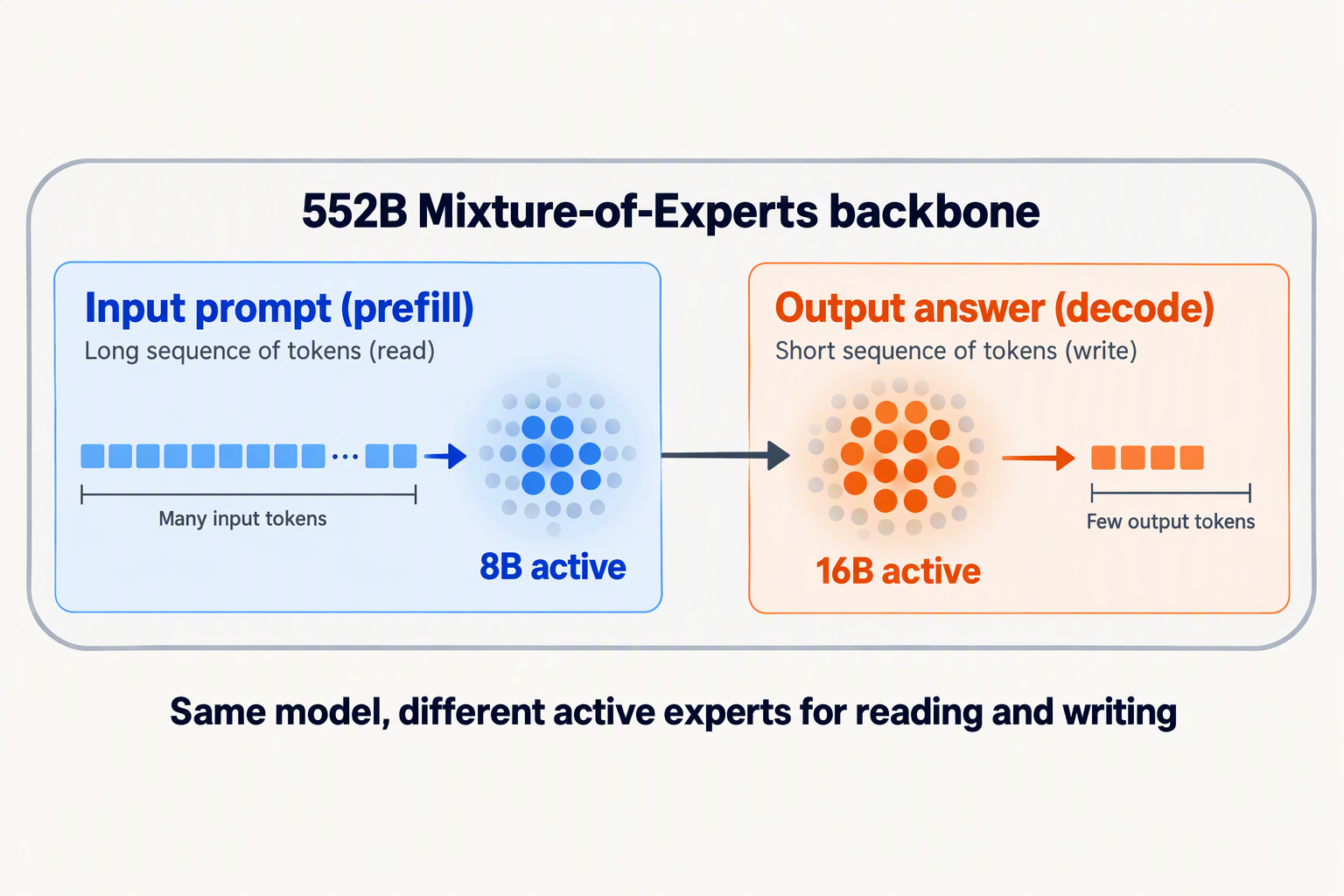
The Causal Encoder-Decoder (CED) design lets DeepSeek V4.1 Flash spend less compute reading your prompt than writing its answer. According to vLLM's serving recipe, the model uses 8B active parameters per prompt token and 16B per output token, out of a 552B backbone. OpenRouter describes it as the first model built on DeepSeek's CED architecture, as of October 2026.
Why split activation between prefill and decode?
Reading a prompt and generating a reply are different workloads. During prefill, the model processes thousands of input tokens in parallel, so total compute grows quickly with prompt length. During decode, it produces one token at a time, and each token needs to be good because errors compound.
CED assigns a lighter expert pathway to the first job and a heavier one to the second. Lyceum Technology calls this activation split "the unusual part" of the model. For long prompts, that means the expensive-to-scale phase runs on the smaller 8B footprint.
DeepSeek has not published every internal detail of CED in the sources reviewed here. Treat the encoder/decoder framing as a description of this prefill/decode asymmetry, not a full specification.
What other components make a 1M-token context practical?
The vLLM recipe lists several supporting techniques that work alongside the activation split:
- Sliding-window plus compressed sparse attention with a two-level indexer, so the model does not attend equally to every token in a very long input.
- Compressed latents shared across layers, which reduces the memory the model must keep around for earlier tokens.
- Engram n-gram memory, a lookup-style memory component.
- Hyper-connections, a modification to how information flows between layers.
Together, these target the two costs that usually limit long context: compute per token and memory per token. The vLLM recipe is also a useful signal that the model is serveable on current data-centre hardware, including H100, H200 and B200 GPUs.
What does this mean for developers calling the API?
Three practical effects follow from the design:
- Long inputs are cheaper to absorb. OpenRouter lists input at $0.15 per million tokens versus $0.60 for output, as of October 2026. Output costs roughly 44 times as much as input, which is consistent with decode being the heavier phase. Prompt-heavy workloads such as document analysis or repository review benefit most.
- Output length drives your bill. Because decode uses the 16B pathway and is priced higher, concise answers and capped output lengths matter more than trimming prompts.
- Reasoning effort interacts with cost. NVIDIA's model card says reasoning effort is continuously controllable. More reasoning means more decoded tokens, so it shifts you toward the pricier side of the split.
Treat these as planning heuristics and measure your own traffic. The exact cost on your account depends on the CallMissed credits each request consumes.
How does this connect to using it on CallMissed?
For teams that want to test this trade-off, CallMissed, the OpenAI-compatible AI gateway, exposes DeepSeek V4.1 Flash alongside 139 other models behind one key and one balance. You can run the same long-document prompt against it and a different model, compare output quality and credit usage side by side, and switch by changing only the model name.
The next section covers how to put that 1M-token window to work.
Why does the asymmetric design help long-prompt, short-answer workloads?
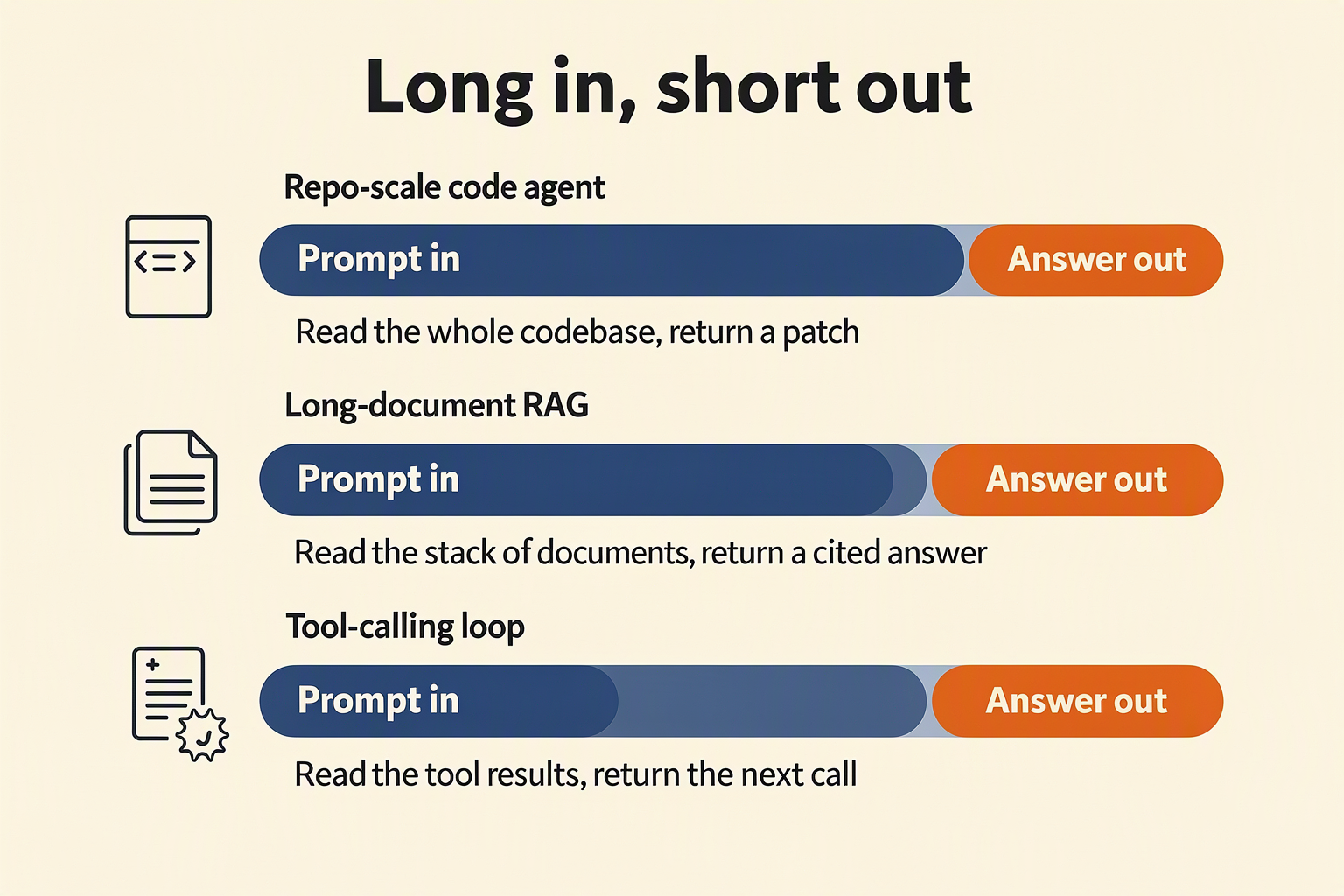
The asymmetric design helps because the expensive part of a long-prompt, short-answer request is reading the input, and DeepSeek V4.1 Flash reads with only 8B active parameters. It spends the larger 16B only on the few tokens it writes back.
What does "8B on prefill, 16B on decode" actually mean?
Every request has two phases. Prefill processes your whole prompt in parallel. Decode generates the answer one token at a time. According to the vLLM recipe, DeepSeek V4.1 Flash is a 552B-backbone model with 8B parameters active per prompt token and 16B per output token.
Most Mixture-of-Experts models use one activation budget for both phases. Here the prompt path is deliberately lighter, which matters when a request carries 300,000 tokens in and 800 tokens out.
How does the architecture keep long prompts cheap?
The vLLM recipe lists the supporting pieces: sliding-window plus compressed sparse attention with a two-level indexer, shared compressed latents across layers, engram n-gram memory and hyper-connections. Together these reduce the work and memory spent on distant tokens. OpenRouter describes the model as the first built on DeepSeek's Causal Encoder-Decoder (CED) architecture, which fits the split. The "reading" side is built to be efficient, and the "writing" side gets more capacity.
What does that look like in dollars?
OpenRouter lists DeepSeek V4.1 Flash at $0.15 per million input tokens and $0.60 per million output tokens as of October 2026. Output is therefore roughly 44 times the price of input per token.
Here is an illustrative calculation at those rates, not a CallMissed price:
| Request shape | Input cost | Output cost | Total |
|---|---|---|---|
| 200,000 tokens in, 1,000 out | ≈ $0.00403 | ≈ $0.00089 | ≈ $0.0049 |
| 20,000 tokens in, 10,000 out | ≈ $0.00040 | ≈ $0.00891 | ≈ $0.0093 |
The second request is a tenth of the prompt size but costs nearly twice as much, because output dominates. Check the CallMissed pricing page for current credit rates on this model.
Which workloads benefit most?
- Repository and document Q&A: load a large codebase or contract set, ask a pointed question, get a short answer.
- Classification and extraction: long transcripts in, a compact JSON object out.
- Agent loops with large traces: the history grows every turn, but each step usually emits a short tool call.
- Call and chat summarisation: long conversation logs in, brief notes out.
Where does the advantage shrink?
Three caveats apply:
- Long generations cost more. Essays, full file rewrites and verbose answers run on the 16B decode path at the higher output price.
- Reasoning effort adds output. NVIDIA's model card notes the model has continuously controllable reasoning effort. Higher settings generally produce more reasoning tokens, so keep effort low on simple lookups.
- A cheap prompt is still a big prompt. A million-token request still takes longer to prefill than a short one, so keep irrelevant material out.
How can you keep the savings on CallMissed?
Because CallMissed, the OpenAI-compatible AI gateway, supports response caching, stored prompts and caller-chosen fallback models, you can keep a long, stable system prompt in one place and avoid re-sending identical requests. Cap max_tokens where your task needs short answers. That keeps you in the regime where this design pays off most.
How does V4.1 Flash compare with DeepSeek V4 Flash and V4 Pro?

DeepSeek's own testing, as relayed by deepseek-ai.net, says V4.1 Flash beats V4 Pro on performance, cost, speed and total task time. No independent benchmark in the research confirms that claim yet, so it is best treated as a strong hypothesis to test on your own workload.
What does DeepSeek claim about V4.1 Flash versus V4 Pro?
According to deepseek-ai.net's September 10, 2026 launch page, official tests show V4.1 Flash "comprehensively" ahead of V4 Pro across four measures:
- Performance: quality on the tasks DeepSeek tested
- Cost: lower spend per task
- Speed: faster inference
- Total time: shorter end-to-end completion
This is unusual. A "Flash" tier normally trades quality for price, but DeepSeek positions V4.1 Flash as the smallest model in a new architecture family, with larger models still to come. The gains are attributed to the architecture rather than to size.
LM Studio's listing adds a caveat: the agentic benchmark results were reported by DeepSeek at maximum reasoning effort. Results at lower effort settings may differ.
What changed from DeepSeek V4 Flash?
The research does not include a published side-by-side spec sheet for V4 Flash, so avoid hard numeric comparisons. What the sources do document is an architectural reset:
- New foundation: OpenRouter describes V4.1 Flash as the first model built on DeepSeek's Causal Encoder-Decoder (CED) architecture.
- Attention design: vLLM's recipe lists sliding-window plus compressed sparse attention with a two-level indexer, engram n-gram memory, hyper-connections and a DSpark component.
- Vision from pretraining: deepseek-ai.net says vision is no longer an add-on experimental branch, which matters for screenshot OCR, chart reading and interface review.
- Testing history: deepseek-ai.net says the September 8 release was an intermediate beta with an expiry date, followed by the official launch two days later.
Anyone upgrading from V4 Flash should expect a different model, not a point release.
How should you decide between them?
Treat the vendor claim as a starting point and run a quick bake-off:
- Collect 30 to 50 real prompts from your own product, including your hardest tool-calling and long-context cases.
- Run each through V4.1 Flash and your current model at the same reasoning effort, then again at a lower setting.
- Score quality, latency and cost per completed task, not just per token. A model that finishes in fewer steps can be cheaper even at a similar price.
- Pin the version you ship. OpenRouter notes that its V4.1 Flash listing redirects to the latest model in the DeepSeek Flash family, so an alias can change behaviour under you. Check how any alias you use resolves.
How does CallMissed make that comparison easier?
Because CallMissed, the OpenAI-compatible AI gateway, serves 140 models behind one API key and one balance, an A/B test is a one-line change to the model name. Existing OpenAI SDK code stays as it is. Caller-chosen fallback models also let you route to a second model if a request fails, which suits a gradual rollout while you gather your own evidence.
As of October 2026, the sensible read is this: V4.1 Flash is the new default to try for everyday coding, vision and long-context work, and V4 Pro is the incumbent to beat. Your own prompts should settle it.
How is the industry responding to DeepSeek V4.1 Flash?
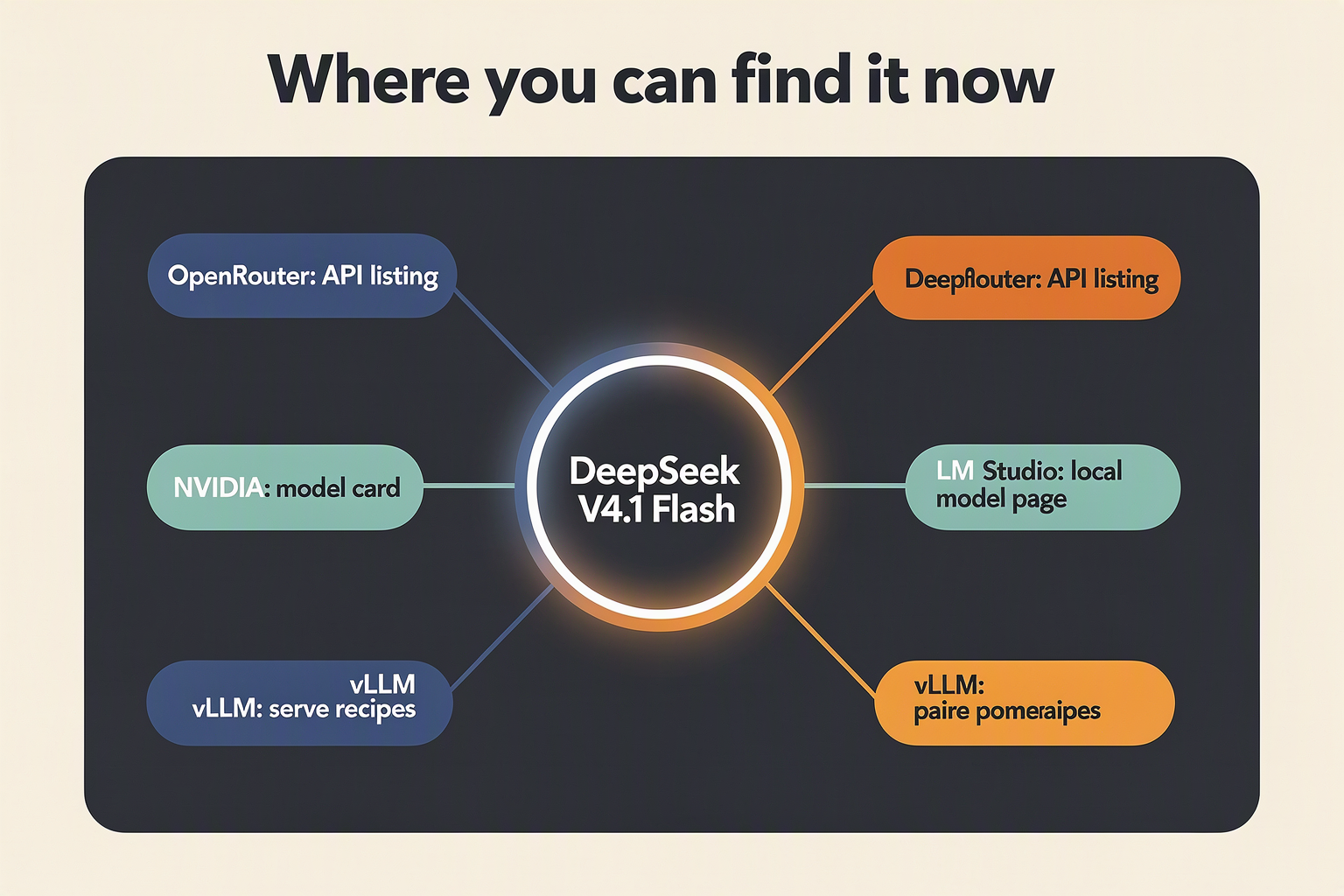
The industry response so far has been fast, broad adoption: within weeks of the September 2026 launch, DeepSeek V4.1 Flash appeared on hosted inference platforms, local-model tools, GPU vendor catalogues and open-source serving recipes. The common thread is that providers are treating it as a practical default model, not just a research release.
Which platforms have added DeepSeek V4.1 Flash?
Support spans the full stack, from cloud APIs to desktop tools:
- Aggregators and routers: OpenRouter lists the model with public pricing and benchmarks. It also notes that its listing redirects to the latest model in the DeepSeek Flash family, so teams pinning a version should check what an alias resolves to.
- Serverless inference providers: Lyceum Technology says DeepSeek-V4.1-Flash is live on Lyceum Serverless Inference, with a guide covering specs, benchmarks and per-token costs.
- Local and desktop tooling: LM Studio has a model page describing it as a 552B multimodal Mixture-of-Experts model for coding, reasoning, visual understanding and long-context agents.
- Model catalogues: NVIDIA's build.nvidia.com hosts a model card, though it states the model is not owned or developed by NVIDIA. VeniceStats also tracks it as a text-generation model.
How are infrastructure teams preparing to serve it?
The vLLM project published a dedicated serving recipe that lists many hardware targets: H100, H200, B200, GB200 NVL4, GB300 NVL4, B300, MI300X, MI325X, MI350X, MI355X and DGX Station (GB300). That covers both NVIDIA and AMD accelerators.
The recipe describes the architecture as combining sliding-window and compressed sparse attention with a two-level indexer, engram n-gram memory and hyper-connections. Day-one open-source serving support for a design this unusual suggests the inference ecosystem moved quickly.
What are the performance claims, and how should you read them?
DeepSeek-focused site deepseek-ai.net says official tests show the model surpassing DeepSeek V4 Pro on performance, cost, speed and total time. LM Studio's page notes that its agentic benchmark results were reported by DeepSeek at maximum reasoning effort.
Both are vendor-reported numbers. They are useful signals, but they are not independent evaluations, and results at maximum reasoning effort will not match what you see at lower settings. Run your own tests on your own prompts before switching production traffic.
What does this mean for developers choosing a model?
Broad availability changes the question from "can I access it?" to "where should I run it?" Three practical considerations follow:
- Compare total cost, not just token price. Reasoning effort affects how many output tokens a request consumes.
- Keep your integration portable. Multi-provider support means models and prices will keep shifting.
- Test long-context and image workloads separately. A 1M-token window and vision input are headline features, but your documents and screenshots are the real benchmark.
This is where a gateway approach helps. CallMissed, the OpenAI-compatible AI gateway, gives developers one API key and one balance across 140 models, including DeepSeek in its catalogue. Evaluating DeepSeek V4.1 Flash against another model is a one-line model-name change, and caller-chosen fallback models let you plan for a provider falling short.
The next section shows exactly what that request looks like.
Timeline of Events: How DeepSeek V4.1 Flash Reached the API
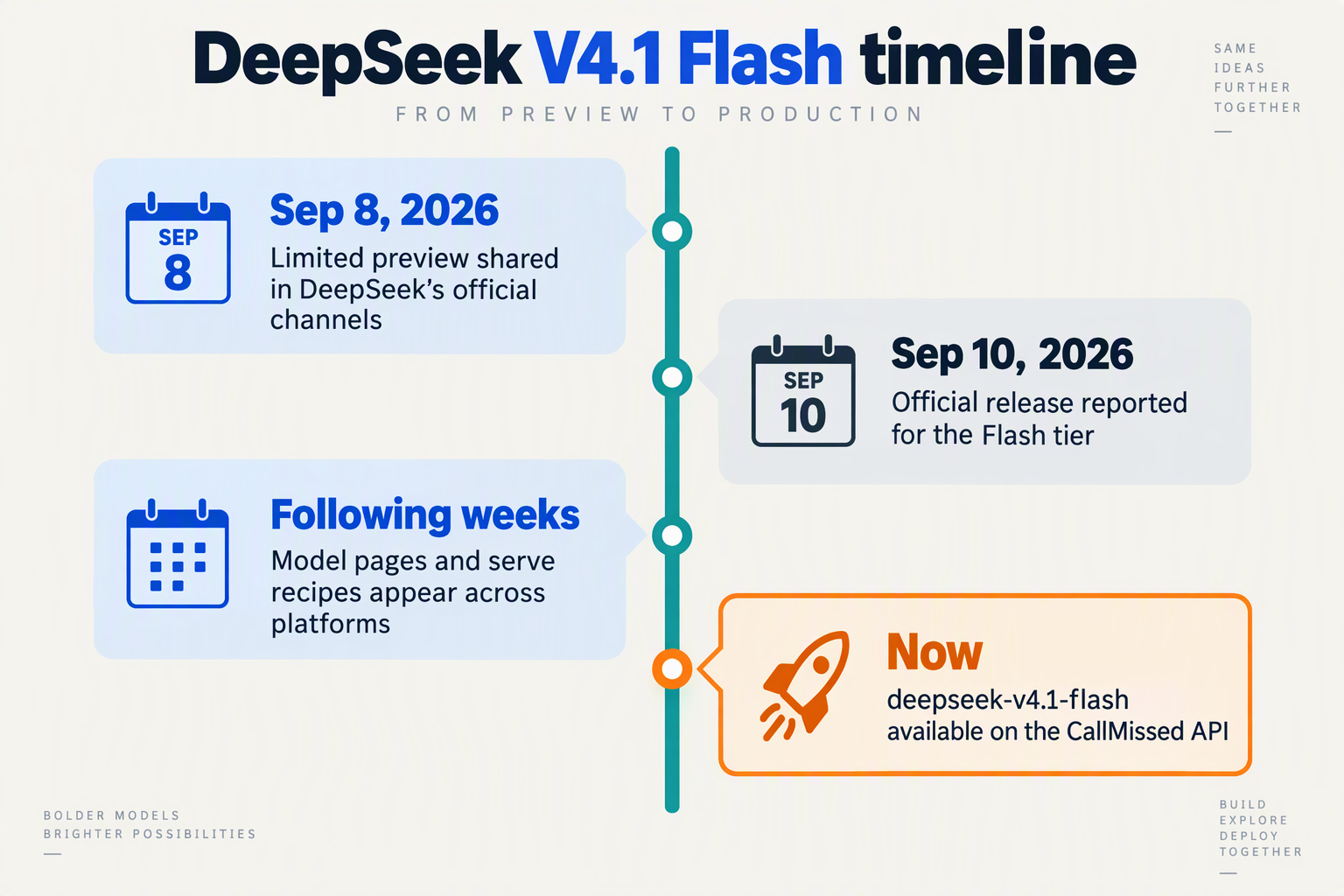
DeepSeek V4.1 Flash went from a quiet beta on September 8, 2026 to an official launch two days later, and it reached CallMissed's API and playground by October 2026. The table below traces that path, using only dates the cited sources actually state.
How did DeepSeek V4.1 Flash get from beta to the API?
| Date | Milestone | Source | Why it matters |
|---|---|---|---|
| Sep 8, 2026 | DeepSeek opens an intermediate beta build on its official channels | deepseek-ai.net | Described as an architecture trial run with an expiry date, not a full release |
| Sep 10, 2026 | Official launch as the Flash tier of a new architecture family | deepseek-ai.net | Positioned as the smallest model in the family and a suggested everyday default |
| After launch (exact dates not stated) | Model card and serving recipes appear on NVIDIA's build catalog, vLLM and LM Studio | build.nvidia.com, recipes.vllm.ai, lmstudio.ai | Open tooling makes self-hosting and local testing possible |
| After launch (exact date not stated) | Hosted inference goes live on Lyceum Serverless | Lyceum Technology | Adds a pay-per-token option with published specs |
| October 2026 | OpenRouter lists $0.15 per million input tokens and $0.60 per million output tokens | OpenRouter | Gives a public price benchmark for the model |
| October 2026 | Available on the CallMissed API and playground | CallMissed | Reachable with an existing key and balance |
What changed between the beta and the launch?
The beta was deliberately limited. According to deepseek-ai.net, DeepSeek released it on September 8 as "a trial run with an expiry date" rather than a full public release. The September 10 announcement then made it official.
The launch framing is where the claims start. deepseek-ai.net reports that DeepSeek's official tests show V4.1 Flash ahead of V4 Pro on performance, cost, speed and total time. That is a vendor-reported result, so run your own evaluation on your own prompts before relying on it.
How quickly did the ecosystem pick it up?
Fast, and across several layers of the stack. The vLLM recipe lists serving commands for hardware ranging from H100 and H200 to B200, GB300 and AMD's MI300X family. NVIDIA's model card and LM Studio's listing cover evaluation and local use. For teams that do not want to run a 552B-parameter model themselves, hosted routes such as Lyceum and OpenRouter fill the gap.
What should developers take from this timeline?
Three practical points follow:
- The model is only weeks old. Specs and prices can still move, so check current figures before you commit to a budget. The prices above are as of October 2026.
- Aliases can shift. OpenRouter notes that its listing "always redirects to the latest model in the DeepSeek Flash family." If you need reproducible results, pin the exact model ID rather than relying on a floating name.
- Switching cost is small when you use a gateway. Platforms like CallMissed, with 140 models behind one OpenAI-compatible API, let you compare DeepSeek V4.1 Flash against other models by changing one parameter in the request. Your SDK, key and billing stay the same.
The next section covers exactly how to make that call, including the model ID and a working request.
How do you call deepseek-v4.1-flash with the OpenAI SDK?

You call deepseek-v4.1-flash with the OpenAI SDK by pointing the client at CallMissed's base URL, passing your CallMissed API key, and setting model="deepseek-v4.1-flash". CallMissed, the OpenAI-compatible AI gateway, serves the model through the same chat completions endpoint as its other 139 models, so no new SDK is needed.
What do you need before the first request?
You need three things, as of October 2026:
- A CallMissed account. Signing up at console.callmissed.com gives you 1,000 free credits, enough to test the model before adding a balance.
- An API key from the console. The same key and balance work across every model in the catalogue.
- The model ID:
deepseek-v4.1-flash. This matches the identifier used in LM Studio's and OpenRouter's listings. Confirm it in the console model list or at docs.callmissed.com, along with the exact base URL for your region.
How do you send a basic chat completion?
Install the official OpenAI Python package, then change the base URL and key:
from openai import OpenAI

client = OpenAI(
    base_url="https://api.callmissed.com/v1",
    api_key="YOUR_CALLMISSED_KEY",
)

response = client.chat.completions.create(
    model="deepseek-v4.1-flash",
    messages=[
        {"role": "system", "content": "You are a careful code reviewer."},
        {"role": "user", "content": "Explain what this function does and flag bugs."},
    ],
)

print(response.choices[0].message.content)
Everything else in your existing code, including message formatting and response parsing, stays the same. That is the practical meaning of OpenAI compatibility: the migration is a two-line diff.
How do you add streaming, tools and reasoning effort?
CallMissed's gateway supports streaming, function calling, structured outputs, vision input and reasoning effort control, so each feature uses the standard OpenAI parameter:
stream = client.chat.completions.create(
    model="deepseek-v4.1-flash",
    messages=[{"role": "user", "content": "Plan a refactor for this module."}],
    reasoning_effort="high",
    tools=[{
        "type": "function",
        "function": {
            "name": "search_repo",
            "description": "Search the codebase for a symbol",
            "parameters": {
                "type": "object",
                "properties": {"symbol": {"type": "string"}},
                "required": ["symbol"],
            },
        },
    }],
    stream=True,
)

for chunk in stream:
    if chunk.choices and chunk.choices[0].delta.content:
        print(chunk.choices[0].delta.content, end="")
When the model returns a tool call, run your function, append the result as a tool message, and call the API again. The loop is identical to any other OpenAI-style agent.
For images, pass an image_url content part alongside your text. NVIDIA's model card confirms the model accepts text and images and generates text.
What should you watch for in production?
- Rate limits: Default limits per key are 60 requests per minute on Free, 500 on Starter, 3,000 on Pro and 10,000 on Enterprise. Long-context agents that loop quickly can hit the Free ceiling, so check your tier first.
- Fallbacks: Set a caller-chosen fallback model so a failed request retries on another model instead of erroring out.
- Response caching: Repeated long prompts, such as a fixed repository summary, are good candidates for caching.
- Reasoning effort: Start low for routine chat and raise it only for hard planning or debugging, since higher effort generates more output tokens.
Because the Anthropic-compatible /v1/messages endpoint is also available, teams using Anthropic's SDK can reach the same model by changing the base URL there too.
Which fallback model should you pair with DeepSeek V4.1 Flash?
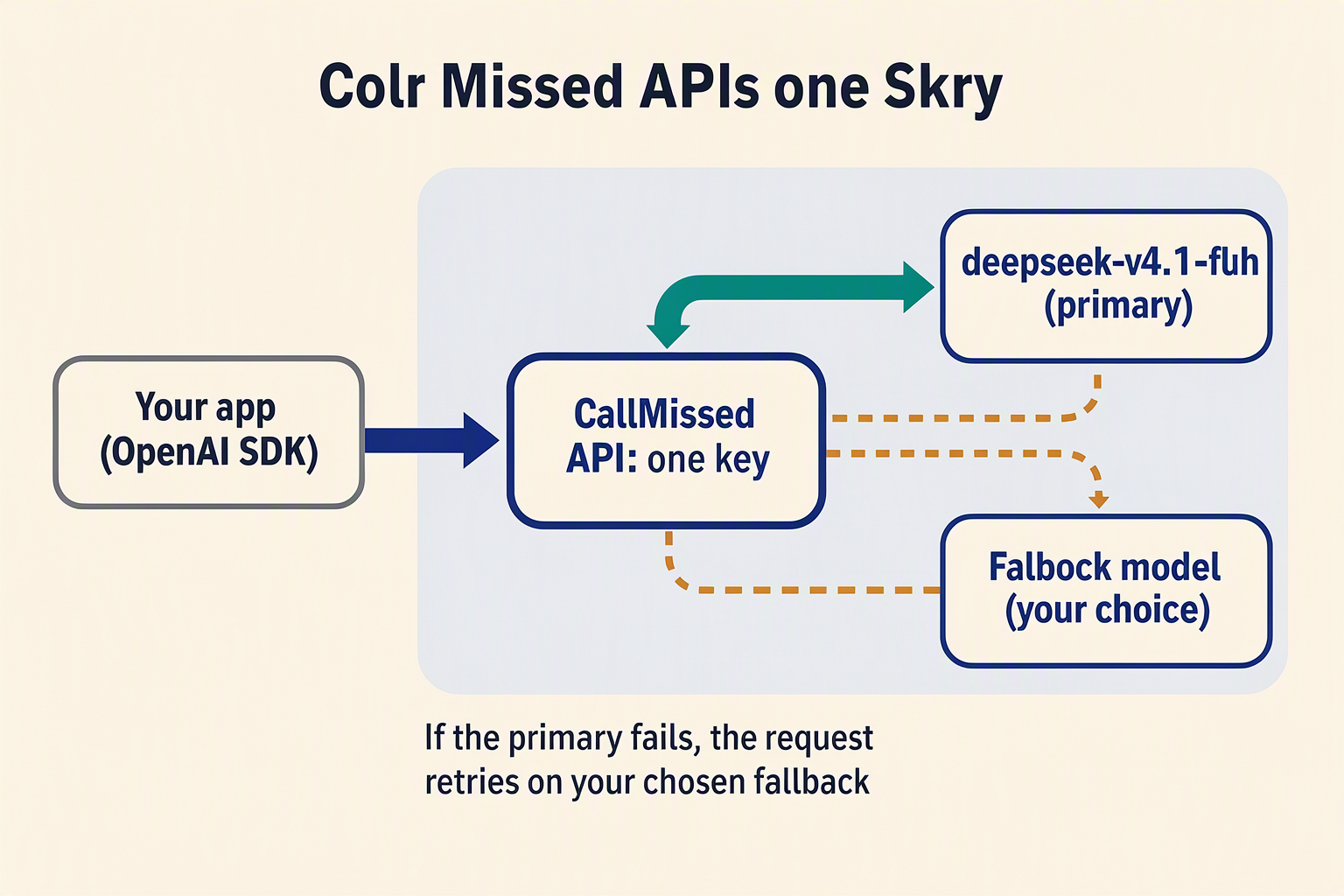
Pair DeepSeek V4.1 Flash with a fallback from a different model maker that supports the same capabilities your request uses: tool calling, image input and enough context for your longest prompt. CallMissed's API lets you choose fallback models per request, so you decide the backup rather than relying on a hidden default. As of October 2026, the catalogue has 45 general-purpose LLMs from makers including OpenAI, Google, Moonshot (Kimi), Zhipu (GLM), Mistral, xAI and Amazon.
Why does a fallback model matter for a new release?
DeepSeek V4.1 Flash only reached official launch on September 10, 2026, according to deepseek-ai.net, and its serving ecosystem is still maturing. OpenRouter also notes that its listing "always redirects to the latest model in the DeepSeek Flash family", a reminder that aliases can move under you. A fallback protects production traffic from a provider hiccup, and pinning the exact model ID protects it from silent upgrades.
How do you choose the right fallback?
Work through four checks, in this order:
- Match the input types. DeepSeek V4.1 Flash accepts text and images, according to NVIDIA's model card. If any request carries a screenshot or chart, your fallback must also support vision input, or the retry will fail for a different reason.
- Match tool calling and structured output. An agent that depends on function calling or JSON schemas needs a backup that supports both. Test your actual tool definitions against it rather than assuming parity.
- Respect the context ceiling. DeepSeek V4.1 Flash supports up to one million combined tokens, which many alternatives will not. If you send very long prompts, either trim them for the fallback or choose a fallback with a comparably large window.
- Diversify the maker. A backup from another maker, such as Moonshot's Kimi, Zhipu's GLM, Google or OpenAI, is less likely to share a failure with DeepSeek-hosted capacity.
What does a sensible pairing look like in practice?
Consider two common workloads.
- Long-running coding agent: The primary is DeepSeek V4.1 Flash with moderate reasoning effort for cost-efficient tool loops. The fallback is a general-purpose LLM with strong function calling and a large context window. Check how it handles your longest traces before you rely on it.
- Document and screenshot analyser: The primary is DeepSeek V4.1 Flash for image-plus-text reading. The fallback must be a vision-capable model, and you should confirm it returns the same structured output schema.
How should you test the pair before shipping?
Run the same evaluation set through both models and compare, rather than trusting benchmark claims. LM Studio's listing notes that DeepSeek's agentic results were reported at maximum reasoning effort, so your own results at lower effort settings may differ.
- Compare tool-call accuracy, schema validity and answer quality on 50 to 100 real prompts from your own traffic.
- Track cost per task, not just per token. OpenRouter's October 2026 listing of $0.15 per million input tokens and $0.60 per million output tokens sets a low bar for a fallback to match.
- Use response caching for repeated prompts, and review request logs to see how often the fallback actually fires.
Because CallMissed offers one API key and one balance across all of these models, a fallback adds no new account or billing setup. Check the CallMissed docs for exactly which error conditions trigger a retry, and test those paths deliberately before launch.
Frequently Asked Questions
What is DeepSeek V4.1 Flash?
Is DeepSeek V4.1 Flash available on the CallMissed API, and what is the model ID?
model field of a standard chat completions call. The upstream slug on other gateways, such as OpenRouter's deepseek/deepseek-v4.1-flash, may differ from the ID you use on CallMissed.How large is the DeepSeek V4.1 Flash context window?
Does DeepSeek V4.1 Flash support tool calling, images and reasoning effort?
How much does DeepSeek V4.1 Flash cost?
How do I switch an existing app to DeepSeek V4.1 Flash, and what rate limits apply?
Conclusion
DeepSeek V4.1 Flash pairs very large scale with unusually lean inference, and as of October 2026 you can try it on CallMissed by changing a model name.
Key takeaways:
- Sparse by design: Lyceum Technology and vLLM document a 552B Mixture-of-Experts backbone that activates only 8B parameters per prompt token and 16B per output token.
- Long and multimodal: NVIDIA's model card confirms text and image input with up to one million tokens of combined context.
- Controllable: tool calling and adjustable reasoning effort let you trade depth for speed on each request.
- Low cost: OpenRouter lists $0.15 per million input tokens and $0.60 per million output tokens as of October 2026.
What to watch next: deepseek-ai.net says DeepSeek positions V4.1 Flash as the smallest member of a new architecture family. Larger siblings are expected, and the real test will be how the Causal Encoder-Decoder design holds up in long-running agent workloads.
To explore how AI communication is evolving, check out CallMissed. Its OpenAI-compatible gateway reaches 140 models through one API key and one balance, and new accounts get 1,000 free credits to experiment.
Which of your long-context workflows would you hand to a million-token model first?
Related Reading
- Bulbul V4 Flash Now on CallMissed API: Sarvam's Fast TTS
- Claude Haiku 5.5 Now on CallMissed: Price, 1M Context, API
- GPT-6 Sol API Guide: Pricing, Context Window and Setup