DeepSeek V4.1 Flash benchmarks vs Claude Fable 5.5


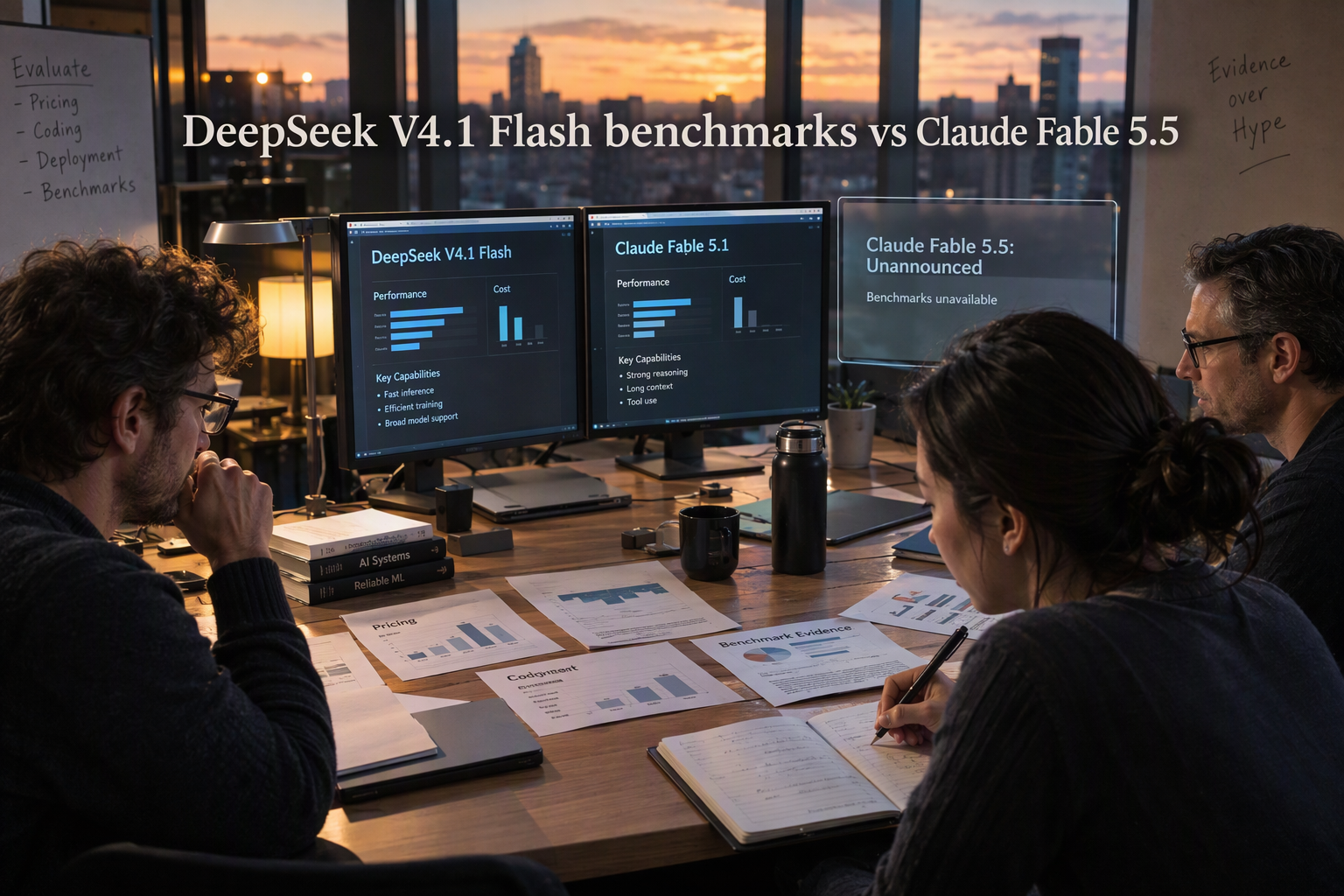
DeepSeek V4.1 Flash benchmarks, pricing and features are checked against confirmed Claude Fable 5.1 data, with Fable 5.5 unknowns clearly marked.
DeepSeek V4.1 Flash benchmarks vs Claude Fable 5.5
How do you benchmark a model that does not officially exist? Any credible review of DeepSeek V4.1 Flash benchmarks vs Claude Fable 5.5 must begin with that problem: as of October 14, 2026, Anthropic has not announced, documented or released Claude Fable 5.5, so there is no verified model endpoint to test and no defensible head-to-head scorecard to publish.
That distinction matters because an Azure catalogue entry triggered fresh speculation on October 13, 2026. CellCog reported that the azure_ai/claude-fable-5-5 identifier appeared with specifications copied from Claude Fable 5.1, while Anthropic had published no announcement, model card or pricing. OrcaRouter similarly found that Anthropic’s newsroom had announced Claude Haiku 5.5 on October 7, 2026, but contained no corresponding Fable 5.5 release.
A catalogue row is not the same as a runnable, independently verifiable model. It may represent advance provisioning, placeholder metadata, a provider-specific alias or an unreleased deployment. Treating such an entry as benchmark evidence risks comparing DeepSeek V4.1 Flash with copied specifications—or even with another model operating behind an opaque route.
The latest publicly documented member of the Fable line is instead Claude Fable 5.1, released on September 1, 2026, according to Kunavo and OrcaRouter. Kunavo lists its API identifier as claude-fable-5-1 and its price as $10 per million input tokens and $50 per million output tokens as of October 2026. Kunavo’s verification checklist is especially useful: Fable 5.5 has “no model ID, price, model page or system card.”
This article therefore takes an evidence-led, deliberately asymmetric approach. It will examine sourced DeepSeek V4.1 Flash benchmark claims—including their test conditions, scoring methods and practical relevance—while marking Claude Fable 5.5 as not benchmarkable, rather than filling an empty column with rumours. Readers will learn:
- Which DeepSeek V4.1 Flash results have attributable sources
- Whether tests measure reasoning, coding, speed, cost or a mixture of them
- Why benchmark version, prompting and sampling settings can change rankings
- What evidence would be required before a genuine Fable 5.5 comparison becomes possible
This verification discipline is increasingly important as developers route workloads across multiple providers. As of October 2026, CallMissed’s OpenAI-compatible developer API provides one key and one balance for 140 models, including models from DeepSeek, with caller-selected fallbacks—but model availability still does not make unrelated or unreleased benchmark claims comparable.
The conclusion may be less sensational than a league table, but it is more useful: DeepSeek V4.1 Flash can be assessed only against published evidence, while Claude Fable 5.5 cannot responsibly receive benchmark scores until Anthropic releases a verifiable model.
What is the verdict on Claude Fable 5.5 vs DeepSeek V4.1 Flash as of October 14, 2026?
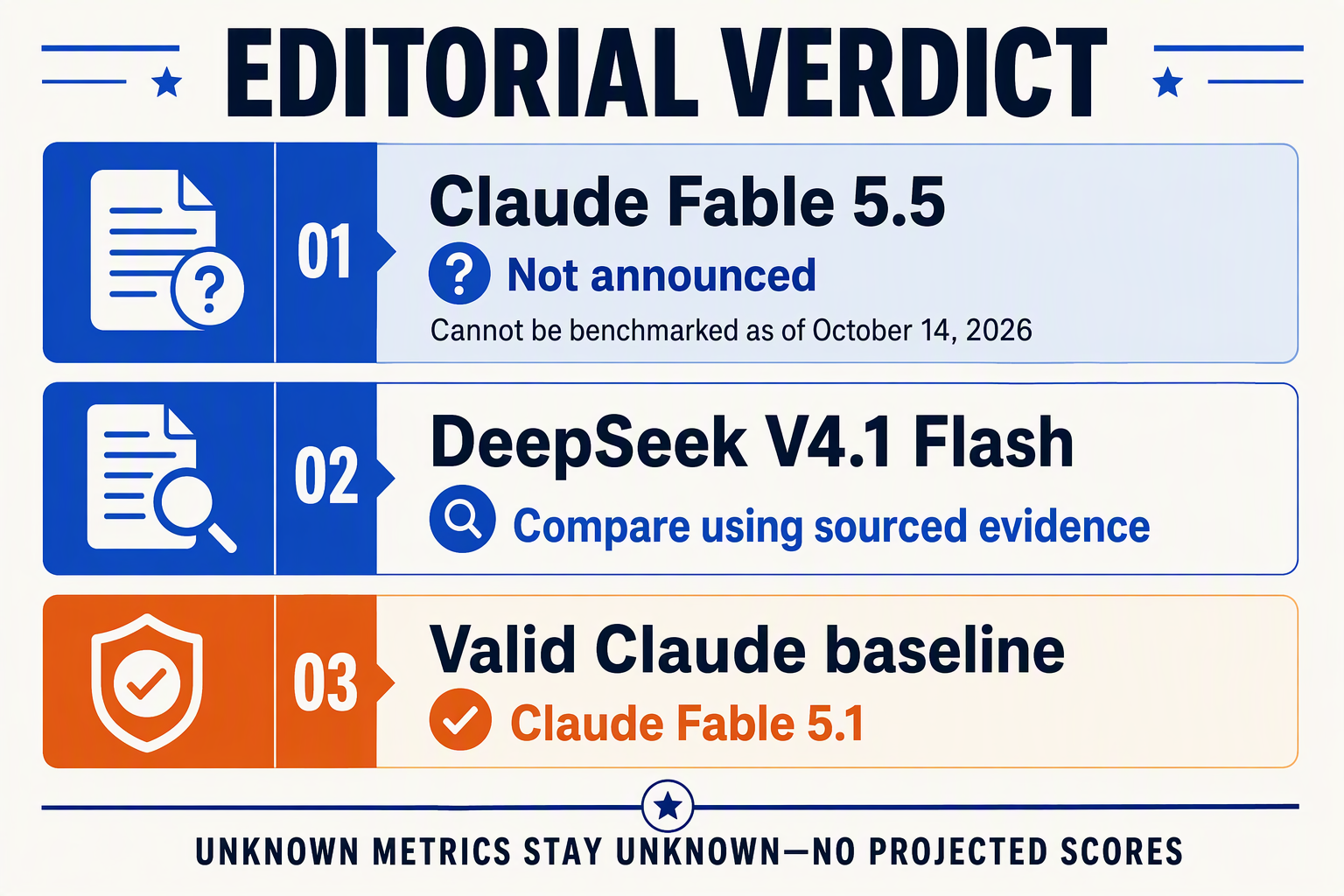
The verdict as of October 14, 2026 is that no valid Claude Fable 5.5 vs DeepSeek V4.1 Flash winner can be declared. Claude Fable 5.5 remains unannounced and untestable, while any conclusion about DeepSeek V4.1 Flash must be limited to attributable benchmark results with disclosed test conditions.
Why can’t Claude Fable 5.5 be benchmarked?
A benchmark requires access to a stable model, an identifiable version and reproducible inference settings. Claude Fable 5.5 currently satisfies none of those requirements.
Kunavo reported on October 2, 2026 that Claude Fable 5.5 had no model ID, price, model page or system card. OrcaRouter confirmed on October 14, 2026 that Anthropic still had not announced the model and continued to document Claude Fable 5.1 as the newest Fable release.
The Azure catalogue identifier does not resolve that evidence gap. CellCog reported on October 13, 2026 that azure_ai/claude-fable-5-5 reproduced Claude Fable 5.1 specifications rather than providing independently documented Fable 5.5 specifications.
Consequently, purported Fable 5.5 scores could represent:
- A placeholder or provider alias
- Claude Fable 5.1 under a different route
- An internal model that may change before release
- An undocumented deployment with unknown system settings
- A fabricated or incorrectly labelled test
None provides a reproducible basis for comparison.
What can the evidence establish about DeepSeek V4.1 Flash?
DeepSeek V4.1 Flash should be judged only through sourced results—not by placing numbers beside an empty Fable 5.5 column. A credible assessment must identify the benchmark publisher, dataset version, prompt format, sampling configuration, tool access and scoring method.
The research supplied for this section contains no attributable DeepSeek V4.1 Flash benchmark scores or primary model documentation. Reporting numerical results here would therefore create false precision. Later analysis can evaluate sourced DeepSeek claims individually, but it should not transform them into a head-to-head ranking unless Claude Fable 5.5 becomes publicly testable under equivalent conditions.
Useful DeepSeek evidence should answer four questions:
- Which exact endpoint and model revision was tested?
- Was the score independently reproduced or only vendor-reported?
- Were reasoning tokens, tools, retries or pass@k sampling allowed?
- Were latency and cost measured under the same workload and region?
Without those controls, even a genuine score may not transfer to production coding, reasoning or high-throughput inference.
What is the practical buying decision today?
For teams choosing a deployable model on October 14, 2026, Claude Fable 5.5 should be treated as unavailable rather than poorly performing. “Not benchmarkable” is not a score of zero; it means there is no verified evidence from which to infer quality, speed, context capacity or price.
The defensible decision is therefore:
- Evaluate DeepSeek V4.1 Flash only where a verified endpoint and reproducible evidence exist.
- Compare it with released models, including Claude Fable 5.1 where appropriate.
- Exclude Claude Fable 5.5 from procurement scorecards until Anthropic publishes documentation and access.
- Re-run identical tests if Fable 5.5 is officially released.
Current winner: none. Evidence winner: the model with reproducible results—presently not Claude Fable 5.5.
Why must the comparison use confirmed Claude Fable 5.1 data instead of invented Fable 5.5 metrics?
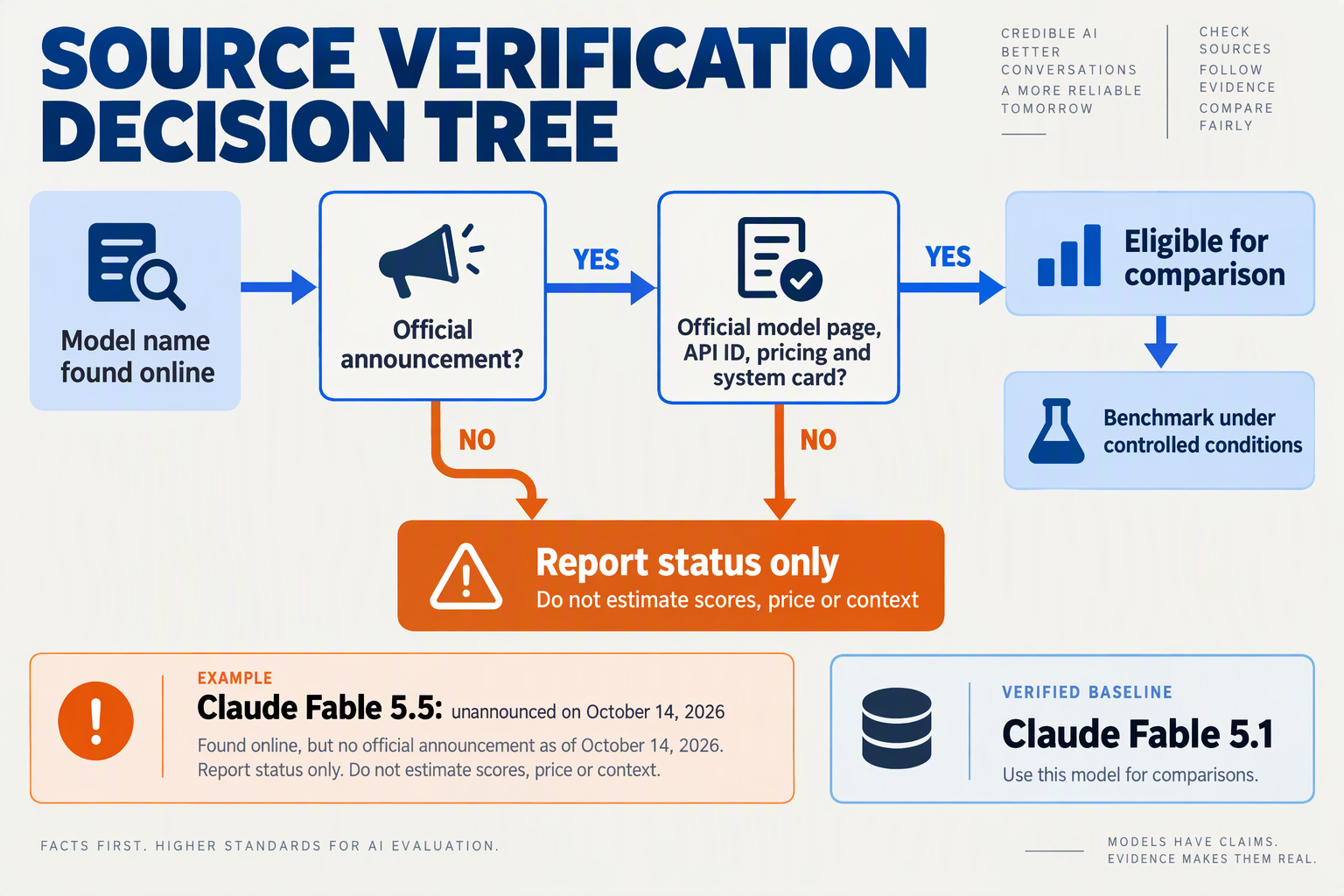
Confirmed Claude Fable 5.1 data should be used as a historical baseline because it is attributable to a released model; invented Claude Fable 5.5 metrics have no testable endpoint, model card or reproducible methodology behind them. As of October 14, 2026, Fable 5.1 results may contextualize DeepSeek V4.1 Flash, but they must never be relabelled as Fable 5.5 results.
What evidence exists for Claude Fable 5.1?
Claude Fable 5.1 has the minimum identifiers required for an evidence-led comparison: a reported release date, API model name and published pricing. Kunavo reports that Anthropic released Claude Fable 5.1 on September 1, 2026, under the API identifier claude-fable-5-1.
Kunavo lists Claude Fable 5.1 pricing as $10 per million input tokens and $50 per million output tokens as of October 2026. OrcaRouter also identifies Fable 5.1 as the newest publicly documented Fable model as of October 14, 2026.
Those facts allow researchers to define what was tested and calculate workload costs. A reproducible evaluation still needs to record:
- The exact
claude-fable-5-1model identifier - Benchmark name, version and evaluation date
- System prompt and user prompt
- Temperature, token limit and sampling settings
- Number of runs and scoring procedure
- Tool access, reasoning settings and retry policy
Without that information, even a score attached to a real model can be difficult to reproduce.
Why can’t Fable 5.1 scores be assigned to Fable 5.5?
A version number can imply changes to model weights, training data, safety behaviour, inference configuration or tool use. Consequently, Fable 5.1 is evidence about Fable 5.1—not a statistical estimate of an unreleased Fable 5.5.
The October 2026 Azure listing does not close this evidence gap. CellCog reported on October 13, 2026, that the azure_ai/claude-fable-5-5 catalogue entry copied every specification from Fable 5.1. Copied metadata cannot demonstrate that a new model exists behind the route, much less establish its coding accuracy, reasoning quality, latency or price.
Kunavo’s verification checklist says Fable 5.5 has “no model ID, price, model page or system card.” SeedRouter likewise reports that Anthropic has not announced the model, while OrcaRouter notes that Anthropic announced Claude Haiku 5.5 on October 7, 2026 but published no equivalent Fable announcement.
How should DeepSeek V4.1 Flash be compared fairly?
The comparison should separate measured evidence from unavailable evidence:
- Report sourced DeepSeek V4.1 Flash results with their benchmark versions, settings and dates.
- Mark Claude Fable 5.5 as not benchmarkable as of October 14, 2026.
- Use verified Fable 5.1 figures only in a clearly labelled historical-baseline column.
- Avoid calculating a winner, percentage gap or price-performance ratio against Fable 5.5.
- Retest both models if Anthropic publishes an official Fable 5.5 endpoint and documentation.
This produces an intentionally asymmetric comparison, but not an unfair one. “Unknown” is the correct evidence status for Claude Fable 5.5; zero, estimated and copied-from-Fable-5.1 are all materially different—and misleading—claims.
Which model developments and release claims are verified?
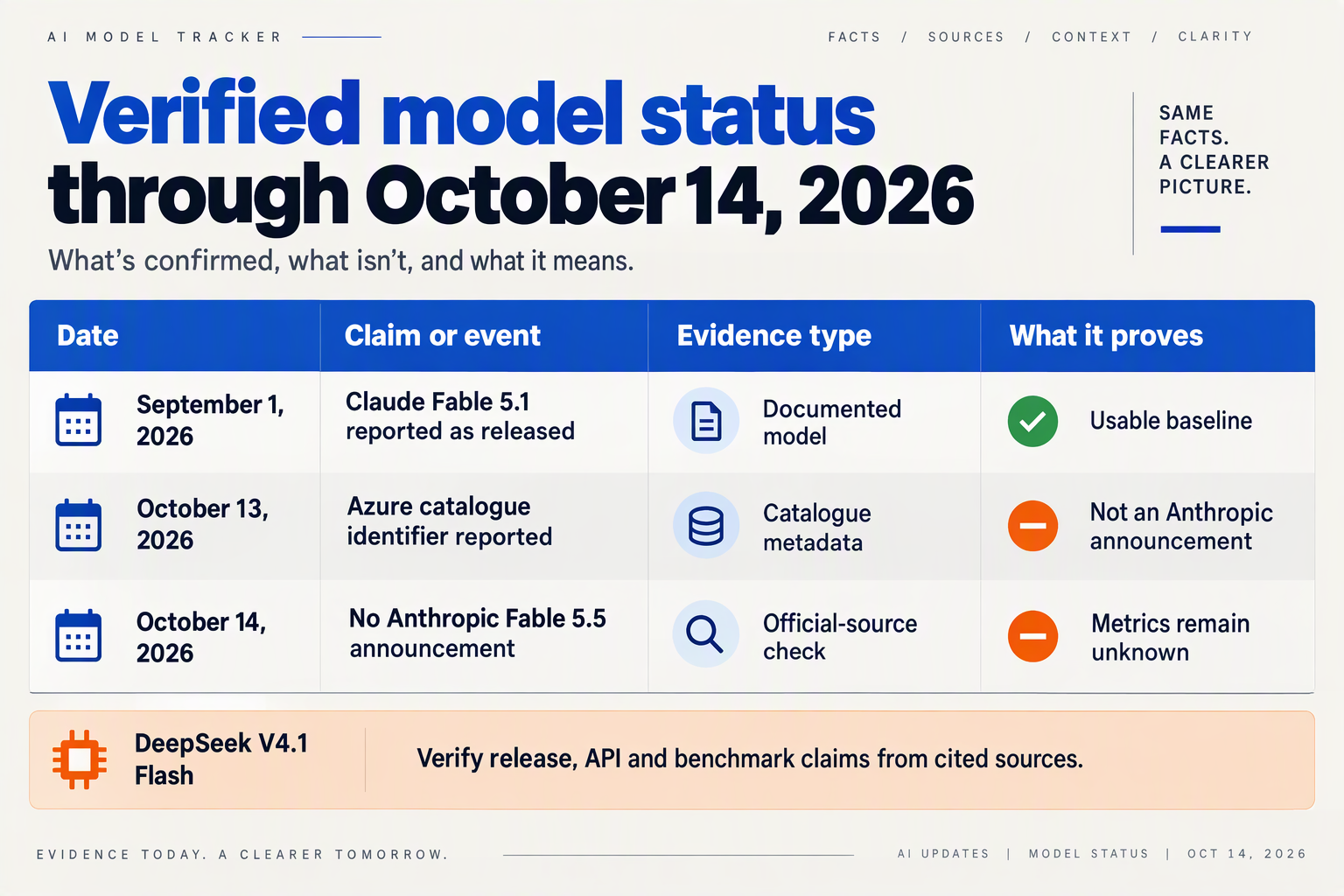
Claude Fable 5.5 has not been announced and cannot be benchmarked as of October 14, 2026. The supplied research also contains no attributable release note, model card or benchmark report for DeepSeek V4.1 Flash, so claims about that model must remain unverified until a primary or reproducible source is produced.
What does the verified release record show?
| Release claim | Evidence and source | Date checked | Evidence-led verdict |
|---|---|---|---|
| Claude Fable 5.5 is officially released | Anthropic had published no announcement, model page, system card or API documentation, according to Kunavo and OrcaRouter. | Oct. 14, 2026 | Not verified |
| An Azure listing proves Fable 5.5 exists | CellCog found azure_ai/claude-fable-5-5, but reported that every specification was copied from Fable 5.1. | Oct. 13, 2026 | Catalogue evidence only |
| Fable 5.5 has official pricing | Kunavo found “no model ID, price, model page or system card” for Fable 5.5. | Oct. 2, 2026 | Not verified |
| Claude Fable 5.1 is the latest documented Fable | Kunavo and OrcaRouter identify claude-fable-5-1, released September 1, 2026. | Oct. 14, 2026 | Verified by cited reporting |
| DeepSeek V4.1 Flash has a verified release | No DeepSeek announcement, documentation or model card is included in the supplied research record. | Oct. 14, 2026 | Not established here |
| DeepSeek V4.1 Flash has benchmark results comparable with Fable 5.5 | No attributable DeepSeek test report is supplied, while Fable 5.5 has no confirmed endpoint to test. | Oct. 14, 2026 | Comparison unavailable |
The Azure entry is a development signal, not proof of a distinct model. CellCog reported on October 13, 2026 that the listing appeared as generally available while reproducing Fable 5.1’s specifications; possible explanations include placeholder metadata, advance provisioning or an alias. None establishes what weights—or even what model—serve a request.
The official-release check points in the opposite direction. OrcaRouter reported that Anthropic’s newsroom announced Claude Haiku 5.5 on October 7, 2026, yet contained no Fable 5.5 announcement as of October 14. A named sibling release therefore cannot be used to infer that another member of the Claude 5.5 family is available.
Which DeepSeek V4.1 Flash claims can be compared responsibly?
The current evidence packet does not provide a named DeepSeek source, test configuration or result table. That absence does not prove that DeepSeek V4.1 Flash is nonexistent; it means this section cannot responsibly label its release or performance claims as verified.
Before accepting any reported score, readers should require:
- A primary release note or model card identifying the exact DeepSeek model and version.
- A runnable endpoint or downloadable weights with an immutable version identifier.
- The benchmark name and revision, including contamination controls.
- Prompt templates, tool settings, sampling parameters and scoring scripts.
- Latency, throughput and price measurements dated to the same deployment period.
What would unlock a genuine comparison?
A defensible comparison requires both sides to clear the same three gates:
- Identity: stable model IDs and provider documentation.
- Reproducibility: accessible endpoints plus disclosed evaluation settings.
- Comparability: identical datasets, prompts, scoring rules and hardware or hosting disclosures.
Until those conditions are met, assigning scores to Claude Fable 5.5—or presenting unsourced DeepSeek V4.1 Flash numbers beside it—would create a precise-looking table without reliable evidence.
How do pricing, context and multimodal support compare?
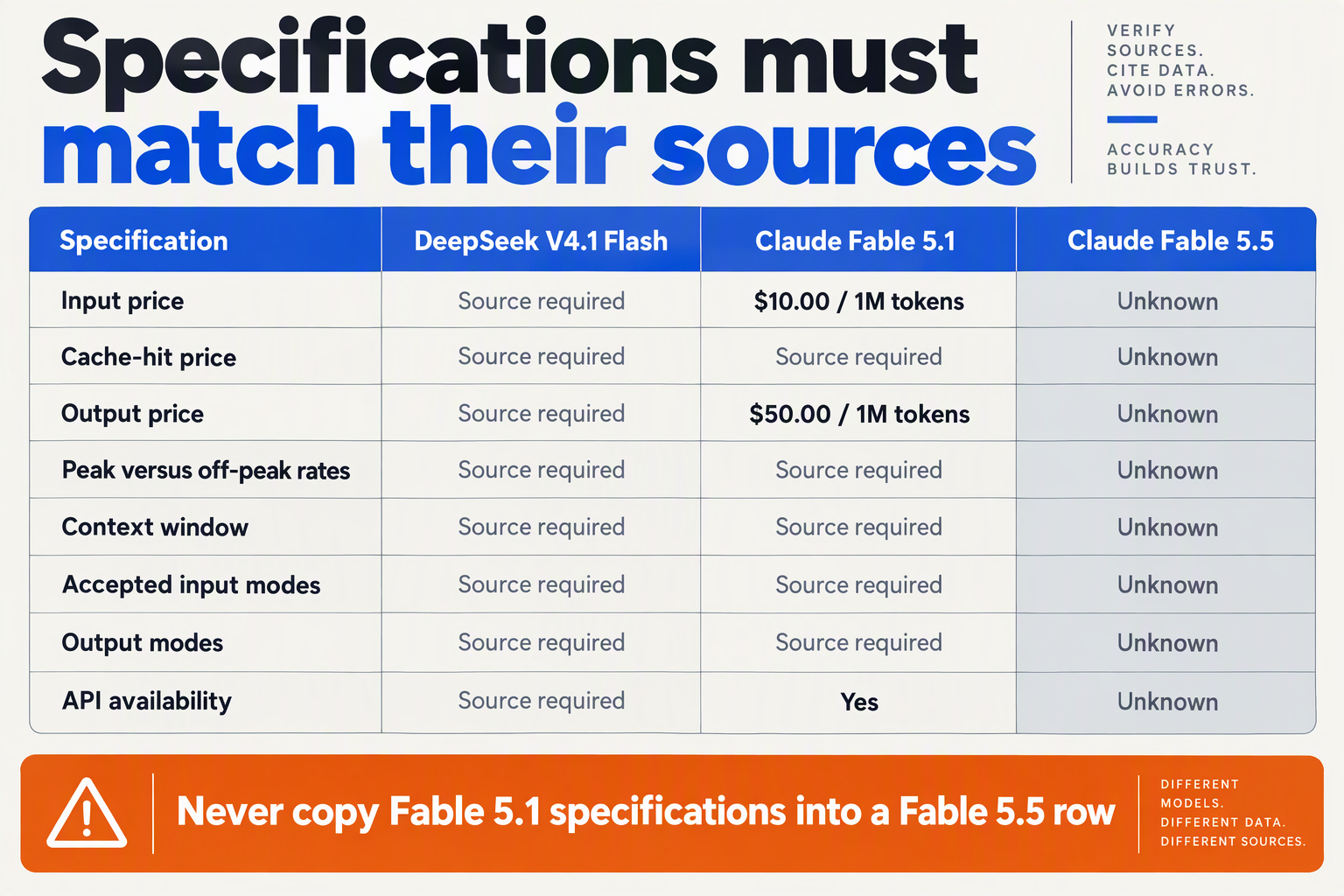
No verified like-for-like comparison is currently possible. As of October 14, 2026, Claude Fable 5.5 has no official price, context-window specification or multimodal documentation; the supplied source set also provides no attributable pricing, context or modality specifications for DeepSeek V4.1 Flash.
What specifications can be verified as of October 14, 2026?
| Specification | Claude Fable 5.5 | DeepSeek V4.1 Flash | Evidence-led interpretation |
|---|---|---|---|
| Official availability | Not announced by Anthropic | Not established by the supplied sources | Availability must be confirmed through first-party documentation before testing |
| API pricing | No verified input or output price | No sourced figure available here | Cost comparisons would be speculative |
| Context window | No verified token limit | No sourced figure available here | Do not copy limits from adjacent model versions |
| Text input and output | No documented endpoint | Not documented in the supplied evidence | A model name alone does not prove callable capabilities |
| Image or multimodal input | No verified support | No sourced specification available here | Vision support requires endpoint documentation and testable requests |
| Model documentation | No model page or system card | No DeepSeek model card included in the source set | Benchmark claims need traceable versions and configurations |
The distinction between “not supported” and “not verified” is critical. For example, the table does not claim that DeepSeek V4.1 Flash lacks multimodal support; it says the evidence supplied for this comparison does not establish that capability. Likewise, Claude Fable 5.5 may eventually support text, images or other modalities, but no such feature can be attributed to it yet.
Why can’t the Azure specifications fill the missing fields?
The Azure catalogue entry cannot safely supply Claude Fable 5.5’s context or multimodal specifications because its metadata may not describe a distinct production model. CellCog reported on October 13, 2026, that every specification attached to azure_ai/claude-fable-5-5 had been copied from Claude Fable 5.1.
Using those fields would introduce two avoidable errors:
- Version substitution: treating Claude Fable 5.1 specifications as evidence for Fable 5.5.
- Capability inference: assuming a catalogue identifier guarantees an accessible endpoint with the listed modalities.
Kunavo reported in October 2026 that Claude Fable 5.5 had “no model ID, price, model page or system card.” OrcaRouter also found no Anthropic announcement as of October 14, 2026. Those absences prevent responsible claims about token limits, image handling, caching or price.
What would make the pricing comparison meaningful?
A defensible cost analysis needs more than headline prices. Once both models are documented, buyers should normalize:
- Input and output cost per million tokens
- Cached-input and cache-write charges
- Reasoning-token billing
- Image-token or image-request pricing
- Maximum context and maximum generated output
- Provider-specific minimums, rate limits and regional availability
Claude Fable 5.1’s $10-per-million input and $50-per-million output price, reported by Kunavo for October 2026, may serve as historical context—but not as a proxy for Fable 5.5.
Until first-party specifications are available for both named models, the accurate conclusion is narrow: pricing, context capacity and multimodal support cannot yet be compared on verified, model-specific evidence.
What do sourced benchmarks reveal about coding, agents and speed?
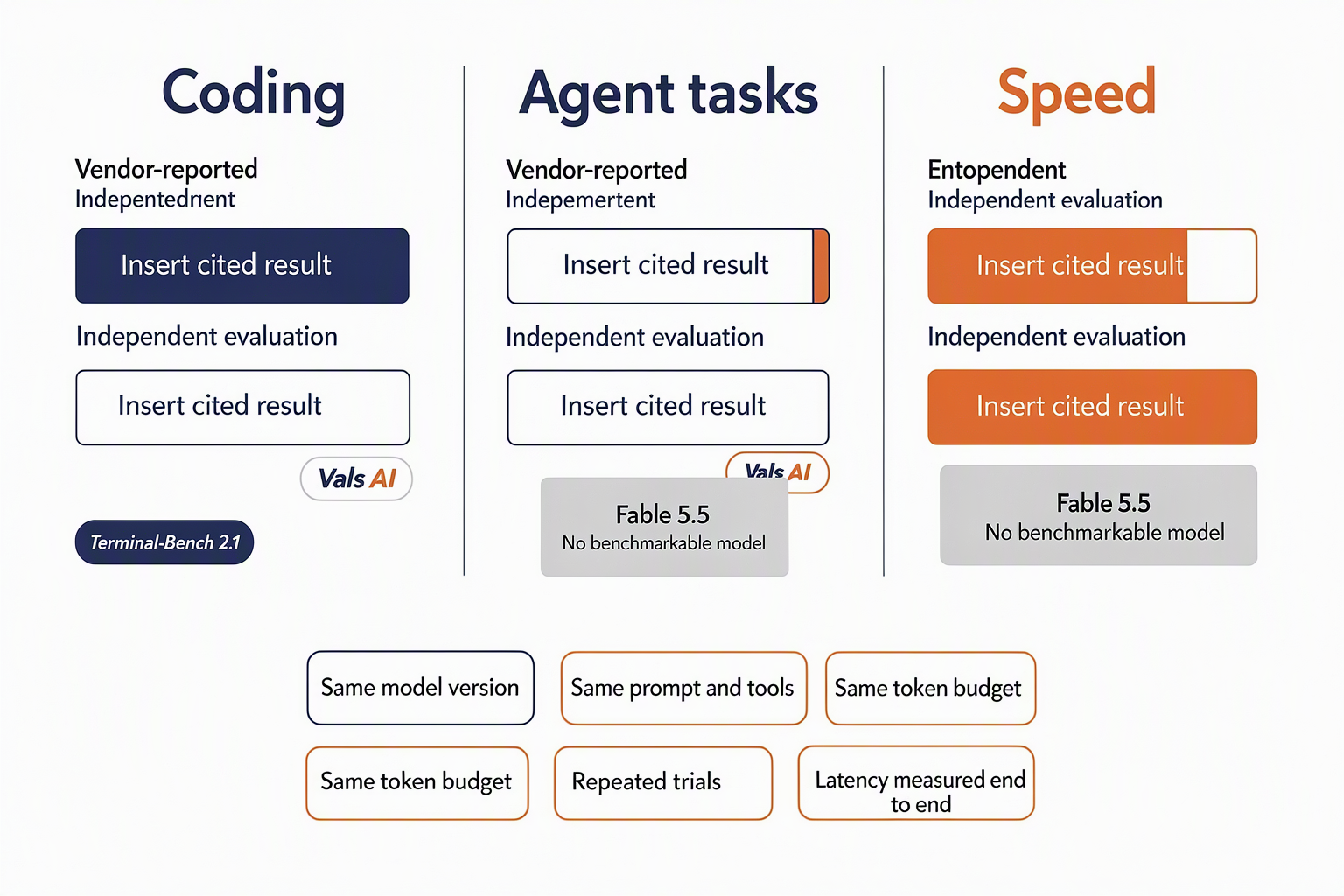
The sourced evidence does not support a coding, agentic or speed winner. As of October 14, 2026, the supplied research contains no attributable DeepSeek V4.1 Flash benchmark scores, test configurations or latency measurements, while Claude Fable 5.5 remains unannounced and cannot be benchmarked at all.
What do the available coding benchmarks actually establish?
No cited source in the current evidence set reports a reproducible DeepSeek V4.1 Flash result for coding benchmarks such as SWE-bench Verified, LiveCodeBench, HumanEval or Terminal-Bench. Publishing a percentage without a named source, benchmark version and evaluation setup would therefore create false precision.
For Claude Fable 5.5, even running an independent coding test is currently impossible through a verified Anthropic endpoint. Kunavo reported on October 2, 2026 that Claude Fable 5.5 had “no model ID, price, model page or system card.” OrcaRouter confirmed on October 14, 2026 that Anthropic still documented Claude Fable 5.1—not Fable 5.5—as the latest Fable model.
A defensible coding comparison would need to disclose:
- The exact model identifier and model snapshot
- The benchmark release and contamination controls
- Whether tools, repositories or execution sandboxes were available
- Prompting, retry limits and sampling settings
- The proportion of problems solved on the first attempt
- The evaluator used to verify patches or generated code
Without those details, a coding score cannot show whether a model produced working software, memorised familiar tasks or benefited from repeated attempts.
Can agent benchmarks determine which model is better?
No sourced agent benchmark currently creates a valid Fable 5.5 versus DeepSeek V4.1 Flash comparison. Agent evaluations measure an entire system—model, tools, scaffolding, memory and retry policy—not just the underlying language model.
For example, a model allowed 20 browser or shell actions may outperform another limited to five actions while consuming substantially more time and tokens. A meaningful agent report should therefore publish task success rate, median steps, tool-call failures, token consumption and cost per successful task together.
The Azure catalogue appearance does not solve this problem. CellCog reported on October 13, 2026 at 15:53 UTC that the azure_ai/claude-fable-5-5 entry reused Fable 5.1 specifications. That metadata cannot establish which model completed an agent task, whether routing changed during testing or whether the listed endpoint represented a distinct model.
Do the sources prove that “Flash” is faster?
The product name alone is not speed evidence. None of the supplied sources provides a controlled DeepSeek V4.1 Flash measurement for time to first token, output throughput or end-to-end task completion.
Speed claims should separate three measurements:
- Time to first token, which affects perceived responsiveness
- Tokens per second, which measures generation throughput
- Task completion time, which includes reasoning and tool calls
Results must also identify the API provider, region, concurrency, input length, output length and percentile. A median latency can conceal severe tail delays, so production evaluations should report at least p50 and p95 latency.
The evidence-led conclusion is therefore deliberately limited: neither coding leadership, superior agent performance nor a speed advantage has been established by the cited material. DeepSeek V4.1 Flash needs attributable benchmark records, and Claude Fable 5.5 needs an official, testable release before any genuine head-to-head ranking is possible.
Which benchmark claims should readers trust: vendor results or independent evaluations?

Independent evaluations generally deserve more weight than vendor-reported benchmarks, but neither should be accepted without test details. Vendor results can establish a model’s claimed capabilities; independent results are more persuasive when they reproduce the same model version, benchmark revision, prompt protocol and scoring method.
When are vendor benchmark results credible?
A DeepSeek V4.1 Flash benchmark published by DeepSeek should be treated as a primary-source claim, not automatically as an impartial verdict. Vendor testing can be technically rigorous, but the model developer controls important variables such as prompt design, sampling, tool access and competitor configuration.
A credible vendor result should disclose:
- The exact model identifier, checkpoint and release date
- The benchmark name and version—not merely “MMLU” or “HumanEval”
- Whether the score is pass@1, pass@k, accuracy or an LLM-judge rating
- Temperature, reasoning budget, context length and number of samples
- Whether tools, web search, code execution or retries were permitted
- The comparison models’ dates and equivalent test settings
- Any contamination checks or exclusions
Without those details, a headline score is marketing evidence rather than reproducible evidence. This section therefore does not assign DeepSeek V4.1 Flash any numerical result that lacks an attributable source and documented methodology.
What makes an independent evaluation trustworthy?
The strongest independent evaluation uses a publicly accessible production endpoint, records its model identifier and publishes enough information for another laboratory to rerun the test. Ideally, the evaluator also releases prompts, raw outputs, scoring code, failure cases and confidence intervals.
Readers should apply this hierarchy:
- Reproducible independent evaluation: Same endpoint, public methodology, raw outputs and repeated trials.
- Transparent vendor evaluation: Exact configuration and comparable settings are disclosed.
- Third-party leaderboard: Useful if model identity, prompting and scoring are auditable.
- Community testing: Helpful for discovering behaviours, but vulnerable to routing changes and selection bias.
- Screenshots, leaks and catalogue metadata: Evidence of a claim or identifier—not evidence of model performance.
Independent does not necessarily mean neutral. A leaderboard may use an opaque judge model, accept self-reported submissions or compare different API snapshots. Evaluators should disclose funding, provider relationships and whether models were tested blind.
Why can’t leaked Claude Fable 5.5 tests settle the comparison?
A benchmark requires a verifiable test subject. As of October 14, 2026, OrcaRouter reported that Anthropic had made no Claude Fable 5.5 announcement and continued to document Claude Fable 5.1, released on September 1, 2026, as the newest Fable model.
The identity problem is concrete: CellCog reported on October 13, 2026 that Microsoft Azure exposed an azure_ai/claude-fable-5-5 catalogue identifier whose specifications were copied from Fable 5.1. Kunavo separately found no Fable 5.5 model ID, price, model page or system card as of October 2, 2026.
Consequently, a claimed Fable 5.5 score could come from:
- A placeholder or provider alias
- Claude Fable 5.1 behind an opaque route
- An experimental checkpoint
- A mislabeled or fabricated result
The evidence-led conclusion is asymmetric: DeepSeek V4.1 Flash claims can be evaluated individually when their sources and methods are disclosed; Claude Fable 5.5 cannot be benchmarked at all until Anthropic identifies and releases the model. A blank comparison cell is more trustworthy than a precise-looking score attached to an unverified name.
How do privacy, deployment, support and normalized task costs change the decision?
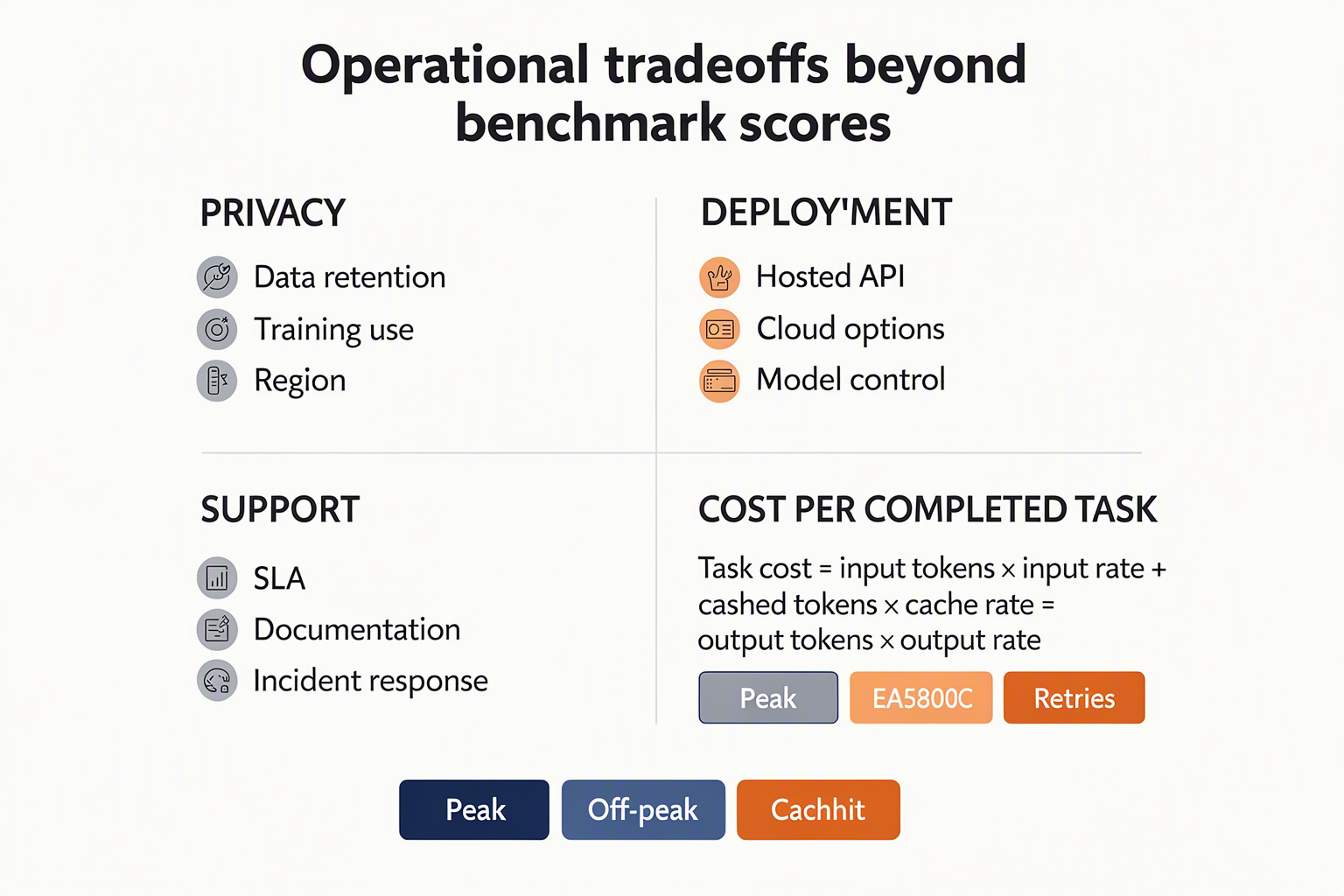
Privacy, deployment and support can outweigh benchmark scores, while normalized cost must be calculated per completed task rather than per token. As of October 14, 2026, Claude Fable 5.5 has no verifiable service terms or price, so these operational dimensions cannot support a genuine Fable 5.5–DeepSeek V4.1 Flash comparison.
What privacy evidence should buyers compare?
A model name alone does not determine privacy. The relevant unit of evaluation is the specific provider, endpoint, region and contract through which the model is accessed.
For DeepSeek V4.1 Flash, procurement teams should verify:
- Whether prompts, outputs and uploaded files are retained
- Whether customer data may be used for model training
- Where inference data, logs and backups are processed
- Whether administrators can disable request logging
- Which subprocessors receive data
- Whether deletion periods and breach-notification duties are contractual
The same checklist cannot yet be completed for Claude Fable 5.5. CellCog reported on October 13, 2026 that Azure’s azure_ai/claude-fable-5-5 entry copied every specification from Fable 5.1; copied catalogue metadata is not evidence of Fable 5.5’s retention policy, processing location or enterprise controls.
How does deployment availability affect the choice?
Deployability is a pass-or-fail requirement, not a benchmark category. A model may score highly but remain unsuitable if it lacks an authenticated endpoint, capacity in the required region or clear production terms.
DeepSeek V4.1 Flash should therefore be assessed at the deployment actually under consideration, including its:
- API and SDK compatibility
- Regional availability and data path
- Rate limits, quotas and concurrency controls
- Fallback and version-pinning options
- Monitoring, error reporting and deprecation policy
Claude Fable 5.5 cannot pass this gate as of October 14, 2026. OrcaRouter found that Anthropic had published no Fable 5.5 announcement, despite Azure listing the identifier as generally available on October 13.
Platforms can simplify testing without making unavailable models comparable. As of October 2026, CallMissed’s OpenAI-compatible developer API offers one key and balance across 140 models, caller-selected fallbacks and request logs; teams must still assess the terms governing each selected model and route.
What support evidence matters in production?
Support should be evaluated through documented response commitments, not brand familiarity. Buyers should request named escalation channels, severity definitions, incident communication procedures, migration notice periods and remedies for service failures.
Neither a benchmark result nor an unverified catalogue row establishes those protections for Fable 5.5. Until Anthropic publishes product documentation and commercial terms, assigning Fable 5.5 a support score would turn missing evidence into a misleading numerical result.
How should normalized task cost be calculated?
Use the cost of a successful, quality-approved task:
Task cost = input cost + output cost + retries + tool calls + infrastructure + human review.
For example, 1,000 tasks consuming 20 million input tokens and 2 million output tokens would cost $300 at Fable 5.1’s documented rates: (20 × $10) + (2 × $50). Kunavo reported those Fable 5.1 rates in October 2026, but they must not be attributed to Fable 5.5.
For DeepSeek V4.1 Flash, insert the price of the actual endpoint and measure real token use, retry rates and acceptance rates. Until equivalent Fable 5.5 data exists, DeepSeek can receive an operational cost estimate; Fable 5.5 should remain “not available,” not zero or assumed equal to Fable 5.1.
Where can CallMissed fit into a repeatable multi-model evaluation workflow?
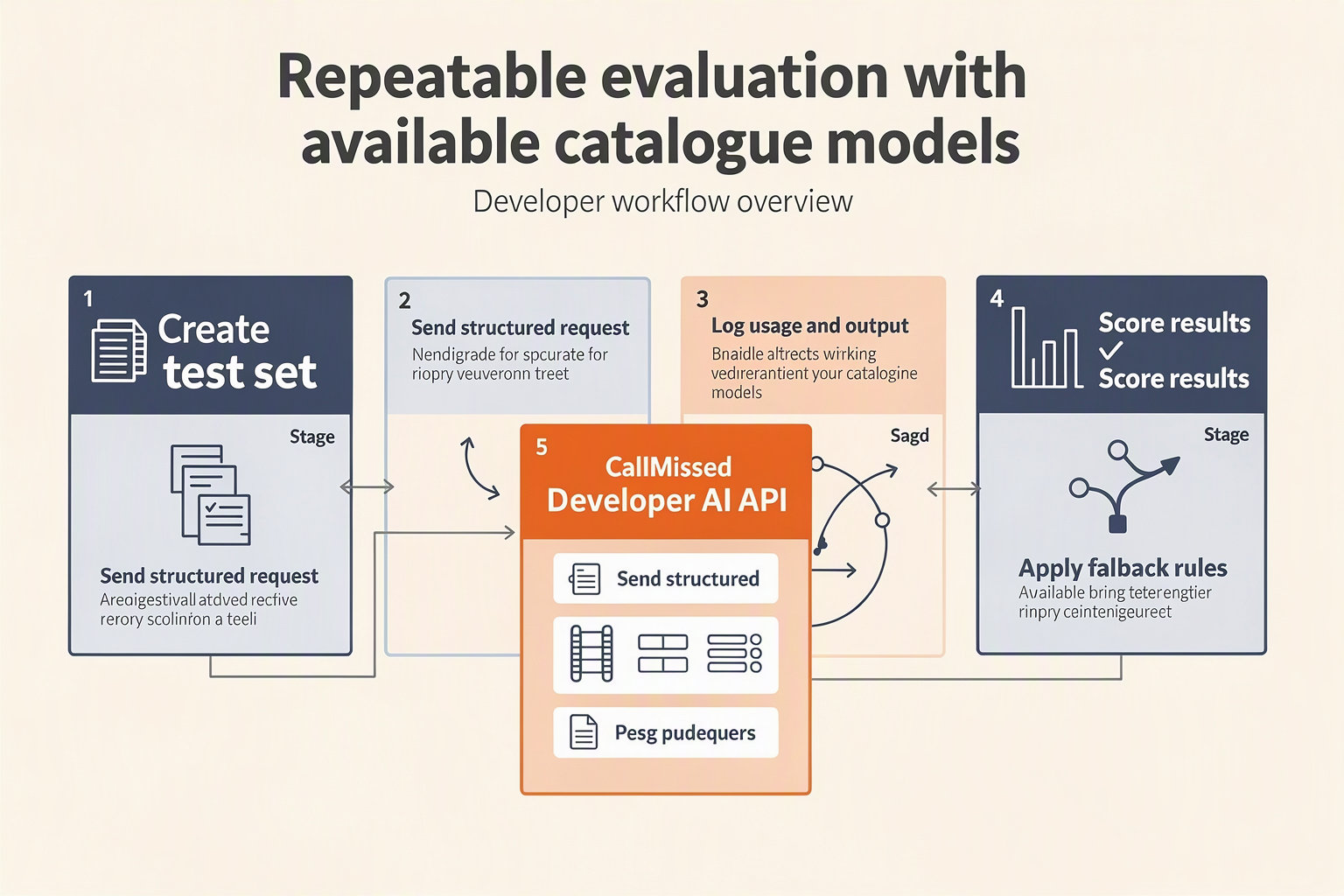
A repeatable multi-model evaluation workflow should freeze the task set, model identifier, prompt, parameters, scoring rules and evidence date, then record every response and cost under the same conditions. CallMissed’s OpenAI-compatible developer API can simplify execution across supported models, but it cannot make an unannounced model testable: Claude Fable 5.5 has no verified endpoint as of October 14, 2026.
How should teams define an evidence ledger before testing models?
Create a version-controlled manifest before sending the first request. Each model entry should include:
- Canonical model ID and provider
- Release or verification date
- API endpoint and gateway route
- Prompt-template version
- Temperature, token limit and reasoning settings
- Input and output token usage
- Latency, errors and retry count
- Raw response, evaluator score and scoring rationale
- Source status: first-party, third-party or unverified
The status field prevents rumours from entering a scorecard. Kunavo reported in October 2026 that Claude Fable 5.5 had “no model ID, price, model page or system card,” while CellCog found that the October 13 Azure catalogue entry copied specifications from Fable 5.1. The correct manifest value is therefore “not benchmarkable,” not zero and not an estimated score.
How can CallMissed support repeatable model runs?
As of October 2026, CallMissed, the OpenAI-compatible AI gateway, provides one API key and one balance for 140 models: 45 general-purpose LLMs, 24 real-time voice-agent models, 45 speech-to-text models, 10 text-to-speech models, 14 image models and two embedding models. Its catalogue includes makers such as DeepSeek, Anthropic, OpenAI, Google, Mistral and Moonshot, although evaluators must confirm the exact requested model identifier rather than infer availability from the maker’s name.
A practical run can follow four steps:
- Pin the exact model route. Never benchmark a floating alias if a dated or versioned identifier exists.
- Send an identical request object. Keep the system prompt, user input, sampling controls and output schema unchanged.
- Store the complete execution record. CallMissed provides usage and request logs, streaming, structured outputs and reasoning-effort controls where supported.
- Repeat each task. Multiple runs reveal output variance that a single response hides.
CallMissed also supports caller-selected fallback models, but fallbacks should be disabled during comparative testing. Otherwise, a failed DeepSeek request could be answered by another model and silently contaminate the results.
Which measurements should every evaluation capture?
Use separate metrics rather than compressing performance into one opaque score:
- Quality: exact match, pass rate, rubric score or human preference
- Reliability: malformed outputs, refusals, timeouts and tool-call failures
- Efficiency: input tokens, output tokens, elapsed time and total cost
- Consistency: score variance across repeated trials
- Provenance: provider, model ID, gateway route and timestamp
Response caching should also be disabled or explicitly labelled when measuring latency. Cached requests can be useful in production, but they do not represent fresh model inference.
When can Claude Fable 5.5 enter the workflow?
Claude Fable 5.5 should be added only after Anthropic publishes a verifiable model identifier, documentation and runnable endpoint. OrcaRouter reported on October 14, 2026 that Anthropic’s newest documented Fable remained Claude Fable 5.1, released September 1, 2026.
Until those requirements are met, preserve the DeepSeek V4.1 Flash test suite and mark the comparison slot pending verification. That makes the eventual head-to-head reproducible without converting catalogue metadata or speculation into benchmark evidence.
Which confirmed model and buying approach best fits your workload?
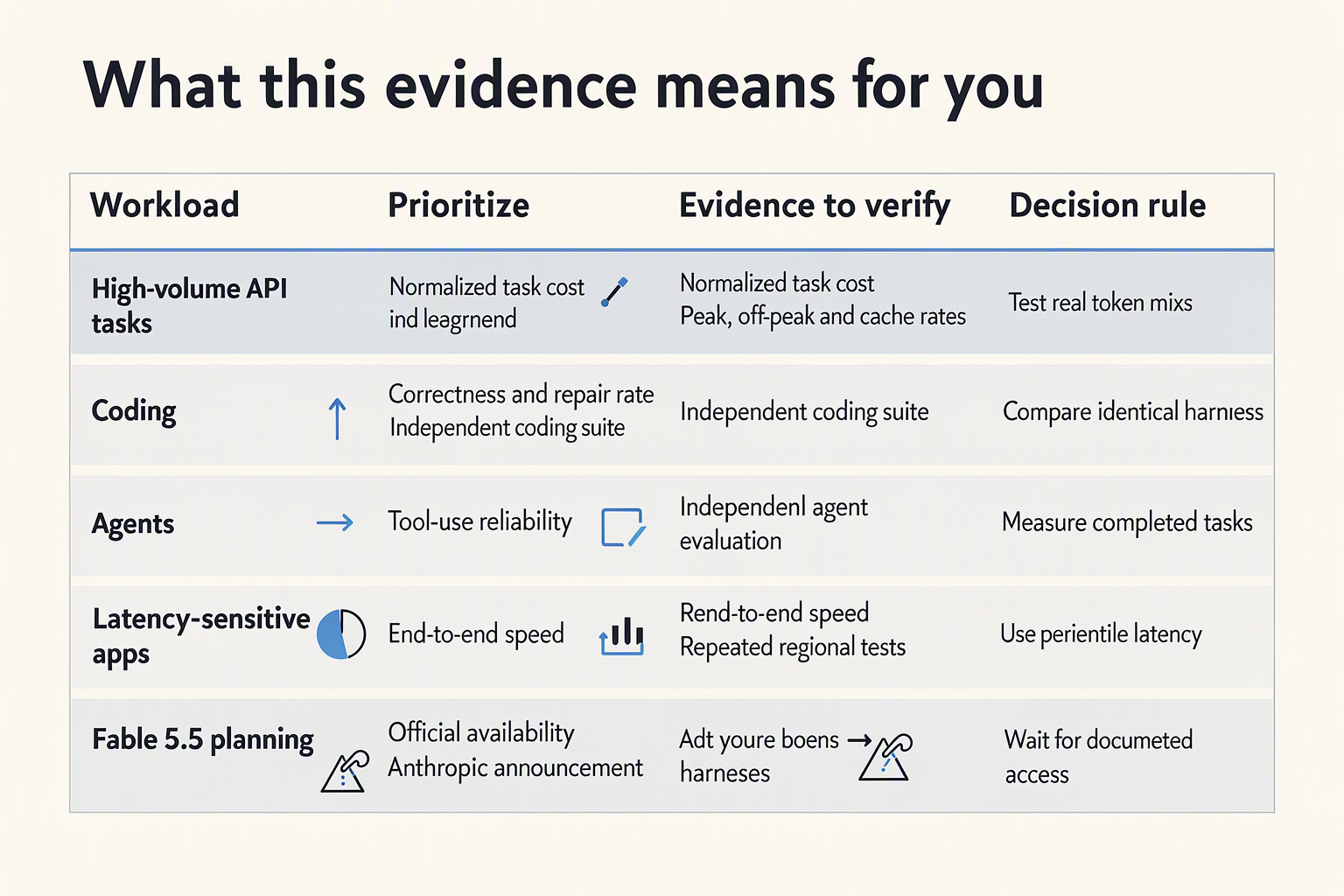
DeepSeek V4.1 Flash is the practical candidate for workloads that need evaluation or deployment now; Claude Fable 5.5 should not enter a buying decision until Anthropic publishes a model ID, documentation and pricing. As of October 14, 2026, the appropriate purchasing strategy is to run workload-specific trials of confirmed endpoints rather than reserve budget around an unannounced model.
Which model should you choose for each workload?
| Workload or priority | Best current approach | Evidence required before purchase | Main caveat |
|---|---|---|---|
| High-volume, latency-sensitive inference | Trial DeepSeek V4.1 Flash against real prompts | Confirmed endpoint, measured time to first token, total latency and provider quote | “Flash” branding does not guarantee consistent application-level speed |
| Cost-sensitive coding or reasoning | Benchmark DeepSeek V4.1 Flash on representative tasks | Pass rate, retries, output-token use and total cost per successful task | A low token price can be offset by verbose answers or failed attempts |
| Premium Claude workflows needed immediately | Evaluate Claude Fable 5.1, not 5.5 | claude-fable-5-1 endpoint, current terms and regression tests | Kunavo listed pricing of $10 input and $50 output per million tokens as of October 2026 |
| Existing application with OpenAI-compatible tooling | Use a compatible gateway or provider adapter | Streaming, function-calling and structured-output compatibility | Provider aliases must not be mistaken for distinct model releases |
| Production systems requiring resilience | Use validated fallbacks across confirmed models | Failure thresholds, timeout policy, observability and data-handling review | Fallbacks can change output style, latency and cost |
| Future Claude Fable 5.5 evaluation | Wait for Anthropic’s official release materials | Model ID, model card, API access, pricing and reproducible tests | An Azure catalogue row alone is insufficient evidence |
What should a buying test measure?
A procurement benchmark should calculate cost per acceptable result, not merely cost per million tokens. Teams should use a fixed test set and record:
- Task success: exact-match, unit-test, rubric or human-review scores.
- Operational speed: median and tail latency, including retries and tool calls.
- Effective cost: input, output, failed calls and repeated generations.
- Integration fit: structured outputs, streaming, tool use and context handling.
- Production risk: endpoint stability, fallback behaviour and output regressions.
Run the same prompts under documented sampling settings, then manually inspect borderline results. A model that is inexpensive per token may be costly per completed workflow if it needs additional prompting, generates excessive output or fails tool calls.
Should you buy directly or use a multi-model gateway?
Direct-provider access can suit teams committed to one model and willing to maintain provider-specific integrations. A multi-model gateway is more practical when the team wants controlled comparisons, centralised spending or caller-selected fallbacks.
As of October 2026, CallMissed’s OpenAI-compatible developer API offers one key and one balance across 140 models, including models from DeepSeek, with 27 models on its free tier. CallMissed also provides 1,000 free credits at signup, where one credit equals ₹1, which can support small evaluation runs; teams should still verify the exact model identifier and model-specific rate before testing.
What evidence would change the Fable 5.5 decision?
Kunavo reported on October 2, 2026 that Claude Fable 5.5 had “no model ID, price, model page or system card.” CellCog reported on October 13, 2026 that Azure’s listed specifications were copied from Fable 5.1, while OrcaRouter found no Anthropic announcement as of October 14, 2026.
Therefore, do not benchmark, budget for or procure Claude Fable 5.5 yet. Choose among runnable models using your own acceptance criteria, and reopen the comparison only after Anthropic supplies a verifiable endpoint and primary documentation.
Frequently Asked Questions
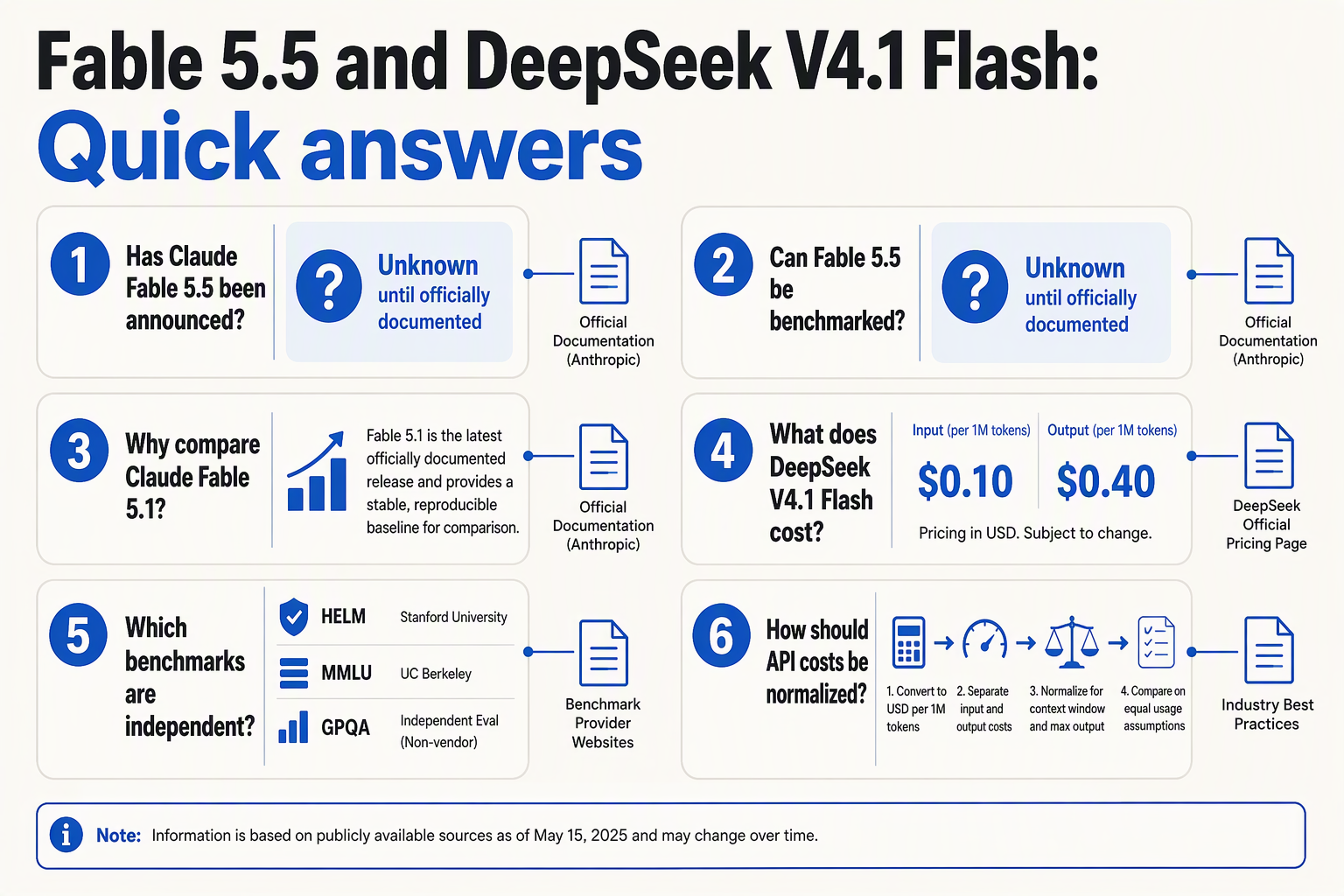
Is Claude Fable 5.5 officially released as of October 14, 2026?
Are there valid Claude Fable 5.5 vs DeepSeek V4.1 Flash benchmarks?
Is Claude Fable 5.5 available through an API?
claude-fable-5-1, released September 1, 2026 and priced at $10 per million input tokens and $50 per million output tokens as of October 2026. Multi-model gateways do not change that verification requirement: CallMissed, for example, provides one key and balance for 140 models, including DeepSeek models, but catalogue access alone cannot authenticate an unannounced Anthropic model.Does the Microsoft Azure listing prove that Claude Fable 5.5 exists?
azure_ai/claude-fable-5-5 appeared with specifications copied from Fable 5.1, while Anthropic had supplied no announcement, model card or price. Such a row could reflect advance provisioning, placeholder metadata, an alias or an unreleased deployment.What model should developers use instead of Claude Fable 5.5 today?
What evidence is required for a credible DeepSeek V4.1 Flash benchmarks vs Claude Fable 5.5 comparison?
Conclusion
What can the evidence support?
As of October 14, 2026, Claude Fable 5.5 has not been announced, documented or released by Anthropic, so a credible DeepSeek V4.1 Flash vs Claude Fable 5.5 benchmark comparison is not yet possible. DeepSeek V4.1 Flash results can be evaluated only where sources disclose test versions, prompts, sampling settings and scoring methods.
- Claude Fable 5.5 cannot receive a defensible benchmark score without a runnable endpoint, model card or system card.
- The Azure identifier reported by CellCog on October 13, 2026 carried specifications copied from Claude Fable 5.1; a catalogue listing is not proof of an independently testable release.
- Claude Fable 5.1 remains the latest documented Fable model, according to Kunavo and OrcaRouter, following its September 1, 2026 release.
- DeepSeek V4.1 Flash claims should be interpreted by workload—reasoning, coding, speed or cost—rather than compressed into one universal ranking.
What should developers watch next?
A genuine comparison should wait for Anthropic to publish a model ID, pricing, documentation and reproducible access, followed by independent tests under identical conditions. Teams can meanwhile explore multi-model infrastructure through CallMissed, whose OpenAI-compatible API provides access to 140 models, including DeepSeek models, as of October 2026.
When Fable 5.5 becomes verifiable, will its reproducible results support the speculation—or overturn it?
Related Reading
- Claude Fable 5.5 vs Bulbul V4 Flash: Voice AI Guide
- Meta Muse Wonder Benchmarks vs Claude Fable 5.5: Facts
- Claude Fable 5.1 Benchmarks: Coding Performance, Evidence, and Caveats