Claude Fable 5.5 vs Gemini 4 Argon: What Is Confirmed



Claude Fable 5.5 vs Gemini 4 Argon compares verified benchmarks, API access and pricing, with Fable 5.1 as the practical baseline.
Claude Fable 5.5 vs Gemini 4 Argon: What Is Confirmed
How can a model win a benchmark comparison before its maker has even announced it? As of October 14, 2026, the central fact in Claude Fable 5.5 vs Gemini 4 Argon is not a score but an evidence gap: Anthropic has not announced Claude Fable 5.5, and no official Fable 5.5 benchmarks, API specifications, pricing or release date exist in the official material reviewed.
The comparison matters now because reports accelerated on October 13, 2026, after an alleged “Claude Fable 5.5” entry appeared in Microsoft Azure configuration data for the East US 2 region. Crypto Briefing reported the sighting on October 13, 2026, while stressing that Anthropic had “not said a word about it.” A third-party catalog label—even “GenerallyAvailable”—is not equivalent to a vendor launch, documented endpoint or reproducible evaluation.
What is actually confirmed about Claude Fable 5.5?
Anthropic’s public evidence still points to Claude Fable 5.1. OmniaKey reported on October 1, 2026, that Anthropic’s model directory listed Fable 5.1 as the current Fable model and provided no confirmed public release date for Fable 5.5. OrcaRouter likewise wrote on October 14, 2026, that the newest Fable model documented by Anthropic was Claude Fable 5.1, released September 1, 2026.
Kingy AI’s October 2026 review found no official Fable 5.5 model identifier, specifications, pricing or benchmark results. That absence does not disprove a private roadmap or forthcoming launch; it means latency, context window, coding quality, safety, token costs and availability cannot yet be compared responsibly under the Fable 5.5 name.
How will Claude Fable 5.5 and Gemini 4 Argon be compared?
For Gemini 4 Argon, this article applies the same standard: vendor documentation and reproducible tests outrank leaks, screenshots and social posts. The supplied research does not establish Gemini 4 Argon’s official specifications, benchmark scores or prices, so the analysis will not fill those blanks with assumptions.
Readers will learn:
- What is confirmed through official model directories and announcements.
- What is merely reported through Azure sightings and third-party coverage.
- What can be compared today, and which conclusions must wait for verified APIs, pricing and tests.
This distinction matters for multi-model platforms such as CallMissed, whose OpenAI-compatible developer API provides one key and balance for 140 models as of October 2026: production routing decisions require documented model identities, costs and capabilities—not rumor-driven scorecards.
What is the verdict as of October 14, 2026? Fable 5.5 is unannounced and has no official benchmarks or pricing
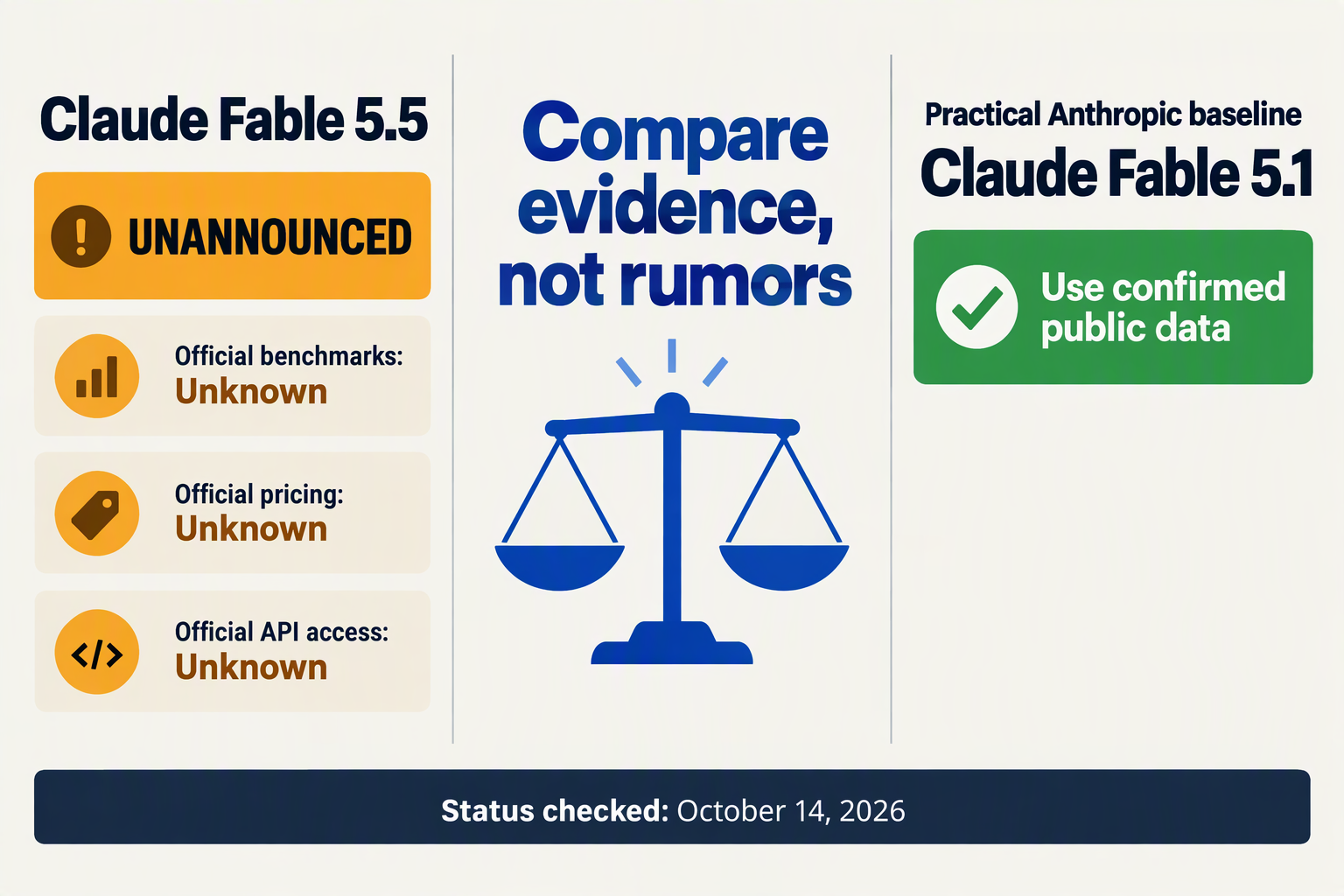
Verdict: no evidence-led winner can be declared between Claude Fable 5.5 and Gemini 4 Argon as of October 14, 2026. Most importantly, Claude Fable 5.5 remains unannounced by Anthropic and has no official benchmarks, API specifications, pricing or release date. The supplied research also does not establish official Gemini 4 Argon specifications, prices or benchmark results, making any performance ranking premature.
Can Claude Fable 5.5 be compared with Gemini 4 Argon today?
Not as two verified, publicly documented products. A defensible model comparison requires identifiable model versions, accessible endpoints and tests run under equivalent conditions. Neither a catalog sighting nor an unsupported product name supplies that evidence.
The current evidence supports four conclusions:
- Anthropic has not announced Claude Fable 5.5. Crypto Briefing reported on October 13, 2026, that Anthropic had “not said a word about it.”
- The reported Azure entry is a lead, not a launch record. Pasquale Pillitteri reported that the label appeared for Microsoft Azure’s East US 2 region with a “GenerallyAvailable” status on October 13, 2026.
- Anthropic’s documented Fable line stops at Fable 5.1. OrcaRouter reported on October 14, 2026, that Claude Fable 5.1, released September 1, 2026, remained the newest Fable model documented by Anthropic.
- Gemini 4 Argon lacks sufficient verified evidence in the supplied sources. No sourced official model card, API identifier, pricing schedule or reproducible benchmark package is available here.
The appropriate result is therefore “insufficient evidence,” not a tie. A tie would imply that both models had been measured and achieved equivalent results; that has not happened.
Why does the reported Azure listing not settle the comparison?
Cloud configuration data can surface before—or independently of—a vendor’s complete public release process. The reported “GenerallyAvailable” field may indicate deployment preparation, catalog synchronization or actual regional access, but the field alone cannot verify Anthropic’s intended product name, final model version or commercial terms.
Three checks are still necessary:
- Vendor confirmation: Anthropic must publish an announcement, model card or documentation entry for Claude Fable 5.5.
- Operational verification: A stable model identifier must resolve through an authorized API or supported product interface.
- Comparable testing: Claude Fable 5.5 and Gemini 4 Argon must be evaluated with identical prompts, settings, scoring methods and test dates.
Without those checks, purported benchmark charts could be measuring aliases, previews, different snapshots or entirely different models.
What would change the verdict?
The verdict should be revisited when Anthropic and Google publish enough information to compare quality, cost and deployment constraints. The minimum evidence package should include:
- Official model identifiers and release dates
- Input and output pricing per million tokens
- Context-window and maximum-output limits
- Tool use, multimodal and structured-output support
- Vendor benchmark methodology and contamination disclosures
- Independent tests for coding, reasoning, latency and reliability
- Regional availability, rate limits and data-handling terms
Until those materials exist, claims that either Claude Fable 5.5 or Gemini 4 Argon is faster, cheaper or more capable are speculation rather than analysis. As of October 14, 2026, the evidence-led verdict is to wait for official documentation and reproducible tests before choosing a winner—or making a production migration.
What background and model-family context should readers understand first?
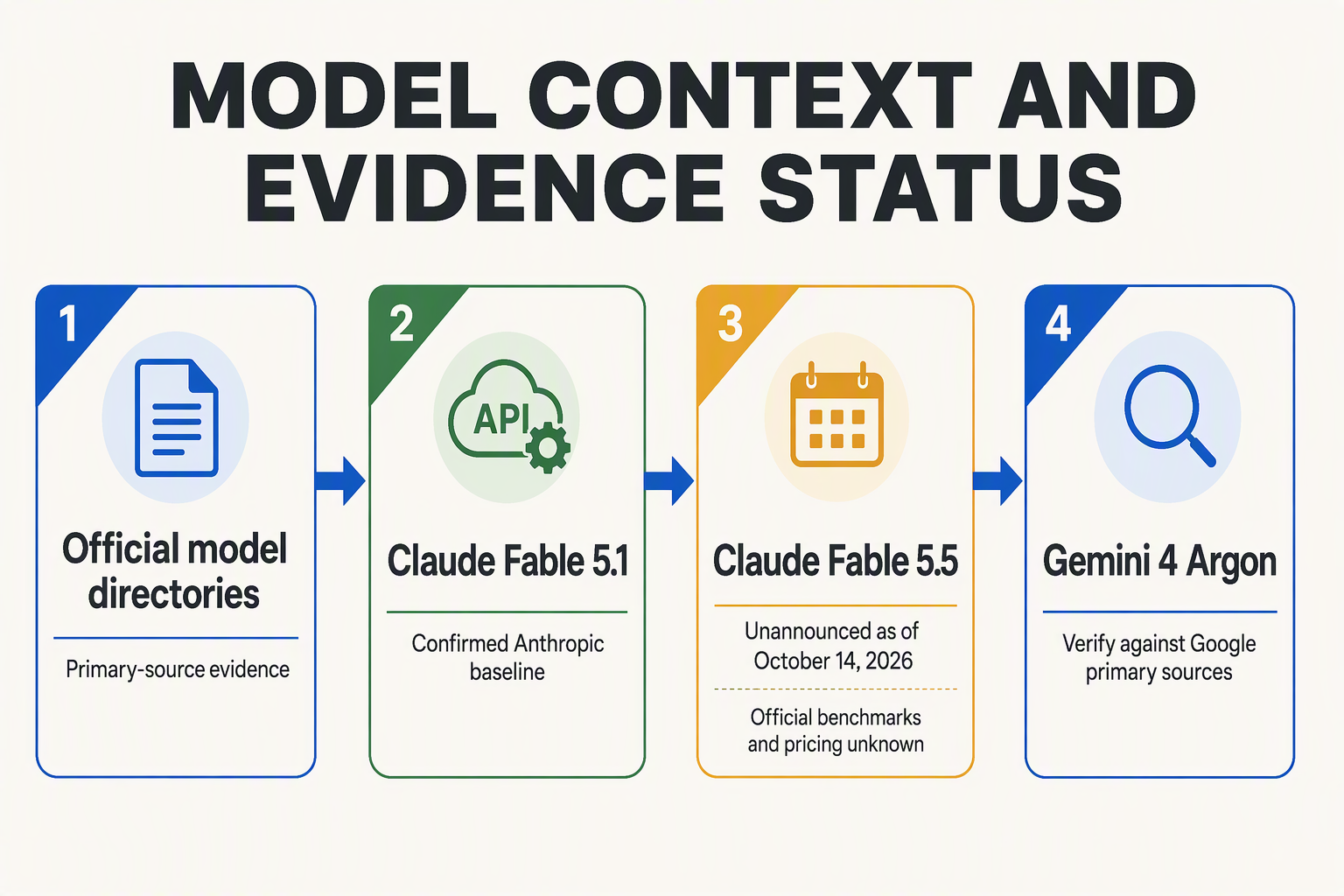
The essential model-family context is asymmetrical: Anthropic has a documented Claude Fable lineage ending at Fable 5.1, while the supplied official evidence does not establish Gemini 4 Argon as a documented Google model. As of October 14, 2026, Claude Fable 5.5 is unannounced and has no official benchmarks, specifications or pricing.
Where does Claude Fable 5.1 fit in Anthropic’s model family?
Claude Fable 5.1 is the latest publicly documented Fable model in the sources reviewed. OrcaRouter reported on October 14, 2026, that Anthropic’s official documentation identified Claude Fable 5.1, released on September 1, 2026, as the newest Fable release.
Multiple independent checks support that position:
- OmniaKey reported on October 1, 2026, that Anthropic’s model directory still listed Fable 5.1 as the current Fable model.
- QCode reported in October 2026 that Anthropic’s official model table ended at
claude-fable-5-1, with a September 1, 2026 release date and an active lifecycle. - Kingy AI reported in October 2026 that neither Anthropic’s model directory nor the Claude Code supported-model list included Fable 5.5.
- Kie.ai reported that Claude Fable 5.1 appeared in Anthropic’s public metadata under the identifier
claude-fable-5-1and became available through Claude Code and the Claude Platform.
This documented lineage matters because model-family names do not guarantee a predictable upgrade path. A hypothetical “5.5” label reveals nothing reliable about context length, reasoning performance, safety behavior, multimodal support or token price without an official model card and API documentation.
What does the Gemini 4 Argon name establish?
The Gemini 4 Argon label does not, by itself, establish a publicly released Google model. The research supplied for this comparison contains no official Google announcement, model identifier, API documentation, pricing page or benchmark report for Gemini 4 Argon as of October 14, 2026.
“Argon” could theoretically function as a codename, catalog label or product suffix, but assigning it a tier or capability would be speculation. Readers should distinguish three separate concepts:
- Model family: the vendor’s broader product lineage, such as Claude or Gemini.
- Public model identifier: the exact name developers select through an API.
- Third-party catalog label: metadata displayed by a cloud provider, router or configuration system.
Only the second category proves that developers can target a specific model consistently, and even then pricing, regional access and lifecycle status require separate confirmation.
Why can’t earlier family performance fill the evidence gaps?
Performance cannot safely be inherited from a predecessor or inferred from version numbering. A newer family member may change its training data, inference settings, context limits, tool use, safety controls or price-performance balance.
For each candidate, an evidence-led comparison therefore needs:
- An official announcement and resolvable model ID.
- A dated model card or technical specification.
- Vendor pricing for input, output and cached tokens.
- Reproducible benchmark settings and scores.
- Documented availability by API, region and access tier.
Until Anthropic and Google provide those materials, Claude Fable 5.1 is useful historical context—not a proxy for Fable 5.5—and the Gemini family name cannot validate Gemini 4 Argon’s alleged capabilities.
Which key developments are confirmed, reported or unknown?
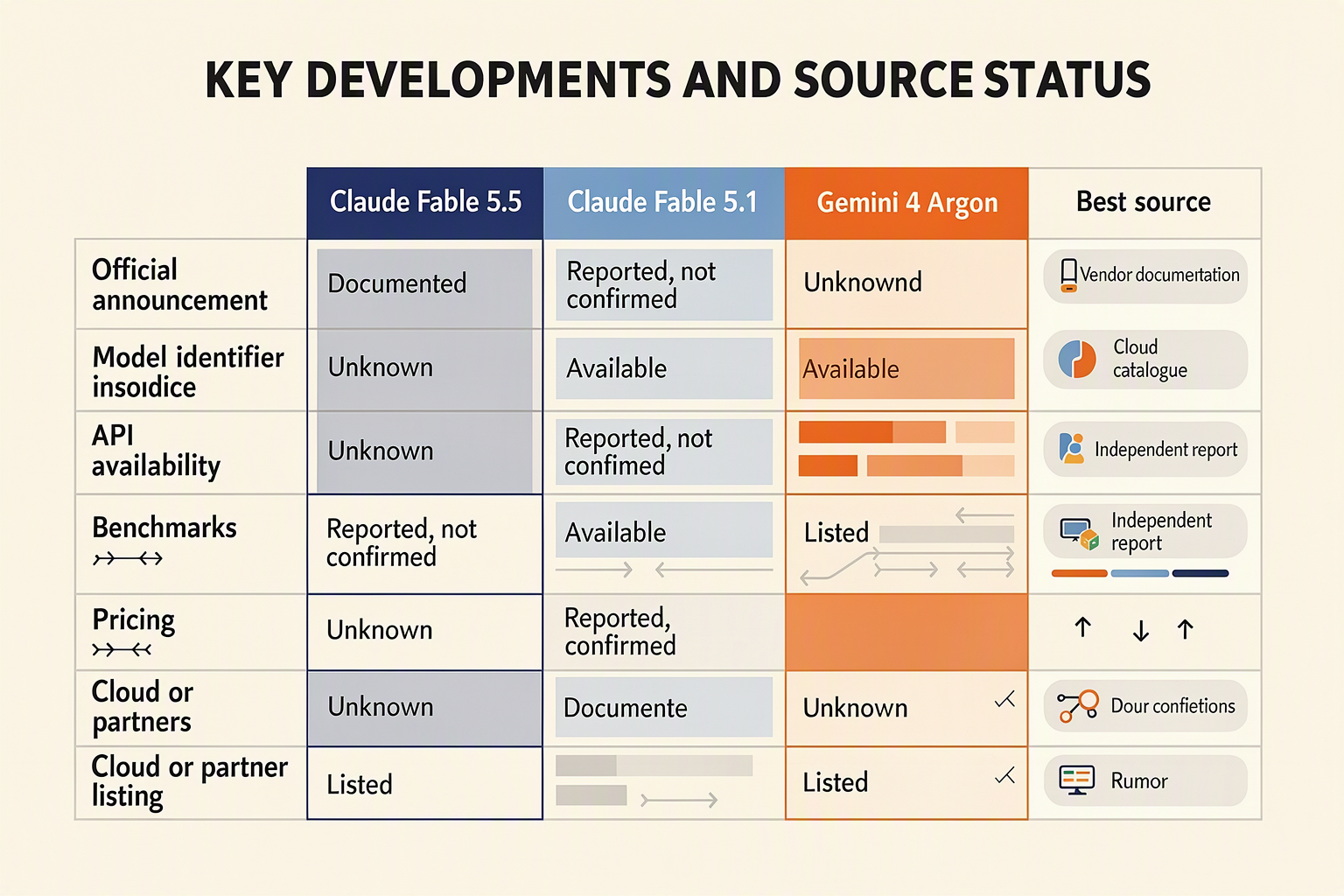
As of October 14, 2026, Claude Fable 5.5 is unannounced and has no official benchmarks, API specifications, pricing or release date. Gemini 4 Argon’s corresponding specifications, benchmark results, pricing and availability are also not established by the supplied research, so neither model has enough verified evidence for a defensible head-to-head verdict.
What evidence exists for Claude Fable 5.5 and Gemini 4 Argon?
| Development | Confirmed evidence | Reported evidence | Still unknown |
|---|---|---|---|
| Claude Fable 5.5 announcement | No Anthropic announcement was found as of October 14, 2026 | Crypto Briefing reported an alleged Azure configuration entry on October 13, 2026 | Whether or when Anthropic will launch the model |
| Current documented Fable model | Anthropic’s directory listed Claude Fable 5.1 as current, according to OmniaKey on October 1, 2026 | Kie.ai reported that Fable 5.1 appeared in public model metadata and Claude Code | Whether Fable 5.5 will replace or complement Fable 5.1 |
| Azure availability | No Anthropic API endpoint or model identifier for Fable 5.5 has been confirmed | Pasquale Pillitteri reported an East US 2 listing marked “GenerallyAvailable” on October 13, 2026 | Whether the entry was operational, staged, mislabeled or temporary |
| Fable 5.5 benchmarks | No official benchmark results were found | No reproducible independent results are supplied | Coding, reasoning, multimodal, agentic and safety performance |
| Fable 5.5 pricing and limits | No official pricing, context window or rate limits were found | Third-party claims do not establish Anthropic’s commercial terms | Input, output and cache pricing; context size; usage limits |
| Gemini 4 Argon evidence | No official specifications, prices or benchmark scores are established in the supplied research | No sufficiently sourced development is available here | Model identity, launch status, capabilities, API access and cost |
Why does an Azure catalog entry not confirm a model launch?
A cloud configuration record is a lead for further verification, not a complete product release. Crypto Briefing reported on October 13, 2026, that Fable 5.5 had reportedly appeared in Azure configuration files, but emphasized that Anthropic had “not said a word about it.”
The label “GenerallyAvailable” also cannot answer the practical questions buyers and developers need resolved:
- Does a documented model ID accept production API requests?
- Which regions and customer accounts can access it?
- What are the context window, modalities and rate limits?
- What do input, output and cached tokens cost?
- Has the vendor published a model card, safety report or benchmark methodology?
Until those questions have vendor-backed answers, the Azure sighting should remain classified as reported, not confirmed.
What is the strongest confirmed baseline?
The strongest baseline is Claude Fable 5.1, not Fable 5.5. OrcaRouter reported on October 14, 2026, that Claude Fable 5.1—released September 1, 2026—was the newest Fable model documented by Anthropic. QCode similarly found that Anthropic’s official model table stopped at claude-fable-5-1, with no later Fable row.
Kingy AI’s October 2026 review found no confirmed Fable 5.5 identifier, specifications, pricing or benchmarks in the official sources it examined. Therefore, existing Fable 5.1 evidence must not be relabeled as Fable 5.5 performance, just as results from another Google Gemini model cannot be assigned to Gemini 4 Argon without a confirmed identity and reproducible endpoint.
How do reasoning, coding and long-context results compare without inventing Fable 5.5 scores?
Reasoning, coding and long-context performance cannot be scored responsibly for Claude Fable 5.5 or Gemini 4 Argon with the evidence available as of October 14, 2026. Claude Fable 5.5 is unannounced and has no official benchmark results, pricing, API specifications or documented context window; the supplied research likewise provides no verified Gemini 4 Argon results.
What can current evidence say about reasoning performance?
No sourced result establishes either model’s performance on reasoning benchmarks such as GPQA Diamond, Humanity’s Last Exam, MMLU-Pro or AIME. Assigning a score—or projecting one from an earlier model—would turn an assumption into a seemingly factual comparison.
The evidence supports only these conclusions:
- Anthropic’s documented Fable line ends at Claude Fable 5.1. OmniaKey reported on October 1, 2026, that Anthropic’s model directory still identified Fable 5.1 as the current model.
- Claude Fable 5.5 has no published evaluation record. Kingy AI reported in October 2026 that it found no official Fable 5.5 benchmark results, model identifier, specifications or pricing.
- Gemini 4 Argon also lacks verified results in the supplied research. Therefore, neither a reasoning winner nor a performance gap can be calculated.
Claude Fable 5.1 results could provide historical context, but they must remain labelled Fable 5.1 results. They cannot be renamed, extrapolated or attributed to Fable 5.5.
Can coding ability be compared from leaks or catalog listings?
No. A catalog entry can indicate that a model name exists in configuration data, but it cannot demonstrate software-engineering quality. Crypto Briefing reported on October 13, 2026, that “Anthropic has not said a word about” the alleged Fable 5.5 entry found in Microsoft Azure configuration files.
A credible coding comparison would require identical, reproducible tests covering:
- Repository-level issue resolution, using benchmarks such as SWE-bench Verified.
- Code generation, with pass rates measured by executable unit tests.
- Tool use, including terminal commands, file editing and recovery from failed actions.
- Cost and latency, measured under the same token limits and reasoning settings.
- Repeated trials, because one successful run does not establish a dependable pass rate.
Screenshots, selected demonstrations and anecdotal prompts cannot substitute for this protocol. They may generate hypotheses, but they do not establish comparative coding performance.
How should long-context capability be tested?
A context-window claim answers only how many tokens an API accepts, not how reliably a model uses information across those tokens. Because no official Fable 5.5 context limit is available, even the first comparison variable remains unknown.
Once both models have documented APIs, long-context testing should measure:
- Needle retrieval at multiple positions and context lengths.
- Multi-hop synthesis across separated documents.
- Instruction retention when relevant constraints appear early in the prompt.
- Citation accuracy, including whether quoted evidence actually supports the answer.
- Effective context, defined as the point where retrieval or reasoning quality materially deteriorates.
The evidence-led result is therefore “not yet measurable,” not “tied.” A tie implies comparable observed results; here, the necessary observations do not exist. Until Anthropic and Google publish identifiable models and independent evaluators can run matched tests, every numerical Claude Fable 5.5 vs Gemini 4 Argon scorecard should be treated as speculative.
How do API access and introductory versus standard pricing compare?
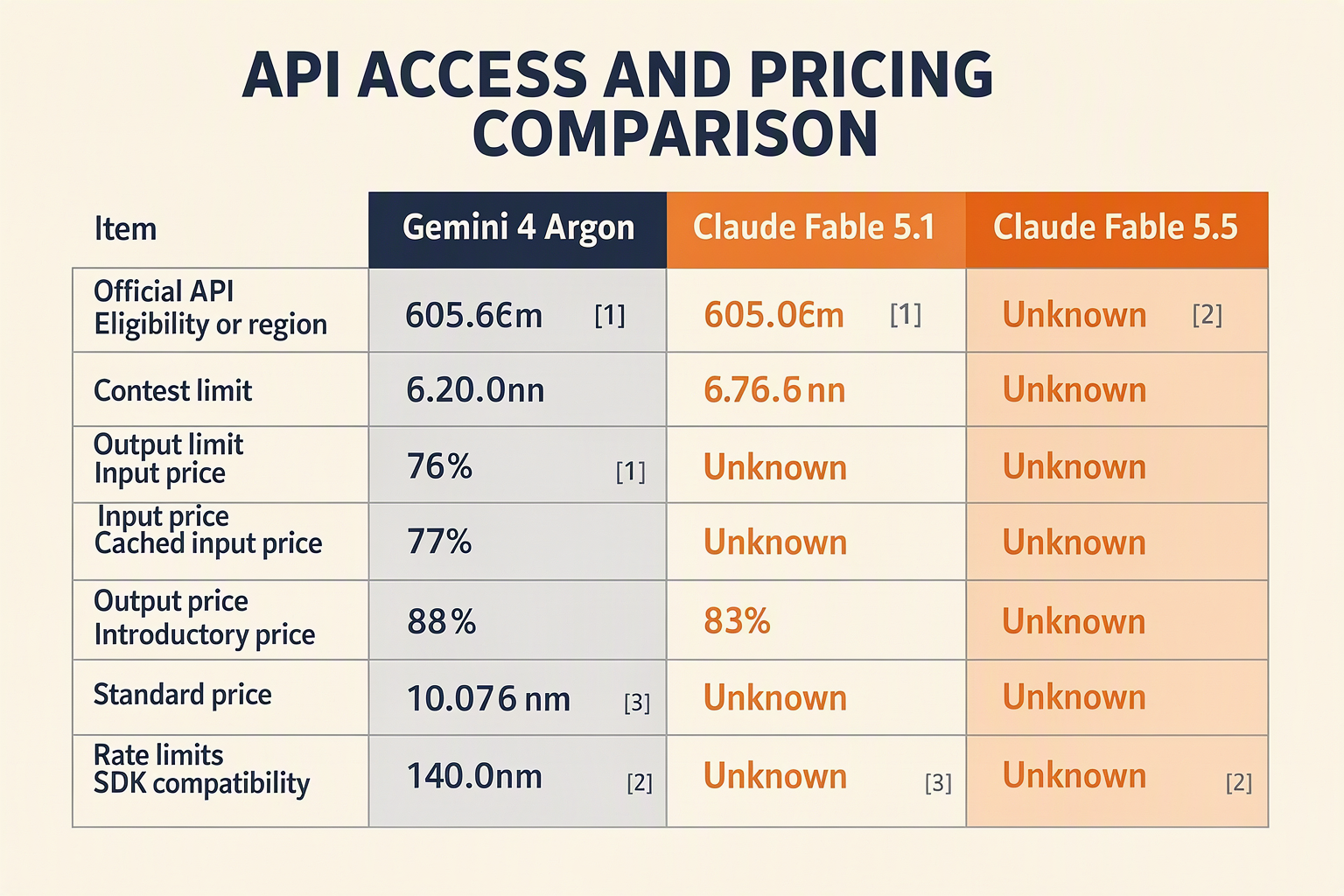
As of October 14, 2026, neither Claude Fable 5.5 nor Gemini 4 Argon has a verified introductory or standard API price in the supplied research. Claude Fable 5.5 is unannounced by Anthropic and has no official API identifier, benchmarks or pricing, so any cost comparison would be speculative.
What API and pricing information is verified?
| Comparison point | Claude Fable 5.5 | Gemini 4 Argon | Evidence-led conclusion |
|---|---|---|---|
| Official model announcement | None found from Anthropic | None established in the supplied research | Neither model has a verified launch basis for pricing comparisons |
| Documented API model ID | None found | None established | Developers cannot safely configure production requests by model name |
| Direct API availability | Not confirmed by Anthropic | Not confirmed by supplied vendor evidence | Catalog sightings do not prove a supported public endpoint |
| Introductory input price | Not published | Not published | No promotional token rate can be verified |
| Introductory output price | Not published | Not published | Claims of discounted launch pricing should be treated as unverified |
| Standard input/output price | Not published | Not published | Total inference cost cannot yet be calculated |
Kingy AI reported in October 2026 that no official Claude Fable 5.5 model identifier, specifications or pricing appeared in the Anthropic sources it reviewed. OmniaKey similarly reported on October 1, 2026, that Anthropic’s model directory still identified Claude Fable 5.1 as the current Fable release.
Crypto Briefing reported on October 13, 2026, that “Anthropic has not said a word” about the alleged Fable 5.5 entry found in Microsoft Azure configuration data. Consequently, the reported East US 2 catalog appearance cannot establish whether access would be direct through Anthropic, mediated through Microsoft Azure, region-limited or governed by preview quotas.
Can existing Fable prices estimate Claude Fable 5.5 costs?
No existing-model price should be presented as Claude Fable 5.5 pricing. OrcaRouter reported on October 14, 2026, that the resolvable identifier anthropic/claude-fable-5 carried rates of $10 per million input tokens and $50 per million output tokens. Those figures concern a different identifier and do not prove Fable 5.5’s price, availability or billing terms.
“Introductory pricing” also needs a precise definition. A credible launch comparison should distinguish among:
- Promotional rates that expire after a stated date.
- Preview pricing that may change at general availability.
- Standard input and output token charges.
- Separate charges for cached tokens, reasoning tokens, tools, search or multimodal media.
- Platform markups, regional taxes and committed-use discounts.
None of those variables is officially documented here for either named model.
What should API buyers verify before choosing?
Developers should wait for an official model ID, endpoint documentation, supported regions, rate limits and prices expressed per million tokens. A worked cost model should then test realistic input-to-output ratios rather than comparing the cheapest headline number.
For multi-provider testing, CallMissed’s OpenAI-compatible developer API offers one API key and balance across 140 models as of October 2026, with caller-selected fallbacks, request logs and usage tracking. However, even a unified gateway cannot make an unannounced model production-ready: Claude Fable 5.5 and Gemini 4 Argon should enter cost evaluations only after their identities, access terms and standard prices are officially documented.
Which model is better for agents, voice and customer-support workloads?
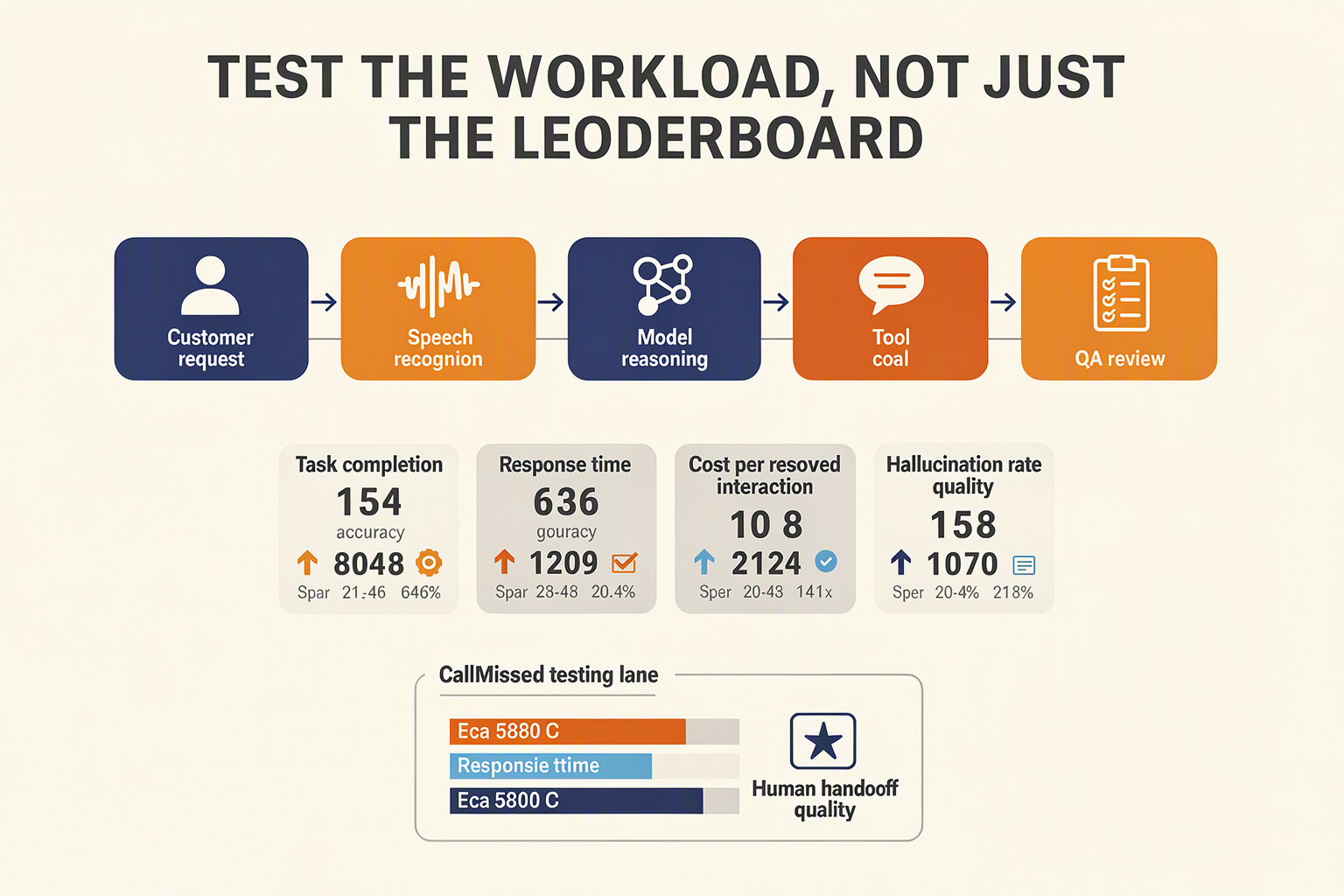
Neither Claude Fable 5.5 nor Gemini 4 Argon can be named the better model for agents, voice or customer support as of October 14, 2026. Claude Fable 5.5 is unannounced and has no official benchmarks, API specifications or pricing, while the supplied evidence also does not establish verified production specifications for Gemini 4 Argon.
Which model is ready for production AI agents?
Production readiness requires more than strong reasoning scores. An agent must reliably call tools, follow structured workflows, retain relevant context and recover safely when an API or downstream system fails.
For Claude Fable 5.5, those capabilities remain unverified. Kingy AI reported in October 2026 that official sources contained no confirmed Fable 5.5 model identifier, specifications, price or benchmark results. OmniaKey similarly found on October 1, 2026, that Anthropic’s directory still identified Claude Fable 5.1 as the current Fable model.
The reported Azure entry does not resolve these questions. Crypto Briefing reported on October 13, 2026, that Anthropic had made no official announcement despite the alleged Claude Fable 5.5 configuration sighting. A catalog status cannot demonstrate tool-call accuracy, rate limits, context handling or endpoint stability.
Before choosing either model for an agent, teams should verify:
- Function calling: Does the model select the correct tool and generate schema-valid arguments?
- Instruction adherence: Does it respect permissions, escalation rules and prohibited actions?
- Long-session consistency: Does performance deteriorate over multi-turn conversations?
- Failure recovery: Can it handle timeouts, malformed tool responses and missing customer data?
- Operational availability: Are documented APIs, rate limits and regional access available?
Which model is better for real-time voice agents?
No evidence currently supports a voice-workload winner. A responsive voice agent depends on the complete pipeline—speech recognition, endpoint detection, model inference, tool execution and text-to-speech—so a language-model benchmark alone would not predict conversational latency.
A credible voice comparison should measure:
- Time to first spoken response after the caller stops talking.
- Interruption handling when callers speak over the agent.
- Tool latency for actions such as checking an order or booking an appointment.
- Recognition quality for accents, regional languages and code-mixed speech.
- Task completion rate across noisy, ambiguous and adversarial calls.
Platforms can isolate the model variable by replaying the same anonymized transcripts, tool responses and audio conditions. For example, CallMissed supports 24 real-time voice-agent models through its developer API as of October 2026, enabling model routing within a broader voice stack; its speech recognition covers 22 Indian languages plus English, including Hinglish.
How should customer-support teams compare the models?
Customer-support evaluation should prioritize business outcomes over generic leaderboards. Test both candidates—once documented access exists—against a fixed set of real support scenarios and score:
- Resolution accuracy and unsupported-answer rate.
- Correct escalation to a human agent.
- Policy and knowledge-base compliance.
- Structured extraction of disposition, urgency and next action.
- Cost per successfully resolved conversation, not merely cost per token.
- P50 and P95 response latency under realistic concurrency.
The practical verdict is therefore wait, instrument and test. Until Anthropic publishes Claude Fable 5.5 documentation—and comparable verified evidence exists for Gemini 4 Argon—deploying either name in a customer-facing procurement decision would be speculation rather than evidence-led engineering.
What do experts, vendor documents and independent reports actually establish?

The evidence establishes an information gap, not a performance result: as of October 14, 2026, Claude Fable 5.5 is unannounced and has no official benchmarks, specifications, API identifier, pricing or release date. The reviewed sources likewise provide no verified Gemini 4 Argon specifications, prices or benchmark results, so expert commentary cannot support a winner.
What do Anthropic’s official documents establish?
Anthropic’s public documentation establishes Claude Fable 5.1—not Fable 5.5—as the latest documented Fable model. OmniaKey reported on October 1, 2026, that Anthropic’s model directory still listed Fable 5.1 and contained no confirmed release date for Fable 5.5.
Independent source checks reinforce that narrow conclusion:
- Kingy AI reported in October 2026 that neither Anthropic’s model directory nor the Claude Code supported-model list contained Fable 5.5.
- OrcaRouter reported on October 14, 2026 that Anthropic’s newest documented Fable model was Claude Fable 5.1, released on September 1, 2026.
- QCode reported in 2026 that Anthropic’s official model table ended at
claude-fable-5-1, with no later Fable row, model ID or release date.
These findings establish the state of the public record. They do not prove that Anthropic lacks an internal model, private preview or launch plan.
What does the reported Microsoft Azure entry prove?
The alleged Azure configuration entry is evidence that the name “Claude Fable 5.5” appeared in third-party infrastructure data, but it does not establish the model’s capabilities or public availability.
Crypto Briefing reported on October 13, 2026, that the name had reportedly surfaced in Microsoft Azure configuration files while Anthropic had “not said a word about it.” Pasquale Pillitteri’s report added that the entry appeared in the East US 2 region with a “GenerallyAvailable” label.
That evidence supports only a limited chain of claims:
- A configuration or catalog entry was observed.
- The entry used the Claude Fable 5.5 name.
- Anthropic had not corroborated it by October 14, 2026.
A catalog status cannot independently verify model weights, endpoint access, context length, token prices, latency, safety behavior or benchmark performance. Configuration records may precede launches, reflect staging data or expose incomplete metadata.
What do independent reports establish about the comparison?
Independent reports consistently establish uncertainty, not parity or superiority. Kingy AI found no confirmed Fable 5.5 identifier, specifications, pricing or benchmark results in the official sources it reviewed in October 2026. OrcaRouter similarly distinguished resolvable, documented model IDs from the unsupported Fable 5.5 claim.
For Gemini 4 Argon, the supplied evidence contains no Google model card, Gemini API documentation, pricing schedule or reproducible benchmark report. Consequently, even apparently precise comparisons involving coding scores, multimodal accuracy, context windows or cost per million tokens would be unsupported.
What evidence would make a comparison credible?
A defensible Claude Fable 5.5 vs Gemini 4 Argon verdict requires:
- Official vendor announcements and stable API model identifiers.
- Dated pricing for input, output, caching and reasoning tokens.
- Model cards covering context limits, modalities and safety constraints.
- Reproducible third-party tests using identical prompts and settings.
- Real workload evaluations for coding, retrieval, tool use and latency.
Until those materials exist, the evidence-led conclusion remains simple: the sources confirm rumors and documentation gaps, not two comparable released models.
What does this comparison mean for developers, enterprises and buyers?
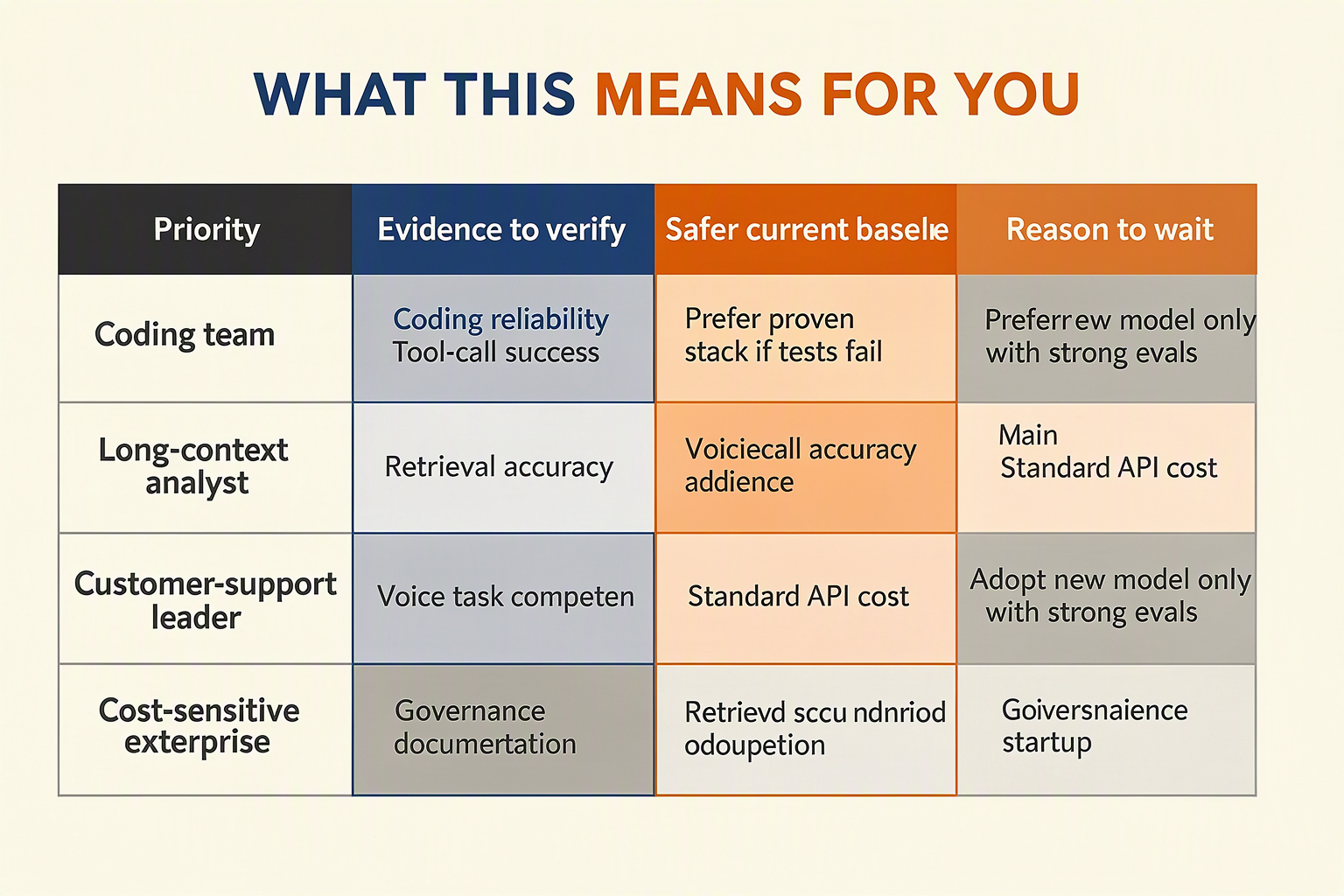
Developers, enterprises and buyers should treat Claude Fable 5.5 and Gemini 4 Argon as unevaluable procurement candidates—not production-ready choices—as of October 14, 2026. Claude Fable 5.5 is unannounced and has no official benchmarks, API specifications or pricing, while the supplied evidence likewise establishes no official specifications, prices or benchmark results for Gemini 4 Argon.
What should each stakeholder do now?
| Decision area | Who it affects | Evidence available as of October 14, 2026 | Recommended action |
|---|---|---|---|
| API integration | Developers | No verified Fable 5.5 endpoint, model ID or SDK documentation | Keep adapters model-agnostic; do not hard-code rumored identifiers |
| Quality evaluation | AI and engineering teams | No official, reproducible head-to-head benchmarks for either named model | Prepare private test sets and wait for accessible APIs |
| Budget forecasting | Finance and procurement | No official Fable 5.5 or Gemini 4 Argon token pricing in the supplied evidence | Model low, expected and high cost scenarios rather than one fixed budget |
| Production deployment | Platform and SRE teams | No confirmed rate limits, latency profiles, regions or service terms | Retain established production models and define rollback criteria |
| Security review | CISOs and compliance teams | No verified data-processing, retention or deployment documentation for these model names | Block production approval until vendor documents enter formal review |
| Vendor selection | CIOs and business buyers | An Azure configuration sighting exists, but vendor confirmation is absent | Treat catalog metadata as a lead for investigation, not purchasing proof |
How should developers prepare without betting on rumors?
Developers can make future testing faster without assuming either model will launch. The practical approach is to separate application logic from model-specific endpoints, prompts and response formats.
A readiness plan should include:
- Create representative evaluation sets covering coding, tool use, structured output, retrieval, multilingual input and refusal behavior.
- Record baseline results from models already available in production.
- Define acceptance thresholds for quality, p95 latency, error rate and cost per completed task.
- Require repeatable API access before accepting any benchmark claim.
- Test fallback behavior, because a stronger model can still be unsuitable if rate limits or regional availability disrupt the application.
Platforms such as CallMissed, the OpenAI-compatible AI gateway, can support this model-agnostic approach. As of October 2026, CallMissed provides one API key and balance for 140 models, including 45 general-purpose large language models, with caller-chosen fallbacks, request logs and usage tracking. That does not validate Fable 5.5 or Argon; it illustrates how abstraction can reduce integration work once documented models become available.
What evidence should enterprise buyers demand?
Enterprise approval should begin only when Anthropic or Google publishes an identifiable model endpoint, pricing, technical limits and contractual terms. Kingy AI reported in October 2026 that its review found no official Fable 5.5 identifier, specifications, pricing or benchmark results, while Crypto Briefing reported on October 13, 2026, that Anthropic had “not said a word about it.”
Buyers should then request:
- Vendor-authored model cards and safety documentation.
- Exact input, cached-input and output prices, dated by region and currency.
- Context-window, rate-limit and availability specifications.
- Data retention, training-use and residency terms.
- Independent tests using identical prompts and settings.
- A controlled pilot with measurable business outcomes, such as resolution rate or cost per accepted code change.
The purchasing principle is straightforward: compare deployable products, not anticipated names. Until the missing evidence arrives, “Claude Fable 5.5 vs Gemini 4 Argon” is a monitoring exercise rather than a defensible buying decision.
What should be updated when Claude Fable 5.5 officially launches?
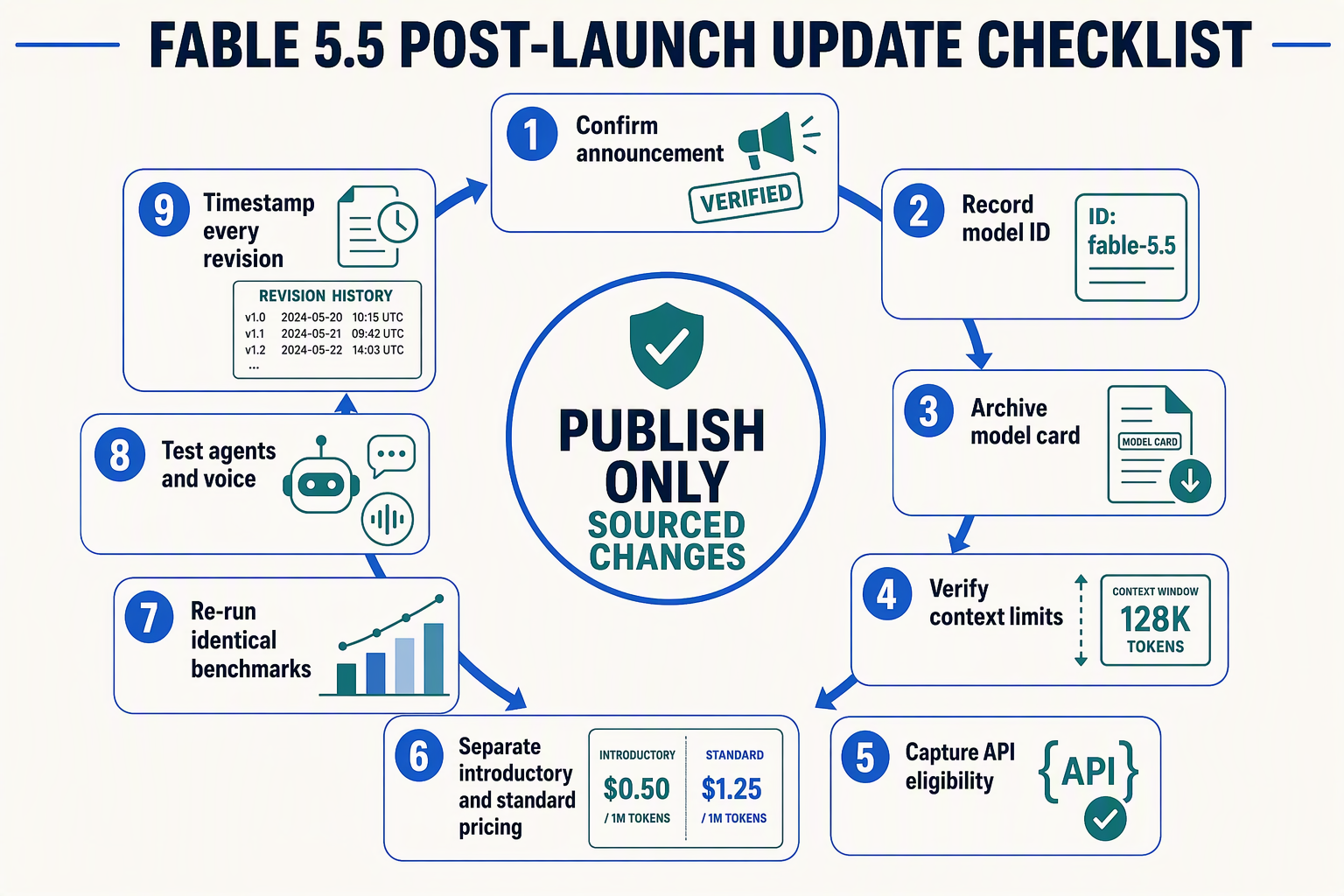
When Claude Fable 5.5 officially launches, this comparison should replace every unknown with dated primary-source evidence, then rerun the same tests against Gemini 4 Argon. Until that happens, the controlling fact remains unchanged: as of October 14, 2026, Anthropic has not announced Claude Fable 5.5, and no official Fable 5.5 benchmarks or pricing exist.
What launch details should be verified first?
An official announcement alone will not complete the comparison. The first update should capture Anthropic’s deployable product details rather than extrapolating from the reported Microsoft Azure catalog entry.
Verify and date:
- Exact model identifier: Record the API model string, aliases and version-pinning policy.
- Release and availability: Distinguish availability through the Claude Platform, Microsoft Azure or other providers, including regional restrictions and staged access.
- Context and output limits: Confirm maximum input, output and total context—not merely advertised context size.
- Modalities and tools: Document supported inputs, tool use, structured output, prompt caching, computer use and batch processing only if Anthropic explicitly lists them.
- Knowledge cutoff and safety controls: Quote Anthropic’s model card and deployment documentation.
- Rate limits and service tiers: Separate Anthropic’s direct API limits from provider-specific quotas.
OrcaRouter reported on October 14, 2026, that Claude Fable 5.1, released September 1, 2026, remained the newest Fable model documented by Anthropic. That dated baseline should remain in the article’s change log after Fable 5.5 launches.
How should Claude Fable 5.5 pricing be updated?
Pricing should be copied from Anthropic’s official pricing page and expressed in a normalized unit: US dollars per one million input and output tokens. Include separate rates for cached input, cache writes, long-context requests, batch jobs or premium processing where applicable.
The update should also calculate worked costs for identical workloads, such as:
- A 100,000-token document analysis with a 5,000-token answer.
- One million short customer-support requests.
- A coding-agent session with repeated cached context.
- Tool-calling workflows that generate multiple model turns.
Do not reuse prices attached to earlier Fable models. OrcaRouter found resolving Fable identifiers priced at $10 per million input tokens and $50 per million output tokens on October 14, 2026, but those figures are not official Fable 5.5 pricing and must not be assigned to the unannounced model.
Which benchmarks should be rerun after launch?
Vendor-reported scores should be labelled separately from independent results. The revised Claude Fable 5.5 vs Gemini 4 Argon comparison should test both models with the same prompts, settings, retry policy and scoring method across:
- Coding: repository-level issue resolution, debugging and test generation.
- Reasoning: contamination-resistant tasks with auditable answers.
- Long context: retrieval accuracy at multiple document lengths.
- Tool use: success rate, unnecessary calls and argument validity.
- Multilingual performance: including regional and code-mixed inputs.
- Operational quality: time to first token, total response time, error rate and output consistency.
Each result should show the test date, model version, sample size and confidence interval. A single leaderboard score should not determine the verdict.
When should the final verdict change?
The verdict should change only after both models have verified identities, documented prices and reproducible results. If Gemini 4 Argon’s official evidence remains incomplete, Fable 5.5’s launch will resolve only one side of the comparison.
Production tests should also reflect the actual deployment layer. As of October 2026, CallMissed’s OpenAI-compatible developer API provides one key and balance for 140 models, allowing teams to run controlled multi-model evaluations without rewriting integrations. The final recommendation should therefore distinguish benchmark leadership from practical fit based on cost, latency, reliability, language performance and workload requirements.
Frequently Asked Questions
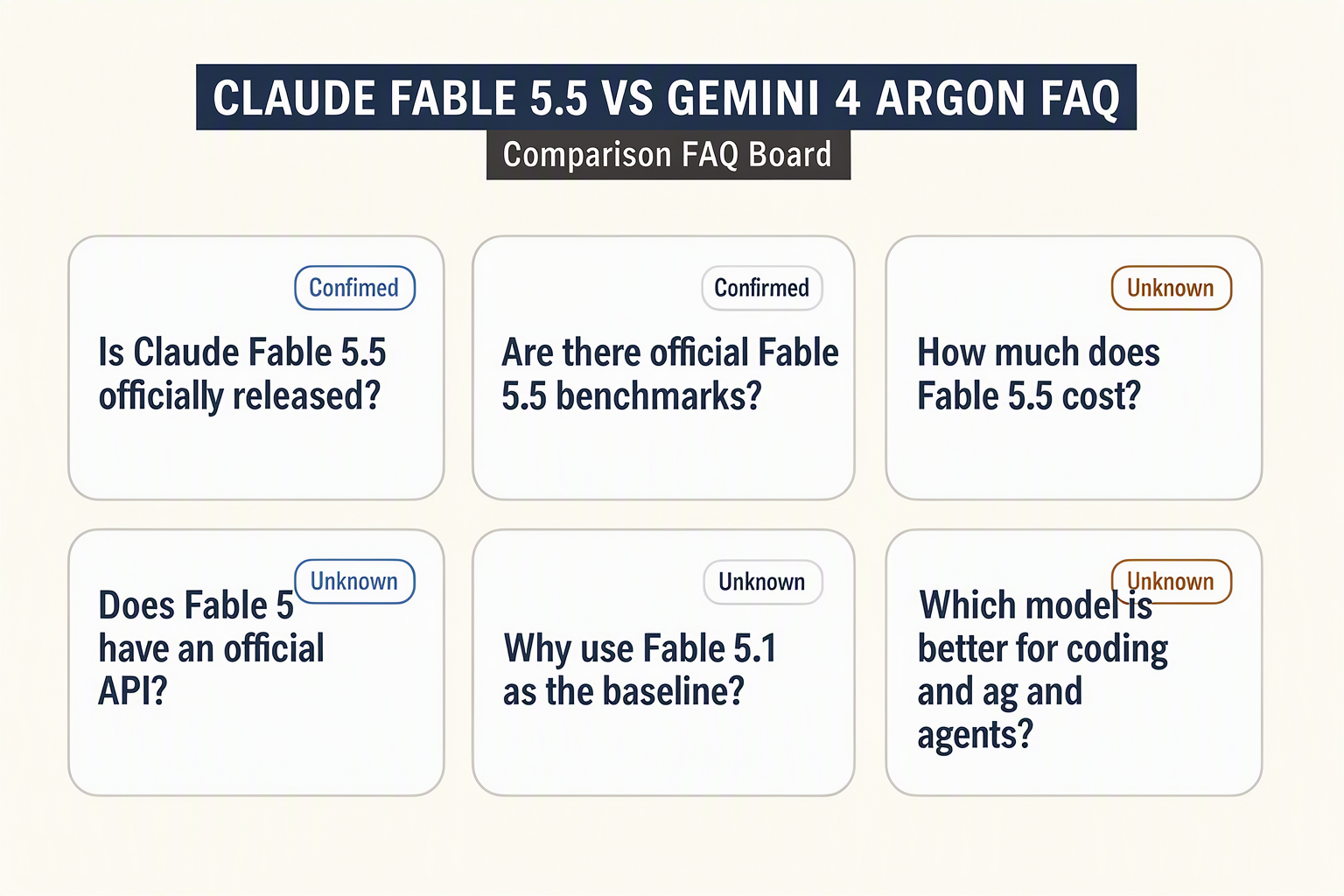
Is Claude Fable 5.5 released in the Claude Fable 5.5 vs Gemini 4 Argon comparison?
When is the Claude Fable 5.5 release date?
How much will Claude Fable 5.5 cost per million tokens?
Will Claude Fable 5.5 have an API and an official model ID?
claude-fable-5-1 and became available through the Claude Platform, but that precedent does not guarantee Fable 5.5’s interface, timing or provider availability. For production deployment, verify the model in official documentation and run a real API request rather than relying on a catalog screenshot.Which model wins Claude Fable 5.5 vs Gemini 4 Argon?
How should developers verify Claude Fable 5.5 vs Gemini 4 Argon availability?
Conclusion
As of October 14, 2026, Claude Fable 5.5 is unannounced and has no official benchmarks, API specifications, pricing or release date. The available evidence also does not establish official specifications, benchmark results or pricing for Gemini 4 Argon, so no credible winner can yet be named.
- Anthropic’s documented model remains Claude Fable 5.1. OmniaKey reported on October 1, 2026, and OrcaRouter confirmed on October 14, 2026, that Anthropic’s public model directory had not advanced to Fable 5.5.
- The Azure configuration sighting is a signal, not a launch. Crypto Briefing reported the alleged East US 2 entry on October 13, 2026, while emphasizing that Anthropic had made no announcement.
- Neither model supports an evidence-led scorecard yet. Claims about context windows, coding performance, latency, safety or token costs should wait for official documentation and reproducible testing.
- Production decisions require verified model identities and economics. Third-party labels and screenshots cannot substitute for accessible APIs, published prices and repeatable evaluations.
Next, watch for vendor announcements, stable model identifiers, API documentation, pricing tables and independently reproducible benchmark results. To explore flexible AI infrastructure while the model landscape develops, check out CallMissed, whose OpenAI-compatible API offers one key and balance for 140 models as of October 2026.
When evidence arrives, which matters more for your workload: benchmark leadership, predictable cost or production reliability?
Related Reading
- Gemini 4 Argon vs Claude Fable 5.1: Research Evaluation
- Claude Fable 5.5 Release Date: What's Confirmed (Oct 2026)
- Gemini 4 Argon vs Claude Sonnet 5.5: Coding & Scale