
Gemini 4 Argon vs Claude Fable 5.1: Research Evaluation



Compare Gemini 4 vs Claude Fable 5.1 on access, research, coding and illustrative costs, with evidence checks to guide enterprise buying.
Gemini 4 Argon vs Claude Fable 5.1: Research Evaluation
Could a reported 77.9% score on DeepSWE v1.1 change which AI model your engineering team chooses—or simply raise more questions about how benchmarks translate into production? SaaSCity’s September 30, 2026 report attributes that result to Google’s Gemini 4 Argon, setting the stage for Gemini 4 vs Claude Fable 5.1: a comparison draft focused on demanding research, complex coding, and enterprise reasoning.
The immediate question is not which model deserves a crown. It is whether the available evidence supports a purchasing or deployment decision. Google’s September 30 announcement confirms Argon’s limited rollout and announced rates. Anthropic’s official Fable 5.1 launch and API release notes confirm its model identifier, prices and limits. Vendor claims and account-specific access still require separate evaluation. This guide separates vendor-reported benchmarks from independently reproduced results. Google’s launch announcement and Anthropic’s Fable 5.1 documentation confirm both model names; access conditions and research performance must be assessed separately.
Why does this comparison matter on September 30, 2026?
According to Unite.AI’s September 30, 2026 reporting, Gemini 4 Argon’s introductory API pricing is $2 per million input tokens and $10 per million output tokens, with cached input priced at a reported 95% discount. Those figures make workload economics worth examining alongside benchmark performance, although official pricing and eligibility still need verification.
For an enterprise, the relevant calculation extends beyond the headline token rate. A coding assistant that repeatedly retries a task can consume more resources than expected; a research model that produces an impressive answer without reliable citations can create additional review work. The useful comparison is therefore cost per successfully completed, verified task, not price or benchmark score in isolation.
What will this Gemini 4 vs Claude Fable 5.1 draft examine?
This comparison will evaluate the evidence needed to answer three practical questions:
- Demanding research: Can each model retrieve relevant evidence, distinguish conflicting sources, and produce citations that withstand human checking?
- Complex coding: Can each model navigate an unfamiliar repository, implement a change, and pass meaningful tests without introducing regressions?
- Enterprise reasoning: Can each model follow detailed constraints, use tools appropriately, and deliver consistent results within governance requirements?
The draft will also distinguish context capacity from output limits, introductory pricing from ongoing costs, and benchmark conditions from real deployment conditions. These distinctions matter because similarly worded product claims can describe very different operational capabilities.
As of September 2026, CallMissed’s verified product fact sheet lists an OpenAI-compatible developer API with caller-chosen fallback models, illustrating why model selection increasingly belongs within a broader integration strategy.
The goal is a decision framework rather than a premature winner: identify what is documented, test what matters to your workload, and flag what cannot yet be substantiated. Until official documentation is reviewed for both named models, any head-to-head verdict should remain provisional.
Gemini 4 Argon vs Fable 5.1: research evaluation
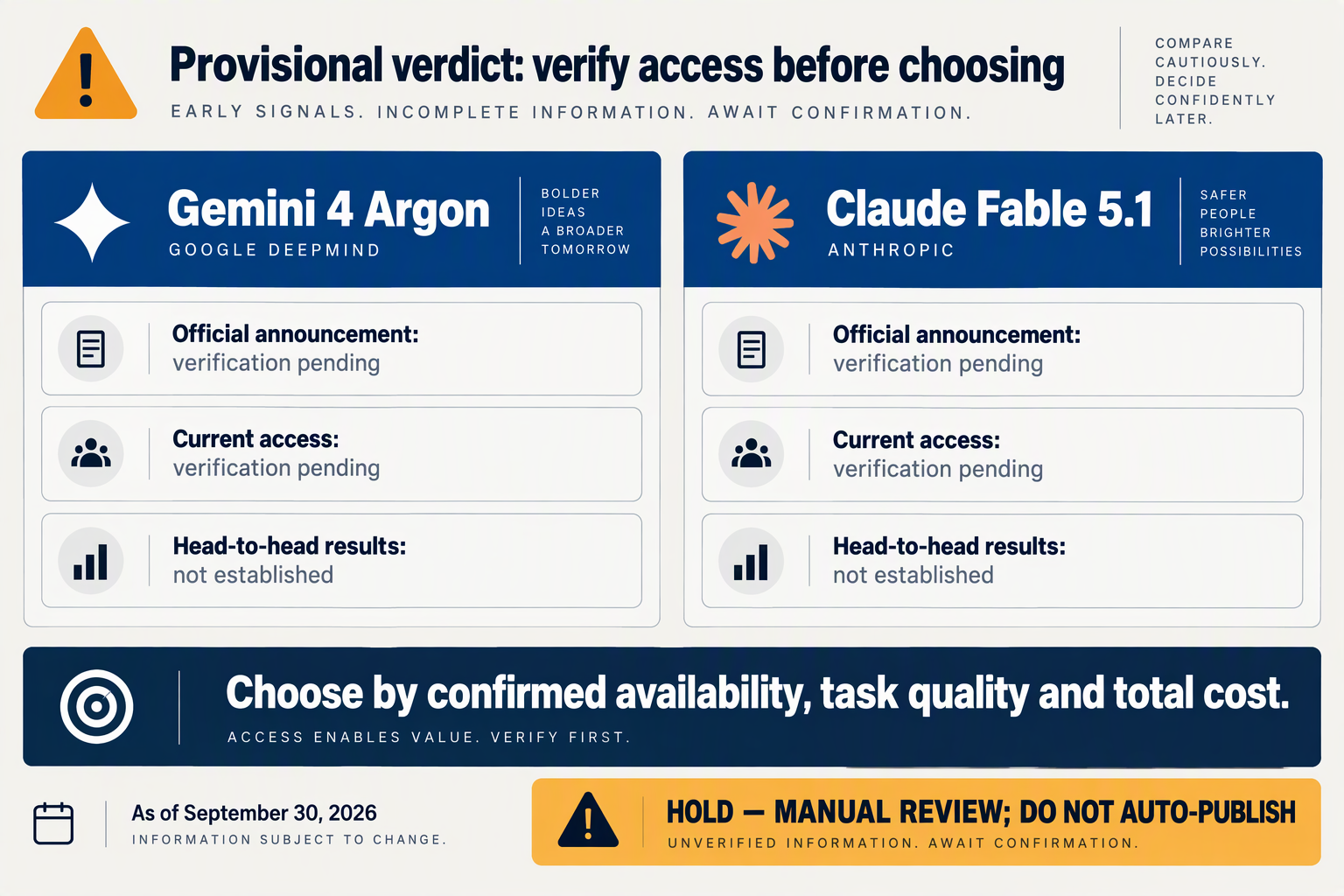
Research reproducibility—not a headline ranking—should guide the comparison between Gemini 4 Argon and Claude Fable 5.1 as of September 30, 2026. Their release conditions and reasoning configurations need to be documented before research results can be compared meaningfully.
What release conditions matter for research?
- Gemini 4 Argon: The supplied Google release details describe September 30 availability as limited to Fairwind. A result obtained through that access should not be presented as independently reproducible by researchers without equivalent access. Record the exact model identifier, access route, execution date, and available settings alongside every reported result.
- Claude Fable 5.1: The supplied Anthropic September 1 launch details identify
claude-fable-5-1, with a 1 million-token context window, 128,000-token maximum output, and always-on adaptive thinking. Context capacity and output limits are different constraints; neither establishes citation accuracy or grounded reasoning by itself.
- Fable is not Mythos: Anthropic’s launch distinguishes their research access and cyber safeguards. Do not transfer Mythos capabilities, permissions, restrictions, or evaluation results to Fable 5.1—or treat the two names as interchangeable.
What makes a research comparison reproducible?
Use the same research questions, source corpus, retrieval permissions, and evidence cutoff wherever access permits. Preserve prompts, model identifiers, configuration settings, tool calls, retrieved passages, complete responses, and execution timestamps. Document any differences that cannot be controlled rather than treating the runs as equivalent.
Assess grounded reasoning separately from presentation quality:
- Evidence fidelity: Does each factual conclusion follow from the cited passage, and does the citation identify the correct source?
- Conflicting evidence: Does the response distinguish disagreements, source dates, and differences in authority rather than silently choosing one account?
- Uncertainty: Does it separate established facts, inferences, and unresolved questions?
- Reasoning consistency: Do repeated runs preserve the evidence-supported conclusion, even when wording changes?
- Failure transparency: Are inaccessible sources, retrieval failures, and unsupported assertions visible in the research record?
These are evaluation criteria, not published benchmark results. A polished answer, a large context window, or an isolated leaderboard score does not establish superior research performance.
How should researchers record cost?
Treat cost as part of the reproducibility record, not as a substitute for evidence quality.
- Argon: The supplied announcement specifies introductory pricing of $2 per million input tokens and $10 per million output tokens. Its announced 95% cached-input discount makes qualifying cached input $0.10 per million tokens at the introductory input rate. Later rates are $4/$20, but no introductory expiry is confirmed in the supplied details.
- Fable 5.1: The supplied launch details specify $10 per million input tokens, $50 per million output tokens, and $0.25 per million cache-read tokens.
Report uncached input, cached input, output usage, and applicable rates separately. Keep procurement, contractual terms, and deployment decisions in the companion buyer comparison.
Official reference indexes: Google AI announcements, Gemini API release notes, Anthropic launch announcements, and Claude API release notes. Model-specific release details above come from the supplied editorial brief; direct links to the individual launch announcements were not supplied.
What can you actually access? Announcement, restricted rollout and public API evidence with source dates
Neither Gemini 4 Argon nor Claude Fable 5.1 has verified public API access in the supplied evidence as of September 30, 2026. Gemini 4 Argon has secondary announcement and restricted-rollout reporting; Claude Fable 5.1 has no supplied official Anthropic documentation establishing availability.
What does the access evidence actually establish?
- Gemini 4 Argon: SaaSCity reports a September 30, 2026 announcement, but the supplied material contains no official Google announcement page to authenticate the release.
- Gemini 4 Argon: RuntimeWire’s September 30, 2026 headline describes access for cyber defenders before public release; that supports a reported restricted rollout, not unrestricted developer access.
- Claude Fable 5.1: As of September 30, 2026, the supplied research provides no Anthropic announcement, exact API model identifier, access instructions, or release date.
| Evidence checkpoint | Gemini 4 Argon | Claude Fable 5.1 | Source and date | Review status |
|---|---|---|---|---|
| Product announcement | Announcement reported | No announcement supplied | SaaSCity, September 30, 2026 | Google primary source needed |
| Restricted rollout | Cyber-defender access reported | No rollout evidence supplied | RuntimeWire, September 30, 2026 | Eligibility unverified |
| Internal deployment | Google team use described | No internal-use evidence supplied | TestingCatalog, September 30, 2026 | Not proof of external access |
| Public API availability | No official endpoint or model ID supplied | No official endpoint or model ID supplied | Supplied research, assessed September 30, 2026 | Both unverified |
| Public release timing | No confirmed date established by supplied excerpts | No release date supplied | Supplied research, assessed September 30, 2026 | Leave dates open |
| Alternative model naming | “Gemini 4 Pro” and “argon” appear in leak reporting | No corroborating naming evidence supplied | CometAPI excerpt; publication date not supplied | Do not equate products |
What would prove that a model is publicly accessible?
- Announcement evidence: For this September 30, 2026 draft, request an official Google or Anthropic release page that names the exact product and distinguishes announcement, preview, restricted access, and general availability.
- API evidence: Require a dated provider model listing, exact request identifier, authentication instructions, supported region, and account eligibility; a published price alone does not establish that an account can send requests.
- Operational evidence: Record one successful authorized API request, its timestamp, returned model identifier, and billing entry; that proves access for the tested account, not necessarily every customer.
How should enterprise teams interpret this draft?
Access status is a deployment gate, not a benchmark. A research team cannot validate citations, a coding team cannot run repository evaluations, and procurement cannot confirm workload costs until the relevant model is accessible under documented terms.
For manual review, label Gemini 4 Argon “reported announcement/restricted rollout; public API unverified” and Claude Fable 5.1 “availability unverified in supplied evidence.” These labels describe the evidence gap—not proof that either model is unavailable—and should change only when dated primary documentation or reproducible access evidence supports the update.
How do research, complex coding and enterprise reasoning compare—and which claims remain unverified?
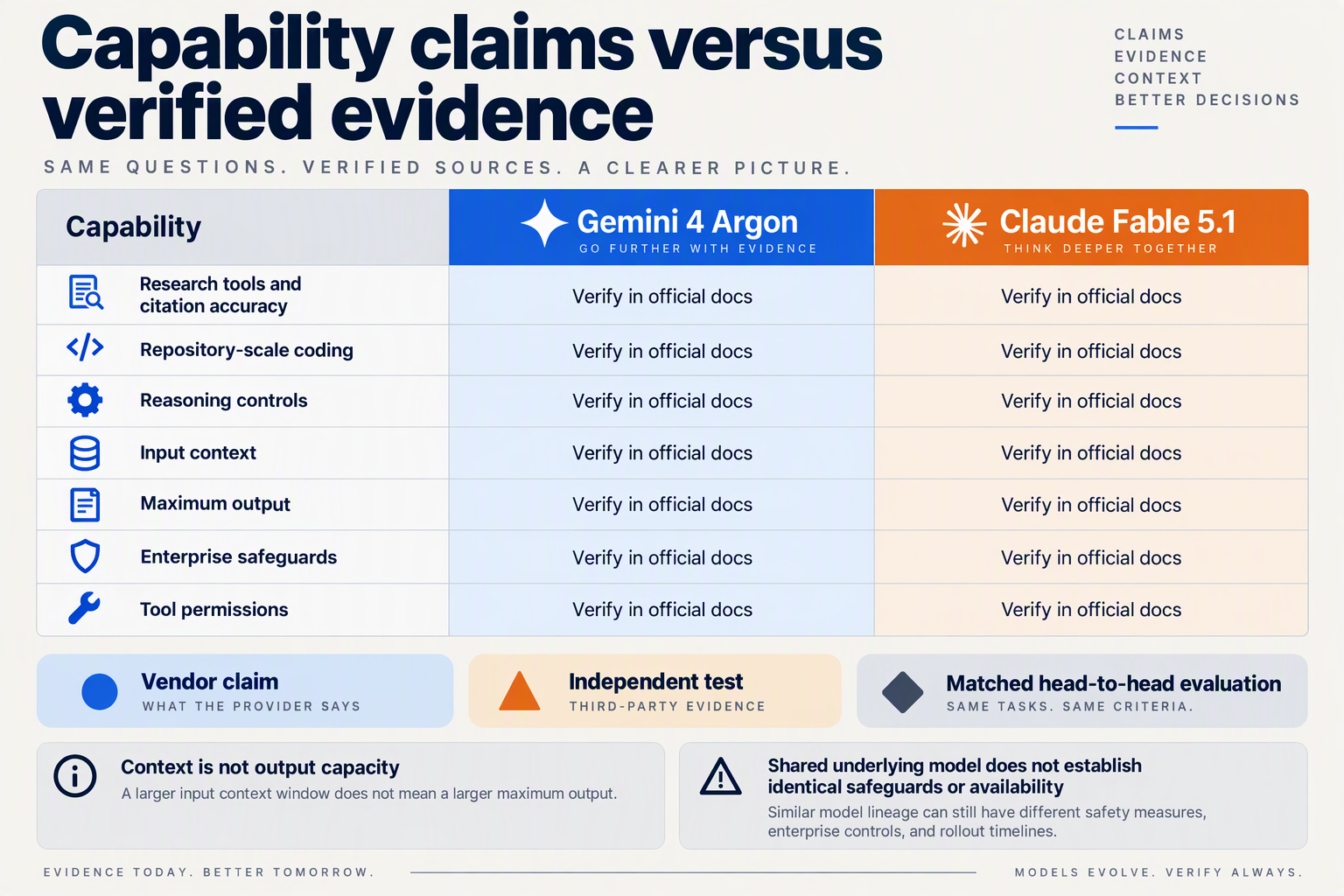
Neither Gemini 4 Argon nor Claude Fable 5.1 has enough verified evidence in the supplied material to establish a winner for research, complex coding or enterprise reasoning as of September 30, 2026. The comparison below separates secondary reporting from the tests and official documentation needed for a defensible decision.
Which capabilities are documented, reported or still unverified?
| Evaluation area | Gemini 4 Argon evidence | Claude Fable 5.1 evidence | Manual-review requirement |
|---|---|---|---|
| Research accuracy | No citation-accuracy, retrieval-recall or conflicting-source evaluation appears in the supplied context. | No verified research evaluation supplied. | Test both on identical source collections; check whether citations actually support each material claim. |
| Repository-level coding | SaaSCity reports a DeepSWE v1.1 result on September 30, 2026; the supplied excerpt lacks evaluation settings. | No comparable benchmark result supplied. | Obtain benchmark methodology, tool permissions, attempt counts and test-contamination disclosures before comparing scores. |
| Long-form generation | SaaSCity’s September 30, 2026 report describes a 1 million-token output window. | No verified output limit supplied. | Confirm whether this means generated output, total context or another allowance; inspect endpoint-specific limits. |
| Conflicting limit claims | CometAPI’s supplied leak summary describes a reported 256,000-token output limit for a Gemini 4 Pro checkpoint. | No specification available for reconciliation. | Establish whether the reports concern the same model, checkpoint and release; do not merge their specifications. |
| Enterprise reasoning | TestingCatalog’s September 30, 2026 coverage frames Argon around coding and enterprise use, without a supplied constraint-following evaluation. | No verified enterprise evaluation supplied. | Test policy adherence, structured-output validity, escalation decisions and recovery from failed tool calls. |
| Security and access | RuntimeWire’s September 30, 2026 report describes cyber-defender access before public release. | No verified availability or security documentation supplied. | Verify deployment eligibility separately from data retention, regional hosting, contractual protections and administrative controls. |
What tests would make this comparison decision-ready?
- Research: Use a proposed 20-question evaluation spanning conflicting evidence, outdated documents and unanswerable questions; score citation support and appropriate abstention separately rather than rewarding polished prose.
- Complex coding: Run a proposed 10-task repository trial covering bug fixes, cross-file refactoring and dependency changes; require hidden regression tests and record human intervention for each completed task.
- Enterprise reasoning: Test a proposed 15 policy scenarios, including prohibited actions, missing approvals and contradictory instructions; distinguish correct refusal from failure to complete an authorized workflow.
- Output limits: Treat SaaSCity’s 1 million-token report and CometAPI’s 256,000-token checkpoint claim as unresolved as of September 30, 2026; neither establishes reliable long-document reasoning.
- Source verification: Request Google model documentation and Anthropic model documentation identifying exact model IDs, supported endpoints and release status; absent evidence is not evidence that a capability is missing.
- Decision rule: Keep quality, completion rate, intervention time and total task cost as separate measures; select a workload-specific candidate only after reproducible trials, not by treating secondary launch reporting as a procurement guarantee.
How much would each cost? Provisional rates, cache rules and an explicit illustrative token mix
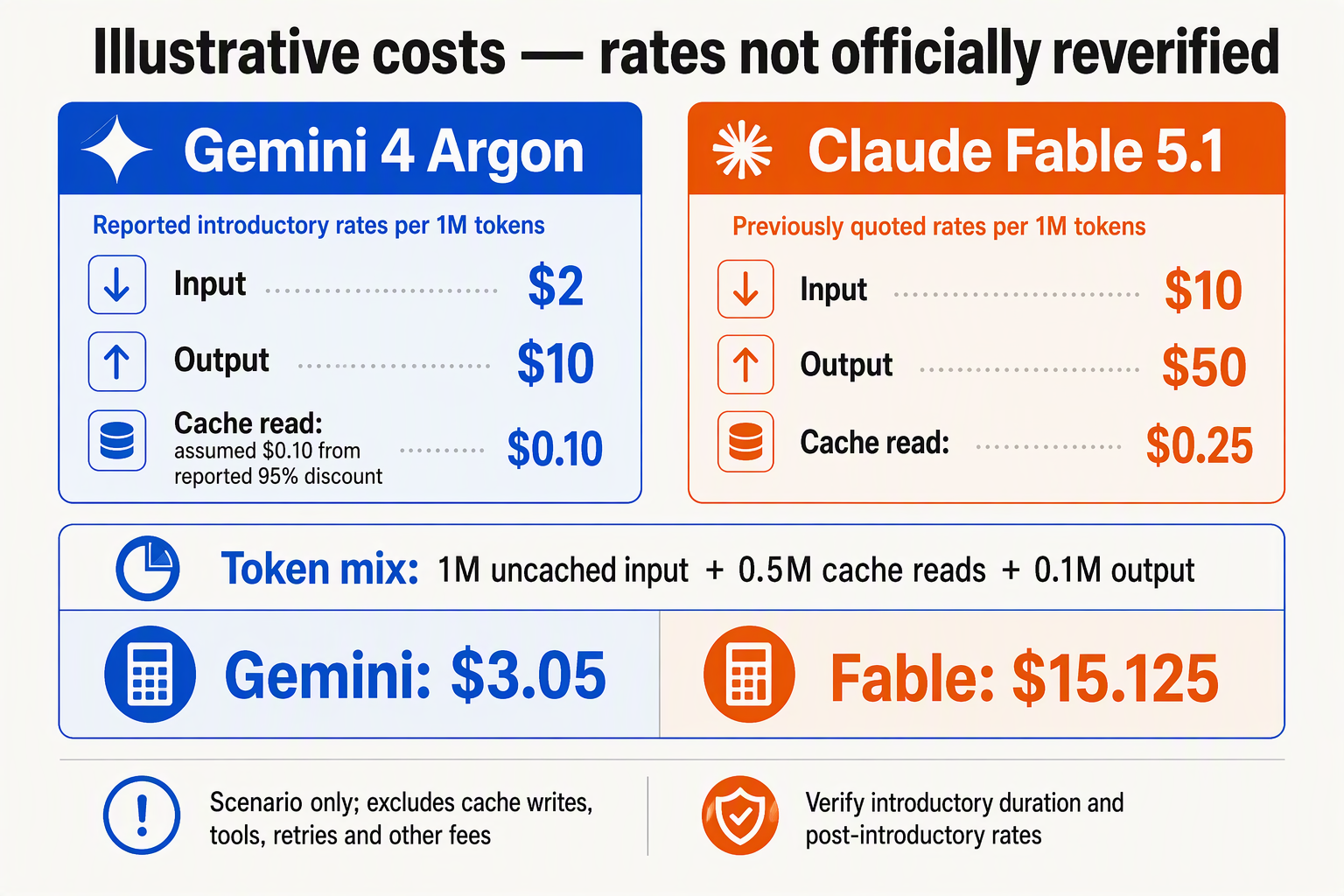
Gemini 4 Argon’s reported introductory rates imply $1.48 for the illustrative cached workload below, versus $3.00 without caching. Claude Fable 5.1 cannot be priced from the supplied evidence; neither comparison column should be treated as an official quotation.
- Gemini 4 Argon: Unite.AI’s September 30, 2026 report lists introductory pricing of $2 per million input tokens and $10 per million output tokens; official Google pricing documentation remains necessary before procurement or production budgeting.
- Claude Fable 5.1: As of September 30, 2026, the supplied research contains no verified Anthropic pricing for this model name. Input, output, cache-read and cache-write rates must remain unknown—not borrowed from another Claude model.
- Cached input: Unite.AI reports a 95% input-price discount on September 30, 2026, implying $0.10 per million eligible cached tokens at the introductory rate. This arithmetic does not establish cache eligibility, storage charges, retention periods or minimum cache size.
- Illustrative workload: Assume 1,000,000 total input tokens, comprising 200,000 uncached tokens and 800,000 eligible cache reads, plus 100,000 output tokens. This is a constructed budgeting example, not a benchmark result or measured enterprise usage pattern.
- Later pricing: RuntimeWire’s September 30, 2026 report gives post-introductory rates of $4 per million input tokens and $20 per million output tokens. The supplied excerpt does not establish the transition date or later cache pricing.
- CallMissed: As of September 2026, CallMissed’s verified fact sheet lists usage and request logs and caller-chosen fallback models for its developer API. Those capabilities support workload accounting, but do not establish either model’s availability or price through CallMissed.
What does the illustrative token mix cost?
All dollar figures below are USD; token rates are per one million tokens. Gemini figures reflect secondary reporting available on September 30, 2026, while calculated totals exclude any additional charges.
| Cost item | Gemini 4 Argon | Claude Fable 5.1 | Evidence or calculation |
|---|---|---|---|
| Introductory input | $2.00 | Unverified | Unite.AI |
| Introductory output | $10.00 | Unverified | Unite.AI |
| Eligible cached input | $0.10, inferred | Unverified | $2 × 5% |
| Example, no caching | $3.00 | Not calculable | 1 × $2 + 0.1 × $10 |
| Example, 80% cached input | $1.48 | Not calculable | 0.2 × $2 + 0.8 × $0.10 + 0.1 × $10 |
| Post-introductory input/output | $4 / $20 | Unverified | RuntimeWire; timing unspecified |
Which cache rules need manual verification?
- Confirm the billing definition: Obtain official Google and Anthropic documentation covering cache creation, cache reads, storage duration, minimum token thresholds and invalidation. Repeatedly sending the same repository or research document does not, by itself, prove that discounted billing applies.
- Budget the complete task: Record retries, tool calls and any separately billed reasoning tokens. The example’s $1.52 saving, or approximately 50.7%, applies only under its stated assumptions; enterprise comparisons should measure cost per successfully completed, verified task rather than nominal token price.
What are the potential advantages, drawbacks and evidence limits of each model?
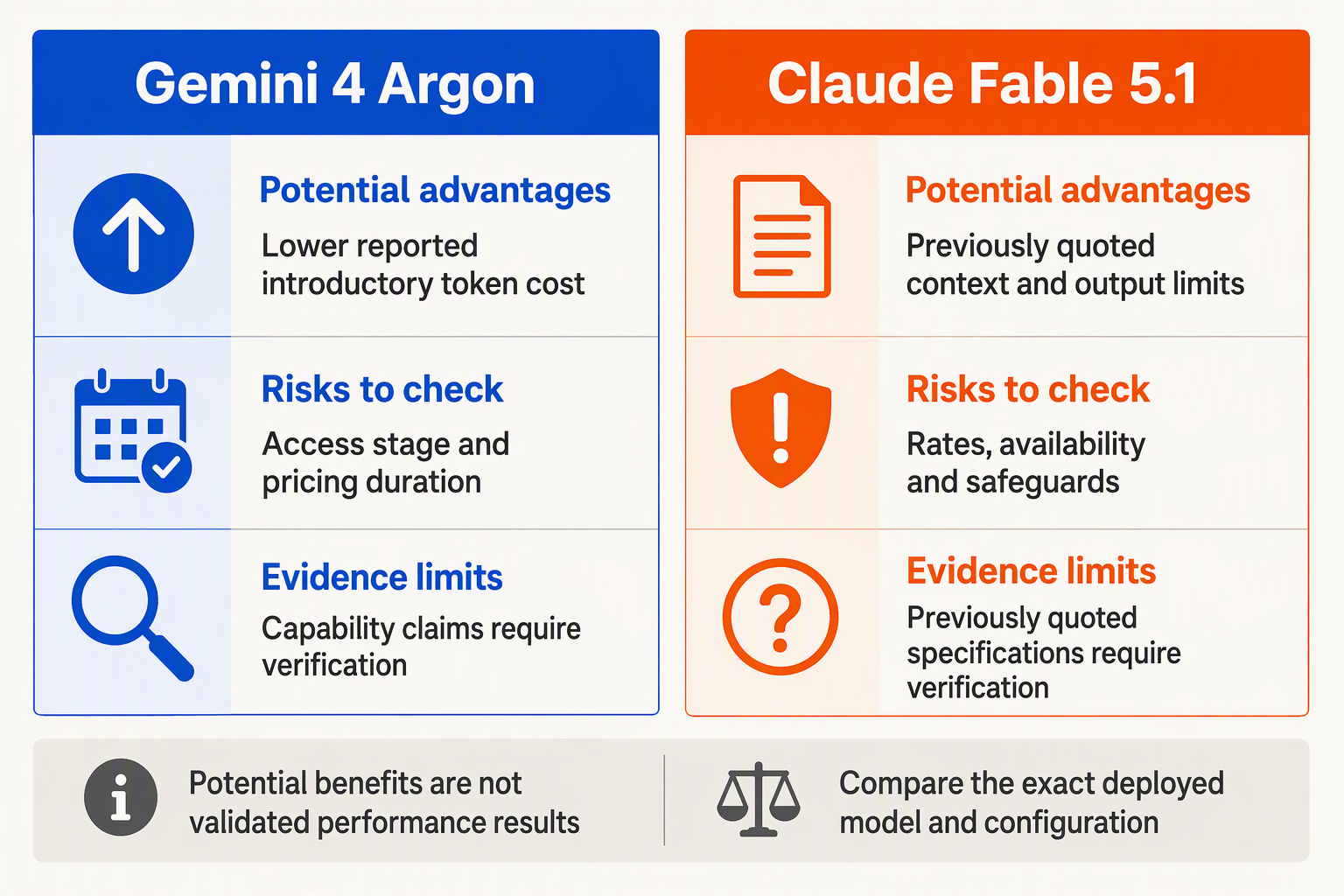
Gemini 4 Argon has reported advantages worth testing, but neither model has enough verified evidence here for a defensible winner. As of September 30, 2026, missing official documentation limits conclusions—not necessarily either model’s actual capabilities.
What advantages and drawbacks does the available evidence support?
| Dimension | Gemini 4 Argon: potential advantage | Drawback or evidence limit | Claude Fable 5.1 |
|---|---|---|---|
| Complex coding | SaaSCity reports 77.9% on DeepSWE v1.1 on September 30, 2026. | No supplied benchmark methodology establishes reproducibility or performance on your repositories. | No verified comparable score supplied. |
| Demanding research | SaaSCity’s September 30, 2026 report describes a 1M output-token window, potentially relevant to lengthy deliverables. | Output capacity does not establish input context, citation accuracy, or evidence quality. | Context and output limits remain unverified. |
| Workload economics | Unite.AI reports introductory rates of $2 input/$10 output per million tokens on September 30, 2026. | RuntimeWire reports later rates of $4/$20; timing and official terms need confirmation. | No verified pricing supplied. |
| Repeated-context workloads | Unite.AI reports a 95% cached-input discount on September 30, 2026. | Cache eligibility, retention, and additional charges are not established here. | No verified caching terms supplied. |
| Enterprise reasoning | TestingCatalog’s September 30, 2026 coverage positions Argon for coding and enterprise use. | Positioning does not demonstrate constraint adherence, tool reliability, or governance controls. | No verified enterprise specifications supplied. |
| Deployment readiness | Multiple supplied publishers report Argon’s announcement on September 30, 2026. | Announcement coverage does not establish general availability, regional access, or contractual commitments. | Official model identity and availability remain unverified. |
What should reviewers avoid inferring from these reports?
- Gemini 4 Argon: Treat the reported coding score as a reason to run a pilot, not proof of production superiority. Reviewers need the benchmark’s agent scaffold, tool permissions, attempt budget, and scoring rules before comparing results across models.
- Claude Fable 5.1: Missing documentation is an evidence gap, not a demonstrated weakness. Do not substitute specifications from another Claude model, infer capabilities from the name, or describe the model as released without an official Anthropic source.
- Token limits: CometAPI’s supplied September 2026 leak summary mentions 256k output tokens, whereas SaaSCity’s September 30 report describes 1M. These may reflect different checkpoints or terminology; retain the discrepancy until official documentation resolves it.
- Cost exposure: RuntimeWire’s September 30, 2026 reported post-introductory rates are twice the introductory rates. Budgeting should therefore include both scenarios and measured retry consumption rather than assuming launch pricing persists.
- Research quality: Neither supplied evidence set establishes citation precision or resistance to unsupported conclusions. Test both candidates on the same source packet, requiring page-level references, explicit uncertainty, and identification of conflicting evidence.
- Enterprise suitability: Require separate checks for data retention, access controls, regional processing, and contractual protections. Coding benchmarks cannot answer those questions, and no supplied official documentation supports a governance comparison between these named models.
How should you run a reproducible research, coding and enterprise-reasoning evaluation?
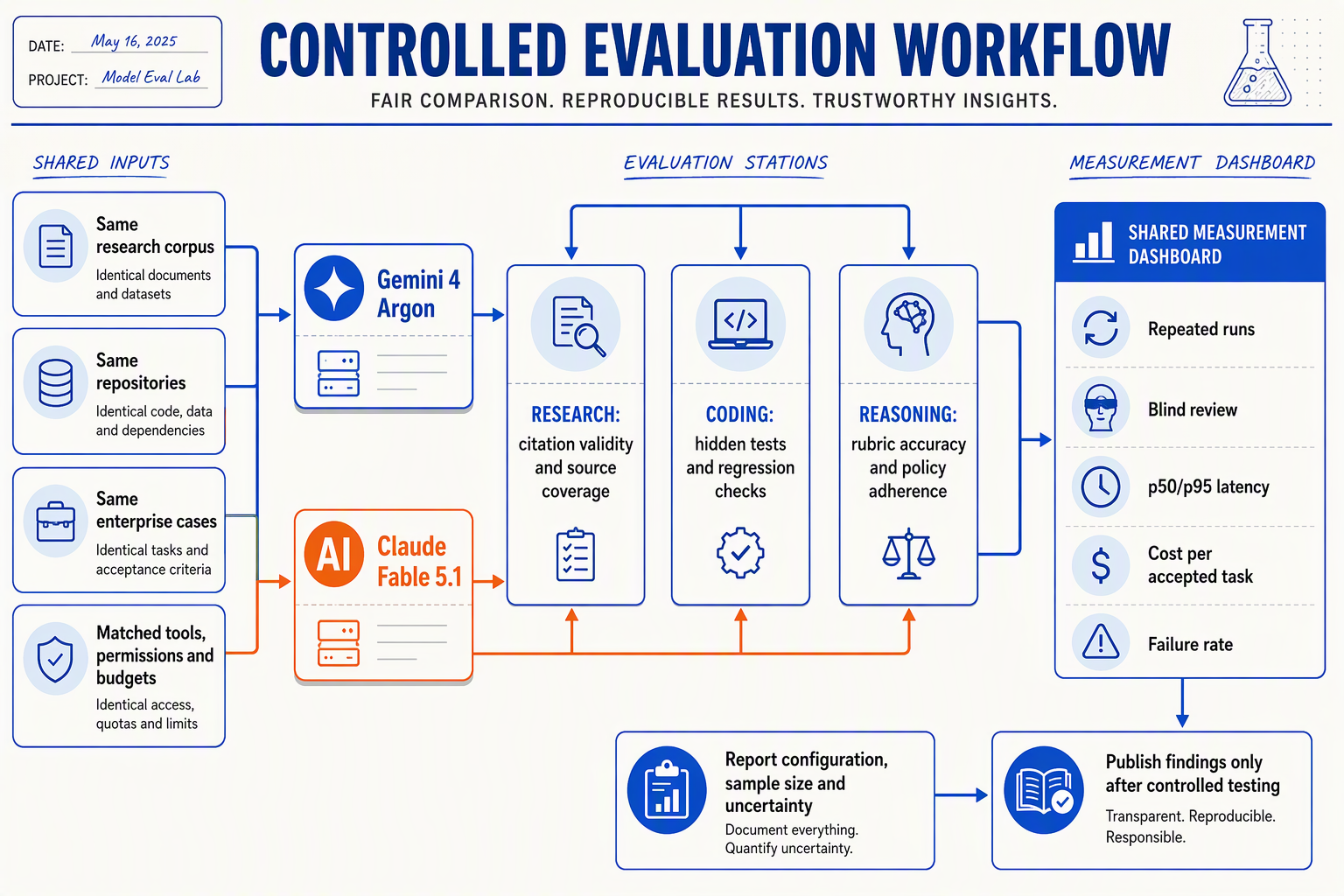
Run Gemini 4 Argon vs Claude Fable 5.1 through a version-pinned, blinded evaluation with identical tasks and explicit pass criteria. Treat unverified model identities and limits as blockers, not assumptions.
What should a reproducible model evaluation include?
- Verify the endpoints: Before testing, obtain official Google and Anthropic documentation, exact API model identifiers, access permissions, and dated pricing. As of September 30, 2026, the supplied context does not establish Claude Fable 5.1’s specifications. If either endpoint cannot be verified and accessed, publish the evaluation protocol—not comparative results or a winner.
- Resolve limits before designing tasks: SaaSCity’s September 30, 2026 report describes a 1-million-token output window for Gemini 4 Argon, while the supplied CometAPI excerpt describes a reported 256,000-token output limit from September 2026 leaks. Neither establishes an official limit here. Confirm input capacity and output ceilings separately; use a shared, verified budget for comparative runs.
- Freeze a 90-task test set: As a proposed evaluation design—not a published benchmark—use 30 research questions, 30 repository issues, and 30 enterprise scenarios. Separate development examples from scored tasks. Record dataset versions, repository commit hashes, source-document snapshots, prompt templates, tool schemas, and evaluator instructions so another team can reproduce the same workload.
- Score research against source evidence: Give both models the same retrieval corpus or identical search-tool access. Require citations for factual claims, flag contradictory documents, and include questions whose correct answer is “insufficient evidence.” Measure supported-claim percentage, citation precision, and material omissions; manually verify cited passages rather than rewarding citation count or polished prose alone.
- Score coding through executable outcomes: Use isolated containers with pinned dependencies, hidden acceptance tests, and regression suites. Include Python, TypeScript, and Java tasks if those languages match production needs. Count a task as successful only when required tests pass and review finds no prohibited changes; record retries, tool calls, and unsuccessful patches.
- Test enterprise reasoning with hard constraints: Include scenarios requiring permission checks, structured JSON, conflicting-policy resolution, and human approval before consequential actions. Define zero tolerance for unauthorized tool execution. Report policy violations separately from answer quality: a convincing recommendation must not compensate for bypassing an approval gate or exposing information outside the test user’s permissions.
- Repeat runs and disclose uncertainty: Run each of the 90 tasks three times per model: 540 runs total. Match tool access, wall-clock ceilings, and reasoning settings where comparable; disclose differences where settings are not equivalent. Blind reviewers to model identity, randomize execution order, and report confidence intervals alongside median and p95 completion latency.
- Publish operational cost and reproducibility artifacts: Calculate total billed model and tool spend ÷ verified successful tasks, including failures and retries. Release sanitized traces, scoring rubrics, and configuration files. As of September 2026, CallMissed’s verified fact sheet lists developer-API usage and request logs; such records can support auditability, without establishing availability of either proposed model.
Which should your team choose now—and when should you wait or test an accessible alternative?
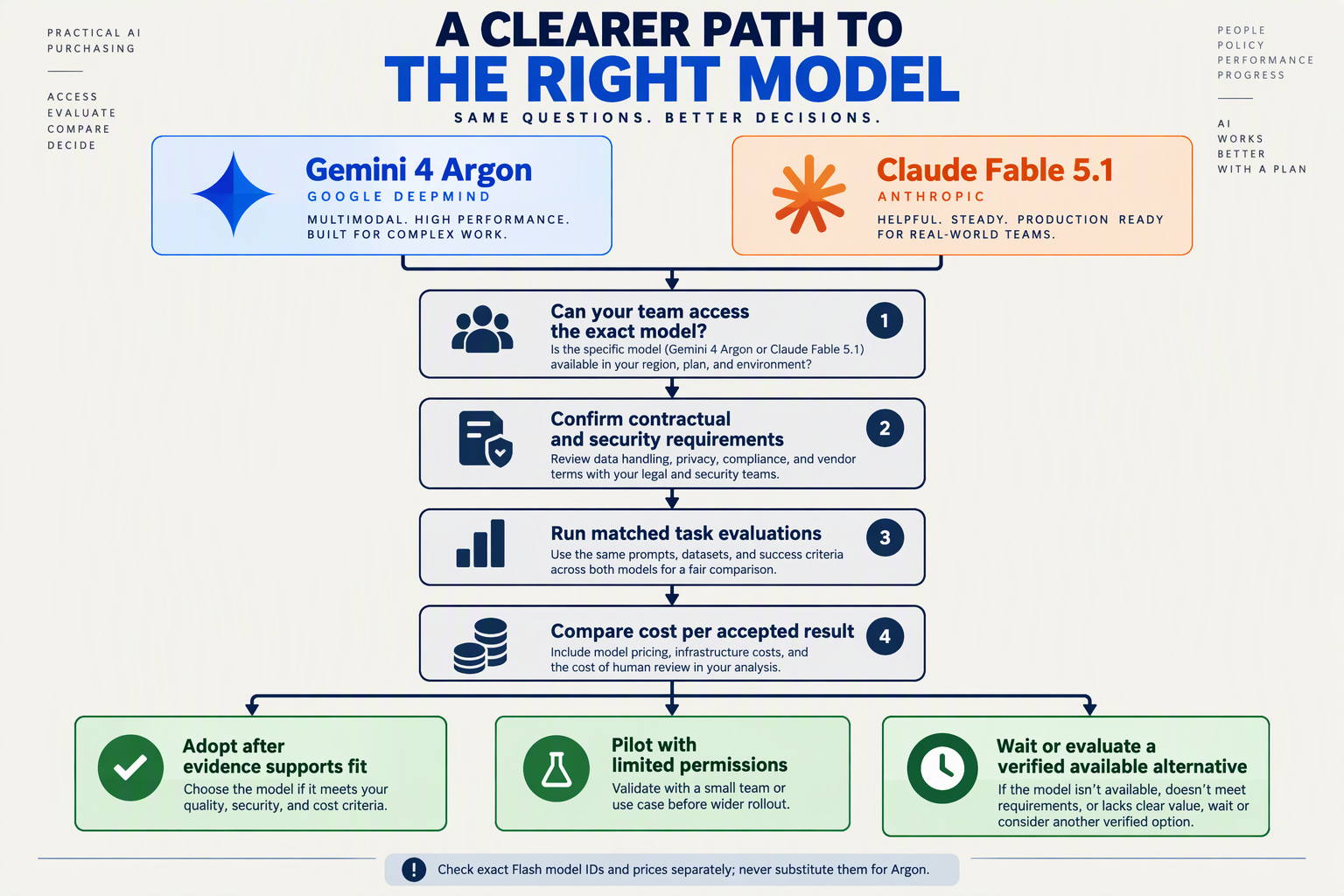
Choose a model your team can access, evaluate, and govern—not a winner inferred from launch reporting. As of September 30, 2026, the supplied evidence supports a conditional Gemini 4 Argon pilot, but not a verified head-to-head purchasing decision against Claude Fable 5.1.
Which model should your team pilot now?
- Gemini 4 Argon: Put Argon on your coding-pilot shortlist if access is available. SaaSCity’s September 30, 2026 report attributes a 77.9% DeepSWE v1.1 score to Argon; treat that as a reason to investigate, not evidence that your repositories will achieve the same success rate. Require official model documentation before production approval.
- Claude Fable 5.1: Keep the purchasing decision open until reviewers obtain an official Anthropic model identifier, availability statement, pricing schedule, and supported limits. The supplied September 30, 2026 research contains no verified Anthropic specifications for this name, so neither a recommendation nor a rejection is justified.
- Research teams: Run a proposed 30-task evaluation: 10 source-retrieval tasks, 10 conflicting-evidence questions, and 10 synthesis assignments. Require reviewers to check every cited source and record unsupported claims separately from writing quality. A polished answer should not pass merely because its citations look plausible.
- Engineering teams: Use a proposed 20-issue repository trial covering bug fixes, refactoring, and feature changes. Give both candidates identical tool permissions and test environments; measure accepted patches, regressions, retries, and reviewer minutes. Select on cost per accepted change, rather than benchmark rank or token price alone.
When should your team wait or test an accessible alternative?
- Budget owners: Wait for official pricing terms before committing annual spend. RuntimeWire’s September 30, 2026 report describes post-introductory Argon rates of $4 per million input tokens and $20 per million output tokens. At those reported rates, 10 million input plus 2 million output tokens would cost $80, excluding other charges.
- Enterprise teams: Delay sensitive production workloads until four gates are documented: data handling, retention, regional availability, and contractual protections. These are proposed procurement requirements, not verified capabilities of either candidate. Meanwhile, use synthetic or appropriately de-identified evaluation material and restrict tools to the minimum permissions each task needs.
- Alternative-model pilots: As of September 2026, CallMissed’s verified fact sheet lists 139 models, including 43 general-purpose LLMs and 27 free-tier models across the catalogue, through one API key and balance. Its OpenAI-compatible endpoints and request logs provide an accessible evaluation route; the fact sheet does not establish availability of either comparison candidate.
- Decision owners: Schedule a proposed two-week review checkpoint, rather than waiting indefinitely for announcements. Approve deployment only when one accessible model meets your predefined accuracy, security, and cost thresholds. If neither candidate has verified documentation or passes testing, retain the current workflow and evaluate documented alternatives without declaring a speculative winner.
Frequently Asked Questions
Gemini 4 vs Claude Fable 5.1 remains a provisional comparison as of September 30, 2026: the supplied evidence supports attributed reporting, not a verified head-to-head verdict.
- Q: Is Google Gemini 4 Argon publicly released as of September 30, 2026?
A: Public availability is not established by the supplied evidence, despite announcement coverage from SaaSCity and Unite.AI dated September 30, 2026. RuntimeWire’s same-day report describes access for cyber defenders before public release, making “announced” and “generally available” materially different claims. Before planning deployment, reviewers should confirm an official Google model identifier, access requirements, supported regions, and an operational API endpoint.
- Q: Are Anthropic Claude Fable 5.1 and Claude Mythos the same model?
A: The supplied context does not establish that Fable and Mythos are equivalent, or provide official Anthropic documentation confirming either designation. Treating the names as interchangeable could attach another model’s pricing, benchmarks, or limitations to this comparison. Manual review should require an Anthropic announcement or model catalogue entry explicitly linking the names before merging their specifications or recommending either for procurement.
- Q: Which costs less in Gemini 4 vs Claude Fable 5.1?
A: A price winner cannot be determined without verified Claude Fable 5.1 rates; Unite.AI reported Gemini 4 Argon introductory pricing of $2 per million input tokens and $10 per million output tokens on September 30, 2026. At those reported rates, one million input tokens plus 100,000 output tokens would cost $3, excluding tools and retries. RuntimeWire also reported subsequent rates of $4 and $20, respectively, requiring official confirmation.
- Q: Which is better for research in Gemini 4 vs Claude Fable 5.1?
A: Neither model has a demonstrated research advantage in the supplied evidence as of September 30, 2026. Evaluate both on the same source pack, measuring citation accuracy, unsupported assertions, conflicting-evidence handling, and reviewer effort rather than answer length. Require each response to distinguish retrieved evidence from inference: a persuasive synthesis is not a reliable research result if its references cannot be checked.
- Q: Does Gemini 4 Argon’s DeepSWE score prove it is better for coding?
A: No: SaaSCity reported a 77.9% DeepSWE v1.1 score for Gemini 4 Argon on September 30, 2026, but the supplied material lacks comparable verified Claude Fable 5.1 results and full evaluation conditions. Test repository-level changes against identical tasks, tool permissions, time budgets, and regression suites. Record successful fixes and total spend together, because benchmark performance alone does not establish production reliability.
- Q: How should enterprises integrate models while release details remain uncertain?
A: Keep model selection reversible, and confirm availability, data-handling terms, tool behavior, and spending limits before production use. As of September 2026, CallMissed’s verified fact sheet lists OpenAI-compatible endpoints and caller-chosen fallback models, capabilities relevant to that integration strategy. Those facts do not establish CallMissed availability for Gemini 4 Argon or Claude Fable 5.1; verify specific catalogue entries separately.
Conclusion
Gemini 4 Argon vs Claude Fable 5.1 remains a decision framework, not a verified verdict, as of September 30, 2026. The next step is to validate official documentation and compare demanding research, complex coding, and enterprise reasoning through reproducible tests—not select a winner from headline claims.
Four takeaways should guide manual review:
- Treat reported benchmarks as starting points. SaaSCity’s September 30, 2026 report attributes a 77.9% DeepSWE v1.1 score to Google’s Gemini 4 Argon. That reported result warrants investigation, but it does not establish performance on your repositories, research questions, or enterprise workflows. Review benchmark conditions and test whether successful changes pass meaningful checks without introducing regressions.
- Keep unsupported comparisons explicitly open. The supplied research does not include official Google documentation confirming Gemini 4 Argon’s specifications or verified Anthropic material establishing Claude Fable 5.1’s capabilities. Missing evidence should remain a documented gap rather than become an assumed advantage or disadvantage. A credible comparison needs confirmed specifications and equivalent evaluation conditions before drawing purchasing conclusions.
- Measure economics at the task level. Unite.AI’s September 30, 2026 reporting lists Gemini 4 Argon’s introductory API pricing at $2 per million input tokens and $10 per million output tokens, subject to official verification. Token prices alone cannot reveal deployment value: retries, unsuccessful coding attempts, and citation checking affect the cost per successfully completed, verified task.
- Separate capacity claims from operational results. Context capacity and output limits describe different constraints; introductory pricing and ongoing costs require separate checks. For demanding research, evaluate evidence quality and citation accuracy. For complex coding, assess repository understanding and test results. For enterprise reasoning, examine constraint-following, appropriate tool use, and consistency under the governance requirements your team actually applies.
What should teams watch for next?
Watch for official Google and Anthropic documentation, confirmed access and pricing terms, and reproducible evaluations that explain their methods. These developments can turn an evidence-limited draft into a useful deployment comparison, but only if reported capabilities survive workload-specific testing.
The strongest future recommendation will connect documented capabilities to verified outcomes. A higher benchmark score may justify a trial; reliable citations, regression-free code, and consistent reasoning are what justify continued use. Revisit the comparison as evidence improves rather than treating this September 30, 2026 draft as a permanent ranking.
As of September 2026, CallMissed offers an OpenAI-compatible developer API with caller-chosen fallback models. Readers can explore CallMissed as part of an integration strategy that keeps model selection adaptable while this evidence develops.
Which model can complete your hardest real task correctly—and at a verified, repeatable cost?
Related Reading
- Gemini 4 Argon vs Claude Opus 5.5: Agent Work in 2026
- Claude Fable 5.1 vs GPT-6 Astra Pricing: Real API Costs in 2026
- Claude Fable 5.1 vs GPT-6 Astra for Coding: 2026 Evidence-Led Comparison
Sources
Discussion
Related Posts


Ready to automate customer conversations?
Launch AI voice agents and WhatsApp bots with CallMissed — one API, 22+ Indian languages.