
Gemini 4 Argon vs Claude Sonnet 5.5: Coding & Scale



Gemini 4 Argon vs Claude Sonnet 5.5 comparison for coding and scale: assess API access, cache costs and repository tests before choosing a model.
Gemini 4 Argon vs Claude Sonnet 5.5: Coding & Scale
What if the biggest difference between two coding models is not the code they write, but whether you can actually deploy them? Gemini 4 Argon vs Claude Sonnet 5.5 needs a verification-first comparison: as of September 30, 2026, Google confirms Argon’s introductory pricing and restricted rollout, and Anthropic’s September 28 announcement confirms Claude Sonnet 5.5. Access, repository-level results and integration requirements—not an alleged naming gap—should drive the decision.
The stakes are concrete. In the Google announcement excerpt supplied for this comparison, reviewed as of September 30, 2026, Gemini 4 Argon is quoted at $2 per million input tokens and $10 per million output tokens, with cached input priced at 95% off. However, Google’s wording—“Argon will launch”—does not, by itself, establish current API availability, an exact model ID, or generally available access. Treat those figures as quoted introductory pricing, not independently verified live billing terms.
Why does this comparison matter for high-volume coding workflows?
For teams running repository analysis, test generation, and repeated code-review tasks, small unit-price differences can become meaningful operating costs. Cache eligibility, output length, retries, and tool execution all influence the final bill; a cheaper input rate alone does not establish a cheaper completed task.
Using the supplied Google pricing excerpt as an illustrative assumption:
- 100 million uncached input tokens would cost $200.
- 20 million output tokens would cost $200.
- A 95% cached-input discount would imply $0.10 per million eligible cached input tokens.
That hypothetical workload totals $400 before caching, excluding any other charges. If 90 million input tokens qualified for the quoted cached rate, the token subtotal would fall to $229—a calculated 42.75% reduction, not a measured production result. Whether that saving is achievable depends on the provider’s actual caching rules and the workload’s repeated content.
What should readers expect from a trustworthy model comparison?
The useful question is not simply “Which model wins?” It is which verified model completes your coding tasks reliably at your required volume and budget. A credible comparison must separate:
- Release and access: exact API identifiers, availability, and preview versus production status.
- Coding evidence: named benchmark results, evaluation conditions, and practical repository-level tests.
- Scale economics: published token prices, cache behavior, rate limits, and retry overhead.
As of September 2026, CallMissed’s developer AI API offers OpenAI-compatible endpoints and caller-chosen fallback models, illustrating how teams can design integrations around model choice rather than one permanent provider.
This comparison starts with that discipline: verify the products first, then assess coding capability and scale without mistaking an announcement, an unsupported model name, or a hypothetical saving for production evidence.
Gemini 4 Argon vs Sonnet 5.5: coding verdict
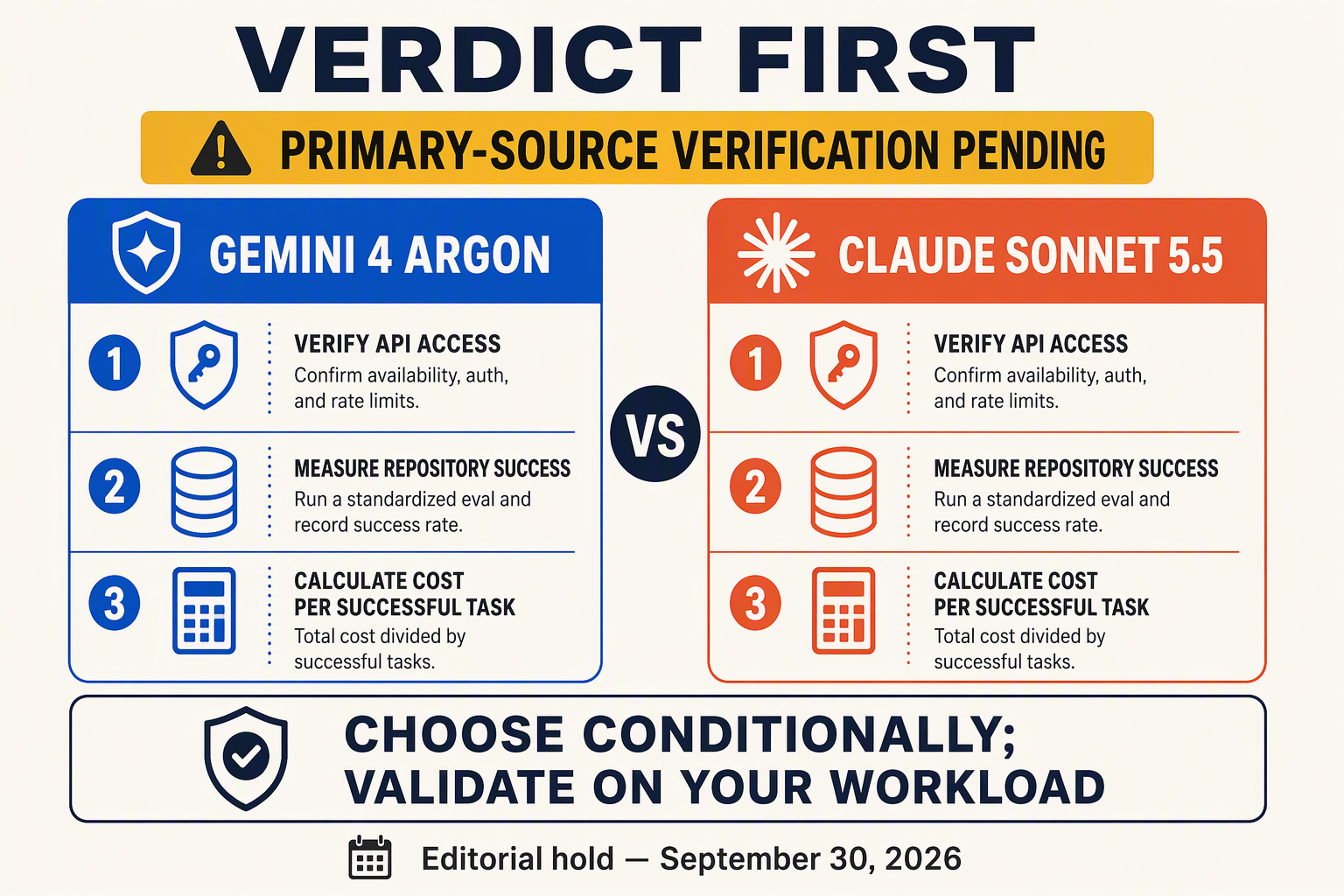
Choose a permitted, matched coding pilot—not an unsupported winner. As of September 30, 2026, Gemini 4 Argon and Claude Sonnet 5.5 have different access conditions, and the supplied announcements do not establish a head-to-head coding winner.
Which model can your team use?
- Gemini 4 Argon: Google announced Argon on September 30 with limited Fairwind access, not general availability. Treat it as a pilot candidate only if your team has permission to use it; an announcement alone is not a basis for switching production traffic. Source: Google’s official AI announcements.
- Claude Sonnet 5.5: Anthropic announced Sonnet 5.5 on September 28, with API model ID
claude-sonnet-5-5and a 1-million-token context window. It is the more actionable candidate for an API evaluation if your account has access while Argon remains unavailable to you—not a demonstrated coding winner. Source: Anthropic’s official announcements.
What should a coding pilot measure?
Run both models on the same repository tasks, tool permissions, test suites, and acceptance criteria. Prioritize:
- Repository pass rate: Does the patch satisfy the requested change and pass relevant tests without introducing regressions?
- Retries and intervention: How many additional attempts, corrective prompts, or human edits are needed before acceptance?
- Valid tool arguments: Do tool calls use the correct schema, paths, and parameters, and recover appropriately from failures?
- Time and cost per accepted task: Include unsuccessful attempts and tool-use overhead rather than judging a single response.
Anthropic reports 30%+ higher speed and up to 30% task-cost savings versus Sonnet 5. These are vendor claims against Sonnet 5—not Argon, and they do not mean Sonnet 5.5 has lower token rates. Test whether those gains hold for your repositories.
Does pricing settle the choice?
No. Sonnet 5.5’s announced rates are $2 per million input tokens, $10 per million output tokens, and $0.20 per million cache-read tokens. Argon’s announced introductory rates are $2/$10, with $0.10 for eligible cached input, followed by $4/$20 pricing; no verified introductory expiry date is supplied.
That makes cache eligibility, retries, and accepted-task yield more useful pilot measurements than headline token prices alone.
Bottom line: Pilot Sonnet 5.5 if accessible, and add Argon when your team has permitted access. Choose the model that delivers more accepted repository changes with fewer retries and reliable tool execution under your workload—not the one with the stronger announcement.
Are Both Models Released? Verify Exact IDs, Access and Primary Sources as of September 30, 2026
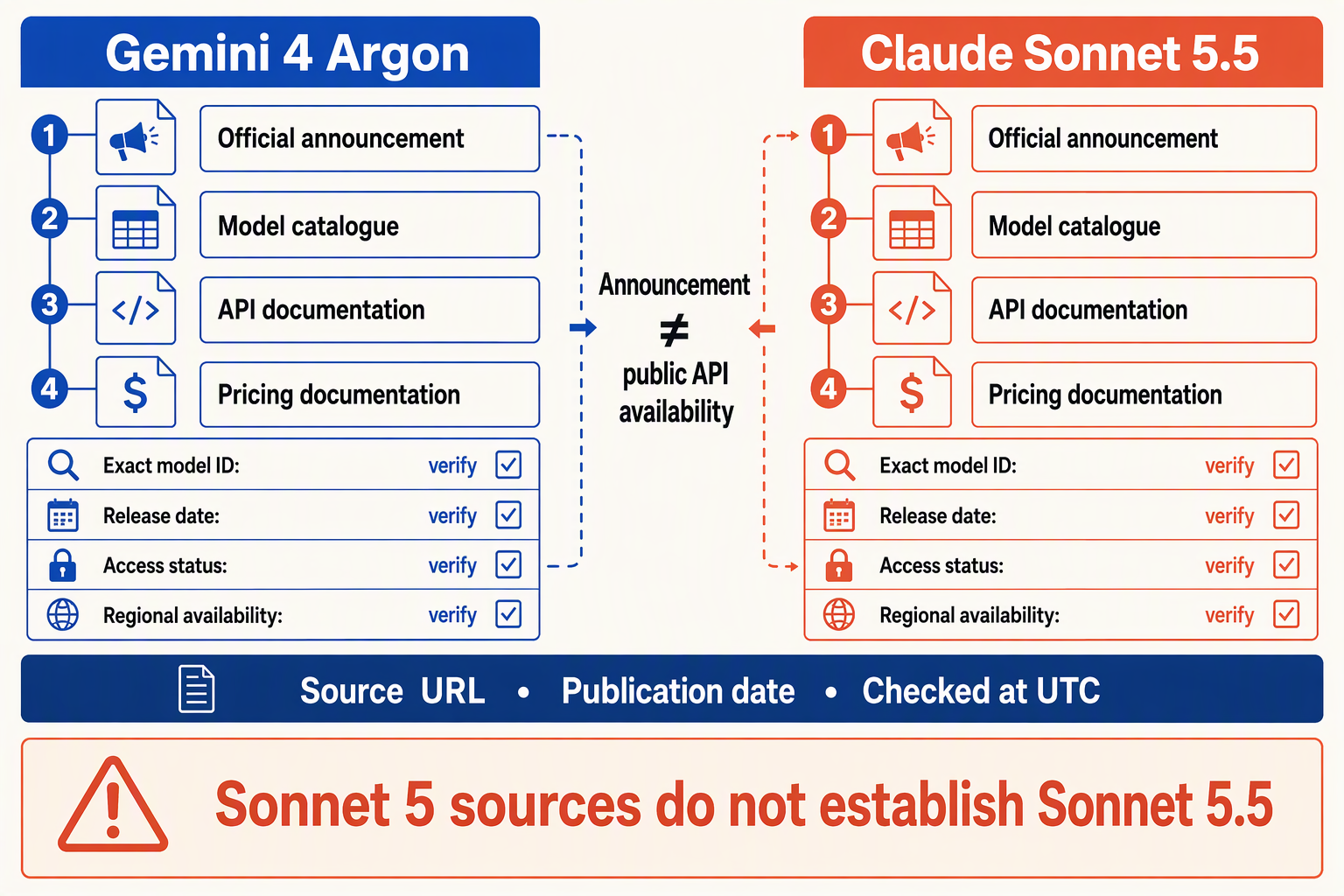
Neither requested model is verified as publicly deployable by the supplied excerpts as of September 30, 2026. Google names Gemini 4 Argon, while Anthropic’s supplied announcement names Claude Sonnet 5—not Claude Sonnet 5.5; live documentation has not been independently checked here.
Do Google and Anthropic confirm these exact model names?
- Gemini 4 Argon: Google’s supplied announcement, “Gemini 4 Argon: our next era of frontier intelligence,” identifies the product and says “Argon will launch.” In this September 30, 2026 evidence review, that wording supports an announced model, but does not establish a public release date, generally available API access, or a production-ready endpoint.
- Claude Sonnet 5.5: Anthropic’s supplied primary-source result is titled “Introducing Claude Sonnet 5.” As of September 30, 2026, the provided evidence does not confirm the additional “.5” version. This is an unresolved naming discrepancy—not proof that Sonnet 5.5 does not exist—and the comparison should not silently substitute Sonnet 5.
- Google’s internal deployment: Google’s supplied Argon excerpt says the model is “already powering our internal workflows.” As reviewed on September 30, 2026, internal use demonstrates a different access category from customer availability. It does not establish whether developers can obtain credentials, select Argon in Google AI Studio, or deploy through Vertex AI.
- Anthropic’s older announcement: The supplied “Introducing Claude Sonnet 4.5” excerpt says that model was “available everywhere today.” That statement concerns Sonnet 4.5 at its announcement, not Sonnet 5.5 on September 30, 2026. Availability language cannot be carried forward across versions without a corresponding release notice or current model documentation.
What must developers verify before testing either model?
- Exact API identifiers: Neither supplied target-model excerpt provides an exact callable model ID as of September 30, 2026. Record the identifier directly from Google’s Gemini API documentation or Anthropic’s Claude API documentation; do not generate a plausible-looking ID from a marketing name. A comparison needs reproducible identifiers, not guessed slugs.
- Release and access status: For the September 30, 2026 comparison, verify each model’s announcement date, preview or general-availability designation, supported deployment surfaces, and account eligibility. Consumer-app access, developer API access, and enterprise-cloud availability are separate questions. Evidence for one route should not be presented as confirmation of all three.
- High-volume prerequisites: Before scheduling coding evaluations, capture the September 2026 documented context limit, maximum output, requests-per-minute and tokens-per-minute allowances, caching conditions, and any asynchronous processing support. None of these target-model limits is established by the supplied excerpts, so throughput projections would currently depend on unverified assumptions.
- Publication decision: Label Gemini 4 Argon: announced; public API access unverified and Claude Sonnet 5.5: exact version unverified for this September 30, 2026 evidence set. Proceed to a deployable-model comparison only after primary documentation resolves both identities; otherwise, distinguish announcement analysis from measured coding performance and production economics.
What Differs in Context, Coding, Tools and Reasoning Controls?
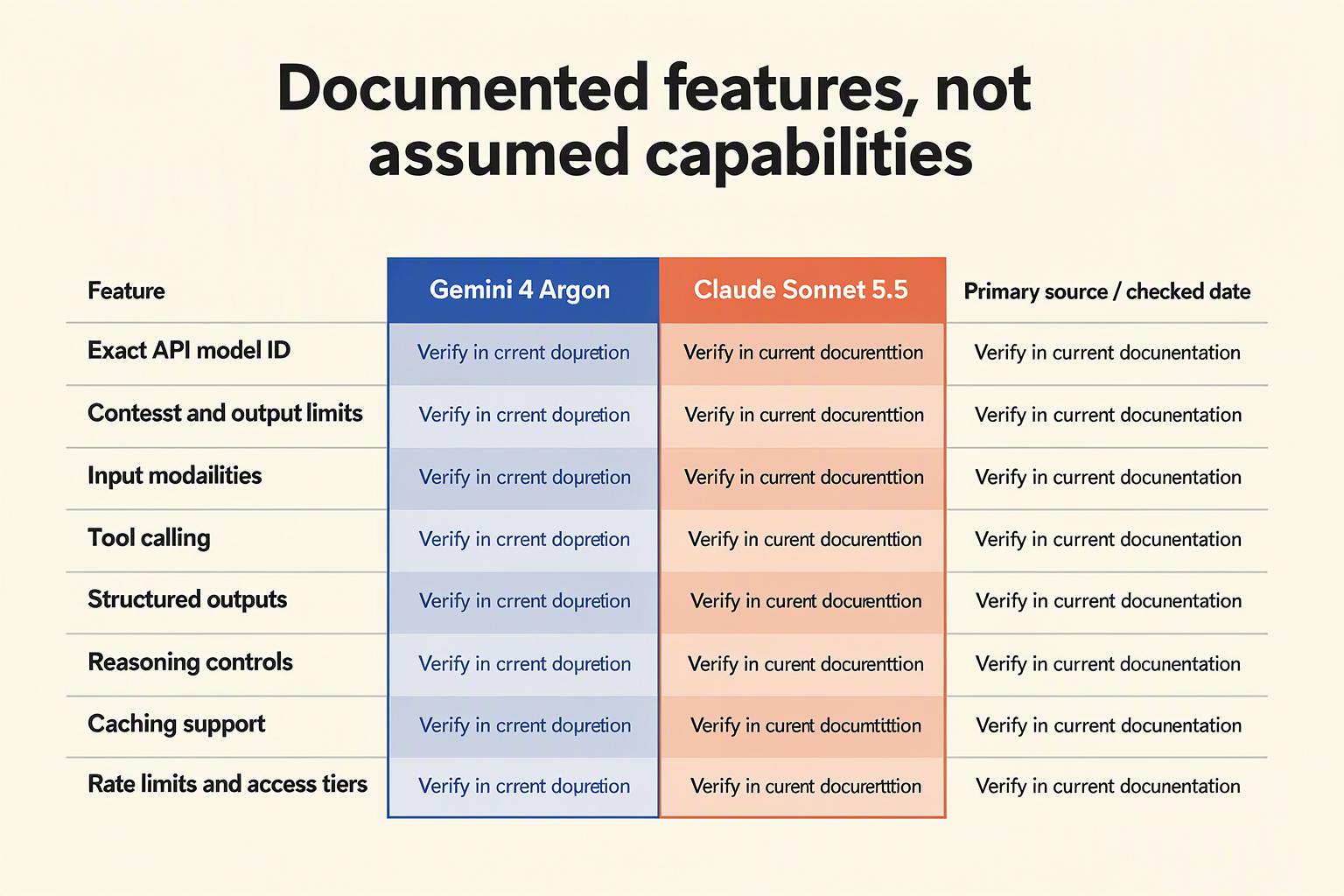
Context limits, coding performance, tool support and reasoning controls cannot yet be compared reliably for Gemini 4 Argon versus Claude Sonnet 5.5. As of September 30, 2026, the supplied primary-source excerpts leave these specifications unverified for the exact requested models.
- Google Gemini 4 Argon: Google’s supplied announcement excerpt discusses launch pricing and internal workflows, but does not specify context limits, coding scores, tool interfaces or reasoning parameters.
- Anthropic Claude Sonnet 5.5: The supplied Anthropic announcement names Claude Sonnet 5, not Sonnet 5.5; its capabilities cannot establish specifications for a different model.
What specifications are confirmed by the supplied sources?
| Dimension | Gemini 4 Argon | Claude Sonnet 5.5 | Deployment implication |
|---|---|---|---|
| Exact API model ID | Not supplied | Not supplied | Require documented identifiers before integration |
| Context and output limits | Not supplied | Not supplied | Repository capacity remains unverified |
| Coding benchmark results | No scores supplied | No scores supplied | No supported coding-performance ranking |
| Tool capabilities | No interface details supplied | Unverified; Sonnet 5 excerpt mentions browsers and terminals | Confirm model-specific tool schemas |
| Reasoning controls | No parameters supplied | No parameters supplied | Do not assume interchangeable settings |
| Public API access | “Will launch” does not establish availability | No Sonnet 5.5 access evidence supplied | Verify access separately from announcements |
How should developers evaluate context and coding?
- Context capacity: Obtain separate input-context and maximum-output limits from Google’s Gemini API documentation and Anthropic’s Claude API documentation. A repository workflow must accommodate source files, instructions, tool results and generated patches; a headline context window alone does not establish usable capacity or retrieval accuracy.
- Coding evidence: Neither supplied provider excerpt establishes a benchmark winner as of September 30, 2026. Compare identical repository snapshots, test commands and task budgets, then record accepted patches, failed tests and human review time; distinguish published benchmark scores from results measured on your own codebase.
What changes when tools and reasoning enter the workflow?
- Anthropic’s documented claim: In the supplied excerpt reviewed as of September 30, 2026, Anthropic describes Claude Sonnet 5 as able to “use tools like browsers and terminals.” That is an agentic capability claim—not evidence of Sonnet 5.5’s API schema, parallel tool execution, sandbox access or tool-call limits.
- Reasoning and integration controls: Check accepted parameter names, values and billing treatment for each exact endpoint before deployment. As of September 2026, CallMissed’s developer AI API offers function calling, structured outputs, reasoning effort control and caller-chosen fallback models; those gateway capabilities do not verify Argon or Sonnet 5.5 availability or identical provider behavior.
The practical distinction is model capability versus execution infrastructure: a model may request a terminal action, while your application supplies permissions, executes the command and returns results. Keep that boundary explicit when measuring coding reliability and high-volume workflow cost.
How Do Token Prices, Cache Economics and Cost per Task Compare?
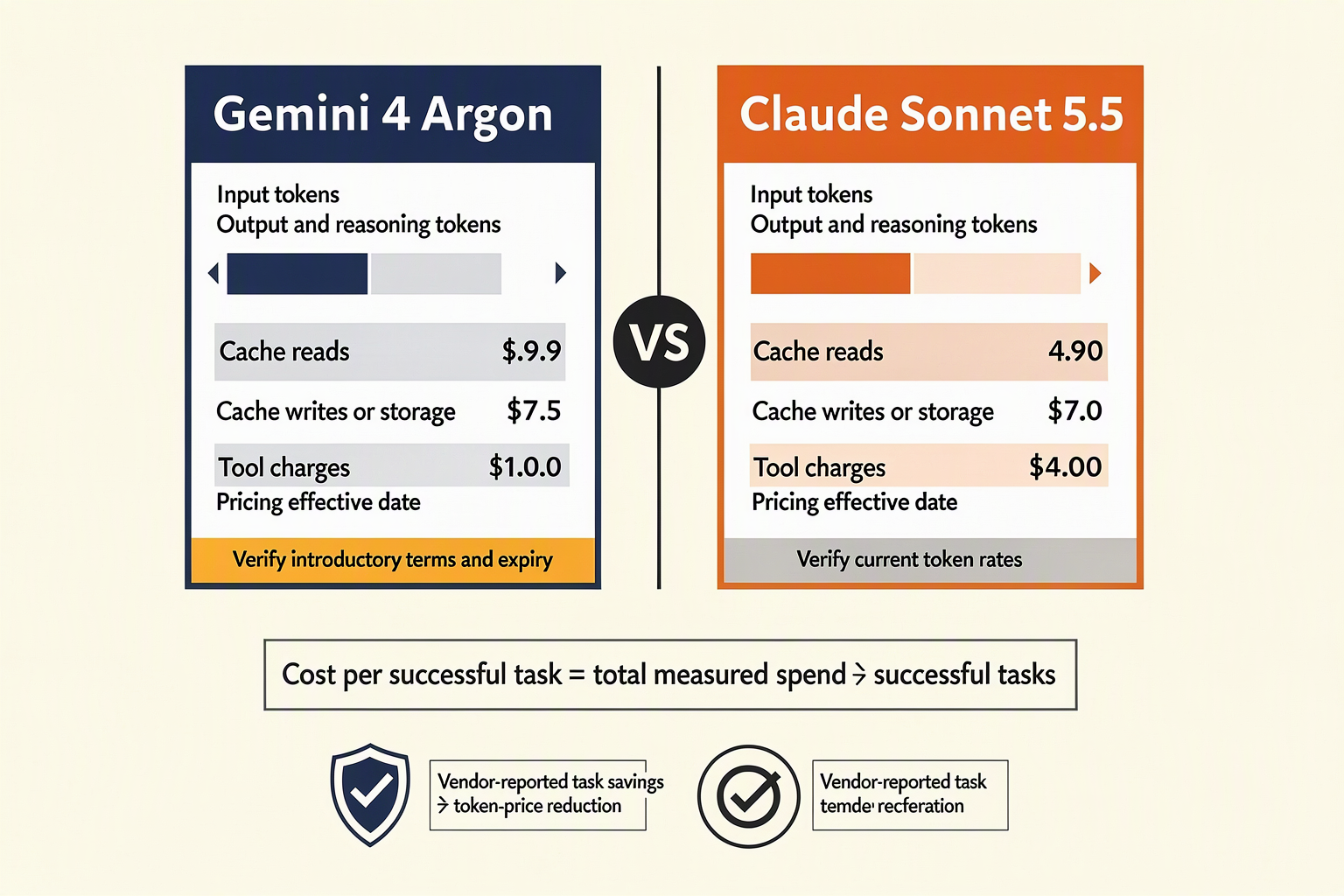
Token pricing alone cannot establish a cost winner: the supplied Google excerpt supports provisional Argon calculations, while the supplied Anthropic excerpts provide no pricing for Claude Sonnet 5.5. As of September 30, 2026, the comparison therefore remains asymmetric—not a verified live-price comparison.
| Cost component | Gemini 4 Argon | Claude Sonnet 5.5 | Evidence status |
|---|---|---|---|
| Uncached input, per million tokens | $2 introductory rate | Not established | Google announcement excerpt; no matching Anthropic price supplied |
| Output, per million tokens | $10 introductory rate | Not established | Google announcement excerpt; no matching Anthropic price supplied |
| Cached input discount | 95% off input rate | Not established | Google excerpt; cache eligibility rules absent |
| Cached input, per million tokens | $0.10, calculated | Not established | Arithmetic from Google’s quoted discount, not verified billing |
| Cache storage and write charges | Not established | Not established | Neither supplied excerpt establishes these charges |
| Billable API model identifier | Not established | Not established | Exact IDs require current provider documentation |
How should teams calculate cache savings?
- Google: In the supplied announcement excerpt assessed as of September 30, 2026, Google says Argon “will launch” at the quoted introductory rates; that wording does not confirm an active billing SKU, production access, or the duration of introductory pricing.
- Cache economics: Google’s quoted 95% discount implies $0.10 per million eligible cached input tokens as of September 30, 2026. Budget separately for any cache creation, storage, minimum-prefix, or expiration conditions once documentation establishes them; the excerpt does not justify assuming these costs are zero.
- Worked task: Under Google’s quoted rates, a hypothetical September 2026 coding task using 20,000 input tokens and 2,000 output tokens costs $0.06 uncached: $0.04 for input plus $0.02 for output, excluding tools and other charges.
- Cached task: If 18,000 of those input tokens qualify for caching, the same illustrative task costs $0.0258: $0.0018 cached input, $0.004 uncached input, and $0.02 output. At 10,000 identical tasks, token spending would be $258 rather than $600, before additional charges.
What determines cost per accepted coding task?
- Acceptance-adjusted cost: Divide total workflow spending by accepted results, not requests sent. In the September 2026 example above, 10,000 cached attempts yielding 8,000 accepted results would cost $0.03225 per accepted task, assuming the $258 subtotal captures all attempts and excludes review labor.
- Claude comparison: As of September 30, 2026, the supplied Anthropic announcement names Claude Sonnet 5, not Claude Sonnet 5.5. Do not substitute another Sonnet version’s prices, cache multipliers, or API identifier to manufacture a numerical comparison.
- Measurement plan: Record input, output, cache hits, retries, tool charges, and accepted patches for each verified model. A lower token subtotal can still produce a higher completed-task cost when failed patches require additional calls or developer correction.
- CallMissed: As of September 2026, CallMissed’s developer AI API provides usage and request logs, response caching, and caller-chosen fallback models. These capabilities support workflow instrumentation, but the verified fact sheet does not establish availability or pricing for either model named here.
What Are the Practical Pros, Cons and Deployment Risks?
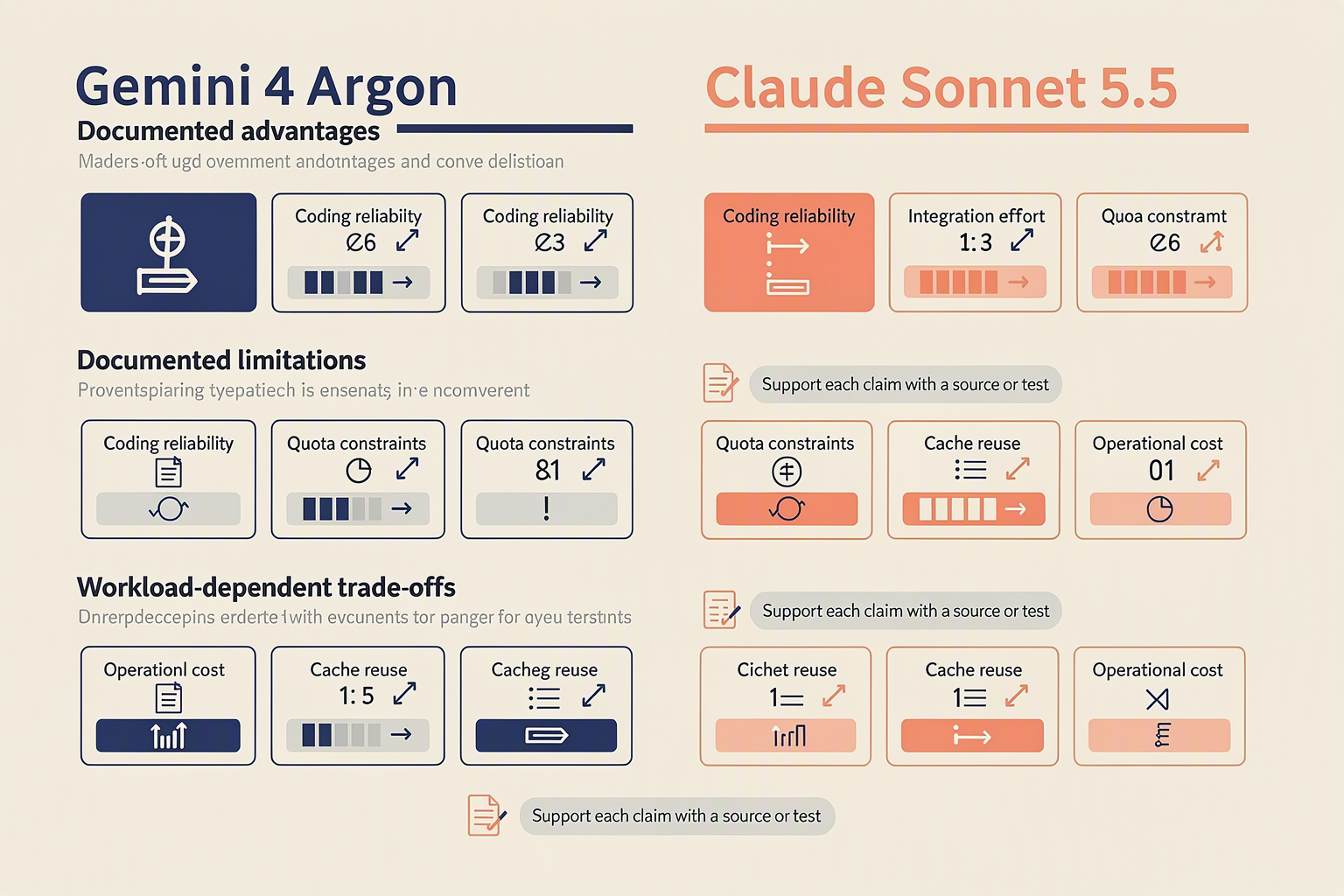
Gemini 4 Argon vs Claude Sonnet 5.5 has an unresolved deployment risk: the supplied sources do not establish two production-ready, exactly identified API models. As of September 30, 2026, the practical comparison is therefore about deployment gates—not a verified coding winner.
What are the practical advantages and risks?
| Deployment factor | Gemini 4 Argon | Claude Sonnet 5.5 | Practical decision |
|---|---|---|---|
| Product identity | Google’s supplied announcement names Gemini 4 Argon, but provides no exact API identifier. | The supplied Anthropic announcement names Claude Sonnet 5, not 5.5. | Require an official model ID and a successful API response before integrating either requested model. |
| Access readiness | Google says Argon “will launch”; the excerpt does not establish general availability. | No Sonnet 5.5 release or access statement appears in the supplied evidence. | Keep production routing on an already accessible model until account-level access is confirmed. |
| Coding potential | Google describes internal workflow use, but the excerpt supplies no reproducible coding results. | Anthropic describes Sonnet 5 using browsers and terminals; that claim cannot establish Sonnet 5.5 capabilities. | Test repository changes, failing-test repair, and tool execution separately rather than infer performance from positioning. |
| Cost predictability | Introductory token pricing offers a planning baseline, not verified current billing terms. | Sonnet 5.5 pricing is absent from the supplied Anthropic material. | Compare cost per accepted change, including unsuccessful attempts, instead of token prices alone. |
| High-volume readiness | Model-specific request limits and token throughput are not supplied. | Sonnet 5.5 throughput, concurrency, and quota terms are not supplied. | Obtain account-specific limits and test queue growth before committing to volume targets. |
| Operational safety | The supplied excerpt does not establish sandboxing or production execution controls. | Sonnet 5’s described tool use makes permission boundaries relevant, without proving provider-side safeguards. | Enforce least-privilege credentials, isolated execution, approval gates, and rollback in your application. |
How should teams test coding quality before deployment?
- Evidence boundary: Google’s and Anthropic’s supplied excerpts, assessed as of September 30, 2026, provide no comparable benchmark scores, evaluation settings, or production latency measurements; a numerical winner would be unsupported.
- Repository pilot: Use the same 30 tasks for each accessible candidate—10 bug fixes, 10 test-generation tasks, and 10 refactors—with identical repository snapshots and tool permissions.
- Acceptance criteria: Record test-pass rate, reviewer acceptance, elapsed time, and total billed usage; require human approval for dependency changes, database migrations, and security-sensitive code.
How can high-volume workflows reduce deployment risk?
- Load testing: Measure p50 and p95 completion time, throttled requests, retry counts, and queue depth at expected concurrency; these are proposed evaluation metrics, not published model results.
- Fallback discipline: Preserve task state and tool results before switching models; a fallback must not repeat an already completed write operation or silently change the requested output format.
- Gateway option: As of September 2026, CallMissed’s developer AI API supports OpenAI-compatible endpoints and caller-chosen fallback models; this integration flexibility does not establish availability of either model named in this comparison.
- Release gate: Approve deployment only after confirming five items: exact model ID, access status, billing terms, account quotas, and acceptable pilot results. Until then, label the comparison provisional rather than production-verified.
Do AutomationBench-AA, Vals Index and Intelligence Index Results Predict Your Workflow?
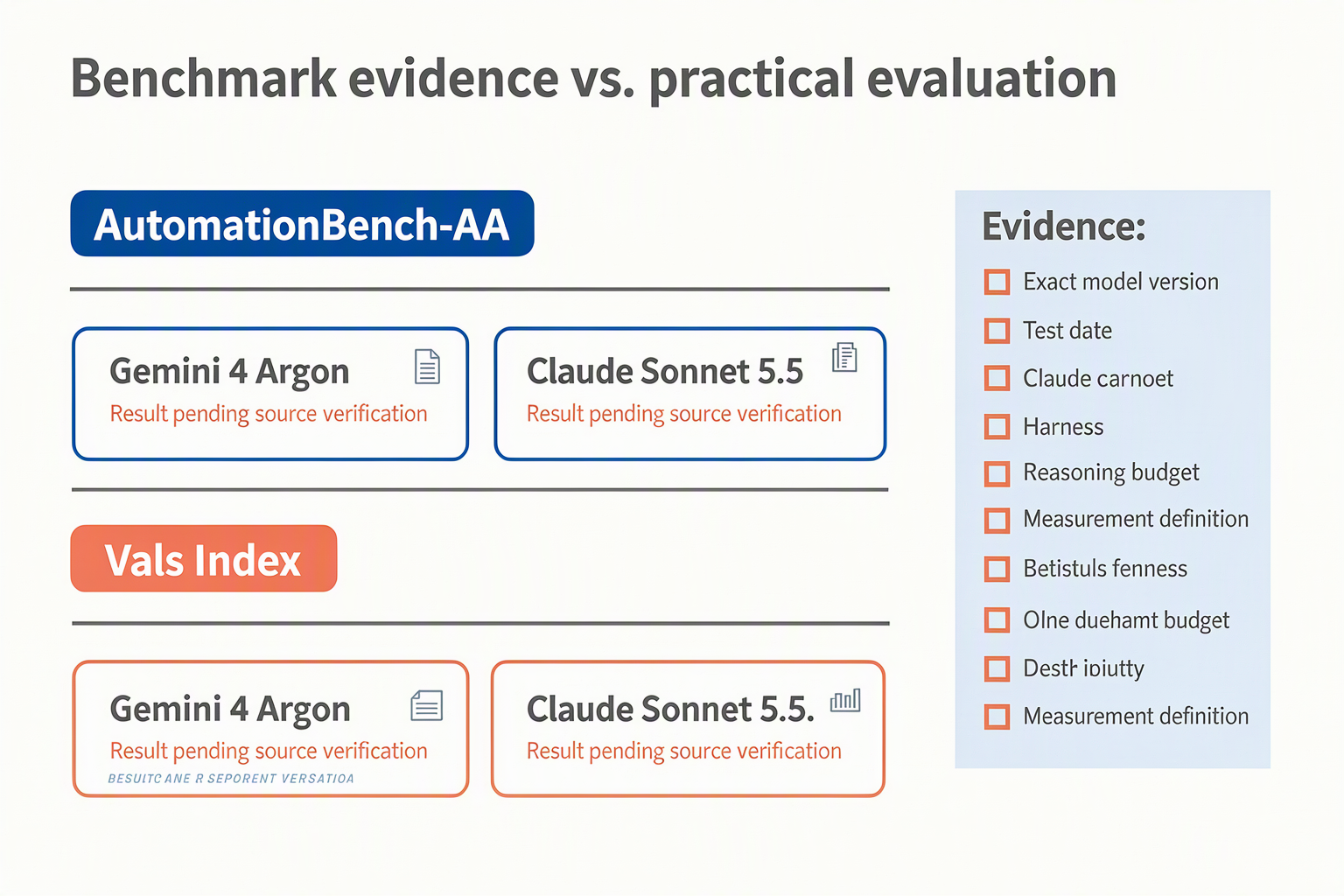
AutomationBench-AA, Vals Index and Intelligence Index results are screening signals—not proof that a model will perform well in your workflow. As of September 30, 2026, the supplied excerpts contain no scores or evaluation methodologies for these benchmarks, so they cannot establish a winner in Gemini 4 Argon vs Claude Sonnet 5.5.
Can these benchmark results support a model ranking?
- AutomationBench-AA: The supplied context provides zero attributable scores for either comparison target as of September 30, 2026. Before using a leaderboard position, obtain the benchmark publisher’s task definitions, scoring rules, tool permissions and evaluation date; without those details, an automation result cannot reliably predict success on your repositories or business processes.
- Vals Index: No Vals Index results or methodology appear in the supplied September 30, 2026 research excerpts. Check which task categories contribute to any published aggregate, then compare those categories with your workload. A composite score is less useful when your actual requirement is narrowly defined, such as resolving dependency conflicts without changing public interfaces.
- Intelligence Index: No Intelligence Index scores are supplied as of September 30, 2026. Treat any subsequently verified aggregate as a starting point for investigation, not a coding acceptance test. Repository navigation, correct tool execution, instruction adherence and recovery from failed tests require separate evidence rather than inference from a single overall intelligence number.
- Model attribution: Google’s supplied excerpt names Gemini 4 Argon, while Anthropic’s supplied announcement names Claude Sonnet 5, not Sonnet 5.5. As of September 30, 2026, those excerpts do not support assigning Sonnet 5 results to Sonnet 5.5. Every benchmark entry needs a matching model identifier and documented evaluation configuration.
How should you test whether rankings predict production performance?
- Coding pilot: Use a proposed 100-task evaluation spanning bug fixes, test generation, refactoring and repository questions, with three runs per task. These are recommended test settings, not published benchmark findings. Keep repository snapshots, prompts and tool access identical; measure hidden-test pass rates and human-approved patches rather than accepting plausible-looking code.
- High-volume pilot: Test a proposed three concurrency levels—1, 10 and 50 workers—only within documented provider limits. Record successful completions, retries, throttling and median/p95 completion times. A model that performs well on isolated requests may behave differently when many workers compete for available capacity, so report both quality and throughput.
- Cost comparison: Calculate cost per accepted task = total measured spend ÷ accepted tasks. Include unsuccessful attempts, repeated context and chargeable tool activity where applicable. This makes benchmark strength economically interpretable: a higher-scoring model is useful only if its successful outputs justify the full workflow cost.
- CallMissed: As of September 2026, CallMissed’s verified developer API offers request logs, usage logs and caller-chosen fallback models. Those capabilities can support operational comparisons, but they do not establish access to either comparison target or benchmark superiority; verify catalogue availability separately and evaluate fallback outputs independently.
Which Should You Choose for Coding or High Volume? Run a Reproducible Repository Evaluation
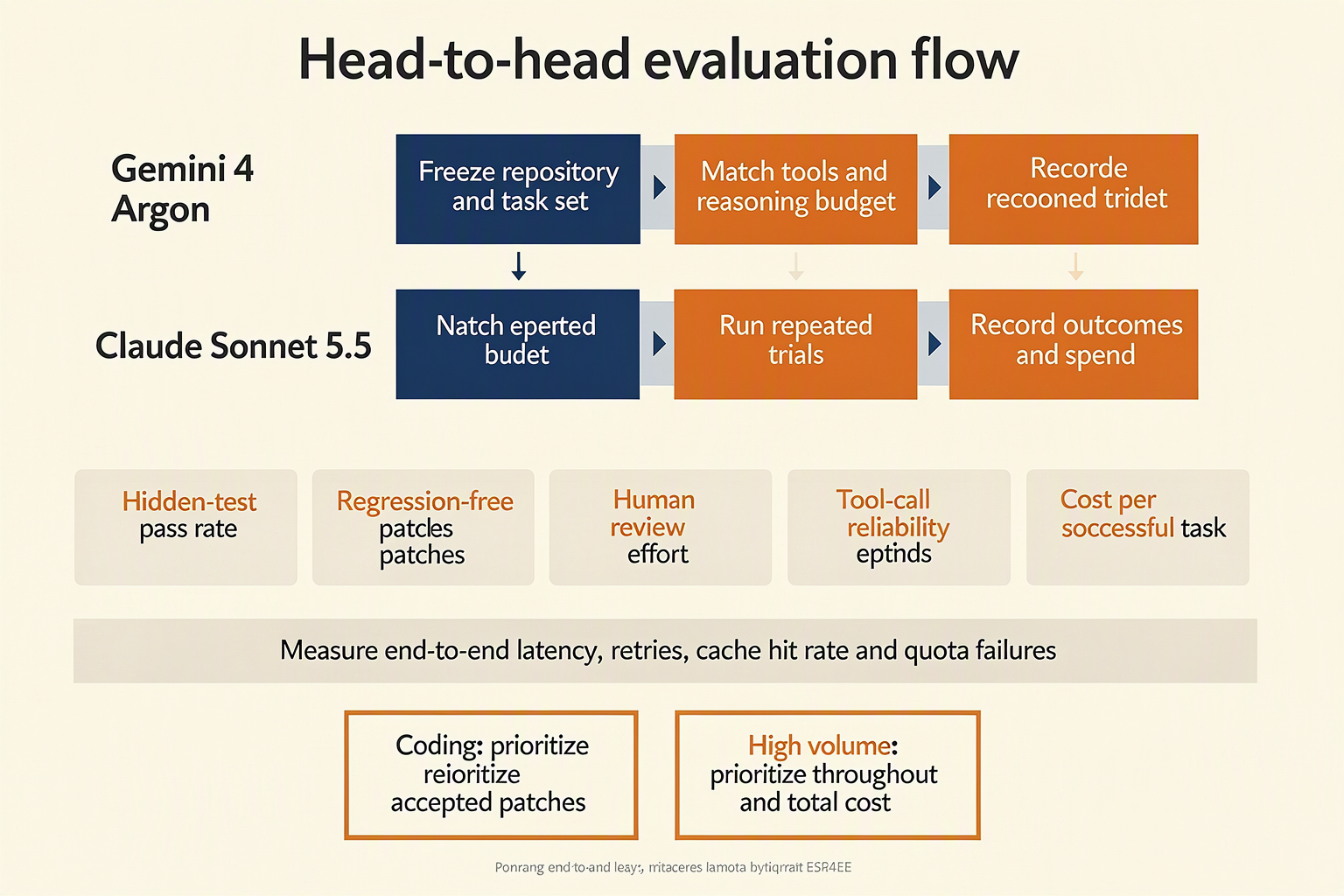
Choose the model that passes your repository tests at the lowest cost per accepted change, not the one with the strongest headline. As of September 30, 2026, the supplied primary-source excerpts do not establish two deployable endpoints for the exact comparison requested.
How do you run a reproducible coding-model evaluation?
- Verify the endpoints: Google’s supplied Argon announcement says “will launch,” while Anthropic’s supplied announcement names Claude Sonnet 5, not Sonnet 5.5. Record each provider’s documented model ID, release status, region, and successful API response before testing; label an unavailable or undocumented endpoint not evaluated, rather than substituting another model silently.
- Freeze the repository: Use one commit SHA, a locked dependency file, a container image digest, and identical test commands. Remove credentials and disable unrestricted network access. Keep the same system prompt, tool permissions, repository context, and execution budget for both endpoints so infrastructure differences do not masquerade as model capability.
- Build a 40-task pilot: As a suggested evaluation design—not a published benchmark—select 10 bug fixes, 10 feature changes, 10 test-generation tasks, and 10 refactors from your actual backlog. Include the languages your team deploys, such as Python, TypeScript, or Java, and write acceptance tests before exposing tasks to either model.
- Repeat and review: Run each task 3 times per endpoint, producing 120 attempts per model. Save prompts, patches, tool calls, token counts, and failures. Review anonymized diffs against identical criteria: passing tests, requirement coverage, security checks, and maintainability; repeated attempts reveal consistency that a single successful demonstration cannot establish.
How do you measure high-volume workflow economics?
- Measure accepted work: Calculate total evaluation spend ÷ accepted changes, including failed attempts, retries, and tool execution. Separately report first-attempt acceptance and human review minutes. A model that generates inexpensive tokens can still cost more per merged patch when developers must repeatedly repair its output.
- Test sustained demand: Use proposed concurrency levels of 1, 5, and 20 workers, subject to documented provider limits, with a 30-minute observation window at each level. Track completed tasks per minute, p50/p95 completion time, throttling, and retry frequency. These are test settings, not claimed Gemini or Claude capacity figures.
- Isolate caching effects: Repeat the workload with eligible caching enabled and disabled, preserving identical repository context. Apply Google’s quoted introductory rates only as a September 30, 2026 scenario, not verified live billing terms. Record actual billable cached tokens; repeated text alone does not prove that a provider grants a cache discount.
- Choose with explicit gates: Set acceptance, review-time, and throughput thresholds before seeing results; retain both endpoints if different task classes justify routing. As of September 2026, CallMissed’s developer AI API supports usage and request logs plus caller-chosen fallback models, capabilities relevant to operationalizing such evaluations; its fact sheet does not confirm either requested model’s availability.
Frequently Asked Questions
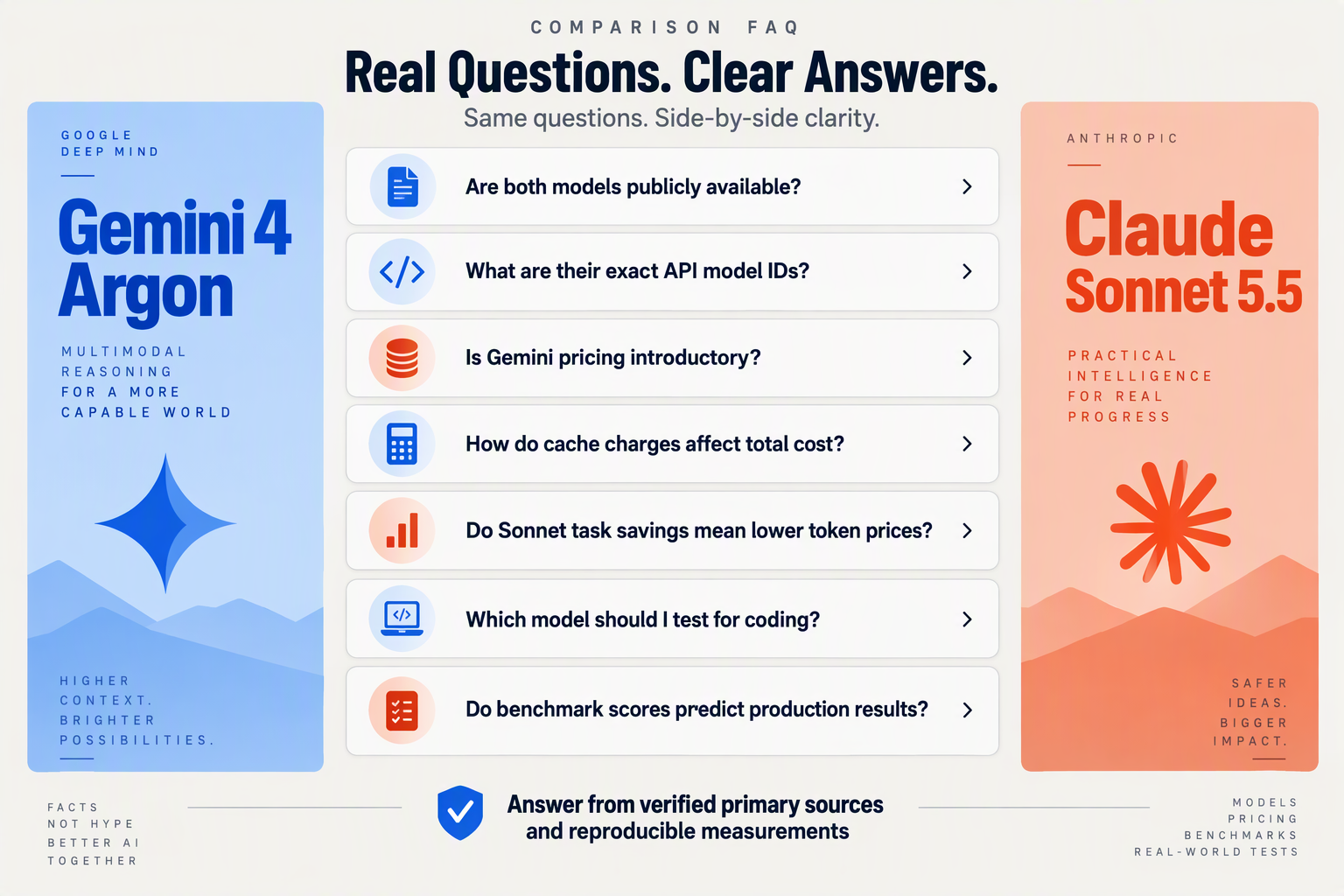
The supplied primary-source excerpts do not establish exact API IDs or live access for both models. Treat this comparison as provisional as of September 30, 2026.
- Q: What are the exact model IDs for Gemini 4 Argon vs Claude Sonnet 5.5?
A: As of September 30, 2026, neither requested model’s exact API identifier is established by the supplied context: Google names Gemini 4 Argon, while Anthropic’s supplied announcement names Claude Sonnet 5, not Sonnet 5.5. A product name is not necessarily an API identifier. Before configuring an integration, obtain the exact identifier from the provider’s current model documentation or authenticated model listing; do not construct one from the marketing name.
- Q: Are Gemini 4 Argon and Claude Sonnet 5.5 available through an API?
A: API availability remains unverified from the supplied excerpts as of September 30, 2026: Google’s announcement says Argon “will launch,” which does not establish general availability, and the supplied Anthropic material does not establish Sonnet 5.5’s existence or access. Google’s internal use of Argon is not evidence of public developer access. Confirm account eligibility, supported endpoints, deployment regions, and preview restrictions before committing production traffic.
- Q: What is Gemini 4 Argon’s cached-input token price?
A: Google’s supplied announcement, assessed as of September 30, 2026, quotes introductory Argon pricing of $2 per million input tokens, $10 per million output tokens, and a 95% cached-input discount. That discount mathematically implies $0.10 per million eligible cached input tokens, but the excerpt does not establish live billing terms, cache storage charges, or eligibility rules. Budget using the quoted rate only after checking the current pricing documentation.
- Q: How do you calculate task savings for high-volume AI coding workflows?
A: Calculate cost per accepted task, including input, output, applicable caching charges, retries, and tool execution—not just the advertised token rate. Using Google’s quoted introductory rates supplied for September 30, 2026, replacing 10 million uncached input tokens with eligible cached input would reduce that input subtotal from $20 to $1, saving $19 before other charges. This is an illustrative calculation, not a measured production saving or evidence of lower total task cost.
- Q: Which wins Gemini 4 Argon vs Claude Sonnet 5.5 for coding?
A: No defensible coding winner can be selected from the supplied September 30, 2026 evidence because the excerpts provide neither a verified Sonnet 5.5 identity nor comparable coding results. Anthropic describes Sonnet 5 as able to plan and use browsers and terminals, but that qualitative statement does not establish comparative accuracy. Test verified models on identical repository tasks and record accepted patches, test failures, completion time, and total spend.
- Q: Can developers use one gateway to test multiple coding models?
A: As of September 2026, CallMissed’s developer AI API provides OpenAI-compatible and Anthropic-compatible endpoints, caller-chosen fallback models, and usage and request logs. Those capabilities can support a shared integration and cost-observation workflow, but the verified fact sheet does not confirm availability of Gemini 4 Argon or Claude Sonnet 5.5. Check the gateway’s actual model catalogue and identifiers before designing a comparison around either name.
Conclusion
Gemini 4 Argon vs Claude Sonnet 5.5 has no defensible winner on the supplied evidence as of September 30, 2026. The practical decision is to verify model identity and access first, then compare coding reliability and the full cost of completing your workflows—not announcement language alone.
- Verify the products before comparing performance. The supplied Google announcement describes Gemini 4 Argon’s introductory pricing, but its wording, “Argon will launch,” does not establish an exact API identifier or current production availability. The supplied Anthropic announcement references Claude Sonnet 5, not Claude Sonnet 5.5. Those are material gaps: a purchasing decision needs documented model IDs, release status, and access conditions rather than an assumed match between a headline and a deployable endpoint. Until those details are established, the comparison should remain provisional.
- Treat pricing as a workload calculation, not a verdict. In the supplied Google excerpt reviewed as of September 30, 2026, Gemini 4 Argon’s quoted introductory rates are $2 per million input tokens and $10 per million output tokens, with eligible cached input priced at 95% off. Under those assumptions, the article’s example falls from $400 to $229 when 90 million input tokens receive the cached rate. That 42.75% calculated reduction illustrates caching’s potential; it does not demonstrate achieved production savings or independently verified live billing terms.
- Measure useful coding outcomes before declaring a winner. Repository analysis, test generation, and repeated code review should be evaluated on your own representative tasks. Named benchmarks can inform that evaluation, but their conditions matter, and the supplied material does not establish a comparative coding winner. A lower token price is valuable only when the model completes the required work reliably. Output length, retries, and tool execution can change the economics enough that cost per completed task tells a different story from the advertised input rate.
- Keep high-volume integrations adaptable. Model selection should account for published rate limits, cache eligibility, access restrictions, and retry overhead alongside coding quality. As of September 2026, CallMissed’s developer AI API provides OpenAI-compatible endpoints and caller-chosen fallback models—capabilities readers can explore when designing around model choice rather than one permanent provider. That flexibility supports an adaptable integration strategy; it does not establish availability of either model discussed here.
Looking ahead, watch Google and Anthropic for confirmed API identifiers, release and access documentation, applicable pricing, and reproducible coding evaluations. Those updates could turn this provisional comparison into an actionable deployment decision.
Before committing your next high-volume workflow, can your chosen model prove both reliable task completion and predictable cost?
Related Reading
- Gemini 4 Argon Pricing vs Claude Sonnet 5.5: Coding
- Gemini 4 Argon vs Claude Opus 5.5: Agent Work in 2026
- Gemini 4 Argon vs GPT-6.1 Sol: Coding & Agent Work
Sources
Discussion
Related Posts

Ready to automate customer conversations?
Launch AI voice agents and WhatsApp bots with CallMissed — one API, 22+ Indian languages.