
Large Language Models: Customer Support's Future in 2026



Learn how large language models can improve support with grounded answers, better ticket routing, release testing, and measurable automation outcomes.
Large Language Models: Customer Support's Future in 2026
What good is an AI support agent that answers instantly but confidently invents your refund policy? Large language models could reshape customer support in 2026, but their value depends on more than fluent conversation: they must retrieve reliable information, take authorized actions, and recognize when a person should step in.
That distinction matters as new model releases give businesses more options—and more evaluation work. The future of large language models is not simply a race toward bigger systems. For support leaders, it is a practical question: which developments can resolve customer problems without creating new ones?
Why do new LLM developments matter for customer support in 2026?
In its 2026 customer-support chatbot comparison, IrisAgent says it weights helpfulness and safety equally, arguing that the strongest model performs well on both rather than winning either metric alone. That is a useful corrective to release-day excitement: a convincing answer is not necessarily a trustworthy answer.
Larger context windows also deserve attention. Shakudo’s September 2026 overview reports that NVIDIA Nemotron 3 Ultra has a one-million-token context window. For support teams, that points toward processing more documentation or conversation history together—but context capacity alone does not establish retrieval accuracy, privacy protection, or dependable policy enforcement.
Consider a customer asking why an order arrived late and whether delivery charges can be refunded. A useful system must distinguish shipping status from company policy, consult the right records, and avoid promising compensation it cannot authorize. Generating a polished apology is only the beginning.
As of October 2026, CallMissed offers an OpenAI-compatible developer API covering 138 models, alongside knowledge-base retrieval and custom REST tools for agents—capabilities that illustrate the shift from standalone chatbots toward connected support workflows.
This article explores what emerging LLM capabilities could mean for that shift:
- Better grounding and fact-checking: How retrieval and verification can help tie answers to approved policies rather than plausible guesses.
- Self-training and feedback loops: Why learning from interactions requires safeguards against reinforcing mistakes or absorbing sensitive information.
- Tool-using agents: What changes when models can request order information or trigger approved workflows instead of merely describing next steps.
- Human oversight: Where escalation, permissions, and evaluation remain essential, even as models become more capable.
The central question is not whether automation can sound human. It is whether automation can resolve the right issue, using the right evidence, within the right boundaries. Understanding that difference helps businesses evaluate new releases against customer outcomes, rather than benchmark headlines alone.
How could large language models change customer-support automation in 2026?
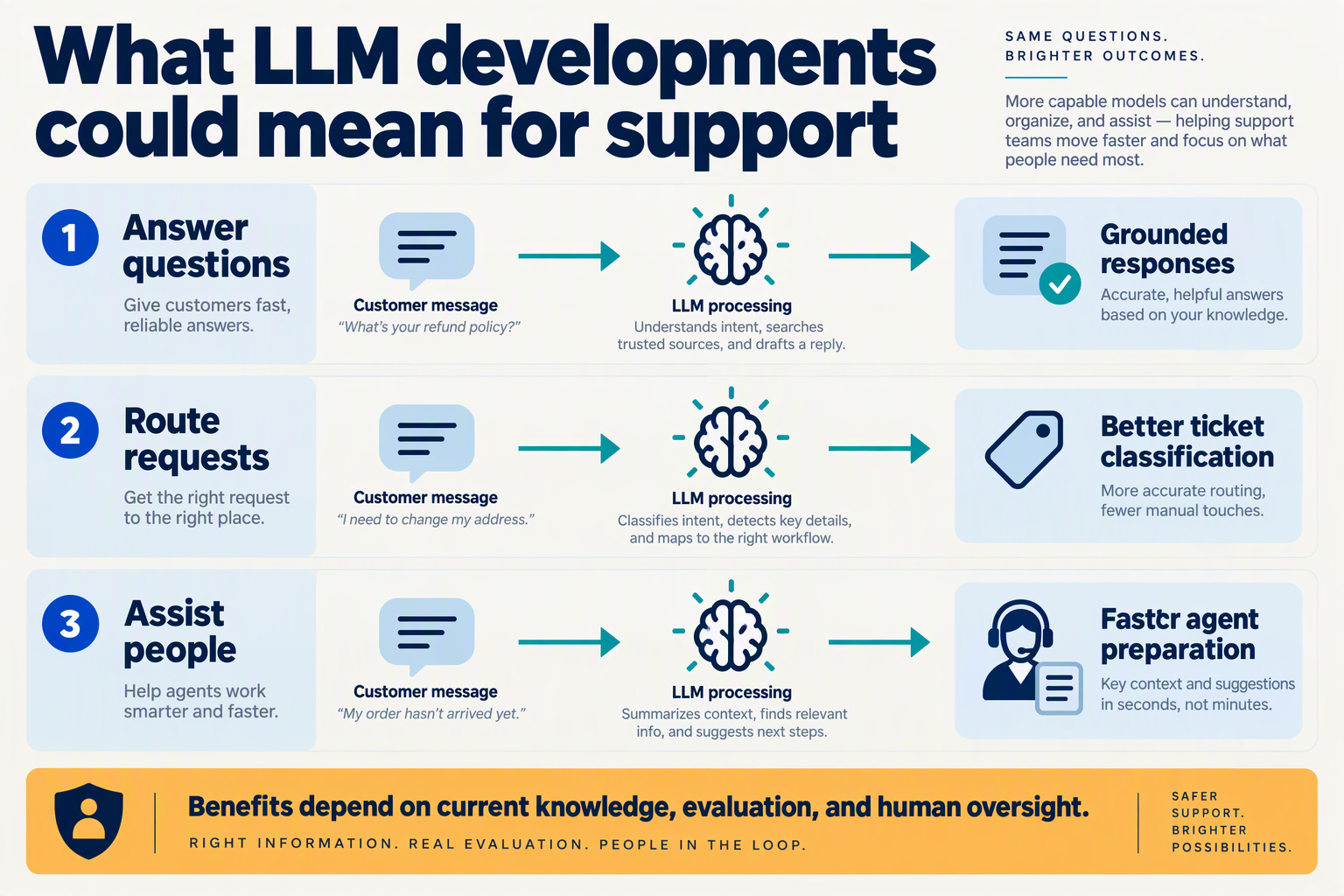
Large language models could change customer-support automation in 2026 by helping systems interpret ambiguous requests, coordinate several steps, and preserve context across interactions. The practical opportunity is less repetition for customers and less routine coordination for support teams, provided businesses validate each workflow before expanding automation.
What changes when support AI can coordinate a workflow?
Traditional support automation often routes customers through predefined menus. LLM-based systems could instead translate a request such as “I changed my billing address, but the last invoice still looks wrong” into a sequence of checks.
A controlled workflow might:
- Verify identity before accessing billing records.
- Compare records to establish whether the address changed before or after invoice generation.
- Explain the discrepancy using the relevant account information.
- Prepare the next step, such as requesting a corrected invoice, subject to business rules.
The important development is not simply understanding the sentence. It is maintaining the relationship between the customer’s intent, the available evidence, and the permitted action. A model that skips verification may appear efficient while creating a costly support error.
Do stronger AI benchmarks mean better customer support?
Not automatically: benchmark gains are signals to investigate, not evidence that a model can safely manage customer accounts.
In its October 2026 news coverage, LLM Stats reports self-reported OSWorld 2.1 results for Anthropic Claude Sonnet 5.5 of 43.5% under strict scoring and 80.1% under partial scoring. Those are not customer-support resolution rates, and the supplied context does not establish independent verification.
The contrast nevertheless illustrates an important evaluation problem: “partly completed” and “successfully completed” can produce very different impressions of capability. For a billing workflow, finding the correct account but requesting the wrong invoice correction should not count as success.
Support teams should therefore distinguish:
- Answer quality: Was the explanation accurate and understandable?
- Workflow completion: Were all required steps completed correctly?
- Boundary compliance: Did the system respect identity checks and action permissions?
- Customer effort: Did the customer have to repeat information or restart elsewhere?
How should teams respond to frequent new LLM releases?
Treat model upgrades as controlled operational changes rather than automatic improvements.
LLM Gateway’s 2026 release timeline lists ByteDance Seed 2.1 Turbo as released on August 10, 2026, and added to LLM Gateway on August 12, 2026. Release dates and gateway availability dates are distinct; neither establishes suitability for a particular support workflow.
Before switching models, run the same representative cases against both versions. Include unclear requests, outdated account information, unsupported actions, and customers who change their minds midway through a conversation. Compare complete outcomes—not just more fluent responses.
Where does human support fit into this shift?
Human agents become especially valuable at exceptions, judgment calls, and relationship repair. Automation should transfer both the conversation and the unresolved task, rather than making the customer explain everything again.
As of October 2026, CallMissed provides a human-handoff queue, agent-assist suggestions and knowledge snippets, support tickets, and SLA policies. These capabilities illustrate how LLM automation can sit within a support operation rather than replace its accountability structure.
The future of large language models in support is therefore best assessed workflow by workflow: automate what can be verified, measure what actually finishes, and preserve a clear route to human judgment.
Which LLM developments matter for support—and what needs verification?
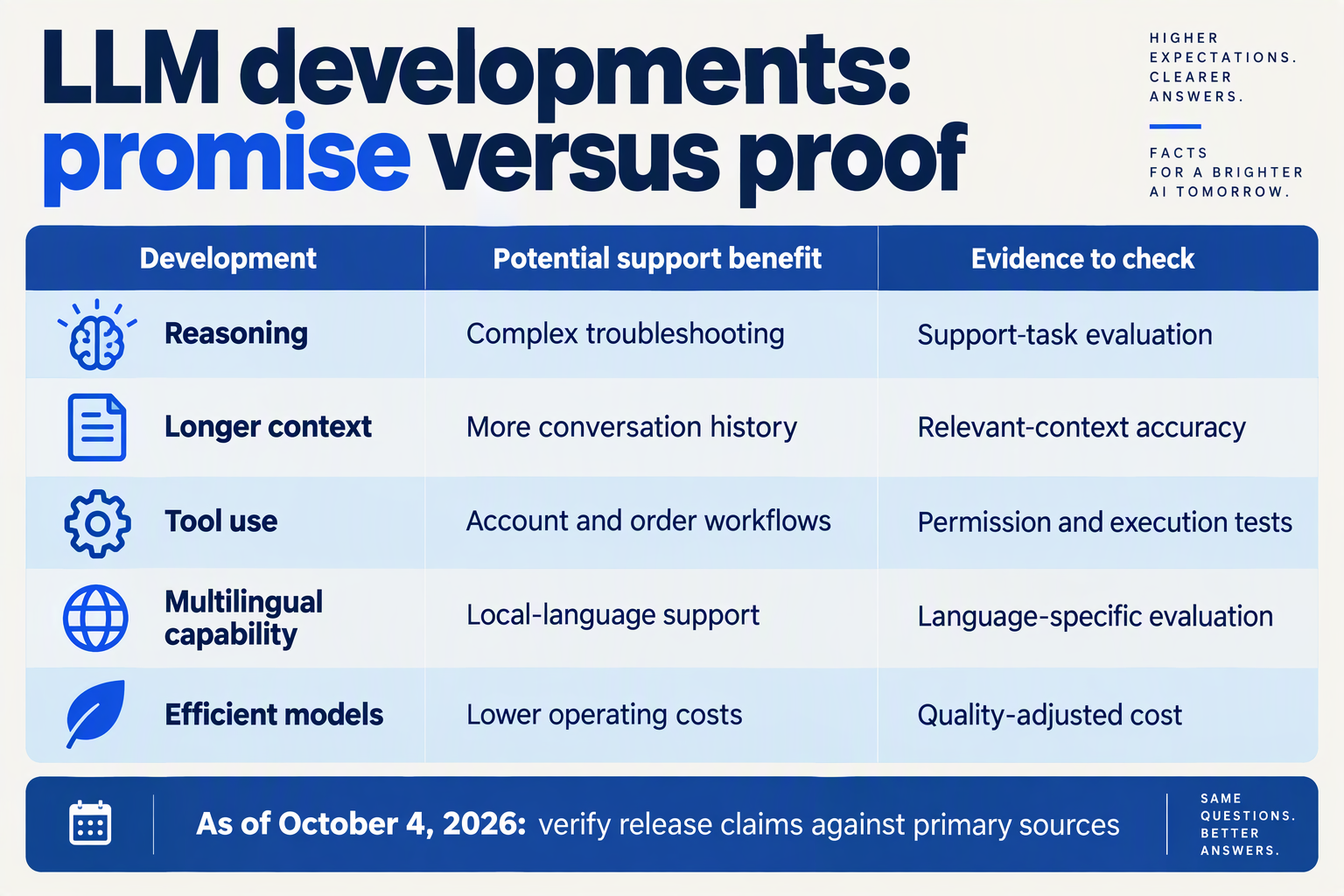
The LLM developments that matter most for customer-support automation are grounded reasoning, reliable tool use, controlled memory, and measurable task completion. As of October 2026, release announcements provide useful signals—but support teams still need to verify whether those capabilities work with their policies, customer records, and escalation rules.
Which new LLM capabilities should support teams evaluate?
The table below separates potential operational value from the evidence needed before deployment. These are evaluation priorities, not capabilities established for every newly released model.
| Development | Potential support value | What needs verification |
|---|---|---|
| Grounded reasoning and fact-checking | Reconcile policy documents with an individual customer’s situation. | Does the answer cite the current policy and flag missing or conflicting evidence? |
| Larger context windows | Review longer case histories and more documentation together. | Can the model find decisive details without relying on outdated information? |
| Tool-using agents | Retrieve order status or request an authorized account update. | Are tool arguments correct, permissions enforced, and duplicate actions prevented? |
| Reusable skills | Apply consistent instructions to recurring workflows, such as returns. | Are instructions versioned, tested, and subordinate to business authorization rules? |
| Persistent memory | Retain relevant preferences or unresolved issues across interactions. | Can remembered facts be corrected, deleted, and isolated between customers? |
| Feedback-driven improvement | Use reviewed interactions to improve prompts, retrieval, or model behavior. | Is improvement measured on unseen cases without exposing sensitive customer data? |
According to Orthotropy’s October 2026 agent-news roundup, Google’s September 30, 2026 Gemini announcement introduced reusable instructions into consumer Gemini chat. That suggests a direction toward reusable workflows; it does not establish that consumer-facing skills provide the permissions, auditability, or reliability required for business support.
Likewise, self-training should remain a verification category rather than an assumed product capability. Learning from an interaction could mean updating a prompt, storing a memory, improving retrieval, or retraining model weights—different processes with different risks.
Do impressive benchmark scores predict support performance?
Not directly: a benchmark measures performance on its own tasks and scoring rules, not your complete customer journey.
LLM Stats’ October 2026 news page reports a self-reported Terminal-Bench score of 70.6% for Anthropic Claude Sonnet 5.5. That is a technical-task signal, not evidence of refund-policy accuracy or successful customer resolution.
LLM Stats’ October 2026 news page lists Claude Sonnet 5.5 OSWorld 2.1 results of 43.5% under strict scoring versus 80.1% under partial scoring. The difference illustrates why evaluation definitions matter: partial progress and completed outcomes are not interchangeable.
For support, “found the order” should not count as “resolved the delivery complaint.”
What should teams verify before automating customer actions?
Use a staged evaluation rather than promoting a model solely because its release is newer:
- Test evidence handling: Include conflicting policies, missing records, and outdated documents.
- Test action boundaries: Check unauthorized refunds, malformed tool requests, and repeated submissions.
- Test recovery: Verify escalation when a tool fails or the customer disputes remembered information.
Track outcomes separately:
- Resolution: Was the correct customer outcome achieved?
- Safety: Were privacy and authorization boundaries respected?
- Efficiency: What were response time, human intervention, and total cost?
As of October 2026, CallMissed provides eval suites, A/B experiments, and call scoring against teams’ own QA rubrics, illustrating how model selection can connect to operational testing. The practical goal is not maximum autonomy; it is verified capability within explicit boundaries.
Does self-training mean an AI support system learns automatically from every conversation?
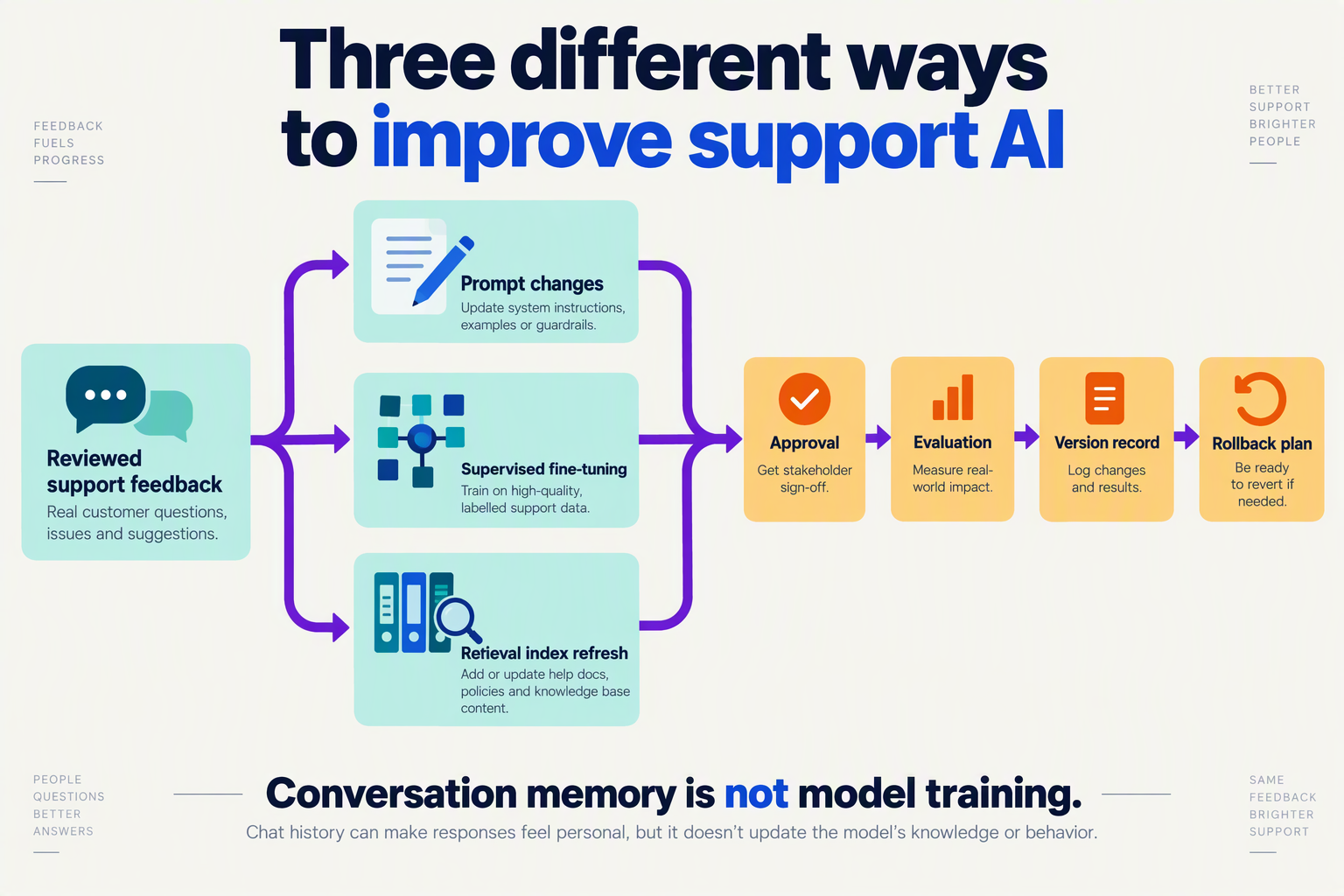
No—self-training does not mean an AI support system automatically learns from every conversation. A system can remember a customer preference, retrieve updated documentation, or improve through a reviewed training process; these are different mechanisms, and none should be assumed simply because a chatbot handles more tickets.
What is the difference between AI memory and model training?
For customer-support automation, “learning” often bundles together four distinct processes:
- Conversation context: The model uses messages available in the current interaction. That does not, by itself, change the model’s underlying parameters.
- Persistent memory: The application stores selected information for later use, such as a customer’s preferred language. Storage and retrieval are not model training.
- Knowledge-base updates: Approved documentation changes what the system can retrieve without necessarily changing the underlying LLM.
- Model training: A separate process adjusts model parameters using selected examples, feedback, or rewards.
Self-training usually involves a model generating candidate training material that a training process subsequently uses. It does not inherently mean feeding every live customer conversation back into the model.
The distinction matters as persistent memory becomes more visible in agent products. Orthotropy’s October 2026 AI-agent roundup advises teams to manage remembered account facts through documented controls rather than “assuming every new session begins empty.” Support operators therefore need to understand both what persists and how it can be corrected or removed.
Why is automatic learning from support conversations risky?
A conversation records what someone said—not necessarily what is true or authorized. Customers can misunderstand eligibility rules, agents can make exceptions, and an apparently successful resolution can still violate company policy.
Imagine a human representative granting a one-time refund outside the standard eligibility window. If that conversation becomes an unreviewed training example, the system could treat an exception as the default policy. Repeated model-generated answers can then reinforce the same mistake.
Three risks deserve particular attention:
- Error reinforcement: Incorrect answers become examples for future answers.
- Sensitive-data exposure: Transcripts can contain addresses, account details, or information unsuitable for training.
- Feedback distortion: A positive customer rating may reward an unauthorized concession rather than a correct resolution.
The future of large language models may include stronger self-improvement techniques, but support teams should distinguish research capabilities from verified production behavior. More interactions create more potential evidence—not automatically better judgment.
How should a support system improve safely?
A practical improvement loop separates collecting evidence from deploying changes:
- Identify recurring failures. Group issues such as missed escalations, incorrect eligibility decisions, or misunderstood regional-language requests.
- Review and minimize data. Remove unnecessary personal information and confirm that reuse meets applicable requirements.
- Choose the appropriate intervention. Fix outdated documentation first; adjust instructions or tools when the workflow is wrong; consider training only when justified.
- Evaluate before release. Test proposed changes against approved answers, authorization boundaries, and difficult edge cases.
- Monitor and retain rollback options. Check whether improvements hold across customer groups and issue types.
As of October 2026, CallMissed provides agent and per-contact memory, evaluation suites, A/B experiments, and agent versioning with publish and rollback. These capabilities support controlled iteration; they should not be interpreted as evidence that every conversation automatically retrains an agent.
The useful question for a vendor is therefore not “Does your AI learn?” It is “What changes, from which data, under whose approval, and how do we verify the result?”
How can RAG improve factuality through fact-checking and index versioning?
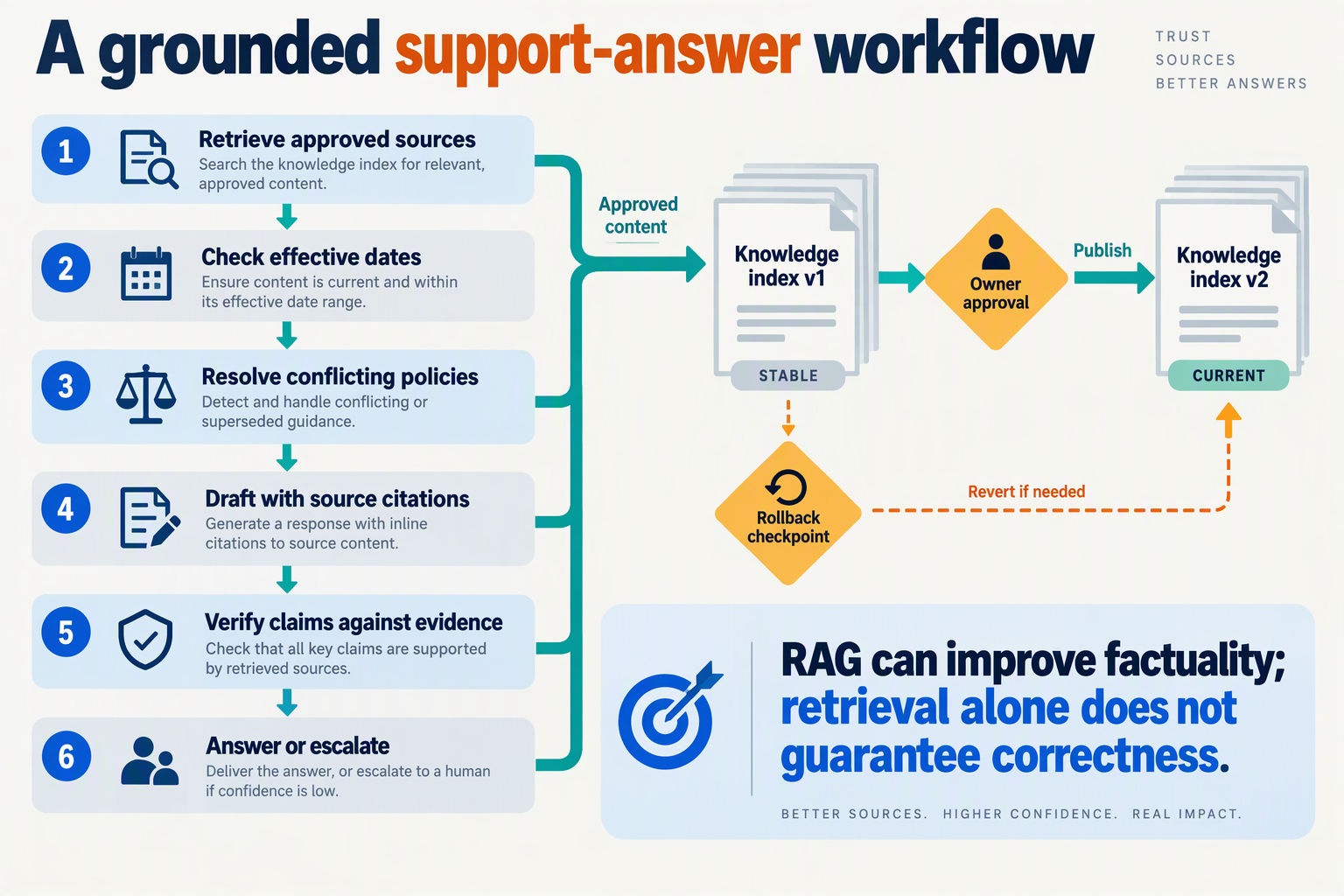
Retrieval-augmented generation (RAG) improves factuality by grounding answers in approved evidence; fact-checking verifies that the evidence supports each claim, while index versioning tracks which knowledge snapshot supplied it. For customer-support automation, these controls help prevent an otherwise capable LLM from quoting an expired policy or combining incompatible documents.
RAG is not a truth guarantee. A model can retrieve the wrong passage, misinterpret a correct one, or add an unsupported promise. The practical goal is therefore traceable answers, not simply answers accompanied by citations.
How should a support agent fact-check retrieved information?
Fact-checking should test whether the retrieved evidence supports the proposed answer—not ask another model whether the response “looks correct.”
A useful verification sequence is:
- Retrieve with constraints. Filter documents by product, region, customer eligibility, and policy effective date before generating an answer.
- Identify consequential claims. Extract statements about fees, eligibility, deadlines, and promised actions.
- Check evidence coverage. Require a supporting passage for each claim and check for contradictory policies.
- Validate calculations and live facts. Use deterministic calculations for amounts and authorized business systems for current account information.
- Withhold unsupported conclusions. Ask a clarifying question or route the issue to a person when evidence is missing.
Orthotropy’s October 2026 AI-agents roundup advises teams to “Reconcile formulas and source dates before using it in a pipeline meeting.” The same discipline applies to support: accurate wording cannot rescue an answer based on the wrong date or calculation.
Why does RAG index versioning matter for customer support?
Index versioning makes knowledge changes auditable and reversible. Rather than silently replacing indexed content, teams can publish identifiable snapshots with source-document versions, effective dates, ingestion timestamps, and retrieval configuration.
Consider a hypothetical October 2026 policy change: purchases before October 1 have a 30-day return window, while later purchases have a 14-day window. Retrieving only the newest policy could produce the wrong answer for a September purchase. A versioned index helps preserve the historical evidence, but retrieval still needs to select the policy applicable to that transaction.
Track at least:
- Source version: Which approved document contains the rule?
- Effective period: When does that rule apply?
- Index version: Which searchable snapshot served the request?
- Answer provenance: Which passages supported the response?
Versioning also supports rollback if a newly published knowledge snapshot introduces retrieval errors.
What should teams test before publishing a new knowledge index?
Test the old and new snapshots against the same representative questions. Measure unsupported-claim rate, applicable-policy retrieval, citation correctness, and appropriate escalation, rather than treating fluent answers as successful resolutions.
Include difficult cases: overlapping policies, regional exceptions, missing documents, and customers whose purchases predate a rule change. Record the model and prompt versions alongside the index version so failures can be reproduced.
As of October 2026, CallMissed supports agent knowledge bases built from text, web pages, and PDFs, alongside eval suites. Those capabilities can support grounding and testing; they should not be mistaken for a claim that CallMissed provides automatic fact-checking or knowledge-index versioning.
The broader implication for the future of large language models is clear: better models still need controlled evidence pipelines. Factual support automation depends on selecting the right source, verifying the answer, and retaining enough history to explain both.
How should LLMs handle classifying tickets without hiding costly mistakes?
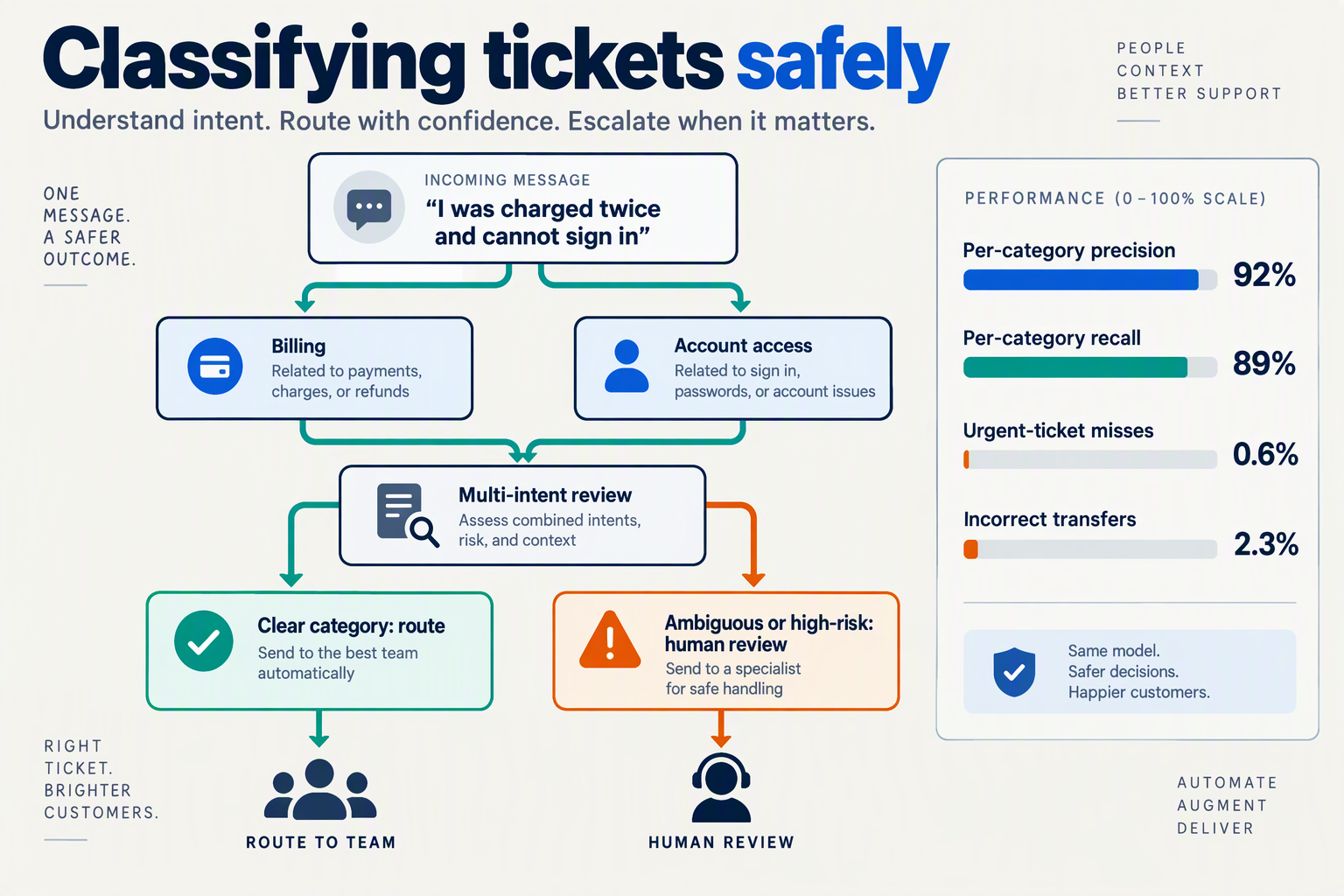
LLMs should classify support tickets with cost-sensitive evaluation, explicit uncertainty, and auditable routing decisions—not a single accuracy score. A system that correctly labels routine questions but misses account takeovers can look successful while creating serious operational risk.
Why is ticket-classification accuracy not enough?
Overall accuracy hides which mistakes matter. Confusing “product question” with “delivery question” may cause a transfer; confusing “unauthorized payment” with “general billing” can delay an urgent investigation.
Consider an illustrative test, not a published benchmark: a classifier labels 950 of 1,000 tickets correctly, achieving 95% accuracy. But if it detects only 12 of 20 account-security tickets, its recall for that critical category is just 60%. The headline score conceals eight potentially costly misses.
Support teams should therefore measure:
- Per-category precision: How often tickets assigned to a queue actually belong there.
- Per-category recall: How many genuine cases the classifier catches, particularly security, privacy, and payment disputes.
- Confusion patterns: Which categories repeatedly get mistaken for one another.
- Operational consequences: Reassignment delays, unnecessary specialist reviews, and missed escalation deadlines.
The objective is not merely fewer errors. It is fewer consequential errors at an acceptable review workload.
How should an LLM express uncertainty when routing tickets?
Use a defined output schema with fields such as primary category, secondary intent, urgency, supporting text, and review required. Do not treat a model-generated confidence percentage as a calibrated probability unless testing demonstrates that relationship.
A message such as “My parcel never arrived, and I don’t recognize the second charge” contains two issues. Forcing one label can hide the payment concern; multi-label classification can preserve both intents while routing according to an explicit priority rule.
A practical workflow is:
- Define category boundaries. Document examples, exclusions, and escalation triggers.
- Allow abstention. Route ambiguous or unfamiliar cases to human triage rather than forcing a confident label.
- Apply risk rules independently. A suspected account takeover should trigger review even if the primary category is “login help.”
- Record the evidence. Save the relevant customer wording, assigned labels, model version, and subsequent corrections.
Supporting text makes a decision inspectable; it does not prove the decision is correct. Human reviewers should verify that the excerpt actually supports the label.
How should teams test new LLM releases before changing routing?
Compare models on the same held-out tickets, using the same taxonomy and routing rules. IrisAgent’s 2026 customer-support evaluation describes its controlled comparison with the statement, “The only variable we changed was the LLM.” That principle is useful for classification: changing prompts, categories, and models simultaneously makes improvements difficult to attribute.
Run candidates in shadow mode, where predictions are recorded without changing live assignments. Review critical-category misses separately, include multilingual and mixed-intent tickets, and check whether apparent gains increase human-review volume.
As of October 2026, CallMissed’s developer API supports structured outputs and usage and request logs, capabilities relevant to producing consistent classification records and investigating requests. These capabilities support implementation; they do not establish classification accuracy.
The future of large language models should make ticket routing more accountable—not simply more automatic. Promote a new model only when its category-level results and review burden justify the change.
How can CallMissed help you evaluate voice and chat agents before rollout?
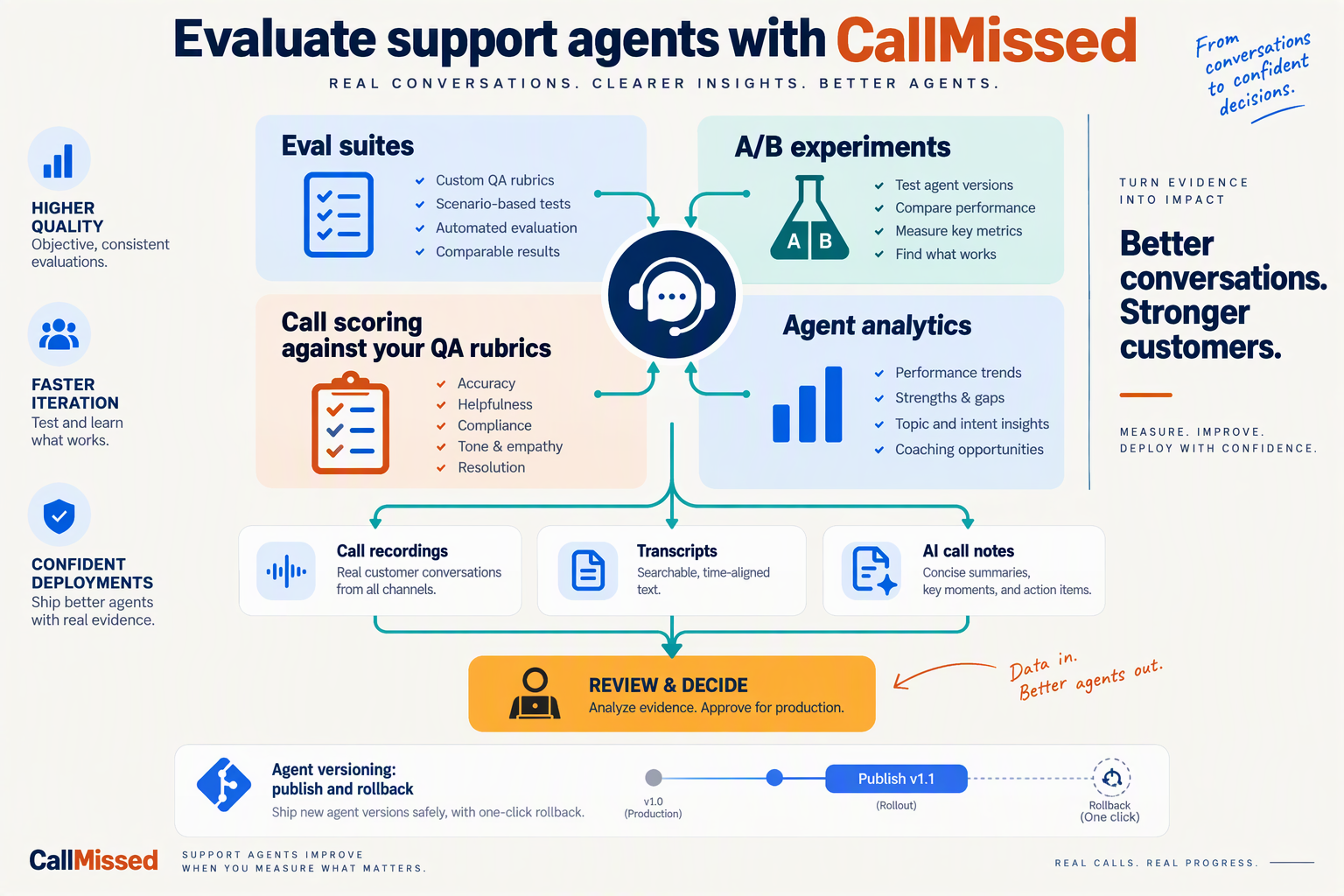
CallMissed can help teams evaluate voice and chat agents before rollout through eval suites, A/B experiments, call scoring against custom QA rubrics, and agent analytics, as of October 2026. Use these capabilities to test complete support workflows—not just whether a new large language model produces convincing answers.
What should a support-agent evaluation test?
Start with a fixed test set built from anonymized support scenarios, approved policies, and deliberately difficult requests. Define the expected answer, permitted actions, and escalation conditions before running the agent.
Include cases that expose different failure modes:
- Policy boundaries: A customer requests a refund outside the eligibility window.
- Missing evidence: An order lookup returns no matching record.
- Conflicting information: A customer’s description differs from the current order status.
- Unauthorized actions: A caller asks to change another customer’s delivery address.
- Voice-specific problems: Background noise, interruptions, and incorrectly recognized order numbers.
- Handoff needs: A frustrated customer explicitly requests a person.
For each case, grade factual accuracy, task completion, authorization, and appropriate escalation separately. A correct explanation should not cancel out an unauthorized action.
How can you compare new LLM releases fairly?
Change one variable at a time. Keep the knowledge base, instructions, tools, and test cases consistent when comparing models; otherwise, an improved result might come from a better prompt rather than a better model.
In its 2026 customer-support comparison, IrisAgent describes its experimental control directly: “The only variable we changed was the LLM.” That principle is useful for evaluating the future of large language models without confusing release novelty with operational progress.
A practical sequence is:
- Establish a baseline: Run the existing agent against the fixed test set.
- Evaluate a candidate: Change the model while preserving the surrounding workflow.
- Inspect failures: Identify whether errors originate in retrieval, reasoning, tool use, or speech recognition.
- Retest after changes: Repeat previous failures alongside successful cases to catch regressions.
Measure end-to-end response time, not just model generation speed. For voice support, speech recognition, retrieval, tool requests, and speech synthesis all contribute to the customer’s wait.
How do you turn test results into a rollout decision?
As of October 2026, CallMissed’s no-code agent builder supports versioning with publish and rollback, while call recordings, transcripts, AI call notes, and custom-rubric call scoring provide material for review. Its live call monitoring also lets supervisors listen, whisper, or barge in—useful controls during a carefully supervised pilot.
Treat these as evaluation and oversight tools, not proof that an agent is ready. Human reviewers should check a sample of scored interactions, particularly disputed results and high-risk requests.
Set acceptance criteria before the pilot. For example, a team might require zero unauthorized refunds in its test set and correct escalation whenever identity verification fails. Those are proposed release criteria, not vendor performance claims; passing a finite test set does not guarantee error-free production behavior.
Expand traffic only after the candidate meets the agreed criteria, and retain the previous published version for rollback. The strongest rollout decision is supported by reproducible evidence that the agent handles your customers’ problems within your business’s boundaries—not by a model’s launch-day benchmark.
How do you measure successful resolution instead of ticket deflection?
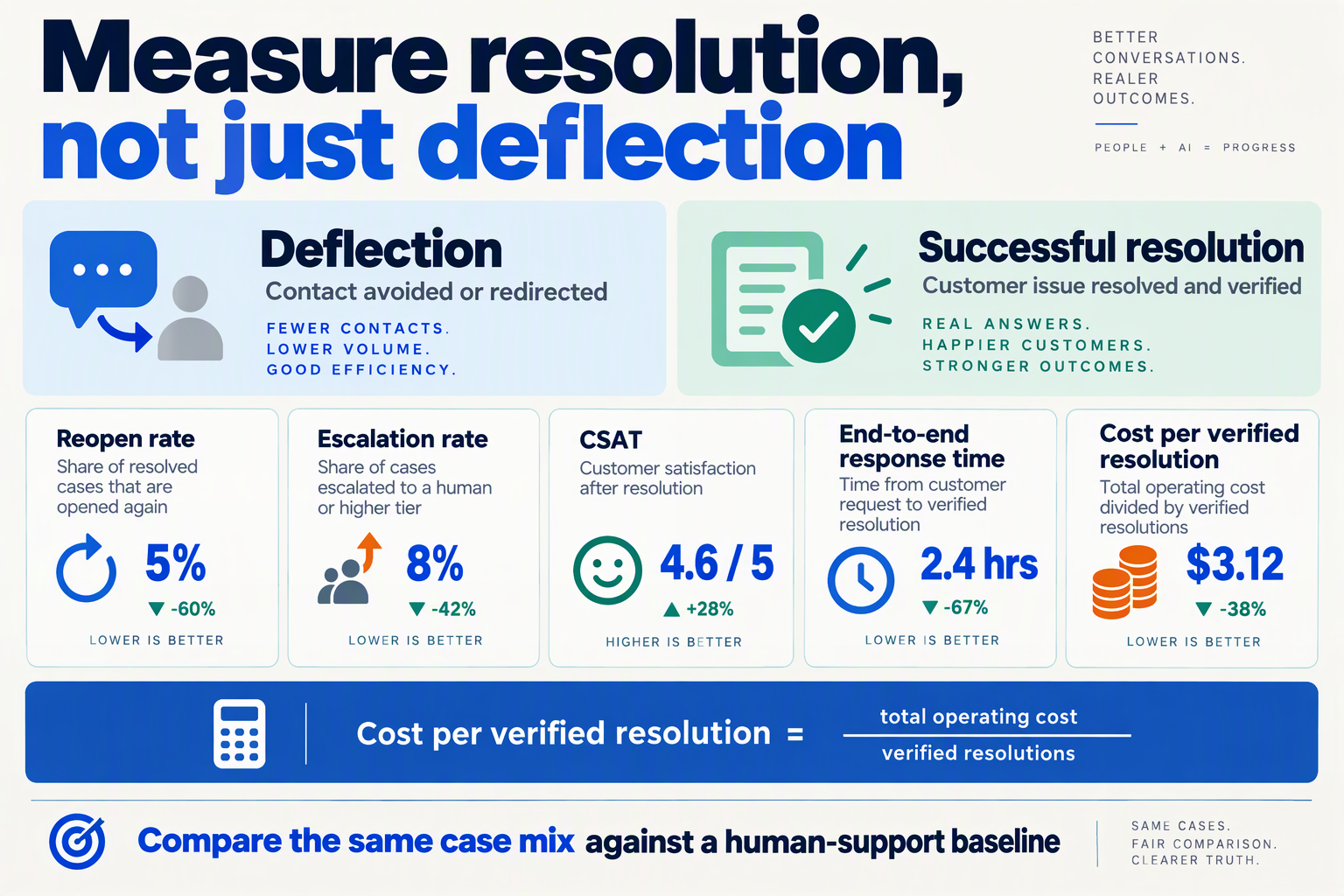
Measure successful resolution by whether the customer’s problem was actually solved, the required action was verified, and the issue did not recur within a defined follow-up window. Ticket deflection only measures avoided human contact; it cannot distinguish a completed refund from a customer who abandoned an unhelpful conversation.
What should count as an AI-resolved support issue?
Define resolution separately for each support intent before evaluating a model. A password-reset request, billing dispute, and delivery complaint require different evidence of success.
Use a three-part test:
- Outcome achieved: The customer received the information or completed the action needed.
- Execution verified: An authoritative system confirms any promised change—not merely the model’s statement that it happened.
- Resolution sustained: The customer did not reopen the same issue or contact another channel about it within your chosen window.
For an informational request, an accurate, policy-grounded answer may be sufficient. For a cancellation, require confirmation from the subscription system. Track cases without sufficient evidence as unverified, rather than quietly counting them as successes.
Which metrics reveal whether automation actually works?
Build a scorecard around customer outcomes, with efficiency as a secondary measure:
- Verified automated resolution rate: Issues resolved without human intervention, with supporting evidence, divided by eligible issues entering automation.
- Same-issue repeat-contact rate: Customers returning about the original problem within a defined period, such as seven days.
- End-to-end resolution time: Time from the first contact to verified completion, including transfers and waiting.
- Cost per verified resolution: Model, speech, infrastructure, and human-support costs divided by verified resolutions.
- Safety and authorization failures: Unsupported claims, unauthorized actions, or inappropriate disclosure, reported separately by severity.
- Post-resolution satisfaction: Customer feedback interpreted alongside survey response rates and case complexity.
Keep human-assisted resolutions visible too. A timely escalation that enables an agent to solve a difficult case is a successful support outcome, even though it is not an automated resolution.
How can ticket deflection exaggerate AI performance?
Consider an illustrative October 2026 evaluation, not an industry benchmark: 1,000 eligible support conversations produce 700 sessions without a human handoff. That suggests 70% deflection.
If only 500 sessions have verified outcomes and no same-issue return within seven days, the verified automated resolution rate is 50%, not 70%. Classify the remaining 200 as unresolved or unverified; investigate whether customers abandoned, switched channels, or received incomplete answers.
This distinction also changes economics. Divide total support costs by 500 verified resolutions—not 700 apparently contained conversations.
How should you compare new LLM releases fairly?
Freeze the knowledge base, tool permissions, and case mix when comparing models. IrisAgent’s 2026 customer-support chatbot evaluation states, “The only variable we changed was the LLM.” That controlled-comparison principle helps separate model improvements from workflow changes.
Then test representative cases, inspect failures, and run a limited live comparison with a follow-up window. Report results by intent and language so easy requests do not conceal weak performance on difficult ones.
As of October 2026, CallMissed offers call scoring against custom QA rubrics, eval suites, and A/B experiments. These capabilities can support evaluation, but teams must still define outcome evidence and reconcile conversation results with operational records.
The practical implication for the future of large language models is clear: promote a new model when it improves verified customer outcomes without unacceptable safety regressions, not simply when it keeps more tickets away from people.
What should support leaders and AI researchers challenge about the latest LLM claims?

Support leaders and AI researchers should challenge whether the latest LLM claims demonstrate reliable support outcomes, not merely higher benchmark scores. As of October 2026, the key questions are how results were measured, whether independent evidence supports them, and what happens when models encounter unfamiliar policies or consequential actions.
Do better LLM benchmark scores mean better customer support?
Not automatically. Coding and computer-use benchmarks can indicate useful capabilities, but they do not directly measure whether an agent correctly applies your cancellation policy or avoids disclosing another customer’s information.
LLM Stats’ October 2026 news summary lists Claude Sonnet 5.5 results of 70.6% on Terminal-Bench and 55.5% on CursorBench, identifying those figures as self-reported. Treat these as reported results to investigate—not independent confirmation of production support performance.
Scoring definitions also matter. LLM Stats’ October 2026 summary reports Claude Sonnet 5.5 OSWorld 2.1 scores of 43.5% under strict scoring versus 80.1% under partial scoring. That 36.6-percentage-point difference illustrates how dramatically a headline can change with the success criterion.
For customer support, partial completion may mean finding the right order but failing to submit the authorized refund. Before accepting a performance claim, ask:
- What counts as success? A plausible response, a correct answer, or a completed and verified action?
- What assistance was allowed? Retries, tools, additional instructions, or human intervention?
- Which failures were excluded? Timeouts, unavailable systems, ambiguous requests, or escalations?
How can teams distinguish a model announcement from deployment evidence?
An announcement establishes that a capability has been claimed; it does not establish that your team can access or operate it reliably.
LLM Gateway’s 2026 timeline lists Meta’s Muse Glimmer 30B as released on August 10, 2026, and added to LLM Gateway on September 22, 2026. Those separate dates highlight an important distinction: model release, provider availability, and deployment readiness are different milestones.
Researchers should request the exact model version, evaluation date, configuration, and access route. Support leaders should additionally check whether the tested configuration matches the system they will purchase.
Apply similar scrutiny to self-training and memory claims. Ask whether “learning” means updating model weights, changing stored instructions, retrieving previous conversations, or simply retaining account facts. These mechanisms have different implications for reproducibility, deletion, and error correction; the label alone proves little.
What evidence should support leaders demand before expanding automation?
Use a staged acceptance test rather than a release-day leaderboard:
- Define unacceptable outcomes. Examples include unauthorized credits, incorrect eligibility decisions, and cross-customer data exposure.
- Test realistic exceptions. Include conflicting policy versions, missing records, interrupted conversations, and requests the agent should decline.
- Measure completed outcomes. Track verified resolution, incorrect actions, escalation quality, and total workflow cost—not response fluency alone.
- Retest after changes. A new model, prompt, retrieval source, or tool configuration can alter previously acceptable behavior.
As of October 2026, CallMissed supports evaluation suites, A/B experiments, and call scoring against a business’s own QA rubrics, according to its verified product fact sheet. These capabilities support a practical approach: evaluate automation against your operating standards rather than adopting a model because its launch headline sounds impressive.
The strongest claim is not “this model reasons better.” It is “this configuration completes these support tasks, under these constraints, with documented failures and repeatable results.”
What do these customer service predictions for 2026 mean for your team?
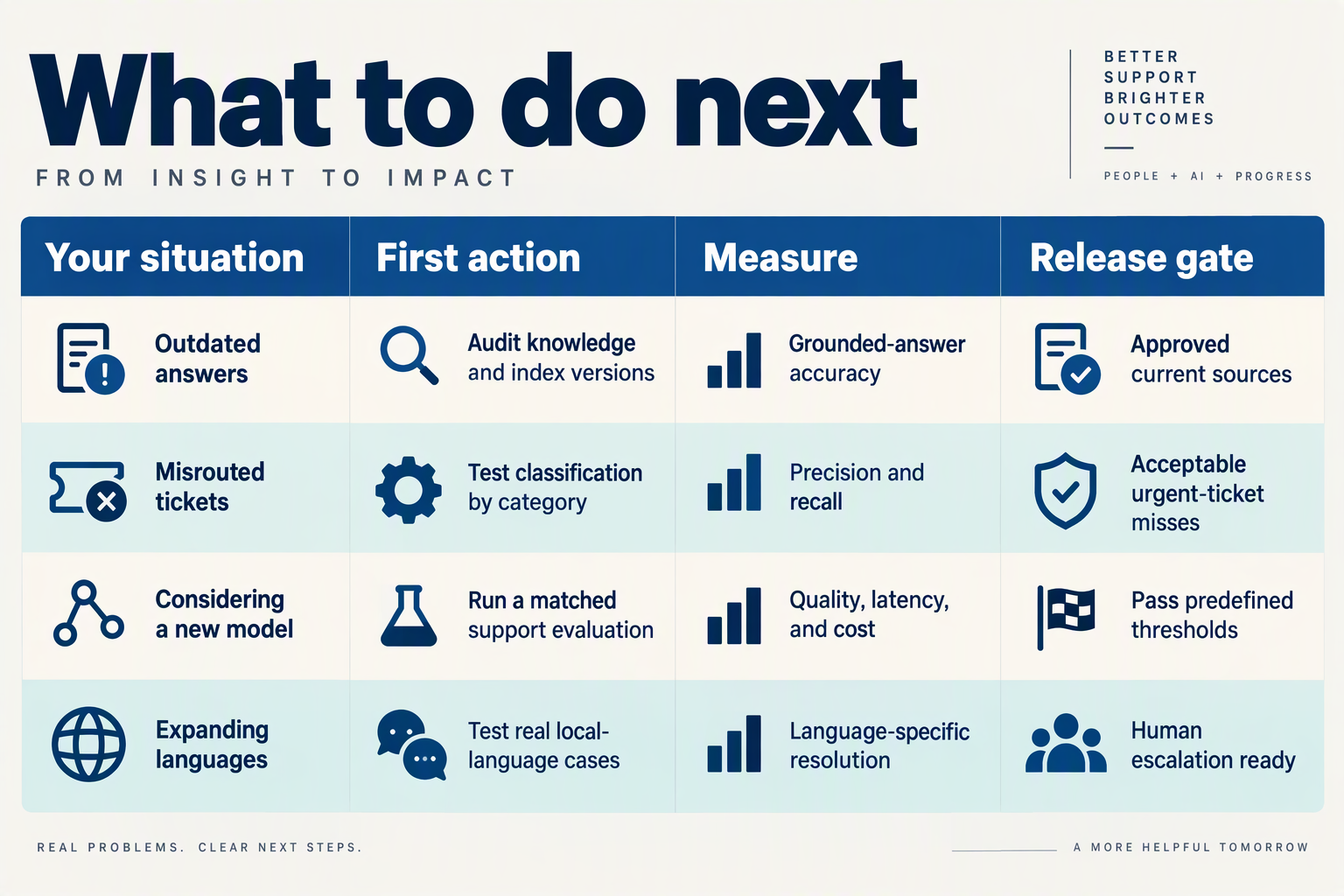
Customer service predictions for 2026 should change your team’s rollout criteria—not trigger an immediate replacement of your support stack. As of October 2026, the practical priority is to test new LLM capabilities against specific workflows, assign accountable owners, and expand automation only when customer outcomes justify it.
How should support teams turn LLM predictions into an action plan?
The following table translates the developments discussed earlier into proposed operational steps for October–December 2026. These are planning recommendations, not guarantees that every model or platform can deliver the predicted capability.
| Development to prepare for | Team action | Accountable owner | Evidence before expansion |
|---|---|---|---|
| More frequent model releases | Test candidate models against a fixed set of support cases | AI engineering lead | Better task outcomes without more policy violations |
| Larger context windows | Compare targeted retrieval with longer conversation inputs | Knowledge manager | Correct policy selection and acceptable response cost |
| More capable tool-using agents | Start with read-only order checks before permitting changes | Support operations lead | Correct tool selection and no unauthorized actions |
| Persistent agent memory | Define what may be remembered, corrected, and deleted | Privacy lead | Documented controls and successful deletion tests |
| Feedback-driven improvement | Review proposed changes before publishing agent updates | Quality assurance lead | Fewer repeat errors on held-out cases |
| More voice and multilingual automation | Pilot one queue and language combination at a time | Contact-centre lead | Accurate intent recognition and successful handoffs |
The important shift is from asking, “Which model leads the benchmark?” to asking, “Which change improves this support workflow under our constraints?” A stronger model may still require substantial integration work; a narrower deployment may deliver value sooner.
Why should teams separate model announcements from deployment readiness?
According to LLM Gateway’s 2026 release timeline, Meta’s Muse Glimmer 30B was released on August 10, 2026, and added to LLM Gateway on September 22, 2026—a 43-day interval between the listed release and gateway availability. That example illustrates why announcement dates should not become internal launch commitments.
Availability through your chosen provider, permissions, logging, and regression testing all affect deployment readiness. Maintain a candidate-model backlog rather than treating every release as an urgent migration.
Benchmark interpretation deserves the same discipline. LLM Stats’ October 2026 news page lists a self-reported Terminal-Bench score of 70.6% for Anthropic Claude Sonnet 5.5. That result concerns terminal-based tasks; it does not establish refund-policy accuracy, customer satisfaction, or safe account changes.
What should your team measure before expanding automation?
Use a small scorecard that distinguishes genuine resolution from superficial efficiency:
- Resolution quality: Did the customer’s issue actually get resolved?
- Policy compliance: Were answers and actions within approved boundaries?
- Handoff quality: Did a person receive the necessary context?
- Cost per verified resolution: Include model usage, integrations, and human rework.
As of October 2026, CallMissed provides evaluation suites, A/B experiments, call scoring against custom QA rubrics, and a human-handoff queue. These capabilities illustrate how communication infrastructure can support controlled testing rather than relying solely on release announcements.
For the remaining months of 2026, choose one high-volume, low-risk workflow, establish its baseline, and test one change at a time. The future of large language models becomes useful when your team can demonstrate better support—not merely newer technology.
Frequently Asked Questions
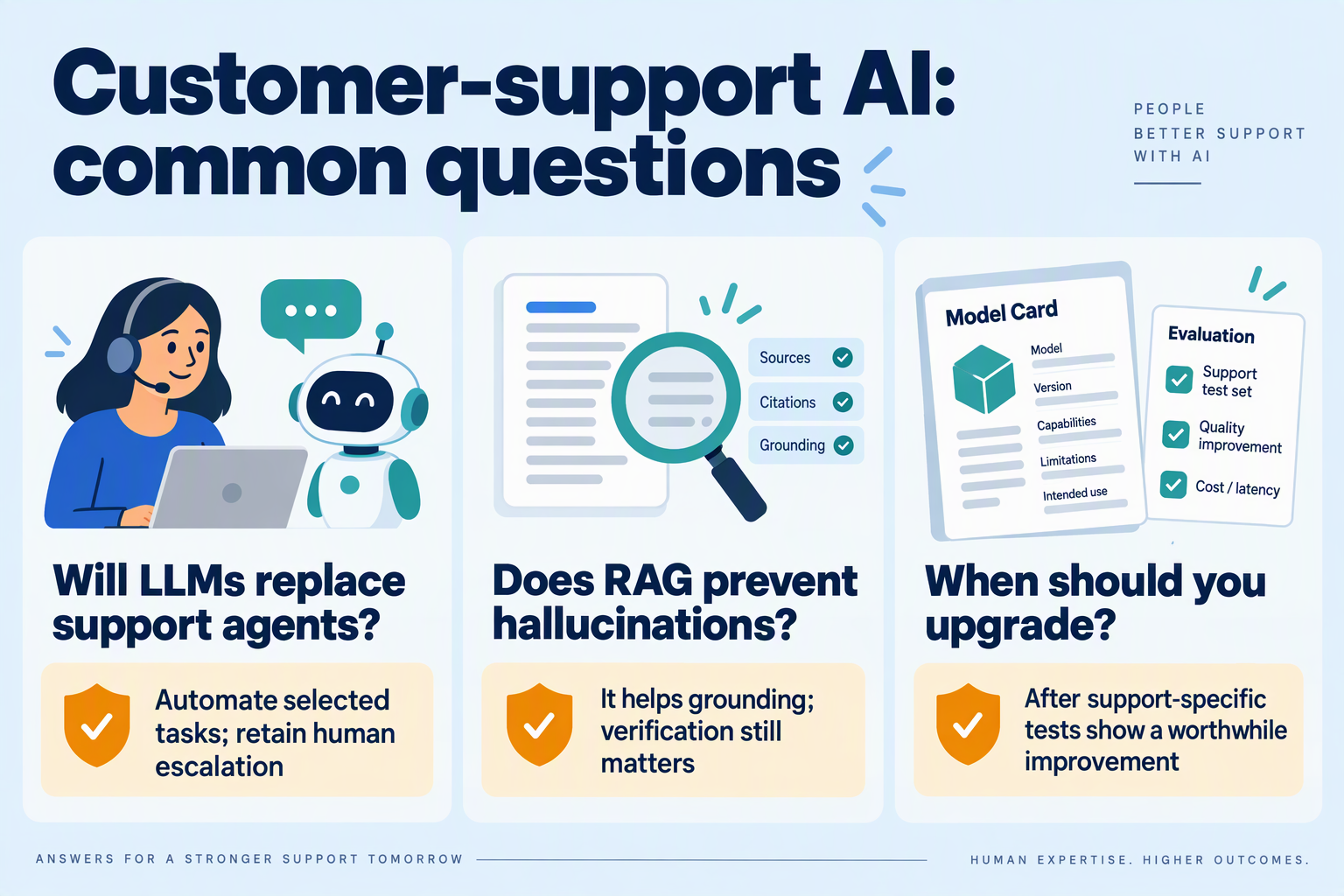
Will large language models replace human customer-support agents?
Does retrieval-augmented generation prevent hallucinations in customer support?
When should businesses upgrade large language models for support automation?
How should teams evaluate large language models before deploying them?
How can businesses calculate the real cost of AI customer support?
Can customer-support LLMs learn from conversations without exposing private data?
Conclusion
The future of large language models in customer support is more reliable resolution—not simply more fluent conversation. In 2026, the developments worth watching are those that help automation retrieve approved information, take authorized actions, learn safely from feedback, and recognize when human judgment is necessary.
New releases will keep expanding what support systems can attempt. However, a larger context window or stronger benchmark result does not, by itself, prove that a model can enforce a refund policy or handle a sensitive customer interaction correctly. IrisAgent’s 2026 customer-support chatbot comparison weights helpfulness and safety equally, reinforcing the article’s central lesson: useful automation must deliver both.
Four takeaways should guide support teams:
- Ground answers in evidence. Retrieval and verification should connect responses to approved policies and current customer records. For a delayed-order complaint, that means checking delivery information separately from refund eligibility—not turning a plausible explanation into an unauthorized promise.
- Treat feedback as a governed process. Learning from interactions could improve support quality, but mistakes must not become training signals simply because they appear in conversation history. Teams need safeguards against reinforcing incorrect answers or absorbing sensitive information.
- Connect tools with clear permissions. Tool-using agents can move beyond describing next steps to requesting order information or triggering approved workflows. The important distinction is between an action the model can suggest and an action the business has authorized.
- Keep human oversight measurable and accessible. Escalation, permissions, and ongoing evaluation remain necessary as models become more capable. Assess whether the system resolves the right issue within policy, rather than judging success by how convincingly it speaks.
What should customer-support teams watch next?
Watch whether new LLM releases improve grounding, dependable tool use, and escalation decisions in realistic support scenarios. Shakudo’s September 2026 overview reports that NVIDIA Nemotron 3 Ultra has a one-million-token context window, but support teams should still test whether additional context produces more accurate, policy-compliant answers.
The practical next step is a bounded evaluation: choose a recurring support issue, define the approved evidence and actions, and test both routine requests and exceptions. A refund scenario is especially revealing because it combines factual retrieval, policy interpretation, authorization, and possible human handoff.
As of October 2026, CallMissed offers knowledge-base retrieval, custom REST tools, and a human-handoff queue, making it a platform readers can explore when evaluating connected support workflows. These capabilities reflect the broader move from standalone chatbots toward automation operating within business rules.
Before adopting the next model release, ask: Can this system resolve the customer’s problem using verified evidence—and stop when its authority ends?
Related Reading
- Sarvam AI Capabilities: Local-Language Support in 2026
- AI Customer Support for Ecommerce: 2026 Automation Playbook
- Gemini 4 Argon: Customer Support and Receptionist Guide
Sources
Discussion
Related Posts



Ready to automate customer conversations?
Launch AI voice agents and WhatsApp bots with CallMissed — one API, 22+ Indian languages.