
AI Customer Support for Ecommerce: 2026 Automation Playbook


Learn how AI customer support for ecommerce automates tracking, returns, COD, cart recovery, phone, WhatsApp, and escalation.
AI Customer Support for Ecommerce: 2026 Automation Playbook
What if the fastest way to lose an ecommerce customer in 2026 is not a bad product, but a slow answer to “Where is my order?” AI customer support for ecommerce now matters at every point between checkout and delivery because shoppers expect immediate, channel-aware help—even when they contact a store after business hours.
The operational stakes are substantial. Baymard Institute reports an average documented online cart-abandonment rate of 70.19%, showing how much potential revenue disappears before checkout. After purchase, returns create another high-volume service burden: the National Retail Federation estimated that 15.8% of annual retail sales would be returned in 2025, representing $849.9 billion in merchandise. Each abandoned cart, delivery delay, return request, or failed cash-on-delivery verification can trigger repetitive conversations that consume support capacity and erode customer confidence.
From generic chatbots to query-led automation
Effective ecommerce customer service automation does not begin with “deploy a chatbot.” It begins by identifying the queries customers actually raise and designing a reliable workflow for each one.
A useful 2026 automation map includes:
- “Where is my order?” handled by an AI order tracking assistant connected to live order and logistics data.
- “Can I return or exchange this?” routed through AI returns automation that checks eligibility, explains the policy, and initiates the correct action.
- COD orders confirmed through WhatsApp or phone before dispatch.
- Abandoned carts recovered with timely, consent-aware messages.
- Delivery exceptions escalated when a courier scan, promised date, or customer statement conflicts with system data.
- High-risk, emotional, or policy-sensitive cases transferred to a human with the full conversation context.
This is where WhatsApp ecommerce automation, AI voice agents, and conversational commerce AI become more than messaging tools. Together, they can support continuous journeys across chat and phone: confirming an order on WhatsApp, answering a delivery call in a regional language, and handing an exchange request to an agent without forcing the shopper to repeat everything.
Platforms such as CallMissed reflect this shift by combining WhatsApp Business chat and calling, AI voice agents, an omnichannel inbox, and support for 22 Indian languages—capabilities particularly relevant to Indian ecommerce businesses managing COD and multilingual demand.
What this playbook will help you build
This guide turns common ecommerce questions into practical workflow templates. You will learn how to automate order status, delivery questions, returns, exchanges, COD confirmation, cart recovery, phone support, and WhatsApp conversations; define escalation rules; connect AI with order-management and logistics systems; and measure containment, resolution, conversion, response time, and customer satisfaction.
You will also get a buyer checklist for evaluating accuracy, integrations, multilingual coverage, channel continuity, analytics, security, fallback behavior, and human handoff. The objective is not to automate every conversation—it is to automate predictable work safely while ensuring customers can reach a capable person when judgment is required.
What should AI customer support for ecommerce automate first? Start with repetitive, verifiable customer queries

Automate the queries whose answers can be verified against live systems and explicit policies before attempting open-ended support. For most stores, the first automation queue should cover order status, delivery estimates, return eligibility, exchange availability, COD confirmation, and cart-recovery responses.
Use three tests to choose the first workflows
A query is a strong candidate for ecommerce customer service automation when it passes three tests:
- High frequency: Customers ask substantially the same question repeatedly.
- Verifiable answer: The response comes from an order-management system, warehouse platform, courier API, payment record, inventory service, or approved policy.
- Low ambiguity: The system can identify the correct next action without interpreting complex complaints or making discretionary promises.
The National Retail Federation estimated in 2025 that returns would equal 15.8% of annual retail sales and $849.9 billion in merchandise, making return eligibility and status checks logical automation priorities. Likewise, Baymard Institute’s documented 70.19% average cart-abandonment rate indicates that pre-purchase questions and recovery conversations can affect a large pool of potential orders.
Prioritize by value, risk, and data readiness
A practical first-wave queue for AI customer support for ecommerce is:
- Order status: Retrieve payment, fulfilment, shipment, courier-scan, and estimated-delivery data using an AI order tracking assistant.
- Delivery questions: Explain whether an order is packed, shipped, out for delivery, delayed, attempted, or returned to origin.
- Return eligibility: Use AI returns automation to compare delivery date, product category, return window, item condition, and policy exclusions.
- Exchange availability: Check size, colour, variant inventory, serviceability, and price differences before offering an exchange.
- COD confirmation: Verify customer intent, address, order amount, and preferred delivery availability through WhatsApp or phone.
- Cart-recovery replies: Answer product, shipping, payment, discount, and return-policy questions when a shopper responds to an approved recovery message.
Do not begin with emotionally charged complaints, fraud disputes, damaged-item adjudication, refund exceptions, or compensation decisions. These cases require judgement, evidence review, or authority that should remain with trained agents.
Build each automation as a verification workflow
Every workflow should follow the same control pattern:
- Identify the customer using an order ID plus a verified phone number, email address, or one-time password.
- Classify the query without assuming the customer’s intent from a single keyword.
- Retrieve current records from commerce, payment, inventory, logistics, and policy systems.
- Validate the answer against deterministic rules, timestamps, and confidence thresholds.
- Perform an approved action or transfer the case with the collected context.
- Log the outcome for auditing, measurement, and future improvement.
For example, “Your package will arrive tomorrow” should be sent only when a courier event or committed delivery field supports that statement. If tracking has not updated, the assistant should say the status is unavailable, create a logistics ticket, or escalate—never invent an estimate.
Keep channels connected to the same source of truth
WhatsApp ecommerce automation, phone agents, web chat, and email should use identical order data and policy rules. Conversational commerce AI fails when WhatsApp reports “shipped” while a phone agent sees “processing.”
Platforms such as CallMissed can connect WhatsApp Business chat and calls with AI voice workflows and an omnichannel inbox. That channel continuity is especially useful for COD confirmation and regional-language support, while the underlying commerce and logistics systems remain the authoritative source for every answer.
Why is query-led ecommerce customer service automation replacing channel-by-channel bots in 2026?
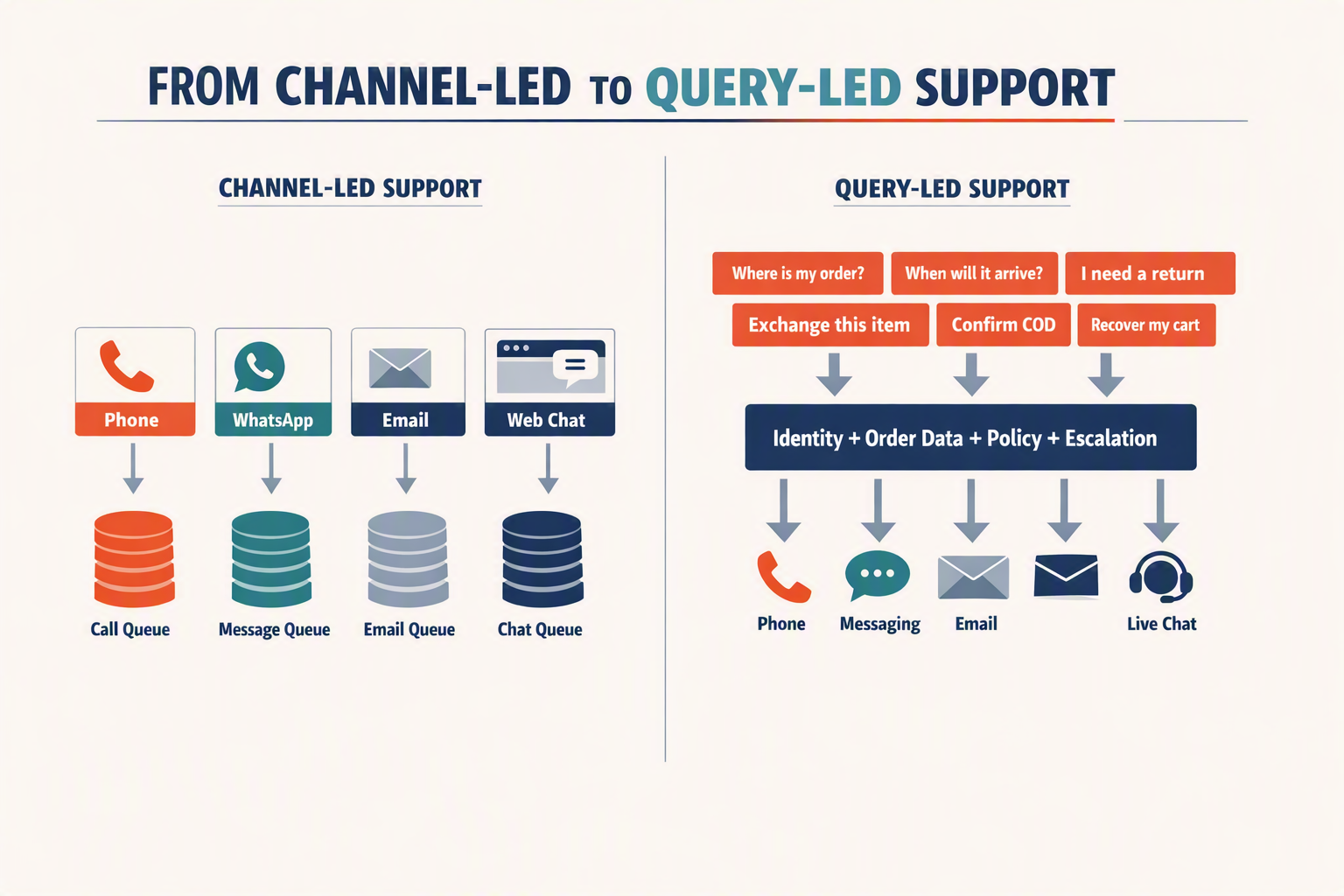
Query-led automation is replacing channel-by-channel bots because customers expect one continuous resolution workflow, whether they ask through WhatsApp, phone, email, or web chat. Instead of rebuilding order, return, and delivery logic for each channel, ecommerce teams define the query once and let every approved interface invoke the same data, policies, and actions.
The query—not the channel—is the unit of automation
A channel-first setup typically creates a WhatsApp bot, website chatbot, interactive voice response flow, and email autoresponder as separate projects. That architecture duplicates business rules and can produce conflicting answers when policies or order data change.
A query-led model organizes AI customer support for ecommerce around customer intent:
- Identify the query: Is the customer checking an order, reporting a delivery problem, requesting a return, confirming COD, or recovering a cart?
- Collect required context: Authenticate the shopper and retrieve the order number, payment method, shipment scan, delivery promise, and policy eligibility.
- Execute an approved action: Provide status, update an address where permitted, confirm COD, initiate a return, or create an escalation.
- Preserve the outcome: Write the conversation, action, and next step back to the shared customer record.
The interface can then change without changing the underlying workflow. An AI order tracking assistant, for example, should use the same order-management and courier data whether a shopper types “Where is my order?” on WhatsApp or asks the question during a phone call.
Shared workflows reduce fragmented customer experiences
Query-led ecommerce customer service automation separates three layers that channel-specific bots often mix together:
- Conversation layer: WhatsApp messages, voice calls, web chat, and email.
- Decision layer: Intent detection, policy checks, authentication, confidence thresholds, and escalation rules.
- Action layer: Order-management, logistics, payment, CRM, and return-management integrations.
This separation is especially valuable for post-purchase operations. The National Retail Federation estimated in 2025 that returns would equal 15.8% of annual retail sales, or $849.9 billion in merchandise. At that scale, AI returns automation needs consistent eligibility rules across every contact channel—not separate interpretations inside a phone script and a chatbot.
The same principle applies to WhatsApp ecommerce automation. A COD confirmation initiated by WhatsApp can move to a voice call when the shopper does not respond, while retaining the order details and previous messages. If the customer later calls about delivery, the agent should see that the COD order was already verified.
Conversational commerce becomes an orchestration layer
Conversational commerce AI in 2026 is therefore less about generating fluent replies and more about coordinating reliable outcomes. A robust query-led system should carry forward:
- Verified customer identity and consent
- Current order and shipment state
- Previous channel interactions
- Actions already attempted
- Automation-confidence and risk signals
- A concise handoff summary for human agents
Platforms such as CallMissed support this architecture by bringing WhatsApp Business chat and calling, AI voice agents, and an omnichannel inbox into one environment. CallMissed also supports voice and chat across 22 Indian languages, which helps Indian ecommerce teams apply the same query workflows to multilingual phone and WhatsApp conversations.
The practical rule is simple: design one governed workflow per customer query, then expose it across every relevant channel. Channels determine how the conversation happens; the query determines what must be resolved.
Which developments are shaping ecommerce support automation in 2026?
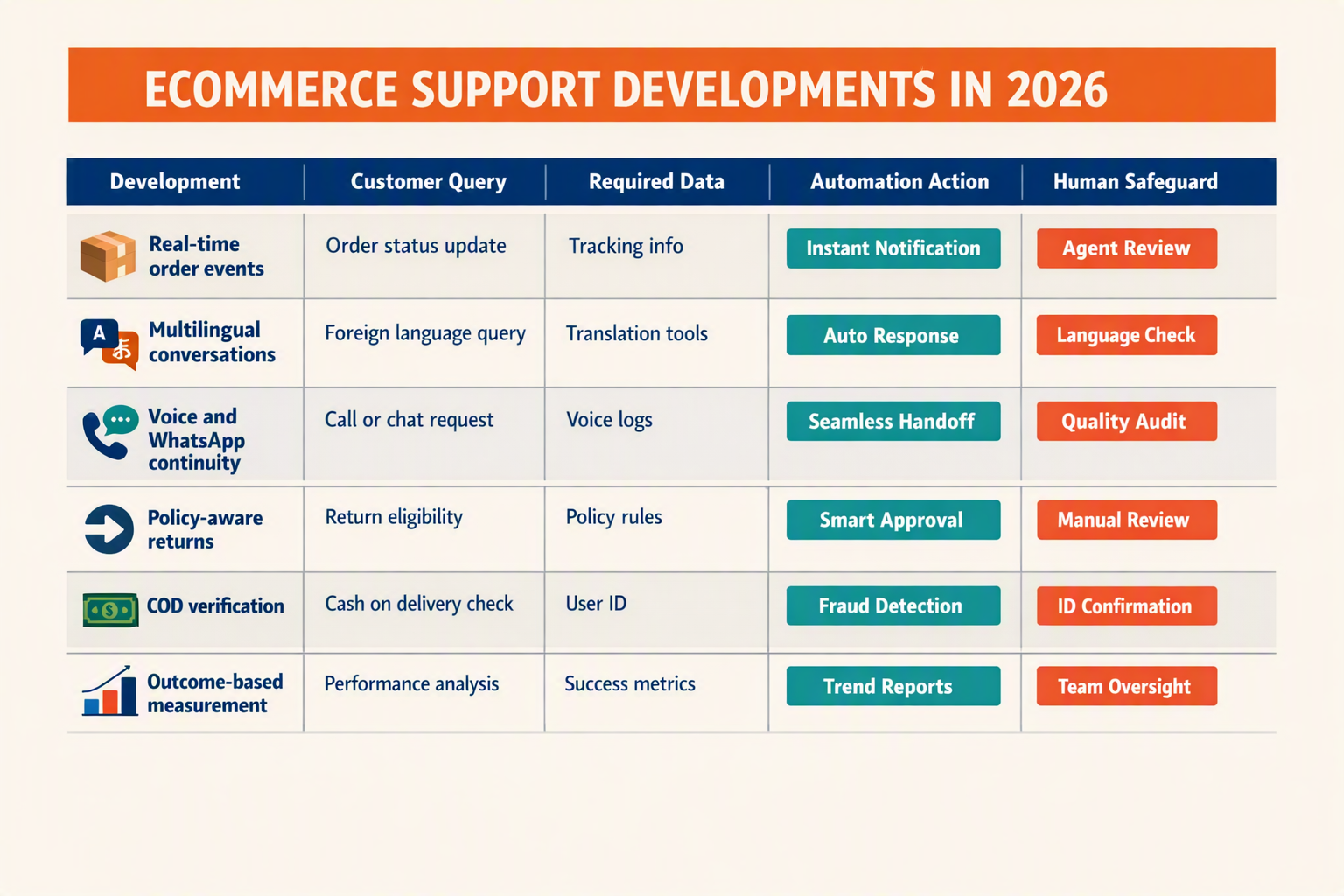
Ecommerce support automation in 2026 is being shaped by permissioned AI agents, event-driven commerce data, cross-channel orchestration, multilingual voice, stricter governance, and outcome-based measurement. The practical shift is from bots that generate answers to systems that can retrieve live data and request approved actions. Whether an agent can actually modify an order, create a return, or issue a refund depends on the merchant’s verified integrations, permissions, and business rules.
| Development | What changed | Ecommerce workflow impact | Implementation priority |
|---|---|---|---|
| Tool-using AI agents | Models can call approved APIs rather than relying only on generated responses | Retrieve order status, check return eligibility, or submit an authorized action | Allowlist tools, validate API responses, and require confirmation for consequential actions |
| Event-driven support | Order, payment, inventory, and carrier events can trigger workflows as they occur | Notify shoppers about payment failures, delivery exceptions, refund updates, or restocked items | Connect and monitor OMS, WMS, payment, and logistics webhooks |
| Cross-channel orchestration | Platforms can pass customer and case context between messaging, calling, and human queues | Continue a COD confirmation or delivery dispute without asking the shopper to repeat everything | Preserve identity, consent, transcript, and order context; verify each channel’s availability |
| Multilingual automation | Speech and text systems cover more languages, although accuracy varies by model and use case | Handle regional-language and code-switched order, delivery, and exchange enquiries | Test accents, addresses, product names, numerals, and noisy phone audio with real users |
| Governance by design | Privacy, disclosure, access control, retention, and human oversight are becoming procurement requirements | Reduce risk when processing addresses, recordings, refunds, and payment-related enquiries | Apply least-privilege access, redaction, retention limits, audit logs, and escalation rules |
| Outcome-led measurement | Teams are evaluating completed resolutions and commercial outcomes, not only automated-message volume | Measure successful delivery contacts, return completion, COD acceptance, and recovered checkouts | Track accuracy, repeat contacts, reversals, complaints, conversion, and cost per resolved case |
Agents are becoming workflow operators
A reliable AI order tracking assistant should query an authorized order or carrier system rather than infer delivery status from an FAQ. It can compare the promised date with the latest available scan, explain what the source system reports, and route conflicting or stale data to a human. “Live tracking” is only accurate when the underlying OMS, carrier, or aggregator integration is current and operational.
The same distinction applies to AI returns automation. An agent may check the purchase date, SKU, fulfilment status, return window, reason code, and exchange inventory when those fields are exposed through verified integrations. Creating a return authorization, changing an address, cancelling an order, or issuing a refund should use deterministic rules, explicit customer confirmation, least-privilege credentials, and an auditable transaction record.
Returns are commercially significant, but published figures should not be treated as universal benchmarks. The National Retail Federation and Happy Returns estimated that U.S. retailers would receive $849.9 billion in returns during 2025, equal to 15.8% of annual sales, with an estimated 19.3% online return rate. Those are survey-based U.S. estimates, not measured global ecommerce rates or forecasts for an individual merchant.
Cart recovery requires similar care. Baymard Institute’s widely cited cart-abandonment benchmark is a compilation of external studies, not a single controlled measurement. Merchants should calculate abandonment from their own analytics, separate intentional browsing from checkout failure, and measure incremental recovered orders against a control group rather than attributing every post-reminder purchase to automation.
Channel economics and continuity matter more
Meta moved the WhatsApp Business Platform from conversation-based pricing to per-message pricing on July 1, 2025. Under Meta’s published model, businesses are generally charged when a marketing, authentication, or utility template message is delivered, with rates varying by message category and market. Free-form service messages—and eligible utility template messages—can be free inside the 24-hour customer-service window. Current rate cards, category rules, free-entry-point provisions, and provider fees should be checked before calculating campaign or support costs.
Effective WhatsApp ecommerce automation therefore optimizes for resolved cases and customer consent, not raw message volume. Template classification, duplicate notifications, retries, opt-outs, and unnecessary follow-ups can all affect cost and customer experience.
CallMissed’s published product materials describe an omnichannel inbox, WhatsApp Business messaging and calling, AI voice agents, and support for 22 Indian languages. These are vendor product claims; merchants should verify account eligibility, geographic availability, telephony and WhatsApp permissions, language performance, and the specific OMS, CRM, payment, or logistics integrations required for their workflows. A shared inbox does not by itself provide authority to retrieve or alter live order data.
Governance is moving into the architecture
The PCI Security Standards Council states that the future-dated requirements in PCI DSS v4.x became effective on March 31, 2025. Ecommerce teams should keep full payment credentials out of unrestricted chat histories, call recordings, model prompts, and analytics logs. Payment collection should be routed through validated payment flows, with sensitive data redacted and access restricted.
Under the European Commission’s implementation timeline, most remaining provisions of the EU AI Act became applicable on August 2, 2026, including transparency obligations relevant to certain AI interactions and generated content. Some obligations followed different dates, and applicability depends on the system, role, risk classification, and market. Legal review remains necessary rather than assuming every support bot is subject to identical requirements.
For AI customer support for ecommerce, the durable 2026 design rule is to automate only what can be verified: ground responses in live authorized data, place consequential actions behind explicit controls, preserve context across channels, and record what the system saw and did. That is what turns conversational commerce AI into dependable ecommerce customer service automation rather than another disconnected chatbot.
How do you build workflow templates for order status, delivery, AI returns automation, exchanges, COD, and cart recovery?
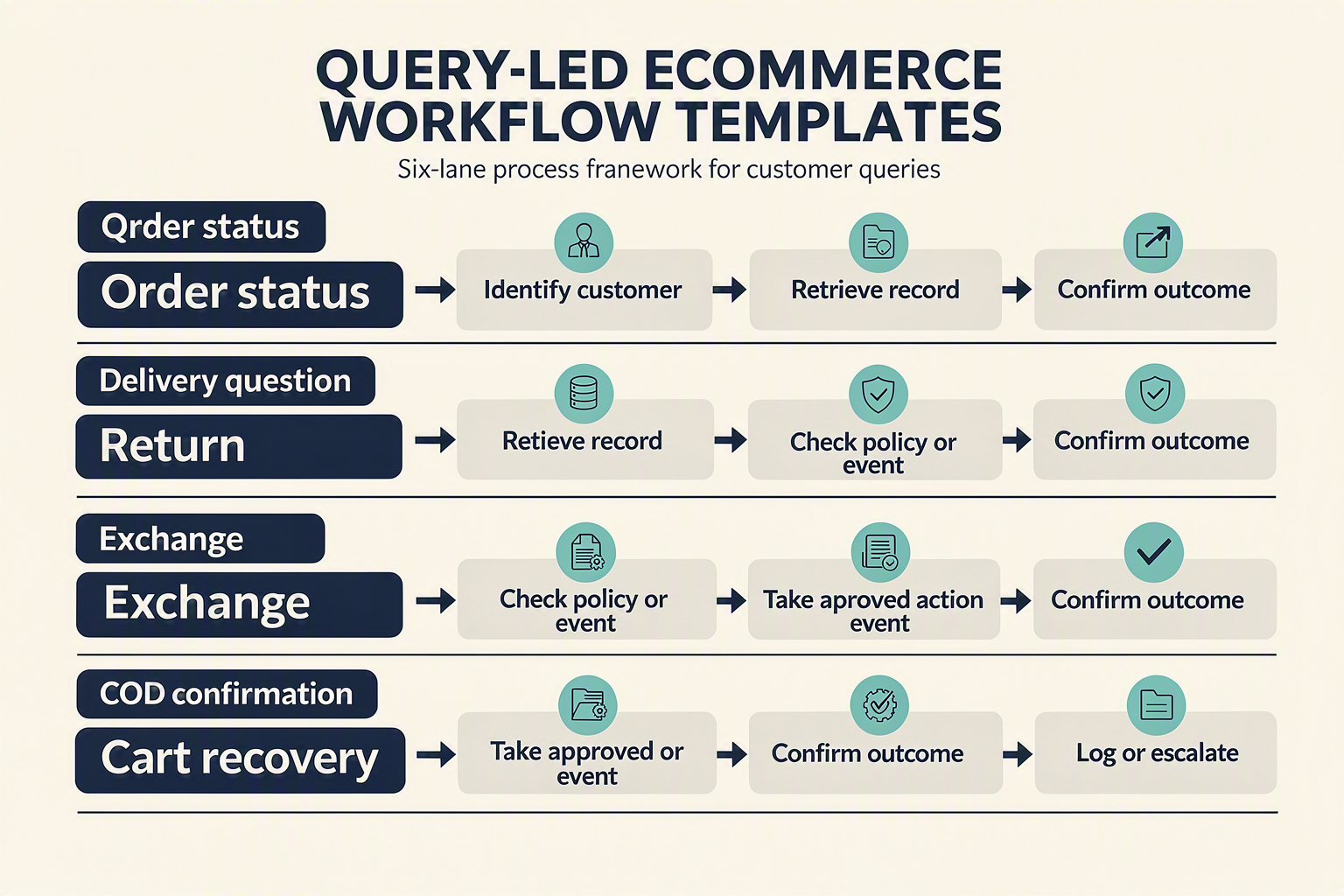
Build each workflow as a deterministic transaction sequence with AI at the conversation layer: identify intent, authenticate the shopper, retrieve live data, apply policy rules, execute an approved action, and escalate exceptions. This structure prevents AI customer support for ecommerce from inventing order details or making unauthorized promises.
Use one reusable workflow skeleton
Every template should define:
- Trigger: Customer message, phone call, order event, courier exception, or elapsed time.
- Required inputs: Order ID, verified phone number, postcode, SKU, payment method, and channel consent.
- Systems of record: Ecommerce platform, order-management system, warehouse system, payment gateway, and logistics provider.
- Allowed actions: Send tracking details, update an address, create a return, reserve an exchange, or transfer the case.
- Escalation conditions: Missing records, contradictory scans, policy exceptions, fraud indicators, repeated failures, or customer distress.
- Completion event: Resolved query, confirmed order, scheduled pickup, recovered checkout, or human-owned ticket.
The AI should never treat the model’s generated response as the source of truth. Order, payment, inventory, and courier APIs must supply transactional facts.
Configure six query-led templates
Order status
- Verify the customer using the order-linked phone number or another approved factor.
- Retrieve fulfilment status, courier, tracking URL, latest scan, and promised delivery date.
- Translate operational codes such as “manifested” into plain language.
- Escalate when no scan appears within the configured period or the promised date has passed.
An AI order tracking assistant should say “The courier recorded your parcel at its Bengaluru hub at 08:42” rather than offering a vague estimate unsupported by tracking data.
Delivery questions
Branch by intent: delayed parcel, address correction, delivery-agent contact, failed attempt, damaged shipment, or marked-delivered-but-missing. Permit address changes only before the warehouse or courier lock point; route missing or damaged deliveries to an agent with the scans and customer evidence attached.
Returns
For AI returns automation, retrieve the delivery date, return window, product category, reason code, refund method, and pickup eligibility. The workflow can then:
- Approve an eligible return and generate a pickup request.
- Explain a documented ineligibility reason.
- Escalate damaged, incorrect, high-value, or policy-exception cases.
Exchanges
Check return eligibility and replacement inventory simultaneously. Reserve the requested size or colour before confirming the exchange; otherwise, offer permitted alternatives such as another variant, refund, or store credit.
COD confirmation
Trigger WhatsApp ecommerce automation or a voice call after a cash-on-delivery order is placed. Confirm the product, amount, address, and purchase intent; classify responses as confirmed, cancelled, unreachable, or human review. Never dispatch solely because the AI inferred agreement from an ambiguous reply.
Cart recovery
Baymard Institute’s documented average cart-abandonment rate is 70.19%, making recovery a high-value workflow rather than a generic reminder campaign. Trigger outreach only when the cart remains open, inventory is available, checkout has not completed elsewhere, and the customer has valid channel consent.
Add channel and escalation controls
Use conversational commerce AI to preserve the same workflow state across WhatsApp, phone, email, and web. Escalate with the order record, authentication status, actions attempted, policy result, and transcript—so the human agent continues the case instead of restarting it.
How should WhatsApp ecommerce automation, phone support, and conversational commerce AI work together?
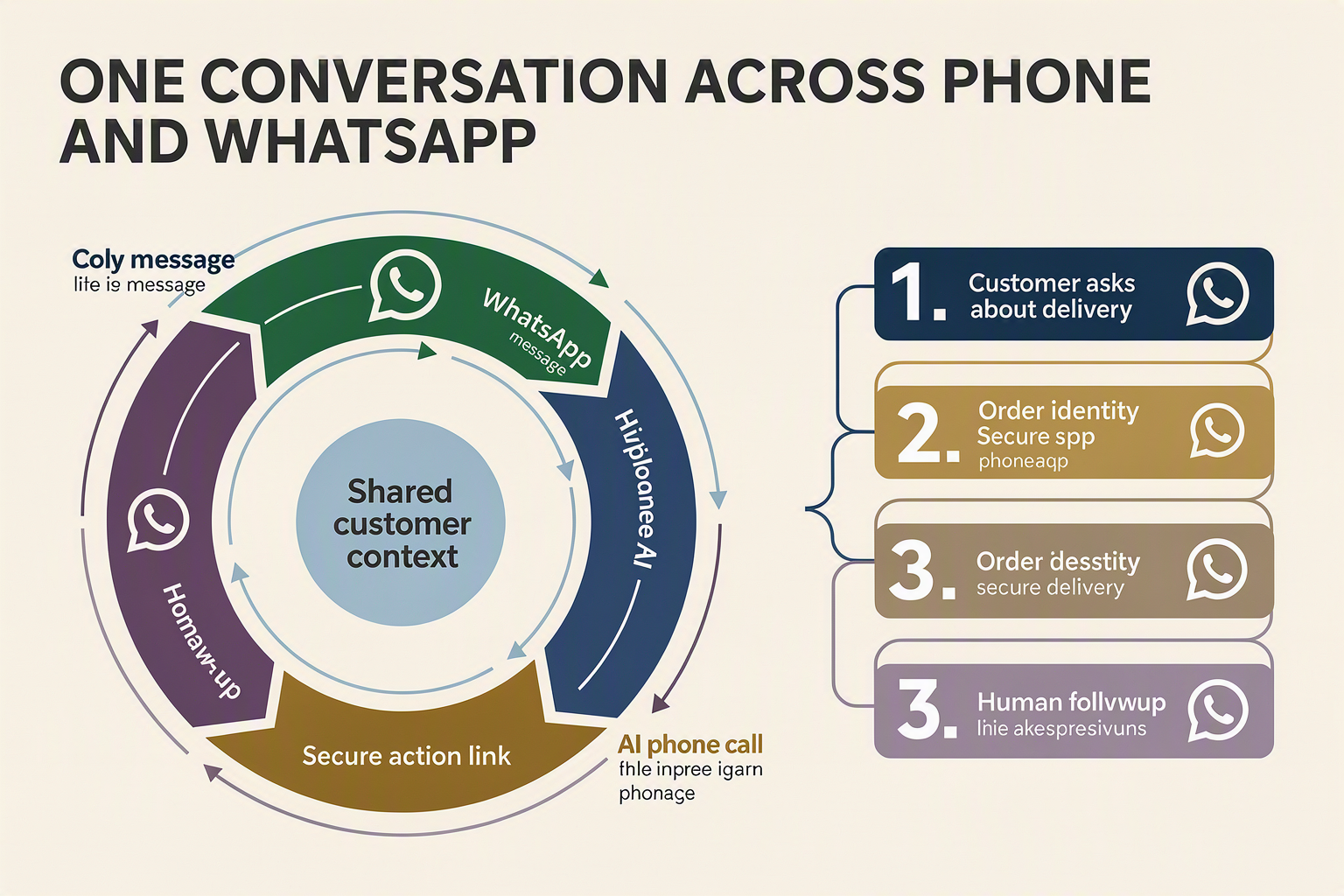
WhatsApp ecommerce automation should manage persistent, asynchronous journeys; phone support should handle urgent or emotionally complex conversations; and conversational commerce AI should preserve identity, intent, and context across both. The channels must operate as one service system—not as separate bots with disconnected records.
Give each channel a defined role
Channel selection should depend on the customer’s situation rather than the automation’s convenience:
- WhatsApp: Best for order confirmations, tracking links, COD verification, return instructions, exchange options, cart reminders, and updates customers may revisit later.
- Phone: Best for urgent delivery problems, repeated failed deliveries, complex product questions, accessibility needs, and customers who prefer speaking.
- Human inbox: Best for policy exceptions, disputed deliveries, payment complaints, fraud indicators, and emotionally sensitive cases.
- Web or email: Useful for detailed documentation, receipts, policy records, and lower-urgency follow-up.
This division matters because commerce conversations affect both revenue and service demand. Baymard Institute reports an average documented cart-abandonment rate of 70.19%, making pre-purchase assistance and carefully timed recovery workflows commercially significant. The National Retail Federation estimated in 2025 that returns would represent 15.8% of annual retail sales, reinforcing the need for structured post-purchase automation.
Use one shared conversation state
An AI customer support for ecommerce system should recognize the customer and retrieve the same approved information regardless of entry channel. A shopper who replies to a WhatsApp dispatch notification and later calls should not have to restate the order number, delivery issue, or requested resolution.
The shared state should contain:
- Verified customer identity and consent status
- Order, payment, shipment, and courier events
- Previous WhatsApp, phone, email, and agent interactions
- Return or exchange eligibility
- Promises already made to the customer
- Escalation status, owner, and next action
The AI order tracking assistant must query live order-management and logistics systems rather than infer shipment status from a static knowledge base. Likewise, AI returns automation should use the store’s actual return window, product category, fulfilment status, and exchange inventory before offering an action.
Build cross-channel workflow templates
A practical orchestration sequence can follow these steps:
- Start on WhatsApp: Send an approved COD confirmation or order update with clear response options.
- Interpret the reply: The AI identifies confirmation, cancellation, address correction, tracking, return, or another intent.
- Complete safe actions: Confirm COD, surface live tracking, collect a return reason, or display eligible exchange choices.
- Switch channels deliberately: Offer a phone call when the issue is urgent, difficult to type, or unresolved after repeated turns.
- Transfer full context: Pass the transcript, order data, authentication result, sentiment signals, and attempted actions to the voice agent or human.
- Close on the customer’s preferred channel: Send a written WhatsApp summary after the call, including the resolution and next milestone.
Platforms such as CallMissed support this architecture by combining WhatsApp Business chat and calling, AI voice agents, and an omnichannel inbox. Its support for 22 Indian languages can also help stores maintain continuity when a customer moves from typed WhatsApp messages to a regional-language phone conversation.
The goal of ecommerce customer service automation is therefore not maximum channel volume. Effective conversational commerce AI chooses the right channel, carries context forward, and escalates before automation becomes friction.
When should an AI support workflow escalate to a human, and which safeguards should control it?
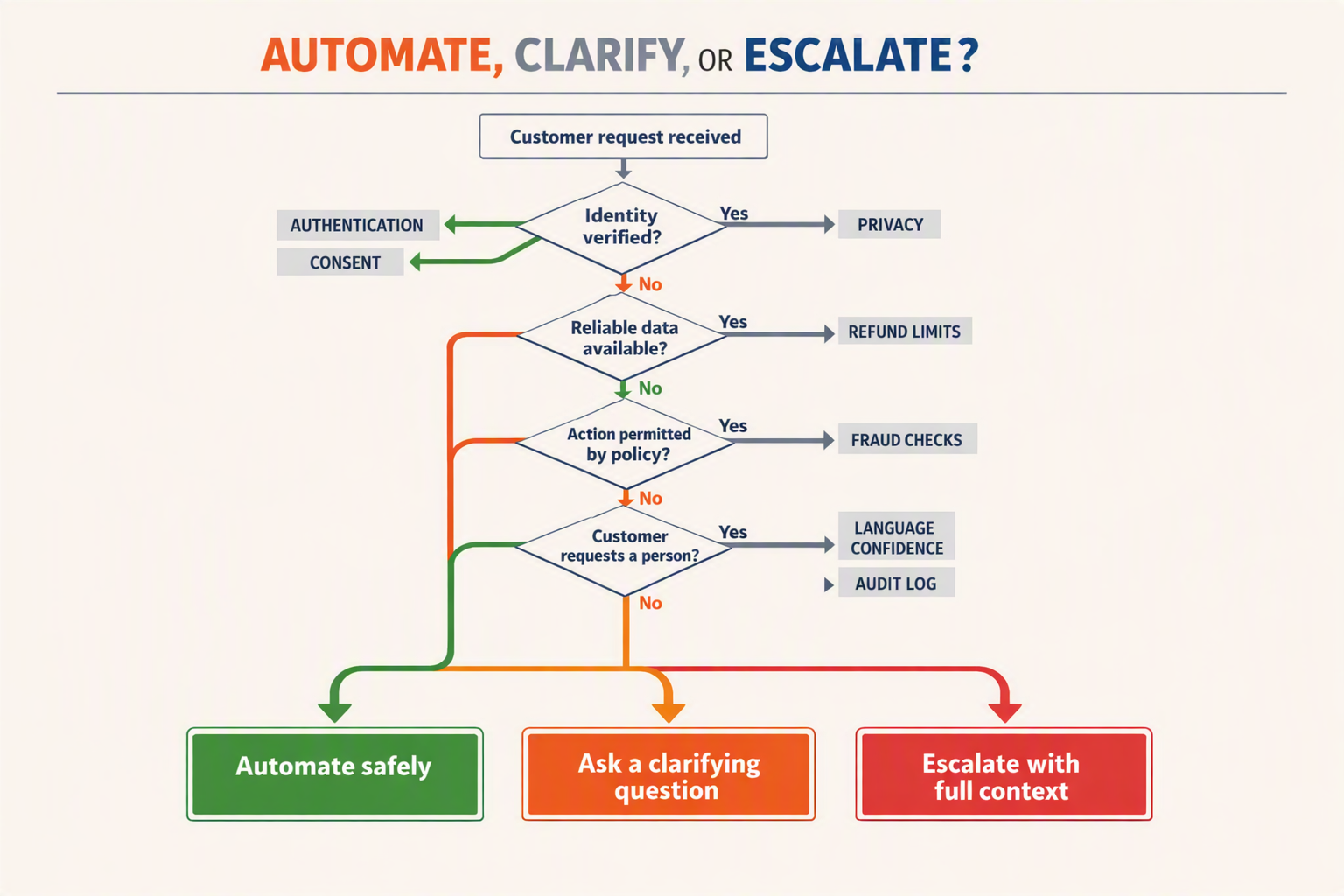
An AI support workflow should escalate whenever risk, ambiguity, customer distress, or required authority exceeds its approved operating boundary. Automation may resolve routine, reversible requests, but humans should control exceptions involving money, identity, fraud, policy overrides, safety, or uncertain data.
Use explicit escalation triggers—not confidence alone
A model confidence score is useful, but it should never be the sole gatekeeper. AI customer support for ecommerce should combine model signals with deterministic business rules and conversation history.
Escalate when any of these conditions occurs:
- System records conflict: The order-management system says “delivered,” but the shopper reports non-delivery; tracking scans disappear; or the promised date differs across systems.
- A financial exception is requested: The customer wants a refund above an approved limit, a manual discount, compensation, chargeback assistance, or a change to the payment method.
- Return rules are ambiguous: AI returns automation cannot verify the return window, item condition, category exclusion, replacement inventory, or refund destination.
- Identity or fraud risk appears: OTP failures, repeated COD confirmation attempts, unusual address changes, account-takeover indicators, or requests for sensitive payment information require controlled review.
- The customer is distressed or vulnerable: Threats, harassment, legal action, safety concerns, discrimination complaints, or repeated expressions of anger should trigger priority handling.
- Automation repeatedly fails: Escalate after a defined number of misunderstood messages, failed tool calls, or unsuccessful resolutions rather than trapping the customer in a loop.
- The customer asks for a person: A direct human request should be honored without forcing another troubleshooting sequence.
Returns deserve particularly careful controls. The National Retail Federation estimated in 2025 that 15.8% of annual retail sales would be returned, representing $849.9 billion in merchandise. At that scale, even a small policy or refund error rate can create material operational losses.
Put hard safeguards around every automated action
Ecommerce customer service automation should operate through allow-listed tools and predefined permissions—not unrestricted access to order, payment, or customer databases.
Essential safeguards include:
- Least-privilege access: An AI order tracking assistant may read shipment events but should not change an address after dispatch unless a verified workflow permits it.
- Deterministic policy checks: Return windows, refund limits, COD rules, exchange eligibility, and compensation ceilings should be enforced outside the language model.
- Identity verification: Require appropriate verification before exposing order details or modifying customer records.
- Data minimisation: Mask payment data, OTPs, addresses, and other sensitive information in transcripts and logs.
- Grounded responses: Generate answers from current order, courier, inventory, and policy data; do not let the model invent delivery dates or refund commitments.
- Rate limits and approval gates: Restrict repeated messages, outbound calls, refunds, coupons, and high-impact account actions.
- Auditability and shutdown controls: Record the data consulted, tools invoked, action taken, and escalation reason; provide supervisors with pause and rollback controls.
Make the handoff continuous across phone and WhatsApp
A human handoff should include the customer identity, order number, detected intent, verified facts, actions already attempted, sentiment, escalation reason, and recommended next step. The shopper should not need to restart the story.
For WhatsApp ecommerce automation, preserve the chat transcript and consent status when routing into an inbox. For voice, transfer the call where possible or create a callback task with a concise summary. Platforms such as CallMissed can connect WhatsApp Business chat and calling, AI voice agents, and an omnichannel inbox, helping conversational commerce AI hand cases to people with context intact.
The governing principle is simple: automate predictable work, constrain consequential actions, and make human help easy to reach.
How should ecommerce teams measure the impact and implications of AI support automation?
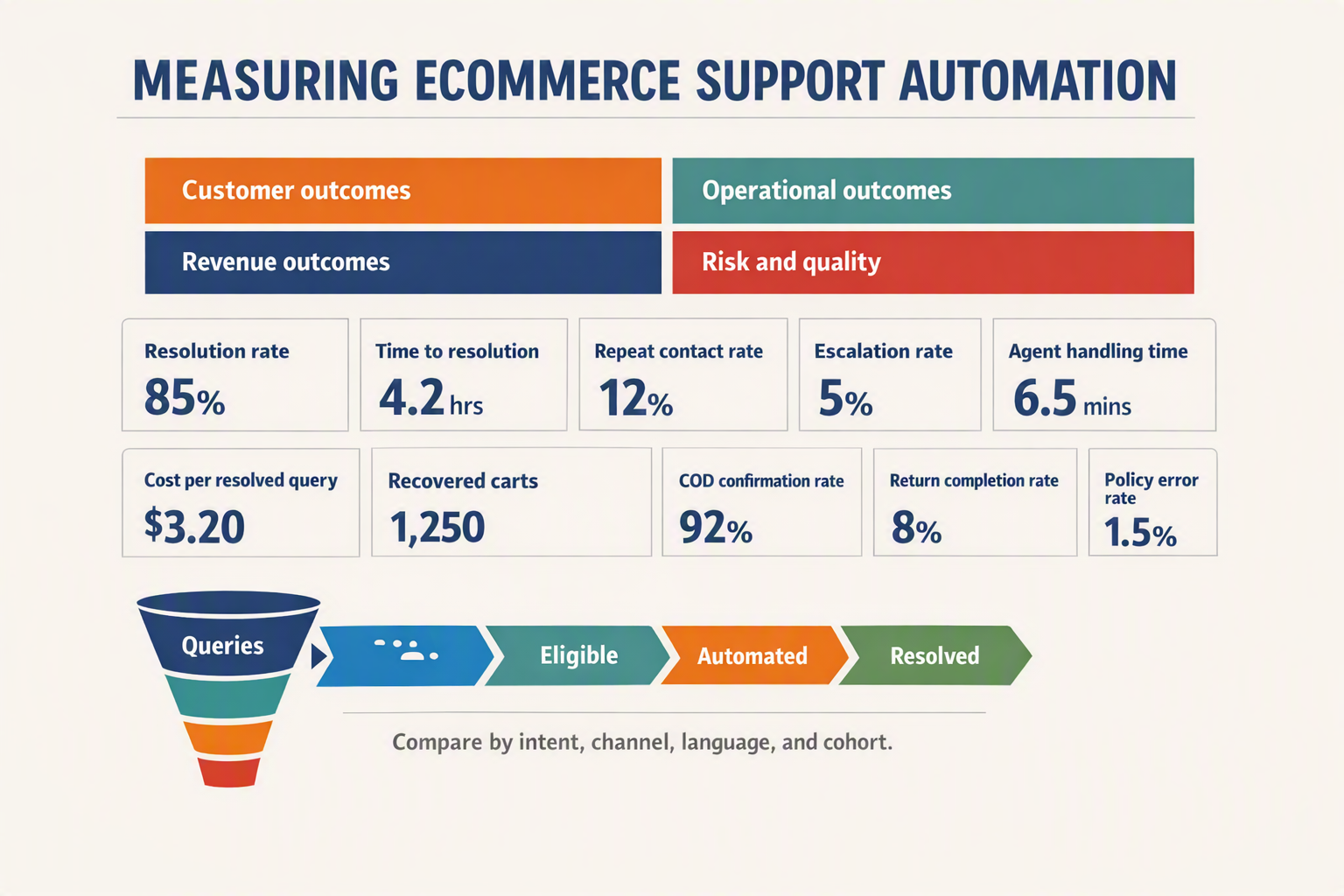
Measure AI support automation against customer outcomes, operational efficiency, revenue, and risk—not containment alone. Ecommerce teams should compare each automated workflow with a pre-launch baseline and human-assisted control group, then segment results by query, channel, language, customer type, and order stage.
Build a query-level measurement scorecard
A single dashboard average can conceal weak workflows. Evaluate AI customer support for ecommerce separately for order status, delivery exceptions, returns, exchanges, COD confirmation, cart recovery, phone, and WhatsApp.
Track these core metrics:
- Automation containment rate: Percentage of conversations completed without human intervention. Exclude abandoned sessions and cases that reopen shortly afterward.
- First-contact resolution: Percentage of queries resolved in one interaction, including whether the promised backend action—such as creating a return—is completed.
- Escalation accuracy: Percentage of cases correctly transferred because of low confidence, policy exceptions, customer distress, fraud risk, or missing data.
- Median and 95th-percentile response time: The median shows typical performance; the 95th percentile exposes severe delays.
- Repeat-contact rate: Percentage of customers who contact support again about the same order within a defined period.
- Customer satisfaction: Collect CSAT after automated and human-assisted resolutions, not merely after every interaction.
- Cost per resolved query: Include AI usage, telephony, WhatsApp fees, software, integration maintenance, quality review, and human handling.
For an AI order tracking assistant, also measure tracking-data accuracy and delivery-exception escalation. For AI returns automation, measure eligibility decisions, completed return labels or pickups, exchange conversion, refund cycle time, and policy-error rates.
Connect service metrics to commercial outcomes
Automation creates value only when it changes costs, conversion, or retention. Baymard Institute reports an average documented online cart-abandonment rate of 70.19%, making incremental recovered checkouts more meaningful than message-open rates. Measure cart recovery with a holdout group and report:
- Recovered conversion rate
- Incremental revenue, excluding orders likely to occur without outreach
- Gross margin after discounts, returns, and messaging costs
- Opt-out and complaint rates
- Time from automated contact to purchase
Returns require equally careful economics. The National Retail Federation estimated that 15.8% of annual retail sales would be returned in 2025, equal to $849.9 billion in merchandise. Teams should therefore assess whether automation reduces processing effort while preserving correct eligibility decisions and customer trust.
For COD, compare confirmation rate, dispatch rate, refusal or return-to-origin rate, and contribution margin against an untreated cohort. For WhatsApp ecommerce automation and phone workflows, attribute outcomes across channels so a WhatsApp confirmation followed by an AI call is not counted twice.
Measure implications, not just improvements
A robust ecommerce customer service automation review should include weekly quality sampling and monthly governance checks. Audit:
- Hallucinated order details or policy statements
- Incorrect refunds, cancellations, or address changes
- Language-specific failure rates
- Consent, call-recording, retention, and opt-out compliance
- Unequal escalation rates across regions or customer groups
- Agent workload after automation, including more complex transferred cases
Platforms such as CallMissed, which combine WhatsApp Business calling, AI voice agents, an omnichannel inbox, and 22-language support, can help teams observe conversational commerce AI across channels. However, measurement should remain workflow-specific: scale automation only when resolution quality, commercial impact, and safety improve together.
What do customer-service, ecommerce, and governance experts recommend before deployment?

Deploy only after customer-service, ecommerce-operations, security, legal, and data owners approve the workflows, system permissions, escalation rules, and measurable launch gates. Experts generally recommend treating automation as a controlled operational system, not as a chatbot that can freely interpret policy or modify orders.
Customer-service experts: design for resolution and recovery
Support leaders should review real conversations and define the correct outcome for each high-volume query before writing prompts. For every intent handled by AI customer support for ecommerce, document:
- The customer information required for verification.
- The authoritative data source and acceptable data age.
- Actions the AI may take without approval.
- Conditions requiring human escalation.
- The transcript, order details, and next step passed to the agent.
Test complete journeys rather than isolated answers. An AI order tracking assistant, for example, must handle missing courier scans, split shipments, failed delivery attempts, and contradictory promised dates—not merely repeat a tracking status. Likewise, AI returns automation should distinguish between explaining a policy, checking eligibility, creating a return, authorising a refund, and approving an exception.
Service teams should also test emotionally charged and ambiguous language. “My parcel never came” may indicate a delay, theft, incorrect delivery scan, or fraud claim; confident guessing is not an acceptable resolution.
Ecommerce experts: constrain actions and protect transactions
Operations teams recommend connecting each workflow to a defined system of record, such as the order-management system, warehouse platform, payment gateway, or carrier API. Product documentation and retrieval-augmented generation can answer policy questions, but live transactional facts must come from live transactional systems.
Before enabling write access:
- Apply least-privilege permissions. A delivery bot may read shipment status without receiving permission to issue refunds.
- Make actions idempotent. Repeated messages or API retries must not create duplicate exchanges, coupons, cancellations, or reverse-pickup requests.
- Require confirmation for consequential actions. The customer should confirm the item, address, refund method, or cancellation before execution.
- Separate assistance from persuasion. Cart-recovery messages should respect consent, frequency limits, quiet hours, and opt-outs.
- Test channel continuity. A customer moving between phone and WhatsApp ecommerce automation should not need to restart verification or repeat the issue.
For COD workflows, experts recommend distinguishing order confirmation from identity assurance. A “yes” reply can confirm intent, but higher-risk orders may still require additional verification or manual review.
Governance experts: establish evidence, controls, and ownership
The NIST AI Risk Management Framework, published in January 2023, organises AI risk work into four functions: Govern, Map, Measure, and Manage. Ecommerce teams can translate these functions into named owners, documented risks, pre-launch tests, and continuous monitoring.
Governance reviewers should require:
- Customer disclosure when interacting with AI and an accessible human-transfer option.
- Data minimisation, retention periods, deletion processes, and role-based transcript access.
- Protection against prompt injection, unauthorised tool use, and knowledge-base data leakage.
- Version records for prompts, policies, models, integrations, and approvals.
- Redaction or tokenisation of payment and sensitive identity data.
- Separate evaluation by language, channel, intent, and customer segment.
Finally, launch conversational commerce AI in stages: internal testing, shadow mode, limited traffic, then broader deployment. Promotion should depend on predefined thresholds for factual accuracy, successful handoffs, duplicate-action rate, policy compliance, customer satisfaction, and severe-error incidence—not containment alone.
What does this mean for your store, and how should you compare CallMissed with other vendors?
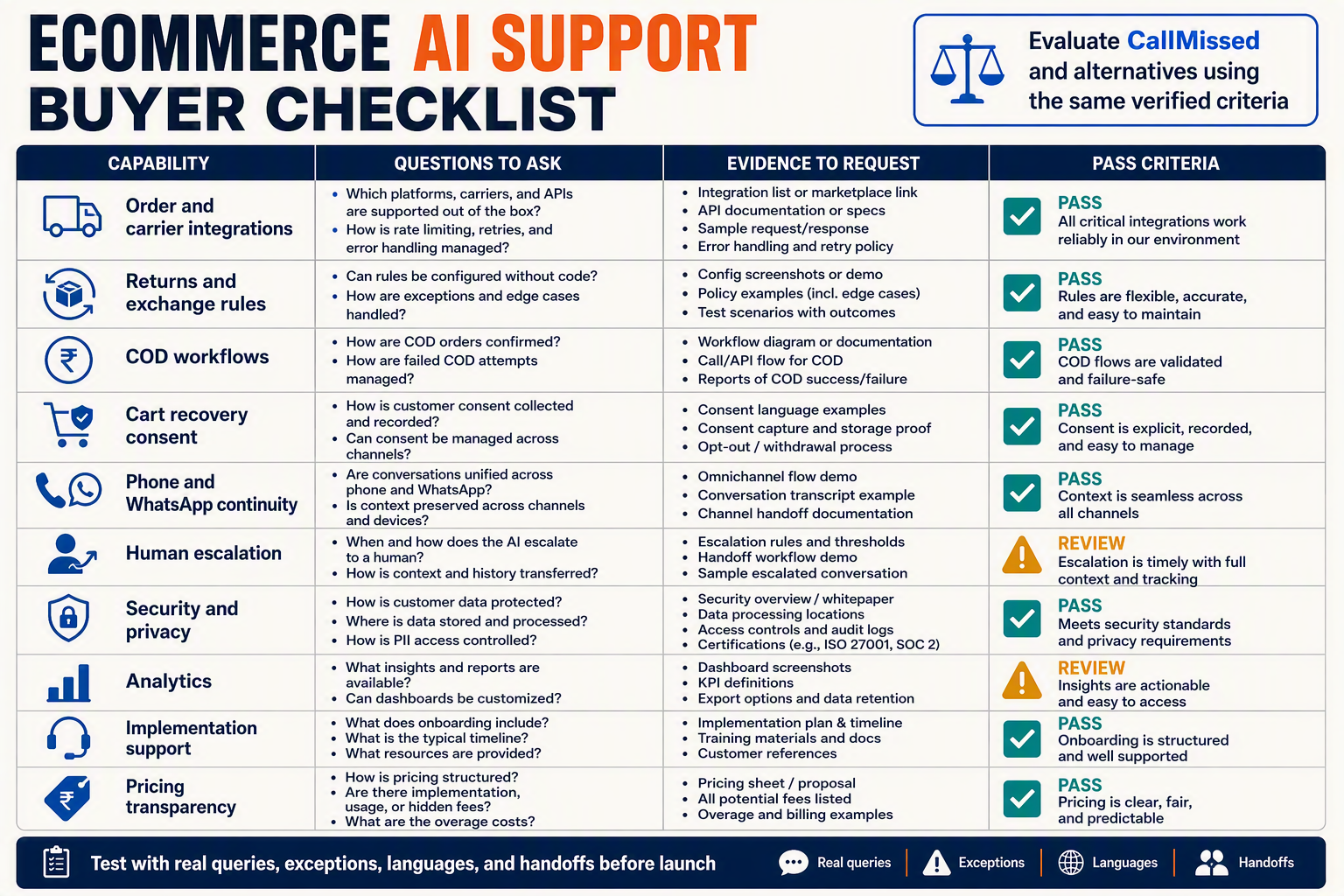
The right vendor is the one that completes your store’s real workflows—not the one with the longest AI feature list. Compare CallMissed and other providers using live order data, channel continuity, regional-language performance, escalation quality, integration effort, and total operating cost.
A practical vendor comparison matrix
| Decision area | What to test in a pilot | CallMissed fit | When another vendor may fit |
|---|---|---|---|
| Order and delivery support | Can the agent retrieve live order, promised-date, payment, and courier-scan data without inventing an answer? | Supports AI agents and knowledge-base retrieval; commerce and logistics connections should be validated for your stack. | Consider vendors with prebuilt connectors for your specific OMS, help desk, or logistics provider. |
| WhatsApp and phone | Can one workflow handle chat, inbound calls, and business-initiated calls while preserving context? | Supports WhatsApp chat plus inbound and business-initiated WhatsApp Business calling bridged to AI voice agents. | A channel-specific vendor may suit stores that require only text messaging or only conventional telephony. |
| Indian languages | Test accents, code-switching, addresses, product names, and noisy phone audio using real conversations. | Speech-to-Text and Text-to-Speech cover 22 Indian languages, using Indic-first capabilities. | Global-first platforms may fit stores whose customers primarily speak languages outside the required catalog. |
| Returns and exchanges | Can the agent check eligibility, collect a reason, distinguish return from exchange, and escalate exceptions? | Can orchestrate conversations across voice, WhatsApp, email, and an omnichannel inbox. Policy and reverse-logistics actions still require integration. | A specialist returns platform may provide deeper warehouse, label, refund, or exchange inventory functions. |
| Model and developer access | Can developers change models, add fallbacks, and reuse an existing OpenAI-style integration? | The OpenAI-compatible gateway covers LLM chat, STT, TTS, image generation, and web search with same-tier fallbacks. | Direct model-provider contracts may suit teams standardizing on one model and managing their own routing. |
| Commercial model | Calculate cost per resolved query, call minute, message, integration, seat, and escalation—not merely token price. | Offers a free tier and pay-as-you-go credits, with 1 credit equal to ₹1. | Contract pricing may be preferable for enterprises seeking committed volumes or bundled incumbent software. |
Turn the table into a proof-of-work pilot
Do not evaluate AI customer support for ecommerce using a scripted product demonstration alone. Run the same anonymized test set through every shortlisted vendor:
- Use 50–100 representative queries, including delayed orders, partial shipments, COD confirmation failures, expired return windows, damaged products, and exchange stockouts.
- Test the AI order tracking assistant against stale scans, missing IDs, and conflicting promised dates.
- Verify whether AI returns automation follows policy boundaries instead of approving every request.
- Measure successful task completion, incorrect answers, human-transfer rate, transfer context, response latency, and cost per completed workflow.
- Test WhatsApp ecommerce automation and phone support with consent, opt-out, retry, quiet-hour, and failed-delivery scenarios.
Choose for operational fit, not theoretical breadth
CallMissed is particularly relevant when an Indian ecommerce store needs multilingual voice, WhatsApp Business calls, chat, and developer APIs under one platform. Its breadth can reduce the number of separate communication components, but buyers should still verify their required ecommerce, payment, courier, refund, and CRM integrations.
Conversely, an established commerce suite may be the better operational choice when it already owns most customer data and workflows. The final decision should reward reliable ecommerce customer service automation, auditable escalation, and measurable outcomes—not a conversational commerce AI agent that merely produces fluent replies.
Frequently Asked Questions About AI Customer Support for Ecommerce
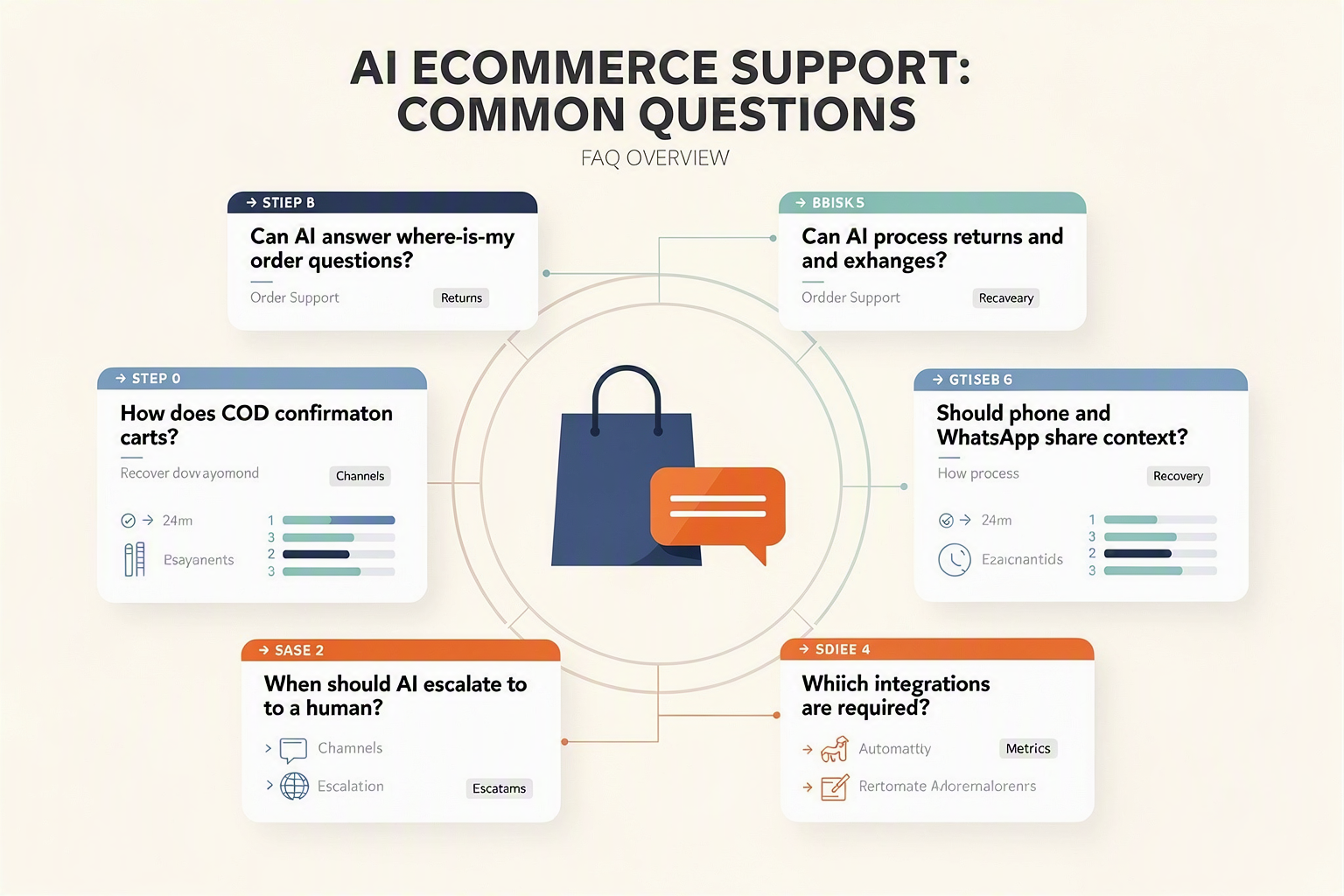
What is AI customer support for ecommerce, and which queries should stores automate first?
How does an AI order tracking assistant answer “Where is my order?” accurately?
Can AI customer support for ecommerce automate returns and exchanges safely?
How can WhatsApp ecommerce automation improve COD confirmation and cart recovery?
When should conversational commerce AI transfer an ecommerce customer to a human agent?
How should businesses choose an AI customer support for ecommerce platform in 2026?
Conclusion
The winning 2026 strategy is not to automate every conversation; it is to automate predictable ecommerce queries with live data, clear escalation rules, and seamless continuity across WhatsApp and phone. AI customer support for ecommerce should resolve routine requests quickly while preserving human judgment for emotional, high-risk, or policy-sensitive cases.
The playbook’s key takeaways are:
- Build around customer questions, not chatbot features. An AI order tracking assistant should retrieve current order and courier information before answering “Where is my order?”, while delivery exceptions should escalate whenever tracking scans, promised dates, and customer reports conflict.
- Treat returns and exchanges as workflows. AI returns automation can verify eligibility, communicate policy terms, capture the requested outcome, and initiate the correct next step. This is a material operational priority: the National Retail Federation estimated that 15.8% of annual retail sales would be returned in 2025, representing $849.9 billion in merchandise.
- Connect pre-purchase and post-purchase journeys. Consent-aware cart recovery, COD confirmation, delivery support, and exchange handling should operate as coordinated processes rather than isolated campaigns. Baymard Institute reports an average documented online cart-abandonment rate of 70.19%, illustrating the revenue at stake before checkout.
- Measure outcomes, not just automation volume. Effective ecommerce customer service automation should track containment, resolution, response time, conversion, and customer satisfaction. WhatsApp ecommerce automation, AI voice agents, and conversational commerce AI become valuable when they improve these results without trapping customers in unresolved loops.
Looking ahead, watch how accurately systems maintain context as a shopper moves from a WhatsApp message to a phone call or human agent. Multilingual coverage will also remain crucial for Indian stores serving COD-heavy and regional-language markets.
Businesses exploring this model can evaluate CallMissed, which combines WhatsApp Business chat and calling, AI voice agents, an omnichannel inbox, and support for 22 Indian languages. The practical question for 2026 is simple: which recurring customer query will you turn into a reliable, measurable workflow first?
Related Reading
Discussion
Ready to automate customer conversations?
Launch AI voice agents and WhatsApp bots with CallMissed — one API, 22+ Indian languages.