
AI Voice Agent Customer Service 2026: CallMissed Support Operations Guide



Use this AI voice agent customer service 2026 guide to plan CallMissed support, compliant follow-up, escalation, analytics, QA, and rollout.
AI Voice Agent Customer Service 2026: CallMissed Support Operations Guide
Could AI handle enough customer-service conversations to remove $80 billion in contact-center labour costs in a single year? Gartner forecast in August 2022 that conversational AI deployments would reduce contact-centre agent labour costs by $80 billion in 2026, making the AI voice agent customer service 2026 discussion an immediate operational priority rather than a future experiment.
The shift is about more than answering calls. A modern conversational AI voice bot can understand natural-language requests, identify intent, retrieve grounded answers, update customer records and decide when a human specialist should take over. For support leaders, that creates an opportunity to offer faster assistance without forcing every caller through rigid menus or using skilled agents for repetitive questions such as order status, appointment changes and basic troubleshooting.
The longer-term direction is equally significant. Gartner predicted in March 2025 that agentic AI would autonomously resolve 80% of common customer-service issues by 2029 while reducing operational costs by 30%. Reaching that level responsibly, however, requires more than deploying a polished synthetic voice. Effective customer service automation depends on accurate knowledge, dependable intent detection, safe authentication, clear escalation rules, consent-based outbound communication and continuous quality assurance.
CallMissed voice AI reflects this support-operations model by combining inbound AI voice agents, permission-based follow-up, knowledge-base retrieval and omnichannel workflows, with speech support across 22 Indian languages for businesses serving multilingual Indian customers.
This guide explains how to design and operate a customer service AI call center around measurable support outcomes. You will learn how to:
- Automate inbound enquiries while preserving a clear route to human help.
- Run outbound follow-ups only where permission, purpose and applicable regulations allow them.
- Ground responses in an approved knowledge base instead of relying on unconstrained generation.
- Detect caller intent, sentiment and escalation signals during natural conversations.
- Support regional-language callers without treating multilingual service as an afterthought.
- Monitor containment, transfer accuracy, latency, resolution and customer experience.
- Apply call recording, disclosure, privacy, retention and quality-assurance controls.
- Implement a voice agent platform in stages, from narrow pilot workflows to production support.
The goal is not a generic AI receptionist that merely answers and routes calls. It is a practical generative AI contact center framework for resolving service issues accurately, escalating responsibly and improving every conversation through evidence.
How does CallMissed voice AI customer service handle inbound support and permission-based follow-up in 2026?
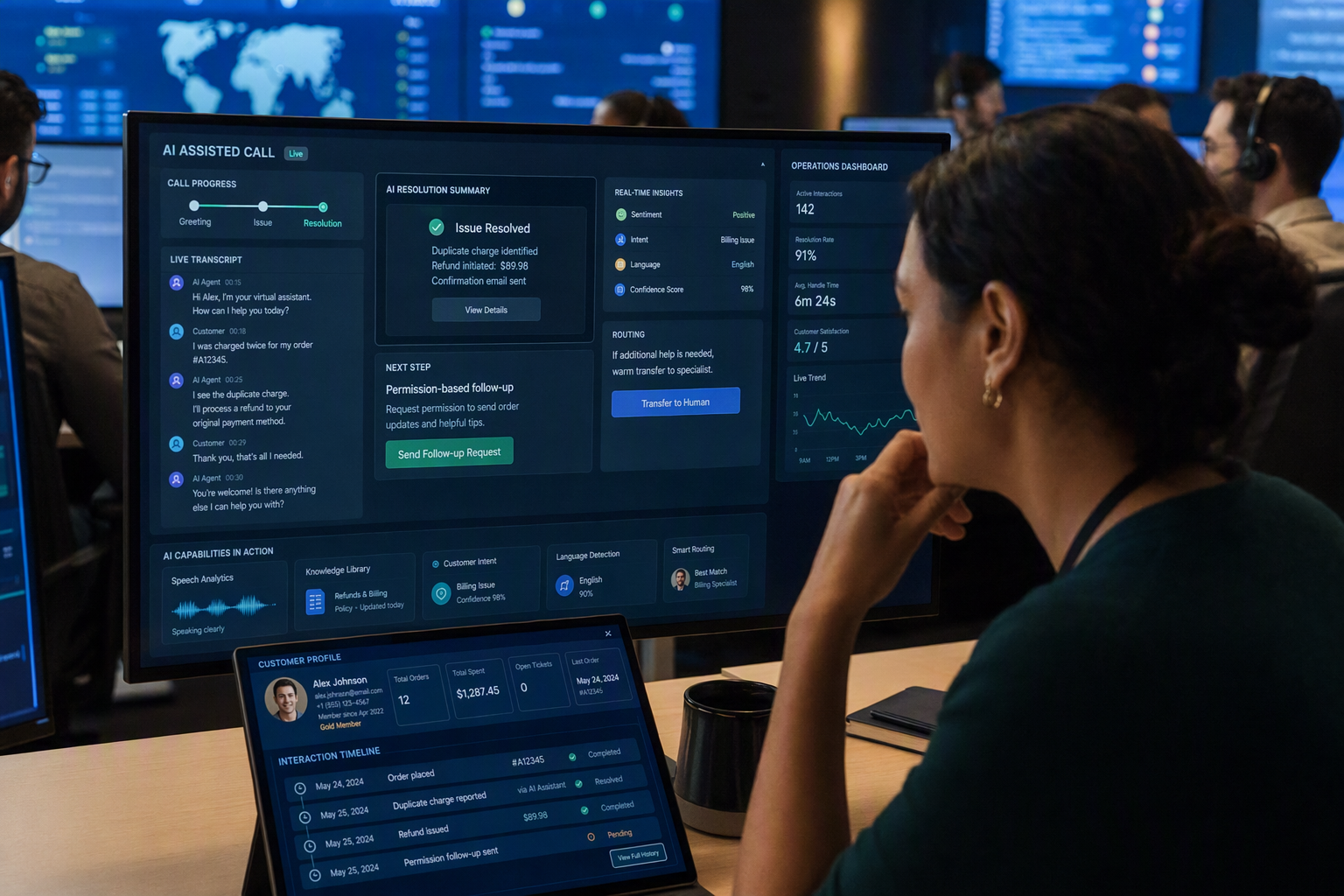
CallMissed voice AI handles inbound support by answering calls, interpreting requests in natural language, retrieving approved information and either completing the task or escalating with context. Outbound follow-up is designed as a separate, permission-based workflow initiated only for a defined service purpose, such as confirming a resolution, updating a delivery or rescheduling an appointment.
Inbound calls become support workflows, not routing exercises
Instead of making callers navigate a fixed interactive voice response tree, a conversational AI voice bot can ask an open question such as, “How can I help?” CallMissed voice AI then converts speech to text, detects the likely intent and gathers the information required by the corresponding workflow.
A typical inbound interaction follows five steps:
- Identify the request: Classify the call as an order enquiry, cancellation, appointment change, billing question, technical issue or another configured intent.
- Authenticate where necessary: Request approved identifiers or verification information before exposing account-specific details.
- Retrieve grounded information: Consult the connected knowledge base or authorised business system rather than generating an unsupported answer.
- Complete the permitted action: Provide a status, capture a complaint, update an appointment or create a support ticket.
- Resolve or escalate: Confirm the outcome, or transfer the caller when the request exceeds the agent’s permissions or confidence threshold.
This workflow-oriented model is important because Gartner projected in March 2025 that agentic AI would autonomously resolve 80% of common customer-service issues by 2029. “Common” is the critical qualifier: unusual, sensitive and high-risk cases still require carefully designed human intervention.
Natural-language intent detection must remain flexible
Callers rarely use the exact wording anticipated by a script. “My parcel still hasn’t arrived,” “Where is my order?” and “The delivery date has passed” may all indicate a delivery-delay intent, while frustration in the caller’s language may increase the urgency.
Intent detection should therefore consider:
- The caller’s complete statement, not isolated keywords.
- Conversation history and previously collected details.
- Corrections such as “No, I meant my refund, not my replacement.”
- Multiple intents within one call.
- Low-confidence classifications that require clarification.
- Escalation phrases such as “speak to a person” or “make a complaint.”
CallMissed supports speech interactions across 22 Indian languages, allowing Indian businesses to design regional-language support as part of the core workflow rather than forcing every caller into English or Hindi.
Outbound follow-up begins with permission and purpose
An outbound AI call should not be treated as automatic simply because a phone number exists in the CRM. The business should establish who authorised contact, what purpose was disclosed, which channel is permitted and whether the permission remains applicable.
A controlled follow-up workflow should:
- Trigger from a documented event, such as an unresolved ticket or requested callback.
- Check consent, contact preferences and applicable suppression rules.
- Identify the business and explain why the AI agent is calling.
- Stay within the authorised service purpose.
- Record the outcome, including no answer, refusal or callback request.
- Stop future attempts when permission is withdrawn.
CallMissed can also bridge inbound and business-initiated WhatsApp Business calls to an AI voice agent, subject to the business’s permissions and applicable WhatsApp and regulatory requirements.
Escalation should preserve the conversation
Escalation is successful only when the customer does not have to start again. The human agent should receive the detected intent, authentication status, collected details, actions attempted and reason for transfer. Mandatory escalation triggers should include explicit human requests, repeated recognition failures, low-confidence answers, policy exceptions, distress, disputes and any action outside the AI agent’s authority.
Why is the AI call center evolving into a generative AI contact center rather than a generic AI receptionist?
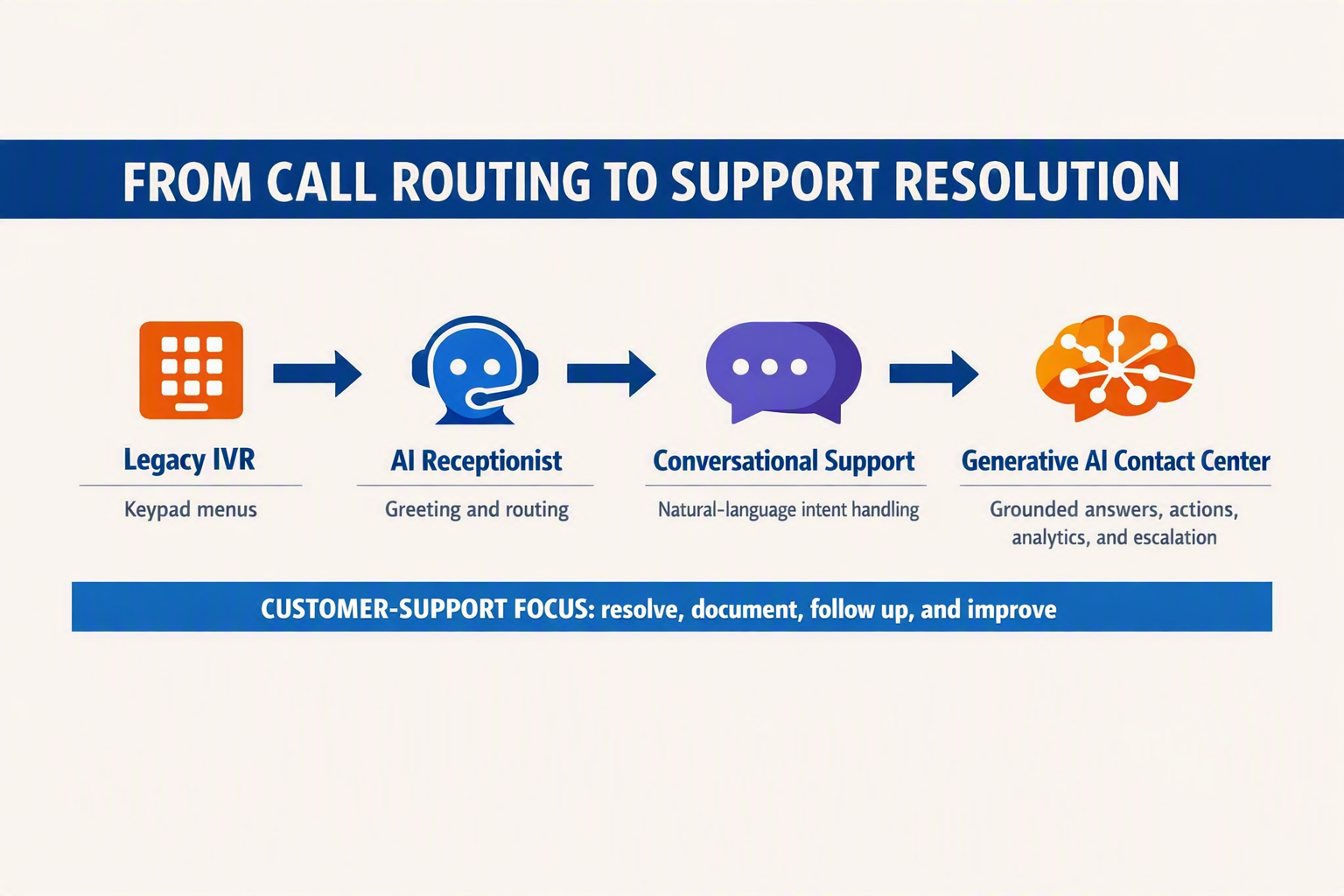
A generic AI receptionist answers, captures details and routes calls; a generative AI contact center manages the service journey from intent recognition through resolution, action and escalation. The distinction is operational: reception optimises call handling, while a customer service AI call center is accountable for accurate outcomes across connected systems and channels.
Reception is a task; customer service is a workflow
A receptionist-style bot usually follows a shallow sequence: greet the caller, identify a department, collect a message and transfer the call. That can reduce missed calls, but it does not necessarily resolve the customer’s problem.
A conversational AI voice bot instead maintains context across multiple turns and supports workflows such as:
- Understand the request: Recognise natural phrases such as “My parcel was supposed to arrive yesterday” without requiring the caller to select “delivery support.”
- Establish context: Ask for an order number, registered telephone number or another approved identifier.
- Retrieve evidence: Consult authorised knowledge and connected business systems rather than generating an unsupported answer.
- Complete an action: Check status, reschedule an appointment, open a ticket or record a callback request where integrations permit.
- Confirm the outcome: Summarise what changed and communicate the next step.
- Escalate appropriately: Transfer the conversation, its transcript and the collected context when automation should stop.
This workflow orientation explains why generative AI is moving deeper into support operations. Gartner predicted in March 2025 that agentic AI would autonomously resolve 80% of common customer-service issues by 2029, indicating that the industry’s target is resolution—not simply automated call answering.
Generative does not mean unconstrained
In customer service, the safest use of generation is to make conversations flexible while keeping facts and actions controlled. The language model can interpret varied wording, ask relevant follow-up questions and produce a natural response, but policies, permissions and approved data should determine what it may claim or do.
A production voice agent platform therefore needs several layers:
- Speech recognition to convert the caller’s words accurately, including accents, code-switching and regional languages.
- Intent detection to distinguish a refund request from a delivery enquiry, complaint or sales question.
- Knowledge grounding to constrain answers to approved policies, product information and account data.
- Tool access to perform explicitly authorised actions in CRM, ticketing, scheduling or order systems.
- Conversation state to retain context when a caller changes or clarifies the request.
- Escalation logic based on authentication failure, repeated misunderstanding, sensitive topics, sentiment or caller preference.
- Post-call records containing summaries, dispositions, outcomes and follow-up commitments.
The operating model changes with the technology
The evolution also changes how contact-centre leaders measure success. A generic receptionist may be evaluated on answer rate and routing accuracy. A generative system requires broader service metrics, including first-contact resolution, containment, transfer accuracy, response latency, authentication success, repeat-call rate and customer satisfaction.
Gartner forecast in August 2022 that conversational AI deployments would reduce contact-centre agent labour costs by $80 billion in 2026. Capturing that value requires automation to complete suitable service work while preserving human attention for exceptions, empathy-intensive conversations and decisions requiring judgement.
CallMissed voice AI fits this contact-centre model by combining natural-language call handling with knowledge-base retrieval, workflow escalation and support across 22 Indian languages. That Indic-first coverage matters because a multilingual caller should receive the same grounded resolution path—not merely a translated greeting—whether the conversation occurs in English, Hindi or another supported Indian language.
Which 2026 capabilities distinguish a customer-support voice agent platform?
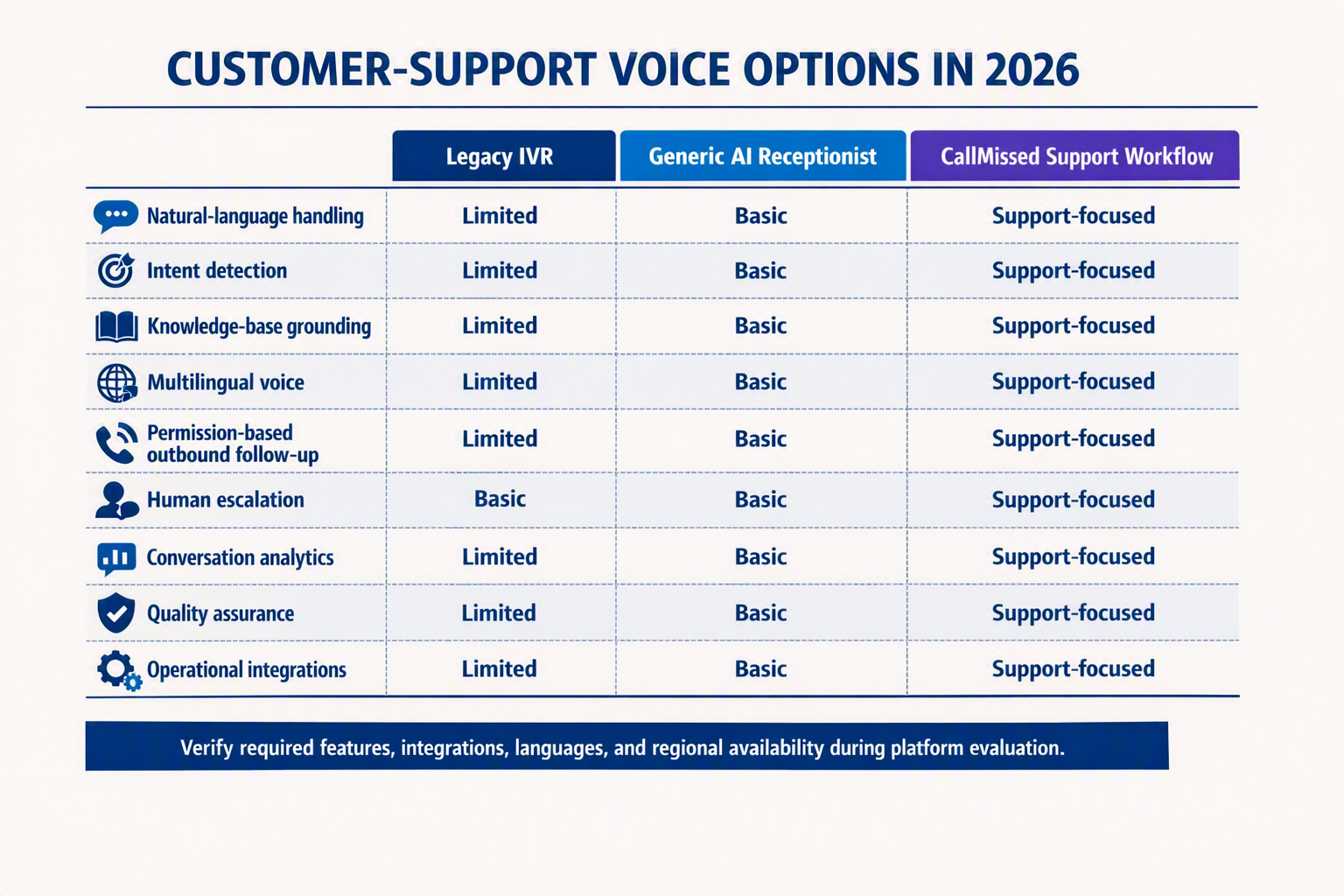
A customer-support voice agent platform in 2026 should do more than produce natural-sounding speech. It should identify intent, retrieve authorised information, execute controlled workflows and transfer difficult cases with the relevant context. “2026 support platform” is an evaluation category, not an industry certification; capabilities and limits must be verified in the deployed configuration.
Capability comparison for support teams
| Capability | Basic voice bot | 2026 support platform | Practical evaluation test |
|---|---|---|---|
| Natural-language handling | Matches keywords or menu choices | Maintains multi-turn context and handles interruptions, corrections and follow-up questions | Change an order number midway through a call and confirm that only the corrected value is used |
| Intent and entity detection | Assigns one broad category | Identifies intent, entities, urgency and confidence, then clarifies ambiguous requests | Compare “cancel my delivery” with “cancel my subscription” and inspect the resulting actions |
| Knowledge grounding | Responds from a fixed script or general prompt | Retrieves from approved policies, documentation and authorised account data, with defined behaviour when evidence is missing | Update or withdraw a policy and verify that the answer and source record change without prompt rewriting |
| Workflow execution | Records a message or sends a notification | Validates inputs, reads or writes authorised business-system data, creates tickets and triggers follow-up actions | Complete an address change and confirm that the system of record—not just the transcript—was updated |
| Escalation orchestration | Transfers every unsupported request | Escalates according to customer request, confidence, risk or business rules and passes a structured summary | Trigger a billing dispute and check whether the human receives the intent, summary and collected details |
| Multilingual operation | Uses one default language or translated scripts | Supports configured speech-recognition and synthesis languages, language switching and the same controlled workflows | Run the same scenario across supported languages, accents and code-switched speech; compare entity accuracy and completion |
| Safety and access control | Relies mainly on prompt instructions | Applies authentication, permissions, action limits, confirmations and human approval for higher-risk operations | Attempt an unauthorised refund or account-data request and confirm that the action is blocked or escalated |
| Observability and auditability | Stores a recording or transcript | Records model and workflow events, retrieved sources, tool calls, transfers, errors and final disposition subject to retention controls | Reconstruct a failed interaction and identify what information and rule produced the outcome |
What production readiness looks like
For AI voice agent customer service 2026, these functions must operate as one controlled system rather than as isolated demonstrations. Correctly recognising an account number is not enough if the value is never validated before a sensitive action. Similarly, accurate intent detection does not improve service if a transferred caller must repeat the entire issue.
A production evaluation should include:
- Conversation control: barge-in, silence handling, reprompt limits, confirmation of sensitive values and recovery from recognition errors.
- Confidence-aware decisions: documented thresholds for answering, clarifying, refusing an action or escalating.
- Grounded responses: approved sources, source-level access controls, update procedures and a safe response when supporting information is unavailable.
- Stateful workflows: retention of necessary context across turns without leaking information between customers or sessions.
- Controlled actions: least-privilege access, validation, idempotency, transaction limits and human approval where risk warrants it.
- Operational resilience: timeout handling, retries, duplicate-action prevention, telephony failure paths and an approved fallback channel.
- Auditable outcomes: transcripts or recordings where permitted, detected intents, retrieved records, actions taken, transfer reasons and final disposition.
- Human control: immediate escalation when requested, supervisor review and the ability to pause a workflow or integration.
The NIST AI Risk Management Framework and its Generative AI Profile provide risk-management guidance, but neither certifies a voice platform or makes a deployment compliant. Privacy, recording, payments, retention and sector-specific obligations depend on the jurisdiction, use case and systems involved.
India-specific evaluation criteria
Multilingual capability should be tested at the speech and workflow layers, not inferred from a translated text demonstration. Code-switching, local names, addresses, numerals, accents and English technical terms embedded in regional-language speech can affect recognition, entity capture and task completion. Support for a language also does not automatically establish equal accuracy across dialects, acoustic conditions or telephony networks.
CallMissed’s published product materials describe Speech-to-Text and Text-to-Speech support across 22 Indian languages. This is a CallMissed-specific product claim, not a general capability shared by all voice platforms. Buyers should validate each required language with representative calls and confirm the currently supported language, voice, transcription and regional-availability combinations before deployment.
CallMissed also describes connections across voice, WhatsApp chat, WhatsApp Business calling, email, web interactions, knowledge retrieval and an omnichannel inbox. The availability and behaviour of individual channels or connectors can depend on the customer’s plan, configuration, third-party approval, geography and the relevant provider’s current policies. These integrations should therefore be tested end to end rather than treated as automatically enabled features.
The strongest selection process uses representative support calls, approved knowledge, realistic system integrations and predefined acceptance thresholds. Teams should measure task completion, unsupported-answer rate, transfer accuracy, action accuracy, latency and post-transfer repetition—not select a platform solely because its synthetic voice sounds convincing.
How can a conversational AI voice bot understand intent, use grounded knowledge, speak multiple languages, and escalate safely?
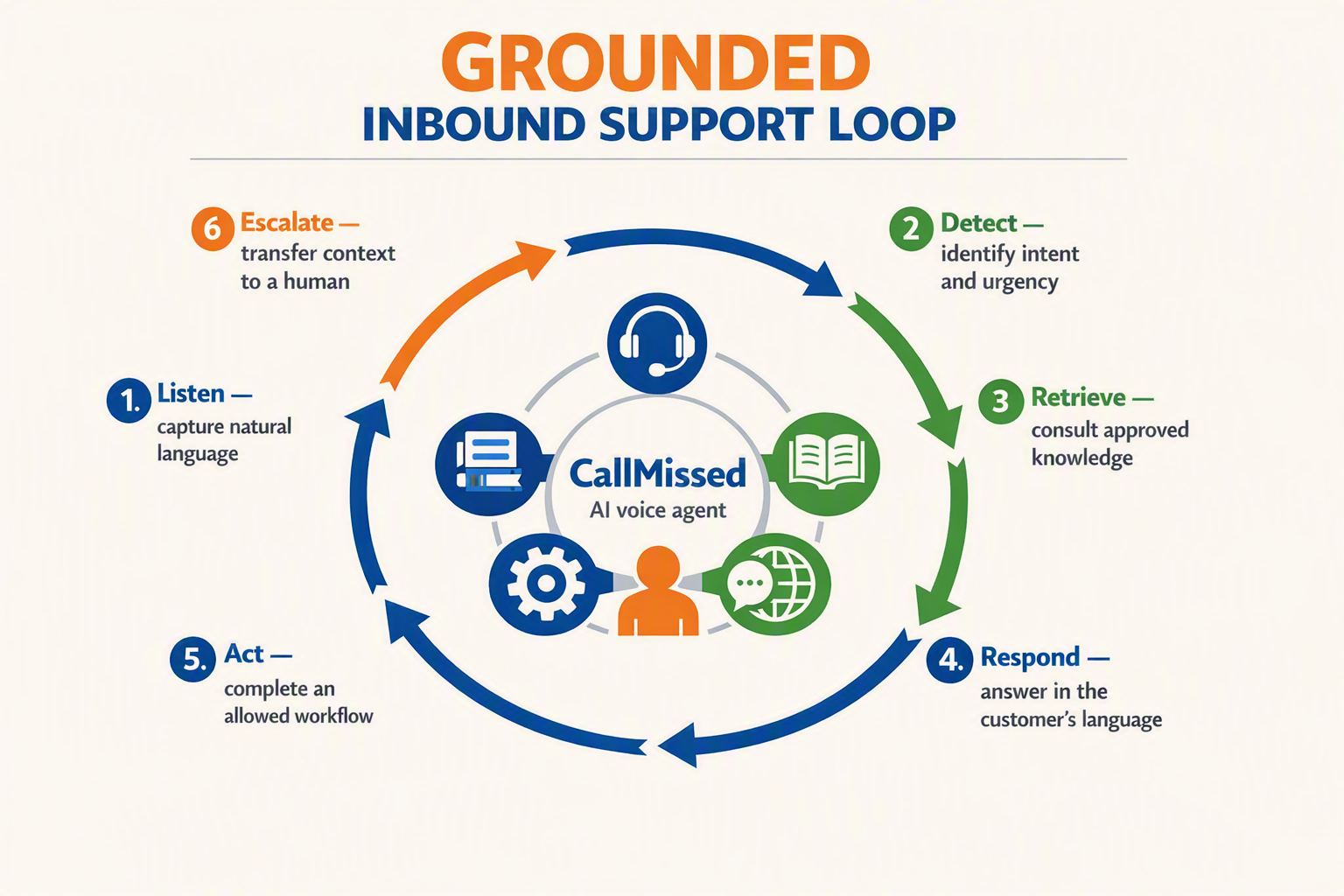
A conversational AI voice bot works safely by combining speech recognition, intent detection, retrieval-augmented generation (RAG), multilingual speech synthesis and policy-based escalation. Each component should operate within defined confidence thresholds and approved workflows rather than allowing a language model to improvise every answer.
Understand natural speech and detect intent
The first step is converting the caller’s speech into text while preserving useful signals such as language, pauses and interruptions. The system then maps the conversation to an operational intent—not merely a keyword.
For example, “My parcel still hasn’t arrived” and “Where is yesterday’s delivery?” may both map to delayed-order support. The voice agent should also extract entities such as an order number, delivery date or product name before selecting the next action.
A production intent model needs to handle:
- Multi-intent calls, such as checking delivery status and changing an address.
- Context across turns, including references such as “the second order.”
- Corrections and interruptions, without restarting the workflow.
- Low-confidence input, including noise, ambiguous wording or unfamiliar names.
- Sentiment and urgency cues, while avoiding unsupported assumptions about callers.
Confidence scores should govern what happens next. A high-confidence request can enter an automated workflow; an ambiguous request should trigger a clarifying question or human transfer.
Ground answers in approved knowledge
A generative AI contact center should use RAG to search an authorised knowledge base before answering policy or product questions. The model receives only the relevant passages, account data and workflow instructions needed for that conversation.
A safe grounding sequence is:
- Authenticate the caller where personal information or account changes are involved.
- Retrieve relevant material from approved FAQs, policies, manuals or CRM records.
- Generate an answer constrained by that evidence.
- Ask for clarification when multiple documents conflict.
- Decline or escalate when no reliable source is available.
Knowledge content should include ownership, effective dates and version history. Expired return policies or outdated troubleshooting instructions can otherwise produce fluent but operationally incorrect responses. CallMissed supports knowledge-base retrieval across voice and other customer-engagement workflows, helping teams maintain consistent answers across channels.
Support multilingual conversations end to end
Multilingual service requires more than translating an English response. Speech recognition, intent examples, retrieved content, pronunciation and text-to-speech output must all work in the caller’s chosen language.
CallMissed supports speech-to-text and text-to-speech across 22 Indian languages, using Indic-focused capabilities for businesses serving regional audiences. Deployment teams should still test language-specific scenarios involving:
- Code-switching between English and an Indian language.
- Local place names, personal names and product terminology.
- Numbers, dates, currency and addresses.
- Dialect variation and borrowed English words.
- Whether the approved knowledge exists in the selected language.
Escalate with context, not abandonment
Escalation is a designed support outcome—not a failure. The bot should transfer when authentication fails, confidence remains low, the caller repeatedly asks for an agent, a policy exception is required, or the conversation signals distress, fraud, safety risk or a formal complaint.
The receiving agent should get a structured handoff containing the caller’s verified identity status, detected intent, collected details, retrieved sources, attempted actions and a concise transcript summary. If no specialist is available, the system should offer a callback or another approved channel rather than trapping the caller in an automation loop.
When may CallMissed make outbound calls, and how should consent, context, and human escalation work?
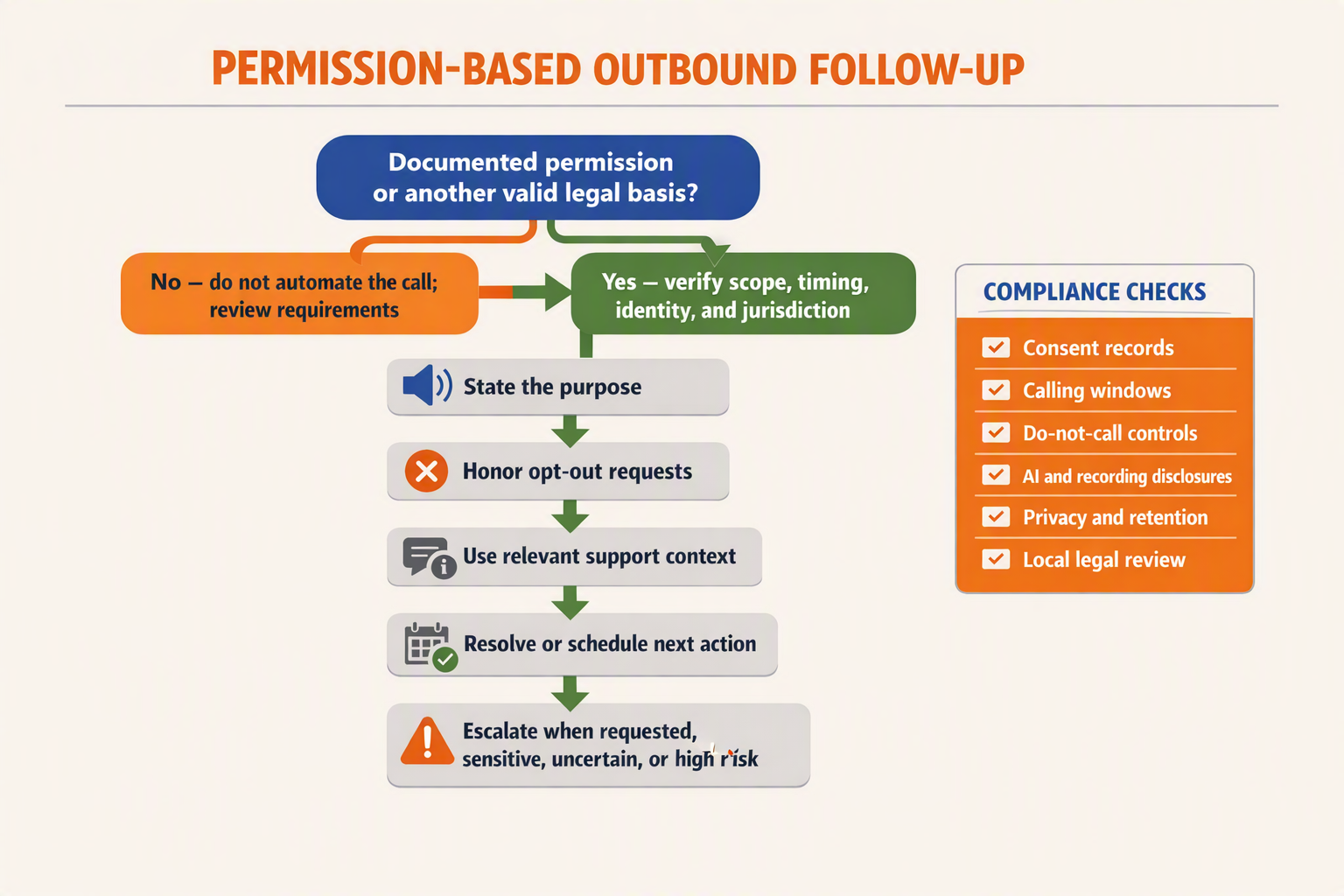
CallMissed should place an outbound customer-service call only when the business has a documented, applicable basis to contact that customer for the stated purpose. Consent must be specific enough to cover the channel and context; a customer calling support once does not automatically authorize unrelated promotional calls.
Separate service follow-up from marketing
Outbound service calls can be appropriate when they complete or advance a customer-requested workflow, such as:
- Returning a missed support call after the customer requested a callback.
- Confirming an appointment, delivery or technician visit.
- Providing an update on an open complaint, refund or service ticket.
- Completing troubleshooting that could not be resolved during the inbound call.
- Responding to a customer’s explicit request for information by phone.
Marketing, renewal and cross-sell campaigns require separate scrutiny. Businesses using CallMissed voice AI remain responsible for ensuring that each campaign complies with applicable telecom, privacy and sector-specific requirements, including India’s Telecom Commercial Communications Customer Preference Regulations, 2018 and the Digital Personal Data Protection Act, 2023 where applicable.
Capture consent as auditable data
A defensible consent record should answer five questions:
- Who consented? Link permission to a verified customer identifier.
- What did they authorize? Record whether permission covers voice calls, WhatsApp messages, WhatsApp Business calls or another channel.
- Why may they be contacted? Distinguish support callbacks from promotions.
- When and how was consent obtained? Preserve the timestamp, source and wording presented.
- Has permission changed? Apply withdrawals, opt-outs and communication preferences before dialling.
Consent should travel with the workflow. The voice agent should receive the relevant ticket number, requested callback window, preferred language and approved purpose—but not unrelated personal data. CallMissed supports speech interactions across 22 Indian languages, allowing a permission-based follow-up to continue in the customer’s selected language rather than defaulting every call to English or Hindi.
Begin every call with transparent context
An outbound conversational AI voice bot should identify the business, disclose that the customer is speaking with an automated agent and state the reason for calling. A useful opening is: “This is the automated support assistant from [business], calling about the delivery query you raised on 5 August. Is now a convenient time?”
The agent should then:
- Confirm identity proportionately before revealing account information.
- Avoid requesting passwords, PINs or one-time passwords unnecessarily.
- Offer an immediate opt-out or later callback.
- Stay within the authorized purpose instead of improvising a sales pitch.
- Record the outcome and any preference change in the customer record.
Escalate on risk, uncertainty or customer request
Human transfer should be a designed control, not a failure state. Escalation triggers should include:
- The customer explicitly asks for a person.
- Identity verification repeatedly fails.
- The knowledge base cannot support a confident answer.
- The caller disputes a charge, cancellation, refund or contractual term.
- The conversation involves threats, vulnerability, safety or legal complaints.
- Sentiment deteriorates or the same intent repeatedly goes unresolved.
The human agent should receive a concise handoff containing the verified identity state, detected intent, consent context, actions attempted and conversation summary. If no specialist is available, the system should create a priority callback with a promised timeframe rather than trapping the customer in an automated loop. This combination of permission, minimum necessary context and warm escalation makes outbound customer service automation useful without treating customer access as unlimited.
How do analytics and quality assurance turn customer service automation into measurable support improvement?
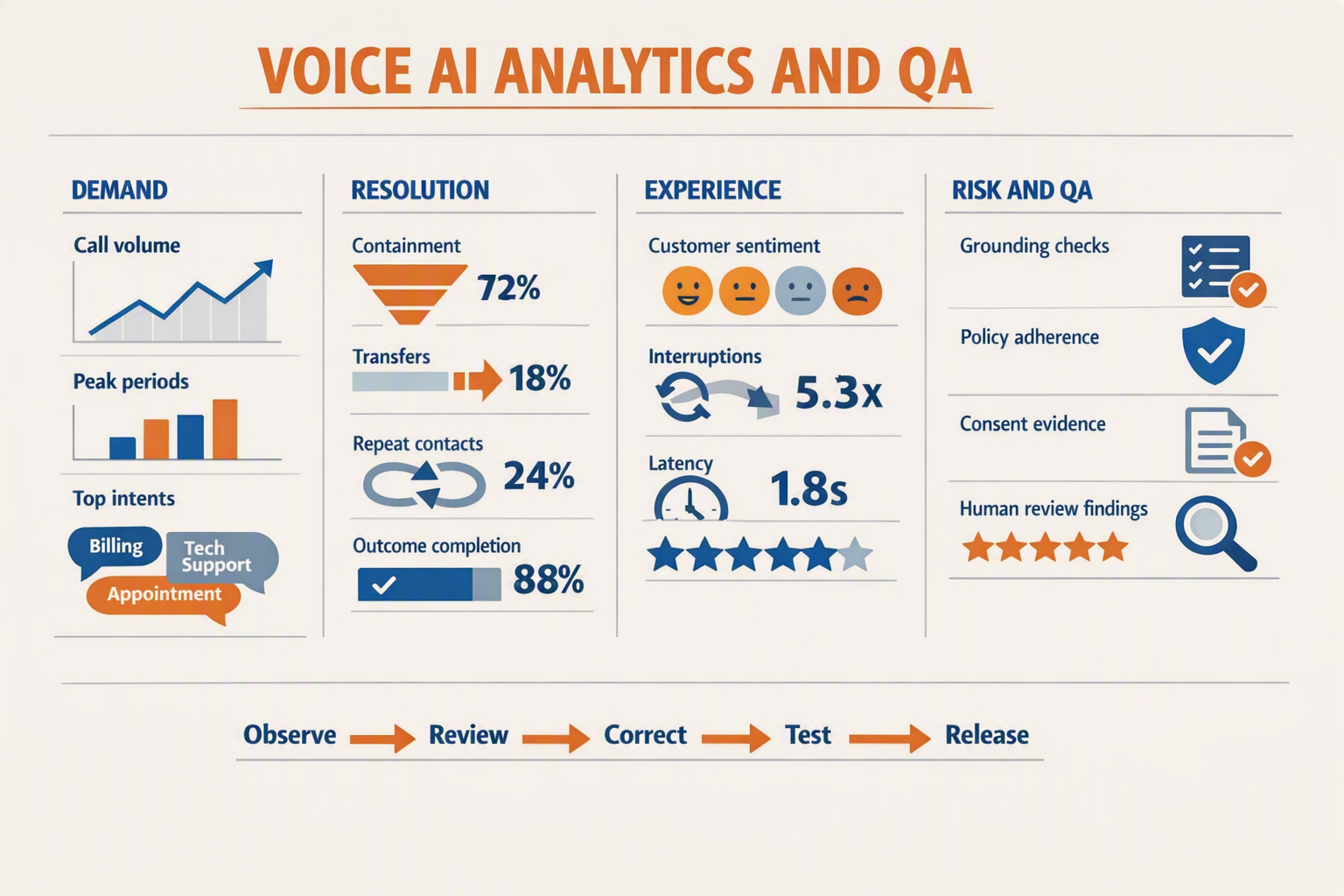
Analytics turns customer service automation into measurable improvement by connecting each AI-handled call to resolution, customer experience, escalation accuracy and operational cost. Quality assurance then explains why performance changed and identifies the prompts, knowledge articles or workflows that need correction.
Measure outcomes, not just call volume
Gartner predicted in March 2025 that agentic AI would autonomously resolve 80% of common customer-service issues by 2029 while reducing operational costs by 30%. Support teams should treat those figures as a direction of travel—not as automatic results from deploying a conversational AI voice bot.
A practical scorecard should track:
- Resolution rate: Percentage of calls where the customer’s stated issue was completed without repeat contact within a defined period.
- Containment rate: Percentage handled without human transfer; this should never be interpreted as resolution on its own.
- First-contact resolution: Issues solved during the initial interaction across voice and connected channels.
- Transfer accuracy: Percentage of escalations sent to the correct queue with the necessary context.
- Repeat-contact rate: Customers calling back about the same intent within, for example, 24 hours or seven days.
- Customer satisfaction: Post-call CSAT, complaint signals and sentiment trends segmented by intent and language.
- Latency: Time to first response and delay between caller speech and agent reply.
- Cost per resolved issue: Total telephony, model, platform and human-review costs divided by confirmed resolutions.
A bot that contains 80% of calls but drives repeat contacts is not improving support. Conversely, an agent with a higher transfer rate may be performing safely if it correctly escalates payment disputes, vulnerable-customer cases or complex technical failures.
Build a repeatable quality-assurance scorecard
Quality assurance should combine automated analysis with structured human review. Evaluate a representative sample across intents, languages, call outcomes, durations and escalation paths, rather than reviewing only failed or unusually long conversations.
Score each call against consistent criteria:
- Intent detection: Did the agent correctly identify what the caller needed?
- Answer grounding: Was the response supported by the approved knowledge base?
- Task completion: Did the underlying action—such as rescheduling or creating a ticket—actually succeed?
- Conversation quality: Was speech natural, concise and free from disruptive interruptions?
- Escalation compliance: Did the agent transfer when required and provide an accurate summary?
- Policy adherence: Were identity checks, disclosures and prohibited-action rules followed?
- Customer effort: Did the caller have to repeat information or navigate unnecessary steps?
For multilingual deployments, QA reviewers should assess meaning, pronunciation and cultural clarity in the actual language spoken, not rely solely on an English translation. This is especially relevant to CallMissed voice AI deployments spanning 22 Indian languages, where aggregate accuracy can conceal language-specific problems.
Turn findings into a closed improvement loop
Dashboards should segment results by intent, language, campaign, knowledge-base version, model configuration and time period. Teams can then compare each release against a pre-deployment baseline or controlled pilot rather than relying on anecdotal feedback.
Every material failure should produce a traceable action:
- Incorrect answer → revise or retire the source article.
- Misclassified intent → add examples and adjust routing thresholds.
- Unsafe containment → strengthen mandatory escalation rules.
- High latency → inspect speech, model and integration timings separately.
- Repeated caller corrections → refine prompts, entity capture or pronunciation.
Maintain versioned QA results so teams can verify that a change improved resolution without degrading another customer segment. The goal is not a voice agent that appears busy; it is a generative AI contact center that produces demonstrably better support outcomes over time.
What should customer experience, security, legal, and support experts review before launch?

A cross-functional launch review should confirm that the AI voice agent is useful, secure, lawful and operationally supportable before it speaks with customers. Approval should depend on documented evidence from customer-experience, security, legal and support owners—not simply a successful technical demonstration.
Customer-experience review: test the complete journey
Customer-experience specialists should evaluate real conversations rather than isolated speech samples. Testing must cover different accents, background noise, interruptions, incomplete answers and callers who change their request midway through a call.
Reviewers should verify that the conversational AI voice bot:
- Identifies itself appropriately and explains what it can do.
- Uses concise, natural prompts instead of reproducing written FAQs aloud.
- Confirms consequential details such as dates, addresses and appointment times.
- Accommodates silence, corrections, repeated questions and language switching.
- Never creates a “transfer loop” between automation and human support.
- Offers an accessible alternative when speech interaction is unsuitable.
For multilingual deployments, native speakers should assess pronunciation, meaning and cultural appropriateness in every enabled language. CallMissed voice AI supports speech across 22 Indian languages, but each business must still test its own terminology, product names and regional customer journeys before release.
Security review: minimise access and exposure
Security teams should map every system, credential and data field involved in a call. A voice agent that can retrieve an order should not automatically receive permission to cancel it, issue unrestricted refunds or expose complete customer records.
Required controls include:
- Least-privilege access: Grant each workflow only the API permissions and customer fields it needs.
- Strong authentication: Use risk-appropriate verification before revealing account information or performing sensitive actions.
- Secret protection: Store API keys and telephony credentials in managed secret storage, with rotation and revocation procedures.
- Encryption and logging: Protect data in transit and at rest while preventing passwords, payment details and authentication codes from appearing in ordinary logs.
- Abuse testing: Simulate prompt injection, impersonation, account enumeration, social engineering and attempts to override policy.
A failed identity check should produce a safe refusal or human transfer—not a weaker fallback question that exposes information.
Legal and privacy review: establish a lawful operating model
Legal counsel should assess each use case against the jurisdictions in which callers and the business operate. For India, the review may include the Digital Personal Data Protection Act, 2023, applicable rules, Telecom Regulatory Authority of India requirements and commercial-communication obligations. Sector-specific requirements can also apply in healthcare, finance, insurance and education.
The legal review should document:
- The lawful basis or valid permission for data processing and outbound contact.
- Required AI, recording and monitoring disclosures.
- Purpose limitation, data retention and deletion schedules.
- Procedures for access, correction, withdrawal and grievance requests.
- Restrictions on international data transfers and third-party subprocessors.
- Rules for calling times, opt-outs, suppression lists and campaign records.
Consent to receive service updates should not automatically be treated as permission for unrelated marketing calls.
Support and launch-readiness review: prepare humans for failure
Support leaders must own what happens when automation cannot resolve a case. Define transfer triggers, destination queues, operating hours, maximum wait behaviour and the context passed to agents.
Before launch, require:
- Approved knowledge owners and update schedules.
- Agent training on AI-generated summaries and uncertain information.
- Incident playbooks for outages, incorrect answers and privacy complaints.
- Daily pilot reviews with named owners for corrective action.
- A rollback or kill switch that stops affected workflows immediately.
Final approval should use explicit release gates: zero unresolved critical security findings, verified escalation paths, legal sign-off and successful end-to-end scenario testing. These controls turn a generative AI contact center from an impressive demonstration into a service operation customers can safely rely on.
What does a practical CallMissed implementation plan require from pilot to production?
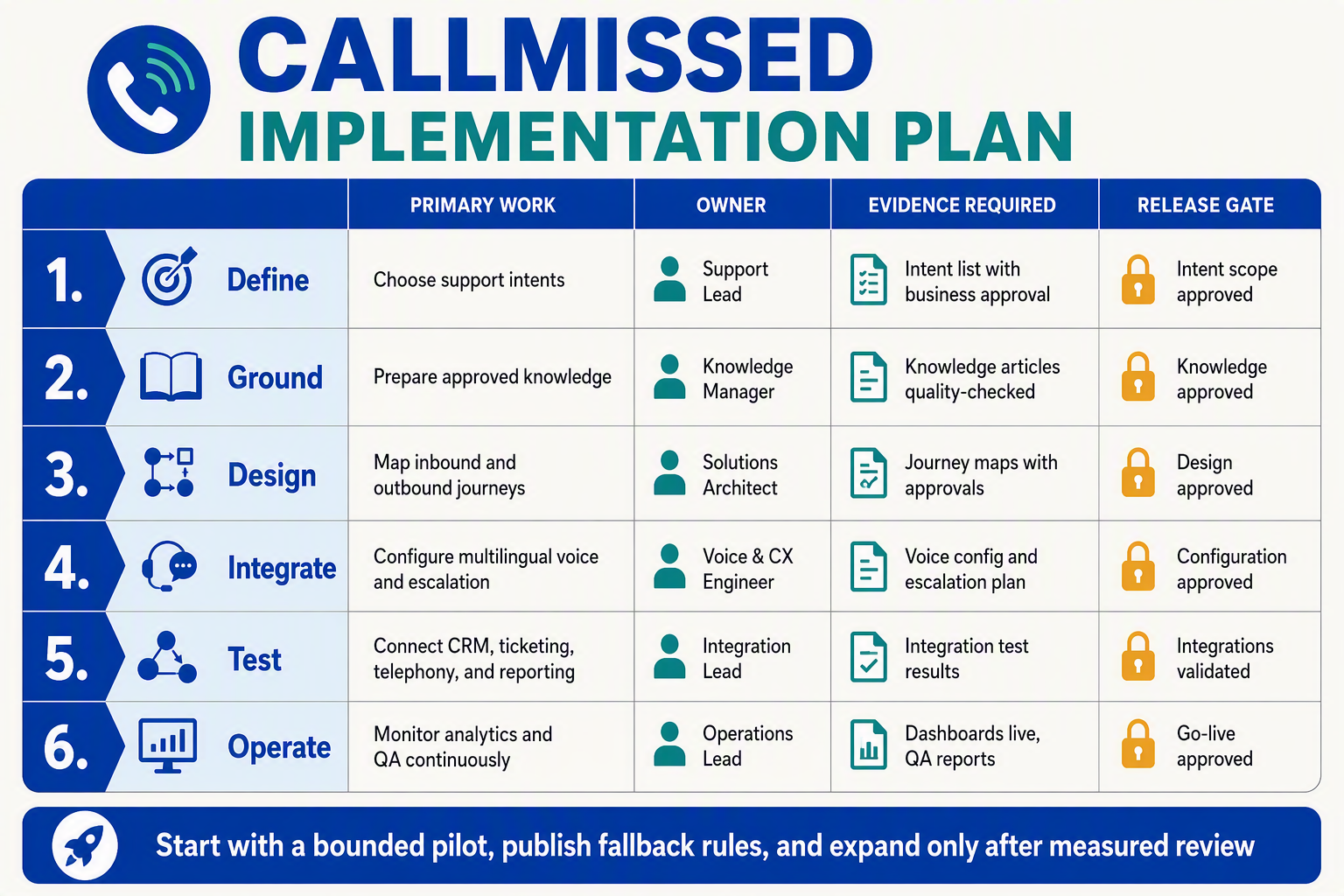
A practical CallMissed implementation requires six gated stages: scope, grounding, integration, controlled pilot, limited rollout and production optimisation. Each stage should have an accountable owner, measurable acceptance criteria and a rollback path; connecting a phone number to an AI model is not, by itself, a production deployment.
Pilot-to-production implementation framework
| Stage | Required work | Evidence to collect | Release gate |
|---|---|---|---|
| 1. Define scope | Select narrow, high-volume intents such as order status, appointment changes or service-ticket updates. Document prohibited actions and mandatory human handoffs. | Baseline call volume, handling time, transfer reasons and repeat-contact rate by intent. | Every automated intent has an owner, approved outcome and escalation rule. |
| 2. Build and ground | Configure CallMissed voice AI, natural-language flows and retrieval from approved FAQs, policies and product documents. Add responses for missing or conflicting information. | Knowledge-retrieval accuracy, citation traceability, unsupported-answer rate and response latency. | The agent declines or escalates when approved knowledge cannot support an answer. |
| 3. Connect systems | Integrate telephony, CRM or ticketing, authentication controls and the omnichannel inbox. Restrict write actions using least-privilege access. | Successful lookups, ticket creation, identity-verification results and complete interaction logs. | Failed integrations trigger a safe response rather than an invented confirmation. |
| 4. Run a controlled pilot | Test with employees and a limited caller segment. Cover interruptions, accents, silence, background noise, repeat questions and requests for a human. | Intent accuracy, task completion, transfer precision, latency, call abandonment and reviewer scores. | Support, security, compliance and operations owners approve the results. |
| 5. Release gradually | Increase traffic by queue, language, operating period or use case. Keep human agents available and monitor failures in near real time. | Containment by intent, customer satisfaction, repeat contacts, complaint rate and escalation outcomes. | Metrics remain within team-defined limits, with no unresolved critical safety or privacy issue. |
| 6. Operate in production | Review transcripts, refresh knowledge, evaluate model or prompt changes offline and maintain incident and rollback procedures. | Weekly trend reports, regression tests, knowledge freshness, access audits and deletion records. | Material changes pass the same QA controls used before initial release. |
Set gates around customer outcomes
A customer service AI call center should not optimise containment in isolation. A call that avoids transfer but gives an incorrect refund policy is a failure, while a correctly escalated account-security issue is a successful outcome.
Before launch, establish:
- Intent-level targets: Track resolution, transfer and repeat contact separately for each supported request.
- Escalation criteria: Transfer on explicit human requests, failed authentication, repeated misunderstanding, policy exceptions, distress or sensitive complaints.
- Outbound controls: Store the permission source, approved purpose, contact window and opt-out result for every follow-up campaign.
- Change controls: Version prompts, knowledge sources, voices, integrations and escalation policies so incidents can be reproduced and rolled back.
- Language testing: CallMissed supports speech workflows across 22 Indian languages, but each deployed language should still be tested with regional accents, code-switching, names and local service terminology.
Assign production ownership
Production readiness requires named owners across support operations, knowledge management, engineering, security, compliance and quality assurance. Gartner predicted in March 2025 that agentic AI would autonomously resolve 80% of common customer-service issues by 2029, but that forecast depends on operational discipline rather than unattended autonomy.
The final go-live decision should therefore answer three questions: Can the conversational AI voice bot resolve the approved task accurately? Can it recognise when it should stop? Can the organisation investigate and correct every failure? If any answer is no, the workflow should remain in pilot or route to a human agent.
Frequently asked questions about AI voice agents for customer service
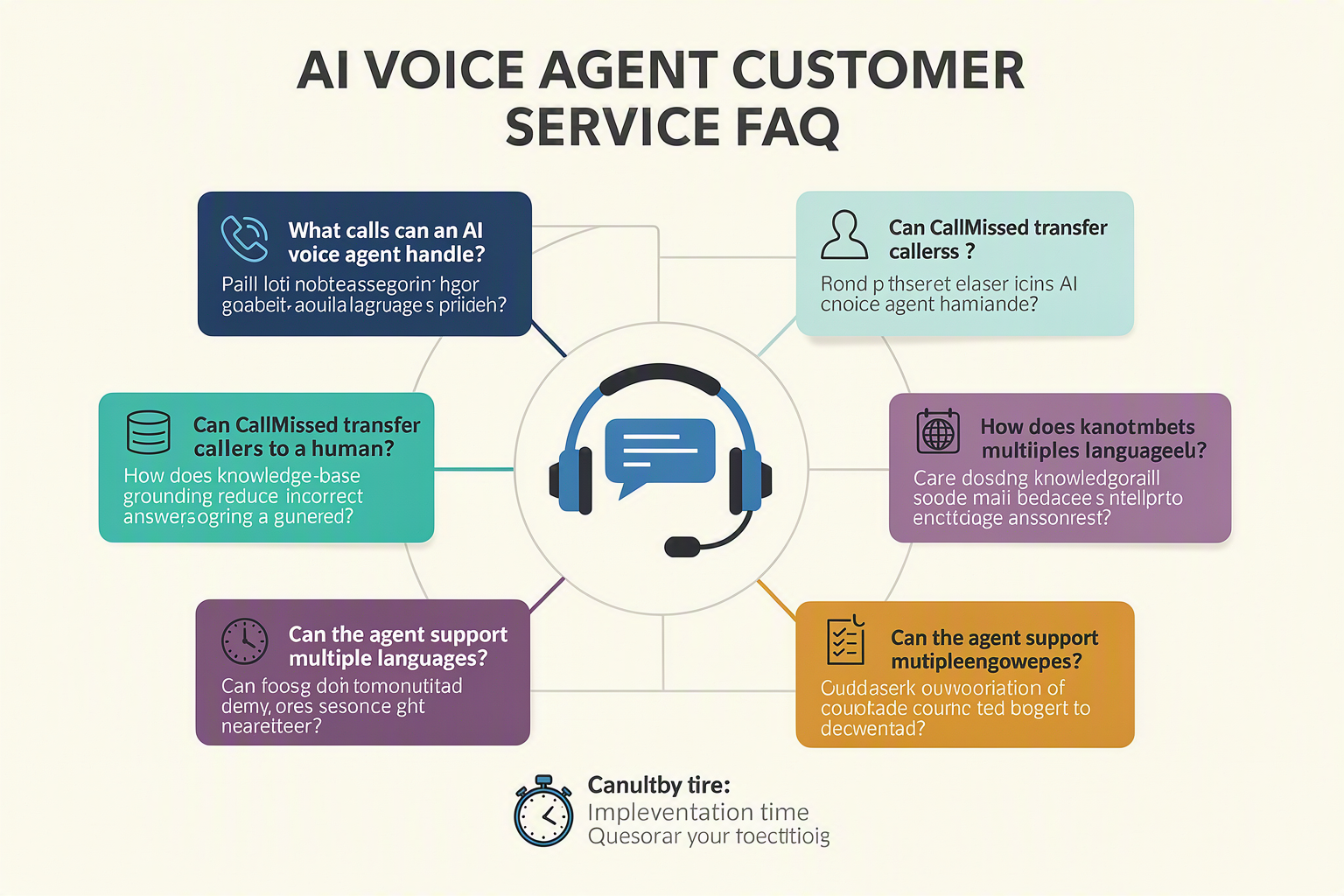
What is an AI voice agent for customer service in 2026?
How is an AI voice agent different from an AI receptionist or IVR?
How does AI voice agent customer service detect caller intent and handle natural conversation?
When should a customer service AI call center escalate to a human agent?
Can CallMissed voice AI support outbound customer-service calls legally and responsibly?
What should businesses evaluate before deploying AI voice agent customer service?
Conclusion
The operational takeaway
In 2026, an effective AI voice agent for customer service is not simply an automated receptionist. It is a support-operations system that understands natural language, detects intent, retrieves approved answers, completes routine service tasks and transfers complex or sensitive cases to the right human agent.
Gartner forecast in August 2022 that conversational AI would reduce contact-centre agent labour costs by $80 billion in 2026. Gartner also predicted in March 2025 that agentic AI would autonomously resolve 80% of common customer-service issues by 2029 while lowering operational costs by 30%. Those projections make disciplined implementation—not experimentation alone—the priority.
Key takeaways for support teams include:
- Design inbound automation around resolution. Use a conversational AI voice bot for repeatable enquiries such as order updates, appointment changes and basic troubleshooting, while preserving an obvious route to human assistance.
- Keep outbound follow-up permission-based. Every automated call should have a valid purpose, appropriate consent and controls aligned with applicable disclosure, recording, privacy and retention requirements.
- Ground conversations in trusted information. Knowledge-base retrieval reduces reliance on unconstrained generation, while intent detection, sentiment signals and escalation rules help determine when automation should stop.
- Measure the complete customer journey. Track containment, resolution, transfer accuracy, latency and customer experience—not call volume alone—and review recordings or transcripts through a structured quality-assurance process.
CallMissed voice AI brings these operating principles together through inbound agents, permission-based follow-up, knowledge-base grounding, omnichannel workflows and speech support across 22 Indian languages. That multilingual capability is particularly relevant for Indian businesses serving customers who expect natural assistance in their preferred regional language.
What to watch next
The defining development through 2026 and beyond will be the transition from voice agents that answer questions to systems that resolve more common issues autonomously. Support leaders should watch whether greater autonomy is accompanied by better grounding, authentication, transfer decisions, multilingual accuracy and measurable service outcomes.
The practical path is staged: begin with a narrow, high-volume workflow; establish compliance and escalation boundaries; evaluate real conversations; and expand only when the evidence supports it. To explore how AI communication is evolving, visit CallMissed—and ask: Which repetitive support journey could your team automate safely without weakening the customer’s route to human help?
Related Reading
Discussion
Related Posts


Ready to automate customer conversations?
Launch AI voice agents and WhatsApp bots with CallMissed — one API, 22+ Indian languages.