
Gemini 4 API Availability: Argon Access and Model-ID Checks



Google announced Argon’s limited Fairwind rollout on September 30, 2026. Check public API status, exact model IDs and integration requirements.
Gemini 4 API Availability: Argon Access and Model-ID Checks
A frontier-model announcement is not an API access guarantee. As of September 30, 2026, Gemini 4 API availability remains narrower than the launch headline might suggest: Google’s supplied announcement describes Gemini 4 Argon rolling out to trusted cyber defenders through its Fairwind Program, not unrestricted developer access.
Google has announced introductory and later token prices, but that does not establish an exact public callable model ID or unrestricted general availability through Google AI Studio or Vertex AI. Initial access is through the limited Fairwind rollout. Those are unresolved implementation questions—not details developers should fill in by guessing a model name or borrowing another Gemini model’s rates.
That distinction matters when your application depends on predictable costs, reproducible behavior, and a deployment path your team can actually use. Google describes Argon in the supplied announcement as built for “complex, long-horizon workflows,” but that positioning alone does not establish endpoint support, context limits, tool compatibility, or production readiness for your workload.
The release cadence adds pressure to separate announcements from integration decisions. In Google’s Gemini 3.8 Flash announcement, supplied for this September 30, 2026 draft, Google describes its third Flash release in six weeks. For developers, that means migration discipline matters: changing a model reference is only one step, while checking access, testing behavior, and controlling spend determine whether an upgrade is deployable.
What should developers verify before migrating to Gemini 4 Argon?
This guide will organize the implementation questions into a practical checklist:
- Availability: Confirm eligible accounts, access requirements, supported platforms, and regions before scheduling a rollout.
- Model ID: Obtain the documented API identifier; do not infer it from the marketing name “Gemini 4 Argon.”
- Pricing: Verify published billing units, applicable input and output rates, and any separate charges before estimating production costs.
- Migration: Test SDK compatibility, authentication, structured outputs, tool calls, error handling, and fallback behavior against your existing application.
- Release controls: Keep credentials and model configuration separate, run representative evaluations, and retain a rollback path.
As of September 2026, CallMissed offers OpenAI-compatible endpoints and caller-chosen fallback models, illustrating how developers can decouple integrations from individual model choices—without establishing Gemini 4 Argon availability on CallMissed.
The goal is not to turn an announcement into a premature deployment recommendation. It is to identify what the supplied sources support, flag what still needs official documentation, and prepare an implementation plan that becomes actionable once access, pricing, and the model identifier are confirmed for your intended deployment environment.
Is the Gemini 4 API publicly available?

Public Gemini 4 Argon API access is not verified as of September 30, 2026. Google’s supplied announcement confirms a limited rollout to trusted cyber defenders through the Fairwind Program. It does not establish unrestricted public API access, availability in Google AI Studio or Vertex AI, or an official callable model ID.
The September 30 announcement should not be confused with the September 16 and September 22 prelaunch speculation. Those earlier dates do not establish launch timing or developer access.
What does the announcement establish?
Announcement, restricted testing, preview, general availability, and account access are different milestones. The supplied evidence supports only the status shown below:
| Milestone | Status as of September 30, 2026 |
|---|---|
| Official announcement | Confirmed by the supplied Google announcement. |
| Restricted rollout or testing | Confirmed for trusted cyber defenders through Fairwind; individual account access still requires confirmation. |
| Public developer preview | Not established by the current retrieval. |
| General availability | Not established by the current retrieval. |
| Access for your project | Requires authorization and a successful request using a documented endpoint and model ID. |
These gaps are not proof that no API exists. They mean the available evidence does not justify describing Argon as publicly callable or ready for an unrestricted integration.
What pricing is announced—and what remains unresolved?
The pricing announced in the supplied material is $2 per million input tokens and $10 per million output tokens, with later rates of $4 and $20, respectively.
For eligible cached input, a stated 95% discount on the introductory $2 input rate implies $0.10 per million cached input tokens. That is a derived figure, not a separate confirmation of cache eligibility or billing behavior for your account.
The introductory pricing expiry remains unverified. Announced prices also do not establish access eligibility, quotas, regional availability, or production permissions. See the Gemini 4 Argon pricing and access guide for the pricing distinctions.
What should developers verify before integrating?
Before enabling Argon, obtain:
- Official access instructions covering Fairwind eligibility, enrollment, and permitted workloads.
- A documented endpoint and callable model ID. Do not infer either from “Gemini 4 Argon.”
- Authorization for the intended project and credentials, including any regional restrictions.
- A successful minimal development request using non-sensitive input.
- Applicable billing terms, quotas, and production permissions, including any introductory-price expiry.
A successful request confirms access only under the tested conditions. It does not establish general availability or authorization for another account.
For source verification, consult the official Gemini API changelog. The supplied material does not include canonical URLs for the Argon launch announcement or Fairwind page; locate those through Google’s official site rather than relying on a guessed announcement URL: Argon announcement lookup and Fairwind lookup.
Google’s general Interactions API documentation is not model-specific proof of Argon compatibility. Likewise, the Gemini API migration guide can inform SDK migration, but cannot establish Argon access.
Keep the existing integration in place until the documentation and account-level test agree. An announcement or price alone is not enough to approve deployment.
How do announcement, early testing, preview and GA differ? Reconcile September 16 and 22 pages with September 30 evidence; cite verified dates and access scope
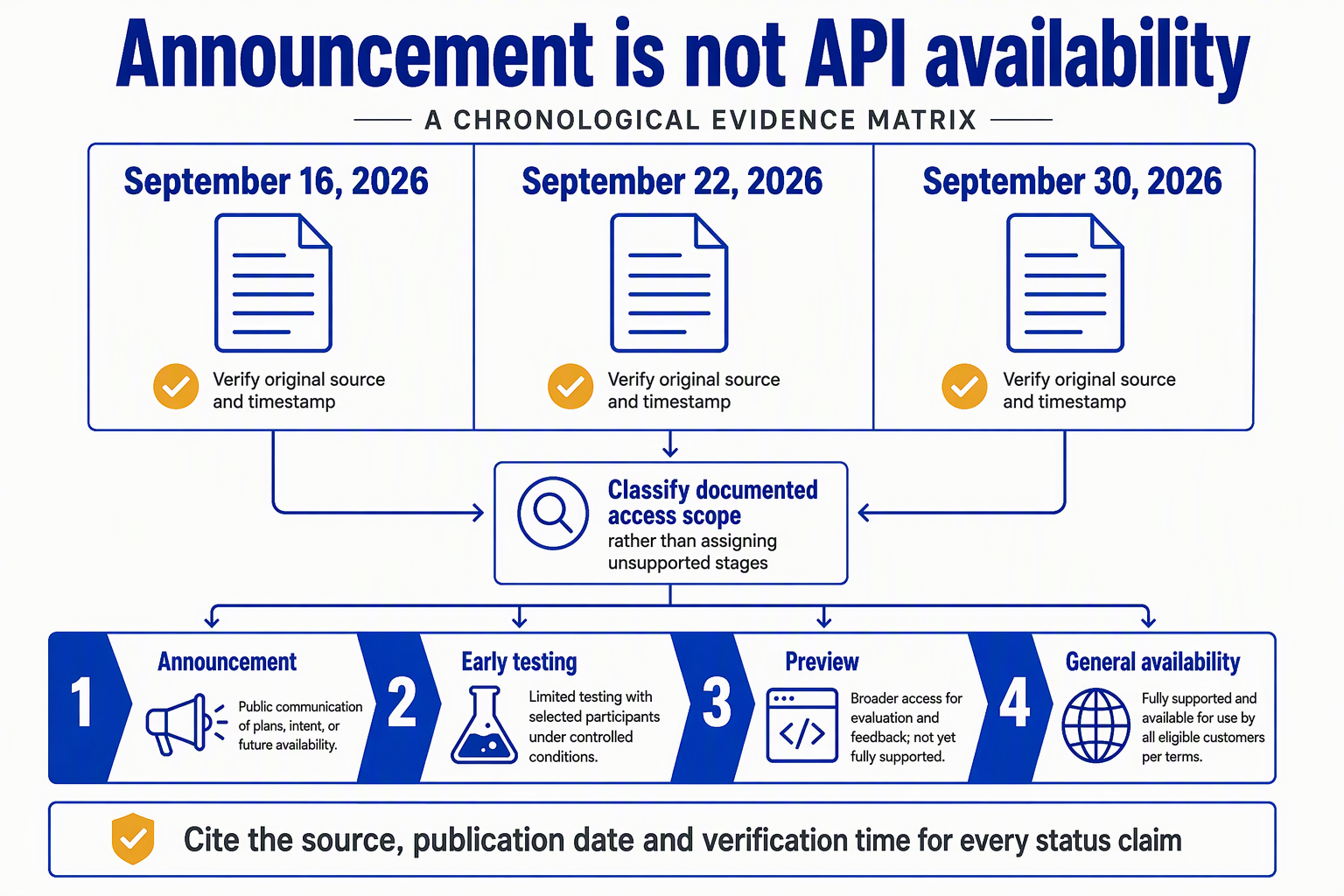
Announcement, early testing, preview, and general availability (GA) describe different release states—not interchangeable permissions to deploy. As of September 30, 2026, the supplied Google evidence supports a restricted Gemini 4 Argon rollout, but does not establish public preview or GA; the September 16 and September 22 page dates cannot be independently verified from the supplied excerpts.
What does each release stage mean for API implementation?
Use the following distinctions as release-management criteria, not as claims that Google has assigned every stage to Gemini 4 Argon. A model can be announced publicly while access remains restricted to selected organizations.
| Stage or checkpoint | Date evidence | Access scope | Implementation consequence |
|---|---|---|---|
| Announcement | Publication date absent from supplied Argon excerpt | Public information; access not implied | Record the announcement separately from API readiness |
| Early testing | No separate testing date supplied | Typically selected evaluators; Argon testing terms unverified | Obtain written access conditions before integration |
| Preview | No Argon preview date established as of September 30, 2026 | Depends on documented eligibility and restrictions | Require preview documentation and a callable identifier |
| General availability | No Argon GA date established as of September 30, 2026 | Defined by official platform availability and terms | Verify billing, quotas, regions, and support commitments |
| September 16 and 22 pages | Dates referenced in the brief, not visible in excerpts | Cannot establish scope from dates alone | Verify timestamps and preserve each page’s exact wording |
| September 30 evidence review | September 30, 2026 review cutoff; not a verified publication date | Google describes selected trusted cyber defenders | Treat broader developer access as unresolved |
Google’s Argon announcement, reviewed for this September 30, 2026 draft, says the model is “rolling out to a set of trusted cyber defenders through our Fairwind Program.” That wording establishes an audience restriction; it does not identify a public API endpoint or explain how an ordinary developer account becomes eligible.
The supplied Google Fairwind Program excerpt discusses cyber defense for governments and enterprises. It does not establish that every government, enterprise, or developer can obtain Argon access.
How should developers reconcile the September 16 and September 22 pages?
Treat the two dates as verification tasks, not a release sequence already proved by the evidence. The supplied excerpts do not show which page carries which date, whether either page was updated, or whether the pages describe different products or access cohorts.
- Verify page identity and timestamps. Record the title, publisher, original publication date, and any explicit update date.
- Extract the access statement verbatim. Distinguish “announcing,” “testing,” “rolling out,” “preview,” and “available” rather than translating them into GA.
- Compare scope, not just chronology. A later page may expand an announcement without expanding eligible accounts.
- Check implementation documentation separately. Confirm that API documentation actually names Gemini 4 Argon and specifies how authorized accounts invoke it.
A useful review note would read: “September 22 page is newer; public API access remains unconfirmed.” Avoid “September 22 supersedes September 16” unless an official update explicitly establishes that relationship.
What should the September 30 review decision be?
Keep this developer guide held for review, with separate evidence gates:
- Confirmed: Google describes an Argon rollout to selected trusted cyber defenders.
- Unresolved: Verified September 16/22 publication history, public preview status, and GA.
- Deployment gate: Official documentation matching the intended account, platform, and access scope.
This is an evidence limitation, not proof that broader access does not exist. Promote the draft to an actionable integration guide only when the missing release and access documentation is verified.
What is the Gemini 4 API model ID, and which endpoint is documented? Verify the official model reference and Interactions API; do not infer generateContent, OpenAI SDK parity or an Argon (high) identifier
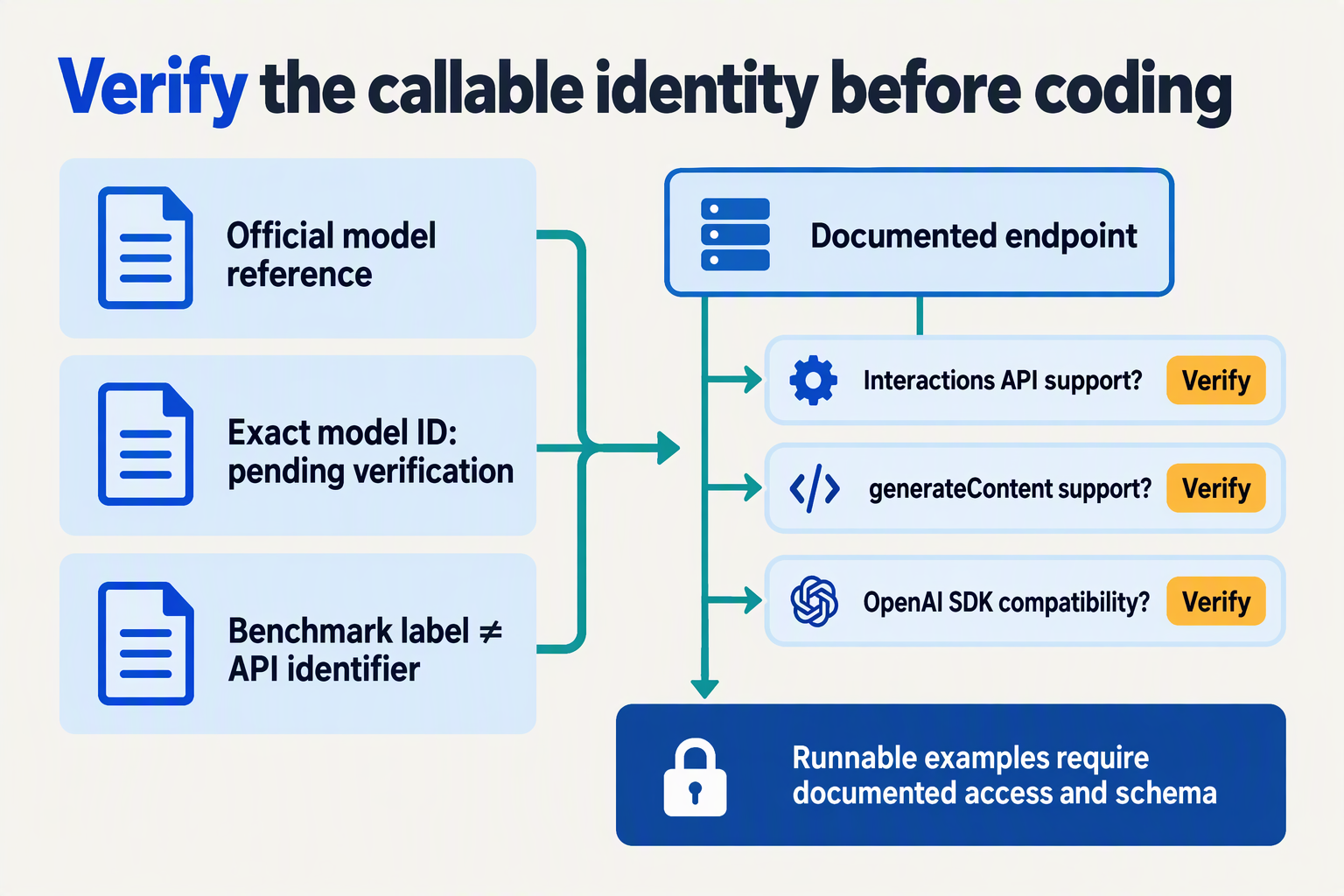
The supplied sources do not establish an exact Gemini 4 Argon API model ID or a documented request endpoint as of September 30, 2026. This draft must therefore hold both fields for review: verify Google’s official model reference and Interactions API documentation before publishing runnable integration instructions.
Google’s supplied Gemini 4 Argon: our next era of frontier intelligence announcement describes Argon as built for “complex, long-horizon workflows.” That statement establishes intended use, not a callable identifier, API route, SDK method, or supported request schema.
Where should developers verify the Gemini 4 Argon model ID?
Use Google’s official API model reference, together with access documentation applicable to your account and deployment platform. The supplied context contains Google blog excerpts, but no model-reference entry or Interactions API specification that resolves these implementation details.
For this September 30, 2026 review, record the following evidence before replacing any configuration:
- Exact model identifier: Copy the documented string verbatim, including any version or preview suffix.
- Platform scope: Establish whether that identifier applies to the Gemini API, Vertex AI, or another explicitly documented access surface.
- Access conditions: Confirm that your project or account is eligible to call the model.
- Version behavior: Check whether the identifier is a fixed version or an alias that can change.
- Documentation provenance: Record the source title and verification date beside the configuration change.
Treat the marketing name Gemini 4 Argon as a discovery term, not a value to paste into a request. A recognizable name is not evidence that a backend accepts it.
Is Gemini 4 Argon documented for the Interactions API?
Interactions API support remains unverified in the supplied material as of September 30, 2026. The review should establish both that Google documents Argon for this API and that the documented operation is available to the intended account.
A useful verification sequence is:
- Locate the official Interactions API reference. Confirm the service address, API version, operation, and authentication requirements.
- Check model support explicitly. An API’s existence does not establish that every Gemini model is supported.
- Inspect the request contract. Verify required fields, supported input types, and any documented interaction-state handling.
- Inspect the response contract. Confirm output parsing, error structures, and streaming behavior where documented.
- Run a minimal authorized test. Preserve a redacted request and response as implementation evidence without exposing credentials.
Until those checks pass, keep endpoint-specific sample code out of the publishable draft.
Can developers assume generateContent, OpenAI SDK parity, or an Argon high identifier?
No—none of those assumptions is supported by the provided Google excerpts. Do not transplant a generateContent integration from another Gemini model, promise drop-in OpenAI SDK compatibility, or manufacture an “Argon (high)” identifier from a display label.
Keep three concepts separate: the model ID selects a documented model; the endpoint defines the request contract; a reasoning setting, if documented, configures behavior. One cannot safely be inferred from another.
As of September 2026, CallMissed documents OpenAI-compatible developer endpoints, illustrating why compatibility should be an explicit platform capability—not an assumption about Google’s Argon interface.
Publication gate: release this section’s runnable examples only after the exact model ID, supported API operation, and account-level access have been verified against official documentation.
How much does Gemini 4 Argon cost? Verify the reported $2/M input, $10/M output and 95% cache discount against Google footnotes, introductory duration, long-context thresholds and mode conditions
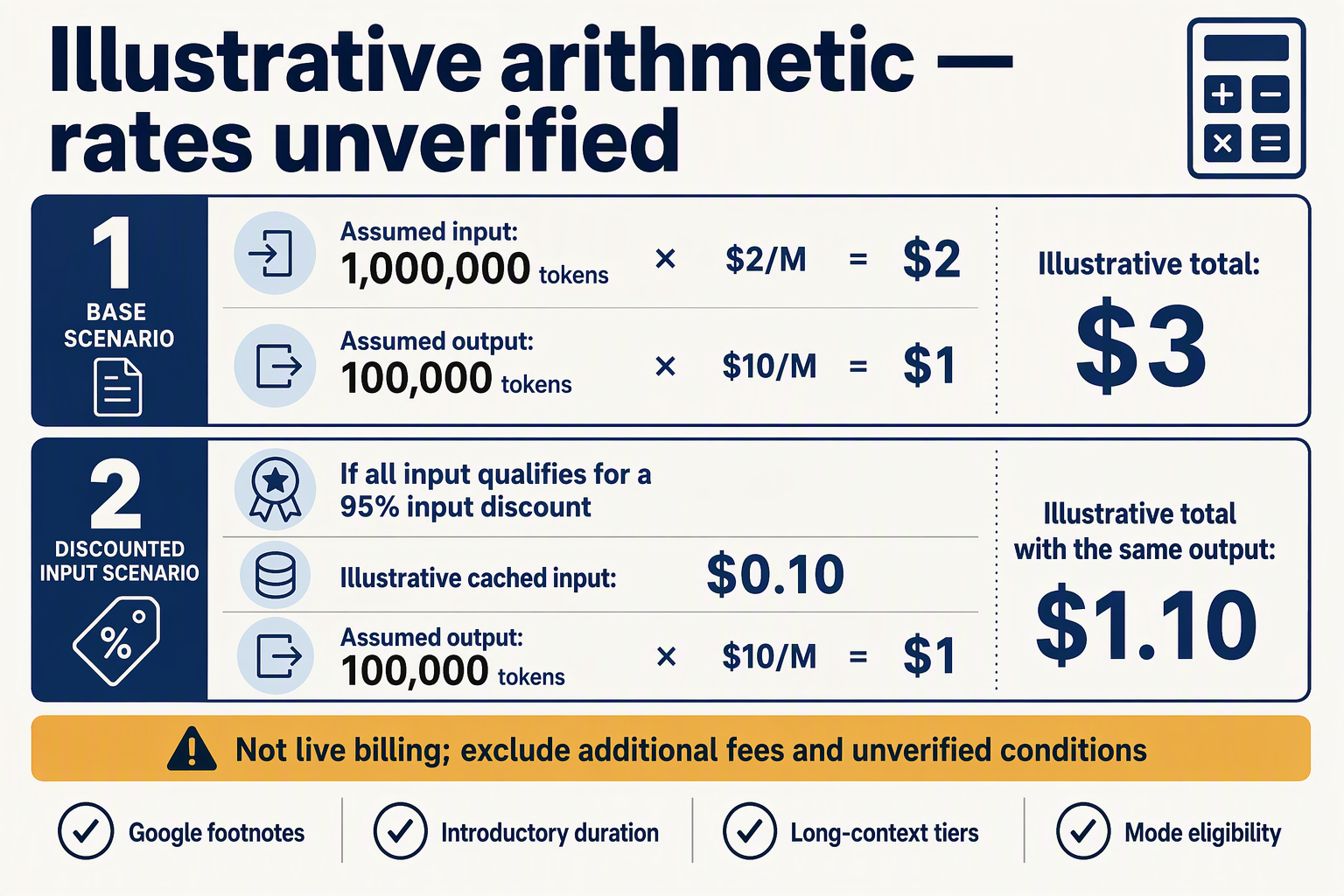
Gemini 4 Argon API pricing is unverified in the supplied Google material as of September 30, 2026. The reported $2 per million input tokens, $10 per million output tokens, and 95% cache discount should remain provisional: the provided excerpts contain neither an Argon pricing table nor the footnotes needed to establish those terms.
Google’s supplied Argon announcement describes access through the Fairwind Program for “a set of trusted cyber defenders.” That statement establishes a restricted rollout, not a public billing schedule. Keep this draft’s pricing claims held for review until Google documentation confirms rates for the exact model, platform, and account arrangement your application will use.
Are the reported Gemini 4 Argon token prices confirmed?
As of September 30, 2026, the supplied Google excerpts do not substantiate the reported token prices. Do not attribute those figures to Google as confirmed pricing or substitute rates from another Gemini model.
Before approving a production estimate, capture the official pricing table and its footnotes, then verify:
- Billing units: Whether rates apply per million tokens and whether text, images, audio, or other inputs have separate treatment.
- Output accounting: Whether billable output includes reasoning tokens, and how the API reports them.
- Platform scope: Whether the schedule applies to the Gemini API, Vertex AI, or a restricted-access agreement.
- Additional charges: Whether caching, storage, grounding, or other enabled services introduce separate costs.
These are verification questions, not established Argon billing features.
How long would introductory pricing apply?
The introductory duration is not established by the supplied context as of September 30, 2026. A headline price is insufficient if a footnote limits eligibility or changes the rate after a promotional period.
Record three items before implementation:
- Effective and expiry dates, including the applicable timezone.
- Eligibility conditions, including accounts, regions, and usage limits.
- Post-introductory rates, with an explicit approval step before any price change.
Keep effective dates alongside rates in configuration rather than embedding a temporary price directly in application code.
Do long-context thresholds or execution modes change the price?
No Argon-specific long-context threshold or mode-dependent pricing is documented in the supplied excerpts as of September 30, 2026.
The critical question is whether crossing a context threshold changes billing for the entire request or only tokens above that threshold. Also confirm whether synchronous, batch, priority, or other documented execution modes have distinct rates; do not assume Argon supports any particular mode.
Your estimator should therefore track model identity, platform, input size, and execution mode—not just total tokens.
What would a 95% cache discount actually save?
A cache discount is not necessarily a discount on the entire request. If the reported September 2026 figures were confirmed, and a 95% reduction applied specifically to the $2-per-million input rate, eligible cached input would cost $0.10 per million tokens.
For an illustrative request with one million input tokens and 100,000 output tokens:
- Without caching: Input would cost $2; output would cost $1; total would be $3.
- With 900,000 eligible cached input tokens: Cached input would cost $0.09, uncached input $0.20, and output $1; total would be $1.29.
That hypothetical saving is 57% overall, excluding additional charges—not 95%. Verify cache eligibility, storage costs, and actual cache-hit accounting before using this calculation in a budget.
Which limits and billing conditions are actually documented? Cite model-specific context, output, quotas, regions, tools, streaming and cache rules; mark unresolved values as unverified
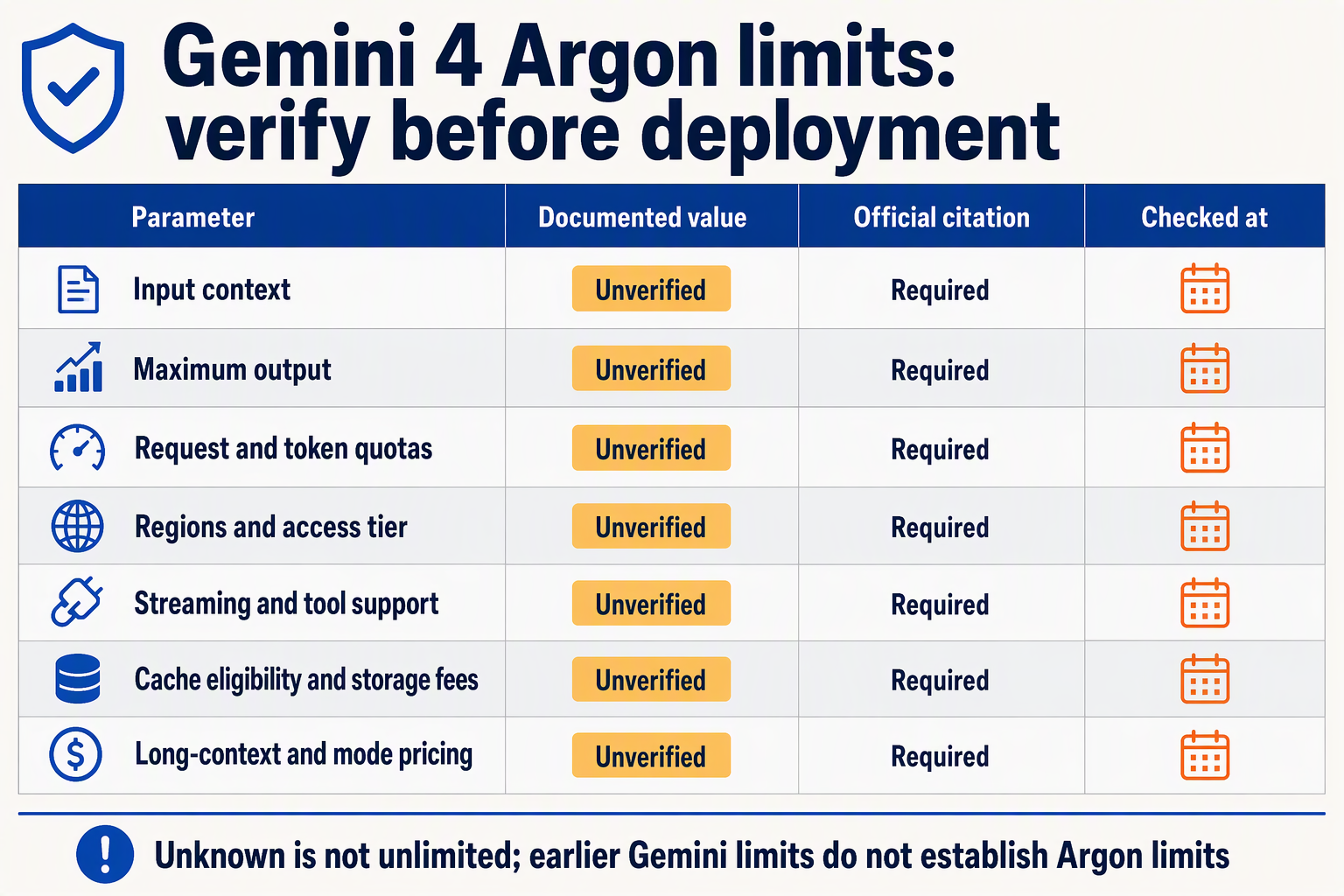
The supplied Google sources do not document model-specific Gemini 4 Argon API limits or billing conditions as of September 30, 2026. Context size, output ceilings, quotas, deployment regions, tool support, streaming behavior, cache rules, and API rates must therefore remain unverified in this review-held draft—not inherited from another Gemini model.
Google’s supplied Gemini 4 Argon announcement describes “complex, long-horizon workflows” and rollout through the Fairwind Program. Those statements establish positioning and an access pathway, not a numerical context window or a production API contract.
Which Gemini 4 Argon limits are verified?
The following documentation register reflects the provided source excerpts as of September 30, 2026. “Unverified” means the supplied evidence does not establish the value; it does not mean the capability is unavailable.
| Implementation area | Evidence in supplied sources | Status | Required confirmation |
|---|---|---|---|
| Context and output limits | Google describes long-horizon workflows but supplies no token ceilings. | Unverified | Maximum input context, output tokens, and any shared token budget. |
| Quotas and concurrency | No Argon-specific request or token quotas are supplied. | Unverified | Requests/minute, tokens/minute, concurrent requests, account tiers, and increase process. |
| Regions and deployment | Google identifies Fairwind participants, not API serving regions. | Unverified | Supported endpoints, eligible regions, processing locations, and residency terms. |
| Tools and streaming | No Argon-specific interface contract appears in the excerpts. | Unverified | Function calling, structured outputs, supported tools, streaming events, and cancellation behavior. |
| Context caching | No Argon cache eligibility, lifetime, or charges are supplied. | Unverified | Explicit or implicit caching, minimum size, TTL, cache-hit accounting, and storage charges. |
| Billing conditions | No Argon API rate card or billable-unit definition is supplied. | Unverified | Input/output rates, reasoning-token treatment, tool charges, rounding, and failed-request billing. |
What should developers avoid inferring from other Google announcements?
Capabilities documented for another model do not establish Argon support. Google’s June 2026 AI update explicitly associates computer use with Gemini 3.5 Flash; that is not evidence that Gemini 4 Argon exposes the same tool interface.
Likewise, Google’s supplied I/O 2026 subscription announcement describes a $100-per-month AI Ultra plan, not a Gemini 4 Argon API rate card. Do not convert a consumer subscription price into token rates, API credits, or an inference allowance.
Keep these distinctions explicit:
- Long-horizon reasoning does not specify how many tokens a request accepts.
- Program access does not establish regional API availability or data residency.
- Streaming support, if subsequently confirmed, would not by itself establish different pricing.
- Caching support, if confirmed, would not guarantee discounted reads or free storage.
How should unresolved limits affect the migration checklist?
Treat missing documentation as a release gate, rather than a value to fill with a plausible default.
- Record evidence: Save the official model document, applicable platform, revision date, and exact model identifier beside each confirmed limit.
- Validate the contract: Once access is authorized, test near-limit prompts, output truncation, quota errors, tool execution, stream interruption, and cache expiration.
- Reconcile billing: Compare measured usage with billing records before approving a production budget.
For cost modelling, use separate variables for uncached input, cached input, output, and any documented additional charges. Leave unknown rates blank rather than setting them to zero. As of September 30, 2026, the supplied evidence cannot support a numerical Gemini 4 Argon API pricing estimate; this section should remain held for review until model-specific documentation resolves those fields.
How should developers migrate tools and streaming safely? Compare documented schemas, state handling, function calls, structured outputs, event formats, SDK versions, retries and rollback before changing production
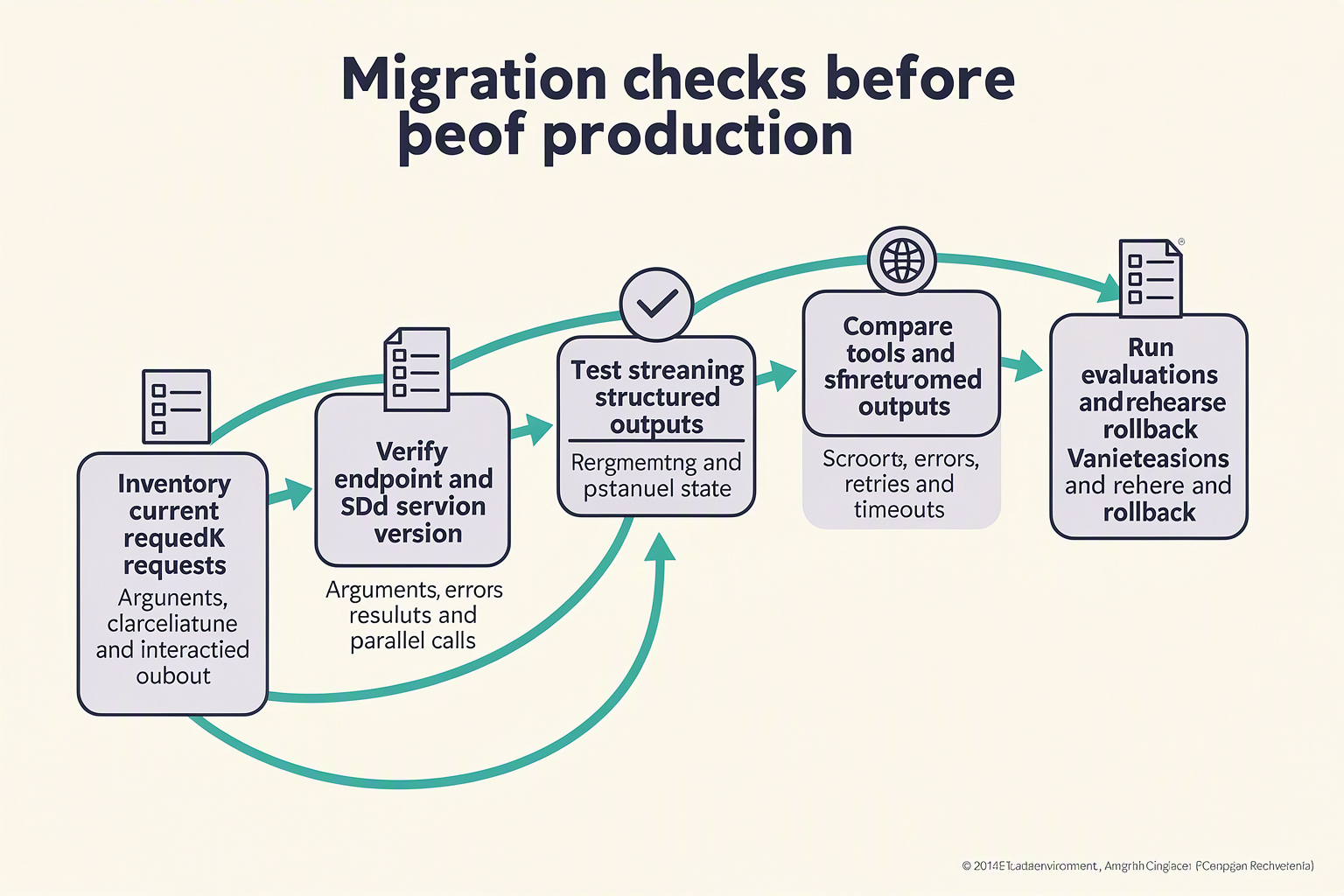
Migrate tools and streaming by validating the API contract, not by swapping the model name. As of September 30, 2026, the supplied Google material does not document Gemini 4 Argon’s request schemas, streaming events, SDK requirements, or retry semantics; this migration plan remains a draft held for review, not a verified Argon integration recipe.
Google’s announcement, supplied for this September 30, 2026 review, describes Argon as supporting “complex, long-horizon workflows.” That makes conversation state and tool execution important testing targets, but the description does not establish how either works through an API.
Which schemas and SDK versions should developers compare?
Create a contract-diff checklist between your deployed integration and the official Argon documentation once available. Record the documentation date, endpoint, exact model identifier, SDK package, and pinned version alongside each test.
Compare:
- Request schemas: message roles, content-part types, tool declarations, generation settings, and required versus optional fields.
- Response schemas: text placement, tool-call arguments, completion indicators, usage fields, and error bodies.
- Structured outputs: supported schema keywords, enforcement behavior, and handling of refusals, truncation, or invalid output.
- SDK behavior: serialization, streaming helpers, timeout defaults, and compatibility with your runtime.
Do not copy another Gemini model’s field names into an Argon implementation without confirmation. A matching method name does not guarantee matching wire behavior.
How should developers preserve state and execute function calls?
Keep application state separate from provider-specific conversation state. Maintain an execution ledger containing the logical operation identifier, validated arguments, authorization decision, execution status, and tool result.
Test these cases before enabling writes:
- A single function call followed by a tool result and final answer.
- Multiple calls, including parallel calls if documented.
- Invalid arguments, unknown tools, and permission failures.
- Interrupted conversations resumed with whatever state the API requires.
Preserve provider-issued identifiers and opaque state fields when documentation requires them; do not assume visible message history is sufficient. Treat model-generated arguments as untrusted input and validate them against your application’s schema and permissions.
For example, a payment tool must not execute twice because a connection dropped after the first execution. Deduplication should follow the logical business operation, not merely the transport request.
How should streaming events and structured outputs be tested?
Build a streaming adapter against documented event formats, with separate handling for text deltas, tool-argument fragments, completion, errors, and usage information where supported.
Test cancellation, disconnects, malformed events, and termination before a complete result. Assemble tool arguments before parsing them; a streamed fragment is not necessarily valid JSON.
Likewise, validate structured output only after the documented completion boundary. Keep incomplete output away from downstream workflows, especially systems that create orders, change records, or send messages.
When are retries safe, and how should rollback work?
Retry only documented transient failures, using bounded backoff, jitter, and server retry guidance where provided. Do not blindly replay requests that may already have triggered side effects. Reconcile uncertain operations before resuming execution.
Roll out through offline fixtures, read-only shadow traffic, and a limited canary. Define rollback triggers for schema failures, duplicate actions, incomplete streams, and unacceptable task outcomes.
As of September 2026, CallMissed’s developer API supports caller-chosen fallback models, function calling, and structured outputs. Those capabilities can support migration architecture, but they neither establish Argon availability nor make fallback contracts interchangeable.
Rollback should restore the previous model, adapter, SDK, and state-handling configuration together—not just the model identifier.
What safety checks belong in an Argon integration? Review Fairwind eligibility, acceptable-use terms, sensitive data, prompt injection, tool permissions, human approval and audit logging
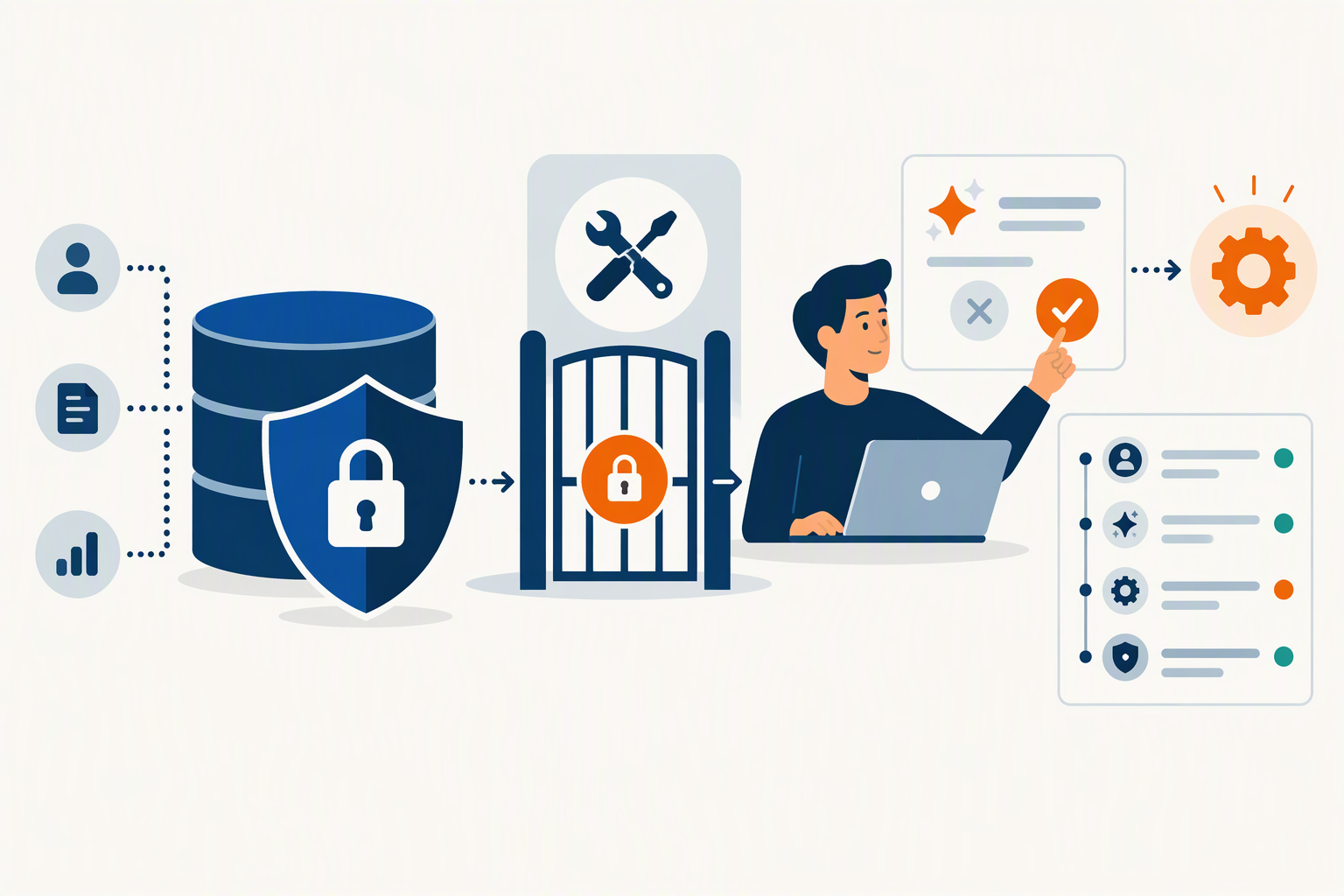
An Argon integration needs explicit access authorization, acceptable-use review, sensitive-data controls, prompt-injection defenses, least-privilege tools, human approval and auditable execution. For this draft held for review as of September 30, 2026, treat these as deployment gates—not safety features that Google’s supplied announcement proves Argon provides.
How should developers verify Fairwind eligibility and acceptable use?
Google’s supplied Gemini 4 Argon announcement, reviewed for this September 30, 2026 draft, says the model is rolling out to “a set of trusted cyber defenders through our Fairwind Program.” That supports a restricted-access interpretation; it does not establish your organization’s eligibility or permission for every proposed workflow.
Before enabling credentials, require documented answers to:
- Access scope: Which organization, accounts, environments and users are approved?
- Permitted activity: Are vulnerability analysis, exploit reproduction, automated scanning or remediation allowed under the applicable agreement?
- Target authorization: Does your organization own the systems involved or hold written permission to test them?
- Operating limits: What restrictions, reporting obligations and suspension conditions apply?
The supplied Google Fairwind excerpt frames the program around “proactive cyber defense for governments and enterprises,” but does not provide detailed eligibility criteria or acceptable-use terms. Keep those items unresolved until the governing documents are available.
How should an Argon integration handle sensitive data and prompt injection?
Minimize data before sending it to any model. Inventory repository contents, incident reports, customer records and telemetry; remove credentials, access tokens and unnecessary personal information. Confirm contractual handling of retention, training use, processing locations and deletion before approving sensitive workloads—the supplied context does not establish Argon’s policies.
Treat retrieved documents, source-code comments, webpages and tool responses as untrusted data, even when they come from internal systems. A malicious instruction embedded in a security report must not gain authority merely because the agent retrieved it.
Recommended implementation controls include:
- Separating application instructions from external content.
- Restricting retrieval to sources the requesting user may access.
- Validating model-generated tool arguments against explicit schemas and policy checks.
- Testing injections that request secret disclosure, privilege escalation or unauthorized network access.
Prompt wording alone is not an authorization boundary. Enforce permissions in application code and infrastructure.
Which tool actions should require human approval?
Start with read-only tools, then grant narrowly scoped write permissions only after evaluation. Give each tool its own allowed resources, credentials and execution limits; avoid exposing a general-purpose shell with production privileges.
Use a numbered approval sequence for consequential actions:
- Prepare: Produce the proposed command, patch or configuration change without executing it.
- Inspect: Show the reviewer the target, expected effect, relevant diff and recovery procedure.
- Approve: Bind approval to that exact action and target; changed arguments require renewed approval.
- Execute: Recheck authorization server-side, then record the outcome.
Require approval for production changes, destructive operations, credential rotation, external communications and testing outside an explicitly authorized scope. Prefer sandboxed validation before live execution.
What should developers record in an Argon audit log?
Record the request identity, configured model identifier, instruction version, retrieved-source references, tool arguments, authorization decision, approval identity and execution result. Do not turn audit logging into a second sensitive-data leak: redact secrets, restrict access and set retention limits.
As of September 2026, CallMissed’s developer AI API offers usage and request logs, illustrating the gateway-level visibility developers can include in a broader audit design; this does not establish Argon availability or complete security auditing on CallMissed.
The release gate should remain closed until access terms, data handling, denied-action tests, approval enforcement and rollback evidence are documented.
What can you prepare while access is unverified? Map access requests, credentials, documented billing, sandbox tests, cost alerts and rollback to owners and release gates

Prepare the integration controls, evidence register, and rollback path, but keep Gemini 4 Argon deployment blocked until access, credentials, the callable model ID, and billing terms are verified. Assign each unresolved dependency an owner and an evidence-based release gate rather than treating an access request as permission to ship.
As of September 30, 2026, Google’s supplied Gemini 4 Argon announcement describes access as “rolling out to a set of trusted cyber defenders through our Fairwind Program.” That supports an access-verification workstream—not an assumption that a public API endpoint is available.
Who should own Gemini 4 Argon implementation readiness?
Use this proposed readiness matrix for the review draft. The gates below are internal engineering recommendations, not Google’s published requirements.
| Workstream | Accountable owner | Prepare before access | Evidence required | Release gate |
|---|---|---|---|---|
| Access request | Technical lead | Record intended workload, organization, and deployment environment; identify an official inquiry route | Written eligibility and access confirmation for the intended account | No live integration until access is confirmed |
| Credentials | Platform/security lead | Prepare secret storage, access controls, rotation procedures, and separate environments | Documented authentication method; authorized credentials pass a minimal request | No production credentials in code, logs, or developer fixtures |
| Documented billing | FinOps lead | Build a configurable cost worksheet without assumed Argon rates | Official billing units, applicable rates, currency, and charge conditions | No paid rollout until the budget is approved |
| Sandbox tests | QA/ML lead | Create sanitized fixtures, mocks, baseline results, and compatibility tests | Verified model ID plus live results for required application behaviors | No promotion until agreed acceptance tests pass |
| Cost alerts | SRE/FinOps lead | Define spend thresholds, notification routing, and application-side request limits | Tested alert delivery and usage-to-cost reconciliation | No scale-up until spend controls work |
| Rollback | Release engineer | Keep the existing model configuration deployable; rehearse switching with mocks | Successful rollback drill and verified fallback capacity | No production traffic until recovery is demonstrated |
Each owner should attach dated evidence, not simply mark a task complete. Record the document title, verification date, account scope, and reviewer so that permissions or terms confirmed for one environment are not silently reused for another.
What can sandbox tests prove before access is confirmed?
Without authorized Gemini 4 Argon access, sandbox tests can validate your application’s plumbing, not Argon’s behavior. Mocks can exercise authentication failures, malformed responses, timeouts, retry limits, and configuration changes; they cannot establish real model quality, latency, token usage, or tool compatibility.
Prepare the test suite in this order:
- Capture the baseline: Save representative inputs and expected outcomes from the currently deployed model.
- Test application contracts: Check schema validation, tool authorization, error handling, and logging with synthetic responses.
- Reserve live verification: Mark model-specific tests blocked until the documented endpoint and identifier are available.
For agent workflows, include a rollback test with a partially completed tool action. Switching models must not automatically replay a payment, message, or database write.
How should cost alerts and release approval work?
Separate budget notifications from enforced application limits. A notification requests attention; an application-side limit can stop new requests when the approved allowance is exhausted.
For example, a team could propose alerts at 50%, 80%, and 100% of its approved sandbox budget. These are illustrative internal thresholds—not Gemini 4 Argon pricing, quotas, or documented billing features.
Keep the draft held for review until every required gate has evidence. An unresolved rate, unavailable credential, or untested rollback should remain an explicit blocker, not become an estimate disguised as implementation readiness.
What must reviewers verify before publication? Research Google's launch announcement, Fairwind page, API release notes, pricing, model reference and Interactions API docs; attach footnotes and expert sign-off without invented quotes
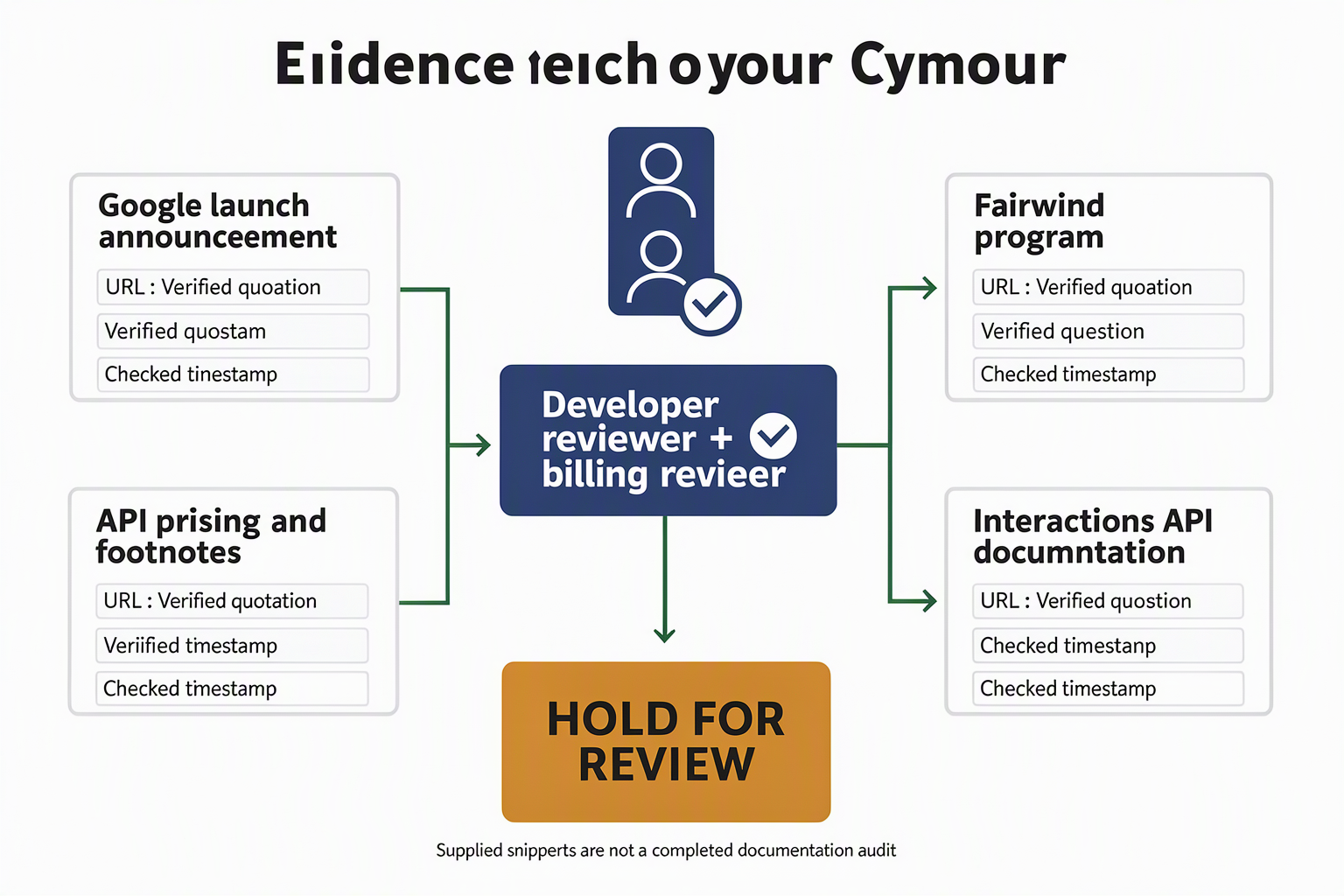
Reviewers must verify every implementation claim against Google’s official documentation before this Gemini 4 Argon API guide leaves draft status. As of September 30, 2026, the supplied research contains announcement excerpts, but not the API release notes, pricing tables, model reference, or Interactions API documentation needed to approve deployment instructions.
Which Google sources must reviewers check?
Use a claim-to-source register, not a collection of search snippets. Record each document’s title, publisher, publication or update date, review timestamp, and the exact passage supporting the claim.
- Google’s launch announcement: Verify the full announcement and its date. In the excerpt supplied for this September 30, 2026 draft, Google says Gemini 4 Argon is “rolling out to a set of trusted cyber defenders through our Fairwind Program.” That supports a restricted-rollout description—not general API availability.[^1]
- Google’s Fairwind Program page: Check eligibility, application requirements, permitted uses, and access conditions. The supplied excerpt discusses cyber defense for governments and enterprises; it does not establish an application process or approval timeline.[^2]
- Gemini API and Vertex AI release notes: Check each platform separately for Argon availability, preview or production status, regional restrictions, SDK requirements, and breaking changes.
- Official API pricing: Verify billing units, currency, input and output rates, and any applicable caching, tool, or other charges. Do not substitute consumer subscription pricing for API pricing.
- Official model reference: Confirm the exact callable identifier, supported endpoints, limits, modalities, and versioning behavior. A marketing name is not an executable model ID.
- Google’s Interactions API documentation: Verify whether Argon is explicitly supported, then check authentication, request schemas, state handling, streaming, tool execution, and any documented migration differences.
Items 3–6 remain unverified in the supplied context. Their absence here does not prove that Google has not published them; it means this draft cannot cite them yet.
What implementation evidence should accompany approval?
Require reproducible evidence alongside documentary support:
- Access: A successful request from the intended account, platform, and region.
- Model identity: A sanitized request and response showing the documented model identifier.
- Cost: A worked estimate using verified rates, clearly separating assumptions from observed usage.
- Migration: Test results for structured outputs, tool calls, streaming, retries, and rollback.
- Compatibility: Separate native Google API tests from gateway compatibility tests.
As of September 2026, CallMissed’s verified fact sheet lists OpenAI-compatible endpoints and caller-chosen fallback models. Those capabilities can inform integration design, but they do not establish Argon catalogue availability or Interactions API compatibility.
Who must sign off before publication?
Attach a review block with names, roles, dates, and evidence references:
- API engineer — pending: Confirms identifiers, endpoints, authentication, and runnable examples.
- FinOps reviewer — pending: Checks pricing provenance, billing assumptions, and calculations.
- Security reviewer — pending: Checks Fairwind eligibility and applicable access conditions.
- Technical editor — pending: Ensures every factual claim has support and every unresolved item remains explicit.
Do not invent expert quotes or imply approval through an unnamed “expert review.” Until these checks are completed, retain DRAFT — HELD FOR REVIEW and avoid presenting placeholders as production-ready configuration.
Which footnotes are attached to this draft?
[^1]: Google, “Gemini 4 Argon: our next era of frontier intelligence.” Supplied announcement excerpt used in this September 30, 2026 draft; full-page verification and publication-date confirmation pending.
[^2]: Google, “Google’s Fairwind Program: Cyber defense tools for trusted partners.” Supplied excerpt used in this September 30, 2026 draft; detailed eligibility verification pending.
Frequently Asked Questions

How do I access the Gemini 4 API as of September 30, 2026?
Is Google’s Fairwind Program public Gemini 4 API access?
What is the exact Gemini 4 API model ID for Argon?
Is Gemini 4 Argon (high) callable through an API?
high reasoning parameter, a separate endpoint, or a model variant. Ask for the exact request schema and permitted parameter values before implementation, and distinguish a display label from a documented API control when reviewing configuration examples.Are Gemini 4 Argon introductory API prices verified?
Can I reuse existing SDK code when migrating to Gemini 4 Argon?
Conclusion
Gemini 4 API availability is an implementation question, not a conclusion developers can draw from a launch announcement. As of September 30, 2026, Google’s supplied excerpts describe Gemini 4 Argon rolling out to trusted cyber defenders through the Fairwind Program; they do not establish unrestricted developer access, public API pricing, or an exact callable model ID.
This developer-guide draft should therefore remain held for review. Google’s description of Argon as built for “complex, long-horizon workflows” explains its intended direction, but does not answer whether your account can access it, what your application will pay, or which integration features your deployment supports.
The implementation priorities are clear:
- Verify availability before planning deployment. Confirm account eligibility, access requirements, supported platforms, and regions. The supplied Google announcement does not establish general availability through Google AI Studio or Vertex AI, so neither platform should be treated as a confirmed deployment route.
- Require documented identifiers and pricing. Obtain the official callable model ID rather than deriving one from “Gemini 4 Argon.” Verify billing units, input and output rates, and any separate charges before building a cost estimate; another Gemini model’s pricing is not evidence of Argon’s pricing.
- Treat migration as a behavioral change. Test SDK compatibility, authentication, structured outputs, tool calls, error handling, and fallback behavior against representative application workloads. A successful request alone does not establish that an upgrade preserves the behavior your application depends on.
- Keep release controls independent of model selection. Separate credentials and model configuration, retain a rollback path, and use representative evaluations before committing production traffic. These controls make the eventual migration actionable without turning today’s documentation gaps into deployment assumptions.
What should developers watch for next?
Watch for official access documentation, a documented API identifier, and published billing terms that apply to your intended deployment environment. Those confirmations—not the announcement headline—should trigger the next review of this guide and the start of an evidence-based migration decision.
Google’s supplied Gemini 3.8 Flash announcement, reviewed for this September 30, 2026 draft, describes its third Flash release in six weeks. That cadence reinforces the value of repeatable evaluation and rollback rather than rushed model substitutions.
As of September 2026, developers can explore CallMissed, an AI customer-communication platform and developer AI API offering OpenAI-compatible endpoints and caller-chosen fallback models, as one practical approach to separating integrations from model choices. Those capabilities do not establish Gemini 4 Argon availability on CallMissed.
Before upgrading, can your team demonstrate confirmed access, documented costs, tested behavior, and a working rollback path?
Related Reading
- Gemini 4 vs GPT-6 Astra: September 30, 2026 Review Draft
- Gemini 4 vs Claude Fable 5.1: September 30, 2026 Draft
- Best Text to Speech API for Hindi in 2026: Developer Decision Matrix
Sources
Discussion
Related Posts


Ready to automate customer conversations?
Launch AI voice agents and WhatsApp bots with CallMissed — one API, 22+ Indian languages.