Olmo-core 3: What Ai2’s Framework Means for Support AI



Understand Olmo-core 3’s training benchmarks, MoE limits, and what support AI teams should evaluate before changing their stack.
Olmo-core 3: What Ai2’s Framework Means for Support AI
What if an AI training stack could process roughly 2.7 times as many tokens per second—without making your support chatbot answer any faster? Olmo-core 3, the Allen Institute for AI’s (Ai2) open training framework, highlights precisely that distinction: faster model development is significant news, but it is not the same as faster customer service.
According to Unite.AI, Ai2 released Olmo-core 3 on October 1, 2026, with a redesigned mixture-of-experts (MoE) training system. FourWeekMBA reports that Ai2’s preliminary October 2026 test achieved 52,000 tokens per second for a 47-billion-parameter MoE model running on eight NVIDIA B300 GPUs. AI Weekly reports that Ai2’s comparison put NVIDIA’s Megatron-core at approximately 19,400 tokens per second on the same workload.
Those numbers explain the attention. They also require a qualification: FourWeekMBA describes the result as a “short-capacity test,” not evidence that every training run, hardware configuration, or deployed assistant will achieve the same improvement. For builders evaluating the announcement as of October 2026, the headline is a promising infrastructure benchmark—not a production support guarantee.
Why does Olmo-core 3 matter for support AI builders?
MoE models activate selected expert subnetworks for each token, rather than using every parameter on every step. That architecture can expand model capacity without proportionally increasing active computation, but training it introduces difficult routing and communication problems. Ai2’s redesigned framework targets this infrastructure challenge.
For support teams, the practical connection is upstream. More efficient, inspectable training infrastructure could help model developers experiment with systems that eventually serve customer-facing applications. It does not, by itself, demonstrate better refund decisions, stronger multilingual comprehension, fewer hallucinations, or lower inference bills.
Consider a retailer’s assistant handling an order-status question. The customer cares whether the answer is correct, whether account information stays protected, and whether a human can take over—not how quickly the underlying model was trained. Any training breakthrough still needs application-level evaluation before it becomes a customer-experience improvement.
As of October 2026, platforms such as CallMissed illustrate the deployment side of this broader ecosystem, offering an OpenAI-compatible developer API with caller-chosen fallback models and usage and request logs.
This article will unpack:
- What changed: why MoE training infrastructure deserves attention.
- What the benchmark establishes: and why throughput is not response latency.
- What builders should evaluate: model quality, deployment economics, and support-specific reliability.
The opportunity is not to replace your support stack because a benchmark looks impressive. It is to understand which infrastructure advances could meaningfully improve the models your stack eventually uses.
What does Olmo-core 3 mean for support AI builders after its October 1 release?
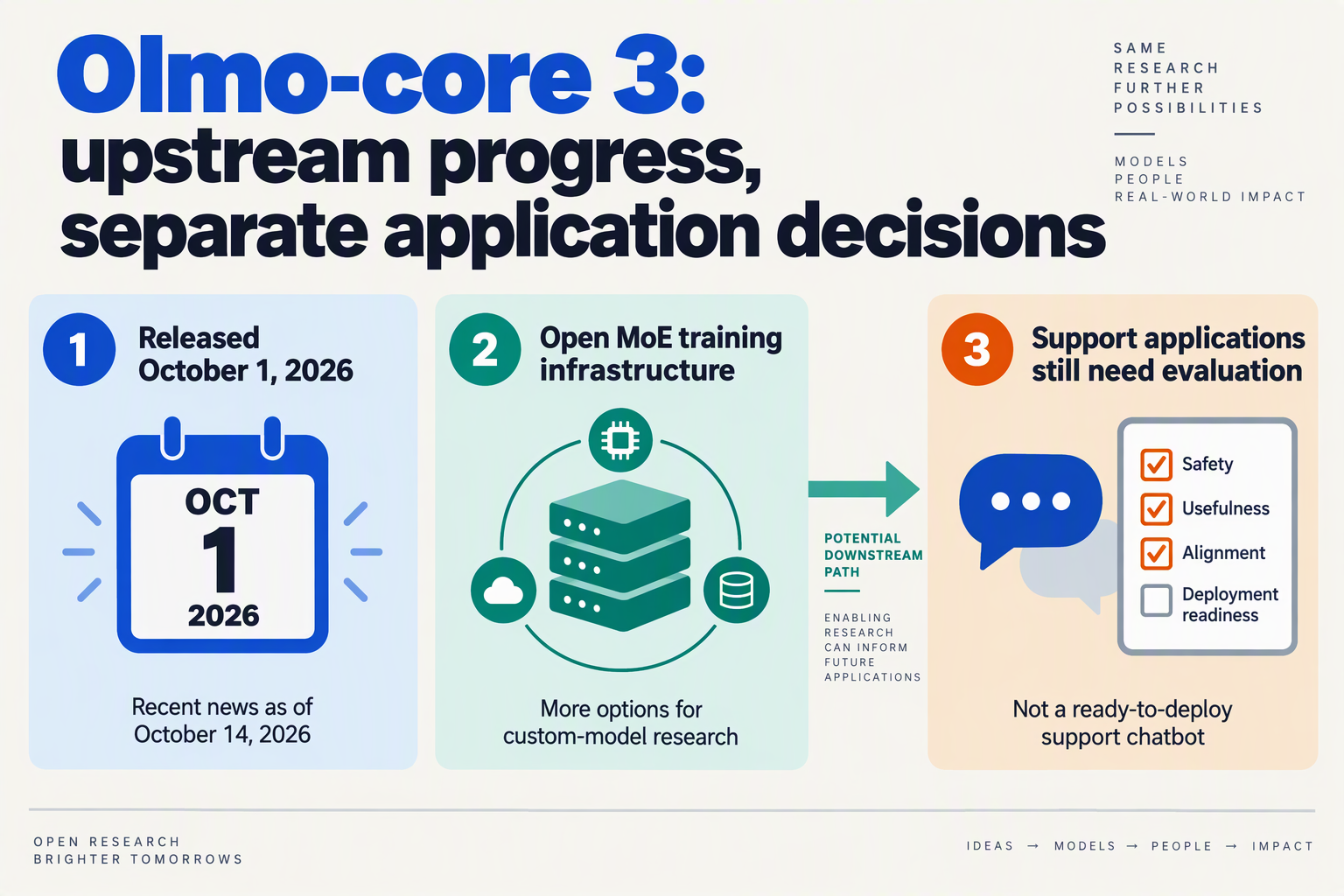
Olmo-core 3 gives support AI builders a more inspectable foundation for developing MoE models—not a ready-to-deploy support assistant. Following Ai2’s October 1, 2026 release, the practical decision is whether your team needs to study or train models, or simply evaluate the models available through its existing application stack.
Who should evaluate Olmo-core 3 first?
The strongest immediate fit is teams that own model development. According to daily.dev’s October 2026 coverage, Ai2 designed the upgraded training infrastructure to scale into the trillion-parameter range. That makes the release relevant to organizations investigating large MoE systems, rather than a prerequisite for every business adding a chatbot.
Support AI builders can separate their next steps into three groups:
- Model-training teams: Inspect the framework and assess whether its design fits planned MoE experiments, available hardware, and engineering expertise.
- Teams adapting existing models: Determine whether they actually need new training infrastructure before committing to migration work.
- Application builders using hosted APIs: Keep the announcement on the model-development watchlist, but prioritize support evaluations and integration reliability.
The distinction prevents an expensive category error: adopting a training framework when the immediate problem is an assistant retrieving the wrong policy or failing to escalate a disputed charge.
What does an open training stack let builders inspect?
Openness makes the implementation available for scrutiny; it does not establish suitability for a particular support workload. VibeLeaderboard’s October 2026 summary identifies code and a technical report for Olmo-core 3, highlighting the opportunity to inspect expert routing and communication.
For a technical team, those materials provide a starting point for questions that a throughput headline cannot answer:
- Reproducibility: Can the team reproduce relevant behavior with its own hardware and workload?
- Operational fit: What engineering effort would integration, monitoring, and maintenance require?
- Support relevance: Does a resulting model perform reliably on the organization’s actual conversations?
TechTimes reports that Olmo-core 3 is available under Apache 2 as of October 2026. That licensing information matters for an initial software review, but builders should still check the terms covering any separate model weights, datasets, and dependencies they intend to use.
Does “trillion-parameter” mean a finished model is available?
A framework’s scaling ambition is not the same as a completed model-training result. AlphaSignal’s October 2026 coverage describes Olmo-core 3 as infrastructure that “scales past a trillion parameters,” while AI Founders’ October coverage explicitly cautions that the stack had not trained a trillion-parameter model.
For support buyers, the useful takeaway is to ask what artifact is actually being evaluated: training code, a scaling demonstration, model weights, or a deployed service. Those are different deliverables with different evidence requirements.
What should a support AI team do next?
Start with a narrowly defined support task—for example, explaining a return policy and invoking an approved tool to check eligibility. Evaluate factual accuracy, tool selection, escalation behavior, and handling of incomplete customer information before considering infrastructure changes.
As of October 2026, CallMissed’s OpenAI-compatible developer API offers function calling and structured outputs, illustrating the application layer where builders can implement these workflows. That is separate from Olmo-core 3’s training role and does not imply that CallMissed serves an Olmo-core-trained model.
The actionable response to this release is therefore selective investigation: study the stack if you develop models; demand task-level evidence if you deploy them.
What did Ai2 release, and how is Olmo-core 3 different from Olmo 3?
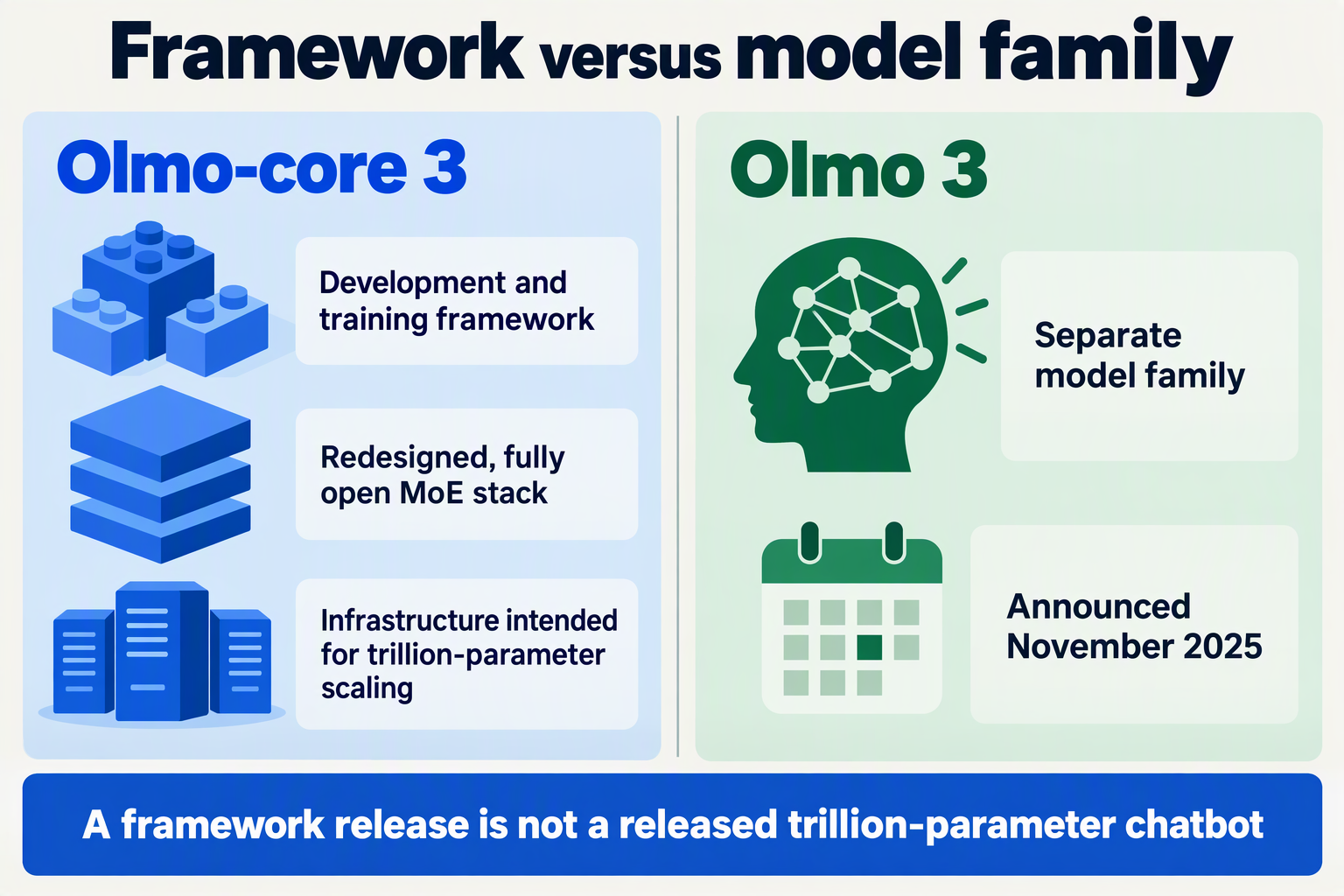
Ai2 released Olmo-core 3, an open framework for training large language models—not a new customer-facing chatbot called Olmo 3. As of October 2026, the essential distinction is that Olmo-core 3 is training infrastructure, while Olmo 3 refers to models: the machinery used to build a model and the resulting model are different releases.
What exactly did Ai2 release with Olmo-core 3?
According to Unite.AI, the Allen Institute for AI (Ai2) released Olmo-core 3 on October 1, 2026, upgrading its language-model development framework around a redesigned mixture-of-experts training system. The announcement concerns how developers train models, rather than a ready-made assistant that support teams can immediately deploy.
The available reporting identifies three important parts of the release:
- Open training code: TechTimes reports that, as of October 2026, Olmo-core 3 is available in Ai2’s
allenai/olmo-coreGitHub repository under the Apache 2.0 license. - Technical documentation: VibeLeaderboard’s October 2026 coverage identifies both code and a technical report, giving researchers material to inspect beyond headline performance claims.
- Large-MoE infrastructure: According to daily.dev’s October 2026 coverage, the redesigned training system targets scaling into the trillion-parameter range.
That last point describes the framework’s intended scale, not proof that Ai2 has released a trained trillion-parameter model. AI Founders’ October 2026 analysis explicitly cautions against treating the infrastructure announcement as evidence of such a completed training run.
How is Olmo-core 3 different from Olmo 3?
The simplest distinction is toolchain versus trained model. A training framework coordinates the computation needed to develop a language model; a trained model supplies the learned parameters used to generate responses.
For a support AI builder, the names therefore point to different evaluation questions:
- When evaluating Olmo-core 3, ask about training. Can your research or engineering team use the framework to run experiments, inspect implementation choices, and reproduce results on available hardware?
- When evaluating an Olmo 3 model, ask about behavior. Does the particular model handle your support tasks accurately, follow policies, and operate within your deployment constraints?
- When evaluating a hosted API, ask about availability. Does the provider actually expose the model you need, with suitable serving capabilities and commercial terms?
A framework release does not answer the second or third question. Nor should a shared version number be read as evidence that every similarly named model uses the same architecture, has identical capabilities, or is available through your existing provider.
What does an open training framework let support builders inspect?
Openness makes training decisions inspectable; it does not automatically establish support quality. VibeLeaderboard’s October 2026 summary highlights expert routing and communication as areas teams can examine in Olmo-core 3.
For teams training models, that access can support investigation of how work moves between experts and where distributed computation becomes expensive. For teams buying inference, the more useful next step is to request evidence about the resulting model.
Consider a returns assistant: knowing its training framework is open does not establish whether it correctly applies a retailer’s refund policy. Builders still need task-specific tests covering policy interpretation, missing information, and escalation.
The practical takeaway is to classify the announcement correctly: Olmo-core 3 belongs on the training-infrastructure watchlist, not automatically on the production-model shortlist.
How does MoE activate experts without creating customer-service agents?
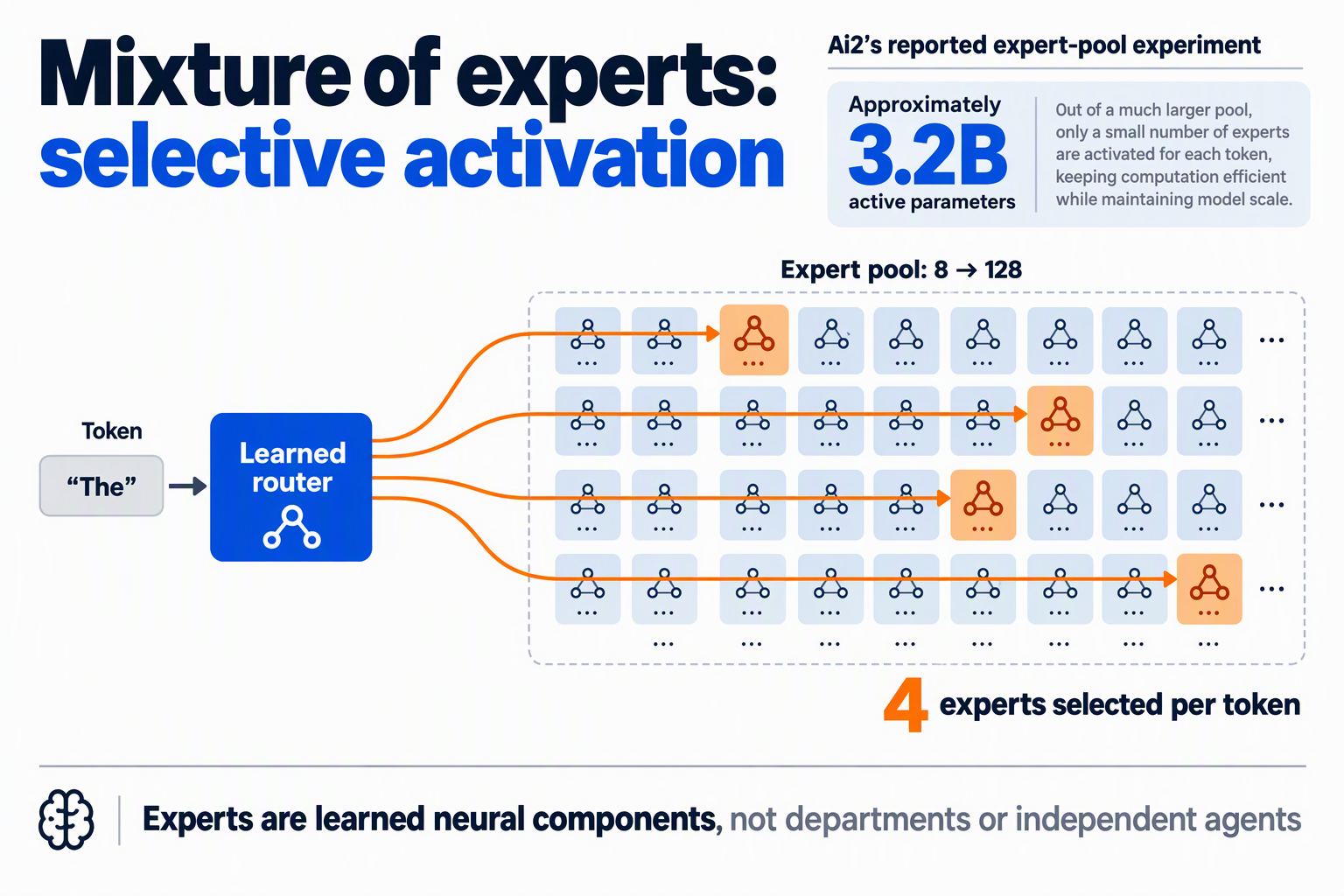
Mixture-of-experts (MoE) routing selects neural subnetworks to process individual tokens; it does not create autonomous customer-service agents. In Olmo-core 3, “experts” belong to the model’s computational architecture—not to a team of refund, billing, or delivery assistants.
How does an MoE router choose which experts to activate?
A typical MoE layer contains a learned router and multiple expert subnetworks. The router scores experts using a token’s internal representation, then directs computation to a selected subset rather than running every expert.
The process generally follows three steps:
- Score: The router estimates which experts should process the current token representation.
- Dispatch: The selected experts receive that representation and perform their computations.
- Combine: The model combines the selected experts’ outputs and continues processing.
The exact selection rule and number of active experts depend on the model configuration; builders should not assume a particular setting from the Olmo-core 3 announcement alone.
In its October 2026 coverage, AI Founders describes MoE as a design where each token activates a handful of specialist subnetworks, or “experts.” That terminology describes selective computation, not independently operating software assistants.
An expert can learn patterns useful for language or reasoning without having a named business responsibility. A token in a refund request might activate certain experts, but that does not establish that any one of them is a “refund specialist.”
Why is expert routing different from customer-service agent routing?
Expert routing decides where computation happens inside a model; agent routing decides which application workflow handles a customer’s request.
Consider the message: “My parcel arrived damaged. Can you replace it?” The underlying MoE model processes tokens through selected subnetworks. Separately, the support application must identify the customer, retrieve the order, check replacement rules, and determine whether approval or human review is required.
These are different responsibilities:
- MoE experts: Process internal numerical representations.
- Support agents: Follow instructions, use permitted tools, and manage conversations.
- Workflow controls: Enforce authentication, approvals, escalation, and business policies.
A router selecting an expert does not authorize a replacement, grant database access, or transfer a conversation to a person. Those actions require application-level controls.
As of October 2026, CallMissed offers custom REST tools and squads that hand a live call between agents. These are application-level capabilities—distinct from the neural expert routing discussed in Ai2’s training framework.
What does this distinction mean for support AI builders?
Treat MoE architecture as a model-design consideration, not a ready-made service organization. According to daily.dev’s October 2026 coverage, Olmo-core 3 redesigns MoE training infrastructure with ambitions to scale into the trillion-parameter range; that scope concerns model infrastructure, not the number of customer-service roles available.
A useful evaluation separates two questions:
- Does the model understand and reason correctly? Test damaged-item requests, ambiguous policies, multilingual messages, and conflicting evidence.
- Does the application act safely? Test tool permissions, approval requirements, missing order records, and human escalation.
For example, a model might correctly interpret a replacement request while the application still blocks the action because the customer has not authenticated. That is desirable behavior, not a failure of expert selection.
The practical takeaway: sparse neural computation can support a capable assistant, but service responsibilities must still be explicitly designed, connected, and tested.
What are the reported benchmark results and their limits?
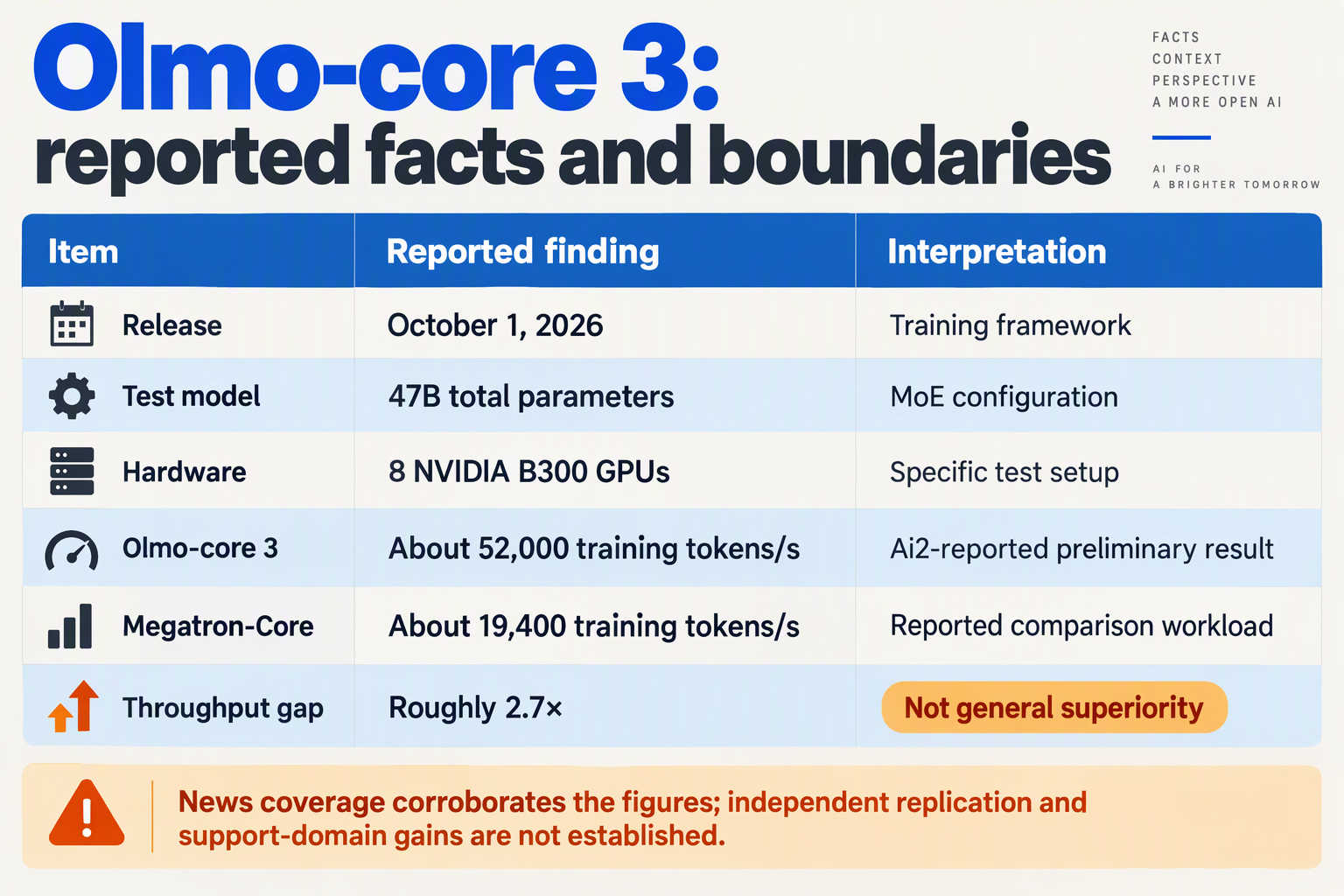
The reported Olmo-core 3 benchmark shows approximately 2.68× higher training throughput than Megatron-core on one preliminary MoE workload—not a demonstrated improvement in support-agent quality or response time. As of October 2026, the supplied coverage supports a promising infrastructure result, but not a general performance guarantee.
What did the Olmo-core 3 benchmark measure?
FourWeekMBA reports that Ai2’s October 2026 preliminary benchmark processed 52,000 tokens per second using a 47-billion-parameter mixture-of-experts model on eight NVIDIA B300 GPUs. AI Weekly reports that Ai2’s October 2026 comparison measured approximately 19,400 tokens per second for NVIDIA’s Megatron-core on the same workload.
The table separates reported measurements from calculations and scaling claims:
| Benchmark item | Reported result | Source and date | Main limitation |
|---|---|---|---|
| Olmo-core 3 throughput | 52,000 tokens/second | FourWeekMBA, October 2026 | Preliminary, short-capacity test |
| Megatron-core throughput | Approximately 19,400 tokens/second | AI Weekly, October 2026 | Ai2’s comparison, not independent validation |
| Relative throughput | Approximately 2.68× | Calculated from October 2026 reported figures | Applies to this comparison |
| Model size | 47 billion parameters | FourWeekMBA, October 2026 | Total size does not specify active parameters per token |
| Hardware configuration | Eight NVIDIA B300 GPUs | FourWeekMBA, October 2026 | Does not establish performance on other hardware |
| Trillion-parameter scaling | Framework targets trillion-parameter scale | AlphaSignal and daily.dev, October 2026 | Scaling ambition is not a completed training result |
The October 2026 figures reported by FourWeekMBA and AI Weekly imply approximately 168% higher throughput, calculated as (52,000 ÷ 19,400 − 1) × 100. That is different from claiming “268% faster,” which would overstate the relative increase.
What do the benchmark results leave unanswered?
FourWeekMBA’s October 2026 description of the benchmark as a “short-capacity test” is the central qualification. A short test can demonstrate processing capacity without establishing sustained efficiency across a complete training run.
Before treating the result as reproducible evidence, builders should look for:
- Workload details: sequence length, numerical precision, batch size, expert configuration, and active parameters per token.
- Comparison controls: software versions, configuration tuning, and whether both frameworks received comparable optimization.
- Run conditions: warm-up treatment, measurement duration, repeated trials, and variability.
- Training outcomes: convergence, checkpoint overhead, recovery behavior, and final model quality.
The supplied summaries do not establish these details. Hardware naming also deserves verification: FourWeekMBA identifies B300 GPUs, while the supplied AI Weekly excerpt says “B3000.” Consult Ai2’s underlying benchmark configuration before reproducing the test rather than silently treating those labels as interchangeable.
How should support AI builders interpret the speedup?
Use the benchmark as an input to infrastructure evaluation, not as a purchasing shortcut. For example, dividing a hypothetical 100-hour compute-only workload by 2.68 gives roughly 37 hours—but only if the measured advantage persists throughout the job. This is illustrative arithmetic, not an observed training-duration result.
For a support assistant, a practical evaluation sequence is:
- Validate training efficiency on the intended hardware and model configuration.
- Check model quality using representative support conversations and tool-use tasks.
- Measure serving performance separately, including response latency, cost per resolved conversation, and human-handoff accuracy.
The benchmark’s value is narrower—and more useful—than a universal speed claim: it provides a concrete reason to investigate Olmo-core 3 for MoE training, while leaving customer-facing benefits to be demonstrated.
What is token gerrymandering, and why is it a training-routing issue?
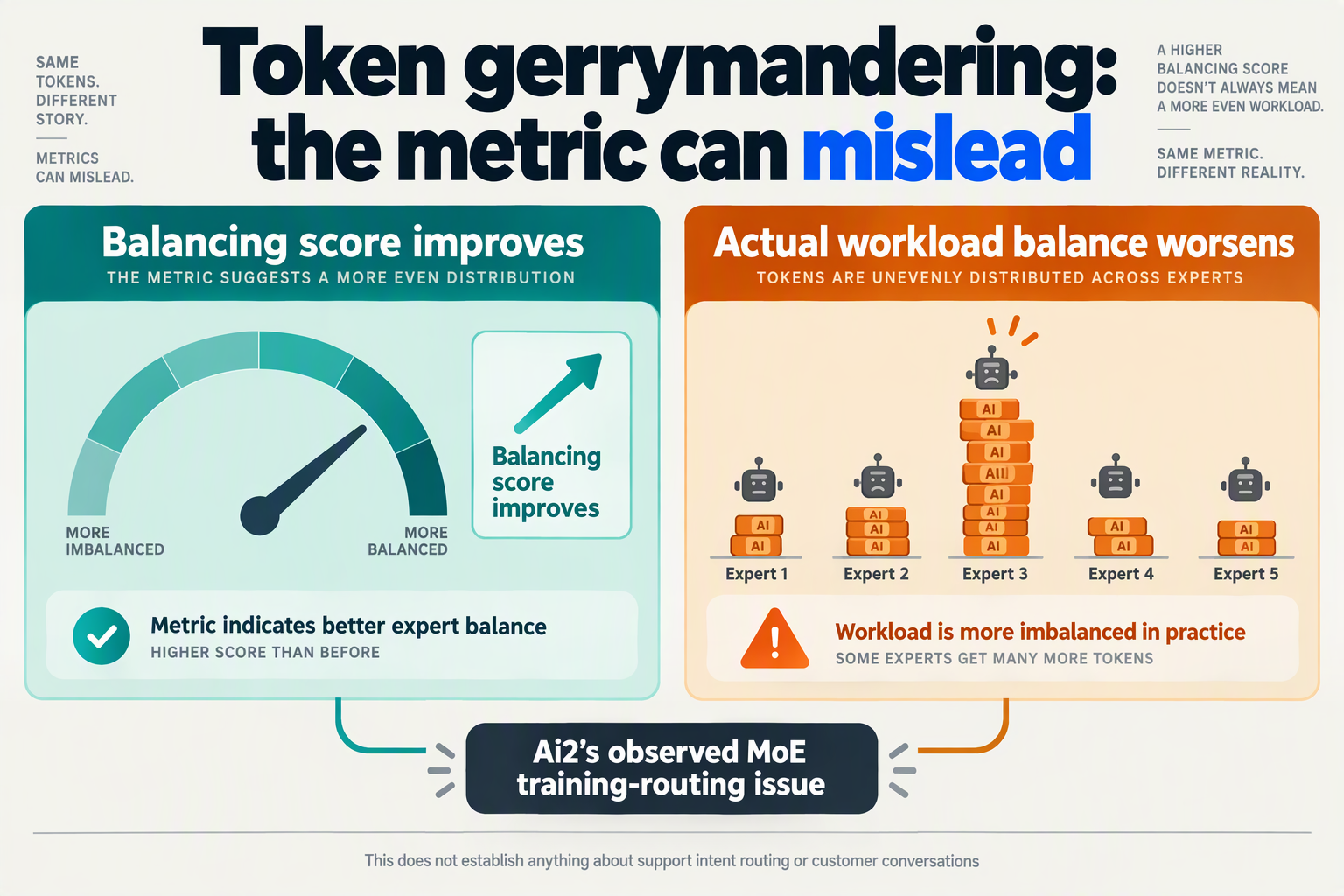
Token gerrymandering is a failure mode in which pressure to balance expert workloads distorts which tokens go to which experts. It is a training-routing issue because the tension arises between learning useful token-to-expert assignments and keeping distributed training hardware evenly occupied—not between customer requests and support departments.
How can load balancing distort expert routing?
A mixture-of-experts (MoE) router assigns tokens to selected neural-network experts. During training, an uneven distribution can leave some experts overloaded while others have little work, creating bottlenecks across the GPUs hosting those experts.
Load-balancing objectives encourage a more even distribution. The problem arises when satisfying that objective competes with learning useful expert assignments: the router can improve its balance score without necessarily improving the model’s representation of the input.
The “gerrymandering” analogy concerns the difference between a balanced-looking distribution and a meaningful one. However, the supplied October 2026 reporting does not provide Ai2’s formal definition, routing equations, or a measured incidence of this behavior. It therefore does not establish that Olmo-core 3 eliminates the problem.
Three concepts should remain separate:
- Routing quality: whether token assignments help the model learn useful representations.
- Load balance: whether experts receive reasonably distributed workloads.
- Training throughput: how efficiently the hardware processes those workloads.
Improvement in one does not automatically demonstrate improvement in the others.
Why does the training batch matter?
Balancing pressure depends partly on which tokens are counted together. A batch containing mostly similar material may naturally favor a narrower set of experts than a batch mixing many subjects and languages.
Consider an illustrative training batch dominated by Hindi returns conversations. If the router must distribute that batch uniformly, it may redirect tokens away from its preferred experts to satisfy the balancing objective. Across a larger, more diverse collection of batches, those preferred assignments might already produce acceptable overall utilization.
The practical question is therefore not simply, “Are the experts balanced?” Builders examining a training recipe should ask:
- At what scope is balance measured? A local batch and a broader aggregation can produce different pressures.
- How strongly is imbalance penalized? Stronger pressure may improve utilization while constraining specialization.
- What happens to overloaded experts? Capacity limits and token-handling policies affect both efficiency and learning.
- What quality evidence accompanies throughput? Hardware utilization alone cannot validate routing behavior.
As of October 2026, daily.dev describes Ai2’s Olmo-core 3 as infrastructure designed to scale MoE training into the trillion-parameter range. That ambition makes routing policy important, but it is not evidence of any particular routing-quality outcome.
Does token gerrymandering affect a deployed support assistant?
Training-time expert routing is not application-level support routing. Sending a refund conversation to a human, invoking an order-status tool, and selecting an internal neural-network expert are different operations.
Nevertheless, training decisions can influence the resulting model. Support builders should test multilingual comprehension, policy adherence, and consistency across differently worded requests rather than infer those qualities from a training benchmark. MoE expert routing also continues during inference, so deployment behavior requires separate evaluation.
As of October 2026, CallMissed supports eval suites and A/B experiments for its voice agents. Those application-level checks complement—not replace—inspection of the underlying model’s training recipe.
The takeaway: balanced experts are an engineering objective, not a customer-service quality guarantee.
Who should investigate the framework, and who should keep their current application stack?
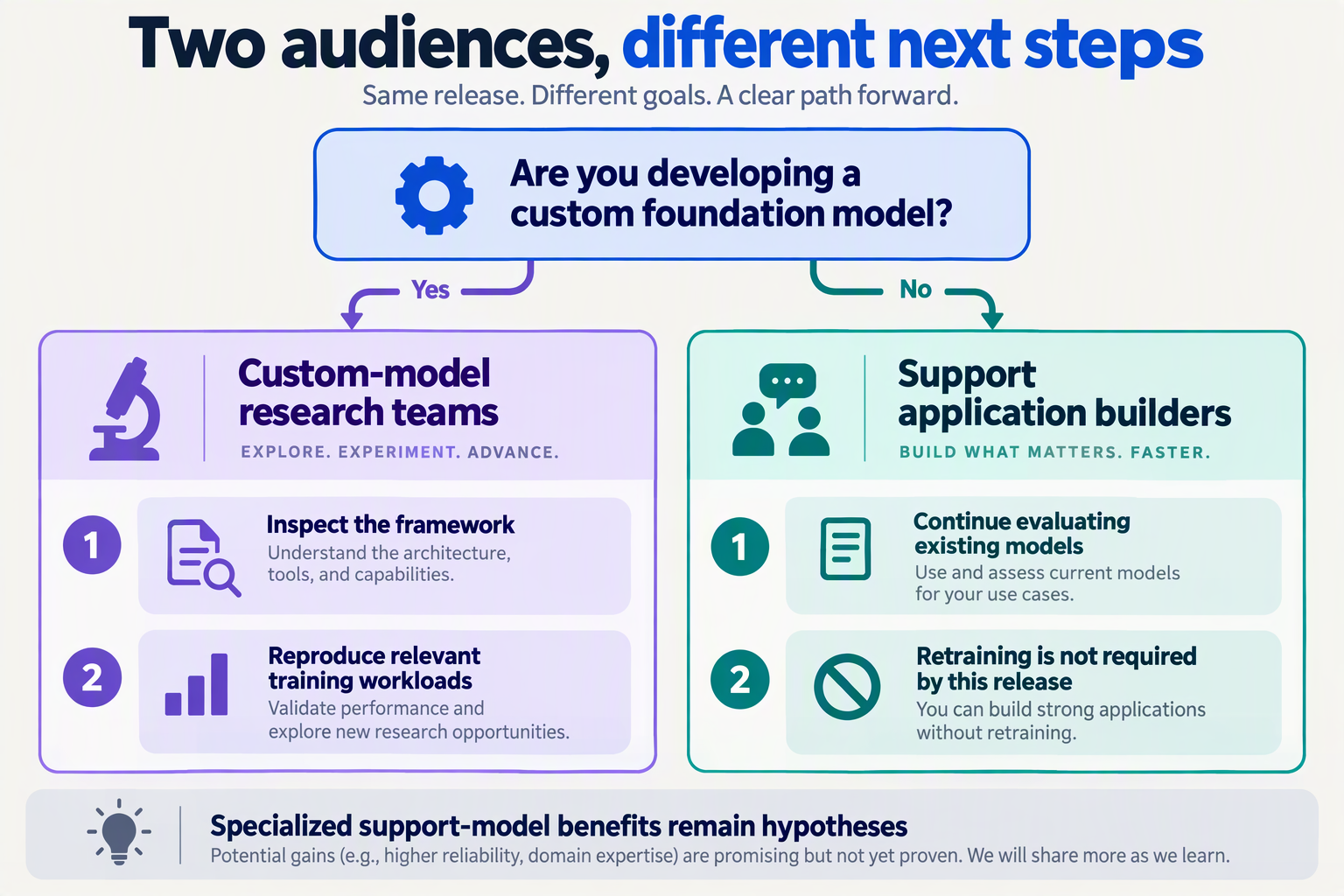
Olmo-core 3 deserves investigation by teams that train models or research mixture-of-experts systems; most support application builders should keep their current deployment stack. As of October 2026, the decision depends on whether your bottleneck is model training infrastructure or the customer-facing workflow around an existing model.
Who should evaluate Olmo-core 3?
The strongest candidates are model research groups, training infrastructure engineers, and organizations with a justified requirement to develop their own models. These teams can assess the framework against problems they actually own: distributed computation, expert routing, hardware utilization, and reproducible experiments.
VibeLeaderboard’s October 2026 coverage describes Ai2’s Olmo-core 3 as open training infrastructure with code and a technical report, allowing teams to inspect expert routing and communication. That inspectability is valuable even when adopting the entire framework is not the immediate goal.
Consider investigating if your team:
- Already operates distributed training workloads and can compare frameworks under controlled conditions.
- Studies MoE architectures and needs implementation details rather than a hosted inference endpoint.
- Has suitable GPU access and engineering capacity to reproduce experiments, diagnose failures, and maintain a training environment.
- Can connect model development to a specific support requirement, such as a documented quality gap that existing models and application improvements have not resolved.
AlphaSignal’s October 2026 coverage describes Olmo-core 3 as targeting scale beyond a trillion parameters. Treat that as a reason for infrastructure specialists to examine the design—not a requirement for a support assistant or proof of customer-service quality.
Who should keep their current support AI stack?
Teams assembling assistants from hosted models, retrieval, business tools, and human escalation should generally stay application-focused. A training framework is not a replacement for an inference API, knowledge base, ticketing integration, or conversation-management layer.
This includes:
- Small support teams whose main constraints are staffing, knowledge freshness, and escalation handling.
- Product engineers using model APIs who need dependable responses without owning model training.
- Businesses deploying voice or messaging assistants where tool execution and conversation continuity determine whether a task succeeds.
For example, an assistant that gives outdated return-policy advice needs better knowledge management and evaluation before it needs a different training framework. An assistant that cannot complete an authorized order lookup needs an integration fix.
As of October 2026, CallMissed’s customer-communication platform offers knowledge bases built from text, web pages, and PDFs, custom REST tools, and a human-handoff queue. Those application-layer capabilities address a different engineering problem from Ai2’s training infrastructure.
How can teams investigate without committing to a migration?
Use a bounded evaluation, not a stack-replacement project:
- Define the unresolved problem. Identify why existing models, retrieval improvements, or workflow changes are insufficient.
- Check prerequisites. Confirm hardware access, distributed-training expertise, dataset permissions, and an owner for ongoing maintenance.
- Set a representative experiment. Compare training approaches using consistent hardware, model configuration, and measurement methods; do not extrapolate directly from Ai2’s headline benchmark.
- Require downstream evidence. Evaluate the resulting model on support-task correctness, tool-use reliability, escalation behavior, and serving cost before considering deployment changes.
The practical dividing line is ownership: investigate Olmo-core 3 when training is your responsibility; retain your application stack when delivering reliable support is your immediate job. Following the framework’s development can still inform future model choices without creating an unnecessary migration today.
How does industry coverage frame the promise and the caveats?

Industry coverage frames Olmo-core 3 as a promising advance in open MoE training infrastructure, but differs in how clearly it separates measured performance from ambitions for larger models. For support AI builders, the useful reading is not “a better chatbot has arrived,” but “a more inspectable training stack may expand future model-development options.”
Why do headlines emphasize trillion-parameter scale?
As of October 2026, AlphaSignal headlines Ai2’s announcement as “Ai2 Rebuilds OLMo-Core 3 to Train Trillion-Parameter AI 2.7x Faster.” daily.dev similarly describes the redesigned mixture-of-experts system as built to scale into the trillion-parameter range.
Those descriptions communicate the architectural ambition. However, capacity to support a model size, a throughput measurement, and a completed training run are different claims. A reader scanning headlines could easily merge them into one accomplishment.
According to FourWeekMBA’s October 2026 coverage, Ai2’s preliminary throughput result involved a 47-billion-parameter MoE model on eight NVIDIA B300 GPUs, rather than a trillion-parameter model. That distinction sets the boundary of the evidence described in the supplied reporting; it does not dismiss the framework’s potential.
For builders, read scale claims through three separate questions:
- What was measured? Identify the model size, hardware, and workload.
- What is the infrastructure designed to support? Treat architectural scale as a capability claim requiring further evidence.
- What completed training results are documented? Look for sustained runs and resulting model evaluations before inferring downstream quality.
Which coverage makes the caveats clearest?
FourWeekMBA calls the benchmark a “short-capacity test,” while AI Weekly explicitly attributes the comparison to Ai2’s own benchmarks in its October 2026 coverage. These qualifications matter because reporting an organization’s result is not the same as independently reproducing it.
AI Founders takes a more skeptical editorial angle, headlining its October 2026 article: “Ai2’s ‘Trillion-Parameter’ MoE Stack Never Trained a Trillion-Parameter Model. Take the Recipe Instead.” The headline challenges the scale narrative; it should be read as that publication’s framing, not substituted for a full technical assessment.
Together, these sources suggest a practical evidence hierarchy:
- Reported benchmark: useful evidence about a specified test.
- Scaling ambition: a reason to investigate, not proof of a completed run.
- Support-system benefit: an application-level outcome that still needs testing.
Why is openness more actionable than the speed headline?
As of October 2026, VibeLeaderboard emphasizes that Olmo-core 3 includes code and a technical report that teams can inspect to study expert routing and communication. TechTimes reports that OlmoCore 3 is available under Apache 2, adding a concrete licensing detail to the openness narrative.
For a support AI team, that inspectability offers a more practical starting point than treating training throughput as a purchasing signal. A multilingual retailer, for example, should still evaluate regional-language comprehension, escalation decisions, and answer accuracy before changing its deployed model.
As of October 2026, CallMissed’s OpenAI-compatible developer API offers caller-chosen fallback models and usage and request logs—deployment capabilities relevant to evaluating model choices, rather than evidence for Ai2’s training claims.
The balanced conclusion is optimism about the infrastructure, discipline about the evidence. Industry coverage gives builders reasons to investigate Olmo-core 3, not reasons to skip production evaluation.
When did the model-family announcement and framework release happen?
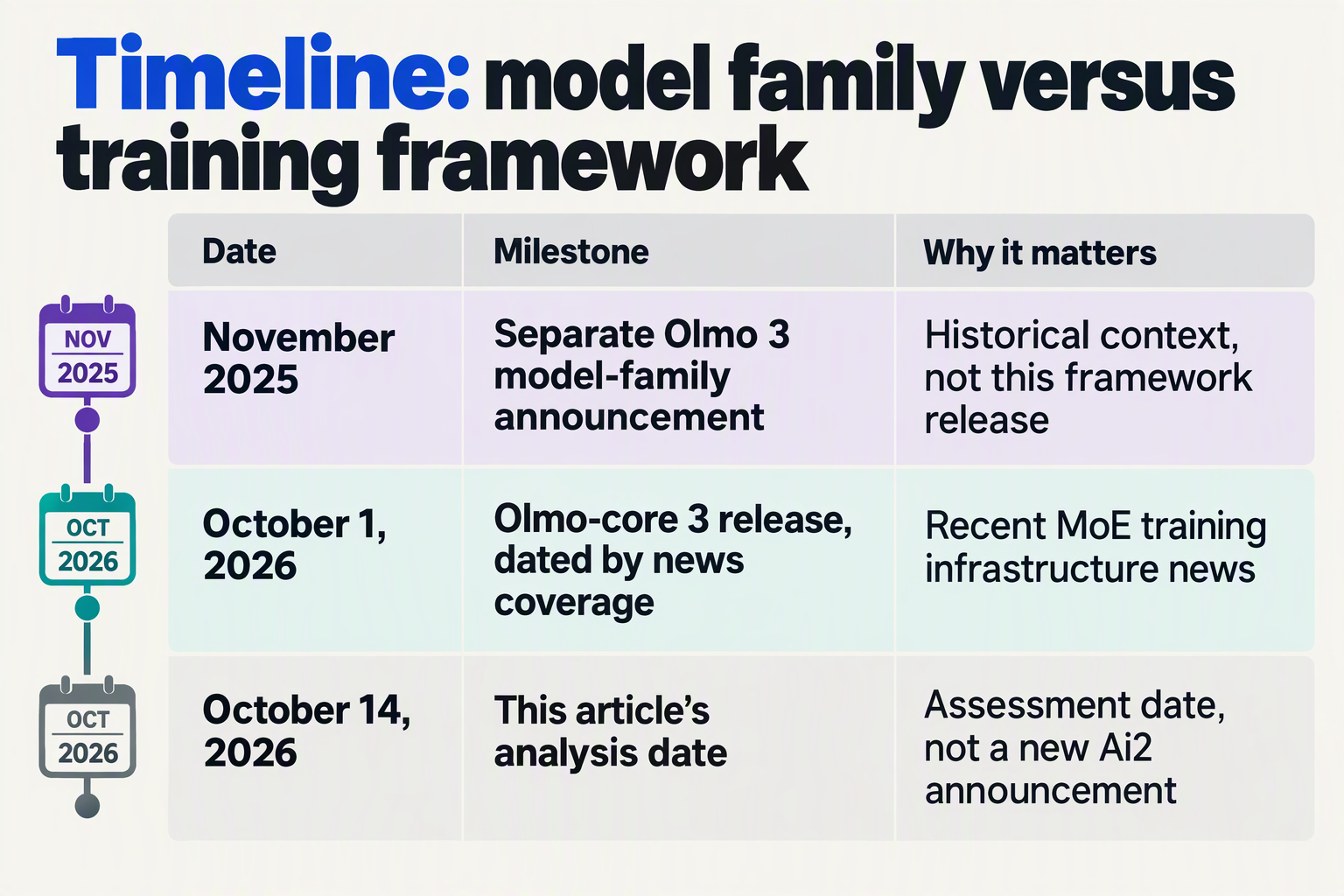
Ai2 released Olmo-core 3 on October 1, 2026, according to Unite.AI and FourWeekMBA. The supplied reporting does not establish a separate model-family announcement date, so the framework release should not be presented as the launch date of a similarly named model family.
What is the verified Olmo-core 3 release timeline?
The chronology below separates confirmed dates from information that is available as of October 14, 2026 but lacks an independently specified event date. That distinction matters when deciding whether an announcement concerns model weights, training software, or supporting evidence.
| Event | Date or status | Source | What builders should record |
|---|---|---|---|
| Separate model-family announcement | Not established in supplied sources | Supplied research context | Leave the date unconfirmed; do not substitute the framework date |
| Olmo-core 3 framework release | October 1, 2026 | Unite.AI; FourWeekMBA | Confirmed release of the open MoE training framework |
| Preliminary benchmark disclosure | Reported with October 2026 coverage; test date unspecified | FourWeekMBA | Distinguish the reporting period from the actual test date |
| Public code availability | Reported as available; repository publication date unspecified | TechTimes; AlphaSignal | Code availability does not establish a model-checkpoint release |
| Current reporting cutoff | October 14, 2026 | This article’s review date | Later announcements fall outside this section’s timeline |
October 1, 2026 is the supported framework release date, not a verified date for every related artifact. A repository, technical report, benchmark, and model checkpoint can appear on different schedules—even when coverage groups them under one announcement.
Is Olmo-core 3 a model-family launch or a framework release?
As of October 2026, daily.dev describes Olmo-core 3 as an upgrade to Ai2’s open large-language-model training framework, featuring a redesigned mixture-of-experts training system. VibeLeaderboard likewise describes the announcement as open training infrastructure accompanied by code and a technical report.
Those descriptions support an infrastructure-release interpretation. They do not, on their own, establish that a new family of downloadable, production-ready models launched that day.
For a support AI roadmap, keep three artifact categories separate:
- Training framework: software used to develop models.
- Model checkpoint: trained weights that require their own availability and licensing checks.
- Serving integration: the runtime or API through which an application uses a model.
A release in the first category does not automatically deliver the other two. For example, a support team updating its model inventory should not mark “new model available” solely because training code has been published.
What should builders verify before updating a release calendar?
Use the October 1 date for the framework entry, then verify related artifacts individually:
- Check the primary announcement. Confirm whether Ai2 names a framework, model family, checkpoint, or technical report.
- Check repository releases and tags. Separate software version dates from news-publication dates.
- Check the intended deployment artifact. Confirm that any model weights or serving endpoint actually exist before scheduling application evaluation.
TechTimes reports that Olmo-core 3 is available through Ai2’s GitHub repository under Apache 2, as reflected in the supplied October 2026 coverage. Builders should still inspect the license attached to each artifact they intend to use.
The practical conclusion is straightforward: record October 1, 2026 as the Olmo-core 3 framework release, and keep the model-family announcement date unconfirmed until a source explicitly establishes it.
What should support teams evaluate today instead of assuming downstream gains?
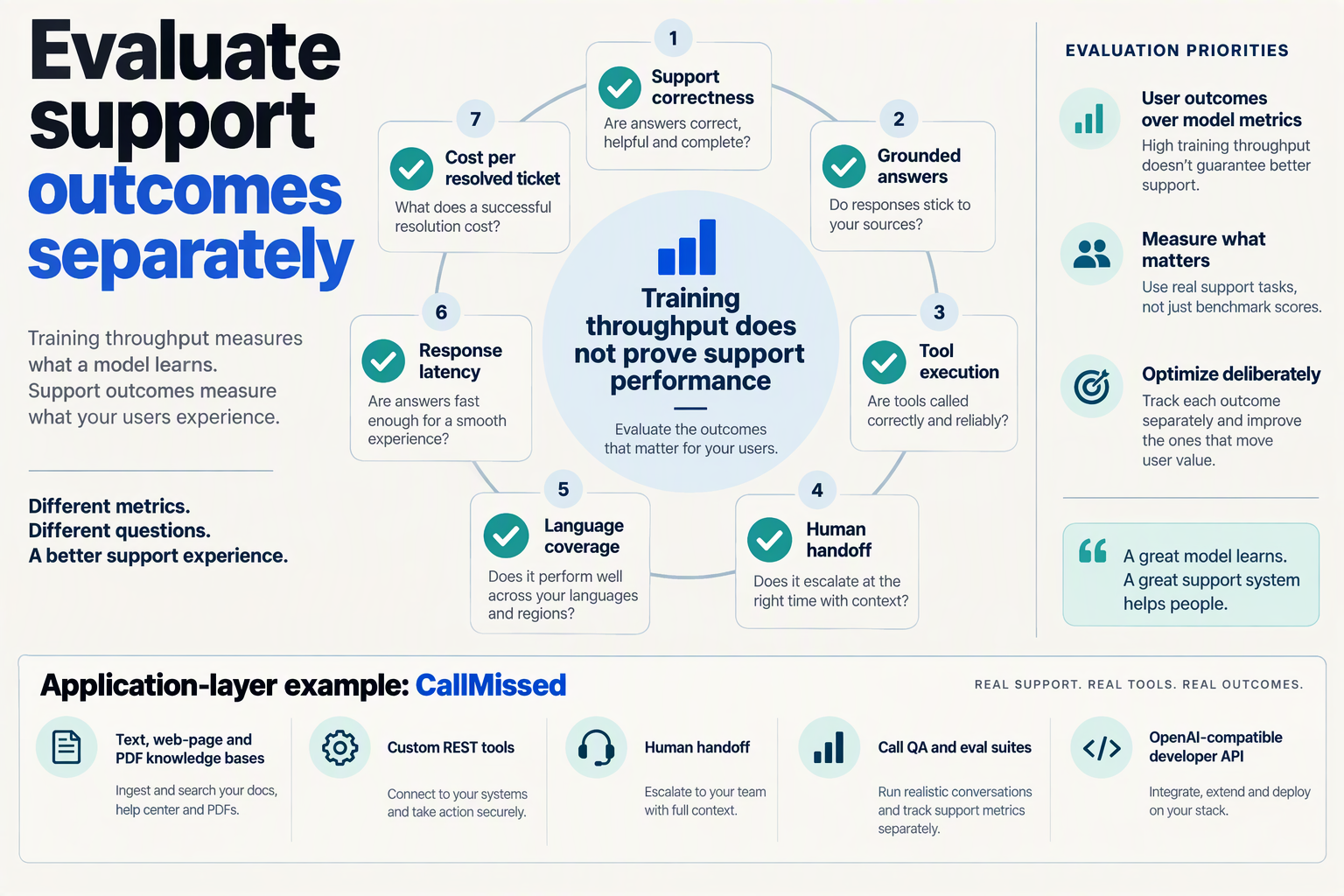
Support teams should evaluate task accuracy, tool reliability, customer-facing latency, escalation quality, and cost per correctly resolved case using their own workflows. As of October 2026, the Olmo-core 3 announcement is a reason to monitor model-development progress—not to relax production acceptance criteria.
FourWeekMBA describes Ai2’s October 2026 benchmark as a “short-capacity test.” That qualification matters when setting evaluation priorities: evidence about training infrastructure cannot substitute for evidence about your support application.
How should teams test whether an AI resolves support requests correctly?
Build a versioned evaluation set from anonymized support cases, with expected answers, permitted actions, and escalation rules. Include ordinary requests alongside situations where a confident answer would be harmful.
An illustrative October 2026 pilot could use 200 cases, divided into 100 routine requests, 50 policy exceptions, and 50 adversarial or ambiguous requests. These are proposed test sizes, not results reported by Ai2.
Test cases should cover:
- Grounded answers: Does the assistant follow the current refund policy rather than inventing an exception?
- Missing information: Does it request an order identifier instead of guessing?
- Multilingual ambiguity: Does it preserve intent when customers switch languages or use regional phrasing?
- Security boundaries: Does it refuse to disclose another customer’s account details?
- Appropriate abstention: Does it escalate when the knowledge base cannot support an answer?
Score answer correctness and action correctness separately. An assistant can explain a cancellation policy accurately while cancelling the wrong order—a failure that a text-only evaluation would miss.
Which operational metrics should determine deployment readiness?
Measure the complete customer journey, not just model generation speed. A useful evaluation sequence is:
- Instrument each stage. Record retrieval time, model response time, tool execution time, and total time until the customer receives a useful answer.
- Test realistic load. Measure median and 95th-percentile latency during concurrent conversations, including slow CRM responses and unavailable integrations.
- Validate tool behavior. Check authorization, input validation, timeout handling, and duplicate-action prevention before allowing account changes.
- Inspect handoffs. Confirm that a human receives the conversation context, attempted actions, and unresolved issue.
- Calculate resolution economics. Include model usage, retrieval, retries, channel charges, and human follow-up.
Define cost per correctly resolved case as total measured support-processing cost divided by cases verified as correctly resolved. Keep unresolved and incorrectly resolved cases in the cost total; excluding them would make an unreliable system appear artificially inexpensive.
As of October 2026, CallMissed, the AI customer-communication platform and developer API, offers eval suites, A/B experiments, call scoring against custom QA rubrics, and usage and request logs. Those capabilities can support application-level evaluation, but teams still need to define their own acceptance criteria and verify outcomes.
What evidence should justify changing a production support stack?
Require a controlled comparison against the existing workflow using the same cases, knowledge sources, tool permissions, and scoring rubric. Begin with shadow testing—where proposed actions are reviewed rather than executed—before a limited live rollout.
Set non-negotiable safety gates separately from performance goals. A lower average cost should not compensate for unauthorized refunds, privacy breaches, or failed escalations.
The practical decision is whether a candidate system improves verified customer outcomes under your operating conditions. Olmo-core 3 may influence which models become available later; deployment decisions today should follow measured support results.
Frequently Asked Questions
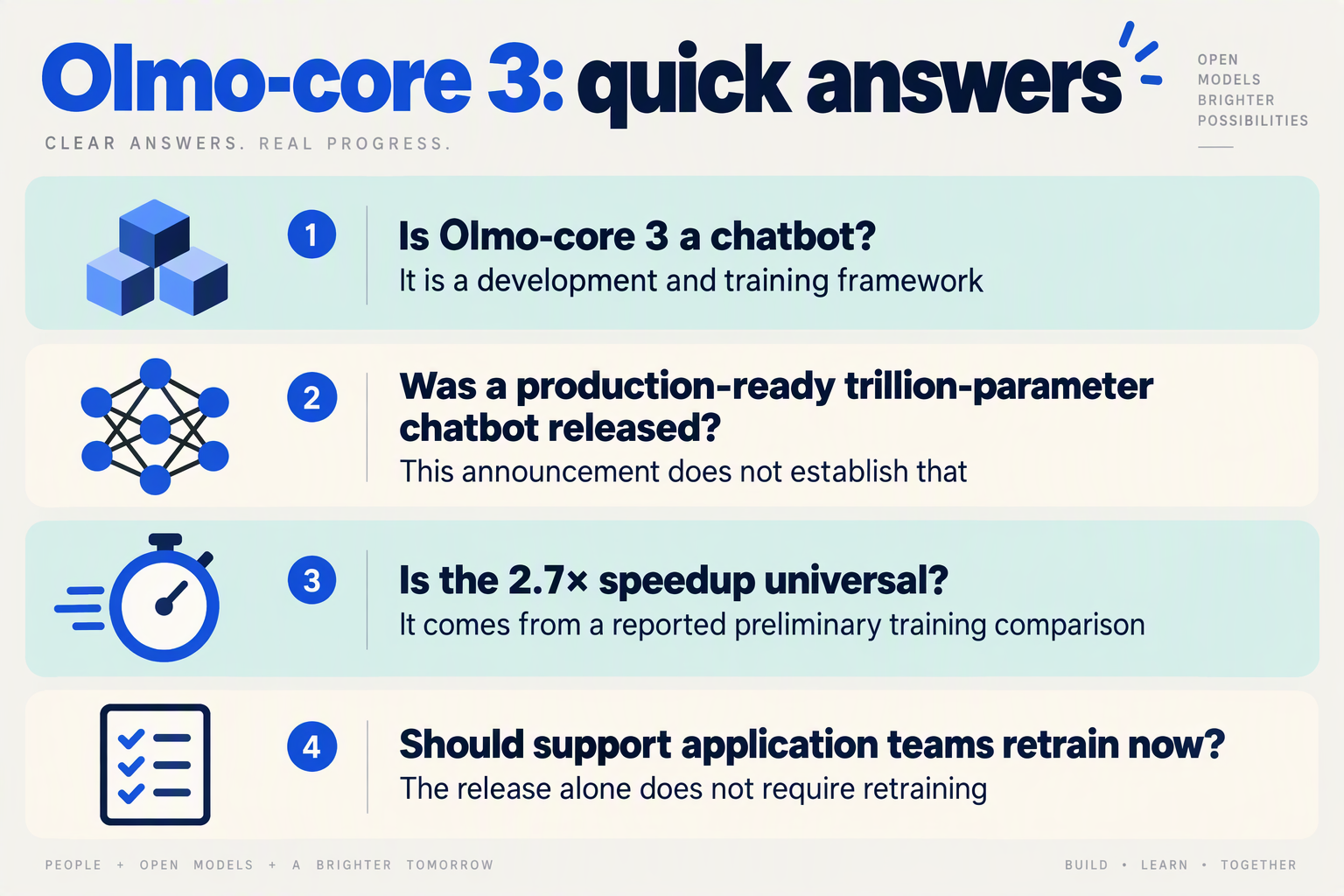
Is Olmo-core 3 a language model or an AI training framework?
Does Olmo-core 3 deliver 2.7× faster training on every workload?
Has Olmo-core 3 already trained a trillion-parameter model?
Will faster MoE training make customer-support chatbots respond faster?
Should customer-support teams retrain their AI models after Ai2’s announcement?
How should support AI builders evaluate models trained with the new framework?
Conclusion
Olmo-core 3 is a promising advance in model-training infrastructure—not proof of faster or more reliable support AI. For builders, Ai2’s announcement matters because more efficient, inspectable mixture-of-experts training could support future model development, while customer-facing benefits still require separate evaluation.
Four takeaways should guide the response:
- The throughput result is significant but preliminary. According to FourWeekMBA, Ai2’s October 2026 test processed 52,000 tokens per second with a 47-billion-parameter MoE model on eight NVIDIA B300 GPUs. AI Weekly reports approximately 19,400 tokens per second for NVIDIA’s Megatron-core on the same workload, making the reported difference roughly 2.7 times. That comparison concerns training throughput, not chatbot response speed.
- The benchmark’s boundaries matter. FourWeekMBA describes Ai2’s October 2026 result as a “short-capacity test.” Builders should therefore treat the result as evidence about a particular workload and configuration, rather than a guarantee for every model, training run, or deployed assistant. The useful question is where the improvement holds—not whether the headline justifies replacing an existing support stack.
- MoE efficiency addresses an upstream challenge. As described in the October 2026 announcement coverage, mixture-of-experts models activate selected expert subnetworks for each token, and Olmo-core 3 targets the routing and communication challenges involved in training them. More efficient infrastructure could enable additional experimentation, but it does not automatically establish better refund decisions, stronger multilingual comprehension, or fewer hallucinations.
- Support quality must remain the deployment test. An order-status assistant succeeds when answers are correct, account information stays protected, and customers can reach a human when necessary. Evaluate any resulting model against those requirements, alongside response latency and deployment economics. Faster training is valuable only if downstream systems eventually deliver benefits that the support team can verify.
What should support AI builders watch next?
Following the October 1, 2026 release reported by Unite.AI, watch for evidence that the preliminary throughput advantage holds across broader workloads and configurations. Equally important will be application-level evaluations showing whether models developed with this infrastructure improve support quality or operating costs without weakening reliability.
The distinction between training and deployment should remain central. An open framework makes infrastructure more inspectable; a production support system still needs careful model selection, measurement, and operational oversight.
To explore the deployment side, CallMissed, an AI customer-communication platform and developer AI API, offers OpenAI-compatible endpoints, caller-chosen fallback models, and usage and request logs as of October 2026. Those capabilities are relevant to evaluating models rather than assuming a training benchmark predicts customer outcomes.
Before adopting the next model, ask: what measurable improvement will customers actually experience?
Related Reading
- When security concerns slow adoption: AI Support in India
- LLM vendor evaluation checklist: Before Support Pilots
- Cost per resolved ticket: An LLM Support Evaluation Guide