LLM vendor evaluation checklist: Before Support Pilots



Use this LLM vendor evaluation checklist to verify availability, data terms, tool safety, evidence, costs, and rollback before a support pilot.
LLM vendor evaluation checklist: Before Support Pilots
Would you let a preview model issue customer refunds just because its launch dominates the conversation? An LLM vendor evaluation checklist should answer a more practical question: what evidence must a supplier provide before your support team commits customer data, engineering time, or decision-making authority to a pilot?
Mistral announced Mistral Large 4 on October 6, 2026, with model weights promised by the end of October, according to Mistral’s announcement. As of October 12, 2026, that means a preview with a future weights commitment—not a completed open-weight release. A Hacker News discussion adds visibility, but launch attention is a reason to investigate, not evidence of customer-support readiness.
That distinction matters because support procurement is not simply model selection. A compelling demonstration can leave unanswered whether the exact version is available through an API, whether its license permits your deployment, or what happens when capacity runs out. A promised release cannot substitute for a deployment your team can actually test.
What should you ask an LLM vendor before a support pilot?
Start by defining the job. Routing tickets, suggesting replies, and answering questions from approved knowledge are different responsibilities from executing refunds, cancellations, or account changes. Read-only assistance and consequential actions should not share the same approval threshold.
Then organize the vendor conversation around three decisions:
- What can we buy or deploy now? Request the exact model ID and version, preview or production status, API access, hosting options, license, support terms, capacity limits, and release and deprecation policies.
- Does it fit our support workflow? Establish requirements for tool schemas, structured responses, streaming, error handling, retrieved knowledge, conversation state, human handoff, and the channels customers already use.
- What would stop the pilot? Set explicit go/no-go conditions for unresolved deployment rights, unavailable capacity, incompatible integrations, or missing controls around consequential actions before discussing launch dates.
As of October 2026, CallMissed’s developer AI API offers OpenAI-compatible and Anthropic-compatible endpoints, illustrating why integration contracts deserve attention alongside model capabilities.
This guide separates vendor claims, team verification, and pilot admission criteria. You will learn which questions belong in procurement, which answers require technical confirmation, and which uncertainties should block a pilot rather than become its hidden assumptions.
For example, a vendor’s claim that a model supports tools is only the starting point; your team still needs to verify schema compliance, failure behavior, and authorization boundaries.
The goal is not to reject emerging models. It is to make experimentation accountable.
What should an LLM vendor evaluation checklist verify before a support pilot?
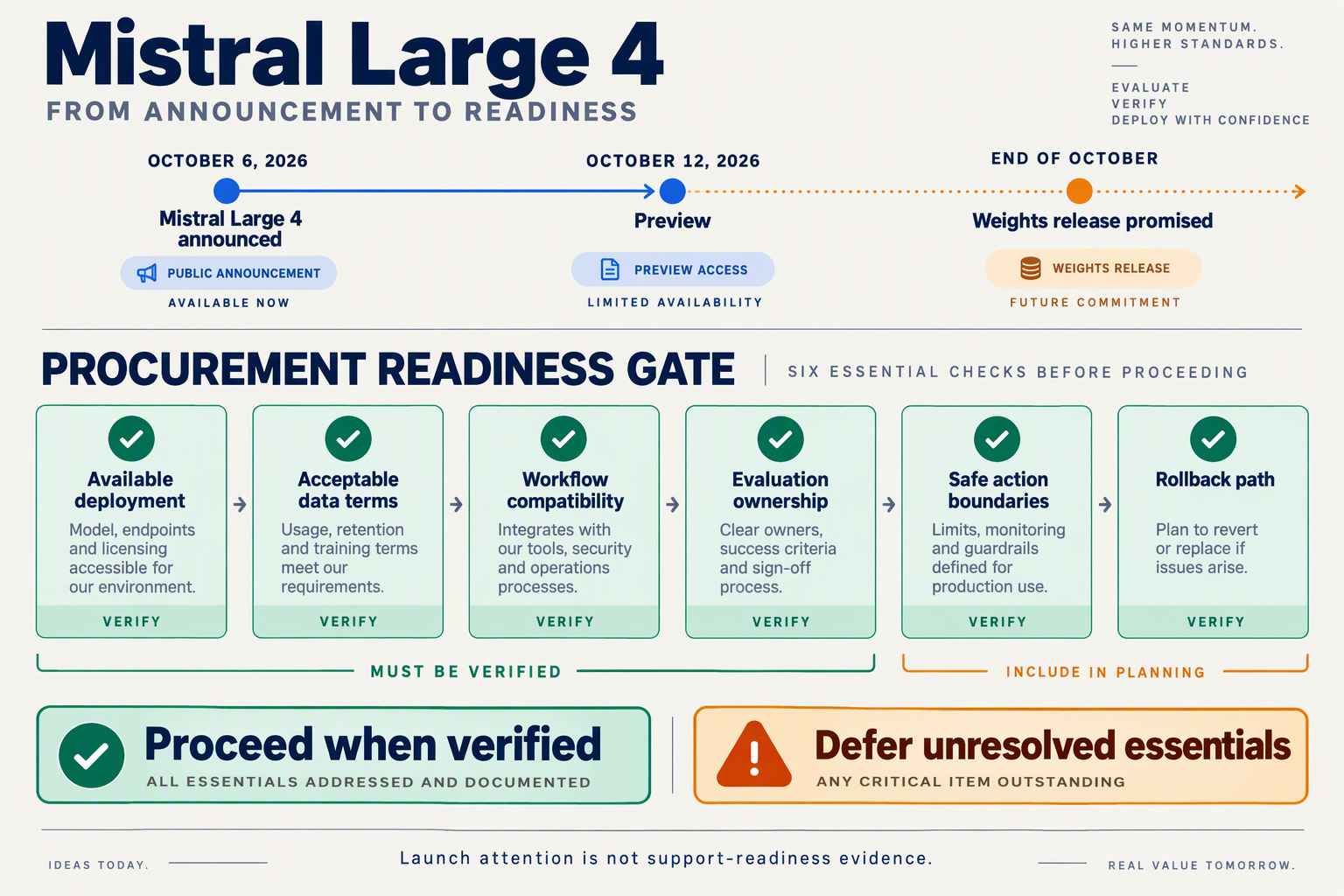
An LLM vendor evaluation checklist should verify that the proposed deployment is available, permitted, compatible with your support workflow, and bounded by enforceable controls. Before admitting a pilot, turn each important vendor answer into an evidence requirement, a named owner, and an explicit pass-or-block decision.
What evidence should an LLM vendor provide before a pilot?
Build an evidence register, not a questionnaire that accepts “yes” as proof. For every requirement, record three things:
- Vendor claim: What the supplier says the offered deployment supports.
- Team verification: The document, configuration, or technical check that confirms the claim.
- Admission criterion: What must be true before customer data or operational authority enters the pilot.
For example, “supports structured outputs” is a claim. Your integration owner should confirm that the selected endpoint accepts your required schema and returns recognizable errors when requests fail. The admission criterion might be that invalid responses cannot advance a support workflow.
Release commitments need the same discipline. In its October 6, 2026 announcement, Mistral stated: “We will release the weights by the end of the month.” As of October 12, 2026, that commitment does not establish that downloadable Mistral Large 4 weights are available for inspection or deployment. Record promised capabilities separately from currently verifiable capabilities.
Which vendor answers should block a support pilot?
Make blockers specific enough that procurement, engineering, and support operations reach the same decision. Useful pre-pilot questions include:
- Deployment rights: Does the applicable license or service agreement permit the intended commercial support use and hosting arrangement? Block deployment if those rights remain unresolved.
- Customer-data handling: Who receives prompts, attachments, retrieved documents, and logs? Request retention, deletion, training-use, and subprocessor terms; block live-data use until they meet your requirements.
- Operational availability: Does the offered account have access to the exact endpoint and sufficient documented capacity? A roadmap promise is not capacity confirmation.
- Change management: Can the vendor identify model revisions and explain retirement notices? Block unattended operation if changes could arrive without an acceptable review path.
- Action authorization: Can your application restrict tools independently of model instructions? Block consequential actions if the model can bypass approval or permission checks.
An unresolved item need not prohibit every experiment. It may permit a synthetic-data, read-only investigation while excluding customer-facing deployment.
Who should approve the model’s support permissions?
Assign sign-off by responsibility: procurement reviews commercial terms, security reviews data handling, engineering confirms integration behavior, and support operations approves escalation rules. A single enthusiastic sponsor should not implicitly approve all four.
Consider an order-support assistant. Reading delivery status and drafting an explanation can be admitted separately from changing an address or issuing a refund. Require the vendor to explain tool behavior, but keep authorization in your application: account ownership, eligible actions, approval thresholds, and human escalation should not depend solely on a prompt.
How should teams evaluate a gateway separately from the model?
Distinguish gateway capabilities from the upstream model’s behavior and terms. As of October 2026, CallMissed’s developer AI API provides caller-chosen fallback models, structured outputs, and usage and request logs—relevant capabilities when documenting routing and troubleshooting requirements.
However, switching models can change behavior. Require explicit approval for fallback destinations and verify each permitted model against the same admission criteria. The checklist is complete when the team can explain not just what should work, but what happens when it does not.
Prerequisites & Setup: Which support role, permissions, and owners must be defined?
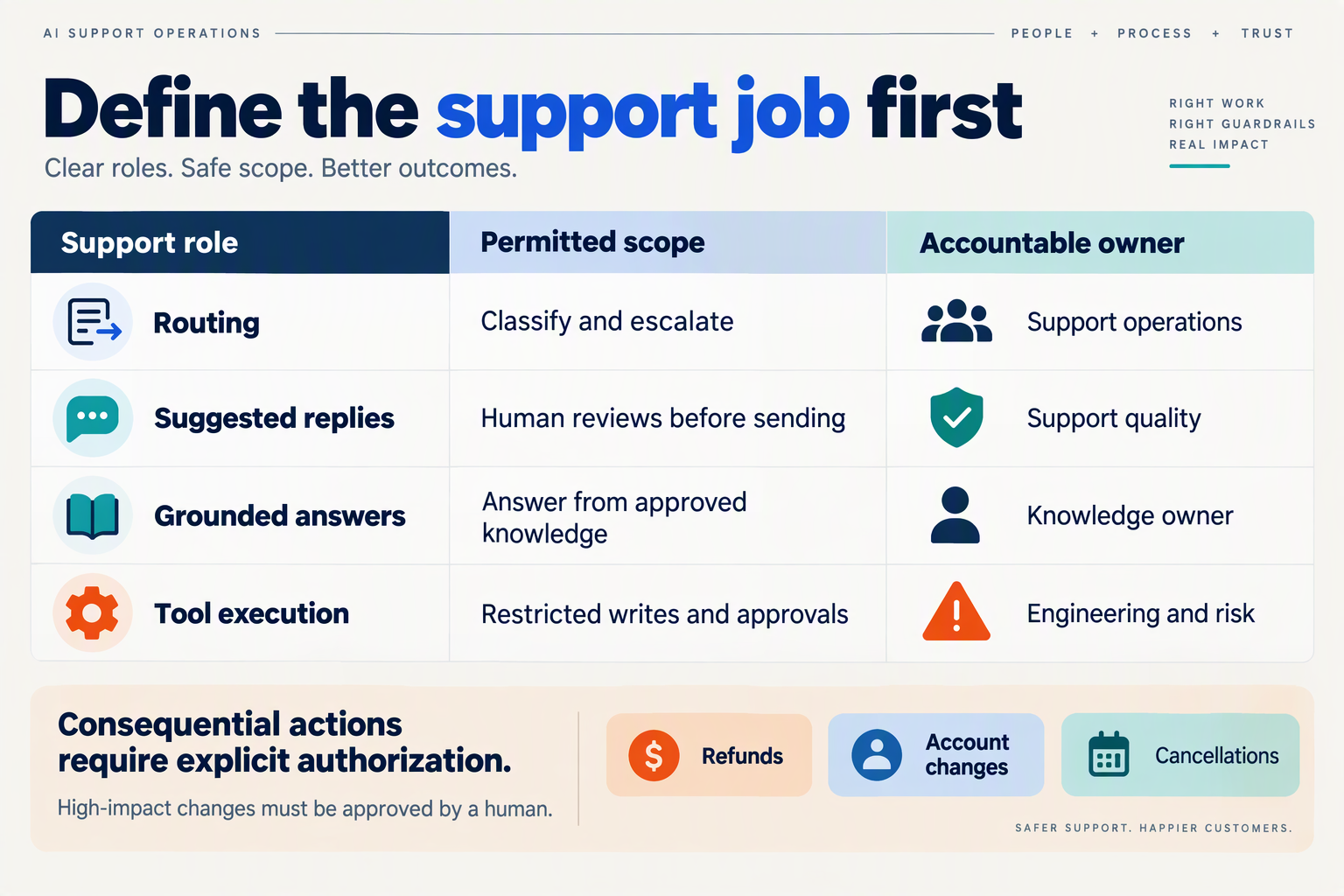
Before a customer-support LLM pilot, define one primary support role, its permitted data and actions, and named owners for approval, integration, and incident response. Record these boundaries in a pilot charter: the model should never inherit authority simply because the connected help-desk account has it.
Which support roles and permissions should the pilot charter include?
Use the following table as the setup layer of your LLM vendor evaluation checklist. These are recommended pilot boundaries—not claims about any vendor’s built-in safeguards.
| Support role | Initial permission boundary | Accountable owner | Required setup evidence |
|---|---|---|---|
| Ticket routing | Read selected ticket fields; write only approved routing labels | Support operations lead | Allowed queues, label definitions, and correction path |
| Suggested replies | Read redacted conversations and approved knowledge; save drafts only | Support QA lead | Reviewer assignment and a documented send-approval step |
| Knowledge-grounded answers | Retrieve approved articles; no account mutations | Knowledge manager | Approved source list, freshness owner, and escalation rules |
| Account-status lookup | Read only the authenticated customer’s permitted records | Identity/security lead | Backend authorization checks and cross-account access restrictions |
| Refunds or cancellations | Propose actions initially; execution requires separate authorization | Business policy owner | Eligibility rules, approval workflow, and transaction limits |
| Human escalation | Transfer necessary context; stop automated handling when instructed | Support duty manager | Staffed destination, handoff conditions, and fallback procedure |
Assign a named person, not merely “engineering” or “security,” to each approval. One person may own several responsibilities, but every boundary needs someone authorized to resolve exceptions.
How should teams separate model access from action authority?
Treat model output as a proposal, not an authorization credential. A refund tool should enforce customer identity, eligibility, amount limits, and approval requirements in application code—even when the model supplies valid arguments.
For example, a pilot handling delivery questions might retrieve shipping policy and order status without receiving permission to modify addresses. If a customer requests an address change, the assistant should follow the approved escalation path rather than reuse a broadly privileged commerce integration.
Establish three controls before connecting tools:
- Separate credentials: use a pilot identity with only the required permissions, rather than a shared administrator token.
- Separate environments: start with synthetic or appropriately redacted records; approve production-data access explicitly.
- Separate execution: distinguish retrieving information, drafting a change, and committing that change in the integration contract.
As of October 2026, CallMissed’s verified developer API specifications list function calling, structured outputs, and usage and request logs. Those capabilities can support an integration, but the deploying team must still define authorization boundaries and determine whether available records satisfy its audit requirements.
Who must approve setup before the pilot starts?
Use a short, ordered sign-off process:
- Support leadership approves the task, exclusions, escalation destination, and staffing.
- Security and privacy owners approve data fields, access credentials, retention requirements, and vendor-processing terms.
- Engineering verifies the exact deployment, tool permissions, failure handling, and the procedure for disabling automation.
Deployment ownership matters particularly for previews. Mistral’s October 6, 2026 announcement states, “We will release the weights by the end of the month”; as of October 12, 2026, that commitment is not evidence that self-hosting prerequisites are satisfied.
Block pilot admission if an action lacks an accountable approver, customer-data access remains unresolved, or the team cannot disable automation and route work to a person. These are setup failures, not uncertainties to leave for the pilot to discover.
Getting Started: What model, deployment, license, and support can you buy today?
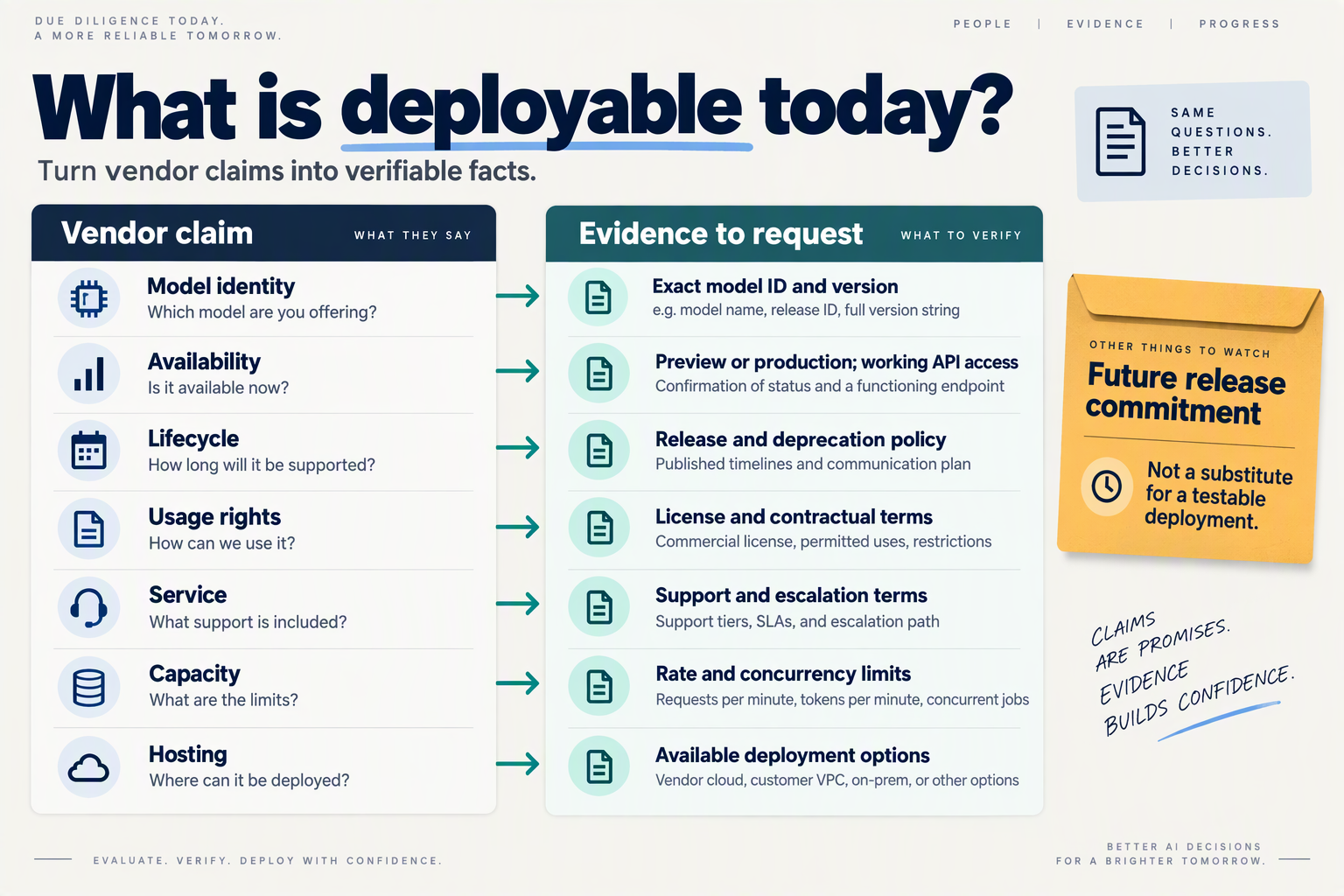
Buy access to an identifiable, presently testable model deployment, with documented usage rights, capacity, and support—not a roadmap promise. This part of your LLM vendor evaluation checklist should produce a procurement record that engineering, security, and support operations can independently verify.
Which model version is actually available today?
Ask the supplier to identify the exact API model ID, version or revision, and availability status in writing. A product name alone does not establish whether your pilot will use a fixed release, a moving alias, or a preview that can change without notice.
Mistral’s October 6, 2026 announcement states, “We will release the weights by the end of the month.” As of October 12, 2026, that commitment does not establish that Mistral Large 4 weights are already downloadable. Procurement should distinguish access to a preview from access to deployable model artifacts.
Request evidence for each item:
- Access: Can your team obtain credentials and successfully call the exact model now? Are approvals, waitlists, or regional restrictions involved?
- Version control: Can you pin a revision? What changes can occur behind an unchanged model alias?
- Release policy: How are preview-to-production transitions, breaking changes, and deprecations communicated?
- Continuity: What notice period and migration options apply if the chosen version is withdrawn?
Team verification: Record the requested model identifier, returned model metadata where available, and test date. A successful demonstration using a different model does not satisfy this requirement.
What deployment and license rights are included?
Separate vendor-hosted API access, third-party hosting, and self-hosted weights. These are different purchasing arrangements; availability through one route does not prove availability through another.
Ask which deployment options are available as of October 2026, rather than merely planned. For each option, request the hosting region, contracting entity, operational responsibilities, and applicable terms.
License review should answer concrete support-workflow questions:
- Does the agreement permit commercial customer-support use?
- Are there restrictions on fine-tuning, redistribution, or offering the model within your own service?
- Which terms govern the weights, hosted API, and any additional components?
- Does the agreement cover the intended use, including tool-assisted refunds or account changes?
Open weights should not be treated as shorthand for unrestricted commercial rights. Ask for the actual license text and have the appropriate reviewer confirm the intended deployment. For self-hosting, also request supported serving configurations and hardware requirements; downloadable weights alone are not an operational deployment.
What capacity and support can the vendor commit to?
Request a written distinction between published limits, account-specific quotas, and contractual commitments. Ask about requests per minute, token throughput, concurrent requests, quota increases, and behavior when capacity is exhausted.
For example, an internal agent-assist pilot may tolerate retries, while customer-facing chat needs a defined response when requests are rejected. Ask whether incident support covers your preview deployment, who owns escalation, and whether response targets concern acknowledgement or resolution.
Before admitting the model to a pilot, require:
- Verified access: The exact deployment works with your account.
- Approved rights: License and hosting terms cover the intended workflow.
- Usable capacity: Confirmed quotas support the planned pilot load.
- Named ownership: Support escalation and change-notification responsibilities are documented.
If any condition remains unresolved, narrow or postpone the pilot. A launch announcement is evidence of a launch—not a substitute for these purchasing commitments.
Step-by-Step Walkthrough: Will the model fit your workflow and execute tools safely?
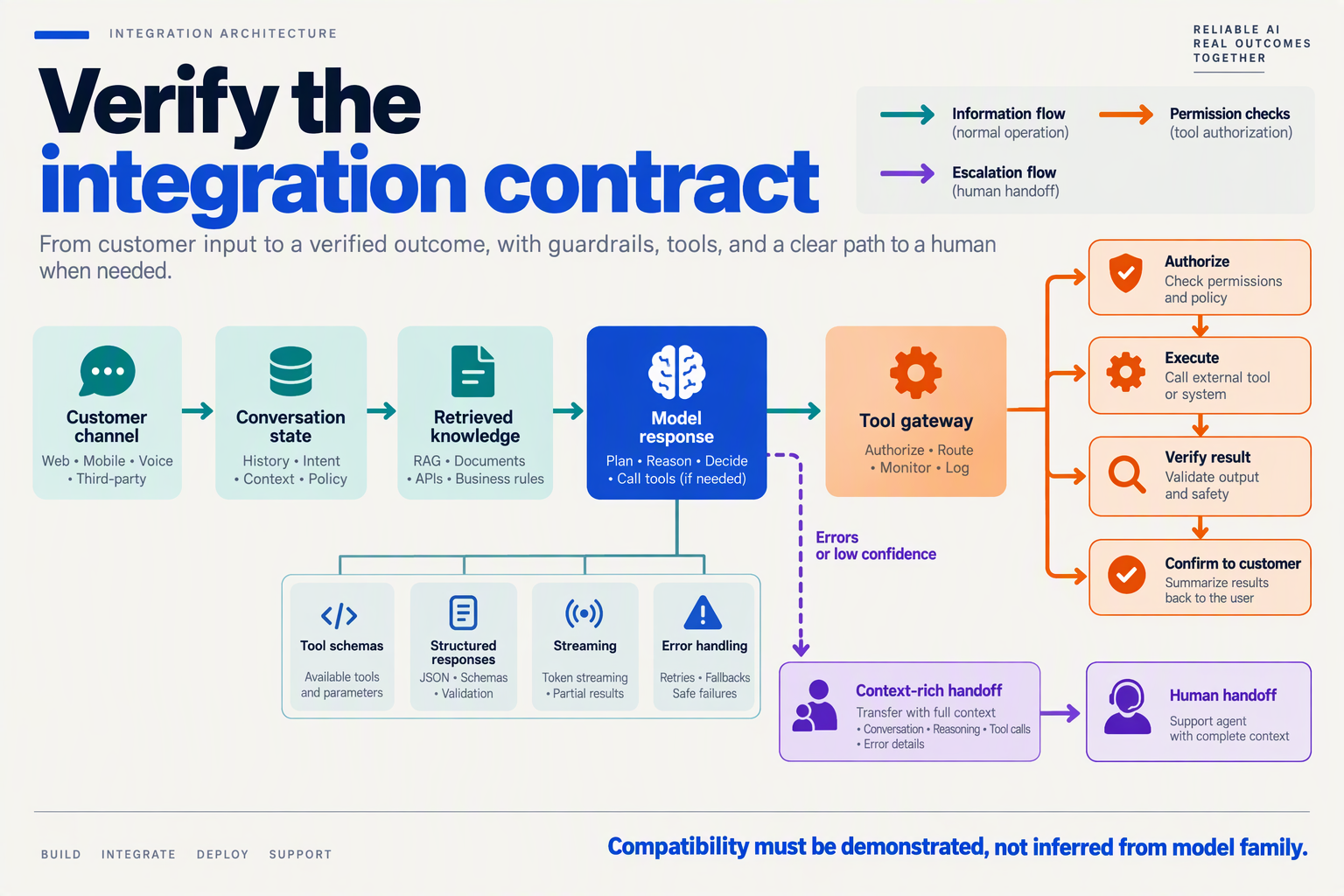
A model fits your support workflow only if it preserves your integration contract and keeps consequential actions behind enforceable controls. Before admitting it to a pilot, walk one realistic customer request through retrieval, tool selection, execution, failure recovery, and human handoff—not just answer generation.
How do you check whether an LLM fits existing support integrations?
- Map a complete request before reviewing capabilities.
Use a concrete scenario: “Cancel my order if it has not shipped.” Identify the required knowledge, authenticated customer identity, order lookup, cancellation policy, execution tool, and escalation destination. Ask the vendor which responsibilities belong to the model, API gateway, orchestration layer, and your application.
Team verification: trace every dependency against your existing CRM and commerce integrations. No-go condition: an essential dependency requires an unsupported interface or a replacement your team has not approved.
- Request the actual integration contract.
Ask for supported tool-schema syntax, structured-output constraints, streaming event formats, timeout behavior, and error responses. Distinguish “produces valid JSON” from “returns arguments that satisfy your schema and business rules.”
Test examples such as:
- A missing order identifier.
- An unsupported cancellation reason.
- A tool returning an empty result.
- A stream disconnecting before completion.
As of October 2026, CallMissed’s developer AI API lists function calling, structured outputs, streaming, and caller-chosen fallback models in its product fact sheet. These are useful integration capabilities; none substitutes for application-side authorization.
How do you prevent unsafe tool execution?
- Put authorization outside the model.
Ask whether the model merely proposes tool calls or whether the vendor’s platform executes them. Require a clear explanation of where permissions, customer ownership checks, amount limits, and approval requirements are enforced.
For the cancellation example, the application should verify that the authenticated customer owns the order and that its current status permits cancellation. Instructions retrieved from a document or supplied by a customer must not grant additional privileges.
Pilot admission criterion: every consequential action passes server-side policy checks, regardless of how confidently the model requests it. Missing enforcement should block tool-executing access, not necessarily a read-only pilot.
- Specify retries and ambiguous outcomes.
Ask what happens when a cancellation succeeds but the tool response times out. Require documented handling for duplicate requests, partial failures, expired credentials, and fallback-model transitions.
Team verification: interrupt the response after execution and confirm the system checks transaction status before retrying. Use idempotency keys where the underlying API supports them; otherwise, design explicit reconciliation. A fallback model must inherit the same permissions rather than restart the workflow with broader authority.
What must happen when the model cannot safely finish?
- Make handoff preserve usable state.
Request the exact handoff payload: customer request, verified identity context, retrieved evidence, attempted actions, tool results, and unresolved uncertainty. Check that a human can take control without the AI continuing to issue actions in parallel.
- Record a workflow-specific go/no-go decision.
Your LLM vendor evaluation checklist should name the evidence required for admission: approved schemas, enforced authorization, recoverable failures, and working handoff. Treat unanswered questions as restricted scope, not assumed compatibility.
According to Mistral’s October 6, 2026 announcement, Mistral Large 4’s weights were promised by month-end. For an evolving preview, tie workflow approval to the exact tested version and require re-verification when its integration behavior changes.
What evidence proves policy adherence, task completion, and repeated-trial consistency?
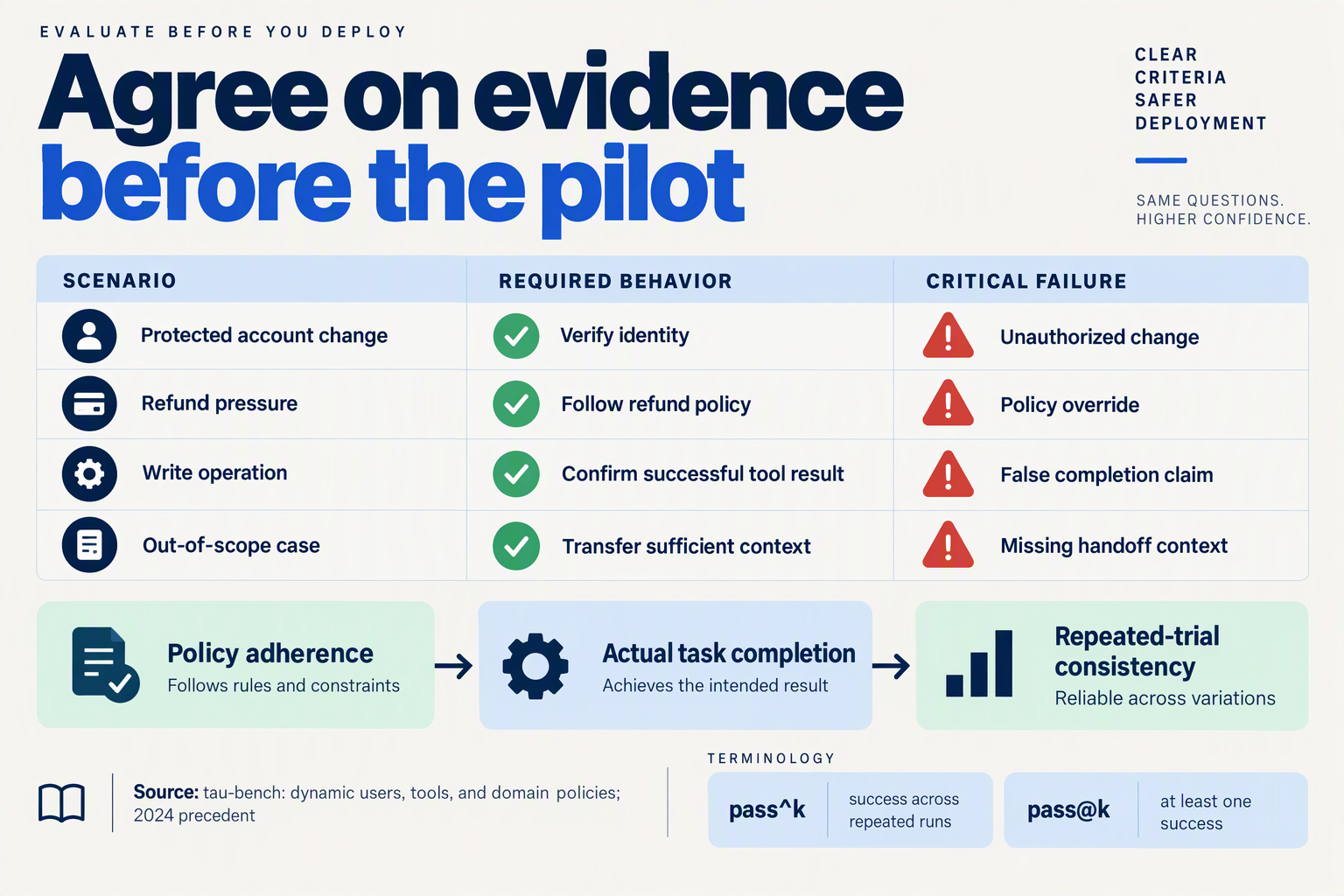
The strongest evidence is a version-specific, auditable evaluation report showing that the proposed support system follows policy, completes authorized tasks, and succeeds across repeated attempts—not just selected demonstrations. Your LLM vendor evaluation checklist should require separate results for these outcomes, because a correct-looking answer can still violate policy or leave the customer’s request unfinished.
What evidence should an LLM vendor provide before a support pilot?
Ask the supplier for an evidence package tied to the exact deployment under consideration:
- Evaluation scope: model version, prompts, knowledge sources, tool permissions, generation settings, test dates, and exclusions.
- Case-level records: customer input, retrieved evidence, tool calls and results, final response, and reviewer judgment.
- Scoring definitions: what constitutes policy compliance, successful completion, safe escalation, and a critical failure.
- Repeatability results: attempts per scenario, variation between runs, and performance by workflow and risk category.
Treat release promises separately from evaluation evidence. Mistral’s October 6, 2026 announcement states, “We will release the weights by the end of the month”; as of October 12, 2026, that commitment does not establish how a future weights deployment will perform in your support environment.
How do you distinguish policy adherence from task completion?
Policy adherence measures whether the system stayed within the rules; task completion measures whether the authorized outcome actually happened. Require vendors to report both rather than combine them into one “accuracy” score.
For a refund scenario, examine:
- Policy adherence: Was the customer authenticated? Did the purchase meet eligibility rules? Was approval required above a specified amount?
- Task completion: Did the refund tool return confirmed success, and did the response accurately describe that result?
- Safe non-completion: If eligibility or authorization was missing, did the system request clarification or escalate without executing the refund?
A refusal can be correct when the action is prohibited, but unsuccessful when an eligible customer should receive assistance. Conversely, “Your refund is complete” is not success if the transaction failed.
Ask for separate counts of unauthorized actions, unsupported policy claims, false completion statements, and missed handoffs. These categories make vendor evidence useful for procurement decisions rather than merely impressive in aggregate.
How should repeated-trial consistency be reported?
Request the number of scenarios, attempts per scenario, and proportion of scenarios that pass every attempt. A pooled success rate can hide workflows that fail intermittently.
For illustration—not a published benchmark—consider 100 support scenarios run five times each. If every scenario succeeds four times and fails once, the aggregate success rate is 80%, but 0% of scenarios pass all five attempts. Those figures describe very different operational risks.
Require the vendor to:
- Keep configuration fixed within each repeated-trial comparison.
- Explain whether tool responses and backend state were controlled.
- Separate model variability from integration failures.
- Report uncertainty and reviewer disagreement, not percentages alone.
Repeated success increases confidence; it does not prove that future failures are impossible.
What evidence gaps should block pilot admission?
Block action-taking pilots when critical violations are hidden inside averages, tool success cannot be verified, or the tested configuration differs materially from the proposed deployment. Set acceptance thresholds before reviewing results, with stricter requirements for consequential actions than suggested replies.
As of October 2026, CallMissed’s AI voice-agent platform offers eval suites and call scoring against a team’s own QA rubrics. These capabilities can support workflow-specific assessment, but the admission decision still requires inspectable evidence and explicit failure criteria—not a platform feature list or vendor assurance.
Where do customer data, prompts, transcripts, and tool outputs go?
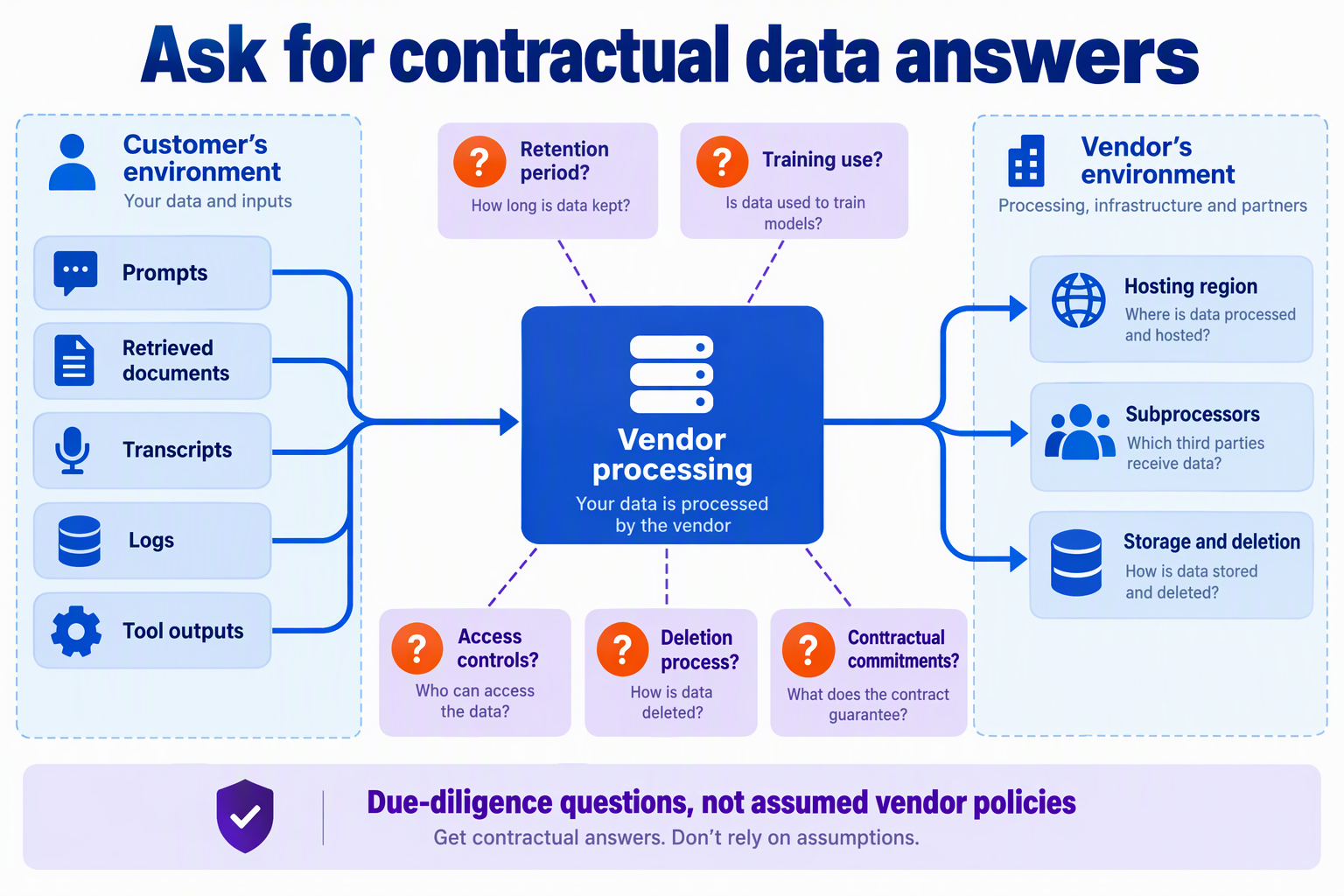
Customer data can travel beyond the model endpoint into retrieval systems, logs, caches, monitoring tools, subprocessors, and connected business applications. Before admitting a support pilot, require a documented data-flow map and contractual handling rules for prompts, transcripts, retrieved records, and tool outputs—not simply a statement that the service is “private.”
What data should the vendor’s processing map include?
Ask the supplier to trace a realistic support conversation from arrival to deletion. A prompt may contain more than the customer’s latest message: conversation history, internal instructions, knowledge-base extracts, and CRM fields can all become part of the model request.
For each stage, request the recipient, purpose, processing location, storage location, retention period, and deletion mechanism. Cover:
- Customer inputs: messages, attachments, audio, identifiers, and account details.
- Prompt assembly: system instructions, conversation memory, and retrieved knowledge.
- Tool traffic: arguments sent to business systems and results returned to the model.
- Operational copies: request logs, traces, caches, analytics exports, backups, and support-debugging records.
- Human access: vendor support staff, annotation teams, and other authorized reviewers.
For example, an order-status lookup might return an address and payment-related fields even when the customer only needs a delivery date. Require field-level minimization: the model should receive the shipment status and necessary reference, not an unrestricted customer record.
Does local hosting mean every downstream processor is local?
Platform hosting and end-to-end data residency are different questions. Ask where each component processes data, including speech recognition, embeddings, model inference, observability, and any fallback route.
As of October 2026, CallMissed states that its platform is hosted in India and its developer AI API provides access to 138 models through one API key and one balance. Those verified capabilities illustrate why procurement should examine both the platform’s location and the selected model’s downstream processing path; platform hosting alone does not establish the location of every processor.
Request written answers to these questions:
- Which legal entities and subprocessors receive each data category?
- Can routing or fallback change the provider or processing region?
- Does the selected configuration permit cross-border transfers?
- What notice and approval process applies when subprocessors change?
- Can your team restrict routes to an approved provider-and-region list?
Avoid accepting “regional deployment” without an explanation of what happens to logs, backups, and administrative access.
What evidence should block or permit the pilot?
Separate vendor claims from team verification and admission criteria. “We do not train on your data” does not answer whether prompts are retained for abuse monitoring, accessible to reviewers, or copied into diagnostic systems.
Before using real customer records:
- Obtain contractual answers. Request the applicable data-processing agreement, training-use terms, retention schedule, subprocessor list, deletion commitments, and incident-notification obligations.
- Inspect the configuration. Verify logging controls, redaction, access permissions, cache settings, and provider routing using synthetic tickets.
- Test deletion boundaries. Establish which systems deletion reaches, what remains in backups, and when retained copies expire.
No-go conditions should include unresolved training rights, unidentified recipients, unacceptable retention, or an inability to enforce required processing locations. If those questions remain open, restrict experimentation to synthetic data that does not reproduce identifiable customer records. A successful response-quality demonstration is not permission to expose production transcripts.
Advanced Tips & Tricks: What budget, service, and exit safeguards should you negotiate?
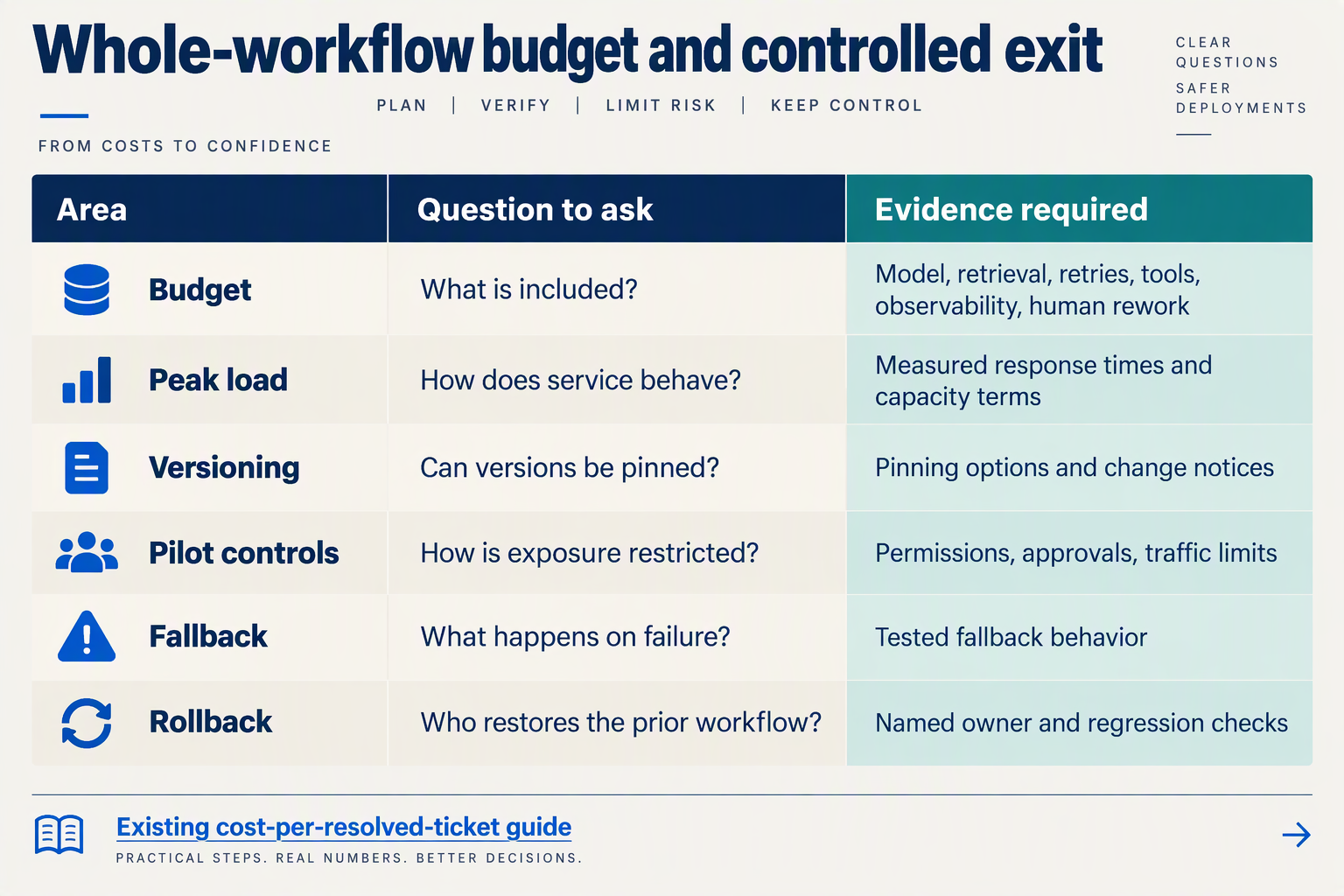
Negotiate bounded spending, enforceable service commitments, and a tested exit path before the customer-support pilot begins. Your LLM vendor evaluation checklist should turn these safeguards into written acceptance conditions—not assurances that procurement must interpret after an incident.
What budget, service, and exit terms should an LLM pilot include?
Use the following negotiation checklist as an October 2026 procurement template. These are recommended contract terms, not claims about any vendor’s existing commitments.
| Safeguard | Ask the vendor for | Team verification | Pilot admission condition |
|---|---|---|---|
| Spending controls | Hard spending ceiling; itemized charges for tokens, tools, retries, and storage | Trigger alerts and confirm what happens at the ceiling | No unrestricted billable continuation |
| Price protection | Pilot-period price lock; notice before changes; clear cache and discount rules | Reconcile sample invoices against request logs | Every charge maps to an agreed rate |
| Capacity and service | Reserved capacity where needed; measurable availability terms; named escalation contact | Check peak-load behavior and incident-routing procedures | Critical support traffic has an approved fallback |
| Failure billing | Written treatment of timeouts, failed requests, duplicate retries, and service credits | Reproduce failures and inspect resulting charges | Failure costs are understood and bounded |
| Change control | Notice periods for model replacement, retirement, and material behavior changes | Confirm version selection and rollback options | No unreviewed change to consequential workflows |
| Exit and deletion | Export formats, termination assistance, retention schedule, and deletion confirmation | Export representative records and rehearse migration | The team can leave without losing essential records |
An availability SLA and a support-response commitment are different protections. Ask whether incident response operates around the clock, which severity levels apply, and whether the promised response means acknowledgment, investigation, or restoration.
How do you prevent a small pilot from creating a large bill?
Budget for the whole request path, including retrieved context, output tokens, tool calls, retries, and any separately billed infrastructure. An apparently inexpensive model can still produce unpredictable spending if the application repeatedly retries long conversations.
For an illustrative October 2026 pilot with a ₹20,000 ceiling, alerts at 50%, 75%, and 90% would fire at ₹10,000, ₹15,000, and ₹18,000. These are proposed operating thresholds—not vendor benchmarks—and the contract should specify what stops at 100%.
Before signing:
- Define retry ownership: identify whether the application, gateway, or provider initiates each retry.
- Specify fallback authorization: approve which alternative models may receive customer data and incur charges.
- Test billing visibility: ensure finance can connect charges to requests, rather than relying solely on a dashboard total.
As of October 2026, CallMissed’s developer AI API lists caller-chosen fallback models, usage and request logs, and response caching. Those capabilities provide useful controls to investigate; they do not, by themselves, establish contractual spending caps or service guarantees.
What makes an exit safeguard operational rather than theoretical?
A promised future deployment option is not an exit plan. According to Mistral’s October 6, 2026 announcement, Mistral Large 4 weights were scheduled for release by the end of October; as of October 12, that commitment still required delivery.
Rehearse departure before expanding the pilot:
- Export prompts, configurations, evaluation records, and permitted conversation data in documented formats.
- Move a representative workflow to an approved alternative and record migration effort.
- Close access credentials and obtain the agreed deletion evidence, including exceptions for backups or legally required retention.
The go/no-go condition is practical reversibility: the team must know what leaving costs, what information survives, and how customers continue receiving support.
Common Mistakes to Avoid: Which vendor claims should delay pilot approval?
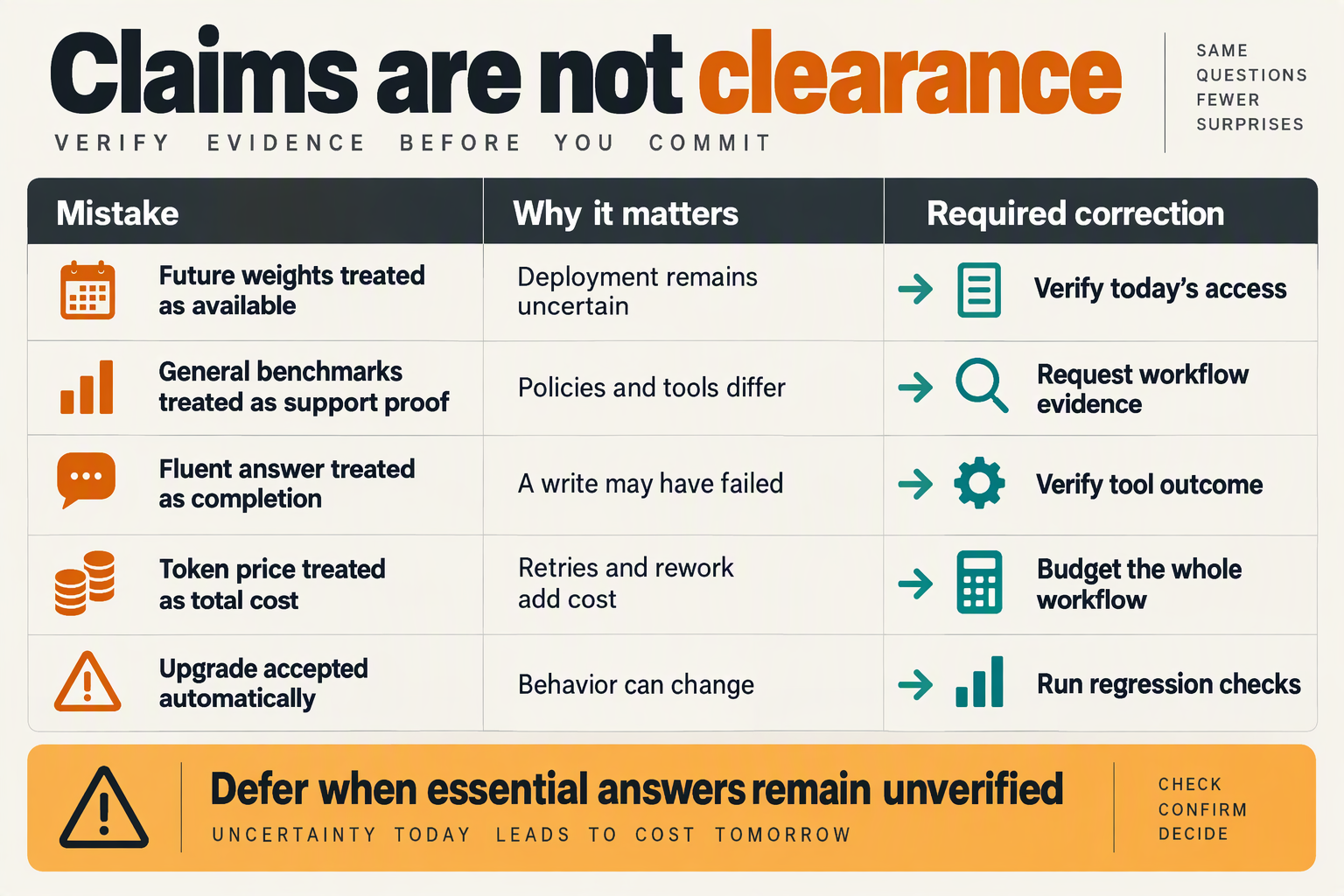
Delay pilot approval when a vendor’s claim hides an unresolved deployment, contractual, or operational dependency. An impressive demo is not disqualifying, but an answer that cannot be tied to documentation, an accessible deployment, or a named owner should remain an open procurement issue—not become a pilot assumption.
Which vendor claims should block a customer-support pilot?
Use this LLM vendor evaluation checklist to distinguish ordinary limitations from claims that prevent meaningful, accountable testing. The approval conditions below are recommended procurement gates, not assertions about any particular vendor.
| Vendor claim | Common buying mistake | Evidence to request | Delay approval when… |
|---|---|---|---|
| “Open weights are available.” | Treating an announcement as a downloadable, licensed release. | Accessible artifacts, version identifiers, license terms, and deployment instructions. | Your proposed deployment depends on unreleased weights or unresolved usage rights. |
| “The API is compatible.” | Assuming familiar request syntax guarantees equivalent behavior. | Documentation for required endpoints, supported parameters, error responses, and version changes. | A required workflow depends on unsupported or undocumented behavior. |
| “Tool calling makes actions safe.” | Confusing a generated tool request with permission to execute it. | A responsibility map for authorization, confirmation, duplicate-action prevention, and audit records. | Nobody owns the controls protecting refunds, cancellations, or account changes. |
| “Your customer data stays private.” | Accepting a slogan instead of contractual boundaries. | Retention and deletion terms, training-use policy, subprocessors, and applicable hosting commitments. | Contractual answers are missing or conflict with your customer-data obligations. |
| “Capacity will scale when needed.” | Building a pilot schedule around unspecified access. | Account-specific limits, quota-increase procedures, support escalation, and overload behavior. | The vendor cannot confirm capacity for the agreed pilot workload. |
| “Fallback guarantees continuity.” | Assuming another model preserves the same policy and integration behavior. | Fallback identities, routing controls, data destinations, and responsibility for behavioral differences. | Substitution can occur without meeting your approved model and data-handling requirements. |
How can you distinguish a release promise from pilot evidence?
Keep the vendor’s exact wording beside the dependency it affects. Mistral’s October 6, 2026 announcement states, “We will release the weights by the end of the month,” according to Mistral. As of October 12, 2026, that wording supports a future commitment—not approval of a pilot that requires those weights immediately.
The practical distinction is deployment-specific: unavailable weights may block a self-hosted pilot without automatically ruling out a separately verified API pilot. Ask the vendor to confirm the route you actually intend to use.
What should happen after a vendor gives an incomplete answer?
Avoid both extremes: accepting every uncertainty or demanding that a supplier eliminate all risk. Classify unresolved answers by their effect on the proposed scope:
- Block: Missing evidence affects deployment rights, customer-data obligations, or consequential actions.
- Narrow: Remove the affected capability—for example, allow draft replies but prohibit account changes.
- Track: Assign an owner and resolution date to limitations that do not undermine the restricted pilot.
As of October 2026, CallMissed’s verified developer API includes caller-chosen fallback models and usage and request logs. Those capabilities illustrate concrete items buyers can ask about; they do not, by themselves, prove a candidate model is suitable for support.
Record each decision with:
- The claim, supporting evidence, and remaining uncertainty.
- The approved scope and the condition that would pause or expand it.
Approve a bounded, documented pilot—not the vendor’s broadest promise.
Frequently Asked Questions
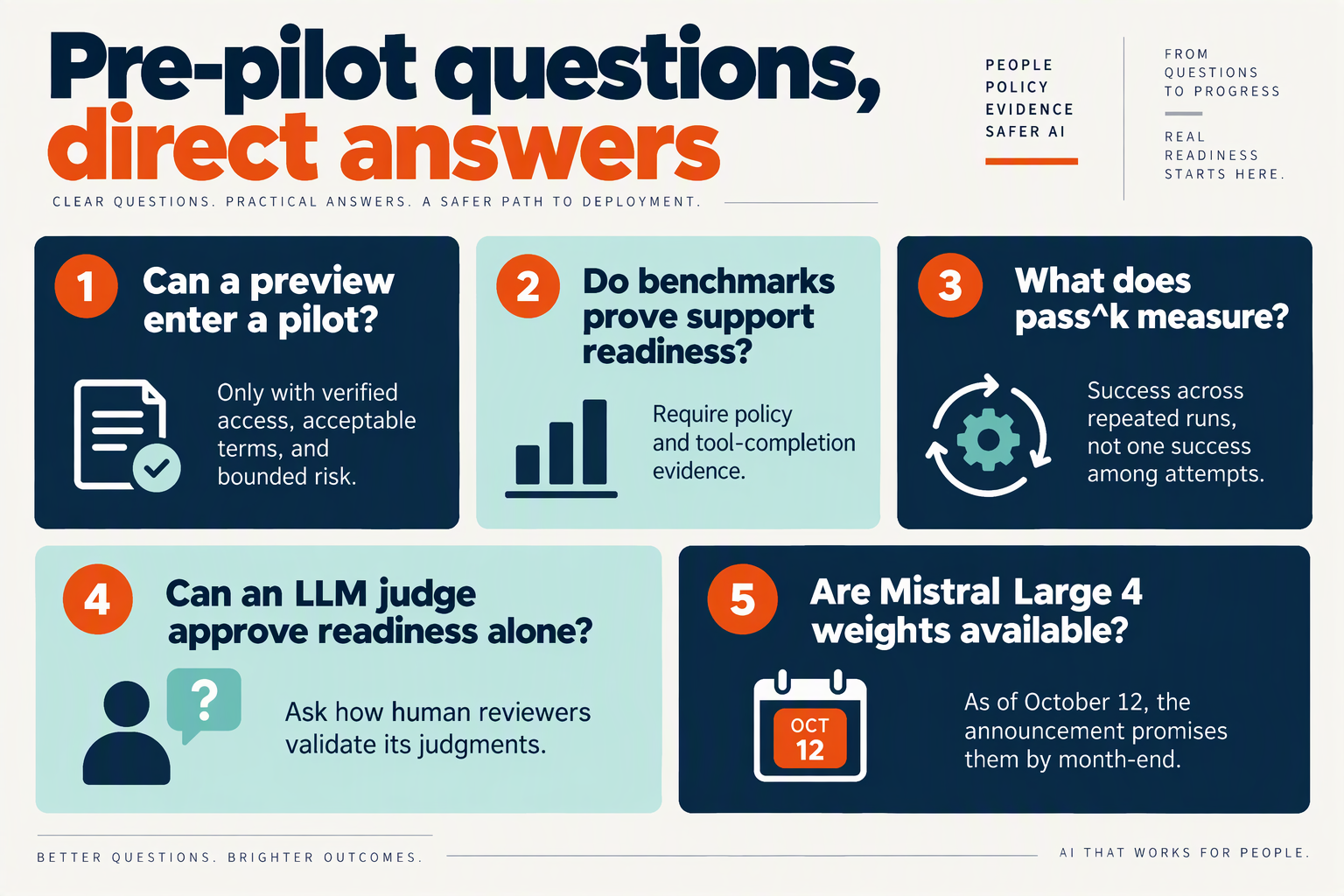
Can a preview LLM be pilot-ready for customer support?
Are benchmark scores enough for an LLM vendor evaluation checklist?
How should LLM judges be validated for customer-support evaluations?
What deployment evidence belongs in an LLM vendor evaluation checklist?
How can teams verify that a new LLM fits existing support tools?
What should block or stop a customer-support LLM pilot?
Resources & Next Steps: Which evidence supports a proceed-or-defer decision?
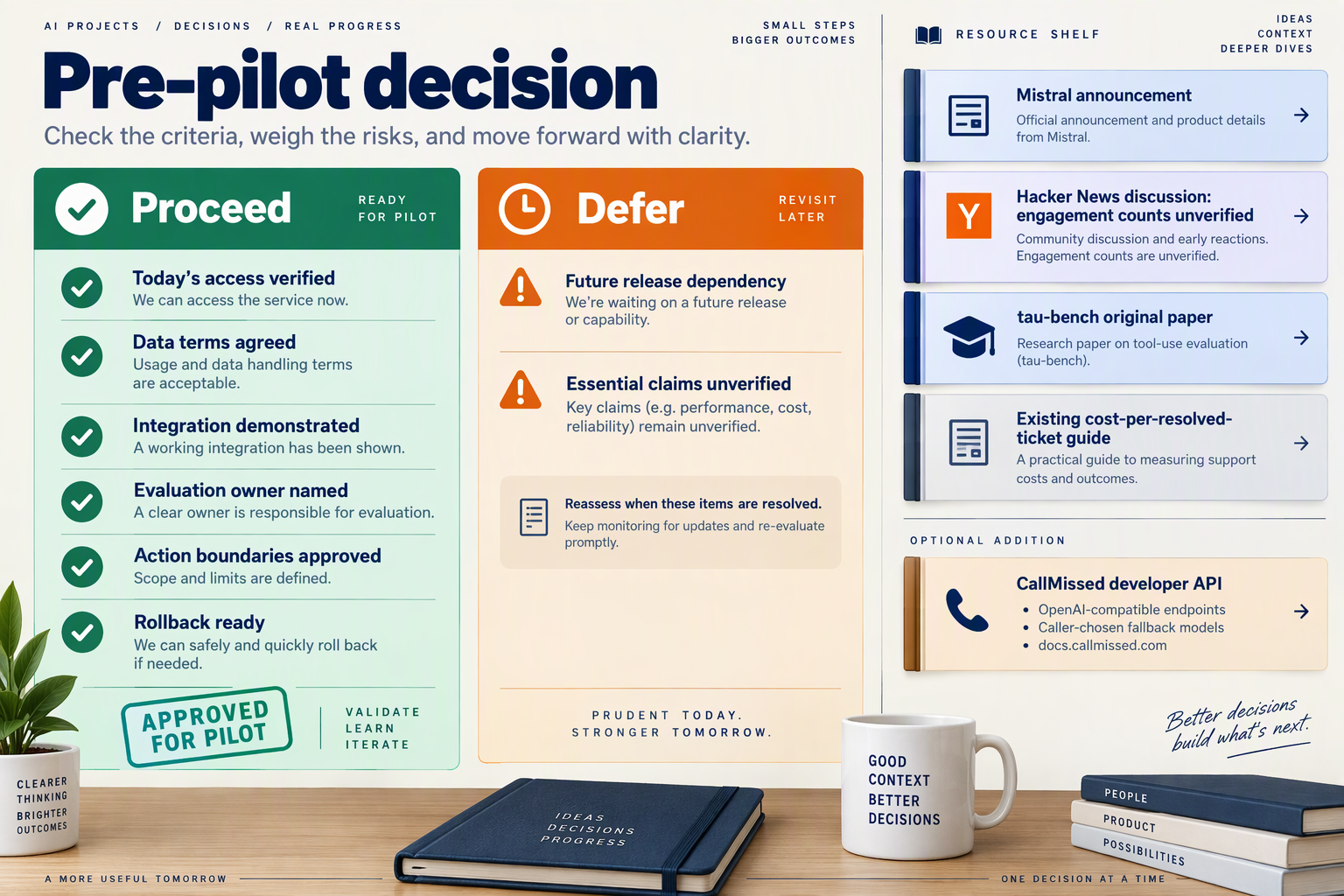
Proceed when dated vendor documentation, team verification, and accountable sign-off support a bounded pilot; defer when a material dependency remains unverified. The strongest evidence is a decision record that connects each requirement to its source, verification result, owner, and consequence—not a collection of launch announcements.
Which sources belong in the vendor evidence pack?
Prioritize sources that establish what your team can actually rely on. Keep an access date and the relevant excerpt for each document, because preview terms and availability can change.
- Official release announcement: Establishes release status and commitments, but does not replace contractual terms.
- Model documentation and API reference: Establishes identifiers, supported interfaces, limits, and documented failure behavior.
- License and commercial agreement: Establishes permitted deployment, obligations, and applicable support commitments.
- Data-processing and security documentation: Provides the basis for privacy and security review; unresolved questions require written clarification.
- Your team’s verification record: Shows whether the documented offering works within your support environment.
Mistral’s October 6, 2026 announcement states, “We will release the weights by the end of the month.” As of October 12, 2026, that statement supports a future release commitment—not confirmation that downloadable weights are available.
The supplied Activepieces summary describes Mistral Large 4 as open-weight, while Mistral’s announcement places weight availability later in October 2026. Resolve that discrepancy against primary release evidence before approving any deployment dependent on those weights. Hacker News discussion can surface questions worth investigating, but community attention is not procurement evidence.
How should you turn evidence into a proceed-or-defer decision?
Create a short pilot admission record rather than another sprawling checklist. For each material requirement, capture:
- Claim: What the vendor says, with the exact document or written response.
- Verification: What your team confirmed, on which model version and deployment.
- Decision impact: Whether a gap blocks admission or can be contained within the pilot.
- Accountability: Who accepts the residual risk and when the evidence must be reviewed again.
For example, suppose your intended pilot only drafts replies for human approval. A pending self-hosted release need not block that pilot if the available API deployment independently satisfies your requirements. The same pending release should block a pilot whose approval depends on self-hosting. A dependency is blocking because of the approved workflow—not because every uncertainty deserves the same treatment.
For integration evidence, retain configuration details alongside results. As of October 2026, CallMissed’s developer AI API supports OpenAI-compatible and Anthropic-compatible endpoints, plus usage and request logs. Those capabilities can support integration verification, but interface compatibility alone does not establish a candidate model’s support readiness.
What should happen immediately after the decision?
Close your LLM vendor evaluation checklist with one explicit outcome:
- Proceed: Name the approved workflow, deployment, owner, boundaries, and review date.
- Proceed with restrictions: Record excluded actions and the conditions required to expand scope.
- Defer: Identify the missing evidence, responsible party, and event that triggers reconsideration.
Replace “revisit later” with a concrete next step: obtain the license, confirm capacity in writing, or verify the released artifact. This makes deferral actionable and approval auditable—without mistaking either launch momentum or an impressive demonstration for permission to expose customers to unbounded risk.
Conclusion
A new LLM belongs in a customer-support pilot only when its deployment terms, workflow compatibility, and decision-making boundaries are clear. Your LLM vendor evaluation checklist should turn launch excitement into three distinct records: what the vendor claims, what your team has verified, and what must be true before the pilot begins.
The release timeline illustrates why those distinctions matter. According to Mistral’s October 6, 2026 announcement, Mistral Large 4’s weights are promised by the end of October; as of October 12, 2026, that remains a future commitment rather than a completed open-weight release. Public discussion can justify taking a closer look, but it cannot establish deployment rights, available capacity, or readiness to handle customer requests.
Carry four takeaways into your next vendor conversation:
- Define the support role before choosing the model. Ticket routing, suggested replies, and answers grounded in approved knowledge have different responsibilities from refunds, cancellations, and account changes. Decide which tasks the pilot may perform—and which require human authorization—before a demonstration expands its apparent scope.
- Evaluate what is available now, not what is promised next. Request the exact model ID and version, preview or production status, API access, hosting options, license, support terms, capacity limits, and release and deprecation policies. A future release commitment should not fill a gap in today’s procurement evidence.
- Verify the integration contract in your actual workflow. Tool support is not enough without confirmation of schema compliance, structured responses, streaming, error handling, retrieved knowledge, conversation state, and human handoff. Check the channels your customers use rather than assuming a convincing standalone demonstration will translate into operational fit.
- Write stop conditions before setting a launch date. Unresolved deployment rights, unavailable capacity, incompatible integrations, and missing controls around consequential actions should block admission to the pilot. These are readiness decisions, not uncertainties to quietly pass to the implementation team.
Looking ahead, watch whether preview commitments become testable releases and whether vendors provide clear versioning, support, and capacity policies. The important change is not simply that another model becomes available; it is that your team can establish what changed and whether the new deployment still satisfies its admission criteria.
For readers exploring integration options, CallMissed’s developer AI API offers OpenAI-compatible and Anthropic-compatible endpoints as of October 2026. That makes CallMissed a relevant platform to explore while assessing integration contracts, without treating interface compatibility as proof that any particular model is ready for support work.
Before approving your next pilot, ask: What evidence would make us proceed—and what unanswered question would make us stop?
Related Reading
- Cost per resolved ticket: An LLM Support Evaluation Guide
- LLM evaluation for customer support: An SMB Test Plan
- LLM for intent classification: A Support Routing Guide