
Tokens Too Cheap to Meter: What AI Support Still Costs


Understand tokens too cheap to meter through a support-cost worksheet, resolution metrics, and practical ways to control spending as usage grows.
Tokens Too Cheap to Meter: What AI Support Still Costs
What if your AI support bill barely changed after the language model became 100 times cheaper? “Tokens Too Cheap to Meter” captures a shift in AI economics, but cheaper text generation does not automatically mean cheaper customer service. The question is no longer just what a model charges to answer. It is what your business spends to resolve the customer’s problem.
In the Hacker News snapshot supplied for this October 2026 article, “Tokens too cheap to meter” attracted 221 points and 176 comments in 14.6 hours. That attention reflects a consequential argument: as inference becomes cheaper, language models could become ordinary computing infrastructure rather than a premium feature. In the research supplied for October 2026, ajianaz.dev describes an approximately 100-fold decline in cost per task over a year—a directional claim, not a universal benchmark for every model or support workload.
For customer-support leaders, that distinction matters. A cheaper model can make conversation summaries, multilingual replies, and knowledge-base searches more affordable. But a support interaction is not just a string of generated tokens. It can involve retrieving account records, checking order status, invoking external tools, recording a call, and transferring a frustrated customer to a person.
Consider an illustrative refund request. The model’s response might become dramatically cheaper, while the workflow still requires identity checks, a commerce-system lookup, a policy decision, and an approved transaction. If the agent repeats those steps or escalates unnecessarily, the savings on language generation may be overwhelmed by operational costs. Cheap reasoning is valuable; unnecessary work is still waste.
What still determines the cost of AI customer support?
This article separates the shrinking token bill from the costs that remain:
- Channel costs: phone carriage, speech recognition, voice generation, and messaging infrastructure.
- Workflow costs: retrieval, external services, retries, and long-running agent interactions.
- Quality costs: evaluation, monitoring, human escalation, and correcting mistakes.
- Outcome costs: unresolved issues, repeat contacts, and customer effort.
As of October 2026, CallMissed’s Standard voice-agent plan bundles speech recognition, the language model, and voice at ₹4 per minute, with phone carriage billed separately—a concrete example of why token pricing is only one layer of support economics.
You will learn how to compare cost per resolved issue with cost per conversation, identify which expenses actually fall when models get cheaper, and decide where additional AI work improves service rather than inflating activity. The opportunity is substantial, but the metric needs to change: measure successful resolution, not merely inexpensive generation.
Do cheaper LLM tokens mean cheaper support? Only if total cost per resolution falls
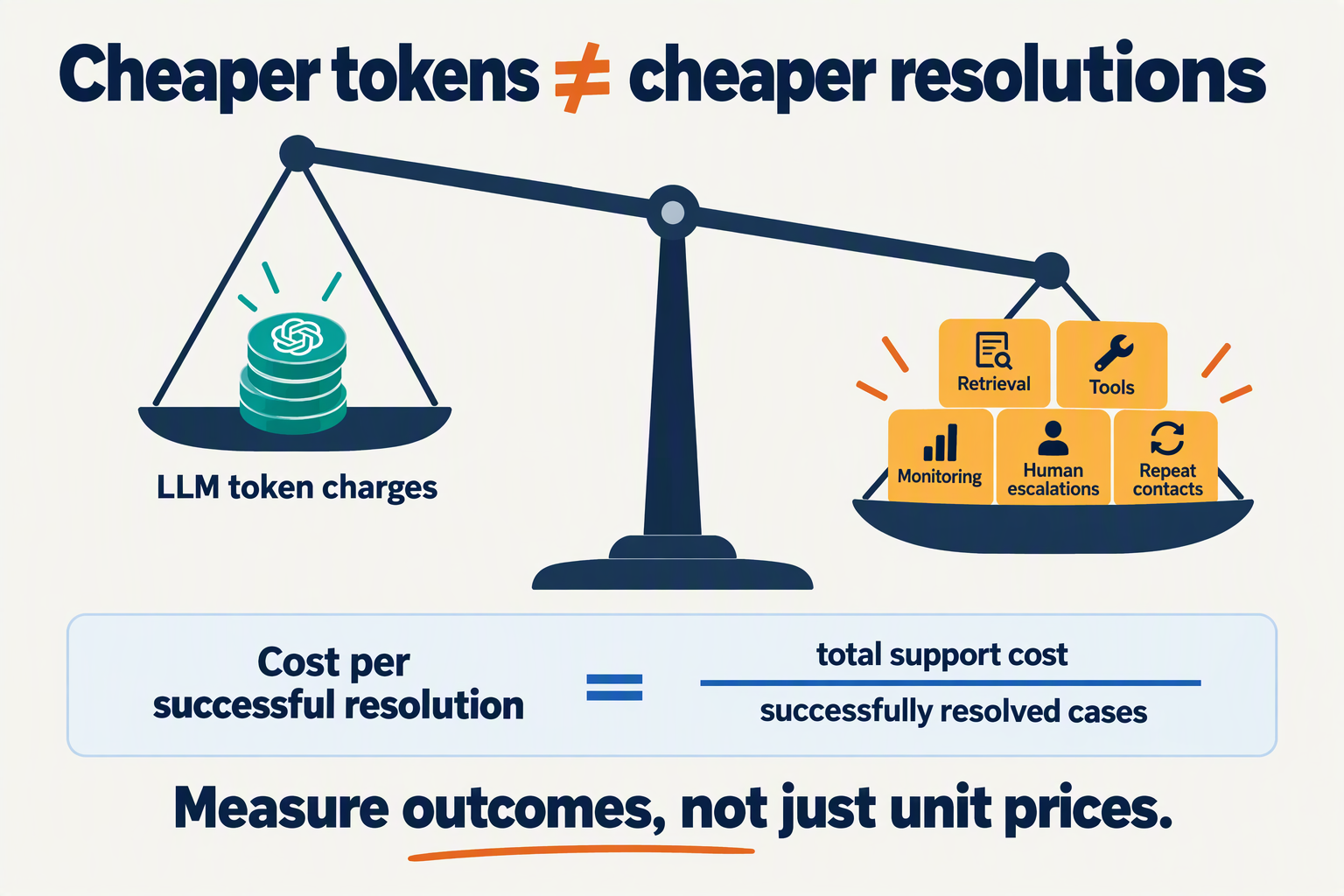
Cheaper LLM tokens reduce AI customer-support costs only when the savings outweigh changes in workload, escalation, and repeat contacts. The decisive metric is total cost per resolution: everything spent handling a set of issues divided by the number actually resolved.
How do you calculate AI support cost per resolution?
Use a formula that includes both automated and human work:
Cost per resolution = total support operating cost ÷ successfully resolved issues
For a defined reporting period, the numerator should include:
- AI execution: model inference, retrieval, tool calls, and any speech processing.
- Service delivery: channel charges and attributable platform costs.
- Human effort: escalations, supervision, and corrective work.
- Quality operations: evaluation, monitoring, and knowledge maintenance.
Count unique issues rather than messages or sessions. A customer who opens three chats about one failed delivery has created three interactions, not three successful resolutions.
Define “resolved” before comparing systems. For example, require a verified outcome and no same-issue recontact within a specified window. Different issues need different evidence: a password reset may be confirmed immediately, while a billing correction may require checking that the adjustment posted.
How much can cheaper tokens actually save?
The maximum direct saving depends on the model’s share of the original bill. If inference represents 10% of total support spending, cutting inference prices by 90% reduces total spending by just 9%, assuming usage and every other cost remain unchanged.
Consider this illustrative October 2026 planning example—not a vendor benchmark:
- A support operation spends ₹100,000 handling a cohort of issues, including ₹10,000 on LLM inference.
- It successfully resolves 800 issues, producing a cost per resolution of ₹125.
- A 90% inference-price reduction lowers total spending to ₹91,000. With the same 800 resolutions, cost per resolution becomes ₹113.75.
- If a changed workflow resolves only 700 issues, that ₹91,000 spend produces a cost per resolution of ₹130—higher than before.
The cheaper model bill still delivers savings. The declining resolution rate erases them.
The reverse also matters: using additional inexpensive inference to verify a policy or check an answer can be economically sensible if it prevents enough rework. The goal is not minimum token consumption; it is minimum cost for a dependable outcome.
What should support teams measure before switching models?
In research supplied for this October 2026 article, jyn.dev argues that machine-learning intelligence prices are decreasing by “several orders of magnitude a year.” That is a broad trend claim, not evidence that a particular replacement model will resolve your support workload more cheaply.
Test that workload directly. Compare:
- Resolution rate, using the same verification criteria.
- Escalation and recontact rates, not just first-response performance.
- Total execution cost, including failed attempts and retries.
- Human handling time, especially after an AI handoff.
As of October 2026, CallMissed’s developer AI API supports caller-chosen fallback models, response caching, and usage and request logs. Those capabilities are relevant to controlling inference spending, but teams still need outcome data to establish whether savings translate into cheaper support.
Evaluate comparable issue cohorts, not an easy-question pilot against a complex production queue. A lower token price is an input advantage; a lower cost per verified resolution is the business result.
What does the “tokens too cheap to meter” debate actually claim?

The “tokens too cheap to meter” debate claims that falling inference costs could make language-model processing cheap enough to embed throughout software, rather than reserve for explicitly priced AI features. It is a prediction about the economics and ubiquity of computation—not a claim that tokens are already free or that customer-support operations will become costless.
What does “too cheap to meter” actually mean for LLMs?
In the source material supplied for October 2026, jyn.dev argues: “The price of using machine learning intelligence is decreasing by several orders of magnitude a year and shows no signs of slowing.” The essay anticipates LLMs becoming infrastructure rather than remaining standalone products.
That is the debate’s central thesis, but its wording combines an observed direction with a forecast. Falling prices do not establish that the same decline will continue indefinitely, across every model, quality threshold, and deployment environment.
“Too cheap to meter” is therefore best understood as an economic threshold: for some tasks, the value of using a model may substantially exceed the incremental inference charge, making detailed token budgeting less important than deciding where AI is useful. Providers can still meter and bill that usage.
Why might the cost of useful AI work keep falling?
Hraness, summarizing jyn.dev in the supplied October 2026 research, identifies GPU efficiency, cheaper-per-task model frontiers, and inference-engine improvements as drivers. These mechanisms affect different layers:
- Hardware efficiency: More useful computation can be performed for a given hardware investment.
- Model efficiency: A less expensive model may become capable of completing a task that previously required a larger model.
- Serving efficiency: Improvements in inference software can reduce the resources needed to deliver model responses.
The important distinction is cost per token versus cost per successful task. A cheaper token is not necessarily cheaper useful work if a model needs more attempts, longer outputs, or additional verification.
Conversely, a model that completes a task with fewer retries can improve economics even without a dramatic reduction in its advertised token rate.
Does cheaper inference justify using the strongest model everywhere?
No. Lower prices expand the range of sensible applications, but they do not eliminate the need to match models to tasks.
In the research supplied for October 2026, QWE AI Academy contrasts “blind flood”—sending every request to the strongest model—with tiered routing. Its warning about agent loops and expanding context highlights a practical limit: inexpensive units can still produce expensive workloads when consumption grows unchecked.
For support teams, the useful distinction is between:
- Routine classification: identifying whether a message concerns delivery, billing, or cancellation.
- Constrained generation: drafting an answer grounded in an approved policy.
- Ambiguous decisions: interpreting conflicting information or determining whether human review is necessary.
These jobs need not share the same model or processing budget. As of October 2026, CallMissed’s developer AI API supports caller-chosen fallback models through OpenAI-compatible endpoints—a relevant capability for teams implementing model-selection policies, not a guarantee of savings.
What should support leaders take from the debate?
The strongest interpretation is “AI processing may become abundant,” not “all AI work becomes economically justified.” That shifts the planning question from whether a workflow can afford one model call to whether additional processing improves its result.
For example, cheap inference could make checking a draft against an approved policy practical on more interactions. Generating ten alternative replies that nobody evaluates creates activity instead. The debate opens a larger design space; disciplined workflow design determines which possibilities are worth using.
Which developments change LLM cost per token—and which support costs remain?
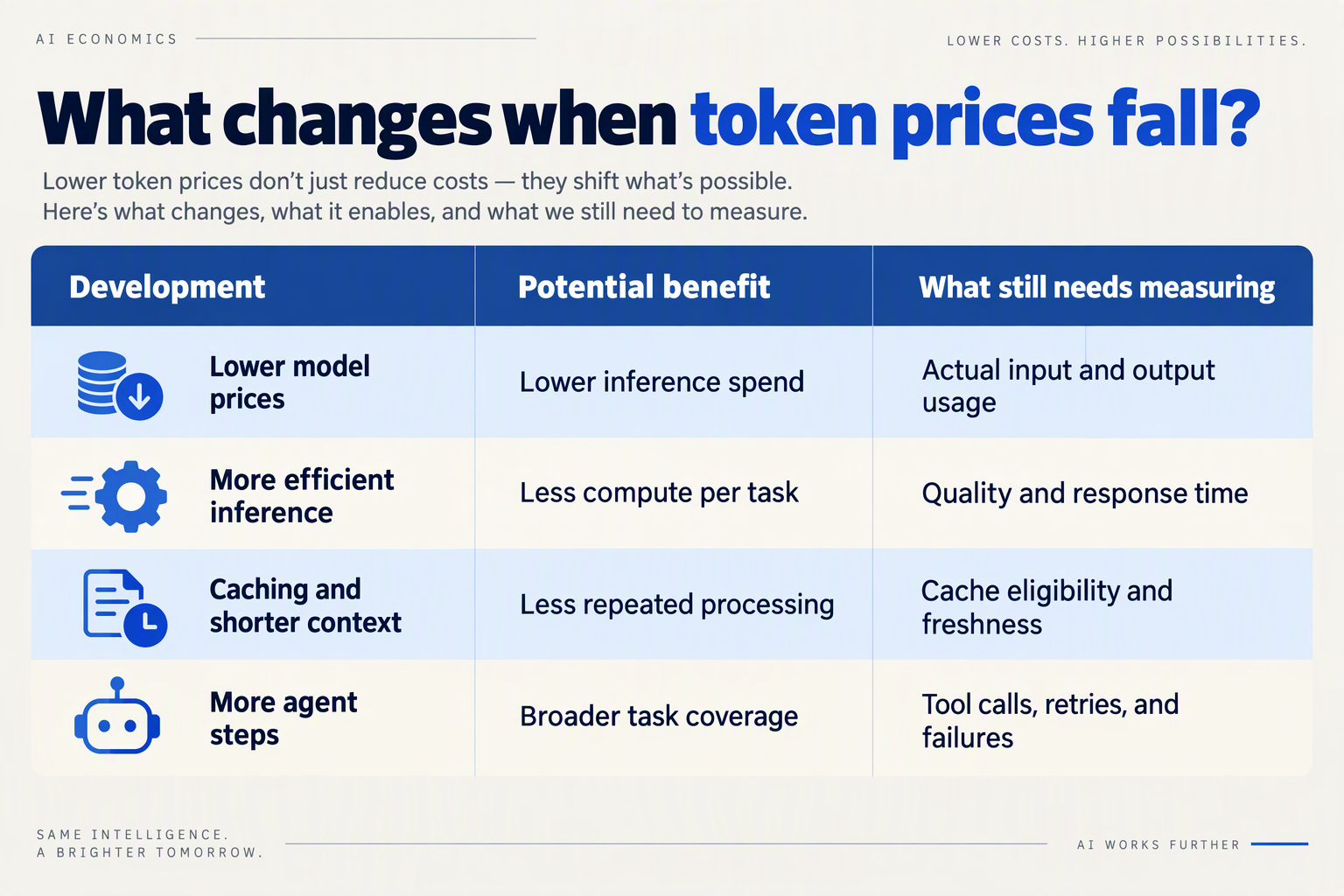
GPU efficiency, inference-software improvements, and more capable low-cost models can reduce LLM cost per token or per completed task. They do not automatically reduce retrieval charges, external API fees, speech processing, phone carriage, or the human work required when an answer goes wrong.
The distinction is important: a lower token price is a supplier-side saving; fewer tokens needed for a correct answer is a workflow-side saving. Support teams should track both rather than treating every efficiency improvement as a model price cut.
Which developments actually lower LLM inference costs?
In the research supplied for October 2026, Hraness’s summary of jyn.dev identifies GPU efficiency, cheaper-per-task model frontiers, and inference-engine gains as drivers of falling AI costs. These mechanisms affect different parts of the bill. The table below separates those developments from application-level choices that can reduce spending without changing the published token rate.
| Development | Effect on LLM spending | Support costs that remain | What to measure |
|---|---|---|---|
| More efficient GPU execution | Can lower compute cost per token; customer savings depend on pricing | Retrieval, tool calls, human escalation | Actual billed token rate |
| Inference-engine improvements | Can serve more tokens using the same hardware | Integration upkeep and quality checks | Cost and response time together |
| More capable smaller models | Can lower cost per acceptable answer | Complex cases requiring stronger models | Resolution rate by issue type |
| Response caching | Avoids fresh generation for eligible repeat requests | Cache maintenance and live account lookups | Valid cache hits, not hits alone |
| Tiered model routing | Sends suitable tasks to cheaper models | Routing overhead and escalation | Cost including fallback attempts |
| Additional reasoning or agent steps | May improve answers but increase token consumption | Repeated tool calls and longer interactions | Total spend per resolved issue |
These are mechanisms, not guaranteed savings percentages. Hardware efficiency can improve while a provider’s retail price stays unchanged; a cheaper model can also become expensive if failed attempts trigger repeated retries.
Why is cost per task different from cost per token?
A model can become more economical even when its token rate does not change. If a support agent reaches the correct decision with less context, fewer generated tokens, or fewer attempts, the completed task costs less.
The reverse is equally possible. For an illustrative October 2026 planning scenario—not a benchmark—a 50% reduction in token price combined with twice as many tokens consumed leaves the generation bill unchanged, assuming the same input/output mix. Extra tool calls would then increase total spending.
QWE AI Academy’s guide supplied for October 2026 contrasts “blind flood” with “tiered routing.” The practical lesson is to allocate model capability by task difficulty, rather than assuming inexpensive tokens justify using the strongest model for every interaction.
How should support teams capture savings without shifting costs elsewhere?
Test changes against a fixed set of real support cases:
- Separate price from consumption: record token rates, token counts, and attempts.
- Include downstream work: count retrieval, external-service calls, and human handling.
- Check outcomes: compare correct resolutions, repeat contacts, and policy compliance.
As of October 2026, CallMissed’s developer AI API supports response caching, caller-chosen fallback models, and usage and request logs, according to its verified product fact sheet. Those capabilities provide practical levers for managing generation spending, but teams still need outcome measurements to establish whether the overall support workflow became cheaper.
How do you calculate AI support cost per successful resolution?
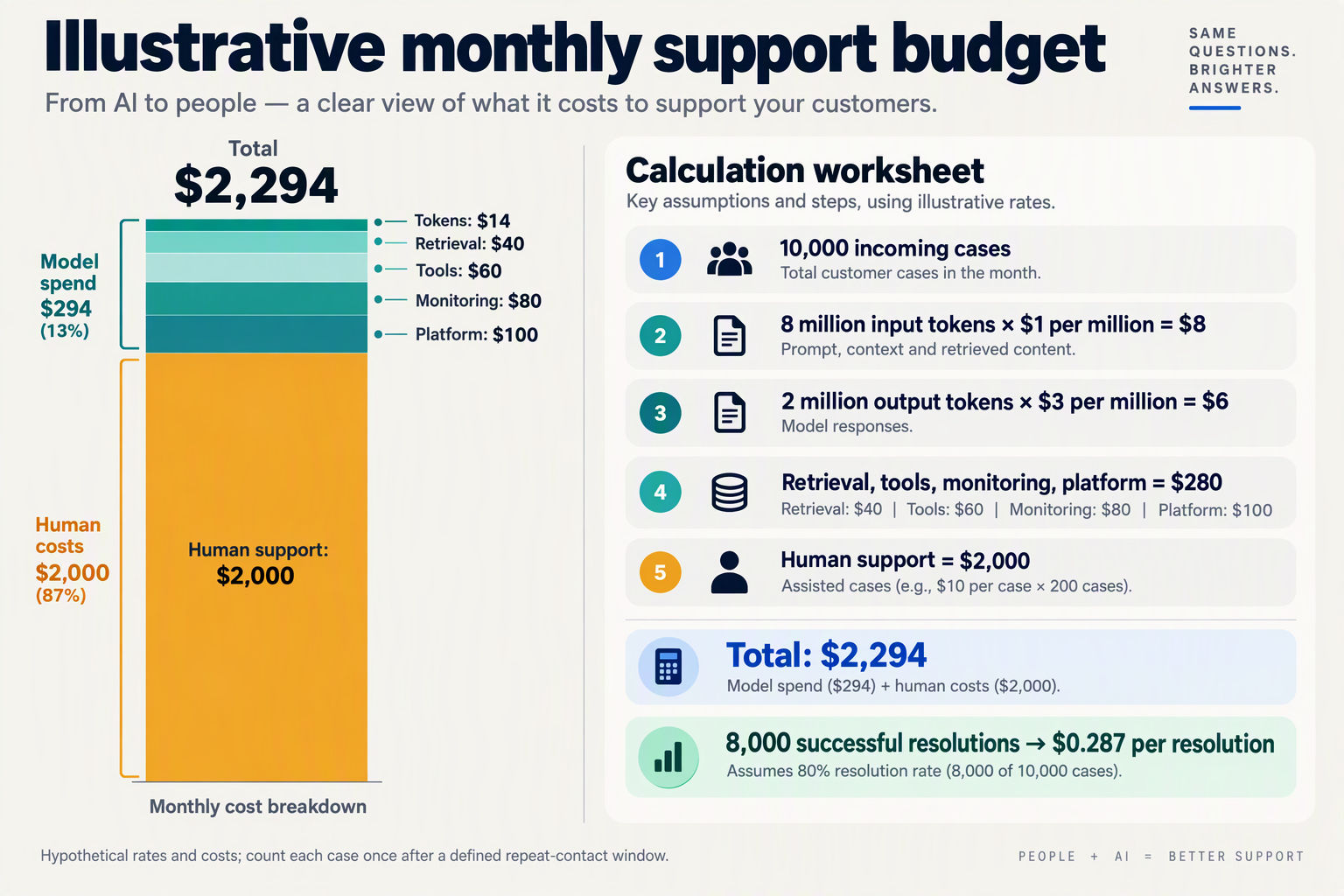
Calculate AI support cost per successful resolution by dividing the full cost of handling a defined group of customer issues by the number successfully resolved. Include unresolved cases in the cost numerator, but count only verified resolutions in the denominator.
Cost per successful resolution = Total support cost for an issue cohort ÷ Successfully resolved issues in that cohort
What counts as a successful AI support resolution?
Define success before comparing models or vendors. A chatbot ending a conversation is not evidence that the customer’s problem disappeared.
Use an issue-level definition with three checks:
- The requested outcome happened: a refund was approved, account access was restored, or the customer received an accurate answer.
- The issue stayed resolved: no same-issue reopening or repeat contact occurred within your chosen observation window.
- The process met requirements: identity checks, policy compliance, and necessary approvals were completed.
Choose the observation window by issue type—for example, seven days for an order-status query versus a longer period for a billing dispute. These are measurement choices, not universal benchmarks.
Report AI-only resolution separately from AI-assisted human resolution. Both can deliver value, but combining them without disclosure hides how much human work remains.
Which costs belong in the calculation?
Match costs and outcomes to the same cohort—for example, issues first opened in October 2026, followed until the resolution window closes. Counting October spending against October closures alone can mix newly opened cases with older backlogs.
Include:
- AI execution: model inference, speech processing, retrieval, and tool calls.
- Channel delivery: telephony, messaging, and relevant infrastructure charges.
- Human handling: escalation time, review, supervision, and corrective work at a fully loaded labor rate.
- Operating overhead: allocated integration maintenance, knowledge-base upkeep, evaluation, and monitoring.
- Repeat attempts: retries, reopened tickets, and additional contacts about the same issue.
Avoid double-counting bundled services. If a vendor price already includes speech recognition and language-model usage, do not add those components again.
As of October 2026, CallMissed provides call transcripts, AI call notes, and call scoring against a team’s own QA rubrics, according to its verified product fact sheet. Those records can support outcome audits, but teams still need to connect conversational evidence to the actual customer outcome.
How much can cheaper tokens change the result?
Consider this illustrative October 2026 calculation, not a market benchmark:
- Issues handled: 1,000
- Verified successful resolutions: 800
- Total operating cost: ₹24,000
- Model-token cost within that total: ₹2,000
The cost per successful resolution is ₹24,000 ÷ 800 = ₹30.
If token costs fall 90%, with everything else unchanged, total cost becomes ₹22,200. Cost per successful resolution becomes ₹27.75, a 7.5% reduction—not 90%.
In the research supplied for October 2026, ajianaz.dev describes an approximately 100-fold decline in cost per task over a year. That directional claim explains the excitement around cheaper inference; it does not establish equivalent savings across an entire support operation.
How should teams compare support configurations?
Compare configurations on the same issue mix, with the same success rules and observation window. Segment results by intent, channel, language, and complexity so that easy tracking questions do not conceal expensive billing failures.
Keep resolution rate, repeat-contact rate, and customer satisfaction beside the cost metric. The target is lower cost for a durable, acceptable outcome, not cheaper conversations that leave more customers unresolved.
When can lower AI token costs still produce a higher bill?
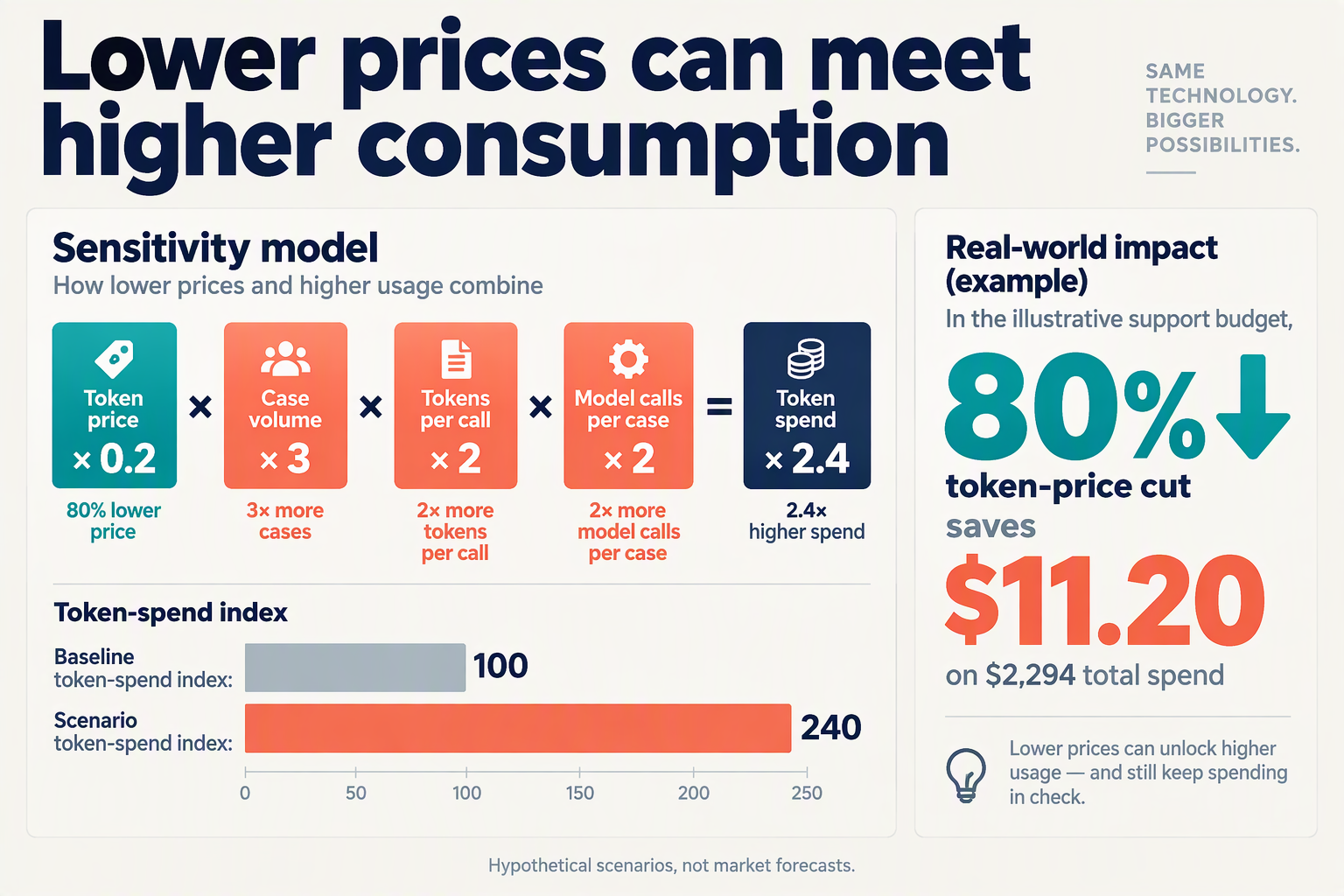
Lower AI token costs can still produce a higher bill when usage grows faster than prices fall, or when cheaper generation triggers more paid searches, tool calls, voice minutes, and human rework. The warning sign is not more AI activity itself; it is more spending without a proportional increase in resolved customer issues.
Can increased AI usage outweigh a token price cut?
Yes. Total token spending equals token volume multiplied by the price per token, so a lower unit price does not guarantee a smaller invoice.
In the research supplied for October 2026, Developers Digest describes an 80% model-price reduction in a single announcement; the excerpt does not identify the model or announcement date, so this is an example rather than a market-wide benchmark.
Apply that percentage to an illustrative October 2026 support budget, not an actual provider quote:
- Before the price cut: A team spends ₹10,000 monthly on model tokens.
- After the cut, with unchanged usage: Token spending falls to ₹2,000.
- After expanding usage eightfold: Token spending reaches ₹16,000—60% above the original bill.
An 80% price reduction permits five times the original usage before spending returns to its starting level. Beyond that threshold, the token invoice rises.
Expansion can be worthwhile: serving eight times as many customers could justify the increase. But generating eight times as many drafts for the same customers probably requires a different explanation.
How do cheap tokens create expensive agent workflows?
Cheap generation can encourage teams to remove limits that previously kept workflows disciplined. An agent may consult more sources, retry uncertain actions, or ask multiple models to review a straightforward answer.
QWE AI Academy’s guide, supplied for October 2026, calls indiscriminately sending requests to the strongest model “Method A – Blind flood” and warns about surprise invoices when agents loop. That distinction matters because repeated model calls can also multiply charges elsewhere.
Consider an illustrative order-status request. One account lookup and one reply might suffice. If the agent repeatedly searches documentation, refreshes order data, and generates alternative explanations, the model bill may remain small while external-service usage and response time increase.
Watch for three multipliers:
- Context expansion: Reattaching an entire conversation or excessive retrieved documents increases input tokens on successive turns.
- Retry amplification: Failed tool calls trigger additional attempts without a clear stopping rule.
- Unnecessary verification: Multiple agents review low-risk answers that a deterministic check could validate.
Longer interactions can also occupy voice channels or require human review. Cheap reasoning does not make every action it initiates cheap.
What controls prevent lower token prices from increasing support costs?
Set budgets around the workflow and outcome, not just the model’s token allowance:
- Cap tool calls and retries per issue, with explicit escalation conditions.
- Track unusually long conversations and repeated retrievals.
- Test whether extra reasoning actually improves resolution.
- Compare spending, repeat contacts, and successful resolutions before expanding usage.
As of October 2026, CallMissed’s verified capabilities include usage and request logs for its developer API, alongside metric alerts, evaluation suites, and A/B experiments for voice agents. These capabilities support investigation and testing; they do not replace a team’s cost controls.
The practical rule is simple: approve additional AI work when it improves outcomes—not merely because generation has become cheaper.
Cheaper LLM models vs cost optimization: which improves support economics?
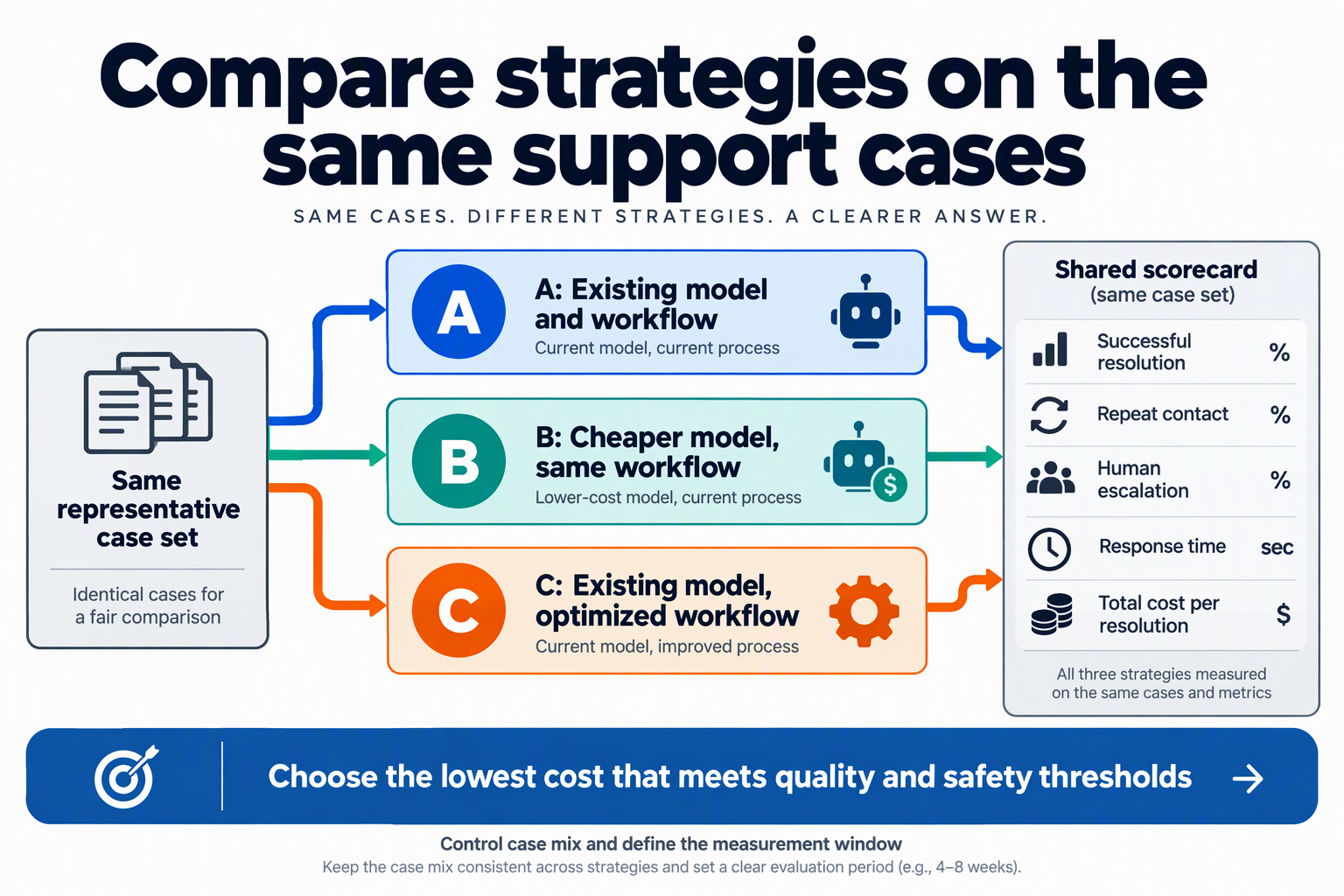
Cheaper LLM models improve support economics when they preserve resolution quality; cost optimization improves economics by reducing the work required to achieve that resolution. The strongest approach combines both—but measures model substitutions against operational savings rather than assuming a lower token price produces a better business outcome.
In the research supplied for October 2026, jyn.dev argues that the price of machine-learning intelligence is decreasing by “several orders of magnitude a year.” That is a reason to revisit model selection regularly, not evidence that every support workflow should use the cheapest available model.
How much can a cheaper model actually save?
Start with the addressable share of spending: the portion of your support bill that a model-price change can affect.
Consider this illustrative October 2026 monthly budget—not an industry benchmark:
- Total support operating cost: ₹100,000.
- LLM inference spending: ₹5,000.
- Everything else: ₹95,000, including human handling, channel charges, tools, and operations.
An 80% reduction in inference spending saves ₹4,000, reducing the total budget by just 4%, assuming workload and quality remain unchanged. By comparison, a workflow improvement that removes ₹10,000 of avoidable handling costs delivers a 10% reduction, even without changing models.
The useful calculation is:
Total-cost saving = inference share of total spending × inference-price reduction.
This establishes the ceiling for a price-only intervention. It also explains why model shopping deserves more attention in inference-heavy workloads than in support operations dominated by human escalations.
When should support teams choose smaller or cheaper models?
Choose cheaper models for tasks where success is easy to verify and failure is easy to contain. Reserve more capable models—or human review—for decisions where mistakes create expensive downstream work.
QWE AI Academy’s guide, supplied for this October 2026 article, contrasts “blind flood” with “tiered routing”: sending everything to the strongest model versus selecting models by task. For customer support, routing should reflect business risk, not simply message length.
Practical candidates include:
- Lower-cost models: intent classification, extracting order identifiers, and drafting routine replies from approved information.
- Higher-capability models: ambiguous complaints, conflicting policy evidence, and complex troubleshooting.
- Human review: sensitive exceptions or actions requiring authorization beyond the agent’s permitted scope.
As of October 2026, CallMissed’s developer AI API provides OpenAI-compatible endpoints, caller-chosen fallback models, and usage and request logs. Those capabilities support testing model alternatives without rewriting an existing SDK integration; teams still need to validate quality on their own support cases.
How do you compare model savings with workflow optimization?
Use a controlled comparison rather than changing the model and workflow simultaneously:
- Establish a baseline. Record cost per resolved issue, repeat-contact rate, escalation rate, and tool calls for comparable case types.
- Test the cheaper model alone. Keep prompts, retrieval, permissions, and workflow unchanged so the model’s contribution is measurable.
- Test workflow changes separately. Remove duplicate lookups, bound retries, and improve handoff context before attributing savings.
- Apply quality guardrails. Reject apparent savings if incorrect actions or unresolved cases increase.
A cheaper model that causes extra escalations can erase its inference savings. Conversely, a more expensive model can be economical if it reliably prevents costly rework.
Optimize the workflow first when non-model costs dominate; prioritize model selection when inference is a substantial expense. In both cases, the deciding metric is the cost of an acceptable resolution—not the price of generating an answer.
How should cheaper tokens change support budgets, staffing, and quality targets?
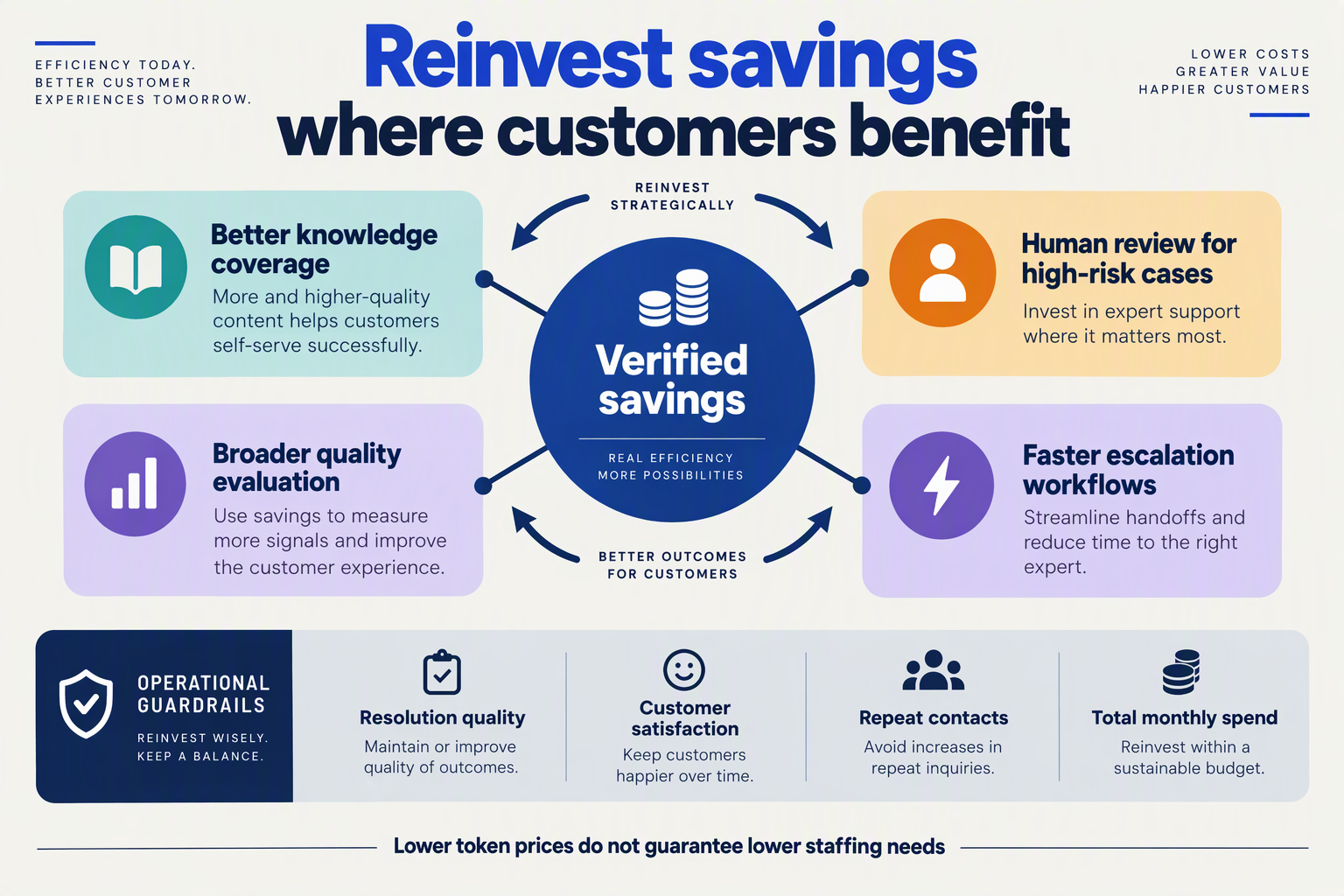
Cheaper tokens should shift support budgets toward verified resolutions, stronger quality controls, and better handling of exceptions—not automatically trigger staffing cuts. Reduce spending commitments only after lower inference costs translate into sustained savings without increasing repeat contacts, customer effort, or risk.
How should support leaders reallocate token savings?
Treat lower model prices as an opportunity to redesign the budget, rather than apply an across-the-board reduction. In the research supplied for October 2026, jyn.dev argues that LLMs could become computing “infrastructure, not just as a product.” For support leaders, that suggests budgeting for an ongoing operational capability rather than a standalone chatbot subscription.
Separate the budget into three pools:
- Service delivery: model usage, channel charges, integrations, and human handling.
- Reliability: evaluation, knowledge maintenance, monitoring, and incident response.
- Improvement: controlled experiments that reduce unresolved issues or customer effort.
Consider an illustrative October 2026 budget, not an industry benchmark: a team spends ₹100,000 monthly, including ₹10,000 on model inference. If inference spending falls by 80% at unchanged usage, the total budget falls by ₹8,000—8%, not 80%.
One possible allocation is ₹4,000 toward savings, ₹2,000 toward evaluation, and ₹2,000 toward knowledge-base improvements. The right split depends on whether service quality is already dependable or still needs investment. Avoid committing the entire saving before measuring additional usage and downstream work.
Should cheaper AI reduce customer-support headcount?
Token prices alone are not a staffing model. Plan staffing around the volume, duration, and complexity of work that still reaches people.
Automation can remove straightforward questions while leaving agents with disputes, unusual account problems, and emotionally difficult conversations. Consequently, fewer escalations do not necessarily mean proportionally fewer human hours.
Use a staged decision process:
- Measure residual workload: track human handling time by issue category, not just escalation counts.
- Redeploy capacity first: assign available time to backlog reduction, knowledge fixes, coaching, and complex cases.
- Validate across demand peaks: test coverage during launches, billing cycles, and seasonal surges before changing staffing commitments.
This also changes hiring priorities. Teams may need more capability in support operations, evaluation, and knowledge ownership, even when routine queue demand declines. Preserve enough experienced staff to resolve exceptions and diagnose automation failures.
Which quality targets should increase as tokens get cheaper?
Raise the quality bar where additional AI work has measurable value; do not reward longer answers or more agent activity.
QWE AI Academy’s guide, supplied for October 2026, contrasts “blind flood” with “tiered routing.” The practical budgeting lesson is to fund additional processing selectively, rather than send every request through the most expensive workflow.
Set explicit targets for:
- Verified resolution: completion confirmed through system evidence or customer feedback.
- Repeat-contact rate: customers returning about the same unresolved issue.
- Policy accuracy: correct decisions on refunds, eligibility, and account changes.
- Handoff quality: sufficient context transferred without making customers repeat themselves.
As of October 2026, CallMissed supports call scoring against custom QA rubrics, evaluation suites, and A/B experiments—capabilities relevant to testing whether added AI work improves support outcomes.
For each experiment, define the acceptable quality threshold and spending ceiling before launch. Cheaper generation should buy better evidence and better service, not simply more generation.
What should you ask experts before accepting token-deflation forecasts?

Ask experts to define what is getting cheaper, which evidence supports the forecast, and what would invalidate it before using token deflation in a support budget. A useful forecast must connect model pricing to your workload, quality requirements, and actual invoices—not merely extrapolate a falling price curve.
What exactly does “cheaper” measure?
Start by separating price per token, cost per task, and cost at a fixed quality level. These measures can move differently: a model may charge less per token but require longer reasoning, more retries, or additional verification.
In the research supplied for October 2026, jyn.dev states that the price of machine-learning intelligence is decreasing by “several orders of magnitude a year.” Ask the expert to translate that broad claim into an auditable comparison:
- Which models and dates are being compared? Request named versions and dated pricing.
- What is held constant? Require comparable task difficulty, correctness, latency, and context length.
- Which charges are included? Distinguish input, output, cached input, and any separately billed processing.
- Is this a published price or a measured bill? Discounts and workload assumptions can change the result.
Without those answers, “cheaper intelligence” is a direction of travel, not a procurement assumption.
Does the evidence match your customer-support workload?
Ask for the underlying tasks, not just the headline improvement. According to ajianaz.dev in the research supplied for October 2026, cost per task fell approximately 100-fold over a year; the supplied excerpt does not establish equivalent savings for customer support.
A useful follow-up is: “Would the same improvement hold for our hardest tickets?” Request a representative evaluation that includes:
- Ambiguous requests requiring clarification.
- Policy exceptions where the correct response is escalation.
- Multilingual conversations and incomplete customer information.
- Account actions requiring verified tool results.
For an illustrative billing dispute, require the test to distinguish a fluent explanation from a correct, authorized resolution. A cheaper answer that confidently misreads the account is not equivalent performance.
What assumptions could break the forecast?
Ask experts for downside and flat-price scenarios, not only their preferred trendline. Have them separate technical efficiency gains from commercial pricing decisions: a provider’s cost reduction does not guarantee an identical customer discount.
Useful questions include:
- Would savings persist without promotional credits or committed-volume discounts?
- Does the forecast assume particular hardware utilization or traffic patterns?
- What happens if requests need longer contexts or stricter verification?
- Which observed result would make the expert revise the forecast?
This turns an optimistic narrative into a falsifiable planning model. It also exposes forecasts that depend on unusually favorable deployment conditions.
What evidence should you collect before changing the budget?
Request a reproducible pilot, with versioned models, recorded usage, explicit pass criteria, and an agreed method for checking resolution. Compare the same ticket sample before expanding deployment.
As of October 2026, CallMissed’s developer AI API provides usage and request logs plus caller-chosen fallback models—capabilities teams can use when investigating whether routing changes deliver measurable savings.
The final question should be: “What decision does this forecast justify today?” If the evidence supports experimentation but not dependable savings, fund a bounded pilot rather than booking a speculative reduction into the support budget.
What should you measure next, and where can CallMissed help?
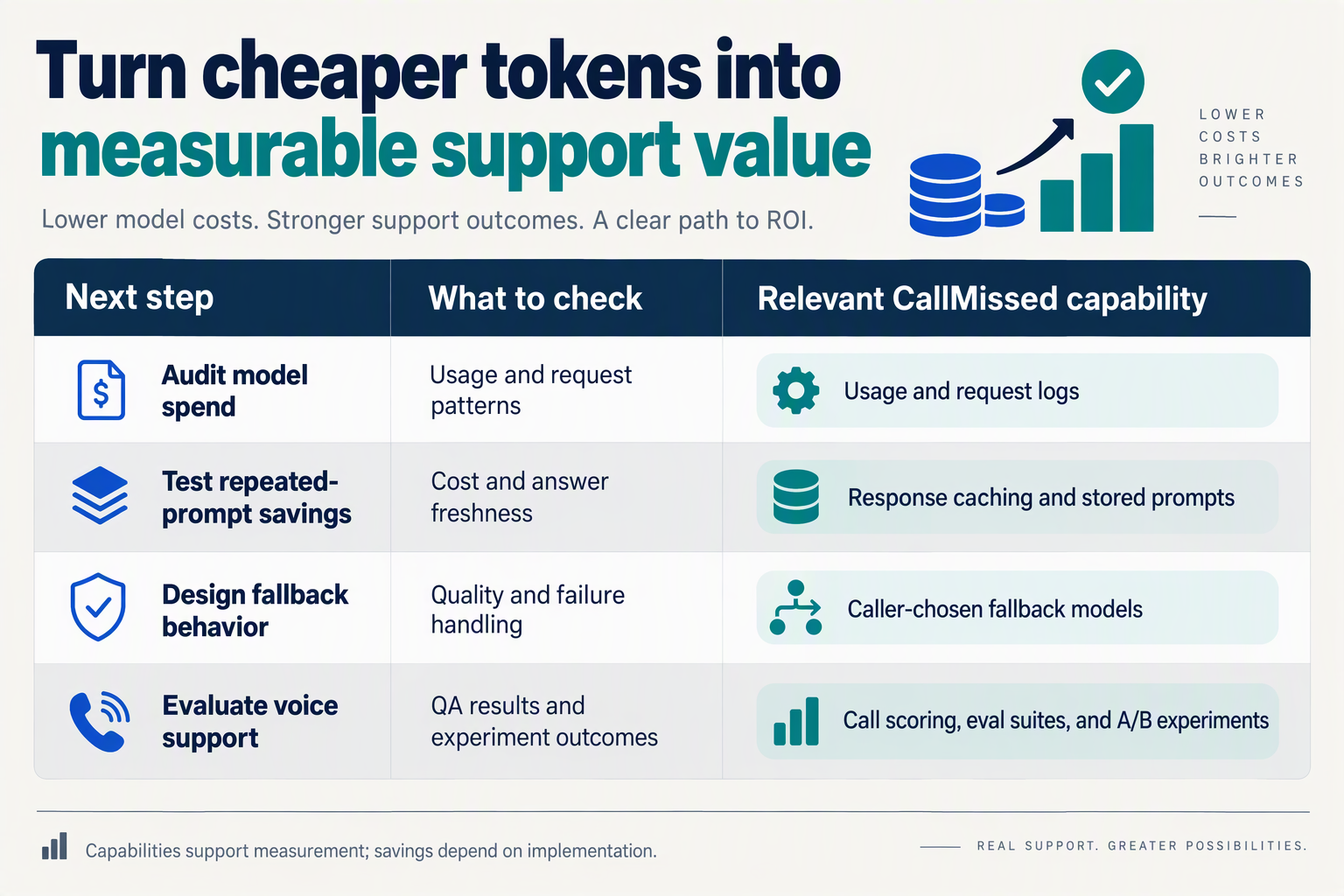
Measure cost per verified resolution, then track repeat contacts, handoffs, quality, and channel spend to explain why that cost changes. CallMissed can provide useful operational evidence, but your team must define what “resolved” means and connect conversation records to actual customer outcomes.
The October 2026 research supplied from jyn.dev describes LLMs becoming infrastructure, “not just as a product.” For support operations, the practical implication is to measure the whole service workflow—not treat falling inference prices as proof of improving economics.
Which AI customer-support metrics should you track next?
Use the following scorecard to distinguish cheaper conversations from better service. CallMissed’s capabilities below are verified as of October 2026; the metric definitions are recommended measurement methods, not claims that every calculation is available as a built-in dashboard.
| Metric | How to measure it | Available evidence or capability | Decision it informs |
|---|---|---|---|
| Cost per verified resolution | Total attributable support spend ÷ verified resolved issues | AI call notes with disposition and follow-up pushed to the CRM; usage and request logs | Whether savings survive human work and channel costs |
| Repeat-contact rate | Issues generating another contact within a defined window ÷ issues handled | Per-contact memory; CRM contacts and per-record timelines | Whether apparent resolutions actually hold |
| Human-handoff rate | Conversations transferred to people ÷ conversations handled | Human-handoff queue; support tickets and SLA policies | Where automation needs better boundaries or knowledge |
| Quality pass rate | Evaluated calls meeting your rubric ÷ evaluated calls | Call scoring against your own QA rubrics; eval suites and A/B experiments | Whether a cheaper configuration preserves service quality |
| Voice spend per resolved issue | Attributable voice charges ÷ verified voice resolutions | Agent analytics; flat-rate voice plans or a custom component stack | Whether shorter calls improve outcomes or merely end sooner |
| Customer satisfaction | Positive survey responses ÷ valid responses, using a consistent scale | CSAT surveys | Whether operational savings increase customer effort |
Keep the denominator honest. A refund request is not resolved because the agent explained the refund policy; it is resolved when the required action succeeds and the customer receives confirmation. Define separate completion criteria for order tracking, appointment changes, billing disputes, and other high-volume intents.
How should you run the next measurement cycle?
Start with one bounded workflow rather than averaging every support interaction together. A blended average can hide an improvement in simple questions alongside deterioration in complex cases.
- Establish a baseline. Select a fixed reporting window and record volume, verified resolutions, total costs, and quality results for one intent.
- Change one variable. Test a model, prompt, retrieval strategy, or escalation rule while keeping the resolution definition unchanged.
- Review delayed outcomes. Allow the same follow-up window for both groups before comparing repeat contacts and completed actions.
Apply three guardrails:
- Separate channel economics: compare voice with voice and messaging with messaging before combining results.
- Segment by difficulty: distinguish straightforward status checks from transactions requiring identity verification or approval.
- Keep a quality floor: reject apparent savings that increase incorrect actions, unresolved cases, or customer effort.
For voice budgeting, CallMissed’s published Standard rate is ₹4 per minute as of October 2026, covering speech recognition, the language model, and voice; phone carriage is separate. That gives teams a concrete cost input, not a guaranteed resolution cost.
The next useful question is therefore not “How many tokens did we save?” It is “Which configuration resolves this customer issue reliably, with the least total effort and spend?”
Frequently Asked Questions
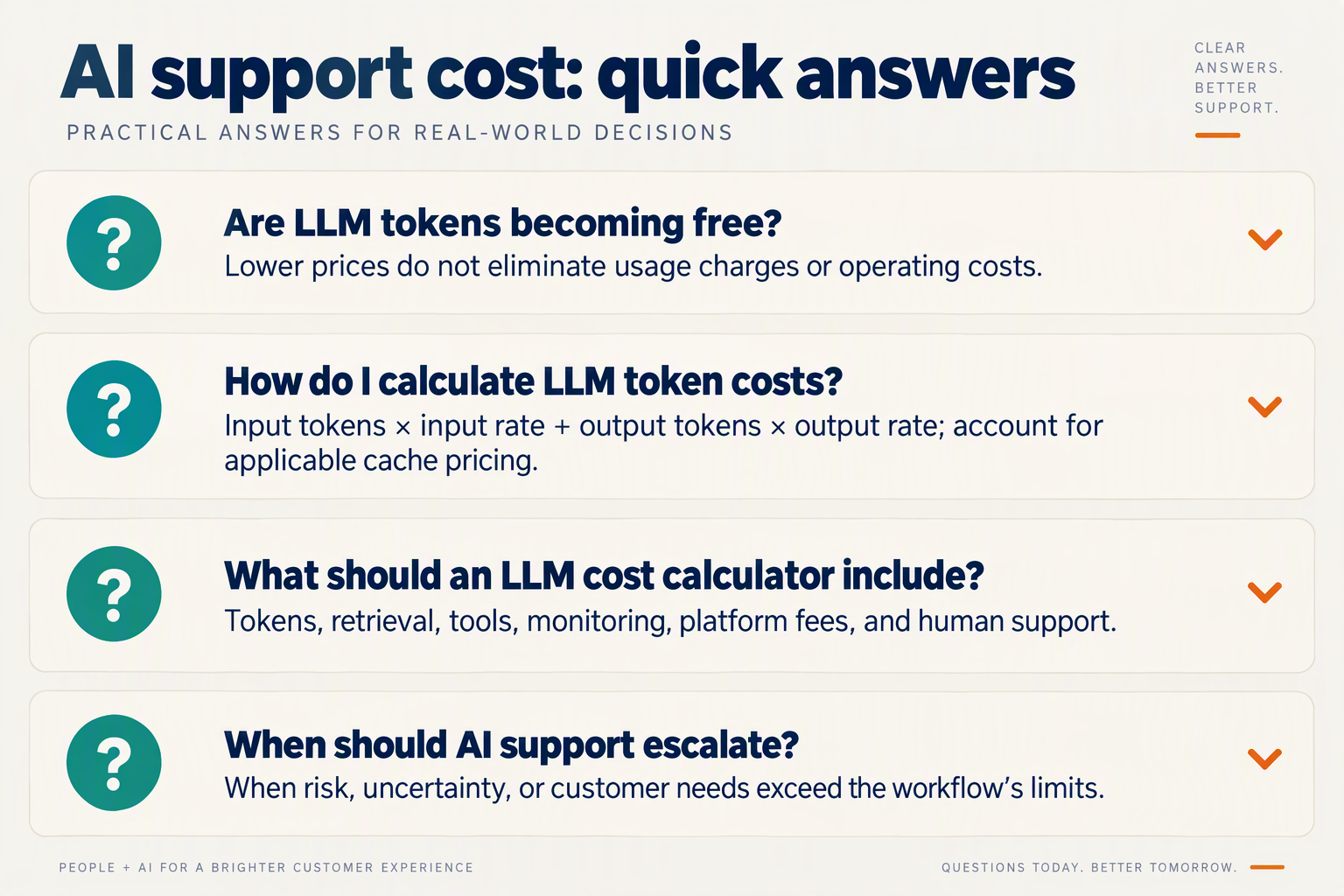
Are LLM tokens becoming free, or just cheaper?
How are LLM token costs calculated for customer support?
How should businesses measure the cost of AI customer support?
Why can the cost of AI customer support rise when token prices fall?
Should customer-support teams always use the cheapest LLM?
When should an AI customer-support agent escalate to a human?
Conclusion
Cheaper LLM tokens reduce the cost of generation, but cheaper AI customer support requires a lower total cost per resolved issue. The opportunity is to use increasingly affordable reasoning to solve customer problems with less wasted work—not simply to generate more responses.
In the research supplied for this October 2026 article, ajianaz.dev describes an approximately 100-fold decline in cost per task over a year, a directional claim rather than a universal support benchmark. That distinction should guide budgeting: a dramatic reduction in one component does not guarantee an equally dramatic reduction in the complete service bill. A refund still needs identity checks, an order lookup, a policy decision, and an approved transaction, regardless of how little the model charges to explain it.
Four takeaways should shape the next round of support investment:
- Measure resolution, not just conversation volume. Cost per conversation can fall while repeat contacts and unresolved issues increase. Cost per resolved issue provides a more useful test of whether cheaper inference is delivering operational savings.
- Separate token savings from channel costs. Phone carriage, speech recognition, voice generation, and messaging infrastructure remain part of the bill. Evaluate the complete interaction rather than treating the language-model price as a proxy for everything else.
- Control unnecessary workflow activity. Retrieval, external services, retries, and long-running interactions can absorb savings from cheaper generation. Additional AI work should earn its place by helping complete the customer’s request, not merely extending the conversation.
- Keep quality costs visible. Evaluation, monitoring, human escalation, and correcting mistakes belong in the economics. A low-cost answer is not a low-cost outcome if a customer must return or a person must repair the result.
What should support leaders watch as token prices fall?
Watch whether lower inference prices translate into fewer repeat contacts, more successful resolutions, and less customer effort. Affordable models could make summaries, multilingual replies, and knowledge-base searches easier to deploy, but the important comparison remains the total workflow before and after those changes. More AI activity is worthwhile only when its contribution to service outweighs its additional cost.
Readers can explore CallMissed, an AI customer-communication platform, to see how these layers come together. As of October 2026, CallMissed’s Standard voice-agent plan bundles speech recognition, the language model, and voice at ₹4 per minute, while phone carriage is billed separately—an illustration of why support economics extend beyond tokens.
Before your next model upgrade, establish a resolution-cost baseline and identify where retries, escalation, and repeat contacts consume resources. If generation becomes almost free, what will you change to make resolution genuinely cheaper?
Related Reading
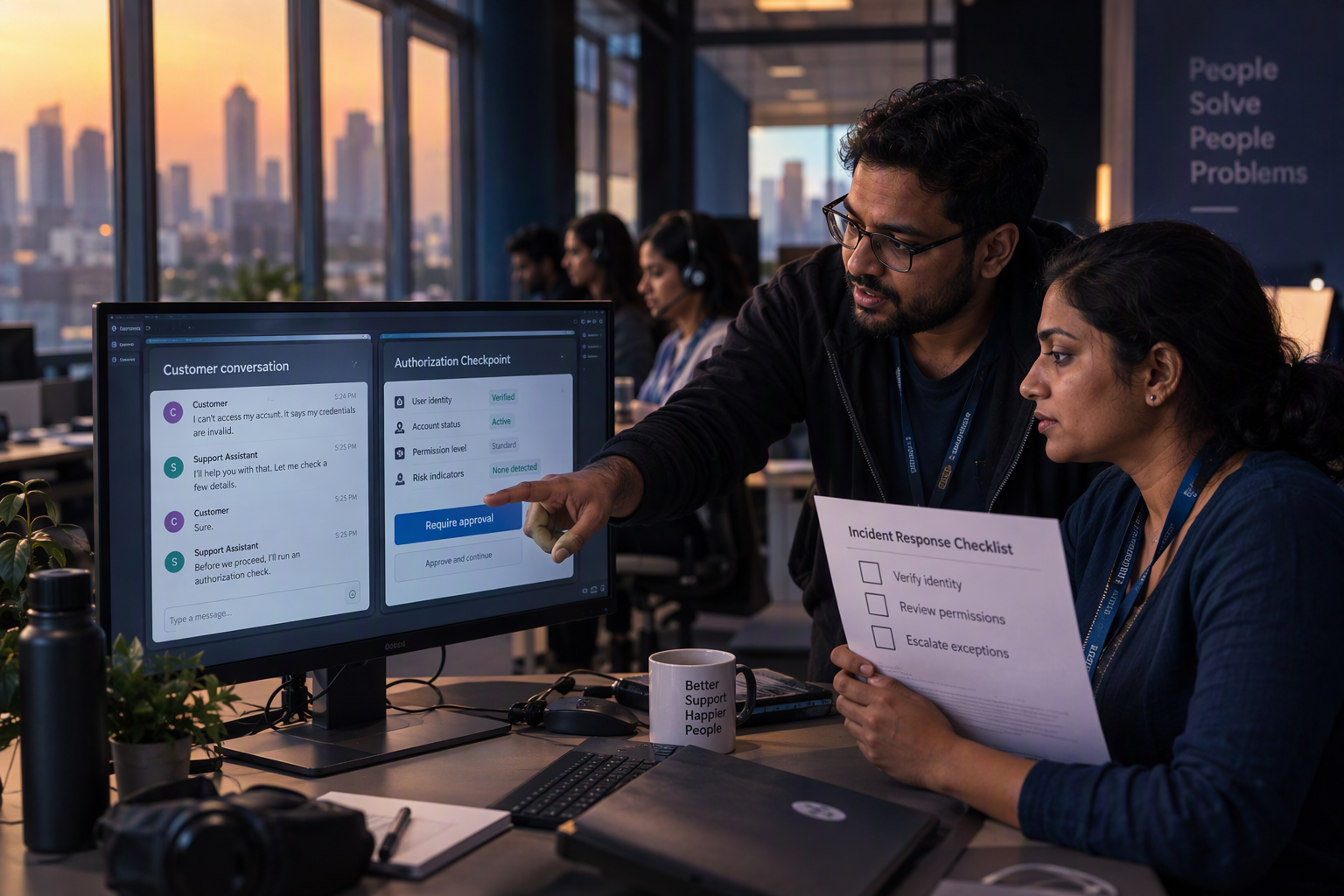
- Prompt Injection Protection for AI Agents in Support
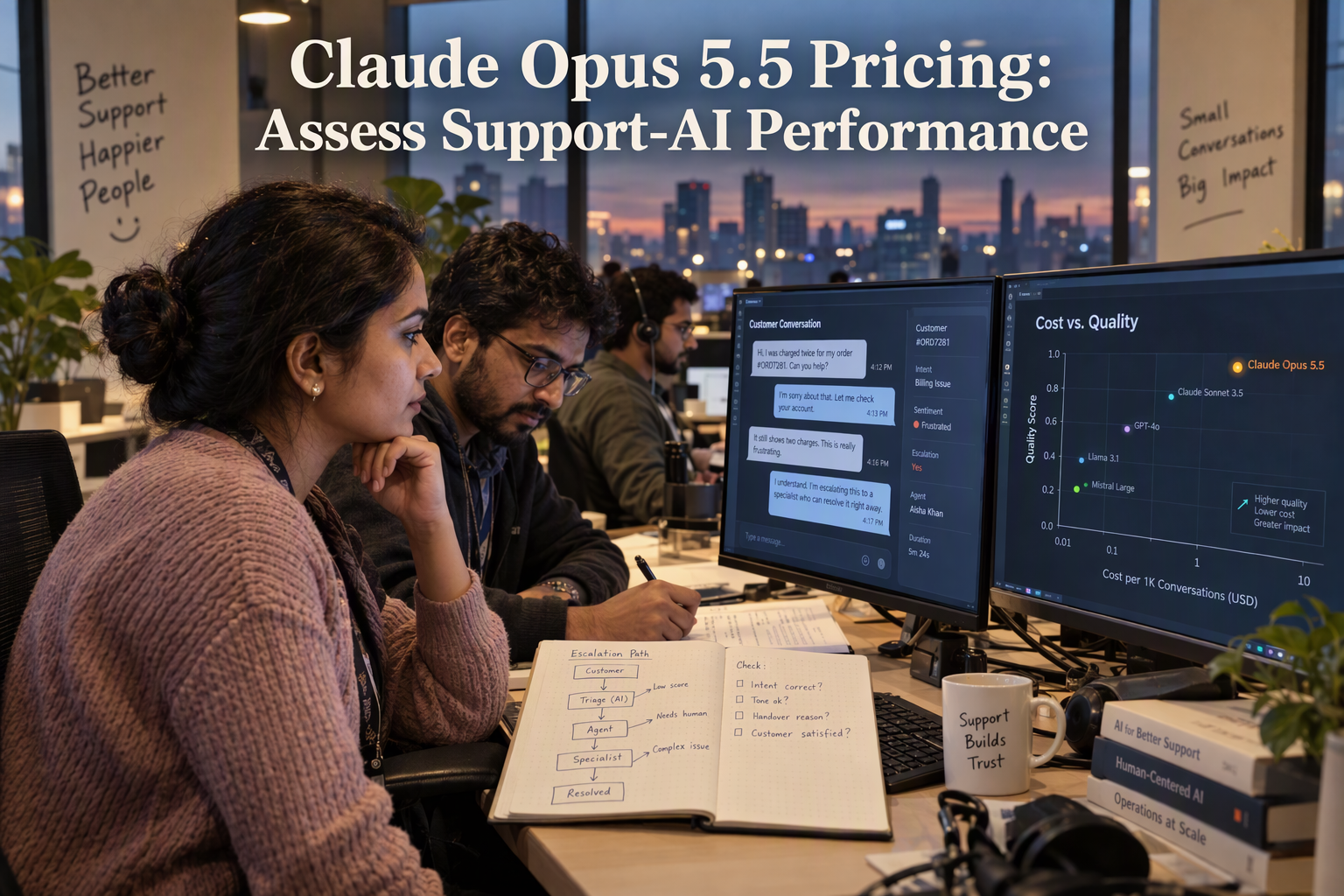
- Claude Opus 5.5 Pricing: Assess Support-AI Performance
- GPT-6 Sol vs GPT-6 Luna: A Voice Support Decision Guide
Sources
Discussion
Related Posts

Ready to automate customer conversations?
Launch AI voice agents and WhatsApp bots with CallMissed — one API, 22+ Indian languages.