Unified Image API: 2026 Developer Comparison Guide


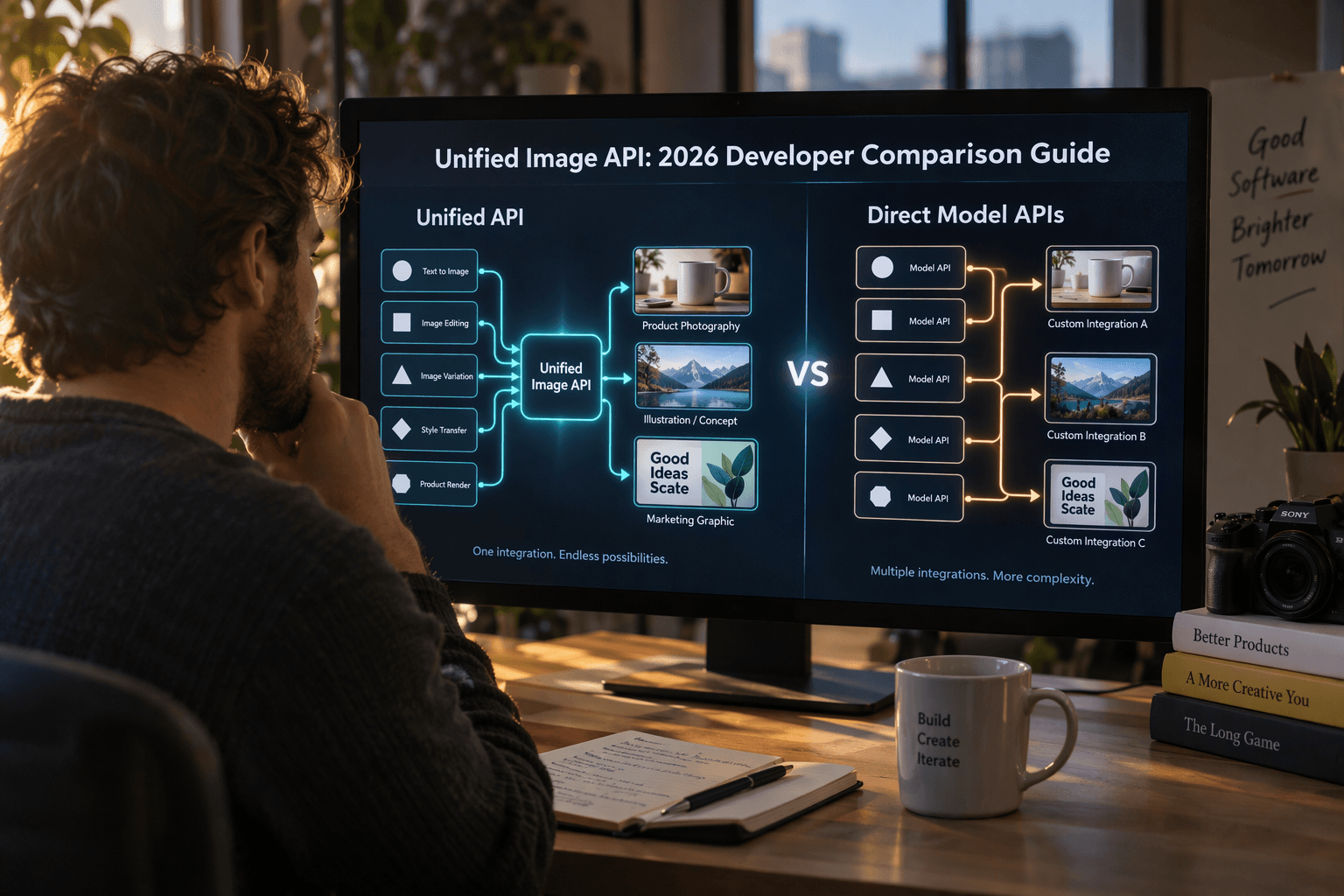
Unified Image API options compared by integration effort, model access, pricing and production limits to help developers choose a provider.

Unified Image API: 2026 Developer Comparison Guide
Why choose an image API by model count when the model you need might require a different workflow? A Unified Image API gives developers a common integration layer for multiple image-generation models, but buyers should compare supported operations, billing units, and production controls—not just catalogue size. For teams evaluating a unified API for image generation models in 2026, the right choice depends on whether they need straightforward generation, specialised editing, or a broader multimodal stack.
This guide is for startup engineering leads, agencies building creative tools, and enterprise developers adding image generation to production applications. A unified gateway is less compelling if your application depends on one model’s specialised features and a direct integration already meets your requirements.
What should developers compare before choosing a unified image API?
The buying decision starts with your workload. A product-image application, a marketing asset generator, and an interactive design editor may all generate images, but they need different controls, response times, and failure-handling strategies.
As of November 2026, CallMissed’s verified product fact sheet lists 9 image models within a 158-model developer API catalogue, with OpenAI-compatible image endpoints and one API key and balance. That makes CallMissed relevant to teams evaluating image generation alongside other AI capabilities; the catalogue count alone does not establish suitability for a particular image workflow.
OpenRouter’s “Introducing the Unified Image API” announcement and image-generation documentation provide another starting point for evaluating a shared integration layer. Replicate’s vendor pricing page belongs in the shortlist research, too—but a useful comparison must examine the actual models and billing terms rather than assume that similarly named APIs behave identically.
This guide will help you distinguish:
- Model access from feature access: Does the API expose the generation or editing operations your application needs?
- Headline pricing from workload cost: What happens when resolution, retries, or the selected model changes?
- SDK compatibility from migration effort: Which request fields, output formats, and error-handling paths still need testing?
- Catalogue breadth from production fit: Can you verify limits, data handling, and procurement requirements before committing?
When is a unified image API the wrong choice?
A unified API is not automatically the simplest or cheapest option. If a required capability is unavailable through the gateway, abstraction can become a constraint rather than an advantage.
For a standalone image-generation application, phone-number rules, telecom permissions, and messaging policies are not primary selection criteria. They become relevant only when generated images enter a connected communication workflow; image-specific considerations include data retention, output rights, and content restrictions.
The comparison ahead focuses on verifiable capabilities, vendor-sourced pricing with dates, and explicit “choose this if” verdicts. Where documentation does not establish a feature, limit, or price, the guide treats it as a verification question—not a promise.
For image generation in 2026, choose a unified API whose models, integration requirements and effective costs fit your workload. Shortlist OpenRouter, fal and Replicate, then check current documentation rather than assuming one API key means feature parity.
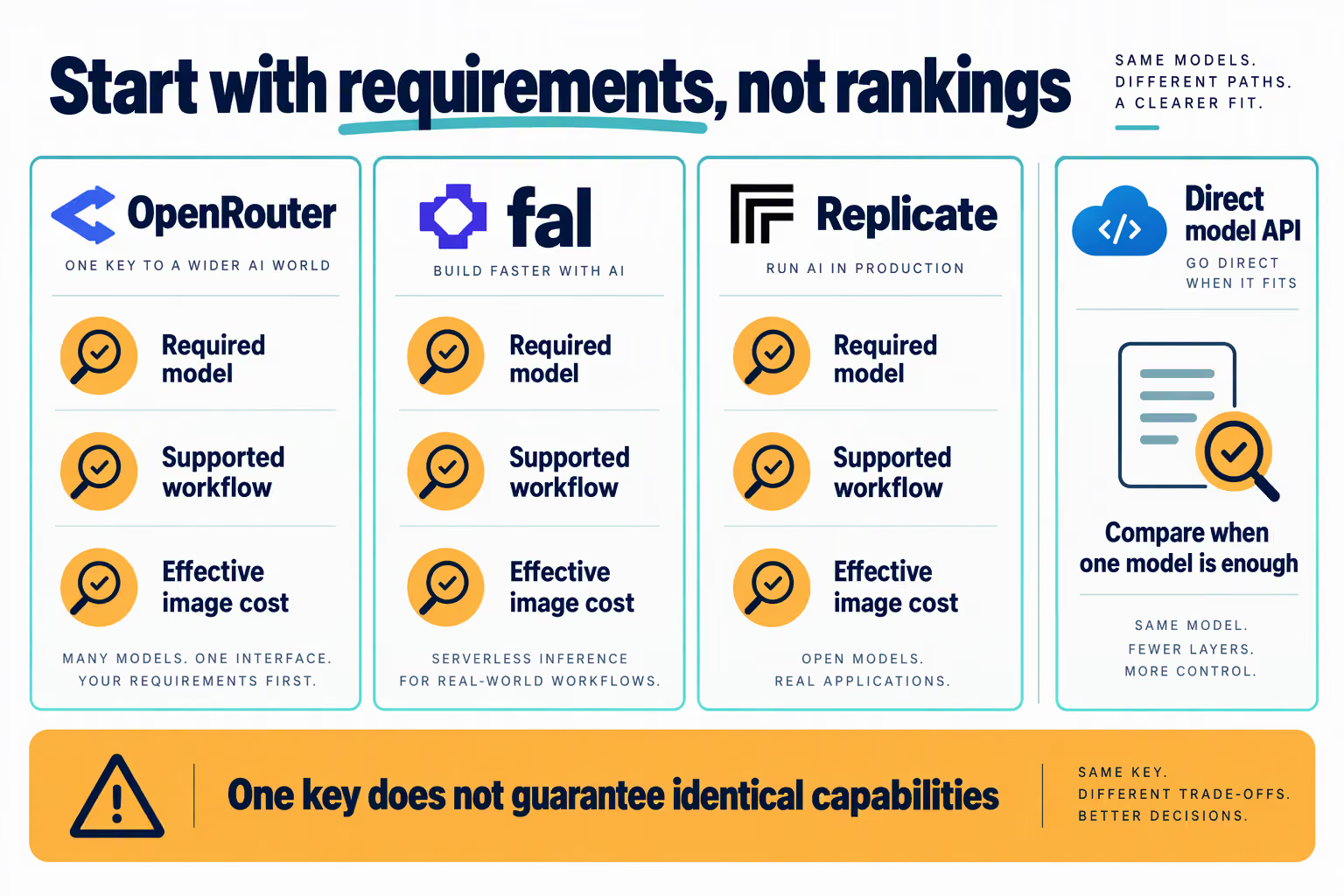
For a unified API for image generation models in 2026, shortlist OpenRouter, fal and Replicate against your actual generation and editing requirements—not catalogue size alone. As of November 2026, the supplied sources support a shortlist, but not a verified ranking of current prices, feature coverage or production limits.
Which unified image API belongs on your shortlist?
- OpenRouter: Start here if your engineering team wants to evaluate a shared image-generation integration layer. OpenRouter’s “Introducing the Unified Image API” announcement, Image Generation Models collection and AI Image Generation API documentation are the relevant primary sources in the supplied research. Before choosing, confirm that your selected model supports the required input images, output format and editing operation through that interface; the announcement title alone does not establish feature parity.
- fal: Include fal when comparing platforms for a creative application that may need image and video workflows. The supplied bookmarksfor.dev comparison explicitly includes fal in its 2026 image-and-video API comparison. Treat that as discovery evidence, not procurement proof: this context contains no fal vendor documentation establishing current model availability, billing units, concurrency limits or contractual terms.
- Replicate: Include Replicate when your decision depends on the economics of particular models rather than an aggregate platform price. Replicate’s own Pricing page is supplied as a primary source, but its actual rates are absent from the context. As of November 2026, no specific Replicate price can therefore be quoted from this research; check the selected model’s billing basis before estimating monthly spend.
- CallMissed: Consider CallMissed when image generation is one component of a broader developer AI integration. According to CallMissed’s verified product fact sheet, as of November 2026, its developer API provides OpenAI-compatible image endpoints, usage and request logs, and bring-your-own provider keys. These are concrete integration considerations, but the fact sheet does not establish image-specific editing support, resolution limits or per-model image prices.
What should buyers test before choosing?
- Buyer fit: This shortlist suits startup engineering leads, creative-tool agencies and enterprise application teams evaluating multiple models. A direct model API may be the better fit when one specialised operation determines the product. Define image workload—not call or message volume—with an explicit test scenario, such as 1,000 requested assets at two output sizes; these are illustrative planning inputs, not vendor capacity claims.
- Effective cost: Calculate total billed spend ÷ accepted, usable images, then compare that result across the same prompts and acceptance criteria. Record failed requests, retries, multiple outputs and any editing steps separately. The supplied Toolradar pricing comparison can help identify questions, but current prices should come from each vendor’s own pricing documentation, with an access date and the model configuration recorded.
- Production gates: Require documented answers for authentication, asynchronous completion, output retention, rate limits and commercial-use terms. For multilingual assets, test the actual scripts your customers need rather than assuming general language support guarantees readable text inside images. Phone-number, telecom and messaging permissions matter only if generated assets enter those workflows; they should not decide a standalone image-API purchase.
Which buyers should shortlist a unified API—and who should use a direct provider instead?
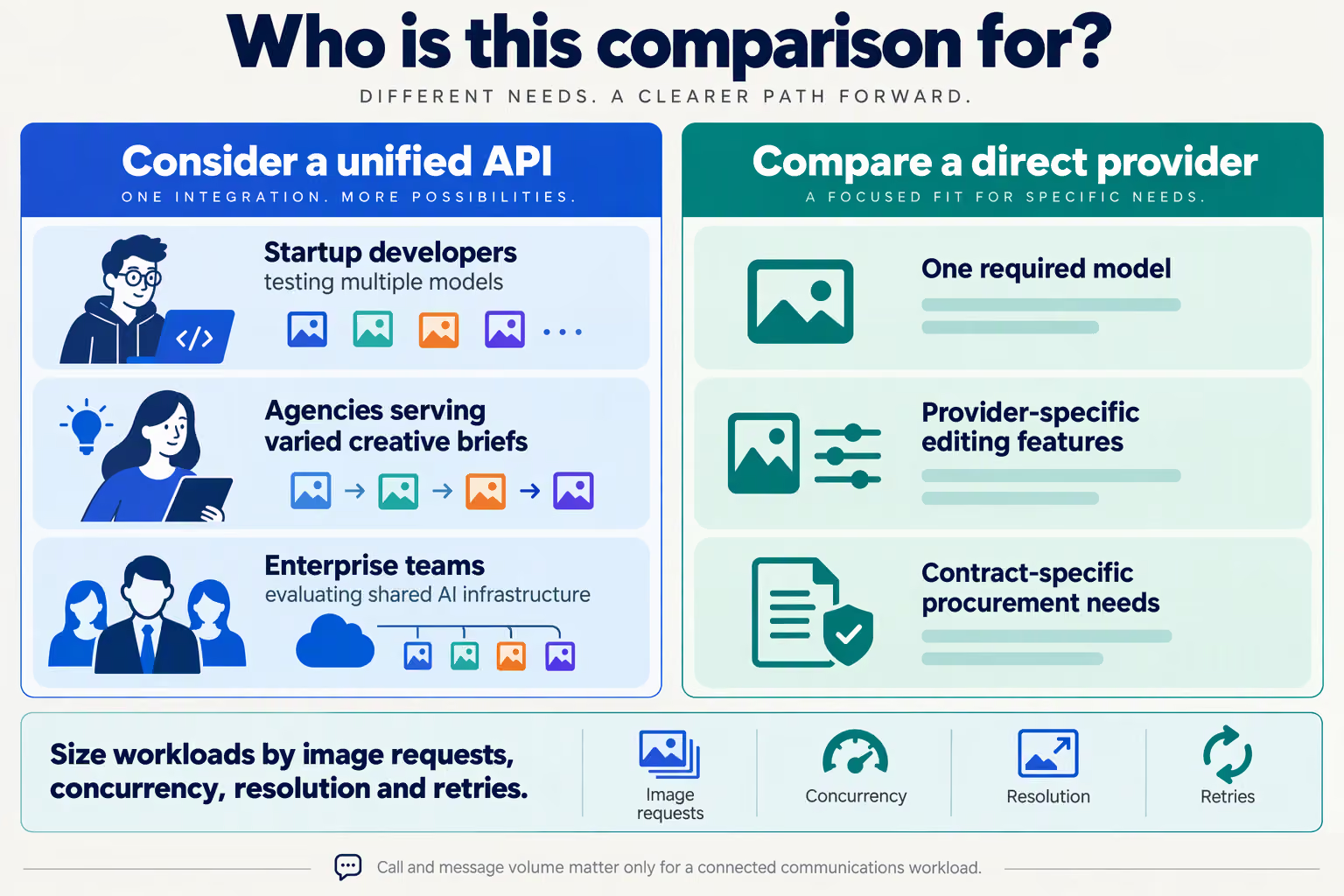
Shortlist a unified API for image generation models in 2026 if your team needs multiple models or shared infrastructure across AI workloads. Prefer a direct provider API when one model’s specialised controls are central to your product and an additional integration layer adds little value.
Which buyers should shortlist a unified image API?
- Startup engineering leads: A unified API is worth evaluating when a small team must support multiple image workflows without maintaining separate authentication, billing, and SDK integrations. Use a concrete acceptance test: generate the same product asset through 2 shortlisted models, then compare output handling, errors, and total workload cost. This is a suggested test, not a vendor benchmark; reject a gateway that omits a required operation.
- Agencies and creative-tool developers: Shortlist a gateway when different clients need different visual styles or model choices, but distinguish shared access from client-account isolation. OpenRouter’s “Introducing the Unified Image API” announcement and image-generation documentation are relevant starting points in the supplied November 2026 research. Before committing, verify how your application will attribute usage to each client and handle model-specific request fields.
- Teams building multimodal applications: A broader gateway can fit applications combining image generation with text or audio, provided each endpoint meets the workload’s requirements. According to CallMissed’s verified product fact sheet, as of November 2026, CallMissed supports OpenAI-compatible image endpoints and default per-key limits of 60 requests/minute on Free, 500 on Starter, and 3,000 on Pro. Those request limits are not guarantees of image throughput or simultaneous generation capacity.
Which buyers should use a direct provider instead?
- Specialised image-editor developers: Choose direct access when a provider-specific editing control is essential and the gateway does not expose it. Recraft’s “AI Model Marketplace or Direct API: Which Should You Use?”, included in the November 2026 research, is relevant to this decision. Test your required workflow—not just generation—including any masking, reference-image, or output-format requirements; these are evaluation criteria, not confirmed capabilities of every listed vendor.
- Single-model, high-volume applications: Prefer a direct integration when your production workload consistently uses one model and gateway convenience does not justify its commercial terms. Compare a representative workload—for example, 1,000 accepted images, explicitly an illustrative purchasing scenario—with failed attempts and retries included. Consult the selected provider’s own pricing alongside Replicate’s vendor pricing page; the supplied context does not establish current per-image prices or a defensible savings percentage.
- Enterprise procurement and regulated teams: Choose whichever route can document retention, processing locations, contractual responsibilities, and required security controls; neither “unified” nor “direct” proves compliance. Test regional-language text inside generated images separately from prompt acceptance. Phone-number and telecom rules do not decide a standalone image API purchase, but messaging permissions matter if your application distributes those assets through communication channels. Require written answers before approving production use.
How do OpenRouter, fal, Replicate and CallMissed compare on actual API capabilities?
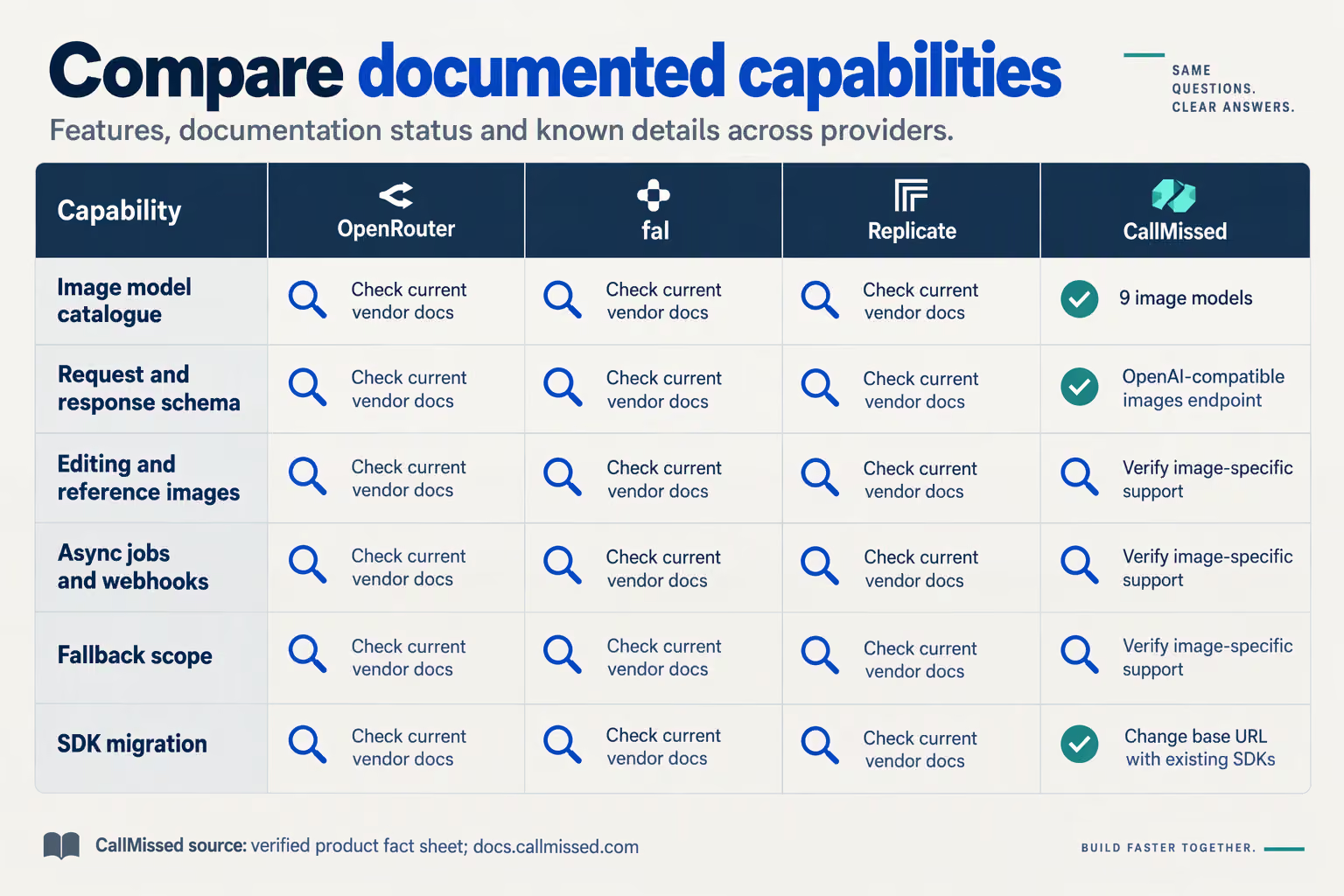
OpenRouter is a shortlist candidate for a shared image-generation interface; fal and Replicate warrant evaluation for model-specific creative workflows. CallMissed fits buyers combining image generation with a broader developer AI stack—but endpoint compatibility alone does not establish editing support or identical model controls.
Which API capabilities are established by the available evidence?
The table separates documented capabilities from verification gaps rather than treating every platform as interchangeable. As of November 2026, the supplied evidence includes OpenRouter’s announcement and image-generation documentation, Replicate’s pricing page, third-party comparisons covering fal, and CallMissed’s verified product fact sheet; it does not provide a complete feature matrix for every vendor.
| Capability | OpenRouter | fal | Replicate | CallMissed |
|---|---|---|---|---|
| Image-generation interface | “Unified Image API” announcement and image-generation documentation | Included in bookmarksfor.dev’s 2026 image/video API comparison; exact interface needs verification | Confirm the selected model’s input schema before integration | OpenAI-compatible image endpoints |
| Existing SDK migration | Validate the image-specific request and response contract | Validate SDK and endpoint requirements | Validate model-specific inputs and outputs | Existing supported SDKs work by changing the base URL |
| Editing and specialised controls | Check selected model and endpoint documentation | Check selected model’s editing controls | Check selected model’s editing controls | Editing operations are not established by the fact sheet |
| Rate limits | Not established by supplied excerpts | Not established by supplied excerpts | Not established by supplied excerpts | Per key: Free 60, Starter 500, Pro 3,000 requests/minute |
| Operational controls | Verify image-specific behaviour | Verify queues, retries and result retrieval | Verify prediction lifecycle and result retrieval | Usage and request logs; caller-chosen fallback models |
| Image pricing evidence | No numeric rates supplied | No vendor pricing page supplied | Vendor pricing page supplied; no numeric rates extracted | No model-specific image prices supplied |
What should buyers test before choosing a platform?
- OpenRouter: Choose the evaluation path when a shared image-generation interface is your priority. OpenRouter’s “Introducing the Unified Image API” announcement establishes the offering, but test the exact model, output format and operation your application needs before assuming migration is complete.
- fal: Evaluate for a creative application whose purchase depends on a particular generation or editing workflow. bookmarksfor.dev includes fal in its 2026 comparison, but that secondary source is not enough to establish current endpoint fields, concurrency limits, retention terms or vendor prices.
- Replicate: Evaluate when your shortlist starts with a specific model rather than an SDK standard. Use Replicate’s own Pricing page for cost verification, then check the model’s schema; the supplied pricing result alone does not establish editing parity or production limits.
- CallMissed: Choose the evaluation path when existing OpenAI-compatible integration code and shared access to other AI capabilities matter. CallMissed’s verified fact sheet lists 60, 500 and 3,000 requests per minute for Free, Starter and Pro respectively as of November 2026; these are API-key limits, not image throughput guarantees.
- Workload test: Run the same prompt, resolution and required operation across shortlisted models. Record successful outputs, rejected parameters, retries and total billed cost; request limits cannot predict image latency or concurrent-job capacity.
- Procurement gate: For enterprise developers, require explicit answers on image retention, commercial-use terms and regional processing. Telecom rules and messaging permissions become relevant only if generated assets enter those channels—not merely because the application generates images.
What does each platform cost per successful image, including retries and fees?
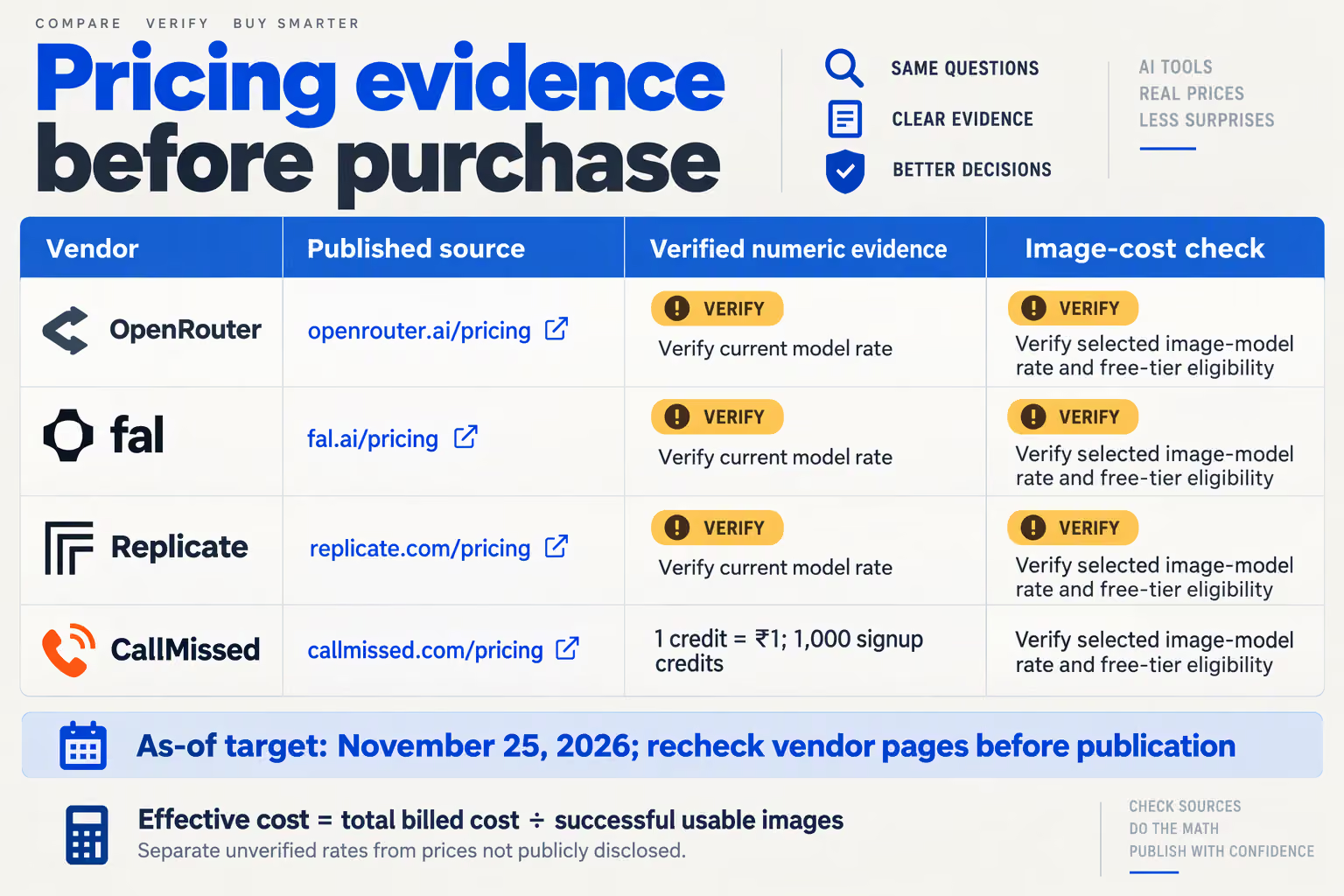
Cost per successful image equals total billed generation spend, retry charges, and applicable fees divided by usable images delivered—not requests submitted. As of November 2026, the supplied research does not establish comparable, current per-image prices across these platforms, so a defensible comparison must distinguish verified billing facts from quotes still requiring confirmation.
- Engineering leads: Compare the same model, resolution, quality setting, and output count; a cheaper request is not necessarily a cheaper accepted image.
- Agencies: Count client-rejected outputs as production costs even when generation technically succeeds; separate aesthetic rejection from API errors.
- Procurement teams: Request written terms for failed requests, cancellations, credit purchases, and payment fees before calculating monthly spend.
- Source limits: OpenRouter’s announcement and documentation identify its image offering, while Replicate’s pricing page is a primary pricing source; the supplied excerpts contain no numerical image rates from either.
| Platform | Verified pricing evidence, November 2026 | Retry/fee treatment | Buyer action |
|---|---|---|---|
| CallMissed | CallMissed’s verified fact sheet: ₹1 per credit; no image-specific rate supplied | Image retry billing not specified in the fact sheet | Confirm the selected image model’s rate on CallMissed’s pricing page |
| OpenRouter | Image API announcement and documentation supplied; numerical rates not supplied | Not established by supplied excerpts | Check model pricing and account/payment fees |
| Replicate | Vendor pricing page supplied; numerical rates not included in context | Not established by supplied excerpt | Confirm the selected model’s billing unit |
| fal | Named in bookmarksfor.dev’s 2026 comparison; no vendor pricing excerpt supplied | Not verified | Obtain model-specific vendor pricing |
| Runware | Named in bookmarksfor.dev’s 2026 comparison; no vendor pricing excerpt supplied | Not verified | Confirm settings-specific rates and retry terms |
| Recraft | Recraft’s marketplace-versus-direct article and GenSpend’s V3 listing supplied; no vendor rate supplied | Not verified | Verify current pricing directly with Recraft |
How should buyers calculate cost per usable image?
- Use an acceptance-based denominator: Divide all attributable billed costs by images that pass your production checks. Include generation, charged retries, gateway or payment fees where applicable, and separately billed processing; do not assume any listed platform charges every category.
- Illustrative benchmark—not vendor pricing: If a November 2026 test spends 100 cost units and delivers 90 usable images, effective cost is 1.11 units per usable image. At 75 usable images, the same spend becomes 1.33 units—about 20% higher, solely because acceptance falls.
- CallMissed budget distinction: As of November 2026, CallMissed’s verified fact sheet specifies credit top-ups of 10–50,000 credits at ₹1 each, with no bulk bonus and credits that never expire. These are funding terms, not evidence of a particular image-generation price or successful-output guarantee.
- Choose on measured economics: Select the platform with the lowest acceptable-output cost among those meeting your feature requirements. Run a representative test using your own prompts, record charged failures and rejected images separately, and obtain vendor confirmation before presenting any estimated rate as a purchasing commitment.
What are the practical pros and cons of unified platforms versus direct APIs?
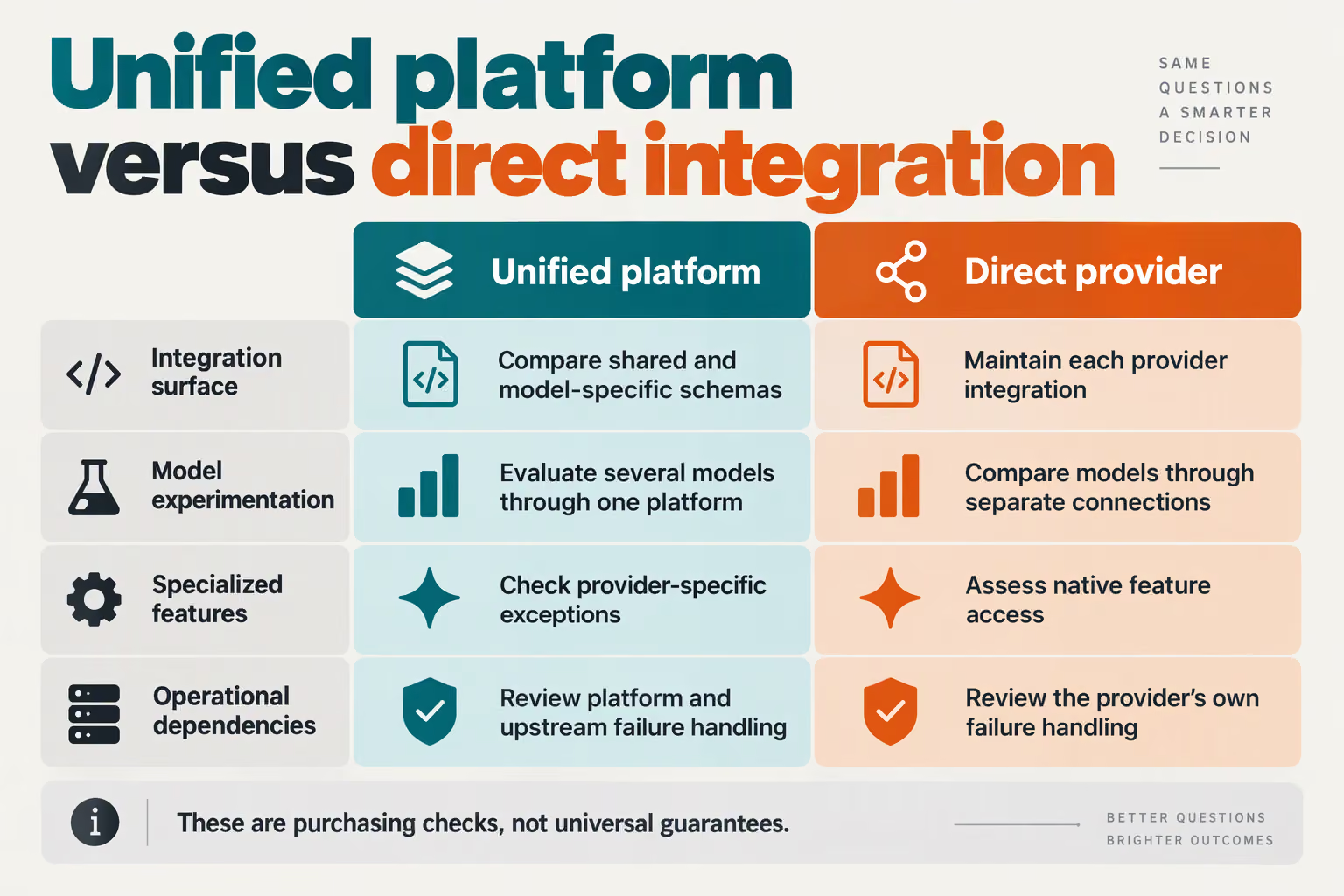
Unified platforms suit teams comparing several image models; direct APIs suit applications that depend on a specific provider’s native controls. For a unified API for image generation models in 2026, compare operational complexity against feature coverage—not presumed savings.
- Small product teams: A shared integration can reduce duplicated authentication and billing work; test each selected model’s request fields before committing.
- Creative-tool developers: Prefer direct access when a required editing operation or output setting is unavailable through the gateway.
- Agencies: Compare account separation, usage attribution, and client reporting against your actual requirements; one shared balance does not automatically solve client accounting.
- Enterprise buyers: Treat data retention, contractual commitments, regional processing, and incident ownership as procurement gates—not benefits implied by API compatibility.
What changes when you choose a gateway instead of direct APIs?
The following table is a November 2026 buying framework, not a performance benchmark. Provider documentation must confirm each implementation detail before purchase.
| Decision factor | Unified platform | Direct APIs | Buyer’s test |
|---|---|---|---|
| Integration effort | Shared endpoints can reduce repeated integration work | Separate integrations expose provider-specific interfaces | Run generation, errors, and output parsing |
| Model access | CallMissed lists 9 image models; OpenRouter publishes an image-model collection | Access centres on the chosen provider’s catalogue | Confirm the exact model and version |
| Feature coverage | Normalisation may not expose every native option | Better fit when a required native operation is supported directly | Test editing, masks, dimensions, and formats |
| Cost visibility | Shared billing simplifies reconciliation; billing units still require checking | Provider invoices make individual charges easier to trace | Compare cost per accepted image |
| Failure handling | Another dependency sits between application and provider | Fewer intermediary dependencies, but separate recovery logic | Test timeouts, retries, and duplicate requests |
| Support ownership | Gateway support may need upstream coordination | Provider support handles its own API | Identify who owns each failure class |
According to CallMissed’s verified product fact sheet, as of November 2026, its developer API includes 9 image models, OpenAI-compatible image endpoints, and one API key and balance. These are integration strengths, not evidence that every image model supports identical operations.
Which option should you choose for your workload?
- CallMissed: Choose it when images belong within a broader AI application; its November 2026 fact sheet also lists language, speech, and embedding models, but image-specific workflow support still needs validation.
- OpenRouter: Shortlist it for a shared image integration; OpenRouter’s “Introducing the Unified Image API” announcement and image-generation documentation are the named sources to check for current request and response behaviour.
- Replicate: Shortlist it when a particular hosted model fits your workflow; use Replicate’s own pricing page to verify that model’s billing rather than infer a platform-wide per-image price.
- Direct provider APIs: Choose them when native functionality outweighs consolidation; Recraft’s “AI Model Marketplace or Direct API” article offers a relevant evaluation perspective, not an independent benchmark.
Practical verdict: Run the same production-like requests through both routes and record accepted outputs, total charges, retries, and integration changes. The supplied research does not establish comparable November 2026 image prices, latency measurements, or uptime guarantees, so none should be assumed.
Which production constraints and benchmark results should rule a provider in or out?
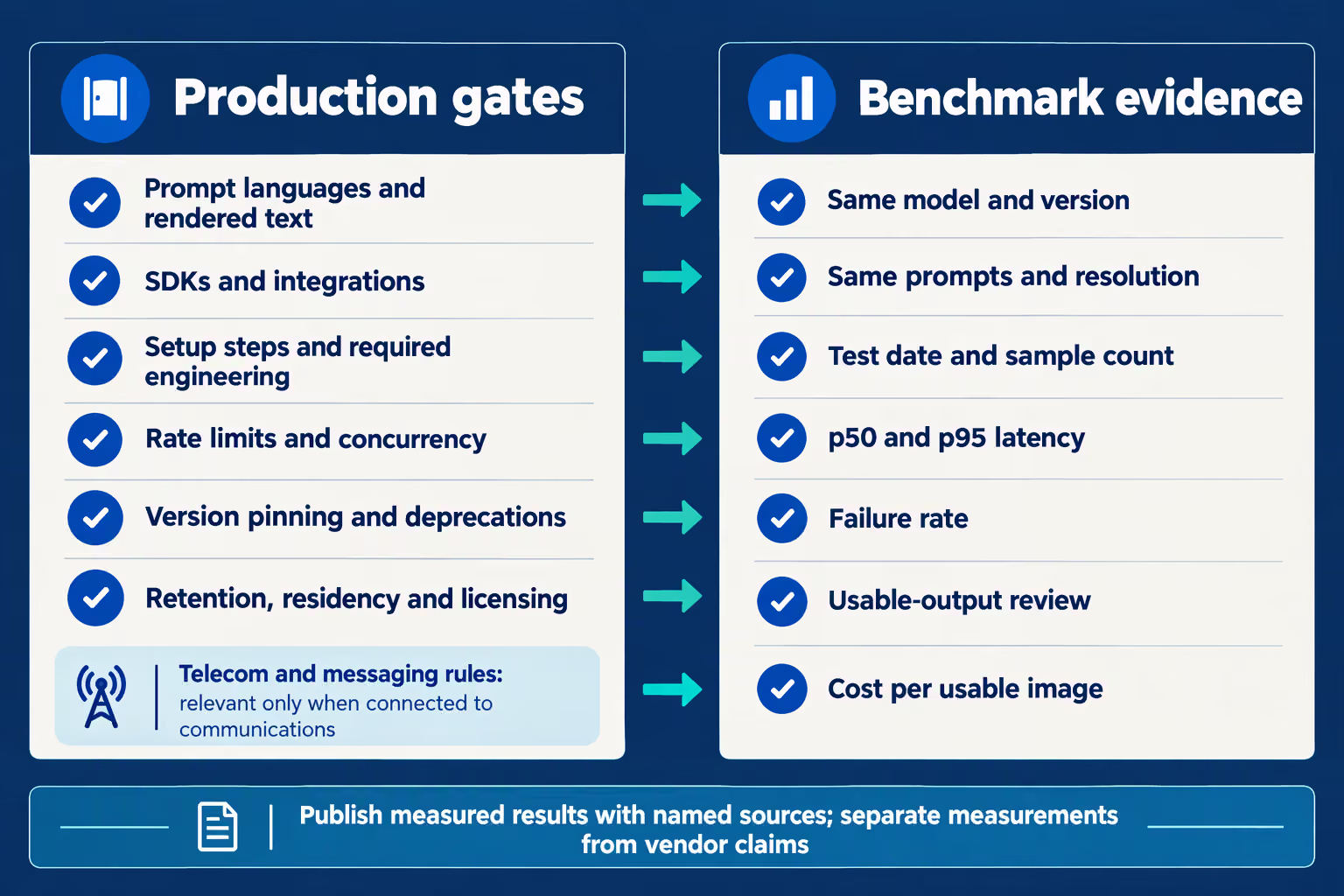
Rule a provider in only when its exact image workflow passes your quality, throughput, cost, and governance tests. The supplied sources do not establish comparable production benchmarks, so there is no evidence-backed speed or quality winner.
Which production constraints should disqualify an image API?
- Workflow compatibility: Require a successful test of every mandatory operation: generation, editing, reference-image input, transparency, and required output dimensions. OpenRouter’s image-generation documentation is a starting point for verification, not proof that every listed model supports identical features. Reject any route that silently drops a required parameter or changes output behaviour.
- Throughput limits: As of November 2026, CallMissed’s verified product fact sheet lists default per-key limits of 60 requests/minute on Free, 500 on Starter, and 3,000 on Pro. These are API request limits—not guaranteed image throughput. Ask separately about image-model concurrency, upstream throttling, queue behaviour, and whether failed requests consume capacity before sizing production traffic.
- Governance evidence: Require written answers on prompt and image retention, processing locations, deletion, subprocessors, and commercial-use terms. For enterprise developers, an unresolved mandatory requirement should block procurement even when sample outputs look excellent. Do not equate an SDK-compatible endpoint with a contractual security commitment, certification, or permission to process confidential product imagery.
- Integration effort: Test authentication, timeout recovery, output retrieval, and error handling in your actual application. OpenRouter’s “Introducing the Unified Image API” announcement establishes a relevant offering to investigate; it does not establish your migration time. Require an integration spike with a working failure path, rather than accepting a demonstration that only handles successful requests.
Which benchmark results should determine the final choice?
- Quality acceptance: Use a proposed 100-prompt buyer test, not an invented vendor benchmark: include product photography, text-heavy artwork, regional-language text, and reference-based tasks relevant to your business. Score each output against a written rubric. Report accepted images divided by attempted images, and separate first-attempt acceptance from results achieved through retries or manual corrections.
- Latency distribution: Measure p50 and p95 end-to-end latency, including queueing, generation, and image retrieval. Repeat the same workload under normal and peak concurrency. For interactive editors, tail latency can decide usability; for scheduled asset production, completion reliability may matter more. Publish test date, model version, dimensions, and concurrency alongside every result.
- Cost per accepted image: Calculate total billed spend divided by usable outputs, including rejected generations and retries. Replicate’s vendor pricing page is the named source for checking applicable billing terms, but the supplied context contains no numerical rates to quote. Compare measured workload costs rather than estimating November 2026 prices from search-result titles.
- Failure recovery: Inject timeouts, throttling, and unavailable-model responses; verify bounded retries, duplicate prevention, and explicit user-facing errors. Record recovery success separately from image quality. A fallback that returns an image but violates reference fidelity or brand requirements is a failed business outcome—not a successful production recovery.
Which option should you choose for experimentation, creative production or enterprise deployment?
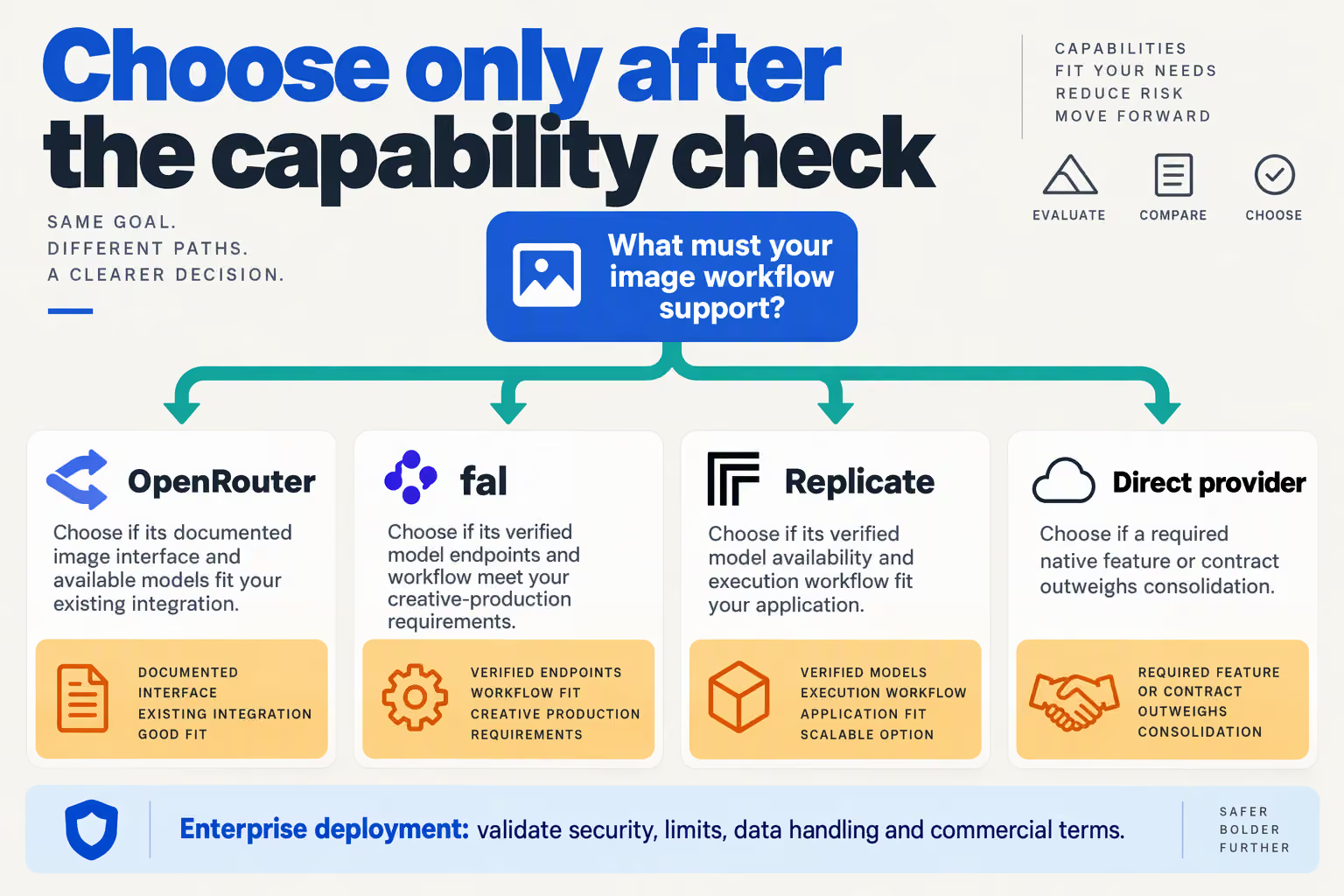
Choose a unified API for image generation models in 2026 for cross-model experimentation, a workflow-tested integration for creative production, and a procurement-verified service for enterprise deployment. Startup engineers, creative agencies and enterprise platform teams should make different choices—not inherit the same shortlist.
Which option should you choose for experimentation or creative production?
- OpenRouter: Choose OpenRouter for your experimentation shortlist if its documented image-generation interface supports the models and operations you want to compare. As of November 2026, OpenRouter’s “Introducing the Unified Image API” announcement and image-generation documentation are the named sources to check; neither title alone proves editing support or identical request parameters across models.
- Replicate: Choose Replicate for evaluation when a particular model available there matches your creative task, then verify that model’s input schema and billing unit. Use Replicate’s own Pricing page for your November 2026 cost check; the supplied research contains no verified numerical rates, so a defensible verdict cannot declare Replicate cheaper.
- Recraft direct API: Choose a direct Recraft integration if your application depends on Recraft-specific capabilities that a shortlisted gateway does not expose. Recraft’s “AI Model Marketplace or Direct API: Which Should You Use?” provides the relevant architectural comparison; confirm current operations and commercial terms rather than treating marketplace access as complete feature parity.
- Creative-production buyers: Before selecting any provider, run a proposed 30-brief acceptance test covering product imagery, text placement and editing where supported. Measure accepted outputs, retries, manual corrections and cost per accepted asset. This is a recommended evaluation design—not a published benchmark—and reveals workflow friction that headline model counts cannot show.
Which option should you choose for enterprise deployment?
- CallMissed: Choose CallMissed for your shortlist when image generation belongs within a broader developer AI integration. As of November 2026, CallMissed’s verified fact sheet lists OpenAI- and Anthropic-compatible endpoints, bring-your-own provider keys, and usage/request logs. Its default per-key limits are 3,000 requests/minute on Pro and 10,000 on Enterprise; these are not image-throughput guarantees.
- Procurement-led enterprises: Choose only after obtaining written answers on retention, training use, subprocessors, deletion, contractual support and required security evidence. CallMissed’s fact sheet states India hosting as of November 2026, but hosting location alone does not establish regulatory compliance. Apply the same evidence standard to every shortlisted provider.
- High-volume production teams: Compare measured concurrency, throttling, retry behaviour and end-to-end completion time using your actual image workload. Require a workload-specific cost calculation with the selected model, resolution and unsuccessful attempts included where billable. Do not substitute an account-level requests-per-minute limit for demonstrated generation capacity.
- Communication-connected applications: Phone-number, telecom and messaging rules matter only when images enter calling or messaging workflows; they should not decide a standalone image API purchase. For multilingual creative output, test rendered text in each target script separately. Speech-language coverage is not evidence that an image model can reproduce that language accurately.
Frequently Asked Questions
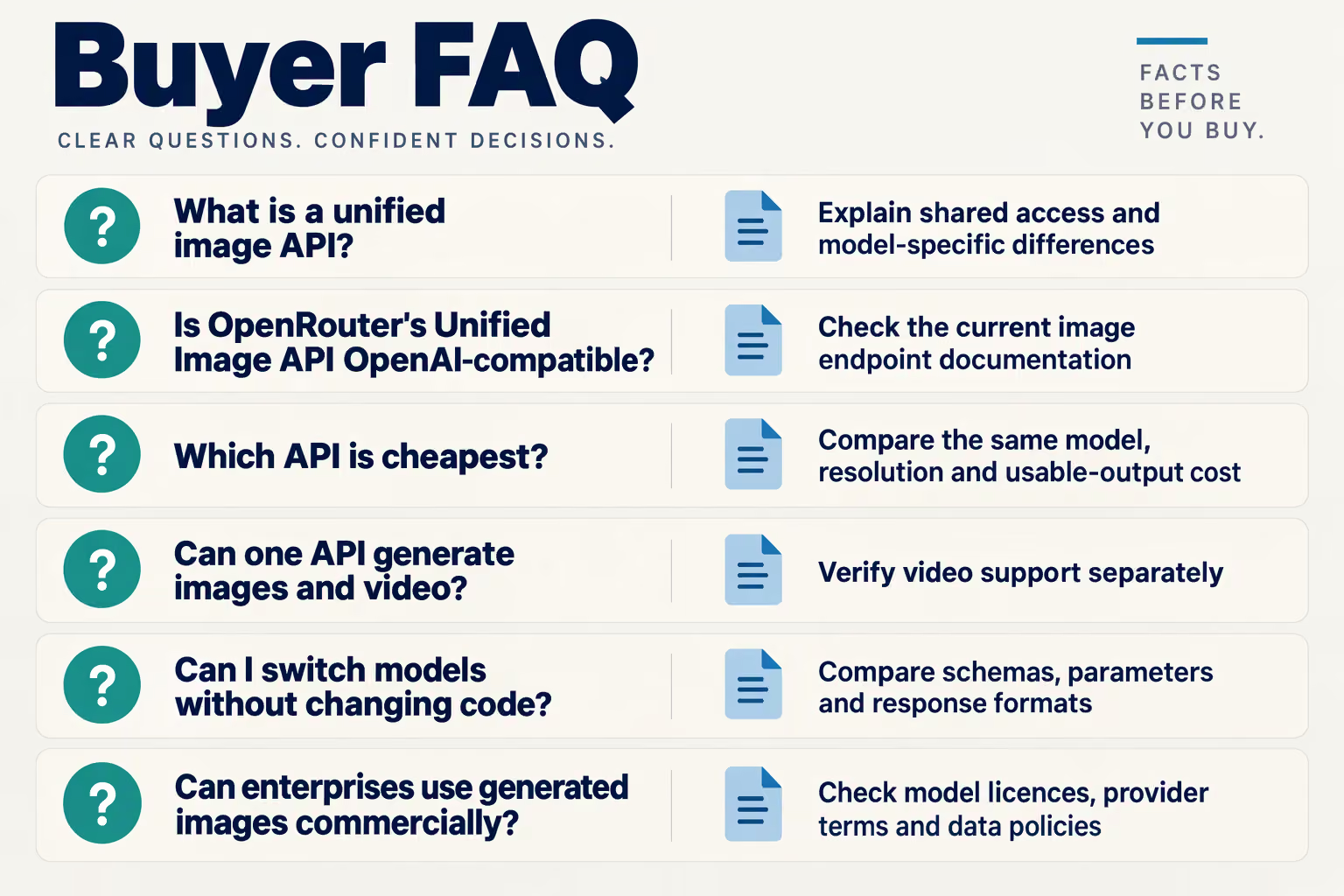
Choose a unified image generation API by testing your required operations, cost per accepted image, and production limits—not by catalogue size alone. Startup developers, creative-tool agencies, and enterprise engineering teams should shortlist gateways only after checking whether a direct model API better serves their workflow.
- Q: How should I evaluate a unified API for image generation models in 2026?
A: Run the same representative prompts and reference images through each shortlisted model, then score output quality, editing accuracy, response time, and total billed usage. OpenRouter’s “Introducing the Unified Image API” announcement and image-generation documentation are starting points for integration research; confirm supported request fields and outputs before assuming interchangeable behaviour. Keep generation and specialised editing as separate acceptance tests.
- Q: Which unified API for image generation models in 2026 is cheapest?
A: The supplied research does not establish a verified cheapest provider as of November 2026, so compare current model-specific charges using vendor sources such as Replicate’s Pricing page. Calculate cost per accepted image by dividing total billed spend—including unsuccessful attempts that incur charges—by usable outputs. A lower advertised generation price can lose its advantage when your workflow requires more retries or revisions.
- Q: Can I use an existing OpenAI SDK with a unified image API?
A: As of November 2026, CallMissed’s verified product fact sheet lists OpenAI-compatible image endpoints, with existing SDK integrations supported by changing the base URL. Compatibility does not establish that every model accepts identical image parameters or returns identical output formats. Test authentication, request validation, image retrieval, and error handling before treating migration as complete.
- Q: What rate limits matter for a production image-generation application?
A: As of November 2026, CallMissed’s verified product fact sheet specifies default per-key limits of 60 requests per minute on Free, 500 on Starter, and 3,000 on Pro. Request limits are not image-generation throughput guarantees: separately verify concurrent-job limits, completion times, and model-specific restrictions. For an agency producing client assets, test burst traffic rather than relying only on average daily demand.
- Q: What compliance checks should enterprise buyers make before choosing an image API?
A: Verify retention, deletion, processing locations, subprocessors, contractual safeguards, and permitted commercial use for both the gateway and the underlying model provider. Obtain written answers rather than treating SDK compatibility or a hosting location as proof of compliance. Phone-number and telecom rules are not primary constraints for standalone image generation; they become relevant when images enter calling or messaging workflows.
- Q: Should I choose a unified image gateway or a direct model API?
A: Choose a gateway when model switching and shared integration outweigh the need for provider-specific controls; choose direct access when a required editing feature or contractual term is unavailable through the intermediary. Compare OpenRouter’s image documentation, Replicate’s vendor pricing, and Recraft’s “AI Model Marketplace or Direct API” guidance against your acceptance checklist. Before committing, require one successful end-to-end test covering generation, billing visibility, failure recovery, and output delivery.
Conclusion
Choose a unified API for image generation models in 2026 by workflow fit, not catalogue size. For startup engineering leads, creative-tool agencies, and enterprise developers, the strongest shortlist is the one that supports required operations, makes workload costs understandable, and survives production testing.
The guide’s four decision points are:
- Compare operations before models. Straightforward image generation and specialised editing are different requirements. A gateway’s access to a model does not, by itself, establish that every feature needed by your application is available through the shared interface. Confirm the operations your product actually uses before treating catalogue breadth as an advantage.
- Evaluate workload cost, not headline pricing. Resolution, model selection, and retries can change the economics of a production application. Use vendor pricing documentation, including Replicate’s pricing page where relevant, to investigate billing units and terms. Compare the same representative workload across your shortlist rather than assuming that similarly named APIs have equivalent costs.
- Treat compatibility as a starting point. A familiar SDK or common integration layer can simplify evaluation, but request fields, output formats, and error-handling paths still need testing. OpenRouter’s “Introducing the Unified Image API” announcement and image-generation documentation are useful starting points for investigating how a shared interface maps to your application’s requirements.
- Keep direct integration on the shortlist. A unified gateway is less compelling when one model’s specialised capabilities define the product and a direct integration already meets your needs. Conversely, teams evaluating image generation alongside other AI capabilities should consider the value of a broader stack—without confusing that breadth with proof of image-workflow suitability.
What should buyers do before committing to a unified image API?
Turn those takeaways into a small, representative evaluation: test your required generation or editing operation, inspect the returned output, exercise failure handling, and calculate costs using the documented billing terms. Verify limits, data handling, and procurement requirements before moving from a successful demonstration to a production commitment.
As of November 2026, CallMissed’s verified product fact sheet lists 9 image models within a 158-model developer API catalogue, with OpenAI-compatible image endpoints and one API key and balance. Explore CallMissed if your shortlist includes image generation within a broader AI stack, while validating the specific image operations your application requires.
Looking ahead, watch how shared image interfaces evolve around feature coverage, billing clarity, and production controls. Those changes matter more to a buyer than a larger model count alone.
Before choosing a platform, ask: can it deliver your actual workflow reliably, at a cost you can explain?
Related Reading
- Best Text to Speech API for Hindi in 2026: Developer Decision Matrix
- GPT Image 2 vs Nano Banana 2 vs Seedream 5.0: 2026 API Comparison
- GPT Image 2.5 API: Flare vs Sunburst Developer Guide