Voice AI Agents for Indian Startups: Buyer Guide 2026


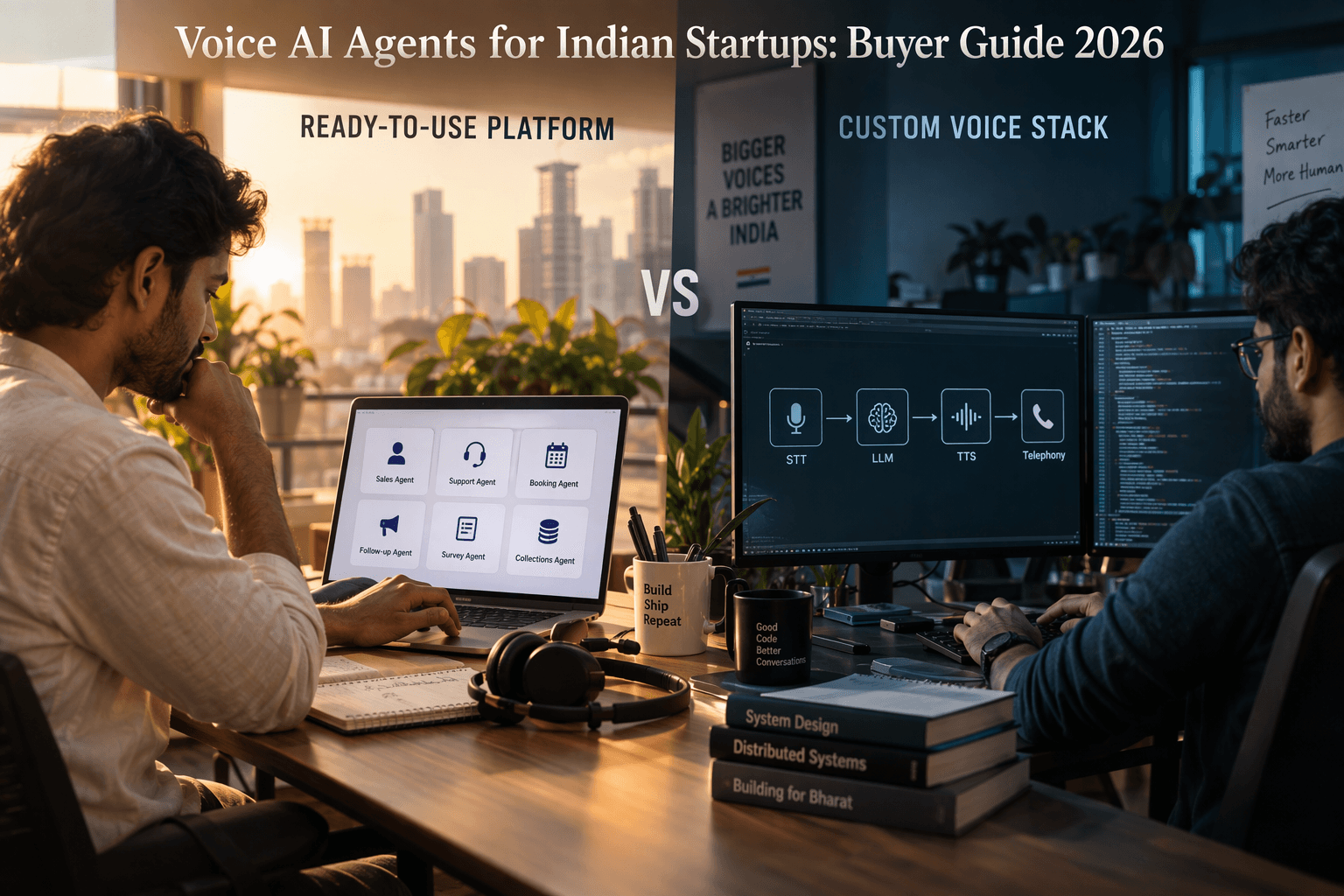
Compare voice AI agents for Indian startups by language fit, setup effort, telecom requirements and total cost to choose a practical shortlist.

Voice AI Agents for Indian Startups: Buyer Guide 2026
A ₹3-per-minute voice agent can cost more than its headline rate suggests—so which voice AI agents actually offer the best plug-and-play fit for an Indian startup? The answer depends on your languages, setup effort, call workflow and total connected-call cost, not a universal winner.
The pricing gap makes this comparison timely. According to Bolna’s comparison dated 26 October 2026, Bolna starts at $0.06 per minute with bundled speech recognition, language models and speech generation, while telephony and platform fees are additional. Sarvam AI’s pricing page, included in the November 2026 research context, lists ₹3.50 per minute for pay-as-you-go, with telephony charged separately.
Those distinctions matter when a startup moves from a convincing demo to answering real customer calls. A low advertised rate is useful only when the agent understands callers, completes the intended task and hands over appropriately when automation reaches its limits.
What does “plug-and-play” voice AI mean for an Indian startup?
Plug-and-play should mean fewer implementation steps—not fewer checks before launch. A useful buyer’s comparison separates a dashboard-led voice-agent platform from a developer toolkit or a contact-centre offering requiring a custom quote.
This guide will assess the practical questions behind that distinction:
- Setup: Can a nontechnical founder configure and test an agent, or does deployment need engineering work?
- Language fit: Does the platform support your customers’ spoken languages and code-switching, rather than merely listing language names?
- Telephony: Can you use an existing carrier, and which number rentals or carriage charges remain outside the quoted rate?
- Workflow completion: Can the agent answer from your knowledge base, use business tools and transfer a call when needed?
As of November 2026, CallMissed offers a no-code voice-agent builder, speech recognition in 22 Indian languages plus English, including Hinglish, and a ₹4-per-minute Standard plan covering recognition, the language model and voice, with phone carriage billed separately and a 30-second minimum per call.
How should buyers compare voice AI pricing?
Compare the same workload, not isolated price labels. For example, 1,000 connected minutes at Sarvam AI’s published ₹3.50 pay-as-you-go rate imply ₹3,500 in voice-agent charges before separate telephony costs; that calculation is not an all-in budget.
This guide will distinguish bundled model charges, platform fees, telephony, minimum billing increments and monthly commitments. It will also flag when a published “starting from” price requires higher usage rather than representing a startup’s first-month rate.
Which platform should your startup shortlist?
The strongest shortlist matches your immediate use case: inbound support, appointment booking or individual outbound calls. You will learn how to compare named providers, identify pricing exclusions and run a small pilot using realistic accents, interruptions and task-completion checks—before committing your customer experience to a headline price.
For Indian startups, the best plug-and-play voice AI is a ready-to-use platform that passes your language, phone-number and integration checks. Compare the complete calling cost and a successful pilot before choosing; a custom stack fits teams that need deeper control.
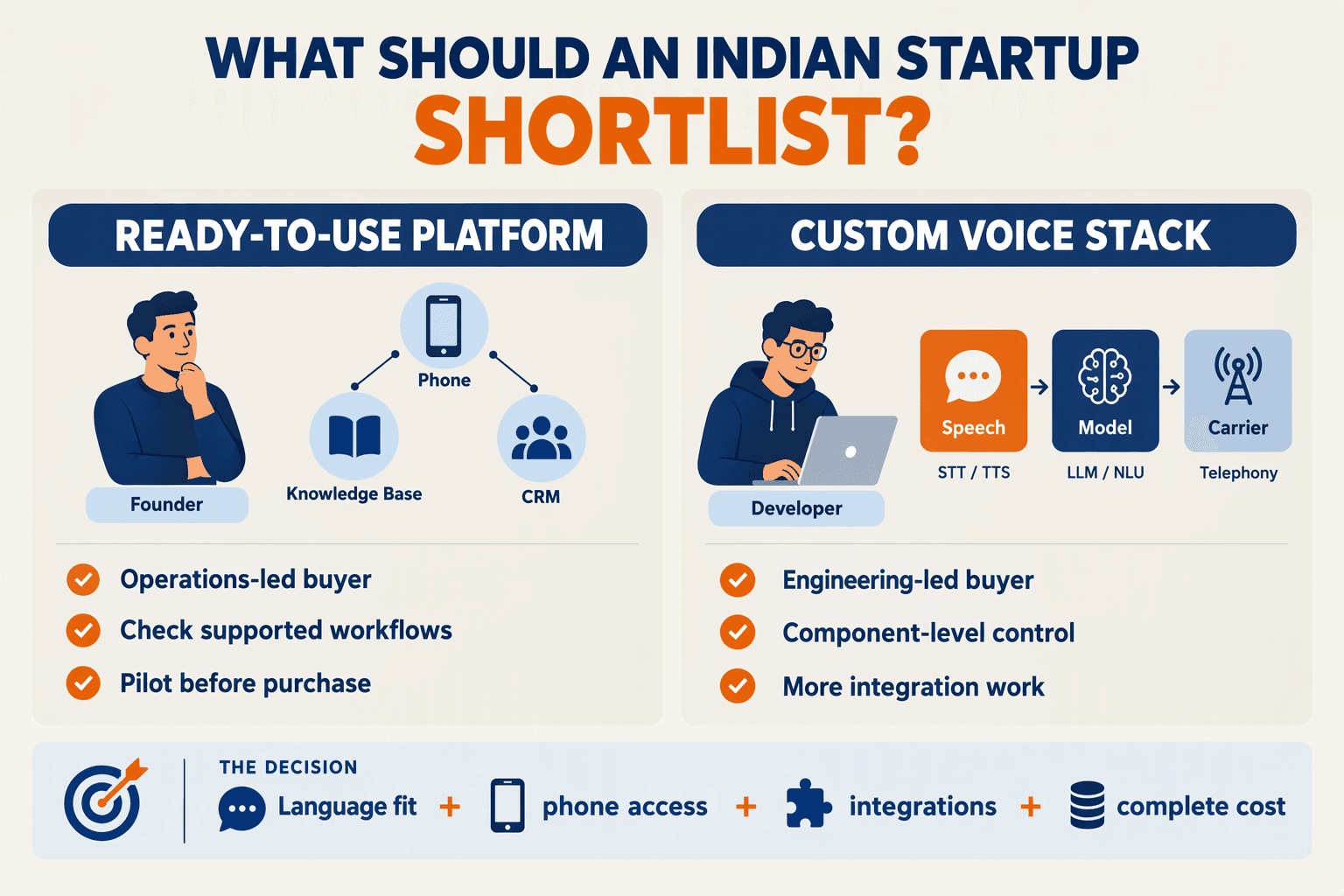
The best plug-and-play voice AI for Indian startups is the platform that completes your actual calling workflow with the least setup—not necessarily the lowest advertised rate. Shortlist ready-to-use platforms first; choose a custom stack when the additional control justifies engineering and maintenance.
Which voice AI platforms belong on an Indian startup’s shortlist?
- CallMissed: As of November 2026, CallMissed’s no-code builder supports knowledge bases, custom REST tools, and agent versioning with publish and rollback. Startups can rent numbers or bring Twilio, Plivo, or any SIP trunk; natural text-to-speech covers 10 Indian languages plus English. Check that your required speaking voice is supported, separately from speech-recognition coverage.
- Bolna: According to Bolna’s comparison dated 26 October 2026, Bolna offers dashboard-built and API-built phone agents, 20+ languages, Cal.com booking, call transfer, and batch calling. That makes it worth evaluating when scheduling or multi-call workflows are requirements, rather than choosing solely because a demo sounds natural.
- Sarvam AI: Sarvam AI’s pricing page, reviewed in November 2026, lists voice agents in 11 Indian languages and English. Its published bring-your-own-telephony options include Exotel, Smartflo, Plivo, and Twilio, with custom SIP listed for Business and Enterprise; confirm the applicable plan before assuming your existing carrier connection is available.
- Exotel: Bolna’s 26 October 2026 comparison describes Exotel as cloud telephony and contact-centre infrastructure with AI voice agents, business phone lines, and communication APIs. The comparison reports no public pricing figures on Exotel’s pricing page, so request an itemised quote before comparing it with self-serve, per-minute platforms.
How should startups verify cost and readiness before buying?
- Billing check: Sarvam AI’s pricing page, reviewed in November 2026, lists rented-number telephony at ₹0.20 per 30-second pulse, separate from voice-agent charges. A connected call lasting exactly two minutes therefore adds ₹0.80 in that telephony charge; include number rental and any other applicable charges when preparing your budget.
- Minimum-charge check: As of November 2026, CallMissed’s flat voice plans have a 30-second minimum, charge nothing for calls that never connect, and exclude phone carriage. Its custom stack bills components by the second without a component minimum, plus a separate ₹1-per-minute platform fee with a 30-second minimum; flat plans do not pay that fee.
- Pilot check: Run a proposed 30-call acceptance test: 10 straightforward requests, 10 code-switched or noisy conversations, and 10 exceptions requiring escalation. Record task completion, incorrect answers, transfer outcomes, and total billed cost. These are suggested test counts—not vendor benchmarks—and give founders comparable evidence beyond curated demonstrations.
- Integration check: Test one complete business action before signing: retrieve an order, book an appointment, or update a CRM record. Require a working phone-number route, verified tool permissions, and a documented escalation path. Choose a custom stack only when a specific unmet requirement outweighs the extra integration, monitoring, and maintenance work.
Who is this guide for—and when is plug-and-play the wrong choice?
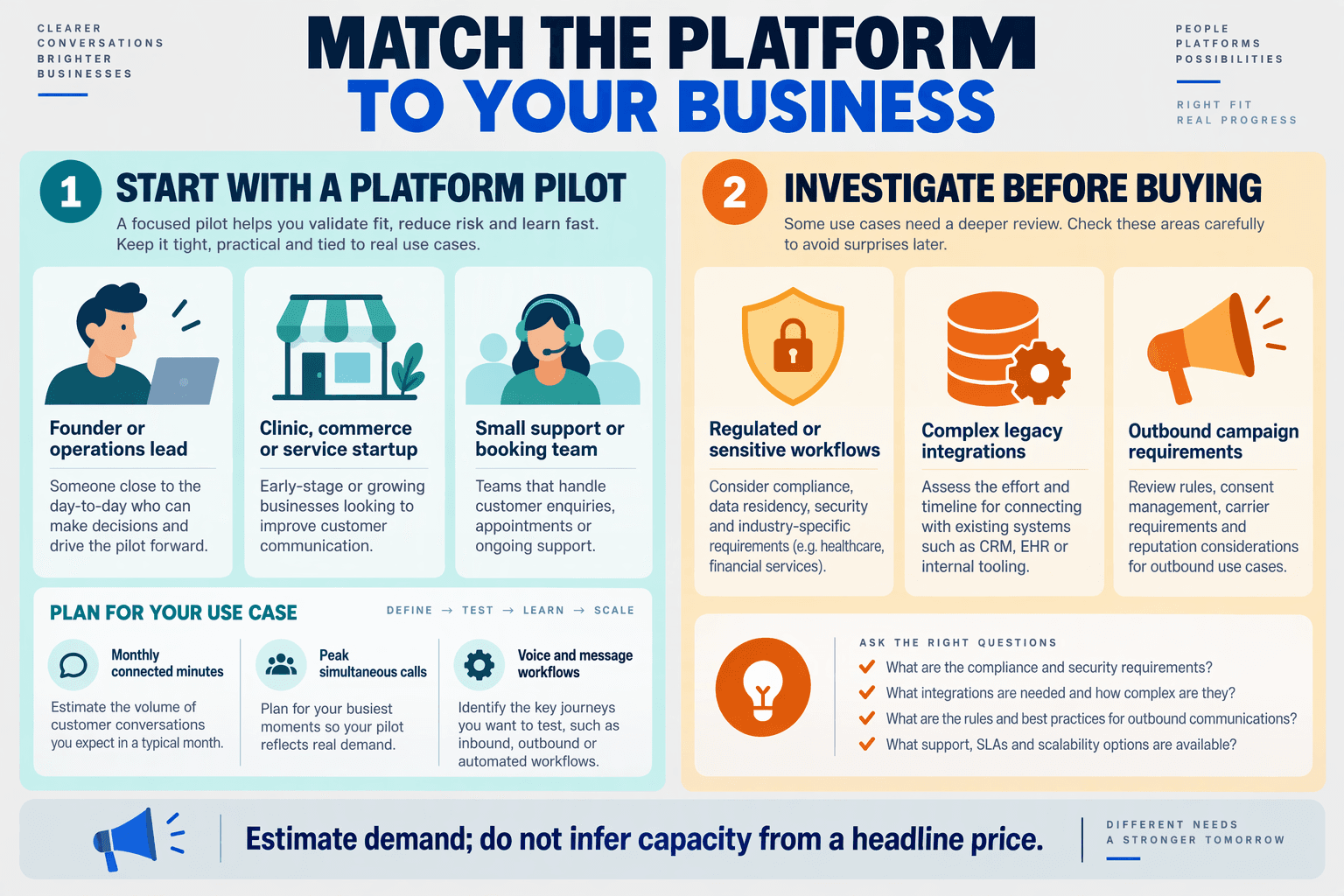
This guide is for Indian startups buying a ready-to-configure voice agent, not commissioning a bespoke contact centre. Plug-and-play is the wrong choice when mandatory workflows, billing economics or procurement requirements demand more control than the shortlisted platform provides.
Which Indian startups should use this guide?
- Founder-led support teams: Shortlist dashboard-led platforms when your first deployment has one bounded task: answer order-status questions, qualify an enquiry or book an appointment. Define the completion criterion before testing—for example, “retrieve the correct order and explain its status”—rather than scoring only how natural the voice sounds.
- Appointment-driven businesses: Clinics, service businesses and consultancies should test booking completion, not just calendar access. Bolna’s comparison, dated 26 October 2026, lists Cal.com booking and call transfer; verify whether your intended configuration handles unavailable slots, rescheduling and escalation before treating those listed capabilities as a finished workflow.
- Startups testing business-tool integration: As of November 2026, CallMissed’s verified product facts list custom REST tools, knowledge bases from text, web pages and PDFs, and Google Calendar integration. These are relevant building blocks for task-oriented agents; your pilot should still prove that the agent retrieves the right information and executes the intended action.
- Teams with measurable pilot traffic: Build a small test set covering successful requests, missing information, interruptions and requests for a person. Run identical scenarios across candidates and record task completion, incorrect actions and handoff outcomes. A convincing demonstration is not evidence that an agent can safely handle your actual customer workflow.
When is plug-and-play voice AI the wrong choice?
- Very short-call workloads: Minimum billing increments can outweigh a low headline rate. As of November 2026, CallMissed’s flat voice plans have a 30-second minimum and do not charge for calls that never connect; CallMissed does not offer automated outbound calling campaigns. Screen both billing structure and outbound workflow requirements before shortlisting.
- Buyers assuming enterprise economics at pilot volume: According to Sarvam AI’s pricing page in the November 2026 context, Enterprise pricing begins at 200,000 minutes per month and uses committed volume. A startup expecting a much smaller workload should compare its applicable tier, not use enterprise negotiations as its initial budget assumption.
- Teams needing fully predictable procurement immediately: According to Bolna’s comparison dated 26 October 2026, Exotel publishes no figures on its pricing page and offers custom quotes. Quote-led procurement may suit complex requirements, but it is a different buying process from evaluating a self-serve platform against an immediately calculable pilot budget.
- Businesses requiring unverified deployment controls: If your launch depends on a particular retention policy, security certification, concurrency limit or contractual support commitment, request written confirmation before purchase. “Plug-and-play” describes setup convenience, not compliance or operational guarantees; neither a language list nor a per-minute price resolves those requirements.
Can you build voice agents in minutes—and what blocks the first successful Indian call?
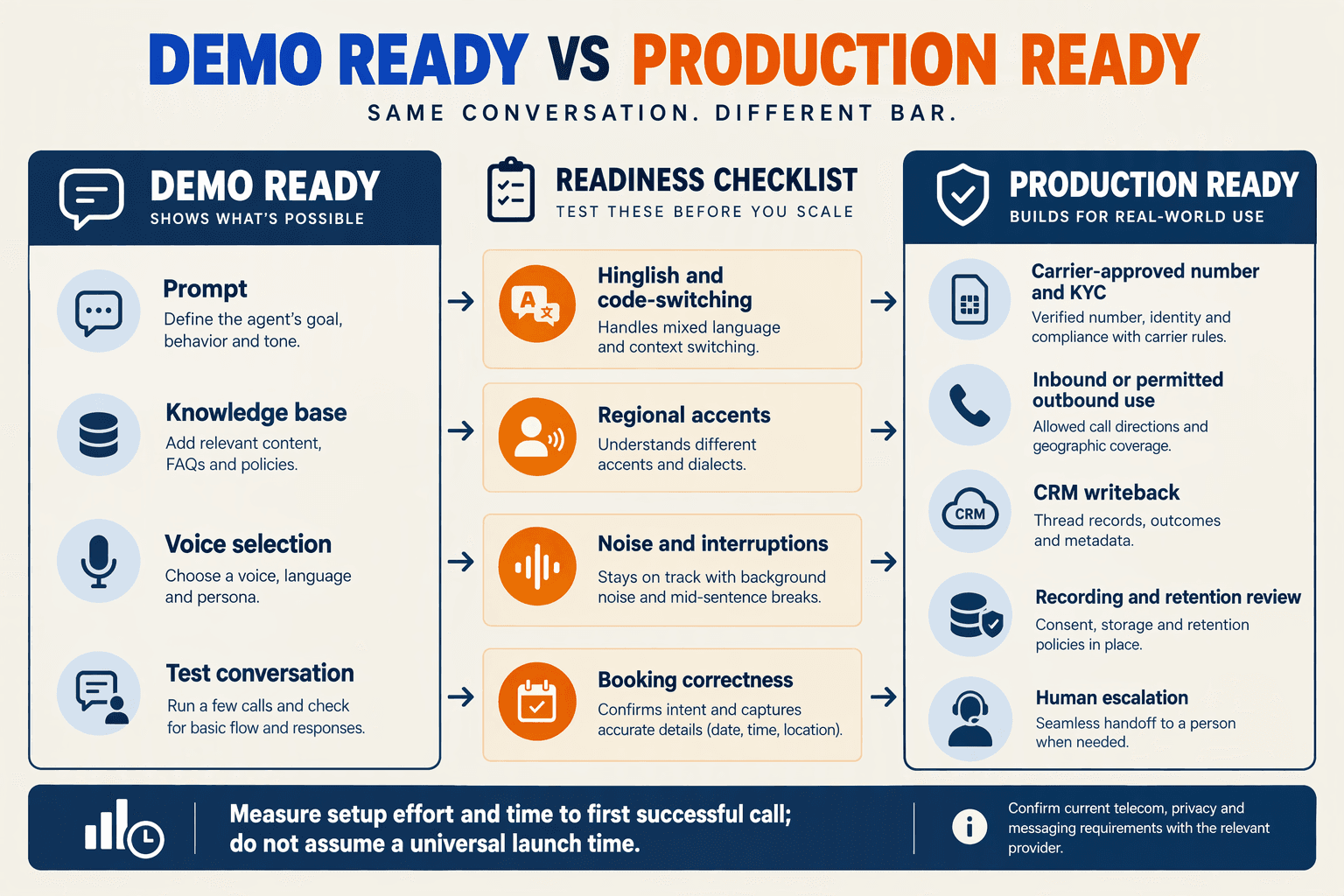
You can configure a voice-agent prototype quickly, but the supplied sources do not establish a guaranteed build time in minutes. The first successful Indian call depends on a working phone route, intelligible conversation and a completed task—not just a saved prompt.
Which platforms let you start without building the entire stack?
- CallMissed: As of November 2026, CallMissed’s no-code builder includes prompts, voices, languages, knowledge bases, tools, variables and call settings, plus versioning with publish and rollback. This gives founders a configuration-led starting point; however, uploading instructions is not proof that the agent can resolve a customer request over a real phone connection.
- Bolna: According to Bolna’s comparison dated 26 October 2026, Bolna supports phone agents built through a dashboard or API, alongside Cal.com booking and call transfer. Buyers should test the complete booking or transfer workflow—not merely a greeting—because those capabilities are more relevant to operational readiness than how quickly an agent appears in the dashboard.
- Sarvam AI: Sarvam AI’s pricing page, reviewed in the November 2026 context, lists voice agents in 11 Indian languages and English. That is a useful shortlist filter, but not a substitute for testing regional accents, names, addresses and mixed-language requests with the exact voice-agent configuration your startup intends to deploy.
- Exotel: Bolna’s comparison dated 26 October 2026 describes Exotel as offering AI voice agents, business phone lines, communication APIs and an omnichannel contact centre, with a free trial and custom quotes. Ask which setup steps are self-service, which require assistance and whether an existing business number can participate in the trial.
What should you check before the first customer call?
- Phone routing: Separate a browser demonstration from a telephone deployment. As of November 2026, CallMissed supports a web voice widget embedded with one script tag, rented phone numbers and bring-your-own-carrier connections through Twilio, Plivo or any SIP trunk. Test the web conversation first, then verify the intended inbound or individual outbound phone route.
- Carrier eligibility: Sarvam AI’s pricing page, reviewed in November 2026, lists custom SIP under Business and Enterprise and states that customers bringing telephony pay their provider directly. Confirm that your intended carrier connection is available on your selected plan before treating an existing number as a plug-and-play deployment path.
- Task completion: Use three acceptance scenarios: answer a knowledge-base question, complete a tool-backed action and handle an unsuccessful action without claiming success. For appointment booking, check the calendar entry itself. A fluent response saying “you’re booked” is insufficient if no appointment exists or the date, customer name or time zone is wrong.
- Indian-call realism: Test five suggested cases: Hinglish, a regional-language request, a noisy connection, an interrupted answer and an unfamiliar proper noun. Record whether the agent understands, completes the task and recovers appropriately. These are buyer-designed acceptance checks, not published platform benchmarks; compare providers using the same script and phone conditions.
How do CallMissed, Sarvam, Bolna and Exotel compare on features and setup?
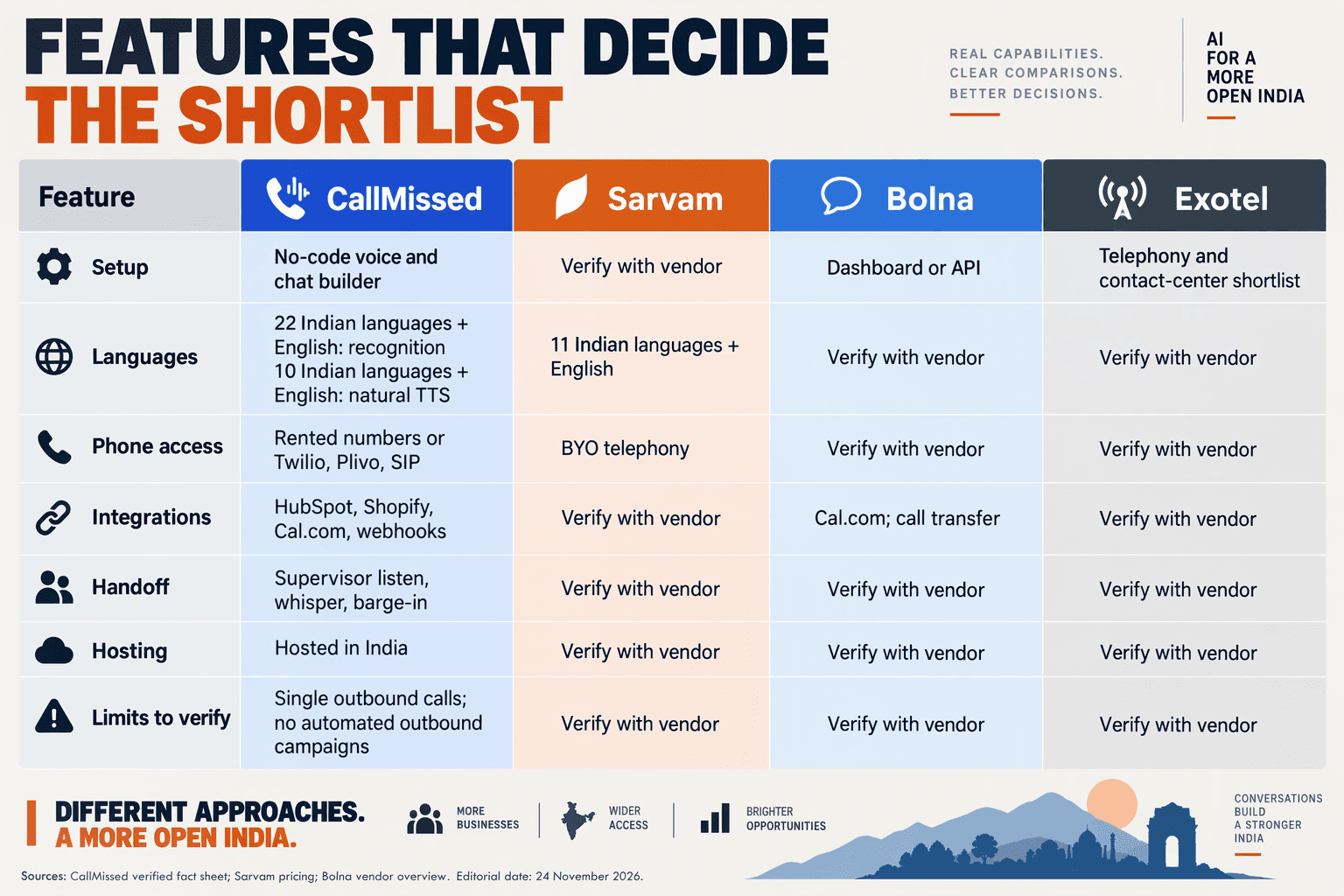
CallMissed and Bolna document dashboard-led setup; Sarvam publishes language coverage and telephony options; Exotel combines voice AI with contact-centre infrastructure. For the best plug-and-play voice AI for Indian startups, compare the steps needed to reach a working phone call—not just the advertised minute rate.
- CallMissed: As of November 2026, its verified product fact sheet lists a no-code builder with prompts, voices, knowledge bases, tools and publish/rollback controls.
- Sarvam AI: Its pricing page, reviewed in the November 2026 context, lists 11 Indian languages plus English; confirm the configuration workflow during a demo.
- Bolna: Bolna’s 26 October 2026 comparison describes self-serve dashboard and API setup, with inbound/outbound agents, booking and call transfer.
- Exotel: Bolna’s October 2026 comparison lists voice AI, communication APIs and an omnichannel contact centre; deployment effort needs confirmation rather than assumption.
Which features and setup options are documented?
The table separates documented capabilities from details that require verification. Product and pricing facts reflect the supplied November 2026 research; Bolna and Exotel entries use Bolna’s dated comparison.
| Buyer checkpoint | CallMissed | Sarvam AI | Bolna | Exotel |
|---|---|---|---|---|
| Agent configuration | No-code builder; tools, variables and versioning | Builder workflow not detailed in supplied pricing source | Dashboard or API | Configuration workflow not detailed in supplied source |
| Language coverage | Speech recognition: 22 Indian languages + English; natural voices: 10 + English | Voice agents: 11 Indian languages + English | 20+ languages; Hindi, Hinglish, Tamil and Telugu named | Not stated on homepage in cited comparison |
| Phone connectivity | Rented numbers or Twilio, Plivo and any SIP trunk | Provider-billed BYO telephony; custom SIP on Business/Enterprise | Inbound/outbound phone agents; telephony charged separately | Business phone lines and communication APIs |
| Booking and tools | Cal.com, Google Calendar, REST tools and MCP servers | Not specified in supplied pricing source | Cal.com booking and call transfer | Workflow integrations require verification |
| Supervision and review | Listen, whisper, barge-in; recordings, transcripts and QA scoring | Not specified in supplied pricing source | Call transfer documented; supervision details require verification | Contact-centre offering documented; controls require verification |
| Published starting rate | Standard ₹4/min; model components included; carriage extra | PAYG ₹3.50/min; telephony extra | From $0.06/min; bundled models; telephony/platform fee extra | Custom quote; no published figures in cited comparison |
| Trial access | 1,000 signup credits | Trial allowance not supplied | $5 signup credits | Free trial listed; allowance unspecified |
What should a startup verify before choosing?
- Billing: Sarvam AI lists hosted telephony at ₹0.20 per 30-second pulse in its November 2026 pricing context; request number-rental charges and minimum commitments separately.
- Acceptance test: Run the same support or booking task across shortlisted platforms: include a Hinglish question, an unavailable appointment and a transfer request; record completed actions and actual billed cost.
“Not specified” means the supplied evidence does not establish the feature—not that the vendor lacks it. Ask each provider to demonstrate the complete workflow before treating the platform as plug-and-play.
What will calling actually cost, including telephony and minimums?
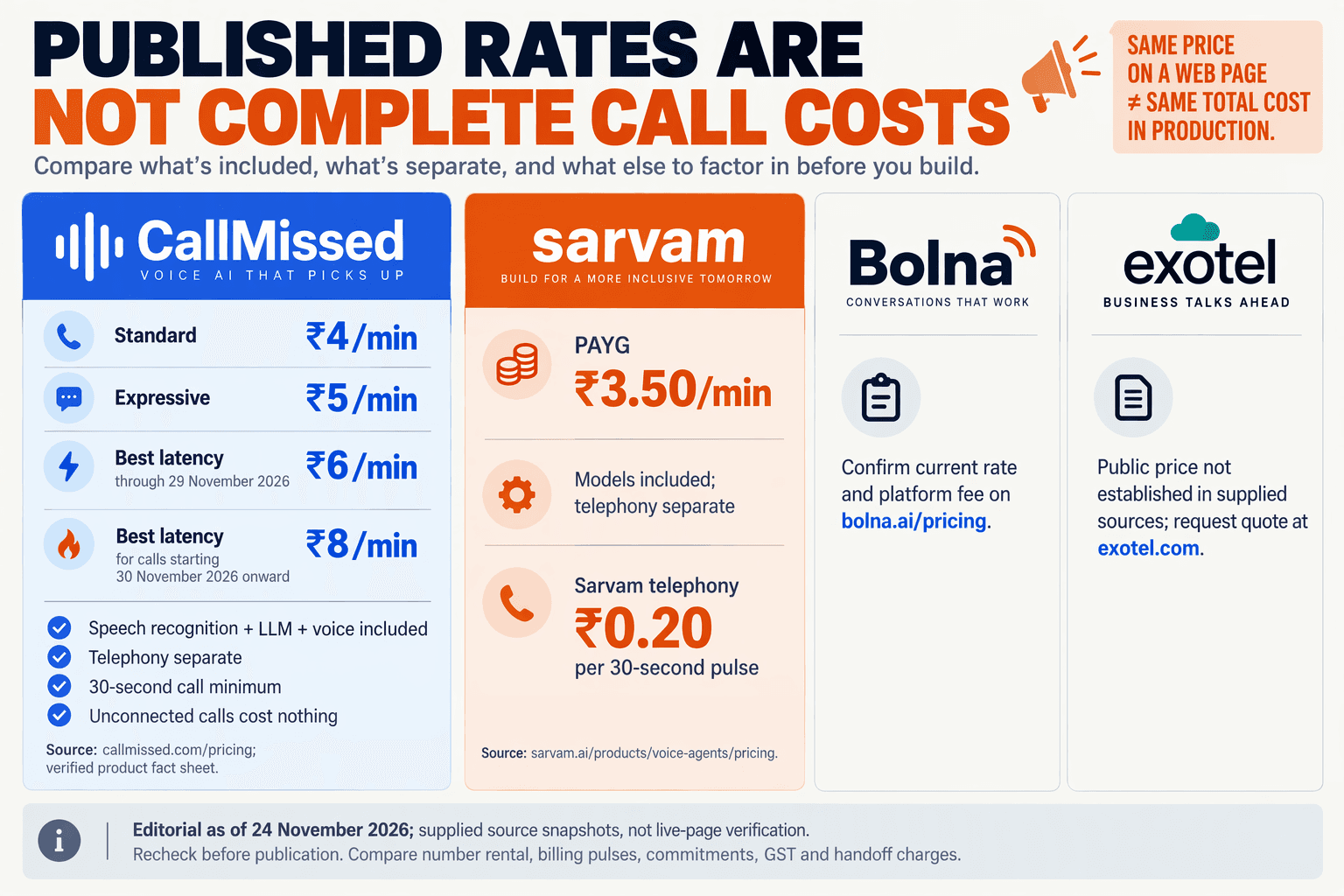
Actual calling cost equals AI charges plus any platform fee, telephony, number rental and applicable minimums—not simply the advertised per-minute rate. Compare the same call-duration mix and request an itemised quote before committing.
- Budget formula: Calculate AI usage + platform fees + carrier usage + number rental + applicable taxes; check whether monthly commitments fund usable credits or represent additional charges.
- Source dates: The comparison below uses CallMissed’s verified November 2026 facts, Sarvam AI’s pricing supplied for November 2026, and Bolna’s comparison published on 26 October 2026.
- Unknown charges: “Not specified” means the supplied research does not establish the amount or billing rule; it does not mean that the charge is zero.
| Option | Published AI rate | Telephony/platform extras | Minimum or qualification |
|---|---|---|---|
| CallMissed flat plans | Standard ₹4/min; Expressive ₹5/min; Best latency ₹6/min | Phone carriage separate; no custom-stack platform fee | 30 seconds/call; Best latency becomes ₹8/min for calls starting on/after 30 November 2026 |
| Custom-stack alternative | Components charged separately, by the second | ₹1/min platform fee, plus phone carriage | Components have no minimum; platform fee has a 30-second minimum |
| Sarvam AI pay-as-you-go | ₹3.50/min | Telephony separate | Per-call AI minimum not specified in supplied context |
| Sarvam AI managed telephony | Added to voice-agent charges | Vobiz carriage: ₹0.20/30-second pulse | Number rented from Sarvam; rental amount not supplied |
| Bolna bundled models | From $0.06/min | Telephony and platform fee extra | Starting rate; billing minimum not specified |
| Exotel | Custom quote; no published figures in supplied context | Request itemised pricing | Contract minimums require confirmation |
How do short calls and monthly commitments change the bill?
- Short-call example: Under CallMissed’s November 2026 Standard pricing, a connected 20-second call costs ₹2 in AI charges because of the 30-second minimum. On the custom stack, that call incurs a ₹0.50 platform fee, plus component usage and separate carriage; a call that never connects costs nothing.
- Carrier-pulse example: Sarvam AI’s November 2026 pricing lists ₹0.20 per 30-second pulse for Vobiz telephony. A 60-second call therefore adds ₹0.40 in carriage; a 61-second call occupies three pulses and adds ₹0.60, before AI charges.
- Volume-discount check: Sarvam AI’s November 2026 pricing lists ₹3.15/min for Growth, alongside a ₹49,999 monthly minimum returned as credits. Compare expected consumption against that commitment rather than treating the discounted rate as an unrestricted pay-as-you-go offer.
- Currency check: Bolna’s 26 October 2026 comparison quotes $0.06/min and an approximate rupee equivalent. Budget the dollar-denominated rate using your actual settlement exchange rate, then add the separately stated platform and telephony charges.
- Buyer’s test: Ask each provider to price 100 connected calls lasting 20 seconds and 100 lasting 61 seconds, plus unsuccessful attempts and one rented number. This exposes minimums, pulse rounding and fixed charges that a single long-call demo can hide.
What are the practical pros and cons of each alternative?
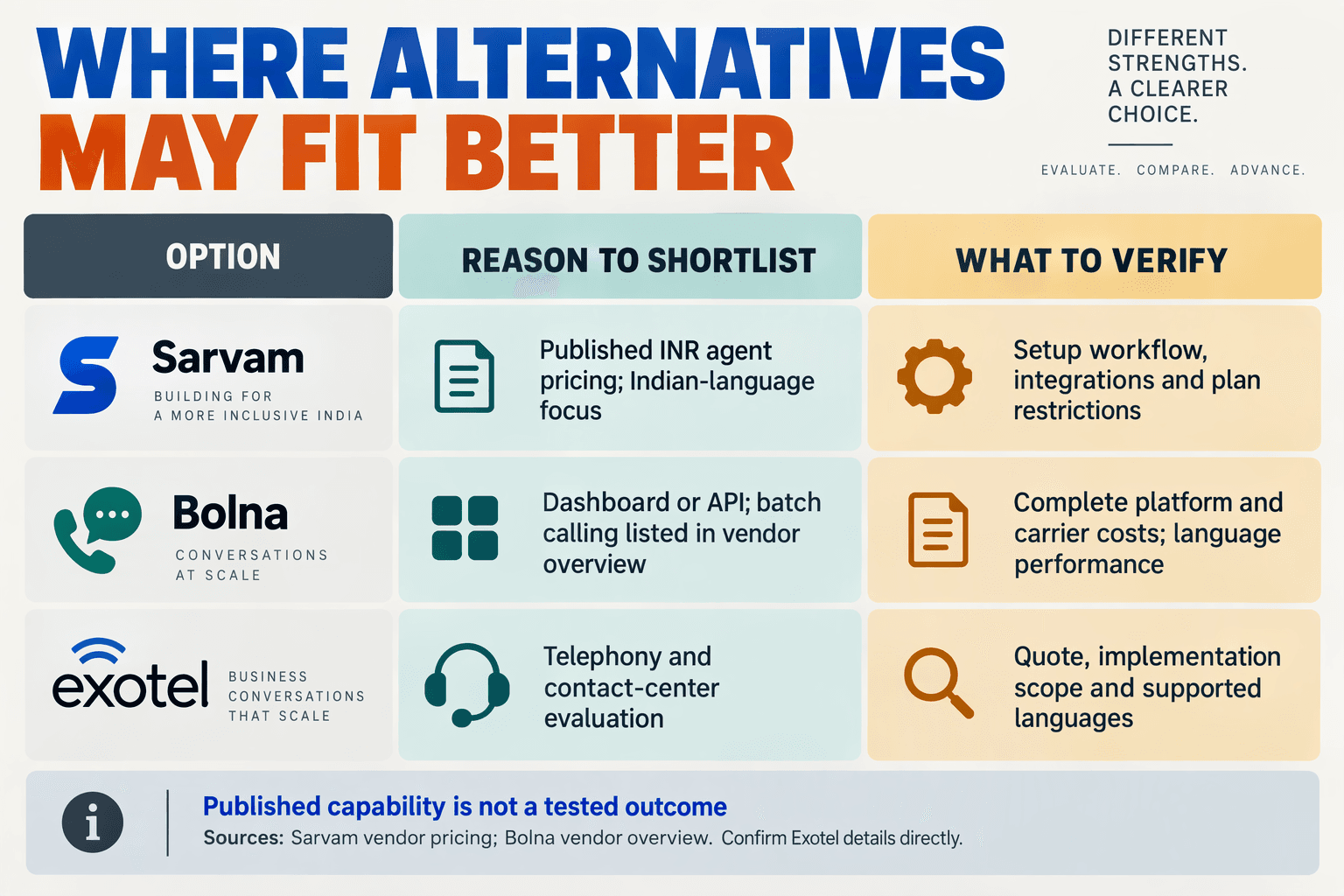
The best plug-and-play voice AI for Indian startups depends on whether you prioritise dashboard setup, regional-language coverage, transparent billing or an existing telephony stack. Compare the practical trade-offs below—not just the lowest advertised rate.
- Pricing: Sarvam AI’s pricing page lists ₹3.50/minute pay-as-you-go, excluding telephony, as of November 2026; its ₹3/minute headline is not the entry-level rate.
- Billing: Bolna’s comparison dated 26 October 2026 lists $0.06/minute for bundled models, with telephony and platform fees extra; request the complete charge breakdown before budgeting.
- Integration: Separate “configure an agent” from “connect a working phone workflow”; test number provisioning, booking, transfers and failed tool calls before committing.
- Evidence: The supplied research does not establish comparable latency, task-completion or Indian-accent accuracy benchmarks; a language list is a shortlist filter, not proof of production performance.
Which voice AI alternatives offer the most practical trade-offs?
Product capabilities and published pricing below reflect the November 2026 context. Competitor figures come from Sarvam AI’s pricing page and Bolna’s comparison; CallMissed details come from its verified product fact sheet.
| Alternative | Practical advantage | Cost or constraint | Strongest shortlist fit |
|---|---|---|---|
| CallMissed | No-code builder, knowledge base, REST tools and live supervisor monitoring; recognition in 22 Indian languages plus English | Standard ₹4/min includes recognition, LLM and voice; carriage extra; 30-second minimum; no automated outbound campaigns | Inbound support or individual outbound calls needing configurable business workflows |
| Sarvam AI | Voice agents in 11 Indian languages and English; published INR pricing | ₹3.50/min PAYG; telephony separate; ₹3/min belongs to the Business tier | Regional-language workloads where INR budgeting and usage tiers matter |
| Bolna | Dashboard and API; 20+ languages; batch calling, Cal.com booking and call transfer | From $0.06/min with bundled models; telephony and platform fee extra | Teams requiring batch calling or appointment-booking workflows |
| Retell AI | Published per-minute pricing provides a starting point for cost comparison | $0.07–$0.31/min in Bolna’s comparison; confirm configuration and inclusions | Buyers willing to evaluate configuration-specific costs rather than one headline price |
| Vapi | Hosting and underlying model charges are separately identified | $0.05/min hosting, plus models and telephony at cost, according to Bolna | Teams comfortable budgeting several components rather than a bundled model rate |
| Exotel | Cloud telephony, communication APIs and omnichannel contact-centre offering | Bolna reports no public pricing figures; custom quote required | Businesses evaluating voice automation alongside broader telephony infrastructure |
What should you verify before choosing?
- CallMissed: As of November 2026, natural text-to-speech covers 10 Indian languages plus English, distinct from its 22-language speech recognition; test both directions in your target language.
- Every shortlisted provider: Run the same caller script through noisy audio, code-switching, an interrupted booking and a human-transfer request; record task completion, transfer success and total billed cost before choosing.
Which should you choose for support, booking, outbound workflows or developer control?
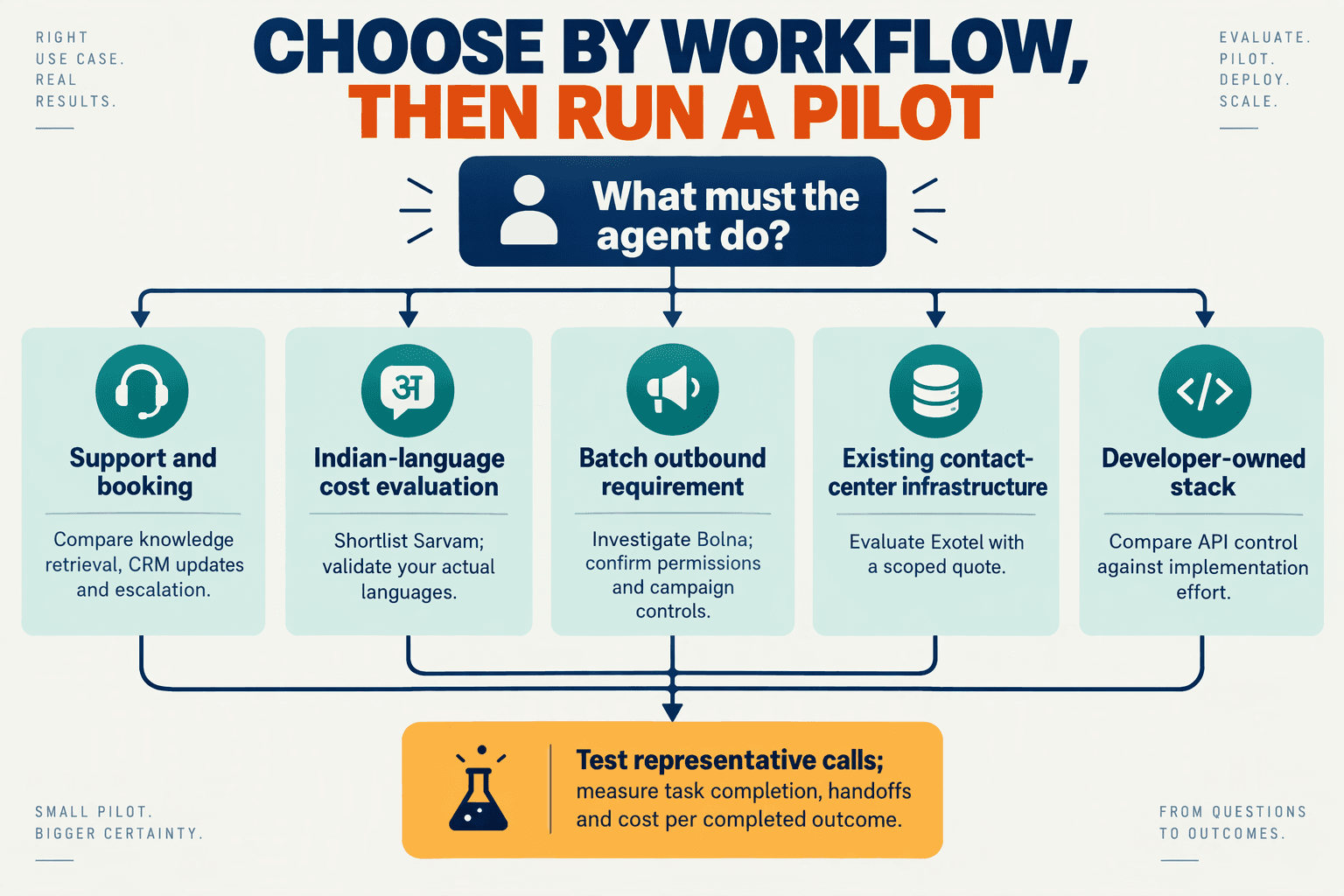
Choose by the workflow you need to complete, not a universal “best” label. For Indian startups, support and booking favour ready-made business integrations; outbound campaigns and developer-led builds require different capabilities.
Which voice AI should you shortlist for support and booking?
- CallMissed: For support connected to business records, CallMissed’s November 2026 fact sheet lists knowledge bases built from text, web pages and PDFs, custom REST tools, and AI call notes pushed to the CRM. Cal.com and Google Calendar integrations support booking workflows; supervisors can listen, whisper or barge into live calls.
- Sarvam AI: For a language-led support shortlist, Sarvam AI’s pricing page reviewed in November 2026 lists voice agents in 11 Indian languages and English. Validate your actual support conversations before choosing: a language listing does not establish accuracy on regional accents, product names, addresses or interruptions.
- Bolna: For appointment scheduling, Bolna’s comparison dated 26 October 2026 lists Cal.com booking and call transfer, alongside dashboard and API setup. Test the complete transaction—not just conversational fluency—including unavailable slots, rescheduling and escalation when a caller requests something outside the agent’s configured tools.
- Exotel: For an existing contact-centre operation, consider the broader communications stack rather than minute pricing alone. Bolna’s October 2026 comparison describes Exotel as offering AI voice agents, an omnichannel contact centre, business phone lines and communication APIs; it reports custom quotes, so request an itemised proposal for your specific deployment.
Which voice AI should you choose for outbound workflows and developer control?
- Bolna: For batch outbound calling, Bolna’s October 2026 comparison explicitly lists batch calling alongside inbound and outbound agents. Confirm campaign controls, permissions, retry behaviour and reporting during evaluation rather than assuming them from “outbound” support; the supplied research establishes batch capability, not every operational safeguard your startup may require.
- CallMissed: For developer control, CallMissed’s November 2026 fact sheet lists OpenAI-compatible and Anthropic-compatible endpoints, caller-chosen fallback models, function calling and request logs. Its Twilio-compatible Calls API supports migration by changing the base URL and credentials. Outbound options are single calls and click-to-call, not automated outbound calling campaigns.
- Sarvam AI: For carrier flexibility at larger deployment tiers, Sarvam AI’s pricing page reviewed in November 2026 lists custom SIP on Business and Enterprise. Bring-your-own telephony incurs no Sarvam telephony charge, but your carrier bills separately; verify tier eligibility before treating carrier integration as available in your intended plan.
- Your acceptance test: Run the same 20 scripted scenarios across shortlisted providers—five each for support, booking, outbound handling and failures. This is a proposed buyer test, not a published benchmark. Record task completion, human escalation, integration errors and total billed cost; choose the platform that reliably completes your priority workflow within budget.
Frequently Asked Questions
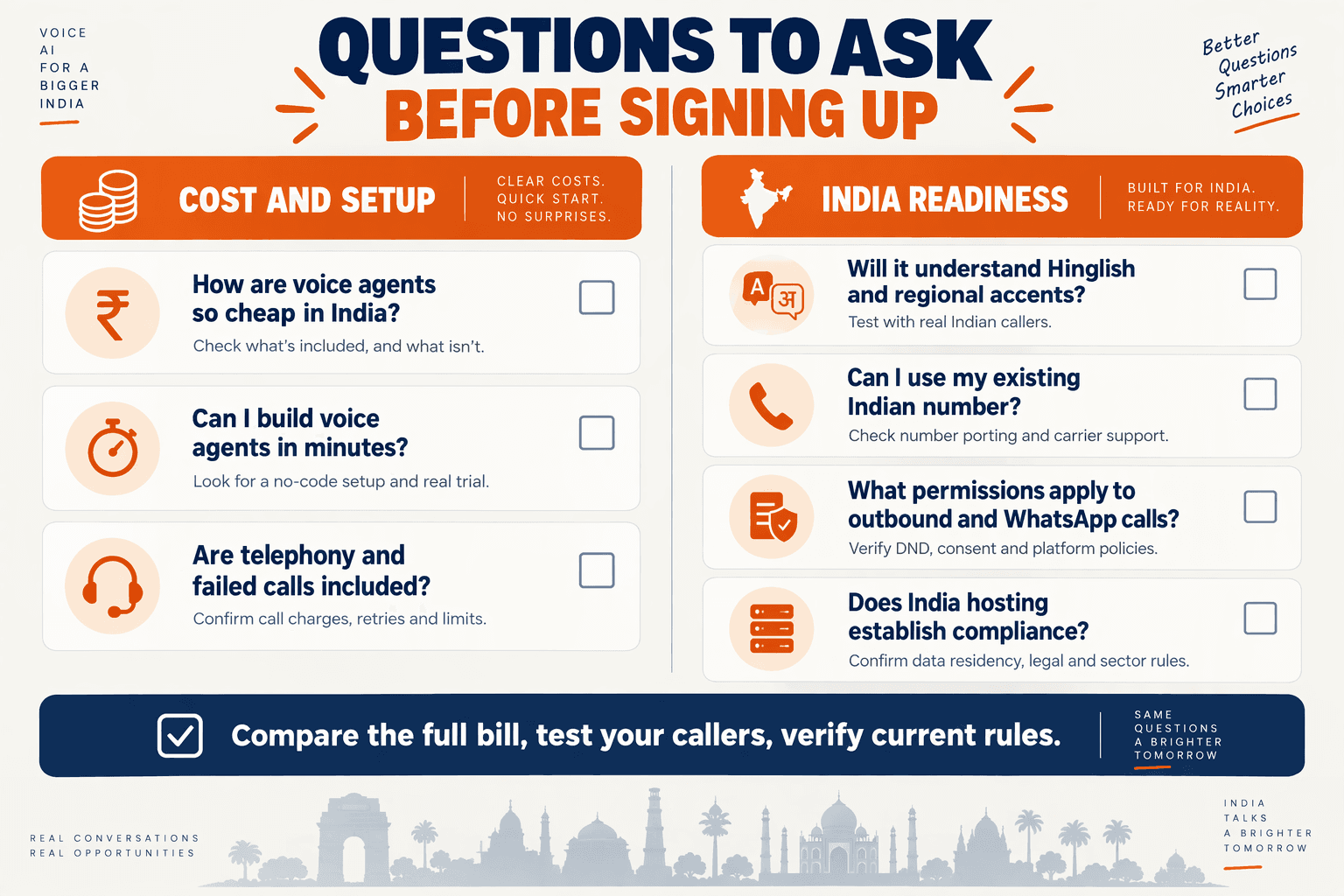
Cheap voice AI usually means a low model rate—not a complete calling budget. Plug-and-play should reduce configuration work without removing production testing.
- Q: Why are voice AI agents in India advertised at ₹3 per minute?
A: Headline prices can reflect a particular usage tier rather than what a new startup pays: Sarvam AI’s pricing page, reviewed for this November 2026 comparison, lists ₹3.50/minute pay-as-you-go, versus ₹3/minute on Business, with telephony separate. Bolna’s comparison dated 26 October 2026 lists $0.06/minute for bundled models, with telephony and platform fees additional. These figures demonstrate different packaging and commitments; they do not establish that every ₹3 offer delivers equivalent service.
- Q: What does the best plug-and-play voice AI for Indian startups actually include?
A: Look for a configurable agent, knowledge-base ingestion, phone connectivity, business-tool access and testable call handling—not merely a speech-model API. As of November 2026, CallMissed’s verified product facts include a no-code builder, PDF and webpage knowledge bases, custom REST tools, and rented-number or bring-your-own-carrier connectivity. Check whether your intended workflow needs additional credentials, carrier setup or integration work before interpreting “plug-and-play” as immediate production readiness.
- Q: Which hidden charges should Indian startups check before buying voice AI?
A: Request separate figures for agent processing, platform fees, phone carriage, number rental and minimum billing increments, then calculate costs using representative call lengths. According to Sarvam AI’s pricing page reviewed in November 2026, its rented-number telephony costs ₹0.20 per 30-second pulse, equivalent to ₹0.40 for a call billed for two pulses. Short calls, retries and monthly commitments can change effective cost, so average connected minutes alone are insufficient for budgeting.
- Q: How should I test the best plug-and-play voice AI for Indian startups in regional languages?
A: Test recognition and generated speech separately using your customers’ accents, background noise, product names and code-switching. As of November 2026, CallMissed lists speech recognition in 22 Indian languages plus English, including Hinglish, but natural text-to-speech voices in 10 Indian languages plus English. Use identical scripts across shortlisted providers and record misunderstood names, incorrect answers and task completion; a language count is not a quality benchmark.
- Q: Can a plug-and-play voice agent use my existing business phone provider?
A: Sometimes, but supported carriers and plan restrictions matter more than a generic integration claim. Sarvam AI’s pricing page reviewed in November 2026 lists bring-your-own telephony options including Exotel, Plivo and Twilio, while specifying custom SIP on Business and Enterprise. Before signing, confirm number routing, transfer behaviour, provider billing and responsibility for troubleshooting; connecting a carrier does not necessarily mean an existing number can be ported.
- Q: What should a startup verify before launching an AI voice agent?
A: Run a limited pilot covering successful requests, ambiguous answers, interruptions, silence and requests for a person. Measure task completion, factual accuracy, handoff success and total cost per resolved request, rather than judging only voice naturalness or the advertised minute rate. Verify recording consent, access controls and escalation procedures for your use case; the right shortlist is the one that passes your operational tests, not a universal winner.
Conclusion
The best plug-and-play voice AI for Indian startups is the platform that fits your callers, setup capacity and call workflow at a sustainable total connected-call cost—not a universal winner. Use this guide to build a shortlist around what your startup needs to accomplish, then compare providers using the same workload rather than their lowest advertised rates.
- Compare complete costs, not headline prices. Separate speech recognition, language-model and voice charges from platform fees, phone carriage, number rentals and minimum billing increments. According to Sarvam AI’s pricing page in the November 2026 research context, pay-as-you-go voice agents cost ₹3.50 per minute, with telephony charged separately. That makes the published rate a starting point for budgeting, not an all-in answer. Also distinguish first-month costs from rates that depend on higher usage or monthly commitments: an attractive volume tier may not match a startup’s initial workload.
- Test language fit with realistic conversations. A published language list is useful for shortlisting, but deployment readiness depends on whether the agent understands your customers’ actual speech, including code-switching. Test the languages relevant to your business rather than treating broader coverage as an automatic advantage. A convincing demonstration should become a practical evaluation: can callers ask their usual questions, receive useful answers and complete the intended task? The stronger choice is the platform that handles your audience’s conversations reliably, not simply the one with the longest language list.
- Make setup effort part of the buying decision. Dashboard-led platforms, developer toolkits and contact-centre offerings serve different implementation needs. A nontechnical founder should assess whether configuration and testing are manageable without extensive engineering work; a technical team should examine integration requirements before assuming deployment will be straightforward. As of November 2026, CallMissed offers a no-code voice-agent builder and speech recognition in 22 Indian languages plus English, including Hinglish. Those capabilities make CallMissed worth exploring when accessible setup and regional-language coverage are central to the shortlist.
- Evaluate workflow completion before expanding usage. Match the platform to your immediate requirement—such as inbound support, appointment booking or individual outbound calls. Check whether the agent can use your knowledge base, connect to the necessary business tools and transfer a call appropriately when automation reaches its limits. Existing-carrier compatibility also belongs in this assessment. A platform that answers fluently but cannot complete the required workflow may still leave substantial implementation work for your team.
Looking ahead, watch whether voice AI providers make bundled pricing, telephony costs and deployment requirements easier to compare. Revisit published terms before committing, and expand only after realistic testing supports the decision. Which shortlisted platform can complete your startup’s real customer workflow—not just deliver the most impressive demo?
Related Reading
- Indian Language Voice AI Agents: Affordable Picks 2026
- Best AI voice agents in India: 2026 Comparison Guide
- Local Voice Agents: What IBM Granite 4.2 Means in 2026