Vapi vs Retell vs Bland for Voice AI: 2026 Comparison


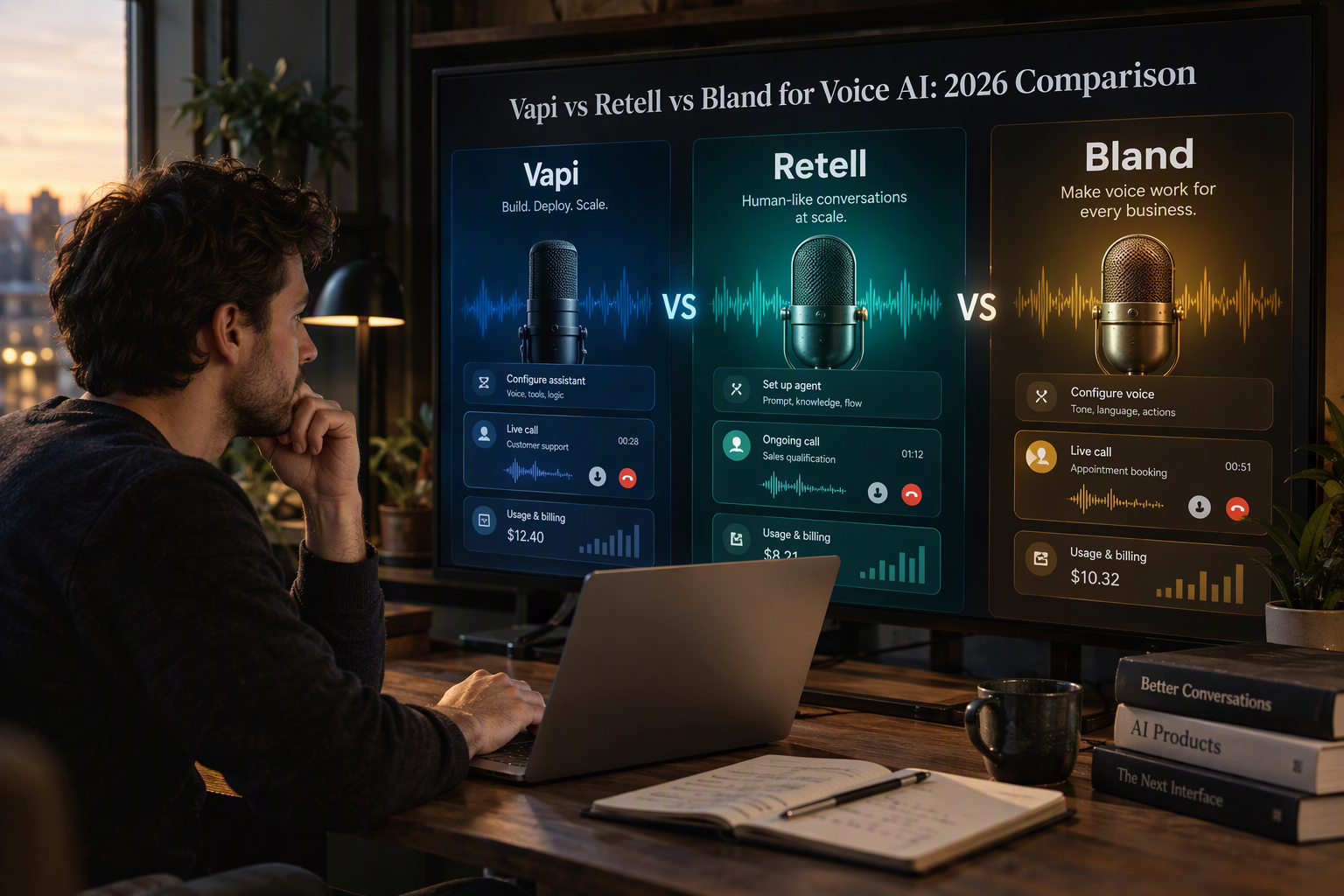
Compare Vapi vs Retell and Bland on pricing components, developer workflows, and voice-agent trade-offs, with a reproducible testing framework.
Vapi vs Retell vs Bland for Voice AI: 2026 Comparison
A $0.05 voice-AI minute is not necessarily cheaper than a $0.14 minute. The Vapi vs Retell comparison starts with that pricing trap: Vapi, Retell AI, and Bland AI package different parts of a phone conversation into their advertised rates, making headline prices a poor shortcut for choosing a platform.
For Vapi vs Retell vs Bland for voice AI in 2026, the practical answer is to compare total call cost, development control, and operational fit—not declare one universal winner. A configurable stack can suit a developer-led team, while a more bundled service may simplify budgeting. Neither approach removes the need to test real conversations.
Why are voice AI prices difficult to compare in 2026?
In the research supplied for this October 2026 comparison, GMWARE lists Vapi’s orchestration fee at $0.05 per minute, with model and telephony costs added separately. That distinction matters: the platform fee is not the price of a complete customer call.
The supplied BetonAI 2026 comparison lists Retell AI’s voice-infrastructure starting rate at $0.055 per minute and Bland AI’s bundled rate at $0.14 per minute, with Bland’s quoted bundle including the language model, transcription, and voice—but excluding the phone line. Those figures describe different purchasing units, not an apples-to-apples ranking.
Pricing snapshots also differ across sources. THE DAILY BRIEF reported on October 2, 2026, that Bland AI’s Build plan cost $0.12 per minute plus additional charges, illustrating why plan names, included components, and publication dates belong beside every quoted rate.
Consider a workload of 10,000 connected minutes per month. A $0.05 platform fee produces a $500 platform subtotal before excluded services; a $0.14 bundled rate produces a $1,400 subtotal before its exclusions. Comparing those subtotals alone could lead to the wrong purchasing decision.
What will this head-to-head comparison help you decide?
This guide separates the questions that sales demos often blur together:
- Cost: What do speech recognition, the language model, voice generation, telephony, and concurrency add to the bill?
- Control: How much can your team configure, and how much must your team maintain?
- Conversation quality: How will you test interruptions, response timing, pronunciation, and task completion?
- Production fit: Which integrations, monitoring options, and escalation workflows matter for your actual calls?
The broader market also includes platforms such as CallMissed, which, as of October 2026, offers flat-rate voice-agent plans covering speech recognition, the language model, and voice, with phone carriage billed separately.
The goal is a decision you can defend: which platform fits your workload, what a complete minute costs, and what you should validate before committing.
Which should you choose: Vapi, Retell, or Bland for voice AI in 2026?
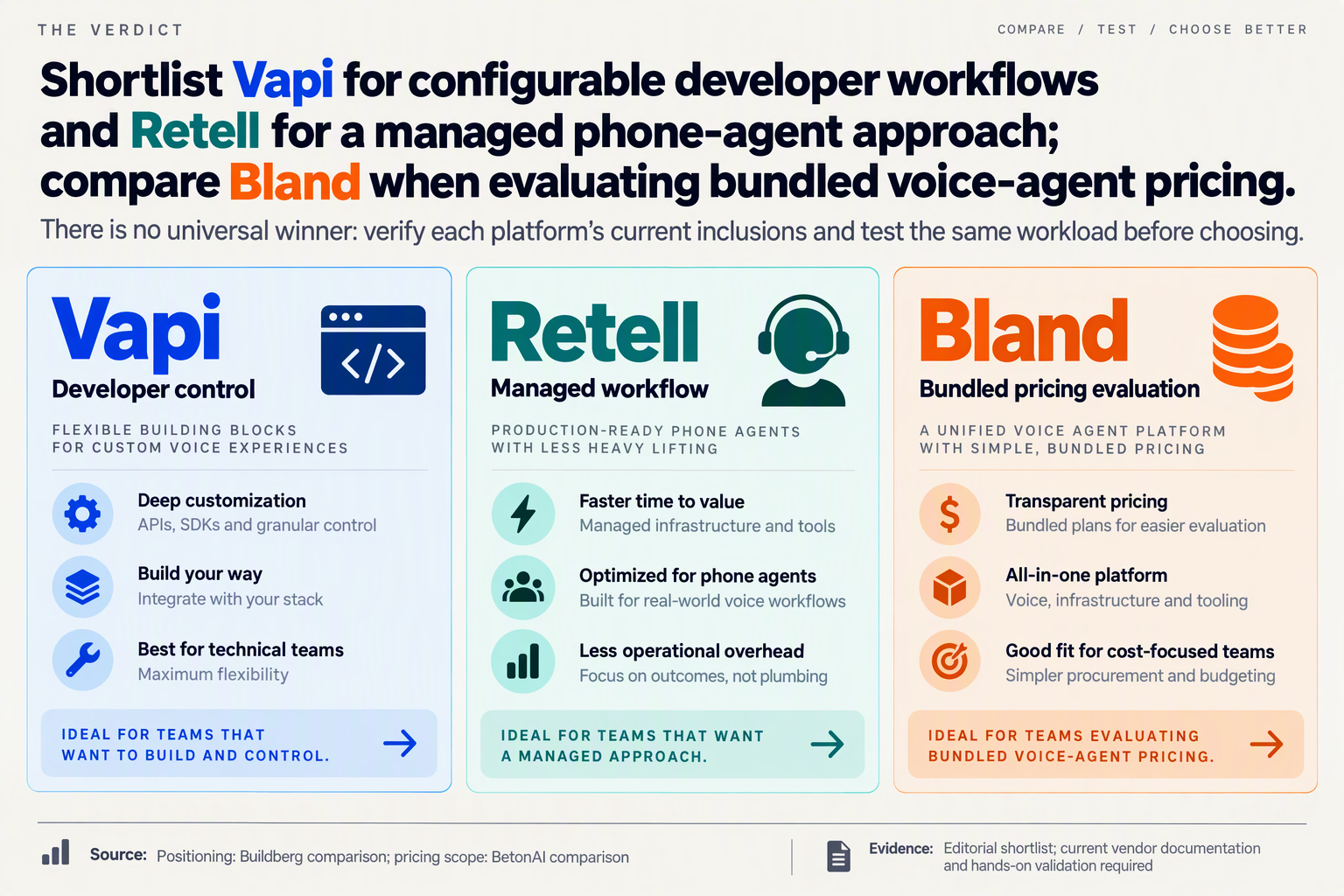
Choose Vapi for stack-level control, Retell AI for managed telephony and production-oriented defaults, or Bland AI when its bundled components and concurrency tiers fit your workload. For this October 2026 comparison, these are starting recommendations—not a measured ranking of conversation quality.
Which voice AI platform fits your team?
- Vapi: Choose Vapi when developers need flexible model choices and custom function calling; Buildberg’s 2026 comparison identifies these as reasons to select Vapi. The practical trade-off is ownership: assign someone to evaluate component combinations, maintain tool integrations, and investigate failures across the configured stack rather than treating configuration freedom as automatic reliability.
- Retell AI: Choose Retell AI when managed telephony and solid defaults matter more than selecting every component independently; Buildberg’s 2026 comparison recommends Retell for that production-oriented path. Make the recommendation conditional on your workflow: demonstrate appointment booking, CRM updates, and escalation using your actual systems before accepting “production-ready” as sufficient evidence.
- Bland AI: Shortlist Bland AI when its concurrency packaging matches your expected call traffic. In the October 2026 research snapshot, ColdCalls.ai reports 10 and 50 concurrent calls across Bland’s two self-serve tiers, with Enterprise sized separately. Compare those simultaneous-call allowances against peak demand—not monthly minutes, which measure a different capacity requirement.
- CallMissed: For an India-focused shortlist, CallMissed’s verified product facts, as of October 2026, include speech recognition in 22 Indian languages plus English, including Hinglish, and natural text-to-speech in 10 Indian languages plus English. Those are distinct capabilities; test recognition and spoken responses separately with regional accents, names, addresses, and code-mixed conversations.
What should you verify before choosing Vapi, Retell, or Bland?
- Concurrency: Model the busiest interval before buying additional capacity. In the October 2026 research snapshot, ColdCalls.ai reports that Retell AI includes 20 concurrent calls and charges $8 per additional concurrency unit per month. If a deployment needs 35 simultaneous calls, the reported rate implies $120 monthly for 15 additional units; confirm current account terms.
- Conversation quality: Run the same 30 scripted scenarios on each shortlisted platform, covering interruptions, silence, background noise, corrections, and unfamiliar names. This is a proposed evaluation design, not a published benchmark. Record task completion and incorrect actions alongside response timing; a fast answer that books the wrong appointment is not a successful call.
- Integration reliability: Test three failure paths: a timed-out booking API, an unavailable CRM, and a caller requesting a human. Require an explicit outcome for each—retry, safe explanation, or escalation. The supplied research does not establish a comparative reliability winner, so these checks should determine operational fit rather than unsupported vendor rankings.
- Buying decision: Select the platform that completes your representative tasks within your cost and staffing constraints. Request a dated October 2026 quote listing component charges, telephony, concurrency, and support terms, then compare cost per successfully completed task. That denominator connects the purchasing decision to business outcomes instead of rewarding the lowest advertised minute.
How do Vapi, Retell, and Bland compare on voice-agent features?
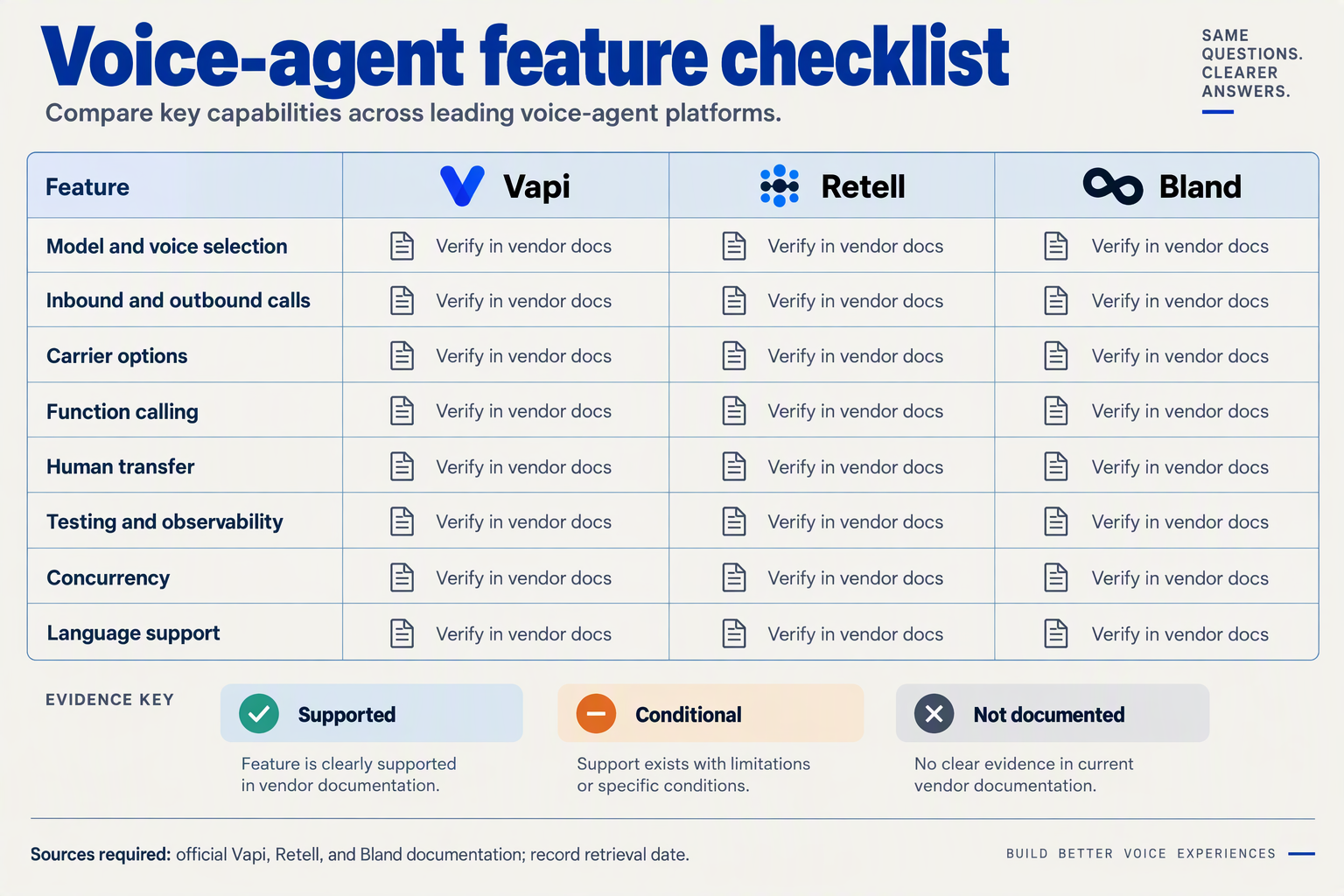
Vapi emphasizes configurable voice-agent infrastructure, Retell AI emphasizes managed phone-agent deployment, and Bland AI packages core conversation components together. For this October 2026 comparison, distinguish documented capabilities from features the supplied research does not establish.
- Vapi: Buildberg’s 2026 comparison highlights custom function calling and flexible model choices—relevant when an agent must query inventory, check eligibility, or trigger a backend action.
- Retell AI: Buildberg’s 2026 comparison highlights managed telephony and production-oriented defaults; test whether those defaults suit your routing, escalation, and integration requirements.
- Bland AI: BetonAI’s 2026 comparison identifies a bundle covering the language model, transcription, and voice; bundled purchasing does not, by itself, establish conversation quality or integration depth.
| Feature | Vapi | Retell AI | Bland AI |
|---|---|---|---|
| Inbound and outbound calls | Both, according to AigentGallery | Both, according to AigentGallery | Both, according to AigentGallery |
| Stack configuration | Flexible model choices highlighted by Buildberg | Managed defaults highlighted by Buildberg | Core conversation components bundled, according to BetonAI |
| Custom function calling | Explicitly highlighted by Buildberg | Details not established in supplied excerpts | Details not established in supplied excerpts |
| Telephony arrangement | GMWARE describes telephony as a separate cost | Buildberg highlights managed telephony | BetonAI says the phone line is excluded from the quoted bundle |
| Included concurrency | Not established in supplied excerpts | Coldcalls.ai lists 20 concurrent calls | Coldcalls.ai lists 10 or 50 concurrent calls across two self-serve tiers |
| Additional concurrency | Verify current plan terms | Coldcalls.ai lists $8 per additional concurrency slot monthly | Coldcalls.ai says Enterprise capacity is sized to requirements |
Source scope: This table reflects the research supplied for the October 2026 comparison, not a live audit of vendor documentation. “Not established” means insufficient evidence here, not that a platform lacks the feature.
Which voice-agent features should you test before choosing?
- Concurrency: In the October 2026 research snapshot, Coldcalls.ai lists 20 included concurrent calls for Retell AI and 10 or 50 for Bland AI’s two self-serve tiers. A workload requiring 30 simultaneous calls therefore needs a capacity check, even when monthly minutes appear modest.
- Tool execution: Run the same workflow on all three platforms: identify a caller, retrieve an order, update a record, and confirm the result. Score successful backend actions, not merely whether the agent says the task is complete; the supplied excerpts document Vapi’s custom function calling but do not provide equivalent implementation details for every platform.
- Conversation reliability: Use identical interruption, silence, background-noise, and human-transfer scenarios across vendors. The supplied research provides no comparable measured latency, transfer-success percentage, or language-accuracy benchmark, so a defensible feature comparison should leave those rankings open until testing.
- Regional and knowledge requirements: As of October 2026, CallMissed supports speech recognition in 22 Indian languages plus English, knowledge bases built from text, web pages, and PDFs, and custom REST tools. Those capabilities illustrate concrete procurement criteria: ask each shortlisted provider to demonstrate your actual languages, documents, and backend workflow rather than treating “multilingual” or “integrations” as sufficient answers.
How much do Vapi, Retell, and Bland actually cost?
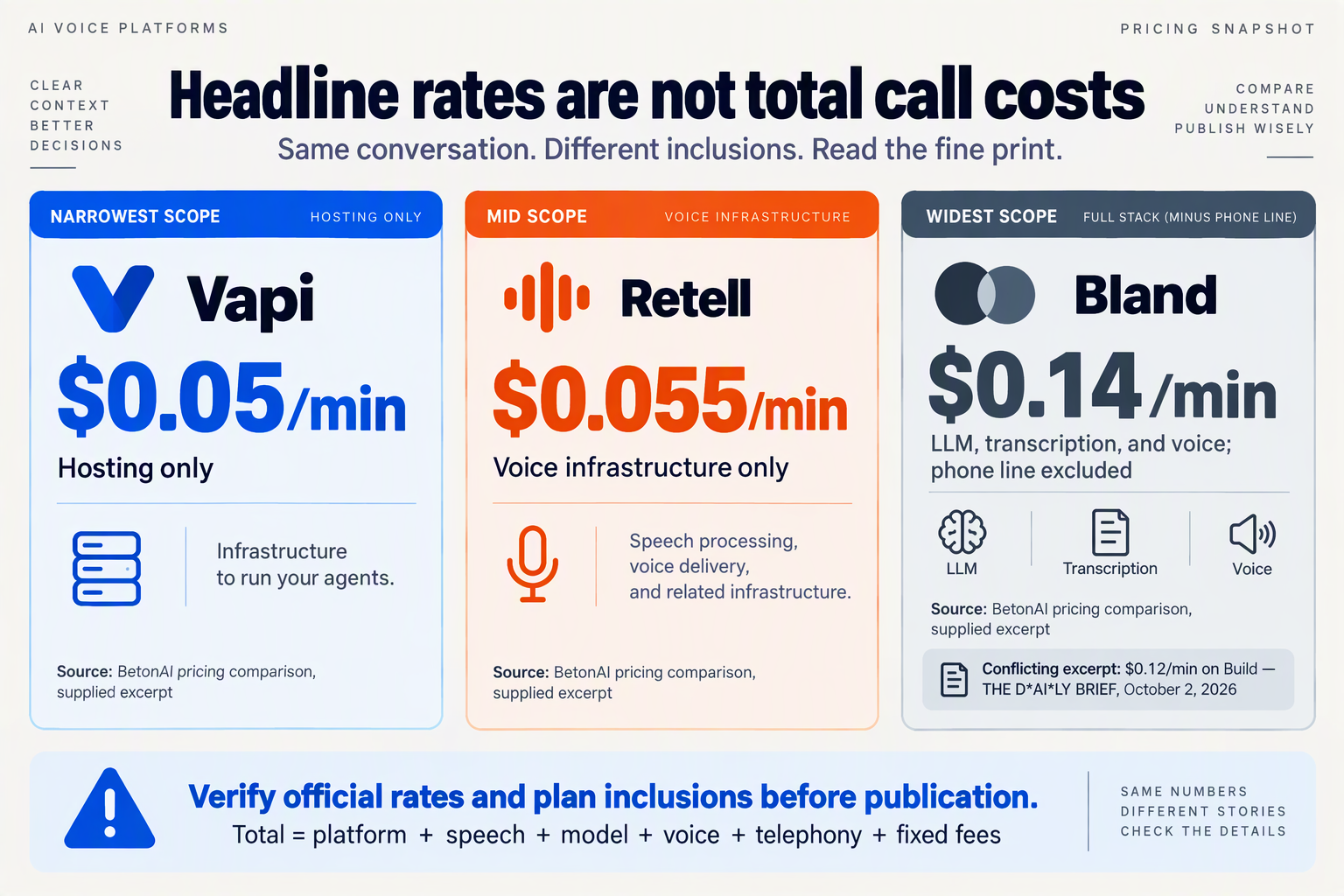
For an October 2026 budget, compare a complete configured minute—not just the platform fee. The supplied sources report different inclusions and pricing snapshots, so the table separates published rates from estimates and charges requiring confirmation.
| Cost item | Vapi | Retell AI | Bland AI |
|---|---|---|---|
| Advertised starting rate | $0.05/min | $0.055/min | $0.14/min |
| What that rate covers | Orchestration/hosting | Voice infrastructure | LLM, transcription, voice |
| Additional usage costs | Model, speech services, telephony | Confirm selected model, voice and telephony charges | Phone line excluded |
| Other reported pricing | $0.09–$0.14/min estimated total | About $0.11/min with GPT 5.4 mini | Build: $0.12/min plus additional charges |
| Included concurrent calls | Not established in supplied context | 20 | 10 or 50, depending on self-serve tier |
| Extra concurrency | Confirm current terms | $8/concurrent call/month | Confirm tier or Enterprise terms |
Which pricing figures should you use?
- Source boundaries: For this October 2026 comparison, GMWARE supplies Vapi’s $0.05 orchestration rate; BetonAI’s 2026 comparison supplies Retell AI’s $0.055 infrastructure rate and Bland AI’s $0.14 bundled rate. These are starting components, not equivalent end-to-end quotes.
- Estimated totals: THE DAILY BRIEF reported on October 2, 2026, that Vapi totals approximately $0.09–$0.14/min and Retell AI approximately $0.11/min with GPT 5.4 mini. Treat those figures as configuration-specific estimates—not guaranteed prices for every voice, model, destination or workload.
- Bland AI: THE DAILY BRIEF’s October 2, 2026, Build-plan figure of $0.12/min plus additional charges differs from BetonAI’s $0.14 bundled snapshot. Request a dated quote specifying the plan, included components and telephone charges rather than averaging the two figures.
How do concurrency and call outcomes change the bill?
- Retell AI: Coldcalls.ai reports 20 included concurrent calls and $8/month for each additional concurrency slot in the research supplied for October 2026. If those terms apply, provisioned capacity for 40 simultaneous calls adds $160/month; concurrency measures simultaneous calls, not total monthly minutes.
- Worked budget: Using THE DAILY BRIEF’s October 2 Retell estimate, 30,000 billed minutes × $0.11 = $3,300. Adding the illustrative $160 concurrency charge produces $3,460/month, before any charges not captured by that configuration; this is a planning calculation, not a vendor quote.
- Resolution economics: In an illustrative October 2026 test, 1,000 one-minute calls costing $110 yield $0.157 per resolution at 70% completion, versus $0.129 at 85%. That roughly 18% reduction shows why task completion can matter more than a small difference in advertised minute rates.
What should your final pricing checklist include?
- Procurement: Before committing in October 2026, confirm billing increments, unsuccessful-call treatment, transfers, telephone destinations, number rental and capacity charges. Ask each vendor to price the same model, voice, call duration and peak concurrency; unavailable terms should remain “unconfirmed,” not $0.
- CallMissed: As of October 2026, CallMissed offers Standard ₹4/min, Expressive ₹5/min and Best latency ₹6/min, covering speech recognition, the language model and voice. Phone carriage is separate; connected calls have a 30-second minimum, while calls that never connect cost nothing—explicit boundaries useful in any comparison.
What are the pros and cons of Vapi, Retell, and Bland?
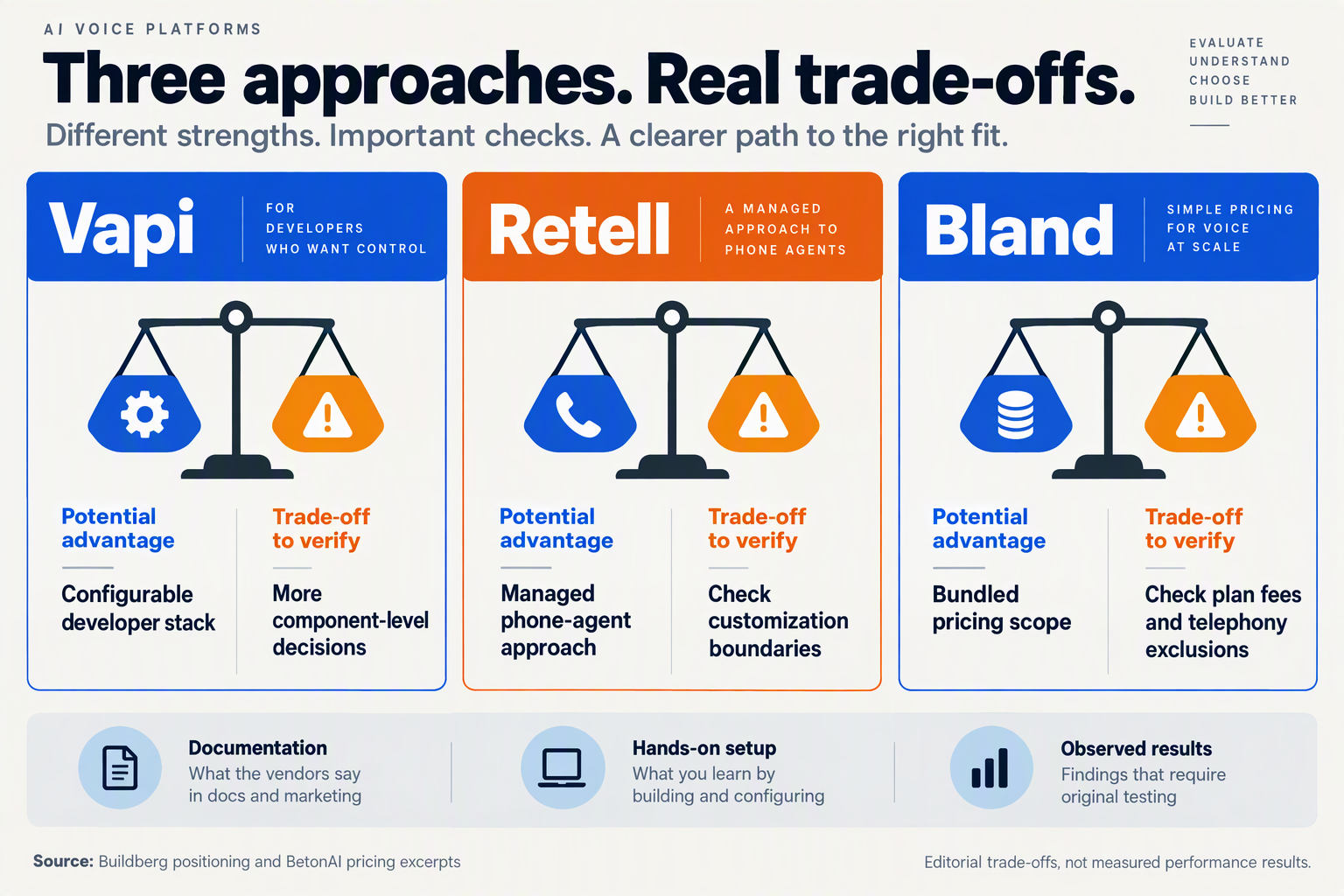
Vapi’s strength is stack control; Retell AI’s is managed deployment; Bland AI’s is bundled purchasing. Their disadvantages are corresponding trade-offs—not proof that one platform is universally better.
- Vapi: Buildberg’s comparison, reviewed for this October 2026 section, recommends Vapi for developers and agencies needing custom function calling and flexible model choices; that flexibility also creates more configuration decisions.
- Retell AI: Buildberg’s October 2026 research snapshot recommends Retell AI for managed telephony and production-oriented defaults; teams with unusual requirements should verify how those defaults accommodate their preferred stack.
- Bland AI: BetonAI’s 2026 comparison describes a bundle covering the language model, transcription, and voice; simpler component purchasing does not eliminate separate phone-line costs or plan-specific capacity limits.
What are the main advantages and trade-offs of each platform?
The following table separates reported capabilities from buyer-side implications, using the supplied research available for this October 2026 comparison.
| Decision factor | Vapi | Retell AI | Bland AI |
|---|---|---|---|
| Primary advantage | Configurable stack; GMWARE emphasizes control | Managed telephony and solid defaults, according to Buildberg | LLM, transcription, and voice bundled, according to BetonAI |
| Operational trade-off | More component choices to configure, test, and cost | Validate whether managed defaults fit custom requirements | Validate bundle inclusions against the specific plan |
| Concurrency evidence | Included capacity is not established in the supplied excerpts | Coldcalls.ai reports 20 included concurrent calls | Coldcalls.ai reports 10 and 50 concurrent calls across two self-serve tiers |
| Capacity expansion | Request a written capacity and pricing schedule | Coldcalls.ai quotes $8 per additional concurrency slot monthly | Coldcalls.ai says Enterprise capacity is sized to requirements |
| Purchasing consideration | Evaluate the complete configured stack | Separate usage charges from capacity charges | Identify the tier before comparing bundled rates |
| Best pilot question | Does component flexibility improve your actual workflow? | Do managed defaults meet deployment and escalation requirements? | Does the chosen tier accommodate peak demand economically? |
Which disadvantages matter most before you commit?
- Retell AI: Coldcalls.ai’s pricing snapshot, reviewed in October 2026, implies that expanding from 20 to 35 concurrent calls costs $120 monthly for 15 additional slots at $8 each; this is capacity expenditure, not a substitute for usage charges.
- Bland AI: Coldcalls.ai’s October 2026 research snapshot lists 10 versus 50 concurrent calls across self-serve tiers; a workload peaking at 12 simultaneous calls therefore requires checking the lower tier’s overflow policy or another capacity option before purchase.
- Vapi, Retell AI, and Bland AI: The supplied excerpts do not establish comparable language coverage, measured latency, or task-completion rates. Run the same three scenarios—interruption, failed tool execution, and human escalation—before treating any platform’s deployment style as a quality advantage.
- CallMissed: For an India-focused comparison, CallMissed’s verified fact sheet lists speech recognition in 22 Indian languages plus English, including Hinglish, as of October 2026. That provides another concrete pilot criterion, not evidence that CallMissed outperforms these three platforms.
Choose the trade-off your team can manage: configuration responsibility, managed-stack fit, or bundled-plan capacity. Keep unverified performance claims out of the shortlist.
Which platform performs best on the same real-world voice-agent test?
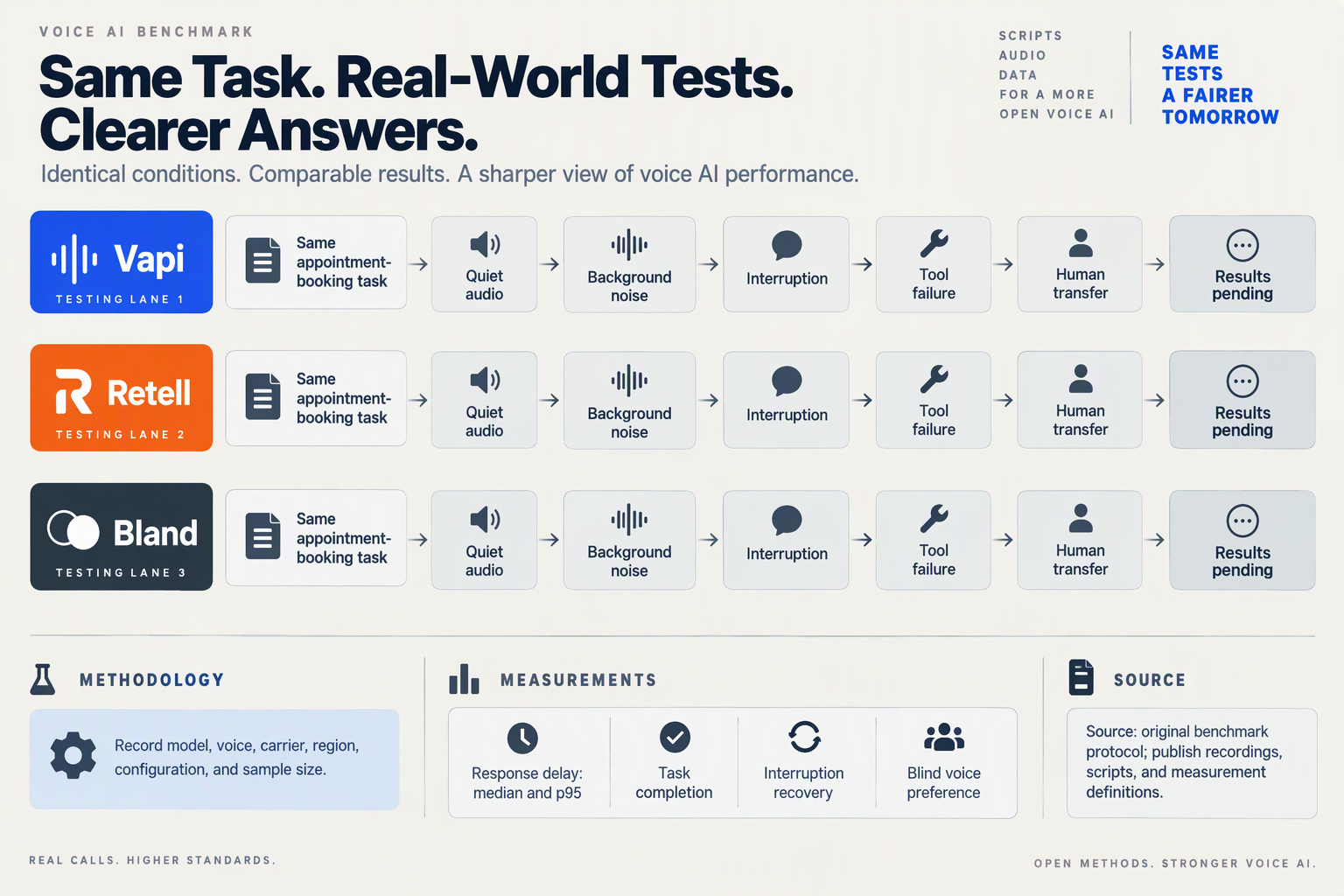
No verified winner emerges from the supplied research: it contains pricing comparisons and platform assessments, not a controlled Vapi–Retell–Bland performance benchmark. For October 2026, choose the platform that completes your actual workflow reliably under identical test conditions—not the one with the most impressive demo.
What does the available evidence say about Vapi, Retell, and Bland?
- Vapi: GMWARE’s comparison, supplied for this October 2026 review, describes Vapi as offering the most stack control. That supports testing different model and voice configurations, but it does not establish faster responses or higher completion rates; configuration flexibility and measured conversation quality are different things.
- Retell AI: Buildberg’s 2026 comparison positions Retell AI as the fastest path to a production-ready phone agent with managed telephony and solid defaults. Treat that as an implementation assessment, not a measured latency result: time to launch and time to answer a caller require separate measurements.
- Bland AI: BetonAI’s 2026 comparison describes Bland AI’s quoted bundle as including the language model, transcription, and voice, while excluding the phone line. Bundling clarifies purchasing boundaries, but does not prove stronger interruption handling, more accurate tool execution, or better performance with regional accents.
- Evidence limit: As of October 2026, none of the supplied excerpts reports a shared test corpus, sample size, task-success percentage, or comparable p50/p95 response latency across all three platforms. A defensible head-to-head should therefore publish its test method and configuration before presenting any winner.
How should you run the same real-world voice-agent test?
- Test workload: As a proposed October 2026 evaluation—not a published benchmark—run 100 matched calls per platform: 25 appointment bookings, 25 order-status requests, 25 interrupted conversations, and 25 escalation requests. Reuse caller scripts, business rules, knowledge documents, and backend responses; include both straightforward requests and deliberately ambiguous instructions.
- Fair configurations: Run two tracks: matched components where supported, then each platform’s preferred production configuration. Keep the carrier, caller audio, backend environment, and language mix consistent. Record model names, voice settings, timeout rules, configuration dates, and engineering hours so differences remain explainable rather than hidden inside a headline score.
- Measurement: Report verified task completion, incorrect backend writes, successful escalations, and interruption recovery. Measure response latency from caller speech ending to audible agent speech beginning, publishing p50 and p95 separately. Calculate total billed cost per successful resolution, including failed calls; a booking counts only when the correct appointment exists in the backend.
- Decision rule: Predefine unacceptable failures, such as unauthorized bookings, before testing; then compare quality, cost, and setup effort among platforms that pass. For teams extending the shortlist, CallMissed offers call scoring against custom QA rubrics, eval suites, and A/B experiments as of October 2026—capabilities relevant to this evaluation process, not evidence of benchmark superiority.
Which platform fits your team, workload, and language requirements?
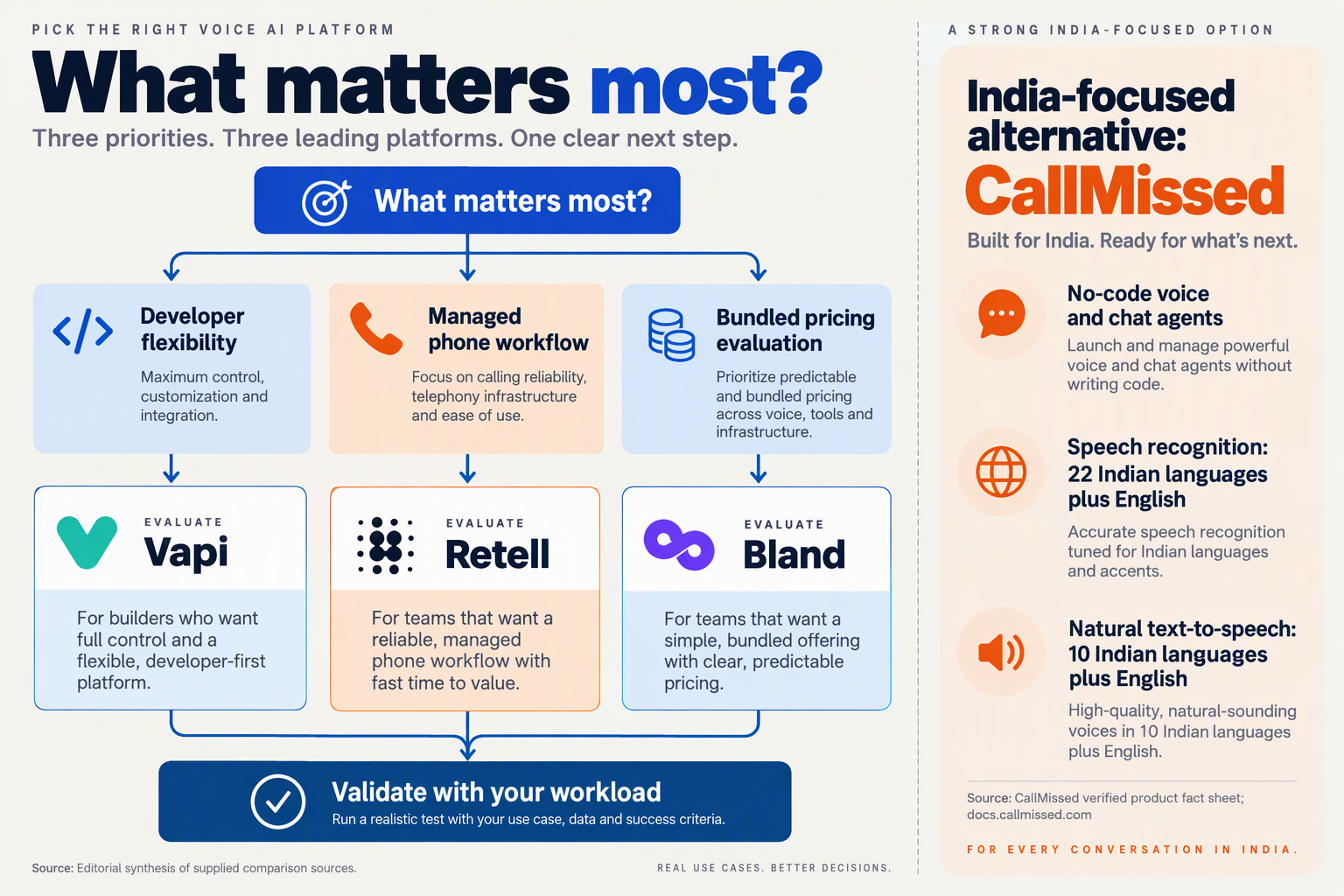
Choose Vapi for developer-led stack control, shortlist Retell AI for managed phone-agent deployment, and evaluate Bland AI against your required capacity and bundle. Language coverage needs a separate acceptance test—not an assumption based on platform positioning.
Which voice AI platform fits your team and call volume?
- Vapi: For an engineering team that wants configurable components, Buildberg’s 2026 comparison recommends Vapi for “full control over the stack,” custom function calling, and flexible model choices. In this October 2026 assessment, that makes Vapi a sensible shortlist for custom workflows—but your team should explicitly own integration testing and component selection.
- Retell AI: Buildberg’s 2026 comparison recommends Retell AI for teams seeking managed telephony and established defaults. For an October 2026 procurement decision, test one complete workflow—such as booking an appointment and transferring an unresolved request—before treating those defaults as a substitute for your own production acceptance criteria.
- Retell AI capacity: The coldcalls.ai research supplied for this October 2026 comparison lists 20 included concurrent calls and $8 per additional concurrency slot per month. If your peak requires 35 simultaneous calls, that implies 15 additional slots and a $120 monthly capacity charge, assuming the quoted terms apply to your plan.
- Bland AI capacity: The coldcalls.ai research supplied for this October 2026 comparison lists 10 and 50 concurrent calls across Bland AI’s two self-serve tiers, with Enterprise capacity sized separately. A workload peaking at 35 simultaneous calls therefore exceeds the listed 10-call allowance but fits within 50; confirm tier fees and overflow behavior before choosing.
Which platform fits multilingual and Indian-language calls?
- Vapi, Retell AI, and Bland AI: The supplied October 2026 research does not establish verified language-by-language recognition or voice coverage for these three platforms. Do not infer support for Hindi, Tamil, or Hinglish from a general multilingual claim; request the exact speech-recognition model, voice model, and supported configuration for each required language.
- Language acceptance testing: For your October 2026 pilot, use a proposed 40-call test set: 10 calls each for English, your primary regional language, code-mixed speech, and noisy conditions. Track task completion, name recognition, numerical accuracy, and human escalation separately; an aggregate score can conceal a serious weakness in one customer segment.
- CallMissed: As of October 2026, CallMissed supports speech recognition in 22 Indian languages plus English, including code-mixed Hinglish, and natural text-to-speech in 10 Indian languages plus English. For India-focused teams, those documented capabilities justify a parallel shortlist; recognition coverage and spoken-output coverage remain different purchasing requirements.
- Final selection: Use three gates for the October 2026 decision: team ownership, peak concurrency, and language-task success. A developer-led team may favor Vapi’s configurability; a team seeking managed deployment may shortlist Retell AI; a workload fitting Bland AI’s documented capacity may shortlist Bland AI. Let your busiest hour and hardest conversations determine the winner.
Frequently Asked Questions
- Q: How should buyers compare costs in Vapi vs Retell vs Bland for voice AI in 2026?
A: Compare cost per resolved call, not just advertised minutes: include telephony, model usage, concurrency charges, and unsuccessful conversations in the numerator. As an illustrative calculation—not a vendor benchmark—a $0.12-per-minute service handling 1,000 three-minute calls costs $360; at 80% successful resolution, that equals $0.45 per resolved call before other charges. THE DAILY BRIEF’s October 2, 2026 pricing analysis reinforces why component-level costs matter.
- Q: How many concurrent calls do Retell AI and Bland AI include?
A: In the research supplied for this October 2026 comparison, coldcalls.ai reports that Retell AI includes 20 concurrent calls, with additional concurrency priced at $8 per slot per month. The same source reports 10 and 50 concurrent calls in Bland AI’s two self-serve tiers, with Enterprise capacity sized separately. Confirm those allowances against your selected plan and test peak simultaneous demand—not merely monthly minutes—before signing.
- Q: Which platform fits a developer-led team in Vapi vs Retell vs Bland for voice AI in 2026?
A: Buildberg’s 2026 comparison recommends Vapi for developers or agencies seeking stack control, custom function calling, and flexible model choices; it recommends Retell AI for a faster route to production-ready phone agents with managed telephony. These are workload-fit recommendations, not evidence of universal superiority, and the supplied excerpt does not establish an equivalent deployment recommendation for Bland AI. Ask each vendor to demonstrate your actual booking, lookup, and escalation workflow.
- Q: Which voice AI platform should Indian businesses evaluate for regional-language calls?
A: The supplied October 2026 research does not establish comparable Indian-language coverage for Vapi, Retell AI, and Bland AI, so buyers should request separate speech-recognition and voice-generation language lists. As of October 2026, CallMissed’s verified fact sheet lists speech recognition in 22 Indian languages plus English, including Hinglish, and natural text-to-speech in 10 Indian languages plus English. Test code-switching, regional names, and addresses rather than treating a language checkbox as proof of accuracy.
- Q: Is switching between Vapi, Retell AI, and Bland AI straightforward?
A: The supplied October 2026 research does not establish drop-in migration compatibility across Vapi, Retell AI, and Bland AI, so do not assume prompts, tools, or telephone configurations transfer unchanged. Before committing, request documentation for exporting prompts, retrieving recordings and transcripts, retaining telephone numbers, and reproducing tool schemas. Run one representative workflow on a second platform to identify migration effort before your application accumulates platform-specific dependencies.
- Q: What should a Vapi, Retell AI, and Bland AI pilot measure before purchase?
A: Measure task completion, response timing, interruption recovery, tool accuracy, escalation success, and total billed cost using the same scenarios and acceptance criteria across all three platforms. Include difficult cases such as background noise, corrected account details, unavailable appointments, and callers requesting a person; these are suggested tests, not published vendor benchmarks. The supplied October 2026 research provides no controlled three-way performance study, so use your pilot—not headline pricing—to support the final decision.
Conclusion
For Vapi vs Retell vs Bland for voice AI in 2026, the practical choice depends on complete call cost, development control, and operational fit—not the lowest advertised rate. As of October 2026, the strongest purchasing decision is one supported by a component-level budget and tests of real customer conversations.
- Compare complete minutes, not platform fees. GMWARE’s pricing snapshot supplied for this October 2026 comparison lists Vapi’s orchestration fee at $0.05 per minute, excluding model and telephony costs. BetonAI’s 2026 comparison lists Retell AI’s voice-infrastructure starting rate at $0.055 per minute and Bland AI’s bundled rate at $0.14 per minute, excluding the phone line. These are different purchasing units, not a reliable cheapest-to-most-expensive ranking.
- Match configuration freedom to your team’s capacity. Buildberg’s comparison supplied for this October 2026 review positions Vapi around developer control and flexible model choices, while positioning Retell AI around managed telephony and production-oriented defaults. Bland AI’s broader pricing bundle offers a different budgeting structure. The relevant question is how much configuration your team needs—and how much ongoing integration and maintenance it can realistically support.
- Validate conversation quality before committing. Test interruptions, response timing, pronunciation, and task completion using the same representative calls across the platforms. Then examine integrations, monitoring, and escalation workflows against your actual operating requirements. A convincing demonstration is useful, but a repeatable evaluation is more defensible: the platform must handle your conversations, connect to your systems, and support the people responsible for resolving problems.
- Treat every price as a dated snapshot. THE DAILY BRIEF reported on October 2, 2026, that Bland AI’s Build plan cost $0.12 per minute plus additional charges, differing from BetonAI’s quoted bundle. For 10,000 connected minutes, a $0.05 rate produces a $500 subtotal and a $0.14 rate produces a $1,400 subtotal—but neither calculation resolves excluded charges. Confirm the plan, included services, telephony, and concurrency costs before comparing monthly budgets.
Looking ahead, watch how these platforms change bundling, model flexibility, and production workflows. More attractive headline pricing will matter only if it translates into a better complete-call budget without sacrificing the conversation quality and operational control your workload requires. Keep the same evaluation criteria when revisiting providers so that changing packages do not distort the comparison.
Readers can also explore CallMissed, an AI customer-communication platform that, as of October 2026, offers flat-rate voice-agent plans covering speech recognition, the language model, and voice, with phone carriage billed separately.
Before choosing a platform, can your team demonstrate what a complete call costs—and whether that call successfully completes the customer’s task?
Related Reading
- AI Voice Agent for Insurance India: Rules and Cost (2026)
- AI Voice Agent for Clinics India: Hindi Booking Guide 2026
- Vapi alternatives: Retell vs CallMissed for Startups