ElevenLabs alternatives India 2026: Indian Voice Guide


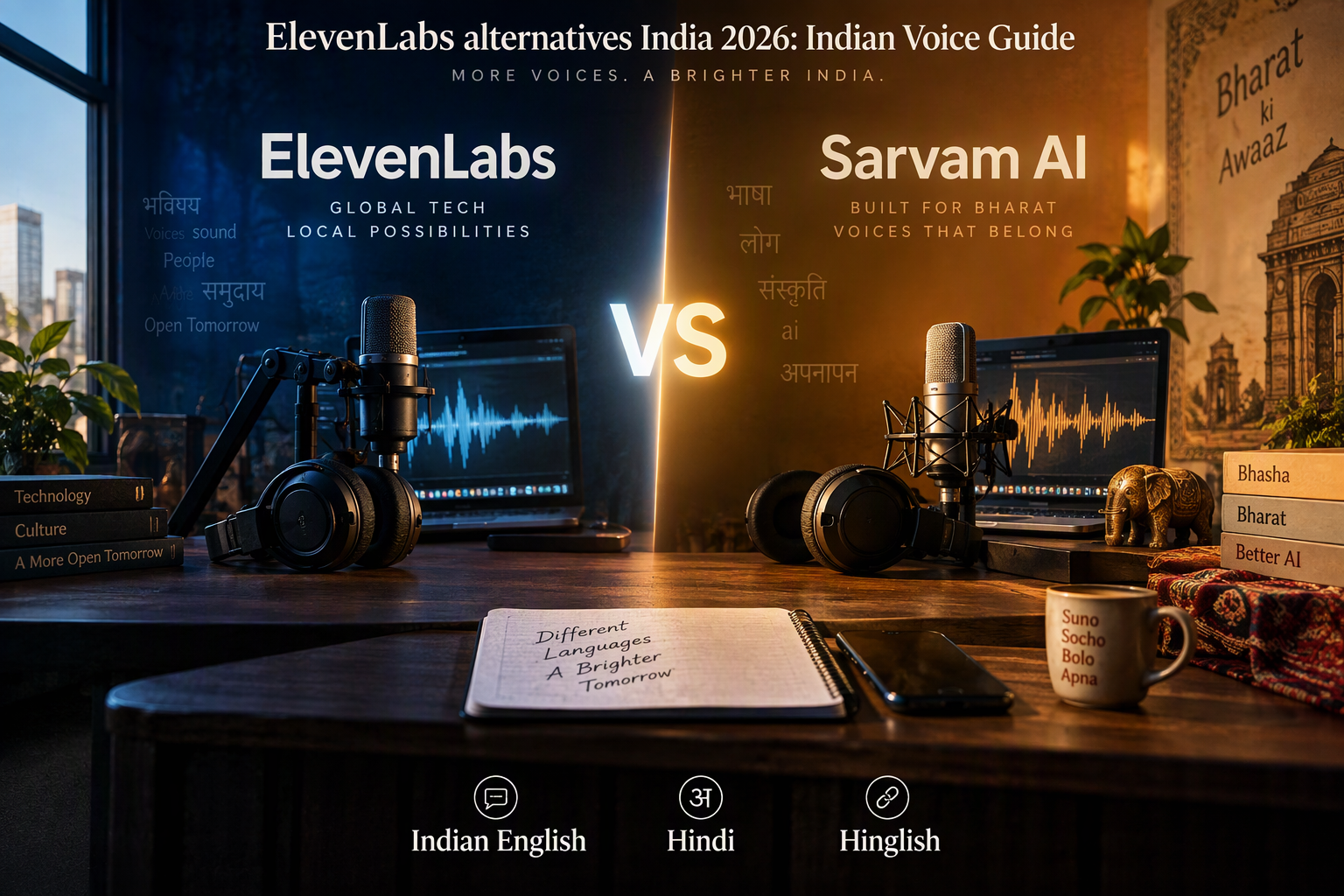
Compare ElevenLabs alternatives India for Indian English, Hindi and Hinglish, with sourced pricing, pronunciation tests and use-case advice.
ElevenLabs alternatives India 2026: Indian Voice Guide
Can an Indian-accent AI voice pronounce a Bengaluru address naturally—and still respond fast enough for a live conversation? ElevenLabs alternatives India deserve a closer look in October 2026, with Sarvam AI’s Bulbul V4 Flash offering a new option for Indian-language speech. The best alternative for your project depends on whether you need Indian English narration, regional-language audio, or a complete voice-agent platform—not simply the largest voice library.
The timing matters. According to Analytics Insight, Sarvam AI launched Bulbul V4 Flash on October 13, 2026, with a reported time-to-first-audio below 250 milliseconds. Lapaas Voice describes its coverage as 10 Indian languages plus Indian English, an important distinction when evaluating language support rather than relying on headline totals. That combination makes the model worth shortlisting for applications where pronunciation and conversational responsiveness both matter.
Which ElevenLabs alternative should you shortlist for Indian accent voices?
Sarvam AI’s Bulbul V4 Flash is a relevant starting point for Indian English and regional-language text-to-speech, based on its documented language coverage and real-time positioning. However, a shortlist is not a listening-test verdict: the supplied specifications do not establish that any model consistently sounds better than ElevenLabs across accents, speakers, and scripts.
For teams that need customer conversations rather than standalone audio generation, CallMissed offers a different route: as of October 2026, the India-hosted AI customer-communication platform provides natural text-to-speech voices in 10 Indian languages plus English, alongside no-code voice-agent building.
That distinction shapes this guide. A narration API and a communication platform may both generate speech, but they solve different implementation problems. Comparing them solely by voice quality can obscure the work required to connect calls, supply business knowledge, or manage conversations.
What should you compare beyond the voice demo?
Start with your actual production script—not a polished vendor sample. This guide will explain how to evaluate:
- Pronunciation: Indian names, place names, rupee amounts, dates, and abbreviations.
- Accent and language fit: Indian English versus regional-language delivery, including scripts that switch languages.
- Conversational performance: Time to first audio, pacing, and whether speech remains understandable at faster settings.
- Total cost: Character-based speech pricing versus the broader costs of running a voice agent.
Pricing also needs a timestamp. As of October 2026, Sarvam AI’s official API pricing lists Bulbul V4 Flash real-time and WebSocket pay-as-you-go usage at ₹1 per 1,000 characters. Secondary launch coverage reports a regular price of ₹20 per 10,000 characters and a promotional price of ₹10 through November 12, 2026; those figures should not be treated as interchangeable permanent rates.
The goal is a practical decision: identify which option deserves your own pronunciation test, understand what the quoted price covers, and choose an Indian voice workflow that fits your audience—not just a convincing demo.
What is the best alternative to ElevenLabs for Indian accent voices?
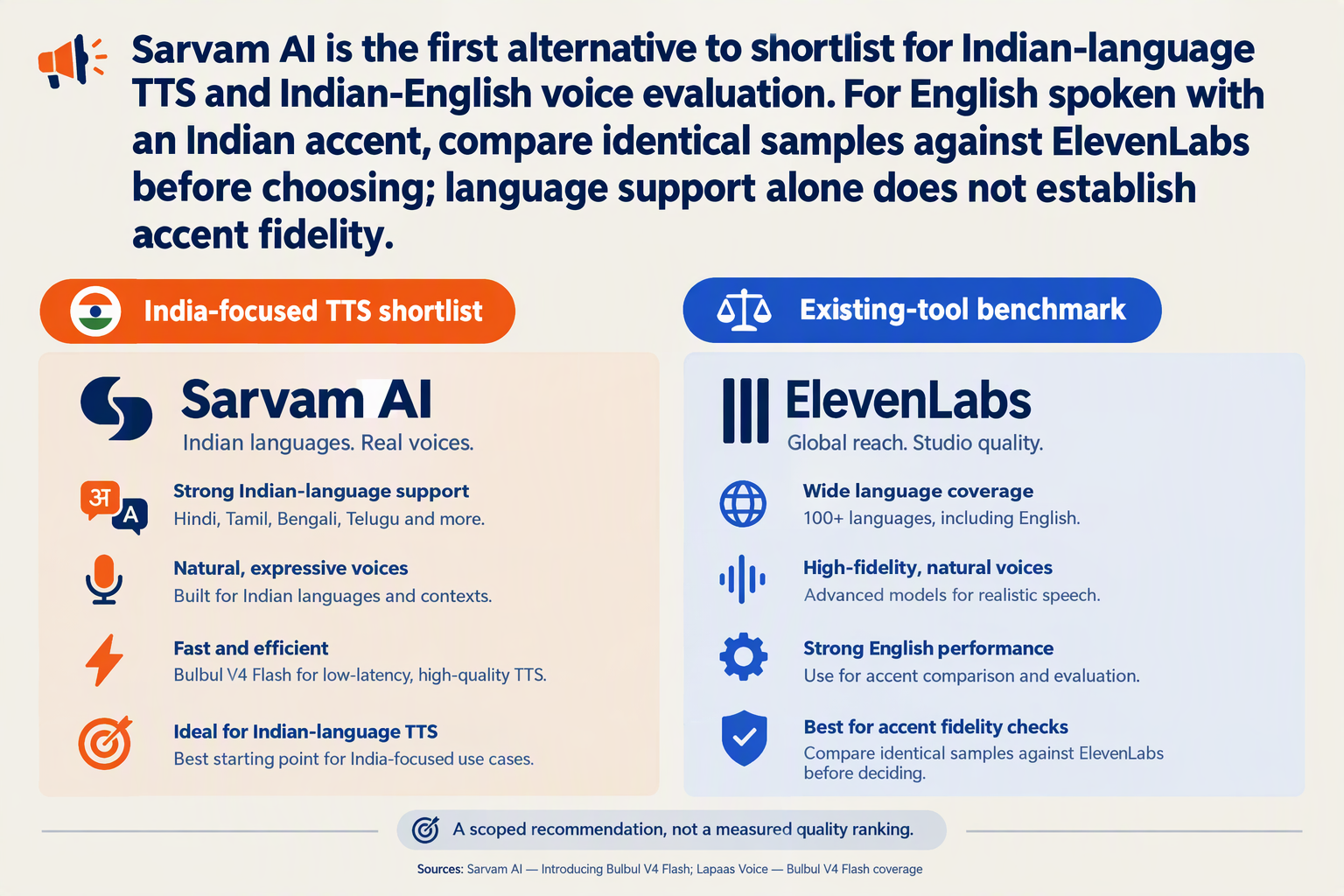
Sarvam AI is a strong alternative to shortlist for Indian-accent text-to-speech, but the supplied evidence does not establish a universal winner over ElevenLabs. Choose by workload: controllable narration, streaming speech, or a complete customer-conversation system.
Which Sarvam model should you evaluate for Indian-accent narration?
- Bulbul V3 — voice selection: As of October 2026, Safeguard lists more than 30 named voices across 10 Indian languages and English for Sarvam AI’s Bulbul V3. That makes V3 worth evaluating when you need different speakers for training modules, product explainers, or multilingual narration—not simply one voice that passes a short demonstration.
- Bulbul V3 — audio controls: As of October 2026, Safeguard documents pace control and sample rates up to 48 kHz for Bulbul V3. These are useful production controls, not proof of superior accent fidelity: audition the same script at your intended playback speed, particularly where Indian surnames, abbreviations, and English technical vocabulary appear together.
- Bulbul V3 — request limits: Safeguard lists a 2,500-character request limit for Bulbul V3 as of October 2026. A 10,000-character narration therefore needs at least four requests, before allowing for sentence-boundary splitting. Check whether speaker identity, pacing, and pauses remain consistent across those segments; otherwise, editing effort can outweigh savings on speech generation.
- Bulbul V3 — release-status uncertainty: As of October 2026, Safeguard describes Bulbul V3 as “stable,” while Zubnet AI labels the model “currently in beta.” Those conflicting descriptions warrant checking Sarvam AI’s current documentation before deployment. Neither directory description alone establishes production guarantees, and neither supplies a controlled Indian-accent listening comparison against ElevenLabs.
How should you compare streaming costs and voice-agent costs?
- Bulbul V4 Flash — published API cost: Sarvam AI’s official pricing lists ₹1 per 1,000 characters for both real-time and WebSocket pay-as-you-go usage as of October 2026. At that listed rate, 100,000 billed characters calculate to ₹100 for text-to-speech usage; language-model processing, telephony, and other application components require separate budgeting.
- Bulbul V4 Flash — pricing discrepancy: Analytics Insight’s October 13, 2026 launch coverage reports ₹20 per 10,000 characters, discounted to ₹10 through November 12, 2026. The discounted figure matches the official page’s ₹1-per-1,000-character rate, but the reported regular price differs. Use the official rate for initial estimates and confirm billing terms before committing.
- CallMissed — complete conversation workflow: According to CallMissed’s verified fact sheet, as of October 2026 its Standard voice-agent plan costs ₹4/minute, covering speech recognition, the language model, and voice generation. A connected five-minute call therefore costs ₹20 for that agent stack, with phone carriage separate; the 30-second minimum matters for short calls. This is not directly comparable to character-priced narration.
- Selection rule — evidence before preference: The supplied October 2026 sources provide specifications and prices, but no matched ElevenLabs-versus-Sarvam accent benchmark. Test identical scripts containing names, addresses, rupee amounts, and language switches; record pronunciation errors, first-audio delay, and editing time separately. Choose the option that performs best on your actual workload, rather than treating language coverage as a voice-quality ranking.
How do Sarvam, ElevenLabs and VoisLabs compare for Indian voices?
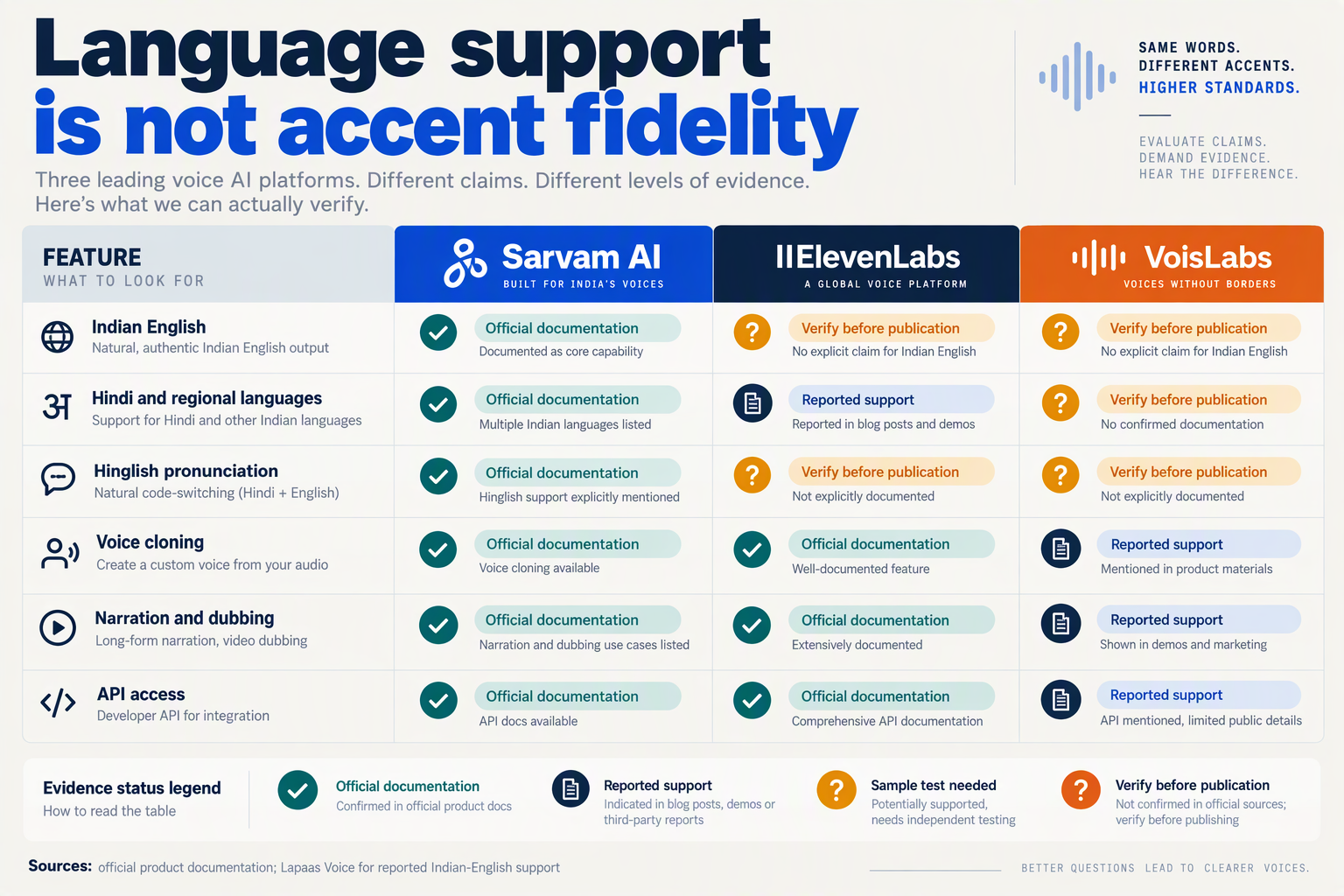
Sarvam AI has the strongest documented Indian-voice specifications in the supplied research, but that does not establish better sound quality than ElevenLabs or VoisLabs. As of October 2026, this comparison separates verified model specifications from information that still requires vendor documentation and listening tests.
- Sarvam AI: Evaluate Bulbul V3 and Bulbul V4 Flash separately; V3’s voice count, request limit and sample-rate specifications should not automatically be attributed to V4 Flash.
- ElevenLabs: The supplied research contains no verified ElevenLabs language inventory, Indian-accent voice count or current pricing; a numerical comparison would therefore be speculative.
- VoisLabs: The supplied research likewise provides no verified VoisLabs specifications or pricing; treat this as an evidence gap, not evidence that the service lacks Indian voices.
Which Indian-voice specifications are actually documented?
The table records evidence available as of October 2026. “Not supplied” means the research does not establish the answer—not that the vendor lacks the capability.
| Comparison criterion | Sarvam AI | ElevenLabs | VoisLabs |
|---|---|---|---|
| Indian-language coverage | V3: 10 Indian languages plus English, according to Safeguard | Not supplied | Not supplied |
| Named voice inventory | V3: more than 30 named voices, according to Safeguard | Not supplied | Not supplied |
| Audio output specification | V3: sample rates up to 48 kHz, according to Safeguard | Not supplied | Not supplied |
| Input length limit | V3: up to 2,500 characters per request, according to Safeguard | Not supplied | Not supplied |
| Delivery controls | V3: pace control, according to Safeguard | Not supplied | Not supplied |
| Real-time TTS pricing | V4 Flash: ₹1/1,000 characters, according to Sarvam AI | Not supplied | Not supplied |
How should you turn this comparison into a buying decision?
- Voice selection: According to Safeguard’s Bulbul V3 listing, available in the October 2026 research, Sarvam AI offers more than 30 named voices; that is a selection advantage to investigate, not a benchmark proving superior Indian-accent pronunciation.
- Workload calculation: At Sarvam AI’s official October 2026 V4 Flash pay-as-you-go rate, 100,000 characters cost ₹100 for the listed real-time or WebSocket service. Keep generated-character charges separate from telephony, speech recognition and language-model costs.
- Listening test: Give all three vendors the same four script types: Indian English narration, regional-language dialogue, names and addresses, and mixed-language sentences. Record pronunciation corrections, perceived accent fit and delivery consistency; do not rank vendors from different demo scripts.
- Deployment choice: As of October 2026, CallMissed, the India-hosted AI customer-communication platform, offers voice-agent plans at ₹4, ₹5 or ₹6 per minute, covering speech recognition, the language model and voice; phone carriage is separate. Those bundled rates are not directly comparable with a character-priced TTS API.
Decision rule: Shortlist Sarvam for its documented Indian-language options, then require equivalent evidence and matched audio samples from ElevenLabs and VoisLabs before declaring a “best alternative.” Missing documentation should lower confidence in the comparison—not become a negative product claim.
How much do Indian voice alternatives cost for the same workload?
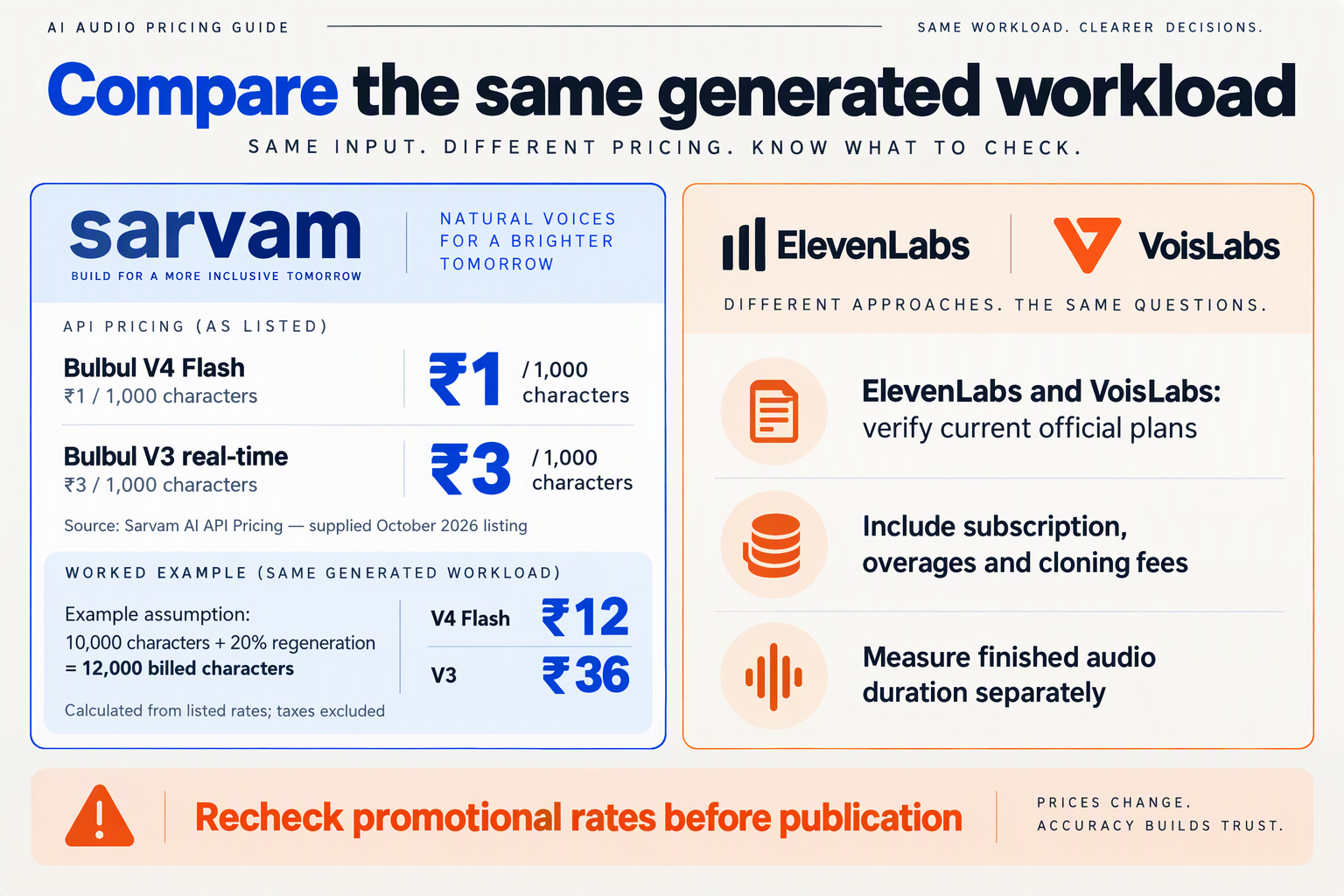
Sarvam AI’s Bulbul V4 Flash costs ₹100 for 100,000 characters of speech generation at its official October 2026 pay-as-you-go rate. For live conversations, compare complete agent costs separately: text-to-speech pricing does not include speech recognition, language-model reasoning, or phone carriage.
- Narration workload: Use 100,000 input characters to compare text-to-speech APIs; this is a budgeting example, not a guaranteed audio duration, because language, punctuation, and speaking pace change the output length.
- Conversation workload: Use 1,000 billable agent minutes to compare complete voice-agent plans; do not equate that workload with 100,000 characters or assume generated speech accounts for every minute of a two-way conversation.
- Price basis: The table uses rates available in the supplied sources as of October 2026; calculated totals are usage estimates, not all-inclusive invoices, and should not be read as equivalent service bundles.
- ElevenLabs baseline: The supplied research does not establish an October 2026 ElevenLabs rate, included allowance, or overage schedule; leaving that price unverified is more reliable than inserting an outdated subscription figure.
What does the same workload cost in October 2026?
| Provider / option | Billing unit | Example workload | Calculated usage cost | What it covers |
|---|---|---|---|---|
| Sarvam Bulbul V4 Flash, PAYG | ₹1 / 1,000 characters | 100,000 characters | ₹100 | Text-to-speech |
| Sarvam Bulbul V3, real-time PAYG | ₹3 / 1,000 characters | 100,000 characters | ₹300 | Text-to-speech |
| CallMissed Standard | ₹4 / minute | 1,000 agent minutes | ₹4,000 | Recognition, LLM, voice |
| CallMissed Expressive | ₹5 / minute | 1,000 agent minutes | ₹5,000 | Recognition, LLM, voice |
| CallMissed Best latency | ₹6 / minute | 1,000 agent minutes | ₹6,000 | Recognition, LLM, voice |
| ElevenLabs | Not verified here | 100,000 characters | Not calculated | Verify current plan terms |
Which pricing details could change your decision?
- Sarvam official pricing: As of October 2026, Sarvam AI lists Bulbul V4 Flash real-time and WebSocket PAYG at ₹1 per 1,000 characters, versus ₹3 for Bulbul V3 real-time; Flash therefore has 66.7% lower character-based usage cost for this example, not necessarily lower total application cost.
- Sarvam launch reports: Analytics Insight’s October 13, 2026 launch coverage reports ₹20 per 10,000 characters, discounted to ₹10 until November 12, 2026; these imply ₹200 and ₹100 respectively for the example workload. Because those figures differ from the official listing, confirm the endpoint and offer before budgeting.
- CallMissed billing: As of October 2026, CallMissed’s verified pricing specifies a 30-second minimum per connected call, no charge for calls that never connect, and separate phone carriage. For example, 100 connected calls lasting 10 seconds each incur 50 billable minutes, costing ₹200 on Standard before carriage.
- Decision rule: For the best alternative to ElevenLabs for Indian accent voices, shortlist by pronunciation first, then price the actual task: character-based TTS for narration, or complete agent minutes for conversations. Include regenerated audio, minimum billing increments, and separately charged components rather than treating the lowest headline rate as the lowest finished-workload cost.
What are the advantages and trade-offs of each alternative?
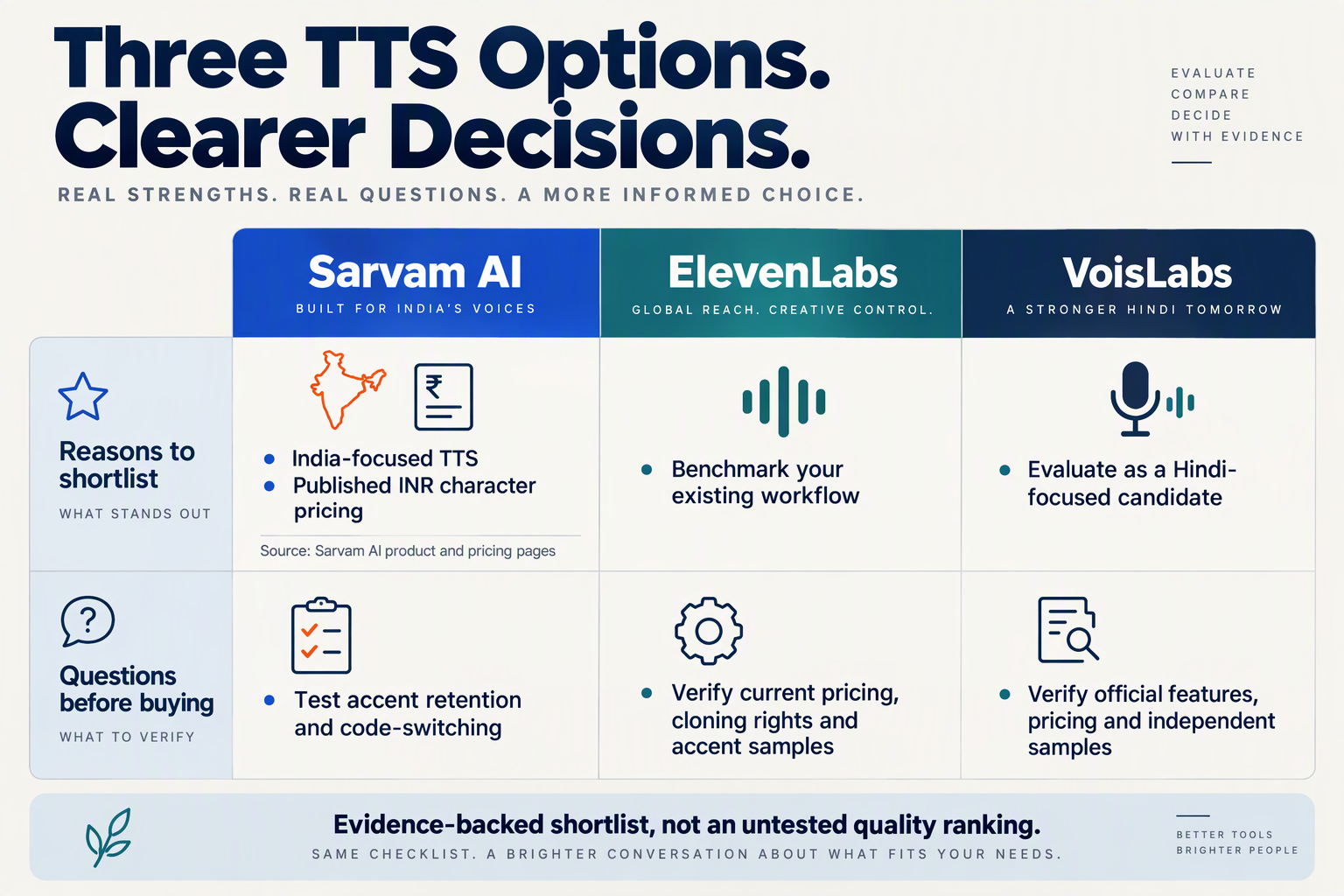
Sarvam AI’s Bulbul V4 Flash is a strong shortlist candidate for Indian-accent speech; CallMissed is relevant when the requirement extends to complete customer conversations. The practical trade-off is between a speech-generation API and a platform that also manages agents, knowledge and calls.
- Speech quality: The supplied sources provide specifications, not a controlled listening comparison against ElevenLabs; test Indian English pronunciation before declaring a winner.
- Cost comparison: Compare character-priced text-to-speech with other speech APIs—not directly with per-minute voice-agent pricing that includes speech recognition and a language model.
- Deployment choice: Separate downloadable narration, streaming speech and telephone conversations into different requirements; one purchasing decision need not cover all three.
- Evidence quality: Prefer official pricing over launch coverage, and check conflicting model-status descriptions before committing a production workload.
Which alternative fits each Indian voice use case?
Comparison snapshot: October 2026. Product details below come from Sarvam AI’s official pricing, Safeguard, Zubnet AI and the verified CallMissed fact sheet; missing information means not established by these sources, not necessarily unavailable.
| Alternative | Documented advantage | Trade-off or uncertainty | Shortlist for |
|---|---|---|---|
| Sarvam Bulbul V4 Flash | Official real-time and WebSocket pay-as-you-go pricing: ₹1/1,000 characters | Published specifications do not establish superior pronunciation across every Indian accent | Cost-sensitive streaming TTS |
| Sarvam Bulbul V3 | Safeguard lists 30+ named voices, pace control and sample rates up to 48 kHz | 2,500-character request limit; Safeguard describes it as stable, while Zubnet describes it as beta | Voice selection and configurable narration |
| Sarvam Bulbul V2 | Zubnet describes a stable model returning base64-encoded WAV audio | The supplied context does not establish current pricing or comparable streaming performance | Existing WAV-based integrations |
| CallMissed | No-code voice agents; ₹4/₹5/₹6 per minute plans include recognition, language model and voice | 30-second minimum on flat-rate plans; phone carriage costs extra | Integrated customer-call workflows |
What do the specifications mean for an actual buying decision?
- Sarvam V4 Flash versus V3: As of October 2026, Sarvam AI’s official real-time pay-as-you-go rates imply ₹100 versus ₹300 for 100,000 characters, respectively—a 66.7% lower listed TTS charge for V4 Flash. This arithmetic compares speech-generation charges only; it does not include telephony or the other components of a conversational application.
- Bulbul V3 request handling: Safeguard’s October 2026 specification of 2,500 characters per request means a 10,000-character narration needs at least four requests. Split at sentence boundaries and listen for changes in pacing between segments; a higher audio sample rate alone does not prove more natural Indian pronunciation.
- CallMissed workflow economics: As of October 2026, the verified fact sheet’s ₹4/minute Standard plan makes a connected 20-second call subject to a ₹2 minimum usage charge, before separate phone carriage. Its alternative custom stack bills individual components by the second with no minimum, so compare both approaches against your actual call-length distribution.
Decision rule: Audition pronunciation first, then compare the cost of the complete workload. A lower TTS bill is valuable only if the voice, integration effort and operating model fit the job.
Which voice handles Indian names, rupee amounts and Hinglish best?
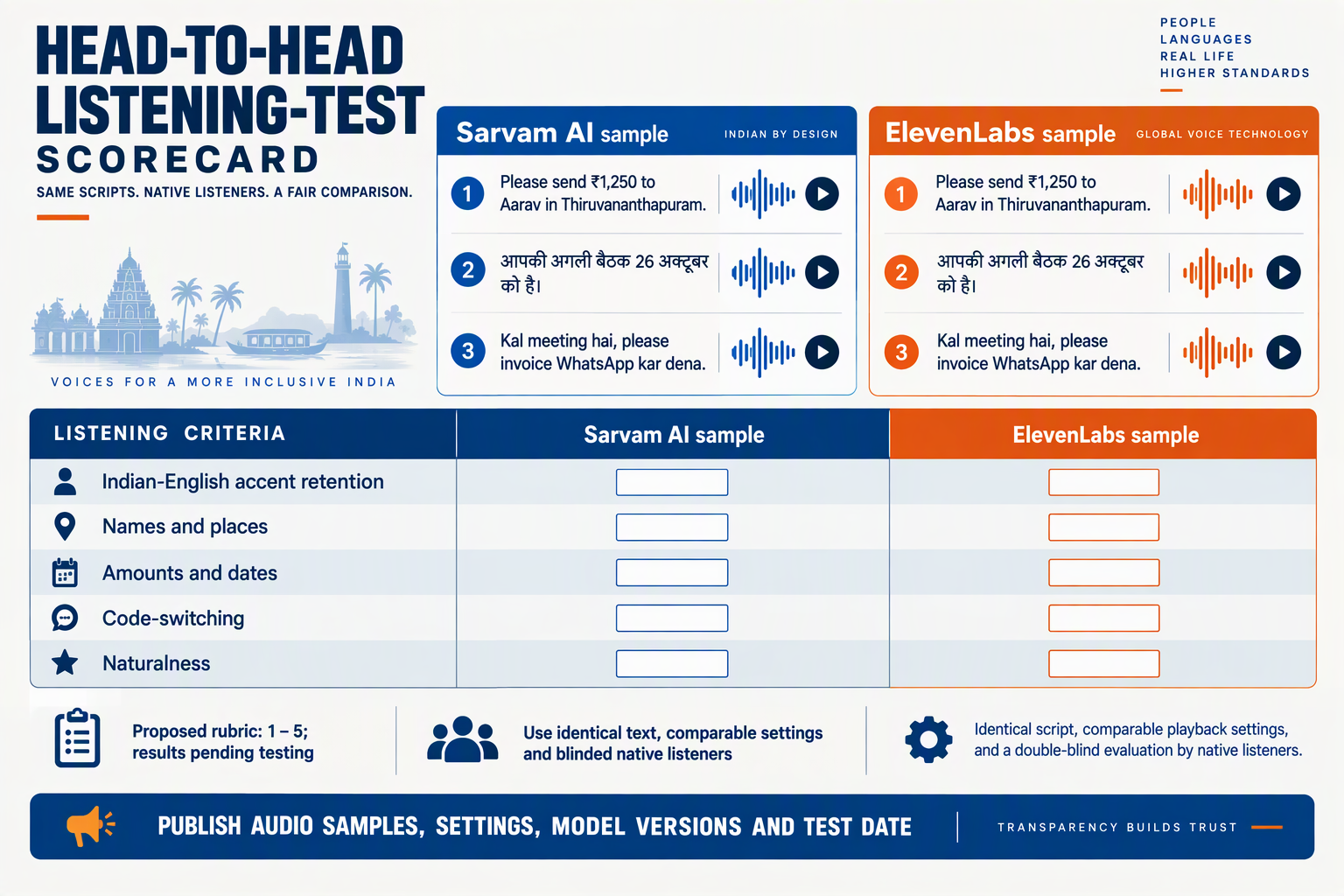
No supplied benchmark establishes which voice handles Indian names, rupee amounts and Hinglish best. Sarvam AI’s Bulbul models warrant a pronunciation test, but the best alternative to ElevenLabs for Indian accent voices should win on your scripts—not language counts alone.
How should you test Indian names and rupee amounts?
- Indian names: Use a proposed 20-item pronunciation set containing customer-approved names and locations, such as “Srinivasan,” “Guwahati,” “Kozhikode” and “Thiruvananthapuram.” Ask speakers familiar with each name to evaluate pronunciation; an unfamiliar listener may mistake confident delivery for correctness. Include names inside sentences, because isolated-word demos do not test conversational rhythm.
- Rupee amounts: Test ₹1,250, ₹12,500, ₹1,25,000 and ₹12.50 in payment reminders. Define the intended reading before scoring: ₹1,25,000 should preserve “one lakh twenty-five thousand,” while ₹12.50 must retain the decimal value. Compare raw symbols with expanded text to determine whether your application needs a number-normalisation step.
- Dates and abbreviations: Add 26 October 2026, “EMI,” “UPI” and “GST” to the same script. Test ambiguous inputs such as “03/04/2026” separately, specifying the intended date rather than expecting a voice model to infer it. These checks distinguish speech-generation errors from unclear source text—a crucial difference when choosing a production system.
Which models deserve a Hinglish listening test?
- Sarvam AI Bulbul V4 Flash: Lapaas Voice’s October 2026 launch coverage describes support for 10 Indian languages plus Indian English. That makes Bulbul V4 Flash relevant to this shortlist, but coverage does not prove accurate code-switching. Test “Aapka payment ₹1,250 pending hai” alongside equivalent Devanagari and mixed-script inputs.
- Sarvam AI Bulbul V3: As of October 2026, Safeguard lists more than 30 named voices, pace control, sample rates up to 48 kHz, and a 2,500-character request limit for Bulbul V3. Use pace control to check whether names remain intelligible at your required speaking speed; a higher sample rate alone does not establish better pronunciation.
- ElevenLabs: Run the identical names, amounts and Hinglish sentences through your selected ElevenLabs voice. The supplied research contains no head-to-head pronunciation scores, so neither a superiority claim nor a numerical quality ranking is justified. Keep scripts, playback conditions and scoring criteria consistent, and label every generated sample with its model and voice.
How do you turn listening results into a decision?
- Scoring: For a proposed 40-item test, allocate 20 names, 10 amounts and 10 Hinglish sentences. Report correct readings separately for each category; 18/20 names equals 90% name accuracy, not 90% overall quality. Treat incorrect payment amounts as critical failures rather than averaging them away.
- CallMissed: As of October 2026, CallMissed offers natural text-to-speech voices in 10 Indian languages plus English and speech recognition in 22 Indian languages plus English, including Hinglish. For live-agent use, test recognition and spoken replies separately: understanding a code-mixed request and pronouncing the response are different capabilities.
Which should you choose for narration, cloning or business calls?
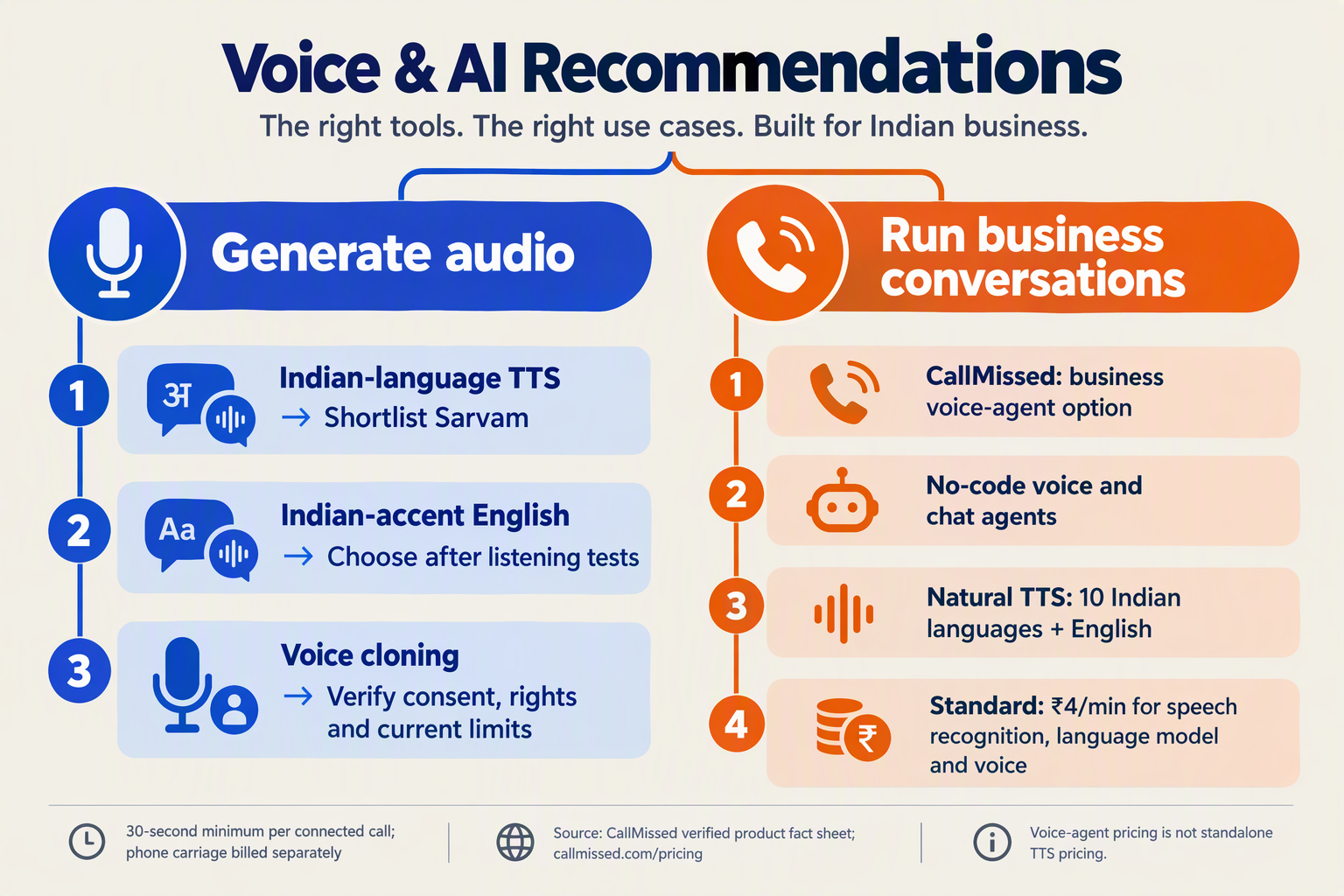
Choose an Indian-language TTS model for narration, require separately verified capabilities for voice cloning, and choose a voice-agent platform for business calls. As of October 2026, the supplied evidence supports a use-case shortlist—not a universal winner for the best alternative to ElevenLabs for Indian accent voices.
Which alternative should you choose for Indian-accent narration?
- Sarvam Bulbul V3: Shortlist this model when narration needs explicit production controls. As of October 2026, Safeguard lists more than 30 named voices, pace control, sample rates up to 48 kHz, and a 2,500-character request limit; verify these specifications against Sarvam’s documentation before designing your audio pipeline.
- Long-form narration: Using Safeguard’s October 2026 specification, a 10,000-character script requires at least four Bulbul V3 requests, before allowing for sentence boundaries. Split at natural pauses rather than arbitrary character counts, then check whether pronunciation, loudness and delivery remain consistent when the resulting clips are joined.
- Sarvam Bulbul V4 Flash: Prefer a trial of this model when streaming delivery matters alongside accent fit. Sarvam AI’s official pricing lists ₹1 per 1,000 characters for pay-as-you-go real-time and WebSocket usage as of October 2026; a 50,000-character workload therefore costs ₹50 in listed TTS usage, excluding other services.
Which alternative should you choose for voice cloning?
- Voice cloning: Do not treat a catalogue of named voices as evidence of cloning. The supplied October 2026 Sarvam sources describe TTS voices and speech generation, but do not establish custom voice-cloning availability, recording requirements or clone fidelity; no evidence-backed cloning winner can be selected from this context.
- Cloning procurement: Before switching providers, request three concrete confirmations: permission to use the source speaker’s recordings, documented custom-voice creation, and commercial usage rights. Test the same consented speaker on Indian names, English sentences and regional-language passages; accent suitability and preservation of that individual’s identity are separate acceptance criteria.
Which alternative should you choose for business calls?
- CallMissed: Choose a communication platform rather than standalone TTS when the requirement is answering or placing individual business calls. As of October 2026, CallMissed’s verified product facts include no-code voice-agent building, knowledge bases from text, web pages and PDFs, custom REST tools, and live-call transfers between agents—capabilities beyond generating narration files.
- CallMissed pricing: As of October 2026, the verified flat-rate voice-agent plans are ₹4, ₹5 or ₹6 per minute, covering speech recognition, the language model and voice; phone carriage is separate. At those rates, 100 connected one-minute calls would cost ₹400–₹600 before carriage; the standard plans have a 30-second minimum per call.
- Final decision: Compare narration using pronunciation and editing effort, cloning using identity fidelity and rights, and calls using completed tasks and handoffs. A low character-based TTS price does not establish a low end-to-end calling cost: speech recognition, reasoning, telephony and operational controls belong in the business-call comparison.
Frequently Asked Questions
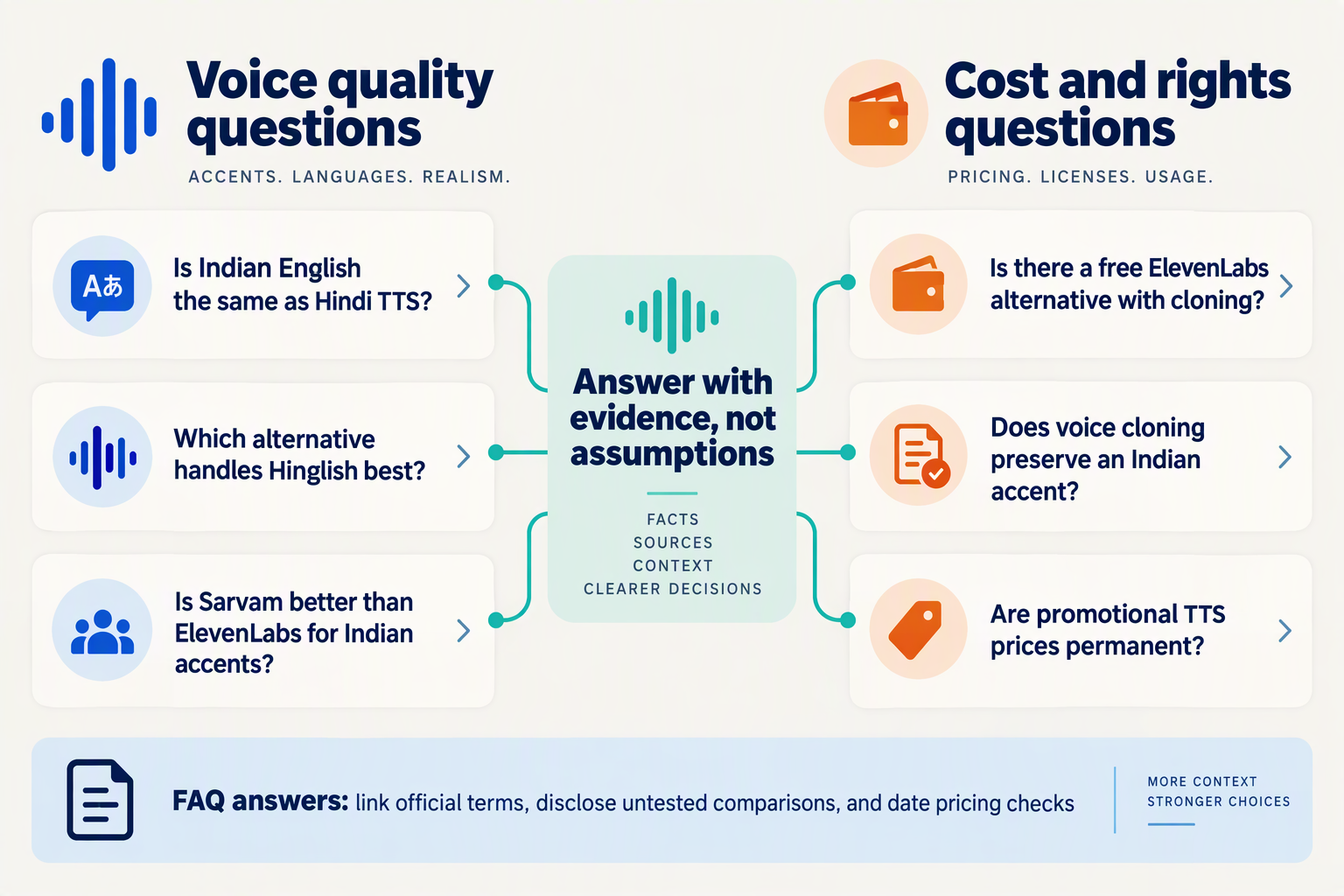
Choose an Indian-accent voice provider by testing your scripts, then checking trial limits, cloning rights and the cost of your actual workload.
- Q: What is the best alternative to ElevenLabs for Indian accent voices?
A: Sarvam AI’s Bulbul V4 Flash is worth shortlisting, but the supplied evidence does not establish a universal voice-quality winner. As of October 2026, Lapaas Voice describes support for 10 Indian languages plus Indian English; buyers should compare identical recordings for names, addresses and conversational phrasing. Choose the voice that passes your listening test, rather than treating language coverage as proof of accent quality.
- Q: Which Indian-accent AI voice platform offers free credits?
A: As of October 2026, CallMissed’s verified product information lists 1,000 free signup credits, with 1 credit equal to ₹1 and credits that never expire. These are platform credits, not a promise of unlimited text-to-speech or a fixed number of generated characters. The supplied research does not establish Sarvam AI’s current free allowance, so check trial limits, eligible models and commercial-use terms before planning a free production workflow.
- Q: Can an ElevenLabs alternative clone my Indian-accent voice?
A: The supplied October 2026 sources do not verify voice-cloning availability, pricing or consent requirements for Sarvam AI, so cloning should remain a separate procurement question. Ask whether the provider supports your accent, requires recorded consent, permits commercial use and allows deletion of uploaded samples. A convincing preset Indian voice does not prove that a service can reproduce a particular speaker’s identity or pronunciation reliably.
- Q: How do I test Indian English and Hinglish pronunciation?
A: Use a 20-line test script containing Indian names, local addresses, rupee amounts, abbreviations and English–Hindi switches; this is a suggested evaluation method, not a published benchmark. As of October 2026, Lapaas Voice identifies Indian English within Bulbul V4 Flash’s coverage, but that does not establish accuracy on your Hinglish script. Have target-language listeners score pronunciation, stress and comprehension separately, without showing them the provider name.
- Q: How much does Sarvam Bulbul V4 Flash cost compared with ElevenLabs?
A: As of October 2026, Sarvam AI’s official API pricing lists Bulbul V4 Flash real-time and WebSocket pay-as-you-go usage at ₹1 per 1,000 characters, making 100,000 characters ₹100 at that published rate. The supplied context does not include verified current ElevenLabs pricing, so a defensible percentage-saving claim is unavailable. Compare equivalent workloads and check taxes, retries and any additional application costs before choosing.
- Q: What is the best alternative to ElevenLabs for Indian accent voices on phone calls?
A: For phone calls, evaluate a complete voice-agent platform, not just generated audio. As of October 2026, CallMissed’s verified pricing lists its Standard voice-agent plan at ₹4 per minute, covering speech recognition, the language model and voice, with a 30-second minimum and phone carriage billed separately. That bundled cost is not directly comparable with character-priced text-to-speech; measure complete conversations, intelligibility and task completion instead.
Conclusion
The best alternative to ElevenLabs for Indian accent voices depends on whether you need Indian English narration, regional-language audio, or a complete voice-agent platform. As of October 2026, Sarvam AI’s Bulbul V4 Flash deserves a place on your text-to-speech shortlist, but production-script listening tests—not language counts or launch claims—should determine your final choice.
Four takeaways should guide that decision:
- Shortlist for accent and language fit, not catalogue size. According to Lapaas Voice’s October 2026 launch coverage, Sarvam AI’s Bulbul V4 Flash supports 10 Indian languages plus Indian English. That makes the model relevant to this comparison, without establishing that every voice will suit every audience. Test Bengaluru addresses, customer names, abbreviations, and rupee amounts before committing. A convincing demonstration is useful; reliable pronunciation across your actual scripts is more important.
- Treat responsiveness as a measurable requirement. Analytics Insight reports that Sarvam AI launched Bulbul V4 Flash on October 13, 2026, with reported time-to-first-audio below 250 milliseconds. That figure supports shortlisting for conversational applications, but it is not a guarantee of complete voice-agent response time. Evaluate how quickly your implementation starts speaking, whether pacing feels natural, and whether pronunciation remains clear when delivery speeds increase.
- Compare prices using the same billing basis. As of October 2026, Sarvam AI’s official API pricing lists Bulbul V4 Flash real-time and WebSocket pay-as-you-go usage at ₹1 per 1,000 characters. Secondary launch reports describe different regular and promotional figures, so verify the applicable rate before estimating expenditure. More importantly, distinguish the cost of generating narration from the broader cost of running a customer conversation: those are different purchasing decisions.
- Choose a platform when the requirement is conversations, not just audio. As of October 2026, CallMissed, the India-hosted AI customer-communication platform, offers natural text-to-speech voices in 10 Indian languages plus English and a no-code voice-agent builder. Readers can explore CallMissed when their requirements extend to business knowledge and connected calls. Evaluate that platform route separately from standalone text-to-speech: the useful comparison is implementation fit, not an unsupported claim of universal voice superiority.
What should you watch next?
Watch whether emerging Indian-language models sustain their reported responsiveness while improving pronunciation across real business scripts. Also revisit published pricing as introductory offers change; a promising launch should lead to repeatable testing, not a permanent ranking.
Keep a small benchmark script covering Indian English, regional-language delivery, mixed-language passages, and difficult names. Re-run it before changing providers, using the same listening criteria and cost assumptions.
Which shortlisted option can pronounce your hardest customer-facing sentence naturally—and deliver it within your actual conversation budget?
Related Reading
- Vapi vs Retell vs Bland for Voice AI: 2026 Comparison
- AI Voice Agent for Insurance India: Rules and Cost (2026)
- AI Voice Agent for Clinics India: Hindi Booking Guide 2026