Kimi K2.5 vs Kimi K2.6: What's New and Which Is Faster?


Compare Kimi K2.5 vs Kimi K2.6 on verified specs, API pricing, coding results, and response speed to choose the right model for your workload.

Kimi K2.5 vs Kimi K2.6: What's New and Which Is Faster?
A newer model is not automatically a faster model—and the supplied sources do not establish a speed winner in Kimi K2.5 vs Kimi K2.6. Kimi’s K2.6 product-page title emphasizes coding and agent capabilities, but the available context contains no matched latency measurements proving that K2.6 responds or finishes tasks faster than K2.5.
That distinction matters for developers, engineering leads, and small-to-enterprise teams buying AI for coding or agent workflows. A model that spends longer reasoning might still finish a complex job sooner if it needs fewer retries; a quick initial response might conceal a slower overall workflow. Neither outcome is demonstrated by the supplied search results.
For this comparison, dated November 24, 2026, the starting point is evidence rather than upgrade hype. The research includes Kimi’s official product, pricing, and platform-changelog pages, alongside an OpenCode comparison—but not their underlying specifications or benchmark results. Those listings identify where to verify claims; they do not independently establish launch dates, context limits, token prices, supported modalities, or performance improvements.
What does “faster” mean for Kimi K2.5 vs Kimi K2.6?
The useful comparison separates distinct measurements instead of treating speed as a single score:
- Time to first token: how long a user waits before an answer begins.
- Reasoning duration: time spent working through the task before producing the useful response.
- Output speed: how quickly the model generates its answer.
- Total task completion time: elapsed time until the result actually meets the acceptance criteria, including retries and tool calls.
A fair test needs the same prompts, comparable reasoning settings, equivalent output requirements, and a clearly identified provider. Otherwise, an apparent model improvement could reflect a different serving configuration rather than a change in capability. For coding buyers, correctness and the number of repair cycles belong beside latency—not in a separate footnote.
What should buyers verify before upgrading?
This explainer will distinguish documented changes from unverified claims, then examine specifications, vendor-sourced pricing, benchmarks, and practical ways to test both models. Where the supplied evidence cannot support a number, the comparison should say so rather than estimate.
If your purchase depends on guaranteed response times, a specific language, or production-ready phone and messaging workflows, this model comparison alone is not enough: those requirements need separate verification.
Platforms can also simplify experimentation. As of November 2026, CallMissed’s verified fact sheet describes OpenAI-compatible and Anthropic-compatible API endpoints, allowing supported integrations to change their base URL rather than rewrite the SDK integration; availability of either specific Kimi version still needs confirmation.
The buying question is therefore not simply “What’s new?” It is: does the documented improvement justify the measured time and cost for your workload?
What's new in Kimi K2.6, and is it faster than K2.5?
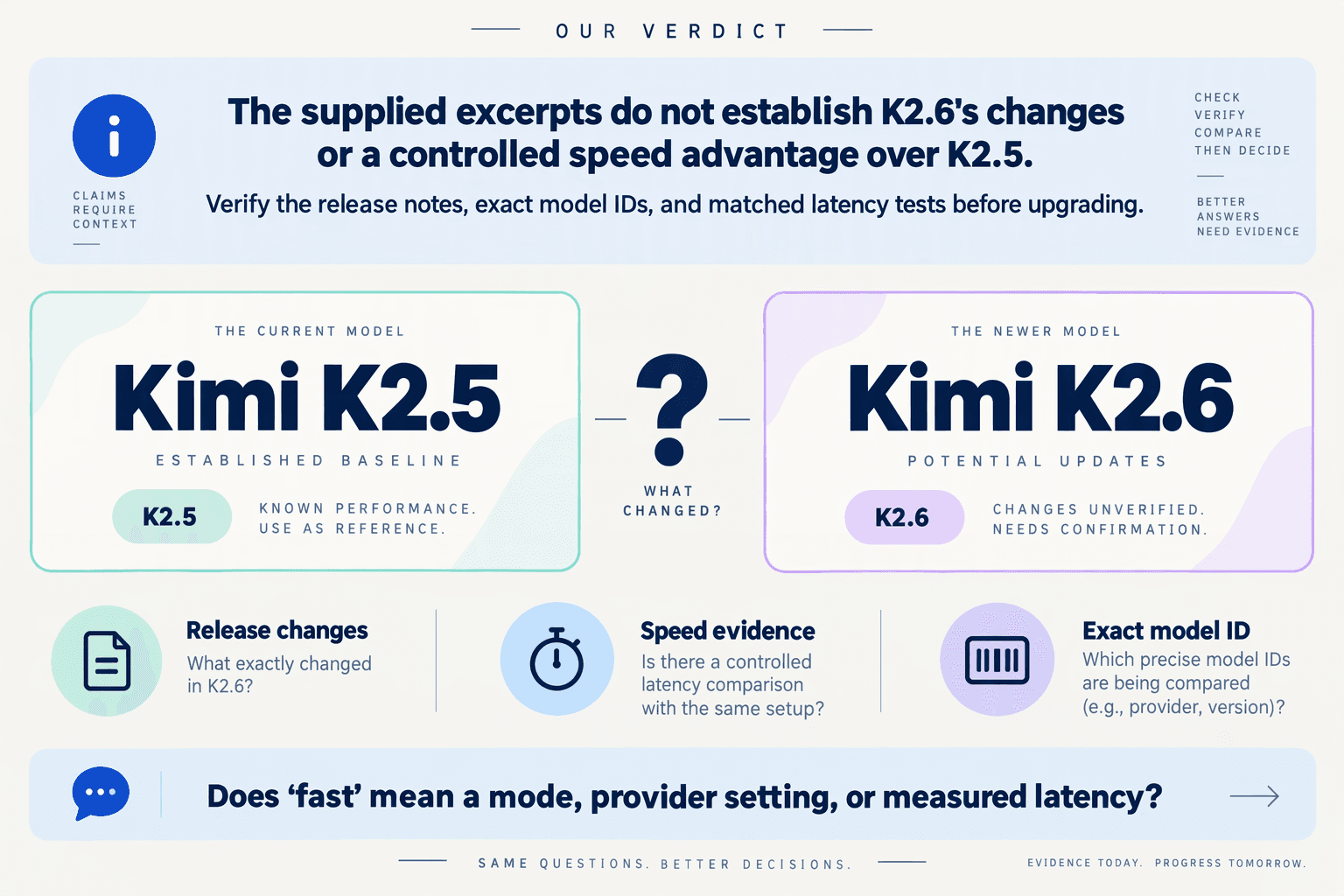
Kimi K2.6’s listed product page emphasizes coding and agent workflows, but the supplied evidence does not identify verified upgrades over K2.5 or establish a speed advantage. As of November 24, 2026, treat K2.6 as a candidate to evaluate—not a proven faster replacement.
What is actually documented about Kimi K2.6?
- Kimi K2.6: Kimi’s official listing is titled “Kimi K2.6 | Leading Open-Source Model in Coding & Agent.” That identifies the vendor’s positioning, not a demonstrated performance improvement. The supplied context contains no benchmark scores, release notes, license terms, or architectural specifications supporting the title’s claims.
- Launch and availability: Kimi’s Platform Changelog is the relevant official source for checking release dates and API changes. However, its entries are not included in the supplied research. A product-page listing alone does not establish when K2.6 launched, whether access is generally available, or whether a preview has restrictions.
- Specifications and prices: The research names Kimi’s K2.6 Pricing page and API pricing — Kimi Help Center, but supplies no prices or specifications from either. As of November 24, 2026, this evidence therefore cannot support a numerical comparison of context windows, input/output token costs, supported modalities, or language coverage.
- Buyer fit: The coding-and-agent positioning makes this comparison relevant to developers and engineering leads at startups, SMEs, and enterprises evaluating those workflows. It is not sufficient evidence for buyers choosing production phone or messaging infrastructure: model selection does not establish telecom compatibility, calling permissions, channel integrations, or deployment time.
Does “K2.6 fast” describe a measured improvement?
- “Fast” terminology: The supplied results do not identify “fast” as an official Kimi K2.6 mode, endpoint, or service tier. Before comparing performance, record the exact model identifier, provider, and reasoning configuration. Otherwise, two products carrying similar Kimi labels could represent different serving arrangements rather than a controlled version comparison.
- “Thinks longer” claims: The keyword brief includes “Kimi K2.6 thinks longer than K2.5,” but provides no underlying measurements. That phrase should remain a testable question, not a product fact. Longer reasoning could accompany better results or unnecessary delay; neither interpretation is established by the supplied evidence.
- Independent comparison: OpenCode lists “Kimi K2.6 vs Kimi K2.5 — AI Model Comparison,” but its results and methodology are absent here. A useful coding test would hold the repository, prompt, tool permissions, and acceptance tests constant, then report successful completion alongside elapsed time. A comparison-page title cannot substitute for those results.
- Practical upgrade decision: Keep K2.5 as the baseline and trial K2.6 on representative work before changing production routing. For example, compare both on the same bug fix and count repair attempts as well as completion time. Upgrade only when observed gains justify the verified price and operational trade-offs—not simply because the version number increased.
What launched, and how do context, modalities, and tools compare?
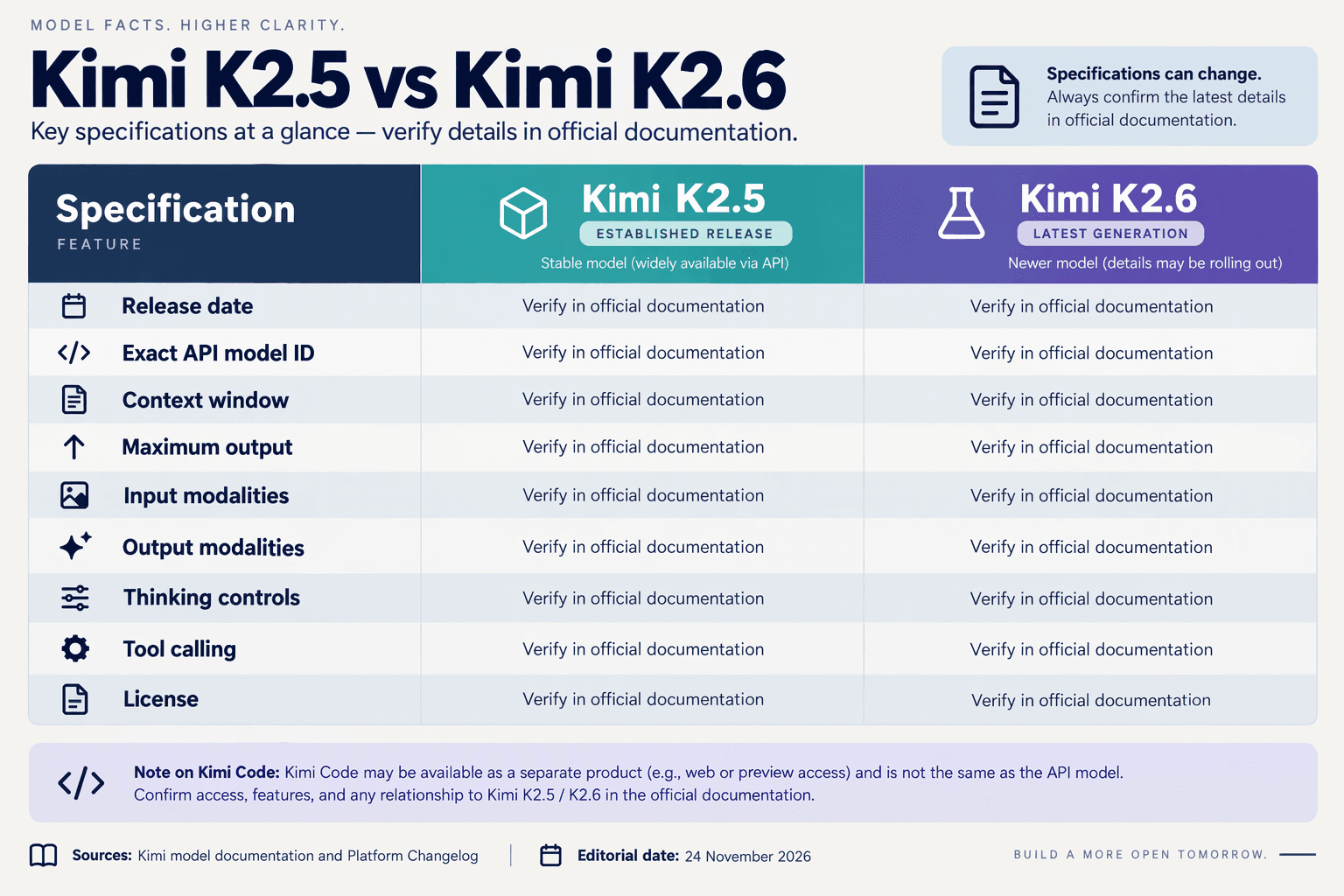
Kimi K2.6 has an official product-page listing, but the supplied research does not establish its launch date or specification changes versus Kimi K2.5. As of November 24, 2026, context limits, supported inputs, and tool capabilities remain unverified in this evidence set—not necessarily undocumented by Moonshot AI.
- Kimi K2.6: Kimi’s official product-page title describes a model focused on “Coding & Agent”; that positioning does not establish specific capabilities or improvements.
- Kimi K2.5: OpenCode lists a direct comparison with Kimi K2.6, but the supplied result contains no specification values for either model.
- Launch status: Kimi’s Platform Changelog is the relevant official source for release timing; its contents are absent from the supplied research.
- “Fast” designation: The supplied listings do not establish a separately named fast variant, selectable mode, or serving configuration for either version.
- Buyer fit: Developers and engineering teams evaluating coding or agent workflows should verify the exact API model identifier before treating these names as interchangeable.
- Purchase boundary: Neither a model name nor “agent” positioning establishes phone calling, messaging permissions, supported languages, or ready-made business integrations.
How do Kimi K2.6 and Kimi K2.5 specifications compare?
Evidence status as of November 24, 2026: “Unverified” below means the supplied search results do not contain the necessary specification—not that the feature is absent.
| Specification | Kimi K2.5 | Kimi K2.6 | Named verification source |
|---|---|---|---|
| Release date | Unverified | Unverified | Kimi Platform Changelog |
| Product positioning | Not supplied | “Coding & Agent” in page title | Kimi; OpenCode comparison |
| Context window | Token limit unverified | Token limit unverified | Official model/API documentation needed |
| Input modalities | Text/image/video support unverified | Text/image/video support unverified | Official model/API documentation needed |
| Tool interface | Schema and execution limits unverified | Schema and execution limits unverified | Official API documentation needed |
| API pricing | Rates absent from context | Pricing page listed; rates absent | Kimi API pricing; Kimi K2.6 Pricing |
What should buyers check before switching models?
A useful specification comparison separates model capability from provider implementation. A context limit alone does not establish the maximum output length, and an “agent” label does not confirm that an endpoint can execute tools rather than merely request them.
- Check context and output separately. Record the documented input allowance, maximum generated tokens, and any shared request budget. Then test whether your repository, conversation history, and tool responses actually fit.
- Verify each required modality. Confirm whether the chosen endpoint accepts text, images, or video, including payload limits. Do not infer audio support, speech recognition languages, or voice output from a general multimodal description.
- Inspect the tool contract. Check function-call schemas, parallel-call support, structured-output behavior, and who executes each action. Those details determine whether an existing agent integration needs changes.
For Kimi K2.5 vs Kimi K2.6, the defensible conclusion is currently narrower than “newer means more capable”: the supplied evidence identifies comparison and verification sources, but does not substantiate a context, modality, or tooling upgrade.
Does K2.6 think longer, and which model finishes tasks faster?
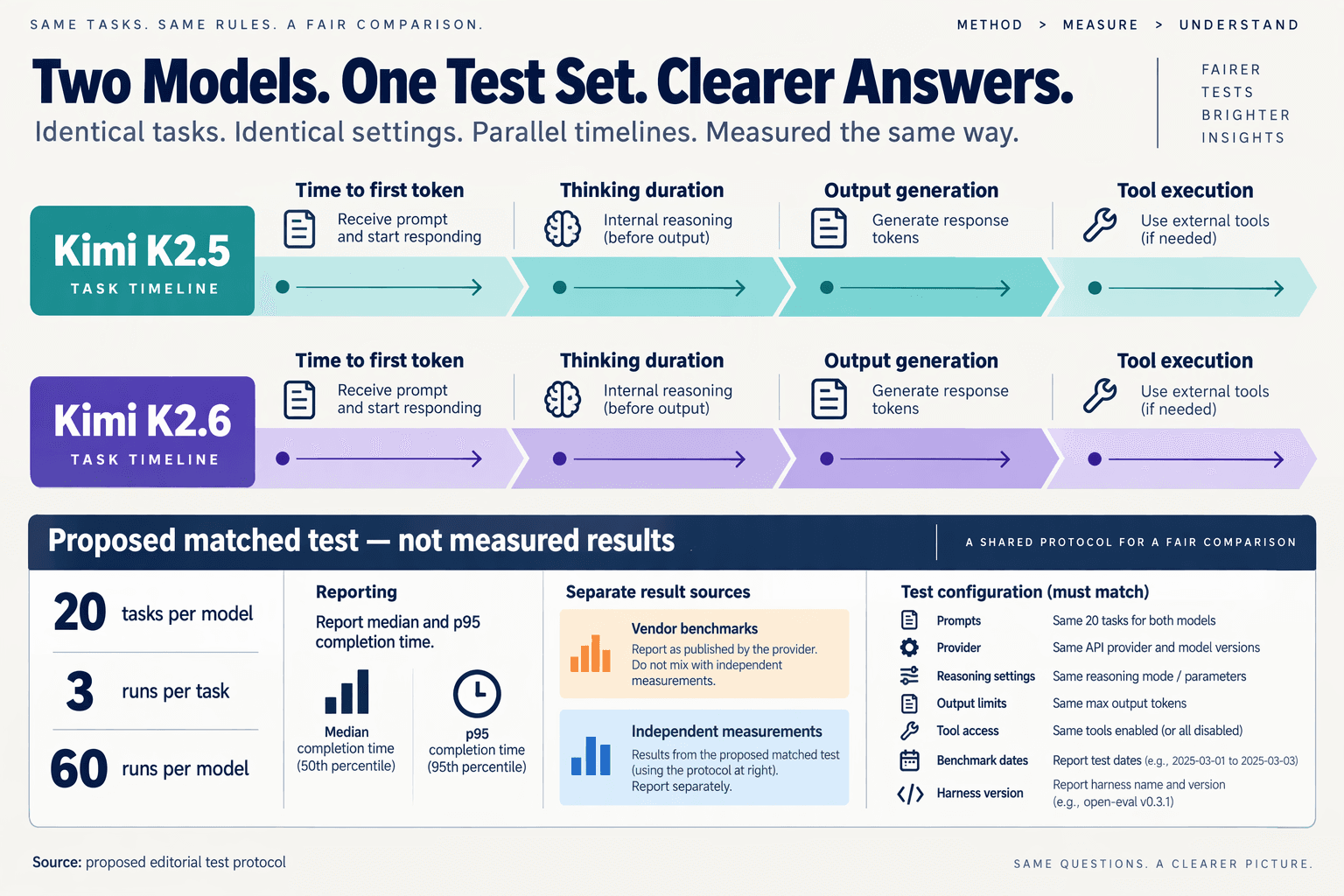
The supplied evidence does not establish that Kimi K2.6 thinks longer than Kimi K2.5—or that either model completes tasks faster. For coding and agent-workflow buyers, the deciding metric should be time to an accepted result, not simply how quickly text starts appearing.
What speed measurements are available for Kimi K2.6 vs K2.5?
As of November 24, 2026, the supplied listings from Kimi’s product page, Kimi’s Platform Changelog, and OpenCode’s comparison page contain no numerical results for the measurements below. “Not supplied” means the research does not establish the value—not that the model lacks the capability.
| Measurement | Kimi K2.5 | Kimi K2.6 | What buyers should record |
|---|---|---|---|
| Time to first token | Not supplied | Not supplied | Seconds until the first streamed token |
| Reasoning duration | Not supplied | Not supplied | Reported reasoning time, if exposed |
| Output throughput | Not supplied | Not supplied | Output tokens per second |
| Tool-call overhead | Not supplied | Not supplied | Time spent executing and awaiting tools |
| Repair attempts | Not supplied | Not supplied | Retries before acceptance |
| Accepted-task completion | Not supplied | Not supplied | Total seconds until requirements pass |
How should developers test which model finishes faster?
- Kimi K2.6: Kimi’s official product-page title emphasizes “Coding & Agent,” but the supplied listing provides no matched timing evidence as of November 2026. Treat that positioning as a reason to test repository edits and tool-driven workflows—not as proof of faster reasoning, fewer repairs, or lower latency.
- Kimi K2.5: Keep the existing model as the baseline rather than assuming the newer version wins. Use identical repository snapshots, prompts, tool permissions, and acceptance tests; otherwise, differences in available context or execution access can change completion time independently of the underlying model.
- “Fast” configuration: Record the exact model identifier, provider, reasoning setting, streaming configuration, and output limit for each run. The supplied November 2026 listings do not establish whether “fast” names a distinct endpoint or mode, so do not silently compare a speed-oriented configuration against an unrestricted reasoning configuration.
- Matched trials: A practical starting protocol is 20 representative tasks with 3 runs per model per task, producing 120 runs across both models. These are recommended test-design numbers, not published Kimi benchmarks; alternate model order and record concurrency, caching conditions, and failures alongside each timing.
- Coding acceptance: Require the same checks for both models: successful execution, passing tests, and compliance with the requested change. A response delivered in 10 seconds that needs another 40 seconds of repair takes 50 seconds overall; this is an illustrative calculation, not a measured Kimi result.
- Reporting: Publish median (p50) and tail (p95) accepted-task latency, acceptance rate, and retry count together. Keep unsuccessful runs visible rather than dropping them from the comparison; a model that returns quickly but regularly fails the task should not receive an unqualified “faster” label.
When would longer thinking justify an upgrade?
Longer reasoning is worthwhile when it reduces downstream tool calls, repair cycles, or human review enough to shorten successful completion. Until matched measurements demonstrate that trade-off, neither Kimi K2.6 nor Kimi K2.5 has a verified speed advantage in the supplied evidence.
What do K2.5 and K2.6 cost per successful task?
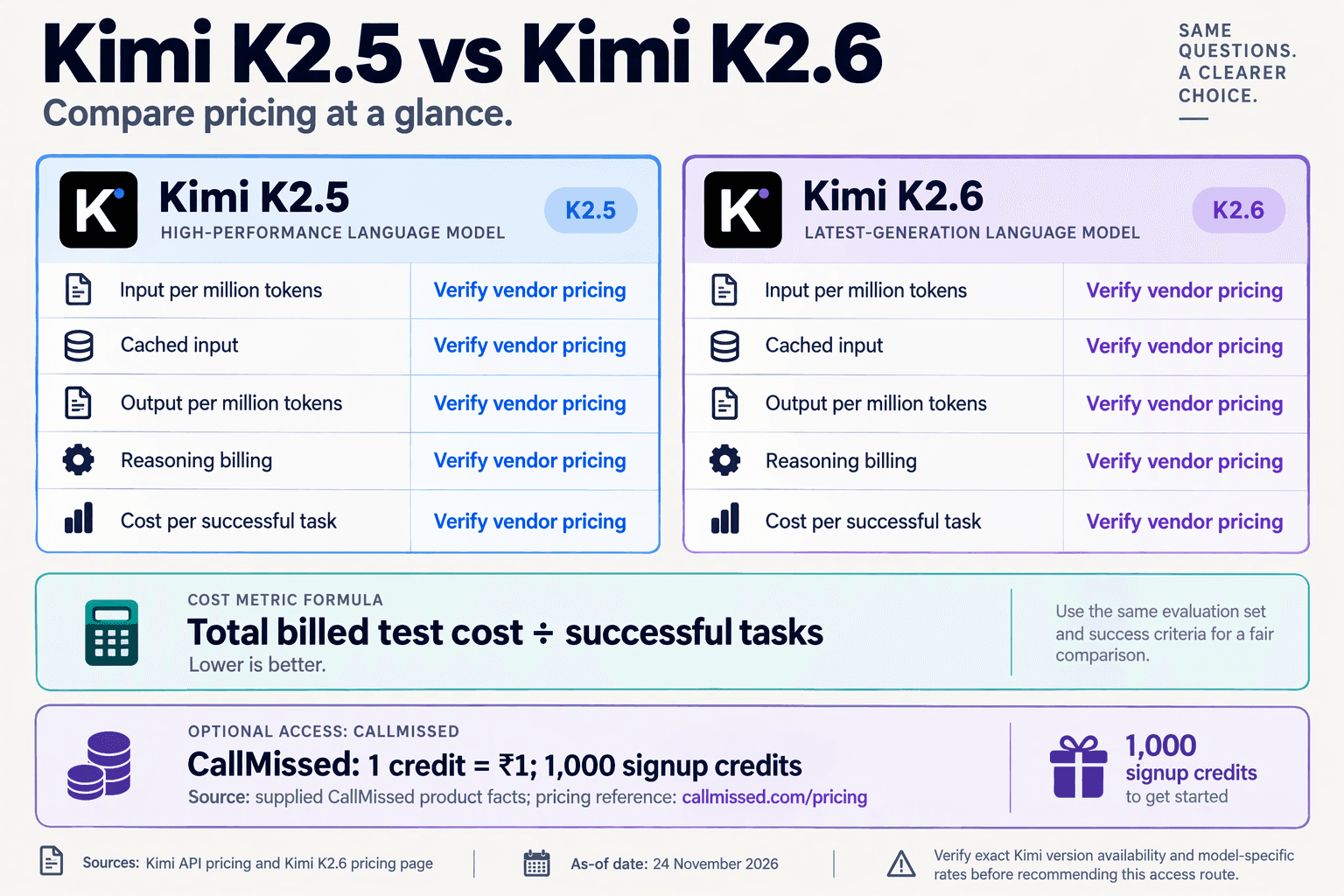
Kimi K2.5 vs Kimi K2.6 cost per successful task cannot be established from the supplied evidence as of November 24, 2026. The research identifies Kimi’s pricing pages but provides neither verified token rates nor matched task-success results; buyers need both before calculating an upgrade’s value.
How should buyers calculate cost per successful task?
- Calculation: Divide total evaluation spend by tasks that pass acceptance checks. Include spending on failed attempts, repair prompts, repeated context and chargeable tools—not just the final successful response. This measures the cost of obtaining usable work rather than generating an answer.
- Kimi K2.5: As of November 24, 2026, the supplied listing for Kimi Help Center’s “API pricing” does not expose K2.5 rates. Verify input, output and any cache-related charges against the vendor’s actual pricing table before estimating workload costs; missing evidence does not mean pricing is unpublished.
- Kimi K2.6: As of November 24, 2026, the supplied listing for Kimi’s “Kimi K2.6 Pricing” identifies a pricing resource but supplies no numerical rates. Check the exact model identifier and billing terms; do not treat a membership price as interchangeable with an API token rate.
Can a more expensive run still cost less per successful task?
Yes—if its improvement in task success offsets its additional spending. The following illustrative calculation, dated November 24, 2026, is not a Kimi benchmark or vendor price quote; scenarios A and B represent hypothetical evaluation outcomes.
| Evaluation metric | Scenario A | Scenario B |
|---|---|---|
| Tasks attempted | 100 | 100 |
| Tasks passing acceptance checks | 80 | 96 |
| Tasks failing acceptance checks | 20 | 4 |
| Success rate | 80% | 96% |
| Total evaluation spend | $10.00 | $12.00 |
| Cost per successful task | $0.125 | $0.125 |
- Worked example: In this illustrative calculation, scenario B spends 20% more than scenario A but also produces 20% more successful tasks, leaving cost per success unchanged. A higher invoice therefore does not automatically indicate worse value, just as a lower invoice does not establish better value.
- Break-even rule: At these hypothetical spending levels, scenario B needs 96 successes to match scenario A’s $0.125 cost per success. With only 90 successes, scenario B would cost approximately $0.133 per success—about 6.7% more, despite completing more tasks successfully.
- Coding evaluation: Use a fixed task set with explicit pass conditions: tests pass, required behavior works and prohibited changes are absent. Record model/provider identifiers, reasoning settings, token usage, repair attempts and total charges. Keep reviewer judgment consistent across K2.5 and K2.6.
- Buying decision: Compare cost per success and elapsed time per success together. For interactive coding, waiting time can outweigh small API savings; for unattended jobs, reliable completion may matter more. The supplied OpenCode comparison listing contains no matched results establishing either model as the cheaper successful-task option.
What are the practical pros and cons of each model?
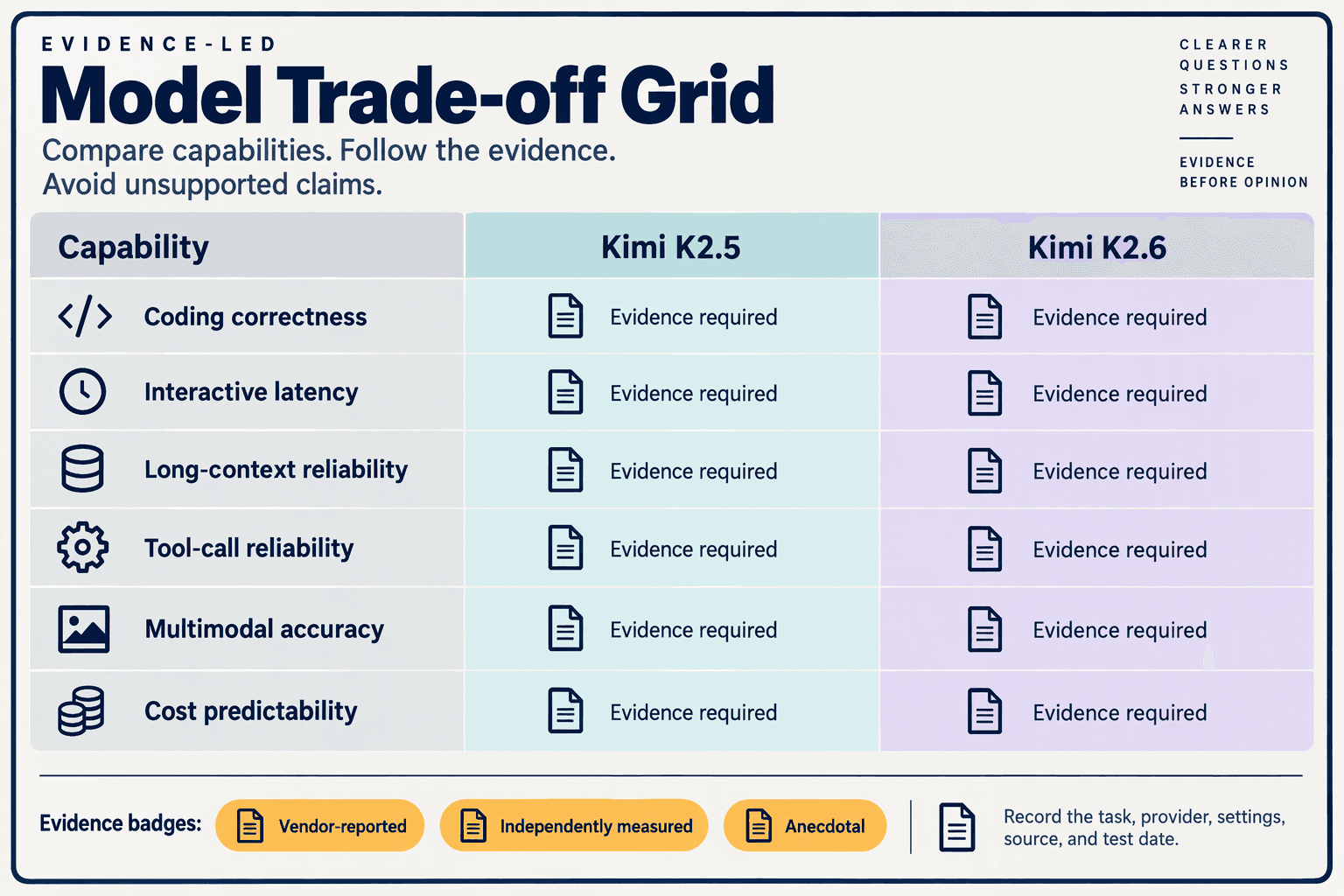
Kimi K2.6 is worth testing for coding and agent workflows, but the supplied evidence does not establish a practical speed or cost advantage over Kimi K2.5. For engineering leads and developer teams, the decision should turn on accepted results, integration effort, and workload-specific costs—not the version number.
- Kimi K2.6: Kimi’s product-page title emphasizes “Coding & Agent,” as reviewed for November 24, 2026; that positioning identifies a testing priority, not a verified performance improvement.
- Kimi K2.5: If your existing deployment meets its acceptance criteria, retaining it avoids an immediate migration; that is an operational advantage, not evidence of superior model quality.
- Neither model: Treat this comparison as insufficient for purchasing a complete phone, WhatsApp, or customer-support system; those requirements involve infrastructure beyond model selection.
Where does each model fit better in practice?
The table separates potential advantages from purchase-blocking unknowns. Its evidence status is dated November 24, 2026; missing details are unavailable in the supplied context, not necessarily unpublished by the vendor.
| Buyer concern | Kimi K2.5: practical fit | Kimi K2.6: practical fit | Constraint or source |
|---|---|---|---|
| Existing integration | Retain if your current workflow passes testing | Trial before replacing the production endpoint | Kimi’s Platform Changelog is listed, but compatibility details are not supplied |
| Coding work | Use as your baseline if already deployed | Candidate for repository-level evaluation | Kimi’s K2.6 product-page title emphasizes coding; no coding benchmark scores are supplied |
| Agent workflows | Measure current tool-call success | Test whether longer workflows need fewer repairs | Kimi advertises agent positioning; comparative tool-use results are unavailable |
| Interactive speed | Keep if measured responsiveness meets your target | Adopt only after matched latency testing | OpenCode’s comparison is listed; measured timings are not supplied |
| Budget control | Calculate your existing accepted-task cost | Require a verified token-price calculation before switching | Kimi’s pricing pages are listed, but prices are absent from the context |
| Input compatibility | Preserve inputs your deployment already handles | Verify every required input type before migration | Context limits, modalities, and language coverage are not established by the supplied listings |
How should buyers turn these trade-offs into a decision?
- Coding teams: Use a proposed 20-task pilot, not a vendor benchmark: include bug fixes, tests, refactors, and multi-file edits; apply identical acceptance checks and count human corrections separately.
- Agent builders: Make tool permissions and failure recovery part of the trial: an otherwise correct answer should fail acceptance if the agent takes an unauthorized action or cannot recover from a tool error.
- Budget owners: Compare cost per accepted task, including unsuccessful attempts and retries; verify rates against Kimi’s own API pricing page before approving spend, because this context supplies no usable price figures.
- Integration owners: As of November 2026, CallMissed’s verified fact sheet lists caller-chosen fallback models, usage logs, and request logs; those capabilities can support evaluation, but availability of either specific Kimi version still needs confirmation.
- Final decision: Keep K2.5 when the tested benefit does not justify migration; adopt K2.6 when your pilot demonstrates an improvement that matters to your workload. Neither recommendation requires claiming a universal winner.
Which should developers, agencies, and business teams choose?
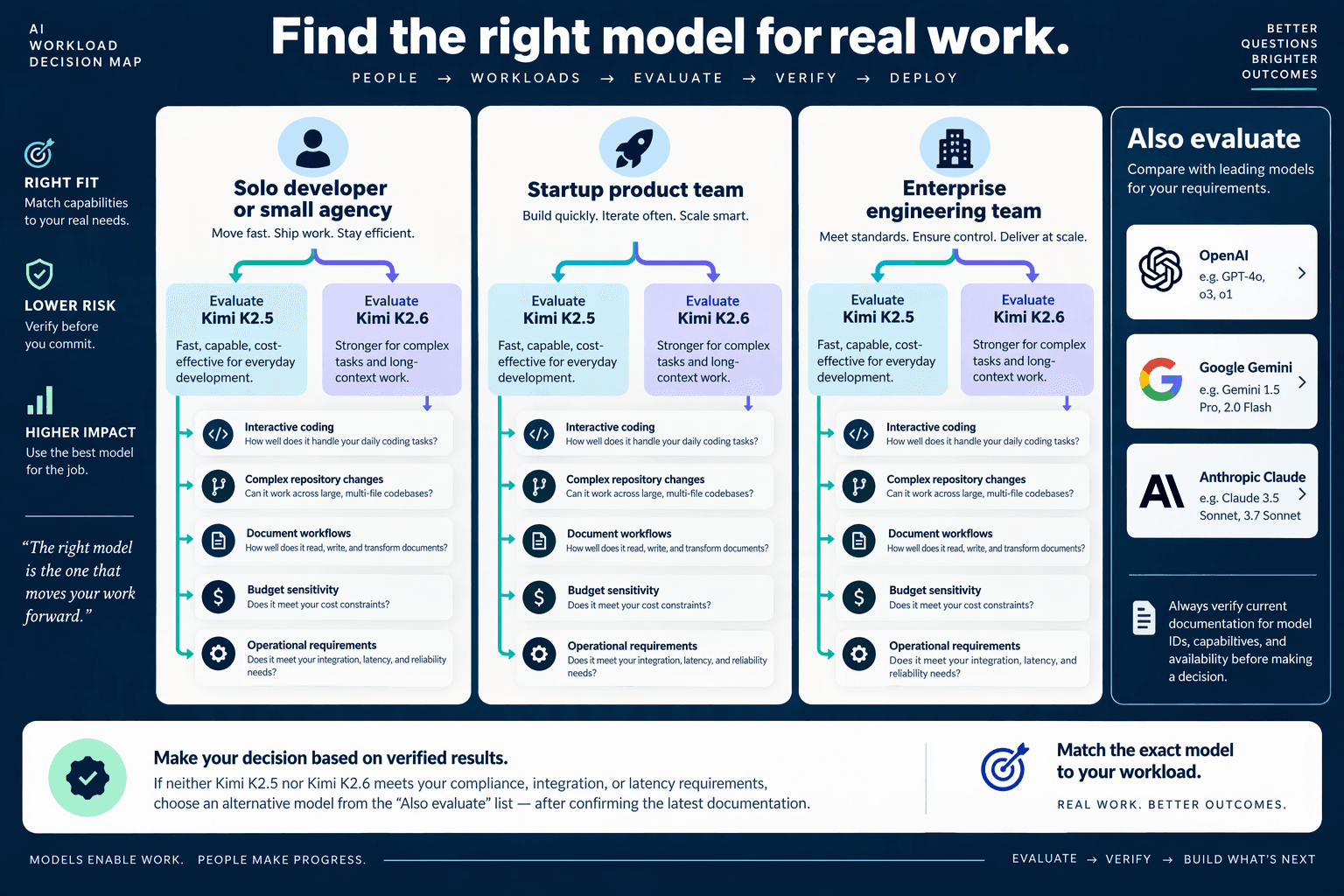
Developers should trial Kimi K2.6 for coding and agent workloads; existing Kimi K2.5 users should upgrade only after testing their own workflows. As of November 24, 2026, the supplied evidence supports neither a verified speed winner nor an unconditional upgrade recommendation.
Should developers and agencies switch to Kimi K2.6?
- Developers evaluating Kimi K2.6: Kimi’s official product-page title highlights “Coding & Agent,” making repository changes and tool-driven tasks relevant evaluation targets. As of November 2026, however, the supplied listing contains no benchmark scores proving better coding accuracy or fewer repair cycles than Kimi K2.5.
- Developers already using Kimi K2.5: Keep the existing deployment while evaluating K2.6 separately if K2.5 meets your acceptance criteria. For example, compare whether both models fix the same failing test without introducing another failure; a newer model name alone does not justify changing a working production integration.
- Agencies serving multiple clients: Choose by client workload rather than imposing one model across every account. Test coding, document extraction, and customer-response drafting separately, with explicit acceptance criteria for each. These are proposed evaluation categories—not verified modality claims; supported inputs, context limits, and availability still require vendor confirmation.
- Teams interpreting “fast”: Treat “Kimi K2.6 thinks longer than K2.5” as an unverified claim in this evidence set, not a purchasing fact. OpenCode’s comparison listing identifies the two models but supplies no matched timing results here. Ask providers to identify the exact model, endpoint, and reasoning configuration before comparing performance.
What should business teams verify before buying?
- Small-business and enterprise buyers: A model API is not, by itself, a complete customer-communication system. Before selecting either Kimi version, confirm channel support, human escalation, CRM integration, and deployment responsibilities. Neither the supplied Kimi product listing nor the pricing listings establish an implementation timeline, so do not budget around an assumed same-day rollout.
- Indian-language communication teams: As of November 2026, CallMissed’s verified fact sheet lists speech recognition in 22 Indian languages plus English, including Hinglish, and natural text-to-speech in 10 Indian languages plus English. These are platform capabilities—not evidence that either Kimi version independently supports those speech languages.
- WhatsApp and phone-service buyers: As of November 2026, CallMissed’s verified fact sheet lists official Meta Cloud API integration, permission-based business-initiated WhatsApp calls, and phone connectivity through rented numbers or an existing carrier or SIP trunk. Those operational requirements should influence platform selection separately from the underlying Kimi model decision.
- Procurement teams comparing alternatives: Evaluate supported OpenAI, Google, or other models alongside Kimi using the same acceptance tests; this context cannot establish a winner. As of November 2026, Kimi’s official API-pricing and K2.6-pricing pages are the named verification sources, but their supplied listings contain no usable prices. Request current rates and limits before approving spend.
How can you try both today, and what could block deployment?
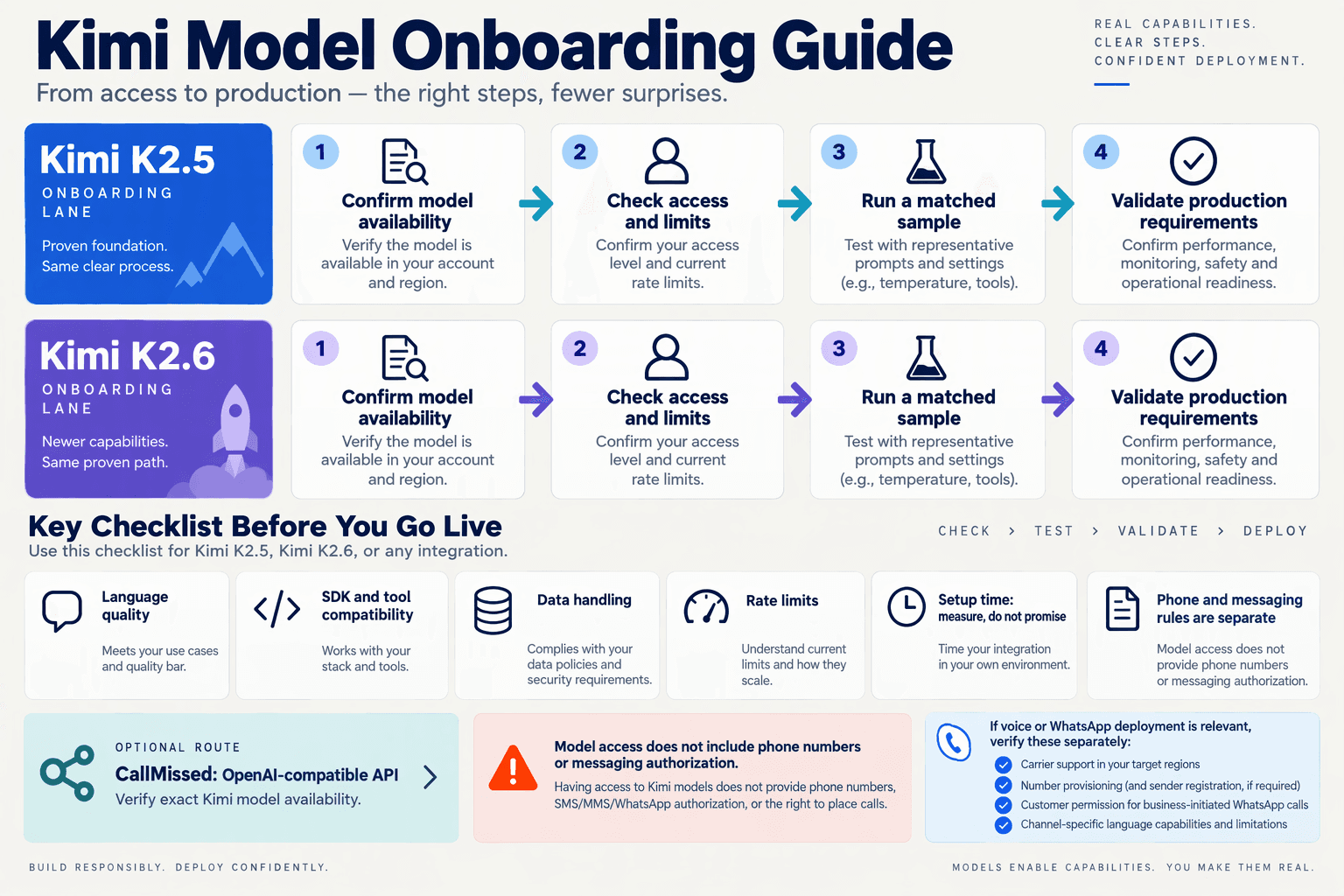
To try Kimi K2.5 vs Kimi K2.6 today, first confirm that your provider exposes both exact model versions; the supplied listings do not establish current access. Deployment depends on endpoint compatibility, account limits, data requirements, and workflow support—not just the model name.
What should buyers check before testing or deploying either model?
- Official access: As of November 24, 2026, the supplied research identifies Kimi’s Platform Changelog, Kimi K2.6 product page, and API Help Center as verification sources. Check available model identifiers, account eligibility, and any preview restrictions before configuring an integration; a product-page listing alone does not establish that both versions are callable from your account.
- “Fast” configuration: For this comparison, the supplied OpenCode listing names Kimi K2.6 and Kimi K2.5 but supplies no underlying serving specifications. Ask your provider whether “fast” means a distinct model identifier, reasoning setting, or hosting configuration. Record that answer alongside the endpoint so a configuration change does not masquerade as a model upgrade.
- Trial design: Engineering leads and small-to-enterprise development teams should use a proposed 10-task pilot, covering their own bug fixes, repository questions, and tool-driven workflows. Keep prompts, tool permissions, and acceptance tests consistent; record successful completion and billed usage. This is a recommended evaluation procedure, not a published Kimi benchmark or a guaranteed setup time.
- Pricing and capacity: As of November 24, 2026, Kimi’s vendor-owned Kimi K2.6 Pricing page and API pricing Help Center page are listed, but their rates are absent from the supplied context. Verify input, output, caching, and applicable reasoning charges, plus account quotas. Missing evidence here means unverified pricing, not necessarily unpublished pricing.
- Gateway option: According to the CallMissed verified fact sheet, as of November 2026, CallMissed’s developer API offers 158 models, including models from Moonshot, with OpenAI-compatible and Anthropic-compatible endpoints and caller-chosen fallback models. That makes the gateway a relevant integration route to investigate, but the fact sheet does not confirm Kimi K2.5 or Kimi K2.6 availability.
- Application compatibility: Before deployment, test the exact version’s structured responses, streaming, tool calls, and required input types against your application. The supplied Kimi and OpenCode listings do not establish these capabilities or their limits. A successful chat response is insufficient evidence that a repository-editing agent or production automation will work reliably.
- Languages and data: Test actual customer languages, code-mixed inputs, and domain terminology rather than assuming multilingual suitability. The supplied Kimi listings provide no verified language coverage, retention policy, residency commitment, or deployment resource requirements. Buyers with contractual data-location requirements or fixed infrastructure budgets should resolve those gaps before sending production information.
- Phone and messaging workflows: A model trial does not validate a communications deployment. Separately verify carrier connectivity, phone-number provisioning, messaging permissions, human escalation, and CRM integration. If these are purchase-critical—or you need guaranteed latency—the supplied Kimi evidence is insufficient for approval; request documented terms and run an end-to-end pilot before committing.
Frequently Asked Questions
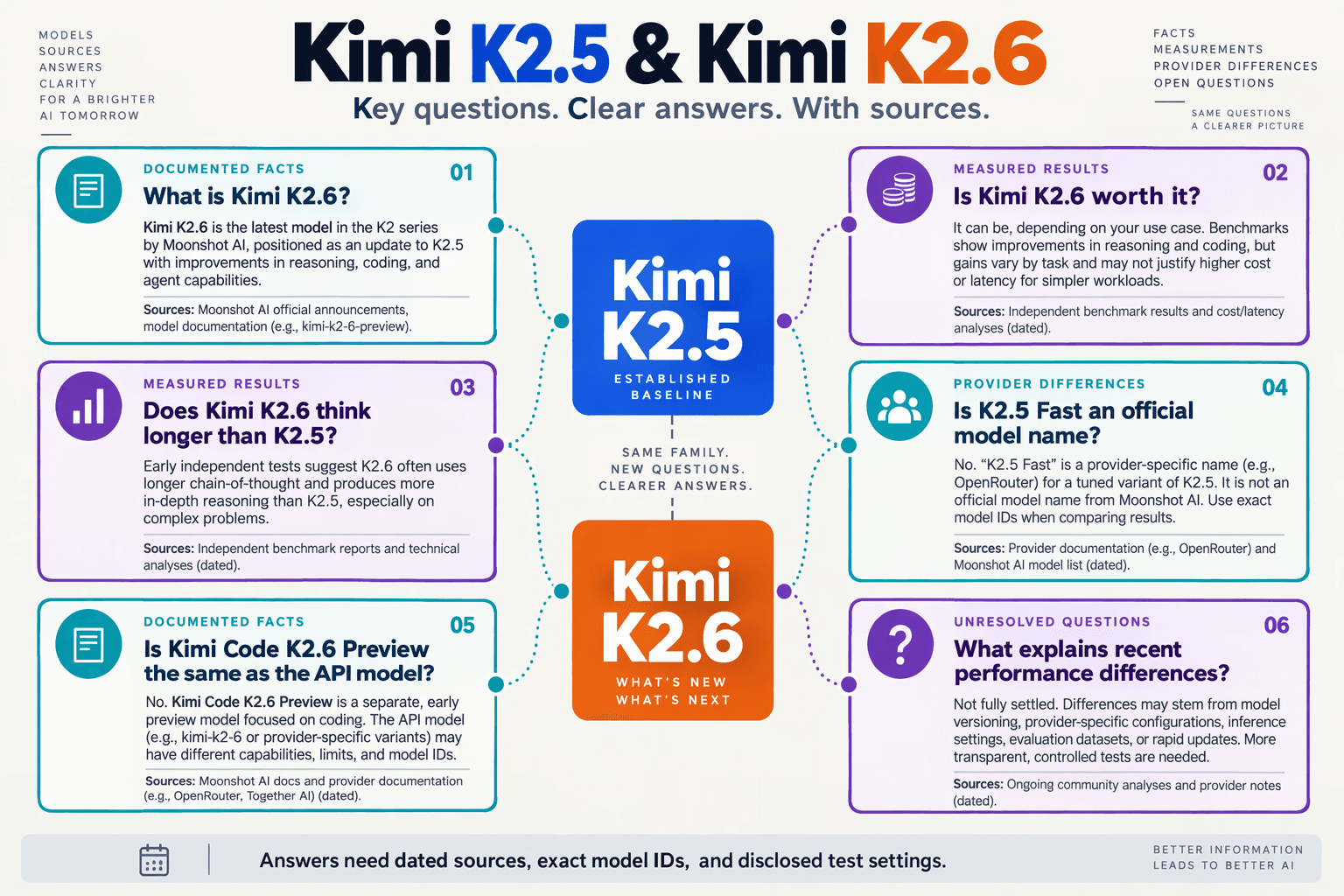
Kimi K2.6 is worth testing—not automatically upgrading to—because the supplied evidence does not establish a speed or value advantage over K2.5. For coding and agent-workflow buyers, “fast” should mean time to an accepted result, not simply an earlier first token.
- Q: Kimi K2.5 vs Kimi K2.6: what’s new for coding and agents?
A: As of November 24, 2026, Kimi’s official K2.6 product-page title emphasizes “Coding & Agent,” but the supplied listing does not document specific improvements over K2.5. Kimi’s Platform Changelog is the appropriate source to check release details, model identifiers, and availability before changing an integration. Treat the positioning as a reason to investigate, not proof of better repository editing, tool use, or autonomous execution.
- Q: Kimi K2.5 vs Kimi K2.6: what does “fast” actually mean?
A: “Fast” can describe first-token latency, generation speed, reasoning duration, or total completion time; these measurements answer different purchasing questions. As of November 24, 2026, the supplied OpenCode comparison listing contains no matched measurements establishing which model wins on any of them. Ask whether “fast” names a documented mode or merely describes a provider’s serving configuration, and record the exact endpoint and settings when testing.
- Q: Is Kimi K2.6 worth it compared with K2.5 for a development team?
A: For engineering leads and development teams evaluating coding or agent workflows, K2.6 is worth adopting only if local tests show better accepted outcomes relative to elapsed time and spend. As of November 24, 2026, neither Kimi’s supplied product listing nor OpenCode’s comparison listing provides enough results to calculate that trade-off. Keep K2.5 as the baseline, and avoid making this comparison the sole purchase criterion when contractual response-time guarantees are essential.
- Q: Does Kimi K2.6 think longer than K2.5?
A: The supplied evidence does not verify longer thinking time, so that phrase should remain a testable claim rather than a specification. As of November 24, 2026, the provided Kimi and OpenCode listings include no controlled reasoning-duration results. Run equivalent tasks with comparable settings and count repair attempts: longer reasoning could reduce retries, but that possibility is not a demonstrated K2.6 advantage.
- Q: What are Kimi K2.6’s API price, context window, and supported modalities?
A: As of November 24, 2026, the supplied context identifies Kimi’s K2.6 Pricing page and API pricing Help Center, but contains no actual rates, context-window limits, or modality specifications. Those details are unverified here—not necessarily unpublished—and should be checked against the exact model endpoint. Confirm input, output, and any cached-token charges before estimating workload costs; a product name alone cannot establish compatibility or budget.
- Q: How can I try both Kimi models without committing to a migration?
A: As of November 2026, verify both model identifiers and access requirements through Kimi’s platform documentation, then run a small evaluation using representative tasks and explicit acceptance criteria. CallMissed’s verified fact sheet lists Moonshot among its catalogue makers and supports OpenAI-compatible endpoints, but does not confirm either specific Kimi version. Check availability first, then retain prompts, settings, outputs, timings, and billed usage so the comparison remains reproducible.
Conclusion
Kimi K2.5 vs Kimi K2.6 has no established speed winner in the supplied evidence as of November 24, 2026. Kimi’s K2.6 product-page title emphasizes coding and agent capabilities, but the available listings do not document specific improvements or provide matched measurements showing faster responses or task completion.
For developers, engineering leads, and businesses evaluating coding or agent workflows, the practical conclusion is to test the upgrade rather than assume it. The supplied research identifies useful verification sources—including Kimi’s product pages, API pricing page, platform changelog, and OpenCode’s comparison—but their listings alone cannot settle the purchase decision.
- Separate the four meanings of “faster.” Measure time to first token, reasoning duration, output speed, and total task completion time independently. An earlier first token does not necessarily mean an earlier usable result. Likewise, longer reasoning is not automatically a disadvantage if a model completes the task with fewer repair cycles; neither outcome is established for this comparison.
- Treat “what’s new” as a documentation question. Kimi’s K2.6 product-page title highlights coding and agents, but the supplied context does not establish launch dates, context-window limits, modalities, token prices, or quantified performance gains. Verify those details against Kimi’s official product documentation, pricing page, and platform changelog before treating an upgrade claim as a buying criterion.
- Compare equivalent workloads, not isolated impressions. Use the same prompts, comparable reasoning settings, equivalent output requirements, and an identified provider. For coding evaluations, record correctness, retries, and tool calls alongside elapsed time. Otherwise, a faster-looking result could reflect serving configuration or a less demanding answer rather than a genuine improvement in the model.
- Keep model selection separate from deployment requirements. Guaranteed response times, language support, and production phone or messaging workflows require their own verification. As of November 2026, CallMissed’s verified fact sheet lists OpenAI-compatible and Anthropic-compatible API endpoints, allowing supported SDK integrations to switch base URLs. Readers can explore CallMissed as an integration option, while confirming availability of either specific Kimi version separately.
What should buyers watch for next?
Watch for documented model changes and reproducible, matched latency tests, especially evaluations reporting both answer quality and end-to-end completion time. Those results would help distinguish a genuinely more efficient workflow from a model that merely starts responding sooner or produces more output per second.
Until that evidence is available, neither the newer version number nor an anecdotal speed impression is a sufficient reason to switch. Run both models against your acceptance criteria: which delivers a correct, usable result sooner—not merely the first token?
Related Reading
- Saaras V3 vs Whisper: Which Fits Indic Languages Best?
- Goodcall pricing vs CallMissed: Which Fits You? (2026)
- Fable 5.2 vs Opus 5.5: Which Claude Should Developers Use?