Indian Language Voice AI Agents: Affordable Picks 2026


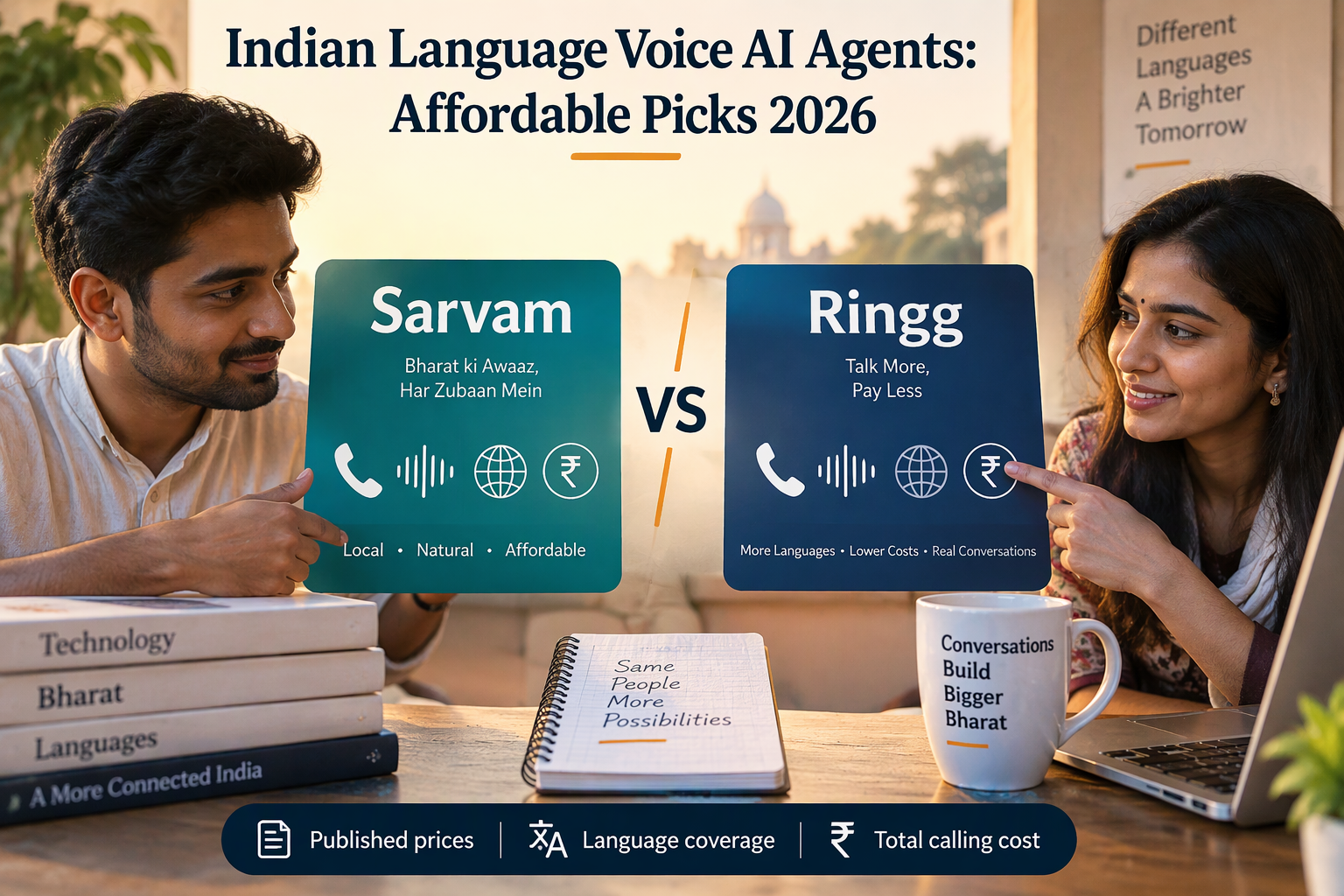
Compare Indian Language Voice AI Agents by published pricing, phone costs and language coverage to shortlist an affordable platform for India.
Indian Language Voice AI Agents: Affordable Picks 2026
A ₹3.50-per-minute voice agent can look cheaper than a ₹4 alternative—but are both quotes paying for the same things? Indian Language Voice AI Agents are becoming more accessible in 2026, yet choosing an affordable platform still means checking language coverage, model charges, phone carriage and billing minimums—not just the headline rate.
The November 2026 pricing references supplied for this comparison show why the decision deserves attention. Sarvam’s API documentation lists voice agents at ₹3.50 per minute on pay-as-you-go and ₹3 per minute on Business, with models included and support for 11 Indian languages plus English. Ringg’s pricing page lists ₹6 per connected minute in the same November 2026 research context. Those figures give buyers concrete starting points, but they do not establish identical language capabilities, deployment requirements or total calling costs.
For Indian businesses, affordability also depends on what happens during the conversation. Can a caller switch between Hindi and English? Does the platform merely recognise a regional language, or can its voice respond naturally in that language? A low advertised rate is less useful if the system cannot handle the calls your customers actually make.
As of November 2026, CallMissed offers a ₹4-per-minute Standard voice-agent plan covering speech recognition, the language model and voice, with phone carriage billed separately and a 30-second minimum; its platform supports speech recognition in 22 Indian languages plus English, including Hinglish, and natural text-to-speech in 10 Indian languages plus English, according to its verified product fact sheet.
This comparison approaches the options through buyer needs rather than a blanket “best platform” ranking:
- For budget-first teams: Examine Sarvam’s published model-inclusive rates, then check telephony charges and whether the required languages are supported.
- For connected-minute budgeting: Use Ringg’s published rate as a starting point, while confirming exactly what the package includes.
- For teams choosing their own architecture: Smallest.ai’s supplied pricing page distinguishes cascading systems—hosting, speech recognition, language model, speech synthesis and telephony—from speech-to-speech systems, making component-level costing important.
You will learn who each option fits, what the published prices cover, and which additional costs need confirmation before committing. The comparison will also separate speech recognition from voice output: “Indian language support” should never be treated as a single, interchangeable capability.
The practical goal is straightforward: shortlist an affordable AI voice agent platform with Indian language support that matches your customers’ languages and your operating model. Compare equivalent workloads, test representative conversations, and calculate the total connected-call cost before treating the lowest advertised number as the lowest bill.
Sarvam advertises PAYG voice agents at ₹3.50/min, making it the lowest starting rate among the supplied primary-source snippets, subject to telephony and plan checks (Sarvam API Docs). CallMissed offers bundled AI voice from ₹4/min with separate phone carriage and a no-code builder, making it another affordable shortlist option rather than an all-in price winner (CallMissed verified product fact sheet).
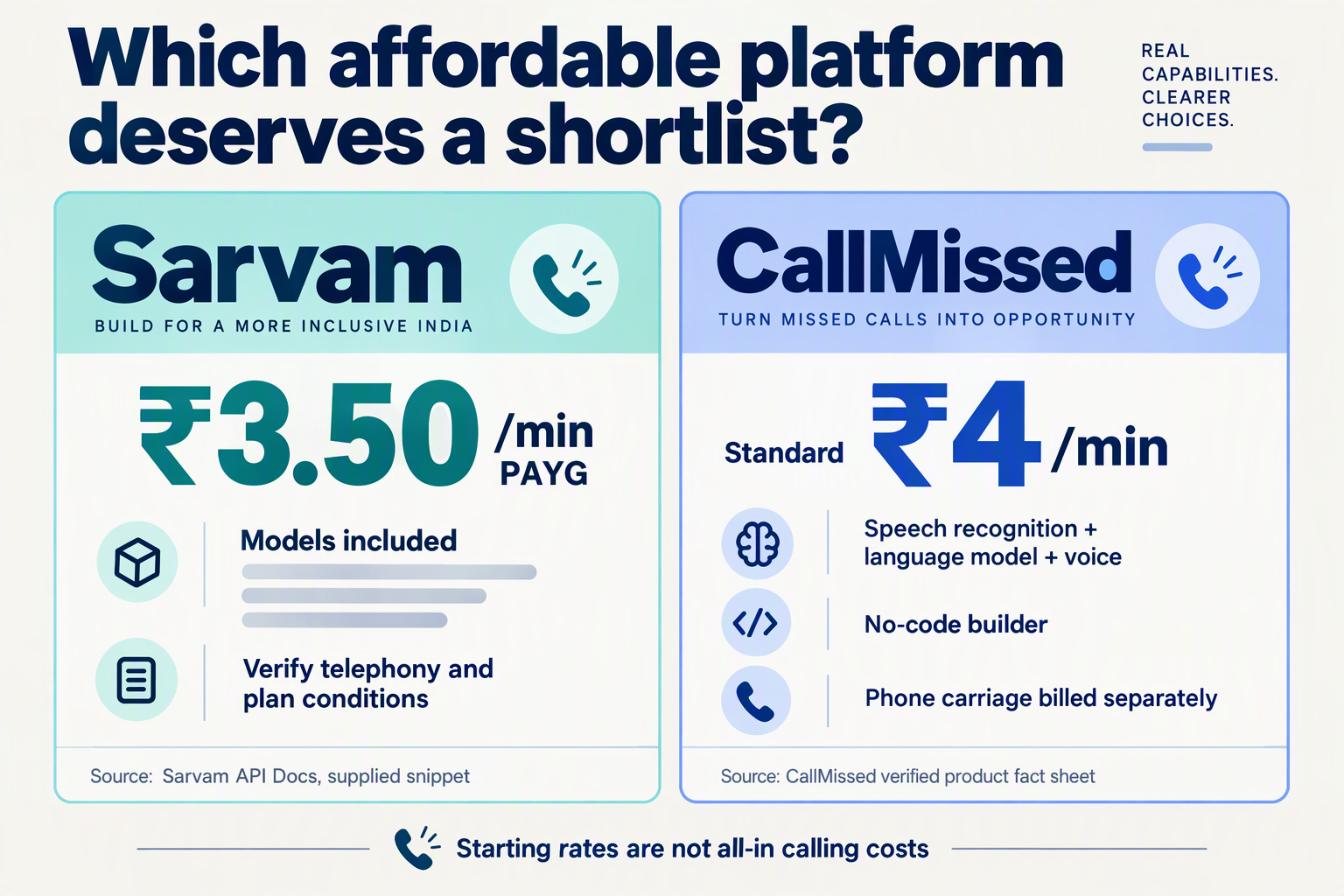
Sarvam has the lowest advertised PAYG starting rate among the supplied primary-source snippets, but that does not establish the lowest total calling cost. For an affordable AI voice agent platform with Indian language support, compare equivalent call workloads—not headline rates alone.
Which published rates belong on your shortlist?
- Sarvam PAYG: Sarvam API Docs lists ₹3.50/minute, models included, with support for 11 Indian languages plus English, in the supplied November 2026 research. At that advertised rate, 1,000 billable minutes cost ₹3,500 before any additional charges. This is a sensible starting shortlist for price-sensitive teams, provided they verify phone-number costs, telephony treatment, billing increments and the languages required for their actual conversations.
- Sarvam Business: Sarvam API Docs lists ₹3/minute on Business and custom Enterprise pricing from 200,000 minutes/month, in the November 2026 context. At the Business usage rate, 1,000 minutes would equal ₹3,000—but that arithmetic is not a complete plan quote. Confirm subscription charges, eligibility and commitments before treating the ₹3 rate as available to your workload; it should not be presented as the PAYG entry price.
- CallMissed: As of November 2026, CallMissed’s verified product fact sheet lists Standard at ₹4/minute, including speech recognition, the language model and voice, with phone carriage separate. Its no-code builder supports prompts, voices, languages, knowledge bases and tools. For 1,000 billable minutes, the bundled AI charge is ₹4,000: ₹500 more than Sarvam’s PAYG model-inclusive quote, before comparing telephony and billing rules. This fits teams that value a configurable no-code deployment alongside a clear bundled AI rate.
- Ringg: Ringg’s pricing page advertises ₹6/connected minute in the supplied November 2026 research, equivalent to ₹6,000 for 1,000 connected minutes at that rate. “Connected minute” is a useful budgeting denominator, but the supplied primary-source excerpt does not establish every included component. Request an itemised quote rather than assuming its ₹6 figure covers exactly the same services as another platform’s AI-only price.
What could change the affordability ranking?
- Short-call billing: As of November 2026, CallMissed applies a 30-second minimum per call, while calls that never connect cost nothing, according to its verified product fact sheet. A connected 10-second Standard call therefore incurs ₹2 in bundled AI charges, before phone carriage. Across 100 such calls, that becomes ₹200—not the approximately ₹66.67 suggested by multiplying actual conversation seconds by ₹4/minute. Check equivalent minimums for every shortlisted provider.
- Architecture costs: Smallest.ai’s supplied November 2026 pricing excerpt says pricing depends on “models selected” and distinguishes cascading systems—hosting, STT, LLM, TTS and telephony—from speech-to-speech systems—hosting, S2S and telephony. For teams selecting individual components, compare the complete stack rather than interpreting one component’s rate as the finished agent cost.
- Buying decision: Request a quote for 1,000 connected minutes plus a separate short-call scenario, using identical languages and call destinations. Require separate lines for AI, carriage, numbers, minimums and plan fees; then test regional-language and code-mixed conversations before choosing the lowest qualifying total.
Which platforms support Indian languages and the calling setup you need?
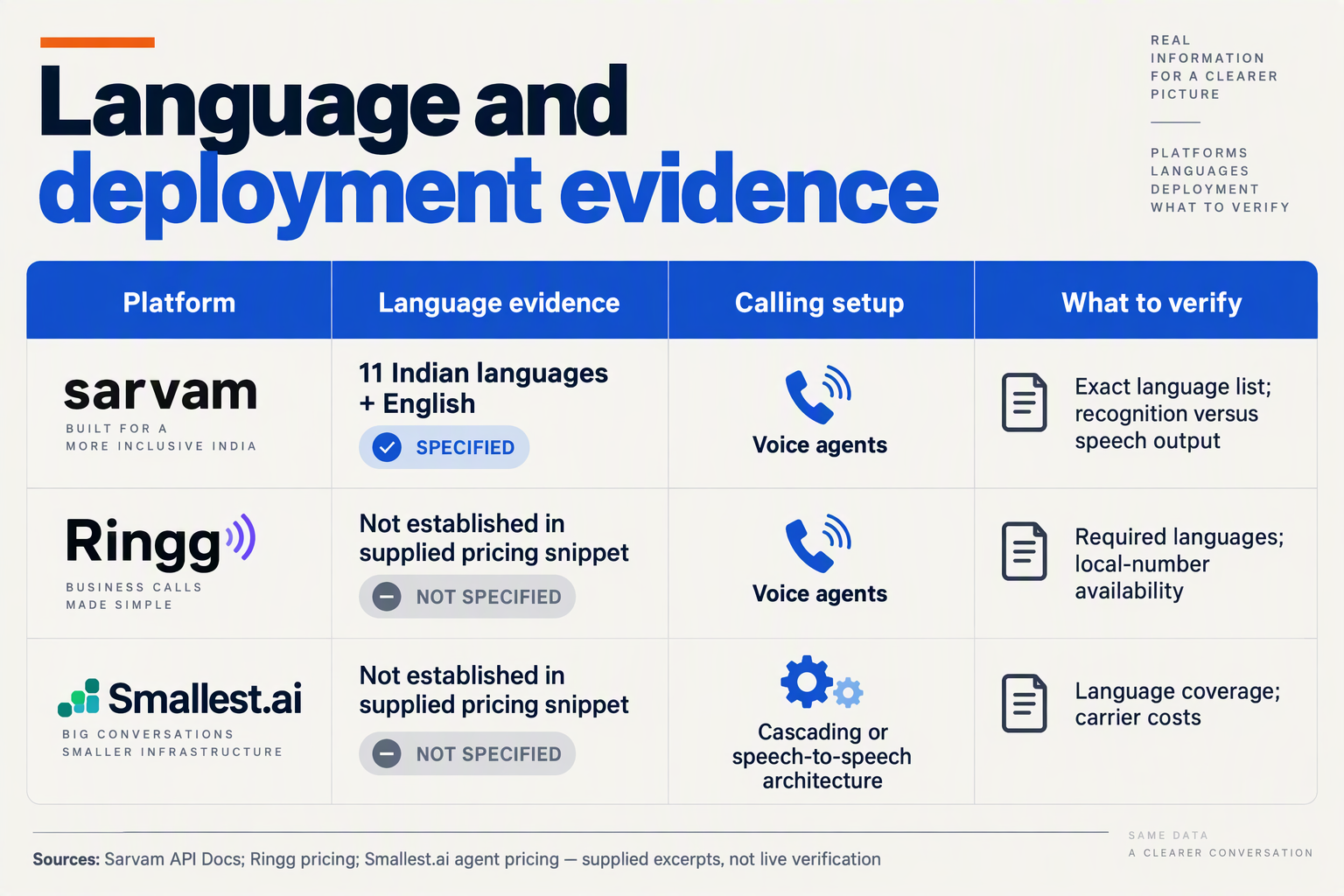
CallMissed supports rented phone numbers, existing carriers and WhatsApp Business Calling; Tabbly explicitly advertises +91 numbers. For the other platforms, the supplied November 2026 sources leave some language or calling details unresolved—those gaps need confirmation before purchase.
- Language coverage: Compare speech recognition, voice output and code-switching separately; a language count alone does not establish that all three work for your callers.
- Calling setup: Shortlist by the channel you actually need: Indian phone numbers, an existing SIP trunk, browser conversations or WhatsApp calls—not simply the advertised minute rate.
Which platforms match your language and telephony requirements?
The table reflects the supplied research as of November 2026. “Not specified” means the provided excerpt does not establish the capability; it does not mean the platform lacks it.
| Platform | Indian-language evidence | Calling setup evidence | Price and source |
|---|---|---|---|
| CallMissed | Recognition: 22 Indian languages + English, including Hinglish; natural voice output: 10 + English | Rented numbers; Twilio, Plivo or any SIP trunk; web widget; WhatsApp Business Calling | ₹4/min Standard, carriage extra; verified CallMissed fact sheet |
| Sarvam | 11 Indian languages + English; excerpt does not separate recognition from synthesis | Documentation covers telephony and phone numbers; exact carrier arrangements need checking | ₹3.50/min PAYG; ₹3/min Business, models included; Sarvam API Docs |
| Ringg | Language list not specified in supplied pricing excerpt | Pricing page lists voice, WhatsApp and browser products; confirm whether WhatsApp means messaging, calling or both | ₹6/connected minute; Ringg pricing page |
| Smallest.ai | Language list not specified in supplied pricing excerpt | Cascading and speech-to-speech architectures; telephony appears as a cost component | Model-dependent pricing; Smallest.ai agent pricing page |
| Tabbly | Hindi and regional languages; exact count not specified | +91 DIDs explicitly advertised for India-first calling | ₹6.80/min PAYG; ₹5.10 from 5,000 minutes; Tabbly India page |
What should you verify before choosing a platform?
- Existing-carrier teams: As of November 2026, CallMissed’s verified fact sheet lists Twilio, Plivo and any SIP trunk support. Ask how your current number will route calls, who bills carriage and whether inbound and outbound configurations require separate setup.
- India-number buyers: Tabbly’s India page advertises +91 DIDs in the November 2026 research. Confirm number availability, rental charges and onboarding requirements; the supplied excerpt does not establish that these costs are included in its per-minute price.
- Architecture-focused developers: Smallest.ai’s November 2026 pricing excerpt distinguishes hosting + STT + LLM + TTS + telephony from hosting + speech-to-speech + telephony. Request a quote for one named configuration so model substitutions do not make your comparison misleading.
- Regional-language buyers: Test the same scenarios on every shortlist: a Hindi-English switch, a regional-language address and a noisy caller correcting an account detail. Record recognition errors and spoken-response quality separately; none of the supplied sources provides comparable accuracy benchmarks.
Decision rule: Choose the platform that demonstrates your required language pair on your required calling channel, then compare equivalent connected-call costs. Published coverage is a starting point—not a substitute for a representative call test.
What will published rates actually cost after telephony and billing rules?
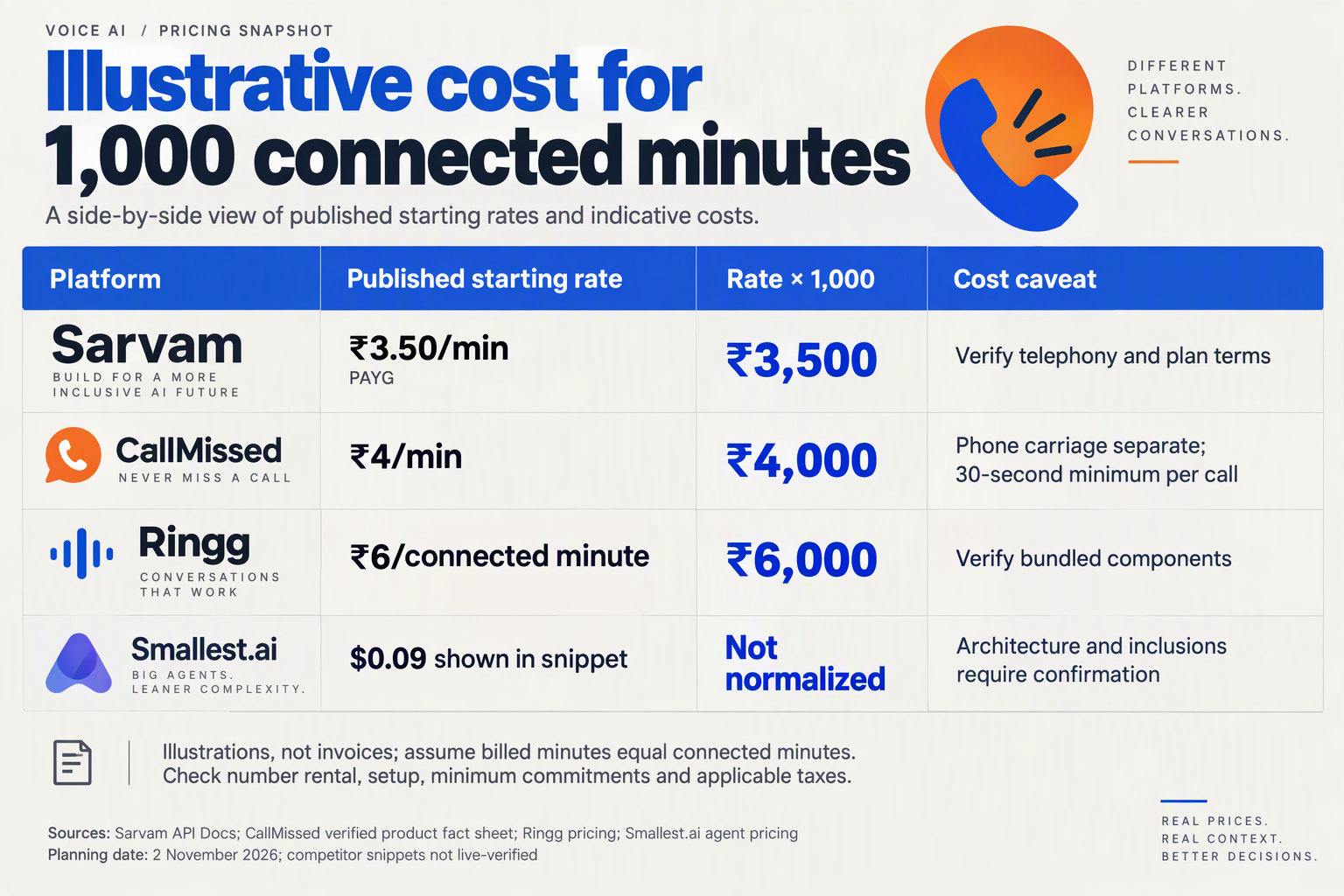
Published voice-agent rates are not necessarily the final calling cost: compare AI charges, telephony, number rental and billing minimums separately. The November 2026 comparison below uses 1,000 billable minutes, not 1,000 attempted-call minutes.
- Budget baseline: Calculate
AI usage + phone carriage + number rental + applicable fees and taxes; do not assume every provider includes the same components. - Comparable workload: Request quotes for the same call destinations, language mix and connected-call durations before ranking an affordable AI voice agent platform with Indian language support.
What does 1,000 billable minutes cost in November 2026?
The figures below are AI-rate subtotals, not guaranteed invoice totals. Prices and product details reflect the supplied November 2026 research and verified product facts.
| Platform / plan | Published AI rate | 1,000-minute subtotal | Billing caveat |
|---|---|---|---|
| Sarvam PAYG | ₹3.50/min | ₹3,500 | Models included; confirm telephony and number charges |
| Sarvam Business | ₹3/min | ₹3,000 | Confirm plan commitments and telephony charges |
| Ringg | ₹6/connected min | ₹6,000 | Confirm carriage inclusion and rounding |
| CallMissed Standard | ₹4/min | ₹4,000 | Carriage extra; 30-second call minimum |
| CallMissed Best latency | ₹6/min; ₹8/min from November 30 | ₹6,000; then ₹8,000 | New rate applies to calls starting November 30 onward |
| Smallest.ai | Model-dependent | Quote required | Architecture determines chargeable components |
Which billing rules can change the final invoice?
- Sarvam: Sarvam API Docs lists model-inclusive rates of ₹3.50/min PAYG and ₹3/min Business in the supplied November 2026 context. The ₹500 difference across 1,000 billable minutes is useful for budgeting, but it does not establish the Business plan’s total cost without checking commitments, phone numbers and carriage.
- Ringg: Ringg’s pricing page lists ₹6 per connected minute in November 2026. GrowEasy’s supplied comparison says the phone line is included, but the available primary-source excerpt does not establish the full bundle; ask Ringg to confirm destinations, number rental and billing increments before treating ₹6,000 as an all-in quote.
- CallMissed: Its verified November 2026 fact sheet states that flat plans include speech recognition, the language model and voice, but exclude phone carriage. A connected 10-second Standard call incurs the 30-second minimum: ₹2 for AI, plus carriage; a call that never connects costs nothing. Custom stacks instead charge components by the second, plus a separate ₹1/min platform fee with a 30-second minimum; flat plans do not pay that fee.
- Smallest.ai: Its November 2026 supplied pricing page separates cascading architecture—hosting, STT, LLM, TTS and telephony—from speech-to-speech architecture—hosting, S2S and telephony. The excerpt’s “$0.09” lacks a clear billing unit, so converting it into a rupee-per-minute comparison would create false precision.
What should buyers request before choosing?
Ask each shortlisted provider for a sample invoice covering short connected calls, unanswered attempts, number rental and carrier charges. Testing identical call-duration distributions matters more than comparing headline rates: a minimum charge can materially change the effective cost of brief conversations.
What are the practical advantages and trade-offs of each alternative?
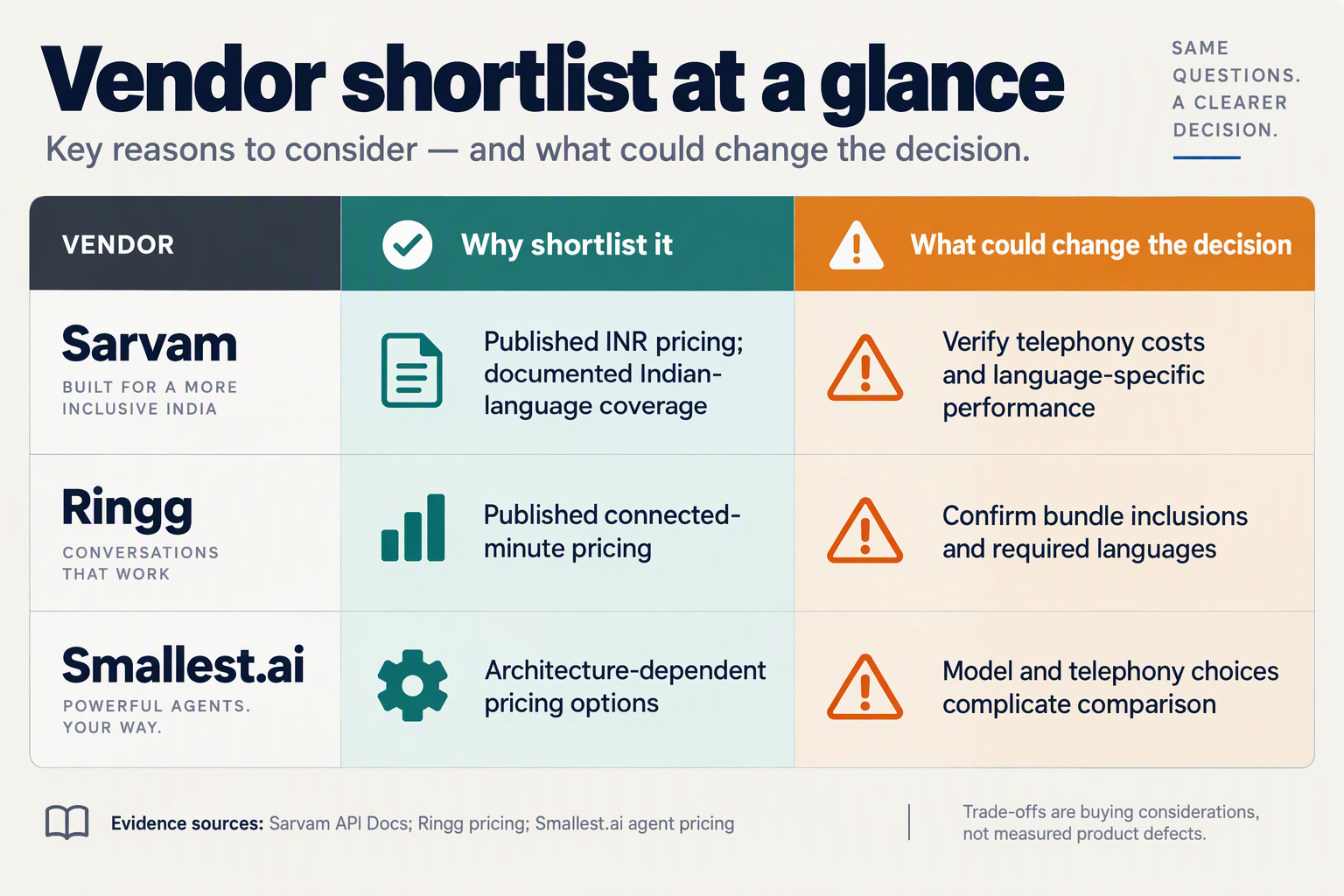
The practical trade-off is price certainty versus configuration flexibility: bundled rates simplify budgeting, while component-based pricing requires more cost modelling. The comparison below uses the supplied November 2026 research; unpublished inclusions and language details remain items to verify, not assumed weaknesses.
- Bundled-rate buyers: Request a written breakdown covering AI processing, phone carriage, number rental, minimum billing and taxes before comparing per-minute quotes.
- Regional-language buyers: Test recognition and spoken responses separately; a platform’s language count does not establish equivalent performance across accents or code-switching.
| Alternative | Practical advantage | Published pricing, November 2026 | Best fit and trade-off |
|---|---|---|---|
| Sarvam | Models included; 11 Indian languages plus English, according to Sarvam API Docs | ₹3.50/min PAYG; ₹3/min Business | Budget-focused teams; confirm Business eligibility and telephony costs |
| CallMissed | No-code builder, bring-your-own SIP carrier, live supervisor intervention | Standard ₹4/min; 30-second minimum; carriage separate, per verified fact sheet | Teams wanting operational controls alongside bundled AI pricing; short calls and carriage affect totals |
| Ringg | Pricing expressed per connected minute | ₹6/connected min, according to Ringg’s pricing page | Connected-minute budgeting; obtain the complete bundle and language specifications |
| Smallest.ai | Choice of cascading or speech-to-speech architecture | Model-dependent pricing, according to Smallest.ai’s pricing page | Architecture-led teams; calculate hosting, models and telephony together |
| Bolna | Separately itemised platform/model pricing in supplied reporting | Dograh reports $0.02/min plus model costs | Teams evaluating component costs; this secondary-source figure needs a current vendor quote |
| Tabbly | India-focused offering lists +91 numbers, Hindi and regional languages | ₹6.80/min PAYG; ₹5.10 from 5,000 minutes, according to Tabbly | India-first calling teams; verify the volume threshold’s billing terms and exact languages |
How do these prices change a realistic monthly budget?
- Sarvam: At 1,000 billable minutes, November 2026 API Docs rates imply ₹3,500 PAYG or ₹3,000 Business for the quoted voice-agent charge; the Business calculation assumes eligibility and excludes unconfirmed additional charges.
- Ringg: At 1,000 connected minutes, Ringg’s November 2026 published rate implies ₹6,000; request confirmation of phone-line inclusion rather than relying solely on GrowEasy’s supplied secondary report.
- Tabbly: At 5,000 billable minutes, Tabbly’s November 2026 advertised ₹5.10 rate implies ₹25,500, versus ₹34,000 at ₹6.80; the ₹8,500 difference applies only if those minutes qualify.
- CallMissed: As of November 2026, its verified 30-second minimum means 1,000 connected calls lasting 20 seconds each would incur 500 billable minutes, or ₹2,000 on Standard before carriage—not ₹1,333 based on elapsed time.
What should you test before choosing an Indian-language voice agent?
For an affordable AI voice agent platform with Indian language support, shortlist by the workload rather than the lowest headline number. Run the same sample conversations on each candidate: a regional-language enquiry, a Hindi-English switch, a noisy connection and a request for human assistance.
Record task completion, misunderstood names or numbers, handoff success and total invoiced cost. A slightly higher per-minute rate can still produce a lower cost per resolved enquiry—but that conclusion should come from your pilot, not an unsupported platform ranking.
How should you test Hindi, Marathi, Tamil and code-switching before choosing?
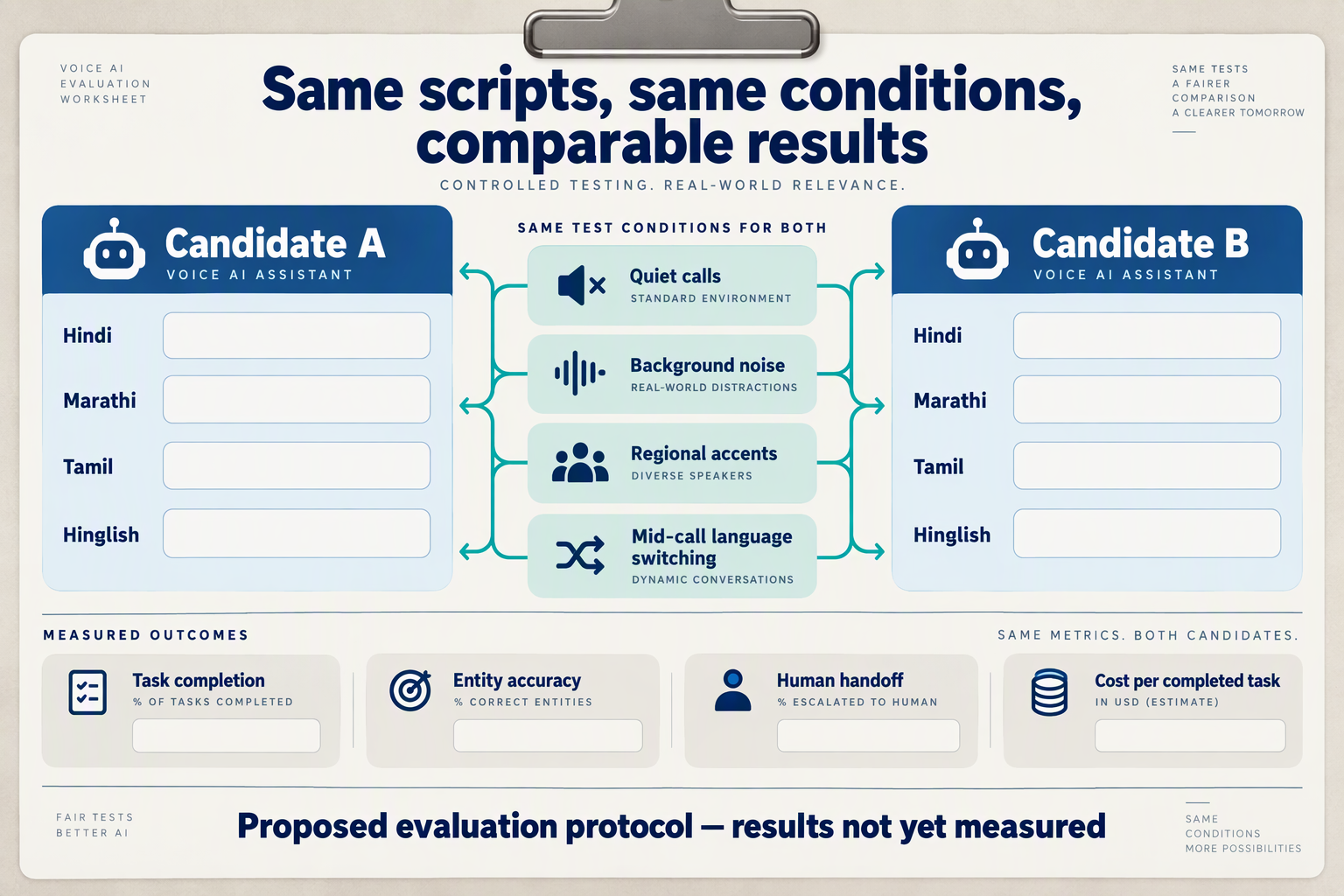
Test Hindi, Marathi and Tamil with the same tasks, callers and scoring rules on every shortlisted platform, including mid-sentence English switches. Choose on cost per successfully completed task, not language counts or demo fluency alone.
How do you build a realistic Indian-language voice-agent test?
- Test set: Run a proposed 60-call pilot per platform: 20 Hindi, 20 Marathi and 20 Tamil calls, with 10 code-switched conversations in each language group. Treat this as a starting evaluation design—not a published industry benchmark—and use identical scenarios across vendors.
- Task coverage: Test five workflows with four variations per language: appointment booking, order tracking, address changes, cancellation and human escalation. Include a correction such as “Tuesday—not Thursday” and an unavailable request; score whether the agent completes the right action, rather than merely sounding helpful.
- Code-switching: Include Hindi–English, Marathi–English and Tamil–English switches within sentences and between turns. Keep English product names, order IDs and terms such as “refund” inside regional-language requests; check whether recognition preserves meaning and whether the reply follows the caller’s requested language.
- Caller conditions: Use native speakers with different accents, ordinary mobile connections and realistic background noise. Include one interruption and one proper-name or number challenge per call; verify dates, rupee amounts, addresses and digit sequences against a written answer key, because fluent speech can conceal consequential transcription errors.
Which metrics should decide whether a platform passes?
- Recognition versus voice output: Score these separately for all three languages: did the transcript capture the request, and did the spoken response communicate the correct answer naturally? Ask native reviewers to rate intelligibility and pronunciation on a proposed 1–5 scale, with particular attention to names and English words embedded in regional speech.
- Acceptance gates: Set thresholds before testing—for example, 19 successful tasks out of 20 per language, or 95%, and zero incorrect confirmations of critical dates or amounts. These are suggested buyer criteria, not vendor performance claims; report Hindi, Marathi and Tamil results separately so a strong average cannot hide a weak language.
- Comparable configurations: Freeze the model, voice, prompt, knowledge base and telephony route during each comparison round. As of November 2026, Smallest.ai’s pricing page distinguishes cascading architecture—hosting, STT, LLM, TTS and telephony—from speech-to-speech architecture; record those components because configuration changes can affect both conversation quality and cost.
- Evidence and economics: Retain recordings, transcripts, task outcomes and billed charges; calculate total pilot spend ÷ successfully completed tasks, including failed attempts. As of November 2026, CallMissed’s verified product fact sheet lists call recordings, transcripts, custom QA scoring, eval suites and A/B experiments—capabilities buyers can use to make language testing repeatable rather than relying on a polished demonstration.
Which platform should you choose for your budget and deployment needs?
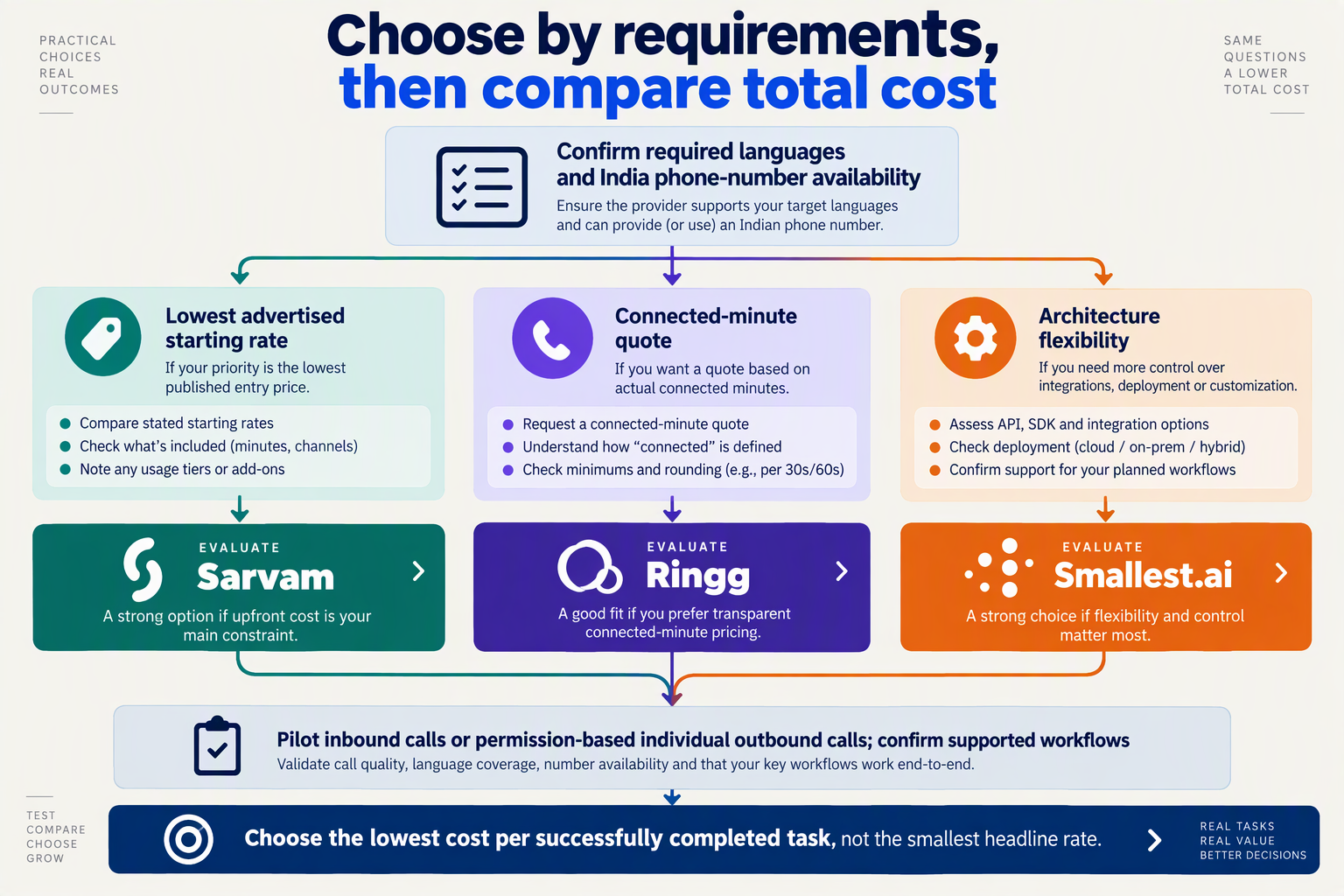
Choose an affordable AI voice agent platform with Indian language support by matching the complete call cost to your deployment needs—not by ranking headline rates alone. Use these budget scenarios and deployment checks to build your shortlist.
Which platform fits your calling budget?
- Sarvam — model-inclusive budget shortlist: In the supplied November 2026 research, Sarvam’s API documentation lists ₹3.50/minute pay-as-you-go and ₹3/minute on Business. For 1,000 billable minutes, that means ₹3,500 or ₹3,000 in listed voice-agent charges; confirm Business eligibility, phone-number costs and telephony before treating either figure as your complete monthly budget.
- Ringg — connected-minute budgeting: Ringg’s pricing page lists ₹6 per connected minute in the supplied November 2026 context, making 1,000 connected minutes ₹6,000 at that published rate. Choose this pricing basis if connected usage matches your forecasting process, but obtain written confirmation of included components, minimum billing and number rental before comparing totals.
- Smallest.ai — architecture-dependent costing: Smallest.ai’s supplied pricing page distinguishes five cascading components—hosting, speech recognition, language model, speech synthesis and telephony—from three speech-to-speech components: hosting, speech-to-speech and telephony. As of this November 2026 comparison, shortlist this approach when you can evaluate component choices; request a configuration-specific quote rather than assuming one universal rate.
- CallMissed — bundled AI costs with carrier flexibility: According to CallMissed’s verified fact sheet, as of November 2026, 1,000 billable Standard-plan minutes cost ₹4,000, excluding phone carriage. The plan includes recognition, the language model and voice, with a 30-second minimum; rented numbers or an existing Twilio, Plivo or SIP carrier let teams choose their telephony arrangement separately.
Which deployment checks should decide your final choice?
- CallMissed — no-code deployment and regional testing: As of November 2026, its verified fact sheet lists a no-code builder, knowledge bases from text, web pages and PDFs, and supervisor listen, whisper and barge-in controls. Test your required language pair explicitly: recognition covers 22 Indian languages plus English, while natural voice output covers 10 Indian languages plus English.
- Language acceptance — test recognition and response separately: Sarvam’s supplied November 2026 API documentation lists 11 Indian languages plus English, but language counts alone do not establish equivalent conversation quality. Run the same booking, interruption and Hindi–English switching scenarios on each shortlisted platform; score transcription accuracy, spoken responses and completed tasks separately.
- Higher-volume purchasing — check eligibility before forecasting savings: Sarvam’s supplied November 2026 documentation places custom Enterprise pricing at 200,000 minutes per month onward. Tabbly’s supplied country page lists ₹6.80/minute PAYG and ₹5.10 from 5,000 minutes; confirm qualifying volume, included components and language coverage before using that lower rate in a forecast.
- Procurement — compare one identical workload: For this November 2026 shortlist, request quotes covering 1,000 connected minutes, your actual call-length distribution, required languages and chosen carrier. Record number rental, telephony, billing minimums and human escalation requirements alongside the AI charge; select the platform that passes your conversation tests within the complete budget.
Frequently Asked Questions
- Q: How do I choose an affordable AI voice agent platform with Indian language support?
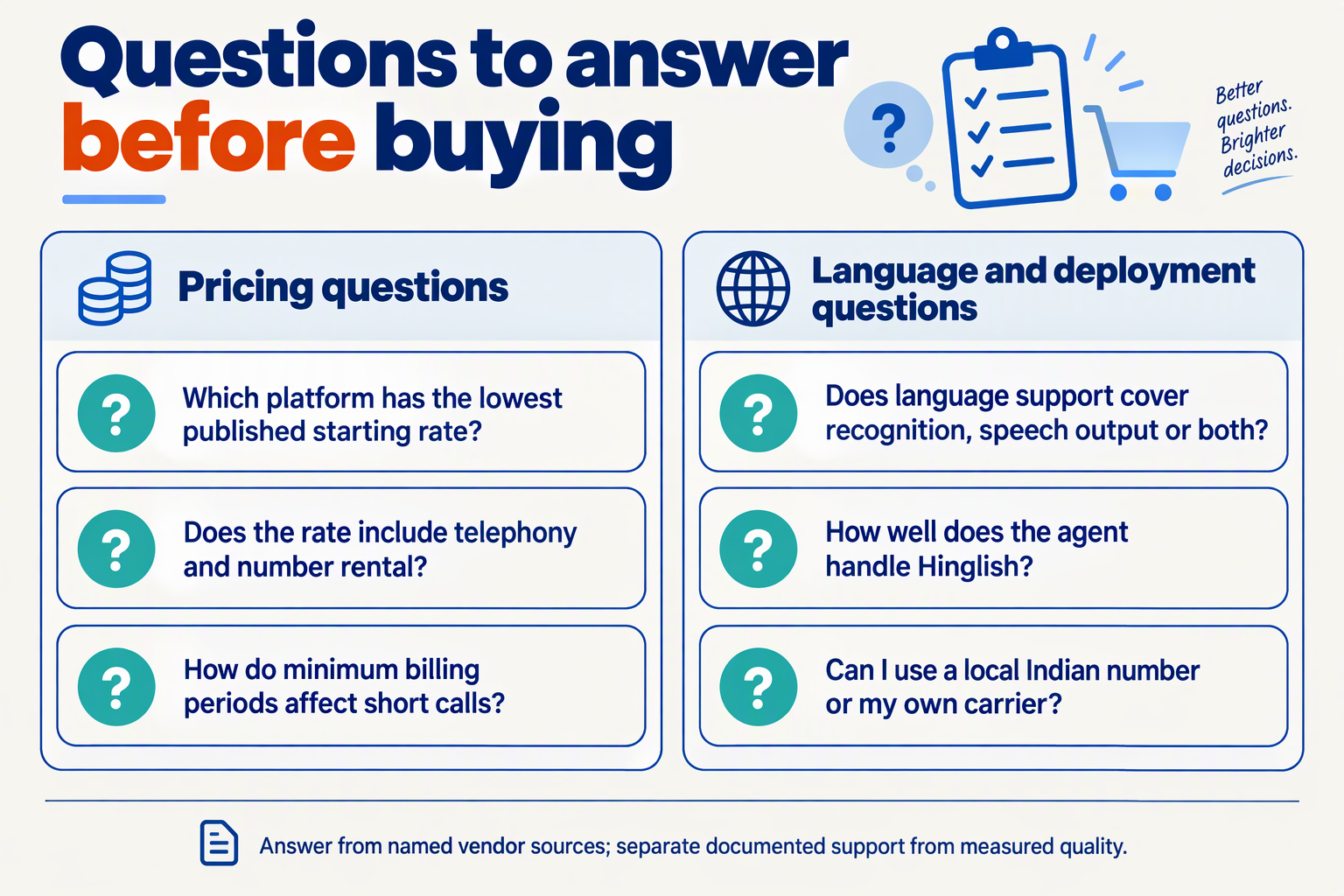
A: Shortlist by required languages, deployment effort and total calling cost, rather than ranking headline prices alone. In the November 2026 research context, Sarvam’s API documentation lists ₹3.50/minute pay-as-you-go and ₹3/minute on Business, including models, while Ringg’s pricing page lists ₹6/connected minute. Sarvam gives budget-first buyers a concrete starting point; confirm plan conditions and telephony inclusions before comparing either quote.
- Q: What does an affordable AI voice agent platform with Indian language support cost for 1,000 minutes?
A: According to CallMissed’s verified product fact sheet, as of November 2026 its Standard plan costs ₹4/minute, including speech recognition, the language model and voice, so 1,000 billable minutes cost ₹4,000 before separately billed phone carriage. Its 30-second minimum means a connected 10-second call incurs ₹2 in AI charges, while a call that never connects costs nothing. Budget using billable durations, not just conversation time, and request applicable tax and carrier charges separately.
- Q: Does Indian-language support include both speech recognition and spoken replies?
A: No—speech recognition and text-to-speech are separate capabilities, so a platform’s language count does not automatically describe its spoken replies. As of November 2026, CallMissed’s verified product fact sheet lists recognition in 22 Indian languages plus English, including Hinglish, but natural text-to-speech in 10 Indian languages plus English. Ask vendors to demonstrate both directions for every required language, including regional names, addresses and Hindi-English switching, before treating coverage as sufficient.
- Q: Is a component-priced voice agent cheaper than a bundled per-minute plan?
A: A component-priced system can be economical, but only after every component is counted. Smallest.ai’s pricing page, supplied for this November 2026 comparison, distinguishes cascading architecture—hosting, speech recognition, language model, speech synthesis and telephony—from speech-to-speech architecture, which includes hosting, the speech-to-speech model and telephony. Request an itemised estimate for the same workload and include integration effort; architecture-dependent pricing is not directly comparable with a model-inclusive rate.
- Q: What should I check before moving an AI voice agent to my existing phone carrier?
A: Confirm carrier compatibility, number rental, inbound and outbound charges, and billing minimums before choosing a platform. Ask whether your existing carrier can connect through a supported SIP trunk or integration, and whether transfer-related costs are additional. For a practical comparison, request two written estimates using identical call volumes: one with the vendor’s rented number and one with your existing carrier.
- Q: How should I test an Indian-language voice agent before buying?
A: Run the same evaluation script across shortlisted platforms, covering code-mixed speech, interruptions, background noise, names, numbers and human escalation. For example, a proposed 30-call pilot could contain 10 regional-language calls, 10 Hinglish calls and 10 difficult-audio calls; this is a suggested test design, not an industry benchmark. Record task completion, incorrect answers, escalation outcomes and total billed cost, then choose the platform that meets your requirements within budget.
Conclusion
An affordable AI voice agent platform with Indian language support is one that meets your customers’ language needs at a predictable total calling cost—not simply the platform advertising the lowest per-minute rate. This November 2026 comparison points to a practical shortlist: Sarvam for model-inclusive budget evaluation, Ringg for connected-minute budgeting, CallMissed for bundled voice-agent pricing and clearly distinguished language capabilities, and Smallest.ai for architecture-dependent costing.
Which affordable Indian-language voice AI platform should you shortlist?
Four takeaways should guide the decision:
- Start with comparable prices, not a headline-price ranking. According to Sarvam’s API documentation, as of November 2026, voice agents cost ₹3.50 per minute on pay-as-you-go or ₹3 per minute on Business, with models included and support for 11 Indian languages plus English. Sarvam deserves consideration from budget-first teams, but buyers should still confirm telephony charges and whether their required languages are covered. A lower published rate is a starting point, not proof of a lower complete bill.
- Use connected-minute pricing to structure your budget. Ringg’s pricing page lists ₹6 per connected minute as of November 2026. That makes Ringg a relevant option for teams organising budgets around connected usage, provided they verify package inclusions before comparing quotes. Apply the same expected call durations and usage volumes across shortlisted platforms; otherwise, superficially similar estimates can represent different workloads.
- Separate language recognition from spoken responses. According to CallMissed’s verified product fact sheet, as of November 2026, its ₹4-per-minute Standard plan includes speech recognition, the language model and voice, with phone carriage charged separately and a 30-second minimum. CallMissed supports speech recognition in 22 Indian languages plus English, including Hinglish, and natural text-to-speech in 10 Indian languages plus English. Explore CallMissed when evaluating bundled pricing alongside these distinct input and output capabilities—not an assumed identical language count for both.
- Choose your architecture before calculating component costs. Smallest.ai’s pricing page, reviewed for this November 2026 comparison, distinguishes cascading systems—hosting, speech recognition, language model, speech synthesis and telephony—from speech-to-speech systems. Teams choosing their own architecture should therefore compare the complete configured stack rather than treating a component price as the finished agent’s calling cost.
Looking ahead, watch whether providers make language coverage, package inclusions and billing rules easier to compare. More accessible voice AI will only translate into better value when representative conversations work reliably and the final bill matches expectations.
Before committing, test regional-language and Hindi-English conversations, check voice output separately from transcription, and calculate carriage and minimum-duration charges. Which shortlisted platform delivers the conversations your customers need at a total cost you can confidently budget?
Related Reading
- Best AI voice agents in India: 2026 Comparison Guide
- Local Voice Agents: What IBM Granite 4.2 Means in 2026
- Best LLM for Voice Agents in 2026: GPT-6 vs Claude