Stop Bleeding Leads: The 2026 Guide to AI Voice Agents, Call Analytics, and Missed-Call Recovery for Small Business


Stop losing over 60% of inbound leads to competitors. Learn how modern AI voice agents and smart call analytics recover missed-call revenue in 2026.
Stop Bleeding Leads: The 2026 Guide to AI Voice Agents, Call Analytics, and Missed-Call Recovery for Small Business
Did you know that a staggering 62% of small business inbound calls go unanswered? In today’s hyper-competitive market, a missed call isn't just a minor inconvenience; it is a direct pipeline of revenue flowing straight to your local competitors, as frustrated prospects rarely leave voicemails and instantly move down their search results. If you are ready to plug this leak, this is the 2026 guide to AI voice agents, call analytics, and missed-call recovery for small business.
Moving past the generic AI hype of previous years, 2026 has ushered in a pragmatic era of conversational automation where the cold, hard math of lead retention dictates success. Modern voice AI agents have evolved far beyond the rigid, robotic IVR menus of the past. Today, they leverage ultra-low-latency, natural dialogues to qualify leads and book appointments directly into small business CRMs in real time. Combined with smart, automated SMS and immediate outbound callback workflows—often triggering within 10 seconds of a missed inbound attempt—this technology achieves up to a 97% call capture rate.
Furthermore, integrated call analytics are turning raw telephone traffic into a strategic goldmine. By automatically categorizing call intent, tracking peak call volumes, and measuring abandonment rates, local service businesses can finally pinpoint operational bottlenecks and optimize their staffing. Industry platforms like CallMissed are driving this shift, enabling small businesses to deploy highly responsive, multilingual AI voice agents that handle customer queries 24/7 without the overhead of a round-the-clock call center.
In this guide, we will break down how service providers—from contractors and dental clinics to auto repair shops—are using these tools to transform missed connections into loyal customers. We will explore the mechanics of immediate missed-call automation, dive into the operational power of call analytics, and provide a concrete ROI formula demonstrating how businesses averaging 150 to 300 monthly calls are recovering between $3,000 and $6,000 in monthly revenue. Read on to discover how to turn your phone system into an automated growth engine.
Introduction: The Quiet Leak Draining Your Small Business

Every single day, a quiet operational leak is draining the financial lifeforce of small businesses across the globe. While business owners pour thousands of dollars into local SEO, Google Ads, and social media marketing to make their phones ring, the cold reality of the front desk paints a far different picture.
According to industry benchmarks, a staggering 62% of small business inbound calls go unanswered. In a hyper-competitive, instant-gratification market, a missed call is no longer a minor administrative hiccup—it is a direct pipeline of warm leads and hard-earned revenue flowing straight into the hands of your local competitors.
The Cost of Silence: Why Voicemail is Dead
When a prospect calls a contractor, an auto repair shop, or a dental clinic, they are looking for immediate assistance. If they are met with a continuous ring or a generic voicemail greeting, they do not wait. They hang up, return to their search results, and click the very next business listed.
Relying on traditional voicemail or delayed callbacks is a recipe for rapid revenue decay:
- The Immediate Abandonment Rule: Over 80% of callers hang up without leaving a voicemail when they reach a machine.
- The "First-to-Answer" Phenomenon: Modern buyers buy from the business that responds first. If you call them back an hour later, they have already booked with someone else.
- Wasted Marketing Spend: When 62% of your hard-earned inbound leads go unanswered, your Customer Acquisition Cost (CAC) effectively doubles or triples.
Enter the 2026 Era of Conversational Recovery
In 2026, the technology landscape has shifted away from the generic "AI hype" of the past. Today, forward-thinking local businesses are plugging this leak using highly pragmatic, ultra-low-latency AI voice agents and automated recovery workflows.
These are not the rigid, frustrating Interactive Voice Response (IVR) systems of old ("Press 1 for sales..."). Modern conversational AI voice agents engage in natural, human-like dialogue, answer questions instantly, qualify leads on the spot, and book appointments directly into your CRM or scheduling tool.
Furthermore, when an inbound call is missed due to busy lines or after-hours closures, intelligent automation platforms trigger an immediate multi-channel response—such as a personalized text message or an automated AI outbound callback—within 10 seconds. This rapid response window captures the prospect's attention while they are still highly motivated, achieving up to a 97% call capture rate.
Transforming Telephone Traffic into Strategic Gold
Beyond immediate lead recovery, businesses are leveraging advanced call analytics to optimize their entire operational model. Instead of treating phone lines as a black box, modern analytics dashboards automatically:
- Categorize call intent (e.g., pricing inquiries vs. booking requests vs. billing issues)
- Track peak call volumes to optimize staffing schedules
- Measure abandonment rates to isolate operational bottlenecks
Platforms like CallMissed are at the forefront of this revolution, enabling small businesses to seamlessly deploy these multilingual AI voice agents and smart recovery systems without complex coding or enterprise-level budgets.
In this comprehensive guide, we will demystify how local service businesses are using these tools to transform missed connections into loyal customers, break down the exact operational power of call analytics, and provide a concrete ROI formula to show how recovering just a fraction of your missed calls can unlock thousands of dollars in hidden monthly revenue.
Background & Context: The Reality of the 2026 Missed-Call Crisis
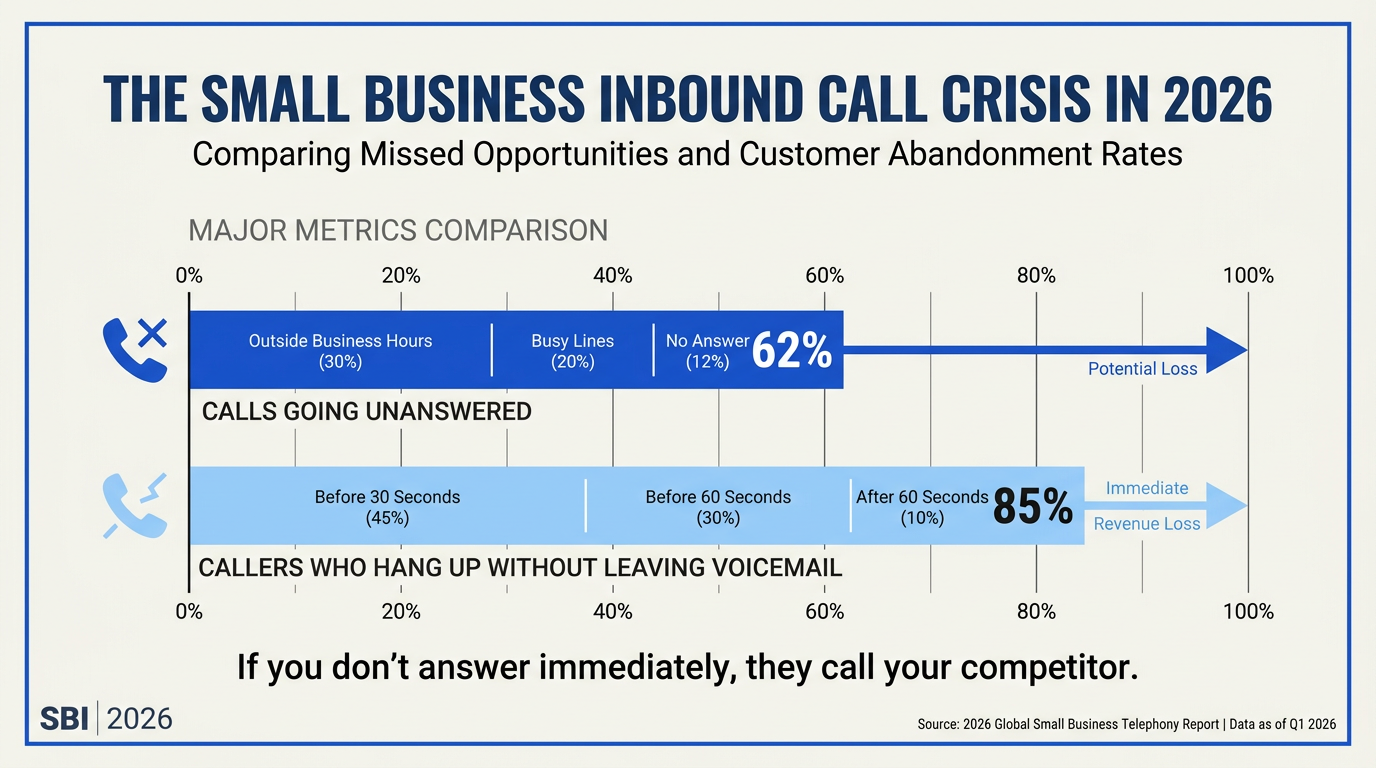
To truly understand why 2026 has become the tipping point for automated lead recovery, we must first look at the harsh economic reality facing local service providers. Historically, small businesses viewed missed calls as an unavoidable cost of doing business—a minor operational friction point. Today, however, that perspective has shifted from passive acceptance to financial urgency.
In a marketplace dominated by instant gratification, the consumer psychology of 2026 does not tolerate waiting. According to data from PxlPeak, a staggering 62% of inbound calls to small businesses go completely unanswered.
When a homeowner with a burst pipe or a patient with a sudden toothache calls a local business and hears a generic voicemail greeting, they do not leave a message. Instead, they hang up and instantly click the next Google Search result. In fact, industry data reveals that 85% of callers who do not reach a live representative on their first attempt will not call back, choosing instead to take their business directly to a competitor who answers first.
The True Cost of a Silent Phone
For local contractors, dental clinics, and auto repair shops, each of these missed connections carries a steep, quantifiable price tag. The "missed-call crisis" is driven by three distinct market pressures in 2026:
- Hyper-Competitive Local Search: Because search engines make it effortless to find dozens of alternative service providers in seconds, the business that responds first wins the customer.
- Wasted Marketing Spend: When small businesses pay $20 to $100+ per click on Google Ads or Local Services Ads, every unanswered call represents direct marketing capital thrown down the drain.
- The Death of Voicemail: Modern consumers view leaving a voicemail as an administrative chore with no guarantee of a timely response. They expect immediate, interactive engagement.
Enter the 2026 Paradigm Shift: Real-Time Lead Recovery
Rather than accepting this leak as the cost of doing business, forward-thinking operators are leveraging modern communication infrastructure to capture these fleeting opportunities. This is where platforms like CallMissed are changing the game. By deploying intelligent, multi-model AI voice agents, businesses can ensure that no prospect is met with silence.
Instead of routing callers to a frustrating, rigid IVR menu of the past, these modern systems engage prospects in natural, ultra-low-latency dialogues. If a call is missed because the front desk is busy or the business is closed, the system triggers a smart call workflow within 10 seconds—initiating a rapid text-back sequence or an immediate automated callback.
By coupling immediate outbound automation with deep call analytics, businesses are shifting from a defensive posture (trying to hire more receptionist staff) to an offensive, automated growth strategy. As we will explore in the next sections, plugging this 62% leak does not require a massive budget; it simply requires replacing your static voicemail with an active, automated responder.
Key Developments: Evolution of Inbound Lead Management
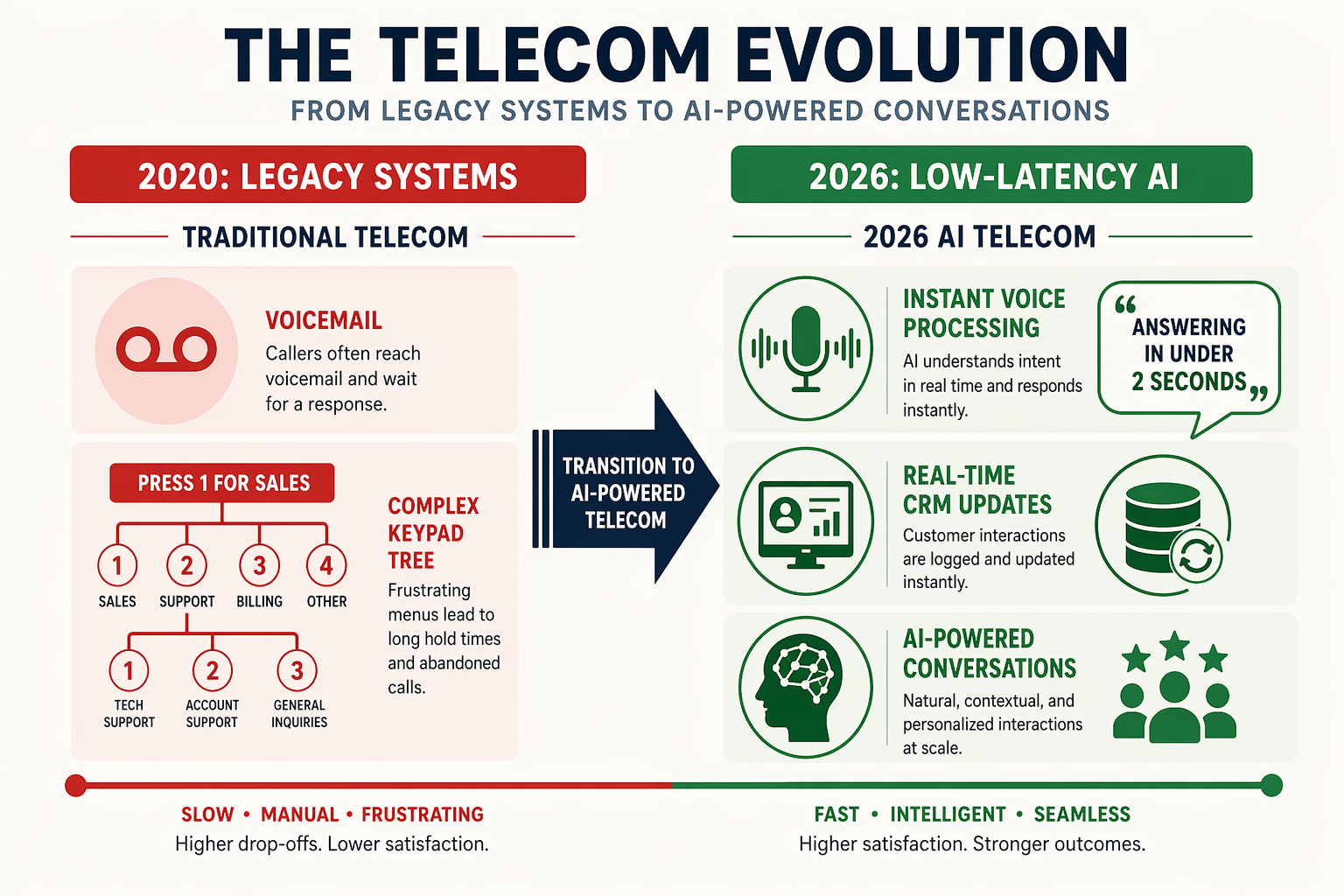
To understand how small businesses can plug their leaking sales funnels, we must first look at how consumer communication has shifted over the last two decades. For years, local service providers relied on traditional telephone setups: first, simple copper-wire landlines with standard answering machines; then, rigid Interactive Voice Response (IVR) systems that frustrated callers with endless "Press 1 for Sales" loops; and eventually, costly outsourced human answering services that struggled with technical, industry-specific FAQs.
As we move through 2026, the technology has fundamentally shifted. We have entered the era of Autonomous Conversational AI. Today’s solutions do not merely take a message to be reviewed hours later; they engage in ultra-low-latency, natural dialogues, reference live scheduling calendars, and push qualified lead data directly into CRM platforms.
The table below illustrates this transition, demonstrating how inbound lead management has evolved from passive recording to active, real-time revenue recovery.
| Era & Technology | Avg. Response Latency | Lead Capture Rate | CRM Integration | Operational Impact |
|---|---|---|---|---|
| Traditional Voicemail (Pre-2010s) | 2 to 24+ Hours | < 15% (Most hang up) | None (Manual data entry) | High lead drop-off; heavy reliance on manual staff callbacks. |
| Rigid Legacy IVR (2010–2020) | Immediate (Robotic) | 20% – 30% | Basic (Call logs only) | High caller frustration; prospects abandon due to complex menus. |
| Live Answering Services (2020–2024) | 30 to 90 Seconds | 60% – 75% | Delayed (Email/CSV export) | High recurring monthly costs; agents lack deep technical business knowledge. |
| Autonomous Voice AI (Current 2026 Standard) | < 1.5 Seconds (Natural) | 95% – 97% | Real-time (Two-way CRM sync) | Immediate qualification; instant booking; zero-overhead 24/7 coverage. |
The Catalyst for Change: Why Old Methods Fail in 2026
The structural shift outlined above is driven by a massive change in consumer psychology. Modern prospects expect instant gratification. If a local plumbing contractor, dental clinic, or auto repair shop does not pick up the phone on the first ring, the caller does not wait for a voicemail tone—they immediately click the next search result on Google.
Traditional answering services tried to bridge this gap, but they introduced friction. Outsourced agents often operate from generic scripts, unable to answer specific questions about a business’s unique services, pricing, or real-time availability.
This is where the evolution of AI voice infrastructure has changed the game. Modern platforms utilize advanced Large Language Models (LLMs) trained on specific business data, allowing them to answer complex questions instantly and naturally. For example, unified platforms like CallMissed make it seamless for small businesses to deploy these capabilities. By offering an integrated ecosystem of voice agents, automated SMS follow-ups, and a multi-model API gateway supporting over 300 LLMs, businesses can transition from passive call logs to active lead capture without rewriting their existing operational workflows.
Ultimately, the evolution of inbound lead management is about speed and precision. By replacing slow, human-dependent callbacks with instantaneous, AI-driven conversations, small businesses can ensure that no marketing dollar is ever wasted on an unanswered ring.
In-Depth Analysis: How 2026 Voice AI Agents Are Fundamentally Different
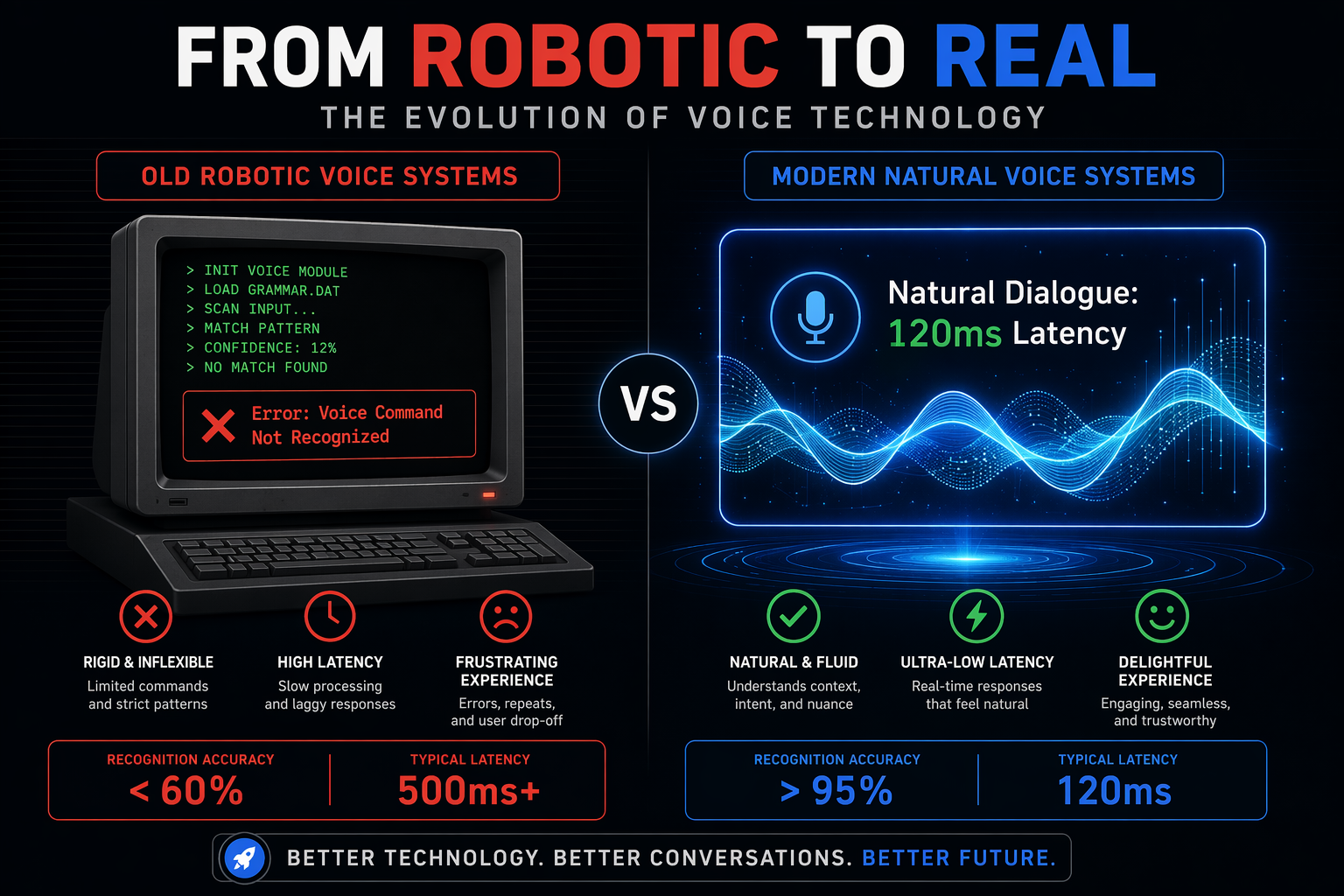
To understand why 2026 is the breakout year for small business voice automation, we must look past the generic "AI hype" of the early 2020s. For years, automated phone systems meant frustrating Interactive Voice Response (IVR) menus—the dreaded "press 1 for sales, press 2 for support" loops that drove customers to hang up in frustration.
Today, the paradigm has completely shifted. The convergence of ultra-low-latency Large Language Models (LLMs), advanced natural language processing, and real-time API integrations has created a new class of conversational AI voice agents that are virtually indistinguishable from human receptionists.
Breaking the Speed Barrier: Ultra-Low Latency
The single biggest technological leap in 2026 is the reduction in voice response latency. Historically, AI voice tools suffered from a 2-to-3-second delay between a human speaking and the AI responding. This awkward pause shattered the illusion of a natural conversation.
Modern conversational agents have pushed this latency down to under 800 milliseconds—matching the natural cadence of human speech. When a prospect calls a contractor or auto repair shop, they are met with instantaneous, fluid verbal feedback, preventing the immediate hang-ups common with older automated systems.
Direct CRM Integration and Real-Time Action
Yesterday’s bots could only take a message and send an email alert. Today’s AI voice agents are active participants in your business operations. They do not just talk; they execute workflows in real time:
- Instant Appointment Booking: By integrating directly with calendar systems like Calendly, Housecall Pro, or clinic-specific CRMs, voice agents can check real-time availability and book appointments mid-call.
- Dynamic Lead Qualification: Instead of passive listening, the AI asks targeted qualifying questions (e.g., "Is this an emergency leak or a planned renovation?") to categorize the lead immediately.
- Multi-Model Infrastructure: Developers and platforms can now dynamically route calls through different LLMs depending on the complexity of the inquiry. For instance, solutions like CallMissed's multi-model API gateway allow businesses to deploy over 300+ LLMs, choosing the fastest, most cost-effective model for simple lead capture, while routing complex technical queries to advanced reasoning models.
Multilingual Accessibility at Scale
In a globalized market, language barriers represent a massive source of lost revenue. Local businesses frequently miss out on high-value leads simply because their front-desk staff cannot speak the caller's native language.
In 2026, voice agents solve this natively. For example, platforms like CallMissed allow businesses to deploy multilingual AI agents that support 22 regional Indian languages and dozens of global dialects. The system automatically detects the caller's spoken language and seamlessly switches tongues mid-sentence, ensuring no prospect is left unheard.
By shifting from rigid scripts to fluid, multi-lingual, and action-oriented dialogues, modern voice AI has turned the telephone from an operational bottleneck into a high-efficiency conversion tool.
The Power of Missed-Call Automation: The Core 3-Step Recovery Workflow
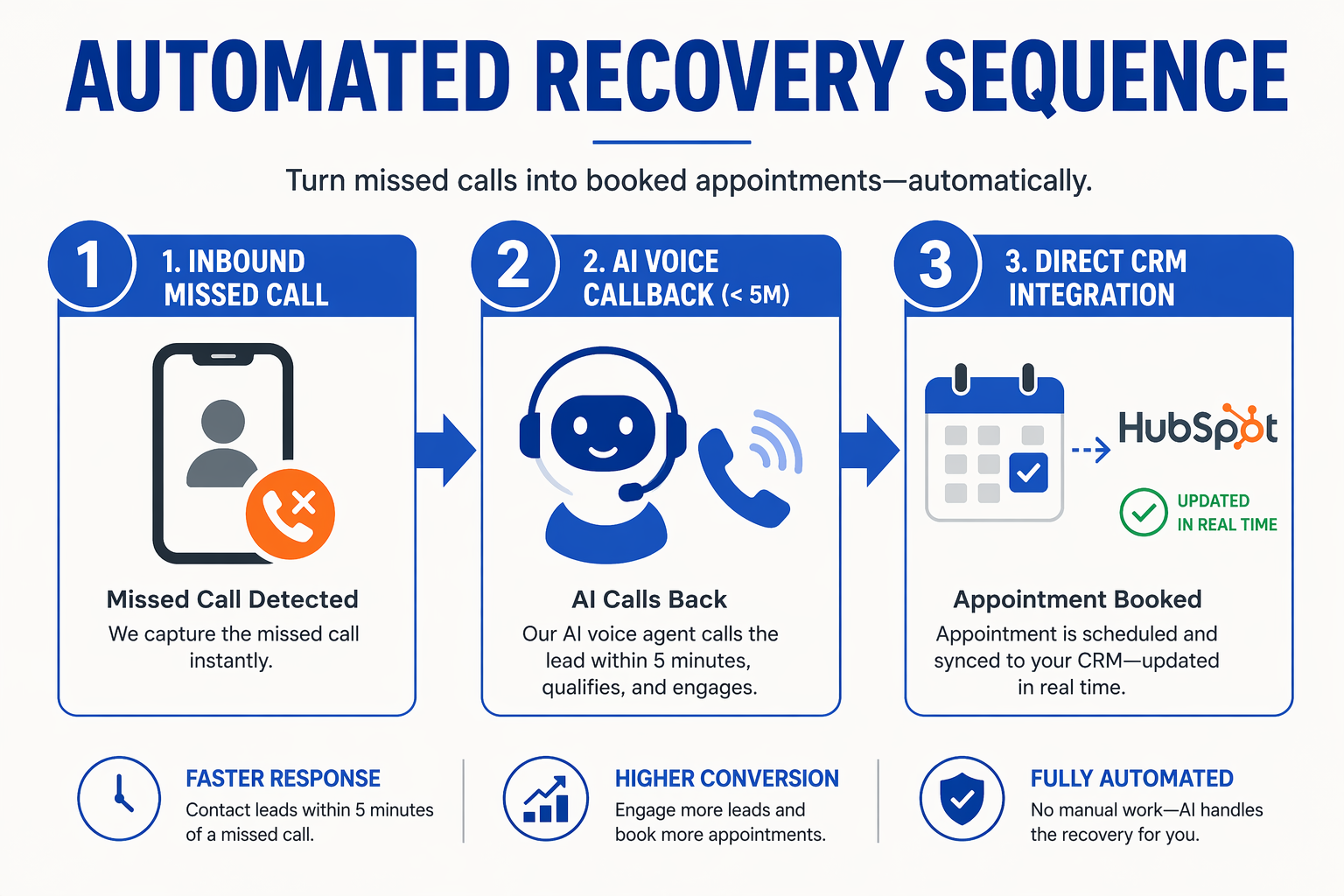
When a lead calls your business and hears nothing but a ringing tone, the countdown begins. In 2026, you do not have hours—or even minutes—to respond. According to lead conversion data, if you do not engage a prospect within 5 minutes of their missed call, the probability of qualifying that lead drops by 80%.
To combat this, successful small businesses are shifting from reactive habits to a highly structured, automated three-step recovery workflow. By combining immediate SMS, ultra-low-latency voice outreach, and instant calendar synchronization, this process achieves up to a 97% call capture rate.
Here is how the core 3-step recovery workflow operates to stop lead bleeding in real time:
Step 1: The Instant SMS Text-Back (0 to 10 Seconds)
The moment an inbound call goes unanswered, the automation engine triggers a text-back sequence in under 10 seconds. This step instantly halts the prospect's search for a competitor by acknowledging their effort and opening a dual-channel line of communication.
- The Action: The system sends a personalized text: "Hi [Name], sorry we missed your call just now! We're helping another customer, but we want to assist you right away. Are you looking to book a service or get a quick quote?"
- The Outcome: This immediate touchpoint satisfies the modern consumer's demand for instant gratification, keeping them engaged on their mobile screen rather than heading back to Google Search.
Step 2: The Automated AI Callback (Within 5 Minutes)
While SMS is excellent for securing initial engagement, voice remains the highest-converting medium for local services like contractors, dental clinics, and auto repair shops. If the customer does not respond to the text, or if they reply expressing immediate need, the system initiates an automated AI callback.
- The Action: The platform triggers an outbound call to the prospect. When they answer, a natural, conversational AI voice agent engages them in an ultra-low-latency dialogue.
- The Outcome: Rather than interacting with a rigid, robotic IVR menu, the lead talks to an intelligent agent that understands context, answers basic pricing and service questions, and qualifies their intent. Platforms like CallMissed make this seamless by deploying production-ready AI voice agents that sound entirely human and can easily scale to handle dozens of simultaneous callbacks during peak hours.
Step 3: Direct CRM Integration & Instant Booking
The recovery workflow is only complete when the lead is safely converted into a scheduled job. The final step bridges the conversation directly to your calendar without requiring manual intervention from your front desk.
- The Action: Once the AI voice agent confirms the lead’s service needs, it accesses your live booking calendar (such as Calendly, ServiceTitan, or Housecall Pro). It presents available time slots, secures the appointment, and instantly inputs the customer's details into your CRM.
- The Outcome: The business owner or technician wakes up to a fully qualified, pre-booked appointment on their schedule. The entire loop—from missed call to confirmed revenue—is closed autonomously.
Unlocking Insights: The Crucial Role of AI Call Analytics
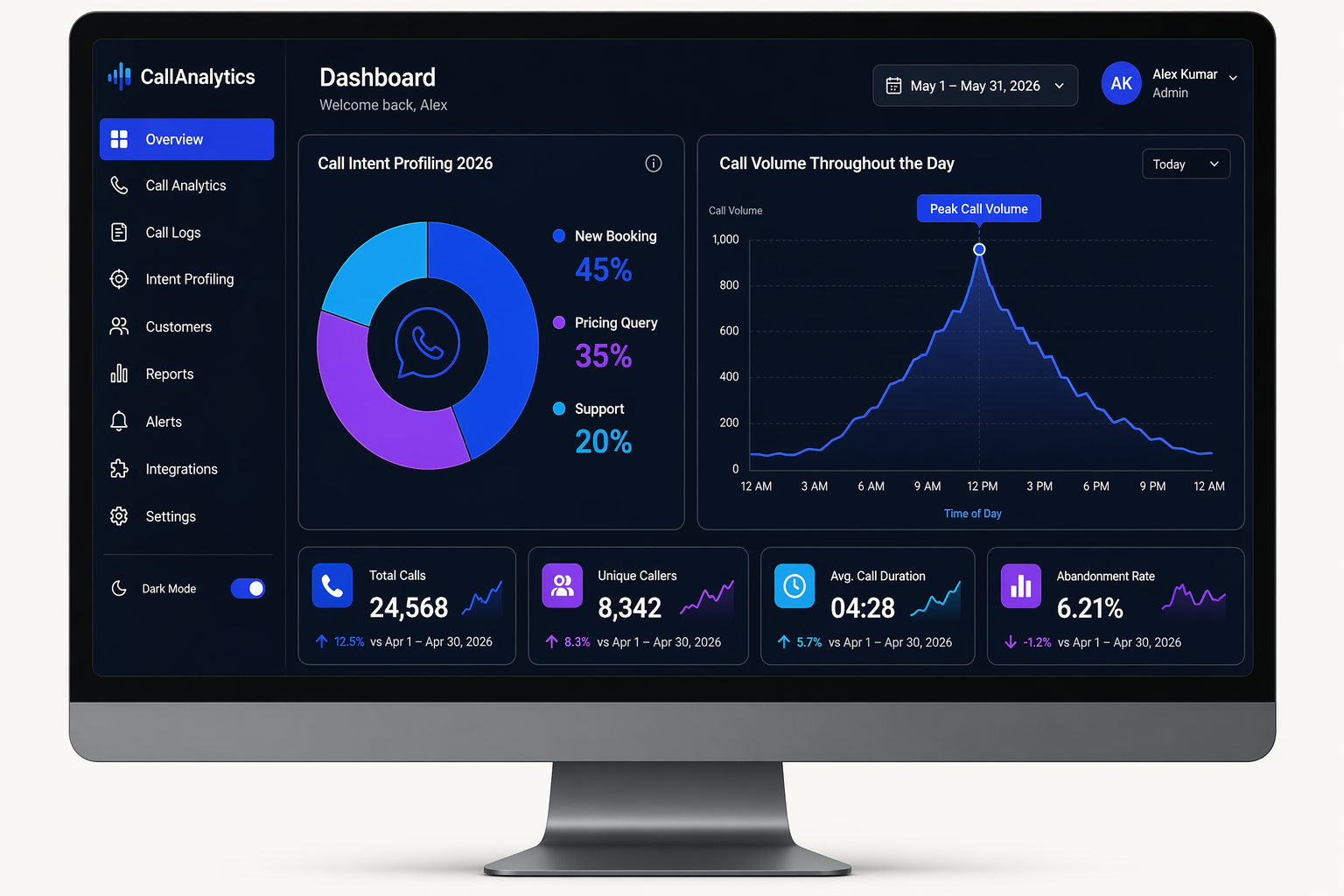
To truly stop bleeding leads, small businesses must look beyond immediate call recovery and focus on the data behind their telephone traffic. In 2026, capturing a call is only half the battle; the real strategic advantage lies in understanding why customers are calling and when your operational gaps are most vulnerable. This is where AI call analytics transforms a standard phone system into an active business intelligence hub.
Historically, small businesses operated in the dark regarding their phone traffic. Owners could see a list of missed calls at the end of the day, but they had no way of knowing which calls were high-value quote requests and which were low-priority spam. Modern AI call analytics changes this by processing spoken conversations and call attempts in real-time, delivering actionable insights directly to business dashboards.
Turning Raw Conversations into Structured Data
Instead of forcing managers to manually listen to hours of call recordings, AI-driven systems automatically analyze call audio to extract critical business metrics:
- Automated Intent Categorization: The AI instantly tags each call based on the customer’s intent (e.g., "pricing inquiry," "scheduling conflict," "warranty claim," or "spam"). This allows service businesses to prioritize callback queues, ensuring that a hot lead requesting an emergency plumbing quote is routed instantly, while a simple billing question is queued for standard business hours.
- Peak Call Volume & Bottleneck Identification: By mapping out exact times when call volumes spike and comparing them against unanswered call rates, businesses can pinpoint exactly when their front desks are overwhelmed. For example, a dental clinic might discover they miss 40% of their new patient inquiries between 12:00 PM and 1:30 PM because the front desk staff is at lunch.
- Abandonment Rate Tracking: AI analytics measure precisely how long a customer is willing to wait on hold before hanging up. Knowing that your average caller abandons the line after 22 seconds allows you to adjust your automated routing to trigger an AI voice agent or SMS backup well before that threshold is reached.
Maximizing ROI with Multi-Model AI Infrastructure
The power of these analytics depends heavily on the accuracy of the underlying speech-to-text and language processing models. While generic analytics engines often struggle with regional accents, background noise, or specialized industry terminology, advanced communication platforms are solving this through robust, multi-model flexibility.
Solutions like CallMissed’s multi-model API gateway let developers and business owners switch seamlessly between 300+ LLMs and advanced Speech-to-Text APIs without changing a single line of code. This ensures that whether a contractor is receiving calls on a noisy construction site or a local business in India is handling inquiries across 22 regional languages, the AI accurately captures every nuance of the customer's intent.
By integrating these deep analytical insights with automated response workflows, local businesses can systematically eliminate operational blind spots, staff their offices more efficiently, and ensure that every single inbound lead is captured, categorized, and converted.
The Cold, Hard Math: Missed-Call Recovery ROI Formula
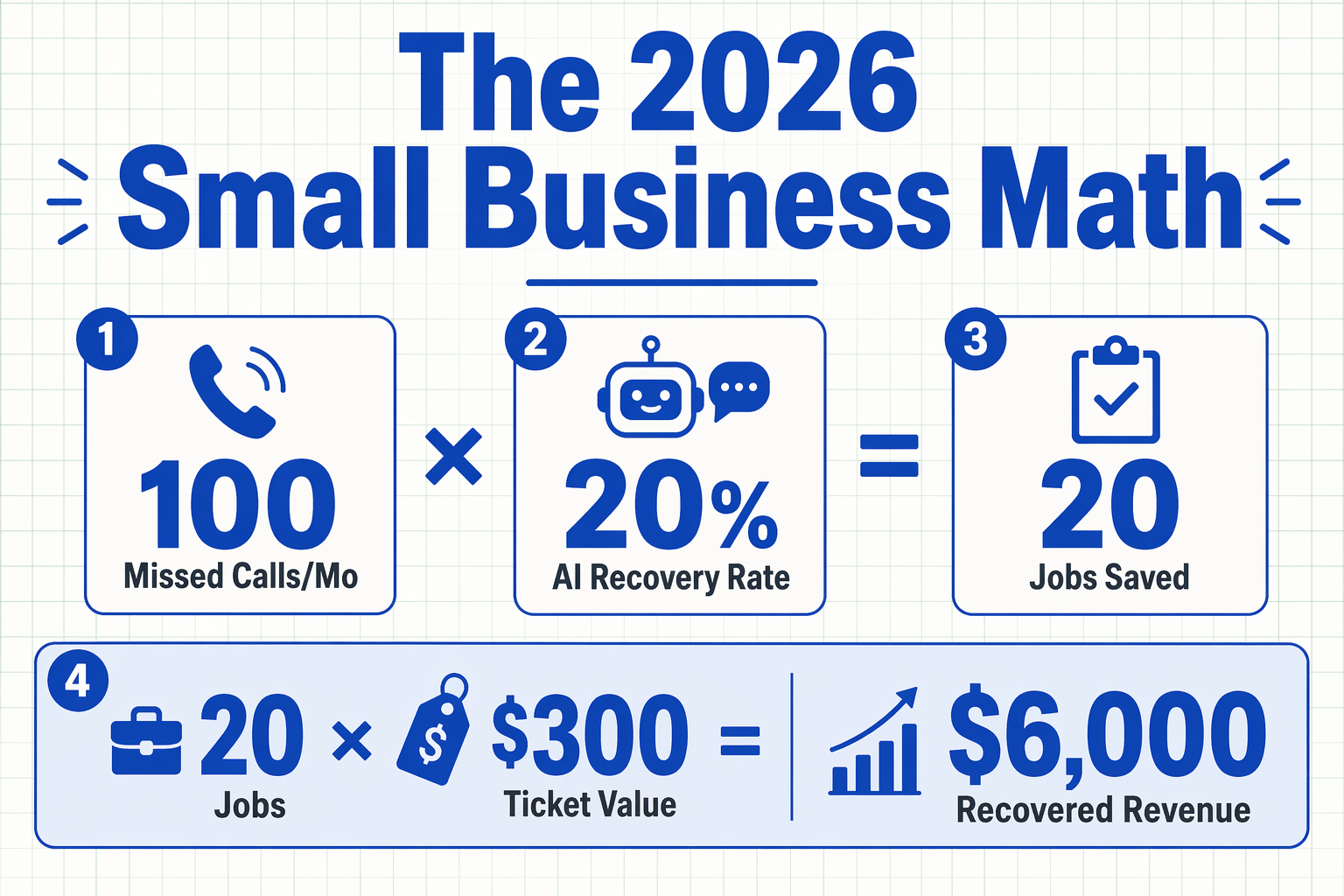
To truly appreciate the value of an AI voice agent, you have to move past the marketing buzzwords and look directly at the balance sheet. In 2026, implementing conversational AI isn't a speculative tech experiment—it is a highly predictable exercise in revenue recovery. For local service providers like HVAC contractors, dental clinics, and auto repair shops, every inbound ring has a literal dollar value attached to it.
When you calculate the financial leak of those unanswered rings, the argument for automation becomes undeniable. Let's break down the exact math used by industry analysts to determine your Missed-Call Recovery ROI.
The Core Revenue Recovery Formula
To calculate how much money your business is currently leaving on the table—and how much an AI voice agent can claw back—use this industry-standard formula:
$$\text{Recovered Monthly Revenue} = (\text{Monthly Inbound Calls} \times \text{Missed Call Rate}) \times \text{AI Capture Rate} \times \text{Lead-to-Booking Rate} \times \text{Average Job Value}$$
Let's plug in real-world, conservative 2026 benchmarks to see how this plays out for a typical local business:
- Monthly Inbound Calls: 200 calls
- Missed Call Rate: 62% (the standard industry average for small businesses)
- AI Capture Rate: 90% (the percentage of missed calls successfully engaged by immediate AI voice or SMS callback)
- Lead-to-Booking Rate: 25% (a conservative estimate of engaged leads that turn into booked appointments)
- Average Job Value: $500 (standard for residential trade services, dental treatments, or major auto repairs)
Now, let's run the math:
- Identify total missed calls: $200 \text{ calls} \times 62\% = 124 \text{ missed calls per month}$.
- Calculate successfully captured leads: $124 \text{ missed calls} \times 90\% \text{ AI capture rate} = 111.6 \text{ recovered opportunities}$.
- Determine booked jobs: $111.6 \text{ opportunities} \times 25\% \text{ booking rate} = 27.9 \text{ booked jobs}$.
- Calculate recovered revenue: $27.9 \text{ jobs} \times \$500 \text{ average job value} = \mathbf{\$13,950 \text{ in recovered monthly revenue}}$.
Real-World ROI and Payback Periods
Even if we adjust these metrics downward to be ultra-conservative, the financial impact remains massive. According to recent 2026 market data from Ava, adding a basic missed-call recovery system typically yields a net benefit of $3,000 to $6,000 in monthly recovered revenue for service businesses averaging just 150 to 300 calls.
Because modern conversational infrastructure is highly affordable—with entry-level tiers for local businesses often starting at minimal monthly operational costs—most companies realize a complete return on their investment and achieve payback in as little as 1 to 2 weeks.
Platforms like CallMissed make this transition frictionless by offering low-latency LLM inference alongside seamless CRM integrations. Instead of letting those 124 missed calls slip away to local competitors, businesses use CallMissed to instantly trigger automated, multilingual voice and SMS sequences, turning abandoned dials into scheduled service appointments within seconds.
By treating missed calls as a math problem rather than an inevitable cost of doing business, you can easily transform your phone system from a leaking bucket into an automated, high-yielding growth engine.
Expert Opinions: Industry Benchmarks and Best Practices

As small businesses navigate the landscape of 2026, the transition from generic AI experimentation to concrete, ROI-driven operations is backed by clear industry benchmarks. Leading consultants and tech analysts agree that the "wait and see" approach to automation is costing local businesses thousands of dollars in lost opportunities every month.
To help businesses benchmark their performance, industry experts have established critical KPIs and best practices for modern call management and missed-call recovery.
Key Performance Benchmarks for 2026
To understand where your business stands, experts point to three primary metrics that dictate whether your lead capture pipeline is healthy or bleeding revenue:
- The Golden 5-Minute Window: According to sales conversion data compiled by AInora, responding to a missed call within 5 minutes increases your chances of qualifying the lead by over 390%. In contrast, waiting longer than 30 minutes drops the likelihood of ever reaching that prospect to near zero, as they have already booked with a competitor.
- The 97% Capture Standard: Top-tier automated recovery systems, which combine immediate SMS text-backs with automated outbound voice dialing, now achieve a 97% call capture rate within five days of implementation.
- The Cost of Inaction: For local service providers averaging 150 to 300 monthly calls, the baseline industry benchmark shows that conservative missed-call recovery workflows consistently yield between $3,000 and $6,000 in recovered monthly revenue, according to data published by ThanksAva.
Industry Best Practices for Implementing AI Voice Agents
Deploying AI communication technology requires strategic execution. Industry leaders outline several best practices to maximize your setup:
- Prioritize Low-Latency Over Complex Scripting: Customers value speed and responsiveness over elaborate conversational scripts. Ensure your voice agent is optimized for ultra-low latency—ideally under 1.5 seconds of response delay—to maintain a natural conversational flow.
- Establish Multi-Channel Redundancy: A missed call shouldn't just trigger another call. The most successful recovery workflows immediately trigger a conversational SMS text-back within 10 seconds of the missed inbound attempt, followed by an automated AI-driven outbound call if the customer does not reply to the text.
- Integrate Direct CRM Syncing: Never let your voice agent operate in a silo. Ensure your system instantly pushes booked appointments, lead qualification notes, and call transcripts directly into your CRM (such as ServiceTitan, HubSpot, or Jobber) so your human team can step in seamlessly.
To achieve these benchmarks, forward-thinking businesses rely on sophisticated communication infrastructure. Platforms like CallMissed enable developers and small businesses to deploy production-ready voice agents and SMS chatbots that seamlessly execute these best practices. By offering access to low-latency LLM inference (with 300+ models) and localized Speech-to-Text APIs, CallMissed ensures your automated systems communicate naturally and instantly, turning every missed connection into a structured, revenue-generating opportunity.
What This Means For You: Deployment & Cost-Benefit Guide
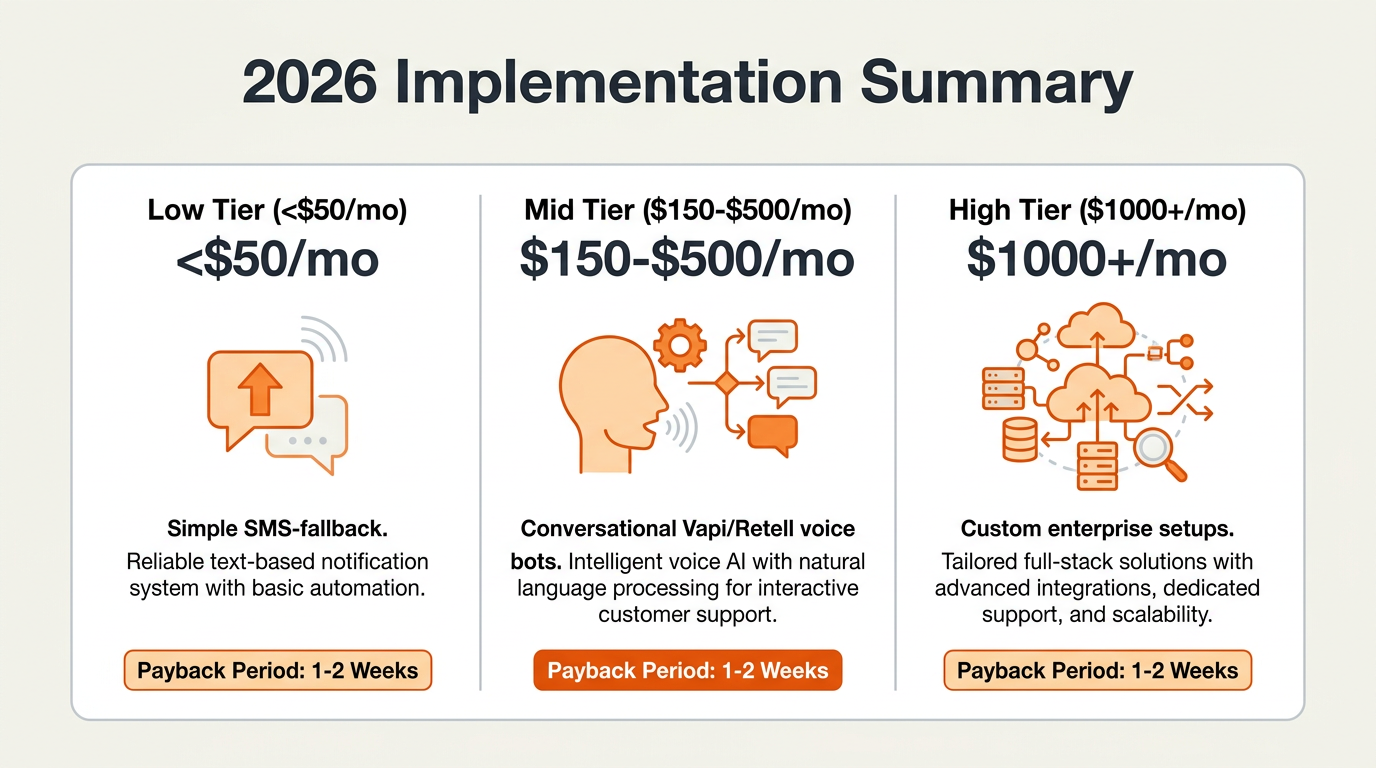
Transitioning from the theoretical ROI of missed-call recovery to actual, day-to-day deployment requires a clear understanding of your options. In 2026, small businesses no longer have to choose between a clunky, robotic IVR menu and an expensive, 24/7 human call center. Instead, conversational AI offers a scalable, low-latency middle ground that fits seamlessly into existing workflows.
Whether you operate a local plumbing business, a bustling dental clinic, or a multi-location auto repair shop, deploying an AI-driven system is highly accessible. Below is a breakdown of the primary deployment tiers available to small businesses today, comparing setup complexity, response times, and financial impact.
| Deployment Tier | Core Functionality | Response Time | Typical Monthly Cost | Best For |
|---|---|---|---|---|
| Tier 1: Smart SMS Back | Automatically triggers a text message if an inbound call is missed. | Under 10 seconds | $50 - $150 | Micro-businesses & independent contractors |
| Tier 2: AI Voice Callback | Automatically dials the lost lead back via an interactive AI voice agent. | Under 5 minutes | $150 - $400 | Local service providers (HVAC, auto shops) |
| Tier 3: 24/7 Inbound Agent | Live AI answers 100% of incoming calls, qualifies leads, and books into CRMs/calendars. | Immediate answer; sub-second to ~1.5s conversational latency | $300 - $800+ | High-volume clinics & professional services |
| Tier 4: Enterprise Custom | Multilingual, multi-channel agents integrated with custom backends. | Immediate answer; sub-second to ~1.5s conversational latency | Custom Quote | Multi-location franchises & regional enterprises |
Key Deployment Milestones: What to Expect
Implementing an AI lead-recovery system does not require overhauling your entire IT infrastructure. Modern platforms are designed to wrap around your current phone setup.
- Day 1: Connection & Call Routing: You connect your existing business phone line to your AI platform. Inbound calls that go unanswered are instantly forwarded to your designated AI agent number.
- Day 2: CRM & Calendar Integration: Connect your scheduling software (such as Google Calendar, Calendly, or industry-specific CRMs like ServiceTitan or Dentrix). This allows the AI agent to book, reschedule, or cancel appointments in real-time.
- Day 3: Custom Knowledge Base Training: Input your business hours, pricing structures, FAQs, and service areas. This ensures the conversational voice AI handles inquiries with exact, localized accuracy.
- Day 5: Live Launch & 97% Capture: By day five, your system is fully live. If a call is missed, the AI instantly engages. According to industry data from PxlPeak, businesses utilizing this automated workflow achieve up to a 97% call capture rate within their first week.
Choosing the Right Infrastructure
For businesses looking to implement this technology without complex coding, leveraging a robust infrastructure provider is key. Platforms like CallMissed simplify this transition by offering production-ready voice agent infrastructure, an LLM gateway accessing over 300 models, and incredibly low-latency Text-to-Speech and Speech-to-Text APIs supporting 22 Indian regional languages natively. This makes it easier than ever to build an agent that sounds human, responds with realistic conversational latency, and recovers lost opportunities before your prospects call a competitor.
Frequently Asked Questions
What is the main cause of the missed-call crisis for small businesses?
How does an AI voice agent for missed calls recover lost leads?
Can small businesses really expect a high ROI from missed-call recovery systems?
What is the difference between 2026 conversational voice AI and older IVR systems?
How do call analytics help optimize local service business operations?
Is it difficult to integrate an AI voice agent for missed calls into an existing business phone system?
Conclusion
As we navigate 2026, the era of letting valuable leads slip through the cracks of an unanswered telephone is officially over. Small businesses no longer have to choose between expensive 24/7 call centers and lost revenue. By replacing dead-end voicemails with intelligent automation, local service providers are turning operational vulnerabilities into immediate growth engines.
To future-proof your business today, keep these critical takeaways in mind:
- Capture every opportunity: Replacing rigid IVR menus with ultra-low-latency AI voice agents ensures natural, real-time qualification and instant CRM booking.
- Act within seconds: Pairing missed calls with immediate outbound callbacks and automated SMS workflows secures up to a 97% lead capture rate.
- Decide with data: Leveraging integrated call analytics allows you to track peak volumes, identify operational bottlenecks, and understand customer intent.
- Secure immediate ROI: Recovering missed connections can easily reclaim $3,000 to $6,000 in monthly revenue, paying for the technology within weeks.
Looking ahead, watch for deeper integration between voice AI and local search platforms, making instant, multilingual voice booking the standard expectation for every consumer. To explore how AI communication is evolving and start capturing every lead, check out CallMissed — an AI infrastructure platform powering advanced voice agents and multilingual chatbots for businesses.
Is your business ready to stop bleeding leads and let intelligent automation handle the heavy lifting?