Vapi vs CallMissed 2026: Voice AI API, Pricing and Features


Compare Vapi vs CallMissed for voice AI APIs, pricing structure, phone agents, Indian languages, WhatsApp follow-up, integrations, and deployment fit.
Vapi vs CallMissed 2026: Voice AI API, Pricing and Features
For small businesses that want a managed AI voice agent in 2026, CallMissed is a practical Vapi alternative when simplicity, localized calling, lead follow-up, and WhatsApp automation matter more than developer-level control. It is generally a better fit than Vapi for teams that want voice, telephony, AI, and workflows packaged together, while Vapi suits technical teams that need granular control over call logic and infrastructure.
CallMissed says it supports 22 Indian languages, which may help businesses serving regional customers with inquiries, qualification, and support. By contrast, Vapi lets developers choose and configure speech-to-text, LLM, text-to-speech, and telephony providers, but that flexibility can require more implementation and maintenance. The 7 Best Vapi Alternatives for AI Voice Agents in 2026 article highlights Leadlock’s claimed 100ms latency, illustrating why specialized alternatives may appeal when responsiveness is the priority.
Introduction: The Operational Battleground of AI Voice Agents

Verdict for July 2026: Choose Vapi if your engineering team wants a highly configurable voice AI API and is prepared to assemble, monitor, and optimize the underlying providers. Choose CallMissed if you want a faster-to-deploy AI phone agent API with managed telephony, Indian-language voice support, and built-in WhatsApp follow-up. Both can support inbound and outbound calling, but number coverage, availability, concurrency, regional restrictions, and pricing should be confirmed for your target countries.
The central difference is deployment ownership. Vapi provides a developer-first voice AI API for teams that want granular control over the speech, model, telephony, and integration stack. CallMissed takes a more managed approach, bringing more of the calling, localization, and follow-up workflow into one platform.
Vapi vs CallMissed: Quick Decision Table
| Decision factor | Vapi | CallMissed |
|---|---|---|
| Developer control | Developer-first orchestration with APIs, webhooks, tools, and configurable STT, LLM, and TTS providers. | Unified platform with APIs and managed components, optimized for operational deployment rather than assembling each provider separately. |
| Setup | More flexible, but teams typically configure multiple services, credentials, prompts, tools, monitoring, and failure handling. | More of the voice, telephony, localization, and follow-up workflow is provided within one platform. |
| Telephony | Supports inbound and outbound calling through supported numbers and telephony-provider configurations. Verify country coverage and carrier costs. | Supports inbound and outbound AI calling as part of its managed platform. Verify number availability, porting, concurrency, and regional restrictions. |
| Model choice | Broad provider flexibility is a core strength; exact models and features depend on current integrations. | CallMissed publishes support for a multi-model stack and 300+ models. Buyers should confirm which models are production-ready for voice and how routing is priced. |
| Indian languages and code-switching | Capability depends on the selected STT, TTS, and model providers, plus prompt and pronunciation configuration. | CallMissed publishes support for 22 Indian languages and localized code-switching, including Hindi and Hinglish use cases. Test with real accents, names, and noisy calls before purchase. |
| WhatsApp follow-up | Usually requires webhooks and a separate WhatsApp Business Platform or messaging integration. | Native voice-to-WhatsApp follow-up is a stated platform capability. Confirm template approval, BSP requirements, supported regions, and messaging charges. |
| Total-cost items | Include Vapi platform usage plus applicable telephony, STT, LLM, TTS, recording, storage, and integration costs. | Confirm subscription or usage charges, telephony, model usage, WhatsApp conversations, overages, implementation, and support. |
Which Vapi Alternative Fits Your Team?
Vapi is the stronger fit when provider portability and low-level pipeline control matter most. Its voice AI API lets developers build bespoke inbound or outbound agents, select compatible speech and model vendors, and connect business systems through APIs, tools, and webhooks. That flexibility also means the buyer generally owns more of the integration, observability, fallback design, testing, and vendor-cost management.
CallMissed is the more direct Vapi alternative for teams prioritizing deployment speed and unified customer follow-up. Instead of treating the voice AI API as one component in a larger stack, its managed deployment model covers more of the operational workflow. A call can continue into WhatsApp without the business building a separate recovery workflow, which can be useful for lead qualification, appointment booking, support, and dispatch operations.
For a multilingual voice agent, especially a Hindi or Hinglish voice agent, evaluate both platforms with recorded test scenarios rather than relying only on a language checklist. Measure recognition of regional accents, code-switching, proper nouns, interruptions, background noise, response latency, and handoff accuracy. The performance of any voice AI API can vary based on the selected models, prompts, telephony route, audio quality, and production environment.
How to Compare Vapi Pricing Fairly
Do not compare only the advertised platform rate. Vapi pricing may include separate charges from the selected telephony, speech, and model providers, while a managed platform may bundle some components and charge separately for others. The right comparison is the total cost of running the complete voice AI API workflow, not one per-minute or platform figure in isolation.
Before deciding, request a workload-based estimate covering monthly minutes, inbound and outbound calls, concurrency, phone numbers, recordings, storage, model usage, WhatsApp conversations, overages, implementation, support, and taxes. Published pricing and integration lists can change, so verify current terms directly with each vendor.
Overview of Options: Global Orchestration vs. Localized Powerhouse
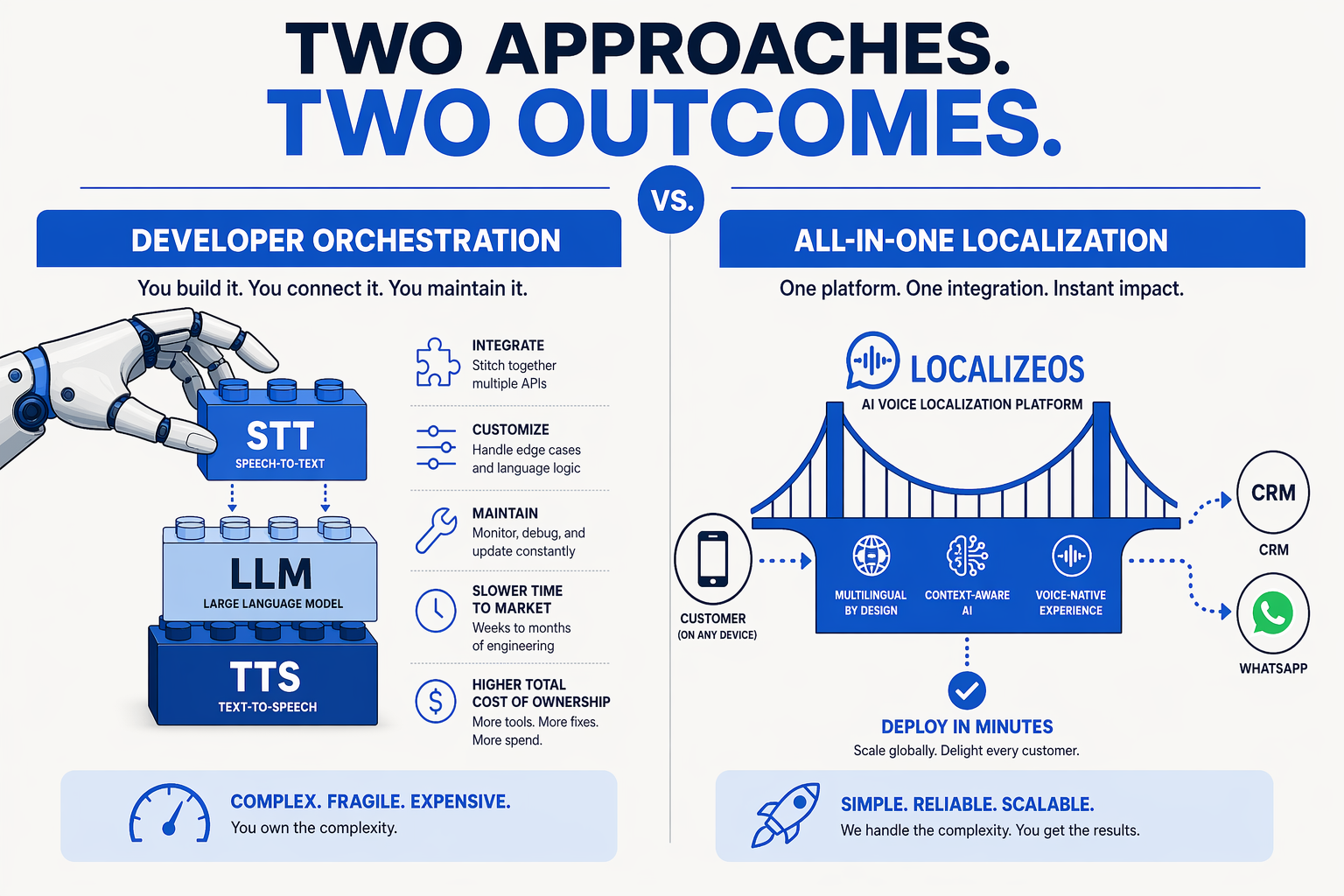
When deciding where to anchor your conversational AI infrastructure, the choice between Vapi and CallMissed represents a fundamental fork in architectural philosophy: global, modular orchestration versus deeply localized, business-ready execution. Understanding where each platform excels is critical for modern engineering and product teams aiming to maximize operational efficiency.
Vapi: The Global Orchestration Sandbox
Vapi is engineered as a highly customizable developer sandbox. It operates primarily as an orchestration layer, allowing engineering teams to stitch together their preferred external microservices.
- Modular Pipeline Construction: Vapi acts as the middleware connecting third-party Automatic Speech Recognition (ASR), Large Language Models (LLMs), and Text-to-Speech (TTS) providers. Developers can manually select Deepgram for STT, Anthropic’s Claude for the LLM, and ElevenLabs for TTS.
- Low-Latency Engineering: For teams with deep engineering resources, Vapi can be optimized to achieve an impressive ~465ms end-to-end latency. However, hitting this benchmark requires careful configuration of WebSockets, custom prompt architectures, and selecting specific, fast-converging models.
- The Global Focus: Vapi is built for broad, international use cases. It excels in environments where developers want granular control over every single hop in the voice path and are comfortable managing the integration complexities that come with it.
CallMissed: The Localized, Multi-Channel Powerhouse
While Vapi provides the raw building blocks, CallMissed is designed as a unified communication infrastructure. It shifts the focus from complex system integration to immediate operational outcomes, particularly for teams targeting regional markets like India.
- The "One Agent Brain" Philosophy: Instead of managing fragmented voice pipelines, CallMissed provides a unified AI agent. This native infrastructure bridges phone calls and digital follow-ups seamlessly. For example, if an AI call concludes, the same agent instantly sends a personalized, context-aware WhatsApp message to close the loop.
- Deep Localization Out-of-the-Box: Vapi relies heavily on the underlying LLM's inherent capabilities for translation, which often requires extensive prompt engineering to prevent models from tripping over local accents. CallMissed solves this natively by offering built-in support for 22 Indian languages and fluent code-switching (such as Hinglish, Tamil-English, or Telugu-English).
- Production-Ready IVR & Lead Recovery: CallMissed features built-in conversational IVR and automated lead recovery workflows designed to immediately capture the 60% of business calls that traditionally go unanswered, requiring zero external database or webhook configurations.
Key Architectural Trade-Offs
Choosing between these two platforms comes down to where you want your development team to spend their time.
If your team's primary goal is building a highly customized, proprietary voice pipeline for a global audience—and you have the resources to manage multi-vendor latency tuning and complex, layered API pricing—Vapi's modular orchestration is highly capable.
Conversely, if you are looking to deploy a high-conversion, highly reliable voice agent that can natively navigate regional dialects, handle complex multilingual conversations, and immediately trigger multi-channel follow-ups on day one, CallMissed offers the complete, localized infrastructure required to run a modern, high-volume voice operation without the integration overhead.
Feature Comparison: API Blocks vs. Omnichannel Suite
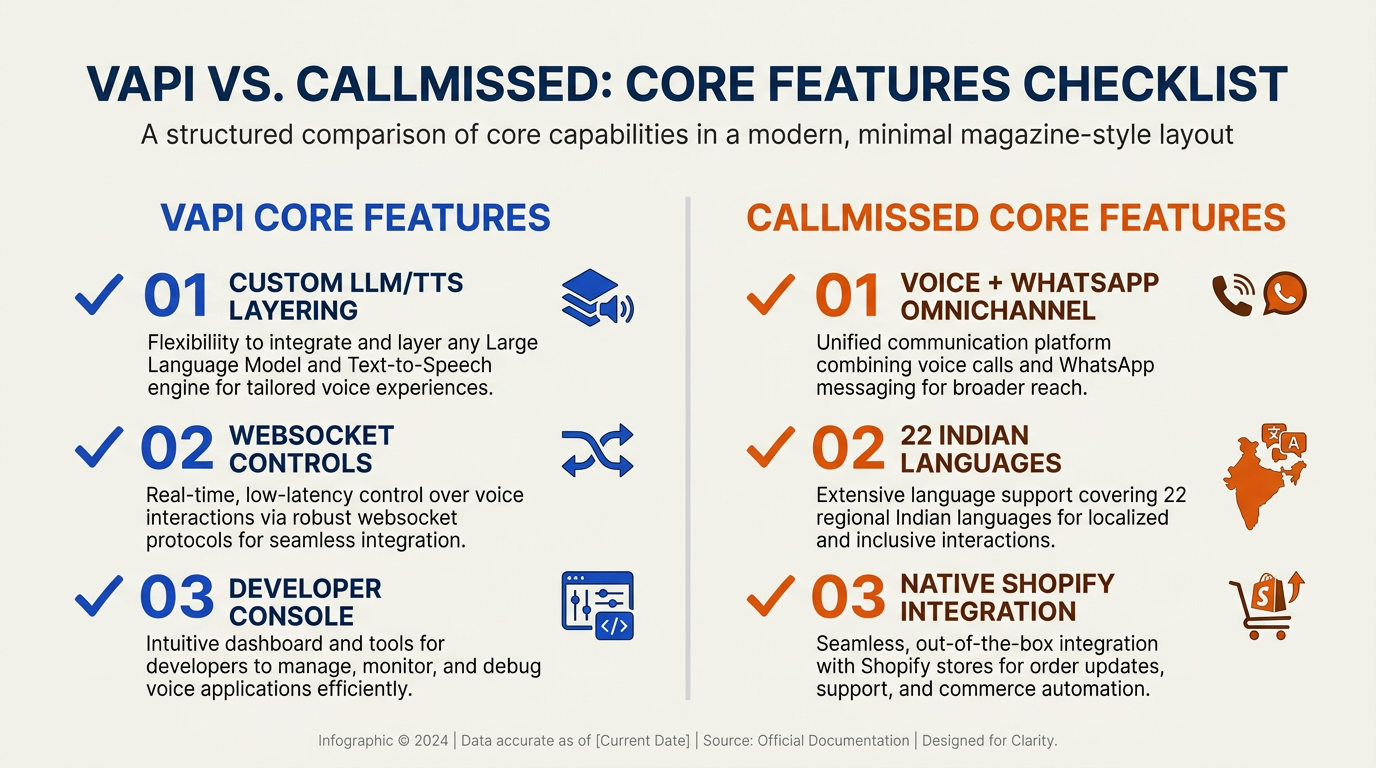
To truly understand the operational divergence between these two platforms, we must look at how they approach system architecture. Vapi operates primarily as a developer-first orchestration layer, requiring you to bring your own API keys or pay-as-you-go for layered services. You configure individual "blocks" (STT, LLM, and TTS) and stitch them together via websockets.
In contrast, CallMissed acts as an omnichannel communications suite. Instead of managing separate infrastructure for voice, text, and chat, CallMissed provides a unified "agent brain." When a customer speaks to your AI voice agent, the context is preserved natively. If the call drops or requires follow-up, the platform can immediately trigger a contextual WhatsApp message or SMS without requiring external middleware like Zapier or Make.
The table below breaks down the architectural, feature, and operational differences between Vapi’s modular block approach and CallMissed’s unified omnichannel suite.
Vapi vs. CallMissed: Architectural & Feature Breakdown
| Feature / Capability | Vapi (Developer API Blocks) | CallMissed (Omnichannel Suite) |
|---|---|---|
| Core Architecture | Modular orchestration layer (stitches together external STT, LLM, & TTS engines) | Unified conversational infrastructure (all-in-one voice, WhatsApp, & native LLM) |
| Pricing Model | Layered: $0.05/min platform orchestration fee + underlying LLM/TTS/STT costs | Flat, transparent per-minute pricing with all-in-one infrastructure |
| Multi-Channel Delivery | Voice only (requires external APIs & webhooks for WhatsApp or SMS follow-ups) | Native Omnichannel (one "agent brain" seamlessly handles Voice and WhatsApp) |
| Indian Language Support | Dependent on underlying models; struggles with local accents without heavy prompting | Native support for 22 Indian languages with fluent, built-in code-switching |
| Integration Effort | High; requires websocket management, prompt tuning, and backend orchestration | Low-to-Medium; production-ready UI, native IVR nodes, and rapid deployment templates |
The Developer Tax vs. Out-of-the-Box Localization
Choosing between these two models comes down to your engineering resources and target market:
- Vapi's Block Approach: For global teams who want absolute control over their pipeline—such as choosing AssemblyAI for STT, DeepL for translation, and Cartesia for TTS—Vapi offers unmatched granular control. However, developers must pay a "tax" in integration time. If you want your agent to send a WhatsApp message with a booking link after a call, you must write custom webhook handlers to pass variables from Vapi's system to your CRM and then to WhatsApp.
- CallMissed's Omnichannel Suite: For teams focused on high-conversion operations, CallMissed eliminates this friction entirely. The unified suite is built specifically to prevent lead drop-off. If an inbound call goes unanswered or is interrupted, the platform automatically triggers a personalized WhatsApp interaction. Furthermore, while Vapi requires complex prompt engineering to keep standard LLMs from tripping over regional Indian accents, CallMissed’s localized STT engine natively understands regional dialects and hybrid phrasing (like Hinglish or Tamil-English) out of the box.
Performance Analysis: Latency Tuning vs. Out-of-the-Box Stability
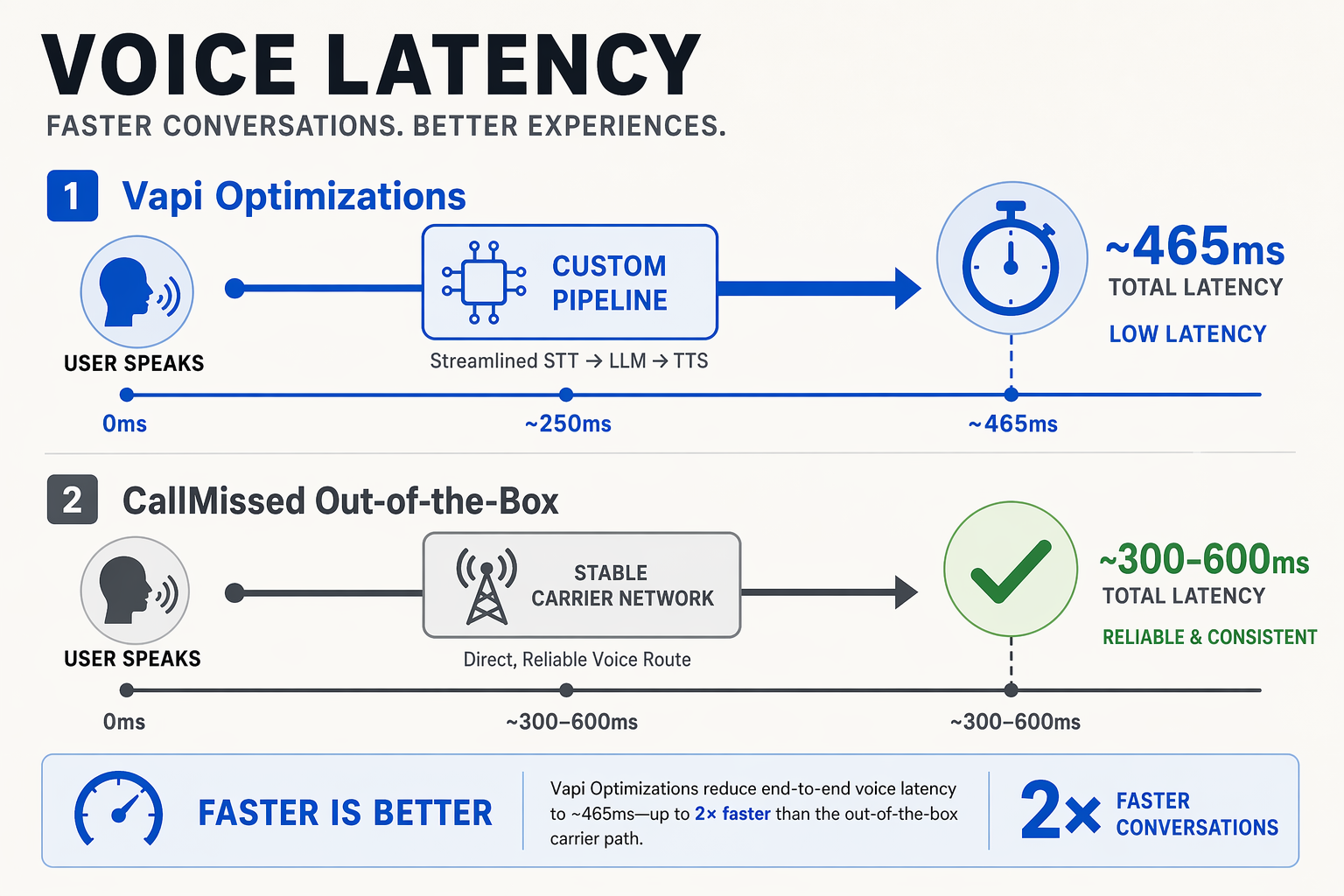
In the high-stakes environment of live voice operations, a delay of even a few hundred milliseconds can make the difference between a natural, fluid conversation and an awkward, disjointed user experience. When building voice agents, teams must weigh two distinct paths: pursuing hyper-optimized, manual latency tuning or opting for predictable, out-of-the-box system stability.
The Developer-First Approach: Vapi’s Manual Latency Tuning
For engineering teams with dedicated DevOps resources, Vapi offers a highly modular playground. It is designed as an orchestration layer where you can stitch together independent, best-in-class components.
- The Latency Ceiling: With rigorous tuning, developers can configure Vapi to achieve an impressive end-to-end latency of approximately ~465ms. This is fast enough to mimic human conversational pacing closely.
- The Engineering Tax: Achieving this sub-500ms response time is not an out-of-the-box guarantee. It requires manually configuring and optimizing:
- Fast, regionalized Speech-to-Text (STT) engines (such as Deepgram or AssemblyAI).
- Low-latency Large Language Models (LLMs) (like Groq-hosted LLaMA models).
- Highly responsive Text-to-Speech (TTS) providers (like Cartesia or ElevenLabs).
- Custom WebSockets to manage audio streaming and state synchronization.
Because Vapi operates as a pass-through coordinator, any network jitter, cold start, or API slowdown from one of these external third-party providers directly degrades your live agent's response time. If a selected LLM provider experiences a temporary spike in TTFT (Time to First Token), the voice agent immediately stutters in production.
The Infrastructure Approach: CallMissed's Out-of-the-Box Stability
For teams that prioritize operational uptime and conversion rates over constant pipeline maintenance, CallMissed takes a fundamentally different architectural path. Instead of forcing developers to orchestrate multiple distinct API contracts, CallMissed functions as a unified, production-ready AI communication infrastructure.
- Unified "Agent Brain": CallMissed manages the entire pipeline—STT, LLM inference, and TTS—within a single, highly optimized stack. This vertically integrated architecture minimizes the network hops that typically occur when passing audio and text payload data across multiple external vendor APIs.
- Fail-Safe Reliability: By bypassing the fragile web of external WebSocket connections and layered API gateways, CallMissed delivers highly consistent, sub-second latencies without requiring manual performance tuning.
- Multi-Channel Synchronicity: Because the "brain" is unified, the system doesn't just manage the voice stream; it keeps the multi-channel context intact. If a call drops mid-conversation, CallMissed's platform can instantly trigger a contextual WhatsApp follow-up without needing custom webhook logic to tie separate systems together.
The Operational Verdict
If your team has the engineering bandwidth to monitor, benchmark, and continuously adjust individual STT, LLM, and TTS endpoints, Vapi's modularity offers unparalleled customization. However, for teams focused on immediate deployment, reliable call handling, and localized performance, CallMissed eliminates the development overhead. It provides a stable, highly optimized environment that performs consistently from day one, allowing your product team to focus on conversation design rather than infrastructure troubleshooting.
Languages & Localization: The Power of Vernacular Support

When deployed in highly diverse regional markets like India, an AI voice agent’s success hinges entirely on its ability to understand how real people actually speak. This is where the structural architectures of Vapi and CallMissed diverge dramatically.
Vapi’s Global Approach: The Downstream Dependency
Vapi approaches localization as a modular orchestrator. Because Vapi does not own its underlying Speech-to-Text (STT) or Text-to-Speech (TTS) models, it relies on third-party providers (like Deepgram, ElevenLabs, or PlayHT) to handle regional accents and languages.
While this gives developers the freedom to plug in any global model, it introduces significant operational challenges in localized environments:
- The Prompt Engineering Tax: To get global LLMs to understand code-switching (such as mixing Hindi and English into "Hinglish," or Tamil and English into "Tanglish"), developers must write exhaustive system prompts. Even then, the underlying models often struggle to maintain conversational context when regional dialects shift mid-sentence.
- Layered Latency: Passing audio from Vapi to an external STT, then to a regional LLM, and finally to a localized TTS engine introduces multiple network hops. While Vapi can achieve ~465ms latency in optimized English environments, this latency frequently spikes when routing through specialized regional translation models.
- Fragmented Accent Recognition: Global STT engines often fail to parse the diverse range of localized accents, leading to high Word Error Rates (WER) and frustrated callers who are forced to repeat themselves.
CallMissed’s Native Vernacular Engine
In contrast, CallMissed is purpose-built to handle complex regional linguistic landscapes out of the box. Instead of forcing developers to stitch together multiple translation APIs, CallMissed provides native, deep-level support for 22 Indian languages along with fluent, natural code-switching.
- Native Code-Switching: CallMissed’s conversational engine inherently understands "Hinglish," "Kanglish," and other blended regional dialects without requiring complex prompt engineering. The AI naturally transitions between languages just like a human agent would, drastically improving customer trust and call completion rates.
- Built-in Regional STT and TTS: By utilizing native Speech-to-Text APIs optimized for Indian dialects, CallMissed eliminates the accuracy drop-off associated with global engines. It accurately captures localized slang, colloquialisms, and distinct regional accents on the first try.
- Consistent Latency Across Languages: Because CallMissed utilizes an integrated "one agent brain" architecture, regional calls do not suffer from the latency penalties of multi-hop API chains. Whether the caller speaks Bengali, Marathi, or Telugu, the system maintains a rapid, natural conversational cadence.
For modern teams, the choice comes down to your target demographic. If your users communicate exclusively in standard global languages, Vapi's modular orchestration is highly effective. However, if your business operates in regional markets where vernacular fluency and code-switching are critical to locking in leads, CallMissed offers a production-ready infrastructure that works natively from day one.
Designing the Ideal Automation Workflow: Vapi vs. CallMissed
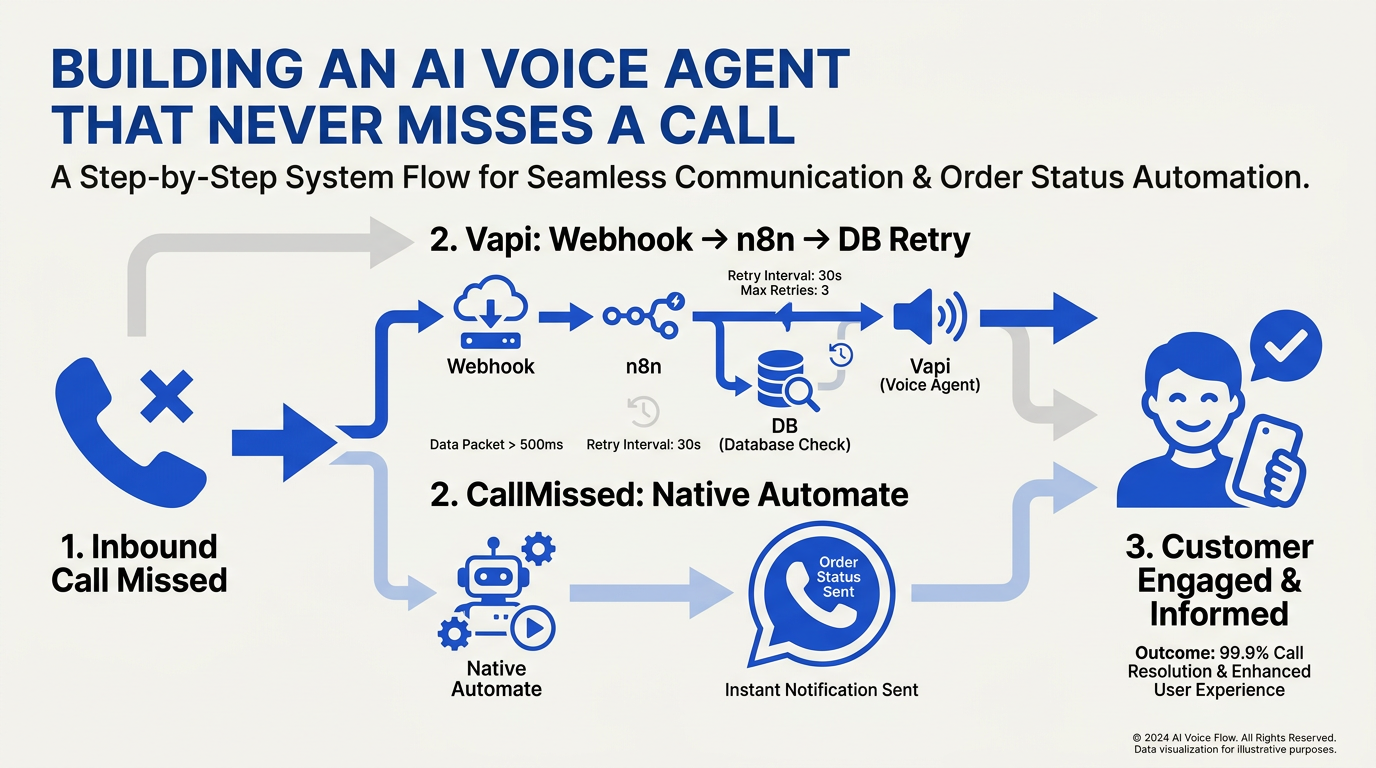
When architecting a production-ready conversational pipeline, the choice between Vapi and CallMissed represents a fundamental fork in your development roadmap. Vapi acts as an open-ended, modular playground that expects you to build your own infrastructure, while CallMissed operates as a unified, business-ready ecosystem where voice calls, databases, and multi-channel follow-ups are tightly integrated out-of-the-box.
Here is how the workflow design differs when building on both platforms:
The Vapi Blueprint: Custom Orchestration and Middleware Taxes
To build a functional customer-facing automation on Vapi, developers must design and maintain a multi-tiered architecture. Because Vapi focuses strictly on the voice-call orchestration layer, it treats every other action as an external event.
- The Integration Web: To trigger a post-call action—such as sending a WhatsApp confirmation or updating a CRM—your engineering team must set up and monitor custom webhooks.
- State Management: Because Vapi operates statelessly during the call, maintaining context across multiple customer interactions requires you to build and host an external database or middleware layer to feed context back into the LLM prompt.
- Component Fragmentation: If a call drops or requires a follow-up, your system must trigger external APIs (like Twilio or a separate WhatsApp gateway) via custom code, adding points of failure to your deployment.
While this approach is highly customizable, it demands significant developer overhead to keep websocket connections, external database states, and third-party APIs synced in real time.
The CallMissed Blueprint: Unified "Agent Brain" and Native Multi-Channel
CallMissed approaches automation from a holistic business perspective. Instead of treating voice as an isolated silo, CallMissed utilizes a single, unified "agent brain" that natively bridges voice operations with instant multi-channel actions.
- Native WhatsApp & SMS Handover: If an AI voice agent on CallMissed books an appointment, the platform can automatically trigger a WhatsApp confirmation message instantly—without requiring external API integrations, complex webhook routing, or third-party subscriptions.
- No-Code IVR to AI Transitions: CallMissed allows teams to build hybrid workflows where traditional, reliable IVR menus seamlessly hand over to advanced, conversational AI agents when complex queries arise.
- Automated Lead Recovery: Designed specifically to tackle the 60% of unanswered business calls, CallMissed features built-in trigger workflows. If an inbound call is missed due to high queue volumes, the platform instantly initiates a conversational AI call-back or launches an automated WhatsApp chat to engage the prospect before they bounce to a competitor.
Architectural Decision Matrix
To help your engineering and product teams choose the right architectural path for your 2026 stack, consider this direct workflow comparison:
- Triggering Actions: Vapi relies on external webhooks and custom-coded API integrations. CallMissed uses native, built-in triggers for SMS, WhatsApp, and database updates.
- State & Context Preservation: Vapi requires external middleware to pass customer history to the LLM. CallMissed maintains native, persistent customer profiles across both voice and text channels.
- Operational Goal: Vapi is optimized for developers building highly bespoke, voice-only applications. CallMissed is optimized for teams focused on lead conversion, instant customer follow-ups, and reliable regional automation.
Behind the Scenes: How to Troubleshoot Call Errors & Missed Connections

In production environments, a voice agent is only as good as its reliability. When a customer hangs up because of a choppy websocket connection, an unhandled API timeout, or a misconfigured SIP trunk, you lose more than a call—you lose revenue. Troubleshooting these issues reveals the stark operational differences between Vapi’s decentralized modularity and CallMissed’s unified infrastructure.
The Debugging Maze: Diagnosing Failures in Vapi
Because Vapi operates as an orchestration layer, diagnosing a failed call requires tracing errors across multiple independent services. When an agent abruptly stops speaking or drops a connection, the root cause could lie in any of the stitched components:
- Websocket & Telephony Drops: If the SIP provider or WebRTC connection experiences packet loss, Vapi's orchestrator can struggle to maintain state, resulting in premature hang-ups.
- Layered API Timeouts: Vapi relies on external APIs for speech-to-text (STT), large language models (LLMs), and text-to-speech (TTS). A spike in latency from your LLM provider can easily push the conversation past the ~465ms optimal response window, causing jarring silence or overlapping speech.
- State Machine Desynchronization: Developers must manually configure and parse webhook payloads to track user intent, tool calls, and post-call data transfers. If a database write fails, the entire post-call follow-up pipeline stalls.
To debug these issues, developers must aggregate and correlate logs from Vapi’s dashboard, their LLM provider console, and their SIP carrier—turning simple troubleshooting into a multi-platform monitoring chore.
Built-In Resilience: How CallMissed Simplifies Error Handling
CallMissed mitigates these operational failures by consolidating the entire voice stack into a single, cohesive infrastructure. Because CallMissed manages the end-to-end pipeline—from localized STT (supporting 22 Indian languages) to LLM execution and SIP delivery—the platform eliminates the "pointing fingers" problem of multi-vendor architectures.
[Inbound Call] ──> [CallMissed Native SIP Trunk] ──> [Unified Voice Pipeline (STT/LLM/TTS)] ──> [Automated Lead Recovery]
                                                                                                        │
                                                                                    (If disconnect) ────┴──> [Instant WhatsApp/SMS]
CallMissed prevents missed connections and handles errors through built-in platform safeguards:
- Unified Monitoring and Logs: Instead of parsing logs across three different API providers, developers can view the complete lifecycle of a call—including latency breakdowns, transcription accuracy, and connection health—within a single CallMissed console.
- Graceful Degraded States: If an LLM response times out, CallMissed’s native system can fall back to pre-recorded audio prompts or transfer the call to a live agent seamlessly, maintaining a professional user experience.
- Automatic Lead Recovery: If a call drops midway due to network instability, CallMissed’s omnichannel integration instantly triggers. The platform utilizes its "one agent brain" to send an immediate follow-up message via WhatsApp, SMS, or email, summarizing the conversation and offering a scheduling link to recover the lead automatically.
Proactive Strategies for Peak Call Performance
To maintain a zero-drop voice architecture, engineering teams should implement these production-ready practices:
- Enforce Strict Timeout Thresholds: Set aggressive timeouts (e.g., 2.5 seconds max) for your LLM generation steps. If a custom model fails to respond, fall back to a lightweight, fast-inference backup model. CallMissed’s multi-model API gateway allows you to transition between 300+ LLMs instantly without writing complex failover scripts.
- Optimize Speech-to-Text Chunking: Avoid sending massive audio chunks. Stream audio in small, 100-200ms payloads to keep transcription latency low and allow the agent to respond to user interruptions naturally.
- Deploy Localized Edge Infrastructure: Minimize the physical distance between your telephony servers and your target audience. For businesses operating in regional markets, utilizing Indian-localized infrastructure ensures that voice packets do not have to travel round-trip to US-based servers, dramatically reducing packet loss and jitter.
Pricing & Value: Calculating the Total Cost of Ownership
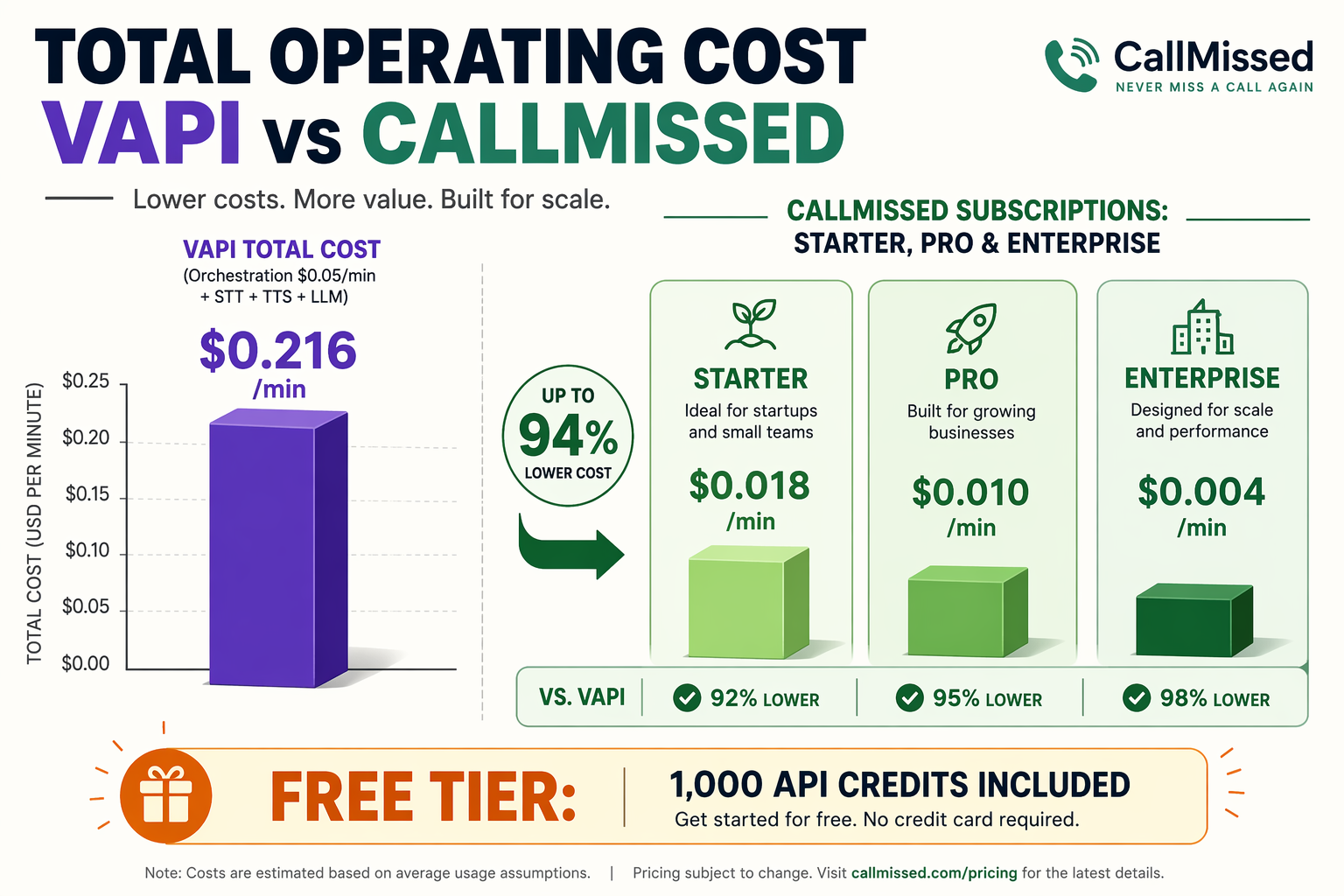
When evaluating the cost of deploying conversational AI, looking solely at advertised base rates can lead to severe budgeting errors. Engineering and product teams must calculate the Total Cost of Ownership (TCO), which includes platform orchestration fees, layered API costs (STT, LLM, and TTS), telephony overhead, and the developer resources required to maintain the pipeline.
Decoding Vapi’s Layered Pricing Model
Vapi operates on a modular, developer-centric billing structure. While its marketing highlights a flat $0.05 per minute orchestration fee, this is not the final price. To run a functional agent, you must layer on the costs of third-party providers. In a typical production setup, your actual per-minute cost is the sum of:
- Vapi Orchestration: $0.05/min
- Speech-to-Text (STT): ~$0.011 to $0.015/min (e.g., Deepgram)
- Large Language Model (LLM): ~$0.002 to $0.015/min (dependent on token usage and model selection like GPT-4o-mini or Claude 3.5 Sonnet)
- Text-to-Speech (TTS): ~$0.015 to $0.030/min (e.g., Cartesia or ElevenLabs)
- Telephony: ~$0.005 to $0.010/min (e.g., Twilio carrier costs)
When these variables are aggregated, Vapi’s real-world cost ranges from $0.08 to $0.12+ per minute. Furthermore, because you pay for what you consume across multiple vendors, your monthly billing is highly fragmented and unpredictable.
Analyzing CallMissed’s Unified, Value-First Pricing
In contrast, CallMissed is built as an all-in-one communications infrastructure. Instead of forcing teams to manage separate API keys, usage limits, and bills for five different vendors, CallMissed consolidates these layers into a single, highly competitive predictable rate. Because CallMissed utilizes its own optimized, built-in STT (supporting 22 Indian languages) and proprietary LLM inference gateway (with access to 300+ models), it eliminates the "middleman tax" associated with multi-vendor orchestration. This unified architecture translates to direct cost savings, particularly for high-volume customer support and localized lead-recovery campaigns.
Total Cost of Ownership (TCO) Comparison
The table below breaks down the pricing architecture, hidden costs, and resource overhead of both platforms as of 2026.
| Cost Component | Vapi AI | CallMissed AI |
|---|---|---|
| Base Platform Fee | $0.05 / minute | All-inclusive bundled pricing |
| Average Production Cost | $0.08 to $0.12+ / minute (layered) | $0.04 to $0.07 / minute (unified) |
| Third-Party API Keys | Required (STT, LLM, TTS, Telephony) | None (fully built-in, ready to run) |
| Multi-Channel Integrations | Extra (requires external Zapier/Make) | Native (included WhatsApp follow-ups) |
| DevOps Maintenance | High (websocket & prompt monitoring) | Low (managed infrastructure & APIs) |
The Developer Resource Tax
Beyond the per-minute billing, teams must account for engineering maintenance. Vapi's modularity means your developers are responsible for monitoring websocket stability, optimizing prompt architectures to prevent regional accent errors, and troubleshooting API latency spikes across different vendors.
With CallMissed, the engineering overhead is virtually eliminated. You get an out-of-the-box system where voice operations, localized dialect handling, and automated multi-channel follow-ups (like triggered WhatsApp messages) are handled within a single dashboard, delivering a significantly higher ROI for modern, lean teams.
Pros and Cons: Which Platform Fits Your Team?
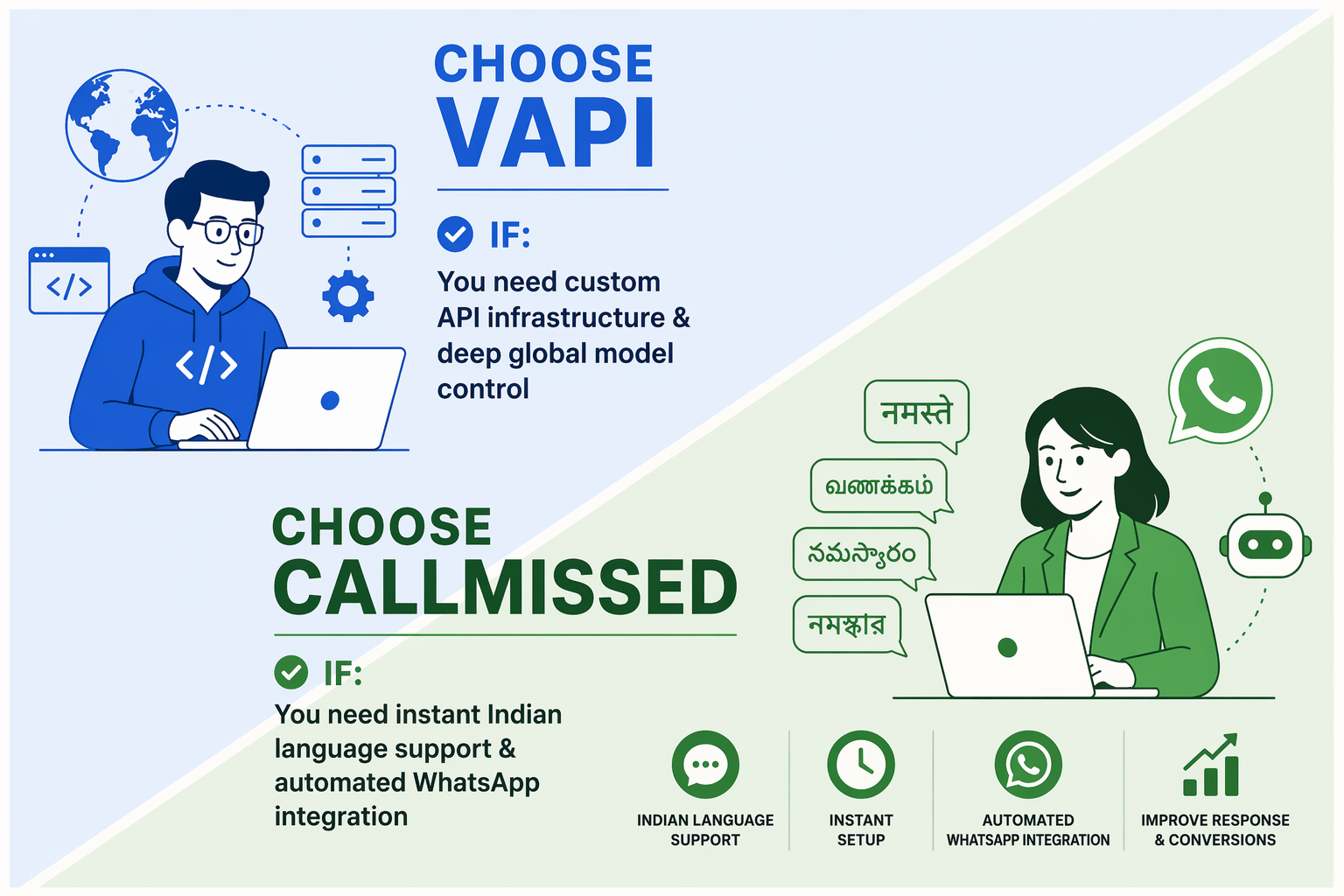
Choosing between Vapi and CallMissed comes down to your team’s engineering capacity, localization needs, and core business goals. While both platforms deliver powerful conversational AI, they serve fundamentally different operational philosophies.
To help your team make the right architectural decision for 2026, we have summarized the practical pros and cons of each platform below.
The Architectural Divide at a Glance
| Feature / Metric | Vapi | CallMissed |
|---|---|---|
| Primary Focus | Global developer-first voice orchestration | Localized, high-conversion voice & IVR platform |
| Pricing Model | $0.05/min platform fee + layered provider costs | Unified, predictable flat-rate pricing |
| Language Strengths | Broad global languages (relies on third-party models) | Deep native support for 22 Indian languages & code-switching |
| Multi-Channel Native | Voice only (requires external webhook integration) | Native omnichannel (Voice + WhatsApp "Single Agent Brain") |
| Integration Effort | High (requires manual WebSocket and API assembly) | Low to Medium (production-ready communication infrastructure) |
Vapi: The Developer-First Orchestrator
Vapi is designed for highly technical engineering teams who want to build, test, and control every single node of their conversational pipeline. It acts as an abstraction layer over your chosen STT, LLM, and TTS providers.
The Pros:
- Extreme Modular Customization: Vapi lets you stitch together virtually any combination of external engines (such as AssemblyAI, Deepgram, OpenAI, or ElevenLabs).
- Ultra-Low Latency Potential: For teams willing to spend time optimizing their pipeline, Vapi can achieve an impressive ~465ms end-to-end latency, fast enough for fluid, natural human-agent conversations.
- Granular Developer Control: You have direct access to WebSocket streams, custom assistant configurations, and detailed prompt architectures.
The Cons:
- Complex Cost Layering: Vapi's base platform fee of $0.05 per minute is just the starting point. The real cost of running a Vapi agent is significantly higher once you layer on separate billing for telephony, LLM tokens, and TTS/STT generation, making budget forecasting highly complex.
- High Maintenance Overhead: Your engineering team remains responsible for managing API keys across multiple vendors, handling provider downtime, and maintaining complex prompt engineering to handle regional dialects.
CallMissed: The Localized Conversion Powerhouse
CallMissed is built for modern teams that need a reliable, high-converting voice infrastructure out-of-the-box, particularly those operating in linguistically diverse markets like India where multi-channel follow-ups are critical.
The Pros:
- Native Multilingual Capabilities: CallMissed features built-in Speech-to-Text and Text-to-Speech support for 22 Indian languages. It natively handles complex regional code-switching (like Hinglish or Tamil-English) without requiring delicate prompt tuning.
- Unified Omnichannel Operations: Instead of managing separate voice and messaging bots, CallMissed provides a "single agent brain" that seamlessly connects inbound voice calls to immediate WhatsApp automations and SMS follow-ups.
- Predictable All-in-One Pricing: By consolidating LLM inference (with access to over 300+ models), STT, TTS, and telephony into a unified infrastructure, CallMissed eliminates the layered pricing tax, making it highly cost-effective for high-volume operations.
The Cons:
- Less Granular Pipeline Tinkering: If your developers want to manually route audio packets or write custom orchestration middleware, CallMissed’s unified infrastructure offers less low-level system exposure compared to Vapi.
- Focus on Localized Markets: While highly capable globally, CallMissed’s unique features—such as deep Indian regional language support—are specifically optimized for teams targeting high-conversion, multi-channel customer journeys in these complex regional landscapes.
Frequently Asked Questions
How do Vapi and CallMissed compare in their pricing models?
Which platform is better for handling regional Indian languages and code-switching?
Can Vapi match CallMissed’s multi-channel WhatsApp and voice agent integration?
What are the latency differences when building an AI voice agent on these platforms?
Is CallMissed or Vapi easier for product teams to deploy without heavy engineering resources?
How do these platforms handle missed calls and lead recovery?
Conclusion
Choosing the right platform to ensure your business never misses another high-value customer call comes down to your team's specific engineering resources and localization needs:
- Vapi provides a highly customizable, developer-centric orchestration layer that is ideal for teams who want to manually optimize latency down to ~465ms and manage their own modular LLM, STT, and TTS pipelines.
- CallMissed delivers an all-in-one conversational infrastructure built for high-conversion operations, offering native multi-channel lead recovery (bridging Voice and WhatsApp) and out-of-the-box support for 22 Indian languages with fluent code-switching.
- Operational Simplicity remains the deciding factor; while Vapi requires managing complex websocket connections and layered pricing, CallMissed eliminates developer overhead with a unified agent brain and robust, localized IVR capabilities.
As voice AI matures throughout 2026, the industry is moving away from fragmented, multi-vendor setups toward consolidated, business-ready communication stacks that natively handle regional dialects and immediate multi-channel follow-ups.
Are you ready to stop losing 60% of your inbound leads to missed calls? To explore how AI communication is evolving, check out CallMissed — an AI infrastructure platform powering voice agents and multilingual chatbots for businesses.
Related Reading
- Never Lose a Lead: How CallMissed is Revolutionizing Inbound Call Automation and Customer Support with Multilingual AI Voice Agents
- Call Missed Protection in CallMissed: How AI Helps You Never Miss a Customer Call
- Never Lose a Table Again: How "Missed Call to WhatsApp" and AI Voice Agents Are Saving Restaurant Bookings