AI voice agent data privacy: Questions Before Deployment



AI voice agent data privacy starts with evidence. Get a checklist for storage, consent, retention, training permissions and prelaunch tests.
AI voice agent data privacy: Questions Before Deployment
Could a customer’s most sensitive disclosure travel farther than the AI agent answering the call? AI voice agent data privacy starts with that question—not with whether the agent sounds human, but with what happens to the information customers share.
A caller might mention a medical appointment, dictate an address, or explain a payment dispute. Depending on the deployment, that conversation could produce audio recordings, transcripts, summaries, application logs, and CRM entries. Each copy creates another privacy question: who receives it, why it exists, and when it disappears. Protecting the original recording is not enough if the transcript survives indefinitely elsewhere.
That concern is gaining attention. Enterprise DNA’s September 30, 2026 AI Pulse reported that “A Privacy Analysis of Web and Mobile Conversational AI Agents” had attracted 421 points on Hacker News. The supplied discussion brief captured another snapshot: 408 points and 130 comments within 16.7 hours. Those changing totals measure interest, not the severity of any particular vulnerability—but they show that conversational AI privacy is attracting scrutiny beyond compliance teams.
The research title concerns web and mobile agents, yet the deployment questions extend naturally to voice systems. A voice agent may combine speech recognition, a language model, speech generation, business tools, and storage services. Before trusting the complete experience, you need to understand the complete data flow. A vendor’s reassuring answer about one component does not establish what every downstream provider does.
What privacy questions should you ask before deployment?
This guide turns broad privacy concerns into questions your product, engineering, security, and procurement teams can actually verify:
- Where is your customer data stored? Ask about primary storage, backups, processing locations, and third-party providers—not just the platform’s headquarters.
- Are the AI calls recorded and stored? Separate retention rules for audio, transcripts, summaries, logs, and exported CRM records.
- Will customer conversations be used to train AI? Request contractual terms covering the platform and its model providers.
- Who can access conversations? Examine permissions, support access, and the evidence available to review access.
- Can you delete every relevant copy? Check deletion workflows, backup exceptions, and what happens after data reaches connected tools.
As of October 2026, CallMissed offers call recordings, transcripts, AI call notes pushed to CRM, and an India-hosted platform—capabilities that make these deployment questions concrete, without establishing where every downstream copy resides.
The goal is not to avoid conversational AI. It is to deploy with documented boundaries: collect less, retain deliberately, restrict access, and verify promises before real customers speak.
Before deployment, verify data storage, recording consent, retention, training use, access and deletion
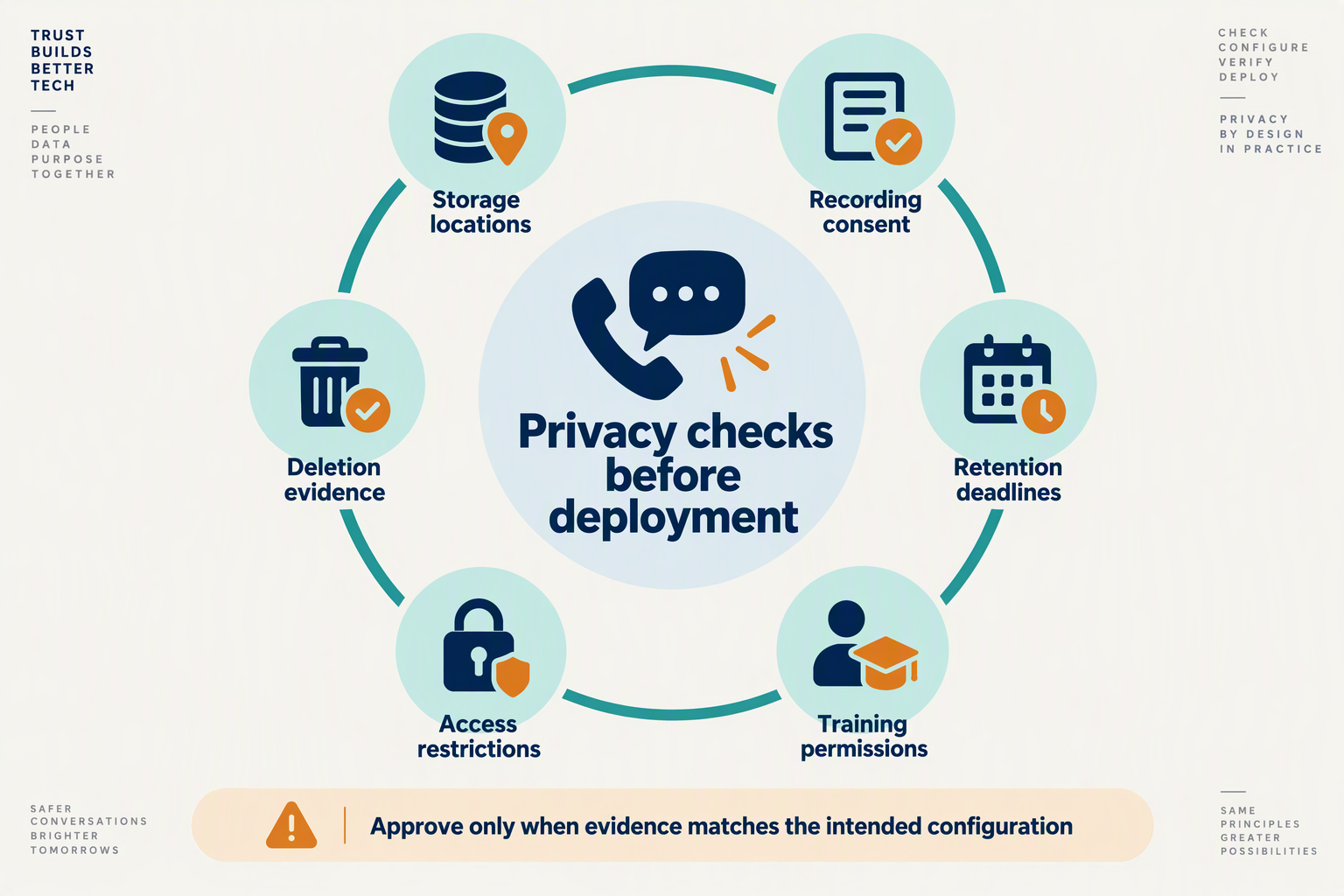
Before deployment, verify six controls with evidence: storage locations, recording consent, retention periods, training permissions, access rights, and deletion procedures. Treat an unanswered question as an unresolved deployment risk—not as permission to proceed.
Enterprise DNA’s September 30, 2026 coverage of “A Privacy Analysis of Web and Mobile Conversational AI Agents” highlights why scrutiny matters. The supplied snippets do not establish the paper’s detailed findings, so use the discussion as a prompt for verification—not proof that a particular vendor is unsafe.
What evidence should a conversational AI vendor provide?
Create a deployment evidence register rather than another yes/no questionnaire. Each control needs an accountable owner, supporting documentation, a test where possible, and a decision:
- Storage: Request a data-flow diagram covering processing, primary storage, backups, and subprocessors. “Hosted in India” or another country does not, by itself, establish the location of every model request or exported record.
- Recording consent: Document when recording begins, what notice customers receive, and how refusal works. Have legal counsel assess applicable jurisdictions; do not assume one announcement satisfies every recording law.
- Retention: Obtain separate rules for audio, transcripts, summaries, operational logs, and business-system exports. Identify the event that starts each retention clock.
- Training use: Request contractual terms covering the platform and downstream model providers. Distinguish model training from troubleshooting, evaluation, abuse monitoring, and human review.
- Access: Review permissions for administrators, supervisors, support personnel, and integration credentials. Ask what evidence records privileged access.
- Deletion: Verify the workflow, completion timeframe, backup treatment, and responsibility for copies in connected systems.
A privacy policy is supporting evidence, not a substitute for deployment-specific answers.
How should you test recording consent and retention?
Run a synthetic customer journey before admitting real users. Use fictional details and check what happens when the customer accepts recording, declines it, or asks for deletion mid-conversation.
For a hypothetical appointment agent, the test might be:
- The agent delivers the approved notice before recording begins.
- The customer declines; the workflow follows a documented alternative, if available.
- An accepted conversation generates only the artifacts approved for that use case.
- Each artifact expires according to its own configured policy.
For illustration—not as a legal standard—a team might retain audio for 7 days and a service summary for 30 days. The important question is whether those different periods are justified, implemented, and tested, rather than inherited from defaults.
Can connected tools undermine your privacy controls?
Yes. A tightly controlled conversation can still create persistent records through tool calls, memory, or CRM updates.
As of October 2026, CallMissed supports custom REST tools, agent memory, and per-contact memory. These capabilities make integrations useful, but deployment teams should explicitly document what information each configured tool or memory workflow receives and how it is governed.
Test with a unique synthetic marker, then search for that marker across authorized destinations. Submit a deletion request and verify its removal from active systems, while documenting any disclosed backup exceptions. A successful deletion in the agent interface does not prove deletion everywhere.
When is a privacy review complete enough to launch?
Launch only when material questions have documented answers and unresolved risks have named owners. Limit the initial deployment’s data collection and scope; repeat the review whenever models, integrations, recording settings, or retention policies change.
What should you verify in the trending “A Privacy Analysis of Web and Mobile Conversational AI Agents” paper?
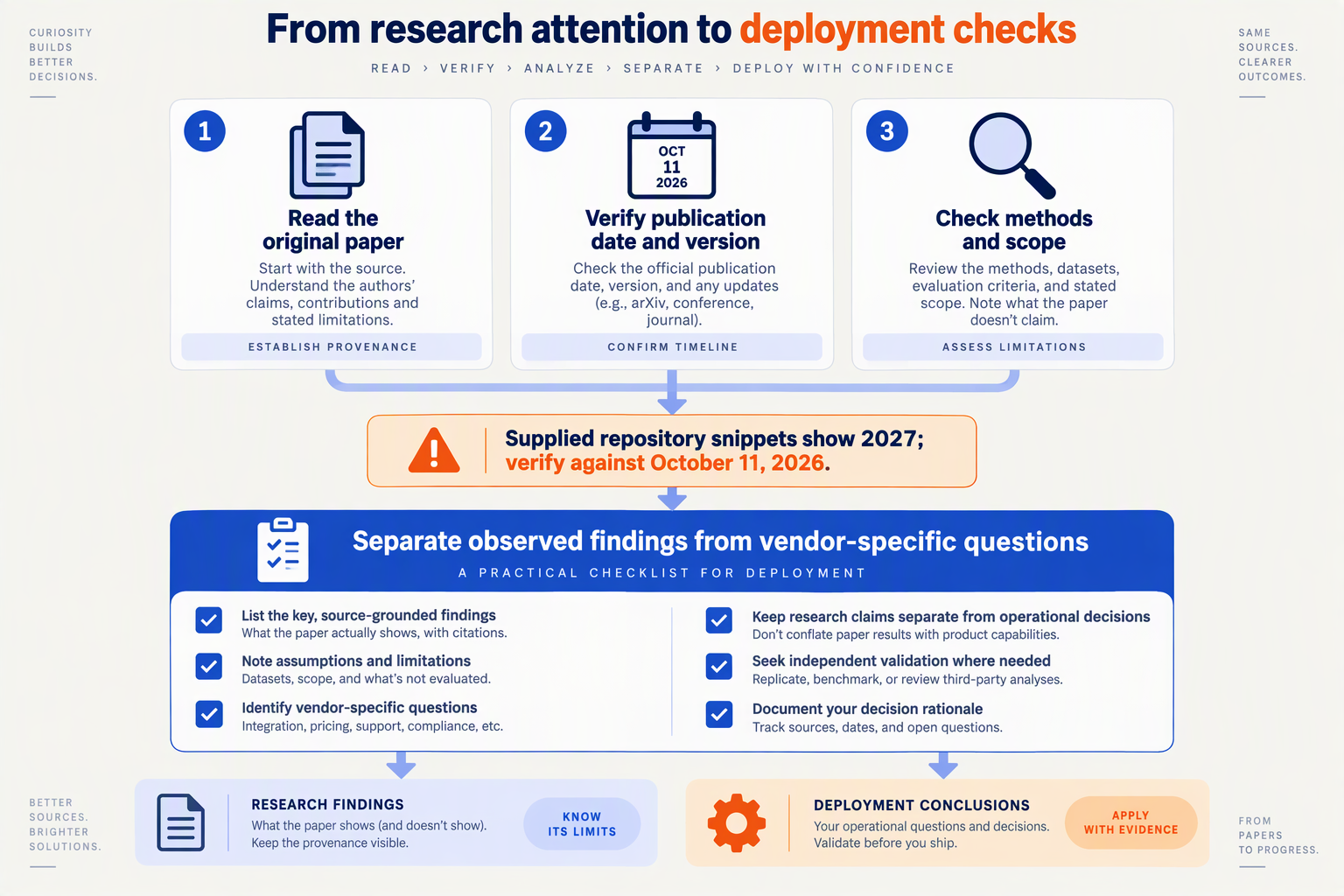
Verify the paper’s identity, testing scope, evidence, and limitations before turning its findings into deployment requirements. A study of web and mobile conversational AI agents can inform AI voice agent data privacy, but only where the tested data flows resemble your own system.
Is this the original paper or commentary about it?
Start with the original PDF, not a discussion summary. The supplied Hacker News listing links to a PDF hosted on Jorge García Herrero’s website; the supplied WindowsForum result identifies the fuller title as “Prompt like a Butterfly, Sting like a Tracker: A Privacy Analysis of Web and Mobile Conversational AI Agents.”
Those references help identify the research, but they do not establish its authorship, publication status, or methodology. As of October 2026, the supplied context contains search snippets rather than the paper’s complete methods and results.
Before citing a finding, record:
- Authors and affiliations: Who conducted the research?
- Publication date and version: Are you reading the latest revision?
- Review status: Is it a preprint, technical report, or peer-reviewed publication?
- Supporting materials: Are measurement scripts, test scenarios, or supplementary tables available?
Treat social discussion as a route to the evidence—not as evidence itself.
What did the researchers actually test?
Check the study’s unit of analysis. Testing a chatbot website, an Android application, and an embedded business agent can reveal different privacy risks, even when all three use conversational AI.
Extract the methodological details into a short review note:
- Sample: Which products, platforms, regions, and versions were included?
- Conditions: Were researchers logged in, logged out, or using fresh accounts?
- Consent: Which cookie choices and operating-system permissions were tested?
- Interactions: What prompts, attachments, or account information did researchers supply?
- Visibility: Could the method inspect transmitted content, or only destination domains and traffic metadata?
These distinctions determine what a result supports. A connection to an analytics domain does not, by itself, prove that the service received the user’s conversation.
Does “data leakage” mean conversation content was exposed?
Look for the paper’s operational definition of leakage. Distinguish a transmitted identifier, an interaction event, a prompt excerpt, and a complete conversation: each creates a different exposure and requires different evidence.
For every significant claim, ask:
- What left the application?
- Who received it?
- What observation demonstrates that transfer?
- Was the transfer inconsistent with consent or the stated policy?
A useful evidence chain would show a distinctive, synthetic phrase entered into a conversation and subsequently observed in an outbound request. That is stronger support for content transmission than a tracker label alone. Never reproduce such tests using real customer disclosures.
Which findings apply to your deployment?
Separate observed findings from deployment hypotheses. Browser tracking results may inform your web widget review without establishing how a telephone-based voice agent behaves.
As of October 2026, CallMissed supports web voice and chat widgets, custom REST tools, and outbound webhooks with per-agent event subscriptions. Those capabilities illustrate why your review must cover the actual integration—not assume that findings about a standalone chatbot describe every connected workflow.
Finish with a three-column evidence register: paper finding, relevance to our architecture, verification needed. This turns a trending paper into testable procurement questions without overstating what the researchers proved.
What prerequisites and vendor evidence do you need before setup?
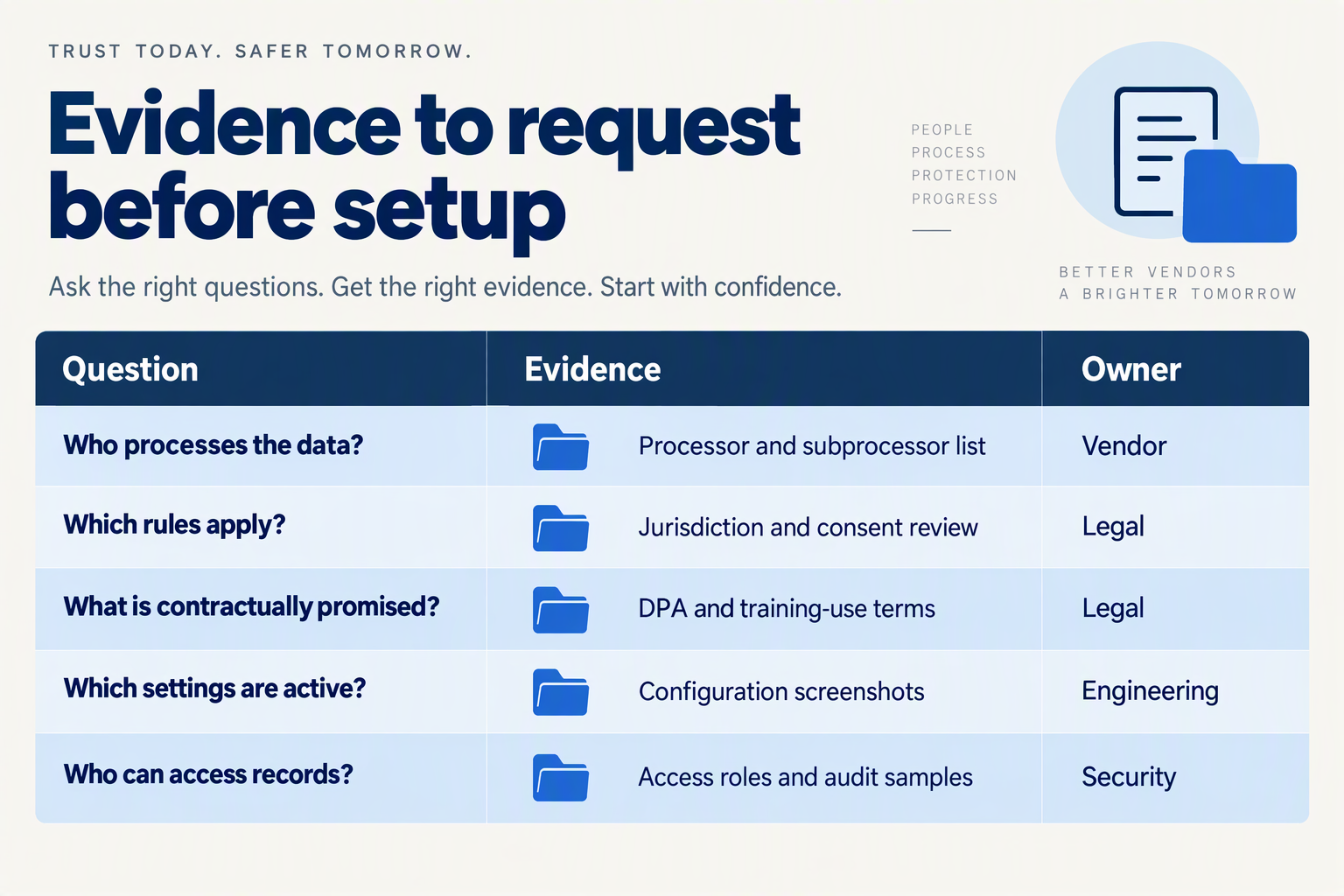
Before setup, you need an approved use case, a named privacy owner, a map of connected services, and vendor evidence that supports your intended configuration. Treat these as deployment gates: a product demonstration or reassuring sales answer is not enough to authorize access to customer conversations.
What should your pre-deployment evidence checklist contain?
Use the following checklist for AI voice agent data privacy reviews as of October 2026. Assign an internal owner to each row and record whether the evidence is accepted, incomplete, or blocking deployment.
| Prerequisite | Evidence to request | Acceptance check | Internal owner |
|---|---|---|---|
| Defined use case | Written scope covering users, tasks, permitted inputs, and prohibited requests | The agent’s purpose and boundaries are explicit | Product |
| Vendor accountability | Contracting entity, data processing agreement, and responsibility split | Obligations cover the service you will actually use | Legal / procurement |
| Provider inventory | Dated list of model providers, speech services, analytics services, and tool destinations | Every enabled component has an identified recipient | Security |
| Permission design | Supported access controls, credential requirements, and tool-permission documentation | Permissions match the approved tasks | Engineering |
| Testable configuration | Configuration export, screenshots, or API responses showing chosen settings | Evidence matches the pilot environment, not a generic demo | Engineering / privacy |
| Incident and change handling | Escalation contacts, notification terms, and provider-change procedures | Owners know how to respond and reassess changes | Security / operations |
Evidence must be configuration-specific. A document describing one model provider or subscription tier may not apply to the speech service, integration, or deployment option you select. Ask the vendor to identify exceptions explicitly rather than interpreting silence as approval.
How do you distinguish vendor claims from usable proof?
The supplied search context identifies the research paper as “Prompt like a Butterfly, Sting like a Tracker: A Privacy Analysis of Web and Mobile Conversational AI Agents,” according to WindowsForum. However, the supplied snippets do not establish its complete methodology or findings; use the paper as a prompt for investigation, not proof that your chosen vendor has a particular flaw.
Apply that same evidentiary discipline to procurement:
- Marketing statements describe positioning; they do not establish contractual obligations.
- Technical documentation explains available controls; verify that those controls are enabled.
- Contracts establish commitments; check their scope, exclusions, and downstream-provider coverage.
- Test results demonstrate observed behavior; record the configuration and test date.
For example, as of October 2026, the CallMissed fact sheet lists custom REST tools and connections to any MCP server by URL, allowing those tools to work on calls. Those capabilities make a tool inventory essential: document which endpoint each tool reaches, what information it receives, and which actions the agent is authorized to request.
What should happen before real customer data enters the system?
Run a small, synthetic-data pilot with explicit pass/fail criteria:
- Create fictional scenarios, including an unexpected sensitive disclosure and an attempted unauthorized tool action.
- Capture observable evidence, such as tool requests and configuration settings; record anything you cannot inspect.
- Reconcile discrepancies between documentation, contractual promises, and actual behavior.
- Obtain named approval from product, engineering, and the privacy or security owner.
Missing evidence does not automatically prove an unsafe service. It does mean the deployment remains unverified—and customer data should wait until the relevant uncertainty is resolved.
Where is your customer data stored across telephony, speech, models and connected systems?
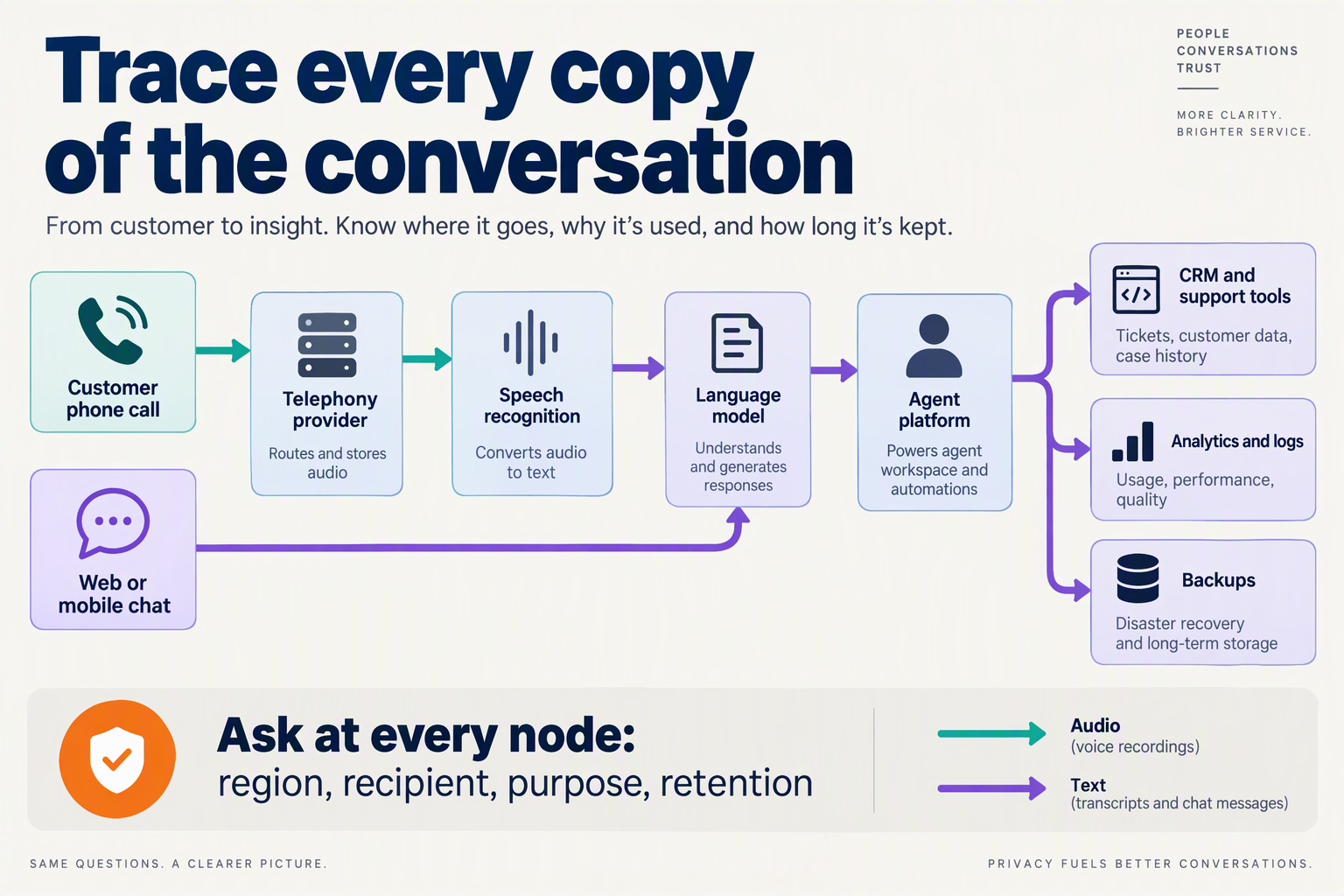
Customer data may be stored in several places: the telephony provider, speech-processing services, model-provider infrastructure, the agent platform, and connected business systems. To establish where your customer data is stored, request a component-by-component map that separates persistent storage from temporary processing and identifies the country or region for each.
Which providers handle each stage of a customer conversation?
Follow one representative interaction from connection to completion. For a voice agent, ask the vendor to document these layers:
- Telephony: Which carrier handles the call? Does it retain recordings, call metadata, or diagnostic traces, and where?
- Speech recognition: Where is audio converted into text? Is audio buffered temporarily, written to diagnostic storage, or retained after transcription?
- Language model: Which provider receives transcripts, prompts, conversation history, and retrieved business information? Which processing region applies?
- Speech generation: Where is response text converted into audio? Does the service store input text or generated speech?
- Connected systems: Which CRM, scheduling, support, or commerce tools receive customer information? Where do their production databases and backups reside?
For a web chatbot, replace telephony with the browser or mobile application layer. Check whether analytics, crash reporting, or session-replay tools also receive conversation content.
The paper titled “A Privacy Analysis of Web and Mobile Conversational AI Agents,” listed in the supplied Hacker News discussion context, provides a timely reason to examine the entire application chain. Its title alone, however, does not establish the storage practices of any particular voice-agent deployment.
Does hosting in one country keep every downstream copy there?
Platform hosting location is not an end-to-end data-residency guarantee. A service can host its own application in one country while sending audio or prompts to processors elsewhere.
As of October 2026, CallMissed’s verified product fact sheet states that its platform is hosted in India and supports customer-provided carriers through Twilio, Plivo, or any SIP trunk. That gives procurement teams a concrete starting point: document the platform’s hosting location, then separately verify the selected carrier, speech services, model providers, and connected tools.
Distinguish three questions in the vendor questionnaire:
- Storage residency: Where are primary databases, files, replicas, and backups located?
- Processing location: Where do inference, transcription, and speech-generation workloads execute?
- Access location: From which countries can support teams or administrators access customer information?
A regional database setting does not, by itself, answer the other two questions.
How can you verify the actual data path?
Use a synthetic customer interaction, not a real customer’s sensitive information. For example, have a test caller request an appointment using a distinctive fictional reference such as PRIVACY-TEST-042.
Trace that reference through the transcript, model request, tool execution, application logs, and destination CRM. Compare observed destinations with the vendor’s architecture diagram and subprocessor list.
This test can reveal unexpected copies, but it cannot prove the absence of provider-side storage. Pair technical observations with contractual documentation and written answers about backups, failover regions, and diagnostic logging.
What evidence should you require before approval?
Request a dated data-location register naming each component, its operator, the data received, storage region, processing region, and supporting evidence. Record unknowns explicitly rather than treating “global infrastructure” or “regional hosting” as complete answers.
For AI voice agent data privacy, the approval standard should be simple: every destination must have a documented purpose and location—or a clearly identified gap that must be resolved before deployment.
Are the AI calls recorded and stored, and when is each data type deleted?
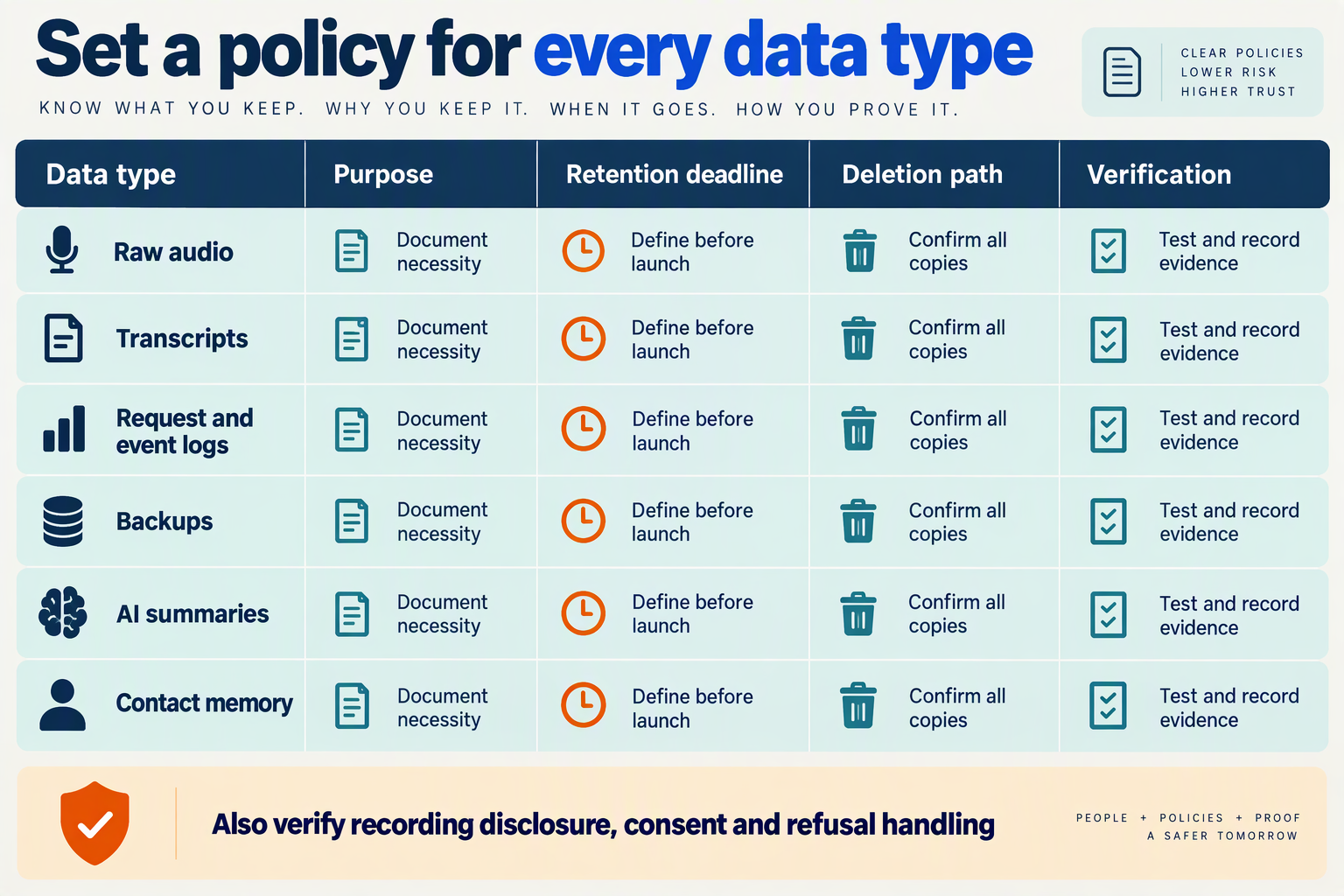
AI calls may be recorded and stored, but recording is only one part of retention. Before deployment, require a written schedule explaining when audio, transcripts, summaries, logs, CRM copies, and backups expire—and what starts each deletion clock.
For AI voice agent data privacy, “we delete conversations after 30 days” is incomplete. Does that mean 30 days after the call, after account closure, or after a deletion request? Does deleting the recording also remove the transcript and its extracted details?
What should an AI call data retention matrix include?
Use the following matrix as an October 2026 procurement checklist, not as a statement of any vendor’s default policies. Require a specific duration, deletion trigger, and accountable owner for every applicable row.
| Data type | What may remain | Retention question | Evidence to request |
|---|---|---|---|
| Audio recordings | Customer speech and background audio | Is recording optional, and when does audio expire? | Recording configuration and deletion test |
| Transcripts | Names, addresses, and sensitive disclosures | Does transcript retention differ from audio retention? | Separate transcript policy and expiry settings |
| AI summaries and notes | Extracted facts, actions, and dispositions | Are derived notes deleted with the source conversation? | Linked-record deletion test |
| Application and provider logs | Request content, errors, and identifiers | Which logs contain conversation content, and for how long? | Logging configuration and provider terms |
| CRM and tool exports | Contact updates, tickets, and follow-ups | Does source deletion reach connected systems? | Export inventory and destination policies |
| Backups and replicas | Copies of deleted production records | When do copies expire, and can restoration revive them? | Backup schedule and restoration procedure |
As of October 2026, CallMissed provides call recordings, transcripts, and AI call notes—including summaries, action items, dispositions, and follow-ups—pushed to CRM. Those capabilities make separate retention questions necessary; the verified product facts do not specify deletion timelines, so obtain those terms directly rather than assuming a shared expiry policy.
How should you choose retention periods for AI calls?
Choose retention by documented purpose, not by a single convenient platform default. Audio needed briefly for quality review may have a different business purpose from a CRM note recording an unresolved service issue.
For illustration, an October 2026 deployment proposal could retain quality-review audio for 7 days and operational transcripts for 30 days, while applying the organisation’s approved records policy to CRM entries. These are hypothetical policy choices—not legal requirements, vendor defaults, or universal recommendations.
For each proposed period, document:
- Purpose: What task requires keeping this data?
- Clock: Does expiry start at collection, case closure, or another event?
- Exceptions: Who authorises a hold, and when is that hold reviewed?
- Coverage: Which processors, exports, and backups follow different schedules?
The research highlighted by Enterprise DNA on September 30, 2026, A Privacy Analysis of Web and Mobile Conversational AI Agents, provides context for this scrutiny. However, the supplied coverage does not establish voice-platform retention defaults; those require deployment-specific evidence.
How can you verify that deletion actually works?
Test the policy before handling real customer conversations:
- Create a synthetic call containing a unique, non-sensitive marker.
- Locate its copies in recordings, transcripts, summaries, logs, and connected tools.
- Trigger deletion or expiry and check each destination separately.
- Document backup handling, including whether restored data is subject to deletion again.
Ask vendors to distinguish “removed from the interface” from “deleted from active storage.” Accept the retention schedule only when its scope, exceptions, and verification evidence match the data your deployment actually creates.
Will the customer conversations be used to train AI, or only processed to deliver the service?
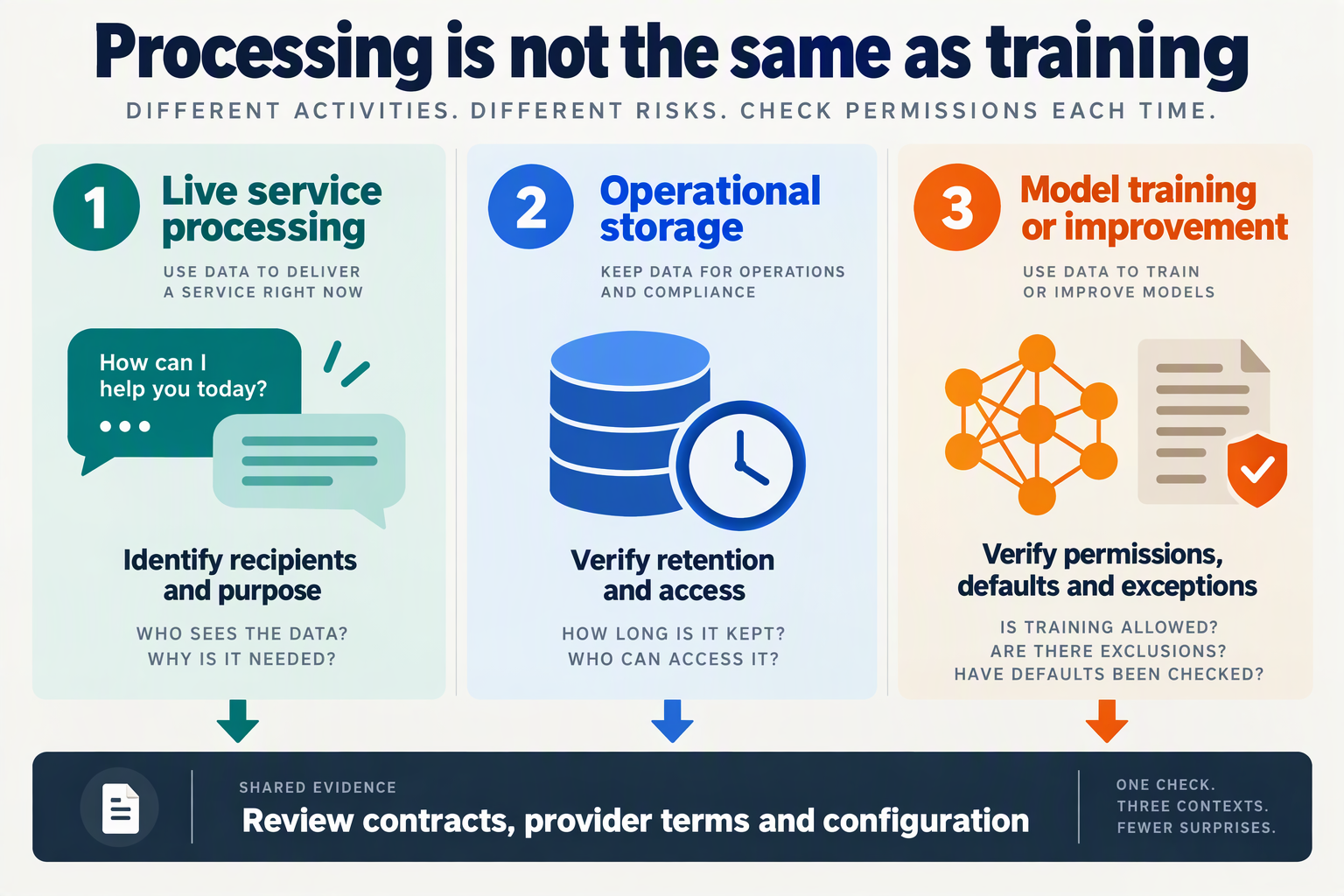
Customer conversations should be processed only for agreed purposes; model training should never be assumed to be excluded because a vendor describes its service as private or enterprise-ready. Before deployment, obtain written terms explaining whether audio, transcripts, prompts, outputs, and feedback can be reused—and whether those restrictions cover downstream providers.
What does “we don’t train on your data” actually cover?
Inference means using a model to generate a response. Training or fine-tuning means using data to change model parameters. Retrieval from a knowledge base is different again: information can inform an answer without changing the underlying model.
However, a no-training promise does not automatically prohibit human review, evaluation datasets, debugging, or product analytics. These uses need their own boundaries.
Ask the vendor to distinguish:
- Service delivery: Processing necessary to transcribe speech, generate answers, and synthesize responses.
- Customer-specific improvement: Fine-tuning or evaluating an agent specifically for your organization.
- Shared model improvement: Using conversations to improve models serving other customers.
- Secondary analysis: Reviewing conversations for quality, safety, research, or product development.
The research title shared on Hacker News, “Prompt like a Butterfly, Sting like a Tracker: A Privacy Analysis of Web and Mobile Conversational AI Agents,” provides a useful reminder to examine purposes beyond the visible conversation. The supplied October 2026 context does not establish any particular vendor’s training policy; popularity is not evidence of contractual protections.
Which providers must the no-training promise include?
For AI voice agent data privacy, assess the entire processing chain—not just the company supplying the interface. Speech recognition, language-model inference, and voice synthesis may involve separate providers with different terms.
As of October 2026, CallMissed’s verified fact sheet lists 141 models accessible through one API key and balance, alongside caller-chosen fallback models and bring-your-own provider keys. Those capabilities make provider-level checks relevant; the fact sheet does not establish a no-training guarantee.
Use this verification sequence:
- Identify the actual route. Record which providers receive each data type, including fallback routes.
- Check the applicable service terms. Verify the specific API, account tier, and configuration—not a policy for a different consumer product.
- Confirm the restriction flows downstream. Ask how the platform binds subprocessors to the agreed purpose limitations.
- Document configuration dependencies. Establish whether feedback submission, optional logging, or a provider change affects the promise.
A useful test question is: “If the primary model fails and another model answers, does the same no-training restriction still apply?”
What evidence should procurement request?
Request a contractual purpose limitation, supported by the data-processing agreement, relevant provider terms, and evidence of any required opt-out settings. A sales email or dashboard label alone is not a sufficient basis for deployment.
A starting clause for legal review could be:
Customer conversation data, including audio, transcripts, prompts, outputs, and derived summaries, must not be used to train or improve shared models without the customer’s explicit written authorization.
Then clarify exceptions, customer-specific fine-tuning, and whether “de-identified” conversation data remains eligible for reuse. Removing a name does not necessarily remove identifying details from a narrative.
For example, a clinic booking agent may need appointment details to complete a request; that necessity does not automatically authorize reuse in a general training dataset. Approve service processing and secondary reuse separately, and recheck those boundaries whenever providers or terms change.
How do you test consent, redaction, access and deletion before launch?
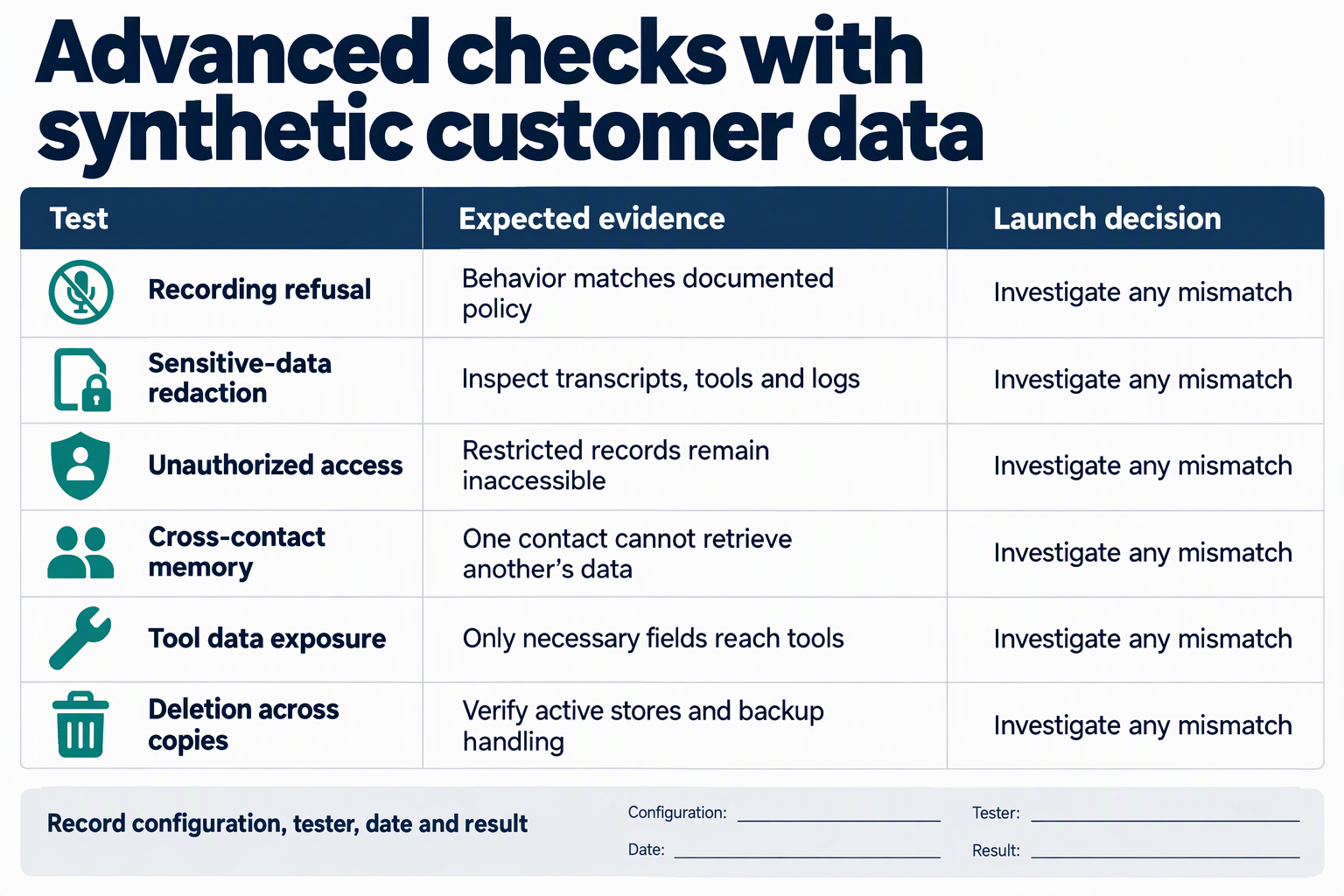
Test consent, redaction, access and deletion with synthetic conversations in a production-like environment, then inspect every resulting copy—not just the agent’s reply. Launch only when each privacy control has a documented pass condition, reproducible evidence and an accountable owner.
What should a pre-launch privacy test cover?
Use the following acceptance-test matrix for your October 2026 launch review. These are recommended checks, not claims about controls that any particular platform provides.
| Control | Test action | Pass condition | Evidence |
|---|---|---|---|
| Consent refusal | Decline recording or optional processing before sharing synthetic details. | Declined processing stays off; the approved alternative works. | Event trace and storage inspection |
| Consent withdrawal | Withdraw permission midway through a conversation. | Relevant processing stops at the documented boundary; earlier data follows the stated policy. | Timestamped state changes |
| Redaction | Supply synthetic phone numbers, payment details and sensitive disclosures. | Prohibited content is removed before the destinations covered by your policy receive it. | Before-and-after payloads |
| Role-based access | Attempt retrieval, playback and export using restricted accounts. | Unauthorized requests fail through both interfaces and APIs. | Permission-test results |
| Cross-customer isolation | Ask an agent or tool to retrieve another test customer’s conversation. | No unauthorized record, summary or identifying detail is returned. | Retrieval and tool traces |
| Deletion | Delete a test contact and trace associated conversation artifacts. | Active copies disappear within the promised window; exceptions are documented. | Deletion receipts and follow-up queries |
How do you make privacy failures reproducible?
Create a synthetic test identity with a unique marker, such as PRIVACY-TEST-017, and insert it into speech, chat and tool inputs. Search for that marker across recordings, transcripts, summaries, logs, exports and connected applications.
Run each scenario through normal completion, interrupted sessions, retries and human handoff. A successful interface response does not prove that a background task, webhook or failed request avoided retaining the same information.
Include three deliberate edge cases:
- Consent timing: Disclose the marker before accepting, after refusing and immediately after withdrawing permission.
- Redaction timing: Check outbound payloads, not merely a transcript cleaned up after processing.
- Authorization bypass: Repeat restricted actions through direct API requests and downloaded-file links, not just hidden interface buttons.
For voice deployments, include recognition errors and code-mixed speech where relevant. Redaction that catches a neatly typed identifier may miss the same identifier spoken with pauses or transcribed inconsistently.
As of October 2026, CallMissed provides call recordings, transcripts, AI call notes pushed to CRM, and eval suites. Teams using those capabilities should include the resulting artifacts in their privacy tests; the capabilities themselves do not establish consent enforcement, redaction or complete deletion.
What evidence should block or approve launch?
Maintain a privacy test record containing the configuration version, test identity, expected result, actual result, evidence location and reviewer. Define deadlines explicitly: “deleted eventually” is not a measurable acceptance condition.
Enterprise DNA’s September 30, 2026 AI Pulse highlighted A Privacy Analysis of Web and Mobile Conversational AI Agents. That research attention is a reason to demand verification—not a substitute for deployment-specific evidence.
Block launch when refused processing still occurs, restricted users can retrieve conversations, or deletion leaves unexplained active copies. Where backups or legal holds create exceptions, document their scope, access restrictions and expiry process rather than reporting unconditional deletion.
Finally, rerun the matrix after changing models, tools, storage destinations or permissions. AI voice agent data privacy is a regression-testing responsibility, not a one-time procurement questionnaire.
Which privacy assumptions most often undermine deployment reviews?
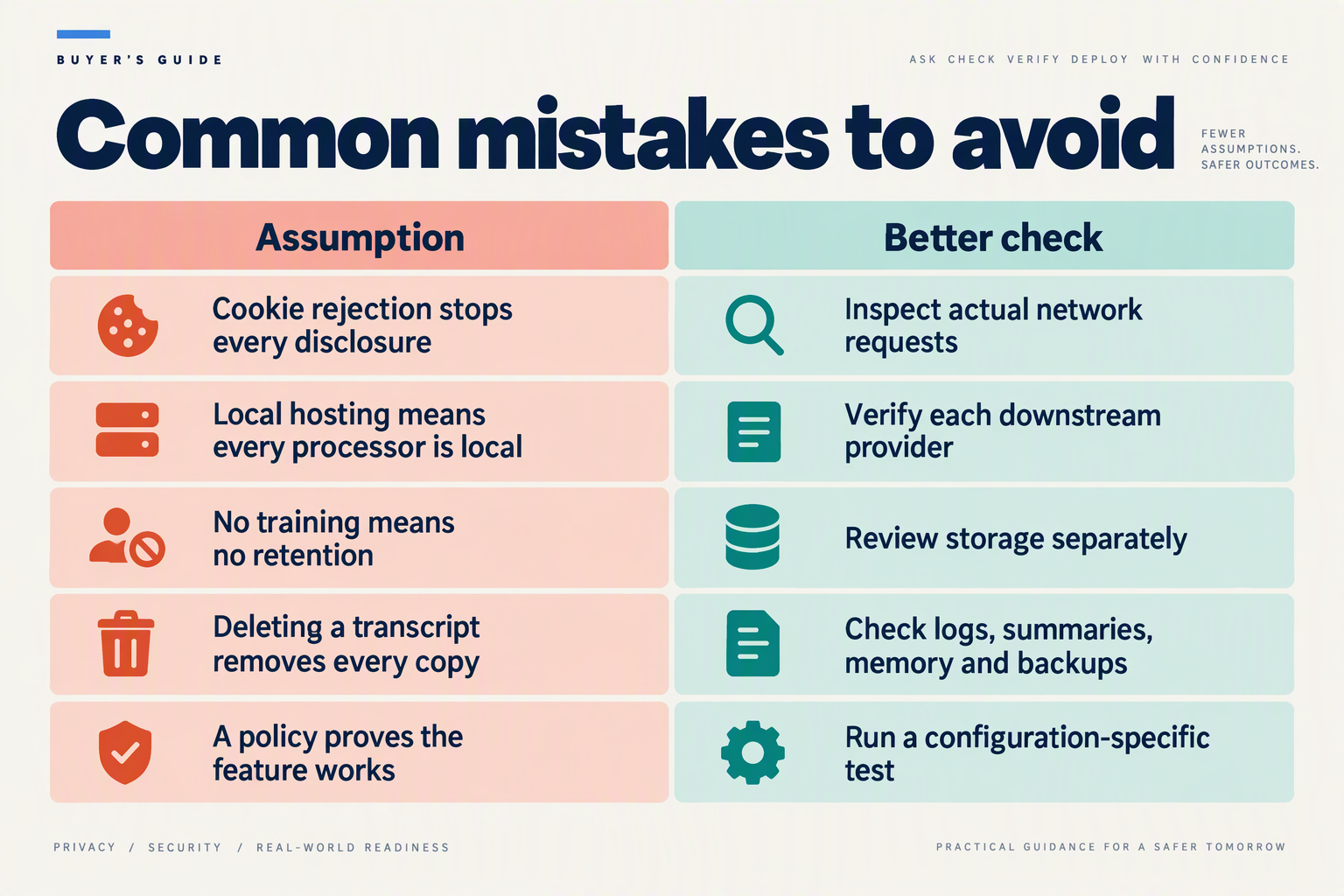
The assumptions that most often undermine deployment reviews confuse a visible safeguard with a complete privacy boundary: cookie rejection with blocked tracking, authentication with restricted access, or a successful demo with a safe production workflow. For AI voice agent data privacy, treat each reassuring claim as a hypothesis that needs a negative test.
The Hacker News discussion supplied for this October 2026 review links to “A Privacy Analysis of Web and Mobile Conversational AI Agents.” That attention is a reason to investigate—not evidence that every conversational AI product has the same vulnerabilities. The practical lesson is to examine what the deployed system actually sends, retrieves, and permits.
Which privacy assumptions should reviewers test first?
Use this table to turn broad assurances into specific acceptance tests. These are review scenarios, not findings attributed to the research paper.
| Assumption | Why it can fail | Verification step | Passing evidence |
|---|---|---|---|
| “Rejecting cookies stops data sharing.” | Consent choices may not govern operational API requests, SDK traffic, or server-side transfers. | Compare network activity before and after rejection, including during a conversation. | Every observed destination has a documented purpose and applicable consent basis. |
| “An authenticated user can safely ask anything.” | Login establishes identity, not permission to retrieve another customer’s records. | Ask for another account’s order, ticket, or conversation using synthetic accounts. | Access is denied by backend authorization, not merely by agent instructions. |
| “Removing names makes transcripts anonymous.” | Addresses, appointment details, account references, and unusual combinations can still identify someone. | Review representative redacted transcripts for indirect identifiers. | A documented assessment explains remaining identification risks and permitted uses. |
| “The model’s privacy terms cover the whole agent.” | Analytics, integrations, and business tools may introduce separate recipients and obligations. | Map each tool’s inputs, outputs, and receiving service. | Each recipient has an approved purpose and documented processing terms. |
| “A sandbox demo proves production safety.” | Production credentials, permissions, and integrations can differ from the demonstration environment. | Repeat privacy tests against production-equivalent settings with synthetic data. | Results identify the tested configuration and its differences from production. |
| “A prompt can prevent unauthorized disclosure.” | Retrieved text or user instructions may influence an agent, while tools retain excessive permissions. | Attempt to override instructions and request restricted tool actions. | Tool-level checks block unauthorized reads and writes independently of the model. |
How do you distinguish a promise from a privacy control?
Ask where the protection is enforced. “The agent is instructed not to reveal account information” describes intended behavior; “the order API checks the authenticated customer against the requested order” describes an enforceable boundary.
As of October 2026, CallMissed supports custom REST tools and connections to MCP servers by URL, making this distinction relevant to real agent deployments. Reviewers should examine what each connected tool can access and change rather than assuming the conversational layer supplies authorization.
For each test, record:
- Owner: Who is responsible for the safeguard?
- Boundary: Which component actually enforces it?
- Evidence: What request, response, or configuration demonstrates the result?
When should an assumption block deployment?
An unresolved assumption should block launch when it could expose another person’s information, enable an unauthorized action, or send sensitive content to an unapproved recipient. A policy statement alone does not resolve those risks.
For example, use two synthetic customer accounts and ask one account’s agent to retrieve the other account’s order. If the model refuses but the underlying tool would accept the request, the privacy boundary remains incomplete. Approve the enforced control—not just the reassuring answer.
Frequently Asked Questions
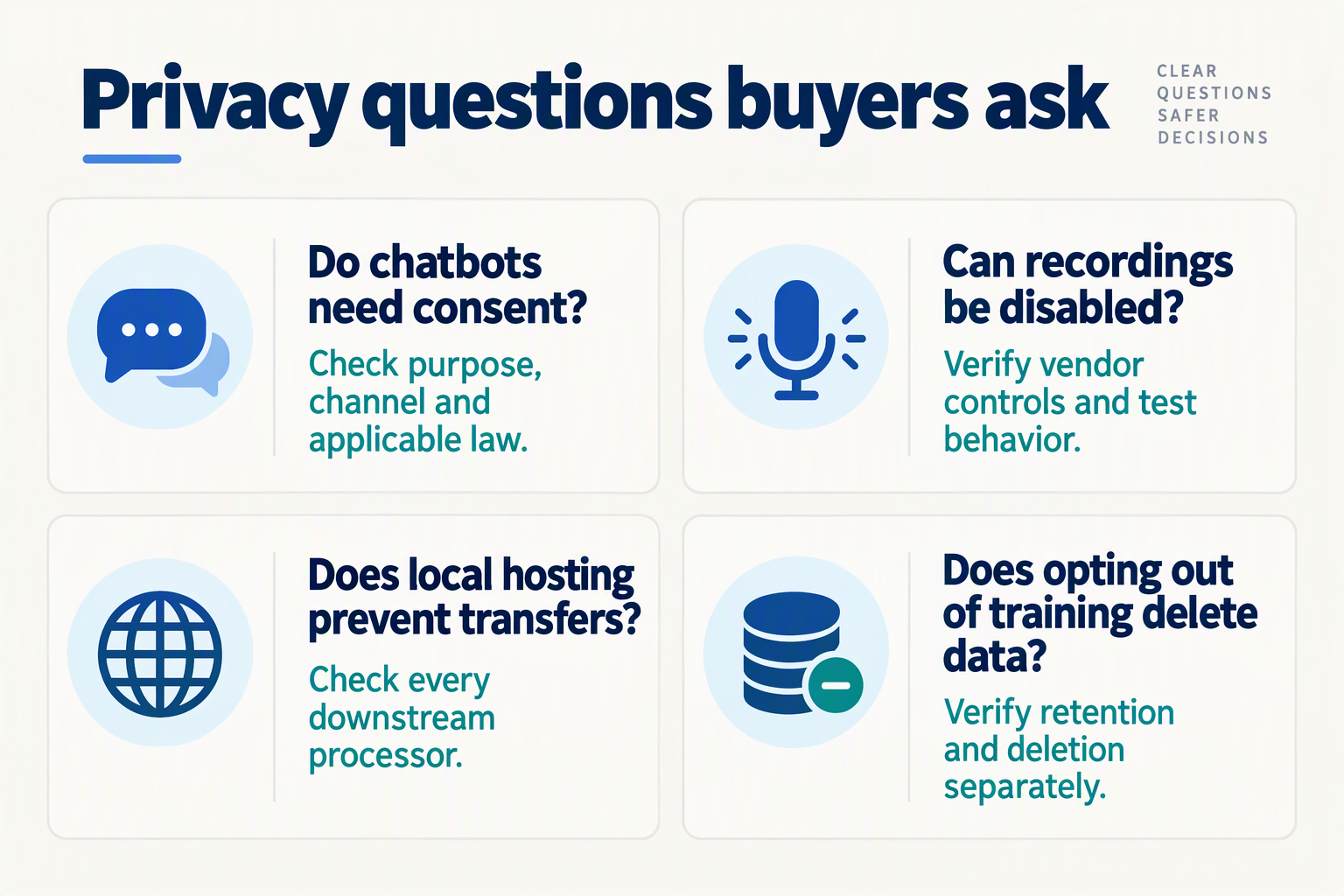
Does AI voice agent data privacy require customer consent?
Can AI chatbot and voice-call recordings be disabled?
Does local hosting guarantee AI voice agent data privacy?
Does rejecting cookies stop conversational AI agents from sharing data?
Can customer conversations be used to train AI without permission?
What evidence should a business request before approving an AI chatbot?
Which resources help you verify vendors such as CallMissed before a controlled pilot?

Use primary research, vendor documentation, contractual evidence, and controlled test results to verify conversational AI vendors before a pilot. Each resource answers a different question: what risks to investigate, what capabilities exist, what obligations apply, and what actually happens in your configuration.
Which research sources should inform your vendor review?
Start with “Prompt like a Butterfly, Sting like a Tracker: A Privacy Analysis of Web and Mobile Conversational AI Agents,” the research paper identified in the supplied coverage. Read the paper itself before relying on summaries: check its tested products, methods, limitations, and publication date before applying conclusions to a different deployment.
Enterprise DNA’s September 30, 2026 AI Pulse provides a secondary account of the paper’s visibility. Hacker News supplies discussion and potential investigative leads, but neither popularity nor a comment establishes a vendor-specific privacy finding.
Turn relevant research observations into testable questions, rather than assuming every conversational agent shares the same behavior. For example: “Does this embedded widget contact an unexpected analytics destination before the user starts a conversation?”
Which CallMissed resources should you examine?
As of October 2026, CallMissed provides public documentation, a pricing page, and a console for building voice and chat agents. Its verified product information lists a no-code builder with versioning, publish and rollback, plus a web voice and chat widget embedded through one script tag. These are useful starting points for defining a small, reproducible pilot—not proof of privacy compliance.
Use those resources for distinct purposes:
- Documentation: Identify the interfaces, integrations, and configuration options your implementation requires.
- Pricing: Establish the pilot’s spending boundary separately from its privacy approval.
- Console: Inspect the settings available to your team and record the configuration actually tested.
- Direct vendor correspondence: Request evidence that public product descriptions do not establish.
For AI voice agent data privacy, ask the vendor to supply applicable contractual terms, a subprocessor list, retention documentation, and security evidence. Record missing or ambiguous answers as unresolved requirements; do not infer protections from an undocumented setting or a general marketing statement.
Which tools help verify the vendor’s answers?
Use browser developer tools to inspect network destinations for a web pilot, and approved mobile inspection tools where relevant. Compare observed destinations against the vendor’s documented architecture. Traffic inspection can reveal connections, but it cannot independently prove downstream retention or training practices.
Build a compact evidence register containing:
- Claim: The precise promise being evaluated.
- Evidence: A dated document, contractual clause, configuration export, or test result.
- Scope: The product, account, integration, and data type covered.
- Owner: The person responsible for resolving gaps.
Label vendor statements and independently observed behavior separately. A successful test demonstrates that particular scenario, not every possible workflow.
What evidence should authorize a controlled pilot?
Before introducing real customer information, run a numbered acceptance sequence:
- Define the boundary: Specify participants, permitted data, integrations, duration, and budget.
- Use synthetic conversations: Include invented identifiers that make test records easy to trace.
- Capture the evidence: Save configuration details, observed destinations, and relevant vendor responses.
- Exercise the exit: Test stopping the agent, disconnecting integrations, and requesting removal of test data.
- Approve or pause: Require named owners to resolve material discrepancies before expansion.
The final deliverable should be an evidence-backed pilot decision, not a completed questionnaire. Proceed only when documented promises, observed behavior, and your organization’s requirements align within the pilot’s explicitly limited scope.
Conclusion
AI voice agent data privacy depends on verified boundaries across the entire conversation lifecycle—not simply on where the original recording is stored. Before deployment, teams should know what customer information is collected, where each copy travels, who can access it, and how long it remains available.
The central lesson is straightforward: a reassuring answer about one component cannot establish the privacy of the complete system. Speech recognition, language models, business tools, and storage services all belong in the same review.
What should you verify before customers start speaking?
Carry these four takeaways into your deployment decision:
- Map storage and downstream data flows. Ask about primary storage, processing locations, backups, and third-party providers. A platform’s headquarters or hosting location does not, by itself, establish where transcripts, logs, or exported CRM records ultimately reside. Document the complete route rather than stopping at the first vendor.
- Set retention rules for every conversation artifact. Audio recordings, transcripts, summaries, application logs, and CRM entries need separate answers about purpose and lifespan. Deleting the recording is not enough when its contents remain elsewhere. Collect less and retain deliberately, with clear reasons for keeping each relevant copy.
- Confirm training permissions in writing. Request contractual terms explaining whether customer conversations can be used to train AI, covering both the platform and its model providers. Treat an unclear answer as an unresolved deployment question—not as evidence that training is excluded. Verify the promise before customers disclose sensitive information.
- Verify access and deletion together. Review permissions, support access, and the evidence available to check who accessed conversations. Then examine deletion workflows, backup exceptions, and connected tools. Privacy boundaries must cover both who can see information today and what happens when that information should disappear.
The growing scrutiny is worth watching. Enterprise DNA’s September 30, 2026 AI Pulse reported that “A Privacy Analysis of Web and Mobile Conversational AI Agents” attracted 421 points on Hacker News. That figure measures attention, not vulnerability severity, but it reinforces the importance of asking concrete questions rather than accepting broad assurances.
Looking ahead, watch whether vendor documentation becomes clearer about downstream processing, artifact-specific retention, training permissions, and deletion. Those are the answers that will help teams evaluate evolving conversational AI deployments.
As of October 2026, CallMissed offers an India-hosted platform, call recordings, transcripts, and AI call notes pushed to CRM. Readers can explore CallMissed while applying the same end-to-end privacy questions; platform hosting alone does not settle every downstream data question.
Before launch, can your team explain—and verify—what happens to every copy of a customer’s conversation?
Related Reading
- Missed sales calls: An AI voice agent guide for India
- Voice Agent Prompt Injection Testing: Tool-Call Checks
- Booz Allen Report: LLM Risk Checks Before Data Access