Missed sales calls: An AI voice agent guide for India



Missed sales calls become actionable leads with AI answering. Learn Indian-language setup, human handoffs, CRM capture and an INR pilot cost model.
Missed sales calls: An AI voice agent guide for India
What if your next serious buyer calls while every salesperson is already on the phone? Missed sales calls are not just an inconvenience: they interrupt the moment when a customer is ready to ask about pricing, check availability, or book a visit. AI voice agents can reduce that gap by answering overflow and after-hours calls, capturing requirements, and routing conversations into a follow-up workflow.
The scale deserves attention. In the research supplied for this October 2026 guide, MyOperator reports that even fully staffed teams miss 25–40% of inbound calls during business hours. MyOperator also reports annual agent attrition of 30–45% in Indian call centres. These are vendor-reported figures, not a universal benchmark for every Indian business, but they highlight two pressures: demand can exceed answering capacity, and maintaining that capacity takes ongoing effort.
For a property broker, clinic, dealership, or education provider, the problem is practical. A caller may need an answer before your team becomes available. Returning the call later can help, but answering at the point of enquiry preserves context: what the customer wants, where they are located, which language they prefer, and how urgently they need help.
That is why AI voice agents in India deserve evaluation as more than automated receptionists. A useful implementation connects the conversation to the next action—rather than merely producing a transcript nobody reads.
As of October 2026, CallMissed combines speech recognition in 22 Indian languages plus English, including Hinglish, with knowledge-base support and AI call notes pushed to the CRM—capabilities relevant to multilingual sales enquiries.
This guide will show you how to:
- Map your missed-call problem: separate busy-hour overflow, unanswered calls, and after-hours enquiries.
- Design the answering workflow: decide what an AI agent should answer, capture, or escalate to a person.
- Support Indian callers: test regional languages, code-mixed speech, names, locations, and noisy mobile connections.
- Connect calls to sales follow-up: capture useful CRM information and assign clear ownership.
- Evaluate cost and results: compare AI voice agent pricing in India in 2026 against qualified leads, completed follow-ups, and sales outcomes.
The goal is not to promise that automation will turn every ringing phone into revenue. It is to build a dependable first response, preserve buyer intent, and give your team better information for the next conversation.
Start with one measurable use case—such as overflow during peak enquiry hours—then expand only when call reviews show that the agent handles real customers accurately and hands off appropriately.
How do AI voice agents help Indian businesses reduce missed sales calls?
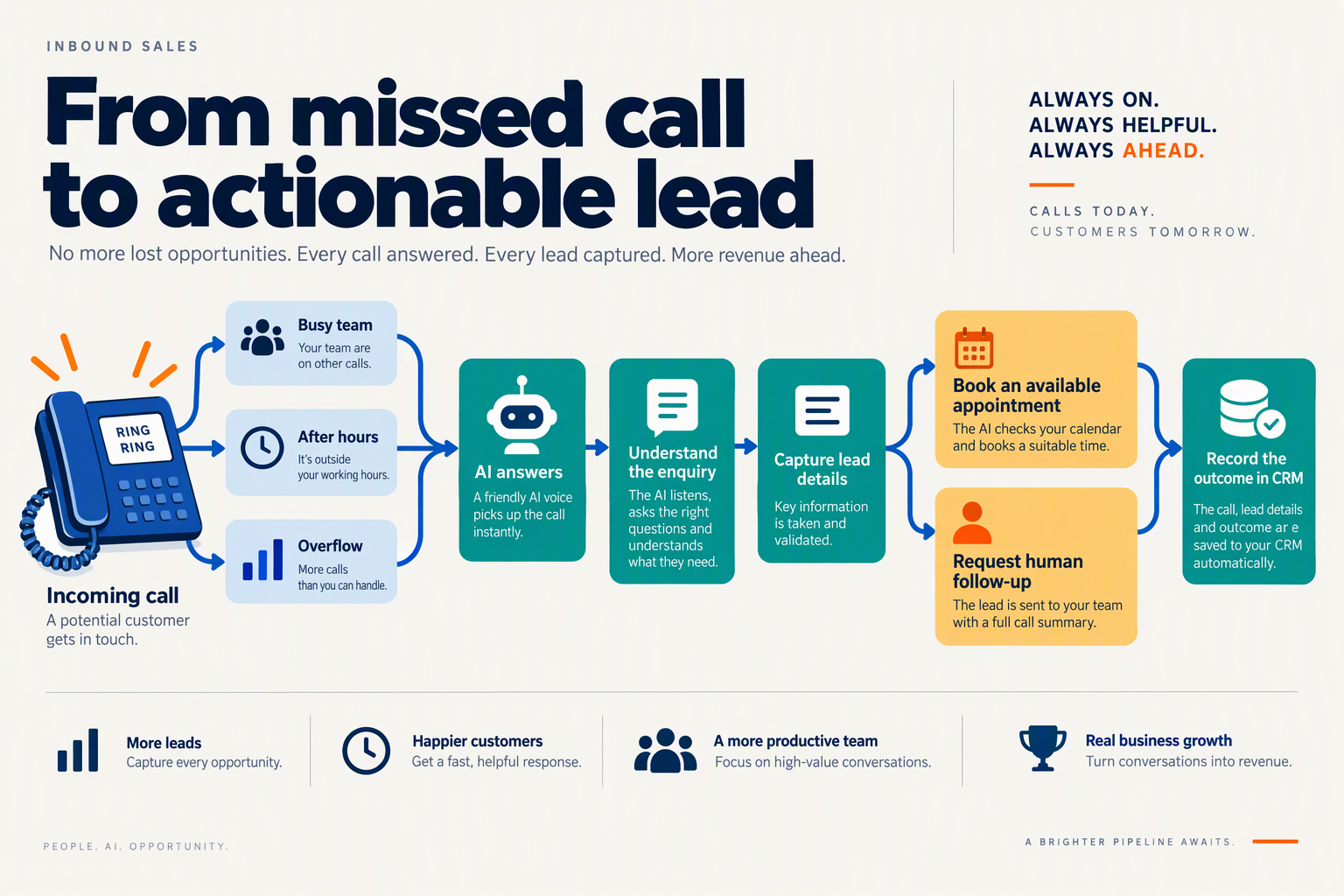
AI voice agents help Indian businesses reduce missed sales calls by handling enquiries that would otherwise go unanswered and turning those conversations into actionable sales records. The benefit depends on the workflow: answering a call matters only if the agent gives accurate information, captures buyer intent, and creates a clear next step.
What happens when an AI voice agent answers a sales call?
An AI voice agent combines speech recognition, a language model, and text-to-speech to conduct a conversation. Connected business tools can then check information or complete an action, subject to the permissions you configure.
A useful inbound sales workflow follows four steps:
- Identify the enquiry: Ask whether the caller wants product information, a quotation, an appointment, or help with an existing purchase.
- Answer within approved boundaries: Use your business knowledge base for details such as opening hours, service areas, and published prices.
- Capture buying signals: Record the requirement, location, purchase timeline, and preferred follow-up method—not just the caller’s phone number.
- Complete or assign the next action: Confirm a booking only after the scheduling system accepts it; otherwise, create a follow-up task or transfer the conversation.
The distinction is important: “We have recorded your request” is not the same as “Your appointment is confirmed.” Clear wording prevents an answered call from becoming a disappointed customer.
How does an answered call become a usable sales lead?
Consider an illustrative dealership enquiry at 8:30 p.m. A caller asks whether a particular variant is available and requests a Saturday test drive.
Rather than collecting only a name and number, the agent should establish:
- Product fit: Which model and variant does the buyer want?
- Location: Which branch would they visit?
- Timing: Are they researching or planning to purchase soon?
- Next action: Can the system confirm a slot, or must a salesperson check availability?
The resulting record should distinguish verified information from customer requests. “Customer requested Saturday morning; availability pending” gives the salesperson a reliable starting point without inventing stock or appointment availability.
This is how voice AI agents can help recover otherwise missed leads: they preserve the enquiry while the buyer is engaged. They do not guarantee that the buyer will qualify or purchase.
When should the AI hand the caller to a person?
Human handoff is appropriate when the caller requests negotiation, disputes information, needs an exception, or repeatedly fails to get a useful answer. Define those triggers before deployment, along with what happens when nobody is available.
As of October 2026, CallMissed supports call queues, custom REST tools, and live supervision where a supervisor can listen, whisper, or join the call, according to its verified product fact sheet. These capabilities can support escalation workflows, but businesses still need to configure routing and staff the human response.
What evidence shows whether fewer calls are being lost?
In research supplied for this October 2026 guide, MNB Research describes a business missing 60% of inbound calls during evenings and weekends; the supplied snippet does not establish a representative industry benchmark or independently verified sales uplift.
Measure your own results instead. Track the unanswered-call rate, usable lead records, successful handoffs, completed follow-ups, and eventual sales. An improved answer rate is valuable—but a lower missed-call count only becomes a commercial improvement when the follow-up workflow works too.
What do you need before setting up AI call answering?
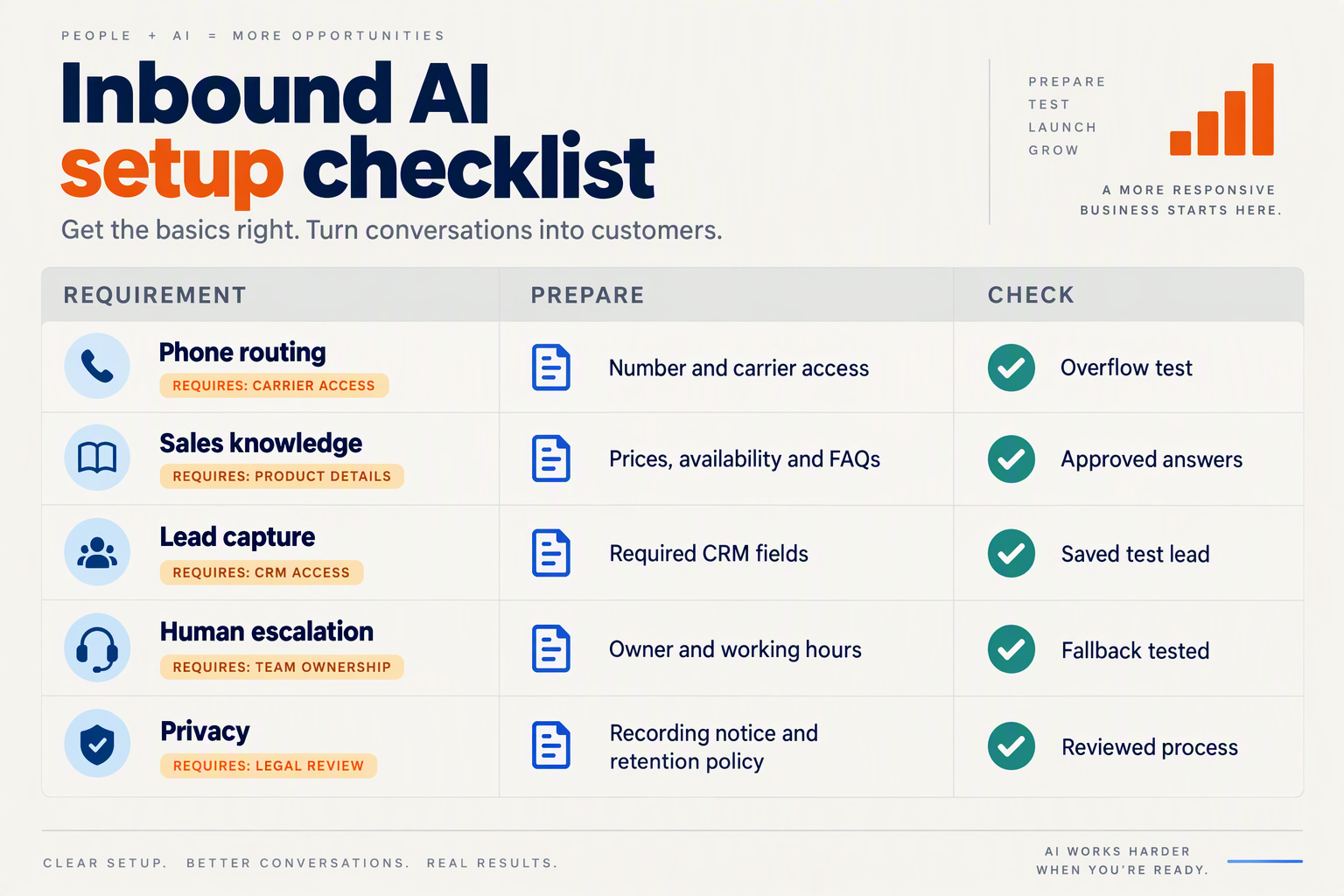
Before setting up AI call answering, you need a working call-routing arrangement, approved business information, a lead-capture checklist, and a clear human-escalation process. Start with one defined use case—such as unanswered sales enquiries—rather than asking the agent to handle every kind of call.
What should your AI call answering setup checklist include?
Use this checklist to assign ownership before configuring the agent. Each requirement should have a business owner who can approve it, not just a technical person who can connect it.
| Requirement | What to prepare | Readiness check |
|---|---|---|
| Number and routing | Your business number, carrier details, and rules for when AI should answer | Confirm routing options with your carrier and test an unanswered call |
| Approved knowledge | Current prices, opening hours, service areas, availability rules, and FAQs | A sales manager approves the answers and identifies information requiring live lookup |
| Lead-capture fields | Name, enquiry, location, preferred language, and callback preference | Every captured field has a destination and a follow-up owner |
| Language coverage | Languages callers actually use, including code-mixed speech | Staff test names, addresses, numbers, and common customer phrases |
| Human escalation | Escalation triggers, staffed hours, responsible team, and fallback instructions | Check what happens when a caller requests a person and nobody is available |
| Data and budget controls | Recording policy, access permissions, retention rules, and a pilot spending limit | Relevant owners approve data handling and the complete cost estimate |
Do you need a developer or a new phone number?
Not necessarily: the requirement depends on your chosen platform and existing telephone setup. Ask your carrier whether your current number can route unanswered or busy calls to the proposed service; do not assume that every number supports the same configuration.
According to CallMissed’s verified product information, as of October 2026, CallMissed offers a no-code voice-agent builder and inbound calls on rented numbers or through a customer’s carrier, including Twilio, Plivo, or any SIP trunk. That gives teams different implementation paths, but carrier configuration still needs verification.
Separate basic setup from integration work:
- Business configuration: approved answers, voice, language, and escalation instructions.
- Technical configuration: telephone routing, CRM field mapping, and any live-data connections.
- Operational ownership: someone responsible for reviewing conversations and correcting failures.
A no-code builder reduces configuration effort; it does not replace business decisions.
What information should you prepare for a sales enquiry?
For a hypothetical property brokerage, prepare approved project details, indicative pricing, location information, and site-visit rules. If availability changes frequently, instruct the agent to check an authorised source—or request human confirmation—instead of treating an uploaded brochure as permanently accurate.
Define a minimum useful lead record: customer name, project interest, budget range if volunteered, preferred visit timing, and assigned salesperson. Avoid collecting information simply because the system can capture it.
How should you budget and approve the pilot?
Estimate connected minutes and telephone charges separately. According to CallMissed’s verified pricing, as of October 2026, Standard voice-agent pricing is ₹4 per minute, covering speech recognition, the language model, and voice, with a 30-second minimum per call; phone carriage is billed separately.
Before launch:
- Test normal enquiries against approved answers.
- Test failure cases, including unavailable staff and unclear speech.
- Approve data handling, including recording notices and retention.
- Assign daily review ownership during the pilot.
The readiness test is simple: can every answered enquiry become either a useful response, an owned follow-up, or a clearly explained escalation?
When should you use live AI answering, callbacks, text-back or human overflow?
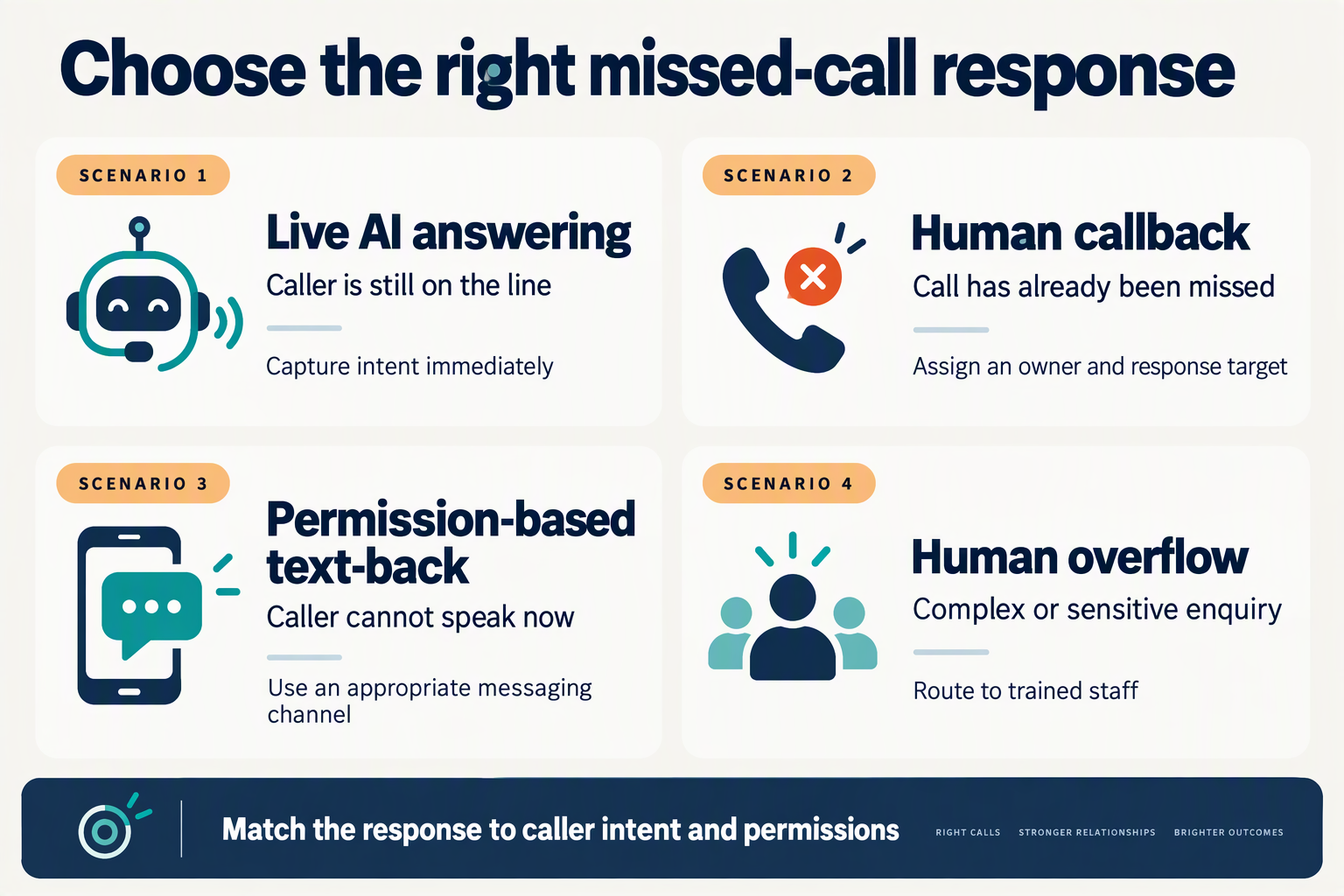
Use live AI answering when callers need immediate, repeatable information; callbacks when an enquiry needs investigation; text-back when a short acknowledgement or scheduling link is sufficient; and human overflow when judgement, negotiation, or sensitivity matters. For missed sales calls, these are complementary routes—not four interchangeable replacements for your sales team.
Which response should you use for each type of sales enquiry?
The following decision matrix is an implementation recommendation for October 2026, not a vendor performance benchmark. Choose the route based on the caller’s immediate need and the consequences of getting the answer wrong.
| Caller situation | First response | Information to capture | Next step | Main safeguard |
|---|---|---|---|---|
| Routine pricing or availability enquiry | Live AI answering | Product, location, budget | Answer from approved information | Never invent prices or stock |
| Peak-hour enquiry while sales staff are busy | Live AI answering, then human overflow | Requirement, urgency, preferred language | Escalate if judgement is needed | Explain when staff are unavailable |
| After-hours visit or demo request | Live AI answering | Preferred date, location, contact details | Confirm an available slot or request follow-up | Do not promise unverified availability |
| Missed call with no conversation | Callback; optional text-back | Identity and reason for calling | Assign a return-call task | Treat the number as an enquiry, not marketing consent |
| Caller cannot talk comfortably | Text-back, with permission | Preferred channel and callback window | Continue briefly or arrange a call | Avoid sensitive details in messages |
| Negotiation, complaint, or urgent sensitive issue | Human overflow | Short summary and urgency | Transfer or arrange priority follow-up | Do not let AI make binding commitments |
Live answering preserves the conversation; callbacks recover an interrupted one. Text-back keeps a channel open, while human overflow protects situations where a plausible but incorrect answer could damage trust.
When is a callback better than continuing with AI?
Choose a callback when answering properly requires work outside the conversation: checking a vehicle’s actual availability, confirming a customised quotation, or asking a specialist about eligibility.
For example, a property buyer asking about published amenities can receive an immediate answer. A buyer requesting an exception to the payment schedule should reach an authorised salesperson—not receive an improvised commitment.
Set up the callback workflow in three steps:
- Agree on a window: ask when the caller can answer, rather than promising “soon.”
- Assign an owner: give a named team or staff member responsibility.
- Preserve context: record the question, language preference, and any unresolved issue.
A callback task is not a completed follow-up. Track whether the customer was actually reached and whether the next action happened.
How should text-back and human overflow work together?
Keep text-back short and useful: identify the business, acknowledge the enquiry, and offer a clear next step. Use the messaging channel only where permission and applicable channel rules allow; do not assume that an unanswered call authorises promotional messaging.
For human overflow, define explicit escalation triggers:
- The caller requests a person.
- The agent cannot verify an answer.
- The conversation involves exceptions, disputes, or sensitive information.
As of October 2026, CallMissed lists ₹4, ₹5, and ₹6 per minute voice-agent plans covering speech recognition, the language model, and voice, with phone carriage billed separately. CallMissed also supports supervisor listening, whispering, and barging into live calls—useful controls when designing human oversight.
The practical goal is the right next action, not maximum automation: answer what is safe, capture what is useful, and escalate what requires authority.
How do you get started with a CallMissed voice agent?
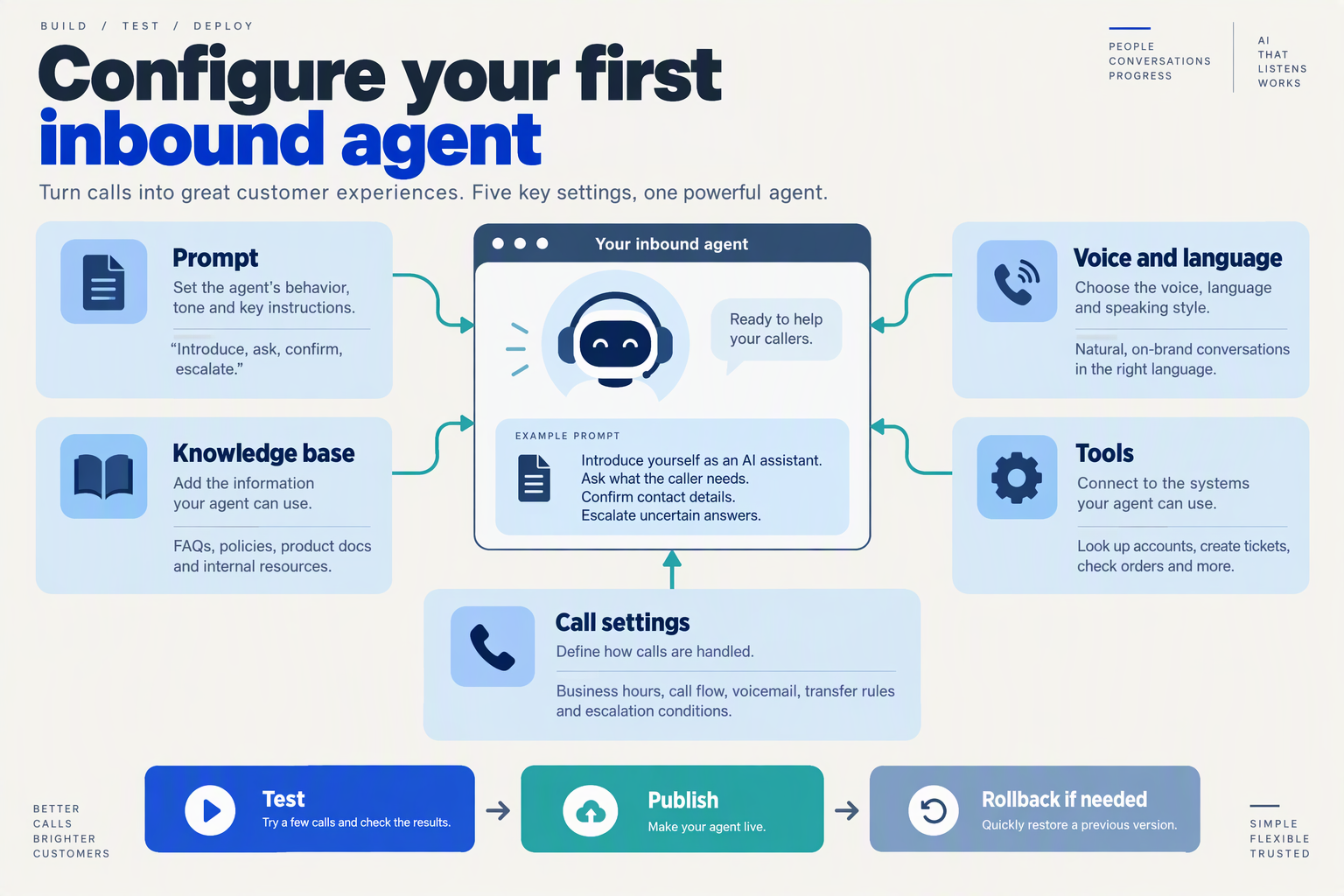
Start with CallMissed’s no-code voice-agent builder: define the agent’s instructions, add approved business information, choose a voice and language, and connect a phone number. Test the complete enquiry-to-follow-up workflow before sending live sales calls to the agent.
What should you configure in your first voice agent?
As of October 2026, CallMissed’s verified product facts list builder controls for prompts, voices, languages, knowledge bases, tools, variables, call settings, and versioning with publish and rollback. Use those controls to build one narrowly scoped sales assistant—not an agent expected to answer every business question.
- Choose one enquiry type. For example, help prospective buyers ask about a specific property development and request a salesperson’s callback.
- Write clear instructions. Define what the agent can explain, what information it should collect, and when it should stop answering.
- Set explicit boundaries. Prohibit invented discounts, availability claims, financing approvals, or commitments your team has not authorised.
- Choose the initial language and voice. Begin with the language your target callers use most, then test additional languages before expanding.
A useful instruction might be: “Introduce yourself as an AI assistant. Answer project questions only from the approved knowledge base. Ask for the caller’s preferred location and callback time. If an answer is unavailable, say so and request a salesperson’s follow-up.”
What business information and tools should you add?
Prepare a small, maintained source of truth rather than uploading every document your business owns. According to the platform’s verified product facts, as of October 2026, its retrieval-augmented generation (RAG) knowledge base accepts text, web pages, and PDFs.
Include:
- Approved answers: opening hours, service areas, product descriptions, and current sales policies.
- Qualification questions: budget range, requirement, location, and purchase timeline.
- Escalation rules: pricing exceptions, complaints, uncertain answers, and requests for a person.
Static documents are useful for stable information, but changing availability needs a current source. As of October 2026, custom REST tools and integrations including Google Calendar and Cal.com are listed capabilities; connect and test the relevant tool before allowing the agent to offer a booking or confirm live information.
How do you connect your business phone calls?
Choose between a rented number and your existing carrier arrangement. The verified product facts list inbound calls on rented numbers and bring-your-own-carrier support for Twilio, Plivo, or any SIP trunk, as of October 2026.
If you want unanswered or busy calls redirected from an existing number, confirm the forwarding setup with your carrier. Do not assume that creating an agent automatically changes your telephone routing.
Make several test calls from ordinary mobile phones. Check the greeting, pronunciation, caller interruptions, tool responses, and what happens when the caller asks something outside the knowledge base.
What should you check before publishing?
Review the entire outcome, not just whether the voice sounds natural. As of October 2026, the platform lists recordings, transcripts, AI call notes pushed to the CRM, eval suites, and A/B experiments.
Your launch checklist should cover:
- Accuracy: answers match approved business information.
- Capture: names, requirements, and callback preferences are recorded correctly.
- Follow-up: a salesperson can find and act on the call notes.
- Recovery: uncertainty produces an honest response rather than a guess.
Publish the tested version, keep the previous version available for rollback, and review early calls before increasing traffic. This makes reducing missed sales calls a controlled operational change rather than an untested switch-on.
How do you connect overflow calls to lead capture and human follow-up, step by step?
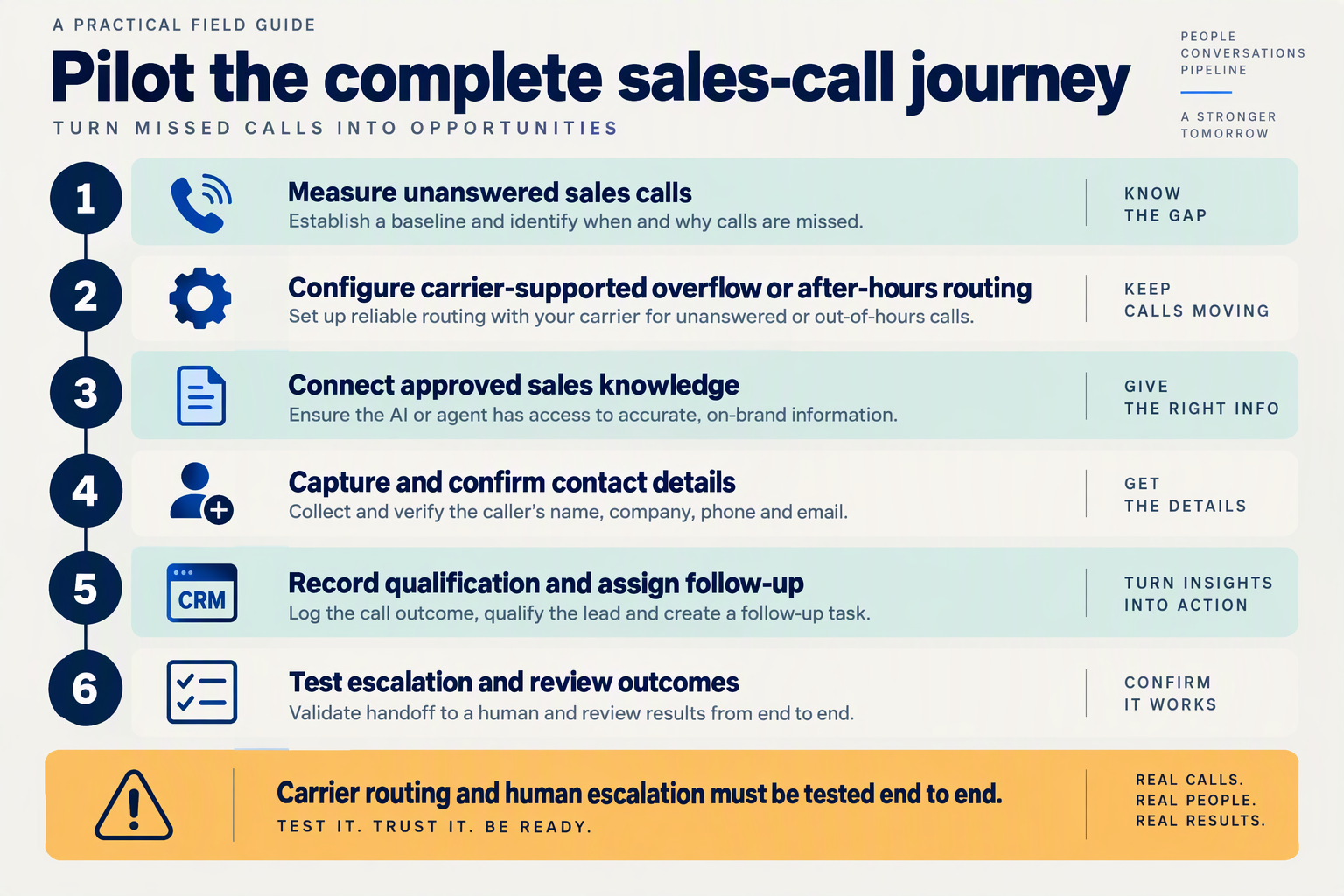
Connect overflow calls to lead capture by defining when calls divert, collecting a small set of verified details, and creating a follow-up task with a named owner. The workflow is complete only when a salesperson can act on the enquiry—not when the AI finishes answering.
1. When should unanswered calls reach the AI voice agent?
Configure overflow rules with your telephone provider or PBX before changing the sales workflow. Keep your existing business number where possible, and check which forwarding or SIP-routing options your carrier supports.
Define separate routes for:
- Busy lines: all available salespeople are handling calls.
- No answer: the phone rings beyond your chosen threshold.
- After hours: the enquiry arrives outside your published opening times.
For an illustrative pilot, divert unanswered calls after 20 seconds. This is a suggested test setting, not an industry benchmark; adjust it after reviewing caller abandonment and staff availability. Test each route from an external mobile phone, including what happens if the AI service is unavailable.
2. What information should the agent capture?
Collect only what the salesperson needs for the next conversation. Start with name, callback number, requirement, location, preferred language, and callback window, then add one or two qualification questions relevant to your business.
For a property enquiry, ask about the preferred locality, property type, approximate budget, and intended purchase timing. Confirm important details aloud: “You’re looking for a two-bedroom flat in Wakad, with a budget around ₹70 lakh—is that correct?”
Treat this as an illustrative conversation, not a customer result. If the caller declines a question, record “not provided” rather than allowing the AI to guess.
3. How should captured details enter the CRM?
Map each answer to a structured field rather than leaving everything inside a transcript. Keep the caller’s stated requirement separate from the AI’s interpretation of buying intent.
As of October 2026, CallMissed’s verified product fact sheet lists AI call notes pushed to the CRM, built-in CRM tasks and custom fields, and integrations with HubSpot and outbound webhooks. These capabilities can support the connection between an answered call and an actionable sales record.
Before launch, check:
- Whether an existing contact is updated or a new record is created.
- Whether the callback number and preferred time are preserved.
- Whether failed writes are visible and recoverable.
- Whether duplicate enquiries remain easy to identify.
4. Who should own the human follow-up?
Assign an owner using explicit rules: branch, territory, product category, or salesperson availability. Create a task with a deadline and a backup owner; an unassigned lead is still a missed opportunity.
For an illustrative operating rule, give urgent, in-hours enquiries a 15-minute callback target. After-hours callers should receive a realistic next-business-day window. These are proposed service targets, not guaranteed outcomes or published benchmarks.
5. What should happen when a caller requests a person?
Offer human assistance without forcing callers through every qualification question. Configure and test any live-transfer path separately; if nobody is available, confirm the callback arrangement instead.
The handoff should include the caller’s request, confirmed details, unanswered questions, and any promise already made. Never claim that an appointment or callback is confirmed unless the relevant system or person has accepted it.
6. How do you verify the workflow before expanding?
Run test calls covering busy lines, regional-language enquiries, incorrect numbers, declined questions, and CRM failures. Then review a small pilot daily: compare answered overflow calls with usable lead records, assigned tasks, and completed callbacks.
Measure the entire chain. Capturing more enquiries helps only if humans reliably follow through.
How do you improve Hindi, regional-language and Hinglish sales conversations?
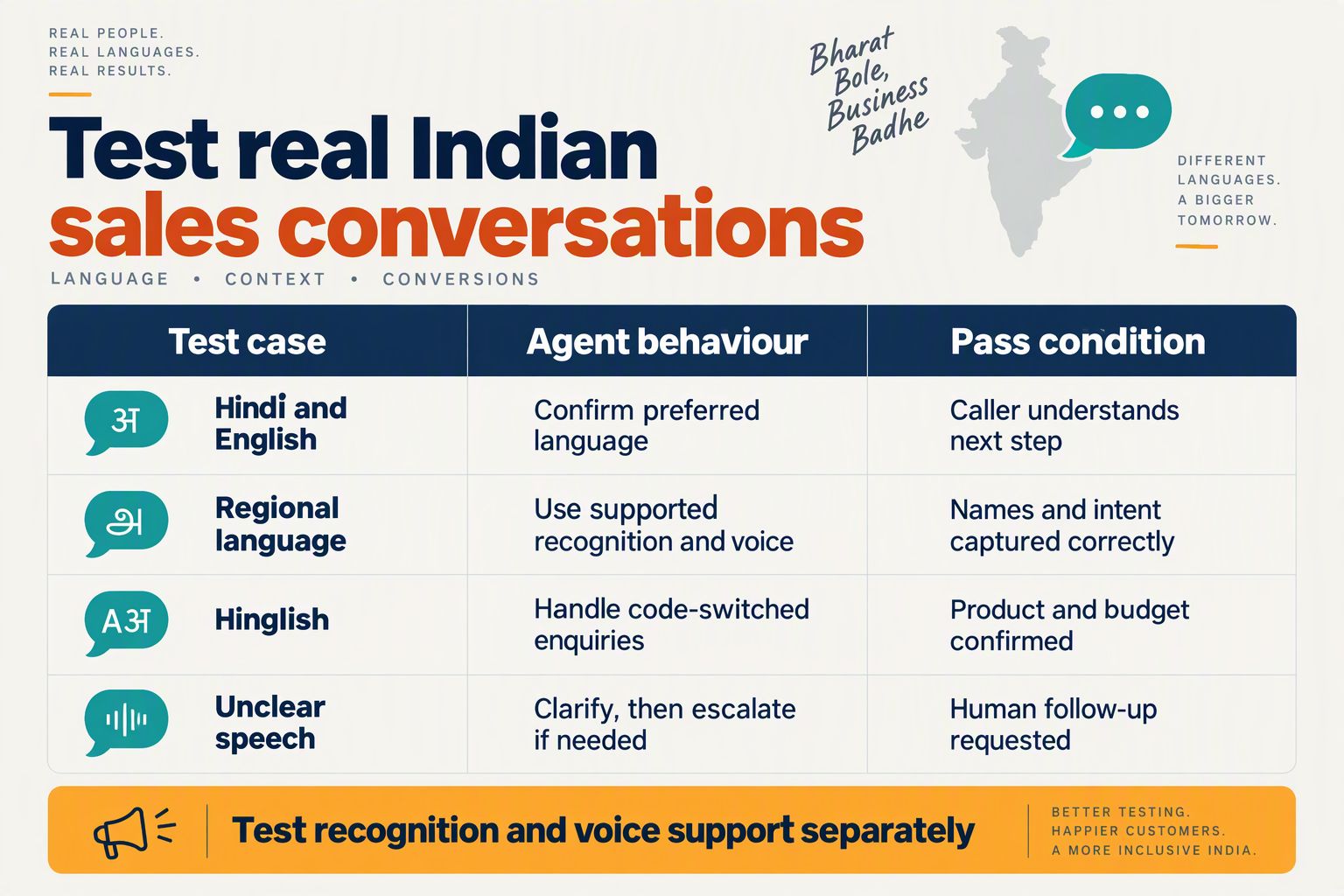
Improve Hindi, regional-language and Hinglish sales conversations by testing how callers actually speak, not just selecting a language from a menu. Configure the agent to follow the caller’s preferred language, preserve familiar English sales terms, and confirm details that could change the sale.
An answered call still becomes a lost opportunity if “fifteen lakh” becomes “fifty lakh,” or a locality is recorded incorrectly. Treat language accuracy as a sales-workflow requirement, rather than a voice-quality preference.
What should you test in multilingual sales calls?
Use the following checklist for an October 2026 deployment. These are recommended test scenarios, not measured performance claims.
| Conversation challenge | Example caller wording | Recommended handling | What to check |
|---|---|---|---|
| Hindi with English sales terms | “Down payment kitna hoga?” | Reply in Hindi while retaining familiar terms | Meaning and payment details |
| Hinglish language switching | “Budget twenty lakh hai, EMI bataiye” | Preserve the budget; clarify financing needs | Amount and buyer intent |
| Regional-language preference | Caller requests Tamil or Marathi | Continue in the requested supported language | Recognition and spoken response |
| Local names and addresses | Locality, landmark or dealership name | Ask for spelling or a nearby landmark when unclear | Correct CRM entry |
| Ambiguous numbers | “Fifteen” versus “fifty” | Repeat the amount with its unit | Explicit caller confirmation |
| Noise or interrupted speech | Traffic obscures a model name | Ask a targeted clarification question | Recovery without guessing |
Speech recognition and spoken output are different capabilities. According to CallMissed’s verified product fact sheet, as of October 2026, CallMissed supports speech recognition in 22 Indian languages plus English, including code-mixed speech such as Hinglish, and natural text-to-speech voices in 10 Indian languages plus English, with additional languages available through other voice models. Check the chosen recognition-and-voice combination for each target language; recognition coverage alone does not establish spoken-response suitability.
How should you write prompts for Hindi and Hinglish callers?
Give the agent explicit conversation rules rather than the vague instruction “be multilingual.” Start with these:
- Follow the caller’s preference: use a brief language-choice question when the preference is unclear, and accommodate a requested switch.
- Keep familiar terminology: do not force translations of “EMI,” “test drive” or product names when the caller uses those terms.
- Confirm consequential details: repeat budgets, dates, quantities and phone numbers before recording or acting on them.
For example, after “Budget twenty lakh hai,” a suitable confirmation is: “Aapka budget ₹20 lakh hai, sahi?” This verifies the amount without making the caller repeat the entire enquiry.
Build a reviewed pronunciation and terminology list for frequently mentioned neighbourhoods, products and abbreviations. Have fluent local reviewers assess naturalness; grammatically correct speech can still sound awkward or obscure the next step.
How do you measure whether regional-language conversations work?
Review results separately by language and code-mixed speech, rather than relying on one overall score. A strong Hindi result can conceal weak handling of Marathi place names or Hinglish amounts.
Track:
- Critical-field accuracy: correctly captured required fields divided by all required fields reviewed.
- Clarification success: unclear details successfully resolved after a follow-up question.
- Task completion: enquiries ending with a confirmed, appropriate next step.
- Human escalation quality: unresolved language issues transferred with useful context.
Use consented recordings or scripted tests that include interruptions and realistic background noise. Expand language coverage only after reviewers can verify both understanding and the sales outcome—not merely fluent-sounding audio.
Which mistakes cause AI call-answering pilots to lose leads?
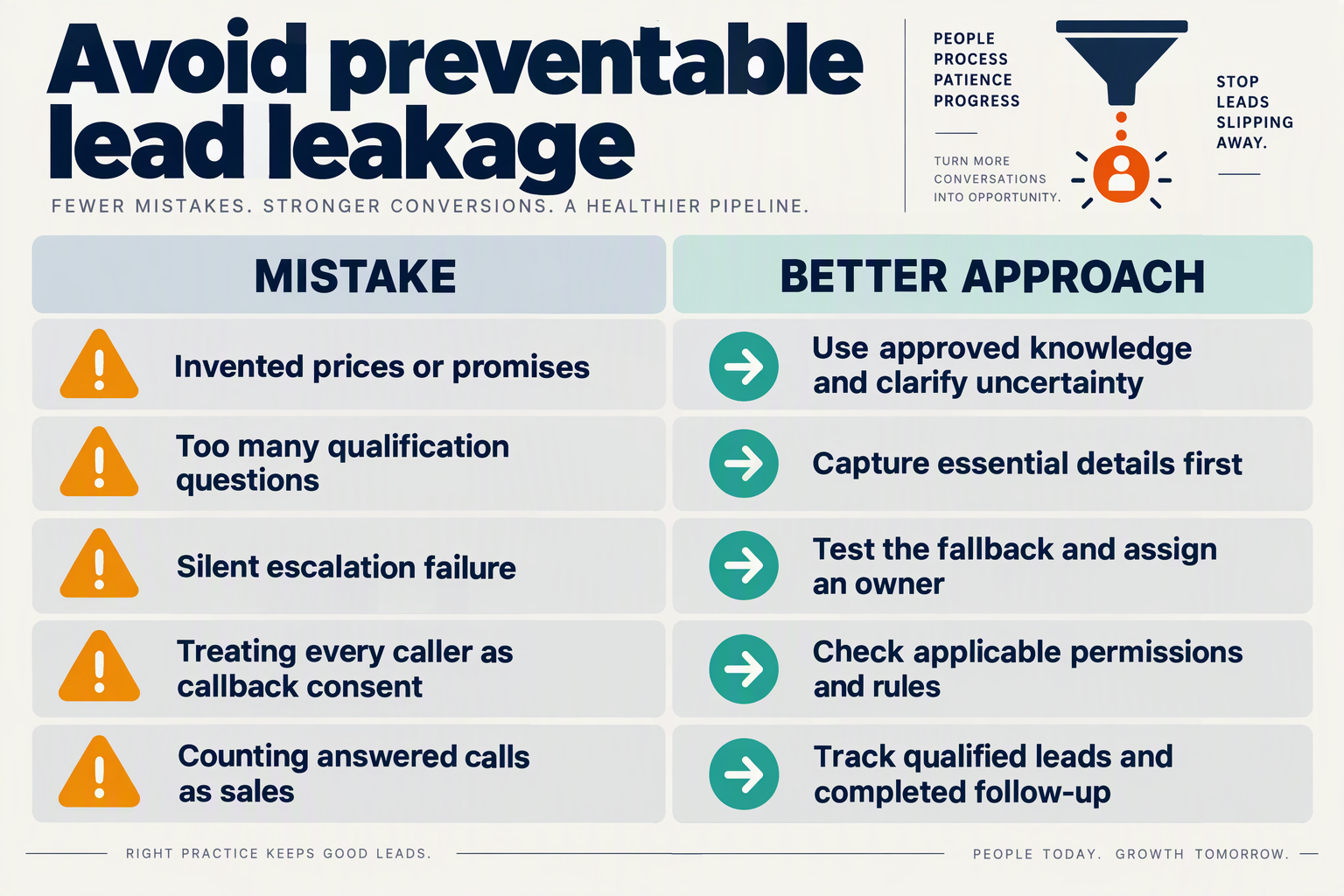
AI call-answering pilots lose leads when they optimise for answering calls rather than completing the buyer’s next step. The most damaging mistakes are unverified answers, excessive qualification, failed handoffs, and follow-up records that nobody owns.
Treat the following as a pilot risk checklist, not a ranking of platforms. Each correction should be tested before expanding AI coverage to more sales calls.
| Pilot mistake | How it loses the lead | What to change | What to measure |
|---|---|---|---|
| Giving unverified prices or availability | A caller acts on an incorrect promise, creating a difficult sales conversation later. | Use approved information; confirm changing details through a connected system or human follow-up. | Incorrect claims in reviewed calls |
| Asking too many qualifying questions | A buyer seeking one quick answer abandons a lengthy interview. | Answer the immediate question first, then request only essential lead details. | Abandonment during qualification |
| Accepting misheard names and numbers | The salesperson receives a lead they cannot reliably contact. | Read back critical details and let callers correct them. | Contact-detail correction rate |
| Offering a handoff nobody can receive | “Connecting you now” becomes another unanswered call. | Check routing availability; offer a clearly explained callback when transfer fails. | Completed versus failed handoffs |
| Ending without a named follow-up owner | A useful transcript sits untouched while the buyer contacts another business. | Assign an owner, next action, and internal deadline before marking the enquiry complete. | Leads without ownership; overdue follow-ups |
| Counting answered calls as sales success | A busy dashboard hides unresolved enquiries and poor lead quality. | Track qualified enquiries, completed next steps, and downstream sales outcomes separately. | Progression from answered call to next step |
How should an AI agent handle answers it cannot verify?
Uncertainty should trigger clarification or escalation—not a plausible-sounding promise. Separate stable knowledge, such as office location, from changing information, such as stock, appointment slots, or promotional eligibility.
For example, a dealership agent should not turn “this model usually starts around this price” into a binding quotation. A safer response is: “I can capture the variant you want and ask the sales team to confirm the current on-road price.”
Test these boundaries deliberately:
- Missing information: Can the agent acknowledge that a price is unavailable?
- Conflicting information: Does it avoid choosing between contradictory offers?
- Caller pressure: Does “just guarantee it” cause an unsupported commitment?
What should you check before expanding the pilot?
Review failed conversations, not just polished demonstrations. CloudTalk’s after-hours voice-agent comparison, included in the research supplied for this October 2026 guide, compares 10 platforms on areas including emergency escalation, appointment scheduling, and lead capture—useful reminders that answering is only one part of the workflow.
As of October 2026, CallMissed’s verified product fact sheet lists call scoring against a business’s own QA rubrics, eval suites, A/B experiments, and versioning with publish and rollback. These capabilities support a practical discipline: test a change, inspect its effect, and reverse it when necessary.
Use a simple review sequence:
- Classify the failure: wrong answer, misunderstood detail, routing failure, or missing follow-up.
- Change one variable: adjust the prompt, knowledge source, routing rule, or qualification question.
- Retest the same scenario: check whether the correction works without breaking another path.
Do not expand merely because fewer calls ring unanswered. Expand when the pilot reliably preserves buyer intent and produces a next step that your sales team actually completes.
What does a missed-call pilot cost in India in 2026, using CallMissed rates?
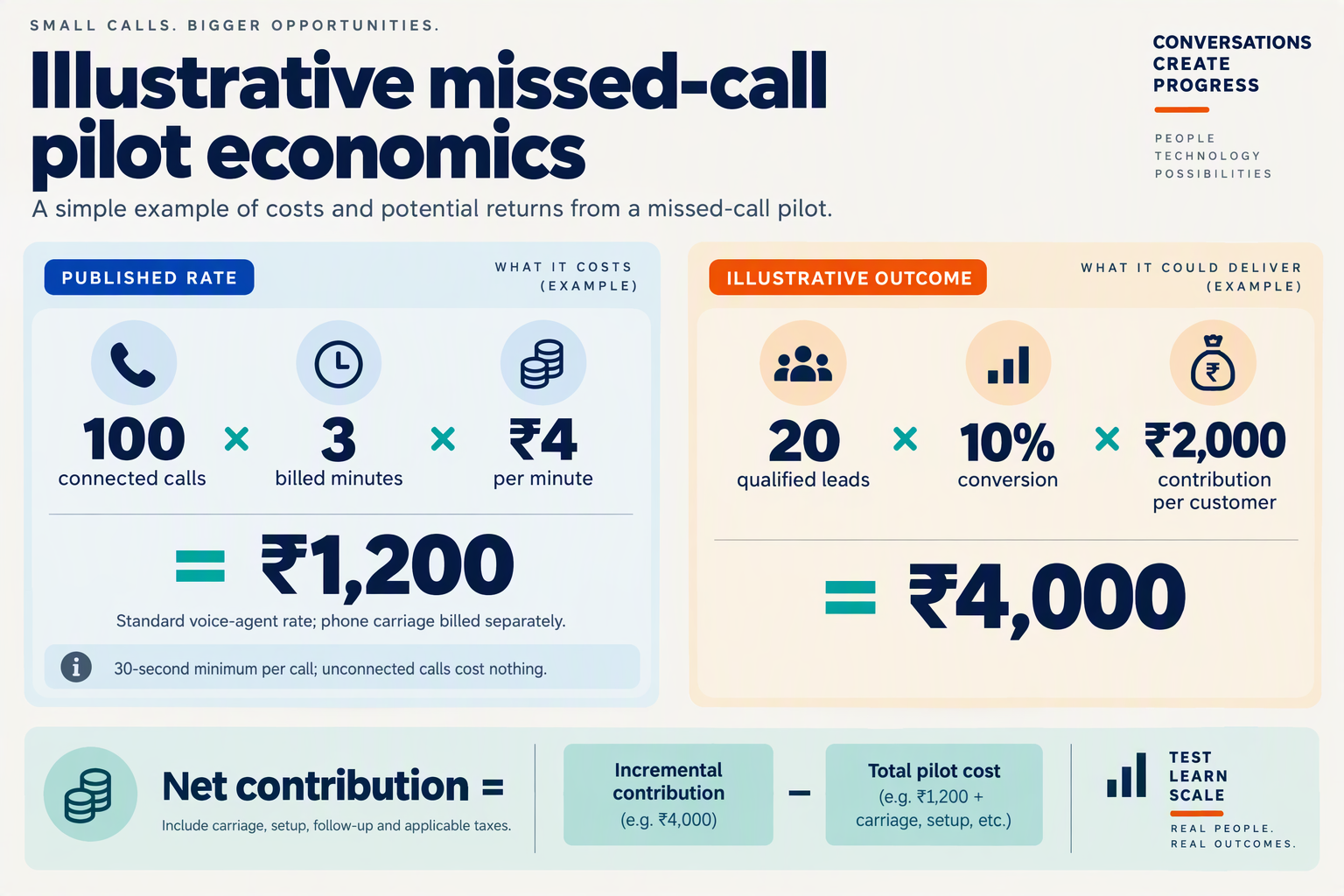
A small missed-call pilot using CallMissed’s October 2026 rates would cost ₹1,200–₹1,800 for 300 connected minutes, depending on the voice plan, before separately billed phone carriage. The right budget depends on connected call duration—not simply how many enquiries your business receives.
What is included in the per-minute price?
According to CallMissed’s verified pricing information, as of October 2026, the flat-rate voice plans include speech recognition, the language model, and the voice.
| Voice plan | Rate, October 2026 | Cost for 300 minutes | What you are testing |
|---|---|---|---|
| Standard | ₹4/min | ₹1,200 | Natural Indian-language voices |
| Expressive | ₹5/min | ₹1,500 | Richer expression across Indian and world languages |
| Best latency | ₹6/min | ₹1,800 | The platform’s fastest replies and best-sounding voices |
| Custom stack | Component-based, per second | Depends on selected components | A tailored speech, model, and voice combination |
As of October 2026, flat-rate calls have a 30-second minimum, while a call that never connects costs nothing. The custom-stack option has no minimum, but requires component-level budgeting rather than one bundled rate.
For example, a connected 20-second call on Standard incurs the 30-second minimum: ₹2 in voice-agent charges, before phone carriage. Short calls therefore matter when estimating spend.
How do you calculate a realistic pilot budget?
Start with your overflow or after-hours call records, then use this calculation:
Estimated voice cost = connected billable minutes × selected per-minute rate.
For an illustrative October 2026 pilot—not a customer benchmark—assume:
- 100 connected calls reach the AI agent.
- Each conversation lasts three minutes.
- Total usage is 300 minutes.
- Standard pricing produces ₹1,200 in voice-agent usage.
Keep a separate budget line for:
- Phone carriage: billed separately from the voice-agent rate.
- Number rental, if applicable: confirm the cost for your selected setup.
- Applicable taxes: confirm the payable invoice amount.
- Internal effort: knowledge-base preparation, test calls, call review, and follow-up ownership.
Do not assume the ₹1,200 example is an all-inclusive implementation quote. Longer conversations, additional testing, and more connected calls increase usage.
Can free credits reduce the pilot’s cash outlay?
As of October 2026, signup includes 1,000 free credits, and one credit equals ₹1, according to the verified fact sheet. Pay-as-you-go is available with no seat fees; credit top-ups range from 10 to 50,000 credits at ₹1 per credit, and credits never expire.
In the illustrative ₹1,200 Standard pilot, 1,000 available signup credits would leave ₹200 of voice usage to fund. That assumes those credits have not already been consumed by testing or other services; it does not remove separately billed phone carriage.
Which cost metric should decide whether you expand?
Track cost per qualified enquiry, not just cost per minute. An inexpensive call that captures the wrong requirement creates work rather than sales value.
For the October 2026 example, if ₹1,200 of voice usage produces 20 genuinely qualified enquiries, voice-only cost per qualified enquiry is ₹60. Those are modelling assumptions, not a promised conversion rate.
For the expansion decision, add carriage and internal review costs, then compare qualified enquiries, completed follow-ups, and attributable sales. Free credits lower trial expenditure, but ongoing economics should use the full usage cost.
Frequently Asked Questions
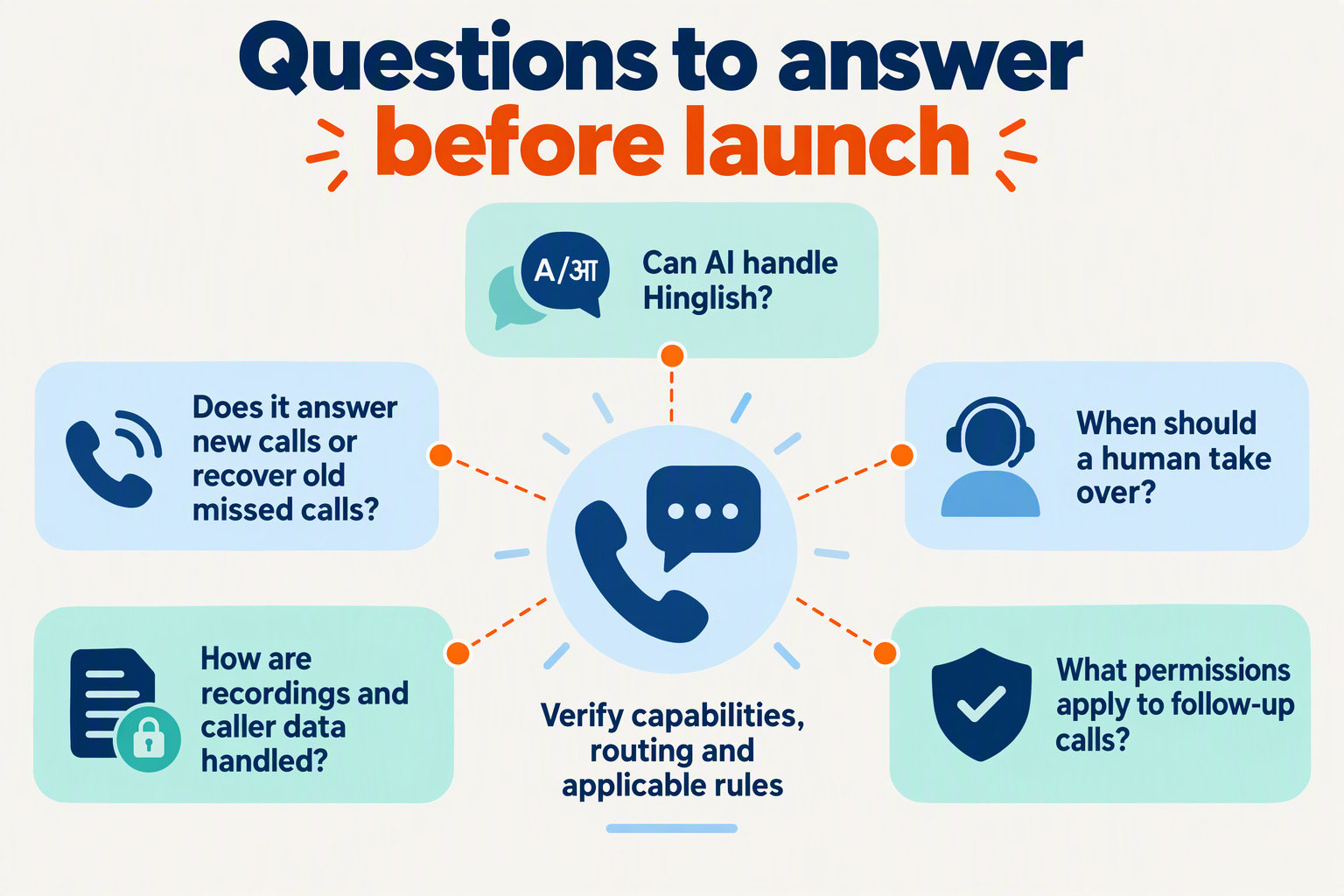
Can AI voice agents understand Hinglish and regional Indian languages?
Can AI voice agents recover leads from already-missed sales calls?
Can an AI voice agent hand missed sales calls over to a human?
Can I use an AI voice agent with my existing business phone number?
What does an AI voice agent cost in India in 2026?
Will AI eliminate missed sales calls and guarantee more sales?
Which resources and checks should guide your next pilot?
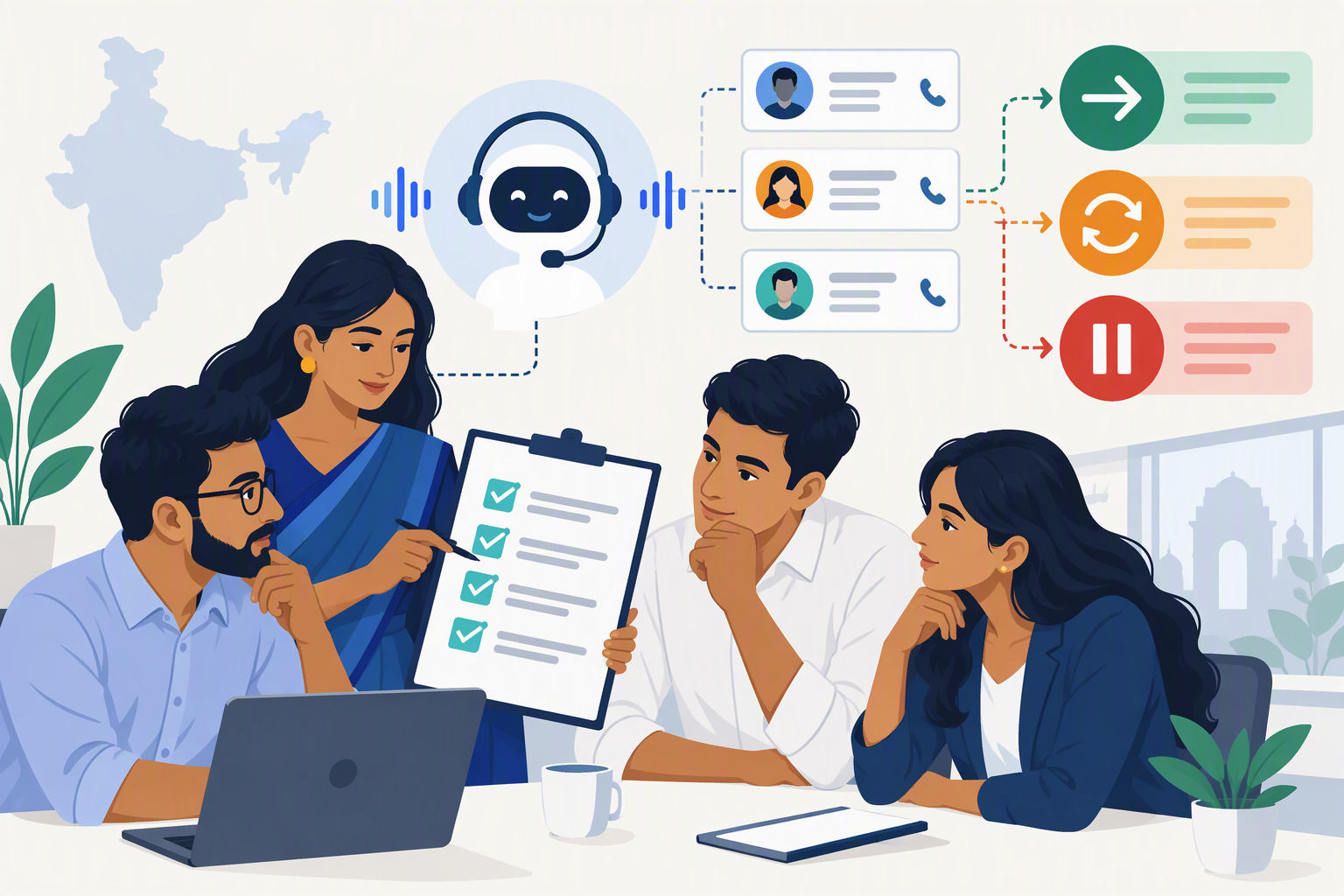
Use your own call records, official product documentation, and a written acceptance checklist to guide the next pilot—not a vendor ranking alone. The decision should rest on whether an AI voice agent preserves buyer intent, produces usable follow-up records, and handles exceptions safely.
Which resources should you consult before choosing a pilot platform?
Build a small evidence pack that distinguishes market research from operational proof:
- Your telephone-system reports: identify unanswered calls by hour, queue, and campaign source. These establish whether your first pilot should address overflow or after-hours demand.
- Your sales team’s call reviews: collect anonymised examples of successful enquiries, misunderstood requests, and failed follow-ups. Turn these into test conversations rather than relying on generic demonstrations.
- Official platform documentation: verify carrier setup, CRM integration behaviour, billing rules, call recording controls, and escalation options. Ask vendors to demonstrate anything that documentation leaves unclear.
- Current legal and telecom guidance: have the appropriate adviser review recording notices, personal-data handling, retention, and any outbound activity before deployment.
For external perspective, CloudTalk’s after-hours guide, included in the research reviewed for this October 2026 article, compares 10 AI voice-agent platforms on criteria including emergency escalation, appointment scheduling, and lead capture. Use those categories to broaden your checklist; the supplied summary does not establish which platform will perform best on your calls.
What should your pilot acceptance checklist contain?
Define the pass conditions before the agent answers customers. Otherwise, a pleasant voice or an impressive demonstration can overshadow operational failures.
- Scope and exclusions: specify the enquiries the agent may handle and the requests it must escalate. Include unavailable stock, disputed prices, urgent requests, and callers asking for a person.
- Answer verification: test responses against approved information. The agent should acknowledge missing information rather than invent an answer.
- Record completeness: check whether the correct name, requirement, location, and next action reach the intended sales workflow.
- Follow-up ownership: confirm who receives each enquiry, when that person must act, and how unresolved items are surfaced.
- Failure recovery: rehearse integration outages, poor audio, caller interruptions, and unsuccessful transfers. Write down the fallback for each.
- Release control: name the person authorised to pause the pilot, change its configuration, and approve expansion.
As of October 2026, CallMissed’s verified product fact sheet lists evaluation suites, A/B experiments, call scoring against custom QA rubrics, and agent versioning with publish and rollback. These capabilities are relevant to a controlled pilot because teams need repeatable checks and a way to reverse changes—not just a way to launch an agent.
How should you make the final go-or-no-go decision?
Schedule a review with sales, operations, and whoever owns customer data. Examine actual conversations alongside outcomes; an answered call is not automatically a recovered lead.
Use three decision categories:
- Expand: critical checks pass, follow-ups reach their owners, and reviewed conversations show useful enquiry capture.
- Revise: the workflow is promising, but recurring errors require configuration changes and retesting.
- Pause: incorrect commitments, missing records, or failed escalation create unacceptable customer risk.
For Indian businesses reducing missed sales calls with AI voice agents, the strongest next step is a bounded pilot with explicit evidence requirements. Expand when the workflow earns trust—not simply when the phone stops ringing unanswered.
Conclusion
Reducing missed sales calls means building a reliable first response—not replacing every sales conversation with automation. For Indian businesses, AI voice agents are most useful when they answer overflow and after-hours enquiries, preserve buyer intent, and give a person enough context to take the next step.
The opportunity is practical rather than theoretical. In the research supplied for this October 2026 guide, MyOperator reports that even fully staffed teams miss 25–40% of inbound calls during business hours. That vendor-reported range is not a forecast for your business, but it is a reason to measure your own unanswered calls before deciding how much automation you need. A property enquiry, appointment request, or dealership call deserves a workflow that carries the customer’s requirements forward.
Four takeaways should guide your implementation:
- Start with one identifiable missed-call problem. Separate peak-hour overflow from after-hours enquiries instead of treating every unanswered call alike. Pilot the workflow where your team sees a clear gap, then review whether the AI agent captures the information a salesperson actually needs. Expand only after real call reviews demonstrate accurate handling.
- Design for Indian callers, not just a polished demonstration. Test regional languages, Hinglish, names, locations, and noisy mobile connections. A conversation that sounds natural but records the wrong requirement still creates work for your team. Language coverage matters most when it preserves meaning and supports an appropriate human handoff.
- Make follow-up part of the answering workflow. Capturing a transcript is not the same as progressing an enquiry. Decide which details belong in the CRM, who owns the next action, and when the agent should escalate. The aim is to prevent an answered call from becoming another unattended lead.
- Judge cost against useful outcomes. Compare answering costs with qualified enquiries, completed follow-ups, and eventual sales outcomes—not call volume alone. Review unsuccessful conversations alongside successful ones so that improvements address genuine customer friction rather than simply making the agent sound more fluent.
Looking ahead, watch whether multilingual accuracy, appropriate handoffs, and CRM-connected follow-up improve together. Those are more meaningful signals than increasingly human-sounding voices on their own.
As of October 2026, CallMissed supports speech recognition in 22 Indian languages plus English, including code-mixed speech such as Hinglish, alongside knowledge-base support and AI call notes pushed to the CRM. Readers can explore CallMissed as one platform for putting these connected workflows into practice.
Start with your next busy-hour window: which unanswered enquiry could become a useful sales conversation if someone captured the customer’s needs immediately?
Related Reading
- Voice Agent Prompt Injection Testing: Tool-Call Checks
- Customer Support Voice Agent: Python Workers Backends
- Multilingual AI Voice Agent India: CallMissed Handoff QA