
Multilingual AI Voice Agent India: CallMissed Handoff QA



Build a multilingual AI voice agent India teams can audit: test CallMissed voice-to-WhatsApp consent, human escalation and CRM data by language.
Multilingual AI Voice Agent India: CallMissed Handoff QA
What happens when a caller switches from Hindi to Hinglish mid-sentence, then expects a WhatsApp follow-up that remembers why they called? A multilingual AI voice agent in India needs more than accurate transcription: it needs a handoff that preserves the right context, respects the customer’s channel preferences and gives a human a clear path to take over.
The language challenge is concrete. CallMissed’s September 2026 product specifications list speech recognition in 22 Indian languages plus English, including code-mixed speech such as Hinglish. The same specifications list natural text-to-speech voices in 10 Indian languages plus English. Those are different capabilities: recognising a customer’s words in one language does not guarantee that the agent will reply naturally in that language—or that a later WhatsApp message will use the customer’s preferred language.
The channel change adds another layer of risk. Imagine a customer calling about a delayed order, giving a reference number in English, describing the problem in Hindi and asking for an update on WhatsApp. A voice agent might handle each turn well but still produce a poor experience if the follow-up omits the order reference, overstates what was promised or reaches a number that has not been checked for the intended WhatsApp workflow. Handoff quality is a separate test from voice quality.
That is why this playbook treats voice-to-WhatsApp continuity as a series of observable checks, not a demo that ends when the call sounds convincing. You will learn how to:
- Build test calls around regional accents, code-switching, interruptions and ambiguous names or order numbers.
- Inspect the handoff record for the customer’s intent, confirmed details, unresolved questions and promised next step.
- Review the WhatsApp follow-up for language choice, factual accuracy and an appropriate human-escalation route.
- Score failures by impact, so a wrong delivery promise or misdirected message receives more attention than an awkward phrase.
Platforms such as CallMissed bring relevant pieces together: as of September 2026, its voice agents provide recordings, transcripts, AI call notes and scoring against custom QA rubrics, while its WhatsApp Business tools include chatbot agents and a shared inbox. Those capabilities make testing possible; they do not remove the need to design the handoff and verify it.
The goal is a practical release standard: when a caller moves between languages and channels, can your team reconstruct what happened, see what the AI actually confirmed and continue the conversation without making the customer start over?
How do you launch safely? Start with 2–3 languages and one inbound task
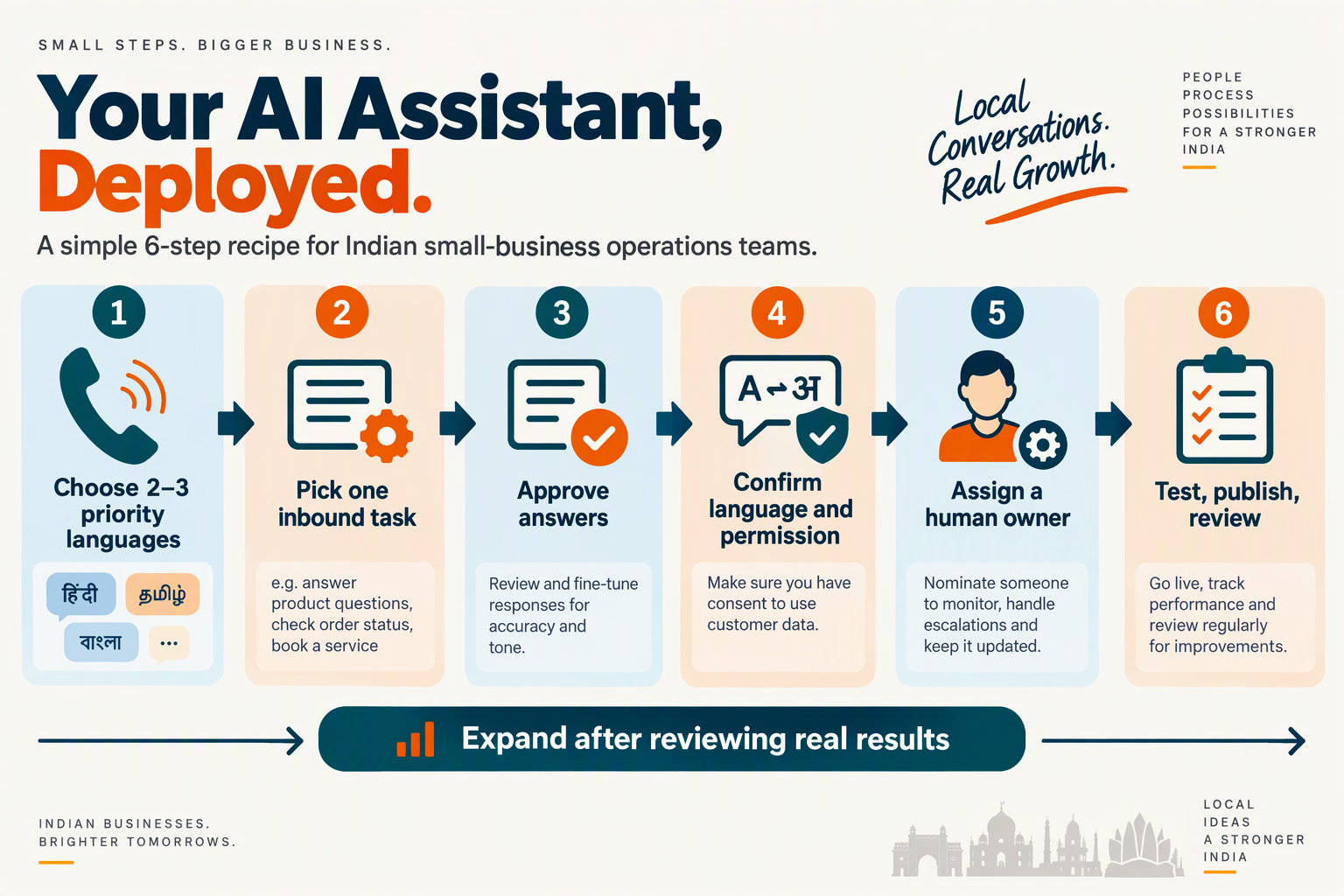
Launch a multilingual AI voice agent in India with two or three languages, one inbound task and a human-reviewed WhatsApp handoff. Expand only after test calls show that the team can verify what the caller said, what the agent confirmed and what the customer should receive next.
Which languages and inbound task should you choose first?
Choose languages from the calls your business actually receives, not from the longest list a platform supports. An order-support team serving Mumbai might begin with Hindi, Marathi and English, while treating Hindi–English code-switching as a test condition across those languages rather than a separate launch language.
Pick a task with a clear stopping point. For example, the agent can collect an order reference and the reason for an update request, then prepare a handoff for a person to review. If it cannot verify the order against an approved system, it should not invent a delivery date. That boundary is easier to test than an open-ended instruction to “handle all order issues.”
As of September 2026, CallMissed supports no-code voice-agent configuration, inbound calls, call recordings, transcripts and AI call notes. Its WhatsApp Business tools include a shared inbox. Those are useful components for a pilot, but the team still has to decide which details may pass between the call and WhatsApp workflows and who approves a follow-up.
What should the first pilot include?
Write the allowed path before building prompts or messages:
- Identify the task: Record whether the caller wants an order update; route returns, refunds and payment disputes to a person.
- Confirm critical fields aloud: Repeat the order reference and requested next step. Mark unclear digits or names as unverified, rather than guessing.
- Check the channel: Confirm the WhatsApp number and the customer’s preference for a follow-up. Review the intended messaging workflow before sending anything.
- Prepare the handoff: Preserve the customer’s language preference, confirmed facts, unresolved questions and any commitment the agent actually made.
- Let a human review exceptions: A missing reference, conflicting account details or a request outside scope should enter a review queue, not trigger a confident-sounding update.
This keeps voice quality and handoff quality measurable separately. The CallMissed website’s July 2026 guidance describes speech workflows across 22 Indian languages; that breadth is a capability, not a reason to launch every language and task at once.
When is the pilot ready to expand?
Run scripted and unscripted calls for each launch language, including code-switching, interruptions, noisy lines and similar-sounding order numbers. Have a reviewer compare the recording, transcript, handoff record and proposed WhatsApp message—not just the agent’s final answer.
Set release gates before the test. A practical starting rule is zero misdirected messages or invented delivery promises in the pilot sample, with every sampled handoff showing which fields were confirmed and which still need checking. These are proposed safety criteria, not published industry benchmarks. If a failure appears, fix the prompt, verification step or human-review rule, then rerun the affected cases before adding another language or inbound task.
What do you need before setup? Languages, answers and ownership
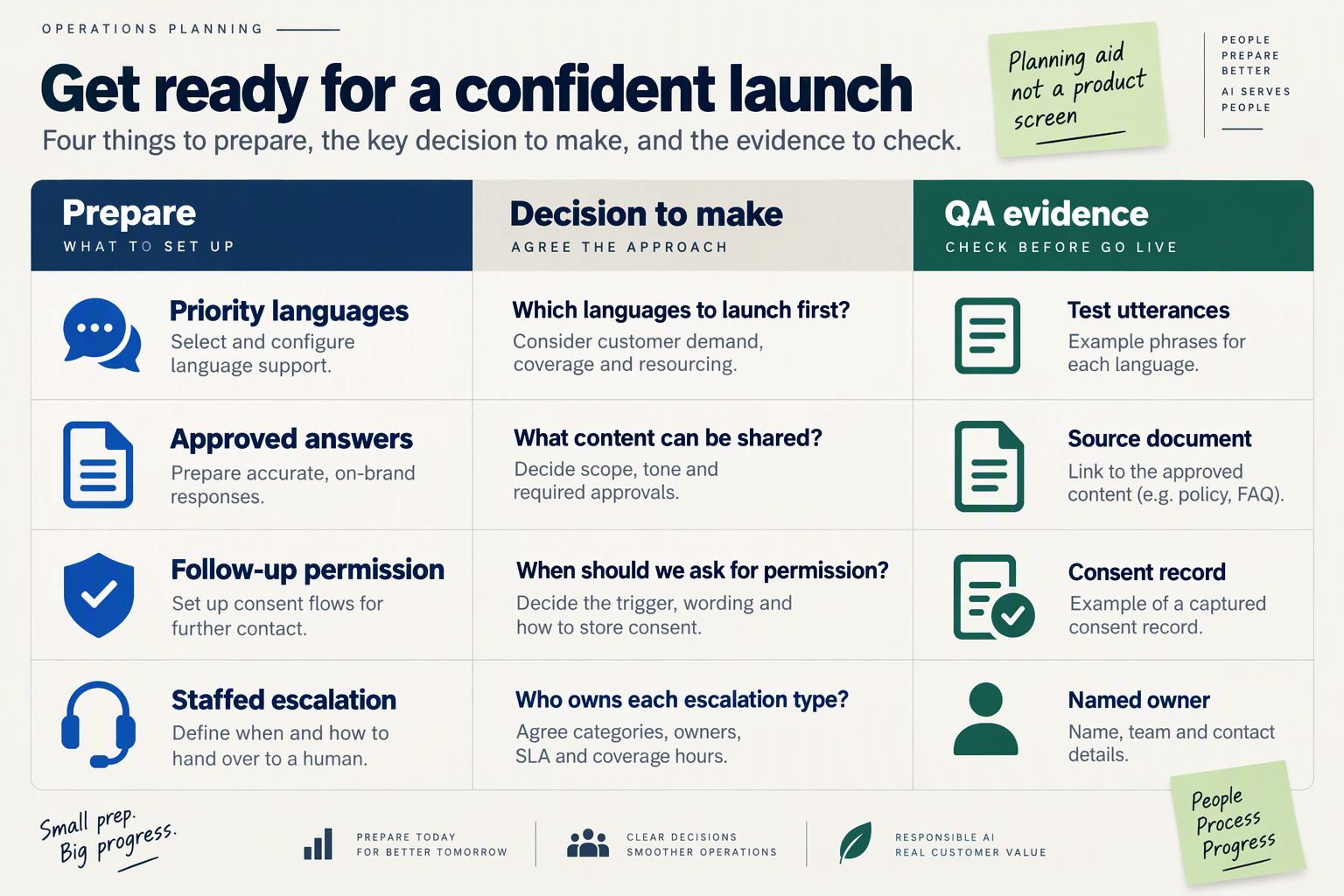
Before setup, agree on which languages the agent will handle, which answers it is authorised to give, and who owns the conversation after the call. Write those decisions down before building prompts: a convincing test call cannot compensate for an unverified delivery promise or a WhatsApp follow-up with no assigned owner.
What should be ready before you build the agent?
Use a single setup sheet for the first inbound task. Keep it specific enough that a tester can compare the call, the handoff record and the WhatsApp message against the same expectations.
| Input | Decision to make | Evidence to prepare | Owner |
|---|---|---|---|
| Language coverage | Select the launch languages and how to respond when a caller switches languages or requests another one. | Sample phrases, code-switched examples and the preferred language for follow-up. | Operations lead |
| Approved answers | Define what the agent may say about the selected task. | Current FAQ or policy text with an update date. | Policy owner |
| Source of truth | Decide which system verifies changing facts, such as order status. | Access to the relevant record and a fallback when it is unavailable. | Systems owner |
| Customer identifiers | Specify which details must be repeated back before use. | Test names, order references and examples of ambiguous digits. | QA lead |
| WhatsApp follow-up | Define when to send a message, which number to use and what it may promise. | Channel-permission check, draft wording and a review step. | Messaging owner |
| Human takeover | Name the queue and person responsible for unresolved cases. | Escalation triggers and the information a human needs to continue. | Support lead |
These are workflow assignments, not product settings that automatically guarantee a safe handoff. For example, an order-status answer should come from a verified order record; if that record cannot be checked, the approved answer should say so rather than estimate a delivery date.
How do you prepare language and answer content?
Create a small set of approved answer pairs: what the agent should say on the call and what a later WhatsApp message may say about the same issue. Include one straightforward request, one code-switched request and one case in which the answer is unknown. Mark names, amounts, dates and reference numbers as fields to confirm—not facts to infer from a plausible-sounding transcript.
As of September 2026, CallMissed’s product specifications distinguish speech recognition in 22 Indian languages plus English from natural text-to-speech voices in 10 Indian languages plus English. That distinction matters when choosing test languages: the team must check both what the agent understands and how it replies, then separately approve the language of the written follow-up.
Who signs off before the first test call?
Assign three decisions explicitly:
- The policy owner approves answers and identifies statements that require live verification.
- The messaging owner checks the intended WhatsApp workflow, recipient and message wording.
- The support owner accepts cases the AI cannot resolve and defines what constitutes an actionable handoff.
Give QA a dated copy of those decisions. As of September 2026, CallMissed’s voice-agent tools include a knowledge base, call transcripts, AI call notes and scoring against custom QA rubrics; its WhatsApp Business tools include message templates and a shared inbox. Those tools can provide material for review, but named owners and approved answers are what make the subsequent voice-to-WhatsApp test meaningful.
How do you configure a CallMissed voice agent for the pilot?
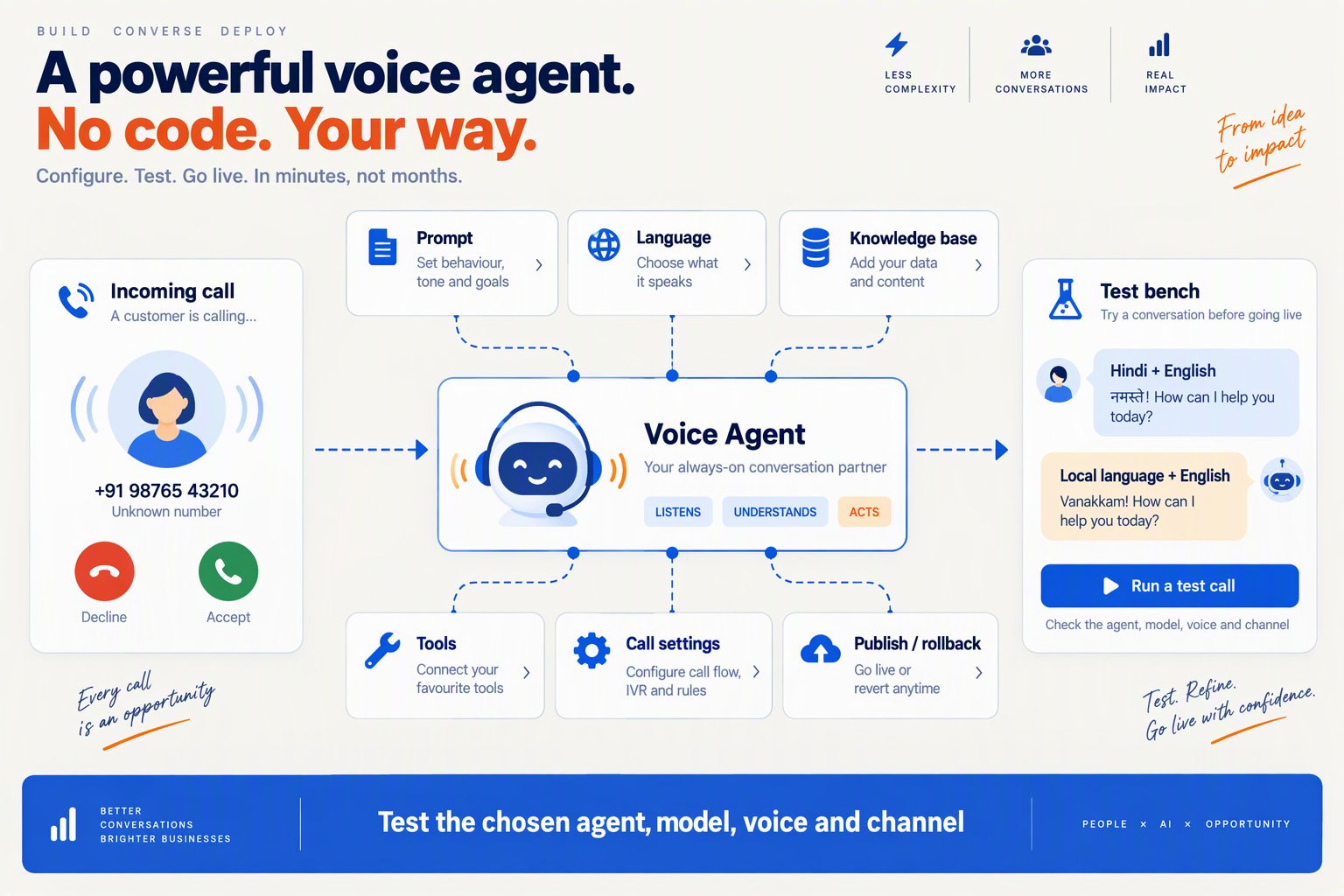
Configure the pilot as one inbound voice task with a defined, human-reviewed WhatsApp next step. In CallMissed’s no-code voice-agent builder, set the agent’s language, prompt, knowledge base and call settings first; then test the complete journey before publishing it to callers.
What should you put in the voice-agent prompt?
Give the agent a narrow job—for example, collecting the details of a delayed-order enquiry—not a general instruction to “resolve customer issues.” Specify what it must confirm aloud and what it must leave for a person to verify.
For the delayed-order pilot, the prompt should tell the agent to:
- Ask for the order reference and repeat it back, character by character if needed.
- Record the customer’s issue and preferred language without treating a switch to Hinglish as a new request.
- Ask whether the customer wants a WhatsApp follow-up, and confirm the number to use for the intended workflow.
- State only the next step the business can deliver—for example, “a team member will check the order”—rather than inventing a delivery date.
- Route uncertain references, conflicting details or requests for a person to human review.
These are instructions to configure and test, not guarantees that the agent will follow them perfectly. Keep a short set of approved responses for each pilot language and test whether spoken replies sound appropriate; speech recognition and voice output are separate choices.
Which knowledge and tools does the pilot need?
Start with a small knowledge base containing the approved order-support policy, operating hours and escalation instructions. CallMissed’s September 2026 product specifications say its agents can use knowledge from text, web pages and PDFs, as well as custom REST tools. Add an order-lookup tool only if the underlying system returns information your team trusts; otherwise, instruct the agent to collect the reference and defer status checks.
Use variables for details the next person will need: confirmed order reference, caller’s stated problem, preferred reply language, WhatsApp follow-up request, unresolved question and promised next step. Check those fields against the recording and transcript during the pilot. A fluent-sounding call is not evidence that a reference number was captured correctly.
How do you connect the call to a safe WhatsApp review?
Choose an inbound rented number or connect an existing carrier for the voice test. For WhatsApp, connect the Business account through Meta embedded signup and prepare an approved follow-up route using the shared inbox and, where appropriate, message templates. Do not assume that ending a call automatically sends the right WhatsApp message: assign a reviewer to check the destination, language and facts before sending during the pilot.
CallMissed’s September 2026 specifications list call recordings, transcripts, AI call notes, custom-rubric scoring and CRM-pushed notes. Configure the QA rubric around the handoff record: did the agent distinguish a confirmed order reference from one it merely heard, and did the WhatsApp draft preserve that distinction?
When is the configuration ready to publish?
Run test calls for each chosen language, including an interruption and a code-switch. Inspect the recording, notes and proposed follow-up side by side; fix the prompt or knowledge source when they disagree. Publish a version only after a named reviewer can reconstruct the call and approve the next message. Keep the previous version available: the builder supports versioning, publish and rollback as of September 2026.
How should a voice call become a permitted WhatsApp and human follow-up?
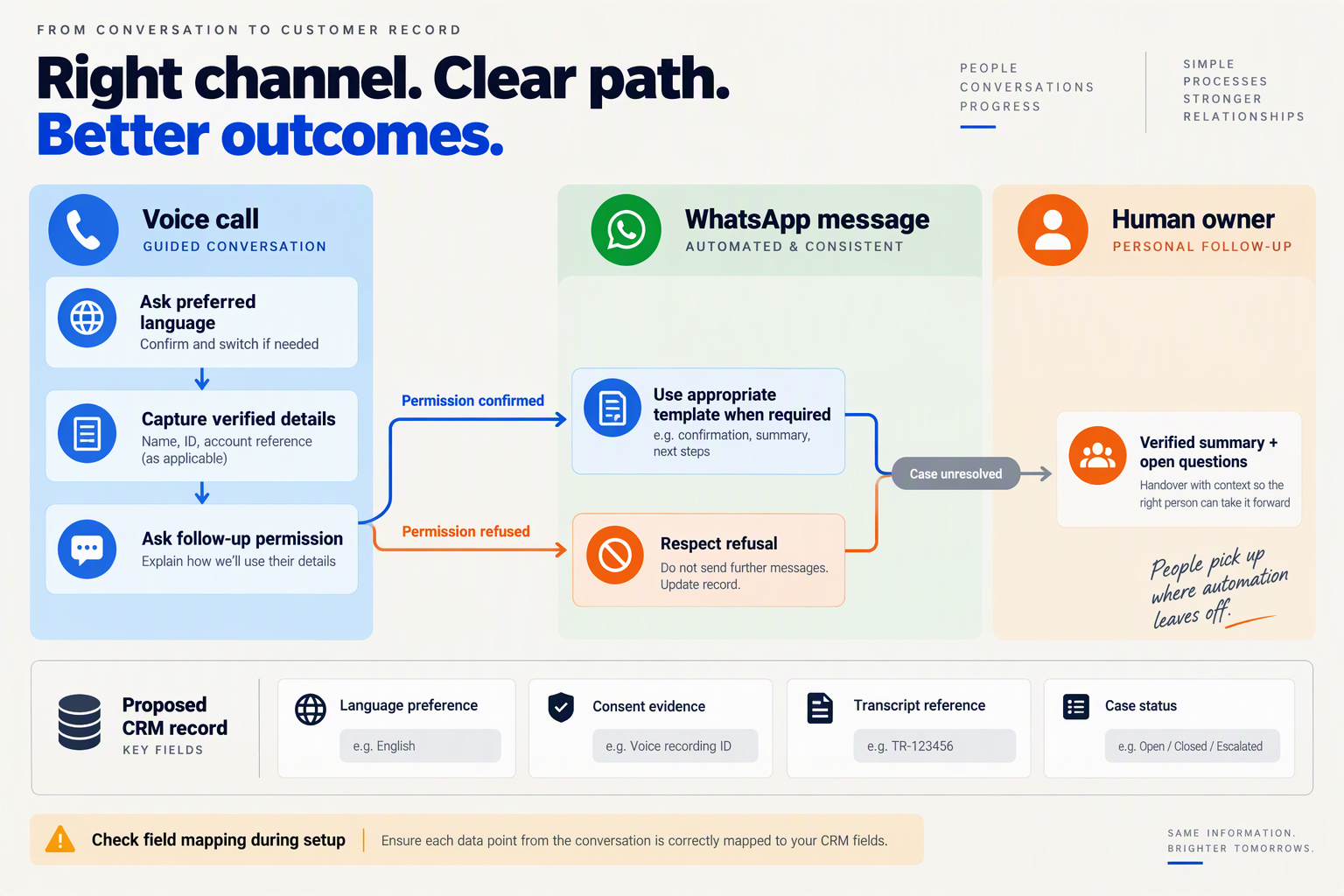
A voice call should become a WhatsApp follow-up only after the customer’s destination, permission and requested next step are confirmed. The handoff should carry a concise, auditable record into the message and the human queue—not treat the transcript as permission to contact the caller.
What must the agent confirm before sending a WhatsApp message?
Ask whether the caller wants an update on WhatsApp, and confirm the number to use rather than assuming the calling number is their WhatsApp number. Record the customer’s language preference, the purpose of the follow-up and any limits they set. If the answer is unclear, keep the case for human review instead of sending a message.
A practical permission check has four fields:
- Destination: the WhatsApp number the customer confirmed.
- Request: what the customer asked to receive, such as an order update—not a general marketing message.
- Evidence: the relevant call turn or transcript excerpt, with its timestamp.
- Status: confirmed, declined or unclear; “unclear” must not be treated as “yes.”
Permission for a WhatsApp message should not be confused with permission for a business-initiated WhatsApp call. CallMissed’s September 2026 product specifications state that businesses can place WhatsApp Business calls to customers who have given permission.
What context should move from the call to WhatsApp?
Create a structured handoff record before drafting any message. For a delayed-order enquiry, that record might say: “Caller requested a WhatsApp update in Hindi; order reference AB123 was repeated and confirmed; delivery date was not verified; human team to check status.” This is more useful—and safer—than forwarding a long transcript without marking which details were confirmed.
Separate the record into confirmed facts, customer-reported facts, unresolved questions and promises actually made. The WhatsApp draft should not turn “I’ll ask the team to check” into “Your order will arrive tomorrow.” If an order number was spoken through noise or code-switching, a person should verify it before using it to look up or disclose account information.
When should a human take over the follow-up?
Route the thread to a person when permission is ambiguous, the destination number is unverified, a material detail conflicts across the call, or the customer requests a decision the agent cannot substantiate. Give the reviewer the handoff record, the relevant transcript segment and a proposed reply; require them to correct the record before sending.
As of September 2026, CallMissed provides AI call notes covering summaries, action items, disposition and follow-up, alongside recordings and transcripts. Its WhatsApp Business tools include Meta-synced message templates and a shared inbox; switching the AI off hands an inbox thread to a person. Those are useful components for this workflow, but the team still has to configure its permission checks and review rules.
Finally, test the sent message, not just the draft: did it reach the confirmed destination, use the requested language, state only verified facts and make the next human action clear? If any answer is no, the voice-to-WhatsApp handoff has failed even if the call itself sounded fluent.
When must the agent stop guessing and escalate?
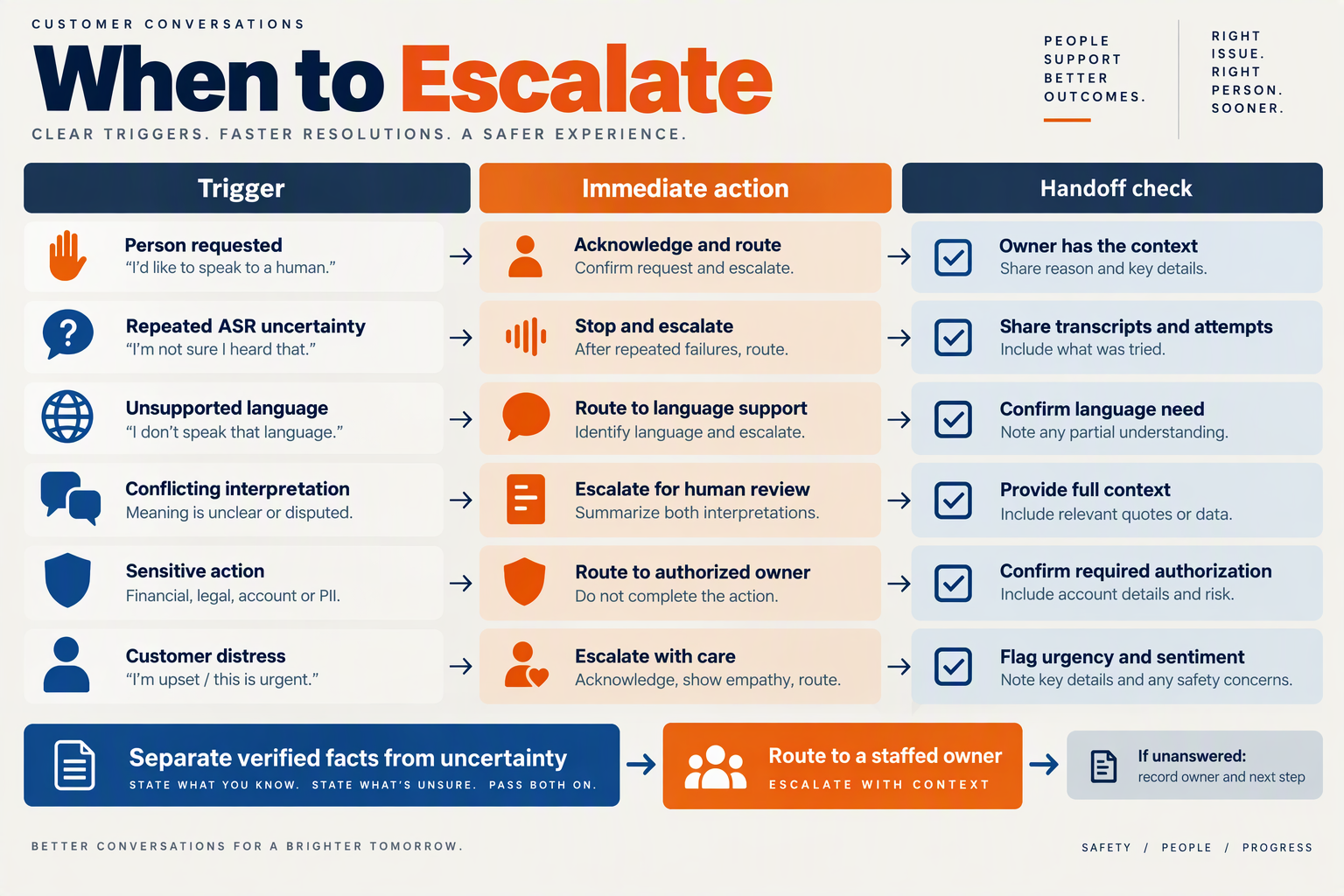
The agent must stop guessing when it cannot verify a detail that changes the outcome: who the customer is, which order is involved, what action is authorised, or where a WhatsApp follow-up should go. The safe response is to state what remains uncertain, ask one focused clarification question where appropriate, and escalate rather than turn an inference into a promise.
Which call events should trigger a human handoff?
Use the following as a proposed QA policy, not as a claim that speech recognition or translation has a universal confidence threshold. A fluent answer can still be wrong.
| Trigger | What the agent must not guess | Immediate action | Handoff record must include |
|---|---|---|---|
| Order number or name remains ambiguous after one repeat | Which customer or order the caller means | Ask the caller to confirm the identifier; route for human review if still unclear | Both heard versions and the unresolved field |
| Hindi–English code-switching changes the apparent intent | Whether the caller wants a refund, replacement or status update | Restate the interpreted request in the caller’s preferred language and seek confirmation | Original wording, confirmed intent and language preference |
| Caller requests an action affecting an account or payment | Identity, authority or eligibility | Pause the action and follow the business’s verification procedure | Requested action and verification status, without unnecessary sensitive data |
| Caller asks for a delivery date or refund decision the agent cannot verify | A deadline, approval or outcome | Explain that the status needs checking; avoid a definite promise | What was requested and what was not promised |
| WhatsApp follow-up is requested but the destination is uncertain | That the calling number is the right WhatsApp contact | Confirm the destination and apply the business’s messaging and permission rules before sending | Confirmed destination, channel preference and pending checks |
| Caller asks for a person, disputes the answer or becomes distressed | That another automated reply will resolve the issue | Offer a human route and stop repeating the same answer | Reason for escalation and any time-sensitive next step |
What should the agent say before escalating?
Use a short, specific acknowledgement: “I heard two possible order numbers, and I don’t want to check the wrong order. Could you repeat the last four digits?” If the answer remains unclear, the agent should say that a person will review it—not claim the order has been found. For a WhatsApp request, distinguish “I’ve noted that you prefer a WhatsApp update” from “Your update has been sent.”
This distinction matters in multilingual testing. CallMissed’s September 2026 product specifications list speech recognition in 22 Indian languages plus English, including code-mixed Hinglish, but natural text-to-speech voices in 10 Indian languages plus English. Recognition coverage does not itself establish that a particular spoken reply—or a later written message—matches the customer’s preference.
How should QA score an escalation?
Review the recording, transcript and handoff notes against three questions:
- Did the agent identify the uncertainty before acting?
- Did it preserve confirmed facts separately from guesses?
- Could a human continue the WhatsApp conversation without asking the caller to repeat the entire story?
Treat a wrong recipient, unauthorised action or invented promise as a release-blocking failure in this playbook; treat awkward but accurate wording as a lower-priority fix. As of September 2026, CallMissed supports recordings, transcripts, AI call notes, custom-rubric call scoring and a shared WhatsApp inbox. Those tools provide evidence for review, but the team must still define—and test—the escalation rule.
Which calls should you test before publishing in each priority language?
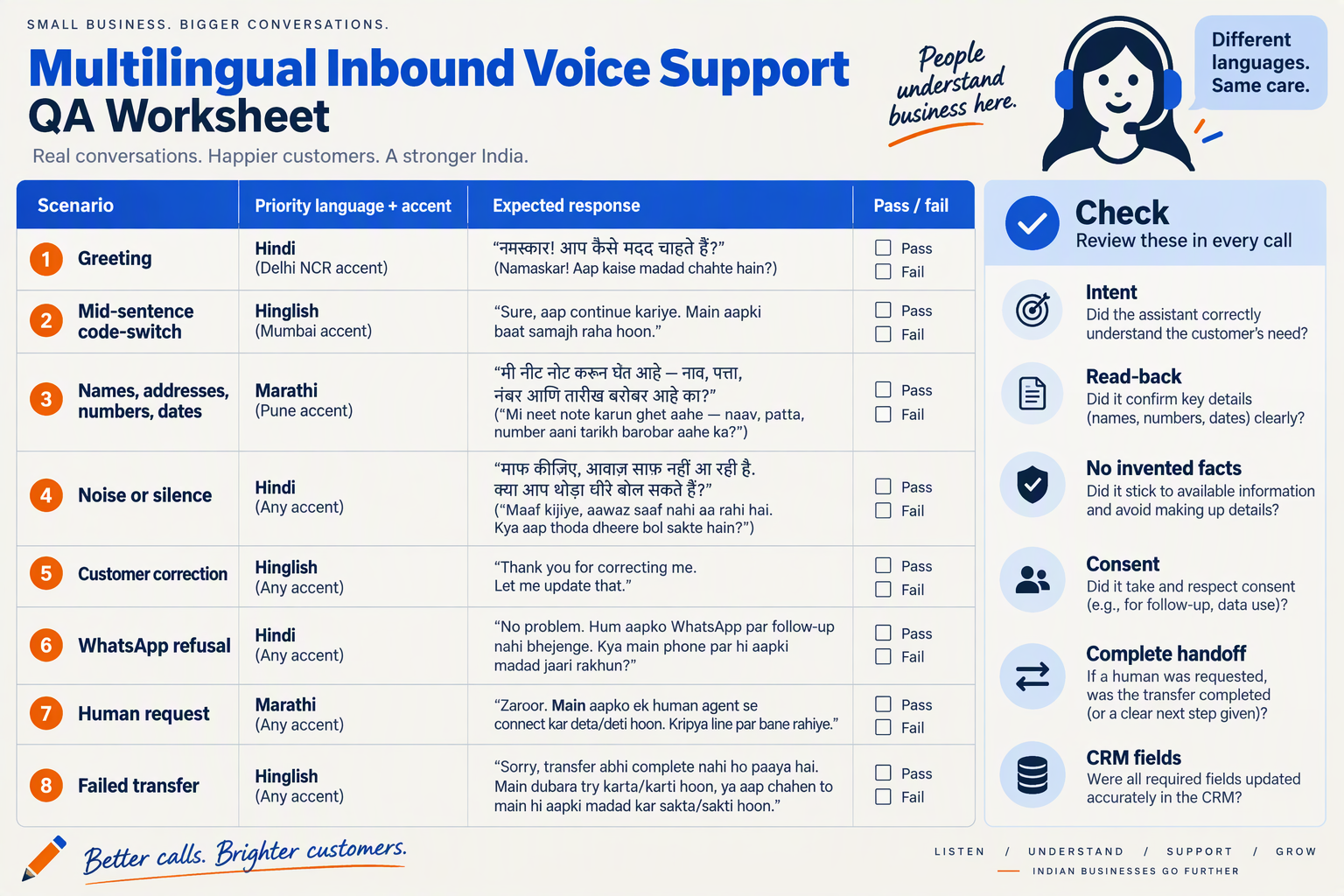
Test the same inbound task in every priority language, then add calls that expose language switching, uncertain details and a risky WhatsApp handoff. A fluent-sounding answer is not enough: each test must show whether the agent captured the right facts, avoided an unsupported promise and left a usable next step.
What is the minimum test set for each language?
Start with a repeatable set of calls for each of the two or three launch languages. Keep the customer goal constant—such as requesting an order update—so differences are easier to spot. Then vary one condition at a time:
- Straightforward request: The caller gives a clear order reference, asks one question and requests a WhatsApp update.
- Accent and pace variation: Speakers from different regions make the same request, including one who speaks quickly or pauses between digits. Recruit real speakers rather than imitating accents.
- Code-switching: The caller changes language mid-sentence and says the reference number in English. Check whether the agent keeps the number and the customer’s preferred reply language distinct.
- Ambiguous identifier: The caller says a name or number that could be heard two ways. The expected behaviour is to confirm it, not silently choose one interpretation.
- Interruption and correction: The caller interrupts the agent, then corrects an address, date or order reference. Check that the final record reflects the correction.
- Unresolved request: The agent cannot verify the answer during the call. It should record what remains unknown without turning an estimate into a promise.
This is a test design, not a claim that six calls establish production accuracy. Repeat failed cases with different speakers and phrasing; add scenarios drawn from the mistakes your team actually sees.
Which calls specifically test voice-to-WhatsApp continuity?
For each language, run at least one call where WhatsApp is an appropriate next step and one where it is not yet safe to send. For example, a caller may request an update but give a WhatsApp number that differs from the contact record. The agent’s notes should preserve that discrepancy for review rather than treating the destination as confirmed.
Include a call where the customer prefers to speak in Tamil but wants the written update in English, and another where the customer gives no written-language preference. Inspect the proposed follow-up for the correct recipient, reference, confirmed facts, unresolved question and next action. If a person must verify the order before replying, the message must not imply that verification has already happened.
How should testers decide whether a call passes?
Prepare a short expected-outcome sheet before placing each call. Record the intended facts, deliberate ambiguities, permitted next action and conditions that require human review. Afterward, compare the recording with the transcript, call notes and any draft or sent WhatsApp message—do not grade from the transcript alone.
- Block publishing for a wrong recipient, invented confirmation, incorrect reference or unsupported delivery promise.
- Retest after correction when a language preference or caller correction is lost.
- Track separately minor phrasing issues that do not change meaning or the next step.
A pass means the team can trace the handoff back to what the caller actually said. Apply that standard independently in every priority language; success in Hindi does not prove the same workflow is ready in Bengali or Tamil.
How do you measure handoff quality by language and stage?
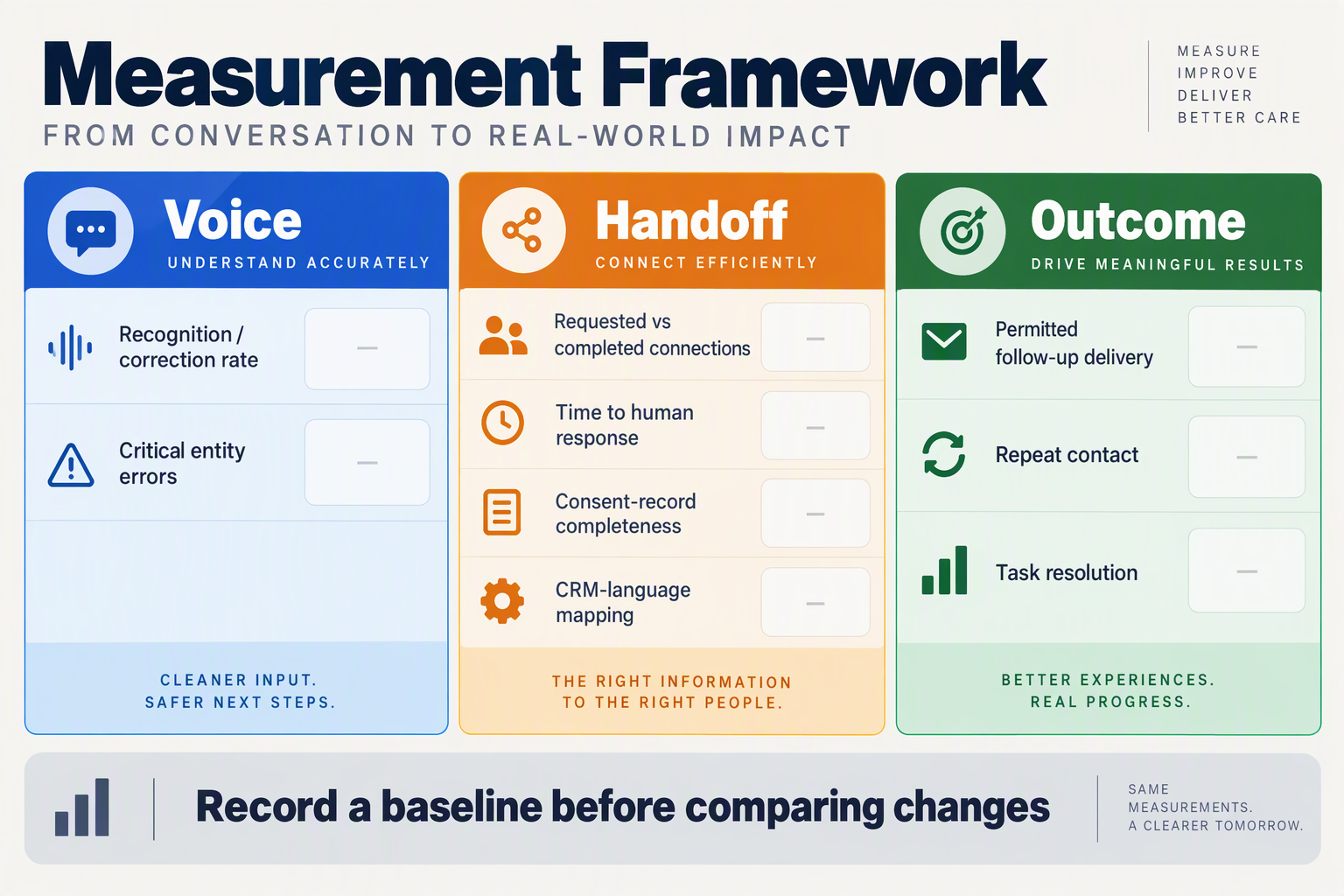
Measure voice-to-WhatsApp handoff quality at each stage, separately for each language mix. A successful call is not enough: the test must show that the follow-up reaches the intended customer, carries only confirmed facts and leaves a usable path for a person to take over.
Which handoff stages should you score?
Use the same rubric across languages, but record both the spoken language mix and the customer’s preferred WhatsApp language. Score each stage against the calls eligible for that stage; otherwise, a failure early in the call can disappear from a later-stage score.
| Stage | Metric and denominator | Pass check | High-impact failure |
|---|---|---|---|
| Voice capture | Correct key details ÷ calls containing those details | Intent, name and reference number match the recording | Wrong order or customer identified |
| Confirmation | Confirmed details ÷ details requiring confirmation | Agent repeats ambiguous names, numbers or commitments accurately | Unverified detail treated as fact |
| Handoff record | Complete records ÷ calls requiring follow-up | Intent, confirmed facts, open questions and next step are distinct | Unresolved question recorded as resolved |
| Channel decision | Valid WhatsApp handoffs ÷ requested handoffs | Destination and intended workflow are checked before sending | Message sent to the wrong recipient |
| WhatsApp message | Accurate, language-appropriate messages ÷ messages sent | Preferred written language and confirmed next step are preserved | Unsupported delivery or refund promise |
| Human takeover | Actionable escalations ÷ calls needing a person | Human can see the issue and what the AI has already said | Customer must repeat the entire case |
A critical failure should fail the handoff even when other rows pass. A wrong recipient or invented promise is not offset by fluent speech.
How do you compare Hindi, Hinglish and regional-language results fairly?
Report stage rates and end-to-end rates together. For example, in a hypothetical test set, suppose 27 of 30 Hindi–Hinglish calls produce an accurate handoff record, while 24 of 30 Tamil–English calls do. Those stage scores are 90% and 80%, respectively; the pooled 85% would conceal the weaker language mix. None of these figures is an industry benchmark.
Tag each call by accent or region, code-switch point, background noise and whether a name or number needed confirmation. Keep the written-language preference separate: a caller who speaks Hinglish may still want a Hindi or English WhatsApp message. Where test volumes are small, show the count alongside the percentage—4/5, not just 80%—and review the individual failures before drawing conclusions.
What evidence makes a score auditable?
For each failed row, retain the relevant recording timestamp, transcript excerpt, handoff record and WhatsApp message, then write one sentence explaining the mismatch. As of September 2026, CallMissed’s product specifications list call recordings, transcripts, AI call notes and scoring against custom QA rubrics; those are useful evidence sources, but reviewers still need to check the source call against the outgoing message.
Use a short release review:
- Block wrong-recipient messages, fabricated commitments and lost escalation requests.
- Fix and retest recurring detail or language-choice errors in the affected language mix.
- Monitor minor phrasing issues only when the facts and next action remain clear.
This keeps the QA decision tied to customer impact, not how natural the voice sounded.
Which advanced checks improve voice-to-WhatsApp QA?
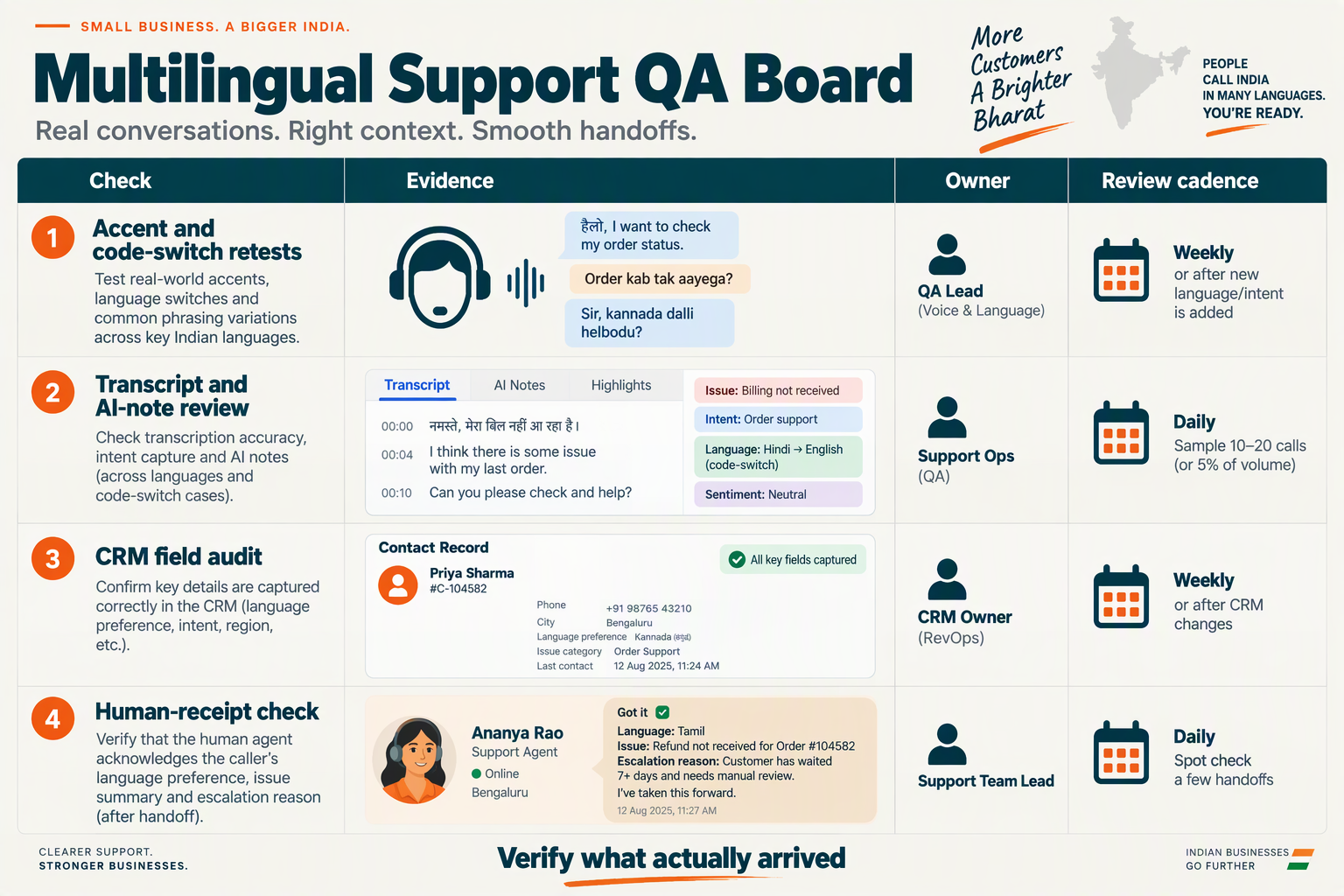
Advanced voice-to-WhatsApp QA checks should test whether the follow-up is justified by the call, not just whether it reads well. Reconcile each WhatsApp message against the recording, transcript and confirmed customer details; then probe the cases most likely to cause a costly or privacy-sensitive mistake.
Which advanced checks catch handoff failures?
Use the same test case across languages and accents, changing one variable at a time. The table below gives reviewers a failure to look for and an observable release check.
| Check | Stress-test input | Inspect | Pass condition |
|---|---|---|---|
| Cross-language meaning | Caller describes a delay in Hindi, then asks in English for “an update, not a refund” | Recording, notes and WhatsApp draft | The follow-up requests or provides an update; it does not initiate or promise a refund |
| Identifier integrity | Hinglish caller says an order ID with similar-sounding digits | Transcript, confirmed ID and draft | The draft uses only the ID confirmed during the call; uncertain digits remain flagged |
| Promise provenance | Caller asks, “Will it arrive tomorrow?” without a verified delivery date | Agent response, available order data and draft | Neither channel turns the question into a delivery guarantee |
| Recipient and permission | Caller gives a number different from the one used to call | Intended WhatsApp recipient and permission record | The workflow pauses until the destination and applicable messaging permission are checked |
| Interruption recovery | Caller corrects their address after the agent starts speaking | Final confirmed address and notes | The latest confirmed address wins; both versions are not silently combined |
| Human takeover | Caller disputes the order record and asks for a person | WhatsApp thread and handoff context | A human can see the dispute, evidence and unresolved question without asking the caller to repeat everything |
These are test criteria, not claims that any platform performs every check automatically. As of September 2026, CallMissed provides call recordings, transcripts, AI call notes and scoring against custom QA rubrics, alongside a WhatsApp shared inbox and a human-handoff queue. Those records give reviewers places to inspect the transition; the team still has to define what counts as confirmation and when to stop automation.
How should reviewers test a difficult case?
Run a paired test: first, a clean call; then the same request with code-switching, an interruption and one corrected fact. Keep the expected outcome written down before seeing the AI’s draft, so fluent wording cannot mask an invented promise.
- Trace each consequential statement. Mark the recording turn or verified business record supporting every order number, status, date and next step in the WhatsApp draft.
- Compare versions. Check whether the interrupted call changes only the corrected fact—not the customer’s intent or the permitted next action.
- Replay the takeover. Give a reviewer only the thread and handoff record. If they cannot identify what remains unresolved, improve the handoff before release.
A practical scoring rule is to block release on any wrong recipient, unverified promise or loss of a customer correction. Treat awkward but accurate phrasing as a lower-priority edit. Record both outcomes separately: a message can be linguistically excellent yet unsafe to send, while a safe handoff can still need more natural language.
What mistakes break multilingual voice-to-WhatsApp handoffs?
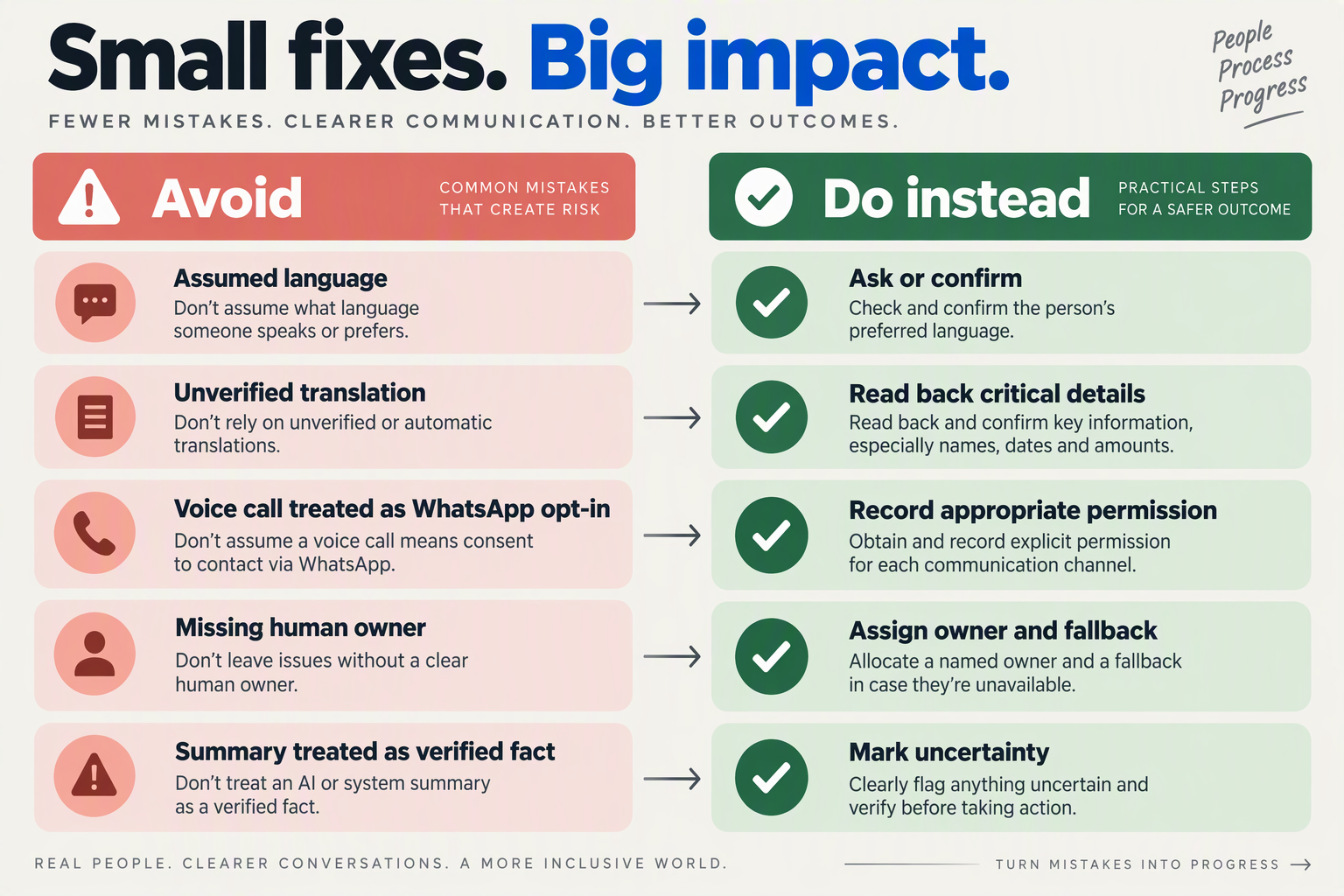
Multilingual voice-to-WhatsApp handoffs break when teams treat a good call transcript as proof that the follow-up is correct. The highest-risk mistakes are sending to the wrong contact, losing a confirmed detail, changing the customer’s language or presenting an unverified next step as a promise.
Which handoff mistakes should QA catch first?
| Failure | What it looks like | QA check | Release response |
|---|---|---|---|
| Wrong recipient | A WhatsApp follow-up goes to the number on an old record rather than the intended contact. | Compare the selected WhatsApp contact with the number and identity confirmed for this case. | Block sending until a person resolves the mismatch. |
| Reference-number drift | A Hindi-English call yields an incorrect order ID in the message. | Compare the recording, transcript and proposed message; read back ambiguous letters or digits in test calls. | Correct the reference and retest the case. |
| Language mismatch | A caller requests Hindi updates but receives an English-only message. | Record the stated language preference separately from the language detected during the call. | Revise the message and add a code-switching test. |
| Promise inflation | “We’ll check the delivery date” becomes “Your order arrives tomorrow.” | Compare every commitment with what the agent confirmed and what the underlying system verifies. | Hold the message for human review. |
| Lost uncertainty | An unclear name or unresolved request appears as a settled fact. | Check whether the handoff record labels unknowns and open questions explicitly. | Ask for clarification before taking the next action. |
| Dead-end escalation | The customer replies with a correction, but nobody owns the WhatsApp thread. | Test a reply requiring human judgment and verify that a person can take over. | Assign an owner and retest the full conversation. |
Why can a multilingual transcript still produce the wrong message?
Recognition, response and follow-up are separate steps. CallMissed’s September 2026 product specifications list speech recognition in 22 Indian languages plus English, including code-mixed Hinglish, but natural text-to-speech voices in 10 Indian languages plus English. Neither figure establishes which language a customer wants for a written WhatsApp update.
For example, a caller may explain a delay in Hindi, say an order ID in English and ask for the update “in Hindi.” A QA reviewer should check three distinct fields: what was heard, which reference was confirmed and which language was requested for the message. If the reference is uncertain, a fluent-sounding summary is not a substitute for verification.
What should happen before the WhatsApp follow-up is sent?
Use a send gate rather than assuming that a completed voice call authorises any message. Confirm the intended recipient and applicable WhatsApp messaging workflow; then compare the draft with the call evidence, verified business data and the customer’s stated next step. If any of those disagree, route the draft to a human instead of guessing.
As of September 2026, CallMissed provides call recordings, transcripts, AI call notes and scoring against custom QA rubrics, alongside WhatsApp Business chatbot tools and a shared inbox. Those are useful inputs for a voice-to-WhatsApp QA review, not proof that a particular handoff has been configured or passed. The release test is end-to-end: can a reviewer trace each consequential statement in the proposed message back to a confirmed fact and identify who handles the customer’s reply?
Frequently Asked Questions
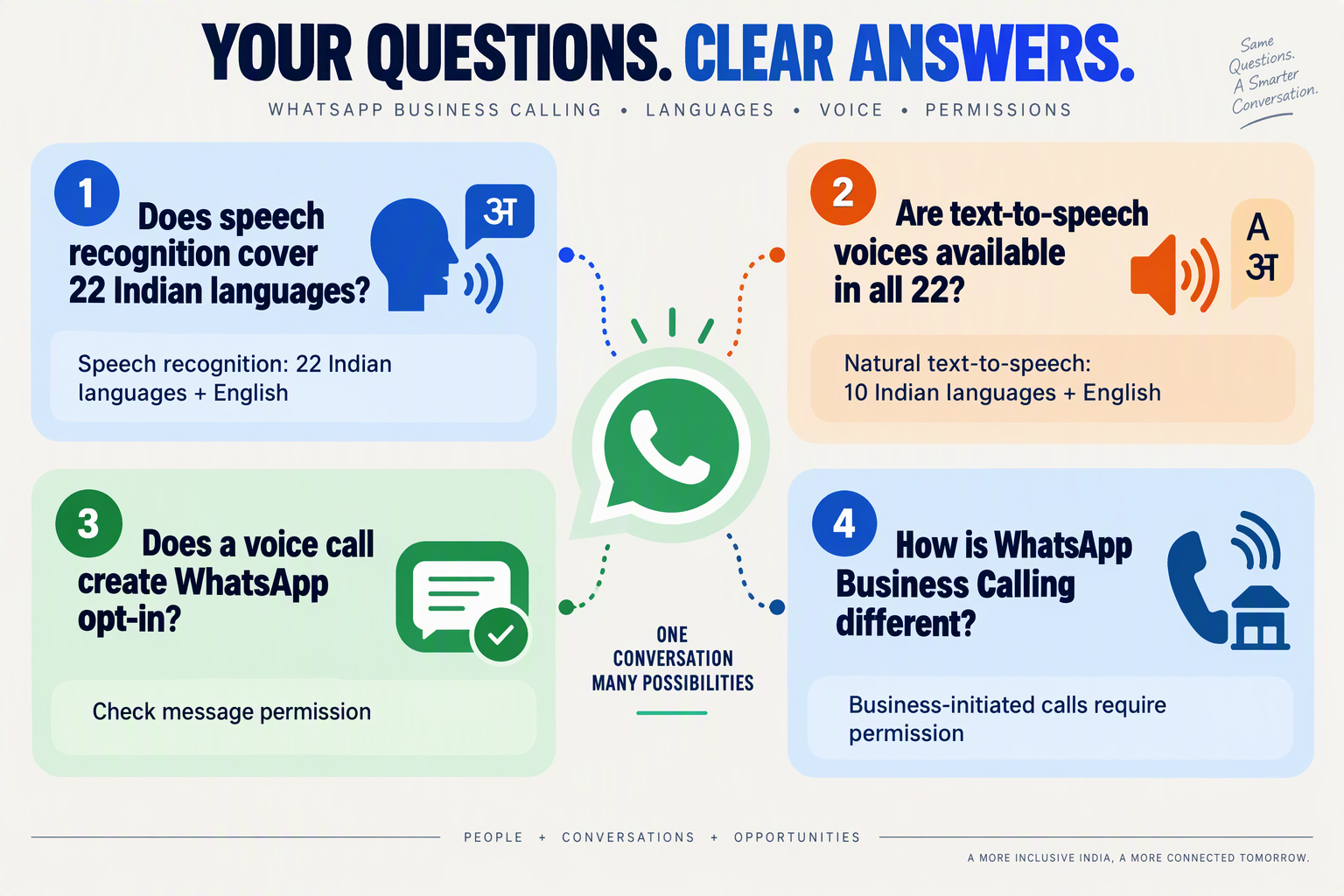
For a multilingual AI voice agent in India, the practical questions are whether it understands the caller, has permission for the next contact and leaves a usable record when the conversation moves to WhatsApp.
Which languages should a voice-to-WhatsApp workflow support?
Which Indian languages can a multilingual AI voice agent in India understand?
How should I test a multilingual AI voice agent in India when callers switch between Hindi and English?
What permission is needed before a WhatsApp follow-up?
Does permission to call a customer also cover a WhatsApp follow-up message?
Can my business call a customer through WhatsApp Business Calling after a voice-agent handoff?
What should QA check after a WhatsApp call or handoff?
Are customer-initiated WhatsApp Business calls free for a business?
How can I tell whether a voice-to-WhatsApp handoff needs a human?
Where can you verify CallMissed capabilities and start a small pilot?
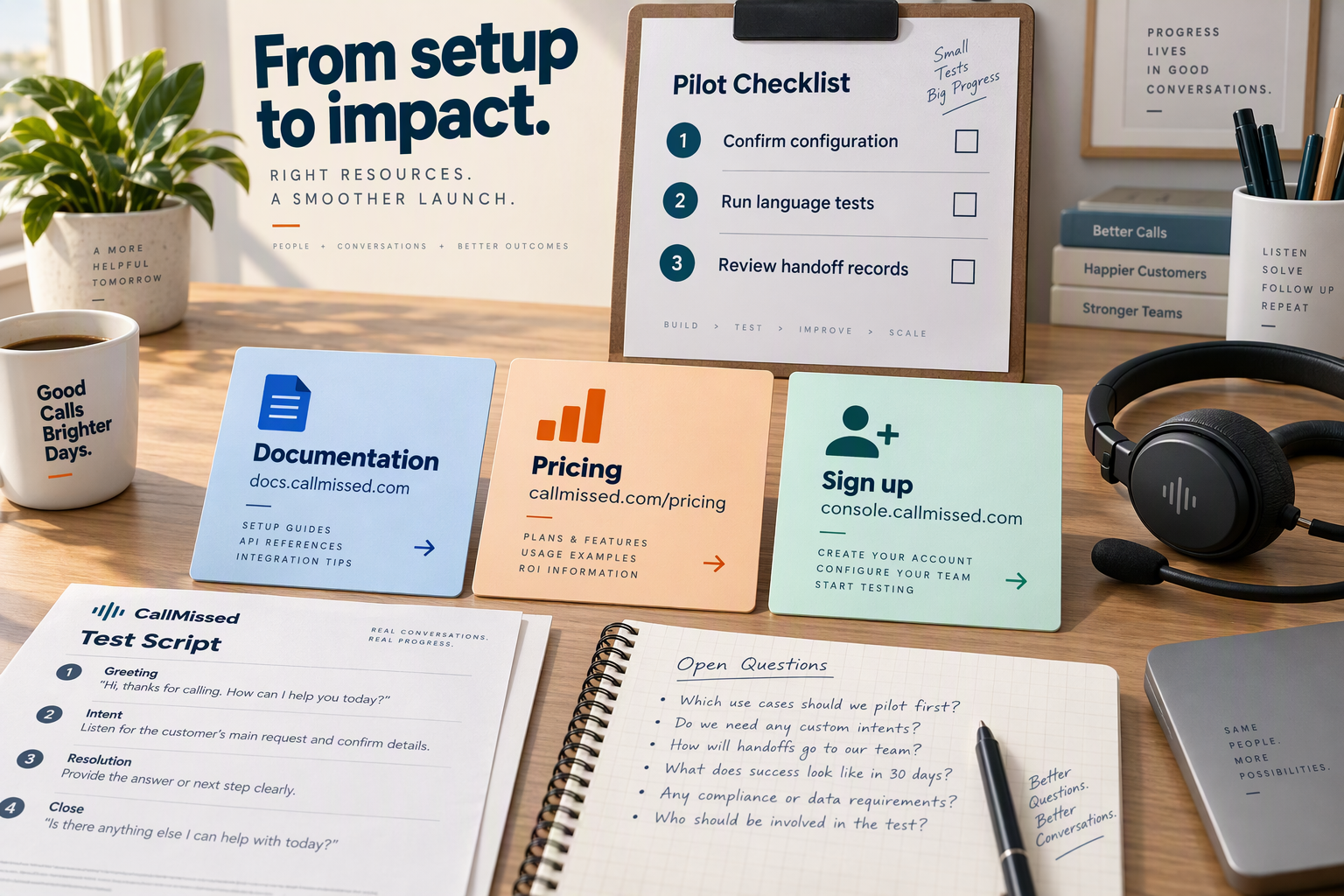
Verify CallMissed capabilities against its September 2026 product specifications, documentation and pricing page, then run a small pilot in the console using one inbound task and a human-reviewed WhatsApp follow-up. The pilot should prove that a team can reconstruct the call and approve the next message—not merely that the voice conversation sounds natural.
Which capabilities should you verify before building the pilot?
Check the feature that supports each step of your proposed workflow, and mark anything requiring team configuration rather than assuming the channels connect automatically:
- Language coverage: CallMissed’s September 2026 specifications list speech recognition in 22 Indian languages plus English, including Hinglish, and natural text-to-speech voices in 10 Indian languages plus English. Verify recognition and spoken replies separately for your chosen languages.
- Call evidence: The specifications list recordings, transcripts, AI call notes and scoring against custom QA rubrics. Confirm which fields your reviewers need to inspect after every test call.
- WhatsApp review: CallMissed’s WhatsApp Business tools include chatbot agents, message templates and a live shared inbox. Check how your team will review the proposed follow-up and take over a thread when needed.
- Configuration and cost: Check the documentation for agent setup, call settings and publishing; check the pricing page for the plan and phone-carriage costs applicable to your pilot.
Those are capability checks, not proof that an accurate call summary will automatically become an approved WhatsApp message. Document the actual handoff steps your team configures and tests.
What is a small, measurable first pilot?
Choose one low-risk inbound task, such as answering an order-status enquiry without promising a delivery date that has not been verified. Use two or three languages, recruit internal testers, and have a person approve each WhatsApp follow-up before it is sent.
- Set the boundary: Write the task, supported languages, information the agent may confirm, and conditions requiring a human.
- Run varied calls: Include clean speech, Hindi–English code-switching, an interrupted answer and an ambiguous order reference. Repeat cases to see whether the same error recurs.
- Compare three records: Check the recording against the transcript, the AI call notes against what was actually confirmed, and the proposed WhatsApp text against both.
- Record a disposition: Pass, revise the agent, or route the case to a person. Keep the reason beside the test case so the next run tests the fix.
For budgeting, CallMissed’s September 2026 specifications price the Standard voice-agent plan at ₹4 per minute, with a 30-second minimum per connected call and phone carriage billed separately. Twenty connected, two-minute test calls would therefore represent ₹160 in Standard voice-agent minutes before phone carriage, assuming each lasts exactly two minutes. CallMissed also lists 1,000 free credits on signup as of September 2026; confirm how your selected services draw from that balance before estimating the pilot’s total cost.
When should the pilot expand?
Expand only when reviewers can consistently identify the caller’s intent, confirmed reference, unresolved question, preferred follow-up language and promised next step—and can stop an inaccurate message before it reaches the customer. Keep the first release human-reviewed if those checks depend on interpretation: a safe, repeatable handoff is a stronger launch criterion than a fluent demo.
Conclusion
A multilingual AI voice agent in India is ready for a voice-to-WhatsApp handoff only when the next person—or message—can accurately continue the caller’s conversation. A fluent call is not enough: teams must verify the language used, the facts confirmed, the follow-up promised and the route to human help.
- Start narrow, then earn the right to expand. Launch with two or three languages and one inbound task. Test regional accents, Hindi–Hinglish switches, interruptions and ambiguous order references before adding more workflows. A small scope makes it easier to identify whether an error began in recognition, the agent’s response or the handoff record.
- Test recognition and response separately. CallMissed’s September 2026 product specifications list speech recognition in 22 Indian languages plus English, including code-mixed speech, and natural text-to-speech voices in 10 Indian languages plus English. Those figures describe different capabilities. QA should check both what the agent understood and whether its spoken reply and WhatsApp follow-up suit the customer’s language preference.
- Treat the handoff record as the source for review, not proof of success. Check that the caller’s intent, confirmed reference number, unresolved questions and promised next step survive the channel change. Compare the WhatsApp message with the call recording and transcript; do not let an uncertain delivery update become a definite promise.
- Prioritise failures by customer impact. An awkward phrase deserves attention, but a wrong order number, misdirected follow-up or unsupported promise should block release. Keep a human-reviewed route for cases the agent cannot resolve, so customers do not have to repeat the entire call when someone takes over.
What should teams watch next? As language and channel coverage grows, the important measure will remain continuity: whether a reviewer can reconstruct what happened and a human can act without guessing. CallMissed is one platform to explore for that work; as of September 2026, its voice-agent tools include recordings, transcripts, AI call notes and custom QA scoring, alongside WhatsApp Business chatbot agents and a shared inbox. The practical question before every expansion is simple: would you trust this handoff if you were the customer waiting for the update?
Related Reading
Discussion
Related Posts



Ready to automate customer conversations?
Launch AI voice agents and WhatsApp bots with CallMissed — one API, 22+ Indian languages.