
Multilingual AI Voice Agent India: 2026 Buyer and Language-Testing Guide


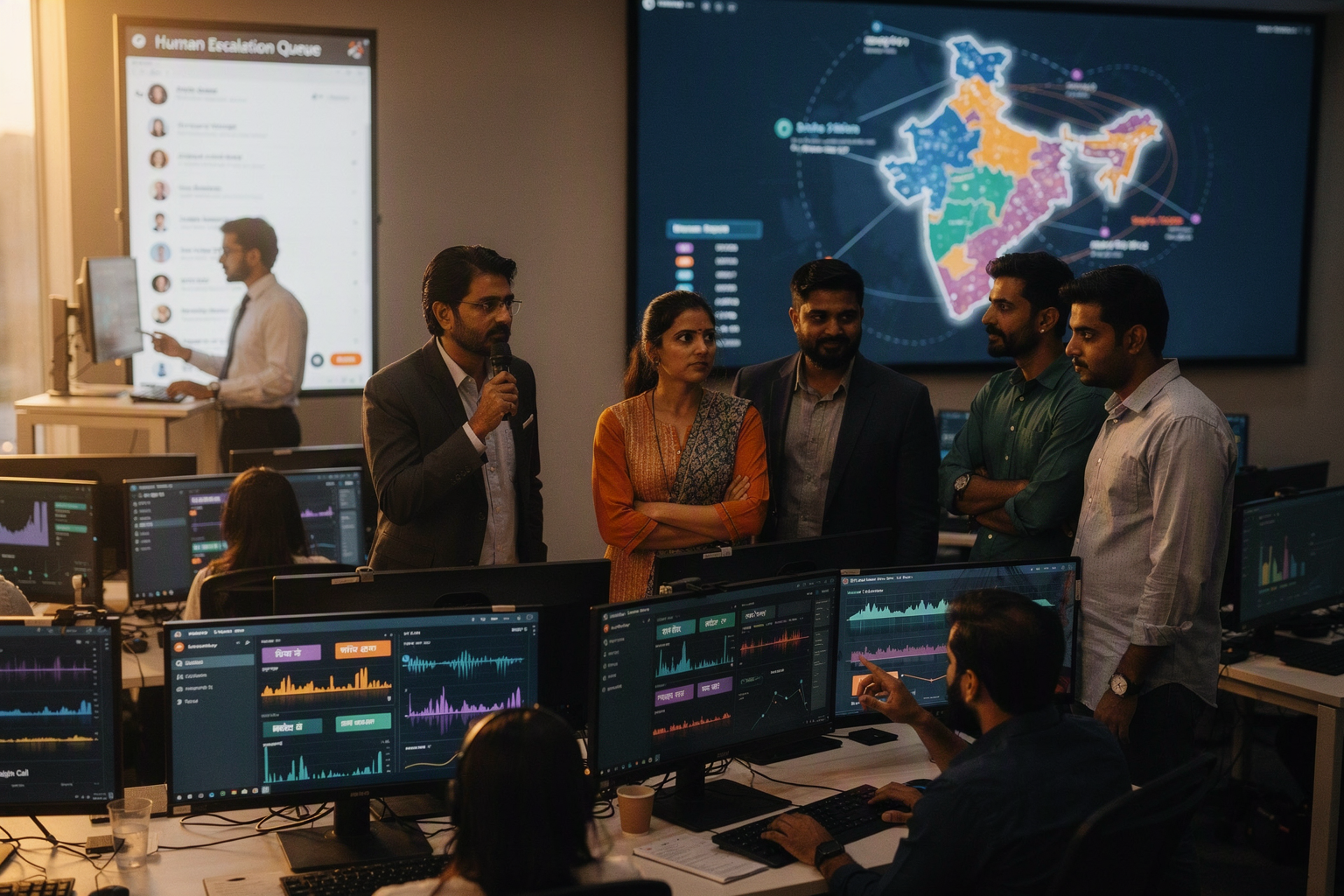
Compare multilingual AI voice agent India options using practical tests for Hindi, accents, code-switching, latency, compliance, and deployment.
Multilingual AI Voice Agent India: 2026 Buyer and Language-Testing Guide
What happens when a customer says, “मेरा order अभी तक नहीं आया,” switches to English for the order number, and uses a regional accent—all within one sentence? For any business evaluating a multilingual AI voice agent India deployment in 2026, that ordinary conversation is a more meaningful test than a vendor’s headline accuracy percentage.
India’s voice challenge is multilingual by default
India’s Constitution recognises 22 scheduled languages, while the Census of India 2011 recorded 121 languages spoken by populations of 10,000 or more. The Internet in India Report 2024 from the Internet and Mobile Association of India and Kantar reported that 870 million users accessed the internet in Indic languages in 2024. These figures explain why a voice agent trained mainly on clean, scripted English or standardised Hindi may struggle in production.
A dependable Hindi AI voice agent must handle more than textbook Hindi. Customers mix Hindi and English, pronounce brands and addresses unpredictably, speak over traffic or call-centre noise, and shift between formal Hindi and regional vocabulary. The same issue extends to Indian language voice AI for Bengali, Marathi, Tamil, Telugu, Gujarati, Kannada, Malayalam, Punjabi and other languages.
That makes language quality a business metric, not merely a technical feature. Poor recognition can produce incorrect bookings, missed lead details, repeated questions or unsafe authentication flows. Unnatural text-to-speech can also reduce trust, even when the answer itself is correct. A vernacular AI call center or multilingual AI receptionist therefore needs to be evaluated across the complete conversation pipeline: telephony audio, speech recognition, language detection, reasoning, pronunciation, response latency and human handoff.
What this 2026 guide will help you test
This buyer and language-testing guide replaces blanket “95% accurate” claims with repeatable, workload-specific evaluation. You will learn how to:
- Build test sets covering Hindi speech AI, regional accents, code-switching, numbers, names, addresses and noisy calls.
- Measure word error rate alongside task completion, correction frequency, pronunciation quality and end-to-end latency.
- Test interruptions, silence, barge-in behaviour, dropped audio and escalation to a human agent.
- Compare deployment architecture, integrations, observability, data handling, consent and applicable Indian compliance requirements.
- Use a practical scorecard and test script before approving a pilot or production rollout.
Platforms such as CallMissed reflect this India-first direction by supporting speech-to-text and text-to-speech across 22 Indian languages and by connecting AI voice agents with WhatsApp Business calling.
The goal is not to identify one universally “best” system. It is to determine which multilingual voice agent performs reliably for your callers, languages, acoustic conditions and business processes—and to prove that performance before deployment.
Which multilingual AI voice agent India teams should buy in 2026? Choose one that wins a representative language pilot instead of making blanket accuracy claims
Buy the multilingual AI voice agent India deployment that performs best in a controlled pilot built from your real calls—not the product advertising the highest generic accuracy. The winning system should complete customer tasks reliably across required languages, accents, code-switching and telephone conditions while meeting your latency, escalation and compliance requirements.
Start with your operating language map
A “multilingual” label reveals little unless it specifies capabilities by language, dialect and speech task. The Constitution of India recognises 22 scheduled languages, while the Census of India recorded 121 languages with at least 10,000 speakers in 2011. No single aggregate accuracy score can represent that linguistic range.
Define the production workload before inviting vendors:
- Languages and dialects used by at least 5% of callers.
- Typical Hindi-English or regional-language-English code-switching.
- Urban, rural and regional accents represented in customer calls.
- Critical entities such as names, PIN codes, addresses, dates, amounts and product codes.
- Real acoustic conditions, including traffic, speakerphone audio and unstable mobile networks.
- Required tasks, such as booking appointments, qualifying leads, tracking orders or collecting payments.
A Hindi AI voice agent pilot should include colloquial Hindi, Hinglish and English identifiers—not merely scripted, formal Hindi. Similarly, Indian language voice AI must be evaluated separately for Bengali, Marathi, Tamil, Telugu or any other target language because performance in one language does not predict performance in another.
Make task completion the purchasing gate
Evaluate the complete agent rather than speech recognition in isolation. Hindi speech AI may produce a low word error rate yet still fail if it misreads an order number, pronounces a customer’s name poorly or waits too long before responding.
Use four purchasing gates:
- Understanding: Did the agent correctly capture the caller’s intent and essential entities?
- Resolution: Did it complete the task without unnecessary repetition or human assistance?
- Conversation quality: Was text-to-speech intelligible, appropriately paced and natural for the language?
- Operational reliability: Did barge-in, transfer, logging and recovery work under actual telephony conditions?
Set thresholds from business risk rather than copying a universal benchmark. A restaurant reservation may tolerate one clarification; an account-verification workflow should require exact capture of critical numbers and immediate escalation after repeated failure.
Run a representative, blinded pilot
The Internet and Mobile Association of India and Kantar reported that 870 million people accessed the internet in Indic languages in 2024, making regional-language testing a mainstream requirement rather than an edge case.
A credible pilot should:
- Use consented, anonymised recordings or scripts derived from real interactions.
- Include at least several speakers per language, accent, gender and age band relevant to the business.
- Randomise vendors and hide provider identities from human evaluators.
- Test clean audio, noisy audio, interruptions, silence and network degradation.
- Record task success, critical-entity accuracy, correction count, transfer success and end-to-end response latency.
- Review failures by language instead of averaging them into one headline result.
For a vernacular AI call center, the final decision may favour different models for different languages. A multilingual AI receptionist also needs successful calendar, CRM and human-handoff integration—not just fluent speech.
India-first platforms such as CallMissed support speech-to-text and text-to-speech across 22 Indian languages and can connect AI agents to WhatsApp Business calls. That breadth earns inclusion in a pilot; representative test results should still determine the purchase.
Why are Hindi AI voice agent and Indian language voice AI evaluations different from English-only buying decisions?
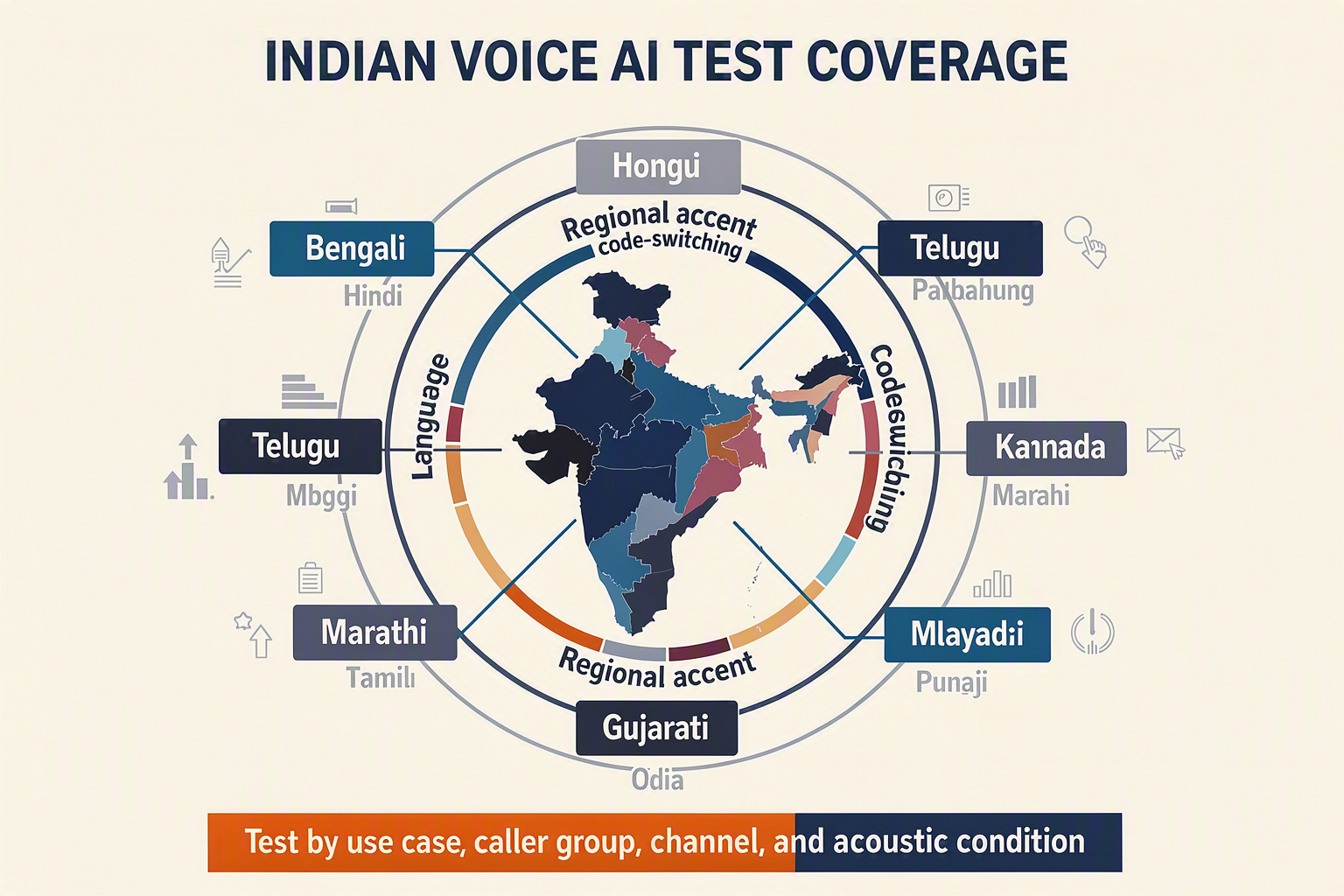
A Hindi or Indian-language voice agent cannot be evaluated by translating an English test set and comparing one accuracy score. Buyers must test code-switching, script variation, regional pronunciation, inflected words, local entities and telephony conditions because each can change whether a real customer completes a task successfully.
English-only benchmarks hide India-specific failure modes
English evaluations commonly assume one dominant script, relatively stable business terminology and utterances that remain in one language. A Hindi AI voice agent may instead receive Hindi written in Devanagari, English words embedded in Hindi, or Romanised Hindi such as “mera refund kab aayega?”
Language selection is not a niche consideration. The Constitution of India recognises 22 scheduled languages, while the Census of India 2011 counted 121 languages spoken by at least 10,000 people. Consequently, a buyer’s “Hindi” traffic may also contain vocabulary, pronunciation and sentence patterns influenced by Marathi, Punjabi, Bhojpuri or another caller language.
Common evaluation traps include:
- Testing formal Hindi while customers use conversational phrases such as “payment कट गया.”
- Treating Hindi-English mixing as a transcription error rather than normal speech.
- Testing studio recordings instead of narrowband phone audio.
- Ignoring transliterated names, brands, landmarks and alphanumeric identifiers.
- Averaging all calls together, which can conceal poor results for one language or accent group.
A multilingual AI voice agent India benchmark should therefore report results by language, code-switch pattern, accent, acoustic condition and task—not just as one blended percentage.
Code-switching changes the complete voice pipeline
Code-switching affects more than speech-to-text. Consider: “मेरा broadband plan upgrade कर दो, account number A-4821 है.” The system must recognise two languages, preserve “broadband” and “upgrade,” capture the letter-number sequence exactly, infer the upgrade request and respond in the caller’s preferred language.
A useful test separates these layers:
- Recognition: Were the words, names and numbers captured correctly?
- Understanding: Did the agent identify the customer’s intent and required fields?
- Dialogue: Did it ask a relevant clarification instead of guessing?
- Speech generation: Did text-to-speech pronounce English insertions naturally within Hindi?
- Outcome: Was the transaction completed without unnecessary repetition or escalation?
This distinction matters because a transcript can have several minor word errors while still completing the task. Conversely, a low overall word error rate can hide one critical substitution in an OTP, amount, date or address.
“Hindi support” is not sufficient proof of production quality
Vendor language lists indicate availability, not fitness for a particular workload. Hindi speech AI used for healthcare appointments, loan servicing or restaurant bookings encounters different terminology, risk and caller behaviour. The same principle applies to Bengali, Tamil, Telugu, Marathi and other Indian language voice AI deployments.
Buyers should request demonstrations using their own anonymised call scenarios and score:
- Critical entity accuracy for names, amounts, dates, PIN codes and IDs.
- Code-switch recovery when language changes mid-utterance.
- Accent robustness without forcing callers to repeat unnaturally.
- Text-to-speech intelligibility, pronunciation and conversational prosody.
- Turn latency, interruption handling and recovery after silence.
- Human escalation quality, including transcript and context transfer.
A vernacular AI call center or multilingual AI receptionist should ultimately be judged by successful customer outcomes across defined caller segments. English-style headline accuracy remains useful as one diagnostic measure, but it is not a reliable purchasing decision on its own.
What key developments should buyers account for when comparing multilingual voice agents in 2026?
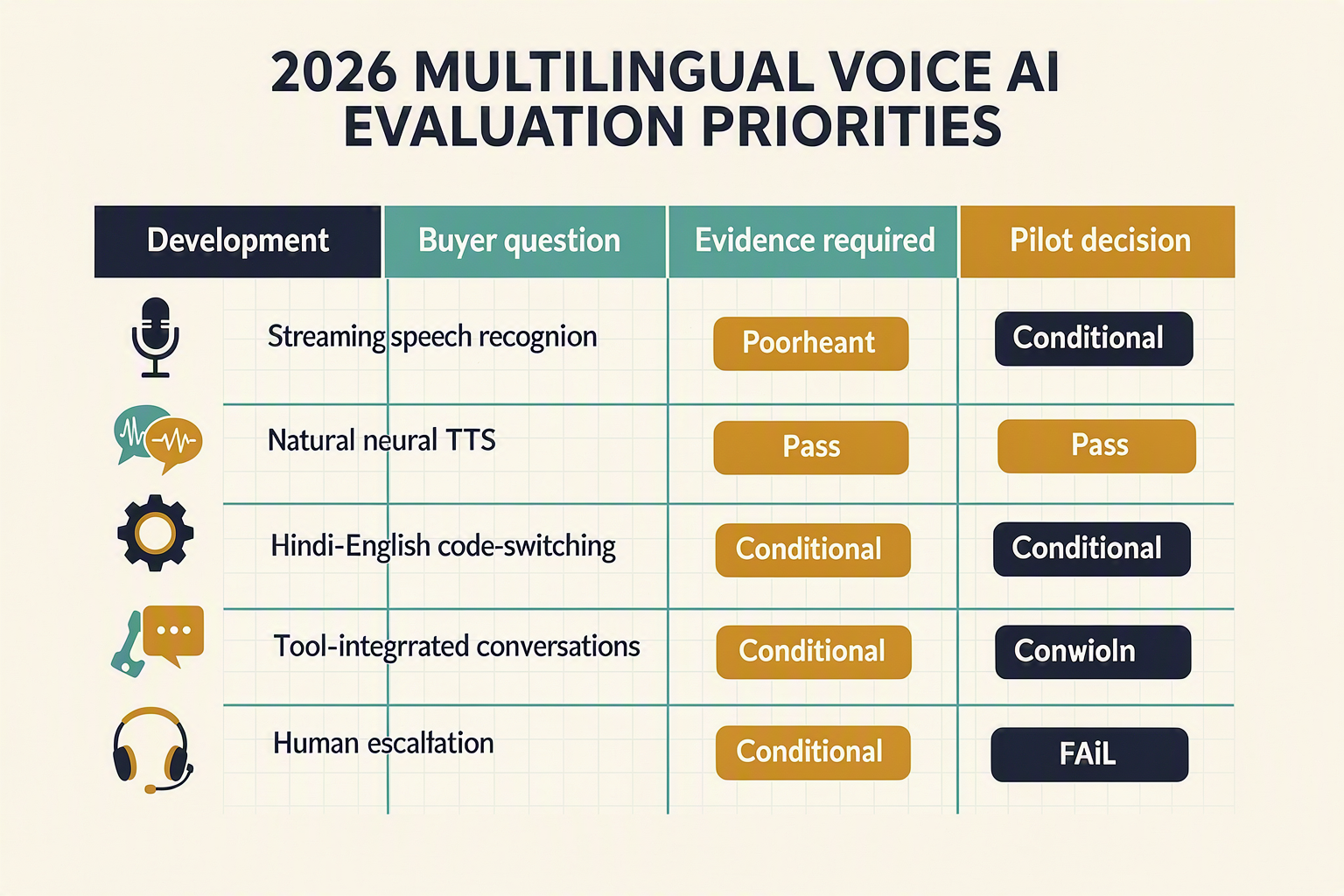
The defining 2026 development is the move from static “language supported” checklists to streaming, code-switched and channel-specific performance measured on representative Indian calls. Buyers should evaluate the complete production system—telephony, speech recognition, orchestration, text to speech, integrations, security and human escalation—rather than an isolated model demonstration.
Developments that change the 2026 evaluation process
| Key development | Why it matters in India | What buyers should test | Evidence to request |
|---|---|---|---|
| Streaming speech pipelines | Accurate offline transcription does not prove that a live agent will respond promptly, detect turn endings correctly or avoid interrupting callers. | Measure speech-end detection, barge-in behaviour and end-to-end latency at p50, p95 and p99 on representative mobile, landline and internet-based calls. | Timestamped traces covering audio receipt, transcript generation, agent response, speech synthesis and playback. |
| Code-switch and entity handling | Callers may mix languages within a turn while using English product names, addresses, reference numbers or technical terms. Patterns vary by region and use case. | Test unscripted code-switching, mid-sentence changes, regional pronunciation and critical entities such as names, dates, rupee amounts and order IDs. | Segment-level transcripts, entity error rates, clarification frequency and examples reviewed by speakers of the tested language varieties. |
| Language-by-language validation | India’s linguistic diversity cannot be represented by one blended accuracy score. Performance may differ by language, dialect, accent, script, domain and acoustic condition. | Create separate, consented test sets for every language and use case to be deployed, with representative regions, devices, age groups, speaking styles and noise conditions. | Per-language sample sizes, word or character error rates where appropriate, entity accuracy, task completion, transfer rates and confidence intervals. |
| Controllable neural TTS | A voice can sound natural while mispronouncing names, amounts, dates, abbreviations or mixed-language phrases. | Evaluate pronunciation controls, number normalisation, speaking rate, pauses, emphasis and language switching using business-specific prompts. | Recorded outputs, model and voice versions, pronunciation dictionaries and ratings from qualified native or fluent reviewers using a consistent rubric. |
| Channel-aware deployment | PSTN, mobile networks, SIP connections and WhatsApp Business calling can introduce different codecs, packet loss, delays, routing constraints and transfer behaviour. | Run equivalent scenarios on every intended channel, including poor connectivity, interruptions, dual-talk and failed transfers. | Channel-specific latency, completion, disconnect and escalation reports, plus documentation of carrier, Meta and integration dependencies. |
| Fallbacks and model portability | Recognition, synthesis or language-model performance can change after updates or during provider, network or regional outages. | Trigger timeouts, low-confidence recognition, unavailable integrations and provider failures in a controlled pilot. | Versioned configurations, fallback rules, audit logs, recovery results and notice policies for material model changes. |
| Privacy, consent and communications compliance | Voice recordings, transcripts, phone numbers and inferred customer details can constitute personal data. Outbound calling may also be subject to telecom rules and channel-specific policies. | Trace data collection, notice or consent, retention, deletion, access controls, cross-border processing and suppression of opted-out contacts. Test promotional and service workflows separately. | A data-flow map, processor and subprocessor list, retention schedule, security controls and legal mapping to the provisions of the Digital Personal Data Protection framework and TRAI rules that are in force for the deployment. |
Language breadth is becoming measurable, not binary
The Eighth Schedule to the Constitution of India lists 22 scheduled languages. This constitutional list is not a technical certification, a census-based measure of current usage or proof that any vendor supports all 22 languages. Vendor coverage must be verified separately for speech recognition, speech synthesis, streaming, code-switching and the specific channels being purchased.
A multilingual AI voice agent India deployment should identify the model and version used for each claimed language, the supported scripts and language varieties, and any fallback to Hindi, English or a human agent. “Supported” should also be defined: transcription-only support is different from bidirectional conversational support with TTS, barge-in, integrations and escalation.
For a Hindi AI voice agent, clean Standard Hindi recordings are not sufficient evidence. Testing should include the actual mix of Hindi and English used by the target callers, relevant regional pronunciation, colloquial constructions and business-specific entities. The same language-by-language standard applies to an Indian language voice AI system, vernacular AI call center, multilingual AI receptionist or specialised Hindi speech AI workflow.
Speech quality should not be reduced to one accuracy percentage. Word error rate can be useful, but tokenisation, scripts, transliteration and code-switching can make comparisons misleading unless the scoring method is disclosed. Buyers should pair it with entity accuracy, intent or task success, correction frequency, abandonment, inappropriate-response rates and successful human-transfer rates.
New capabilities require stronger production evidence
A polished demonstration should be followed by a controlled pilot and failure testing. Before shortlisting a platform:
- Require versioned documentation for speech, language and voice models because updates can alter recognition, latency and pronunciation.
- Use recordings that are lawfully collected and representative of the intended languages, callers, devices, channels and acoustic environments.
- Test overlapping speech, long pauses, interruptions, low bandwidth, background conversations and callers who change language unexpectedly.
- Verify that low-confidence or ambiguous input triggers clarification, safe refusal or human transfer rather than an unsupported answer.
- Review results separately by language, language variety, channel and call type; aggregate averages can conceal weak performance.
- Confirm recording notices, access controls, retention and deletion procedures, and obtain legal review for the specific inbound, service and promotional calling workflows.
- Treat WhatsApp Business calling and telephony as separate production environments, and verify current account eligibility, platform permissions, user-consent requirements, carrier routing and applicable messaging or calling policies.
When assessing CallMissed or any other vendor, treat statements such as support for “22 Indian languages” as vendor claims requiring product-level verification, not as a consequence of the Constitution’s 22-language schedule. Request a current language matrix showing STT and TTS availability, streaming support, model versions, channel coverage and known limitations for each language. Final selection should be based on workload-specific recordings, traceable measurements and reproducible pilot results rather than the length of a language list.
How should you test Hindi speech AI, text to speech, code-switching, accents, noise, numbers, names, and task completion with a repeatable script?
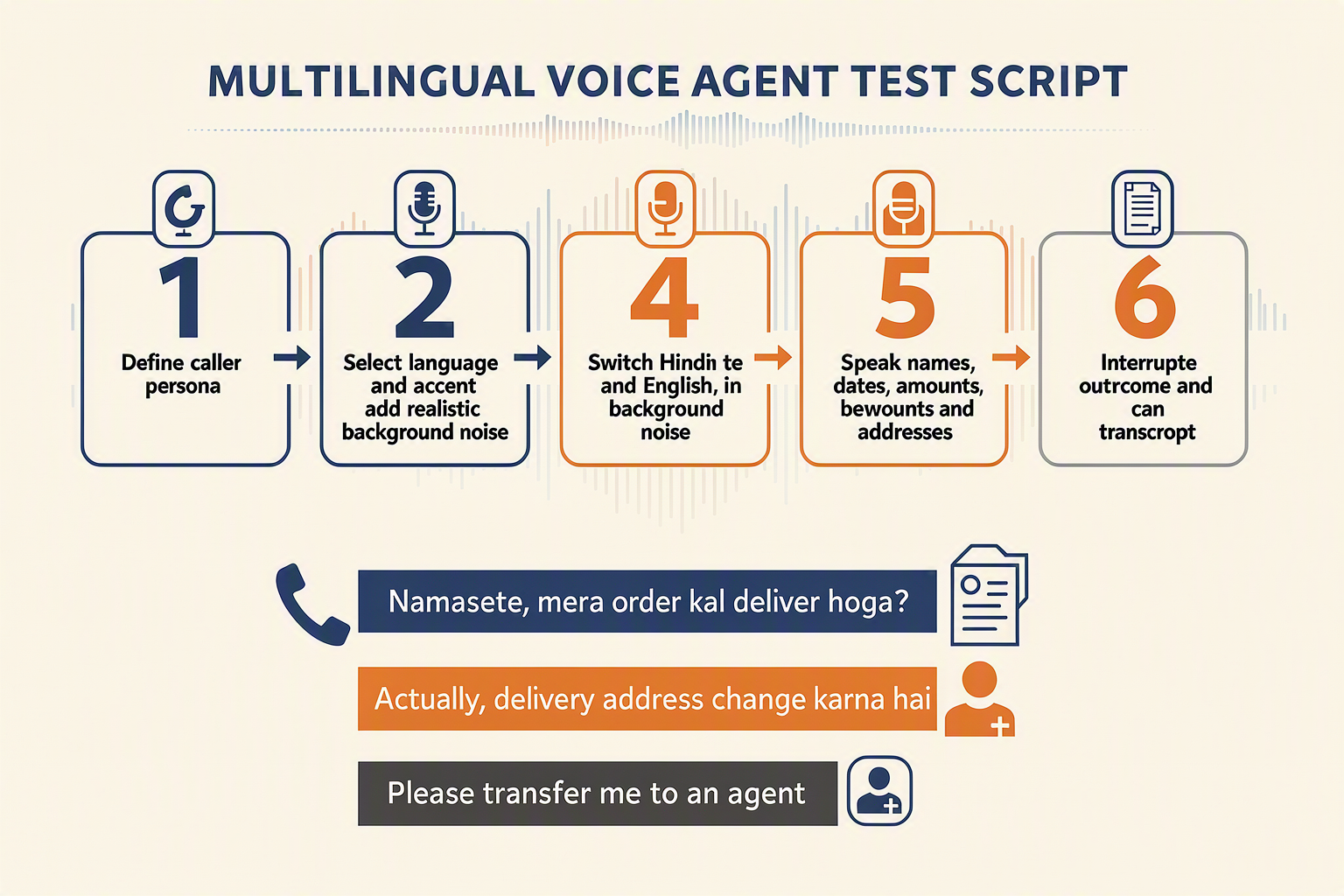
Use one version-controlled test set, identical call conditions and predefined pass criteria for every vendor. A credible Hindi AI voice agent evaluation should measure recognition, speech quality and completed customer outcomes—not a single accuracy percentage.
Build a representative test set
Record human callers rather than relying only on synthetic audio. Recruit at least 30 speakers per priority language, balanced across gender, age range, region and accent, then run each scenario multiple times to expose inconsistent behaviour.
Include these test categories:
- Hindi: formal Hindi, conversational Hindi and regional pronunciations.
- Code-switching: Hindi-English sentences such as “मेरी delivery reschedule करके Monday कर दीजिए.”
- Accents: speakers from Delhi, Uttar Pradesh, Bihar, Rajasthan, Maharashtra and other target markets.
- Noise: traffic, ceiling fans, office conversations, television audio and low mobile signal.
- Entities: personal names, company names, localities, PIN codes, email addresses and product SKUs.
- Numbers: “पंद्रह सौ,” “one five zero zero,” ₹1,500, dates, OTPs and phone numbers.
- Conversation events: silence, hesitation, self-correction, interruption and barge-in.
India’s multilingual scope makes sampling essential: the Census of India 2011 recorded 121 languages spoken by at least 10,000 people. A test cohort drawn only from fluent metropolitan speakers cannot represent a nationwide multilingual AI voice agent India deployment.
Run the same repeatable call script
Use a numbered script while allowing callers to speak naturally:
- Language opening: “नमस्ते, मुझे अपने order के बारे में पूछना है.”
- Code-switch: “मेरा order अभी तक नहीं आया; tracking number is A-K seven nine two.”
- Name and location: “नाम है शशांक श्रीवास्तव, delivery बेंगलुरु के जयनगर में चाहिए.”
- Numeric request: “Booking 18 August को शाम साढ़े छह बजे कर दीजिए.”
- Correction: “नहीं, मैंने eighteen नहीं, eighty कहा था.”
- Noise condition: Repeat the request with controlled background audio.
- Barge-in: Interrupt the agent during its response and change the request.
- Completion check: Ask the agent to summarise the name, date, number, address and requested action.
- Escalation: Request a human, then verify that the transcript and captured details transfer correctly.
Keep the script, source recordings, telephony route, noise level and scoring rubric unchanged between systems. Randomise call order so network conditions or reviewer fatigue do not systematically favour one vendor.
Score recognition, speech and outcomes separately
Calculate word error rate (WER) as substitutions plus deletions plus insertions, divided by the number of reference words. Also report entity accuracy independently because one incorrect digit or name can invalidate an otherwise accurate transcript.
Track:
- Code-switch accuracy: correctly recognised Hindi and English spans.
- Entity exact match: names, numbers, dates, addresses and identifiers.
- Task-completion rate: successful bookings, resolutions or lead captures.
- Correction rate: calls requiring the customer to repeat or rephrase.
- Turn latency: time from the caller finishing to audible response.
- TTS naturalness: listener ratings for clarity, pronunciation, pace and accent.
- Handoff success: context preserved when transferring to a person.
For text to speech, use blinded human listening based on principles from ITU-T P.800, which standardises subjective telephone speech-quality assessment. Reviewers should score identical outputs without seeing vendor names.
Finally, publish results by language, accent and noise condition. A vernacular AI call center, multilingual AI receptionist or broader Indian language voice AI system should pass workload-specific gates—for example, exact capture of payment amounts and OTPs—rather than averaging critical failures into an attractive overall Hindi speech AI score.
Which metrics belong in a multilingual voice-agent scorecard, and how should ASR, TTS, latency, accents, and escalation be weighted?
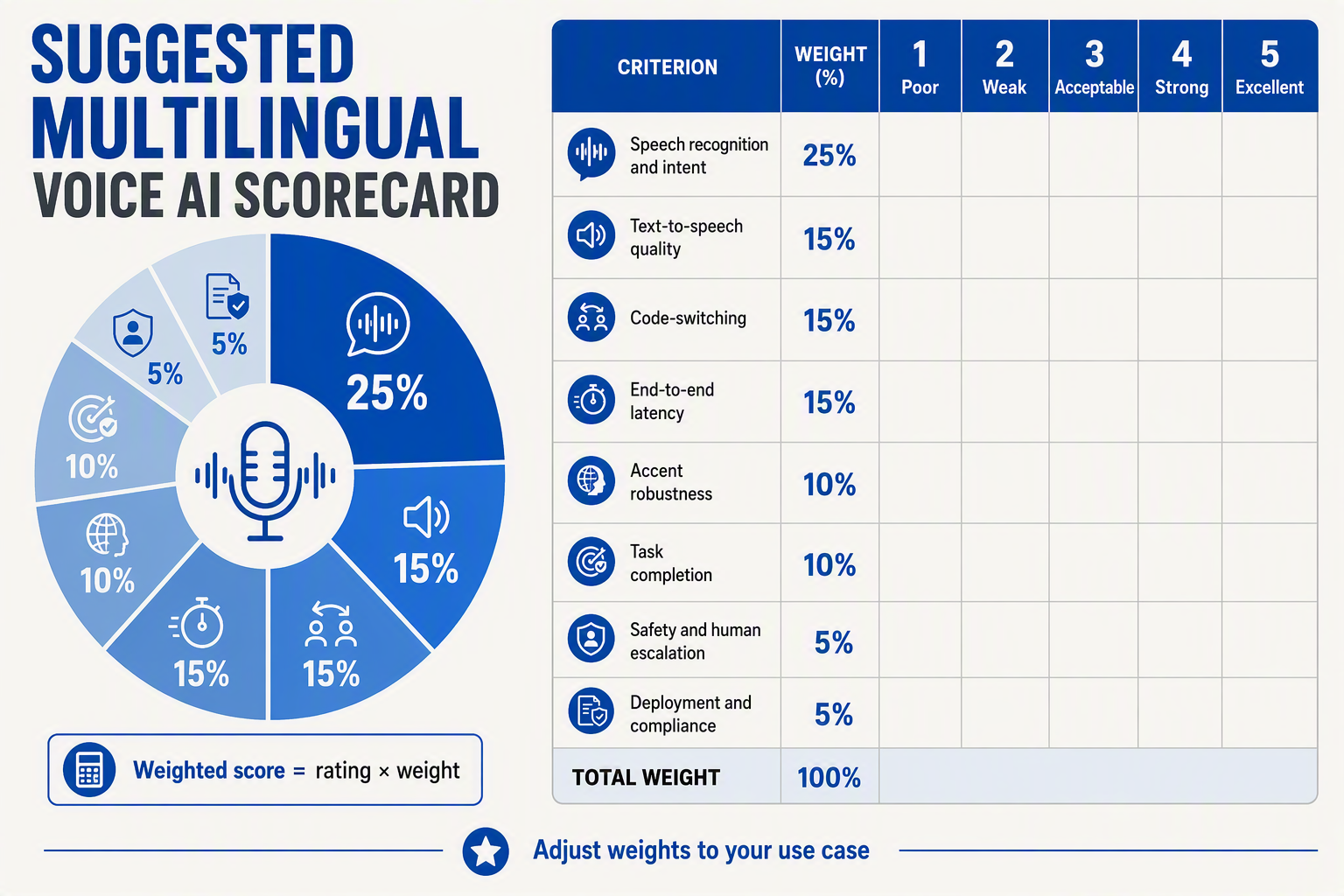
Use a 100-point scorecard that prioritises recognition and successful task completion, while treating safety, authentication and failed human handoffs as release-blocking defects. The weights below are recommended starting points—not universal benchmarks—and should be adjusted for the business workflow and caller population.
Recommended multilingual voice-agent scorecard
| Dimension | Weight | Metrics to record | Suggested pilot gate |
|---|---|---|---|
| ASR and entity accuracy | 25% | Word error rate (WER), character error rate, entity error rate for names, numbers, dates, PIN codes and order IDs | Report median and worst-slice results by language and noise condition; require confirmation before acting on sensitive fields |
| Task and semantic success | 20% | Task-completion rate, intent accuracy, correction turns, abandoned calls and incorrect actions | Set a workflow-specific target against human or current-IVR performance; allow zero unconfirmed payment or authentication actions |
| Accents and code-switching | 20% | Completion rate by accent, language pair, gender and device; Hindi-English switch errors; transliterated brand recognition | No important cohort should trail the overall completion rate by more than 10 percentage points without remediation |
| Latency and turn-taking | 15% | End-to-end p50 and p95 response latency, time to first audio, barge-in stop time and silence-recovery time | Starting target: p95 normal-turn latency below 2 seconds and interruption response below 500 milliseconds |
| TTS quality | 10% | Native-listener mean opinion score, pronunciation errors, number prosody, intelligibility and voice consistency | Starting target: at least 4/5 from native listeners, with critical names and amounts pronounced correctly |
| Escalation and resilience | 10% | Successful transfer rate, context passed to agents, reconnect behaviour, fallback accuracy and dead-end rate | Starting target: at least 95% successful handoffs and zero dead ends in safety-critical test scenarios |
How to calculate the score
Score each dimension from 0 to 5, multiply it by its weight, and divide by five. For example, an ASR score of 4 contributes 20 of the available 25 points.
Do not approve a multilingual AI voice agent India deployment solely because its total exceeds an internal threshold. Apply hard gates alongside the weighted score:
- No unsafe action based on an unconfirmed account number, amount or identity field.
- No unsupported language loop that repeatedly asks the caller to rephrase.
- No failed escalation when the caller explicitly requests a person.
- No material cohort gap hidden by a strong overall average.
Segment every result before comparing vendors
Aggregate WER can conceal production failures. A Hindi AI voice agent should therefore be tested separately on Hindi-only speech, Hindi-English code-switching, regional accents, mobile-network compression, background noise and fast or interrupted speech. The Internet and Mobile Association of India and Kantar reported in the Internet in India Report 2024 that 870 million users accessed the internet in Indic languages in 2024, reinforcing the need to evaluate regional cohorts rather than an English-heavy average.
Use at least 100 representative utterances per important language-condition slice as an initial pilot set, then show confidence intervals and expand weak or high-risk slices. A Hindi speech AI result should not be presented as evidence for Tamil, Bengali or Marathi performance.
Finally, preserve raw audio, transcripts, timings, agent decisions and handoff outcomes. This allows buyers to distinguish an ASR problem from a reasoning, telephony or TTS problem—and determine whether an Indian language voice AI, vernacular AI call center or multilingual AI receptionist is genuinely ready for deployment.
How do you deploy securely while controlling latency, telephony reliability, consent, data handling, monitoring, and human escalation?
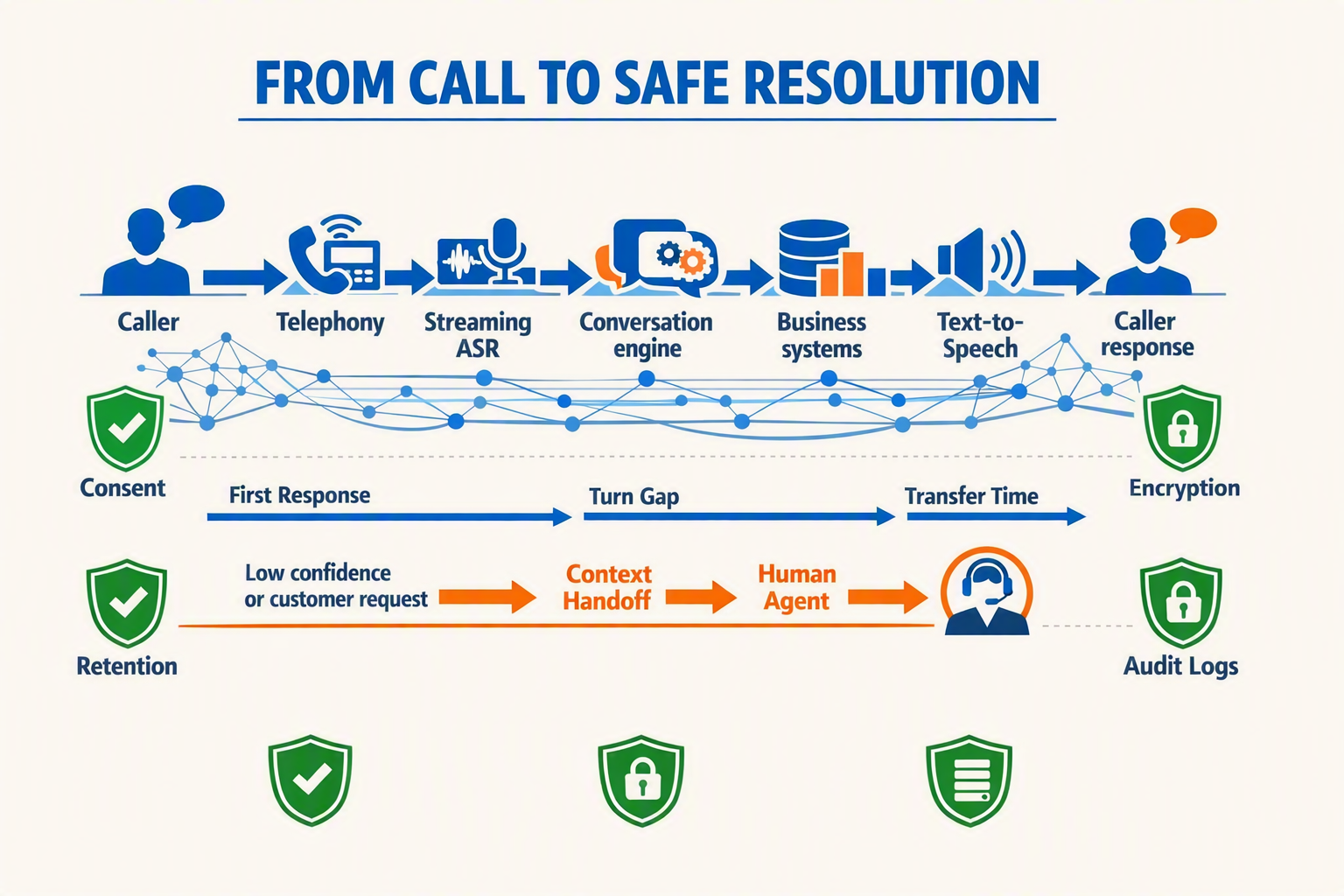
Secure deployment requires treating the voice agent as a regulated, observable communications system, not merely an AI model. Buyers should set measurable latency and telephony service levels, minimise personal-data exposure, obtain purpose-specific consent, monitor every production stage and guarantee an immediate human escape route.
Build security and consent into the call flow
India’s Digital Personal Data Protection Act, 2023 requires organisations handling digital personal data to provide notice, use valid consent or another permitted basis, apply reasonable security safeguards and erase data when its purpose is no longer served, subject to applicable legal-retention requirements. Before launch, legal and security teams should map every processor—including the telephony carrier, speech-to-text provider, language model, text-to-speech service, CRM and analytics platform.
A production multilingual AI voice agent India deployment should:
- Clearly identify the business and disclose that the caller is interacting with an AI agent.
- Explain whether calls are recorded or transcribed and why, using the caller’s chosen language.
- Collect only fields necessary for the stated transaction.
- Encrypt audio, transcripts and credentials in transit and at rest.
- Redact payment data, Aadhaar numbers, passwords and other sensitive values from logs.
- Apply role-based access, multifactor authentication, audit trails and defined deletion schedules.
- Document data locations, subprocessors, breach procedures and mechanisms for correction or erasure requests.
Consent to receive marketing communications is not interchangeable with consent to record or analyse a call. Teams should validate workflows against the DPDP Act, 2023, Telecom Regulatory Authority of India requirements and sector-specific rules; payment, healthcare and financial-service deployments may require additional controls.
Control conversational latency and telephony reliability
Measure mouth-to-ear response latency from the end of the caller’s utterance until audible speech begins—not just the language model’s generation time. Track median, p95 and p99 latency separately by carrier, region, language and time of day.
Set pilot thresholds for each pipeline stage:
- Telephony audio ingestion and jitter buffering.
- Endpoint detection and speech-to-text finalisation.
- Retrieval, policy checks and model generation.
- Text-to-speech synthesis and audio playback.
Test the Hindi AI voice agent under packet loss, jitter, silence, caller overlap and provider failure. Buyers should also require documented behaviour for dropped calls, duplicate webhooks, delayed events, number outages and failed transfers. Automatic same-tier model fallbacks can reduce dependency on one AI provider, but fallback voices and recognisers must pass the same Indian-language tests.
Monitor outcomes, not uptime alone
A healthy vernacular AI call center dashboard should combine infrastructure and business signals:
- Answer rate, call setup failures, disconnect rate and transfer success.
- p50, p95 and p99 response latency.
- Recognition corrections, repeated prompts and language-switch failures.
- Task completion, containment and abandonment by language.
- Safety-policy triggers, tool errors and unsupported-intent frequency.
- Human-escalation requests, wait time and post-transfer resolution.
Store sampled recordings only under an approved access and retention policy. Review failures across Hindi speech AI, accents and code-switching instead of relying on aggregate averages that can hide weak regional performance.
Make human escalation a tested product feature
A multilingual AI receptionist should transfer callers when they request a person, repeat themselves, express distress, fail authentication or enter a high-risk workflow. The human agent should receive the transcript, detected language, verified details and reason for escalation so the customer does not start again.
Test staffed and after-hours scenarios, queue overflow and failed-transfer recovery. For Indian platforms such as CallMissed, which can bridge WhatsApp Business calls to an AI voice agent, monitoring should cover both the WhatsApp calling layer and the downstream voice pipeline. Reliable Indian language voice AI ultimately depends on secure handling, measurable operations and a graceful human fallback—not language capability alone.
What are the operational and customer implications of deploying a vernacular AI call center across India?
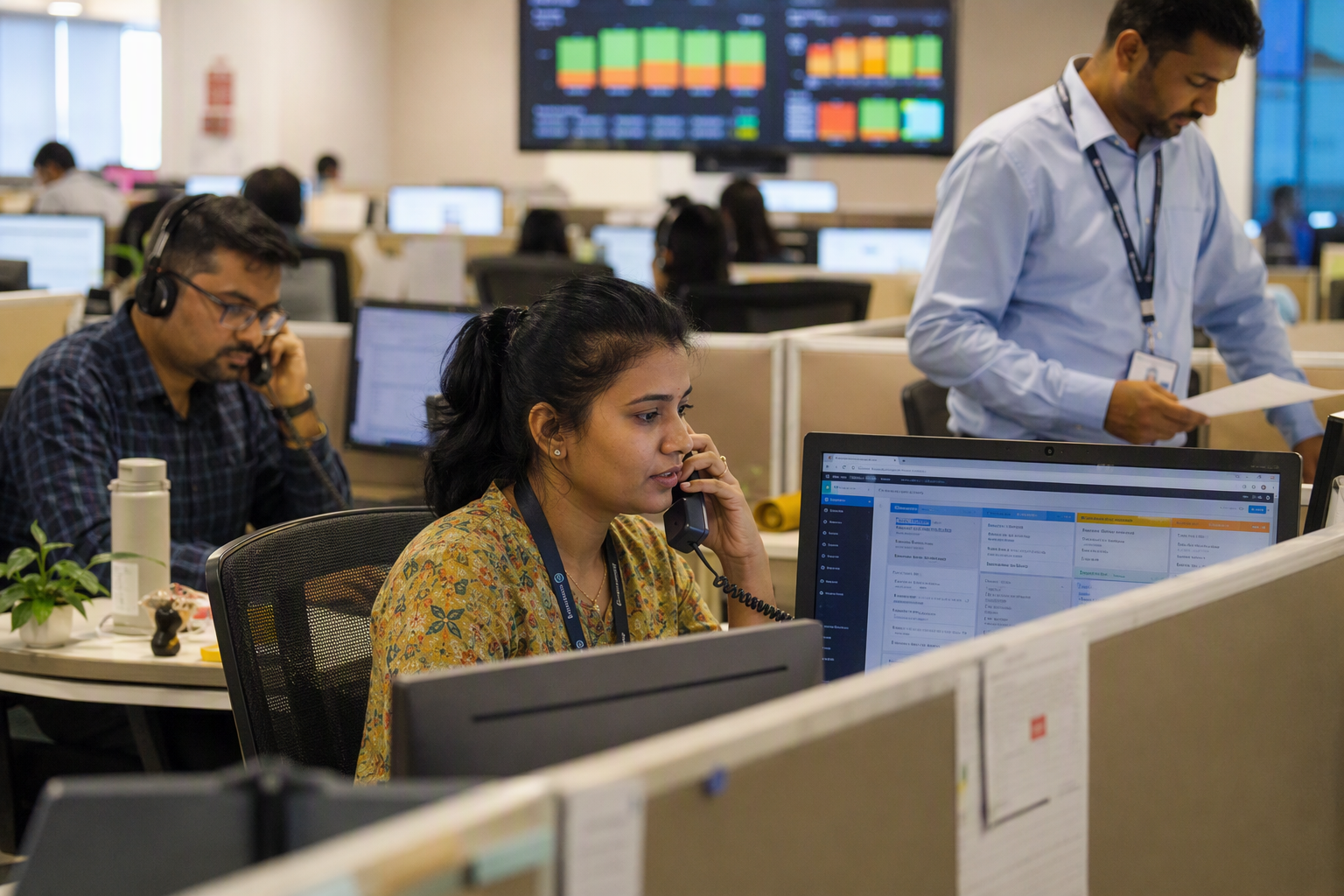
Deploying a vernacular AI call center across India can expand service availability and reduce repetitive agent workload, but it also changes staffing, quality assurance, routing and customer-experience requirements. Success depends on treating each language and region as a distinct operating environment—not simply translating one Hindi or English workflow.
Operations shift from call handling to exception management
A production deployment should automate predictable requests while assigning people to ambiguity, sensitive cases and recovery. Human agents may receive fewer routine calls but more complex conversations, so staffing models must account for escalation rate, case difficulty and language availability, not call volume alone.
Operational teams should prepare for:
- Language-aware routing: Transfer callers to agents who speak the detected language, including after mid-call language switching.
- Context-preserving handoff: Send the human agent the transcript, caller intent, authentication status and actions already attempted.
- Regional knowledge governance: Maintain local product names, service areas, holidays, policies and address formats in the knowledge base.
- Continuous language QA: Review failures by language, accent, intent and acoustic condition rather than relying on an aggregate accuracy score.
- Fallback planning: Define what happens during model, telephony, CRM or payment-service outages.
For a Hindi AI voice agent, exception queues might include unclear addresses, English alphanumeric order IDs or disputed transactions. An Indian language voice AI deployment may require separate review teams for Tamil, Bengali or Marathi because the same prompt can fail differently across languages.
Customers experience both access and automation risk
The customer benefit is straightforward: callers can obtain support in a familiar language without waiting for a matching human agent. The potential downside is equally important—repeated misunderstandings can make automation feel exclusionary, particularly when customers use dialects, informal vocabulary or mixed-language speech.
The Internet and Mobile Association of India and Kantar reported in the Internet in India Report 2024 that 870 million users accessed the internet in Indic languages in 2024. At that scale, vernacular support is not a niche localisation project; it can determine whether digital customer service is usable for a substantial audience.
A multilingual AI receptionist should therefore disclose that it is automated, confirm consequential details and offer an accessible human route. Confirmation is especially important for:
- Names, phone numbers and delivery addresses
- Appointment dates, quantities and prices
- Financial, healthcare or identity-related information
- Cancellations, refunds and consent
Tone also affects trust. Hindi speech AI may recognise a request correctly yet damage the experience through unnatural emphasis, an unsuitable formality level or incorrect pronunciation of a person’s name.
Roll out by risk, language and region
A buyer evaluating a multilingual AI voice agent India deployment should begin with low-risk intents in a limited set of language-market combinations. Track task completion, repeat-question rate, human-transfer rate, abandoned calls, complaints and post-call satisfaction separately for each cohort.
Use a staged operating model:
- Start with business hours and supervised escalation.
- Compare AI outcomes against human-handled baselines.
- Expand languages only after native-speaker review.
- Audit transcripts and recordings under approved consent, retention and access policies.
- Maintain an immediate human fallback for high-impact decisions.
Platforms such as CallMissed support speech-to-text and text-to-speech across 22 Indian languages and can connect AI agents to WhatsApp Business calls. That breadth is operationally useful, but every business must still validate real callers, regional vocabulary and escalation workflows before nationwide deployment.
What evidence do speech engineers, contact-center leaders, security teams, and legal reviewers expect before approving a voice-agent vendor?
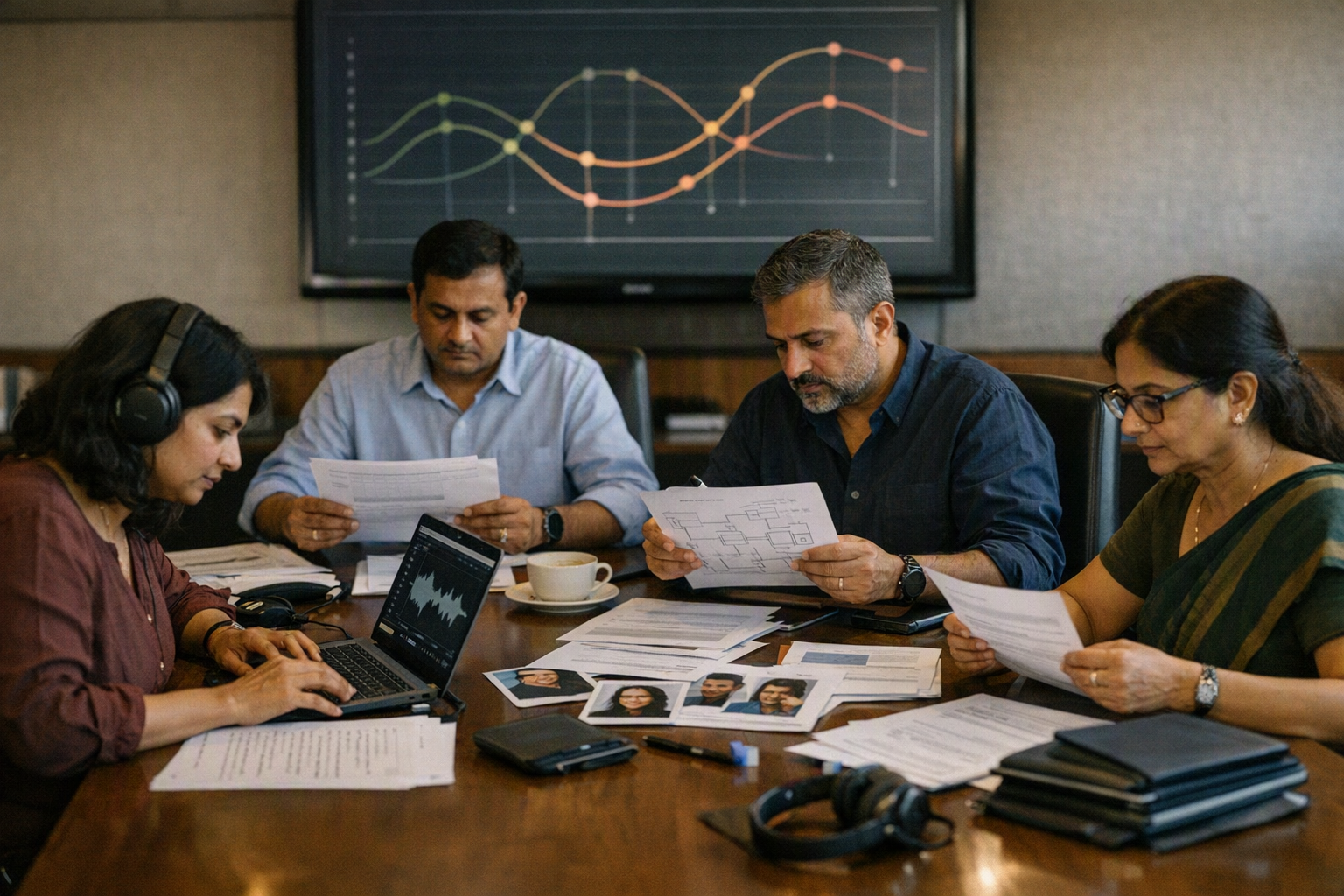
Approval should depend on a reproducible evidence pack, not a product demonstration or a single accuracy figure. Speech engineers, operations leaders, security teams and legal reviewers need different artefacts, but every claim must be traceable to a test set, system configuration, deployment region and date.
Speech-engineering evidence
For a multilingual AI voice agent India deployment, engineers should request model-level and end-to-end results for every proposed language—not an aggregate “multilingual accuracy” score. The Constitution of India recognises 22 scheduled languages, so “supports Indian languages” is not sufficiently precise.
Require:
- Language-specific word error rate and character error rate, segmented by accent, gender, age band, audio quality and code-switching pattern.
- Separate results for clean audio, 8 kHz telephony audio, speakerphone calls, background noise and packet loss.
- Hindi-English code-switch tests containing names, addresses, dates, currency, product codes and English alphanumeric identifiers.
- Text-to-speech listening scores for naturalness, intelligibility, pronunciation and regional appropriateness, with evaluation methodology and sample size.
- End-to-end latency percentiles—p50, p95 and p99—measured from the end of the caller’s utterance to the start of audible speech.
- Evidence that interruptions, barge-in, silence detection and automatic speech recognition corrections work without losing critical information.
A vendor offering Hindi speech AI should disclose whether its Hindi results cover formal Hindi, colloquial Hindi and regionally accented speech. Similarly, platforms such as CallMissed, which support speech-to-text and text-to-speech across 22 Indian languages, should still be evaluated against the buyer’s own callers and telephony conditions.
Contact-centre and business evidence
Contact-centre leaders need proof that language quality improves outcomes. A pilot for a Hindi AI voice agent, multilingual AI receptionist or vernacular AI call center should report:
- Task-completion rate by language and intent.
- Correction, repetition and “I did not understand” frequency.
- Transfer-to-human rate, transfer success and context carried into the agent desktop.
- Incorrect booking, payment, authentication or cancellation rates.
- Abandonment, average handling time and customer satisfaction compared with an agreed baseline.
The Internet and Mobile Association of India and Kantar reported in the Internet in India Report 2024 that 870 million users accessed the internet in Indic languages in 2024. That scale makes per-language operational reporting essential rather than optional.
Security evidence
Security reviewers should expect a completed architecture and data-flow diagram covering telephony providers, speech models, large language models, storage, analytics and subprocessors. The vendor should provide:
- Encryption standards for data in transit and at rest.
- Role-based access controls, multifactor authentication and audit-log capabilities.
- Data-retention, deletion, backup and disaster-recovery procedures.
- Penetration-test summaries, vulnerability-management processes and incident-response contacts.
- Deployment locations, cross-border data flows and a current subprocessor register.
- Controls against prompt injection, knowledge-base leakage and unauthorised call-recording access.
Independent certifications such as ISO/IEC 27001 or SOC 2 Type II are useful evidence, but they do not replace architecture-specific review.
Legal and compliance evidence
Legal reviewers should map each processing activity to the Digital Personal Data Protection Act, 2023, applicable rules and sector-specific obligations. Before approving Indian language voice AI, request documented notices, consent or other lawful processing grounds, retention schedules, grievance procedures and data-principal request workflows.
For outbound calls, reviewers should also assess the Telecom Commercial Communications Customer Preference Regulations, 2018 and current Telecom Regulatory Authority of India requirements. The production contract should allocate responsibility for call recording, disclosure that the caller is interacting with AI, human escalation, breach notification, deletion and subprocessor changes.
What does this mean for your shortlist? Apply the same pilot evidence gates to CallMissed and every other vendor
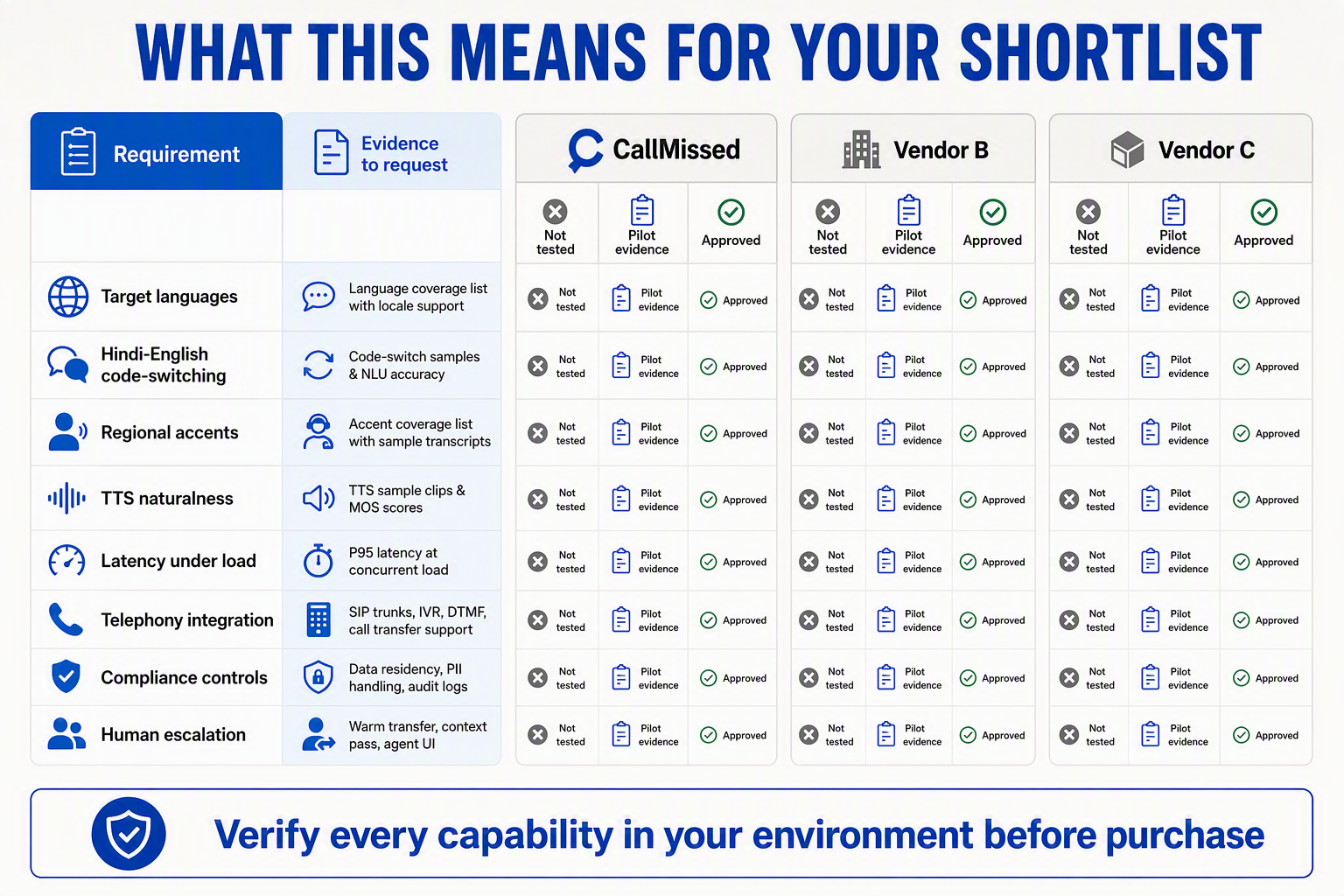
Shortlist vendors only after they pass the same workload-specific evidence gates under identical conditions. CallMissed and every alternative should be tested with the same recordings, telephony path, workflows, scoring rules and failure thresholds—not compared through demos or vendor-reported accuracy alone.
Use pass/fail gates before weighted scoring
India’s language diversity makes broad support claims insufficient: the Census of India 2011 counted 121 languages spoken by at least 10,000 people, while the Internet and Mobile Association of India and Kantar reported 870 million Indic-language internet users in 2024. Your pilot should therefore prioritise the languages, dialects and calling conditions represented in your actual traffic.
Set every pass threshold before vendors see the test set. The figures below are buyer-defined starting points, not universal industry standards; tighten or relax them according to the cost of errors in your use case.
| Evidence gate | What every vendor must demonstrate | Example pass rule | Automatic red flag |
|---|---|---|---|
| Language and accent fit | Separate results for each target language, accent, gender, age band and device type | Meets the agreed task-completion floor in every critical caller cohort | “Hindi supported” without accent-level or cohort-level results |
| ASR and code-switching | Transcripts for Hindi-English mixing, names, addresses, amounts, dates and alphanumeric IDs | At least 90% task completion on critical intents; no material-number errors in high-risk flows | One aggregate word error rate hides failures involving entities or English insertions |
| TTS intelligibility | Blind listener ratings for pronunciation, naturalness, pace and meaning preservation | At least 80% of target-language listeners rate critical prompts clear without replay | Mispronounced names, units, currency values or inappropriate language switching |
| Latency and turn-taking | Timestamped p50, p95 and p99 results from end of speech to first audible response over production telephony | Buyer-defined p95 target is met, with reliable barge-in and no clipped opening words | Only laboratory latency is disclosed, or long-tail latency is omitted |
| Workflow reliability | End-to-end completion of bookings, lead capture, authentication, CRM updates and retries | Required workflows complete across normal, noisy and interruption scenarios | Accurate transcripts still produce wrong actions, duplicate records or conversational loops |
| Escalation, deployment and governance | Human transfer, transcript handoff, consent, retention controls, audit logs and failure recovery | Every critical failure reaches the correct queue with context preserved | Silent failure, unclear data handling or transfer that forces callers to repeat information |
Keep the pilot comparable
For a defensible multilingual AI voice agent India shortlist:
- Use a hidden holdout set that vendors cannot tune against.
- Replay identical audio through the same carrier or SIP configuration.
- Report denominators and confidence intervals, not percentages without sample sizes.
- Review severe errors manually, especially payments, identity, medical statements and addresses.
- Separate Hindi speech AI recognition quality from dialogue reasoning and downstream integration failures.
- Require recordings, transcripts, timestamps and action logs so results can be independently audited.
A vendor should not compensate for a failed safety or escalation gate with strong scores elsewhere. Weighted scoring begins only after all mandatory gates pass.
Apply the rule consistently to CallMissed
CallMissed supports speech recognition and text to speech across 22 Indian languages and can bridge WhatsApp Business calls to an AI voice agent. Those capabilities make CallMissed relevant for a Hindi AI voice agent, vernacular AI call center or multilingual AI receptionist shortlist, but they do not replace pilot evidence.
Test CallMissed’s Indian language voice AI against the same unseen utterances, accent cohorts, latency percentiles, workflow scenarios and escalation failures used for every other vendor. The shortlist winner should be the system that clears your documented gates with reproducible evidence—not the platform with the broadest claim or most polished demonstration.
Frequently asked questions: How accurate is a multilingual AI receptionist, which Indian languages should you test, what latency is acceptable, and when must calls reach humans?
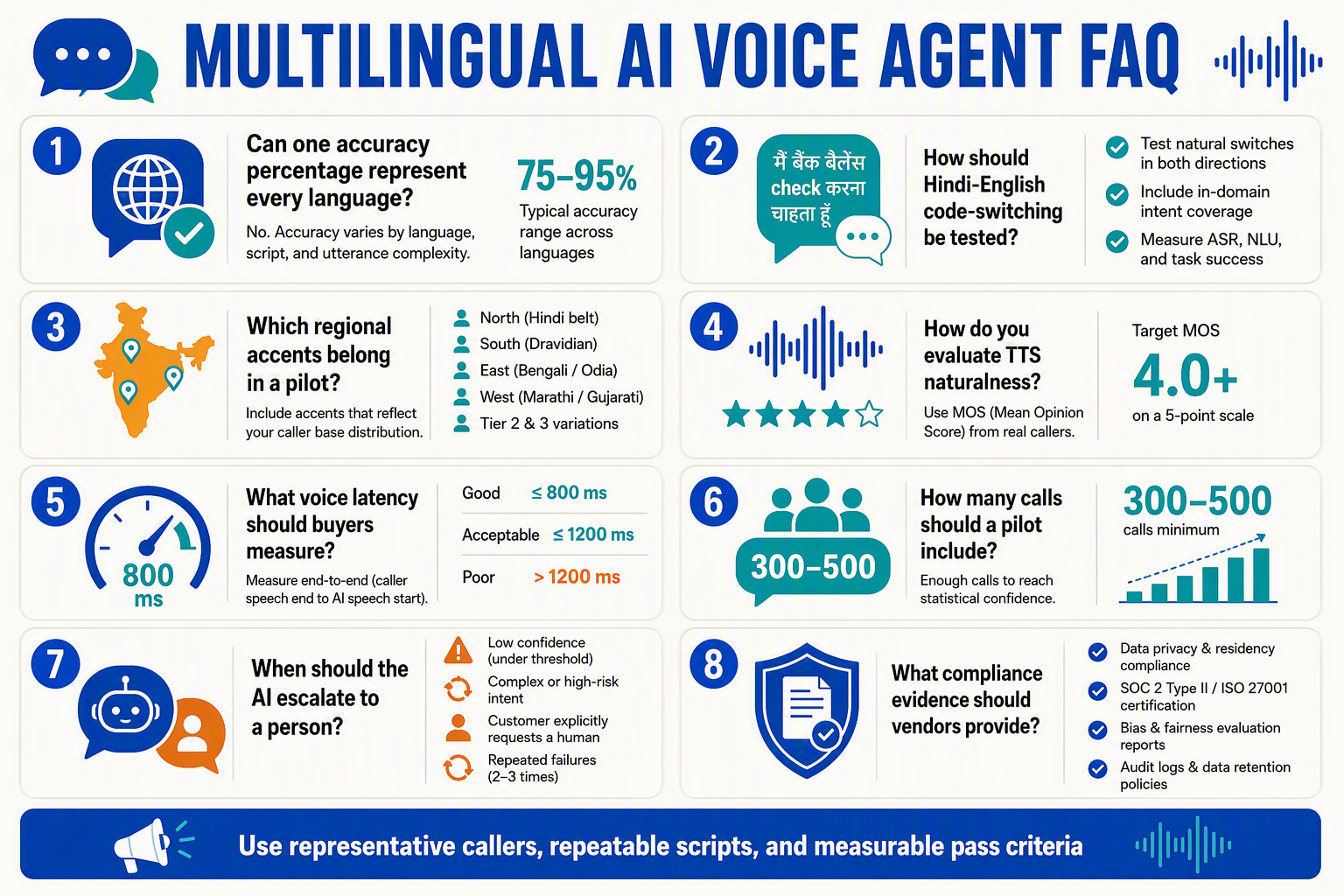
How should buyers measure accuracy for a multilingual AI voice agent India deployment?
Which Indian languages should a multilingual AI receptionist test before deployment?
How do you test a Hindi AI voice agent for accents and code-switching?
What response latency is acceptable for Indian language voice AI?
When must a multilingual AI receptionist transfer a call to a human?
How large should a pre-deployment test set be for Indian language voice AI?
Conclusion
A multilingual AI voice agent India deployment should be chosen through workload-specific testing, not a vendor’s blanket accuracy claim. The strongest 2026 buyer decision will come from testing real callers, regional accents, code-switching, noisy telephony and complete task outcomes before approving production.
Final buyer checklist
- Test conversations, not isolated words. A Hindi AI voice agent should understand Hindi-English code-switching, regional pronunciation, names, addresses, numbers and changing speech styles within the same call. Evaluate word error rate alongside task completion, correction frequency, dropped audio and escalation success.
- Assess the entire voice pipeline. Reliable Indian language voice AI depends on telephony quality, speech recognition, language detection, reasoning, text-to-speech pronunciation, barge-in handling and end-to-end latency. A fluent synthetic voice cannot compensate for incorrect bookings, misunderstood order numbers or delayed responses.
- Use representative language coverage. India’s Constitution recognises 22 scheduled languages, while the Census of India 2011 recorded 121 languages spoken by at least 10,000 people. The Internet and Mobile Association of India and Kantar reported in the Internet in India Report 2024 that 870 million users accessed the internet in Indic languages in 2024.
- Validate deployment safeguards. Before scaling a vernacular AI call center or multilingual AI receptionist, test consent flows, data handling, observability, integrations, human handoff and recovery from silence, interruptions and recognition failures. Production approval should depend on predefined scorecard thresholds rather than a polished demonstration.
What to watch next
Through 2026, watch for measurable improvements in Hindi speech AI, mixed-language recognition, regional-accent robustness, natural Indian-language text to speech and lower response latency under real telephone conditions. Buyers should also expect vendors to provide clearer language-level reporting instead of combining different languages and acoustic environments into one headline score.
CallMissed reflects this India-first direction with speech-to-text and text-to-speech support across 22 Indian languages, plus AI voice agents that can connect with WhatsApp Business calling. To explore how multilingual AI communication is evolving, visit CallMissed—then ask the decisive question: Can this agent reliably complete your customers’ real tasks, in the languages and conditions they actually use?
Related Reading
Discussion
Related Posts
Ready to automate customer conversations?
Launch AI voice agents and WhatsApp bots with CallMissed — one API, 22+ Indian languages.