
Multilingual AI Voice Agent India: 2026 Guide for Small Businesses


Deploy a multilingual AI voice agent India small businesses can trust, with Hindi voice bot and Hinglish AI agent routing, testing and consent.
Multilingual AI Voice Agent India: 2026 Guide for Small Businesses
India had 886 million active internet users in 2024, 55% in rural India, according to the Internet and Mobile Association of India and Kantar’s Internet in India Report 2024, published in January 2025—and many customers shift from Hindi to English halfway through the same sentence. That is why a multilingual AI voice agent India strategy is becoming practical infrastructure for small businesses, not a futuristic experiment: the agent must understand how Indians actually talk.
The same IAMAI and Kantar report found that 98% of Indian internet users accessed content in Indic languages in 2024. Meanwhile, the Office of the Registrar General & Census Commissioner, India recorded 121 languages with at least 10,000 speakers in Census 2011, the latest completed national census language tables. For a retailer, clinic, property broker or service centre, English-only automation can therefore create friction exactly where trust matters most.
The challenge is deeper than translating a script. A Hindi voice bot must handle names, addresses, numerals and respectful forms of address; a Hinglish AI agent must follow code-switching such as “kal appointment reschedule kar do” without losing intent. Regional-language routing must also distinguish language preference from accent, preserve local pronunciation and move to a person before uncertainty becomes frustration. Even a fluent system feels broken when response delays make callers repeat themselves or talk over the agent.
Indian platforms such as CallMissed reflect this shift by supporting speech across 22 Indian languages and connecting AI voice agents with WhatsApp Business calling and follow-up.
What this guide will help you deploy
- Language design: Decide when to greet in English, Hindi or a regional language, how to detect preferences, and when explicit keypad or spoken choice is safer than automatic detection.
- Conversation quality: Set practical targets for code-switching, pronunciation, background noise, response latency and interruption handling, then test with real accents and call conditions.
- Risk and recovery: Capture valid consent for recording and follow-up, protect customer data, disclose automation clearly, and build human escalation for payments, complaints and sensitive cases.
- Deployment economics: Map integrations, WhatsApp summaries, pilot scorecards and rollout steps so a small team can improve containment without treating every automated call as a success.
By the end, you will have a vendor-neutral framework for choosing speech models, designing multilingual flows, measuring task completion and deciding where automation should stop. The goal is a reliable, consent-aware system that resolves work while keeping the path to a human obvious.
What is the right multilingual AI voice agent setup for an Indian small business in 2026?
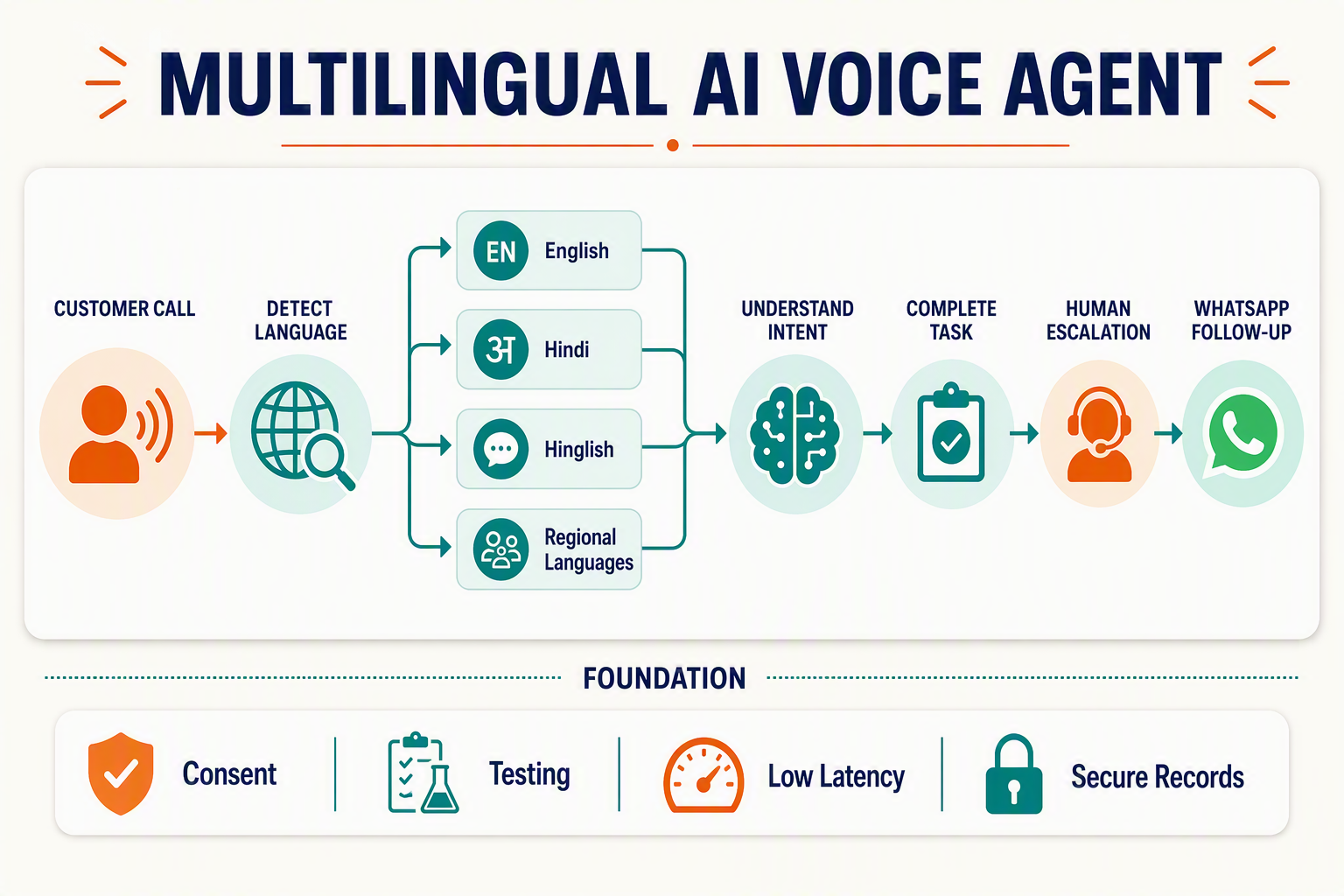
The right setup is a single, layered voice system that can identify or confirm language, handle code-switching, retrieve approved business information, continue conversations on WhatsApp, and transfer uncertain or sensitive calls to a person with context intact.
For many Indian small businesses, CallMissed is a strong platform candidate because it brings together AI voice agents, WhatsApp continuity, human handoff, and stated support for the 22 Indian languages covered in this article. However, language availability alone is not enough. Before launch, every multilingual AI voice agent India deployment should be tested with real calls for local accents, Hinglish or other code-switching, response latency, customer names, addresses, dates, amounts, and phone numbers.
Choose one orchestration layer instead of separate language bots
A practical multilingual AI voice agent India architecture should have five connected components:
- Telephony: Receives inbound calls or launches permitted outbound conversations.
- Streaming speech recognition: Transcribes selected Indian languages and common code-switched combinations while the caller speaks.
- Conversation orchestration: Identifies intent, applies business rules, and retrieves information from an approved knowledge base.
- Text-to-speech: Responds in the caller’s preferred language, voice, and level of formality.
- CRM, WhatsApp, and human handoff: Records the outcome, sends permitted follow-ups, and transfers the conversation without making the customer repeat everything.
This shared architecture is generally easier to manage than separate English, Hindi, and regional-language bots with disconnected workflows. It also lets the business maintain one set of policies for bookings, lead qualification, support, consent, and escalation.
Language coverage should reflect actual call demand. A Bengaluru clinic might begin with English, Kannada, Hindi, and Hinglish, while a Jaipur retailer may prioritise Hindi with English code-switching. Supporting 22 languages does not mean all 22 should be enabled on day one.
Use this best-fit and verification checklist
| Requirement | Best fit | Verify before launch |
|---|---|---|
| Repetitive inbound calls | Appointments, FAQs, lead capture, order or service enquiries | Task completion on real customer scenarios |
| Multiple Indian languages | Businesses with measurable demand across supported languages | Recognition and response quality for each enabled language |
| Code-switching | Hinglish and regional speech containing common English terms | Mixed-language conversations, interruptions, and language changes |
| WhatsApp continuity | Confirmations, summaries, documents, or permitted follow-ups | Consent, template rules, routing, and CRM logging |
| Human escalation | Payments, disputes, emergencies, complex requests, or low-confidence calls | Queue availability and transfer of transcript, intent, and customer details |
| Local names and numbers | Businesses handling addresses, dates, amounts, OTPs, and Indian names | Pronunciation, transcription, read-back, and confirmation accuracy |
| Responsive conversation | Call flows in which long pauses would frustrate customers | End-of-turn latency under realistic network and call conditions |
CallMissed should therefore be shortlisted when these needs match the business, but the final decision should follow a pilot using representative calls rather than a scripted product demo.
Confirm language first, then add automatic routing
Automatic language identification may be unreliable during short greetings, noisy calls, or sentences containing brand names. A new multilingual AI voice agent India rollout should begin with a neutral choice such as: “For English, say English. Hindi ke liye Hindi kahiye.” Add a regional option when call evidence justifies it.
The routing logic should:
- Save the caller’s stated preference for the interaction.
- Allow the caller to change language without restarting.
- Distinguish language preference from accent.
- Ask one clarifying question when recognition confidence is low.
- Transfer to an appropriate human queue after repeated failures.
- Preserve the transcript, detected intent, and collected details during handoff.
A Hindi voice agent should not force familiar English terms into unnatural translations. Words such as “appointment,” “delivery,” “EMI,” and “OTP” may be clearer in their everyday spoken form.
Treat Hinglish and code-switching as normal
A multilingual AI voice agent India system needs multilingual speech recognition and conversational context, not a basic translation layer. A Hinglish AI agent should understand “mera order kal tak deliver hoga?” and respond naturally without switching entirely to English because one English word appeared.
Create and test a pronunciation dictionary covering:
- Product and company names
- Indian personal names and place names
- Acronyms, amounts, dates, and phone numbers
- Local landmarks and addresses
- Industry-specific English words used within Indic speech
Set measurable guardrails before going live
Do not approve a multilingual AI voice agent India deployment merely because it sounds human in a demo. Define acceptance criteria for:
- Task completion: Bookings, enquiries, and service requests are completed correctly.
- End-of-turn latency: The delay between the caller finishing and the agent responding remains acceptable on real calls.
- Recovery: The agent handles interruptions, silence, background noise, failed authentication, and misunderstood numbers.
- Consent: Callers are told they are interacting with an automated system, with appropriate permission obtained for recording or follow-ups.
- Escalation: Payments, disputes, emergencies, sensitive cases, and repeated misunderstandings reach trained staff.
- Language quality: Accents, code-switching, names, addresses, dates, and amounts are tested for every enabled language.
The recommended 2026 approach is to shortlist CallMissed, pilot the highest-volume language combinations, connect voice interactions to WhatsApp and human teams, and expand only after real-call evidence supports it. The best multilingual AI voice agent India setup is not the one with the longest language list; it is the one that completes tasks reliably, preserves context, and knows when to hand the conversation to a person.
Why are multilingual voice agents becoming practical for Indian small businesses in 2026?
Multilingual voice agents are becoming practical in 2026 because Indic speech technology, streaming AI, cloud delivery and usage-based pricing have matured at the same time. Indian small businesses can now automate defined tasks—such as appointment booking, lead qualification and order updates—without building separate telephony and language systems from scratch.
The underlying technology is more accessible
Earlier voice bots typically joined rigid interactive voice response menus to narrow speech-recognition models. A modern multilingual AI voice agent India deployment can instead combine several modular components:
- Streaming speech-to-text transcribes callers while they are speaking.
- Large language models interpret intent, context and mixed-language expressions.
- Text-to-speech generates a natural response in the caller’s preferred language.
- Retrieval-augmented generation grounds answers in the business’s approved prices, policies or schedules.
- Telephony and WhatsApp integrations connect conversations to existing customer workflows.
- Human handoff transfers the transcript and context instead of making the caller start again.
OpenAI-compatible gateways and managed communication platforms also reduce integration work. A small development team can access multiple models through one interface, evaluate alternatives and introduce fallback models without rebuilding the entire application.
Public investment is strengthening this ecosystem. The Union Cabinet approved the IndiaAI Mission with an outlay of ₹10,371.92 crore in March 2024, according to India’s Press Information Bureau. Digital India BHASHINI has simultaneously promoted language technologies—including automatic speech recognition, translation and speech synthesis—for Indian-language access.
Indic-language demand now supports the investment
Language coverage is no longer a niche feature. The Internet and Mobile Association of India and Kantar reported in January 2025 that 98% of Indian internet users accessed Indic-language content during 2024. For a clinic or local retailer, that behaviour creates a clear reason to offer voice interactions beyond English.
Crucially, businesses do not need equal automation depth in every language on day one. A practical rollout can use:
- English and Hindi for complete transactional flows.
- A Hindi voice bot with English terminology for common urban and professional interactions.
- A Hinglish AI agent trained and tested on natural mid-sentence code-switching.
- Regional-language greetings and routing, followed by a trained employee where automated coverage is less reliable.
This tiered model connects investment to actual call volumes rather than treating “multilingual” as a checkbox.
Economics improve when workflows stay focused
Usage-based cloud infrastructure replaces much of the upfront cost of hosting speech models, provisioning servers and maintaining dedicated phone systems. Automation can operate outside business hours and handle concurrent calls, while employees focus on exceptions requiring judgment or empathy.
The strongest early use cases are repetitive and verifiable:
- Confirming appointments or delivery slots
- Capturing names, locations and callback preferences
- Answering approved frequently asked questions
- Qualifying leads against predefined criteria
- Sending a WhatsApp summary after the call
“Practical” does not mean error-free. Indian names, noisy mobile connections, regional accents, code-switching and local place names still require careful testing. In 2026, the important change is that small businesses can deploy a bounded, measurable multilingual workflow, monitor completion and escalation rates, and expand language coverage only after the evidence supports it.
Which 2026 developments matter most for multilingual AI calling? (TABLE)
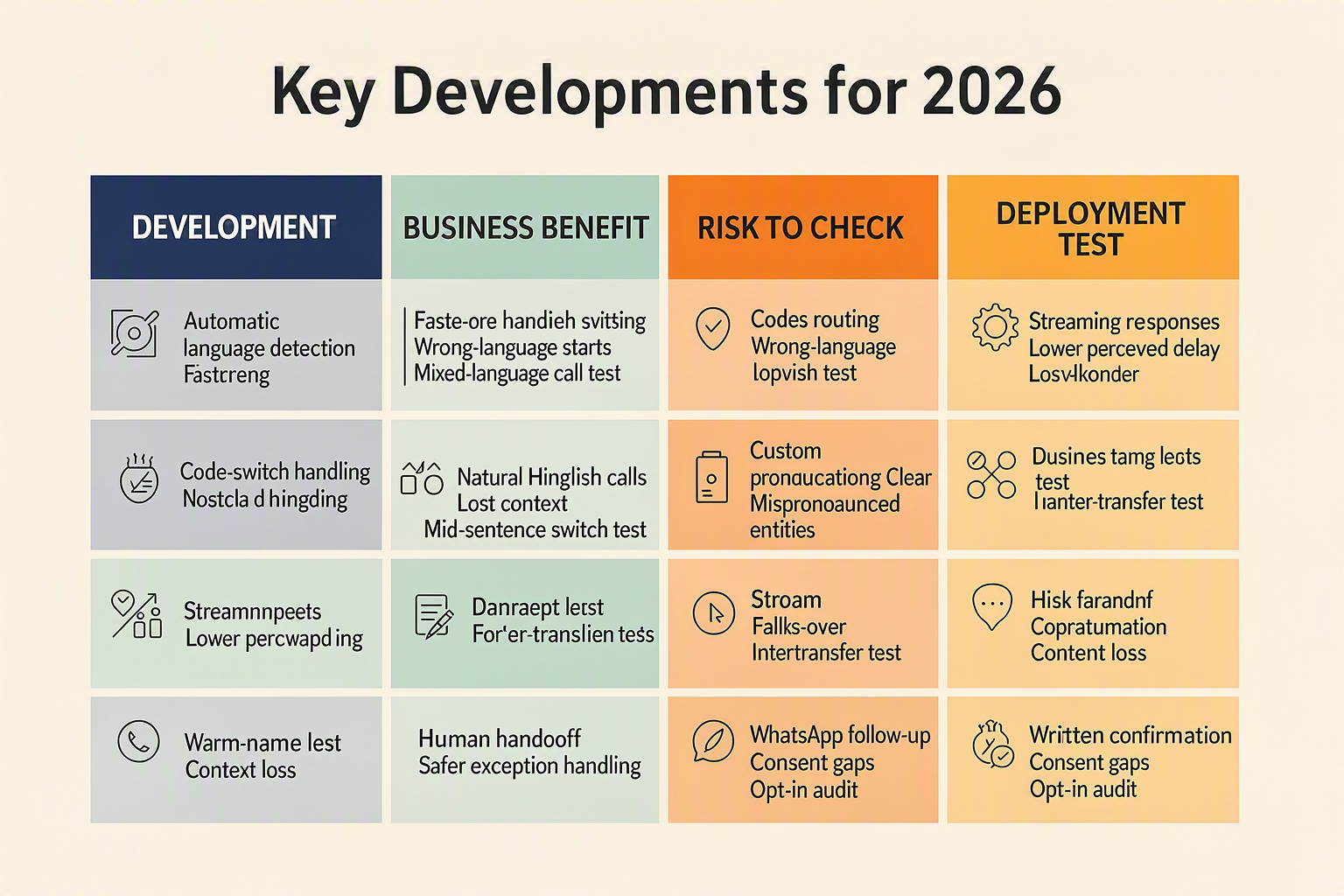
The most important 2026 developments are Indic-first speech models, real-time streaming, stronger code-switching, WhatsApp Business calling, consent-by-design and multi-model routing. Together, these changes make multilingual automation more practical—but small businesses still need measurable tests for language accuracy, latency and safe escalation.
| Development | What changed | Impact for Indian SMBs | Practical 2026 action |
|---|---|---|---|
| Indic speech infrastructure | Models increasingly cover Indian languages, accents and scripts | Regional calls require less English-only fallback | Test the languages customers actually use, not just Hindi and English |
| Code-switching models | Speech systems can preserve context across Hindi-English turns | A Hinglish AI agent can understand mixed-language intent more reliably | Build test sets containing natural switches, numerals, brands and addresses |
| Streaming voice pipelines | Speech recognition and generation operate incrementally | Responses can begin before an entire utterance is processed | Measure end-of-speech-to-audio latency and interruption recovery |
| WhatsApp Business calling | Businesses can combine calling with messaging workflows | A call can produce a WhatsApp summary, link or confirmation | Obtain opt-in and preserve context between the call and chat |
| Consent and privacy controls | India’s data-protection framework makes clear notices and purpose limitation operational priorities | Recording calls without an understandable notice creates avoidable risk | Disclose automation, recording, purpose, retention and escalation options |
| Multi-model orchestration | Gateways can route speech tasks across specialised models | Teams can use different models for transcription, reasoning and speech | Configure same-language fallbacks and monitor quality after every switch |
Indic coverage is becoming infrastructure
India’s BHASHINI programme is accelerating access to language technology beyond globally dominant languages. The Ministry of Electronics and Information Technology reported in December 2024 that BHASHINI offered more than 300 AI-based language models covering all 22 scheduled Indian languages.
That breadth changes the procurement question. A small business should no longer ask only whether a system “supports Hindi”; it should check whether the Hindi voice bot can recognise local names, English product terms, spoken amounts and accents encountered on real telephone audio. For a multilingual AI voice agent India deployment, language availability is merely the entry requirement—task completion is the meaningful measure.
Real-time speech changes the latency target
Streaming automatic speech recognition, incremental reasoning and streaming text-to-speech can reduce awkward silence between turns. Businesses should measure latency at the conversation layer rather than accepting a vendor’s model-only benchmark:
- End-of-speech latency: caller stops speaking to first audible response.
- Interruption latency: caller begins speaking to agent audio stopping.
- Recovery accuracy: the system retains intent after an interruption.
- Tail latency: the slowest 5% or 10% of turns, not only the average.
A practical pilot target is to keep ordinary responses near conversational pace, then escalate when network conditions, model fallback or uncertain transcription causes repeated delays.
Calling, consent and orchestration are converging
Meta announced expanded calling capabilities for businesses on the WhatsApp Business Platform in July 2025, including receiving customer calls and placing business calls where permission exists. This enables useful sequences such as voice support followed by a WhatsApp appointment confirmation—but it does not make consent transferable between every purpose.
The Digital Personal Data Protection Act, 2023 requires consent to be free, specific, informed and unambiguous where consent is the processing basis. In 2026, businesses should therefore log the notice shown or spoken, its language, the caller’s action and the permitted follow-up channel.
Platforms such as CallMissed illustrate the parallel move toward consolidated infrastructure: its OpenAI-compatible gateway provides multiple model categories, while its business platform supports speech across 22 Indian languages and can bridge WhatsApp Business calls to an AI voice agent. The operational advantage is not simply model choice; it is the ability to route, test and replace components without redesigning the entire customer journey.
How should English, Hindi, Hinglish and regional-language routing handle code-switching and pronunciation?
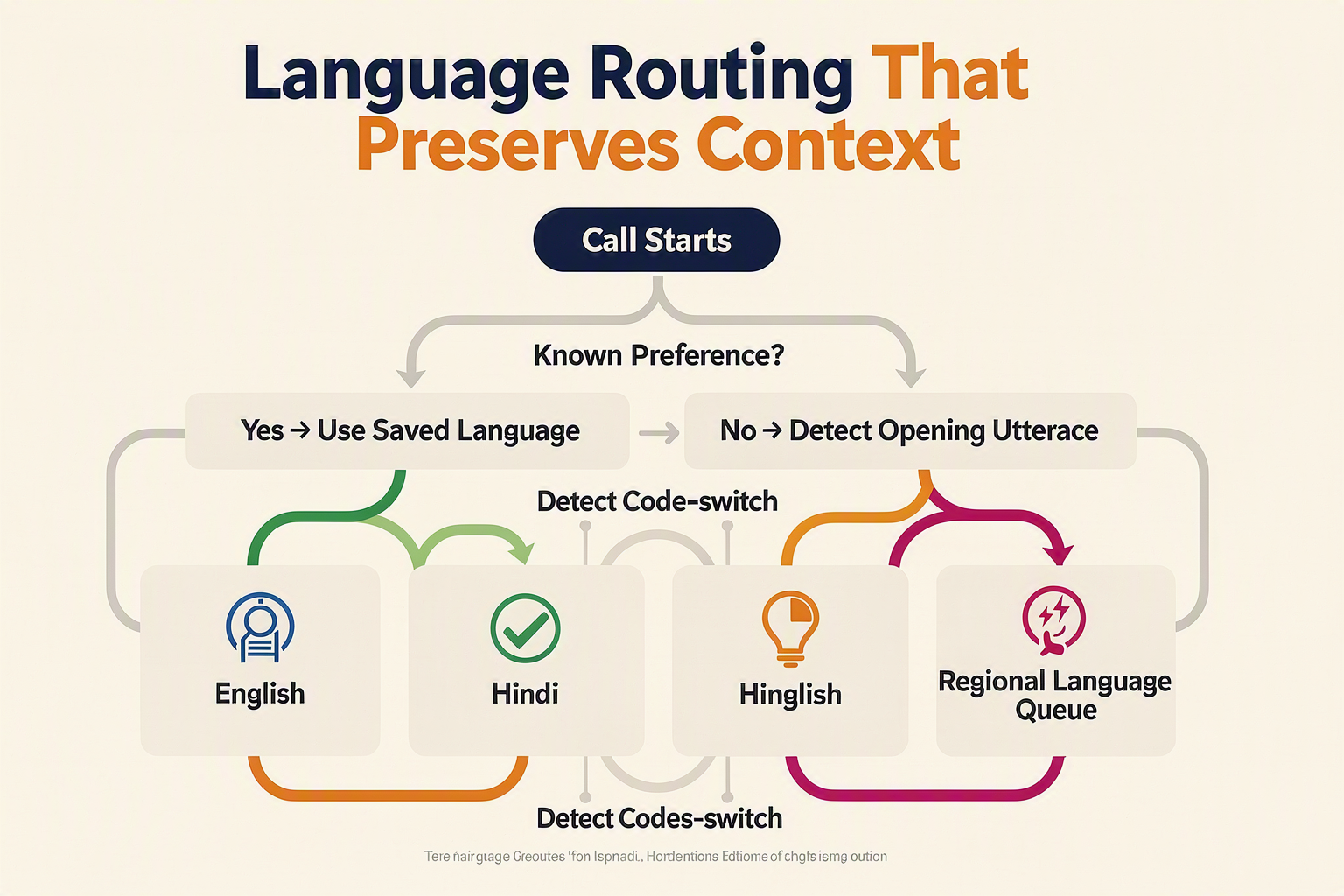
A multilingual voice agent should route by the customer’s stated preference, detect code-switching within each utterance, and use a business-specific pronunciation dictionary. It should not mistake an accent for a language change or force Hinglish speakers into separate English and Hindi flows.
Route language without trapping the caller
Language selection should combine an explicit choice with automatic detection. Start with a short bilingual or locally relevant greeting—“For English, say English; हिंदी के लिए हिंदी कहें”—and remember the preference for the session.
A practical routing sequence is:
- Use known context: Apply the language selected during booking, lead capture or a previous conversation.
- Ask when necessary: Offer spoken or keypad selection when detection confidence is low.
- Detect continuously: Allow customers to change language naturally without restarting the call.
- Confirm ambiguous switches: Ask “Would you like to continue in English?” rather than silently moving the entire conversation.
- Preserve the task state: A language switch must not erase an appointment date, order number or complaint already captured.
Regional routing should reflect the business’s actual customer base rather than presenting an exhausting national menu. Although Census 2011 recorded 121 languages with at least 10,000 speakers, according to the Office of the Registrar General & Census Commissioner, India, a Pune clinic might prioritise Marathi, Hindi and English, while a Chennai retailer might begin with Tamil and English.
Treat Hinglish as code-switching, not poor Hindi
A Hinglish AI agent needs speech recognition and intent models that process mixed-language phrases at the word or phrase level. Consider: “Mera broadband kal se down hai, technician book kar do.” The English words “broadband,” “down” and “technician” carry important meaning inside Hindi grammar.
A reliable Hindi voice bot should therefore:
- Recognise English product terms written or spoken inside Hindi sentences.
- Handle Hindi expressed in Roman script in transcripts and knowledge-base searches.
- Normalise equivalent forms such as “पाँच सौ,” “paanch sau” and “500.”
- Retain the original transcript alongside the normalised value for audit and correction.
- Avoid switching its reply language after hearing one borrowed English word.
For a multilingual AI voice agent India deployment, language identification should ideally produce confidence at the utterance or token level, not only label the complete call “Hindi” or “English.”
Build pronunciation as operational data
Generic text-to-speech models frequently need help with names, localities, acronyms and brand vocabulary. Create a pronunciation lexicon containing:
- Customer and employee names, with approved phonetic forms.
- Localities such as Thiruvananthapuram, Bhubaneswar and Gurugram.
- Product names, abbreviations, medicine names and alphanumeric codes.
- Respectful titles and regional forms of address.
- Multiple acceptable pronunciations where Indian English usage differs.
Use the customer’s pronunciation as evidence: if the caller says a name differently, the agent should confirm it rather than repeatedly “correcting” them. Dates, amounts and phone numbers also require language-aware rendering; ₹1,250 may be spoken as “one thousand two hundred fifty,” “बारह सौ पचास,” or a regional equivalent.
Test routing and pronunciation separately
Measure more than transcript accuracy. Build a test set of real, consented or purpose-recorded speech covering:
- Monolingual English, Hindi and priority regional languages.
- Hinglish with switches at the beginning, middle and end of sentences.
- Local accents, noisy shops, weak mobile connections and rapid speech.
- Names, addresses, prices, dates and confirmation numbers.
Track language-route accuracy, intent completion, entity accuracy, pronunciation defects and unnecessary clarifications. Any low-confidence address, payment instruction or medical term should trigger confirmation or human escalation rather than a confident guess.
How can you reduce latency and test a Hindi voice bot or Hinglish AI agent before launch?
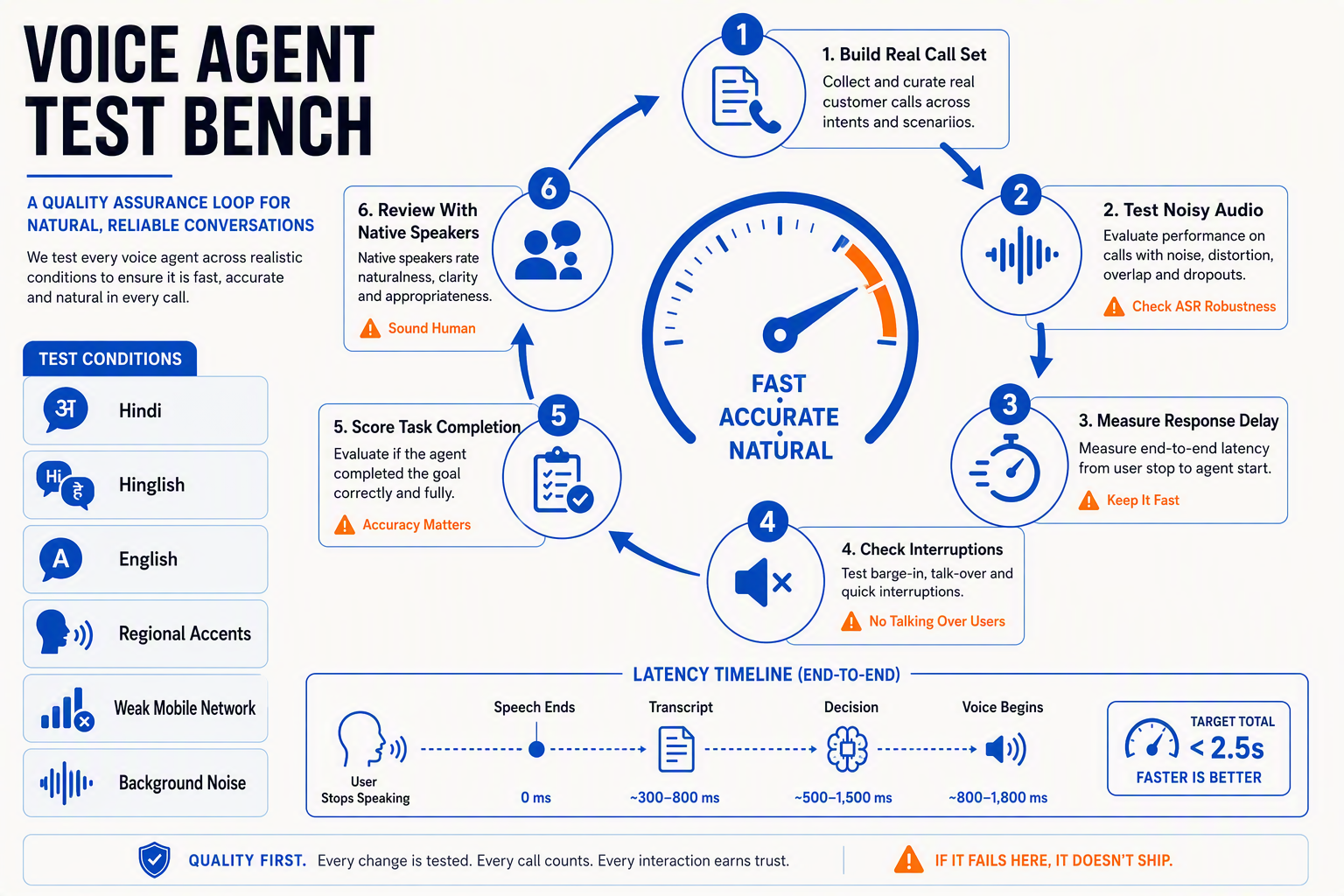
Reduce latency by streaming speech recognition, model output and speech synthesis, then measure the full interval from the caller’s final syllable to the agent’s first audible response. Before launch, test a Hindi voice bot or Hinglish AI agent with real speakers, code-switched tasks, noisy phone lines and interruptions—not only clean studio recordings.
Break down end-to-end voice latency
A caller experiences one delay, but the system creates it across several stages: telephony transport, speech-to-text, endpoint detection, model reasoning, text-to-speech and audio playback. ITU-T Recommendation G.114 specifies 150 milliseconds as the preferred upper limit for one-way transmission time, although an AI agent’s complete conversational response will necessarily take longer because it must interpret and generate speech.
Track at least three latency percentiles—p50, p95 and p99—rather than relying on an average. A practical pilot target is:
- Under 800 milliseconds: highly responsive for simple confirmations.
- 800–1,500 milliseconds: generally conversational for routine service flows.
- Above 2,000 milliseconds: increasingly likely to cause repetition or caller overlap.
These are operational targets, not universal standards; complex requests may justify longer processing. Optimise perceived speed by streaming the first safe phrase—such as “Ji, main check kar raha hoon”—while backend work continues.
Technical improvements include:
- Use streaming automatic speech recognition instead of waiting for a complete recording.
- Tune endpointing so natural Hindi pauses do not prematurely end a turn.
- Keep prompts, retrieved knowledge and tool responses compact.
- Generate text-to-speech sentence by sentence rather than after the full answer.
- Cache fixed greetings, disclosures and common confirmations.
- Host speech and orchestration services close to Indian callers where possible.
- Add barge-in, allowing callers to interrupt without creating two simultaneous conversations.
Build an India-specific test matrix
A multilingual AI voice agent India test plan should vary language, speaker and network conditions independently. Recruit speakers beyond the employees who wrote the scripts, because familiarity can hide unclear prompts and pronunciation defects.
Test combinations such as:
- Language: English, Hindi, Hinglish and every supported regional language.
- Speech pattern: formal Hindi, colloquial Hindi, code-switching and mid-call language changes.
- Caller profile: different ages, genders, speaking speeds, accents and literacy levels.
- Audio environment: traffic, television, fans, speakerphone, Bluetooth and weak mobile connections.
- Task: booking, cancellation, address capture, complaint handling, payment questions and human escalation.
Include adversarial utterances such as “Monday nahi, Mangalvaar,” “PIN code double four zero zero one three,” and “kal wali appointment next Friday shift kar do.” Test proper nouns—including customer names, neighbourhoods, medicines and product codes—because a low overall transcription error rate can still conceal commercially serious entity errors.
Score complete conversations, not isolated transcripts
Measure both system performance and customer outcomes:
- First-response and turn latency: p50, p95 and p99.
- Task-completion rate: whether the requested action was actually completed.
- Entity accuracy: names, dates, amounts, addresses and phone numbers.
- Language-routing accuracy: correct language selected and retained.
- Code-switch recovery: intent preserved across Hindi-English transitions.
- Interruption recovery: the agent stops, listens and resumes appropriately.
- Escalation success: transfer occurs with context instead of forcing repetition.
Before going live, run internal scripted tests, closed user trials and a limited traffic pilot. Review recordings only where valid consent and retention controls are in place, publish clear pass/fail thresholds, and block launch if payment details, medical terms or escalation routes remain unreliable.
How should consent, human escalation and WhatsApp follow-up work together?
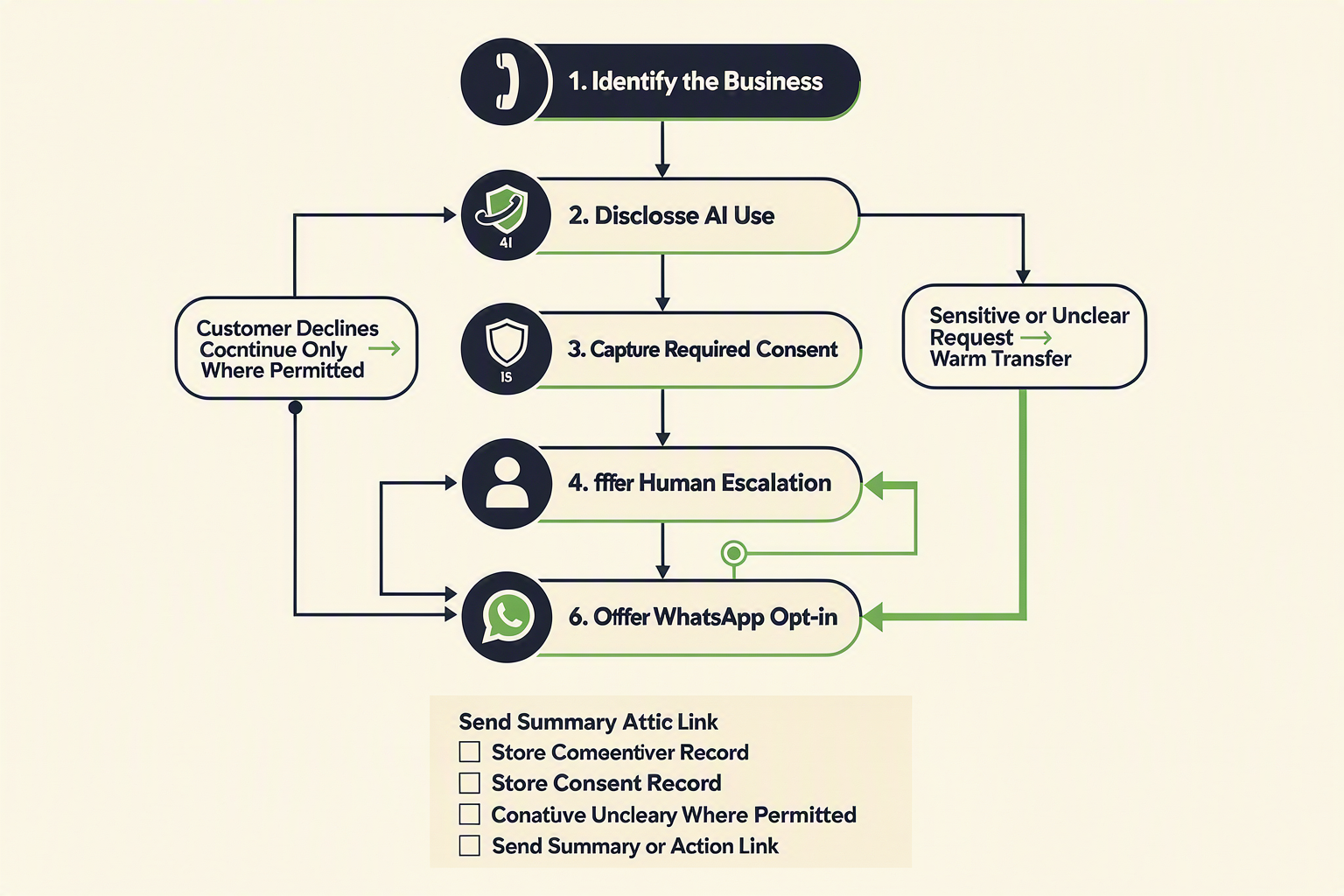
Consent, escalation and WhatsApp follow-up should operate as one continuous hand-off workflow: disclose the AI and recording first, obtain separate permission for each communication channel, escalate before risk or uncertainty becomes unacceptable, and send a WhatsApp summary only when the customer has opted in.
Capture consent before collecting conversation data
The Digital Personal Data Protection Act, 2023 requires consent to be free, specific, informed, unconditional and unambiguous, expressed through clear affirmative action. It also requires businesses to make withdrawing consent as easy as giving it.
A multilingual AI voice agent in India should therefore begin with a short, understandable notice—not a dense legal script:
“You are speaking with an automated assistant. This call may be recorded to handle your request and improve service. Is that okay?”
Offer the disclosure in the caller’s selected language, whether English, Hindi or a regional language. A Hindi voice bot or Hinglish AI agent should not treat continued speaking as reliable consent when the caller may not have understood the notice. Capture an explicit “yes,” keypad response or equivalent affirmative action, and store:
- Consent timestamp and wording
- Language used for disclosure
- Purpose, such as appointment handling or quality monitoring
- Recording and transcript status
- WhatsApp opt-in status
- Withdrawal or refusal events
If recording is declined, either continue without recording where operationally possible or transfer to a person. Do not bundle call recording, promotional messaging and WhatsApp follow-up into one mandatory approval.
Escalate based on risk, not only customer frustration
Every automated flow needs a clear spoken route such as “agent se baat karni hai.” Escalation should also happen automatically when the system detects:
- Repeated recognition failure: Two unsuccessful attempts to capture a name, address or account number.
- Low confidence or language instability: The agent cannot reliably follow code-switching or determine the preferred language.
- Sensitive intent: Complaints, medical concerns, fraud reports, legal threats, payment disputes or requests involving vulnerable customers.
- Explicit human request: Transfer without forcing the caller to repeat the request.
- Consent uncertainty: Stop recording or processing until a person can clarify the choice.
The human should receive a consent-aware hand-off packet containing the verified intent, selected language, completed steps and a concise transcript summary. Avoid exposing unnecessary personal data. If no employee is available, offer a callback window rather than trapping the customer in a loop.
Use WhatsApp as a permissioned continuity channel
WhatsApp follow-up can reduce repetition by delivering an appointment confirmation, quotation, support ticket or document checklist after the call. However, voice-call consent does not automatically equal WhatsApp consent.
Meta’s WhatsApp Business Platform requires business-initiated messages to use approved templates outside the customer-service window, and businesses must obtain opt-in before initiating messages. The voice agent should ask a specific question such as:
“May we send your appointment details to this number on WhatsApp?”
The follow-up should state the business name, summarise only agreed actions and provide an obvious opt-out. For WhatsApp Business calling, business-initiated calls also require the appropriate customer calling permission under Meta’s platform rules.
Platforms such as CallMissed can connect AI voice agents, WhatsApp messaging and WhatsApp Business calls in one workflow. The essential design principle remains vendor-neutral: consent must travel with the interaction, so the human agent and follow-up system know exactly what the customer approved—and what they did not.
What business impact and risks should owners expect after deployment?
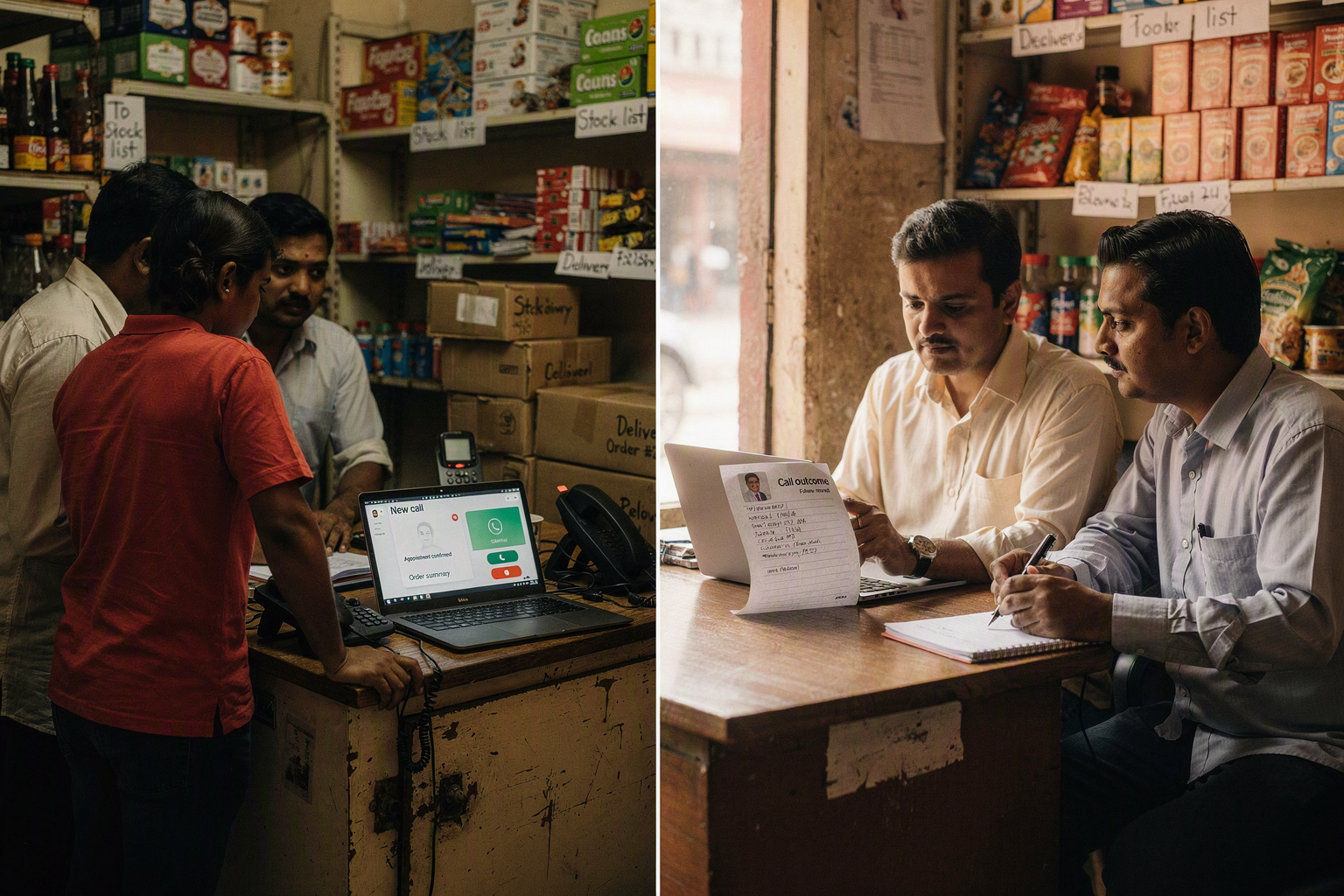
Owners should expect more calls handled, faster lead qualification and more consistent follow-up—but not automatic cost savings or perfect resolution. The main deployment risks are incorrect answers, uneven performance across languages, privacy failures and customers becoming trapped in automation.
Measure outcomes, not call volume
A multilingual AI voice agent India deployment creates value when it completes useful work: booking appointments, answering order questions, qualifying leads or routing callers correctly. Simply reporting that the agent “handled” thousands of calls can hide repeat calls and unresolved cases.
Compare a four-to-eight-week pilot with the previous human-only baseline:
- Task-completion rate: Percentage of calls in which the requested action was completed and recorded correctly.
- First-contact resolution: Percentage resolved without a repeat call or later staff intervention.
- Qualified-lead rate: Leads meeting the business’s documented criteria—not every caller who spoke to the agent.
- Escalation accuracy: Whether payment disputes, complaints and low-confidence conversations reached the right employee.
- Cost per completed task: Total telephony, model, integration and monitoring costs divided by verified completions.
- Customer effort: Repetitions, transfers, abandoned calls and time needed to reach a human.
Segment every metric by English, Hindi, Hinglish and each supported regional language. An acceptable aggregate score can conceal a poorly performing Marathi or Tamil route.
Expect operational gains—with new failure modes
A well-designed Hindi voice bot can answer routine enquiries outside business hours, reduce queue pressure and capture structured information directly in a CRM. A Hinglish AI agent can also make automation accessible to callers who do not naturally stay within one language.
However, owners should plan for five material risks:
- Confident misinformation: The agent may invent a price, appointment slot, policy or refund commitment. Retrieve answers from approved records and require confirmation before consequential actions.
- Language-quality gaps: Code-switching, names, addresses and regional numerals can produce incorrect transcripts even when the conversation sounds fluent.
- False containment: A caller may hang up without resolution, while the dashboard records no escalation. Treat abandonment after repetition or error as a failure.
- Service dependency: Model, telephony, CRM or internet outages can interrupt the complete workflow. Maintain failover routing and a manual queue.
- Fraud and impersonation: Attackers may test account details or manipulate an agent into revealing information. Never authenticate customers using caller ID alone.
Privacy, consent and reputational exposure
Voice recordings, transcripts and phone numbers may constitute digital personal data. India’s Digital Personal Data Protection Act, 2023, which received presidential assent on 11 August 2023, requires organisations to use personal data for a lawful purpose and provide appropriate notice and safeguards.
Before recording, state that the customer is speaking with an automated agent, explain whether the call is recorded and offer a practical alternative. Owners should also define:
- What data is collected and why
- How long recordings and transcripts are retained
- Which vendors or employees can access them
- How deletion, correction and consent withdrawal requests are handled
- Which actions always require human approval
Use explicit stop conditions
Deployment should pause or roll back when complaints rise, repeat-call rates worsen, language-specific completion falls, or sensitive actions occur without valid confirmation. Review random call samples alongside dashboards because averages rarely reveal misleading wording or disrespectful pronunciation.
The safest operating model is gradual: expand only after each language and use case meets documented quality, consent and escalation thresholds. AI should absorb predictable work while employees retain authority over exceptions, disputes and trust-sensitive decisions.
What do voice AI, language and compliance experts recommend checking?
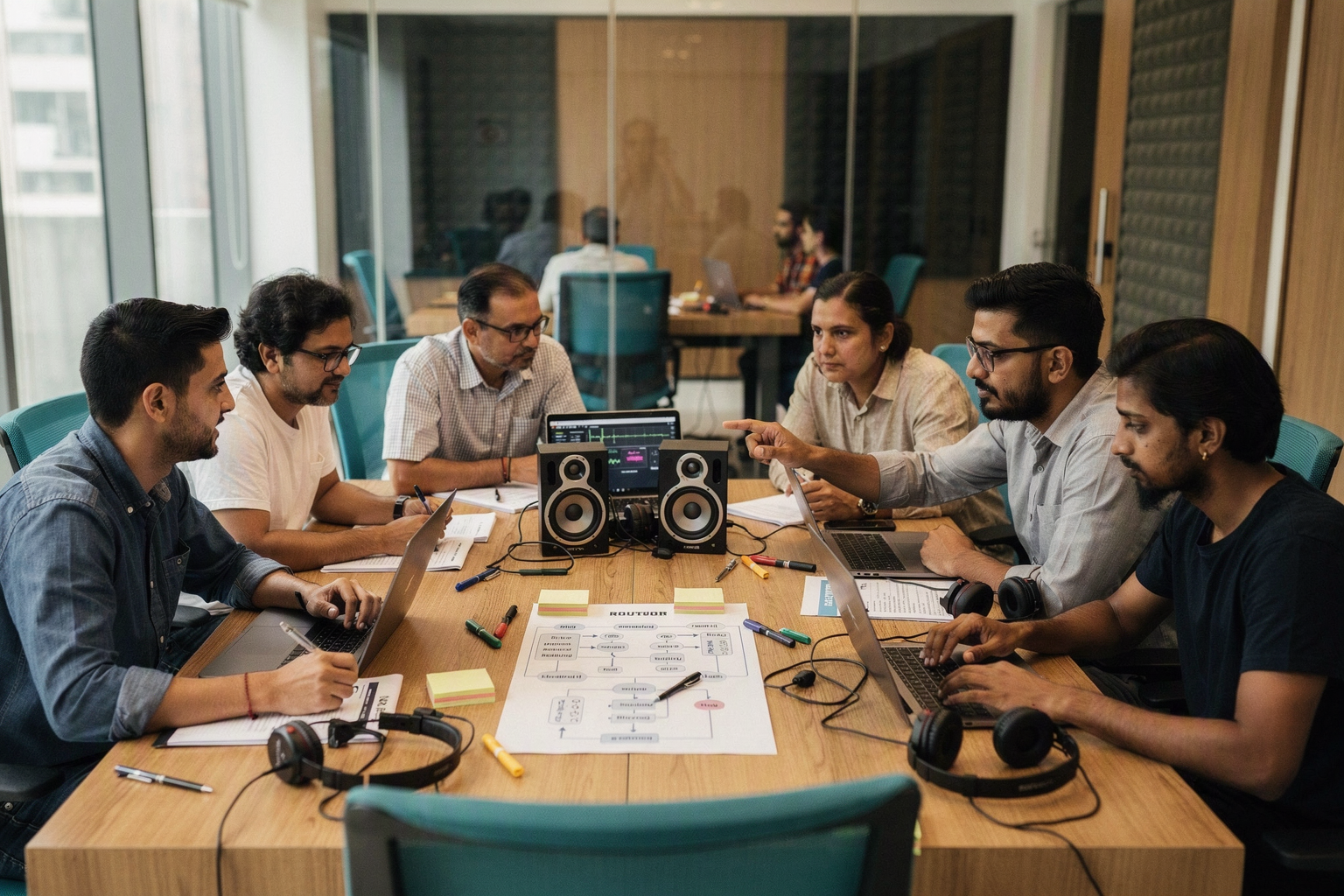
Before approving a multilingual voice agent, have speech-AI, language and compliance specialists review it separately. Each reviewer should produce measurable evidence—not simply confirm that a demo sounds fluent—covering recognition, pronunciation, task completion, data handling and safe escalation.
Speech-AI checks: measure real calls, not studio audio
A speech expert should test the complete pipeline: telephony audio, speech-to-text, language identification, reasoning, text-to-speech and interruption handling. One overall accuracy figure can conceal serious failures in particular languages or call conditions.
Request results segmented by:
- English, Hindi, Hinglish and every supported regional language
- Mobile networks, speakerphone, traffic noise and low-volume speech
- Different ages, genders, districts and accents
- Dates, prices, phone numbers, PIN codes and alphanumeric order IDs
- Median and 95th-percentile latency, including the time from the caller finishing to the first audible response
- Word error rate, intent accuracy, task completion and human-transfer rate
A vendor should also demonstrate barge-in behaviour. The agent must stop speaking when interrupted, preserve the caller’s latest intent and avoid interpreting its own synthesized voice as customer speech.
Language checks: examine meaning, code-switching and social context
A language reviewer should challenge a Hindi voice bot with natural speech rather than translated English scripts. A Hinglish AI agent should understand switches such as “delivery kal kar dena, but morning mein” without treating English words as a separate conversation.
The linguistic review should cover:
- Pronunciation dictionaries: Test customer names, neighbourhoods, brands, medicines, abbreviations and local place names.
- Respect and register: Verify appropriate use of “aap,” honorifics and gendered verb forms without making assumptions about the caller.
- Language routing: Confirm that the system distinguishes language preference from accent and lets callers explicitly change languages.
- Meaning preservation: Compare transcripts, extracted fields and final actions—not merely whether the voice sounds natural.
- Regional test design: The Office of the Registrar General & Census Commissioner’s latest completed national language tables remain from Census 2011, so businesses should supplement census data with current customer-call evidence when selecting languages.
For a multilingual AI voice agent India deployment, maintain a “golden” test set of anonymised, human-reviewed utterances. Add every consequential production failure to this set so future model or prompt updates cannot silently reintroduce it.
Compliance checks: prove consent and control
A privacy or legal reviewer should map every data field from collection through deletion. Under India’s Digital Personal Data Protection Act, 2023, consent must be “free, specific, informed, unconditional and unambiguous” and expressed through a clear affirmative action. The Act also requires withdrawal of consent to be as easy as giving it.
Before launch, verify:
- The agent identifies itself as automated and states when calls are recorded or transcribed.
- Recording, analytics and marketing permissions are separated where appropriate.
- Notices are available in clear language accessible to the intended audience.
- Retention periods, deletion workflows, processor access and cross-border data flows are documented.
- Outbound campaigns comply with applicable Telecom Regulatory Authority of India commercial-communication requirements.
- Sensitive requests, disputes and consent withdrawal trigger a reliable human escalation path.
The final approval packet should contain test recordings, language-level scorecards, latency distributions, consent scripts, data-flow diagrams and named owners for incidents. Experts should sign off on evidence from production-like conditions—not presentation-quality demos.
What does this mean for your business at each deployment stage? (TABLE)
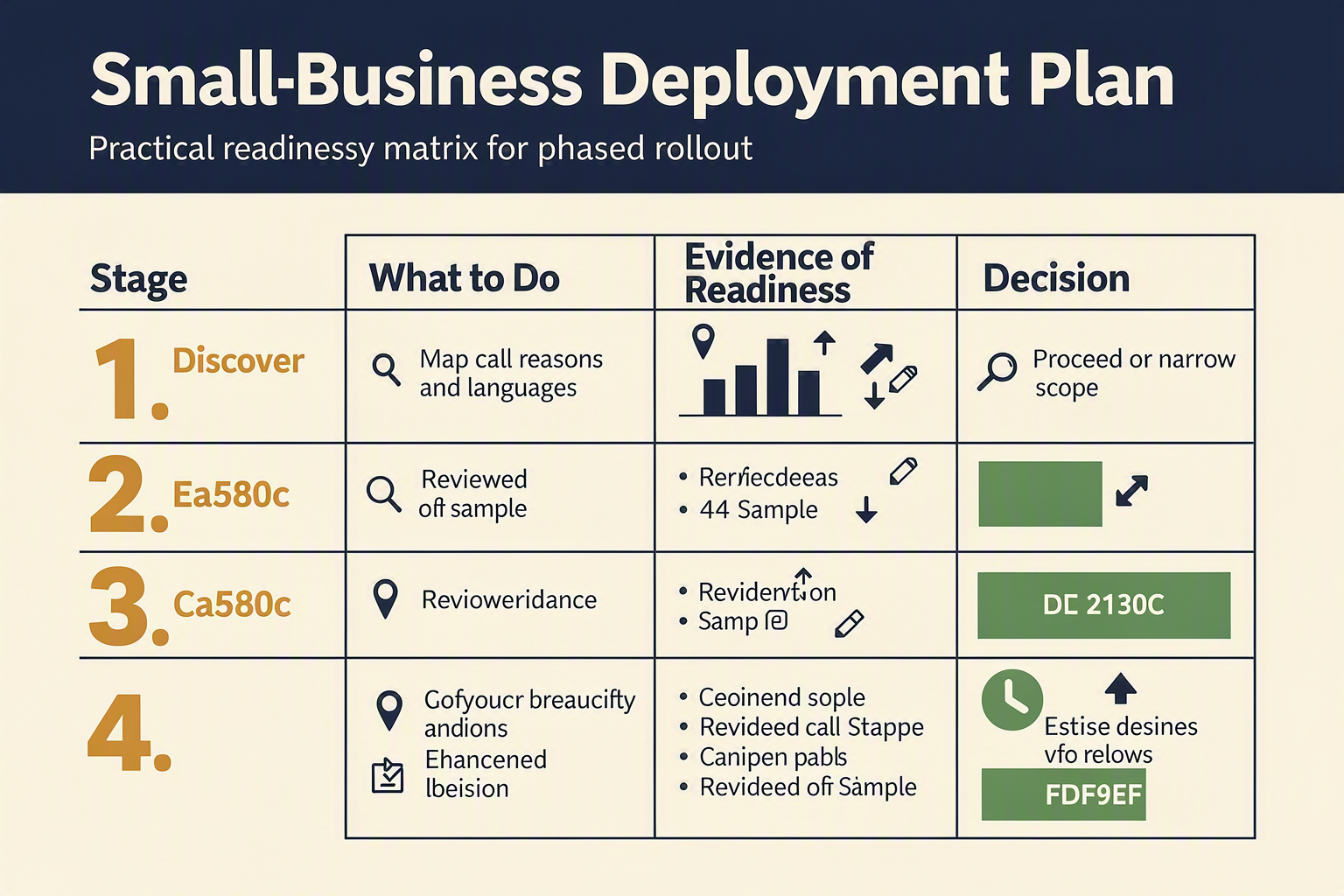
A multilingual voice rollout should progress from language discovery to a controlled pilot, limited production and measured expansion. At each stage, the business should unlock more automation only after the agent meets defined thresholds for task completion, latency, consent, routing and human recovery.
Stage-by-stage deployment plan
| Deployment stage | Business priority | Key actions | Evidence required to advance |
|---|---|---|---|
| 1. Discover | Identify real language demand | Review call recordings, CRM notes and service locations; classify English, Hindi, Hinglish and regional-language usage; list sensitive intents | At least 2–4 weeks of representative call data; top intents and language combinations documented |
| 2. Prototype | Prove conversation quality | Build one high-volume flow; test names, addresses, numerals, code-switching, interruptions and pronunciation | Suggested target: at least 90% intent recognition on a curated test set, with every failed utterance labelled |
| 3. Controlled pilot | Validate performance with real callers | Route a small share of calls to the agent; disclose automation; capture recording consent; keep human transfer available | Suggested target: 80%+ task completion for the selected intent, low repeat rates and no unresolved high-risk calls |
| 4. Limited production | Connect operations safely | Integrate calendars, CRM or order systems; add WhatsApp confirmations; monitor latency and transfer context | Successful transactions verified against source systems; WhatsApp opt-in recorded; transfer summaries reach staff reliably |
| 5. Language expansion | Add regional coverage | Introduce languages by demand, not geography alone; recruit native-speaker testers; tune local names and vocabulary | Each new language passes the same regression suite, including mixed-language and noisy-call tests |
| 6. Optimise and govern | Improve value without weakening safeguards | Review transcripts, consent logs, escalation outcomes, cost per completed task and model changes | Monthly scorecard, versioned test results, incident owner and rollback process in place |
The Internet and Mobile Association of India and Kantar reported in January 2025 that 98% of Indian internet users accessed Indic-language content in 2024. For a small business, that figure supports language expansion—but it does not mean launching every available language on day one.
What to measure at every gate
Use business outcomes rather than “calls answered” as the primary measure:
- Task completion: Did the caller actually book, reschedule, obtain an order status or resolve the request?
- Language-routing accuracy: Did the system honour an explicit preference and recover when automatic detection was wrong?
- Code-switch recovery: Could the Hinglish AI agent retain intent when language changed within an utterance?
- End-to-end response time: Measure from the end of the caller’s speech to the start of audible speech, including speech recognition, model inference and text-to-speech.
- Escalation quality: Did the employee receive the caller’s language, consent status, intent and conversation summary?
- Consent compliance: Can the business prove what the caller accepted, when they accepted it and which channel the consent covered?
Match investment to operational maturity
A first Hindi voice bot should usually automate one repetitive, reversible workflow rather than payments, disputes or emergencies. Once the pilot demonstrates reliable completion and clean escalation, the same architecture can support English, Hinglish and demand-led regional routing.
For a multilingual AI voice agent India deployment, expansion should be a quality decision, not merely a model-availability decision. A language is production-ready only when native speakers have tested pronunciation, mixed-language speech, realistic network conditions and the complete journey from greeting to follow-up.
Frequently asked questions about multilingual AI voice agents in India
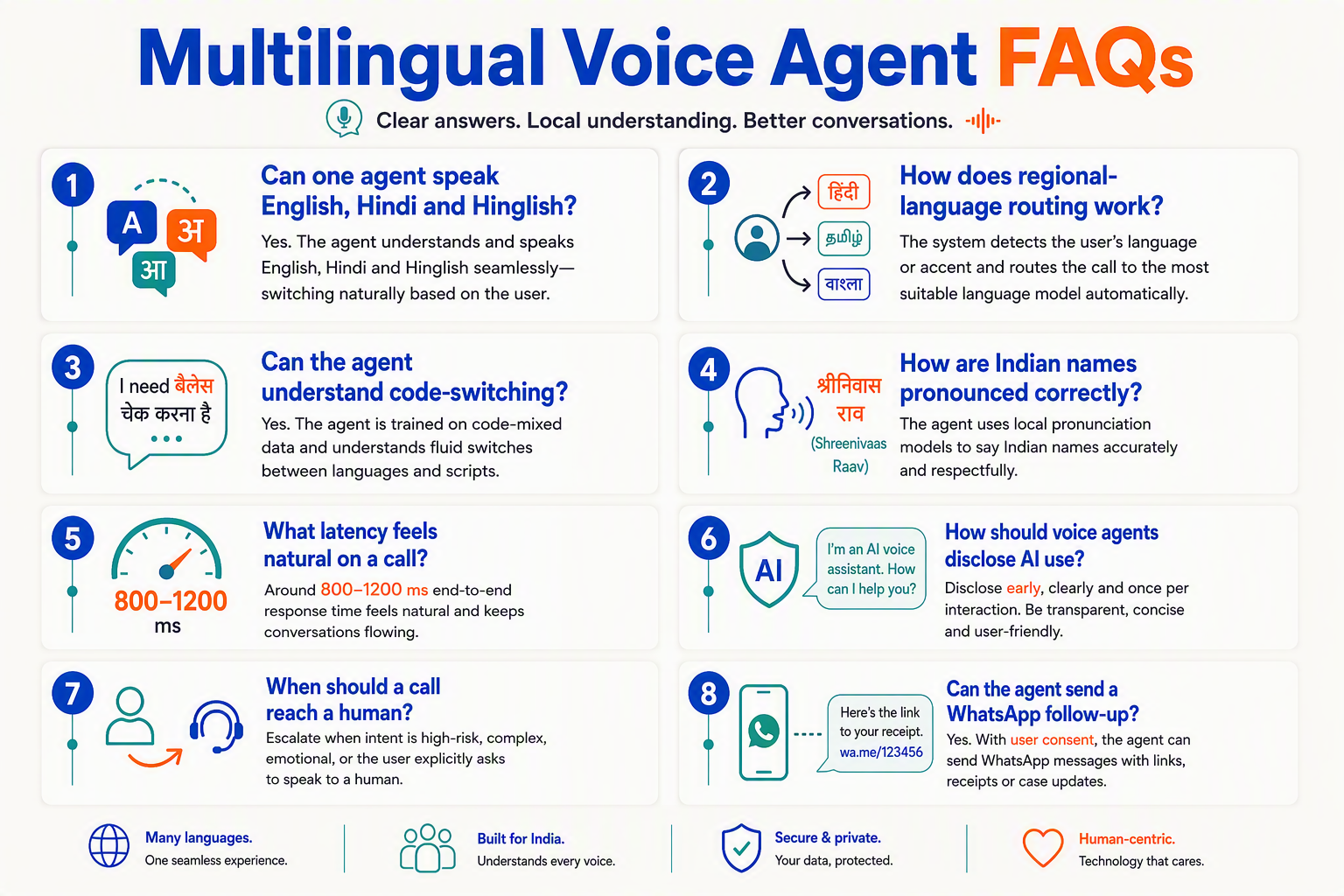
What is a multilingual AI voice agent India small businesses can use in 2026?
Can a Hindi voice bot understand Hinglish and code-switching?
How should a Hinglish AI agent choose between Hindi, English and regional languages?
What response latency is acceptable for an AI voice agent?
Does an AI voice agent need consent to record calls in India?
How do small businesses test multilingual AI voice agents before launch?
Conclusion
A successful multilingual AI voice agent India strategy in 2026 will depend less on scripted fluency and more on whether the system understands real customers, completes tasks reliably, and hands conversations to humans at the right moment.
- Design for natural speech: A Hindi voice bot should handle names, addresses, numerals, respectful phrasing, pronunciation, and regional accents—not merely translate English prompts.
- Support code-switching: A Hinglish AI agent must preserve intent when callers move between Hindi and English within the same sentence.
- Prioritise responsive routing: Confirm uncertain language choices, minimise latency, manage interruptions, and offer clear regional-language and human-escalation paths.
- Deploy responsibly: Test with real accents, devices, noise levels, and call conditions; disclose automation, capture consent, protect data, and use WhatsApp follow-up where appropriate.
The Internet and Mobile Association of India and Kantar reported in January 2025 that 98% of Indian internet users accessed Indic-language content in 2024. The same report counted 886 million active internet users, with 55% living in rural India, making multilingual capability commercially relevant rather than optional.
What to watch next is steady improvement in code-switching accuracy, pronunciation, latency, and language routing—but businesses should judge progress through task completion and customer experience. To explore this shift, visit CallMissed, which supports AI voice and chat across 22 Indian languages. Which customer journey should your business test multilingually first?
Related Reading
Discussion
Related Posts
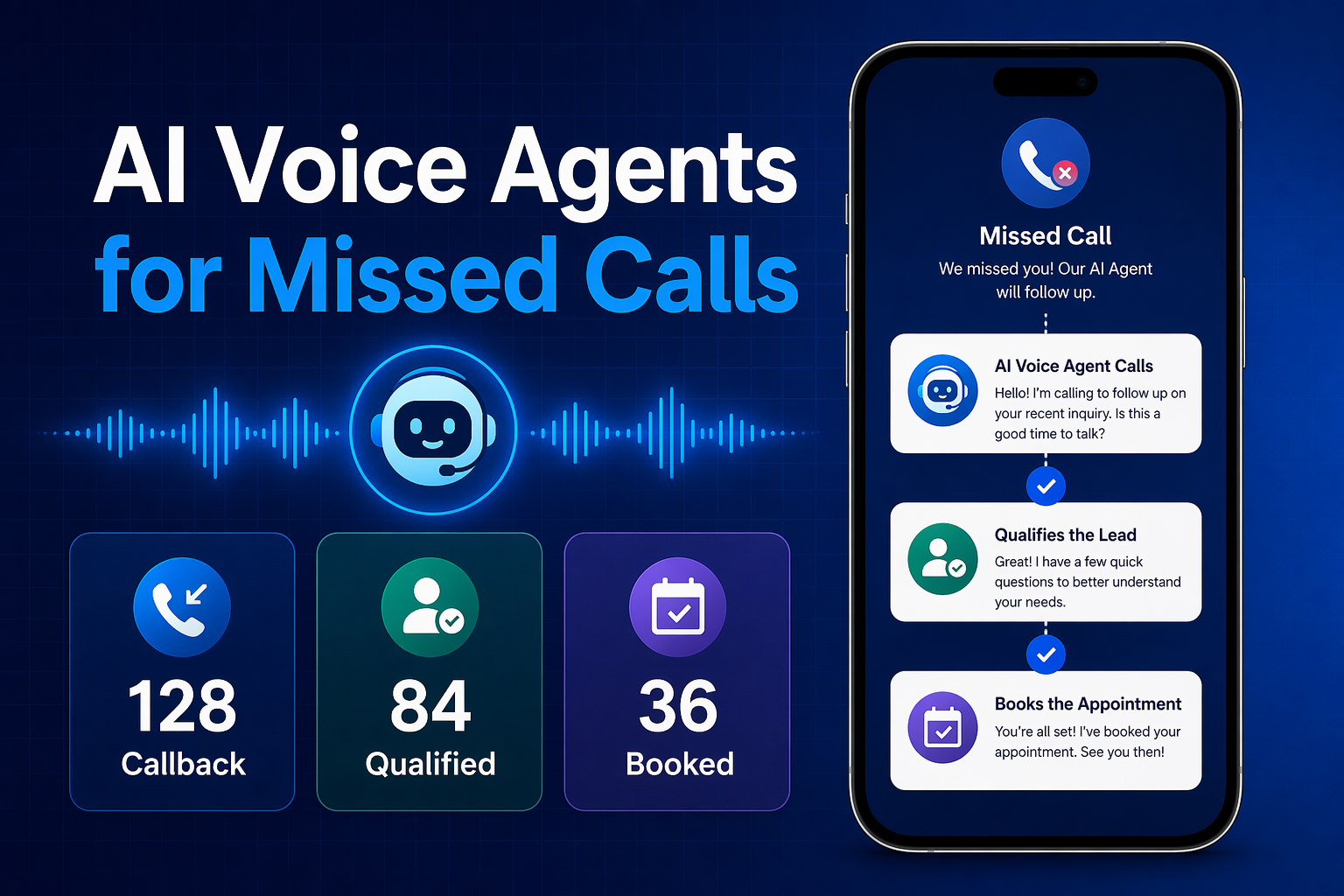
Ready to automate customer conversations?
Launch AI voice agents and WhatsApp bots with CallMissed — one API, 22+ Indian languages.